Nicholas Hedges

Art, Writing and Research

  • Amazon
  • Behance
  • Facebook
  • Instagram
  • Pinterest
  • YouTube
  • Art
    • Digital
    • Drawing
    • Grids
      • Correspondence
      • The Wall
      • The Tourist
    • Ink on paper
      • Shadow Calligraphy
    • Installation
      • Murder
      • Echo
    • Painting
    • Patterns
    • Mixed Media
    • Photographic installation
      • St. Giles Fair 1908
      • Cornmarket 1907
      • Headington Hill 1903
      • Queen Street 1897
    • Research/Sketches
    • Stitched Work
      • Missded 1
      • Missded 2
      • Missded 3
      • Missded 4
    • Text Work
  • Blogs
    • Family History
    • Goethean Observations
    • Grief
    • Light Slowed But Never Stilled
    • Lists
    • Present Empathy
    • Shadow Calligraphy
    • Trees
    • Time
    • Walking Meditations
  • Video
  • Photography
    • Pillars of Snow
    • Creatures
    • The Trees
    • Snow
    • St. Giles Fair 1908
    • Cornmarket 1907
    • Headington Hill 1903
    • Queen Street 1897
    • Travel
  • Illustration and Design
  • Music
  • Projects
    • Dissonance and Rhyme
    • Design for an Heirloom
    • Backdrops
    • Shadow Calligraphy
  • Exhibitions
    • A Line Drawn in Water
      • Artwork
    • A Line Drawn in Water (Blog)
    • Mine the Mountain 3
      • Artwork
    • Mine the Mountain 2
      • Artwork
      • The Wall
    • The Woods, Breathing
      • Artwork
    • Snow
      • Artwork
    • Echo
      • Artwork
    • Murder
      • Artwork
    • The Tourist
    • Dreamcatcher
    • Mine the Mountain
      • Artwork
      • The Tourist
    • M8
    • The Gate
    • Creatures
      • Artwork
    • Residue
      • Artwork
    • A visit to Auschwitz
      • Artwork
  • Me
    • Artist’s Statement

X

June 30, 2008 by Nicholas Hedges

It was whilst I was cycling home from the studio this morning that the idea first came to me. I was thinking about the two paintings on which I am currently working, both of which are based on the landscape around Hafodyrynys, Wales (the village in which my Grandmother grew up) and one of which I intend to show, veiled, at the Mine the Mountain exhibition in October.
The paintings themselves were going quite well, but remembering the original idea behind them, I realised that there was something missing. The original idea was that these paintings, or rather the final selected painting would be based on both the death of my great-great-uncle, Jonah Rogers who was killed in action in the Second Battle of Ypres on May 8th 1915 and my birthday, May 8th 1971. The title of the piece was provisionally May 8th, but as is often the case, the painting has led me away from this. That isn’t to say the subject has been lost completely; I still want to think about Jonah, but how do I show him in the painting? How do I show the ambiguity between existence and nonexistence/death?
The answer came as I thought about names and some of the documents I have obtained through researching my family tree. Almost without exception, none of my ancestors from Wales at this time could read or write and all of them signed their name (or rather, indicated their presence) with an ‘x’. The ‘x’ therefore becomes a sign of a presence, but one which is anonymous.

Of course the ‘x’ is usually accompanied by the line; ‘the mark of…’ (as above) but without that, the human becomes relegated to this nondescript, anonymous sign (one could argue of course that we are all, in our names, reduced to signs, but the ability to write allows us to transfer to the page – and therefore leave to posterity – much more than just the name by which we are known). The act of making that mark instead of writing one’s name is also very significant. It levels all those who make it; it renders everyone the same – at least in the eyes of history. One could say that the greatest leveller of all is death and that the ‘x’ becomes the mark of death; presence is defined by absence.

We know much of what happened in the past through the written word although there are of course many other sources in which it’s also revealed; paintings, artworks, newspaper stories, oral histories/stories, fingerprints, photographs and so on, but for the most part, we know about the past through what we read. I have written about the limits of the written word before in relation to the work I did on ‘The Gate’, but looking at it again in relation to these paintings and to my previous work/research, there is something very poignant about these anonymous signatures; I can’t help but think of the names we see on memorials, carved into walls and so on. Imagine if they simply read ‘x’… For many who died in the Great War and whose bodies were either never found, names have been lost and an ‘x’ is perhaps all one could write on their behalf.

In relation to the landscape, ‘x’ has different connotations; on maps it marks a spot – it denotes the presence of something, a thing which is present and yet absent – hidden away from sight and mind like buried treasure. Marking the canvas with an ‘x’ would give the painting the meaning I was looking for; the presence of someone absent; the reduction of everyone in time to complete obscurity. Furthermore, taking what I wrote in the paragraph above, ‘x’ marks the last resting place of all those (including my great-great-uncle) whose bodies were never found.

X

The paintings are still in the early stages but there was instantly something about the marks which appealed. In some respects I saw them (those in the sky) as angels which given the nature of the work seemed relevant. They also reminded me of the stars one sometimes finds painted on the ceilings of cathedrals or in mediaeval manuscripts. But those ‘on the ground’ called to mind something else, something which given Jonah Rogers’ fate gave the paintings another dimension; first the shape reminded me of the deckchairs I made for the Residue exhibition (The Smell of an English Summer 1916 (Fresh Cut Grass))..

The Smell of an English Summer 1916 (Fresh Cut Grass)

…and secondly, the x-shape defences one sees on wartime photographs such as those of the Normandy landings below…

Filed Under: Artist in Residence Tagged With: Artist in Residence, Hafodyrynys, Mine the Mountain, Residue, World War I, WWI, X

Real People

June 22, 2008 by Nicholas Hedges

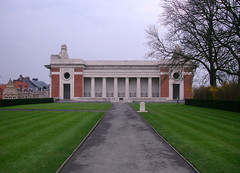
For about seven months now I have been researching my family tree through Ancestry.com and in that time I have been quite successful, tracing four lines (Hedges, Stevens, Jones and Sarjeant) back to the beginning of the nineteenth century and in some cases well beyond. I have exchanged emails with a second cousin in Canada (to whom I owe a great deal as regards his efforts with the Sarjeant tree), visited the graves of ancestors I never knew I had in Wales and, having visited the Menin Gate in Ypres a year ago, discovered that my great-great-uncle is commemorated upon it having been killed in the second battle of Ypres in 1915 (there may be a second great-great-uncle who died at the Somme, but until I receive his death certificate I cannot be certain). Having done all this and talked with both my 95 year old grandmothers about their respective childhoods, and having looked at various photographs, these people I have drawn from the past have come alive, but it was only at the end of last week, that the fact these were once real people became truly apparent.

The furthest I’ve gone back with the Stevens family is to a certain John Stevens, a tailor, who was born in Oxford around 1812. The Stevens side of the family (my maternal grandfather) came to Oxford in 1952 from Reading, so it was strange therefore to find that they’d originated in the twon where I was born. He had six children by his wife Charlotte; John (1837), Samuel (1839), Elizabeth (1843), Rosetta (1844), Henry (1846) and finally, my great-great-grandfather, Jabez (1848). Having turned my attention recently to those to whom I am not directly descended, i.e. the siblings of great-grandparents and so on, I decided to look at the eldest sibling in this family, John.

Born in 1837, I traced him through the censuses and discovered that in 1857 he married Emma Fisher and with her had seven children; Emma (1859), William (1861), Henry (1863), Mary (1865), John (1867), Martha (1869) and Kate (1871). All of these I found listed on the 1871 census along with their mother, but, there was no mention of the father John. I looked ahead to 1881 and while I couldn’t find Emma, I found her children and her husband, and it was here in this document that the whole tree assumed a much more tangible dimension. In 1881 John was listed as a Pauper Patient in the Berkshire County Moulsford Asylum (now Fair Mile Hospital). Why he was in there I couldn’t say, but next to his name was his trade ‘Tailor’ (the same as his father) and the word ‘lunatic’.

Suddenly, this man seemed more real than any of those I’d previously discovered; so for that matter did his wife and their children, after all, if he was in an asylum, what had become of them? I couldn’t find any mention of Emma, but some of his children had been separated; Henry and John were living with their Uncle Samuel, also a Tailor; Mary was living with her Aunt Rosetta, and sadly, Martha and Kate, the two youngest sisters, were inmates at the Reading and Wokingham District School (workhouse).
Turning back to the fate of their father, John, I tried to find him in the 1871 census, and eventually I discovered him; it seemed his misfortune had come much earlier for he was at this time an inmate at ‘Broadmoor Asylum for the criminally insane.’ I’ve no idea yet what he did but clearly it was serious. Reading about the asylum I read that those found ‘not guilty’ of serious crimes through their insanity were at the end of their sentences assessed, and if found to be unfit for release were sent to county asylums which seems to have been the case with John.

As regards his wife Emma, I have yet to find any trace of her in the 1881 census. It might be of course that she died in the 1870s but a search for the record of her death yields a more likely date of 1885; this will of course require more research. As regards John, I found reference to a John Stevens, born in 1837 who died in the district of Wallingford (in which Cholsey – the location of the Moulsford Asylum would fall) in 1885. No doubt he never recovered his sanity or his freedom.
As to the fate of their children, that will of course need further research.

Filed Under: Family History Tagged With: Family History, Family Stevens, Stevens

Henry Jones’ First Wife

June 17, 2008 by Nicholas Hedges

I have been looking to find the first wife of Henry Jones for a while now having got it wrong first time round, albeit getting her first name right. I had – for reasons I cannot recall – listed her as being Mary Carey, but have since discounted that having found no matching record for their marriage.
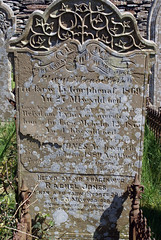
In May, we visited the graveyard in Cefn-y-Crib which some of my Welsh ancestors are buried, and there found the grave of Henry Jones, which we could see was also the grave of his second wife Rachel and his first wife Mary and daughter Lydia.

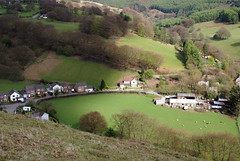
Hafodyrynys and Surrounds

The gravestone was a little damaged and the name of his first wife a little bit obscured, but one could nevertheless make out the name, Mari – the Welsh spelling of Mary. But what was her surname?
Having searched through the marriage indexes I came across a few possibilities that fitted in with the dates they would have been wed; Mary Lewis (1859), Mary Harris (1860) and Mary Issacs (1860). The last of these names rang a bell, and when I looked at the certificate for Henry’s marriage to his second wife Rachel, I saw the name Anne Isaac as being one of the witnesses.

Edmund Jones, the other witness, was the father of Rachel Jones (Jones was also her maiden name) and so I can only assume that both Henry’s parents were dead at the time. Of course, Isaac is not Isaacs but then spelling mistakes were made. Furthermore, when searching for Mary Issacs’ birth, I found only a few, all of whom would have been too young to have married Henry in 1860. Could the name have been wrong on the marriage index? Should it have been Isaac?

We know that she died in 1869 at the age of 27 and having searched for Mary Isaac in the birth records I found one Mary Isaac, born in the Pontypool district in 1843. But what of the other contenders; Mary Lewis and Mary Harris? There were a number of Mary Lewises born in 1842 (which one assumes is the correct year of birth), as indeed there were a number of Mary Harrises also born in 1842.

Filed Under: Family History Tagged With: Family History, Family Jones, Hafodyrynys, Jones, X

8th May – A Painting

June 16, 2008 by Nicholas Hedges

This is the second day of working on the painting which will be shown as part of my ‘Mine the Mountain‘ exhibition. The title, 8th May, alludes to both my date of birth and the date my great-great-uncle, Jonah Rogers, was killed in action at the Battle of Frezenberg Ridge (Second Battle of Ypres) in 1915.

8th May - Oil on Canvas: Day 02

When the painting is shown it will be veiled to represent the death of my ancestor. When the veil is lifted, the work will of course be changed to represent my own coming into being. Veiled, the scene is obfuscated, hidden from the deceased to prevent his getting lost on his way to the next life; when lifted, the scene is presented as I remember it, or know it.

Filed Under: Paintings Tagged With: Jonah Rogers, Mine the Mountain, Paintings

Rogers Conundrum II

May 12, 2008 by Nicholas Hedges

Following on from my previous post on this subject (see Rogers Conundrum) I obtained today a copy of my great-grandmother’s birth certificate.

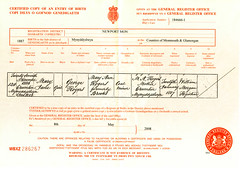
On the certificate, it clearly states that Mary Jane Rogers was born on 27th November, 1886 in Crumlin, Mynyddyslwyn; that her father was George Rogers and her motherMary Ann, formerly Brooks. Having Mary Ann’s maiden name is obviously a great help, but it just goes to show that censuses can be wrong.

Below is a detail of that census.

In this entry there are two errors; one the name of George’s spouse which should read Mary A and not Sarah A, and secondly the name of their daughter (my great-grandmother) Mary Jane which is given as Bessie J.

Filed Under: Family History Tagged With: Family History, Family Jones, Jones, Rogers

2nd Battalion Monmouthshire Regiment

May 9, 2008 by Nicholas Hedges

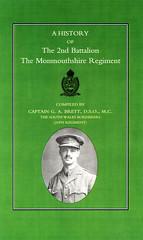
Having discovered that my great great-uncle, Jonah Rogers, was a Private in the 2nd Battalion of the Monmouthshire Regiment (he was killed in active service on May 8th 1915 and is commemorated on the Menin Gate) I began searching for anything which might tell me more about the place in which he fought and died. Fortunately, I happened upon a book which couldn’t be more useful; ‘A History of The 2nd Battalion The Monmouthshire Regiment’ compiled by Captain G.A. Brett, D.S.O., M.C. in the 1930s.

The 2nd Battalion Monmouthshire Regiment

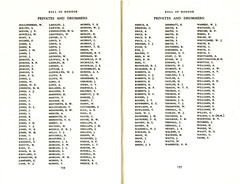
The first thing I wanted to do was be sure that this book covered the history relevant to Jonah, and in the back, in the Roll of Honour, I found him, ROGERS J., one amongst many other names.


In the book, the author relates in great detail information concerning the preparations for war and the route the Battalion took as it moved into the theatre of this terrible conflict. It seems that there were three units of the 2nd Battalion, the first formed from the outset of war in August 1914, with two and three following thereafter. I wondered to which unit Jonah had belonged. The following is a passage taken from the book:

“The 7th November, 1914, is an historic date for the and Monmouthshires, for early on the morning of that day the Battalion landed at Havre on active service. Over four long and terrible years were to drag their slow length before it would recross the narrow sea from France, and few of those who disembarked with it were fated to return with it. Its strength on landing was 30 Officers and 984 Other Ranks. Before it came home t8o Officers and 3,878 Other Ranks had passed through it. But they had earned for their Battalion a name for fighting and endurance of which their county, with all its old traditions of border pugnacity, could well be proud. While some of the officers came from other counties, a few indeed from the colonies and abroad, the vast majority of the men were from the mining valleys of Monmouthshire, every town, village and hamlet of which must at one time or another have been represented in the 2nd Battalion.”

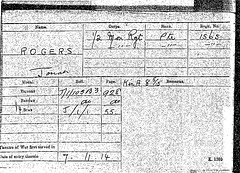
The key part of this passage is of course the date, 7th November, 1914, and having consulted Jonah’s medal records, I discovered ‘the date of entry therein’ corresponded exactly: 7-11-14.

Jonah Rogers Medals Record

The movements of Jonah Rogers and the 2nd Battalion can be listed as follows:
5th August 1914 – Orders to mobilise the Battalion.
6th August 1914 – 7.30pm. The Company entrained at Crumlin nearly 100 strong, en route for Pembroke Dock.
Evening of 7th August 1914 – The transport moved off and halting for the nights at Llanellen, Hereford, Ludlow and Church Stretton, completed the march to Oswestry on the afternoon of the 11th August 1914.
20th August 1914 – The Brigade moved to Northampton where the Welsh Division was concentrating.
Evening of 5th November 1914 – The Battalion embarked at Southampton on the ‘Manchester Importer’.
6th November 1914 – Arrived off Le Havre and anchored until night.
7th November 1914 – The Battalion landed in Havre.
8th November 1914 – Entrained, arrived at St. Omer, 10th November 1914.
18th/19th November 1914, passed fit by Inspector or Reserve Troops, marched to Bailleul, halting for the night at Hazebrouck and reaching Le Bizet the following day.
21st November 1914 – ‘C’ and ‘D’ company enter the trenches, relieved by ‘C’ and ‘D’ on the 23rd.
2nd December 1914 – 2nd Monmouthshires relieve the 2nd Essex, taking over a battalion frontage of eleven hundred yards of trenches.
Christmas Day 1914 – Informal Truce
January 1915 – Redistribution of troops. The forward company of the 2nd Monmouthshires, which was relieved every 2 days, held some cottages and some trenches behind Le Ghier Wood.
20th February 1915 to end of March 1915 – The Battalion relieved the 2nd Essex taking over the same frontage occupied in December.
2nd May 1915 – 2nd Monmouthshires experienced the heaviest shelling they had yet encountered. Later in the day, the enemy launched a fierce attack under cover of asphyxiating gas.
Night of 4th/5th May 1915 – The Battalion relieved the 5th South Lancashires about Weiltje. Another heavy gas attack, not followed up by infantry assault. The position included Mouse Trap Farm (known also to the British as Shell Trap Farm).
8th May 1915 – Battle of Frezenberg Ridge with desperate fighting ensuing for the following six days. Private Jonah Rogers was killed in action on the 8th May 1915.
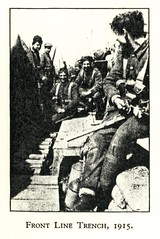
Although I have no photographs of Jonah, there is a photograph in the book showing a front-line trench in 1915. It’s impossible to say whether one of these men is Jonah, but what one can say is, he was no doubt just like them.

Trench 1915

The following is a map of positions occupied by the 2nd Monmouthshires during the 2nd Battle of Ypres. You can see (click on the image for large view) that on the day Jonah was killed, they were positioned in Shell Trap Farm.

Positions of 2nd Monmouthshires

Filed Under: Family History Tagged With: A Line Drawn In Water, Jonah Rogers, World War I, WWI

Memory and Iconoclasm

May 8, 2008 by Nicholas Hedges

I watched a programme the other night on the Iconoclasts and the destruction of English Religious Art during the 16th and 17th centuries. Seeing the sculptures with their faces hacked and limbs broken off, I couldn’t help but think how beautiful these images really were; paintings with faces rubbed away, headless sculptures surrounding effigies and so on. There is a beauty in the destruction, a marker of man’s presence which is, distrurbingly perhaps, more palpable than any sculpture could ever be. Perhaps it is the mark of the common, ordinary man as opposed to the rare being which makes these destroyed images so imminent. It takes little to smash; quite the opposite to create. Or perhaps the rough hewn cuts, cleaving the stone are evidence of a moment; a moment in time which through its violence is as immediate as a haiku. 300 years can pass in the few seconds it takes to read one. 300 years can pass in the second it takes to see the mark of an axe.

As I thought about what I’d seen – the whitewashed walls and the triumph of words over imagery, I couldn’t help but see memory in much the same light. As soon as the outside world enters through our eyes, memory sets to work with its own hammers and chisels, striking out and smashing the retained image to pieces. And even though our memories – like the sculptures and paintings vandalised during the Reformation – are vague, they are nonetheless imminent windows which compress time as effortlessly as the axe and the haiku.

Filed Under: Uncategorized Tagged With: Iconoclasm, Memory

Rogers Conundrum

May 5, 2008 by Nicholas Hedges

Having made the recent trip to Wales, I decided to try and get a bit further with a line on my family tree – that of my grandmother’s mother’s parents. My grandmother’s maternal grandparents were George and Mary Ann Rogers.

In my family tree I have them and their children listed as follows:
George Rogers (1864-1944)
Mary Ann Rogers (1864-1941)
Alfred John Rogers (1886-1954)
Mary Jane Rogers (1887-1969)
William George Rogers (1887-1897)
Ruth Rogers (1890-1925)
Evan Rogers (1892-?)
Jonah Rogers (1894-1915)
Enoch Rogers (1896-?)
George Rogers (1898-1916)

Although these dates aren’t all 100% accurate, they are for the most part within a year or two. I discovered them through a combination of the 1901 Welsh Census and a visit to the churchyard at Cefn-y-Crib, but what I want to know now is the maiden name of Mary Ann Rogers which I began to look for by searching for details of her marriage to George, narrowing my range between 1880 and the date of their first born. However, having located several possible entries for George Rogers I found that none of them tallied with anyone called Mary Ann; in fact, I could find no evidence at all for their marriage within this range.

I began to wonder whether (as was the case with my great great-grandfather Henry Jones) George Rogers was married twice. Perhaps this was the reason I could not find the dates I expected. I therefore noted down all the references for George Rogers and looked up all the female names which correlated. There were a fair few names one of which stood out as the most likely. This was a lady called Sarah Hiley who was married in Pontypool in the second quarter of 1885 to one of two possible grooms, one of which was a George Rogers. Given that his first child was born in 1886, this date seemed to lend credence to this theory.

It was then as I looked through the Wales Census of 1891 that I found the following entry along with the ages of those listed:

George Rogers (28)
Sarah A Rogers (26)
Alfred J Rogers (7)
William G Rogers (4)
Bessie J Rogers (5)
Ruth Rogers (1)

What struck me was of course the names, all of whom (except for Bessie and William (who died in 1897)) I’d found in the 1901 census albeit with a different mother. But what about my great grandmother Mary Jane? Having run through a number of permutations as to what might have caused her to be missing in the 1891 census (a search for her name revealed nothing) I suddenly realised that Bessie J Rogers, born around 1886 must be her; they were one and the same person.

George Rogers I believe was once married to a woman called Sarah and by 1891 they’d had four children together. By 1901, Sarah was, one presumes, dead, and George had married Mary Ann. Whether the other children were hers or Sarah’s I don’t know at this point. I decided to look for an entry for their marriage and eventually I found a possible wedding between a George Rogers and a Mary Ann Pritchard in the last quarter of 1894. What I haven’t been able to find however are any entries for Sarah Rogers’ death.

I have now ordered a wedding certificate for George Rogers and Sarah Hiley (if indeed they were married) and a birth certificate for my great grandmother Mary Jane. At least these should shed some light on what has become quite a mystery.

Filed Under: Family History Tagged With: Family History, Family Jones, Jones, Rogers

Hafodyrynys

May 5, 2008 by Nicholas Hedges

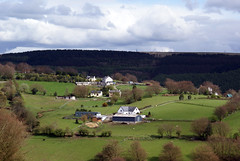
A few months ago when I interviewed my Grandmother about her childhood, she talked about the mountain around which she’d grown up in the village of Hafodyrynys, South Wales, not far from Pontypool. Her words about this mountain, which is in fact more of a hill, were very moving, for it was on this hill she played as a child and where she would watch her father as he walked to work in the mine at Llanhilleth. Below is part of that conversation:

“I can see him now because he went up our garden over the road and the mountain started from there up… and he’d go so far up and he’d turn back and wave to us, and if we went out to play, our Mam would say, “you can go up the mountain to play…” but every now and then our Mam would come out in the garden and we had to wave to her to know that we were alright you know… always remember going up the mountain…”

One of my main objectives for visiting Hafodyrynys was to see this mountain and to walk from the back of my Grandmother’s old garden in Rectory Road, up the side of the mountain, and to turn and look down at the house, just as her father had done on his way to the mines, and as she had done when playing. Another objective was to visit the graveyard in which a number of my ancestors are buried. Among those I wanted to find were:

Elias Jones (1882-1929)
Great-Grandfather

Mary Jane Rogers (1887-1969)
Great-Grandmother

Henry Jones (1839-1889)
Great Great-Grandfather

Rachel Jones (1853-1916)
Great Great-Grandmother

Mary Carey (1843-1869)
First wife of Henry Jones

George Rogers (1864-1944)
Great Great-Grandfather

Mary Ann Rogers (1864-1941)
Great Great-Grandmother

As well as being places where one can remember the dead, graves are also important evidence for the genealogist, and as I was to find out in the churchyard at Cefn-y-Crib (a small village between Hafodyrynys and Pantygasseg), the graves of my ancestors both confirmed my research as regards certain individuals, and opened up a new avenue of investigation, which, given my interest in World War One battlefields was to prove particularly interesting.

After visiting the ruins of Raglan Castle, we made our way towards Hafodyrynys and having taken a back road came first to Pantygasseg, a village I knew through my research as being the place where my Great-Uncle amongst many others had worked as a miner. Looking at the census records for the area, almost every man was employed in the mines. The village (which is no more than a single street with houses on one side) also interested me as regards the meaning behind its name, which in Welsh means, ‘hollow in the mare’s back’. This description derives from the shape of the mountain as it appears on the horizon and having researched the theme of ‘distance’ some time ago for an art project, I found it interesting that the village got its name from how it was seen from afar. Pantygasseg is so named through its being a part of (or identified with) the distance.

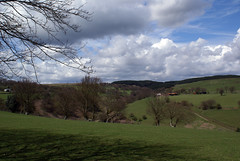
Hafodyrynys and Surrounds

Standing in Pantygasseg and looking at the surrounding hills therefore, I got the sensation that I had become a part of that distance, or that I was at least closer to it than I had ever been. I was reminded at this point of a quote from Rainer Maria Rilke’s ‘The Notebooks of Malte Laurids Brigge’ where he writes:

“Is it possible that one believed it necessary to retrieve what happened before one was born? Is it possible that one would have to remind every individual that he is indeed sprung from all who have gone before, has known this therefore and should not let himself be persuaded by others who knew otherwise?”

In Pantygasseg, I was indeed ‘retrieving’ the past and reminding myself that I was not only sprung from all who have gone before, but that I was also sprung from this very place.

Hafodyrynys and Surrounds

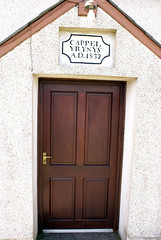
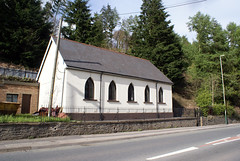
Just a few minutes down the narrow road from Pantygasseg, we arrived at the churchyard in Cefn-y-Crib (looking through a Welsh dictionary, I’ve tried to get an idea as to what it might mean, and ‘back of the ridge’ is my best guess thus far). According to my Grandmother , the Cefn was regarded (at least by her mother) as a rather rough place, but it was here that a number of my ancestors were buried in the small churchyard of the ‘Cappel Yr Ynys,’ a Congregational Church built according to the plaque above the door in 1832 (I’ve since discovered that a number of my ancestors also lived here).

Hafodyrynys and Surrounds

It was also to this church that my Grandmother came as a child and so for many reasons it was quite an emotional visit for me and my Dad, who, at each stage of the journey (which was indeed something akin to a pilgrimage) phoned my Grandmother to tell her where we were. The knowledge that we were standing at her parents’ graveside brought tears to her eyes and memories back which she could only know and there was something about this relaying of the journey back to her which was particularly engaging. I knew she’d be sitting in her chair back home and couldn’t help but imagine what she was thinking, what she was remembering about those places in which we were now standing of which I at least had no memory; it was as if we were walking within her memories.

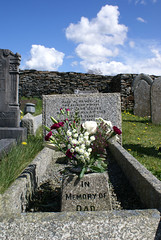
My Grandmother had given us some flowers to put on the grave of her parents, and this, along with the grave of her mother’s parents were the only ones for sure that we knew of.

Hafodyrynys and Surrounds

I’d been struggling to find the date of my Great-Grandfather’s (Elias Jones’) death, but on the side of the grave he shares with his wife, I found it; September 2nd 1929. He was just 47 years of age and died as a result of the coal-dust he breathed in through his work in the mines. With the Rogers’ grave, I had the dates already, but it was poignant to stand next to them (just as it was with all the graves) and realise that the grave marked the end of the path of their lives; a path around this area and it surrounds, which if it had been any different at all would have meant my not being here. I could only stand there by their being in the first place; my coming into being had not only been shaped by them, but also by the shape of the landscape itself, that of which I was now a part.

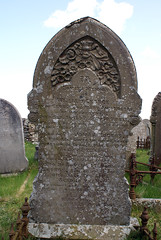
The next grave Monika found was that of my great great-grandfather, Henry Jones who died in 1889. Looking at the age at which he died and the date of birth I had for him in my family tree, I was relieved that I had indeed got the right man and below his name was – as expected – the name of his second wife – my great great-Grandmother Rachel, who died in 1916. But according to my research he’d been married before, to – if I was correct – Mary Carey, who’d died in 1869 aged 26.

Hafodyrynys and Surrounds

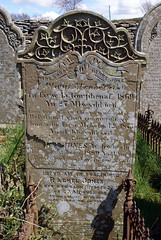
I looked around the graveyard for her grave but found nothing, and it wasn’t until we arrived home later and, again with the help of a Welsh dictionary, translated a few of the words on Henry and Rachel Jones’ grave, that we realised this stone had initially been cut for his first wife Mary. The words ‘Mari. Gwraig [wife] of Henry Jones,’ can be seen at the top along with the date of death (1869) and the age 27 (I’ve since adjusted her date of birth by one year). Also, listed below Mary, is a daughter, Lydia, who died in 1873 at the age of just 4 years. This would put her date of birth at around 1869, the same year as Jacob and the same year as Mary’s death; could it be that Jacob and Lydia were twins and that Mary died in childbirth?

The next gravestone which was to prove particularly interesting was one which began:

Hafodyrynys and Surrounds

“In loving memory of William George, son of George and Mary Ann Rogers, of Hafodyrynys, Died Sep. 3rd 1897, Aged 10 years.”

George and Mary Ann Rogers are my great great-grandparents. I hadn’t got William George listed amongst their children, but I had got the man named beneath, Jonah Rogers. I knew that he had been killed in the First World War, but was intrigued to find on the grave his rank and his regiment as well as the date and location of his death. Again, once home, I looked up his details on the website of the Commonwealth War Graves Commission and found that he’d been killed in Ypres and that his name was on the Menin Gate, places which Monika and I had visited last year and my Dad the year before. Not only that, but given the date of his death, I could trace him to the Battle of Frezenberg Ridge (8th – 13th May 1915), part of the Second Battle of Ypres.

Ieper

The man below, George, I also had listed. Ruth Hall, who is listed at the bottom of the gravestone I’m
assuming is my great great-aunt Ruth Rogers, the daughter of George and Mary Ann who was born in 1890 and died on April 5th 1925 aged 35 years.

Working on one’s family tree, one is of course deluged with lists of names of both people and places, and it’s only when you stand at the graves of those you have found in the surrounds they knew so well in life, that you can begin to make a real connection, and this connection, in this small churchyard was extremely powerful.

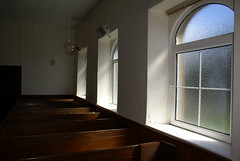
May 1st, the day of our visit, was election day and the annexe attached to the church was being used as a polling station. Having asked whether we might be allowed a look inside the church we were told we’d be welcome to pay a quick visit, and as we stood inside the small chapel, it felt strange to think that as a child my Grandmother had once sat in the pews facing where we were standing. Perhaps all of my forebears buried in the churchyard had once occupied these pews; given the date of the church’s foundation it didn’t seem unlikely. The bible which rested next to the pulpit looked as if it might have been there since that time, and I couldn’t help but imagine the minister reading from its pages as my ancestors listened.

Hafodyrynys and Surrounds

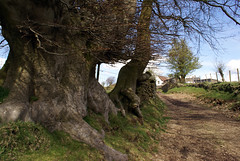
Having left the churchyard, we made our way down into Hafodyrynys, admiring as we drove the scenery and the trees which lined the road. There was something about the trees which particularly fascinated me, they didn’t seem to grow so much as writhe, twisting around themselves, confounding themselves with the fact of their own existence.

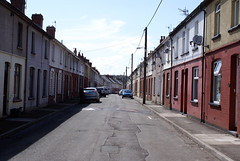
Once in Hafodyrynys, we parked the car and made our way towards Rectory Road, the street in which my Grandmother was born, and of which she’d spoken so fondly when we talked a while ago. Having stopped to ask a resident where we might find it (a man who said he knew my Grandmother) we eventually found the rather nondescript row of houses which looked to me as if they’d seen better days.

Hafodyrynys and Surrounds

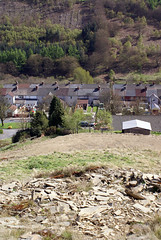
It wasn’t that they were neglected in anyway, but with satellite dishes on almost everyone, they seemed to all recall simpler times. Perhaps that was as much to do with what I recalled my Grandmother telling me, about how she would play on the ‘mountain’ behind her garden and how her father had walked over it on his way to work in Llanhilleth.

Hafodyrynys and Surrounds

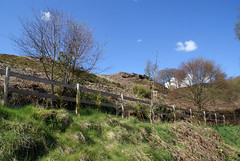
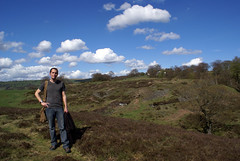
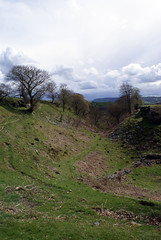
Having found the house in which she’d been born, we walked up an alleyway just a few doors down and made our way to the mountain. I wanted to walk up it and look back down on her garden, imagining my great-grandfather, looking down on his family and my Grandmother looking and waving at her mother as she played. And having walked to the top I did just that, taking in the view of the beautiful countryside, taking in the shape of the landscape which had in the way it shaped the paths of my ancestors served in part to bring about my own ‘coming into being’.

Hafodyrynys and Surrounds

I also reflected on Jonah Rogers, my great great-uncle, and thought about the misery he’d endured in Ypres and the horrors he must had seen, contrasting them with the view from the mountain, the view he must have known so well and dreamt about in all the mud and nightmare of Flanders. Having been in Ypres last year and now standing in Hafodyrynys, I couldn’t help but feel I had fulfilled a dream of his, to leave Ypres and see his home again.

Hafodyrynys and Surrounds

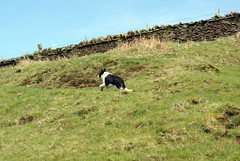
Having followed the directions of a man we’d met on the side of the mountain, we found ourselves not so much lost, as uncertain of where we should be heading. We walked through the second of two gates on a farm which we’d been told to pass through and found ourselves suddenly in the company of a very young border-collie who came bounding down to meet us before heading off again in the direction of the farmer who was at that point having a rest somewhere up a track which rose to our right.

Hafodyrynys and Surrounds

Hafodyrynys and Surrounds
Unsure as to whether we should take this track or that straight ahead of us, we too made our way up to the farmer who proceeded to take us on a tour of his farm. And so, in the company of him and his two dogs, we saw his fields, his sheep and were given some historical and geographical information pertaining to the area which lay all around us. It was as if for a few moments he were the voice young Jonah’s consciousness, recalling to himself all the familiar place names as he sat amongst those that were unfamiliar, colouring in the lush green fields where he could see only mud, and remembering the trees where in his nightmare all the trees had been gunned down, like soldiers shot at dawn.

Hafodyrynys and Surrounds

In amongst the hills and the patchwork of fields, the farmer told us the names of the various hamlets and villages; Penwaen, Pen-Twyn, Glandwr, but the most interesting thing for me (even more than the fact a walking stick made from a Holly Tree will make your hand turn black) was the stile which the farmer told us had not changed in his lifetime. It might not sound an exceptional fact, but it was interesting in that to me, looking at it for the first time, it was just an old, ramshackle stile, but for the farmer it was an abundant source of memories; memories one assumes about people he recalls from his childhood up to the present day, people who had since passed away, who once walked the road we were walking. It served to remind me of how the shape of the places in which we live serve to shape our lives as well as those who come after us, how the most insignificant thing in the world can harbour the most significant memories; and stiles of course help us on our way, it helps us cross a threshold – a theme which recently I have thought about a great deal.

Hafodyrynys and Surrounds

Having left the farmer and made our way back to the car, we visited another of my Grandmother ‘s churches, one in which my great Grandmother Mary Ann Rogers was a preacher (she was also the town midwife). Following this we made our way home back to Oxford, following the footsteps of my Grandmother and her family, who followed her to Oxford in the 1930s, leaving the Valleys so her brother George would not have to work down the mines. From Pantygasseg, to Llanhilleth, even on the farmer’s land, there was abundant evidence of mining, and one was reminded of the strange duality inherent in this beautiful landscape; the threshold between light and dark, play and the harsh reality of hard, dangerous, often fatal work.

Hafodyrynys and Surrounds

Back in Oxford I looked again at my family tree and though I can’t put faces to most of those at whose graves we’d stood that day, I can at least, and more importantly, put them in their landscape, and, furthermore, by walking in that landscape, put myself not only in their shoes, but somehow in their memories.

Hafodyrynys and Surrounds

Filed Under: Family History, Trees Tagged With: Family History, Family Jones, Hafodyrynys, Jones

Pilgrims of the Wild

April 30, 2008 by Nicholas Hedges

Whilst reading the Warsaw Diary of Adam Czerniakow (edited by Raul Hilberg, Stanislaw Staron and Josef Kermisz) I came across the following two entries:

“December 26, 1939- Wawrzecki’s death, no sleep all night. Disturbing thoughts about the new gzajrach in January (emigration) and about the complaints of ill treatment which I have no power to remedy. At night I read a lot, constantly envying all the heroes of my novels because they lived in different times. I am about ready to go to the Community offices. Walking down the staircase I notice on the doors of the second-floor apartments that visiting cards, naturally ‘Aryan,’ now serve as amulets. A special charge for delivering coal [to wearers of] the armbands. Deianira’s coat. Jugs of cherry brandy. A. Rotwand, Wasong (Christians of Jewish descent). It is reported to me in the evening that one of the workers from the Labor Battalion has been arrested (a section leader?). Later Mrs. Rotstadt about her husband. I will be going to the Gestapo in this matter tomorrow morning. Pawel was robbed.”

“January 19, 1940- The community in the morning. Families of the arrested. A meeting of the Council. I issued instructions. During the night I read a novel, ‘The Pilgrims of the Forest’ – Grey Owl – Szara Sowa. The forest, little wild animals – a vertiable Eden. Lichenbaum is told: ‘Sie wollen unsere Sachen nicht kaput machen‘.”

What I found so interesting and indeed poignant about these two entries was how Czerniakow had become envious of the fiction he was reading, how the escape afforded by a book (which is of course there for all who read) was almost too much to bear in light of the dreadful reality in which he lived. He wanted to escape, but the text of the book kept him out; I’m thinking here of the work I did on ‘The Gate – The Ordinary Language of Freedom‘, in which the text of history keeps us from seeing the reality of that which it describes. To paraphrase Elie Wiesel’s words (himself a Holocaust survivor) we can move ‘closer to the gate but not inside, because we can’t go inside, but that’s close enough.’ I can’t help see Czerniakow at such a gate, beyond which is the veritable Eden he found in ‘Pilgrims of the Forest.’ He too could move closer, but not inside.

This appalling reality which Czerniakow and the Jews faced at the time is well known – or at least, well documented, but what the diary reveals is how the Nazi machine ground down its victims over a long period of time; heaping upon them punitive laws and levels of bureaucracy which would have broken anyone. The fact that Czerniakow continued for as long as he did says a lot about the man he was. It also calls to mind thoughts I had on the Holocaust a while back in relation to a document discussed in Claude Lanzmann’s film Shoah (a document discussed by the editor of this book Raul Hilberg). You can read about Fahrplananordnung 587 here.

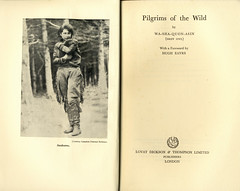
Returning to the book which Czerniakow was reading in January 1940 (which is actually titled Pilgrims of the Wild), I found a 1935 edition which I recently bought.

Pilgrims of the Wild

I’m not sure what I’ll do with the work, but to read the same words (I’m not sure whether he read the English or whether there was a Polish edition) about the freedom denied him and all those in the community, would I think be interesting and another way in to a very difficult subject.

Filed Under: Holocaust Tagged With: Adam Czerniakow, Claude Lanzmann, Holocaust, Pilgrim of the Wild, WWII

Verdun

April 30, 2008 by Nicholas Hedges

On 26th April I visited the battlefields and sites of Verdun. The name, like that of the Somme and Ypres, calls to mind visions of unimaginable horror; thousands upon thousands of men turned into names carved in monuments in towns throughout Europe, or lost completely, names and all, in the churned and pulverised fields. In my imagination, such places are always wet, cold, dark and desolate, as frozen in their appearance as they are fixed in old black and white photographs.

I won’t at this point discuss the battle’s history, suffice to say it’s a place in which around 500,000 men lost their lives, a figure which like so many grim statistics (I’m thinking here of my work on the Holocaust) is almost impossible to imagine (as much as it’s impossible to correlate). 26,000,000 shells rained upon the battlefield, six shells for every square metre. But difficult as these facts are to process, we must at least try.

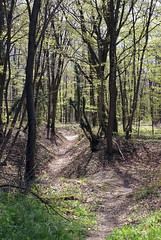
Having arrived in Verdun, we stopped the car at a track leading into a wood and no sooner had we started to walk amongst the trees than we became aware of the undulating ground; the shell craters and trenches, around and from within which this new wood had grown. At once we recalled the craters and trenches of Sanctuary Wood in Ypres, but the contrast between the two was clear; in Sanctuary Wood the trenches had been, at least, ‘over-preserved’ (some suggest they were dug for tourists after the war) but here they’d remained untouched since the end of hostilities. They were rounded and smoothed, and all the more powerful. At Sanctuary Wood, the whole place had the feel of a playground, whilst in this wood, the peace and quiet provided a stark counterpoint to the horrors of war.

Verdun

This counterpoint came in the birdsong and the colour of the sky, which on what was a glorious day was tinted by the brown of the trees and last year’s leaves filling the craters and trenches; a curious bruising as if a part of the dusk was somehow stained upon it. And between the carpet of leaves and the blue of the sky, was the green of this year’s growth; the whole scene a complete contrast to what the name, Verdun, had until now conjured in my mind. This place was simply beautiful.

Verdun

Save for a few tourists, we walked the woods alone, and yet, even then, the trees like those we’d encountered at other sites of trauma, seemed more than what they were. But whereas those which grow in Auschwitz-Birkenau and Belzec are strangely complicit in the events of the past, those in Verdun had grown from its wreckage; they did not hide what happened there. And stranger still was the sense that in this place Mankind was older than nature; Man had shaped the ground through his own destruction; he had made the void – the quagmire of mud – from which nature had risen, giving the trees a human quality, as if they carried with them the memory of all who fell – as if they were the fallen soldiers. And the resilience of Nature, it’s ability to rise from such appalling devastation, was one of the most striking aspects of our visit; despite the human feel of the trees, I realised how small humans are, even when they are made big through war. No matter what we do, Nature will in the course of time return. Long after we have finally gone, she will still be here, just as she was that day, in blue sky and birdsong, and as such, to walk through the woods was like being the last two people left on Earth.
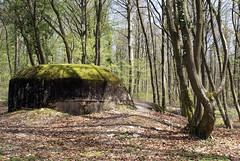
This scarred idyll was littered with other wartime detritus; the pillboxes within which men would hide, seeking out their fellow man beyond the apertures through which their guns were trained. They sat like concrete bells, still ringing with the war, like the ringing heard in silence, after exposure to something loud. (I am reminded here of the idea of sympathetic vibrations, where when a bell is struck, another bell across the room begins vibrating, giving off the same sound. These pillboxes which litter the landscape around Verdun, and which we saw in Ypres, seem to contain within their walls and deep impenetrable interiors, a sound which finds sympathy in all the others. I can imagine these vibrations ringing in sites all across the world, again long after man has gone.)

Verdun

Having recorded the sounds of the birds (and on playback I notice the insects – and I start to think of flies trapped in amber) we left the wood and made our way to Fort Vaux, the second to fall in the Battle of Verdun and a place I will return to later.

This persistence of Nature was nowhere more apparent than in one of the ruined villages which we visited towards the end of the day. There was nothing left of Fleury-devant-Douaumont save for the street names preserved on signposts along with signs indicating where there’d been a farm, the cafe, Town Hall and the workshop of a weaver.

Verdun

One of the interesting things about the numerous ruined villages is how they each have a Major, a post created to preserve the memory of the place as well as those who lived there. Like the woods, the landscape was blistered beneath the lush grass, undulating like immeasurably slow ripples following the impact of thousands of shells. It was pockmarked with craters some of which had filled with water to make ponds, beautiful beneath the dappled shade of the trees. Again, one had the feel of Man being older than Nature, with the new wood growing out of what remained of the village; despite the unimaginable numbers of shells which ploughed the soil, the sheer number of dead, the poison of the gas used in the battle, the ground had somehow made this beautiful landscape. And just as a corpse can tell us much about its demise through what nature has written upon it – the time of death for example – so the woods grown out from the corpse of the landscape speak of the time that has passed; and here is the curious enigma of the Great War. Despite the fact that almost a hundred years separates us, it doesn’t seem that long ago.

Verdun

Fort Vaux is a name synonymous with the suffering, endurance and the bravery of the soldiers who fought there. Even after the French were forced to surrender, the Germans presented arms as a mark of respect. The following is an extract from H.P. Willmott’s book on the First World War.

Verdun

“The German bombardment of the Fort began on June 1st 1916, at one point firing shells at the rate of 1,500 to 2,000 of the per hour. Inside were 600 troops under the command of Major Raynal. Just before dawn on the 2nd the barrage stopped and two German battalions moved forward. By mid-afternoon they had overwhelmed the defenders and occupied a large part of the superstructure. Raynal was determined to resist, and he and his men withdrew to the underground corridors where a grim battle was fought in the darkness with grenades and machine guns. On June 4th the Germans used flamethrowers in an attempt to drive the French out with asphyxiating black smoke…”
It’s a curious shell, a skull like structure cut into the rock which belies the horrors it has witnessed. Standing on top, one could see why it was so important, commanding spectacular views of the surrounding countryside and here, the contrast between the view of the tourist and that of the soldier becomes stark. What would they have seen from this same position? Hard to imagine that it was such a wasteland.

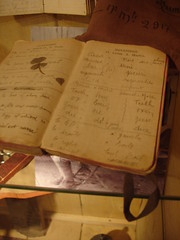
From Fort Vaux we made our way to the Memorial Museum and then to the Douaumont Ossuary. At the Museum, there was one object in particular which interested me, and that was a notebook containing handwritten translations of English words into French.

Verdun

The first line is the translation for Dead; Mort.

Verdun

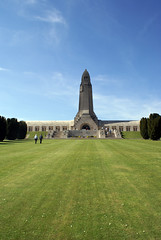
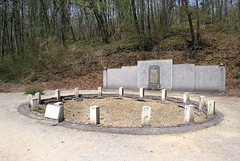
The structure of the ossuary is very much of its time and has the appearance of something which wouldn’t look out of place in Fritz Lang’s vision of the future, Metropolis. And this fact reminds us that it was just twenty years later when Europe and the world would be plunged into yet another catastrophe, indeed, during our journey around Verdun, we found evidence of this catastrophe in a memorial to 16 people killed in the second world war whose mutilated bodies were found dumped in a ditch which itself formed their memorial.

Verdun

From the top of the tower, one is again presented with spectacular views of the battlefields and again one can’t imagine what it would have looked like in those dark months of 1916. The tower itself houses the Victory Bell and the Lantern of the Dead which shines out over the battlefield.
Most of the structure is taken up by the 137 metre long cloister where each tomb shows a precise area of the battlefield from where the bodies were recovered. What one does notice – especially on a warm sunny day like that on which we visited – was how cold it is inside. One expects it to be colder given the thick stone walls, but there is something of an extra dimension to the chill, one is made all the more aware of being in the presence of the dead. And yet, this cold defines the living, it shows up our breath and for me, this was one of the most powerful aspects of the building.

Verdun

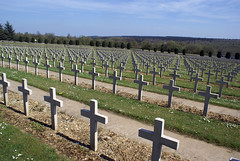
Outside the ossuary, through a row of small windows, one can see the bones of the 130,000 dead entombed within. Seeing the piles of leg bones, shoulder blades, vertebrae and skulls, one is reminded of the randomness of war, the arbitrariness of death on the battlefield. Like numbers and lists of names, it’s hard to imagine that these mountain of bones were once thousands of individuals, just as walking amongst the graves of the 15,000 men in front of the ossuary, one cannot imagine that many dead. Multiply that number, that space by thirty, see where it stretches out into the distance, and one begins to understand – in part – the horror of the war.

But one can never know what it was really like, and that to some extent is the point. Would we want to? We must do everything we can to never know. The inability to contemplate such horror in the face of such natural beauty is exactly its power. What we see when we walk through the woods is in some respects the world as it was before the war, the world of better days as remembered by those caught in the ‘meat-grinder’ of battle. The trenches gouged in the ground and the shell-craters pock-marking the soil are reminders of a brutal past, and yet they are also a warning about the future.
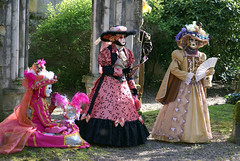
Having left the ossuray we made our way into the town of Verdun itself. Music was playing from speakers attached to all the lamposts, and at the appearance of people dressed in costume and sporting masks, we realised we had come at the time of a carnival. But there was something sinister about these people, the way in which they were a part of the town but detached, within but without. Something about their featureless, anonymous faces; the way they looked at us but we could not look at them, just a version of their selves.

Verdun

And seeing all these colourfully dressed people on the steps of the town’s huge memorial served to illustrate the continuity of life, but also the fact that those who died on the battlefields outside the town would have known brighter, happier, more colourful times, a juxtaposition which is everywhere in Verdun and which was to be found in the town’s Cathedral, itself hit on the first day of the battle – February 21st 1916.

Verdun

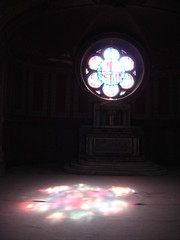
The Cathedral still bears the scars of war, but on the inside, one finds again the colour.

Verdun

Filed Under: Trees, World War I Tagged With: Place, Silence, The Somme, World War I, WWI, Ypres

Shadows 2

April 17, 2008 by Nicholas Hedges

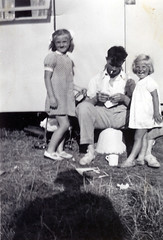
Recently I bought ‘The Book of Shadows’ (edited by Jefferey Fraenkel), which I found whilst browsing in Blackwell’s bookshop, a book of found photographs all of which contain the shadow of the photographer along with that which is photographed. It’s something in which I have been interested for some time with some of my own family photographs containing just such shadows.

It called to mind as I flicked through the pages, looking at photographs such as that below, the words of Austerlitz in W.G. Sebald’s book of the same name, in which the character Austerlitz states that fortifications:

“…cast the shadow of their own destruction before them, and are designed from the first with an eye to their later existence as ruins.”

In many respects, the same could be said of any building or even, individuals. We all cast the shadow of our own mortlity before us, and, in respect of what Barthes has written in Camera Lucida (“I observe with horror an anterior future of which death is the stake… I shudder… over a catastrophe which has already occurred. Whether or not the subject is already dead, every photograph is this catastrophe.”) these shadows in these pictures could be said to be just that.

Below is one of the images from the book. There is something poetic about this image in particular, in the way the train tracks lead us to the distance, to the future, almost as if they are there to transport this shadow of the photographer’s own ‘destruction’.

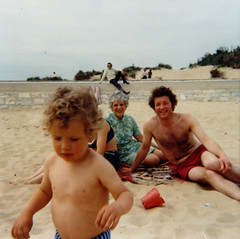
Below is one from my own collection showing my grandfather, my aunt and my mother.

Grandad

Filed Under: Photography Tagged With: Catastrophe, Ruins, Sebald, Shadows, Vintage Photographs

The Gate – A Reflection

April 11, 2008 by Nicholas Hedges

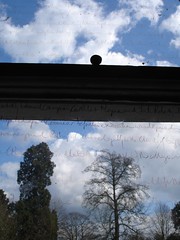
Today I made what one might term an ‘intervention’ in the Larkin Room of St. John’s College as part of the Travel and Trauma Colloquium which is being held there today and tomorrow. The work has been written across two large glass doors and throughout the day I’ve been reflecting on its meaning in light of answers I have given to questions posed by delegates and also in light of the papers delivered as part of the colloquium.

The Gate (The Ordinary Language of Freedom)

When I started to create the work in the morning, the weather was beautiful; blue sky, sun – a perfect Spring morning. Yet very quickly the day changed and as I was writing about the bad weather on 26th March (that being the day on which I wrote the text: see Work in Progress – The Gate) so the heavens opened and the rain (and hail) began to fall. And at once I began to think about the weather and history (as you do). History (with a capital ‘H’) is of course full of accounts of bad weather (storms, droughts and so on) but what one doesn’t read (for perfectly understandable reasons) is accounts of average or day-to-day weather conditions in relation to less than average events. There are of course numerous historical exceptions to this, such as in the diaries of Samuel Pepys whose accounts of the weather serve to bring the seventeenth century alive, but as the rain fell, just as it had over two weeks ago, I began to wonder what the weather was like at times of less than average – great – historical events. In my text I wrote:

“It’s stopped. The rain, but all around, the colours are by a few degrees darker.”

And I wondered, how were colours similarly changed in the past?
I was talking with a delegate about how it is such small things which tell us the most about the past, and knowing how the weather was on certain notable days in history would help paint a better picture of the past. There isn’t much weather in history, some yes, but there should be more! Anyway I digress… suffice to say, what the similarity in the weather showed me, was how from year to year, century to century, rain is always rain, sun is always sun. They both come and go along with fog and snow. They help fill in the outlines of facts with colour (the outlines in my case were the words I was writing).

The Gate (The Ordinary Language of Freedom)

Going back a moment, to Wednesday when I typed up the transcript (the text of what I had written on 26th March) I found the version I was typing was almost a dreamlike replica of the actual event. It was very different to remembering the event, for the remembered event doesn’t follow the same temporal pattern as the memory inspired by the typed text. The memory (not that inspired by the text) of that time is limited to a few images which blur and blend together to create an homogenous view of the hour I spent in the Larkin Room; on remembering it, I have by no means the sense of any linear time. Writing it out word for word however was like re-living that moment, but time was changed to the time it took me to type it up again; the hour became more like two – but it was linear all the same.

After a few of the speakers had delivered their papers I began to consider what I could see as a connection between tourism and history. One of the questions raised in the colloquium was why we are tourists? (The question emerged from a discussion about 19th century tourists but it still holds today) What are we doing when we visit other places? One of the answers which emerged was that we are somehow comparing the places we are visiting with that from which we’re from, usually unfavourably. We go away in order to return grateful for what we have, we travel, in part, to confirm that where we live is better. Of course this by no means universal – far from it, but travel often augments are sense of home.

As I wrote in my introduction to the project, for me, it’s the individual tourist’s resolution of a disquiet resulting from a shift in the status of a place – the act of leaving or being able to leave – which in some respects makes such places popular today (heightening as they do our sense of existence, of life).” Just as we return from our holidays with a heightened sense of home, so we return from the camps with a heightened sense of life.

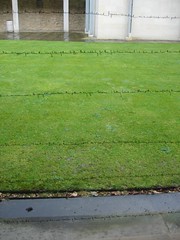
We are I believe, in History, tourists of the past. History is a place, a foreign country which we can visit and leave. It goes without saying that those in the past cannot. When we write or read about the past, we are making our own barbed-wire fence to keep the past in. We look as Wiesel says but go no further. We observe but cannot participate, we see from a distance. The barbed wire keeps us out just as it keeps the past in. But as I have written lately in regard to another project (Umbilical Light), to read history, to know it properly – to understand it – necessitates our own non-existence, we have to tear down the wire and enter the past into which we must then dissolve like smoke in a grey sky. The text of history books is therefore an armature by which we are shaped, it makes us the living and those behind the dead. But what about the not-yet-born? Are they also to be found behind the text, or like the dead within the words itself? As I have already written, “to know it properly necessitates our own non-existence” and in our conscious minds that becomes the very image of death. Does that not mean therefore that we exist amongst them?

The Gate (The Ordinary Language of Freedom)

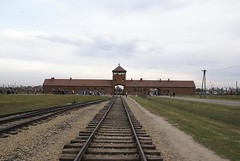
As one can see, the creation of this work today in the context of the colloquium has thrown up many more questions. But to summarise… the historical text in respect to trauma acts as a fence to keep that trauma at bay, we can read of the trauma in words and glimpse a world behind them, but as when one reads the words on the window, we cannot see the world very clearly. If we focus on the world behind, we lose sight of the text, of the past. Standing in Auschwitz-Birkenau I could of course see the world as it is now, but the words I had read seemed vague, I could not correlate the two – my mind simply couldn’t conceive it. And now, when I return to the words, my memory of the place in which I’d stood is vague, as vague perhaps as the images I have of the past and all its traumatic events. I have gone to the gate but no further.

Filed Under: Holocaust Tagged With: Auschwitz, History, Holocaust, Pepys, The Gate, WWII

Dark Tourism Conference III

April 9, 2008 by Nicholas Hedges

At college yesterday, I noticed how the text I’d written on the windows (see Dark Tourism Conference II) had faded. There was something very poetic about it, the fact the text (the wire) had in the course of time faded, although there were still parts of it remaining. It served to remind me how the past eventually dissolves altogether, how the pain of tragedies in the course of time fades into forgetfulness.

Dark Tourism

Something else which struck a chord with me regarding this link between text and forgetting, was a quote from Frances Yates’ book, ‘The Art of Memory,’ in which she writes:

“In the Phaedrus; Socrates tells the story of the God Theuth who invented numbers and arithmetic, geometry and astronomy, draughts and dice, and most importantly of all, letters. The king of all Egypt was the God Thamus who told Theuth that the invention of writing was not, as suggested, an elixir of memory and wisdom, but of reminding; the invention will produce forgetfulness.”

It would be interesting to create this project in a place where the text could remain, to slowly fade away in time. One could imagine going over the text as it fades, creating on the glass a kind of palimpsest…

Filed Under: Uncategorized Tagged With: Dark Tourism, Frances Yates, Memory, Myth

The Gate

April 9, 2008 by Nicholas Hedges

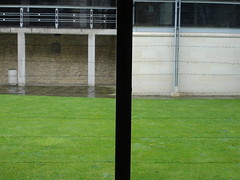
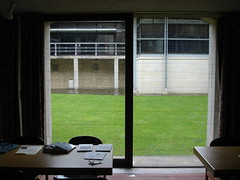
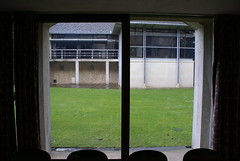
The project I am working on for the Travel and Trauma (Dark Tourism) conference (11-12th April) is now – in light of Elie Wiesel’s comments regarding the Holocaust’s visual representation – called The Gate. I shall be writing on the windows of the Larkin Room at St. John’s college (see photograph below) using text I wrote whilst sitting and looking out the window for a period of one hour on 26th March 2008, between 12 and 1pm.

Larkin Room, St. John's College

The text to go on the glass is as follows:

Looking outside the windows I can see the following. A modern complex straight ahead in front of which is a lawn. The bells are chiming twelve o’clock. The lawn is uneven, partly covered with weeds and daisies. To my left are a few shrubs, most bare except for the first green leaves of Spring. A small tree grows beside it and through the brambles I can see that the sky has turned dark; I expect it will rain soon, or even given the recent weather it may even snow. Beside the shrubs are a few daffodils which already seem weary. Last years leaves are mixed with the pebbles just by the bottom of the windows and the earth is peppered with acorns. Ivy grows up the exterior wall. To my right – another tree and more shrubs which are looking in a somewhat healthier state. Again a few meagre daffodils seem uncertain as to whether they should come out or not. The shrubs have been pruned here and the leaves are moving slightly in the breeze. Across the path grows a much older and larger tree – I’m not sure of the type – is it an oak? That might account for the acorns. Surrounding it is a large flower bed – more shrubs, another tree and a much larger crop of daffodils. I start to wonder about the wall; a number of people walk up the path and disappear from view from behind the concrete pillar. I can hear voices and also the rumble of traffic from town. There’s only voices and the sound of birds. I return to the wall and wonder about its provenance. How old is it? Did it mark the boundary of something? A man with glasses and a bald head walks down the path. Someone outside is coming down the stairs – there are two of them, a man and a woman. They disappear and the birds start singing again – not that they really stopped. The wall runs round the perimeter of this garden, except on one side where it has become a part of the modern building – concrete pillars, girders and glass. A small strip light is on and seems very ugly in this place. A girl walks past checking her phone. She walks without looking as if she knows this place so well she hardly needs to look – like a ghost following the trail of their lives. There are two litter bins; one is made of concrete and has a lid – the other is dark grey – plastic and much smaller. I think it must be a blackbird I can hear – much louder than any other. Next to the modern building is another – a different design and just as ugly. It’s hard to tell its age, whether it’s newer or older than that which faces me, or even that in which I am sitting. There is a long grey piece of guttering running down its entire length; I notice as I look at it that rain is beginning to fall; not as heavy as I thought it might be, just a veil of rain. Following my eyes to the left of the gutter , I find myself looking at a row of houses. From the design and the brick work I imagine that they’re nineteenth century. Strange how they seem much more human than those ahead of me and that behind which I am sitting. A girl walks past with a purple scarf and a bag – dark hair – she’s gone. A door slams somewhere behind me. In the corner of this garden (here comes the man I mentioned earlier, bald with glasses; he’s carrying a book) is another tree; strange how they seem to appear, how I didn’t notice them earlier. Another man in a short-sleeved shirt walks past. I see his reflection in the windows as he walks behind me. I think I can see a shield engraved on one of the windows ahead of me; is it the crest of the college? I can’t tell what it is – it actually looks like a cockerel. A pigeon wanders about on the grass – another tree! A silver birch sapling. I can hear footsteps and I see someone’s reflection in the window. A girl with a dark jacket, hand in pockets head bowed against the rain. I notice now, that the roof of the building straight ahead (another man in a t-shirt – then a couple, a man and a woman wearing a hood – then one carrying an umbrella) is made from what look like old tiles. Was there a building here before from which they were taken? If not, where have they come from? A bird flies across in front of me, I didn’t notice what it was. I see now that the wall around the garden is actually breached by a passage which goes somewhere – I’ve no idea where. Also, just next to the large flower bed (a man in a blue sweater walks past, his keys or something clanking with each step he takes) there is a flight of steps. They must lead to a raised pathway. The girl I mentioned earlier with the purple scarf walks across carrying a large pink bag. There are voices just outside . They greet each other? The couple – the girl with the hood and the young man walk back. An aeroplane roars overhead as another shadowed figure drenched in a wet coat walks past. More footsteps and again I cannot see where they come from. Then I see a young woman with a purple hat. Her steps echo as she walks through the passage to my right. A young man with glasses saunters past carrying a bottle of something, he walks around the lawn and down the passage I didn’t see earlier. The pigeon takes off and flies over the wall. In the windows of the building opposite I see the pale grey sky and the reflections of the older buildings. Two reflections just like ghosts appear in the glass ahead of me then disappear just like the rising tide of the traffic. And suddenly, for the first time since I sat down, I can hear the sound of a clock ticking somewhere in the room, counting of the passing time, just as the words of the those who walk around the lawn. Another aeroplane – or is it thunder? The sky is much brighter now although the rain is falling no less hard. As I speak however it starts to come down harder. I can hear it now, before it fell and didn’t make a sound. Now I can hear it scratching at the glass – I can see how it makes people run whereas before they were happy just to walk. I notice a drain cover down to the left – on it more acorns. A young man runs down the path to my right. Someone is talking behind me. The path is now reflecting the world through the fact it is so wet. The concrete pillars opposite are fragmented in the pattern of the slabs, as is the concrete bin. A couple walk past – the girl is carrying a pinkish patterned umbrella. The rain comes even harder now; I can hear it on the leaves of the shrubs, it drowns out the clock, as if each drop is a second and all the seconds that came before are returning to the earth. The drain cover has a distinct puddle now. Someone bangs something. Voices come behind me. I see their reflections in the windows, but I don’t see them. The sky appears to be becoming blue now, but yet it continues to pour with rain. I can hear the clock but I can’t see where it is. I just know time is passing without knowing how much. Someone is whistling; there is no tune to speak of, just a vague collection of notes strung together with a breath. There is, I realise another – what looks like a flower bed to my left, surrounding the tree. I wonder how it looks in the summer. My eye holds the image of a young man in a luminous jacket. He’s gone now but I can still see him. Where does everyone go, I can’t tell from where I am sitting. The rain is easing now, and the sound of the traffic intensifies, pricked by the footsteps which echo behind me. I can hear words but do not understand them, they are shapeless. I can see another light – a round, globe light in the building ahead and to the left; there’s something so depressing about them – lights on during the day. It’s stopped. The rain, but all around, the colours are by a few degrees darker. , the pathways reflect the world around them. A door opens to my right with a creak and closes. Footsteps. The sky is brightening up and the sun picks up the wet branches of the trees,, as if the sky itself has been cut to shape and laid upon them. And some are decorated with small droplets – of course now it’s started to rain again. What’s beyond the wall? There is the drone of an aeroplane, the percussion of rain and footsteps. Harder and harder it comes now. I can see it strike the path ahead of me. It’s actually hail. The rain seems to fall as lengths rather than drops. In front of me, on the step just outside, I watch the drops strike the puddle which has formed like the arms of an old typewriter striking the letters on the page. A few hailstones leap upon the lawn, as if they have been spat from the ground rather than fallen from the sky. The pigeon takes flight – a blue and green umbrella – one with a proper wooden handle. Three people walk past. They laugh through the passage. The girl is wearing a pink coat. I wonder what they are laughing about? A man walks but I couldn’t hear what he said – now I can – his friend is talking about something with flowers on. He laughs and they’re gone. The puddle on the manhole cover gets bigger, but the drops are falling slowly now; the typewriter is slowing down, the world has a little less to say. Funny how the walls surrounding this garden seem so unmoved by the rain – how much rain has fallen upon them in the years they have existed? Who have they seen walk past? Are we a blur to them? Do we pass by so quickly that we are not seen? I see a reflection walk slowly past in the glass, as if the glass is ice and the image is slowed to the speed of its molecules. Abstract patterns in the glass ahead of me like modern stained glass. A girl walks past and into the building. I see her through the windows at the top. I see her walk all the way to the left before she is swallowed by the dark of the glass as if she was never anything but a reflection. The clock strikes the hour. One o’clock.

Filed Under: Holocaust, Trees Tagged With: Dark Tourism, Holocaust, The Gate, WWII

Oxford’s Lost Streets

April 8, 2008 by Nicholas Hedges

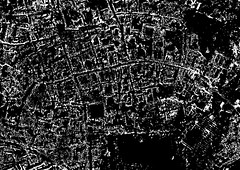
Appropriately for the work I’ve been doing on Oxford Destroyed (itself, part of my Tour Stories project), I chanced again upon a map of the lost streets of Oxford. I first found it a year or so ago, and it was only in conversation today that I remembered it; strange how things acquire relevance at a much later date. The map shows a number of streets and lanes lost to the city by the 17th century; among them Exeter Lane, Schools Street, Frideswide Lane and Jury Lane (the rather unfortunate Shitbarn Lane was also amongst their number). Looking at the map, I couldn’t help think of the ‘map’ I’ve recently ‘made’ as part of the the Oxford Destroyed project; the aerial view of the fictional ruined city.

Oxford Ruins

Thinking about the ruined cityscape, I imagined as I ‘walked the ruins’, how the layout of the streets would perhaps change as new routes were cut through the rubble of buildings, and, looking at the map of the lost streets of Oxford along with those which are still in existence, one can see how these changes are in fact all part of the natural evolution of the city.
In my introdction to Tour Stories I wrote:

As old as it is, Oxford is like every city, one which constantly changes. People come and go, passing through its streets as daytrippers; others live a lifetime here and never leave. Generations come and go, stones corrode; whole buildings are lost to progress. Every day the city is in some small way renewed, restored, destroyed and rebuilt. And with every building that is lost, with the death of every one who has ever known it, so the city changes.

The one thing that has changed little over the centuries is the layout of the streets. Buildings as I said above are lost to progress; generations come and go. One of the things that defines Oxford as being what it is is this ancient layout of streets and lanes down which people have walked for hundreds of years. But nevertheless as the map has shown, even these streets can be removed. High Street, Queen Street, St. Aldates and Cornmarket Street might well have stayed more or less intact (albeit the last three with different names) but those such as I listed above have succumbed.

The idea of streets lost to time beneath various buildings is to me as enigmantic as the lost names of John Gwynn’s survey (1772), a document I have been using on another project; 6 Yards 0 Feet 6 Inches and just as I am exploring this survey through a piece of sonic art/composition, so I want to explore these missing thoroughfares. The spaces still exist of course; Jury Lane has been swallowed up by Christ Church, Exeter Lane by the Bodleian Library, Schools Street by Radcliffe Square (part of it is still extant and is now known as St. Mary’s passage) and Frideswide Lane also by Christ Church.

The lost streets also interest me in relation to other projects; for example, the route between the two sites for my Mine the Mountain exhibition in Autumn (the Town Hall Gallery and the Botanic Gardens) are connected by Deadman’s Walk, the route taken along the old city wall by Jewish mourners in the 13th century. It seems to me that some of that route was along what its shown on the map as being Frideswide Lane, but what interests me in particular is Jury Lane off what is now St. Aldates. In the Victoria County History for Oxfordshire, it states :

Jury Lane (c. 1215-25): Little Jewry (1325); Jury Lane (1376); Civil School Lane (1526). Closed c. 1545 and incorporated in Christ Church.

Little Jewry corresponds with Great Jewry, the old name for St. Aldates which was, after Great Jewry, known as Fish Street. It was the mediaeval Jewish Quarter and the missing street strikes a chord with the theme I have been exploring for the past eighteen months or so; the missing of the Holocaust.

This theme of missing people has lately found form in another project – Umbilical Light and seeing the faces in this work, it is interesting to see how all these works are becoming intertwined.

Filed Under: Oxford Tagged With: History, John Gwynne, Lost Streets, Oxford, Survey

6 Yards 0 Feet 6 Inches III

April 6, 2008 by Nicholas Hedges

Following up the work I have done so far with the composition based on John Gwynn’s survey, I have decided to do the same with video. This follows on from work I have done on Tour Stories/Umbilical Light, projects based on photographs taken in Oxford around the turn of the 19th/20th century.

I’m not sure yet what the images will be within each, but I think it will be something along the lines of the photographs I have been using.

Filed Under: Uncategorized Tagged With: 18th Century, 6 Yards 0 Feet 6 Inches, John Gwynne, Sonic Work, Survey

Invisible Cities and String

April 3, 2008 by Nicholas Hedges

Given my work with string of late and my continuing interest in cities (see www.tourstories.com) I was struck when re-reading Italo Calvino’s ‘Invisible Cities’ by the following passage:

“In Ersilia, to establish the relationships that sustain the city’s life, the inhabitants stretch strings from the corners of the houses, white or black or gray or black-and-white according to whether they mark a relationship of blood, of trade, authority, agency. When the strings become so numerous that you can no longer pass among them, the inhabitants leave: the houses are dismantled; only the strings and their supports remain.

From a mountainside, camping with their household goods, Ersilia’s refugees look at the labyrinth of taut strings and poles that rise in the plain. That is the city of Ersilia still, and they are nothing.

They rebuild Ersilia elsewhere. They weave a similar pattern of strings which they would like to be more complex and at the same time more regular than the other. Then they abandon it and take themselves and their houses still farther away.
Thus, when traveling in the territory of Ersilia, you come upon the ruins of the abandoned cities, without the walls which do not last, without the bones of the dead which the wind rolls away: spiderwebs of intricate relationships seeking a form.”

What I think Calvino is talking about here is how despite perhaps the interval of one, two, three hundred years or more, the same basic human needs and relationships remain, existing between people who live today. In describing another city, he writes again about the relationships between people, but those which exist only momentarily:

“In Chloe, a great city, the people who move through the streets are all strangers. At each encounter, they imagine a thousand things about one another; meetings which could take place between them, conversations, surprises, caresses, bites.”
“Something runs among them, an exchange of glances like lines that connect one figure with another and draws arrows, stars, triangles, until all combinations are used up in a moment…”

The same patterns are there, and if these lines were made of string like those above, one can imagine something like a cat’s cradle, constantly changing with these fleeting and ephemeral relationships.

Filed Under: Uncategorized Tagged With: Ersilia, Italo Calvino

6 Yards 0 Feet 6 Inches II

April 2, 2008 by Nicholas Hedges

Having converted the distances for each dwelling/building into seconds, I created a new track in Cubase and added markers for each of the sections, creating as a result a sonic image for the southern side of the High Street as it appeared in 1772. Below is a detail of a larger screenshot. Click on the image to open a new window with the larger image.

I’m not sure at this stage how I will proceed with the score, but I have added a note (C3) at each marker point which is at least a start. These can be seen in the two midi tracks beneath; the first track a short note, the second row the length of the interval between them. Listening – whilst it doesn’t make for an interesting sonic encounter – does at least allow the listener, in this case me, to get a sense of physical space of the street from the duration of the notes (in the case of the second midi track) or the duration between each (as in the case of the first).

Filed Under: Uncategorized Tagged With: 18th Century, 6 Yards 0 Feet 6 Inches, John Gwynne, Sonic Work, Survey

Zuleika Dobson

March 31, 2008 by Nicholas Hedges

It was through reading E.M. Forster’s lectures (collected in a book entitled ‘Aspects of the Novel’ and first published in 1927) delivered under the auspices of Trinity College, Cambridge, that I first came across a reference to Max Beerbohm’s satirical novel Zuleika Dobson. In particular it was a passage quoted by Forster as ‘this most exquisite of funeral palls… Has,” he goes on to say “not a passage like this a beauty unattainable by serious litertature?” The answer to that is in some respects yes and below is that very passage:

“Through the square, across the High Street and down Grove Street they passed. The Duke looked up at the tower of Merton… Strange that tonight it would still be standing there, in all its sober and solid beauty – still be gazing over the roofs and chimneys, at the tower of Magdalen, its rightful bride. Through untold centuries of the future it would stand thus, gaze thus. He winced. Oxford walls have a way of belittling us; and the Duke was loth to regard his doom as trivial.

Aye by all the minerals we are mocked. Vegetables, yearly deciduous are far more sympathetic. The lilac and laburnum making lovely now the railed pathway to Christ Church Meadow were all a-swaying and a-nodding to the Duke as he passed by – ‘Adieu, adieu your Grace,’ they were whispering. ‘We are very sorry for you – very sorry indeed. We never dared suppose you would predecease us. We think your death a very great tragedy. Adieu!”

The premise of the novel concerns the arrival into Oxford of the beautiful Zuleika Dobson, a woman of such beauty, any man who sees her cannot help but fall in love.

“To these Emperors, for whom none weeps, time will give no surcease. Surely, it is sign of some grace in them that they rejoiced not, this bright afternoon, in the evil that was to befall the city of their penance.”

Broad Street

The problem is that Miss Dobson herself cannot love any man who loves her in return and so, having fallen in love with the brilliant Duke of Dorset, her love is immediately lost on hearing of his reciprocal feelings. Spurned, there is only one course of action left to the Duke and that is suicide by drowning in the Isis during Eights Week. But such is the esteem in which he’s held, and such is the love every undergraduate holds for Miss Dobson, that almost the entire undergraduate population of Oxford plunges into the river and is lost.

Taking the plaintive tones of the passage above and some other extracts of the novel, I assumed (not recalling the date of its first publication) that Beerbohm’s novel was something of an allegory about the lost generation of the First World War, of the lost innocence of Edwardian Oxford. However, the novel was first published in 1911, and as such, the book is not unlike the pair of black owls which perch on the battlements of the Duke’s ancestral home and foretell of his death.

“Young Oxford! Here, in this mass of boyish faces, all fused and obliterated, was the realisation of that phrase. Two or three thousands of human bodies, human souls? Yet the effect of them in the moonlight was as of one great passive monster.”

Just after reading the novel, I started reading again Peter Vansittart’s survey of the First World War, Voices From the Great War. Comprising quotes, poems, letters and so on, the book paints a picture of the war through the long lost contemporaneous voices. I first bought the book following a visit made to Ypres and turned to it again having received a gift of almost 200 postcards from the time of the Great War.

World War 1 Serviceman

Taking the three together – Beerbohm’s novel, the postcards and the quotes – one begins to read the absurd fantasy of Zuleika Dobson in an altogether different way. We have all seen images of men cheerfully marching to the Front, waving their hats and shouting, and when one reads of the mass (almost cheerful) suicide of all the young men in the novel, one cannot help but compare.

“There was a confusion of shouts from the raft of screams from the roof. Many youths-all the youths there-cried ‘Zuleika!’ and leapt emulously headlong into the water. ‘Brave fellows!’ shouted the elder men, supposing rescue-work. The rain pelted, the thunder pealed. Here and there was a glimpse of a young head above water-for an instant only.
Shouts and screams now from the infected barges on either side. A score of fresh plunges. ‘Splendid fellows!'”

And from Vansitartt’s book…

“The enormous expansion of wealth in the peaceful years between 1908 and 1914 brought not happiness but fear, and fear so powerful that it could be expressed only in images of fear and destruction. When war came, it was almost universally accepted as something foreseen and foretold. Even those who loathed the notion of it acquiesced in it as inevitable, and it is not foolish to conclude that what ultimately brought the war was not the ambitions and fears of Germany, but a death-wish in the peoples of Europe, a half-conscious desire to break away from their humdrum or horrifying circumstances to something more exciting or more exalted.” C.M. Bowra

“War might drive a man till he dropped: it could be a dangerous and bloody business; we believed, however, that it still offered movement, colour, adventure, and drama. Later, when the murderous, idiotic machinery of the Western Front was grinding away, of course all was different.” J.B. Priestly

Of course it was different – the reality of the situation. And having turned the last few pages of Beerbohm’s novel, I wondered what it would have looked like, all those dead young men lying prone in the waters of the Isis.

Filed Under: World War I Tagged With: Memory, Nowness, World War I, WWI, WWI Postcards, WWI Postcards, Zuleika Dobson

  • « Previous Page
  • 1
  • …
  • 22
  • 23
  • 24
  • 25
  • 26
  • …
  • 32
  • Next Page »
  • The ‘Now of Then’
  • Artist’s Statement
  • Designs for an Heirloom
  • Dissonance and rhyme
  • Wildflowers
  • Emptiness
  • Wave (goodbye)
  • Now In The Past Of An Unreal Place
  • Return to Graphite
  • Genius
  • Latest Backdrops
  • Extended Backdrops
  • Backdrops
  • Komorebi
  • Acorns
  • Scroll Work
  • Goethean Observation: Japanese Scroll
  • Mistakes
  • The Leaf Is Singing Still
  • Past Present
  • Scrolls
  • As Yet Untitled
  • Holes
  • Scroll
  • A Calligraphy of Shadows
  • More Paintings
  • Latest Paintings
  • Walking Meditation 2
  • Knowing We Are There
  • Venice by Moonlight 1840
  • Fragments and Additions
  • Reimagining The Past
  • Walking Meditation 1
  • Mindful Walking I
  • Grief II
  • Three New Paintings
  • Nana’s Mountain
  • Painting
  • Iridescence
  • Roman Bottle
  • Rinsho
  • Shadow Calligraphy
  • Becoming Memory
  • Fox Talbot’s Glassware
  • Goethean Observation: Diffuser II
  • Goethean Observation: Diffuser
  • A Remembrance of Things We Never Have Known
  • A Moment’s Language
  • Take Me Home
  • Arrival/Departure
  • Diffusers
  • Grief
  • Mum
  • Measuring the past
  • Disordered Time
  • Entropy
  • Wicked Magician, Fly
  • The Quanta of History
  • Empathy Forward
  • The Natural World of 978
  • The Gone Forest
  • Empathy/Exchange: 668 grams
  • Goethean Observation: Pilgrims of the Wild, 1935
  • Nazareth O
  • Several Johns and St. Thomas
  • Raspberry
  • Tokens and Shadows
  • Patterns Seeping (II)
  • ‘Missded’ 4 – Tokens
  • Patterns seeping
  • Cut Paintings
  • ‘Missded’ 4
  • Locks III
  • Locks II
  • ‘Missded’ 2 – Tokens
  • My Son’s Drawings II
  • ‘Missded’ 2
  • ‘Missded’ 3 – Tokens
  • ‘Missded’ 3
  • ‘Missded’ 1 – A Framed Token
  • Morning Has Broken
  • Tokens of absence
  • ‘Missded’ 1, stitched
  • More Little Words
  • Three Little Words
  • Spaces In Between
  • ‘Missded’ 3
  • ‘Missded’ 2
  • ‘Missded’ 1
  • Locks
  • Tracings
  • My Son’s Paintings
  • Writing Shadows
  • Samuel Borton’s Post Chaises
  • Dawid Sierakowiak
  • Pitchipoi
  • Latest Tree Drawings
  • Notebook
  • Somewhere Between Writing and Trees II
  • Somewhere Between Writing and Trees

© Nicholas Hedges 2024

  • Facebook
  • Instagram
  • Twitter
  • YouTube

Copyright © 2025 · Outreach Pro on Genesis Framework · WordPress · Log in