Nicholas Hedges

Art, Writing and Research

  • Amazon
  • Behance
  • Facebook
  • Instagram
  • Pinterest
  • YouTube
  • Art
    • Digital
    • Drawing
    • Grids
      • Correspondence
      • The Wall
      • The Tourist
    • Ink on paper
      • Shadow Calligraphy
    • Installation
      • Murder
      • Echo
    • Painting
    • Patterns
    • Mixed Media
    • Photographic installation
      • St. Giles Fair 1908
      • Cornmarket 1907
      • Headington Hill 1903
      • Queen Street 1897
    • Research/Sketches
    • Stitched Work
      • Missded 1
      • Missded 2
      • Missded 3
      • Missded 4
    • Text Work
  • Blogs
    • Family History
    • Goethean Observations
    • Grief
    • Light Slowed But Never Stilled
    • Lists
    • Present Empathy
    • Shadow Calligraphy
    • Trees
    • Time
    • Walking Meditations
  • Video
  • Photography
    • Pillars of Snow
    • Creatures
    • The Trees
    • Snow
    • St. Giles Fair 1908
    • Cornmarket 1907
    • Headington Hill 1903
    • Queen Street 1897
    • Travel
  • Illustration and Design
  • Music
  • Projects
    • Dissonance and Rhyme
    • Design for an Heirloom
    • Backdrops
    • Shadow Calligraphy
  • Exhibitions
    • A Line Drawn in Water
      • Artwork
    • A Line Drawn in Water (Blog)
    • Mine the Mountain 3
      • Artwork
    • Mine the Mountain 2
      • Artwork
      • The Wall
    • The Woods, Breathing
      • Artwork
    • Snow
      • Artwork
    • Echo
      • Artwork
    • Murder
      • Artwork
    • The Tourist
    • Dreamcatcher
    • Mine the Mountain
      • Artwork
      • The Tourist
    • M8
    • The Gate
    • Creatures
      • Artwork
    • Residue
      • Artwork
    • A visit to Auschwitz
      • Artwork
  • Me
    • Artist’s Statement

Weeping

October 20, 2007 by Nicholas Hedges

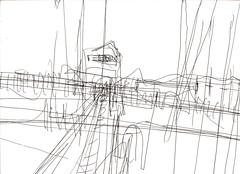
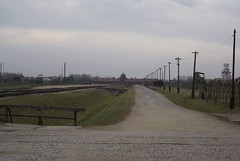
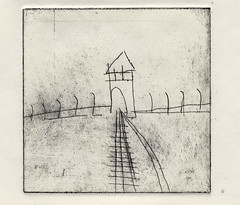
The following drawing is part of a series I’ve been working on regarding Auschwitz-Birkenau and the theme of pathways.

Untitled-9

Looking at the picture, I was reminded of something which for a while escaped me. There was something about the tower in particular which I was sure bore a striking resemblance with another, famous painting.

The following is a detail from the drawing.

Looking at it closely, at the apparent anguish and suffering in the ‘face’ of the tower (the tower as suffering goes against all I have written about it so far: “…the gate house is different, it knows its time has passed but doesn’t seem ashamed in anyway. Its almost as if it relives every moment in its glass eyes, glass eyes which are far from being blind. They don’t reflect what they see around them now but rather what has been, what the tower wants to remember…”) made me think at once of the painting I’d been thinking of, an image painted in 1937 and again, one of the utmost despair: Picasso’s ‘Weeping Woman’.

Filed Under: Holocaust Tagged With: 'Blind' Drawing, Drawings, Holocaust, Picasso, String, WWII

Bill Viola and Highlights

October 19, 2007 by Nicholas Hedges

“We have been living this same moment ever since we were conceived. It is memory, and to some extent sleep, that gives the impression of a life of discrete parts, periods or sections, of certain times or ‘highlights’.”

I was thinking about the above quote from Bill Viola in relation to the myth of the Three Fates; Clotho, Lachesis and Atropo. I had imagined creating a work involving string being drawn, measured and cut as signifying life being measured and cut. This was to have been created in relation to my ongoing work on the Holocaust.

However, it could be that the lengths of string represent not only individual lives, but these discrete moments (memories) which Viola describes, i.e. moments of a single life. This could be very interesting as regards work which aims to find the individual amongst the millions who died in the Holocaust. A pile of cut strings could represent a pile of bodies, or, a pile of one person’s memories.

19-10-07

19-10-07-ii

Filed Under: Uncategorized Tagged With: Bill Viola, Memory, Three Fates

New Studio, New Work

October 19, 2007 by Nicholas Hedges

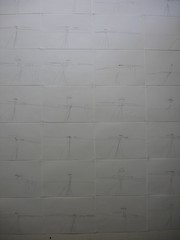
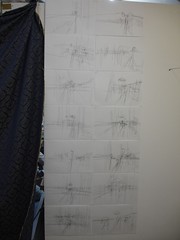
I have finally got myself into gear as regards moving into my studio at Magdalen Road and have now started to get some work done. I started with putting some pictures up on the wall (those I made after my visit to Auschwitz-Birkenau) and was struck by how different they appeared when shown all together. When I first showed them they were on two walls and all in a row, but having them all on one wall lent them a whole different – and more sinister – aspect.

Old Drawings

They’ve always been rather intimidating images, but now there was something relentless and almost obsessive about them; as a group they seemed to talk more; but this was not a dialogue between the pictures and the viewer (me in this case, but I believe it would have the same effect with anyone else) it was now more like an internal monologue – the externalisation of a guilty conscience. I thought about wallpapering them to the walls which would I think strengthen their obsessive quality.
I also drew more of the ‘collective views’ which are interesting. They too have the same relentless, clawing quality, but do not have quite the same connotations of guilt which one gets from repeated and near identical images.

New Drawings

As I drew these images, I ‘found my way’ back inside the camp, seeing it clearly in my mind as I drew with my eyes closed. I followed the various lines, in particular the railways tracks, the wire fences and the telegraph wires. And as my pen marked them on the page, I began to think about their functions. The train tracks were a means to the outside world, they were defined by their end points – outside, beyond the camp – connected to the great European cities and the home towns of many who died there. The telegraph wires were likewise a means of communicating with the outside world, which for those in the camp was an impossible dream – something quite unreal. All I could think as I drew, was the ‘image’ of screams being carried down the wires. Sadly the outside world wasn’t listening.

Auschwitz-Birkenau

Having worked on the drawings for a while, I then began to work on an idea I sketched out a while ago.

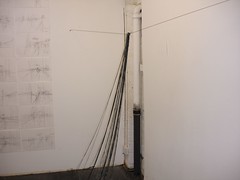
I started working on the knot using the balls of string which I dyed last week and as I began to build up the knot I found that the dye hadn’t taken properly which nevertheless produced and interesting effect as the knot grew.
Knot
.
Knot

Any work associated with the Holocaust and which is realised with fabric has certain connotations, but what interested me particularly was what I’d thought about whilst drawing earlier – in particular the telegraph wires. The cut strings trailing on the floor – which represent the cut threads of life – became telegraph wires in my mind.

DSC05144

Could I perhaps use wires instead of string?

Filed Under: Holocaust Tagged With: Auschwitz, Holocaust, String, WWII

Printmaking – A Reflection III

October 18, 2007 by Nicholas Hedges

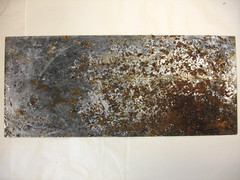
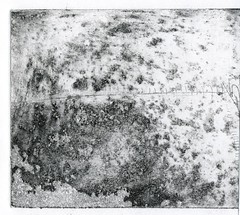
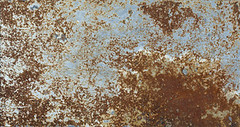
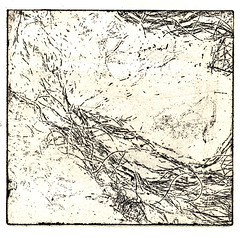
Yesterday I carried on with the process I initiated two weeks ago, that of burying an engraved plate, leaving it a week and then printing the rusted version. Having dug up the plate after a second period in the ground, I was pleased with the resulting pattern of rust which I hoped would be lifted onto the paper by some of the ink during the printing process.

Printing Plate

The resulting print from this plate was as follows.

Print 3 (Photo)

The thing I realised with printing from such a rusted plate was the fact that the rust has quite a pull on the ink, and so once the paper has been through the press and one lifts it from the plate, it has a tendency to be left behind. With the print above, I was somewhat disappointed that the rust was ‘drowned out’ by the ink – hardly surprising when I think how thickly it was applied. Of course this is normal, but whereas one can use the scrim to take the ink off, and use quite a bit of pressure to do so, with the rust one doesn’t want to rub so much (and thereby remove it) and so the ink remains too thick in these areas.

I took a second print of the plate without re-inking and and the texture of the rust was well preserved.

3rd Print detail (2nd Proof)

For the next print (after a third week in the ground the plate will be even rustier) I need to ink the particularly rusted sections less and perhaps moisten the rust to encourage it to lift off the plate.
As well as continuing this experiment, I also started working with photo-polymer plates. A photograph is printed onto acetate (with all black areas ‘removed’/greyed) and this positive is then used to ‘etch’ the plate. The plate is sensitive to UV light and so this is done in a darkroom in a UV box. The light passes through the acetate and exposes the plate in the darker areas. When the plate is washed and inked, these areas then take the ink which is then printed onto the page.

In order to get a good print, one needs to make two or three proofs, the results of which are below (those on the left being the first).

Photo-Etching

Photo-Etching

Photo-Etching

The question I have to ask myself now is what does it mean to print these photographs as etchings? Something to consider over the next few days.

Filed Under: Photography Tagged With: Holocaust, Printmaking, Vintage Photographs, WWII

The Goethean Method and Haiku

October 15, 2007 by Nicholas Hedges

I have recently studied, as part of my MA in Social Sculpture, a couple of articles on the use of Goethe’s Scientific method in observing both objects (Talking with History: Using Goethe’s Scientific Approach with Human Artefacts by Jim Davis) and landscape (Goethean Science as a Way to Read Landscape by Iris Brook). Both these articles, whilst using different methodologies, share the same aim; to show how Goethe’s approach to phenomena, can lead to an understanding of the subject (in these instances, an object and the landscape) which runs much deeper than a more ‘traditional’ objective view.

For his approach, Jim Davis uses “a series of questions that Floris Lowndes (2000) uses for organising one of Rudolf Steiner’s meditation exercises.” The questions in his methodology are (preceded by a defining keyword):

a) physical: What is it made of? What are its properties?
b) historical: How is it made? How is it used?
c) emotional: Why this design? What are my feelings about it?
d) creative: Who created it? Invented it?
e) desire/need: What need or desire led to its invention?
f) origins, background: What preceded it? What was its context?
g) archetype: What is the concept of the thing? Other forms?

These questions are, he explains, “are a set of ‘canned riddles’ that formalize and direct the conversation which leads from the physical objects to a form that can only be grasped imaginatively or intuitively. By working through the questions from a) to g), the process follows Goethe’s ‘genetic method’ of proceeding from empirical observation to archetype.”

I have written in detail about my application of this methodology in a ‘conversation’ I had with a Lira da Braccio in The Ashmolean Museum in Oxford, but what I was particularly interested in, was how this method allowed me, through my imagination, to visit the past of this musical instrument more directly than I would have managed before.

The second article by Iris Brook, describes her use of “Goethean observation as a means of surveying and appraising landscape…”. She describes her methodology as follows:

a) Exact sense perception: “…the observer attempt[s] to approach the object from a clearer, more objective standpoint.. This stage was called by Goethe, exact sense perception and is characterised by a detailed observation of all the ‘bare facts’ of the phenomenon that are available to our ordinary senses. It is an attempt to see what is present with as little personal judgement and evaluation as possible.”

b) Exact sensorial fantasy: “The second stage of looking at the phenomenon is what Goethe called ‘exact sensorial fantasy’ (Exact sinnliche Phantasie). An aspect of this activity is to perceive the time-life of the phenomenon, that is to see the phenomenon in time. This means no longer seeing the thing in an objective frozen present as prompted by the first stage, but as a thing with history. That history can be drawn from the phenomenon with the use of an imaginative faculty that cultivates temporal and physical relationships…”

c) Seeing in beholding: “In the third stage one attempts to still active perception to allow the thing to express itself through the observer. We attempt to step outside of what has gone before and make space for the thing to articulate in its own way.”

d) Being one with the subject: “Being one with the object in this fourth stage allows the human ability to conceptualise to serve the thing: we lend it this human capacity. When the phenomenon being explored does not have the ability to think, it is the most participatory part of Goethean observation.”

What interested me about Iris Brook’s approach was how it allowed the landscape she was studying to reveal itself (its gesture), while Brook herself, through her ‘perception, imagination, inspiration and intuition’, becomes “one with nature”, understanding the landscape’s position within the wider landscape not only in a physical sense but also in a temporal one.

The phrase “one with nature” comes not from any book on Goethe (although there might be just such a phrase in one of the many available) but a book by Lucien Stryk on the Haiku of Massuo Kinsaku (1644-94) who later became known as Basho; it’s in his collection of travel sketches, The Records of a Travel-Worn Satchel, that he writes:

“… All who achieve greatness in art… possess one thing in common: they are one with nature.”

This phrase shares much with Goethe’s approach, in that following the methodology as described by Brook, one does indeed become “one with the subject” which in her case was a “60-acre parcel of land that lies at the foot of the north-facing slopes of the Lammermuir Hills, 20 miles east of Edinburgh.”

Stryk states: “Basho’s discussion of poetry was always tinged by Zen thought, and what in his maturity he advocated above all was the realization on muga [no-self, selflessness, non-ego or ecstasy] so close an identification with the things one writes of that self is forgotten. As Zen’s Sixth Patriarch, Hui-neng (637-712), put it, one should not look at, but as, the object.”

The forgetting of self and becoming the object, are absolutely the same as what Brook describes in the fourth stage of the methodology

One of Basho’s disciples, Doho, writes of a conversation he had with the poet: “The master said, ‘Learn about a pine tree from a pine tree, and about a bamboo stalk from a bamboo stalk.’

What he meant was that the poet should detach his mind from self… and enter into the object, sharing its delicate life and feelings whereupon a poem forms itself. Description of the object is not enough: unless a poem contains feelings which have come from the object, the object and the poet’s self will be separate things.”

The similarities between this advice and that offered by Goethe is striking. Regarding the advice recalled by Doho, Stryk writes: “To give an indication of the influence of such comments on subsequent practice of the art, a contemporary haiku school, Tenro, possesses a creed, Shasei (on-the-spot composition, with the subject ‘traced to its origin’), virtually based on the theoretical statements and practice of Basho. Tenro has some two thousand members all over Japan, and it is customary for groups to meet at a designated spot, perhaps a Zen temple in a place famous for its pines or bamboo, and there write as many as one hundred haiku in a day, attempting to enter the object,’ share its delicate life and feelings.'”

Filed Under: Goethean Observations Tagged With: Goethean Observation, Haiku

Memorial to the Future

October 14, 2007 by Nicholas Hedges

Given my interest in memorials, I was interested to read on the BBC News site a story regarding the recently ‘dedicated’ memorial to Armed Services Personnel killed since the second world war.

What struck me most was the following line:

“There is room for 15,000 more names to be carved on the Portland stone walls of the memorial, at the National Memorial Arboretum.”

There is indeed something particularly chilling about this fact, for it’s as if the memorial itself is acknowledging the fact that we have learnt nothing from the deaths of those whose names are already inscribed on the walls, that’s it’s as much a memorial to the future as it is to the past; a memorial to those who at this moment are living.

Filed Under: Uncategorized Tagged With: Memorials

Printmaking – A Reflection II

October 10, 2007 by Nicholas Hedges

Having completed my first two etchings, I decided to make another larger one, again using my Auschwitz-Birkenau drawings as a basis. The following print is the result.
Auschwitz-Birkenau

What I have become interested in, is, as I wrote on my original printmaking entry, the plates themselves, not only as physical objects in their own right, but as metaphors for actions which later one remembers (the memories being the prints taken from the plate). Having buried a plate in the first week and taken a print of the rusted plate this week (which was particularly interesting) I decided to bury the plate from which the above print was taken, and this I did, burying the plate in my garden.

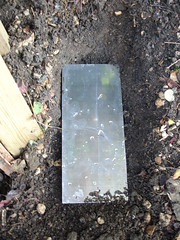
The plate buried in garden

A week later, the plate was dug up again. We’d had some pretty heavy downpours so I was hoping for a good bit of rust.

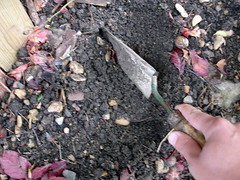
The plate about to be dug up

Just the act of using the trowel reminded me of archaeologists gently scraping away the earth to reveal the hidden thing beneath the surface.

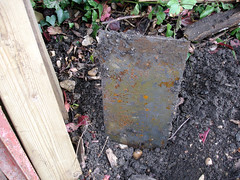
The plate uncovered

The plate itself was compacted with earth, underneath which was an interesting patina of various rusts.

The rusted plate

Tomorrow I shall take a print from this and then re-bury the plate in the garden for another week. I will also start making more plates for burying but not actually printing.

Filed Under: Uncategorized Tagged With: Plate, Printmaking

Hidden. Ignored. Denied.

October 8, 2007 by Nicholas Hedges

In a session today on my MA in Social Sculpture, we considered the following three words: Hidden, Ignored, Denied. What do we understand by these words? Not simply in their meaning but in their relationship to one another, to us and to the world around us. As we began to discuss the words, it quickly became apparent that we had different views on their significance, e.g. which was the stronger word, ignored or denied? Was hidden a positive or a negative word?

Initially, I began to think about what hidden means to me, and, in my sketchbook, I wrote down that what is denied to me, I hide, or, to put it another way, I hide it because it is denied to me. So, far from (as someone else said) the word being positive, I started by seeing it as negative. When a thing is hidden, someone suggested, we embrace it, we protect it; much like we would a treasure. Of course I wouldn’t argue with this, we do indeed sometimes hide what we cherish. And as I thought about it, I took the idea of embracing and applied it to the ‘ignored’. I had started by suggesting that we ignore something in the hope that it goes away. The thing ignored and the thing hidden are both external to us (even if they are part of us), but the difference is that while we might embrace a hidden thing, the thing ignored embraces us, it hold us.

I then began to think about ‘denied’. Is ignoring stronger than denial? One girl suggested that ignoring was passive and denial was something much more active, but as I thought about it, I began to see that for me, it was the other way round. Denial was the more passive of the two. To ignore something requires a concerted conscious effort, even if the act of ignoring is brief, the thing ignored remains with us for longer. Denial can be as simple as changing the channel on a television; we might deny time to the news of an atrocity for example. That is different to ignoring it; to ignore the atrocity is to give it space in our minds but not in our mouths.

The difference between ignoring a thing and denying a thing became something very important to me, particularly in relation to my work on The Trees, a project concerned with ‘denial in the landscape of atrocity and suffering’. I thought about ignoring and how when I ignore something, I am in effect denying something in myself. If I (a subject rather than myself) deny time on the television to an atrocity, or a natural disaster like an earthquake, I am in effect, ignoring (or attempting to ignore) my own lack of concern – my apathy, just as a Holocaust denier is not denying the fact of the Holocaust per se, but rather, trying to ignore their own belief that it was no bad thing, that they got what they deserved.

Taking this further (the subjective ‘ignore’ and the objective ‘deny’), I figured that if I have something about me I want to hide, I can ignore it, but with others I have to deny it. To ignore is to be silent, to deny requires words. It’s easy to deny something when talking with another, it is, as I first suggested, a passive action. But to ignore something is almost a physical action, it requires effort and is anything but passive.

I wanted to create some kind of framework for considering how we hide, how we ignore and how we deny, and so I simply asked myself those same questions. How?

How do we hide something? By not talking about it. By not giving shape to the thing we wish to hide. To cover it, to deny it form. How do we ignore something? First we must acknowledge it. It cannot be covered, obfuscated, blurred. Its form must be clear, defined. And what of denial? How do we deny? Again, the thing must be defined in order for us to deny it, but whereas the ignored thing’s form is of itself, the denied form is somehow changed. To deny is to give the thing a different form, to externalise an internal emotion in the guise of something else. For example, returning to the Holocaust denier; he denies the Holocaust so as to ignore his own hatred and prejudice; if it did not happen, he cannot be guilty. The same is true when someone we love is seriously ill. Often we will deny the illness by clothing it in something less serious so as to ignore, as far as we can, the possible (and feared) outcomes that we are considering. We often deny death, but we can never ignore it.

Of course there are different degrees of meaning in every word. There are passive and active ends of a word’s spectrum of meaning amd words themselves occupy different places in other word’s spectrums. Hidden, ignored and denied can all be placed at points on a spectrum of ‘invisibility’. What I have outlined above is not a set of definitive meanings for these three words, but rather a way of exploring words, and arriving at meaning through a process of questioning, such as one might use when observing any other phenomema.

Filed Under: Trees Tagged With: Hidden Ignored Denied, The Trees, Trees

Anne Frank’s Tree

October 5, 2007 by Nicholas Hedges

With the work I’ve been doing on trees at the sites of death camps in Poland, I found the following article, taken from the BBC News site very interesting.

The chestnut tree that comforted Anne Frank as she hid from the Nazis in Amsterdam during World War II has won a reprieve from being felled. Amsterdam city council ruled in March that the rotting 150-year-old tree must be felled as a danger to the public. Following protests the council has given those who want to save the tree until January to come up with a plan.

The tree was a ray of hope for the famous diary writer as she hid in the attic of the canal-side warehouse.The Jewish teenager remained indoors with her family for 25 months until they were arrested in August 1944.She died of typhus in the Bergen-Belsen camp in March 1945.

The attic window from which Anne Frank could see the tree was the only one that had not been blacked out.In an entry dated February 23, 1944, she wrote: “From my favourite spot on the floor I look up at the blue sky and the bare chestnut tree, on whose branches little raindrops shine, appearing like silver, and at the seagulls and other birds as they glide on the wind…

“As long as this exists, I thought, and I may live to see it, this sunshine, the cloudless skies, while this lasts I cannot be unhappy.”

Ton Boon of the Amsterdam Centrum borough told Agence France-Presse news agency there was “only one Anne Frank tree” and it had been agreed to allow time for a possible rescue plan.

Experts say the 27-tonne tree is too diseased from fungi to be saved and the owner wants it cut down as he would be liable for any damage caused should it fall. The tree is adjacent to the building that now houses the Anne Frank Museum. A Utrecht-based firm, Trees Institute, has suggested a salvage plan involving treatment and support for the trunk and limbs.

Spokesman Edwin Koot told Associated Press: “The tree represented freedom… to Anne Frank. We must go the extra mile to try to save it.”

Filed Under: Holocaust, Trees Tagged With: Anne Frank, Holocaust, The Trees, Trees, WWII

Printmaking – A Reflection

October 4, 2007 by Nicholas Hedges

Last week saw my first attempts at printmaking (etching) the results of which can be seen below.

Auschwitz-Birkenau Etching

Hard ground etching on steel plate.
String Etching

Soft ground etching on steel plate.

The two techniques we used were hard and soft ground etching, both of which yielded surprising results, which, in part, is the beauty of printmaking, where the eventual result is never certain. Of course this might just be down to inexperience; I’m sure that professional printmakers achieve results which are wholly intended.

For the first print, I decided to etch a version of the drawings I made of Auschwitz-Birkenau, not so as to aestheticise the image, but to explore what could be gained from this particular medium. Would it bring anything new to my investigations? Despite the fact it looks like something one might find on a greetings card (itself an interesting point) the quality of the image interested me nonetheless – in particular the lines of the track and the fence where the ink had been left on the plate. The manipulation of the ink I realised could make all the difference – an obvious point perhaps, but then I had assumed that I would be creating a clean image with pure and crisp lines (something which I could certainly try in the future). But what interested me the most was the plate itself, the plate as an object in its own right, and, it’s in this that I see potential for investigation re my work on Auschwitz-Birkenau.

As an experiment, we buried some of our plates (these will be dug up this week) so as to cause them to rust. I’d already begun to think of the plate and the print as metaphors for action and the remembered action, and the idea of something rusting or decaying synonymous with the past, where original, unrepeatable moments decay and the memories of those events are merely obfuscated reproductions; the original moment is only ever partially revealed.

The actual scratching at the plate in order to secure an image also interested me. There is something – violent is too strong a word – ‘particular’ about its physicality which, if the plate is the ‘lived action’, declares a degree of tribulation a regards its making, and dealing, as I do in much of my work, with trauma, the etching of an image on a plate and the ‘biting’ of the image into the plate by acid serves to emphasise this.

From this etched, ‘traumatic’ image, one can make facsimiles, but these copies – these memories or post-memories – are never the same (for one they are reversed), and as the plate decays so any prints will remove themselves further from the actual event. Of course, if no prints are made from the plates – if actions are not ‘remembered’ – then more possiblities arise.

Filed Under: Uncategorized Tagged With: Printmaking

Canaletto

September 21, 2007 by Nicholas Hedges

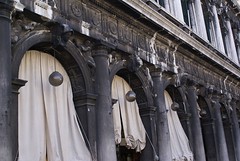
Yesterday, prior to meeting a friend, I paid a quick visit to the National Gallery, a place of which I can never tire (just the fact one can enter as freely as one enters a shop never ceases to amaze me). I had little time, around 15-20 minutes and so I headed towards the 18th century, and as I walked I saw a sign pointing the way to Venice. Having not long returned from the city, I made my way in that direction, checking my watch to keep an eye on the time and quickly found myself there again, in the mind of a certain Canaletto. Of course, I am familiar with Canaletto and his great views of the Grand Canal, but it was, as always a pleasure to see them again. And with Venice still fresh in my memory, wet like paint, I found the canvases teaming with life; the blue two centuries old sky which I had seen just two weeks ago, the turquoise canals and the buildings, which always put me in mind of old yet elegant widows. Yet, it was two smaller works which I found the most appealing. Firstly, ‘Venice: Piazza San Marco and the Colonnade of the Procuratie Nuove’ painted in about 1756, and secondly ‘Venice: Piazza San Marco,’ painted again around 1756.

I paid little attention to the dates (I didn’t have much time as I said), but recognised there was something melancholic about these works when compared with others I could see (such as the Regatta on the Grand Canal).

In my mind, I can still hear Venice, I can hear the sounds of these very colonades, I can feel the lapping shadows, and when I look at the paintings above, those sounds (the murmuring voices, the footsteps chipping at the ground) become those of the people in the paintings, of men, women and children who have been dead for two centuries. One can almost imagine, the man in the green cape holding his coffee (‘Venice: Piazza San Marco’) still standing there now, listening in on the conversations of the living, quite unaware of the passing of time, of the passing of his own life.

Venice

And it is interesting, and indeed appropriate, that not far from the place painted by Canaletto in these two late works, Bill Viola’s meditation on life and death was installed in the Chiesa di San Gallo. This work, with its use of water as a ‘dividing line’ between life and death has no more appropriate place to he shown than Venice, and the more I think about the city, the more I see it as a place where life and death coexist; indeed, the very symbol of Venice, the Gondolier has a role to play. Amongst the crowds thronging the Riva Degli Schiavoni, who’s to say the dead don’t stand amidst the tourists – the man with his coffee cup – awaiting the Gondoliers who will ferry them to the next place. Perhaps it is the city’s almost supernatural existence, which lends the place this other-worldly air. As Paul Morand writes in somewhat unconventional biography, ‘Venices’:

” Venice did not withstand Attila, Bonaparte, the Hapsburgs, or Eisenhower; she had something more important to do: survive; they believed they were building upon rock; she sided with the poets and decided to be built on water… Within her restricted space, Venice, situated as she is in the middle of nowhere, between the foetal waters and those of the Styx encapsulates my journey on earth…”

Filed Under: Paintings Tagged With: Bill Viola, Canaletto, Paintings, Paul Morand, Venice

Venice – The Biennale

September 17, 2007 by Nicholas Hedges

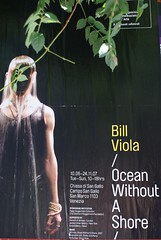
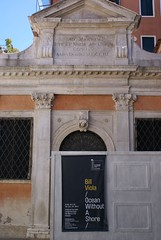
For some time I have wanted to visit the Biennale, and, finally this year, I went. To be honest, I had little idea what to expect, or what – from a ‘professional’ perspective – I would gain, but my hopes were raised when, having left our hotel, we saw the following poster:

Venice

Admittedly this was a fringe event, but it promised much. I last saw Bill Viola’s work in May this year, in Warsaw, and was blown away by it. He’s an artist who interests me a great deal, not just through his exhibited works, but also through his writing. So, on a hot and glorious day, we made our way to the Chiesa di San Gallo, a small and somewhat unassuming fifteenth century church, a stone’s throw from St. Mark’s Square.

Venice

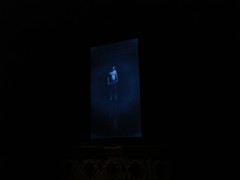
Inside it was dark. On three altars, three large, flat screens were placed, one in front and two either side of those who stood or sat watching near the entrance. There was a stillness inside, emphasised by the sonic aspect of the work as well as by the coolness of the interior, a quietude augmented by the contrast with the heat and the light outside.

At first I thought there was something wrong with two of the screens, as the pictures shown on both of them were monochrome, blurred and rather grainy, much like an image one might see through an infrared camera. The screen directly in front however, showed a figure, beautifully lit and filmed as one would expect from Viola. Of course the point soon became clear.

Venice

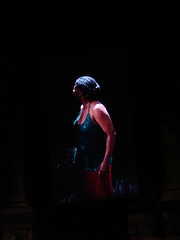
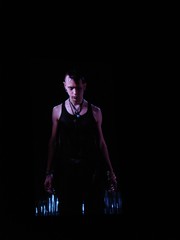
Before the monochrome figures was a wall of water which one could not quite discern except for the occasional highlights at the bottom of the screen where the water caught the lights. Slowly, again in Viola’s inimitable style, the figures behind the water (always shown in isolation) walked toward us, towards the mysterious screen of water. Then at last they broke through, their limbs shrouded in a halo-like light as the water became visible around them.

Venice

The figures (of which there were several) then stood for a moment, before – after varying periods of time – they walked back through the screen of water to become monochrome, fuliginous shadows; versions of what they had just that second been.

Venice

This was a work, whose meaning was emphasised and expounded by its location. It could quite easily work in isolation, in a gallery (as was the case in Warsaw) for example, but here, in the church, it became a different piece altogether; the church was as much a part of the piece as the images played on the screens; indeed, the work’s meaning came as much through it’s ancient interior, (through which countless generations have passed in consideration of life and death and life after death and who are now themselves memories held by the church) its stones and its statues, as through the power of technology. As one looked at the ghosts behind the invisible walls of water, one could imagine the ghosts of all those who’d once sat where we were sitting. And when the figures emerged and returned to the depths, thoughts of one’s own mortality could not be ignored. More can be seen at the official website, www.oceanwithoutashore.com.

The next day we made our way to the Giardini to see the pavillions of the various participating countries and to see what, along with Bill Viola, was on offer. It says something about the art that we soon had a leaderboard (as if this was a Eurovision event) and even more, that for much of the trawl through the Giardini we had only a first and second place. Nothing warranted a third, although the battle for the wooden spoon was intense (won jointly in the end by Canada and the quite appalling German contingent).

For me, the best piece by some way was to be found in the Polish Pavillion, represented by Monika Sosnowska.

Venice

Venice

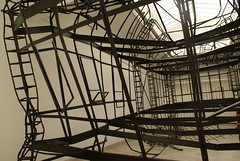
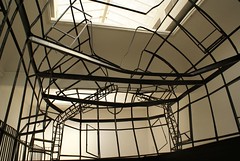
This was one of the few pieces in the whole exhibition which (like Viola’s fringe work) considered the space in which it was displayed. The architectural form, a sort of prefabricated structure had been bent and twisted so as to fit into the space in which it was shown. It had it seemed been brought to its knees and brought to mind an exhibition we had seen in Poland a few months back concerning the housing developments of the communist era, in which it wasn’t so much the structures themselves which were crushed and forced to fit a space, but humans themselves. The structure also reminded me of my own work as regards my drawings, and so I saw this almost as a physical, three dimensional drawing.
Spain came second and Russia third with the USA in fourth. I know it cheapens the whole event to reduce art to winners and losers, but then, such was the overall standard of the work it was hard not to see it that way. As for the British Pavillion… the less said the better.

Later that afternoon we took in the Arsenale, the quarter mile interior beneath which, art is reduced even further by casual and indifferent glances, to side shows and decoration. Admittedly the space is very impressive (how often is that phrase used as a means of justifying an otherwise mediocre exhinition) and there were moments when one felt glad to be there.

Venice

Oscar Munoz’s Memorial was particularly poignant, and Yang Fudong’s series of films (parts 1 to 5 of ‘Seven Intellectuals on the Yellow Mountain’) especially beautiful.

Venice

But aside from these there was little else to get excited about. The question, fundamentally, is this: how should art be seen? Or to put it another way, how best is it viewed? With Viola, the work was in its own space and its power was enhanced by the content within the church and the light and life outside. With the Biennale, in the Pavillions and the interminable Arsenale, art became like any word repeated over and over again; in the end (actually some time before the end) it lost its meaning completely.

Filed Under: Uncategorized Tagged With: Biennale, Bill Viola, Venice

Venice – Part I

September 17, 2007 by Nicholas Hedges

You can have no secrets from Venice. It knows everything. It works you out as you walk the streets and canals. If it needs more time, or if you have more secrets than most, it will keep you walking, turning like a puzzle in which you are the ball trapped in a maze. Things will look as if looked upon for the first time, but you will have seen them many times before; things that you think you know will not be known to you. You however will be known: to the houses, the open windows and the water running beneath the bridges. You are at first a rumour passed between them, till when you rest, when the ball falls through the hole, then, and only then, do you become a certainty, a fact.

Venice

The city is like a puzzle, with one possible combination; one where all the pieces are thrown and reassembled with every step you take. And just as the city is in this state of constant flux, so are you. But you have many combinations and you are not reassembled the same way every time, but are thrown together randomly, and only the merest fluke, an unlikely stroke of luck, will see you as you know you really are.

Filed Under: Uncategorized Tagged With: Venice

Chania

August 22, 2007 by Nicholas Hedges

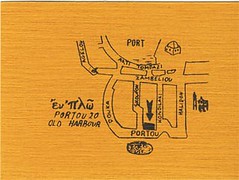
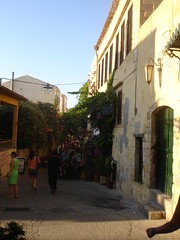
It was in the small square, at southern end of Kondylaki Street, where we met two brothers, coaxing as best they could, passing tourists into their restaurant. “My brother and I are having a party,” they told us, “at 7.30.” They handed us a card. “You’re nice people, where are you from?” They’d asked the same question, albeit more pointedly (and with a heavy dose of irony) to those who’d ignored their advances. England, I said, and Monika, from Poland. Funny how when speaking English to foreigners, I do so with an accent; one which I presume is something akin to – as in this case – the Greek way of speaking. I’d done as much in Spain a few weeks back, ordering a beer as if I was Speedy Gonzalez. “Ah, Poland! Where in Poland? Krakow? Warszawa? Katowice? Czestochowa?” Warszawa, came the reply. “The best!” one of the brothers replied, with acute comic timing; it was clear they’d been doing this for quite some time. “It starts at 7.30 and…” one added, as an aside, but yet, with a certain flourish, “I assure you, my mother and my sister are in the kitchen…” As if we needed such assurances.

Restaurant   Advertisment

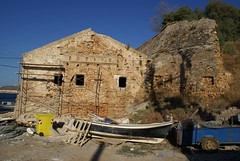
Having already walked around much of Chania, I had the impression that aside from the 15th century lighthouse, many of the town’s landmarks, or architectural points of interest, somehow lurked around streets such as this one. They stood in corners, perched above the roads (or lay below ground level) stealing themselves away in shadows, rather than standing out as buildings often do, waiting like dressed up grandparents for a visit. This is certainly not a criticism (far from it), and there are of course exceptions to this – for want of a better word – rule. But generally speaking, Chania’s visual history is there to be found rather than simply observed. Of course, no building in any town or city gives up its secrets through simple observation; one must enter into some sort of a dialogue. But in the way in which a building might give up its secrets, so Chania gives up its buildings.

Crete

The history of the town is as interesting as it is often tragic, and the scars of war and conquest are manifest in its palimpsestic array of buildings, many of whose origins date back to the Venetian era (13th to mid 17th century). It is the site of the ancient Minoan settlement of Cydonia (evidence of which can be seen in the Kasteli district in the Old Town), and has been ruled successively by Byzantines, Arabs, Ventians and Ottamans, who overran the city in 1645. Finally, in 1941, the Nazis took control and another tragic page in Chania’s history was written.

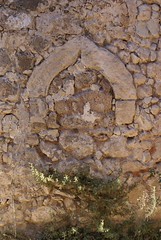
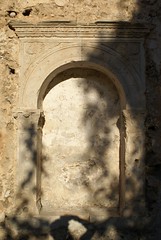
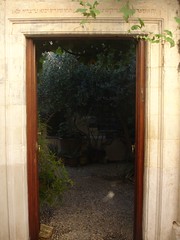
Walking around the town, we found evidence of this tumultuous past in churches turned into mosques and mosques turned back into churches; Islamic arches filled in and plain windows set within the stones. I’ve always harboured an interest in blocked up doors and windows, and here in Chania there were many examples. And this is what I find so fascinating about the town; the fact that ruins are not isolated but are used again in other buildings, that successive architectural values give rise to conflated, unique, and idiosyncratic styles; that where one regime follows another, the past is not torn down, but is modified (one is reminded here of recent debates surrounding communist buildings in post-communist countries).

Crete

Crete

Crete

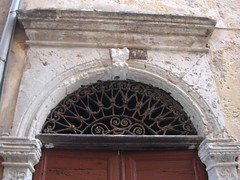
The Janissaries Mosque for example on the western harbour, built in 1645 is now an art gallery, and on its facade one can still see portions of Arabic reliefs – scripts carved from out of the stone. The calligraphy is worn and whispering, yet its presence is a clear reminder of the past. And all around Chania, it is these shards which pierce the consciousness of the traveller; Venetian windows and doorways plugged into tumbledown houses appear like childhood memories from nowhere, and one realises that Chania is not a town of buildings at all, but rather one constructed entirely of fragments. And such is the the number of fragments revealed to those who walk the streets, I found myself – as a typical tourist – taking numerous photographs. My camera was readied as if I was on safari, ready to capture an exquisite Venetian architrave, which might, at any moment disappear back into the shadows. I remember writing a while back, a novel set in my home town Oxford, where the young protagonist observed through an iron gate, one of the last remaining Bastions of the old city wall. “St. Cross was the daughter church of St. Peter in the East and was situated not far from that church in a street of the same name. It was approached by Longwall Street, towards the end of which, just before the junction with Hollywell and St. Cross Road, Adam’s pace slowed in anticipation of the gate through which could be glimpsed a remnant of Oxford’s mediaeval past. It was one of his favourite monuments, but no matter how contrived and deliberate his steps, the lone bastion of the old city wall seemed to fall from sight as if glimpsed from a passing car, as though no mortal eyes could frame it for longer than the time it took to blink. It was as if through the bars, the centuries passed still lingered, appearing in a space built for a second.” This is how I felt, when finding evidence of the past in these remnants of windows and doors. I would stand and try to build the past around them, that from which they were – for a few seconds at least – conspicuously estranged. But no matter how long I looked, for example at the window below, my gaze could never do justice to the scale of the past behind it.

Crete

Even when looking at the photographs, I find the same thing applies, and I’m reminded of a quote from Proust, as discussed in a text by Samuel Beckett: “But were I granted time to accomplish my work, I would not fail to stamp it with the seal of that Time, now so forcibly present to my mind, and in it I would describe men, even at the risk of giving them the appearance of monstrous beings, as occupying in Time a much greater piece than that so sparingly conceded to them in Space, a place indeed extended beyond measure, because, like giants plunged in the years, they touch at once those periods of their lives – separated by so many days – so far apart in Time.” These elements, these architectural shards, are like parts of those same-said giants, parts of limbs touching the present day. We cannot observe with one look the beings as a whole, we can only walk and see in pieces what constitutes the sum, a sum which can only ever be imagined.

I’d thought, whilst walking around Chania, how with every step it seemed to change, as if one were walking through a huge kaleidoscope – a image enhanced by the colour in the streets; the kitsch fodder for tourists, the pink hues of the closing day and the swarms of people, emerging to devour the night, flitting about the myriad lights. The town’s character is revealed through whatever fragment it chooses to present the viewer, at whatever time: a window’s architrave, a decorative lintel, an old vaulted ceiling in one of the many restaurants. I could imagine a mass of giants, writhing beneath the cover of Chania’s single facade, itself like a blanket – a patchwork quilt by which the past is covered.

On the bus to Heathrow, just the week before we found ourselves in Chania, I had been considering my work on the Holocaust and considering the question which so many ask me, ‘why are you interested?’ There is, I have since realised, a reason why, but in the process of finding the answer, I found myself considering other traumatic events and in particular the places where these events were played out, whether Auschwitz-Birkenau, the battlefields of World War 1 or a single cell in the Tower of London. Recently too, I’ve been watching Claude Lanzmann’s ‘Shoah’ and whilst listening to the testimonies of survivors, I thought of those places I had visited; Auschwitz-Birkenau, Majdanek and Belzec. Listening to (and indeed watching) the testimonies of those who perpetrated such crimes (‘may I takes notes?’ asks one, as if learning the facts of the crimes for the first time and thereby denying his own involvement), I found it hard to see, in the faces of men who looked like any other grandfather, the face of the monsters they were (excepting Josef Oberhauser, interviewed by Lanzmann in a Berlin bar). The truth is – and this is what makes the Holocaust all the more terrible – ordinary people, who outside of war would, in all likelihood, have led ordinary lives, did in war, unspeakable things. Likewise, ordinary places became sites of gross inhumanity, trees became soldiers, as if beneath the surface, there exists a poison, which surfaces in history and debases everything and everyone it touches, disappearing to leave the world silent, the victims dead and perpetrators old, old men, hoping that age might rob them of what they’ve done.

Walking up Kondylaki street, away from the harbour, we saw a sign for the the Etz Hayyim Synagogue. We followed the sign, and as if the giants moved beneath the surface of Chania’s long facade, a doorway opened up to us.

Crete

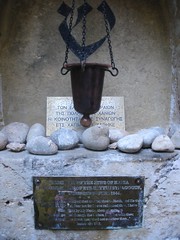
The free literature explained how: ‘the synagogue was reconstructed under the aegis of the World Monuments Fund in New York and the Central Board of Jewish Communities of Greece…’ and that ‘…while committed to its Jewish character Etz Hayyim is also sensitive to the multi-ethnic and religious needs of our times and its doors are open to provide a haven for all persons seeking a place of spiritual repose and regeneration.’

Indeed it was a place of great tranquility; a peace at odds with the past, and the sad history of those who once prayed there.

Crete

Turning back to the pamphlet supplied by the synagogue, I read the following section, entitled ‘The 2nd World War and the Jews of Hania – 1941-1944’. It read: Suddenly, just before dawn on the 29th May 1944, the entire area in which the Jews lived was blocked off by trucks and loudspeakers ordered the Jews out into the street. They were not allowed to take anything with them and were assembled at the south end of Kondylaki Street in the small square and in the square adjacent to the harbour to the north. Within an hour they were driven by trucks to the prison of Ayas not far from Hania. The Jewish Quarter was immediately looted – first by the soldiers. In the late afternoon they synagogue of Etz Hayyim was stripped of all its religious artefacts and left to be rented by squatters. After almost two weeks of imprisonment at Ayas, with little food and no changes of clothes, the Jews of Hania were loaded onto trucks and driven to the east of the island to Herakleion. The official count is that 265 men, women and children arrived there on the 9th June and were put on board a converted tanker called the Tanais that set sail for Athens that evening at 8.00. Along with them were some 600 Greek and Italian prisoners of war. At 3.15am on the morning of the 10th June the ship was sighted just off the island of Milos by a British submarine and immediately given a torpedo broadside that broke the ship apart. All who were aboard were drowned. Had the ship arrived in Athens the Jews on board would have been sent by cattle-cars to Auschwitz-Birkenau for immediate gassing and cremation which is what had already happened to the Jews of Salonika and elsewhere in Greece. 94% of the Jews of Greece perished in the ‘Final Solution’ of the Nazis.

It was hard to imagine, walking back up this street and around those of the old Jewish Quarter, how such a thing could have happened here. But it did.

Crete

“You are nice people…” one of the brothers said. He was again being sarcastic. The group of tourists had declined his advances and so he fixed his eyes on a female member of the party, and drew his hands down, as if to trace her curves. He looked at me and winked, nodding in her direction. I smiled and walked on.

Filed Under: Holocaust, Trees Tagged With: Chania, Holocaust, WWII

A Hollow Square

August 13, 2007 by Nicholas Hedges

Thinking about the Hollow Square further, I thought of Gloucester Green – which is of course a square – and of my previous ideas regarding the contrast between the square at night and during the day. During the day, it might be said to be full, and at night, quite empty. The square too (Broken Hayes) was used to drill soldiers during the civil war, so it has a military history. The idea of empty (hollow) squares

Filed Under: Artist in Residence Tagged With: Artist in Residence, Gloucester Green, Oxford, Residue

Alsace

August 1, 2007 by Nicholas Hedges

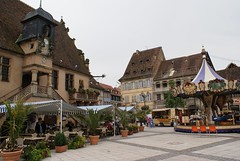
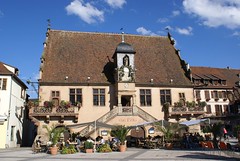
I have just returned from a visit to Luxembourg to see my girlfriend, during which time we took a trip to Alsace. As per usual, I had little idea as to what I should expect of the place, but had heard that it was particularly pretty. The traffic jam on the approach to Metz didn’t bode well, but once we were past this we made our way at a good pace towards our first destination. However, before reaching it, we passed through the village of Molsheim (not so far from our ultimate destination of Colmar) and if ever there was a word to describe it then pretty would be it. The weather was a little overcast, but nevertheless, the village’s obvious picturesque charm shone through.

Molsheim, Alsace

It was we thought rather like something from of a fairytale. One would have hardly been surprised if Shrek had passed by on the street, followed by Donkey and Puss in Boots.
We stayed long enough for a quick stroll, during which time I snapped several pictures, and made our way back to the car. In truth I thought it was a one off, but driving on, we soon discovered that every village was a similar, chocolate-box place; one might have expected to eat the houses, let alone take photos of them.

All this however was in stark contrast to our next stop.

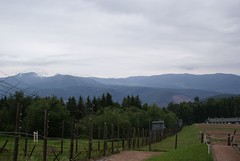
Before making our way to Colmar, we took a detour on a meandering road which led us up into the Vosges mountains. The scenery was breathtaking. The clouds fell and trees rose like arrows to pierce them, whilst the drop at the side of the took one’s breath and cast it over the edges of the road. After a twisting ascent, we finally arrived at the concentration camp of Natzweiler-Struthof.

Natweiler-Struthof

The following is taken from the guide:

“On 1st May 1941, the Nazis opened the KL-Natzweiler concentration camp in a place called Struthof. Nearly 52,000 people from all over Europe were deported to this camp or one of hits annexes. 22,000 of them never returned. On the 23rd Novemeber 1944, Allied Forces discovered the site, abandoned by the Nazis in September 1944.”

It was here that Hitler’s architect Albert Speer surveyed the area and recognised its rich resources of red granite. A camp was therefore established so that slave labourers could be used to work in the quarries. It also housed large numbers of so-called Night and Fog (Nacht Und Nebel) prisoners, so called because they disappeared as if into the night or the fog.

The camp itself is dominated by a large memorial to the many who died here, including many Poles and members of the French Resistance. And, although not a Death Camp per se, the two barracks at the bottom (two of the few which now remain intact) reeked of death and untold misery. Even here, amidst the natural splendour and beauty of the Vosges, there is a room with a hole in the ground to let the blood run through, a white tiled morturary slab and white painted windows, not so much to stop people looking out, but to prevent anyone looking in.

Natweiler-Struthof

It’s strange how they appear gagged; prevented from talking rather than seeing, and taken with the camp’s isolation, they serve to reinforce the silence which hangs over the place like the clouds.
Whether it’s because of the camp’s comparatively small size (certainly compared with somewhere like Auschwitz-Birkenau or Majdanek) or the relatively ‘smaller’ death toll, again compared with somewhere like Auschwitz-Birkenau, the sense of the individual was particularly apparent here – or at least, the sense of ‘individual death’. Perhaps the location – the natural geography of the place – helped foster this feeling, primarily through the sheer size of the landscape by which the camp is surrounded. As a visitor, you feel isolated, you are aware of yourself, and the sheer scale and colour of distance. The blue mountains rising from the horizon like massive cardboard cutout waves in which you might drown; you might well shout but little would be heard, and yet, in just such terrain, echoes rebound; voices and anguished cries from the past, directed at the future of which we are a part.
As with all visits to places such as this (Auschwitz, Birkenau, Majdanek, Belzec) it is the leaving that is most affecting, walking through the gate to rejoin the real world, something which in the case of Natzweiler Struthof, 22,000 people were never able to do.

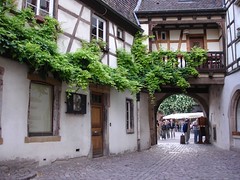
From Natzweiler-Struthof, we made our way to the town of Colmar, home to the artist (as I was later to discover) Martin Schongauer (1448-1491). It would be, I was told by Monika, like Molsheim, but bigger and she wasn’t wrong. Having arrived in the evening and checked into our hotel, we went for a brief stroll, with the main aim of finding somewhere to eat, which we did in a very attractive courtyard.

Colmar, Alsace

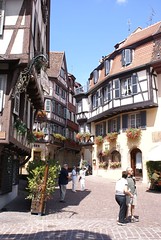
It was clear that this was a beautiful town, yet the next day, when the sun came out, it seemed to open itself like a flower, or as I thought at the time, like a knot, unpicked and unwound. And for several hours we followed this unravelling string of roads and lanes, amazed at every turn at just how pretty it was. Most towns (by no means all) have their more attractive quarters, a sprinkling of timber-framed houses leaning into the streets, peering circumspectively from the past into the present day, yet Colmar seemed to consist almost entirely of buildings such as these. There were of course the odd tower block and less elegant structures, but unlike other towns, where such buildings are in the majority, in Colmar they appeared very much in the minority.

Colmar, Alsace

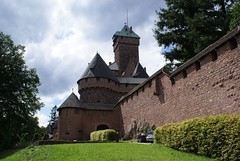
Having walked the streets, sat and sampled the local wine, we drove back towards Luxembourg, visiting the castle of Haut Koenigsbourg on the way. From a distance it does indeed look very impressive, perched on one of the wooded mountains, but up close you realise you’ve been fooled. It makes no apologies for the deception, and tourists, including ourselves still pay the 7 euros and wander through its make-believe rooms, hallways and chambers. It shares something with Colmar, that being the sense that neither would not look out of place in a fairytale. Colmar seems too good to be true, almost contrived, yet walking the streets you feel as if you are in the company of everyone who has ever lived there. They walk with the tourists, the streets they know so well, admiring the houses in which they once lived, telling each other what’s changed since that time. They listen to the stories told by the tour guides, pitting them against their own recollections. But in Haut-Koenigsbourg, we have nothing more than an elaborate film set.

Alsace

Built on top of the ruins of a genuine castle, the present day structure, constructed around 1905, is neither of the ancient past, or the past of a hundred years ago. It says nothing to us, not because it does not remember the past, but rather because it has none. It’s a mayfly, existing only for the day of your visit. It tells you nothing new, but simply echoes what you know already, expecting nonetheless that you might be impressed. Even the photographs displayed in some of its rooms seem phoney. As we left I was reminded of King Arthur in ‘Monty Python and the Holy Grail’, when after the Camelot song he says to his knights; “On second thoughts, let’s not go to Camelot. It is a silly place”. Our sentiments exactly.

Our visit was quick (at least it afforded spectacular views of the surrounding countryside) and from here we made our way back to Molsheim for dinner. Of course we arrived too early (dinner was at 6.30 and not a minute earlier) and so we enjoyed a drink and waited for the hour to arrive, which soon enough it did.

Molsheim, Alsace

And on that hour (or demi-heure) people emerged to occupy the empty tables and chairs by which we were surrounded, as if an invisible signal had been given to which we were not privy. I was reminded of one of the children television shows of the late 60s and early 70s – Trumpton, Camberwick Green and Chigley. In Chigley, a whistle is blown at the end of the programme and all the workers in the factory, and all the town’s residents repair to the bandstand to hear the band. Somewhere in Molsheim, the whistle had been blown. We just couldn’t hear it.

Filed Under: Trees Tagged With: Alsace, Silence

A Rocking Horse at Starbucks

July 15, 2007 by Nicholas Hedges

Whilst writing on old photographs, I came across several pictures of Oxford, taken for the most part just after the turn of the twentieth century. One of them, a view of Cornmarket in 1907 is reproduced below.

This photograph is interesting for a number of reasons (you can read more on this and other photographs here), the clothes – particularly those worn by the women – and the rather rudimentary means of transport, all point to a time long since gone. But what really took my interest, over and above everything else, was the rocking horse in the window on the right hand side of the image (see detail below).

The following is taken from my my writing on old photographs of Oxford:

“…rather sentimentally perhaps, I was drawn to the rocking horse in the window. One can’t help but wonder what happened to this somewhat peripheral object (peripheral in terms of the overall photograph). I can well imagine it languishing in some dusty attic, forgotten, broken… although, of course it might be in very rude health, respected as an old family heirloom. And herein lies it’s point of interest. Whatever its current state – if indeed it still exists – here, in the picture, it’s yet to occupy the mind of the person to whom it belonged. It’s yet to form the memories which that person would carry with them throughout their life, memories which they might have passed down and which might, to this day be talked about. Perhaps this rocking horse no longer exists as a physical object, but maybe somewhere, it continues to move in words, written or spoken.”

I knew the window in which the rocking horse stood 100 years ago still existed, although now, sitting behind the glass, in place of the horse, were people drinking coffee in one one the city’s Starbucks.
Comparing the image above taken in 2007 with that taken in 1907, it’s clear that in the intervening 100 years there have been – obviously – many changes – not least the fact that everyone in the 1907 photograph is dead (Barthes’ ‘Catastrophe’). Also, there have been many changes regarding the street’s physical appearance – several of the buildings have been demolished and replaced, in many cases, not for the better (the concrete block on the corner of Market Street).

Looking beyond the photographs, at the wider world, I looked up a list of inventions and discoveries of the 20th century, to get more of an idea as to what else has changed. Most of course were obvious, but the list ran roughly as follows:
instant coffee
talking pictures
the crossword puzzle
the bra
the pop-up toaster
frozen-food
TV
the aerosol spray
penicillin
bubble-gum
the jet-engine
the computer
the polaroid
cats eyes
canned beer
nylon
radar
the photocopier
the ballpoint pen
the helicopter
the slinky
the atom-bomb
the microwave oven
the Frisbee
Velcro
the credit-card
the non-stick pan
McDonalds (which stands today in this very street – in fact, I took the photograph just outside)
the Barbie Doll
audio-cassettes
felt-tips
the ATM
LCD
VCR
the CD
the post-it note
the ink-jet printer
mobile phones
Apple
Windows
Prozac
the internet…

It’s the small things in this list (e.g. the pop-up toaster and post-it notes) as well as the large (jet-engines, the internet) which particulary interest me; small things, but things which have nevertheless helped shape our world today; the way we think and the way we live our lives. It’s hard to imagine a world without the pop-up toaster, ball-point pens and frozen food, but there it is in the photograph.
I first became interested in the importance of small objects on a residency at OVADA, making a series of walks around the city, on which I would note down anything that took my interest, no matter how small and seemingly irrelevant. Below is an extract from a talk I gave as part of the residency.

“The chances of any of us being who we are is practically nil. In order for me to be born, I had to be conceived at the exact time I was conceived, any difference in time – even a split second – and I wouldn’t be me. Also, everything leading up to that moment had to be exactly as it was; anything done differently by my parents, no matter how small, how seemingly irrelevant, any deviation from the path and I would not be me.”

Any of these smaller objects have the power to alter the path of our lives and as such the future. In 1907, the rocking horse in the window might have caught the attention of a passer-by, enough at least to alter his or her life’s path just for a second, and subsequently, in some small or signficant way, the future. I wonder – if I was walking around the city of 1907, listing things as I did on the residency, whether I would have written down, ‘Rocking Horse in a window’.

This future world has seen enormous changes. The world in 1907, of which that street was a part, is in many respects a completely different place to the world of 2007 (not least because of two world wars, the Holocaust, and countless other wars and atrocities). Yet, the two photographs, or at least the first photograph and my contemporary knowledge of the street, share similarities – they are recognisable as being one of the same thing. In both photographs, the tower of St. Michael at the Northgate can be seen in the distance, standing where it has stood since c.1050.

In fact, despite the wholsesale change in the population and the changes to a number of the street’s buildings, the most striking difference for me, is the absence of the rocking horse. So much about the turn of the twentieth century seems to be expressed by it standing in the window, and so much about the years in between, articulated by its disappearance.

Filed Under: Oxford Tagged With: Catastrophe, Oxford, Rocking Horse, Vintage Photographs

Diaries, Lists and Haiku

June 28, 2007 by Nicholas Hedges

Last night I watched Chris Marker’s film ‘Sans Soleil’ or ‘Sunless’, and having watched it, downloaded the text from the film. There was one passage in particular which interested me which was as follows:

“He spoke to me of Sei Shonagon, a lady in waiting to Princess Sadako at the beginning of the 11th century, in the Heian period. Do we ever know where history is really made? Rulers ruled and used complicated strategies to fight one another. Real power was in the hands of a family of hereditary regents; the emperor’s court had become nothing more than a place of intrigues and intellectual games. But by learning to draw a sort of melancholy comfort from the contemplation of the tiniest things this small group of idlers left a mark on Japanese sensibility much deeper than the mediocre thundering of the politicians. Shonagon had a passion for lists: the list of ‘elegant things,’ ‘distressing things,’ or even of ‘things not worth doing.’ One day she got the idea of drawing up a list of ‘things that quicken the heart.’ Not a bad criterion I realize when I’m filming; I bow to the economic miracle, but what I want to show you are the neighborhood celebrations.”

As part of my residency at OVADA, I spent a long time compiling lists of things I’d seen on a particular walk around the city centre and so this extract intrigued me because of my own efforts in the art of list making. There is something about the mundane that is more telling in respect to the bigger picture of the past than anything one might find in the pages of a history book.
The beginning of the film deals with this very fact:

“I’m just back from Hokkaido, the Northern Island. Rich and hurried Japanese take the plane, others take the ferry: waiting, immobility, snatches of sleep. Curiously all of that makes me think of a past or future war: night trains, air raids, fallout shelters, small fragments of war enshrined in everyday life. He liked the fragility of those moments suspended in time. Those memories whose only function it being to leave behind nothing but memories. He wrote: I’ve been round the world several times and now only banality still interests me. On this trip I’ve tracked it with the relentlessness of a bounty hunter. At dawn we’ll be in Tokyo.”

As one might guess from the extract above, the film had a predominantly Japanese theme, and I was reminded of the Haiku I wrote last year. Most of them were, on reflection, not particularly good, but there were a few which took me almost instantly back to the time they were written. I could remember everything about the time they were written and, more importantly, why they were written.Here are just a few.

In a vague garden
In the morning’s smallest light
The first bird’s singing

Insomniac bird
Sings though we should never know
This dark melody

The moon was a blur
On a long lost photograph
A timeless second

The cat spies the birds
While they look down from above
And I watch them all

Secrets of the deep
Are whispered by the Snowdrop
Missing its flower

Just for a moment
I swapped places with a cat
Sitting on the wall

Incongruous field
A horse without a rider
Stands like a shadow

The painted subway
A crow hovers on the wind
I think of angels

The tall girder-cross
Lone man sits in a cafe
She can’t stand his kiss

The sudden trees have
Grown before the constant gates
The violent field

I was listening to a discussion programme on ‘Diaries’ and in particular, what makes a good diary. I, like many people have tried keeping a diary or journal and actually managed to sustain one for about 10 years, between 1989 and 1999. Much of it, is of course of no interest to anyone else but me, and even then, the greater part of the entries are a little mundane (and not mundane in a good way – as described above). What was agreed, during the conversation, was that what makes a diary interesting is not what the author thinks, but rather what they see. It is again the small details which help to build the bigger picture of the time. Of course, this is by no means a rule, and there are many exceptions where the good and the great have opened their hearts and inspired nothing less than awe. But these are exceptions.

Turning back to Haiku, I read the following in a book (On Love and Barley) on the great Haiku poet, Basho (1644-1694) :

“So the poet presents an observation of a natural, often commonplace event, in plainest diction, without verbal trickery. The effect is one of spareness, yet the reader is aware of a microcosm related to transcendent unity. A moment, crystallised, distilled, snatched from time’s flow, and that is enough. All suggestion and implication, the haiku event is held precious because, in part, it demands the reader’s participation: without a sensitive audience it would appear unimpressive. Haiku’s great popularity is only partly due to its avoidance of the forbidding obscurities found in other kinds of verse: more important, it is likely to give the reader a glimpse of hitherto unrecognised depths in the self.”

There are two lines in the above which interest me the most. Firstly, the reference to a commonplace event, and secondly, the suggestion that the poems demand the reader’s participation. It is by sharing a moment that we become a part of that time which has long since passed.

The following is one of Basho’s haiku as printed in the book:

Old pond
leap-splash-
a frog.

In terms of taking us back to a moment, the three lines above do just that. It isn’t necessarily that we see the pond, see the frog, the poet, but rather that we experience a second or so of the seventeenth century as if it were happening now.

Filed Under: Artist in Residence, Lists, Trees Tagged With: Artist in Residence, Basho, Diaries, Haiku, Listmaking, Lists, Moments, Nowness, Residue

Random Memories: The 1983 General Election

June 26, 2007 by Nicholas Hedges

I have recently started to think more about my memories and how I should start writing them down, not because as a collection they would amount to a great memoir, but because it’s often the small snippets which come to us for no apparent reason that are amongst the most interesting. Reading the work of W.G Sebald has certainly precipitated this idea and so, here I am with a memory which came to me a few moments ago. I should point out that these memories are not stories or anecdotes; they do not have a punchline or cast new light on momentous moments of the past, but rather they are fragments which remind me of how life really was. Incidentally, I took delivery today of a copy of Walter Benjamin’s ‘The Arcade Project’, a large tome, made up of quotes, thoughts, ruminations etc. on the Parisian Arcades of the Nineteenth Century. To borrow, or rather steal, from the translators’ notes:

“Benjamin’s intention from the first, it would seem, was to grasp such diverse material under the general category of Urgeschichte signifying the ‘primal history’ of the nineteenth century. This was something that could be realized only indirectly, through ‘cunning’: it was not the great men and celebrated events of traditional historiography but rather the ‘refuse’ and ‘detritus’ of history, the half concealed, variegated traces of the daily life of ‘the collective,’ that was to be the object of study [my italics], and with the aid of methods more akin – above all, in their dependence of chance – to the methods of the nineteenth-century collector of antiquities and curiosities, or indeed to the methods of the nineteenth-century ragpicker, than to those of the modern historian. Not conceptual analysis but something like dream interpretation was the model.”

It’s often the case, that these small pieces of memory, these apparently inconsequential fragments, often build to give a much clearer, more defined image of a time, than a particular event or traditional historiography, and, as such, I will write as many that spring to mind over the coming months.

The first of these fragments concerns me riding my bike (I was going to write ‘cycling’ but ‘cycling’ wasn’t what I did when I was a boy. I ‘rode my bike’ as all boys did). I was ‘riding my bike’ up Ambleside Drive (one of the roads around where I grew up) at a time approaching an election. I’m not entirely sure as to which election it was, but given my age, I can only assume it was the General Election of 1983. Ambleside Drive itself was a very pleasant road which rose from the bottom of a hill (where was my old school) to the top – Eden Drive – where one would find a small collection of four shops, all of which have since disappeared: Kendal’s (groceries), Tucker’s (butcher), Shepherd’s (greengrocer) and the Post Office. I have many memories of this small parade which would fill several pages in themselves, but for the moment, here are just a few.

I remember buying sweets in Kendal’s (when this shop closed, the purchase of sweets was transferred to the Post Office opposite or Mallows at the bottom of the hill) and being amazed by the slicing machine with its circular blade. Here we purchased our sweets prior to going to the cinema up in Headington; they were a type of sweet I can’t quite put my finger on, although mint and lemon seems to ring a bell. The cinema was at the top of the road where my grandparents lived and it was here I saw Benji and Grizzly among many others. I remember little else about Kendal’s, apart from the slices of ham falling from the machine, the cheese slicer, the jars of sweets (a ‘quarter of pear drops’) up on the left, ‘Wavy Line’ and the path outside, which ran by the side of the shop to join the road. When the shop closed and became a house, I couldn’t quite believe I wasn’t able to walk on that path anymore, and the whole idea of a shop becoming a house seemed to go against the whole nature of things – just as it does today. In fact, there is something still quite ghostly and not a little sad about this small parade.
Mr Tucker the butcher (adjacent to Kendal’s) was a cheerful man, always in his dirty white coat, bald head, black-rimmed glasses and sporting large sideburns. I can see him now taking the pencil from behind his ears and writing the price on the paper packet, containing whatever meat Mum was cooking that week. I remember the beaded curtain to the back, the way he wrote his prices in deformed numerals, in the window display and on the board outside. And the handles of the doors – I remember them, along with the front wall, which, I believe is still there today.

Mr Shepherd, the greengrocer (opposite Tucker’s) was was a cheerful man. He too would always have a pen behind his ear and would wear a coat that was either green or grey. I seem to recall an orange biro, or even a collection of biros in his top pocket. Like Mr Tucker, his prices comprised deformed numerals, and whatever was requested, he would measure it into the bowl of his scales, which were without doubt the most formidable I have ever seen – the mass of numbers which made up the chart would however, be read in an instant – take the pen from behind his ear and write the product and price on the order pad. I can see his writing now, black biro, almost illegible, slanting to the right. In a deft manoeuvre, the bowl of the scales would be tipped up, the contents emptied into a brown paper bag, the open corners gripped and the bag swung over itself so as to close it, all done as if a conjurer on a stage.

Outside the shop was a figure of eight path which ran around two patches of grass. We would ride around these on our bikes or tricycles whilst Mum carried on with the shop inside. I vaguely remember Mr Shepherd’s brother. He too worked in the shop until one day he disappeared. I later learnt he’d hanged himself.

The Post Office was pretty much that, and was the last of the four shops to close.

Returning to the election, I must admit that I cannot remember much about it. Of course now I know the result (Conservative landslide) and its place in history, but in terms of my contemporary thoughts there are none – all except for the fact that even at that young age (I would have just turned 12) I couldn’t understand why anyone would be voting Conservative. Conservative? Quite where my disdain originated I don’t really know; one assumes it was at home, but my parents were never what I would call political. All I can remember is looking in bewilderment at the small blue posters in the windows of a few houses up the road. The posters were particularly neat and quite unlike the posters one sees displayed in windows these days; certainly, the current vogue of nailing one’s colours to huge boards in the front garden (as if one were selling the house) didn’t, as far as I recall, exist back then. No luminous-green posters with the red font of Labour (back then the liveries were simple; blue or red) , and certainly not the bright orange diamonds of the LibDems (who were then the SDP Liberal Alliance). In fact, there is something about Liberal Democrat posters which belie their power in parliament; perhaps the smaller a party’s tally of seats, the louder they have to ‘shout’ in the hustings. At the last election, some LibDem posters I saw were large to the point of obscene. Back then however, the conservative posters (which were actually more like postcards) were well mannered – much like those who looked out from behind the windows in which they were displayed. They didn’t shout but rather stated their allegiance as if introducing themselves at a wake.

And so I cycled on. Perhaps to post a letter or to just to go to the shops.

Corfe Castle 1983
Corfe Castle. Taken in 1983.

Filed Under: Uncategorized Tagged With: Arcades Project, Childhood, Memory, Walter Benjamin

On Old Photographs

June 13, 2007 by Nicholas Hedges

Over the course of the past week, I’ve been scanning in what amounts to almost my entire collection of family photographs. I started, initially, a while ago with just a few that I particularly liked, but after a time, began to think of scanning all those contained in various old albums, a plastic bag and a dilapidated cardboard box. The possibility that one day they would be lost was as good a reason as any; that and the fact it would be easier to view them and to organise them (through the joys of Flickr) were my principal motives.

So, staying up late into the night, I have, over the last few days become somewhat obsessive, and scanned in a few hundred photographs, covering a period of time between c.1946 to c.1997. And, although at first this was a purely practical exericse, it soon became much more than this. It was, and still is, a journey of discovery, for in these small, ‘chemical annexations’, I can see again faces long since lost to the past; revisit once familiar places, and perhaps most poignantly of all, find long lost objects as if I were rummaging through the contents of an attic.

I will write about this experience at length, but will conclude with a summary of what I’ve been thinking when looking at these images. Firstly, I’ve come to realise how drawn I am to ‘bad’ photographs such as the one below:

Unknown Seaside

There is something about this photograph (and many others like it) which I find particulary haunting; something about its amateurishness, which makes it seem somehow more genuine. It has the freshness of a sketch as opposed to a finished painting and contains references to an experience which is both direct and profound. Perhaps it is the footprints in the sand, long since washed away which I find so affecting? Or maybe the unknown swimmers and the water-skiier: distant then, and as just as unknown to me now. What course did they take through life after this picture was taken? Did they yet survive the sea, in which, in time, we all will come to be drowned?
As Barthes said:

“I observe with horror an anterior future of which death is the stake… Whether or not the subject is already dead, every photograph is this catastrophe.”

The photograph above seems to illustrate this perfectly, as do many ‘bad photographs’ I have found. Perhaps it’s because they contain this reference to the less than falable human holding the camera (a difference between chemical and digital).

Following on from this, I’ve become very interested in the peripheral parts of photographs, particularly in relation to images taken near the sea (distant swimmers, ships and so on). I have already written about windows in relation to other photographs, but having recently scanned and observed so many images, I’ve come to realise that it’s these areas which are the most ‘genuine’, perhaps because those inhabiting the distance are freed from the artifice of a pose, or because at the moment the picture was taken (just as they were for the rest of their lives) they were oblivious to the photograph’s principal subject and the one taking the picture.

This obliviousness is something I find quite compelling, particularly in relation to my work on the Holocaust, whose victims were by and large anonymous, both in life and now in death. Although I wasn’t living at the time, many members of my family were; they were the ones on the periphery, the specks in the distance, oblivious to what was going on behind them.

This is a photograph taken in c.1976. It shows my brother in the foreground playing tennis, a lovely image of a fondly remembered family holiday. But what interests me, in relation to my thinking, is the distance.

Looking out to sea we can see a ship, a tanker, sailing under the direction of more (and no doubt large numbers of) human beings, hidden away and quite unknowable. Yet for a time we shared the same stretch of the planet. Those onboard would have had no idea as to our existence, they would have seen at best a mass of coloured dots on the horizon. Yet this degree of separation does not make us any less human, any less feeling. Distance does not negate our hopes and our ambitions. Those few unknowable dots, in the eyes of the ship’s crew, were my family, and have in the years that followed, seen more members come and go. And whether the distance between us is measured in years or miles, we must never forget, that what we see as specs on the horizon, or dots that make the picture on the TV screen, are, in the end, the same people as us.

For more on this subject, click here.

Filed Under: Photography Tagged With: Bathes, Catastrophe, Childhood, Creatures, Details, Holocaust, Photographs, WWII

  • « Previous Page
  • 1
  • …
  • 26
  • 27
  • 28
  • 29
  • 30
  • …
  • 32
  • Next Page »
  • The ‘Now of Then’
  • Artist’s Statement
  • Designs for an Heirloom
  • Dissonance and rhyme
  • Wildflowers
  • Emptiness
  • Wave (goodbye)
  • Now In The Past Of An Unreal Place
  • Return to Graphite
  • Genius
  • Latest Backdrops
  • Extended Backdrops
  • Backdrops
  • Komorebi
  • Acorns
  • Scroll Work
  • Goethean Observation: Japanese Scroll
  • Mistakes
  • The Leaf Is Singing Still
  • Past Present
  • Scrolls
  • As Yet Untitled
  • Holes
  • Scroll
  • A Calligraphy of Shadows
  • More Paintings
  • Latest Paintings
  • Walking Meditation 2
  • Knowing We Are There
  • Venice by Moonlight 1840
  • Fragments and Additions
  • Reimagining The Past
  • Walking Meditation 1
  • Mindful Walking I
  • Grief II
  • Three New Paintings
  • Nana’s Mountain
  • Painting
  • Iridescence
  • Roman Bottle
  • Rinsho
  • Shadow Calligraphy
  • Becoming Memory
  • Fox Talbot’s Glassware
  • Goethean Observation: Diffuser II
  • Goethean Observation: Diffuser
  • A Remembrance of Things We Never Have Known
  • A Moment’s Language
  • Take Me Home
  • Arrival/Departure
  • Diffusers
  • Grief
  • Mum
  • Measuring the past
  • Disordered Time
  • Entropy
  • Wicked Magician, Fly
  • The Quanta of History
  • Empathy Forward
  • The Natural World of 978
  • The Gone Forest
  • Empathy/Exchange: 668 grams
  • Goethean Observation: Pilgrims of the Wild, 1935
  • Nazareth O
  • Several Johns and St. Thomas
  • Raspberry
  • Tokens and Shadows
  • Patterns Seeping (II)
  • ‘Missded’ 4 – Tokens
  • Patterns seeping
  • Cut Paintings
  • ‘Missded’ 4
  • Locks III
  • Locks II
  • ‘Missded’ 2 – Tokens
  • My Son’s Drawings II
  • ‘Missded’ 2
  • ‘Missded’ 3 – Tokens
  • ‘Missded’ 3
  • ‘Missded’ 1 – A Framed Token
  • Morning Has Broken
  • Tokens of absence
  • ‘Missded’ 1, stitched
  • More Little Words
  • Three Little Words
  • Spaces In Between
  • ‘Missded’ 3
  • ‘Missded’ 2
  • ‘Missded’ 1
  • Locks
  • Tracings
  • My Son’s Paintings
  • Writing Shadows
  • Samuel Borton’s Post Chaises
  • Dawid Sierakowiak
  • Pitchipoi
  • Latest Tree Drawings
  • Notebook
  • Somewhere Between Writing and Trees II
  • Somewhere Between Writing and Trees

© Nicholas Hedges 2024

  • Facebook
  • Instagram
  • Twitter
  • YouTube

Copyright © 2025 · Outreach Pro on Genesis Framework · WordPress · Log in