Nicholas Hedges

Art, Writing and Research

  • Amazon
  • Behance
  • Facebook
  • Instagram
  • Pinterest
  • YouTube
  • Art
    • Digital
    • Drawing
    • Grids
      • Correspondence
      • The Wall
      • The Tourist
    • Ink on paper
      • Shadow Calligraphy
    • Installation
      • Murder
      • Echo
    • Painting
    • Patterns
    • Mixed Media
    • Photographic installation
      • St. Giles Fair 1908
      • Cornmarket 1907
      • Headington Hill 1903
      • Queen Street 1897
    • Research/Sketches
    • Stitched Work
      • Missded 1
      • Missded 2
      • Missded 3
      • Missded 4
    • Text Work
  • Blogs
    • Family History
    • Goethean Observations
    • Grief
    • Light Slowed But Never Stilled
    • Lists
    • Present Empathy
    • Shadow Calligraphy
    • Trees
    • Time
    • Walking Meditations
  • Video
  • Photography
    • Pillars of Snow
    • Creatures
    • The Trees
    • Snow
    • St. Giles Fair 1908
    • Cornmarket 1907
    • Headington Hill 1903
    • Queen Street 1897
    • Travel
  • Illustration and Design
  • Music
  • Projects
    • Dissonance and Rhyme
    • Design for an Heirloom
    • Backdrops
    • Shadow Calligraphy
  • Exhibitions
    • A Line Drawn in Water
      • Artwork
    • A Line Drawn in Water (Blog)
    • Mine the Mountain 3
      • Artwork
    • Mine the Mountain 2
      • Artwork
      • The Wall
    • The Woods, Breathing
      • Artwork
    • Snow
      • Artwork
    • Echo
      • Artwork
    • Murder
      • Artwork
    • The Tourist
    • Dreamcatcher
    • Mine the Mountain
      • Artwork
      • The Tourist
    • M8
    • The Gate
    • Creatures
      • Artwork
    • Residue
      • Artwork
    • A visit to Auschwitz
      • Artwork
  • Me
    • Artist’s Statement

Poem – The Crematorium

August 12, 2009 by Nicholas Hedges

And so to the crematorium
We’ll make our way again. This empty place
Full of names, shards like glass from broken
Window panes, and rain like thorns on roses.
To the waiting room where no-one sits
Where all the clocks have stopped to rub their hands
Where mourners recount the hour of the toll
And one by one swallow nothing whole.

Through the gates the headlights come, bearing down
On everyone who waits. Black slick night,
Shadows in no hurry for today or
Days that have passed. A nervous laugh
Hovers above the breathless chimney stack
A graceful scar upon the tumbling sky
The bird floats high by dint of searching eyes
And dives. Gone as if it never was at all.

We greet old friends and those still unknown
With half-suppressed expressions. Like uncertain
Lovers in love’s first encounter; a chain-gang shackled
By the things we should remember, we walk
Towards the chapel. We follow the pipes
That bellow death in gentle slumbered tones
And take our seats with strangers; our only
Child in common has seen the flame and blown.

We hide in the order of service
Words of hymns that nobody knows, rising from
The page like cat-pawed moths, flitting round a
Hopeful bulb. Then at last the curtains close
To hide the cheap illusion. Some close their eyes.
Some stand with hands clutching their tears
Like summer drinking rain. Then all go home
Beyond the flowers, until it’s time again.

Filed Under: Poetry Tagged With: Poem, Poetry, The Crematorium

Mr Stevens

August 11, 2009 by Nicholas Hedges

A year or so ago, I started work on a piece of work based around John Gwynn’s survey of 1772. The piece was called (as a working title) ‘6 Yards 0 Feet 6 inches’ based on the measurement of John Malchair‘s home in Broad Street. Having discovered an ancestor – John Stevens – born in the city in 1811, I wondered if there was any chance that one of the Mr Stevens’ listed on the survey was an ancestor of mine? It seemed a long shot but after today’s research I’m rather more optimistic.

If I did have an ancestor in Oxford at the time of the survey and if my research is correct, then that ancestor would be John Steven, the grandfather of the one previously mentioned. I’ve no idea when he was born but I do know that he was married in 1764 and is described as coming from St. Martin’s Parish, where his son Samuel, John Jr’s father was baptised in 1776. One could assume therefore that I did indeed have ancestors living in the parish of St. Martin’s at the time of the survey.
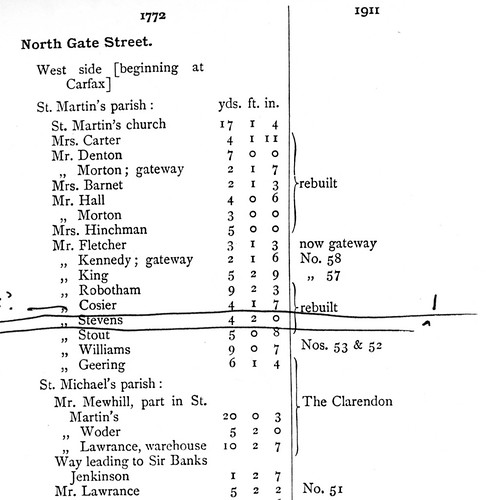
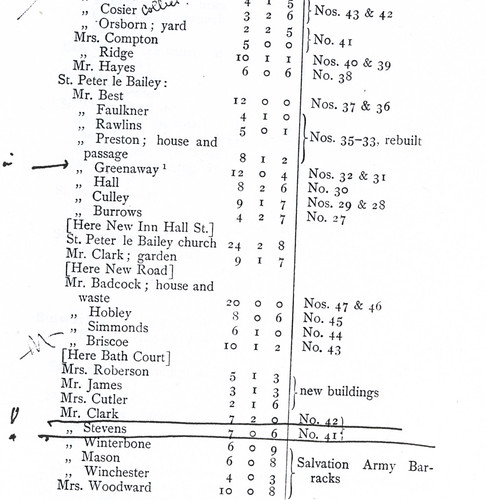
The images below are taken from the survey and show two Stevens one of which might well be my ancestor.

Gwynn fails to include (at least on the copy I have) first names from the survey but within the parish of St Martin’s two Mr Stevens are recorded along with a Mrs Stevens. One can assume however, that those most likely to be mine are the two Mr Stevens mentioned as living in the parish, one in Butcherrow (now Queen Street), the other in North Gate Street (now Cornmarket). The residence in Butcherrow is 7 yards 0 feet and 6 inches. That in North Gate Street is 4 yards 2 feet 0 inches.

John Gwynn's Survey 1772

John Gwynn's Survey 1772

Of course more work is required to see if one of these is indeed my ancestor, but I must admit to being very inspired by the prospect.

Filed Under: Oxford Tagged With: 18th Century, Family History, Family Stevens, John Gwynne, Oxford, Stevens, Survey

John Stevens (1811-1876)

August 11, 2009 by Nicholas Hedges

Researching John Stevens in the library today, I found what I’m sure must be his parents. Having looked at the Index of Baptisms for the time around his birth (1811) I found only one person matching his dates. John Stevens was born on 7th October 1811 in St. Aldate’s parish. His parents are given as Samuel and Mary Stevens, and looking at John Stevens’ children, I found that his second born son is named Samuel (his first son is called John). I decided to see if I could locate a Samuel Stevens in the Parish Registers. I couldn’t be sure that he was born in the city but it seemed quite likely. Sure enough I found a Samuel Stevens born on the 4th April 1776, baptised in St. Martin’s (now demolished). His parents were given as John and Lydia Stevens and so I looked for a record of their marriage in the city. Again my luck was in and I found that they were married on March 24th 1764 in St. Mary Magdalen. Lydia’s maiden name was Borton and the witnesses at the wedding were Sam Borton and Mary Stevens. John is described as being from St. Martin’s which is where Samuel was baptised.

Filed Under: Family History Tagged With: Family History, Family Stevens, John Stevens, Stevens

Old Newspapers

August 8, 2009 by Nicholas Hedges

I’ve just spent the afternoon in the library reading through a selection of old newspapers from 1771/2 along with numerous copies from the ninetheenth century. I was hoping, initially, to find anything mentioning a Mr. Stevens, Tailor as in a survey of the city (1772) made by John Gwynn several Stevens are listed. As my ‘several-greats’ Grandfather was born in Oxford in 1811 and was a tailor, I wondered whether one of these might be a relation. Anyway, unsurprisingly I found no such mention, but what I did find were a few tantalising glimpses into the 18th century city.

The first is the theft of some lead on October 11th 1771:

“Whereas a considerable quantity of lead has been stolen from off the gate of the physic gardens’ opening into Rose Lane. This notice is given that whosoever will give information to the Rev.Dr. Wetherell, Vice Chancellor, so that the offender or offenders may be brought to justice, shall upon his or their conviction, receive a reward of five guineas.”

Whether or not the guilt party were ever brought to book I don’t know. A couple of weeks later, another audacious theft occurred, this time in Holywell Street:

“Whereas on Monday the 21st of this instant October 1771, the iron rails to the steps of Mrs. Wise’s house in Holywell were taken away. This is to give notice that if any one will discover the offender or offenders so that they may be brought to justice, shall, on his or their conviction receive half a guinea reward from Francis Kibblewhite in Holywell.”

Looking at my 1772 survey, I see that Mrs. Wise lived at what is now called No.2 Holywell Street. Mr Kibblewhite lived at what is now No.38.

Following a burglary on November 8th 1771 in Old Butcher Row (modern day Queen Street) the reward offered for information was much more tempting – provided of course, one had information with which to complete any deal, and thus be tempted to impart.

“Whereas the dwelling of Mr. John Greenway situate in the Old Butcher Row, in this city was last night broke open and divers sums of money and other valuable effects stolen thereout. Notice is hereby given that if any person or persons will discover the offender or offenders so that he, she or they may thereof be committed, he shall receive the sum of fifty guineas from me.”

This very large amount of money (a guinea was equal to £1 1s) was offered by Francis Greenway. The following week on November 16th, the news appeared again with an addendum:

“N.B. It is discovered that a plain round gold snuff box and eight gold rings, chiefly Mourning ones belonging to the family were at the same time taken away.”

The following week this appears, just below the same story repeated for the third week and addressed ‘To the Publick’:

“Whereas some evil designing persons have maliciously propagated various infamous aspersions which tend to injure our characters relating to the late robbery committed at Mr. John Greenway’s home in old Butcher Row; in order to vindicate and clear ourselves of the said aspersions, we did severally make oath that we were not in any wise directly or indirectly concerned in the said robbery or have any knowledge of the person or persons who committed the same, and we do declare that the said aspersions so far as they tend to lessen or injure our reputations and characters are totally false.”

The letter is signed again by Francis Greenway although whether he is including himself as one of the aggrieved I’m not sure. Below his name are the names of two servants, Mary Staunton and Jane Carpenter who made their oath before the Mayor, John Austin. Francis Greenway offered a further 5 guineas to whosoever gave information leading to the conviction of the slanderers which he increased to 20 guineas later on. This was not the end however. On December 7th 1771 when the same story appeared with the same letter to the publick beneath, Francis Greenway wrote:

“And as it is apprehended more than one person must have been concerned in the above burglary, this further notice is given that any one giving information against his accomplice or accomplices shall be paid the above reward of 50 guineas upon his, her or their conviction and will likewise, upon being admitted evidence, be entitled to a Free Pardon.”

That was still not the end of the matter. On December 21st, he added that the reward of 50 guineas was “besides the forty pounds allowed by parliament for me.”

These notices or stories were printed every week and did not stop being printed until March 21st 1772. Whether anyone was brought to justice I don’t know.

Perhaps the most enigmatic story or notice I read however was that printed on February 8th 1771.

“Whereas a person (supposed to be a Gentleman’s Servant) went out of Oxford, December 12th 1770 over Magdalen Bridge and took the Watlington Road riding a horse with a long tail and leading another with a cut tail on which a Portmanteau was tied: whoever recollects seeing the same person and can give information of his name and place of abode so that he may be spoke withal, shall on such proof receive half a guinea reward from the printer.”

Not exactly 50 guineas, but a very curious notice which has left me, as have the stories above, with so many questions. Who stole the lead and Mrs. Wise’s railings? Who carried out the robbery in Old Butcher Row – was it an inside job? And who was the man on the horse, leaving the city over Magdalen Bridge in the winter of 1770? Time – as far as I’m aware – hasn’t told so far. So, maybe I will.

Filed Under: Oxford Tagged With: 18th Century, Gentlemans Servant, History, Newspaper Cutting, Oxford, Servant

The Mayos

August 2, 2009 by Nicholas Hedges

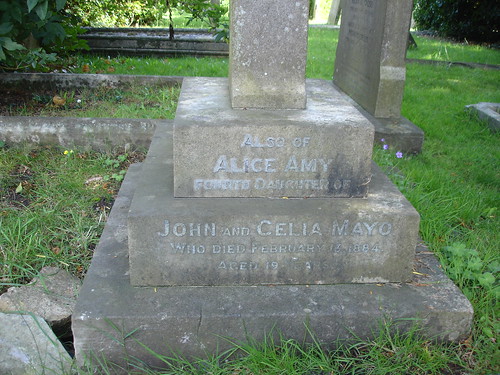
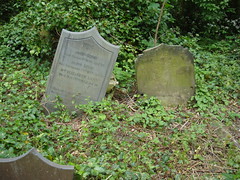
Having looked again at the gravestone mentioned in the previous blog, I realised that I made a mistake as regards John and Celia Mayo. The date of death, February 18th 1884 refers to the fourth daughter of John and Celia, Alice Amy. What becomes apparent however when looking at the gravestone, is the dreadful toll of deaths suffered by the family. One particularly feels for the father, John Mayo, who having lost his wife at the age of 36, then went on to lose four daughters in the space of 9 years. The youngest was 18, the eldest just 22.

Celia, first daughter, died August 5th 1875, aged 22.
Agnes Lucy, second daughter, died January 16th 1880, aged 22.
Laura Edith, third daughter, died March 28th 1878, aged 18.
Alice Amy, daughter, died February 18th 1884, aged 19.

Mayo 1871

Filed Under: Oxford Tagged With: History, Jericho Cemetery, Mayo, Oxford, Unknown People

Individuals

August 2, 2009 by Nicholas Hedges

Today I took down my installation in St. Sepulchre’s Cemetery, Jericho, which despite the weather (relentless rain) went very well. As with anything like this when work is placed in an unsecured public space, one expects that a few things might go missing, but over the course of two and a half weeks only one label was taken. Two of the label stands had been used by a homeless guy to secure his tent and people I’ve met subsequently assumed that the tent was in fact part of the work. Hardly surprising really, particularly when one considers that a tent or tent-like structure in a cemetery usually denotes an exhumation. In this sense, the tent worked quite nicely with the idea of me bringing the my ancestor – dead for over 150 years – to the surface.

Part of the idea behind the piece was that the story of my great-great-great-grandmother would lead people around the cemetery whereupon they would discover the names of other people buried in the cemetery. As I took the installation down, I noticed a grave on which were listed several names including John and Celia Mayo who died on the same day, February 13th 1884. They were both 19 years of age. What the story is behind their deaths I don’t know, but certainly it’s something I will be exploring in the near future.

Names

Filed Under: Uncategorized Tagged With: Jericho Cemetery, Mayo, St Sepulchres Cemetery, Unknown People

The Place That’s Always There

July 31, 2009 by Nicholas Hedges

The image below is a work in progress. Following on from the series of works I’ve made which have been variously titled ‘Creatures‘ and ‘Broken Toys‘ I’ve started to look at the landscape from which these images of people have been taken.

The Place That's Always There

Filed Under: Uncategorized Tagged With: Broken Toys, Creatures, The Place That's Always There

Stephen Hedges (1811-1885)

July 20, 2009 by Nicholas Hedges

I discovered Stephen Hedges about a year ago whilst researching my great-great-great-grandfather Richard Hedges (1808-1882). The two of them were brothers. Having noticed that Stephen died in Australia in 1885 I straight away wondered whether he’d been transported there. Sure enough, a descendent of the family, Julia, confirmed the fact. She herself is descended (like me) from William Hedges who was born in Abingdon in 1750 and his wife Jane (surname unknown) who was born in 1754. I am descended from their son Henry Hedges (1776-1844) and Julia from his brother James (born in 1787). Stephen and Richard were sons of Henry.

Stephen Hedges was convicted at the Berkshire Easter Sessions at Newbury on April 15th 1828. On trial with him were his co-defendents, H. Stockwell and J. Harper. They were all indicted for stealing 154 lbs of lead from a house in Radley and having been found guilty Stephen and Henry Stockwell were sentenced to be transported to Australia for 7 years.

Stephen Hedges (and his accomplice Henry) left England on June 27th 1828 aboard the Marquis of Hastings, arriving in Port Jackson, New South Wales on 12th October. Having served his sentence, Stephen remained in Australia, marrying Elizabeth Carter on Christmas Eve 1838.

Below is the first part of a report concerning Stephen Hedges’ conviction taken from Jackson’s Oxford Journal (April 26th 1828) – click on the image to open the full PDF.

Filed Under: A Line Drawn in Water, Artist in Residence Tagged With: A Line Drawn In Water, Family History, Newspaper Cutting, Stephen Hedges

Before Demolition

July 19, 2009 by Nicholas Hedges

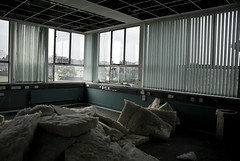
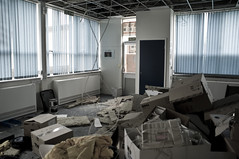
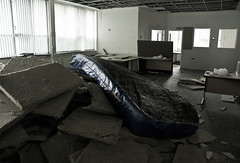
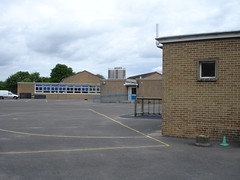
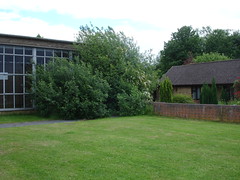
On Friday last week I paid a visit to my old school (Northway Midddle) which is due to be demolished in the next few weeks to make room for houses. I left the school in 1984, the year that it was closed, and even then it was clear that the preferred option of many was to pull it down and make room for houses. Ever since, the building has remained standing in a kind of limbo, part community centre, part office space and having heard the decision last week to finally put the place out of its misery – a decision which seems absurd given its potential (potential which the council couldn’t see if it picked up a football and did six hours of keepy-ups) – I decided to try and gain entry and take a few photographs before it’s lost forever.

Northway Middle School

Granted, Northway School is not the most beautiful of buildings, but with its gym and playing fields, art room (including a walk-in kiln) and stage it could have been turned into a first class sports and cultural centre. Of course the council were as unimaginative in 1984 as they are today and instead it became a wasted space. And whatever the merits – or otherwise – of the building itself, it’s nonetheless a piece of the area’s heritage. It’s played a major part in the lives of many people and deserves to be recorded.

Therefore with my camera I endeavoured to do just that. I had been warned that the interior of the building had been altered a great deal after 1984 but even so I wanted to find something, one image that encapuslated what the place meant to me and many others. Standing inside the building for the first time in 25 years I could see just how much it had changed (rather like myself), and as I walked around in the company of the caretaker, I found that my memories were somehow scrambled as if by by the stud walls and altered layouts of the rooms. Nevertheless I started taking pictures, attempting to jump start my memory, as if the camera was a defribulator for my brain.

Before Demolition

The stairwell hadn’t changed a bit and I could almost hear the sound of the school bell and voices chattering. But in most parts of the school’s trashed interior it was as if I was walking in a place I’d never been to before. Even the view through the windows had changed almost beyond recognition. The John Radcliffe hospital loomed ever larger and the playground had already been turned into houses. Only the imposing tower block on the estate anchored the view in the past, and catching a glimpse of it through a few of the windows started the memories coming.

Before Demolition

After about half an hour and having walked around the school from top to bottom, I began at last to recall things, to see memories much more clearly. I was able to remove the stud walls and new corridors and reimagine how the place had looked when I was there. I remembered the maths room and Mr Smith. I could recall how he’d turn on the lights before appearing. In looking out the window, I could also remember that I’d been in this room when my grandad had died on January 13th 1984. It was around 2.15pm when he passed away.

Before Demolition

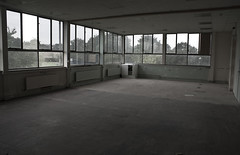
Perhaps the room I remembered most clearly and that which was the most recognisable was Mrs. Bantam’s. She was my teacher in the first year and even though the room was just a shell, I could easily recall how things had looked, what it was like to move around inside. The way we move around a given space and the way memories are ‘attached’ to such a movement became very apparent here. Whereas before (except on the stairwell) familiar paths through the building had been blocked by ‘new’ partitions and so on (particularly in the third year area), here those paths remained intact. Memory isn’t only triggered by what we see and hear and what we smell, but the way we move through a space. Memory is kinaesthetic.

Before Demolition

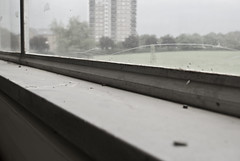
After about an hour I had to leave, finishing with photographs of the windowsills into which some pupils had scratched their names.

Before Demolition

As I think back to my visit, I don’t so much see the things I saw then, the images which you can see on the photographs, but rather my memories, which despite the altered condition of the interior have become sharper – at least in places.

Before Demolition

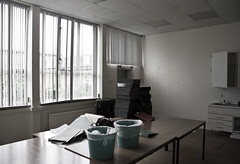
The above picture was once the science room, the domain of Mr. Hipkiss. The room I remember as being dark. There were high wooden desks, a blackboard in the corner and the strange lingering smell of chemicals which were kept in a room at the front of the class. We had to cover our books in wallpaper (woodchip in my case) and it was in this room that I first heard the word Google. In fact, I now recall how Mr. Hipkiss had written the number (a Googleplex, one comprising umpteen noughts) on a long sheet of paper. I can see it now on the wall. I seem to remember black blinds which might account for the fuliginous aspect of my memory and the faces Mr. Hipkiss drew of eminent scientists which were always photocopied so the text and drawings were pink. They weren’t true likenesses, he told us. He had made them all up.

Before Demolition

The above picture shows the old art room and at the back was where we had cookery lessons with Mrs. Braybrooke.

Before Demolition

This room was a basic woodworking room and general craft area which had a walk-in kiln. So which photograph encapsulates my time at the school? Well it would have to be the second photograph in this blog, that which I reproduced below.

Before Demolition

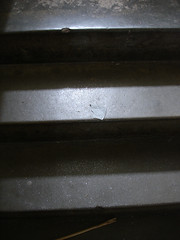
Memories are, as I said kinaesthetic and nowhere are the paths through the school better preserved than on the stairwell. How many times did I walk up and down them? Impossible to say. All I know now is that I won’t ever again and soon no-one ever will.

Filed Under: Family History Tagged With: Childhood, Demolition, Family History, Memory, Northway School

Back to my First School

June 20, 2009 by Nicholas Hedges

Today, my brother Simon and I took a trip down memory lane and visited New Marston First School which had opened its doors as part of its anniversary celebrations. The school had opened in 1949 and 27 years later, in 1976 I began my time there, leaving four years later to attend Northway Middle school. Simon had started three years earlier than me and it was hard to believe that some 30 years and more had passed since that time. I can still recall quite clearly my time at nursery (a stone’s throw away) and my first visit to the school when I was four years old. I’d made a picture of a lamb with polystyrene balls – or rather out of polystyrene balls I should perhaps say. And so there I was today, almost ten times the age I’d be when I first walked through the gates; if I was to return ten times my current age I’d be getting on for 400; dead in other words and a little upsetting for the children of 2409.

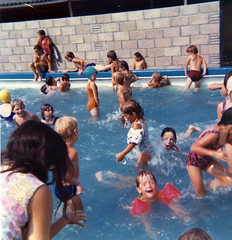
Almost straight away, as soon as we walked through the gates I began to feel a wave of nostalgia flooding not so much over me, but within me; ‘welling within me’ would perhaps be a better phrase for I could sense the place physically; I could recall walking there as a child. Much of it looks much the same, although of course things have changed, a few new doors, a new bicycle shed (or is it shelter now?) and so on, but essentially little else had been altered. However, after 30 years or more things are bound to be different and nowhere was this more evident than at what had been the swimming pool; a place beloved by my nostalgic mind, but loathed at the time by my feeble little body.

New Marston First School

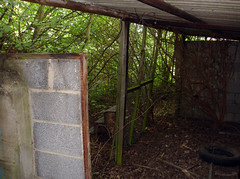
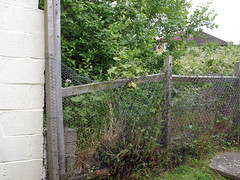
The changing rooms were always, to say the least, basic; sheds (or were they shelters?) comprising holes, breezeblocks and a corrugated roof. They were insubstantial then and just about standing in their decrepitude now, but the pool itself, if anything does remain is now lost in a jungle of trees, brambles and weeds. I couldn’t imagine a scene more different from what I could remember; indeed, if the whole plot had been cleared and a new block built in its place it wouldn’t have seemed as changed. It was shocking to see that part of my childhood had already become in part a ruin – but not just a ruin, rather, one undiscovered in the midst of sprawling vegetation. The swimming pool had become the equivalent – albeit less dramatic – of a Mayan temple lost in a Mexican jungle.

New Marston First School

Nature was reclaiming a part of my childhood, much as it had recovered the graves I’d seen at Highgate cemetery and I was reminded of the words of Walter Benjamin and his concept of ‘Natural History’ which is not, as we might suppose, the history of nature, but rather a term to describe the manner in which the ‘artefacts of human history acquire an aspect of mute, natural being at the point where they begin to lose their place in a viable form of life.’ I’d always thought about this definition in respect to ruins and other monuments of the past, and yet here it was, perfectly illustrated at the remains of a pool in which I used to swim (and in which I’d gained my 10 metre swimming badge).
Standing at the back of the pool and looking into the undergrowth, I could almost hear the sound of the water; I could remember the grey clouds which always seemed to gather whenever it was swim-day. And looking at the backs of the changing rooms, I could see in my mind’s eye, the board on which the temperature was always chalked and which was never above 16oC.

New Marston First School

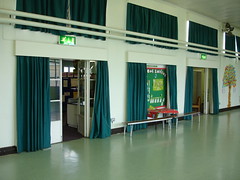
Inside, the school had changed very little. The main hall straight in front was everything I remembered it being – although there was a new floor (the old floor was a brown tiled one with a tennis court marked – for some reason – in tape) but before we could go inside we were greeted and taken to the ‘anniversary display’ in what was, in our day at least, the east-end of the school and a very different place to the west. It has to be said that the display left something to be desired. There were a few documents from the 1950s and 90s, but very little from the 70s which rather surprised me. Still, I was rather more interested in looking around and walking the length of the ‘east-end’ corridor the memories soon returned. But these memories were not so much of specific things but rather a general sense of having been there before a long time ago. They were memories insofar as I could recall images, albeit vague, and could recognise differences (it’s in the differences – what’s not there and what has been added – that memories are perhaps most clearly defined), but these memories were as much physical as cerebral; they were sensations rather than impressions. Now this may not be the time to begin discussing the kinaesthetic nature of memory or the notion of consciousness as corporeal (embodied mind as opposed to a mind/body dualism) but I was interested in how my visit to the school would help me in my recent work with phenomenological perception… but more of that later.

New Marston First School

At the end of the east-end corridor is a small incline on which we used to stand in line to get our dinner. The canteen itself has now been moved (to what was a cloakroom) but looking at the room from the outside I couldn’t get over how small it was. My memories of the canteen have always been of a large room, full of echoes in which hundreds of children sat and ate their food. Looking at it today I could see how my memory had ‘grown’ the interior to match my body in the years that had passed. It was a fraction of the size I’d remembered.
New Marston First School

Looking at what is now called the sports hall – opposite what was the canteen – I could see that something was different but couldn’t tell exactly what that something was. Initially, and consciously at least, I thought that nothing much had changed, but a change had been registered somewhere, because when we went outside, I could see straight away that most of the old large windows had been blocked off which answered the question ‘what’s different?’ that had been there all the time.
The more we walked through the school, so more changes became apparent. Where the school had previously been one long corridor, there were now several doors dividing it up. This, I would imagine, has as much to do with fire safety as anything else and called to mind how when we were at school the fire alarm was the headmaster, Mr. Norris, who during drills walked through the school ringing a bell. In the event of a real fire, one imagines he might well have run rather than walked and shouted ‘Fire! Get out! Get out!’ just to be sure.

New Marston First School

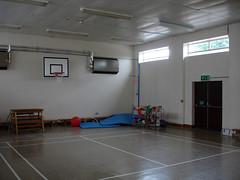
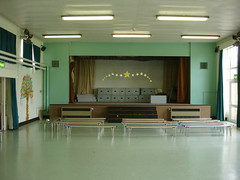
In the main hall, which we’d glimpsed when we first arrived, things – apart from the floor and a scattering of technology – had changed very little. The wall-bars still stood against one of the walls and the stage still stood musing upon my past successes.
New Marston First School

Boy in dressing gown was one notable part. A snake-charmer in Little Mookra another. But the crowning achievement was Prince Florenzel in Snow White. When I was meant to be proclaiming to the audience of my love for Snow White I was indisposed in the toilet. The stone steps leading to the stage (from the toilet) are still as they were; as clear and as sparkly as the memory itself. Indeed, along with these steps, there was a lot that was quite unchanged.

New Marston First School

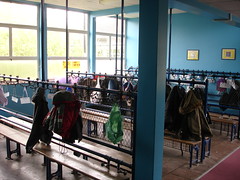
The clothes pegs, benches and shoe-baskets of one of the old cloakrooms were still in place. But it wasn’t so much things still in situ or things that had changed which prompted a rush of memories, as the line we were walking.
New Marston First School

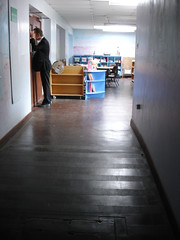
What was most familiar to me as we walked through the school was the shape of the corridor, the shape of the ‘line’ we followed. Therefore, the nostalgia pangs (for want of a better way of putting it) weren’t so much the result of a mental response to the school but also a physical one. Or, to take the argument I alluded to previously, the response was that of an embodied mind; in other words, we don’t remember things in the mind and as a consequence feel a physical response, but rather they are one and the same thing. The recollection isn’t only triggered through our senses (in this case our vision) but by our physical position in a place, by our being in that place; we sense and think with our bodies.
New Marston First School

I felt this particularly strongly in the playground in which there was a notable absence of climbing frames – proper climbing frames that is, with metal bars and concrete underneath. As I walked across the playground to the door which led back into the west-end corridor I found myself ‘physically thinking’ of times associated with my being at the school; my nan’s garden, summer holidays and our house in Coniston Avenue. It wasn’t so much just recalling memories but somehow experiencing them.
After 40 minutes or so we left, and it was a very strange feeling to walk back through the gates, doing something so clearly connected with going home, to where we lived as children. The view up the hill only served to pull the body in that direction.
New Marston First School

Instead however we turned left and walked towards our old Middle School – Northway, which is now something of a community centre; I say something, as from the outside it looks more than a little care-worn. Again, the same pangs of nostalgia took a hold as I walked through the gate, and again these sensations came about as a result of being in that particular place. Seeing a photograph brings back memories, but that is very different to feeling them. In looking at a images of something as it was may bring about visual memories. But being in a place makes them physical
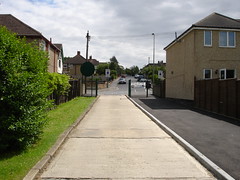
Like the swimming pool at New Marston, I haven’t seen something so fundamentally altered (and which has made such an impact on me) as the playground – or rather, the place where the playground used to be. The whole area including a large piece of land surrounding what was the second year area has now become a small housing development. The problem is that part of the school or community centre or whatever it’s meant to be now appears utterly incongruous.
Northway Middle School

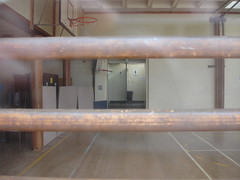
To have a school gym abutting a bungalow is odd at the very least; in terms of my remembering the past and how things used to be it was utterly absurd. Of course things change, but one would have thought that planners could have been a little more imaginative in how the school was incorporated into the development and how in turn the development was incorporated into the school.

Northway Middle School

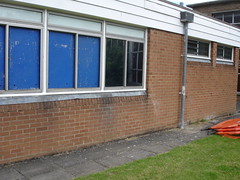
The gym and the second year classrooms, of which I have very fond memories, looked like a limb tied off from the body of the school, and as a result they appeared lifeless and in need of removal
Northway Middle School

Having left the school and returned to the car we drove past our childhood home in Coniston Avenue. All roads from the two schools we’d visited seemed to take us there but when we drove past we saw clearly how the passage of time could change things, again for the worse. Since my dad left a few years back the house has gradually fallen into a state of disrepair, but this has become a whole lot worse and the house looks on its way to becoming derelict. The fences have gone, the garage is boarded up and most shockingly of all, the large oak tree which played such a part in my childhood, being feature of the small world that I knew and fuelling my imagination has been cut down. We drove past quickly so I didn’t have time to take it all in, but in that split second I found a gap which couldn’t be filled by a hundred years of looking.

Filed Under: Trees Tagged With: Childhood, Memory, Natural History, New Marston, Ruins, Swimming, Walter Benjamin

Mediaeval Pottery

June 10, 2009 by Nicholas Hedges

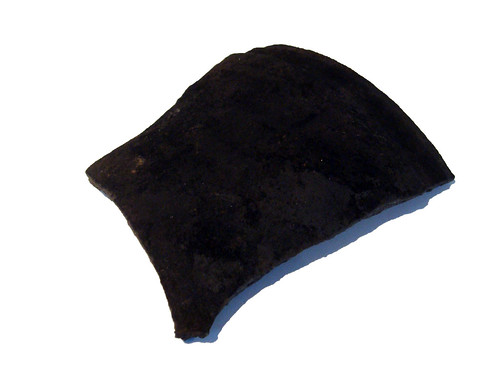
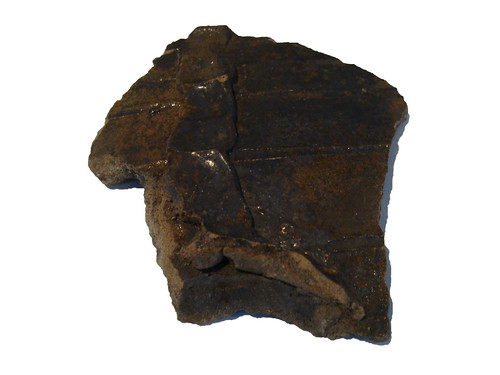
As part of a future project I have been loaned two fragments of mediaeval pottery by the Museum resource Centre at Standlake, Oxfordshire. I visited the MRC today and with their help rummaged through a few box-loads of pottery shards and decided on the two pictured below.
Mediaeval Pottery Shards

Mediaeval Pottery Shards

Both pieces are mediaeval and were found around the Trill Mill Stream area of Oxford during an excavation in 1985.

Filed Under: Archaeology, Fragment Tagged With: Archaeology, Fragment, Fragments, Pottery

Connections

June 1, 2009 by Nicholas Hedges

Gaston Bachelard, ‘The Poetics of Space’:

“Thus we cover the universe with drawings we have lived.”

Tim Ingold, ‘Lines’:

“The line that goes along has, in Klee’s terms, gone out for a walk.”
“Wayfaring, I believe, is the most fundamental mode by which living beings, both human and non-human, inhabit the earth. By habitation I do not mean making one’s place in a world that has been prepared in advance for the populations that arrive to reside there. The inhabitant is rather one who participates from within in the very process of the world’s continual coming into being and who, in laying a trail of life, contributes to its weave and texture.”

Fernando Pessoa, ‘The Book of Disquiet’:

“To live is to crochet according to a pattern we were given. But while doing it the mind is at liberty, and all enchanted princes can stroll in their parks between one and another plunge of the hooked ivory needle. Needlework of things… Intervals… Nothing…
Besides, what can I expect from myself? My sensations in all their horrible acuity, and a profound awareness of feeling… A sharp mind that only destroys me, and an unusual capacity for dreaming to keep me entertained… A dead will and a reflection that cradles it, like a living child… Yes, crochet…”

Filed Under: Uncategorized Tagged With: Connections, Fernando Pessoa, Gaston Bachelard, Lines, Tim Ingold

Long and Flaubert

May 29, 2009 by Nicholas Hedges

From an essay in a Richard Long monograph (The Intricacy of the Skein, the Complexity of the Web: Richard Long’s Art by Paul Moorhouse):

To a large extent however, these works are not seen by anyone apart from the artist and others who happen to come upon them. Not only are they temporary sculptures which behind the process of their assimilation into nature as soon as the artist leaves them, they are also frequently in remote locations.

From Christopher Woodward’s ‘In Ruins’:

As Gustave Flaubert remarked in a letter to a friend in 1846, when he was twenty-five years old:

Yesterday … I saw some ruins, beloved ruins of my youth which I knew already … I thought again about them, and about the dead whom I had never known and on whom my feet trampled. I love above all the sight of vegetation resting upon old ruins; this embrace of nature, coming swiftly to bury the work of man the moment his hand is no longer there to defend it, fills me with deep and ample joy.

Filed Under: Quotes Tagged With: Christopher Woodward, Flaubert, Quotes, Richard Long, Ruins, Useful Quotes

Music and Names

May 11, 2009 by Nicholas Hedges

Over a year ago I wrote about the beginnings of a project concerned with Music and Text. I must admit that I’ve not followed up this project what with my MA Show and other things taking over, however, recently, in working on another project (see: Wolvercote Cemetery) I have come around to picking up where I left off. It was whilst considering the cemetery in Wolvercote, but whilst visiting another cemetery in Highgate that I was struck whilst looking at the hundreds of names carved into the stone how once these names would have had a sound.

As I wrote after my visit: “…when we read a name, we hear within our minds, albeit silently, the sound of a name that was spoken countless times. We hear it muffled, like bells were muffled at times of death.”

I then began to think back to another line of research which I’d started sometime earlier. This was in regards to Old Musical Instruments which I studied in the Ashmolean Museum. The reason for the research was to try out a method of observation the results of which led me to assert (a point which may appear rather obvious) that the design of the instruments, sitting silently behind their glass; the materials used and so forth, were as such so that the instrument would make the perfect sound.

The silent instrument sitting in its display case was made to make a sound, just as a name, carved on a tombstone was there to be spoken.

A Lira da Braccio in the Ashmolean Museum.

Highgate Cemetery

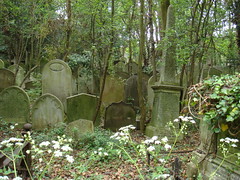
Graves in Highgate Cemetery.

Filed Under: Goethean Observations Tagged With: Cemetery, Goethean Observation, Highgate Cemetery, Instruments, Music

Highgate Cemetery

May 6, 2009 by Nicholas Hedges

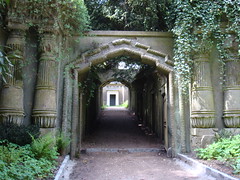
I’d known about Highgate cemetery, principally as the last resting place of Karl Marx, but this was the first time I had visited it. Having left Archways Tube station, I walked up Highgate Hill, through the pleasant surroundings of Waterlow Park and found my outside a large iron gate, standing amongst a small group of people waiting to go in. The cemetery itself is divided into two sections; the older West and the newer East. The East side can be visited at any time, but the West can only be accessed as part of a guided tour. It was for this tour that we along with a dozen others waited our turn.

I had the feeling that we were queuing to be let inside a prison. Not that I’ve ever queued for such a reason. It was simply the fact that we were locked outside waiting for our appointed time to visit, when those kept behind the walls would be allowed to receive us (there is something similar too in the architecture of the gatehouse and that which one sees in some Victorian prisons). Also, I couldn’t help but think of King Kong – the wall and the gates behind which the giant beast was kept. There was certainly a sense of anticipation, which had, it seems, been in part been created by the cemetery’s architect Stephen Geary.

Highgate Cemetery

The way into the cemetery itself, from the courtyard, is via a flight of steps. When standing in the courtyard, the cemetery cannot be seen; it’s only when walking through the archway leading to the steps, at the top of which one can see the greenery and the first of the monuments, that this vast cemetery is slowly revealed.

There is certainly more than a hint of theatre in how one enters, and the fact one ascends the stairs into the world of the dead serves to reflect a belief in the continuity of life after death; by ascending the steps we follow in the footsteps of those long since passed away, as if they were not borne here by pallbearers, horses and hearse, but had walked here themselves. Their lives continue and of course life continues through our present-day visiting.

It is this which makes the place feel strangely alive. That is not to suggest of course that those interred within are indeed still living in the physical sense of the word, but that the memory of their lives is almost tangible. Many of those buried here would have enjoyed the finer things that Victorian life could offer, things which we modern-day visitors can only know through books, films and television. These people lived the lives that we can only imagine.

Highgate Cemetery

I do not wish however to over-romanticise their lives, by suggesting that they were all happy and spent their time at balls, dressed in splendid costumes; that their lives were indeed little more than costume dramas; that would be naive to say the least. But nonetheless, as I walked around the cemetery, I was aware as I read the names on the tumbledown, but nonetheless impressive monuments, that the names inscribed upon them – or at least some of them, particularly in the Circle of Lebanon (which reminded me, in some respects, of the Great Crescent in Bath which we’d visited the day before) – would have been known in society. They would have called to mind faces, voices, attitudes and characters where today they are labels for empty spaces.

The Victorian attitude to death – the strong belief in the afterlife which I’ve already mentioned – is clearly apparent in this cemetery; religion was of course very important to them. Strange then that they should choose to design their funerary monuments in the style of Ancient Egyptian tombs and temples. Perhaps this was as much down to the fashion of the time as anything else, but could it also be that the Ancient Egyptians’ attitude to death and remembrance was somehow a confirmation of a continued existence? That’s not to say – and this goes without saying – that Victorians shared in the Polytheistic beliefs of the Pharaohs, but that the very age and ancient duration of their (the Pharaohs’) memory, which had and has spanned several millennia, promised an afterlife of a different kind; one that would be shared with living. Alongside the immortality of the soul, the endurance of the name was also important.

Highgate Cemetery

Such large and elaborate monuments are rebuttals of death itself. They are large and elaborate parts of the living world and, it could be argued, belie the uncertainty of a continued heavenly existence. They occupy a space in the land of the living, just as did the deceased, and when we read a name, we hear within our minds, albeit silently, the sound of a name that was spoken countless times. We hear it muffled, like bells were muffled at times of death.

I was reminded when reflecting on this of some work I did on Old Musical Instruments in the Ashmolean Museum in Oxford. It might sound obvious, but having studied materials used in the making of a Lira di Braccio as well as its shape, I became aware that it was so designed and made so as to make a sound. Names too are like this. They are given so as to be said.

Considering the perpetuity of names and memory amidst the slow convulsions of the ground , I coudn’t help but think of the writings of Sir Thomas Browne, who in Urne Burial, published in 1658, wrote some of the most beautiful lines ever put down on the subject of mortality and remembrance:

“And therefore restlesse inquietude for the diuturnity of our memories unto present considerations seems vanity almost out of date, and superanuated peece of folly. We cannot hope to live so long in our names as some have done in their persons, one face of Janus holds no proportion unto the other. ‘Tis too late to be ambitious. The great mutations of the world are acted, our time may be too short for our designes. To extend our memories by Monuments, whose death we dayly pray for, and whose durations we cannot hope, without injury to our expectations in the advent of the last day, were a contradiction to our beliefs. We whose generations are ordained in this setting part of time, are providentially taken off from such imaginations. And being necessitated to eye the remaining particle of futurity, are naturally constituted unto thoughts of the next world, and cannot excusably decline the consideration of that duration, which maketh Pyramids pillars of snow, and all that’s past a moment.
[…]There is no antidote against the Opium of time, which temporally considereth all things; Our Fathers finde their graves in our short memories, and sadly tell us how we may be buried in our Survivors. Grave-stones tell truth scarce fourty years; Generations passe while some trees stand, and old Families last not three Oaks. To be read by bare Inscriptions like many in Gruter, to hope for Eternity by Ænigmaticall Epithetes, or first letters of our names, to be studied by Antiquaries, who we were, and have new Names given us like many of the Mummies, are cold consolations unto the students of perpetuity, even by everlasting Languages.
[…]Darknesse and light divide the course of time, and oblivion shares with memory a great part even of our living beings; we slightly remember our felicities, and the smartest stroaks of affliction leave but short smart upon us.”

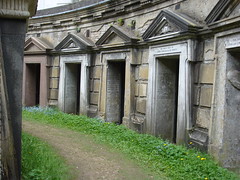
Walking in the Circle of Lebanon (reached by a gateway which itself could be a cast off from a production of Aida) one couldn’t help but think of the families entombed within the sepulchres and, as I’ve already written, the lives which they led in Victorian society. The dead names carved in the stone were now as hollow and as empty as whatever lay behind the closed doors. And up beyond the Circle of Lebanon, the once wealthy inhabitants of the cemetery, far from the whirligig of their colourful lives were now just bones turned over in the soil. The trees, growing all around, seemed to be reaching with their roots deep into the ground like a man searching for change in his pockets, elbowing their way between the tombstones, staggering amongst the ivy trusses, as if driven mad by the idea of nothing.

Highgate Cemetery

In a recent study of another cemetery, this time in Wolvercote, Oxford, I came to the conclusion through a particular process of observation, that there were no such things as cemeteries. Well, of course there are cemeteries, but in a wider, more holistic view there is just the cycle of birth, life and death, whether those cycles are applied to the existences of human beings, animals or leaves. Where those leaves fall and where bodies are laid to rest is in the end quite irrelevant.

Highgate Cemetery itself was saved because of the threat of development. For many years it was left to decay, grown over with ivy, brambles and trees and suffering from vandalism. Unchecked, this cemetery could have disappeared along with all the names and their monuments. Thankfully, through the dedication of a relatively small number of people, the cemetery remains a place that we can visit today. But why is it we do so?

Highgate Cemetery

There are of course many reasons why a place like Highgate is of interest, not least from a purely historical perspective. The Victorian attitude towards death is a subject in itself, as are the styles and designs of the various funerary monuments. But for many of us who visit I think the reasons run much deeper.

The monuments we see were put there for us. As we walk, we try to imagine the lives of those who lived a century before we were even born, when we did not exist. And now, when the those who lived back then, exist only in the hollow shell of their names, so we cast our eyes to the future when our names will also no longer be spoken.
Back in 2007, Monika and I visited Pere Lachaise and Montmartre cemeteries in Paris, and reflecting on our visits I wrote:

“Cemeteries have something in common with old photographs, particularly when we consider the the writing of Roland Barthes who writes that photographs have within them the ‘catastrophe of death,’ and that, ‘in the photograph, Time’s immobilisation assumes only an excessive, monstrous mode: Time is engorged…’. In cemeteries too, Time is somehow engorged and contains in abundance that catastophe. One has the impression of time standing still, stopped by the dates of death carved into the many gravestones and tombs, yet we know, all too well, that time continues.”

Perhaps it’s Time, engorged within the bounds of the cemetery that skews the gravestones and monuments.

As I wrote earlier, the people buried in this cemetery lived lives that we can only imagine. Similarly, their existence now is one that we can only conceive at the very limits of our imaginations. My aunt once said to me, “you have to believe in something,” ergo, you can’t believe in nothing. And this is certainly true, I can’t imagine nothing, whether that nothing is all the time before I was born or all the time that will come after my death. Cemeteries, like any historical record, building or object tell us there was something and that there always will be something.

Cemeteries point to both our past and future non-existence at a moment when we feel the present most acutely.

As Sir Thomas Browne wrote in his conclusion to Urne Burial:

“‘Tis all one to lye in St Innocents* Church-yard, as in the Sands of Ægypt: Ready to be any thing, in the extasie of being ever, and as content with six foot as the Moles of Adrainus**.
*in Paris where bodies soon consume.
**A stately Mausoleum or sepulchral pyle built by Adrianus in Rome, where now standeth the Castle of St. Angelo.

Filed Under: Goethean Observations, Trees Tagged With: Barthes, Catastrophe, Cemetery, Death, Goethean Observation, Highgate Cemetery, Instruments, Montmartre, Music, Sir Thomas Browne, Urne Burial

A to B

February 24, 2009 by Nicholas Hedges

As part of a new project, I took a walk to Headington, going via the house where I grew up. I haven’t walked around that area for many years and was quite surprised at how run down it appeared to be, particularly my old house. Of course places change – it’s only natural, but many houses and gardens in what was once a very well maintained street looked – for want of a better word – shabby. Like a lot of places nowadays, the front gardens have been abandoned, either to cars or, through apathy, to the weeds. Walls and fences have been torn down. They’ve collapsed or been removed. There’s a profusion of signs too – a common complaint for many – which litter the streets; a far cry from the 1970s and 80s.

I was also aware as I walked of the huge increase in traffic in the area, at least since I’d lived there, particularly towards Old Headington which, I assume has something to do with the ever expanding John Radcliffe Hospital.

It was on my way to Old Headington that I became aware of two different qualities of memory – not specific ones as such, but those accumulated memories which help us know where we are. I’ve walked thousands of times up and down the streets where I lived (to and from school; to and from the shops), but on the road towards Old Headington my memories are much more of being driven, usually on my way to my Nan’s in the back of Dad’s car. Walking the street today, I noticed things that I’d never seen before whereas walking down the street on which I lived everything was much more familiar (even though they’d changed). This difference is due to the way memories of these places were formed. Of the street on which I lived they were formed, in the main, through walking. On the road to Old Headington, they were formed, again in the main, through a window in the back of the car.

As we walk, we accumulate a sense of place through the memories which are stored in the mind. These images are stronger and clearer when taken in through walking, and indeed when recalled through walking. The slower the pace (although not to the point of a standstill) the more we absorb of the world and thereby the better our sense of place.

The world today, or rather our interaction with and indeed within it is very ‘nodal’. We travel from A to B, usually (but not always) as quickly as we can. The bit in between A and B is taken up, in the case of the car, with looking at the road ahead of us. I should point out that I am in no way anti-car, anti-train or anti-plane; I rely on them as anyone does; my point is that we rely on them far too much at the expense of our engagement with the world around us.

When we walk from A to B however, we don’t ‘get’ just A and B but everything in between. The act of walking ‘anchors’ our destination and the place from which we travel, positioning them in the world. We have time to think, to see and to accumulate a sense of place. We have time to engage with the world and thereby position ourselves within it.

Whilst studying the Old London Road for another project, I began to get an understanding of how slowing our life down helps us to engage with the world around us. I also became aware of how roads today are much different to those in the past. Journeys were slower and roads were very much more a connection between two places. This may sound like a truism, but what I mean is that today, one could travel for mile after mile on roads without actually getting anywhere at all. Destination is not something built into the fabric of the road – something which I felt was very much the case on the Old London Road. Again I should point out that I am not in favour (were it possible) of a return to bumpy, uncomfortable, 16 hour journeys to London.

When the pace of life was slower, when people walked more than they did, I wonder whether their sense of place in the world was different (physical as opposed to social). Again I don’t want to sound as if I’m being naively romantic about the past – it was often grim and difficult to say the very least, but I do think it must have been the case that the world was perceived very differently, not because of the lack of technologies such as the camera, the internet, film or television per se, but because of the pace. Technology of course is a contributing factor to the increased pace of life (and not just through transport). Increasingly we use our mobile phones or email to contact one another (and a great thing both of them are too). But again, this form of contact reduces the world to nodes, to A and B. In the days before such technologies (even when phones were abundant – this applies to a time not so long ago) if we wanted to speak with someone, we would go to meet them, or write them a letter. Either way, our words were physical; they had a place in the world; it wasn’t just about A to B but, as with walking, A through to B.

I think what I’ve gleaned through my ramblings – both physical and verbal – is that we are missing the bits in between. Everything is being reduced to A, B and C. Where there are bit in between, they are little more than a hinterland, glimpses of which we snatch as we travel along roads, motorways, train tracks or even through the air. This brings me back to the houses of which I spoke earlier. They have the appearance, even to the walker, of something that is seen in transit, at speed. Even if one looks for a period of time at one of the houses I saw today (again by no means all of them) it’s as if one is looking through the window of a passing car.

Filed Under: Oxford Tagged With: Childhood, Family History, Memory, Oxford, Walk

Front and Back Battlefield

February 11, 2009 by Nicholas Hedges

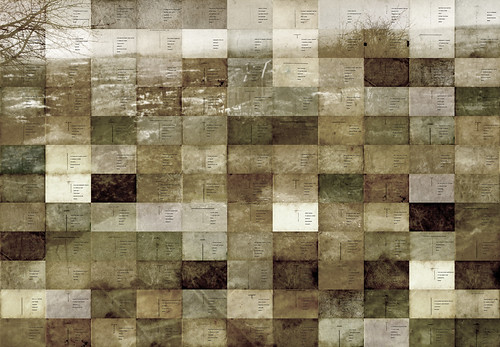
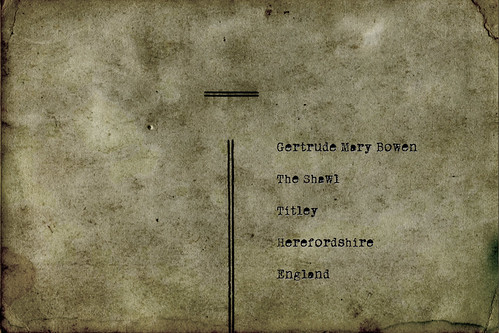
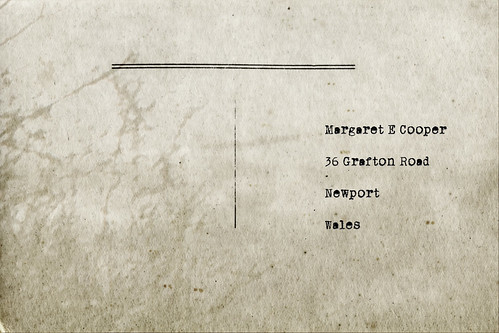
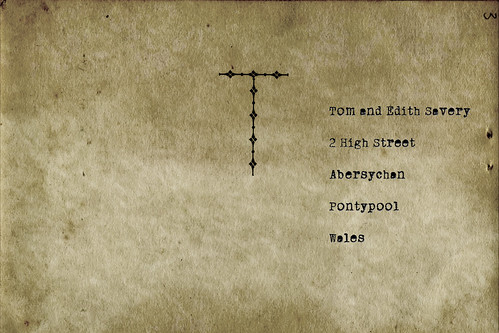
Below are examples of the postcards I have made featuring the names and addresses of next-of-kin of men of the 2nd Monmouthshire Battalion who fell in the Fisrt World War. I’m making the work for a conference in Tourist Experiences: Meanings, Motivations, Behaviours at UCLa in April. The first image shows the postcards in their entirety.
Front and Back Battlefield Full View

Front and Back Battlefield

Front and Back Battlefield

Front and Back Battlefield

Front and Back Battlefield

Filed Under: World War I Tagged With: Front and Back, World War I, WWI, WWI Postcards, WWI Postcards

Front and Back (2nd Mons)

January 27, 2009 by Nicholas Hedges

I started work on a new painting today based on the work I made as part of my Mine the Mountain exhibition. This piece, Front and Back (2nd Mons), uses the ‘T’ shaped divides on the backs of postcards which are then stencilled onto the canvas, already painted with a generic battlefield scene. I would really like to paint this on a large scale but we’ll see how this goes first.

Front and Back (2nd Mons)

Filed Under: Paintings Tagged With: A Line Drawn In Water, Front and Back, Paintings, World War I, WWI, WWI Postcards

X, III

January 8, 2009 by Nicholas Hedges

Whilst looking at some more Trench Maps of the area in which my great-great-uncle was killed, I was reminded of an idea I had for some paintings which I had made notes on in my sketchbook. The image below is taken from my notebook and shows a quick sketch of an aerial view of the area with hundreds of Xs marking places where men fell and lay undiscovered. It follows on from some work I did for my Mine the Mountain exhibition in October 2008.


The next image is taken from a trench map dated to March 1918.

There is no legend as to what these Xs mean, but given what I wrote in my notebook, I couldn’t help but see them as anonymous graves. The word ‘secret’ at the top of the map enhanced that idea.

Filed Under: World War I Tagged With: A Line Drawn In Water, Jonah Rogers, Mine the Mountain, Trench Maps, X

Maps

January 8, 2009 by Nicholas Hedges

As a child I spent many hours drawing maps of imaginary lands to which in my mind I would often escape. Over time these worlds – and one in particular (see image below) – became a very real part of my existence; I knew its towns, forests, plains and mountains; I knew the seas by which it was surrounded, the lakes and rivers and potted histories of each location. I created characters and can still to this day remember them along with the geography of the world they inhabited.

My Invented World - Ehvfandar

As well as being a means of navigating my imagination, the maps were also guides to the real world. Whilst out walking, I would just as likely find myself walking in my fictional landscape and as such parallels between the real and the imagined were established. To some extent these parallels still exist but it wasn’t until I started researching trench maps of the area in which my great-great-uncle Jonah Rogers was killed (near Ypres) that I was again reminded of my fictional world.

I was interested in pinpointing the place in which Jonah Rogers was killed; to see what the terrain was like and thereby understand, at least in part, something of the world he would have known. One can often imagine that the trenches were more or less just rudimentary ditches cut into the ground in which soliders lived as best they could, just a matter of yards away from the enemy, and of course, in many respects that’s precisley what they were; but the trench system was actually very complex. Far from being two lines gouged into the ground, the trenches of the opposing armies were labyrinthine as the image below reveals.

This map shows an area just outside Ypres. One can see precisely how complex the system of trenches were and yet of course the map can only tell us so much. Sanctuary Wood (shown on the left of the detail above) was described in the diary of one officer as follows:

“Of the terrible and horrible scenes I have seen in the war, Sanctuary Wood is the worst… Sanctuary Wood in 1914 was a sanctuary, but today, Dante in his wildest imaginings never conceived a like.”
It’s hard to imagine Dante’s image of hell as being in any way less horrific than anything on earth, particularly when looking at the map above.

What one can also see on another part of this map are some of the names which soldiers gave to the trenches and the areas in which they were fighting. Often names that were difficult to pronnounce were changed so that, for example, Ploegsteert became Plug Street. However, in some cases, areas were given names that made sense in terms of their being familiar names from home.

On this image one can clearly see a place called Clapham Junction. Of course there was no Clapham Junction in Belgium before the war, but by naming unfamiliar (and often utterly destroyed areas) with familiar names, soldiers and officers could, one assumes, navigate areas more easily, whether physically or in terms of reconaissance and planning. To plan attacks on places which have become muddied wastelands (to put it mildly) with few features remaining (the woods on the maps, shown as collections of lollypop trees were of course little more than burned splinters) one would need names, just as one would need names for the complex network of trenches. Could it be that by naming places with names from home, such reduced and barren landscapes (the ‘topography of Golgotha’ as Wilfred Owen called the Western Front) would appear as belonging in some way to the soldiers who fought there – was it a way of inspiring them?

The closest map – in terms of date – I could find relating to my great-great-uncle’s war, was one of St. Julien which dates from July 1915, just two months after his death in the Second Battle of Ypres. I’d wanted to get an idea of the trench system he would have been known at first hand and as I looked at the trenches shown (only German trenches were shown on this map) I found a road named after my home town; Oxford Road. Ironically, alongside this road was a cottage (one must assume there was little left of it at the time) which had been dubbed Monmouth Cottage – my great-great-uncle was from Monmouthshire.

I couldn’t help but think there was something in this naming of unfamiliar places with more familiar names which paralleled thoughts I’d had as regards my family heritage and in particular how researching it has helped me relate more easily to the past.

History is of course full of gaps. If we try and picture a place as it appeared at a given date we have to use our imaginations to fill in the holes where, for example, buildings have been razed. If we read reports or stories about events in the past we have to use our imaginations to understand the moment as fully as possible, to understand how the average person responded at the time. In doing so, we project a part of ourselves onto the past, something which is of course familiar (see ‘From Dinosaurs to Human Beings,’ OVADA Residency Blog, 2007).

Like my childhood maps of invented places, my family tree is in many ways a map of a fictional landscape, or rather a route through it. That is not to say of course that my family’s past is itself a fiction, but rather that history, in terms of how we see it in our minds is. History is in many ways a wasteland having been obliterated by time and yet there are parts of its landscape which still remain standing despite the tumult. Extant buildings, contemporaneous documents all act as pointers to a disappeared world, a world which also hides untold numbers of anonymous people. To help me navigate this landscape , I can invent my own names just as I did as a child, only this time the names will relate to, or be those of my ancestors; they will refer to dates and facts I have gleaned about their lives. In this sense I am labelling an unfamiliar, temporal landscape with familiar names, a landscape that like the battlefields of the Front has been all but destroyed. I’m filling in the gaps, mapping myself not only onto the physical world but also the past.

The worlds I invented as a child were in many ways idealised views of the real world with unspoilt forests, mediaeval cities and unpolluted seas. What faced the man at the Front was the opposite, a terrible vision of what the world could be or had become. Labelling such a world with names like Piccadilly, Buckingham Palace Road, Marylebone Road, Liverpool Street, Trafalgar Square and so on, in some ways gave it a more human face; where there were gaps, such names would fill them in perhaps with memories of home.

In the end maps are there to guide us, to reveal something about a place or perhaps a person; it all depends of course on what the map represents. We might be looking at maps of countries or maps of the brain – Katherine Harmon’s book ‘Personal Geographies and other Maps of the Imagination‘ is a great resource in this respect. When I look at the map of my invented world, I am not so much presented with a means of navigating a fictional world but rather a map of my own childhood. Looking at the place names I can in fact see the real world as it was at the time. The map therefore becomes a representation of something entirely different. The same could be said of the Trench Maps. They are maps of something quite unimaginable; if we took one and stood on a battlefield today it might offer us a hint of the way things were. But with the names of the trenches, roads, farms and cottages, they become maps of somewhere entirely different – a fictional place built only from memories. But those memories conjured by the names listed above – Piccadilly, Trafalgar Square etc. – are our memories, we can only imagine Trafalgar Square as it is today or as it is within our own minds. What we can establish, with the help of these maps, is an understanding of a sense of dislocation, between the solider in the trenches and his life back home. They serve to make those who fought and died in the war much more real.

With regards a map of my family tree I can place my ancestors in different parts of the country but of course none of them lived their lives standing still. Again there are gaps to be filled and whereas to fill in the gaps of history one can use one’s imagination, with regards the mapping of my ancestry and individual people, it is through walking around the places that they inhabited that these gaps can be filled. To close, I return to the blog entry I made during a residency at OVADA. In it I wrote:

“These invented worlds became, as I grew up, the ‘invented’ or imagined landscapes of Oxford’s past; landscapes that were – just as they still are – created from fragments, parts of the past which are still extant in the city; old buildings, walls, objects and so on. Between these structures, these fragments, I would fill the gaps, with my own imagination, with thoughts derived from my own experience. The city’s past and the past in general, as it exists within my mind, is then, to use the metaphor of cloning in Jurassic Park, a cloned dinosaur. The extant buildings, structures and objects within museums, are like the mosquitoes trapped inside the amber. They are broken strands of DNA. All that is required is for me to fill the gaps, and this I can do with my own DNA. I am in effect, the frog.
This metaphor is interesting in that DNA patterns are, of course, unique to everyone. My DNA is different to everybody else’s as there’s is to mine. Therefore, using my imagination to plug in the gaps of the past, means that the ‘past’ will comprise large parts of my own experience; my dinosaur will contain elements of my own being. (See ‘Postcard 1906’). But although my DNA is unique, it is nonetheless derived from my own past, elements have been passed down by my ancestors from time immemorial. The code which makes me who I am, comprises parts of people I know now (parents and grandmothers), people I knew (grandfathers and great-grandmother) and people lost to the past altogether (great-great grandparents and so on). What interests me about this, is that, through stating above how ‘my dinosaur will contain elements of my own being’ I can now see that ‘my dinosaur’ will contain elements of my own being, which is itself comprised of elements of hundreds – thousands – of people, the majority of whom I will of course never know and who have been dead for centuries. I like to think therefore, that ‘my dinosaur’ and my imagination aren’t entirely unique.”

In the traditional diagram of the family tree each individual is isolated, joined to others by means of a single line, almost as if they appeared at one point, moved a bit and passed the baton on to the next in line. Of course things are much more complex than this; individuals overlap in terms of the length of their lives and if we were to try and represent an individual’s journey through life, the line would be impossibly complex. Inevitably there are gaps which as I’ve said I can fill (at least, in part) by walking in the places they would have walked. In Wales, where my Grandmother grew up I found it incredible to think that this place I’d never been to and the streets, lanes and hills I had never walked, had all played a part in my existence. Without them I would not be here, or indeed there. I was then filling in the gaps, like the frog DNA in Jurassic Park, but the dinosaur I spoke of in the extract above was not so much History in this case, but me.

Filed Under: Family History, Trees Tagged With: Childhood, Dante, Family History, Jonah Rogers, Map, The Trees, Trees, Trench Maps, Ypres

  • « Previous Page
  • 1
  • …
  • 20
  • 21
  • 22
  • 23
  • 24
  • …
  • 32
  • Next Page »
  • The ‘Now of Then’
  • Artist’s Statement
  • Designs for an Heirloom
  • Dissonance and rhyme
  • Wildflowers
  • Emptiness
  • Wave (goodbye)
  • Now In The Past Of An Unreal Place
  • Return to Graphite
  • Genius
  • Latest Backdrops
  • Extended Backdrops
  • Backdrops
  • Komorebi
  • Acorns
  • Scroll Work
  • Goethean Observation: Japanese Scroll
  • Mistakes
  • The Leaf Is Singing Still
  • Past Present
  • Scrolls
  • As Yet Untitled
  • Holes
  • Scroll
  • A Calligraphy of Shadows
  • More Paintings
  • Latest Paintings
  • Walking Meditation 2
  • Knowing We Are There
  • Venice by Moonlight 1840
  • Fragments and Additions
  • Reimagining The Past
  • Walking Meditation 1
  • Mindful Walking I
  • Grief II
  • Three New Paintings
  • Nana’s Mountain
  • Painting
  • Iridescence
  • Roman Bottle
  • Rinsho
  • Shadow Calligraphy
  • Becoming Memory
  • Fox Talbot’s Glassware
  • Goethean Observation: Diffuser II
  • Goethean Observation: Diffuser
  • A Remembrance of Things We Never Have Known
  • A Moment’s Language
  • Take Me Home
  • Arrival/Departure
  • Diffusers
  • Grief
  • Mum
  • Measuring the past
  • Disordered Time
  • Entropy
  • Wicked Magician, Fly
  • The Quanta of History
  • Empathy Forward
  • The Natural World of 978
  • The Gone Forest
  • Empathy/Exchange: 668 grams
  • Goethean Observation: Pilgrims of the Wild, 1935
  • Nazareth O
  • Several Johns and St. Thomas
  • Raspberry
  • Tokens and Shadows
  • Patterns Seeping (II)
  • ‘Missded’ 4 – Tokens
  • Patterns seeping
  • Cut Paintings
  • ‘Missded’ 4
  • Locks III
  • Locks II
  • ‘Missded’ 2 – Tokens
  • My Son’s Drawings II
  • ‘Missded’ 2
  • ‘Missded’ 3 – Tokens
  • ‘Missded’ 3
  • ‘Missded’ 1 – A Framed Token
  • Morning Has Broken
  • Tokens of absence
  • ‘Missded’ 1, stitched
  • More Little Words
  • Three Little Words
  • Spaces In Between
  • ‘Missded’ 3
  • ‘Missded’ 2
  • ‘Missded’ 1
  • Locks
  • Tracings
  • My Son’s Paintings
  • Writing Shadows
  • Samuel Borton’s Post Chaises
  • Dawid Sierakowiak
  • Pitchipoi
  • Latest Tree Drawings
  • Notebook
  • Somewhere Between Writing and Trees II
  • Somewhere Between Writing and Trees

© Nicholas Hedges 2024

  • Facebook
  • Instagram
  • Twitter
  • YouTube

Copyright © 2025 · Outreach Pro on Genesis Framework · WordPress · Log in