Nicholas Hedges

Art, Writing and Research

  • Amazon
  • Behance
  • Facebook
  • Instagram
  • Pinterest
  • YouTube
  • Art
    • Digital
    • Drawing
    • Grids
      • Correspondence
      • The Wall
      • The Tourist
    • Ink on paper
      • Shadow Calligraphy
    • Installation
      • Murder
      • Echo
    • Painting
    • Patterns
    • Mixed Media
    • Photographic installation
      • St. Giles Fair 1908
      • Cornmarket 1907
      • Headington Hill 1903
      • Queen Street 1897
    • Research/Sketches
    • Stitched Work
      • Missded 1
      • Missded 2
      • Missded 3
      • Missded 4
    • Text Work
  • Blogs
    • Family History
    • Goethean Observations
    • Grief
    • Light Slowed But Never Stilled
    • Lists
    • Present Empathy
    • Shadow Calligraphy
    • Trees
    • Time
    • Walking Meditations
  • Video
  • Photography
    • Pillars of Snow
    • Creatures
    • The Trees
    • Snow
    • St. Giles Fair 1908
    • Cornmarket 1907
    • Headington Hill 1903
    • Queen Street 1897
    • Travel
  • Illustration and Design
  • Music
  • Projects
    • Dissonance and Rhyme
    • Design for an Heirloom
    • Backdrops
    • Shadow Calligraphy
  • Exhibitions
    • A Line Drawn in Water
      • Artwork
    • A Line Drawn in Water (Blog)
    • Mine the Mountain 3
      • Artwork
    • Mine the Mountain 2
      • Artwork
      • The Wall
    • The Woods, Breathing
      • Artwork
    • Snow
      • Artwork
    • Echo
      • Artwork
    • Murder
      • Artwork
    • The Tourist
    • Dreamcatcher
    • Mine the Mountain
      • Artwork
      • The Tourist
    • M8
    • The Gate
    • Creatures
      • Artwork
    • Residue
      • Artwork
    • A visit to Auschwitz
      • Artwork
  • Me
    • Artist’s Statement

Fields

March 4, 2011 by Nicholas Hedges

I’ve spent a very interesting morning in the archives at Christ Church college, researching as part of the East Oxford Archaeology Project. I had no fixed idea as to what I wanted to look for but was interested to see where the various material on offer would lead me.

I started by looking at a large and beautiful map of 1777 which showed the field system in East Oxford along with the names of fields and some of the individual furlongs. The abundance of units of measurement are quite baffling but nonetheless very poetic: furlongs, perches, chains, rods etc. and the way locations of land are described equally interesting; for example “The field called the Lakes begins next to Drove Acre Meer shooting onto the Marsh.”

A meer as far as I’ve been able to ascertain is a boundary deriving from the Old English world mǣre. Interestingly, Drove Acre still exists today in the form of Drove Acre Road, which joins with Ridgefield Road, so named after the old Ridge Field on which it’s built. Before I go into other field names, I want to try and identify the different units of measurement.

A rood is a unit describing an area of land and is equivalent to 1/4 acre. An acre is therefore 4 roods. In terms of length, an acre is a furlong (a furrowlong) which is equivalent to 10 chains or 220 yards. A chain therefore is 22 yards. A rod, pole or perch is 5 1/2 yards. A mile is 8 furlongs. 

I also found a unit called a butt, which I believe is where the oxen (ploughing a furlong) turned and rested where one acre butted onto the next creating a small mound of earth. 

The names of the main fields in this area – as I discovered in a document of 1814 – are as follows:

Bartholomew Field
Ridge Field
Compass Field
The Lakes
Broad Field
Church Field
Far Field
Wood Field
Open Field Meadow

The name Far Field makes sense in that it’s situated some way from town. But The Lakes? 

Within these fields, individual furlongs were also given names, such as:

Pressmore Furlong
London Way Furlong
Ridge Furlong
Furlong by the Mead Hedge
Clay Pits Furlong
Furlong Shooting on Breaden Hill
Short Furlong in Catwell
Brook Furlong
Hare Hedge Furlong
Croft Furlong by Bullingdon Green

The word shoot or shooting is used a lot to describe the location of land, such as ‘Furlong shooting on Sander’s Marsh.’ I think this must mean that the furlong joins or abuts the marsh. ‘The furlong that shoots on the alms-house,’ for example seems to describe land that joins the alms-house which I think describes those in St. Clements. 

What interests me is how differently this area of Oxford would have been known to those who lived 200 years ago. It’s an obvious point given that much of what were fields are now houses, but it’s the names that interest. How did these places acquire these names, and why have some survived and others haven’t? (It’s probably just as well that no-one lives in Shittern Corner today).

Filed Under: Oxford Tagged With: 18th Century, Archaeology, Oxford, Place

Ridge and Furrow

February 14, 2011 by Nicholas Hedges

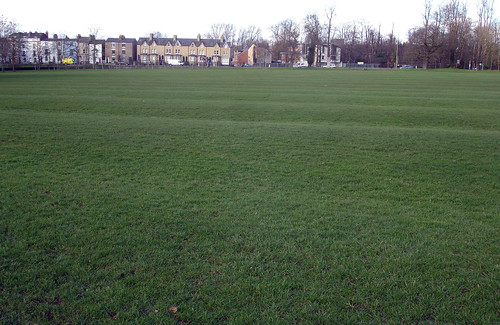
South Park in Oxford is a place which holds many memories for me; from cross-country runs at school, to Fun in the Parks, Firework displays and Radiohead in 2001. A view from South Park features in a Laurel and Hardy film ‘Chumps at Oxford’ and it’s been suggested (probably erroneously) that it’s the inspiration behind the Small Faces’ 1967 hit ‘Itchycoo Park’.What interests me most about the park however are the undulations with which it’s covered as shown the image below.

Mediaeval Ridge and Furrow

These undulations are landscape features created as a result of mediaeval farming methods known as ridge and furrow. Strips of land owned by individuals would be ploughed in such as way as to cause the ridges and furrows to form. Crops would be planted on the ridges while the furrows would help with drainage, and even today, one finds oneself walking along the ridges as the furrows are often boggy.

I find it amazing that an activity performed by people many centuries ago can still be seen so vividly in the landscape today. One expects to find features such as castle mounds, ditches and defensive (or siege) works,  but to see something created as a result of man’s interaction with the landscape over the course of time (in the growing of crops) is particularly interesting – not to say poetic. Individuals, long since lost to the past, worked the land so as to feed themselves – or make a living – and so perpetuate their ‘line’, and in the landscape, centuries later, the line still continues.

The lines continue too whenever we walk the ridges, for as we walk, we’re doing something people did hundreds of years ago (albeit without a plough) in exactly the same place.  As if the ridges are the grooves of a record, we find ourselves replaying a time when much of the land around the city comprised fields and meadows.

Filed Under: Archaeology Tagged With: Archaeology, Movement, Ridge and Furrow, Walks

New Marston War Memorial Names

February 14, 2011 by Nicholas Hedges

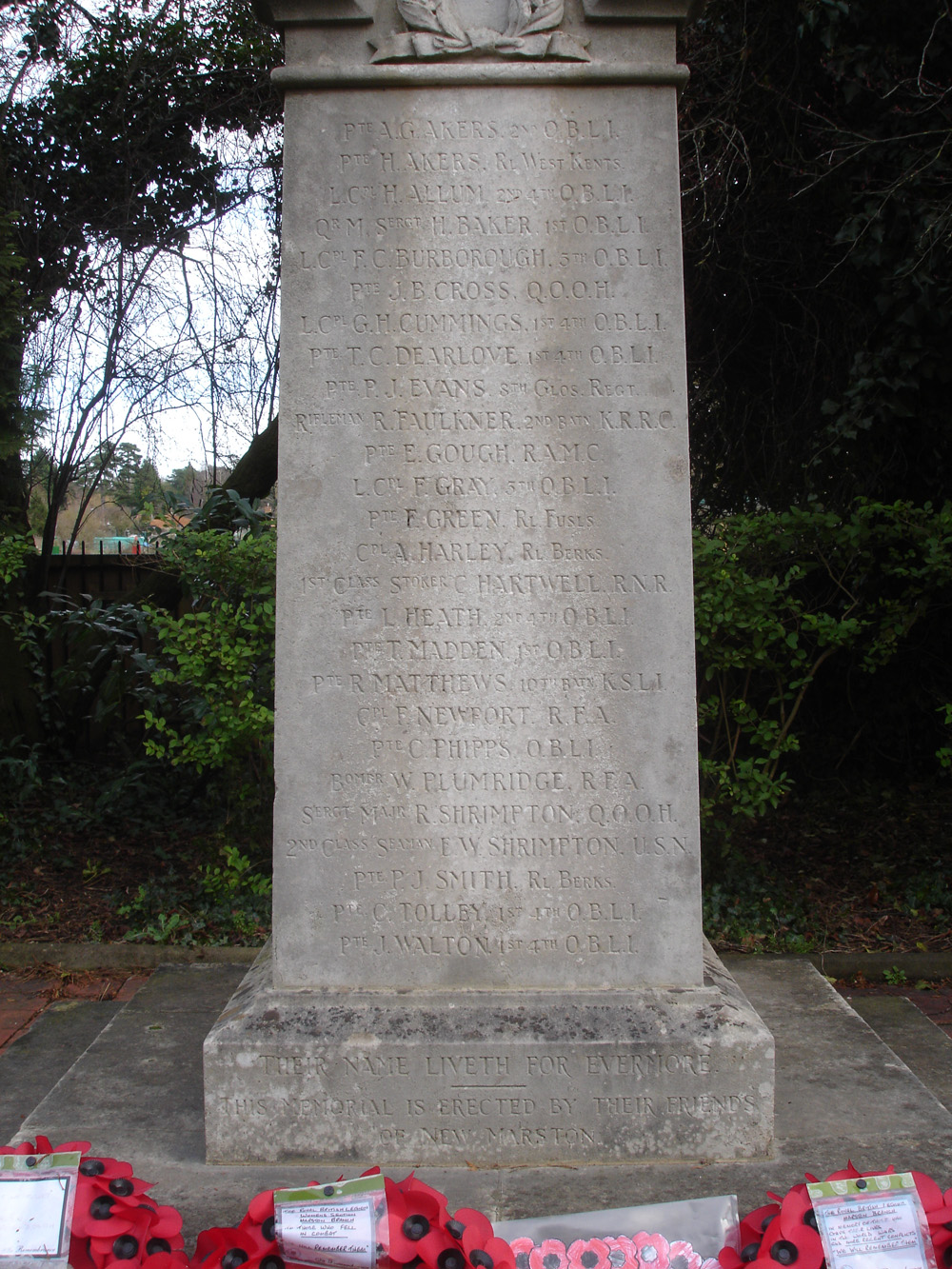
At the bottom of my street is a War Memorial such as you find in most towns and villages throughout the country. I’ve walked past the memorial many, many times and while I’ve often thought of those who died in both World Wars, I’d never before read its list of people. Therefore, this week I did just that and have spent time researching where they died and where they’re now buried.

A couple of details at once stood out : A G Akers, the first on the list, lived in my road and died of wounds on the last day of the war; 11th November 1918. Arthur Gerald Harley was killed in action, aged 21 on 1st July 1916 – the infamous first day of the Battle of the Somme.

I will endeavour to find out as much as I can about some of those who are commemorated on this memorial, in the meantime the following list is what I’ve so far discovered:

A G Akers
Private 10524
11/11/1918 Died
Oxford and Bucks Light Infantry
S. II. GG. 20.ST. Sever Cemetery Extension, Rouen
Lived in New Marston
Harold John Akers
Lance Corporal G/6709
11/11/1915 Killed in action
Queen’s Own (Royal West Kent Regiment)
Panel 45 and 47.Ypres (Menin Gate)
Lived in Folkestone
Hubert Allum  
Lance Corporal 202107
10/09/1917 Killed in action
Age 25
Oxford and Bucks Light Infantry
Panel 96 to 98.Tyne Cot Memorial
Lived in New Marston
H Baker
Lance Serjeant 9341
02/08/1916 Died
Age 22
Oxford and Bucks Light Infantry
XXI. A. 19. Baghdad (North Gate) War Cemetery
Lived in Holton
Frederick Charles Burborough
Lance Corporal 17854
25/09/1915 Killed in action
Oxford and Bucks Light Infantry
Panel 37 and 39. Ypres (Menin Gate) Memorial
Lived in Tilehurst
Joseph Bailey Cross
Private 285440
05/11/1918 Killed in action
Queen’s Own Oxfordshire Hussars
In South corner. Obies Communal Cemetery
Lived in Oxford
George Herbert Cummings
Private 4706
14/08/1916 Killed in action
Oxford and Bucks Light Infantry
Pier and Face 10 A and 10 D. Thiepval Memorial
Lived in New Marston
Thomas Charles Dearlove
Private 18259
25/09/1915 Killed in action
Age 27
Oxford and Bucks Light Infantry
Panel 37 and 39. Ypres (Menin Gate) Memorial
Percival James Evans
Private 27723
18/11/1916 Killed in action
Age 24
Gloucestershire Regiment
Pier and Face 5 A and 5 B. Thiepval Memorial
R Faulkner
Private 22865
04/10/1917 Died of wounds
Age 19
King’s Own (Royal Lancaster Regiment)
P. III. K. 2A.ST. Sever Cemetery Extension, Rouen
Edward Gough
Private 446123
29/03/1919
Age 44
Royal Army Medical Corps
C. 213. Alexandria (Hadra) War Memorial Cemetery
Frederick Gray
Lance Corporal 10523
20/09/1917 Killed in action
Oxford and Bucks Light Infantry
Panel 96 to 98. Tyne Cot Memorial
Lived in New Marston
Frank Green
Private 5838
07/07/1916 Killed in action
Age 32
Royal Fusiliers
Pier and Face 8 C 9 A and 16 A. Thiepval Memorial
Lived in Oxford
Arthur Gerald Harley
Lance Corporal 10379
01/07/1916 Killed in action
Age 21
Royal Berkshire Regiment
Pier and Face 11 D. Thiepval Memorial
Lived in Oxford
Charles Thomas Hartwell
Stoker 2919T
01/11/1914
Royal Naval Reserve
5. Plymouth Naval Memorial
Lewis Heath
Private 201358
22/08/1917 Killed in action
Age 22
Oxford and Bucks Light Infantry
Panel 96 to 98. Tyne Cot Memorial
Lived in New Marston
Thomas Walter Madden
Private 201697
16/06/1918 Died of wounds
Age 20
Oxford and Bucks Light Infantry
Plot 2. Row D. Grave 3. Montecchio Precalcino Communal Cemetery Extension
Lived in New Marston
Richard David Matthews
Private 31925
31/05/1919
Age 39
King’s Shropshire Light Infantry
P. 29. Cairo War Memorial Cemetery
Frederick Newport
Corporal 83648
03/09/1916 Killed in action
Royal Field Artillery
Pier and Face 1 A and 8 A. Thiepval Memorial
Charles Percy Phipps
Lieutenant 
19/07/1916
Age 20
Oxford and Bucks Light Infantry
Panel 83 to 85. Loos Memorial
William John Plumridge
Bombardier 24311
31/12/1915 Died
Age 26
Royal Field Artillery
Plot I. Row C. Grave 12. Corbie Communal Cemetery
Richard Tirrell Shrimpton
Squadron Serjeant Major 285021
09/08/1918 Killed in action
Age 27
Queen’s Own Oxfordshire Hussars
I. AA. 1. Caix British Cemetery
Lived in Oxford
EW Shrimpton
Percy James Smith
Private 8068
01/11/1914 Killed in action
Age 26
Royal Berkshire Regiment
Panel 45. Ypres (Menin Gate) Memorial
Lived in New Marston
Charles Tolley
Private 5927
26/08/1916 Died of wounds
Age 32
Oxford and Bucks Light Infantry
I. A. 30. Varennes Military Cemetery
John Walton
Private 2239
09/04/1916 Died of wounds
Age 21
Oxford and Bucks Light Infantry
D. 31. Beauval Communal Cemetery

Filed Under: World War I Tagged With: Memorials, Memory, Soldiers, World War I, WWI

Sewn Hammock

January 19, 2011 by Nicholas Hedges

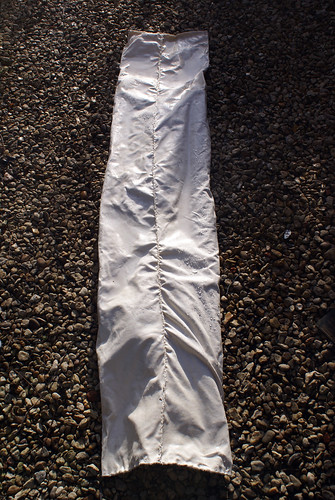
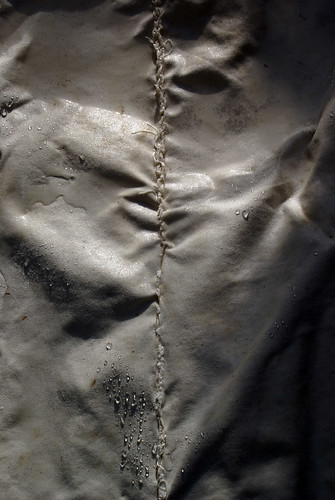
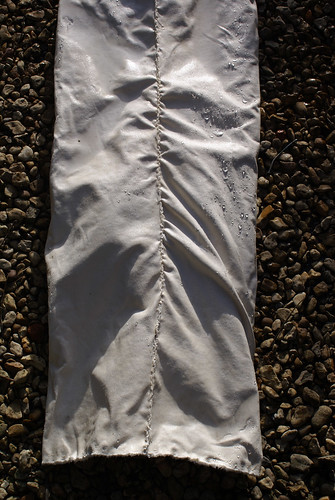
Below are some photographs taken of some work in progress, showing a broken deckchair sewn up in canvas. The idea has come from maritime history, when dead sailors were sewn into their hammocks before being cast into the sea.

Sewn Hammock

Sewn Hammock

Sewn Hammock

Filed Under: Uncategorized Tagged With: Deckchairs, Stitchwork

Natural Born Psychogeographer

January 18, 2011 by Nicholas Hedges

It seems amazing to me that given the way I perceive the world around me – and the way I have since I was a child – and looking the work I’ve made over the course of the last few years, that I haven’t before delved into the world of Psychogeography, for having started to read Merlin Coverley’s book Psychogeography I seem to be a natural psychogeographer. I recall that when I studied for my degree back in the early 90s, I was fascinated by the writings of Andre Breton and Louis Aragon (‘Nadja’ and ‘Paris Peasant’) which today sit on my bookshelves along with the works of J.-K. Husymans, Blake and Peter Ackroyd, writers who are all discussed in Coverley’s book.Why they intrigued me so much I never really understood, until now.

This morning, in Coverley’s book, I read the following quote form a 19 year old member of Lettrist International who went by the name of Chtcheglov (his real name was Gilles Ivain, and he was later incarcerated in an asylum…). Within that quote, a few lines in particular interested me. The full quote however is as follows:

All cities are geological; you cannot take three steps without encountering ghosts bearing all the prestige of their legends. We move within a closed landscape whose landmarks constantly draw us to the past. Certain shifting angles, certain receding perspectives, allow us to glimpse original conceptions of space, but this vision remains fragmentary. It must be sought in the magical locales of fairy tales and surreralist writings: castles, endless walls, little forgotten bars, mammoth caves, casino mirrors.

The following line in particular brought me up short: ‘…Certain shifting angles, certain receding perspectives, allow us to glimpse original conceptions of space, but this vision remains fragmentary…’ for this exactly describes how I think when I walk through a city, or in fact any particular place. The remains comprising our present-day landscapes are overlaid with a weave of unremembered lives, narratives and events, which, Coverely explains, can, in a moment be revealed through even the most mundane objects and surroundings. It’s as if, whilst walking down the street, one can see something which opens up a ‘receding perspective’ just as Chtcheglov writes, allowing us for a second to glimpse those ‘original conceptions of space.’ The vision is fragmentary and lasts just a moment, but everywhere these possibilities exist.

I’ve often  used the idea of mundane (or everyday) objects and surroundings in my work as a means of accessing the past – as revealing the past through the lens of the present, and before beginning my MA in 2006, I wrote about what I called ‘memory spaces’; spaces which opened up when looking at old buildings or objects. For me, these spaces, were – or rather are – memories of a particular object or building held by people who lived  generations before us. I was trying to find a way of describing how when I look at an old building, it’s as if I gain access, in some fragmentary way, to the memories of those who beheld it years before – as if I could then walk from one of their memories to another.

In another piece of writing (What is History?), I tried to find another way of describing how we access these spaces. Instead of perceiving history as a series of horizontal layers, built up one on top of the other, I suggested that it was more accurate to see the past as comprising a vast number of durations, where every object, every building, every part of a building etc., was a duration, extending vertically down the page. (This idea was inspired by the writings of Bill Viola, who wrote how ‘we have been living this same moment ever since we were conceived. It is memory, he says, ‘and to some extent sleep, that gives the impression of a life of discrete parts, periods or sections, of certain times or highlights’. Similarly we can say that every object, building or landscape feature has existed in one continuous moment and that it is to some extent the passing generations which gives the impression of the past as being a series of ‘discrete parts, periods or sections.)

As I wrote:

Access to the past therefore comes not via a kind of mental gymnastics where we straddle the horizontal strata of different moments in time, accessing a part [an object] via the whole (the entire epoch of that particular layer e.g. 1900), but through the careful observation of a part in which the whole can be observed. As Henri Bortoft writes in The Wholeness of Nature – Goethe’s Way of Seeing; ‘…thus the whole emerges simultaneously with the accumulation of the parts, not because it is the sum of the parts, but because it is immanent within them’. In other words, from an object [for example, one made in 1900] we can extrapolate its wider context (the ‘epoch of 1900’). Instead of drilling down through many periods [of horizontal] time in order to get from one time to another some distance below (or behind), we simply have to observe an object we know that links the two. In this… model , there are no horizontal barriers, just vertical, navigable channels.

Therefore, when looking at an object in a museum, or glimpsing something whilst walking in the street, angles are shifted as Chtcheglov explains, and receding perspectives revealed, precisely because of the way the present comprises these continuous durations. Of course it doesn’t happen all the time, but depends on any number of things, not least the way we perceive that object at the moment of our encounter. History in this sense is kinaesthetic.

Filed Under: Quotes Tagged With: Bill Viola, Chtcheglov, Goethe, Henri Bortoft, Psychogeography, Quotes, Useful Quotes

Heavy Water Sleep: Pages 10 & 11

January 12, 2011 by Nicholas Hedges

Original Version

Version 1

Version 2

To see other pages from this project please click here.

Filed Under: Heavy Water Sleep, Holocaust Tagged With: Heavy Water Sleep, Holocaust, Text Work, WWII

Windows, Bicycles and Catastrophe

January 9, 2011 by Nicholas Hedges

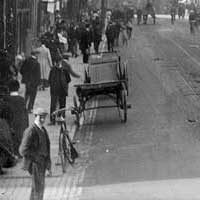
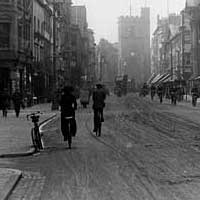
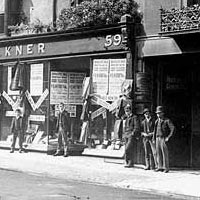
Windows in images are, as I’ve discussed previously, evidence of people living their lives without a thought for the subject or subjects in the photograph. This entry examines a number of details taken from photographs of Oxford at the beginning of the 20th century.

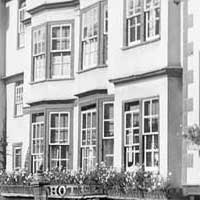
This detail below, from a view of the High Street taken in 1907, shows the open windows of what was then the Mitre Hotel.

Perhaps these windows were opened by guests visiting the city over 100 years ago, or perhaps by maids in preparation for their visit. But what was taking place behind these windows when the photograph was taken? What conversations were being had? As I’ve said above, whatever they were and whatever was happening within, the open windows serve to give life back to a place from which the photograph was taken. The rooms become portals to unseen parts of the image, not just in the rest of the city, but rather the wider world. It is perhaps then, rather appropriate, that this image shows a hotel.

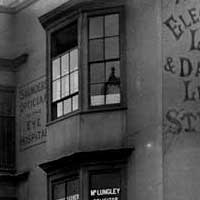
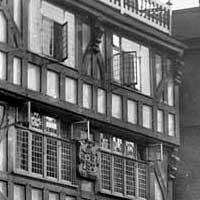
The image above, taken from a photograph of 1909 (amazing how we can just skip a couple of years) is particularly interesting, in that as well as being open, we can also see clear reflections within the window’s glass. This window serves again to take us beyond the boundaries of the image, into its hidden interiors, from where we might look upon that view reflected in the window. The same can be said to some degree about the image below, also from a photograph of 1909.

As an aside, it’s interesting how these two images, because they were taken in the same year, constitute in our mind’s eye a single moment; the year (in this case 1909) becomes just that – a moment in time. But what period of time separates the photographs from which these details are taken? Is it minutes, hours, days, weeks or several months? What happened between the taking of one picture and the other?
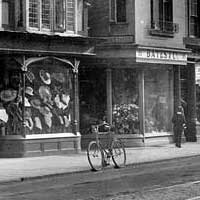
In the detail below (from a photograph of 1907)  my eyes are drawn to the the bicycle; not the make or the style, but the way it seems to reveal the presence of time, or rather an inconsequential moment in time. For me, it’s in these everday, unremarkable moments that the past is revealed – where history really comes alive.
Of course the man in the foreground looking at the camera, and those people walking up the High Street are subjects of a particular moment (cameras are, Barthes beautifully put it, ‘clocks for seeing’), but there’s something about the bicycle which expresses it better. Below is another a detail from a photograph of 1911. Taken again in the High Street, a few metres back from the one above, Carfax Tower in visible the distance.

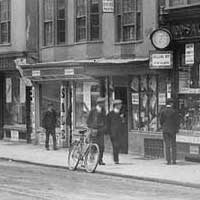
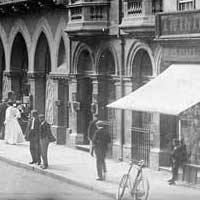
In the image below, something in the window of a shop on the High Street in 1909 has caught they eye of the man looking in as well as the two men walking towards him. The man with his hands in his pockets also describes a specific moment in time; the way he’s standing seems to suggest that he’s just that second stopped; something very different to being ‘stopped’ – as in the case of the two men walking – by the shutter of the camera. But again it’s the bicycle parked at the side of the road which, for me, best describes the moment; or more accurately, its continuity – its place in a passage of time. Even though the two men walking have clearly come from somewhere and will no doubt go somewher else, the bicycle is still much the better way of representing a moment within the passage of consectuive moments, both before and after.

But why is this the case?

One might assume that in a photograph there’s no better means of indicating someone’s presence than someone’s image. The detail above shows such a person on the right. But somehow, the bike and the absence of its rider are more indicative of presence than the man we can actually see, just as it is – as I’ve described above – a better indicator of a single moment in a wider sequence of moments.

In Camera Lucida, Barthes writes:

“I observe with horror an anterior future of which death is the stake… I shudder… over a catastrophe which has already occurred. Whether or not the subject is already dead, every photograph is this catastrophe.”

Forgetting the bicycle for a moment and looking instead at the man in the photograph, one knows that he is dead. His frozen pose alludes to this anterior future of which Barthes speaks. He also writes:

“In the photograph, Time’s immobilisation assumes only an excessive, monstrous mode: Time is engorged…”

The idea of time engorged conjures up apocalyptic images of disaster; Time not able to proceed but growing nonetheless, swelling within the frame of the picture, the world shaking as it struggles to chew and to swallow. The man in the picture above must and will fall victim to this catastrophe (he must and will die), but the man who’s left his bicycle (and as such the photograph) will instead be sure to survive.

I’d assumed it was the act of leaving the bicycle which gave the bicycle its status in the photograph; the fact that whoever left it would be sure to return and pick it up in a matter of seconds or at most minutes; that it was the idea of these few moments which countered the blurring of time I described above (where entire years can implode to fit the space a second – which itself alludes to the idea of engorged time). But in fact, I believe it’s the rider’s escape from the photograph which instills in them – the bicycles – their appeal to the viewer.We know the rider must be somewhere and it’s as if he’s still there; as if the moment from when he left his bike (for example in 1909), to picking it up again is still ongoing.

The detail above is taken from a photograph of Cornmarket in 1889. Looking at the entire image, one can see that all the buildings shown have since been demolished, and as sad as this is when one sees what stands there now, one doesn’t find it hard to imagine. Buildings are demolished all the time – it’s a fact of life. But when looking at the detail above, with its open window, it seems less conceivable that it’s since been destroyed, that it no longer exists.

Such a thought doesn’t occur however when I look at images of people.

The image above is a detail from the same photograph. Like the building they stand against, all these men are gone. But this, unlike with the detail of the window, does not strike me as inconceivable in any way; quite the opposite. Perhaps it’s the open window which makes the building’s demise (or non existence) seem so unlikely. The open window is indicative of life, of the everyday aspect of life. Who would open a window in a building set to be demolished? But then, who would dress and pose for death?

Above, Cornmarket 1907. Another rider has escaped impending disaster.

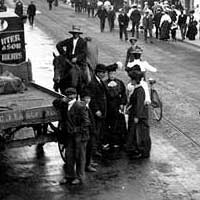
Also Cornmarker 1907. A group of people talk at the southern end, nearest to Carfax. Their clothes (particularly those of the women) position them unequivocally in the time in which they lived.

A number of questions come to mind as I look at them and the scene around them. What are they talking about? What were the hot topics of the day? Where is the woman pushing her bike? (Wherever it is, it’s too late to escape the imminent catastrophe). In this image however, that which captures my interest above all is the rain on the pavement.

Just as shadows give life to a photograph (without the sun beyond the frame of the photograph there can be no shadows within it) so puddles and reflections on wet pavements point to a time before the photograph was taken and, – like shadows with the sun – to the clouds above and beyond the gaze of the lens. Barthes declares that “the photograph is without a future” and while this might be the case, there’s is no doubt they have a past.

Sometimes, photographs (without shadows, puddles, windows open and closed) can look flat and lifeless, as if they’re merely constructions (tableau vivant) designed in their entirety, as counterfeits for the reality they purport to be. They have no future, but, more importantly perhaps, no past. The rain in the photograph above however counters this; it gives the photograph its validity, it is a recognisable sign that something came before.

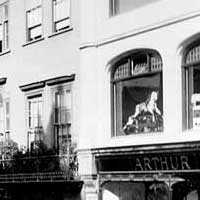
The detail above is taken from the same picture (Cornmarket 1907), and, rather sentimentally perhaps, I was drawn to the rocking horse in the window. One can’t help but wonder what happened to this somewhat peripheral object (peripheral in terms of the overall photograph). I can well imagine it languishing in some dusty attic, forgotten, even broken… although, of course it might be in very rude health, respected as an old family heirloom. And herein lies its point of interest. Whatever its current state – if indeed it still exists – here, in the picture, it’s yet to occupy the mind of the person to whom it belonged. It’s yet to form the memories which that person would have carried with them throughout their life, memories which they might have passed down and which might, to this day be talked about. Perhaps this rocking horse no longer exists as a physical object, but maybe somewhere, it continues to move in words, written or spoken.

Filed Under: Photography Tagged With: Barthes, Bicycles, Catastrophe, Everydayness, Nowness, Photographs, Vintage Photographs, Windows

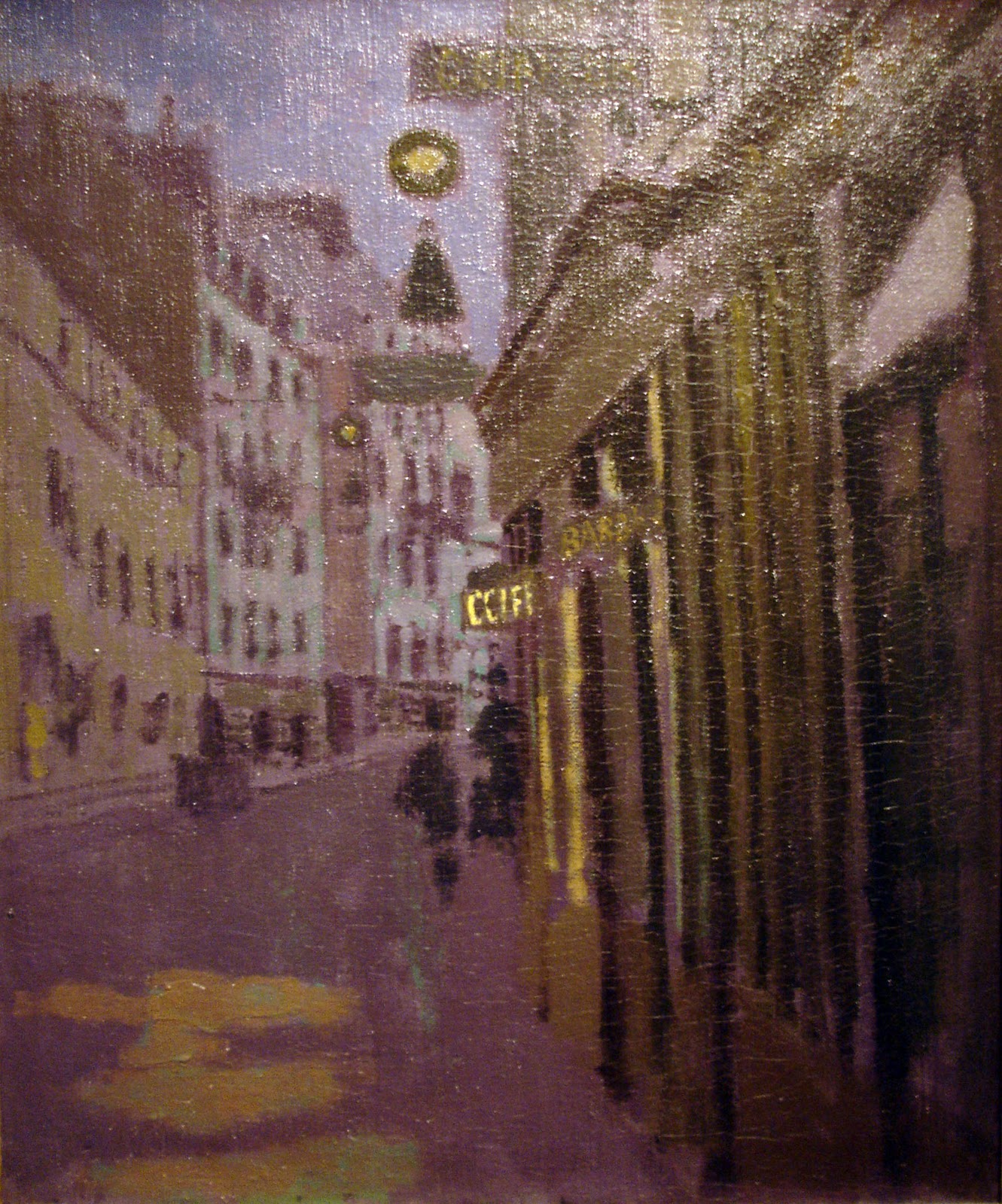
The rue Notre-Dame des Champs, Paris by Walter Sickert

January 6, 2011 by Nicholas Hedges

The photograph below is a rather poor reproduction of a painting hanging in The Ashmolean museum, Oxford. It is perhaps, my favourite painting in the museum. Painted by Walter Sickert (1860-1942), it’s one which I have stood before for some considerable time, not least quite recently in order to write the following.

In my previous entry, regarding Cy Twombly’s Panorama, I discussed, albeit briefly, how it was quite impossible to fully appreciate a painting through a reproduction. Of course that much is obvious, but I wanted to write about this particular work to see just how differently I perceived it compared with the work by Cy Twombly, which, as I say, I’ve only ever seen in a book.

As can be seen from the photograph, one of the things I noticed straight away about this painting was the light reflecting off its surface. Not really anything to do with the painting perhaps, but, nonetheless it forced me to move, to find an angle where I wouldn’t be dazzled, and by doing so, I discovered something about the painting itself. What’s important here, is the fact that a painting isn’t just a surface on which paint is applied (although the appreciation of surface and texture can only be attained when faced with the real thing). Instead, a painting is as much about the space around it. Of course, Walter Sickert would have no idea that his painting would one day grace a wall in the Ashmolean museum, dazzled by the lights. But he would have walked whilst painting it, or rather moved before the easel. He would have stood in front, to the left, to the right, and this movement in the act of painting is, I believe, important in the act of viewing and appreciating the result.

So what do we see in this work? Well, it’s a road in Paris (the rue Notre-Dame des Champs), one on which the painter John Singer Sargent had a studio. Given the muted palette and bruised sky, the picture shows a scene from about that time of day when the night begins removing all the colours from the world, when the last light in the sky, makes all manner of colours that seem to last for just a few seconds. It’s a wet end to a day that’s more than likely seen nothing but rain. The concertinaed facades of the shops with their heavy paint dragged down the surface, the downward strokes of the windows in the buildings opposite and the vague forms from which the scene’s almost entirely comprised, all suggest the fading light and drenched air of an autumn or winter evening.

There are puddles in the street which soak up the sickly light of the cafe like a man with a sponge mopping up blood after a brawl. The road is somewhat sickly and the light of the cafe offers us a refuge from whatever is coming just around the corner. Two or three figures stand just ahead. Are they moving? Are they walking towards us? Away? It’s hard to tell. But a feeling of isolation, pervading the picture, is I believe augmented by their presence.

As I moved before the painting, shifting my weight from one foot to the other, the colours seemed to shift. The bluey-violet sky shimmered above the drowned buildings, and the reflections in the road revealed new colours the more I looked. Looking at the painting in the flesh, I felt – compared with looking at the reproduction above – that my eyes had to move in order to cross from one side to the other. In a reproduction, the spaces are of course greatly reduced and everything can be seen or grabbed in an instant. In the flesh (and this painting is very much about the physicality of the world) you look as you might when standing somewhere in town.  You look with more than just your eyes; you experience the painting with your body; one that stands alone before the canvas.

Returning for the moment to the glare of the lights, I found that when I looked at the painting from the right hand side, the glare subsided, and that all that remained were just a few specs where the paint was raised above the rest of the surface. Furthermore, from this position, the painting seemed to open up, as if the concertinaed lines of the shop facades were being pulled, expanding like bellows. Here, the street seemed to pull me on. Standing directly in front, it almost seems about to collapse upon itself.

I’m not trying to suggest that this is all deliberate on the part of the artist, but to emphasise the fact that the act of looking at a painting is a physical experience. Sickert would have known this street, he would have recalled what it was like to stand there. He would have moved before the canvas as he painted, and, as a viewer, the way I stand and move before the canvas reflects that. It is, in the end, the only way to get to know art.

www.nicholashedges.co.uk

Filed Under: Paintings Tagged With: Paintings, Sickert

Windows 1

January 5, 2011 by Nicholas Hedges

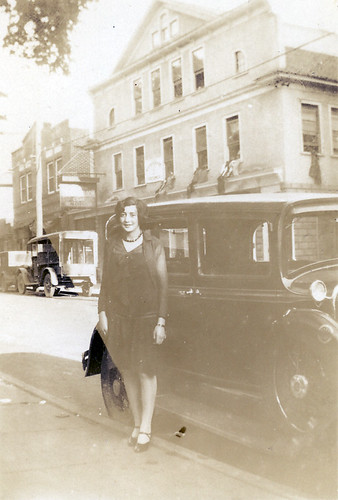
This image was part of a collection I bought a few years ago. I had no idea what I was buying at the time and was intrigued by the image reproduced below.

A young woman and a car

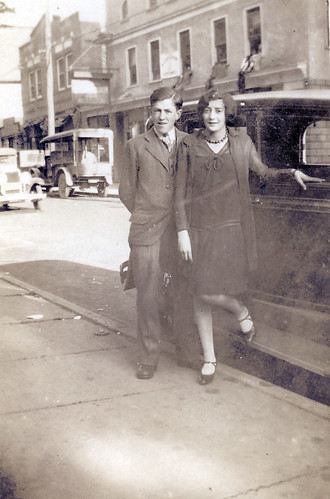
In the photograph, a young woman poses beside a car. The awkwardness of her pose and the uncertainty in her face suggests that she is attending a special occasion of some kind. In the second image below, she is joined moments later (or perhaps it was before) by a young man (her partner?) who also looks a little uncertain, not necessarily because of what he’s about to do, but rather because of what he’s doing at that exact moment, i.e. having his photo taken. Perhaps they are young lovers about to get married? Of course we’ll never know.

A young couple and a car

What intrigues me about these pictures are the details. Looking again at the second photo – which might of course, in the course of time, have come before the one above it (“…if things are perceived as discrete parts or elements they can be rearranged…” as Bill Viola writes) – a car has appeared on the left, moving into shot just as the shutter is released. Even though the young man has also ‘appeared,’ it’s nevertheless the car which gives us the sense of time passing; it is a vehicle for what Sontag describes in her book, ‘On Photography’ as “time’s relentless melt.”

Who was in the car as it drove past? Where was it going? Where had it come from?

History often comes to us ‘top ‘n’ tailed’, where all that went before the period in question, and all that came thereafter is removed, leaving us with an event which reads like a novel; conveniently packaged with a beginning, a middle and an end. To some extent, regarding this, the first image serves as an illustration, whereas with the second, the car tells us that something came before the ‘beginning’, and that something will follow ‘the end’. As a painter, Degas was inspired by photography, and used this device to give his works a greater sense of movement. It’s not so much a means of accentuating movement with regards to that which is shown, but moving the viewer into the world that’s hidden beyond its edges. 

Just as in the first photograph I looked at, my viewpoint shifts as I become aware of the image’s other protagonists. From in front of the couple, and in the guise of the person who took the photo, I glimpse the couple as if I can see them out the window of the car. It doesn’t last for long, but it shows how an image can be opened up by such small details.  

Windows in photographs have always interested me for much the same reason. Within the context of an image, like those above, they provide a means of escape, or again, as in the case of the first photograph I discussed, a means of concealment. They act as eyes, reflecting – literally – the world around them; the world beyond the limits of the picture’s edge. Spatially and temporally, there’s always more to a photograph that that contained within its borders; and for me, a photograph’s appeal, often resides in how it allows access to these spaces.

In the detail below, we can see in some of the windows, the sky and the trees reflected from beyond the frame of the camera; another way in which a camera can capture that beyond its reach.

Windows are also evidence (or perhaps reminders) of ordinary people living their everyday lives without a thought for the subject or subjects below – in this case the couple on the pavement. They conceal those who are perfectly oblivious to the chemical annexation of whatever inconsequential moment in time is being captured. And as a result, this invisible population can often breathe life into a photograph well beyond the stage upon which the action is taking place.

In his book ‘Camera Obscura,’  Roland Barthes describes a portrait by James van der Zee, of a Black American family taken in 1926. Barthes writes:

“On account of her necklace, the black woman in her Sunday best has had, for me, a whole life external to her portrait.”

What Barthes perhaps means, is that the necklace has a provenance, and therefore seems to speak more about the woman’s life than anything else in the photograph. It is a cherished object, worn perhaps for the occasion of the picture (just as the necklace has perhaps been worn by the young lady in the images above). For me, this is, in a way, analogous to the windows in the first picture and the car in the second, for they are small details compared with the picture’s subjects, but details which, nonetheless, build for us a bigger picture of the world the subjects inhabit.
 
The closed windows in the building then, reflect the world beyond the edges of the photograph, they provide evidence of a world beyond the stage. Furthermore, they are windows onto the stage, through which those sitting, standing or passing behind might, just like the driver in the car, catch a glimpse of the actors.
The open windows however provide us with something a little different. Open a window and the outside world pours in; sounds, smells, the noise of the traffic and passing conversations. In other words – life. They serve to animate the scene, again just like the car, and through them we can let our imaginations wander, to discover for themselves, more of this world long since vanished.

Filed Under: Photography, Trees Tagged With: Barthes, Bill Viola, Photographs, Vintage Photographs, Windows

Secret Police 2

January 4, 2011 by Nicholas Hedges

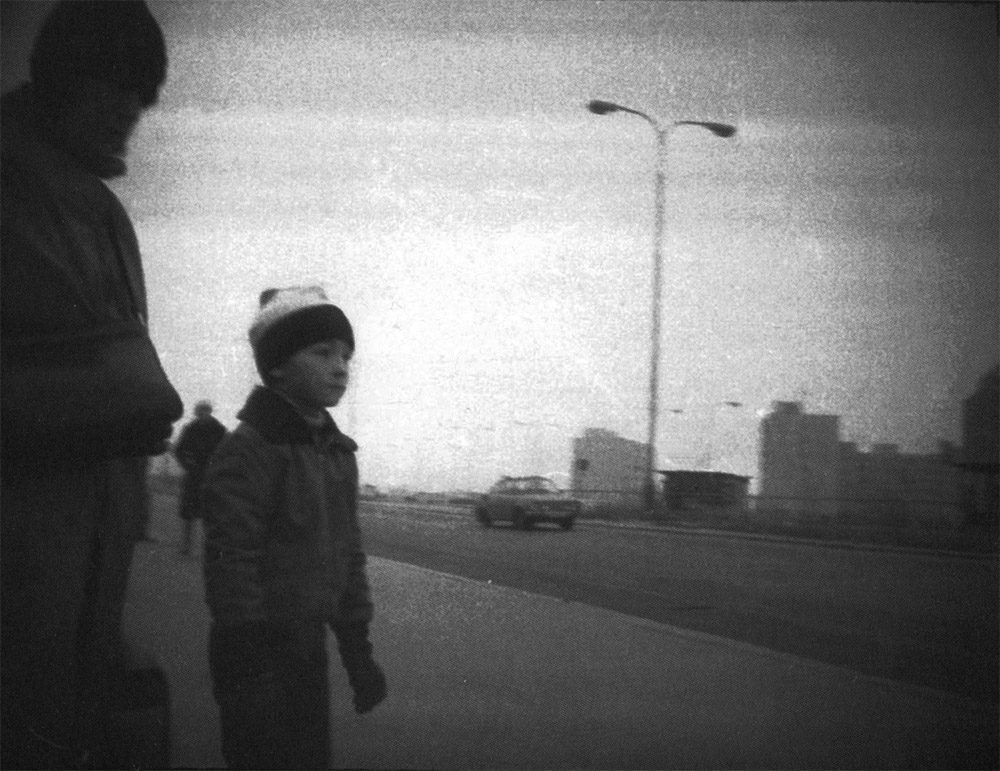
I want to look at another photograph from the book ‘Prague Through the Lens of the Secret Police.’

Leaving aside how the photograph came to be taken, this is, I think, a stunningly beautiful shot. Its tonal quality, the grain of the picture’s surface, the soft focus and the gradation of light from the centre of the photograph to shadow at its edges, all make for an image which revolves around the child and which, we might say, celebrates the innocence of childhood. There’s a sense of wonder in the boy’s face, his eyes staring at something we cannot see in the distance. And yet there’s also a sense of foreboding (light becomes shadow); in the figure on the pavement behind them, in the solitary car on the road, the grey concrete blocks and the double lights of the lampost which mirror the shape of the child’s eyes as if they too are watching, not what lies ahead, but what is down below. There is perhaps no point in looking ahead to the future, but the boy does it anyway.

Besides the boy and the street lamps, only the car has eyes. The woman beside him is wearing dark glasses, the figure behind is little more than a blur, and even the tower blocks seem blind without their windows. No-one inside is looking out. People are there to be looked at, nothing else. And yet the boy stares ahead, oblivious. His body is tense – perhaps from the cold – as if he’s about to run towards the future.

Of course there is one person in this image I haven’t mentioned, and that’s the person who took the picture; a  member of the Czech secret police following the woman and her child. However, unlike with the previous photograph, I do not feel I’m there within the frame. I’m very much an outsider looking in. But given how the photograph was taken (perhaps from the surveillance officer’s waist) my viewpoint is subsequently low, as if I too am a child, accentuating the sense that this is a photograph about the boy, or rather childhood: innoncence in contrast to its loss under such a regime. But these of course are interpretations made some 27 years in the future. The fact is, that this was a photograph taken for the purposes of surveillance, for control. In reality, it’s far from being the beautiful photograph I said it was earlier.

Yet it is still that: beautiful.

Over time its purpose,  as an object of surveillance, has slipped away, leaving it open to aesthetic appreciation. But there is an awkwardness here, something uncomfortable in the fact, and this is an area to whcih I’ll be returning.

Filed Under: Photography Tagged With: Photographs, Secret Police, Vintage Photographs

Panorama by Cy Twombly – Part 1

January 2, 2011 by Nicholas Hedges

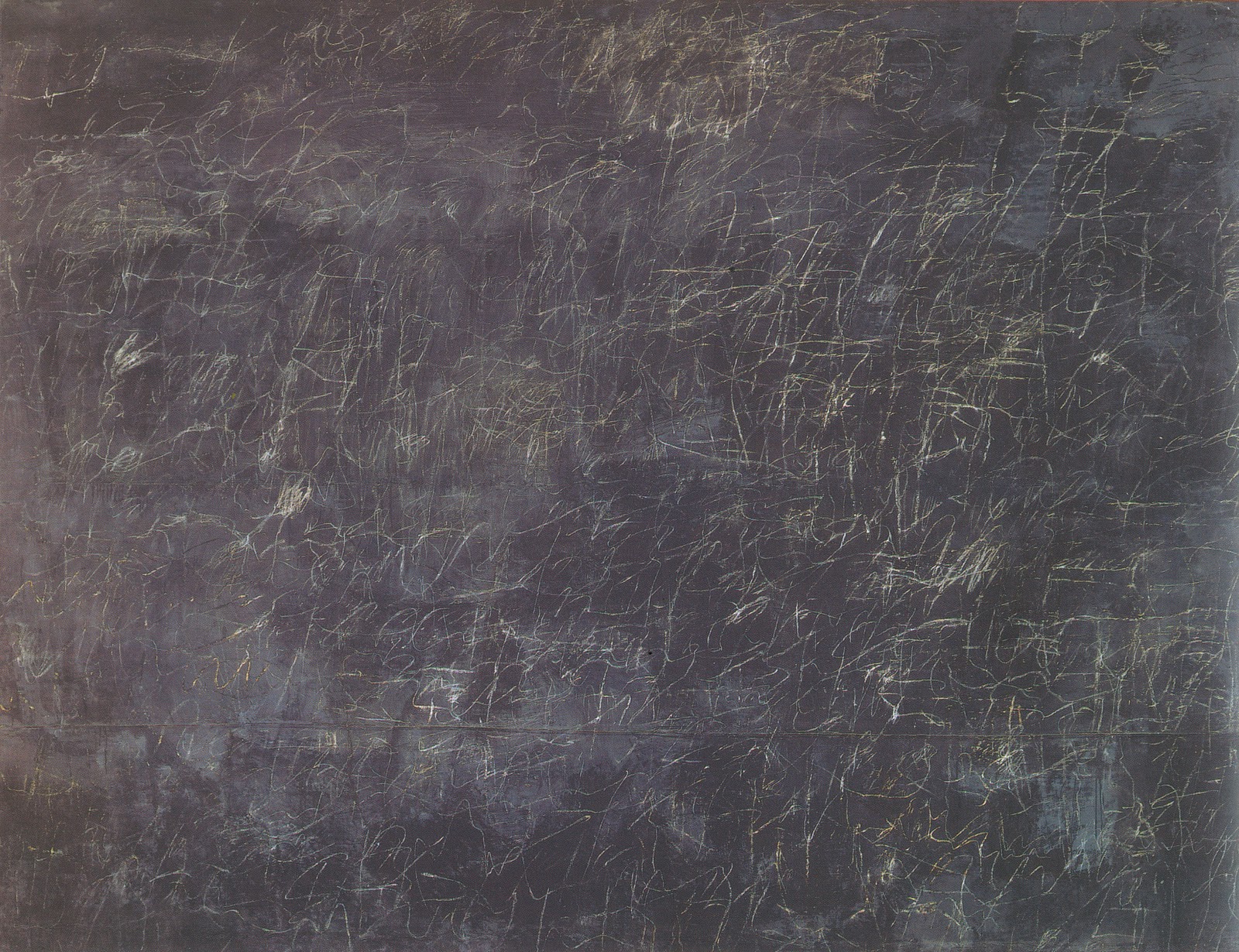
The first painting I have chosen is Cy Twombly’s 1955 painting Panorama.

The first thing to say about discussing a work of art which one has only seen in a book, is that any view is going to be extremely restricted. To be fully appreciated, art (whether paintings, installations, sculpture and so on) needs to be experienced. The impact of a painting can be felt as much with the body as the eyes, and a reproduction found in a book will only reveal a fraction of its ‘story’. (I never cease to be amazed  – and indeed, depressed – at how people when standing before a painting in a gallery will choose to view it through the screen of their camera, rather than look directly). This difference between experiencing a painting and seeing it in a book is itself an interesting area to research, and one I’ll be looking at over the coming months. Nevertheless, reproductions can still tell us a great deal, so with this in mind I shall begin with the painting shown above.    
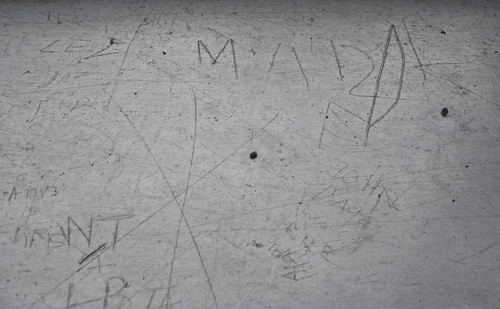
I have always been drawn to a certain kind of aesthetic, one which you’ll often find in places of decay, where time has taken hold of a building and chewed upon it like a dog with a bone. The aesthetic of time or the passage of time is beautiful in its relentlessness; from crumbling walls and cracked plaster, to buckled paint layers and the weary look of old books and photographs. It’s something which, for whatever reason, captivates me, whether I’m there amongst the glorious ruins of Pompeii and Herculaneum; walking down a hot and dusty street in Siracusa; looking at a long abandoned tomb in Montparnasse or standing in my old school, just before its scheduled demolition. Indeed, it was in my old school that I photographed the window sills, scratched with the names of bored pupils from the 1970s, and it wasn’t so much the names that interested me, rather, the look of those names; an aesthetic which we find in Cy Twombly’s Panorama, painted in 1955.
Before Demolition

I can anticipate what many might say when confronted with a painting such as this. ‘I could do that’ is a usual retort, or even worse, ‘a child could do better.’ Which is of course not the point. Whenever someone says ‘I could do that,’ I always point out that they haven’t, and that, in all likelihood, they’d have no reason to try. ‘I could’ in this instance, is just another way of saying ‘I haven’t’. And while I’m not going to extol its virtues as a great work of art, a work of art this painting is and one which, for whatever reason I’m particularly drawn to.
But why? What is it about this piece that I find so engaging?
Without wishing to sound too shallow, first and foremost it’s the look of the painting which appeals. Looks matter for me in art, but that’s not to say art should be beautiful (nothing could be further from the truth); but it needs to be engaging. In order to hold the attention of the viewer, in order to attract them in the first place, you need to trigger something within them. To use a rather crude analogy, it’s rather like the cover of a book and the subsequent opening line. Get it right and your story with its deep themes and intricate plots may well get the chance to be revealed. Get it wrong and no matter how perfect the rest of the book, the potential reader will never get to know. As I’ve said, this is a crude analogy, and I don’t wish to dwell on the idea of a painting being analogous to a book; but nonetheless artists have something to say and how they say it matters. Of course there are no rules governing taste, and what one person likes another will dislike, or even hate.
In the case of Panorama, it’s a painting I’ve come to love.
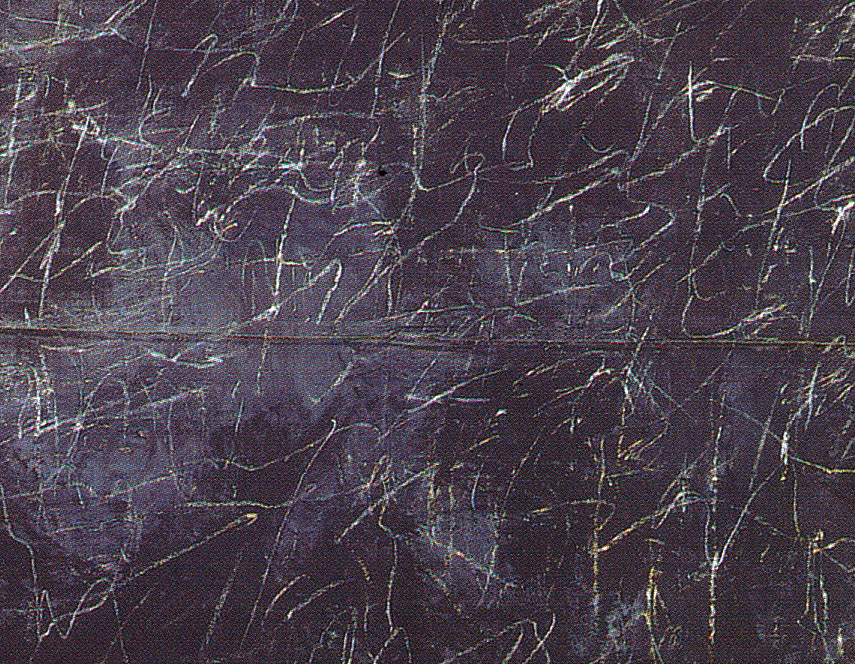
Looking at this painting (a detail is shown above) is like looking at a wall upon which people have scratched words and names, which then over time have lost their shape and meaning. The scratches are words or signifiers reduced to a new kind of text yet to be deciphered. Not that as a viewer I’m trying to make sense of all the lines or even groups of lines. This isn’t a game of ‘pick-up-sticks,’ where individual elements are teased out from the apparent chaos.

Sicily

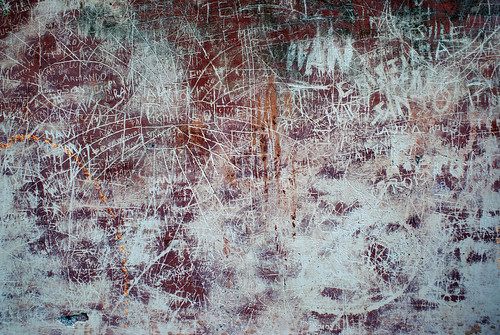
Something which in a moment was possessed with meaning, means nothing now, and all those moments, layered one on top of the other, create as a result, a palimpsest of ambiguous symbols signifying a strange kind of nothingness; a presence which at the same time is also an absence. People come and people go, and in some respects, this painting is for me a work about time – about the simultaneity of what I’ve just described: presence and absence.

Of course we know that this is the work of one man, but even so, there is a sense of a multitude of meanings. If it’s not a collection of thoughts, then it’s a mass of independent actions; a multitude of presents, wrapped up in a simultaneous slab of the past.
The shades of grey, smudges and rapid scrawls, also call to mind a blackboard, on which someone has poured out their thoughts in the hope of distilling them down into an equation – a simple truth. I’ve always loved the aesthetic of the blackboard (as well as mathematics); the half revealed texts and mathematical symbols, the swirling smudges of rubbings out, the dust and the physicality of thought. (I’m only glad we didn’t have whiteboards or even worse, smartboards when I was at school). This could be a painting about obfuscation, of concealment, where something has been scratched out and hidden from view. Or perhaps it’s the opposite, a painting that is looking, searching for that something which remains elusive?
We can follow lines, from one to the next in our own search, but we’re always held on the surface; we cannot penetrate the painting’s depth. And depth there must be, for the work could not have been made in an instant, but gradually over the course of time. It is then a panorama, viewed in a moment, and made of many thousands.
www.nicholashedges.co.uk

Filed Under: Paintings Tagged With: Cy Twombly, Graffiti, Paintings

Secret Police 1

January 2, 2011 by Nicholas Hedges

The first image I want to look at (taken from a book called ‘Prague Through the Lens of the Secret Police’ from the Institute for the Study of Totalitarian Regimes; ÚSTR, Prague 2009, 1st edition) shows a scene captured from the window of an apartment block in May 1980.

The net curtain hanging in front of the closed window serves to conceal the identity of the photographer, not only from those outside, but also from us as we look at the picture; more so even, than the fact the photographer is standing behind the camera. Nevertheless, despite the fact they can’t be seen, one is aware of the photographer’s presence. It’s almost as if the camera has captured something beyond the reach of its lens; the secret policeman is out of sight, but never out of mind, just as he was every single day, throughout the time of Communist rule in what was then Czechoslovakia.
The net curtain serves to obscure our view of the world outside, but far from removing us from what is taking place down in the street, it seems instead to immerse us in its here and now (or rather there and then). It becomes the means by which the light from that single moment in May 1980 is frozen, rather than the click of the camera’s shutter.

As I look at the photograph, the identity of the voyeur is both concealed and revealed. The space before the net curtain (that inside the room) becomes the world around me now, here in the present. I look at the image in silence (or to put it another way, I watch the image) and become aware of my breathing as well as every little noise around me; the hum of my computer, the ticking of a clock, a bird singing in the garden. It’s as if the plane of the photograph has moved a few inches forward, as if the photograph begins just beyond the curtain, with the pot of old flowers on the window sill. We are the secret police, watching through the window 30 years in the future.

This paradox is one of the consequences of photography, whatever the particular photograph we’re studying. In fact, however we research the past, we become like secret police, following people, keeping notes, putting notes in files. We document their lives as if we’re trailing them, following them down the street, around buildings or even in their own homes. And yet of course we’re always far in the distance. We follow on behind, yet we’re always way ahead. 

Returning to our image, we can assume the person being followed is the woman entering the apartment block opposite. She turns a little, as if she’s aware that she is being watched. At first glance, it’s as if she’s also being watched by the children on the right, but when we follow their gaze, we can see that two of them are looking beyond the frame of the photograph, somewhere down the street to the left. The woman being followed – our ‘target’ – is glancing that way too, as if something has made a noise. Perhaps that noise startled whoever was watching enough to take the picture?
As I look at the photograph, I rewind the scene a little. There’s the noise and its aftermath, then, in a flash I’m there walking through the doorway, stepping into the shadows beyond, my footsteps clattering, mixed in with the noise which slowly falls away in a receding echo. And as my viewpoint shifts as the observer, so I move between the scene’s protagonists at which the plane of the photograph falls away completely. Was it perhaps a broken window they heard?
Back in the room (and here in my room in the present day) I lean back, as if to avoid the possibility the target might turn her head completely and look up at the window behind, at that from behind which I’m looking 30 years in the future. I look away from her and ahead at the windows opposite. There are two of them, one open, the other closed, both dressed in the same net curtains through which I’m also peering. The sound I’ve described has found its way through the open window, carried on the wind,   along with the children’s conversation and the woman’s footsteps below. Is there someone there too, hiding behind the curtain? A neighbour looking to see what the noise was, or another member of the secret police following the same person, or even someone else? Or perhaps it’s someone else entirely who stands opposite, looking like me at a photograph somewhere in the future, one in which I’m looking back from behind a net curtain, there in the window across the street. 

Filed Under: Photography Tagged With: Photographs, Secret Police, Silence, Vintage Photographs, Windows

An Introduction

January 2, 2011 by Nicholas Hedges

“Such is the photograph: it cannot say what it lets us see.”
Roland Barthes

The aim of this project is to write about photographs; about those things they let me see but which they cannot say. I will select, mostly at random, photographs from some of my books, as well as those in my own collection and write whatever comes to mind as I look at them. From time to time I might discuss them in light of the work of writers like Roland Barthes and Susan Sontag, but my aim is to keep things simple, insofar as I will write about my own personal experience of looking at, and on occasion, holding each of the images.

Photographs are like the night sky, or as Susan Sontag writes – ‘the delayed rays of a star.’ They show us something that was and is, but which at the same time isn’t any longer. Each one is a paradox where the act of looking creates a space in which the observer and observed (as regards photographs taken before we were born) are both absent and present at one and the same time. A whole new dimenison is opened up, where the presentness of the past becomes most apparent. It’s as if the act of photographing slows the light from the photographed being or beings to the point of being still, without it actually coming to a complete stop.

Looking at a photograph is not only a visual thing, but something which brings into play our embodied imagination. The term ‘kinaesthetic empathy’ is often used to describe the phenomenon of watching dance on stage, where members of the audience feel with their bodies what is happening in front of them. And while photographs might seem like static images, the image itself, like the light which caused it to be made, is merely slowed rather than stilled. With our embodied imaginations, we can speed the light up and see, indeed participate in what came next in the seconds which followed.

Filed Under: Photography Tagged With: Barthes, Photographs, Vintage Photographs

John Malchair 1770

December 31, 2010 by Nicholas Hedges

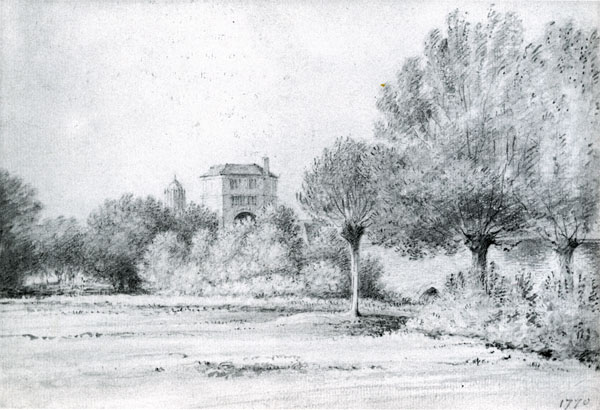
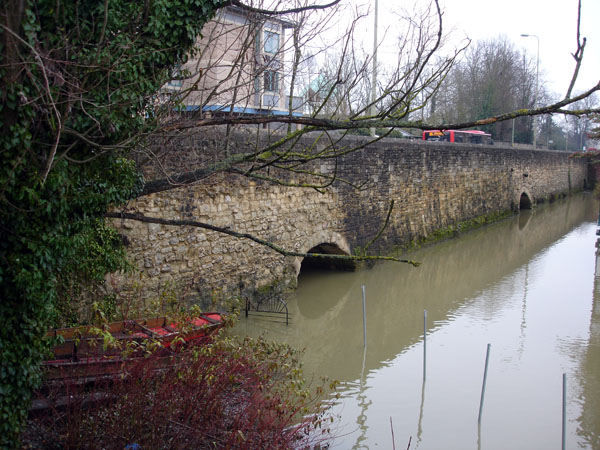
The following is a drawing made by John Malchair showing the causeway of what is now Abingdon Road. The rather unusual building is Friar Bacon’s Study which was demolished in 1779. Beneath the drawing is a photograph showing the same causeway, with two arches, a little bit like the arch which can be seen in the drawing.

Filed Under: Photography, The Gentleman's Servant Tagged With: Drawings, John Malchair, Photographs

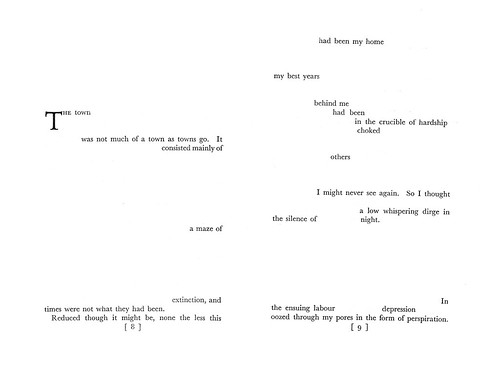
Heavy Water Sleep: Pages 8 & 9

December 29, 2010 by Nicholas Hedges

Original Version

08-09

Version 1

08-09 [29-12-2010]

Version 2

08-09

Filed Under: Heavy Water Sleep, Photography Tagged With: Heavy Water Sleep, Holocaust, Photographs, Text Work, WWII

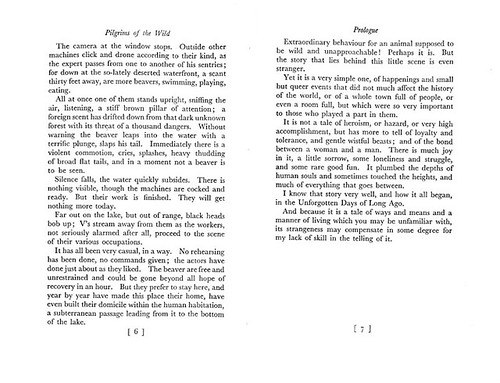
Heavy Water Sleep: Pages 6 & 7

December 22, 2010 by Nicholas Hedges

Original Version

06-07

Version 1

06/07 - Version 2 [22-12-2010]

Version 2

06/07 - Version 2 [22-12-2010]

Filed Under: Heavy Water Sleep, Photography Tagged With: Heavy Water Sleep, Holocaust, Photographs, Text Work, WWII

Light and Sound

December 22, 2010 by Nicholas Hedges

Whilst updating the Family Tree section of my website, I listened again to part of an interview I recorded with my Nana in December 2007. She died just under a year later and the three hours I spent with her that afternoon, talking about her life have come to be amongst the most important I can remember. And whilst the content of our conversations were often moving, listening to it now, two years after her death, I began to think about how the act of listening to her, now that she is no longer with us affected me, comparing it to how I feel, when looking at photographs of those who have died. Does the difference between the two media, between light and sound, change the way we respond to the past? And if so, how?

Filed Under: Family History Tagged With: Family History, Family Jones, Interview, Jones, Nana

Connections

December 22, 2010 by Nicholas Hedges

Two images from two separate projects: Heavy Water Sleep (top) and Fragment (below).

Fragment 3

Filed Under: Heavy Water Sleep Tagged With: Connections, Fragments, Heavy Water Sleep, Sonic Work, Text Work

Fragment: GPS to Midi

December 22, 2010 by Nicholas Hedges

I’ve been looking for a way of converting GPS data to midi as part of a project based on a fragment of mediaeval pottery which I found in the Museum stores at Standlake in Oxfordshire. The GPS data derives from a walk I made around the area where the pot was discovered during an excavation in 1986 (St. Aldates in Oxford).

Part of the project articulates the idea of the pot’s creation (on a potters wheel) by using a turntable on which a vinyl record will play a fragment of an audio piece, the rest being composed of silence (or at least the crackle of the vinyl). The idea for the audio composition was to create something using GPS data. But how could this be turned into midi information?

The image below shows the route recorded on my GPS device.

Fragment Sound Walk 01 Garmin

Originally, I’d coverted the data into midi (via photoshop) as in the image below, but the result was too complicated, and not a little messy.

Fragment Sound Walk 01 Midi

It was whilst considering how one makes paper snowflakes, that I went from cutting holes in a fragment of paper to the holes of old piano rolls. What I needed was something which was more like this. Instead of trying to copy the line of the walk completely therefore, I have instead blocked in notes where there are points on the GPS map as in the images below.

Firstly, in Photoshop, I combine a screenshot of the map with one of the midi inspector in Cubase.

Fragment 1

Then, where there’s a circle on the GPS line, I create a note in the nearest ‘box’.

Fragment 2

The result, when compared with my earlier attempt is now much neater and easier to work with.

Fragment 3

Filed Under: Fragment Tagged With: Fragment, Fragments, GPS, Lines, Midi, Positioning, Silence

Heavy Water Sleep: Pages 4 & 5

December 21, 2010 by Nicholas Hedges

Original Version


Version 1

Version 2

04/05 - Version 2 [21-12-2010]

For more information on this project, please click here.

Filed Under: Heavy Water Sleep, Holocaust Tagged With: Heavy Water Sleep, Holocaust, Text Work, WWII

  • « Previous Page
  • 1
  • …
  • 13
  • 14
  • 15
  • 16
  • 17
  • …
  • 32
  • Next Page »
  • The ‘Now of Then’
  • Artist’s Statement
  • Designs for an Heirloom
  • Dissonance and rhyme
  • Wildflowers
  • Emptiness
  • Wave (goodbye)
  • Now In The Past Of An Unreal Place
  • Return to Graphite
  • Genius
  • Latest Backdrops
  • Extended Backdrops
  • Backdrops
  • Komorebi
  • Acorns
  • Scroll Work
  • Goethean Observation: Japanese Scroll
  • Mistakes
  • The Leaf Is Singing Still
  • Past Present
  • Scrolls
  • As Yet Untitled
  • Holes
  • Scroll
  • A Calligraphy of Shadows
  • More Paintings
  • Latest Paintings
  • Walking Meditation 2
  • Knowing We Are There
  • Venice by Moonlight 1840
  • Fragments and Additions
  • Reimagining The Past
  • Walking Meditation 1
  • Mindful Walking I
  • Grief II
  • Three New Paintings
  • Nana’s Mountain
  • Painting
  • Iridescence
  • Roman Bottle
  • Rinsho
  • Shadow Calligraphy
  • Becoming Memory
  • Fox Talbot’s Glassware
  • Goethean Observation: Diffuser II
  • Goethean Observation: Diffuser
  • A Remembrance of Things We Never Have Known
  • A Moment’s Language
  • Take Me Home
  • Arrival/Departure
  • Diffusers
  • Grief
  • Mum
  • Measuring the past
  • Disordered Time
  • Entropy
  • Wicked Magician, Fly
  • The Quanta of History
  • Empathy Forward
  • The Natural World of 978
  • The Gone Forest
  • Empathy/Exchange: 668 grams
  • Goethean Observation: Pilgrims of the Wild, 1935
  • Nazareth O
  • Several Johns and St. Thomas
  • Raspberry
  • Tokens and Shadows
  • Patterns Seeping (II)
  • ‘Missded’ 4 – Tokens
  • Patterns seeping
  • Cut Paintings
  • ‘Missded’ 4
  • Locks III
  • Locks II
  • ‘Missded’ 2 – Tokens
  • My Son’s Drawings II
  • ‘Missded’ 2
  • ‘Missded’ 3 – Tokens
  • ‘Missded’ 3
  • ‘Missded’ 1 – A Framed Token
  • Morning Has Broken
  • Tokens of absence
  • ‘Missded’ 1, stitched
  • More Little Words
  • Three Little Words
  • Spaces In Between
  • ‘Missded’ 3
  • ‘Missded’ 2
  • ‘Missded’ 1
  • Locks
  • Tracings
  • My Son’s Paintings
  • Writing Shadows
  • Samuel Borton’s Post Chaises
  • Dawid Sierakowiak
  • Pitchipoi
  • Latest Tree Drawings
  • Notebook
  • Somewhere Between Writing and Trees II
  • Somewhere Between Writing and Trees

© Nicholas Hedges 2024

  • Facebook
  • Instagram
  • Twitter
  • YouTube

Copyright © 2025 · Outreach Pro on Genesis Framework · WordPress · Log in