Nicholas Hedges

Art, Writing and Research

  • Amazon
  • Behance
  • Facebook
  • Instagram
  • Pinterest
  • YouTube
  • Art
    • Digital
    • Drawing
    • Grids
      • Correspondence
      • The Wall
      • The Tourist
    • Ink on paper
      • Shadow Calligraphy
    • Installation
      • Murder
      • Echo
    • Painting
    • Patterns
    • Mixed Media
    • Photographic installation
      • St. Giles Fair 1908
      • Cornmarket 1907
      • Headington Hill 1903
      • Queen Street 1897
    • Research/Sketches
    • Stitched Work
      • Missded 1
      • Missded 2
      • Missded 3
      • Missded 4
    • Text Work
  • Blogs
    • Family History
    • Goethean Observations
    • Grief
    • Light Slowed But Never Stilled
    • Lists
    • Present Empathy
    • Shadow Calligraphy
    • Trees
    • Time
    • Walking Meditations
  • Video
  • Photography
    • Pillars of Snow
    • Creatures
    • The Trees
    • Snow
    • St. Giles Fair 1908
    • Cornmarket 1907
    • Headington Hill 1903
    • Queen Street 1897
    • Travel
  • Illustration and Design
  • Music
  • Projects
    • Dissonance and Rhyme
    • Design for an Heirloom
    • Backdrops
    • Shadow Calligraphy
  • Exhibitions
    • A Line Drawn in Water
      • Artwork
    • A Line Drawn in Water (Blog)
    • Mine the Mountain 3
      • Artwork
    • Mine the Mountain 2
      • Artwork
      • The Wall
    • The Woods, Breathing
      • Artwork
    • Snow
      • Artwork
    • Echo
      • Artwork
    • Murder
      • Artwork
    • The Tourist
    • Dreamcatcher
    • Mine the Mountain
      • Artwork
      • The Tourist
    • M8
    • The Gate
    • Creatures
      • Artwork
    • Residue
      • Artwork
    • A visit to Auschwitz
      • Artwork
  • Me
    • Artist’s Statement

Dreamcatcher II

November 15, 2007 by Nicholas Hedges

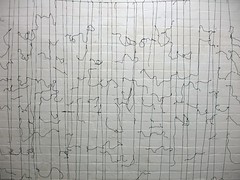
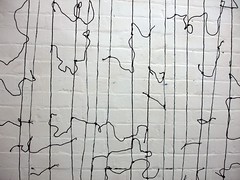
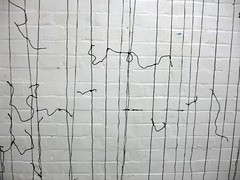
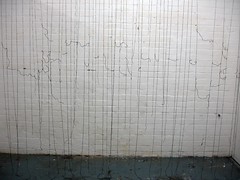
Whilst working on my ‘Dreamcatcher’ project/installation today, I thought again about the idea of it being a piece of music, and, as I thought, a visitor to the studio (Tiffany, who has a very nice voice) decided to try and ‘sing it’, along with Philippa (who first suggested it looked like music). Using the vertical strings as measures and the horizontal strings as indicators of notes on a scale, they sang the entire work, and, although it was a bit of fun, the sound they made did remind me of a kind of lamentation. As I worked on the strings, untangling them and tying knots etc. I felt as if I was playing some kind of instrument – something like a harp.

Dreamcatcher (work in progress 2)

I also thought a lot about the action of weaving, for it’s felt these past two days as if I’ve been creating a piece of clothing, and, given what these cut strings or threads represent, I was reminded of a quote from Roland Barthes’ ‘Camera Lucida’.

“Clothes make a second grave for the loved being.”

A second grave is somehow analogous with the idea of post-memory, for if one sees the clothes of someone who has passed away, one can somehow imagine them without really knowing who they were, just as post-memory allows one to get a feel for a past event without having witnessed the actual moment itself.

Dreamcatcher (work in progress 2)

Filed Under: Uncategorized Tagged With: Barthes, Dreamcatcher

Dreamcatcher

November 14, 2007 by Nicholas Hedges

In March 2008, Brookes will be showing a select number of works at MAO (Modern Art Oxford) and so I have decided to submit two proposals, one of which is entitled ‘Dreamcatcher’. The following extracts are taken from that proposal, the first section being ‘about me’ and the second ‘about the work’.

“As an artist, my main areas of interest are time, memory and remembering, with a particular emphasis on postmemory and its formation within the individual consciousness. Examining past events such as World War 1 and the Holocaust, my work seeks to explore how we formulate memories of times when we were not born, or of events to which we were not witness. What strategies do we employ in reconstructing the past? Contemporaneous objects, documents, photographs, verbal and written testimonies/narratives can all be used by the imagination to create postmemories, but what role do they play in the present-day, real-time, world?”

“An installation comprising a single room, all four walls of which are wallpapered with hundreds of drawings (see attached images for completed examples). These are drawings of the gate-tower at Auschwitz-Birkenau as remembered by myself following my visit there in October 2006. In the centre of the room, a net is suspended from the ceiling, created from hundreds of pieces of black string knotted together; a physical version of all the drawings, as if they were shown on a single piece of paper, and as if the ink had been turned into string.

The drawings themselves could be said to represent a last, snatched glance at the gate-tower of Birkenau and their number a testament to the number of people who died there. It could also be said to reveal my own incomprehension of standing in a place where over a million people died (a conflict between memory and postmemory), each death a piece of string – the thread of life drawn, measured and cut, as according to Greek Mythology – and tied to make the Dreamcatcher. Dreamcatchers are said to let good dreams through and ensnare nightmares, and for all the victims, Auschwitz-Birkenau was exactly that – a catastrophic nightmare.”

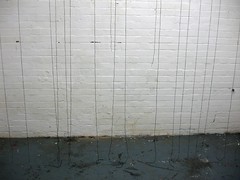
Today I started to create a prototype net at my studio and like all these things, it proved quite different in the way it began to develop off the page. Firstly, I tied a piece of string across my space about 7 feet off the ground and then attached vertical pieces which extended down to the floor. Almost straight away, I found myself thinking of a gallows.

Dreamcatcher (work in progress)

When it came to tying the horizontal strings, I used the pile of cut strings which proved rather difficult to use, but I used them nevertheless, and the action of tying, again proved interesting albeit for very different reasons than before. Each knot felt just like an act of remembrance. It was a positive act rather than a negative one.

Having completed a number of the horizontal strings, a colleague in the studio told me that she thought it looked like a musical score of some kind. I was thinking that it looked like writing; but this idea of it being musical was interesting.

Dreamcatcher (work in progress)

Dreamcatcher (work in progress)

Filed Under: Holocaust Tagged With: Dreamcatcher, Holocaust, String, WWII

Colour

November 12, 2007 by Nicholas Hedges

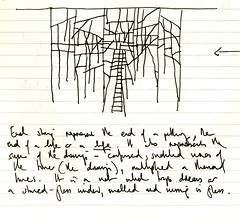
Each string (in what I have so far called the ‘net’) represents in its ‘cut end’ the end of a path, the end of a life. Each string also represents a life entire as measured by the three fates. Furthermore they could be said, as a group to represent the combination of paths which, at a specific moment in time created one of the many terrible moments of the Holocaust. Also, the image of the whole represents the sum of the snatched visions of the tower at Birkenau (the drawings).

Of the physical appearance of the net, the following quote from Fernando Pessoa’s ‘The Book of Disquiet’ is very pertinent:

“I also have my crochet,
It dates from when I began to think,
Stitch on stitch forming a whole without a whole,
A cloth, and I don’t know if it’s for a garment or for nothing,
A soul, and I don’t know if it’s for feeling or living.”

The image of the net looks like a ‘dream-catcher’ and in many ways that works in respect of this theme; dreams which many would have had of going back home, trapped in its strings. (There is also the idea of the writes of the telegraph poles carrying messages out of the camp and across Europe).

I was also thinking today about work by two of my colleagues which was very much to do with colour. This made me look at my own work (which is anything but colourful) and the subsequent contrast interested me. It reminded me of a television programme I watched last night about the photographer Albert-Kahn who documented the First World War in colour photographs. When we think of the past, in terms of the war, pre-war and Victorian periods, we think of it in terms of black and white. When we see colour photographs of the First World War they seem to validate reality – the very fact of time before we were born.

In my work there is no colour as such, but it is there, just as colour is there in Black and White photographs.

12-11-07
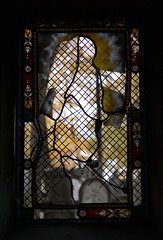
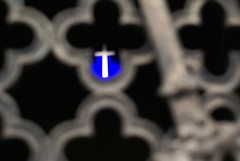
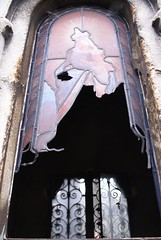
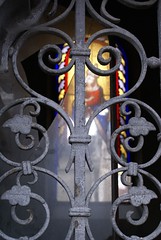
In the image above, I was reminded of the stained glass windows in the many tombs of Montmartre and Pere Lachaise cemeteries. The lines of the image (of the net) could just as easily be the lead work of a broken stained-glass window; what is missing of course is the colour.

Pere Lachaise, Paris

Colour could be a validating factor in this case. Often when we think of the Holocaust or World War One for example, we see them in Black and White (like the cats (although evidence suggests they may have limited colour vision) we saw in the cemetery); we often think of the weather as being dull, grey, miserable, always winter, and when we read evidence of the time that talks of blue sky and sun, it always seems somehow shocking. The following is an extract from Tadeusz Borowski’s “This Way for the Gas Ladies and Gentlemen.”

“‘…You have no idea how tremendous the world looks when you fall out of a closed, packed freight car! The sky is so high…’
‘…and blue…’
‘Exactly, blue, and the trees smell wonderful. The forest – you want to take it in your hand!'”

When imagining arrival at somewhere like Birkenau, one imagines it being night, or the smoke from the chimneys hiding the sky like a fog. But of course, people would have arrived on beautiful summer days, when colour was abundant.

Filed Under: Holocaust, Trees Tagged With: Borowski, Colour, Fernando Pessoa, Holocaust, String, World War I, WWI, WWII

Herodotus and the Morning Paper

November 10, 2007 by Nicholas Hedges

One has to remove the future from a past event to really understand its ‘presentness’. One has to view historical (‘Herodotus’ – see Walter Benjamin and Objects) events as being on the periphery, whilst the mean and the commonplace (‘morning paper’) take centre stage. It is the distance which interests me, the distance from the heroic or ‘main’ event and the historical perspective this gives us.

“Thus the whole emerges simultaneously with the accumulation of the parts, not because it is the sum of the parts, but because it is immanent within them.”

Bortoft’s theory of authentic wholeness could be applied to history. A great event, such as a coronation (let’s say, that of Elizabeth I), is not a whole in itself. Step outside the ceremony, outside the city and into the countryside; walk into a tavern… what is happening there, at the exact moment of the coronation? Let’s say a man sits at a table eating his dinner, enjoying a drink. The moment of the coronation is not simply about the ceremony but the moment in time (some time on January 15, 1559); that moment, of which the Queen and the man in the house are equal parts, although history has forgotten one and kept alive the other. Within both these people (parts), the moment (the whole) is immanent.
The man in the tavern pours his wine from a jug; 450 years later and that jug is in a display case in a museum, freed as Benjamin would have it from the ‘drudgery of its usefulness.’ For us to see it properly as it stands behind the glass, we need to re-impose that drudgery, we need to see it as it was, when it was useful.

Returning to the idea of distance and perspective: the distant elements in my old holiday photographs on which I have been doing some work, as well as those in old photographs (windows and bicycles) coincide to some degree with what I have written above. When I look at a photograph, taken during a family holiday in the late 1970s, I see the people I recognise, whether that’s myself, my brother, parents or grandparents. But there are often others, all of whom were a part of that moment (such as the girl below who was standing in the distance of one of our snaps).

20

Returning to objects: how do we re-impose the ‘drudgery of an object’s usefulness’ back onto the object? Think of the old musical instruments in the museum. How did I give it back its usefulness? By using the Goethean method of observing, and, in particular, by placing it back – through use of the imagination – in its own time. Although I wasn’t looking at the specific ‘gesture’ of things at that time, I believe I found the gesture of the lira di braccio nonetheless.

So, returning to the man in the tavern; what are the elements of that place which one would need to understand in order to re-construct it through the imagination? Objects (contemporary and old), environments (the room itself and elements thereof), conversations…

Filed Under: Goethean Observations Tagged With: Creatures, Goethean Observation, Henri Bortoft, Herodotus, Objects, Vintage Photographs, Walter Benjamin

Walter Benjamin and Objects

November 10, 2007 by Nicholas Hedges

Walter Benjamin, in his ‘Arcades Project’ writes:

“The collector dreams his way not only into a distant or bygone world, but also into a better one-one in which, to be sure, human beings are no better provided with what they need than in the everyday world, but in which things are freed from the drudgery of being useful.”

and in his introduction (Expose 1939)…

“The subject of this book is an illusion expressed by Schopenhauer in the following formula: to seize the essence of history, it suffices to compare Herodotus and the morning newspaper. What is expressed here is a feeling of vertigo characteristic of the nineteenth century’s conception of history. It corresponds to a viewpoint according to which the course of the world is an endless series of facts congealed in the form of things.”

When I was thinking about how I perceive history, or at least, how I try to perceive history, I began to consider that it was as much about removing the ‘stain’ of history from whatever it was I was perceiving, i.e. an event, date etc., and seeing that event or date as it was, in all its minutiae, at the moment of its happening. It was as much about the mundane (the morning newspaper) as it was the heroic (Herodotus). And that is why I’m so drawn to objects, the simple things – broken bits of pots and so on – one finds in a museum, those things which have been collected and ‘relieved of the drudgery of being useful’ as Benjamin puts it. However, in order to find one’s way back in time, when looking at such objects, one needs to reimpose that drudgery, to see them as they were, when they were in fact useful, when they were being used, and who it was who was using them.

Filed Under: Uncategorized Tagged With: Arcades Project, Herodotus, Objects, Schopenhauer, Walter Benjamin

Paris, Capital of the Nineteenth Century

November 8, 2007 by Nicholas Hedges

On the first day of this month, I travelled to Paris on Eurostar and met my girlfriend Monika at the Gare de Nord station, she having travelled in from Luxembourg by TGV to Gare de l’Est. I was last in Paris in 1992/93 (the exact date eludes me) on a visit made as part of my degree in Art History, and although my memories of the city were rather vague and (before re-visiting) few, my impression of it was nonetheless intact and fairly lucid. From the pretend statue at Sacre Coeur (a woman, painted white, standing still), to being lost somewhere near Les Halles, from the pastels of Odilon Redon in the Musee D’Orsay, to Rodin’s ‘Balzac’, from the Musee Moreau to a few trips made on the Metro, I could adduce that Paris was beautiful, and, as Walter Benjamin described it in his Arcades Project, the ‘Capital of the Nineteenth Century.’

This sense of it being a nineteenth century city might owe as much to the fact that much of it was indeed built (or rebuilt) in that period (with the extensive renovations by Haussmann in the 1860s) and that its ‘symbol’ the Eiffel Tower, was constructed between 1887-89 as the entrance arch for the Exposition Universelle (the novelist Guy de Maupassant, who claimed to hate the tower, supposedly ate lunch at the tower’s restaurant every day. When asked why, he answered that it was the one place in Paris where you couldn’t see it).

The city’s character is formed as much by an abundance of 19th century literature (Zola, Baudelaire, Balzac, Huysmans…) and art (Realism, Impressionism, Post-Impressionism, Symbolism…) than simply ‘bricks and mortar’, yet, despite this sense, it’s by no means a city stuck in the past at all, rather it’s very much of the present, as if the intervening time had not intervened, as if there was nothing to intervene between.

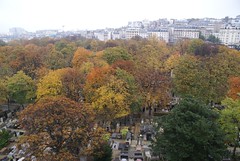
November the 1st is All Saints Day, and by tradition, people in many European countries, including France, take flowers to the graves of dead relatives. Our hotel room, overlooked the cemetery at Montmartre which, having unpacked, we visited.

Paris

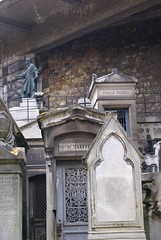
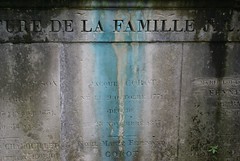
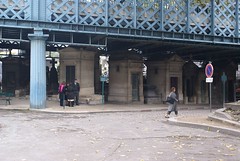
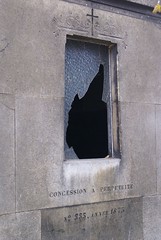
For Monika, being Polish, the day was very much part of her own tradition, and one of the first things we saw as we walked around, was a group of Poles reciting a prayer for a fellow countryman laid to rest in the cemetery. The cemetery itself was interesting inasmuch as it was very much a part of the city, rather than a place divorced from life – a sense augmented by the bridge which ran above it, beneath which the tombs of the dead resembled makeshift dwellings erected by the homeless; constructions for the purpose of temporary habitation, rather than eternal rest. Indeed, given the occasional broken pane of glass we wondered whether or not they were in fact used as shelters; where the living tap the dead for respite from life.

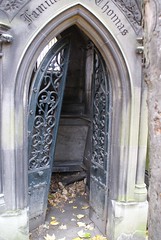
These little dwellings were beautiful, especially where time, which ought to have let the dead alone, had scratched away at the doors, much like the vagrants seeking shelter from the rain.

Paris

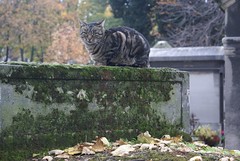
The first grave we saw took my interest, since a cat was laying on top of it, dead centre, looking towards the headstone. I took a photograph (which I have since, accidentally deleted) and immediately, a lady, standing with a man (I presume was her husband) asked me in French, ‘why did you take a picture?’ I must confess here that I do not speak French and relied on Monika who does. I explained that I was interested in the cat and was amazed then to discover that the grave was that of her mother. Suddenly, from an anonymous grave with an anonymous name, the memorial had come to mean much more. There was a physical, living connection. She explained in polite conversation, that the cat had been there most of the day and hadn’t moved even when she busied herself about the grave arranging flowers and so on. Cats, we were to discover, were a common feature of the cemetery.

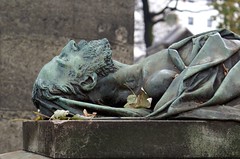
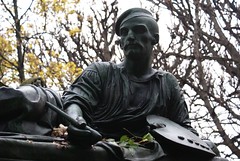
One sculpted tomb was especially beautiful. It showed what I presume to be the deceased, not as he was whilst living, but as he was dead. His sunken features, his closed eyes, and the exposed shoulder all pointed to something deeper than sleep. The eyes in particular were striking, in that one could see they were the eyes of a man who would never open them again. The shroud had been pulled back, to allow one last look at his face, a look which had lasted over a century. I say, as he was dead, but of course he still is dead, and this sculpture serves in a way to remind us, that even in death we are not free from ‘time’s relentless melt’.

Montmartre Cemetery, Paris

On our second day in Paris, we visited the Louvre which, I remembered, I hadn’t visited during my first stay in the city. The building is indeed impressive, as are the queues which inevitably form outside. Nevertheless, having joined the queue outside we soon found our way to the queue inside which as well as being much longer was even slower to move. In fact, it took almost an hour to get a ticket which wasn’t surprising considering that one of the two tills serving our queue was closed and when that which was closed finally opened, the open one, for the purposes of consistency, closed, and this fat caterpillar of people continued chewing on its incredulity.

Once in, I found the Louvre to be almost worth the wait, although the queue had sapped our strength somewhat, and what one needs when walking around the palace is all the strength one can muster; mental as well as physical. What did strike me was the bizarre behaviour of most of the other visitors, something which I remembered as having struck me when I visited what I think was the Grand Palais during my first visit. Back then, a number of people walked around the galleries videoing continuously, looking at everything through the eyepiece of a video-camera, and now, in this increasingly digital age, the same is true but on a much larger scale. Maybe it is something to do with our contemporary culture which means we cannot see something unless it’s reproduced, we cannot know it except through facsimile, that things are not received as being experienced unless captured by a camera. Imagine, you’re approaching a painting, a genuine da Vinci (not the Mona Lisa in this instance). You are about to see something which you know the great man saw himself, something with a provenance dating back over five centuries, an image which countless numbers have looked at since its creation. What do you do? Well, the woman in front of us framed it in her camera, took its picture and walked off looking at the image on her camera’s display. The difference between something original and a copy (and by copy I mean a skewed, 5 megapixel digital photograph) has, it seems, been attenuated to such an extent that there’s no longer any perceived difference at all.

Near to where this ‘incident’ took place is the room which houses the Mona Lisa, a painting whose popularity is, in part, due to the viral-like profusion of its myriad reproductions. On posters, postcards, badges, T-shirts, calendars, mugs and so on, the image is better known than any other in the world, and so, as if she were a celebrity, people crowd about her – as she gazes out from behind her bullet-proof screen – all wanting a copy of their own. Phones are raised amidst the clamorous throng like numerous periscopes; cameras snap at her heels. It really beggars belief.

There were no throngs of people slobbering around Holbein’s portrait of Erasmus, or Vermeer’s Astronomer, and there was no-one standing in front of Ingres sublime portrait of Louis Francois Bertin, a painting which at 116 x 95cm, is, if not in scale, truly epic. Bertin looks out from across almost two hundred years, as alive as he was then. He looks at you as you dare to return his dismissive gaze. One can almost hear him scoff. You are mortal. You can almost hear him say it. He is immortal and you know that he is thinking it. He looks right through you at the centuries to come when you will be long gone from his gaze. “I will still be here,” he says. It really is one of the great portraits.

An artist well known for his monumental works, Anselm Kiefer, was at the time of our visit exhibiting three new works commissioned by the Louvre. It took us a while to find them, and when we did I must say I was rather disappointed. Whereas Ingres more modest-sized portrait was made vast in the palace, Kiefer’s painting ‘Athanor’ despite its scale was rendered rather small. The two sculptures either side were somewhat peripheral and reminded me of Christmas trees which after New Year start to outstay their welcome. This is not to say that any of these works are bad, they’re not – far from it. But somehow in this setting they just didn’t seem to work.

After the Louvre, we were given a guided tour by one of Monika’s friends of the Marais district, which was a real treat. The Marais district (meaning marsh or swamp), spreads across the 3rd and 4th arrondissements on the Rive Droit, or Right Bank of the Seine. According to one of the many websites on The Marais, it was:

“… in fact a swamp until the 13th century; when it was converted for agricultural use. In the early 1600s, Henry IV built the Place des Vosges, turning the area into the Paris’s most fashionable residential district and attracting wealthy aristocrats who erected luxurious but discreet hotels particuliers (private mansions). When the aristocracy moved to Versailles and Faubourg Saint Germain during the late 17th and 18th centuries, the Marais and its mansions passed into the hands of ordinary Parisians. Today, the Marais is one of the few neighborhoods of Paris that still has almost all of its pre-Revolutionary architecture. In recent years the area has become trendy, but it’s still home to a long-established Jewish community.”

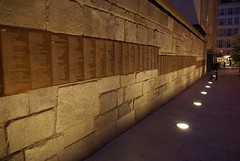
Evidence of the Jewish community, and, in particular, the traumas suffered at the hands of the Nazis and the Vichy government can be found in the Holocaust Memorial, as well as the memorial in the Alle des Justes, dedicated to all those who helped the Jews in such dangerous and terrible times; thousands of anonymous names (unknown at least to visitors) who nevertheless did so much, to do good in a very bleak world.

On numerous walls of various buildings were plaques dedicated to the hundreds of children deported from the district’s schools. Having visited some of the terrible places where some of these children ended up, it’s somehow even more distressing to see the place from where they were taken.

Paris

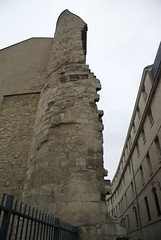
Evidence of the area’s mediaeval past can be seen in its surviving ancient wall, the only section left of the Philippe Auguste fortifications which date back to the 11th and 12th centuries. It’s just one of the many features which distinguishes this part of Paris from the rest of Benjamin’s ‘Capital of the Nineteenth Century’.

Paris

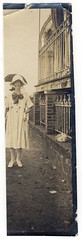
But it’s more than just the old buildings, the place has a character which is quite unique; it’s quite understated (although not entirely); most unlike the sweeping brovado of Haussmann’s boulevards. In one part of Marais, there is a group of antique shops, called Village St. Paul, where we came across a photographic shop selling old photographs. This shop, called ‘Des Photographies’ was a place in which I could have spent several hours sifting through snapshots of times long gone, and although we were pushed for time, we did purchase two photographs, or rather one and a half, for one of the photos had been cut from a bigger picture.

The first shows a young woman, standing in the rain. I cannot tell exactly when it was taken, but I would imagine it’s some time in the 1920s or 30s.

A Lady

I liked this for the fact it had been cut from a bigger photograph. But why was it cut? Was it malicious? Was it through heartbreak? Was someone cutting this woman, this memory, from their life? Of course it could have been anything but malicious.

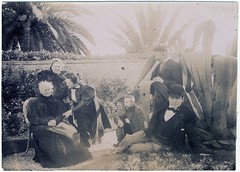
The second photograph, which Monika bought for me, is a group portrait, perhaps a family, taken around the end of the nineteenth century.

Group Portrait

This photograph is interesting for many reasons, one being that no-one is looking in the same direction. Only one person, the woman standing behind the old lady (seated) is looking at the camera. The photograph itself, judging from the back, had at one point been part of an album, and one can’t help wonder when looking at it what other pictures accompanied it within that collection. Individual portraits of those within the picture perhaps? Images of where they came from? Who were these people, these men and women who have since lost their names? It’s strange, but sometimes names outlive the body (on plaques and tombstones) or bodies (or at least their alchemical equivalents) outlive the names (such as with these photographs), but rarely do the two continue to coexist.

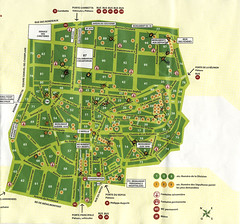
The following morning we made our way to the largest and most famous cemetery in the city, Pere Lachaise. The cemetery takes its name from Pere François de la Chaise (1624-1709), confessor to Louis XIV, and is reputed to be the world’s most visited cemetery, not that it seemed particularly busy as we walked around. Armed with a map upon which we’d marked the graves we wanted to see, we spent a few hours wandering through the streets and avenues of this vast necropolis.

Pere Lachaise Map

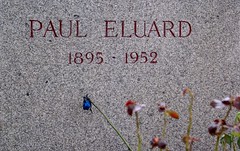
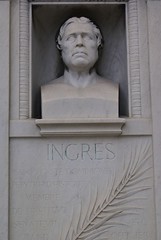
Among the graves we visisted were those of, Apollinaire, Balzac, Sarah Bernhardt, Bizet, Gustave Caillebote, Chopin, Corot, Daumier, David, Delacroix, Paul Eluard, Gericault, Ingres, Moliere, Piaf, Pissarro, Proust, Seurat, Gertrude Stein and Oscar Wilde.

Paris
Theodore Gericault (1791-1824)

Paris
Jean-Baptiste Camille Corot (1796-1875)

Pere Lachaise, Paris
Paul Eluard (1895-1952)

Paris
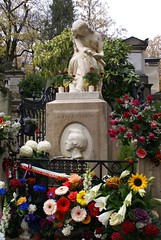
Frederic Chopin (1810-1849)

Paris
Jean Auguste Dominique Ingres (1780-1867)

And there was something quite strange about seeing the graves of painters whose works we had seen in the Louvre the previous day, artists such as Ingres, who’d given Louis Francois Bertin immortality through his portrait. It was hard to reconcile the fact the he – Ingres – had been dead and buried in this place for 140 years, over a hundred years before I was even born, whilst fresh in my memory was an image which would have once occupied a space in his own: the intervening time had not, as I said earlier, intervened at all.

As with the cemetery at Montmartre, what I found myself drawn to were the graves of those who’ve not left behind a tangible heritage (paintings, discoveries, books etc.). Those names without bodies; scratched like grafitti, by a vagrant time who wanders amongst the stacked sepulchres. Names which do not ring bells when you read them, into whose shapes the moss has grown; names around which death has become less eternal; fragile like glass, broken in the bent and buckled leading of once replete windows.

Pere Lachaise, Paris

In broken windows such as these, we see the passing, not just of a life, but of memories; the passing of those who came after the deceased with whom the increasingly vague memories of a distant relative melt into further graves. In every cemetery, you will find hundreds, maybe thousands of anonymous names; names and numbers from which we are separated by generations, decades or even centuries, and of course the ultimate experience: death. And in a cemetery, perhaps somewhere in France, are the names of those people in the photographs I bought in Le Marais; the single woman cut from the bigger picture (in more ways than one), the old lady seated on a chair in the sunlit garden, the two women beside her, and the three men all looking in different directions.

Having said goodbye to Monika at Gare de l’Est, I listened to ‘In Our Time’, a podcast from the BBC. The episode I was listening to was on the 17th century philosopher Spinoza, whose work George Eliot had translated in the 19th century, and whilst discussing Eliot’s epic novel Middlemarch, one of the speakers paraphrased an extract from its conclusion, an extract which I have since discovered, just as she had written it:

“But the effect of her being on those around her was incalculably diffusive: for the growing good of the world is partly dependent on unhistoric acts; and that things are not so ill with you and me as they might have been, is half owing to the number who lived faithfully a hidden life, and rest in unvisited tombs.”

What we leave behind (our legacy) is not justified solely by its apparent value or greatness; whether or not it’s great art or literature, or a discovery which will prove a catalyst for even greater advances. It is not dependent on whether or not we have made some kind of sacrifice or acted with courage in times of great affliction. It is also those unhistoric acts of which Eliot speaks, by people who in many cases are not even names anymore. It’s often the decidely average which plays the greater part. Everything, even the mundane has an influence on the world.

In the translator’s forward to Walter Benjamin’s even more epic Arcades Project, Howard Eiland and Kevin McLaughlin write of Bejmain’s intentions as being:

“to grasp such diverse material under the general category of Urgeschichte, signifying the ‘primal history’ of the nineteenth century. This was something that could be realized only indirectly, through ‘cunning’: it was not the great men and celebrated events of traditional historiography but rather the ‘refuse’ and ‘detritus’ of history, the half concealed, variegated traces of the daily life of ‘the collective,’ that was to be the object of study, and with the aid of methods more akin – above all, in their dependence of chance – to the methods of the nineteenth-century collector of antiquities and curiosities, or indeed to the methods of the nineteenth-century ragpicker, than to those of the modern historian.”

Paris is indeed the capital of the nineteenth century, but what of the nineteenth century itself? As the French philosopher Henri Bergson wrote, who is himself commemorated in the Pantheon:

“There will no longer be any more reason to say that the past effaces itself as soon as it’s perceived, than there is to suppose that individual objects cease to exist when we cease to perceive them.”

Somewhere, the century still exists and Paris is still its capital.

Filed Under: Photography, Trees Tagged With: Arcades Project, Cemetery, George Eliot, Junkshop Photographs, Paris, Pere la Chaise, Spinoza, Vintage Photographs, Walter Benjamin

Middlemarch

November 8, 2007 by Nicholas Hedges

Having listened to the ‘In Our Time’ programme on Spinoza, and heard a paraphrasing of George Eliot’s Middlemarch (the conclusion), I searched the text and found the actual quote:

“But the effect of her being on those around her was incalculably diffusive: for the growing good of the world is partly dependent on unhistoric acts; and that things are not so ill with you and me as they might have been, is half owing to the number who lived faithfully a hidden life, and rest in unvisited tombs.”

Having visisted the cemeteries at Montmartre and Pere Lachaise, and having used a map to find the graves of the famous, it was interesting, that I found myself drawn most of all to the graves of the unknown, which, of course, far out-number those of the more familiar. What had all these hundreds of anonymous people done in their lives, and what was the effect of their actions on our present day existence?

Filed Under: Uncategorized Tagged With: George Eliot, Middlemarch, Montmartre, Pere la Chaise

Projects

November 8, 2007 by Nicholas Hedges

I decided to write up a list of work/projects that I am working on/towards/planning etc. just so as to keep tabs on where things are going.

Knot
Knot with cups
Wallpapered drawings
Net
Rusted plates
Hansel and Gretel (illustrations)
Prints from rusted plates
Distance in photographs
Windows and bicycles in old photographs (Barthes)
Twinned
Geocaching
Pile of cut string
Pile of uncut string
Three Fates performance with single string
Three Fates performance with lots of string
Three Fates performance with audio tape
Three Fates performance with film
Bicycle wheel
Mirrors – etching
Windows – wire
John Malchair
Deckchairs
Plucked (resonating) strings
Bowls of water (whole and parts)
Tour Stories (Blog and Podcast)
String network (held by one person)
Hansel and Gretel (rocks in woods, piled)
Net/Clothes
Three Fates Performance – woollen clothes
Broken stained-glass window (Pere Lachaise)
Broken stained glass window with rusted plates
Barbed wire stained glass
Three Fates Performance (with typewriter ribbon: soft-ground etching)
Typewritten text
Rusted plates in mirror-frames
Rusted plates in photograph frames
Maps – invented landscapes
Wax cubes – memory work
Old London Road
Object Zoo
Cat’s Cradle (Spinoza’s Causality)

Filed Under: Uncategorized Tagged With: Projects

Parisian Cemeteries and Old Photographs

November 7, 2007 by Nicholas Hedges

Whilst writing about Parisian Cemeteries, I came to realise that there was a similarity between the cemetery and old photographs. Roland Barthes, in relation to photographs talks of the catastrophe of death inherent in every one, and how, in photographs time is engorged.

“I observe with horror an anterior future of which death is the stake… I shudder, like Winnicott’s psychotic patient over a catastrophe which has already occurred. Whether or not the subject is already dead, every photograph is this catastrophe.”

“In the photograph, Time’s immobilisation assumes only an excessive, monstrous mode: Time is engorged…”

The same could be said of cemeteries, except in their case, the death in question (the inherent catastrophe) is not those of the already dead, but our own, and Time’s engorgement, is the passage of time within the cemetery’s boundaries, where with all the dates of death, where it has been ‘tripped up’ and where it has stumbled, the passage has been disrupted, much like a cart pulled over rough ground. In a cemetery, time lags behind itself, behind where it should be, and for a moment we are more free of its grasp than at any other time; more alive amongst the dead than ever amongst the living.

Filed Under: Uncategorized Tagged With: Barthes, Catastrophe, Cemetery, Paris, Time

Parisian Cemeteries

November 7, 2007 by Nicholas Hedges

Whilst on a trip to Paris with Monika, we paid a visit to two cemeteries; one, the cemetery at Montmartre, near our hotel, and the other, the famous Pere Lachaise cemetery in the east of the city. The cemetery at Montmartre was interesting in the way it was very much a part of the city, rather than a place divorced from life. This feeling was enhanced by the bridge which ran above it, beneath which the tombs of the dead reminded me of the makeshift dwellings put up by the homeless.

Paris

The first grave we saw took my interest, since a cat was laying on to of it, dead centre, looking towards the headstone. I took a photograph (which I have since, accidentally deleted) and immediately, a lady, standing with a man (I presume was her husband) asked me in French, ‘why did you take a picture?’ I must confess here that I do not speak French and relied on Monika who does. I explained that I was interested in the cat and was amazed to discover that the grave was that of her mother. Suddenly, from an anonymous grave with an anonymous name, the memorial had come to mean much more. There was a physical, living connection. She explained in polite conversation, that the cat had been there most of the day and hadn’t moved even when she busied herself about the grave arranging flowers and so on. Cats, we were to discover, were a common feature of the cemetery.

Paris

The day we visited was November 1st, a public holiday and the Day of the Dead, a time in some European countries when people visit the graves of loved ones. I knew, through Monika, that it was an important time in Poland, and, sure enough, where there were Polish graves in the cemetery, there were Poles, laying flowers, saying prayers, and remembering those of their country who had long since died; a tradition which is both poignant and to be admired. Later, when we visited Pere Lachaise, we found the grave of Chopin bedecked with flowers and a sashes of the Polish colours.

Paris

Some of the graves in the Montmartre Cemetery were particularly beautiful. Many were like tiny dwellings replete with doors and windows (usually stained glass), and although many had decayed through the ravages of time, their wearied state accentuated the romantacism inherent in many such cemeteries.

Montmartre Cemetery, Paris

One sculpted tomb was particularly beautiful. It showed what I presume to be the deceased, not as he was whilst living, but as he was dead. His sunken features, his closed eyes, and the exposed shoulder all pointed to something deeper than sleep. The eyes in particular were striking, in that one could see they were the eyes of a man who would never open them again. The shroud had been pulled back, to allow one last look at his face, a look which had lasted over a century. I say, as he was dead, but of course he still is dead, and this sculpture serves in a way to remind us, that even in death we are not free from ‘time’s relentless melt’.

Montmartre Cemetery, Paris

At Pere Lachaise, I was keen to visit the graves of artists, writers and composers such as Ingres, Moliere, Pissarro, Proust, Chopin, Gericault, Delacroix and Wilde amongst many others and having bought a map of the cemetery (which is vast) Monika and I planned our visit and began to seek them out.

Pere Lachaise Map

It was strange – in the case of the various painters buried there – that having seen their work in the Louvre, we were now standing above their remains. One painting, for example, which we had seen in the Louvre, stuck in my mind as I stood next to the grave of Ingres (1780-1867). It was his portrait, painted in 1832, of Louis Francois Bertin, one of the most famous works by the artist, and one which is so full of life, it hardly seemed possible that the man in the painting and the man who painted it were long since dead. How was it, that I had seen something I know Ingres had also (obviously) seen, yet here I was, standing above his grave where he had lay for over a century before I was even born. That is the power of painting; they are objects into which the artist paints him or herself, in brushstrokes (particularly in the case of the Impressionist and Post-Impressionist works we saw) which made in moment can exist for all time.

On the way home from Paris, as I passed beneath the sea in the channel tunnel, I began to write about the visit to Pere Lachaise. What I had been aware of as we walked around, was the content of the photographs I was taking, some of which follow:

Paris

Paris

Paris

Paris

They were all images of decay, the gradual fall into disrepair of the numerous memorials in this vast necropolis, and, given the work I have lately been doing on the ‘gestures’ of things, I began to consider the ‘gesture’ of this particular cemetery. What follows is what I wrote on the way home:

(The gesture is) like mould, lichen, which grows slowly in small patches over a long period of time. But these spores are invisible, we cannot see them except in the broken panes of glass, the flaked paint, the verdigris patinas on the doors to individual tombs, the chipped stones; every trace of time’s slow, considered vandalism. It’s always present in the cemetery and every now and then, one detects a trace of its fleeting presence – the scent of vinegar which lingers around a tomb where the glass is missing, where the door is open, or where the iron gates have corroded and been worn through by time’s relentless scratching; time’s relentlessness.

Even when all trace of the bones has gone, long after the burial clothes and the casket, time will continue its malevolence, picking at the fabric of memory, wearing down the words, smoothing over names, dismantling the dead and our memories of them, withering through slow alchemy these parts into atoms. Candles lit and placed beside the graves will soon be extinguished, flowers will be wilted, trees will be naked, picked of their leaves and left like confetti, to remind the living of this withering certainty.

Cemeteries are not just places where the dead are dismantled, where the names by which these parts were held together are also broken apart. They are as much for the living, who fight with death to keep the parts together, to deny death, to deny its certainty; to deny their own futures. The living wander the graves to maintain the present. Inside cemeteries the present is stretched.

We walk through cemeteries, and with our minds like nets try and catch this butterfly called Time, but we are assailed by its beauty, we stand open-mouthed and wait for the crysalis to be spun with invisible thread around us.”

Cemeteries have something in common with old photographs, particularly when we consider the the writing of Roland Barthes who writes that photographs have within them the ‘catastrophe of death,’ and that, ‘in the photograph, Time’s immobilisation assumes only an excessive, monstrous mode: Time is engorged…’. In cemeteries too, Time is somehow engorged and obviously contains – in abundance – that catastophe. One has the impression of time standing still, stopped by the dates of death carved into the many gravestones and tombs, yet we know, all too well, that time continues…

Filed Under: Photography, Trees Tagged With: Barthes, Catastrophe, Cemetery, Gesture, Montmartre, Paris, Pere la Chaise, Vintage Photographs

Spinoza, Eliot and Pere Lachaise

November 4, 2007 by Nicholas Hedges

Written in transit from Gare du Nord to Waterloo, listening in part to In Our Time on Spinoza.

Social Scuplture – Gesture work for the next week.

Cemetery (Pere Lachaise) Like mould, lichen, which grows slowly in small patches over a long period of time. But these spores are invisible, we cannot see them except in the broken panes of glass, the flaked paint, the verdigris patinas on the doors to individual tombs, the chipped stones; every trace of time’s slow, considered vandalism. It’s always present in the cemetery and every now and then, one detects a trace of its fleeting presence – the scent of vinegar which lingers around a tomb where the glass is missing, where the door is open, or where the iron gates have corroded and been worn through by time’s relentless scratching; time’s relentlessness.

Even when all trace of the bones has gone, long after the burial clothes and the casket, time will continue its malevolence, picking at the fabric of memory, wearing down the words, smoothing over names, dismantling the dead and our memories of them, withering through slow alchemy these parts into atoms. Candles lit and placed beside the graves will soon be extinguished, flowers will be wilted, trees will be naked, picked of their leaves and left like confetti, to remind the living of this withering certainty.

[Look at Spinoza – nothing in nature that can be called contingent. Connections (if we could see them) determine what we do through a network of causation]

Cemeteries are not just places where the dead are dismantled, where the names by which these parts were held together are also broken apart. They are as much for the living, who fight with death to keep the parts together, to deny death, to deny its certainty; to deny their own futures. The living wander the graves to maintain the present. Inside cemeteries the present is stretched.

We walk through cemeteries, and with our minds like nets try and catch this butterfly called Time, but we are assailed by its beauty, we stand open-mouthed and wait for the chrysalis to be spun with invisible thread around us.

[Marcus Aureolis – “In the thought that I am part of the whole, I will be content with all that comes to pass. IOT. Spinoza. 30.21]

Paraphrasing George Eliot – end of Middlemarch. “We must be forgiving to people because what people do is not really up to them, it’s much more influenced by the outside than they expect. But that things are better with us than they might be is due to many unremembered, unhistoric acts by people who sleep in unvisited graves.”

The way people perceive the world must be determined by the language they speak, the sound of their words etc.

Filed Under: Trees Tagged With: George Eliot, Middlemarch, Paris, Pere la Chaise, Spinoza, Trace

Cut String

October 26, 2007 by Nicholas Hedges

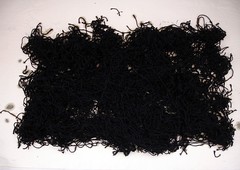
I finally dyed all the cut pieces of string and put them on some newsprint to dry. Looking at them I was reminded, for some reason, of writing, of a mass of scribbled words which had been piled up on top of one another.

Cut String

Filed Under: Uncategorized Tagged With: String

Printmaking – A Reflection IV

October 26, 2007 by Nicholas Hedges

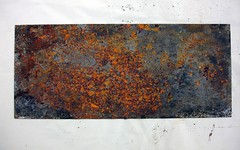
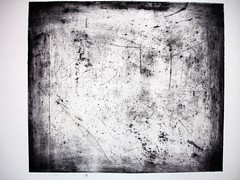
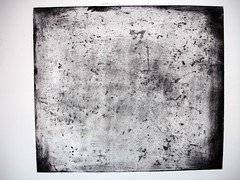
I completed another set of prints this week, again trying to lift the rust from a plate but again failing. However, the resulting prints were interesting so it wasn’t all bad – I just need to look at whether I should print from the rusted plates now or use them simply in their own right.

This time, the reverse of the plate was that which was particularly rusted (because it was face up in the ground) and so it was from this side that I decided to try and take the first print.

Plate (3rd week Buried)

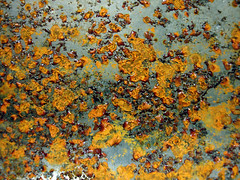
The rust itself was particularly beautiful with some very nice red -almost liquid – rust-drops on its surface.

Plate (3rd week Buried) Detail

The resulting print however was a little disappointing. Perhaps using a heavier paper might do the trick?

Print 4 (Reverse)

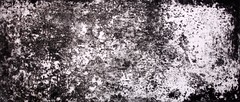
Again I printed the other side which by now is so marked, it’s difficult to remove much of the ink and so the resulting image is extremely dark.

Print 4

The most interesting results came with a plate I hid in the woods. I left it for a period of a week, and although there didn’t appear to be much on it, aside from a few patches of rust, it was only when it was printed that the extent of wear on the plate’s surface became apparent.

Plate from the Woods

This was the plate I used, and having taken the image I was interested in how I could see my own reflection, for the marking on the plate had reminded me of the surfaces of old mirrors. Seeing the marks revealed in the print led me think how interesting it would be to print some mirrors. Maybe past reflections would be contained on the resulting image…?

Woodland Plate - First Print

In fact, on the side of which I took the photograph, there is a shadow which could well pass for my image…

Woodland Plate - First Print (Reverse)

Filed Under: Uncategorized Tagged With: Printmaking

Mirrors

October 26, 2007 by Nicholas Hedges

Having worked with a plate I left in the woods, I began to think about whether I could take a print from a used mirror? I like the idea of everything the mirror sees leaving a trace (as an imperfection) on the mirror’s surface, as if each look rubs a part of it away. So I’ve decided to buy a few old mirrors from various charity shops and give it a try. Whether they would withstand the pressure of a press without breaking I don’t know, and whether there would be enough abrasions on the surface to achieve anything on paper is another matter, but the idea is very appealing.

Filed Under: Uncategorized Tagged With: Mirrors

Gesture of the Holocaust

October 25, 2007 by Nicholas Hedges

I recently received a copy of the transcript of Claude Lanzmann’s Shoah, his epic documentary about the Holocaust and read over the part of the film which had, on watching it, affected me so much. In that part, historian Raul Hilberg discusses a document, the Fahrplananordnung 587, an innocuous looking typewritten document (save perhaps for the word ‘Treblinka’) which he reveals, bit by bit, as being anything but innocuous; rather it is a document which in the beaurocratic language of timetables, represents the deaths of some 10,000 Jews. It is just one of many hundreds (the number 587 tells us how many); each of which is a cipher for unimaginable misery and suffering. What follows is part of that transcript:

This is the Fahrplananordnung 587, which is typical for special trains. The number of the order goes to show you how many of them there were, Underneath: Nur fur den Dienstgebrauch – ‘Only for internal use.’ But this turns out to be a very low classification for secrecy. And the fact that in this entire document, which after all deals with death trains, one cannot see – not only on this one, one cannot see it on others – the word geheim, ‘secret’ is astonishing to me. That they would not have done that is very astonishing.

On second thought, I believe that has they labelled it secret, they would have invited a great many enquiries from people who got hold of it. They would then perhaps have raised more questions; they would have focused attention on the thing. And the key to the entire operation from the psychological standpoint was never to utter the words that would be appropriate to the action being taken. Say nothing; do these things; do not describe them. So therefore this ‘Nur fur den Dienstgebrauch.’ And now notice to how many recipients this particular order goes. ‘Bfe’ – Bahnhofe. On this stretch there are one, two, three, four, five, six, seven, eight, and here we are in Malkinia, which is of course the station near Treblinka. But notice that is takes eight recipients for this relatively short distance through Radom to the Warsaw district – eight, because the train passes through these stations. Therefore, each one has to know. Not only that, but of course you’re not going to write two pieces of paper if you can write only one.
Therefore, we find here not only PKR, which is a death train, going here in the plan labelled thus, but we also see the empty train after it has arrived in Treblinka, now originating in Treblinka, and you can always know whether it’s an empty train with the letter L in front of it, leer, and now –
Ruckleitung des Leerzuges, which means ‘return of the empty train’.
– the train returns empty. And now we’re going back. Then we have another train. Now notice that there is very little subtlety to this numbering system. We are going from 9228 to 9229, to 9230, to 9231, to 9232. Hardly any originality here. It’s just very regular traffic.
Death traffic.
Death traffic. And here we see that starting out in one ghetto, which is obviously being emptied, the train leaves for Treblinka. It leaves on the thirtieth of September, 1942, eighteen minutes after four o’clock – by the schedule at least – and arrives there at eleven twenty four on the next morning. This is also a very long train, which may be the reason it is so slow. It’s a 50G – fünfzig Güterwagen – fifty freight cars filled with people.
That’s an exceptionally heavy transport. Now once the train has been loaded at Treblinka – and you notice there are two numbers here: 11:24, that’s in the morning, and 15:59, which is to say almost four o’clock in the afternoon – in that interval of time the train has to be unloaded, cleaned and turned around. And you see here the same numbers appear as the Leerzug, the now empty train, goes to another place. And it leaves at four o’clock in the afternoon and goes now to that other place where is yet another small town where it picks up victims. And there you are at three o’clock in the morning. It leaves on the twenty-third at three o’clock in the morning. And arrives there the next day.

What is that? It seems to be the same train.

It is the same – quite obviously the same. The number has to be changed quite obviously. Correct. Then it goes back to Treblinka and this is again a long trip; and it now goes back to yet another place – the same situation, the same trip. And then yet another. Goes to Treblinka and then arrives in Czestochowa the twenty-ninth of September and then the cycle is complete. And this is called a Fahrplananordnung. If you count up the number of not empty trains but full ones – PKRs – there’s one – there’s one here, that’s two, that’s three, that’s four – we may be talking about ten thousand dead Jews on this Fahrplananordnung here.

What I saw as being described here was in many respects a gesture of the Holocaust. The gesture of a thing, whether it is an object or a system, is essentially a movement and with this passage, the underlying movement of all the documented horrors becomes apparent. To borrow from Hannah Arendt, it is banal. So can I really discover the gesture of the Holocaust? Or at least a part of it?

Filed Under: Holocaust Tagged With: Claude Lanzmann, Gesture, Holocaust, WWII

Lists and Bill Viola

October 24, 2007 by Nicholas Hedges

Whilst writing up some notes on making lists as a strategy, I thought again of the Bill Viola quote I mentioned in the last entry. The following is taken from what I wrote concerning lists, starting with an extract from one of the first lists I made during my residency at OVADA:

engine purrs
yellow clothes
hiss
reverse warning sounds
food
pie ‘n’ pint
Leffe
thumbs up
zebra crossing
fat stomach
boarded windows

This I then turned into a ‘prose’ version:

An engine purrs. A woman with yellow clothes walks towards me. The hiss of a bus’s brakes, and then its reverse warning sounds, telling of its departure. Outside the pub on a blackboard food is advertised; a pie ‘n’ pint. Leffe is also served here. A man gives a thumbs up as I cross the zebra crossing. A man with a fat stomach walks towards and then past me. Ahead, on the opposite side of the street, a shop and a restaurant stand empty with boarded windows.

The idea of single words, or ‘hightlights’ reminds me of Bill Viola’s quote regarding our lives as a single moment.

“We have been living this same moment ever since we were conceived. It is memory, and to some extent sleep, that gives the impression of a life of discrete parts, periods or sections, of certain times or ‘highlights’.”

The individual words are highlights, extrapolated from (or in this instance built into) a piece of prose (the ‘same moment’).

Filed Under: Artist in Residence, Lists Tagged With: Artist in Residence, Bill Viola, Listmaking, Lists, Residue

Clotho. Lachesis. Atropos.

October 22, 2007 by Nicholas Hedges

Thinking about the Three Fates project, I was considering how the individual fates, Clotho, Lachesis and Atropos, might somehow reflect the work I’ve been doing over the past year. As I thought about their roles, I realised that there were some interesting connections. Clotho for example, through her spinning yarn and creating life, reflects much of the work I’ve been doing regarding pathways and the coming-into-being (the unliklely, almost impossible coming-into-being) of the individual human. It is interesting that in much of my work and thoughts this year, I have been considering the pathways of our ancestors and visualising those pathways with, amongst other things, string (a tangle of string might represent the impossible pathways of ancestors). Lachesis of course represents the lifespan of the individual, and in the case of my work, the lives of individuals is a recurrent theme, particularly as regards my work on the Holocaust and World War One. Everything to do with life, our physical acts (such as walking) and the everyday, mundane objects which we encounter and which shape it, are represented by her. Atropos, who cuts the thread, is of course death, and I needn’t say how she fits in.

Of course, much of my work deals with memory and Bill Viola’s quote regarding how we have been “living this same moment ever since we were conceived,” and how “it is memory, and to some extent sleep, that gives the impression of a life of discrete parts, periods or sections, of certain times or ‘highlights'”, fits in with the ‘action’ of the three fates, who could be said to be dividing a single life into its component memories as well as Life with a capital ‘L’ into its separate lives.

Filed Under: Uncategorized Tagged With: Bill Viola, Myth, String, Three Fates

Knot Installation

October 22, 2007 by Nicholas Hedges

Taking the work I have done so far on the knot installation, and looking at some of the ideas inspired by a set of recent free-drawings on the subject of Auschwitz-Birkenau, I decided to try out an idea I’d put down quickly in my sketchbook on the 20th.
20-10-07

This involved tying a few of the paper cups I’d shown at OVADA to the ends of the strings (which themselves, now dry and somewhat two-toned reminded me even more of wires) to emphasise the idea of these strings being ways to communicate with those who have come before us. The cups act as both a device for listening and a device for hearing and in that sense they are tools for dialogue. There are 50 strings altogether, and so, I initially tried the idea with about a dozen cups.

Knot

Knot

The idea worked well, although one loses a little, the sense of a string being cut, so I will just carry them through as separate works.

Filed Under: Uncategorized Tagged With: Knots, String

Atropos’ Shears

October 21, 2007 by Nicholas Hedges

Today I began to cut up a few balls of string, cutting the strand into various lengths so as to indicate the different lengths of lives. It was interesting how as the pile grew, it had a completely different consistency to a ball of string that had become tangled, having been unravelled, dyed and left in a pile. It seems an obvious point to make but an observation that is nonetheless worth mentioning. It was on the second ball of string that I began to focus on the sound of the scissors and as I cut, I realised what the sound reminded me of – it was the sound of hair being cut. Of course the cutting of hair and the Holocaust have particular and distrurbing overtones, and on the third ball of string, I made a loop several strands thick and cut the lengths that way. In this respect, the thickness of the strings and the action of the scissors trying to cut through the threads became interesting to me.

I thought again of the ideas I have had recently where, three ‘Fates’ would pull tape through a reel to reel recorder. The action of the pulling – a violent action – when applied to the idea of Atropos cutting hair was particularly chilling.

Looking at the ‘string’ work I’ve been doing recently, the work with lines in the camp (railways lines, telegraph wires, barbed wire), threads, tape, Clotho, Lachesis, Atropos and scissors, it’s interesting how the action (potential performance) of the Three Fates can be used in so many different ways when the fabric is changed. Certainly, this whole performance/action is something I want to explore thoroughly over the next few months.

Filed Under: Uncategorized Tagged With: Myth, String, Three Fates

The Repeated Image

October 20, 2007 by Nicholas Hedges

The repeated images imply a memory one can’t rid one’s mind of and/or singular visions of many people. Represented on one page, one gets an image of confusion, panic. There is a sense of urgency about it.

17-10-07-i

17-10-07-ii

Filed Under: Uncategorized Tagged With: Notes

  • « Previous Page
  • 1
  • …
  • 25
  • 26
  • 27
  • 28
  • 29
  • …
  • 32
  • Next Page »
  • The ‘Now of Then’
  • Artist’s Statement
  • Designs for an Heirloom
  • Dissonance and rhyme
  • Wildflowers
  • Emptiness
  • Wave (goodbye)
  • Now In The Past Of An Unreal Place
  • Return to Graphite
  • Genius
  • Latest Backdrops
  • Extended Backdrops
  • Backdrops
  • Komorebi
  • Acorns
  • Scroll Work
  • Goethean Observation: Japanese Scroll
  • Mistakes
  • The Leaf Is Singing Still
  • Past Present
  • Scrolls
  • As Yet Untitled
  • Holes
  • Scroll
  • A Calligraphy of Shadows
  • More Paintings
  • Latest Paintings
  • Walking Meditation 2
  • Knowing We Are There
  • Venice by Moonlight 1840
  • Fragments and Additions
  • Reimagining The Past
  • Walking Meditation 1
  • Mindful Walking I
  • Grief II
  • Three New Paintings
  • Nana’s Mountain
  • Painting
  • Iridescence
  • Roman Bottle
  • Rinsho
  • Shadow Calligraphy
  • Becoming Memory
  • Fox Talbot’s Glassware
  • Goethean Observation: Diffuser II
  • Goethean Observation: Diffuser
  • A Remembrance of Things We Never Have Known
  • A Moment’s Language
  • Take Me Home
  • Arrival/Departure
  • Diffusers
  • Grief
  • Mum
  • Measuring the past
  • Disordered Time
  • Entropy
  • Wicked Magician, Fly
  • The Quanta of History
  • Empathy Forward
  • The Natural World of 978
  • The Gone Forest
  • Empathy/Exchange: 668 grams
  • Goethean Observation: Pilgrims of the Wild, 1935
  • Nazareth O
  • Several Johns and St. Thomas
  • Raspberry
  • Tokens and Shadows
  • Patterns Seeping (II)
  • ‘Missded’ 4 – Tokens
  • Patterns seeping
  • Cut Paintings
  • ‘Missded’ 4
  • Locks III
  • Locks II
  • ‘Missded’ 2 – Tokens
  • My Son’s Drawings II
  • ‘Missded’ 2
  • ‘Missded’ 3 – Tokens
  • ‘Missded’ 3
  • ‘Missded’ 1 – A Framed Token
  • Morning Has Broken
  • Tokens of absence
  • ‘Missded’ 1, stitched
  • More Little Words
  • Three Little Words
  • Spaces In Between
  • ‘Missded’ 3
  • ‘Missded’ 2
  • ‘Missded’ 1
  • Locks
  • Tracings
  • My Son’s Paintings
  • Writing Shadows
  • Samuel Borton’s Post Chaises
  • Dawid Sierakowiak
  • Pitchipoi
  • Latest Tree Drawings
  • Notebook
  • Somewhere Between Writing and Trees II
  • Somewhere Between Writing and Trees

© Nicholas Hedges 2024

  • Facebook
  • Instagram
  • Twitter
  • YouTube

Copyright © 2025 · Outreach Pro on Genesis Framework · WordPress · Log in