Nicholas Hedges

Art, Writing and Research

  • Amazon
  • Behance
  • Facebook
  • Instagram
  • Pinterest
  • YouTube
  • Art
    • Digital
    • Drawing
    • Grids
      • Correspondence
      • The Wall
      • The Tourist
    • Ink on paper
      • Shadow Calligraphy
    • Installation
      • Murder
      • Echo
    • Painting
    • Patterns
    • Mixed Media
    • Photographic installation
      • St. Giles Fair 1908
      • Cornmarket 1907
      • Headington Hill 1903
      • Queen Street 1897
    • Research/Sketches
    • Stitched Work
      • Missded 1
      • Missded 2
      • Missded 3
      • Missded 4
    • Text Work
  • Blogs
    • Family History
    • Goethean Observations
    • Grief
    • Light Slowed But Never Stilled
    • Lists
    • Present Empathy
    • Shadow Calligraphy
    • Trees
    • Time
    • Walking Meditations
  • Video
  • Photography
    • Pillars of Snow
    • Creatures
    • The Trees
    • Snow
    • St. Giles Fair 1908
    • Cornmarket 1907
    • Headington Hill 1903
    • Queen Street 1897
    • Travel
  • Illustration and Design
  • Music
  • Projects
    • Dissonance and Rhyme
    • Design for an Heirloom
    • Backdrops
    • Shadow Calligraphy
  • Exhibitions
    • A Line Drawn in Water
      • Artwork
    • A Line Drawn in Water (Blog)
    • Mine the Mountain 3
      • Artwork
    • Mine the Mountain 2
      • Artwork
      • The Wall
    • The Woods, Breathing
      • Artwork
    • Snow
      • Artwork
    • Echo
      • Artwork
    • Murder
      • Artwork
    • The Tourist
    • Dreamcatcher
    • Mine the Mountain
      • Artwork
      • The Tourist
    • M8
    • The Gate
    • Creatures
      • Artwork
    • Residue
      • Artwork
    • A visit to Auschwitz
      • Artwork
  • Me
    • Artist’s Statement

Clocks

March 24, 2008 by Nicholas Hedges

Working on the tree last night I discovered, through the Ancestry website, a lady who is descended from a common ancestor. The ancestor in question is my great-grandmother, on my father’s side, Ellen E Lafford whose brother Albert is the direct descendent of the lady I mentioned. Looking at her family tree (I couldn’t help but feel I was somehow intruding, especially as she’s put up quite a few photographs) and looking at the faces of all these strangers, it was odd to think of how we share this common link, albeit one which goes back to the late nineteenth century, and to consider the different paths our families have taken. It’s strange too, to consider the thought that my descendants will, one day down the line, be complete strangers… and then of course the mind begins to wander – or rather run with it all – and positively boggles when considering all those others living today with whom I share so many ancestors; people to whom, however distantly, I am related.

This of course brings me back round to the point of much of my artwork, the idea of all those anonymous people swallowed up by history; the faces on the photographs of Oxford which I’ve started to collect, names on memorials, names lost altogether, and I’m reminded again of the words of Rilke in his novel, ‘The Notebooks of Malte Laurids Brigge’ when he says (always worth quoting in full):

“Is it possible that the whole history of the world has been misunderstood? Is it possible that the past is false, because one has always spoken of its masses just as though one were telling of a coming together of many human beings, instead of speaking of the individual around whom they stood because he was a stranger and was dying?
Yes it is possible.
Is it possible that one believed it necessary to retrieve what happened before one was born? Is it possible that one would have to remind every individual that he is indeed sprung from all who have gone before, has known this therefore and should not let himself be persuaded by others who knew otherwise?
Yes it is possible.
Is it possible that all these people know with perfect accuracy a past that has never existed? Is it possible that all realities are nothing to them; that their life is running down, unconnected with anything, like a clock in an empty room?
Yes it is possible.”

Researching my family tree is a desire perhaps to be anything but a clock in an empty room. Rather, to quote Roland Barthes, I would prefer to be what he describes as cameras being; a clock for seeing.
I was recently reading a book of work by Georges Perec, and in particular a transcription of a conversation he had with someone called Frank Venaille. In it he describes himself as a unanimist:

“a literary movement that didn’t produce much but whose name I very much like. A movement that starts with yourself and goes towards others. It’s what I call sympathy, a sort of projection, and at the same time an appeal!”
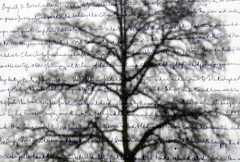
Again, this describes what my research is all about, something which starts with myself and goes towards others, a sort of sympathy with history, or at least, with those who have been lost to history. It is a projection of oneself onto the face of the past and as Perec states (although this might not be his meaning) an appeal to be remembered.

Filed Under: Quotes Tagged With: Family History, Georges Perec, Quotes, Rilke, Useful Quotes

John Malchair and Henry Taunt

March 22, 2008 by Nicholas Hedges

Over the course of the past few months I have been looking in some detail at the works of two people who one might say are connected, John Malchair (1730-1812) and Henry Taunt (1842-1922). Malchair was an 18th century German-born musician and artist who lived most of his life in Oxford, and Henry Taunt, a photographer who worked in the city at the end of the 19th/beginning of the 20th centuries. Although separated by almost a century and using very different media, their work nonetheless leaves us with a tantalising record of things that have long been lost.

Malchair, through his drawings (and too, his collection of music heard on the streets of the city) recorded the city in the years prior to and after the 1771 Mileways Act which saw much of the old town demolished. It is because of his work that we have visual records of so much that was lost, in particular – for me at least – Friar Bacon’s study, the strange and beguiling edifice which one stood on Folly Bridge in the south of the city and which was demolished in 1779.

Henry Taunt also recorded through his photographs much of the city which has in the years since been demolished. But more significantly are the images of people caught within these photographs like flies in prehistoric amber. Faces look up at us from beyond the grave, heads are turned away from us in the distance (the other end of the street becomes a hundred years away). Through the work of Taunt we are afforded a glimpse of moments which have been swallowed up in the course of history just as moments are swallowed now in the course of an average day. It is these ordinary moments which we recognise and which make the past and present so readily interchangeable.

Filed Under: Uncategorized Tagged With: 18th Century, Henry Taunt, John Malchair, Mileways Act, Mileways Act 1771

Memory – The Poor Draughtsman II

March 22, 2008 by Nicholas Hedges

Following on from my last entry on the subject (Memory – The Poor Draughtsman) I thought back to the ruined church I saw in Berlin, the Kaiser-Wilhelm Memorial church.

For me, the tower is just what the memory of a building is; a ruin of sorts, one which in part has been reconstructed by the brain to make an image which best approximates reality. Its edges are indistinct, the stone is vague and the fabric a hotchpotch of different materials no doubt rescued from the rubble. Whenever we think of a place we know – for example a building – we build – or rebuild – anew in our minds every time we think of it, constructing the remembered thing from whatever we can find.
The following image is a quick Photoshop sketch which takes the idea of the remembered ruin by blending an old map of Oxford (1750) with the image of the contemporary city as a ruin (aerial view) which I made recently. A more finished piece might leave those buildings still extant intact and blend in fully the areas which have been completely destroyed or altered.

Looking at this, and considering ideas of memory and draughtmanship, I was reminded of the work of Arie A. Galles who has made fourteen large scale drawings of aerial photographs taken over death camps during the second world war. I first discovered his work when studying the death camp at Belzec and have now begun to understand or interpret his work in a different way.

For him, memory is no ruin, it is as sharp as a photograph taken from the skies. But there is it seems a difference between the memory of a place and the memory of people. In the image of Belzec (above) something has been obscured, hidden, buried. It is a piece of text, the fourth verse of the Kaddish; a prayer said for the dead. Perhaps then, we should read this image as a warning, that this place of trauma will always be there, but is victims are gone; there is always the risk it seems of forgetting.
What is also interesting for me about Galles’ work, is the fact the drawings are made using charcoal. There is something about it (something it shares with coal), which gives the drawings of Galles’ extra poignancy; something living, now dead is used to make something new – it creates. I mention coal as I have in light of my work on my family tree, in particular with regards my great-grandfather Elias who worked in the coal mines of South Wales, been considering making drawings using coal. The images of the ruined city, the areial photographs and the black and white photographs I’ve been looking at of people long dead all point to my looking more closely at this idea.

Filed Under: Oxford Tagged With: 18th Century, Arie a Galles, Berlin, Map, Memory, Oxford, Ruins

6 Yards 0 Feet 6 Inches

March 22, 2008 by Nicholas Hedges

I’ve started to consider ways in which I might use John Gwynn’s survey of 1772 as a basis for a score and after various ideas decided the best place to start was – obviously – with the measurements Gwynn recorded; measurements of the size of properties in the centre of the city.

The following is an image taken from a reproduction of the survey, showing Gwynn’s statistics of 1772, and those taken in 1911 for Holywell Street.

For the moment I have decided to concentrate on the south side of the High Street and have reproduced the stats for this part of the city which can be downloaded as a PDF. After various attempts at translating the measurements into time so that the score might be structured in this way, I finally came up with the following method: the yards and feet I converted into inches (36 inches in a yard, 12 inches in a foot). I added the remaining inches and then converted back into yards (the idea was to end up with a figure or figures that most resembled time, e.g. 10.789 seconds). So for example; Mr Brockis owned property on the south side of the High Street which was 14 yards, 2 feet and 4 inches in length. By using the wonders of Excel, I ended up with a figure – through calculating with the above formula – of 14.77777778 yards, which although was more like the period-of-time-type measurement I was looking for made me feel uneasy; there was something about decimal points and imperial measurements which didn’t add up so to speak. The obvious thing therefore was to convert this sum (14.77777778 yards) into centimetres, which in another column of my ever-expanding spreadhseet I did by multiplying the sum by a factor of 91.44. Mr Brockis’ propery therefore came out as being 1351.28cm in length, or 13.5128 metres. Much better; I had my figure.

The next thing to do was to take these seconds and see how long the composition for the south side of the High Street would be. Again using Excel, I calculated that the entire piece would last 13 minutes and 32 seconds and today I decided to try it out. Armed with a stopwatch I walked the length of the street (in quite appalling weather) and found that at a reasonable, ambling kind of pace, it took me about 10 minutes 25 seconds. Although not quite 13 minutes 32 seconds (others would of course walk much more slowly) it nonetheless means that any following composition is imbued with a sense of space; the music (whatever the music will come to be) will liaise directly with a walk through the city.

Filed Under: Uncategorized Tagged With: 18th Century, John Gwynne, Survey

Umbilical Light II

March 18, 2008 by Nicholas Hedges

I started working on the project today using some VJ Sofware called Resolume which allows for comprehensive realtime effects changes etc. using MIDI and received audio signals. Parameters of effects such as blurring (which I have used in this project) can be determined by the frequency range of the received audio signal which means one can get some very nice results quite quickly.
I started by using details of photographs which I’d scanned from a book of old Oxford photographs. The published images are not so great so the details are even less so, but nevertheless this added somewhat to the progression of the work.

What I couldn’t help but see when I was working on the piece, using all manner of synths to make the desired noise (which I haven’t quite achieved as yet) was how the photographs when manipulated in this way became x-ray photographs of internal organs which, given the title of the projects seemed very apt.

The following photographs are the three main images I used:


Taken in what is now South Park in 1903

Taken in Queen Street c1900

Taken in St. Clements c1910
The following are stills created using synthesizers (my old Roland XP60 as well as Reaktor and Absytnth) and Resolume.
Umbilical Light Video

Umbilical Light Video

For me, the image looked like a heart and when I manipualted the video using a basic bass drum pattern, it really worked. Below is a video file showing a part of the work – unfortunately without the sound.


Filed Under: Photography Tagged With: Umbilica Light, Video, Vintage Photographs, VJ

Umbilical Light

March 14, 2008 by Nicholas Hedges

In ‘Camera Lucida,’ Roland Barthes asks whether history is not simply that time when we were not born? He writes:

“I could read my non-existence in the clothes my mother had worn before I can remember her.”

The study of history necessitates the consideration of our own non-existence. To imagine a past event, as it was before our birth, requires us to see that event without knowledge of what was to come, much as how we don’t know what is coming tomorrow. But to imagine our non-existence, our being not-yet-born, becomes in our conscious minds nothing less than the image of death; such is why perhaps we struggle to comprehend the past, to look upon a turn of the century photograph, where our coming-into-being is so precarious.

Looking at photographs of Oxford, taken around the beginning of the 20th century (such as that below taken in Cornmarket in 1907), I can’t help imagine that somehow, amongst the numbers pictured, are some of my ancestors, or, failing that, someone they at least knew. Perhaps there might be someone unknown to them, who nevertheless crossed their path and in some small way (or, in the case of my own coming-into-being, no small way) made an impact on their life and indeed on all those to come.

But then of course, by thinking this, I am doing just what I shouldn’t do when trying to properly understand this image or rather this moment in time. I am placing upon it the weight of future history. But when I recognise the buildings in the picture, how can I take myself ‘out of the frame’ altogether? Is it not impossible?

Is history then not simply the study of the past, but rather the study of how we got here today? A study of pathways, intersections and the spaces in between – a form of cartography? Well, it is and it isn’t. To study an event we must discover what really happened, and what could have happened if things had been different, what might its protagonists have done otherwise? History therefore – through these other possible outcomes – requires us to examine our own fragility, our unlikely selves and the possibility of our never being born to ask the questions at all.

At the moment the photograph above was taken, when all those pictured were going about the business of their lives, the chance of my Being was practically nil. Now, as I look at the photograph I know that everyone pictured is dead; I can read my own non-existence in the clothes they are wearing, just as they might have read theirs in the photograph itself. But here we have a difference between not-Being and being dead and the photograph is an illustration of that very thing.

Susan Sontag wrote:

“From a real body, which was there, proceed radiations which ultimately touch me, who am here; the duration of the transmission is insignificant; the photograph of the missing being as Sontag says, will touch me like the delayed rays of a star. A sort of umbilical cord links the body of the photographed thing to my gaze – light though impalpable, is here a carnal medium, a skin I share with anyone who has been photographed.”

When we look at a star in the night sky, we can be assured that in most cases, the light which hits our eye, is at least hundreds of years old. It might even be that the star no longer exists, yet we can be certain that it did exist. The same can be said of those we see in the photograph; somehow the light as Sontag writes is like the delayed rays of a star – an umbilical cord which links us with them and vice-versa (if any of those pictured are indeed my ancestors, then the metaphor becomes more vivid). The moment the light left them (and the star), we did not exist; the moment we received it, they did not exist, and yet here we both are and here we have been.

This umbilical light, which springs from each of us, links us to our own non-existence. History is indeed a study of pathways, intersections and the spaces inbetween, and these pathways are made of light.

Filed Under: Oxford Tagged With: Barthes, Oxford, Stars, Susan Sontag, Vintage Photographs

Music and Text

March 12, 2008 by Nicholas Hedges

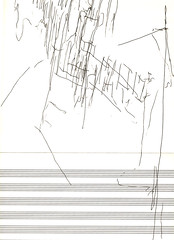
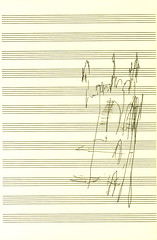
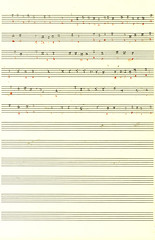
As part of a new project, I’ve been looking at ways of creating musical scores. As someone who composes music but cannot read it, I find this particularly interesting inasmuch as I’m looking to write a piece of music but want to do so, not by ‘feeling’ the music as I’m playing it (as is how I normally do it), but rather, through a process of ‘writing’ it down first. The scoring should, furthermore, be linked with the theme of the piece. For example, for the music I want to write as part of my Tour Stories: Oxford Destroyed project, I’ve tried drawing remembered images of the city, blind on a piece of manuscript paper.

Oxford Music Drawings

Oxford Music Drawings

It was whilst making work for a project “The Ordinary Language of Freedom” that I became aware of how what I was doing (writing on a window) reminded me of the look of music – a link made manifest perhaps by dint of the fact I cannot read it.

Dark Tourism

And prior to this, music – and in particular, musical scores – surfaced towards the end of my work on the Dreamcatcher project, where I began to see the piles of string as unsung/unwritten notes and the net as an attempt to piece them together – to write, in effect, a score of unwritten music.

Dreamcatcher X

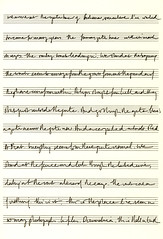
Yesterday, I made some work which incorporated the text style of ‘The Ordinary Language of Freedom’ project and my works with manuscript paper. I was interested to see how it would look, and, what it would mean, if I wrote directly onto the staves in this way.

Text on Staves
I began by considering what what one can derive from a blank sheet of manuscript paper. Comparing it with an ordinary blank sheet of paper there is clearly a difference. The staves somehow resonate, they make a sound even when there is nothing on them, and remind me of the silence one encounters in churches; pregnant with echoes (one thinks here again of Bill Viola’s discussion of sound in Chartres catherdral). When the text is written upon the staves (as above), the text becomes music, but of a different kind. The words are not words to be sung (that would be the case if the words were written beneath the staves and notes upon them) neither are they to be spoken. If the words are written beneath the staves without notation then they become neither words to be sung or spoken. They are not music. They are not simply text. They become lost.
12-03-08
Looking at some past text work I made as part of my OVADA residency (‘Wound’), I thought of repeating the work using manuscript paper.
Wound
The results were particularly interesting.
Music and Text
There is something about this piece which I find particularly resonant. The text is taken from a piece of writing I made following my visit to Auschwitz-Birkenau in which I describe the silence of the place; one, which like that in churches, I remember as being pregnant with the past. Looking at it closely, I was in fact reminded of mediaeval manucripts.

I need to explore these ideas more throughly, which in part I will do through a new project (6 Yards 0 Feet 6 Inches) and then, with a few ‘scores’ in hand, I will start to create some music based upon them.

Filed Under: Uncategorized Tagged With: Bill Viola, Dreamcatcher, Music, Silence, Sonic Work

Memory – The Poor Draughtsman

March 10, 2008 by Nicholas Hedges

I have for a long time been interested in memory and how – in terms of its visual fidelity to the thing remembered – it is a rather poor draughtsman. I was thinking of this in terms of how I ‘see’ Oxford when I am remembering it – a street, a building and so on. The city is of course a place I have known well for many, many years and yet, if I try and draw a building (for example Magdalen Tower) or a street (such as the High), I realise very quickly, as I explore the image in my mind (and on the page) that what my mind takes as being Magdalen Tower and High Street has more in common with a ruin that the real thing. That is not to say I see a smouldering pile of blackened stones and charred twisted timbers, but rather, the image which comprises – in my mind at least – the whole, is in fact made up of miscellaneous fragments which are often unrecognisable or entirely out of sequence.

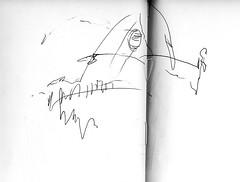
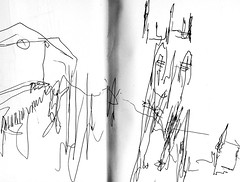
As with the work I did on Auschwitz, I decided to try and draw Oxford, and the following were made with my eyes closed.

Oxford Destroyed Memory Images

In light of my Tour Stories: Oxford Destroyed project, I found these images particularly resonant, and I began to wonder what would happen if I did the same with text; free-writing about a building as I see it in my mind.

Oxford Destroyed Memory Images

Filed Under: Oxford Tagged With: Drawings, Oxford, Oxford Destroyed

Dreamcatcher X

March 6, 2008 by Nicholas Hedges

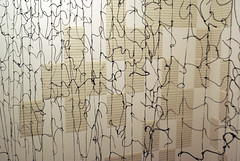
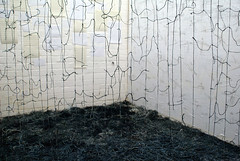
Today I began to install the Dreamcatcher work at MAO which after a while trying to package up the ‘net’ I finally managed to do. Right away I was taken aback by the difference between the work as it appeared in my studio and the work as it appears in the gallery; there is something rather staid about it which might be to do with the lighting (which we will work on tomorrow) and the power-socket in the corner. It just seems at present to be a decorative hanging.

Dreamcatcher X

The other problem for me is the backdrop which still looks a bit contrived; the sheets of music are I think essential but the way they are presented isn’t quite working. It might be down to the fact there isn’t enough paper so I bought some more today and will add that tomorrow morning.

Dreamcatcher X

The detail below shows for me the importance of the manuscript paper as one sees the net superimposed upon it as if it is music written on the page. I guess it’s just a case of trial and error at the moment, but in the case of this show I might removed the paper altogether.

Dreamcatcher X

Another option might be to go back to the original idea and add the drawn images of Auschwitz?

Filed Under: Holocaust Tagged With: Drawings, Dreamcatcher, Holocaust, Music, WWII

John Gwynn Survey

March 3, 2008 by Nicholas Hedges

I have for a long time been interested in John Gwynn’s survey of 1772, carried out in reponse to the Paving Commission’s desire for improvements to the city. In ‘A History of the County of Oxford: Volume 4’ (Victoria County History), it states in the opening paragraph on ‘Modern Oxford’ that ‘…With the Paving Commission of 1771 Oxford’s modern history began…’ and that ‘…The enthusiasm for public improvements alarmed some householders, particularly when the Paving Commission’s surveyor, John Gwynn, was observed all over town, measuring and making notes on streets and houses.’

For a long time I have wanted to work with the survey, being particularly interested in the list of names and associated measurements of the spaces they occupied in the eighteenth century city; people who of course have long since disappeared.

I had looked at it in relation to some work I did as part of my residency at OVADA in April/May last year. Firstly, regards a painting called Gloucester Green to Broken Hayes:

The title ‘Broken Hayes’ is the old name for Gloucester Green and describes a place which, in a sense, no longer exists, although, like the ghostly dwellings on John Gwynn’s survey (1772) it’s ‘footprint’ is still visible in the boundaries of the Green. Many of the items rubbed out on the canvas no longer exist in the places where I ‘found’ them; they are, in name only memories, just like Broken Hayes, yet like the physical aspect of that place, they still exist.

Then the walk I made from which the painting derived:

This isn’t an area I know that well – I’m not sure if I’ve ever walked the entire length of Paradise Street – and yet afterwards, when I looked at David Loggan’s map of 1675, it all seemed very familiar. I was surprised at how much was left after the upheaval of redevelopment, particularly when standing near St. George’s tower, near the junction of St. Thomas’ and Paradise Streets. Now, looking at John Gwynn’s surveys, I could make much more sense of the Oxford of 1772.

In another entry I wrote:

“But the layout of the streets (if not the buildings and their inhabitants) still remain, and so, by walking these streets, armed with a residual list of measurements, one can walk back in time and make a connection with this vanished population.This correlation between time and distance had initially come through my thinking of how difficult it often is, to identify with people who live abroad in war-zones (Iraq and Afghanistan for example), for, even though these countries are only a comparatively short distance away, they might as well be years in the past, for it’s almost as difficult to relate to those who live (and die) there, as it is to those who lived and died, for example, during the first and second world wars, or the time of John Gwynn.”

However, in light of the recent work I have made as part of the Brookes show at MAO, my ideas have changed a little. Thinking back to some thoughts I had on the Three Fates, I’ve decided to try merging the two ideas. One aspect of the story of Gwynn I liked particularly was the idea of residents being worried by his measuring, as if he was measuring up the fate of their homes and the city as a whole. So, I’ve decided to take these measurements, and using string and a ruler, measure out the string and cut them according to the survey. Mr Pepal would therefore be 12 yards, 1 foot and 9 inches.

Filed Under: Oxford Tagged With: 18th Century, John Gwynne, Oxford, Survey

Dark Tourism – Language and Text

March 3, 2008 by Nicholas Hedges

In his book, ‘At the Mind’s Limits’, Auschwitz survivor, Jean Améry writes:

“We emerged from the camp stripped, robbed, emptied out, disoriented – and it was a long time before we were able even to learn the ordinary language of freedom. Still today, incidentally we speak it with discomfort and without real trust in its validity.”

Given the work I have been exploring recently, which is all centred around text, I found this particularly interesting, particularly given the text I’m exploring is that of post-memory which in terms of its validity (in respect of actual events) is by definition untrustworthy – post-memory doesn’t pretend to be accurate. Amery goes on to write:

“If I may quote once more, and once again an Austrian, then I would like to cite the words that Karl Kraus pronounced in the first years of the Third Reich: ‘The word fell into a sleep, when that world awoke.’ Certainly, he said that as a defender of this metaphysical ‘word,’ while we former camp inmates borrow the formulation from him and repeat it sceptically as an argument against this ‘word’. The word always dies where the claim of some reality is total. It died for us a long time ago. And we were not even left with the feeling that we must regret its departure.”

I didn’t know anything about Karl Kraus and so looked him up on Wikipedia. The following is taken from that source:

“Karl Kraus was convinced that every little error, albeit of an importance that was seemingly limited in time and space, shows the great evils of the world and era. Thus, he could see in a missing comma a symptom of that state of the world that would allow a world war. One of the main points of his writings was to show the great evils inherent in such seemingly small errors… Language was to him the most important tell-tale for the wrongs of the world. He viewed his contemporaries’ careless treatment of language as a sign for their careless treatment of the world as a whole… 

…He accused people – and most of all journalists and authors – of using language as a means to command rather than serving it as an end. To Kraus, language was not a means to distribute ready-made opinions, but rather the medium of thought itself. As such, it needed critical reflection. Therefore, dejournalising his readers was an important concern of Kraus in “a time that is thoroughly journalised, that is informed by the spirit but is deaf to the unity of form and contents”. He wanted to educate his readers to an “understanding of the cause of the German language, to that height at which the written word is understood as a necessary incarnation of the thought, and not simply a shell demanded by society around an opinion.”

Filed Under: Holocaust Tagged With: Dark Tourism, Holocaust, Jean Amery, WWII

Dreamcatcher IX

March 3, 2008 by Nicholas Hedges

Thinking about the backdrop for the Dreamcatcher I have decided that it would be best to stick with just empty sheets of manuscript paper rather than bits of everything else. The trouble is I haven’t collected enough different types of paper and having just three things (manuscript paper, postcards and lined paper) makes it as a whole look a bit ‘cobbled together’ and rather contrived. Having just the manuscript paper however helps me to avoid this. Furthermore it makes for a stronger piece. With just the empty manuscript paper as a backdrop, the cut string would become just the unwritten notes, unsung music; and they would I believe be more pertinent to the theme of lost voices, silenced voices. There is something more human about these pieces of string being unplayed or unsung music.
One particularly interesting contrast is the idea of music (sung music in particular) filling a space. One can imagine the sound waves with the potential of filling a vast area and then the pile of unsung notes (unheard voices) piled in just a corner. There is the difference too in the quality of the two; the sound being light and the string being dense and heavy.

I am reminded here of something I read in Bill Viola’s collection of writing: ‘Reasons for Knocking at an Empty House. Writings 1973-1994’.

“Chartres and other edifices like it have been described as ‘music frozen in stone’. References to sound and acoustics here are twofold. Not only are there the actual sonic characteristics of the cavernous interior, but the form and structure of the building itself reflects the principles of sacred harmony – a sort of ‘acoustics within acoustics’. When one enters a Gothic sanctuary, it is immediately noticeable that sound commands the space. This is not just a simple echo effect at work, but rather all sounds, no matter how near, far or loud appear to be originating at the same place. They seem to be detracted from the immediate scene, floating somewhere where the point of view has become the entire space.”

I’m particularly interested in the idea of the net being a score of sorts, one that can be sung or played (I like the idea of the cello being used in this context, as this instrument, a mournful one in many ways, has often been described as being the closest sounding instrument (in terms of its timbre) to the human voice. If one was using the net as a score, what would one be playing? The lines of the string, the intersections (knots) or the spaces between?

Dreamcatcher VIII

In many ways, this takes me back to a research project I started, but on which I never worked that much called Pathways Project. And already a title has come to mind. Dead Light: Unsung.

Filed Under: Holocaust Tagged With: Bill Viola, Drawings, Dreamcatcher, Holocaust, Music, Silence, WWII

Dreamcatcher VIII

March 1, 2008 by Nicholas Hedges

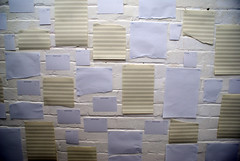
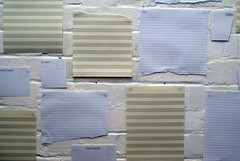
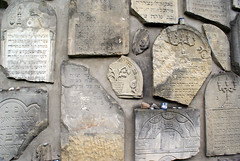
This afternoon I worked on a possible ‘backdrop’ for the Dreamcatcher installation which will itself be installed at MAO on wednesday. As it stands (without the backdrop), it works, but I want to make a connection between the string and text, music, drawing etc. and the idea of the pile of string being a pile of unwritten words, unwritten music and so on. One idea I’ve had is to place pieces of blank paper, postcards, manuscript paper and writing paper on the back wall, and all the while I’ve thought about it, the more the image of the ‘rescued’ Jewish gravestones made into a memorial war in Kazimierz-Dolny (Poland) appeared in my mind.

So with my various pieces of paper, I went to the studio and made an attempt at creating something. The results are as below:

Dreamcatcher VIII

Dreamcatcher VIII

Looking at the above, one can see a connection with the image below – the wall in Kazimierz-Dolny.

Old Jewish Cemetery, Kazimierz Dolny, Poland

Below, is the backdrop as seen behind the net and the string.

Dreamcatcher VIII

So, I think this idea works very well, my only problem is the quality of the fragments. As the above was made this afternoon, just to see how it would look, I’m a little unsure of how it should be displayed come Thursday when it’s installed in MAO. I think the paper is important but I’m not sure blu-tacking is good enough. Also the paper looks too clean and the postcards I think should go (maybe just one or two pieces). The main thing is not to let it look too contrived; the string and the net work well, at the moment the paper fragments jar just a little – something to work on tomorrow and Monday.

Filed Under: Holocaust Tagged With: Drawings, Dreamcatcher, Holocaust, Music, Poland, WWII

Mine the Mountain Designs

March 1, 2008 by Nicholas Hedges

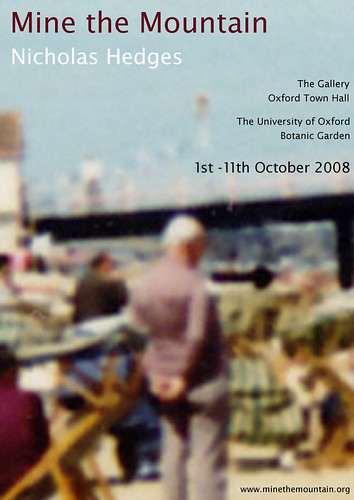
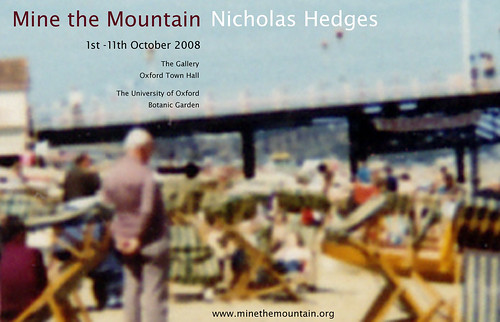
I have finally come up with three designs for the Mine the Mountain exhibition in October this year. They are for an A4 poster, a postcard and a businesscard.

A4 Poster

Postcard

Business Card

Filed Under: Uncategorized Tagged With: Mine the Mountain, Poster

Dark Tourism Conference II

February 29, 2008 by Nicholas Hedges

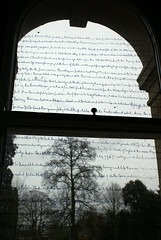
Having thought about the ideas raised after my visit to St. John’s College, I decided to try the idea out in my studio space at Brookes. I began by copying the entry on St. John’s College from the Encyclopaedia of Oxford which, using a water-based marker I then wrote out (in part) onto one of the windows. The windows are not the right shape for the project but I got a good idea of how it would look nevertheless.

Dark Tourism

Having used the text of the history of St. John’s I decided to write on another window, all that I could see as I looked through the glass, and, having done this, I considered the significance of the two.
The text delineates the surface of the glass and so defines it more readily as a barrier; the text itself is not a physical barrier but rather a conscious one. One is able to shift one’s focus from one to the other but can never see them at the same time – at least not clearly. With regards the text describing the scene beyond the window I found that this created an interesting, temporal exchange. Looking through the text one can see the world as it is ‘now’, whereas when reading the text one can only see the world (albeit in words) as it was. You have to read/view one or the other – you can’t do both.

Reading the text traps the viewer for a moment in the past and obscures the reality of the world. It follows therefore that seeing the world as it is outside hides the past. Reading the text describing the scene outside as the text was written, one can flit between past and present but can see by doing so how some things remain the same. A building for example described in the text might well be the same as when viewed through the glass, whereas someone who was walking beyond the glass when the text was written will exist in words but will not be visible to the viewer when looking (reading) between lines. Of course it might be that words used to describe a person in a somewhat vague fashion in the text may be applicable to someone beyond the glass when the viewer’s focus is shifted; for me, this is a good way to represent the continuity of life and also acts as a warning that the past can always repeat itself.

Dark Tourism

How does this work resolve with the issue of Dark Tourism? Let’s assume we are in Auschwitz-Birkenau. As tourists we are exposed to a place of trauma; we constantly flit between the past (that of which we’ve read in testimonies or seen in films and photographs) and the present (the reality of the world around us). Often we cannot make a connection between the two. We may well have read about one million dead but standing where we stand in the present, we simply cannot imagine it. However, when we do see something that fits the ‘text’ and the world around us, when we find a correlation (such as the gate tower), the past with all its trauma is brought into the present and vice-versa; there is in effect an exchange. But of course we are always safe behind the barrier; the barbed-wire-text fence doesn’t keep us in, but keeps the past at bay.

So why do we visit places of trauma? Perhaps it’s because we can always leave, we can move between past and present, yet know that we can always go home. Perhaps that’s why we go to places such as Auschwitz; because we know we can leave – leave with our existence all the brighter because of it, framed by the shadow of the past.

In the end, words (whether describing the experience of a tourist or a victim) can only take us so far. As Elie Wiesel wrote: ‘I would bring the viewer closer to the gate but not inside, because he can’t go inside, but that’s close enough.’ We can walk up to the ‘barbed-wire’ (text) fence, we can see the wires (read the text) and see through them, but we can never go any closer – not would we want to; that is, as Wiesel says, ‘close enough.’

Filed Under: Holocaust Tagged With: Dark Tourism, Elie Wiesel, Holocaust, Text Work, The Gate, WWII

Oxford Destroyed – Images

February 27, 2008 by Nicholas Hedges

I was thinking the other day about the images our memories present to us and what they represent in the real world. I have been interested for a long time in what exactly remembered images are, and having thought about my Tour Stories Project (Oxford Destroyed) I started to think about Oxford as it exists in my memory. If I picture the High Street what do I see, and, if I try and draw that image, what does it look like? I supposed the resulting image would not be unlike a ruin and so I tried it out.

Oxford Destroyed Memory Images

In many ways, the images I drew of what I could see in my memory were like images of the city in ruins, and in many respects, the remembered city is a ruin – it has, after all, in terms of its temporality, passed by.

In Sebald’s novel Austerlitz, Austerlitz states that fortifications:

“…cast the shadow of their own destruction before them, and are designed from the first with an eye to their later existence as ruins.”

I think in some respects this might apply to any structure and their later existence as memories.

Filed Under: Uncategorized Tagged With: Drawings, Oxford Destroyed, Sebald

Dark Tourism Conference

February 26, 2008 by Nicholas Hedges

This morning I went down to St. John’s college to view a room in which I’ve proposed to exhibit work during a conference to be held there in April. The conference is titled ‘Travel and Trauma: Suffering and the Journey’ with a sub-heading; ‘A Writing Journeys and Places Interdisciplinary Colloquium,’ and therefore I wanted to show something which would fit in with this theme. Even though much of the work on my MA has already dealt with this subject and would be entirely appropriate for this event, I have in mind to do something new. And so, I went to view the space to see what possibilities it might afford me.

The space itself is a room in a modern block and what I noticed right away was that there was a lot of glass with, and as a result, a good view of the outside. I asked if the outside might be used and there seemed to be no objections to this. However, the more I thought about the space, and the more I thought about the conference title, the more I saw myself writing – creating a work with text. I thought of some of the work I’d done in the past, and the painting I made after my visit to Auschwitz gave me an idea.

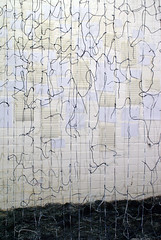
The text written across the painting and resembling wire immediately made me think of writing in a similar style across the large windows in the room (perhaps with a black chinagraph pencil). But what would I write? Whatever it was would have to be relevant to the space and the idea of tourism and after thinking for a while I considered again the view beyond the window – the reality of what was on the other side of the glass. I thought of writing a history of St. John’s college but then considered instead, the idea of writing a description of what was actually there outside, framed by the window at which those reading the text would be standing; reading and yet blind to the reality of what was in front of them.

So what would this mean: people reading the text describing the reality of what was there ahead of them, blind to that reality because of the text/wire behind which they are held? For me it signifies the impossibility of getting near to the reality of an event through writing/reading about and expriencing a place, but saying that, it wouldn’t be a work suggesting the futility of such experiences – far from it – but it would hopefully raise questions about our role as tourists.

Filed Under: Paintings Tagged With: Dark Tourism, Paintings, Text Work, The Gate

Dreamcatcher VII

February 25, 2008 by Nicholas Hedges

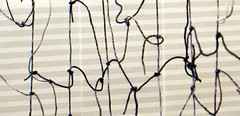
On my way to Luxembourg, I considered the pile of string and went over what I’d previously written, that the lines equate to hair, memories of the individual, individuals themselves, written words, unspoken words. The dreamcatcher, I summarised, is the attempt of the tourist to piece together a moment from the mass of dead light. It is the attempt to imagine what victims might have written /thought at the time (unwritten words) and maybe in the future; it is the attempt to piece together unsung melodies (music) and, to some extent, unsaid words (wires). But how do I help people make that connection?

Dreamcatcher VII

Could I use postcards, manuscript paper, writing paper?

25-02-08

Having drawn the above (right-hand side) I was reminded of the wall of broken/displaced gravestones myself and Monika saw in Kazimierz-Dolny.

Old Jewish Cemetery, Kazimierz Dolny, Poland

If I use postcards, manuscript paper, writing paper and so on (put on the wall behind the pile of string) would it be best to rip them and attempt to put them back together in the manner of the wall?

Filed Under: Holocaust Tagged With: Drawings, Dreamcatcher, Holocaust, Music, WWII

Dreamcatcher VI

February 21, 2008 by Nicholas Hedges

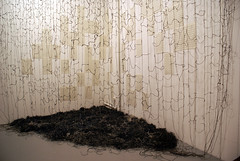
I spent a couple of hours in the studio this afternoon cutting up the string which will go on the floor beneath the net of the dreamcatcher. Quite a bit of the string (which was dyed in balls) had remained relatively untocuhed by the dye, yet all the same, this gave the pile of string an interesting appearance. Of course there is no getting away from the fact that the pile alludes to the mountain of human hair which one can see in the museum at Auschwitz, but as I cut more of the string, I saw the string not so much as hair as unwritten words. The fact that some of it was white, ‘uninked’ as it were made me think of words that had been written and then erased. The way the dye has taken to some of the string has also given it the appearance of wire, and again this added to the idea of things left unwritten, but in this instance, things left unsaid, as if the wires were phone wires.

If this pile of string is to allude to things never said and never-written then the dreamcatcher becomes an attempt by the tourist (the viewer) to imagine what they (the victims) might have said and might have written. But like the dreamcatcher as something of an appropriated cultural symbol, the net of words and ‘voices’ are also appropriated from a decimated culture and can in no way tell us what it was really like to be there. Dreamcatchers let the good dreams through and ensnare the nightmares; we can never know what it was like to be there, and we will always pass through.

The question is, how do I enable the viewer to understand the string as unwritten words?

Filed Under: Holocaust Tagged With: Drawings, Dreamcatcher, Holocaust, Music, WWII

Creatures 2

February 13, 2008 by Nicholas Hedges

New images, 30 x 20 inches.

Filed Under: Photography Tagged With: Creatures, Detail, Photographs

  • « Previous Page
  • 1
  • …
  • 23
  • 24
  • 25
  • 26
  • 27
  • …
  • 32
  • Next Page »
  • The ‘Now of Then’
  • Artist’s Statement
  • Designs for an Heirloom
  • Dissonance and rhyme
  • Wildflowers
  • Emptiness
  • Wave (goodbye)
  • Now In The Past Of An Unreal Place
  • Return to Graphite
  • Genius
  • Latest Backdrops
  • Extended Backdrops
  • Backdrops
  • Komorebi
  • Acorns
  • Scroll Work
  • Goethean Observation: Japanese Scroll
  • Mistakes
  • The Leaf Is Singing Still
  • Past Present
  • Scrolls
  • As Yet Untitled
  • Holes
  • Scroll
  • A Calligraphy of Shadows
  • More Paintings
  • Latest Paintings
  • Walking Meditation 2
  • Knowing We Are There
  • Venice by Moonlight 1840
  • Fragments and Additions
  • Reimagining The Past
  • Walking Meditation 1
  • Mindful Walking I
  • Grief II
  • Three New Paintings
  • Nana’s Mountain
  • Painting
  • Iridescence
  • Roman Bottle
  • Rinsho
  • Shadow Calligraphy
  • Becoming Memory
  • Fox Talbot’s Glassware
  • Goethean Observation: Diffuser II
  • Goethean Observation: Diffuser
  • A Remembrance of Things We Never Have Known
  • A Moment’s Language
  • Take Me Home
  • Arrival/Departure
  • Diffusers
  • Grief
  • Mum
  • Measuring the past
  • Disordered Time
  • Entropy
  • Wicked Magician, Fly
  • The Quanta of History
  • Empathy Forward
  • The Natural World of 978
  • The Gone Forest
  • Empathy/Exchange: 668 grams
  • Goethean Observation: Pilgrims of the Wild, 1935
  • Nazareth O
  • Several Johns and St. Thomas
  • Raspberry
  • Tokens and Shadows
  • Patterns Seeping (II)
  • ‘Missded’ 4 – Tokens
  • Patterns seeping
  • Cut Paintings
  • ‘Missded’ 4
  • Locks III
  • Locks II
  • ‘Missded’ 2 – Tokens
  • My Son’s Drawings II
  • ‘Missded’ 2
  • ‘Missded’ 3 – Tokens
  • ‘Missded’ 3
  • ‘Missded’ 1 – A Framed Token
  • Morning Has Broken
  • Tokens of absence
  • ‘Missded’ 1, stitched
  • More Little Words
  • Three Little Words
  • Spaces In Between
  • ‘Missded’ 3
  • ‘Missded’ 2
  • ‘Missded’ 1
  • Locks
  • Tracings
  • My Son’s Paintings
  • Writing Shadows
  • Samuel Borton’s Post Chaises
  • Dawid Sierakowiak
  • Pitchipoi
  • Latest Tree Drawings
  • Notebook
  • Somewhere Between Writing and Trees II
  • Somewhere Between Writing and Trees

© Nicholas Hedges 2024

  • Facebook
  • Instagram
  • Twitter
  • YouTube

Copyright © 2025 · Outreach Pro on Genesis Framework · WordPress · Log in