Nicholas Hedges

Art, Writing and Research

  • Amazon
  • Behance
  • Facebook
  • Instagram
  • Pinterest
  • YouTube
  • Art
    • Digital
    • Drawing
    • Grids
      • Correspondence
      • The Wall
      • The Tourist
    • Ink on paper
      • Shadow Calligraphy
    • Installation
      • Murder
      • Echo
    • Painting
    • Patterns
    • Mixed Media
    • Photographic installation
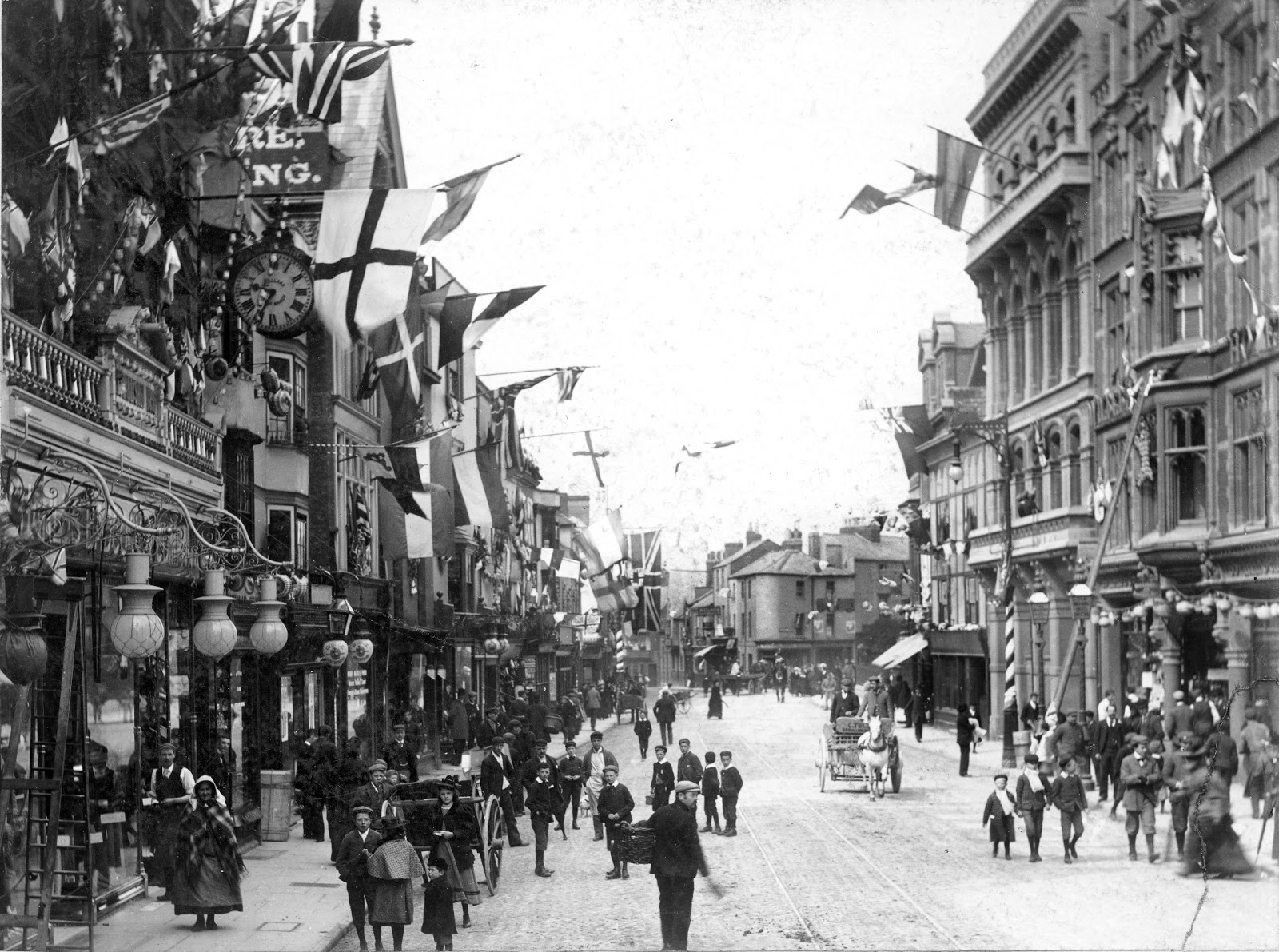
      • St. Giles Fair 1908
      • Cornmarket 1907
      • Headington Hill 1903
      • Queen Street 1897
    • Research/Sketches
    • Stitched Work
      • Missded 1
      • Missded 2
      • Missded 3
      • Missded 4
    • Text Work
  • Blogs
    • Family History
    • Goethean Observations
    • Grief
    • Light Slowed But Never Stilled
    • Lists
    • Present Empathy
    • Shadow Calligraphy
    • Trees
    • Time
    • Walking Meditations
  • Video
  • Photography
    • Pillars of Snow
    • Creatures
    • The Trees
    • Snow
    • St. Giles Fair 1908
    • Cornmarket 1907
    • Headington Hill 1903
    • Queen Street 1897
    • Travel
  • Illustration and Design
  • Music
  • Projects
    • Dissonance and Rhyme
    • Design for an Heirloom
    • Backdrops
    • Shadow Calligraphy
  • Exhibitions
    • A Line Drawn in Water
      • Artwork
    • A Line Drawn in Water (Blog)
    • Mine the Mountain 3
      • Artwork
    • Mine the Mountain 2
      • Artwork
      • The Wall
    • The Woods, Breathing
      • Artwork
    • Snow
      • Artwork
    • Echo
      • Artwork
    • Murder
      • Artwork
    • The Tourist
    • Dreamcatcher
    • Mine the Mountain
      • Artwork
      • The Tourist
    • M8
    • The Gate
    • Creatures
      • Artwork
    • Residue
      • Artwork
    • A visit to Auschwitz
      • Artwork
  • Me
    • Artist’s Statement

Glimmerings: The War Poets, Paths and Folds

October 16, 2012 by Nicholas Hedges

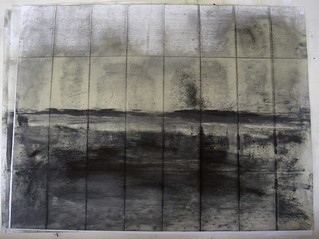
One of the nicest compliments I received during Friday’s private view was ‘…these remind me of Siegfried Sassoon…’. The works in question were those images of imagined World War I landscapes painted onto folded paper, one of which I have shown below:

DSC07879

In fact, the war poets were brought up a number of times in relation to these works which – for obvious reasons – pleased me enormously. But, I wondered what it was about these pieces which called to mind the poets?

One of the poets I’ve become increasingly interested in, is Edward Thomas – killed at the battle of Arras in 1917. I first became aware of his work whilst reading a book of World War I poetry, in which I found his poem ‘Roads’ (a poem I’ve already discussed in relation to my work). It was then in Robert Macfarlane’s book ‘Wild Places’ that I encountered Thomas again, this time in relation to another poet, Ivor Gurney. In a previous blog I wrote:

After returning from the war, Ivor Gurney, like so many others suffered a breakdown (he’d suffered his first in 1913) and a passage in Macfarlane’s book, which describes the visits to Gurney – within the Dartford asylum – by Helen Thomas, the widow of Edward Thomas is particularly moving. Helen took with her one of her husband’s Ordnance survey maps of Gloucestershire:

‘She recalled afterwards that Gurney, on being shown the map, took it at once from her, and spread it out on his bed, in his hot little white-tiled room in the asylum, with the sunlight falling in patterns upon the floor. Then the two of them kneeled together by the bed and traced out, with their fingers, walks that they and Edward had taken in the past.’

Macfarlane discusses Thomas in another book, ‘The Old Ways: A Journey on Foot,’ in which he writes how for Thomas, paths “connected real places but… also led outwards to metaphysics, backwards to history and inwards to the self. These traverses – between the conceptual, the spectral and the personal – occur often without signage in his writing, and are among its most characteristic events. He imagined himself in topographical terms. Corners, junctions, stiles, fingerposts, forks, crossroads, trivia, beckoning over-the-hill paths, tracks that led to danger, death or bliss: he internalized the features of path-filled landscapes such that they gave form to his melancholy and his hopes. Walking was a means of personal myth-making, but it also shaped his everyday longings: he not only thought on paths and of them, but also with them.”

DSC07578

Ever since I walked a path in Wales on which I knew my great-great grandfather walked every day to the mine in which he worked, I’ve been interested in the idea of people as place (and vice-versa) – see Landscape DNA – the simultaneity of stories so far. The path from the small town of Hafodyrynys to Llanhilleth where he worked, not only connected those two places, it also connected me with my ancestor. It did just what Thomas suggested; connected real places but also went backwards to the past and inwards to my own self. As Macfarlane puts it: “paths run through people as surely as they run through places.”

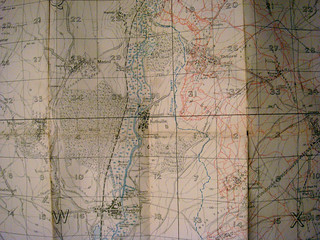
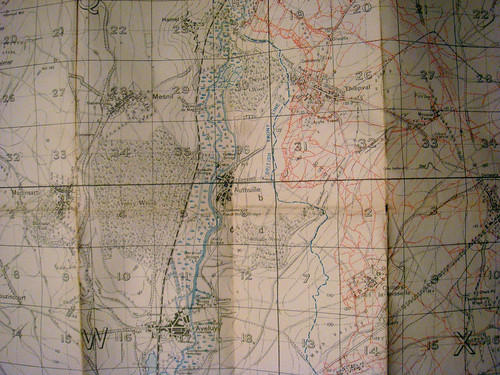
It was important for me that the images shown above did not appear so much as pictures – objects stuck on a wall – as objects of use. I wanted them to appear as if they’d been unfolded rather than simply painted, that like maps, they could be read rather than simply looked at. I wanted them to retain the potential for being folded (which, if they were framed, wouldn’t have been possible) for this inherent potential of folding and unfolding refers back to an observation I made whilst studying an old trench map.

DSC07754

During that observation I wrote, “…the past movements associated with this map are therefore recorded in its folds. It resists being folded any other way.”

The folds in the map are like ancient paths in a landscape. We can walk (within reason) wherever we like through a place, but more often than not, we will follow the way of countless others before us. Paths are themselves like folds within the landscape, and we, like the map, resist being folded any other way.

Trench Map 1916

Macfarlane again writes how for Thomas “…map-reading approached mysticism: he described it as an ‘old power’, of which only a few people had the ‘glimmerings’.”

These glimmerings reminded me of a passage I read in Merlin Coverley’s book Psychogeography, in which he writes: “Certain shifting angles, certain receding perspectives, allow us to glimpse original conceptions of space, but this vision remains fragmentary…”

These ‘glimmerings’or ‘shifting angles’ are best seen or accessed through the everyday; observations of which I record in other map works.

Map Work

This is something which Macfarlane again seems to allude to in ‘The Old Ways: A Journey on Foot’, when he writes: “The journeys told here take their bearings from the distant past, but also from the debris and phenomena of the present, for this is often a double insistence of old landscapes: that they be read in the then but felt in the now. The waymarkers of my walks were not only dolmens, tumuli and long barrows, but also last year’s ash-leaf frails (brittle in the hand), last night’s fox scat (rank in the nose), this minute’s bird call (sharp in the ear), the pylon’s lyric crackle and the crop-sprayer’s hiss.”

As I have recorded in my text-maps:

A man talks holding his hat
A flag flies, fluttering in the growing wind
The next bus is due
A car beeps
Amber, red, the signal beeps
The brakes hiss on a bus

Maps are objects which we fold and unfold. We unfold them to find our place within the landscape. We fold them and carry them with us. The process or unfolding and (en)folding: the idea that the past can be seen as being enfolded within the smallest objects and everyday observations in vital to my work; as is the way in which we are enfolded (written) into the landscape as we walk; the way in which the landscape is unfolded as we travel across it. Knowledge, likewise, is also unfolded in this way. As Tim Ingold writes in ‘Being Alive: Essays on Movement, Knowledge and Description’:

“…knowledge is perpetually ‘under construction… the things of this world are their stories, identified not by fixed attributes but by their paths of movement in an unfolding [my italics] field of relations. Each is the focus of ongoing activity. Thus in the storied world… things do not exist, they occur. Where things meet, occurrences intertwine, as each becomes bound up in the other’s story. Every such binding is a place or topic. It is in this binding that knowledge is generated.”

Empathy is another important aspect of my work and I’ve stated before that empathy is an augmented discourse between bodily experience and knowledge. I like to think that with these works I’ve discovered a means of expressing that.

Finally, the works I’ve made are fragile pieces, and in another passage on Thomas, I found in Macfarlane’s prose a sentence which describes why they should be so: “His poems are thronged with ghosts, dark doubles, and deep forests in which paths peter out; his landscapes are often brittle surfaces, prone to sudden collapse.”

Perhaps this, in part, answers my question above.

Filed Under: Lists, Poetry Tagged With: Broken Landscape, Edward Thomas, Ivor Gurney, Listmaking, Lists, Maps, Paths, Poetry, Trench Maps, Walks, War Poets, World War I, WWI

Kaleidoscope – Exhibition

October 14, 2012 by Nicholas Hedges

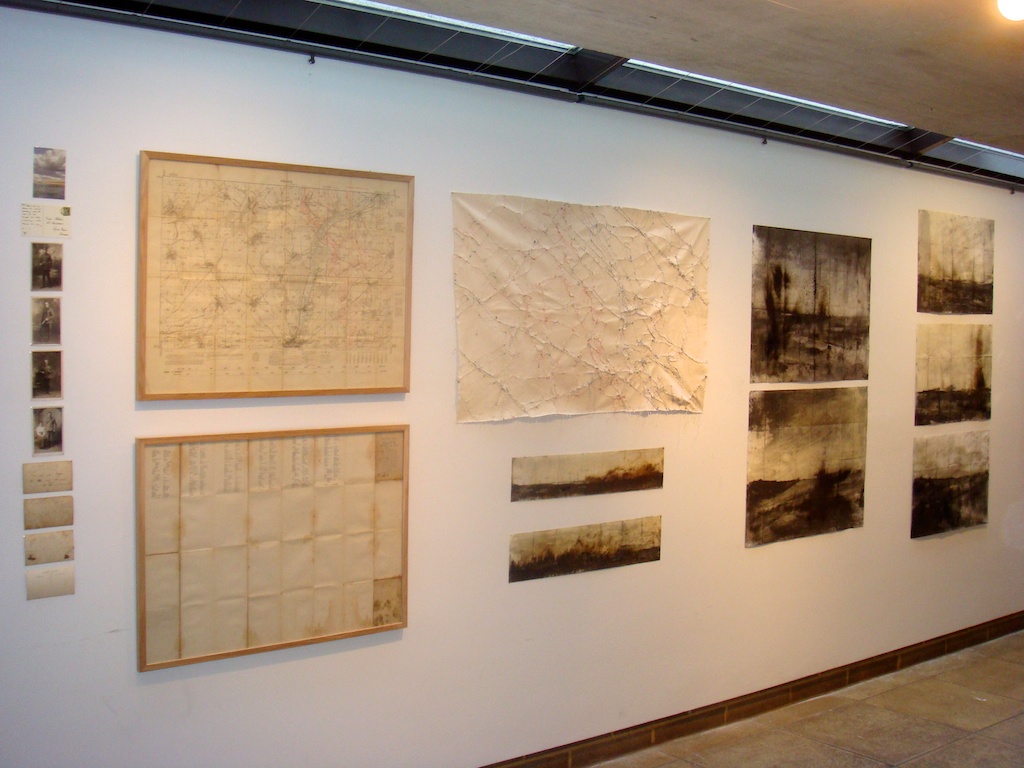
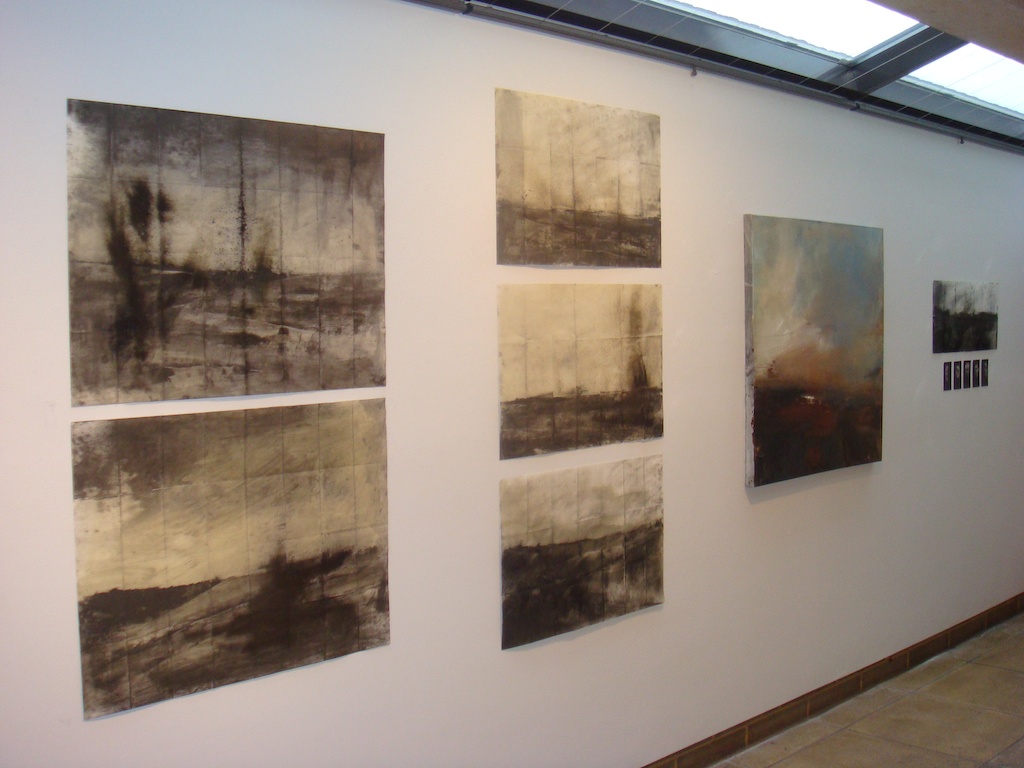
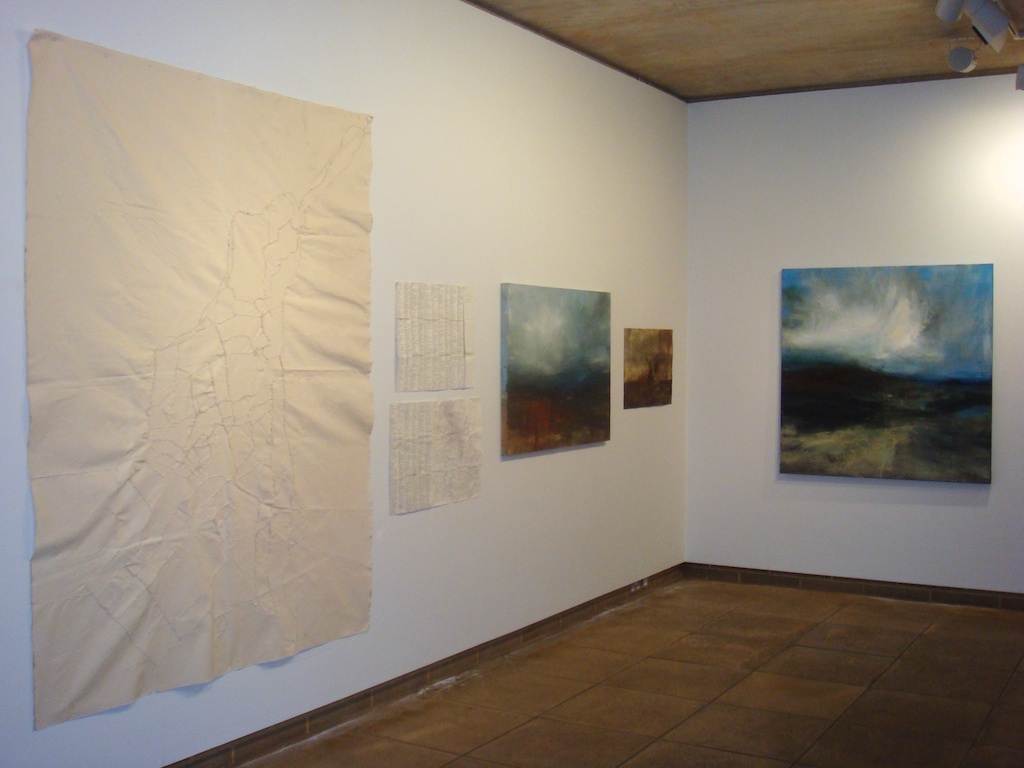
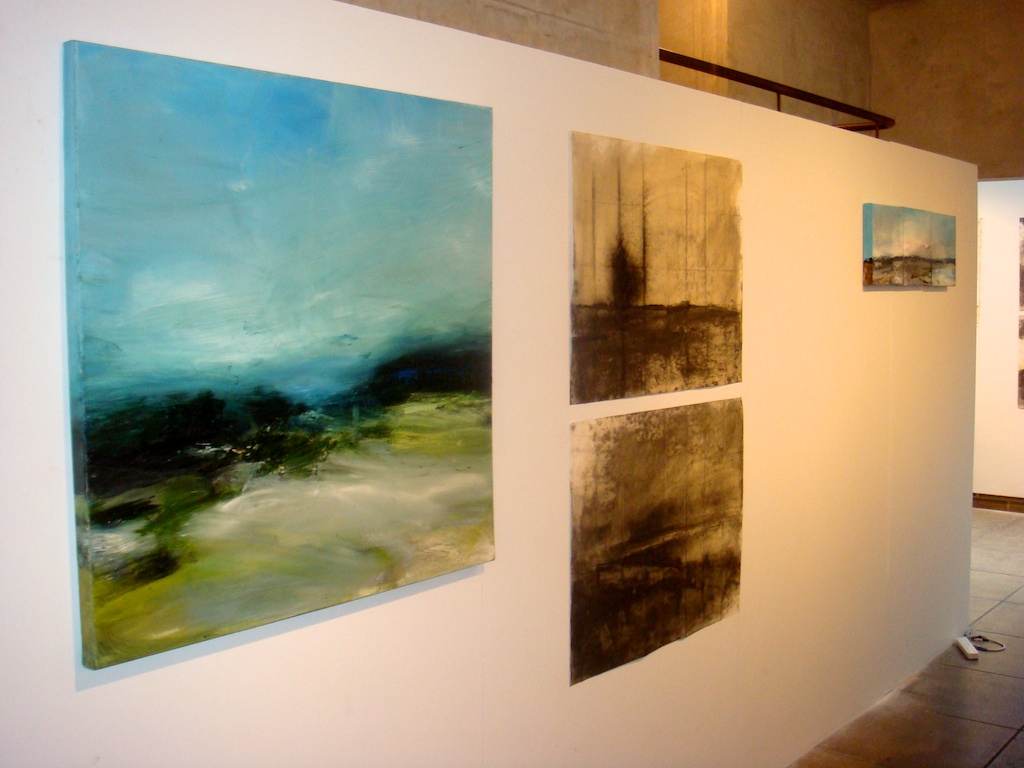
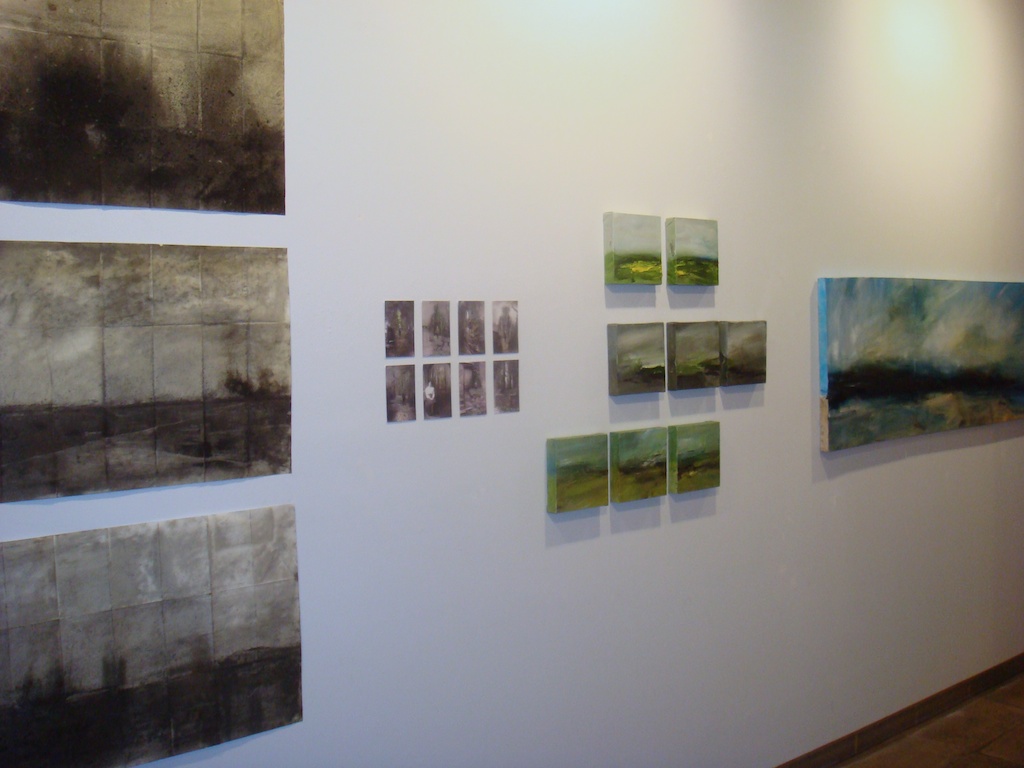
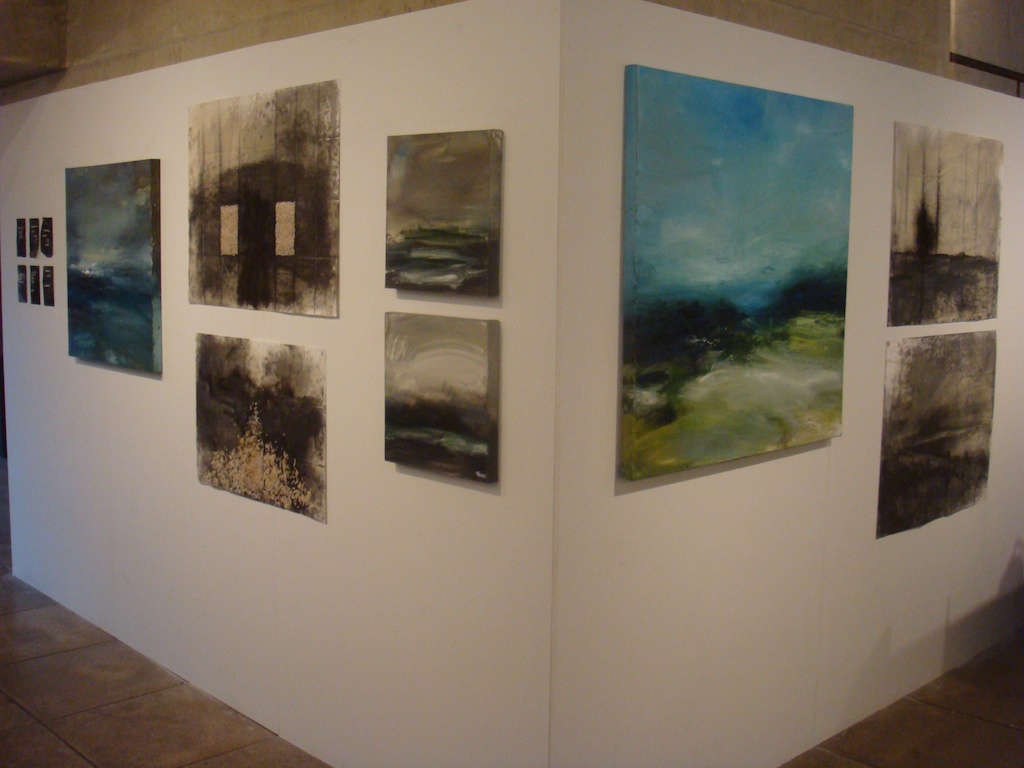
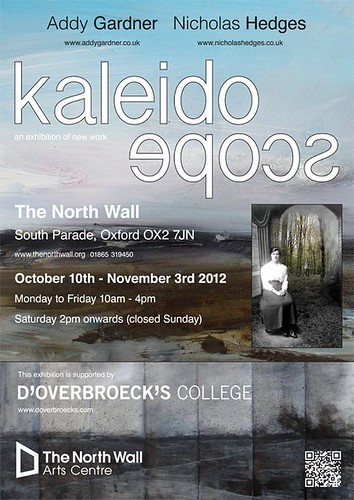
Some photos from Kaleidoscope; the exhibition I, along with my fiancee Addy Gardner, are currently staging at The North Wall Gallery, South Parade, Summertown, Oxford. The exhibition runs until 3rd November. See website for more details.

Filed Under: Artist in Residence Tagged With: Addy Gardner, Artist in Residence, Australia, Kaleidoscope, World War I, WWI

Aerial Views

August 19, 2012 by Nicholas Hedges

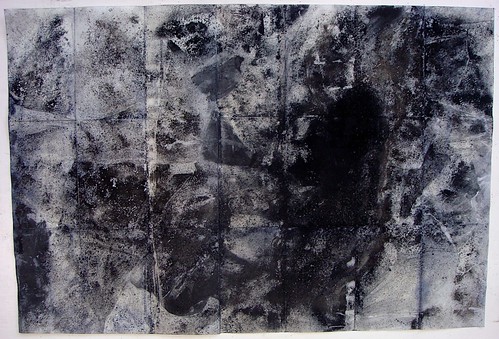
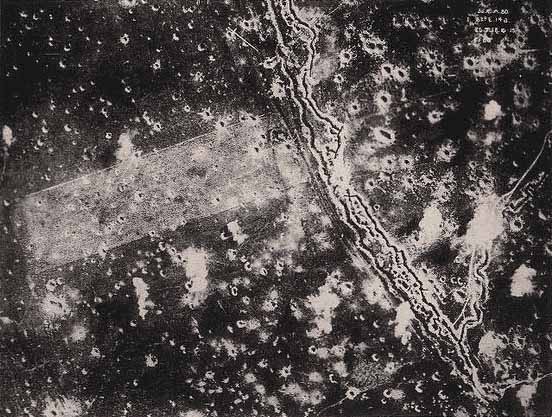
I worked on a piece yesterday, the origins of which were a GPS trace of trench systems around the village of Serre. I had the idea of ‘colouring’ each segment using ash, graphite and coal dust, but of course the boundaries between these segments blurred into more or less one. However, I liked the look of what I’d produced, which reminded me – in particular where I’d made the lines visible using a palette knife – of aerial photographs I’d seen of the trenches.

The first image I produced:

DSC07650

An aerial view of battlefields taken during the First World War:

The coal dust is significant for me as it alludes to the miners who worked beneath the battlefields, as well as those miners who were called up for duty such as my own great-great-uncle, Jonah Rogers who was killed near Ypres in 1915.
What I’d like to do now, is do another piece, creating the same texture but only using the folds of the paper to create the lines (and perhaps the creases).

Filed Under: World War I Tagged With: Aerial Views, Family History, Jonah Rogers, World War I, WWI

Kaleidoscope – coming soon

August 16, 2012 by Nicholas Hedges

Kaleidoscope Exhibition

Read more at the exhibition website.

Filed Under: Uncategorized Tagged With: Addy Gardner, Kaleidoscope

Weft and Warp

July 19, 2012 by Nicholas Hedges

In Tim Ingold’s Being Alive, Essays on Movement, Knowledge and Description, he writes the following:

“Recall Hägerstrand’s idea that everything there is, launched in the current of time, has a trajectory of becoming. The entwining of these ever-extending trajectories comprises the texture of the world.”

This reminded me of something I wrote some time ago about history and the relationship between history and objects:

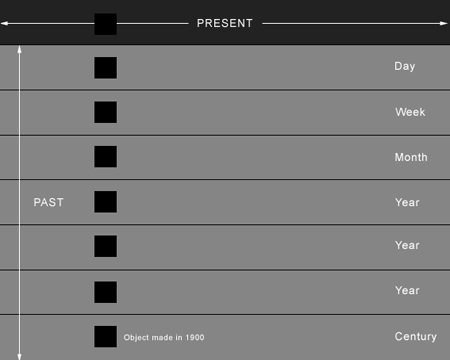
“…what we have is not a series of horizontal strata representing stacked moments in time (days, months, years, centuries etc.), but concurrent vertical lines, or what I have called ‘durations’ where each duration is an object, building or landscape feature and where the present is our simultaneous perception of those that are extant (of course, in the case of buildings, individual objects can also contain many separate durations).

It was Bill Viola who said that ‘we have been living this same moment ever since we were conceived. It is memory, and to some extent sleep, that gives the impression of a life of discrete parts, periods or sections, of certain times or highlights’. Similarly we can say that every object, building or landscape feature has existed in one continuous moment and that it is to some extent the passing generations which gives the impression of the past as being a series of ‘discrete parts, periods or sections…”

This is very similar to what Hägerstrand – via Ingold – describes above and in many ways, the second diagram (above), illustrating the idea of vertical durations, is like a loom, where the durations are the warp threads and our perception of simultaneous durations are the weft, leading to an entwining of what Hägerstrand calls ever-extended trajectories making up the texture of the world.

In this analogy we are both the weft and the warp; both a duration and the perceiver of durations. We find something similar to this, again in Ingold’s writing:

“…since the living body is primordially and irrevocably stitched into the fabric of the world, our perception of the world is no more, and no less, than the world’s perception of itself – in and through us. This is just another way of saying that the inhabited world is sentient.”

Filed Under: Quotes Tagged With: Bill Viola, Durations, Fabric, History, Quotes, Tim Ingold, Useful Quotes

The Material World

July 19, 2012 by Nicholas Hedges

“What, then, is this material world? Of what does it consist?”

So asks Tim Ingold, in his book, Being Alive, Essays on Movement, Knowledge and Description. It seems an obvious question, or rather, a question for which there is an obvious answer, but in terms of the field Material Culture it would seem to be not so straightforward. Citing a number of works on the subject, Ingold writes how “their engagements, for the most part, are not with the tangible stuff of craftsmen and manufacturers but with the abstract ruminations of philosophers and theorists.” Furthermore, “literature in anthropology and archaeology that deals explicitly with the subjects of materiality and material culture seems to have hardly anything to say about materials.” Ingold then goes on to cite an inventory of materials one might expect to see when dealing with this subject, as can be found in a book by Henry Hodges called Artefacts.

pottery
glazes
glass and enamels
copper and copper alloys
iron and steel
gold, silver, lead and mercury
stone
wood
fibres and threads
textiles and baskets
hides and leather
antler, bone, horn, ivory
dyes, pigments and paints
adhesives

In an array of books on his bookshelf, all dealing in some form with the subject of material culture, Ingold states that one looks in vain for any “comprehensible explanation of what ‘materiality’ actually means, or for any account of materials and their properties.” 

To cut a long story short, Ingold goes on to question what the material world actually is – thus the question at the top: “What, then, is this material world? Of what does it consist?”

He writes:

“Christopher Gosden suggests, we could divide it into two broad components: landscape and artefacts. Thus it seems that we have human minds on the one hand, and a material world of landscape and artefacts on the other. That, you might think, should cover just about everything. But does it? Consider, for a moment, what is left out. Starting with landscape, does this include the sky? Where do we put the sun, the moon and the stars? We can reach for the stars but cannot touch them: are they, then, material realities with which humans can make contact, or do they exist only for us in the mind? is the moon part of the material world for terrestrial travellers, or only for cosmonauts who touch down on the lunar landscape? How about sunlight? Life depends on it. But if sunlight were a constituent of the material world, then we would have to admit not only that the diurnal landscape differs materially from the nocturnal one, but also that the shadow of a landscape feature, such as a rock or tree, is as much a part of the material world as the feature itself. For creatures that live in the shade, it does indeed make a difference! What, then, of the air? When you breathe, or feel the wind on your face, are you engaging with the material world? When the fog descends, and everything around you looks dim and mysterious, has the material world changed, or are you just seeing the same world differently? Does rain belong to the material world, or only the puddles that it leaves in ditches and pot-holes? Does falling snow join the material world only once it settles on the ground? As engineers and builders know all too well, rain and frost can break up roads and buildings. How then can we claim that roads and buildings are part of the material world, if rain and frost are not? And where would we place fire and smoke, molten lava and volcanic ash, not to mention liquids of all kinds from ink to running water? … If, moreover, they are part of the material world, then the same must be true of my own body. So where does this fit in? If I and my body are one and the same, and if my body indeed partakes of the material world, then how can the body-that-I-am engage with that world?”

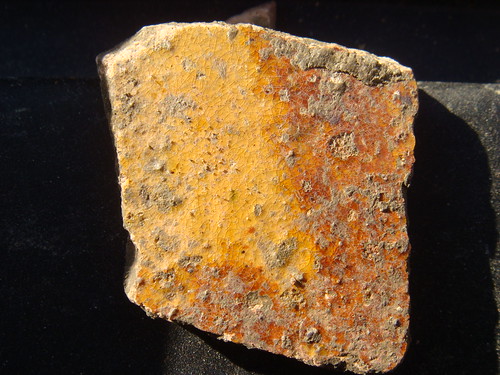
When I read this, I thought about the dig I went on last year at Bartlemas Chapel in Oxford, when I found a small but rather beautiful piece of mediaeval (I think) pottery.

Bartlemas Chapel Excavation

There are many ways in which one could interpret this find, but what I thought about was how this was like a missing piece of the present, and how, before it was lost to the soil, it had existed in a mediaeval present that was (save for the obvious differences) just like ours today. There was the wind, there were trees and flowers, the clouds, the sky and of course the sun, by whose light the beautiful glaze could be seen again, just as it had been by someone living hundreds of years ago. Reading what Tim Ingold has written about materiality and material culture above therefore made perfect sense.

And as regards my work with empathy and the importance in this respect of materiality and material culture, the idea of the body as part of the material world was also of interest. We are not set outside the material world but are an integral part – therefore it’s easier to engage empathetically with an individual through the objects those individuals once used. Empathy is as I’ve said before an augmented discourse between bodily experience and knowledge. Knowledge as Ingold writes derives through movement: “It is by moving that we know, and it is by moving, too, that we describe.” When I discovered the piece of pottery (through moving), I uncovered not only the object itself, but the material world by which it was once surrounded, including those people who once used it, or the person who even made it.

Filed Under: Archaeology, Lists, Trees Tagged With: Archaeology, Artefacts, Bartlemas Chapel, Empathy, Fragments, Landscape, Listmaking, Lists, Pottery, Stars, Tim Ingold

Moments

July 17, 2012 by Nicholas Hedges

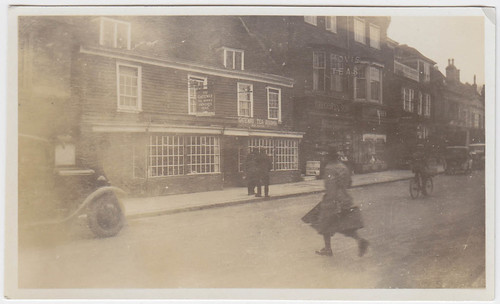
Following on from the completion of my text map (which I’m thinking of as a map of an individual rather than a place) I remembered this photograph which I bought in a junk shop, which seems, visually, to capture the idea of the texts. The photograph (below) dates from the 1920s.

Junk Shop Photograph

One can imagine what someone doing the same thing as me might have written had they walked through this scene:

A woman walks quickly over the road
Two men chat on the pavement
A cyclist passes
‘Hovis Teas’
Parked cars

Filed Under: Lists, Photography Tagged With: Listmaking, Lists, Moments, Nowness, Vintage Photographs

Movement, Knowledge and Description

July 17, 2012 by Nicholas Hedges

Having read Tim Ingold’s book ‘Lines – a Brief History‘, I downloaded another of his books entitled ‘Being Alive, Essays in Movement, Knowledge and Description‘ as the title seemed to suggest it would be of interest to me insofar as my work on empathy and the past has found itself returning time and again to ideas of movement and knowledge; empathy is, I believe, an augmented discourse between bodily experience and knowledge, and my aim as an artist is to articulate empathy through the description of this conversation between individuals and the landscape.

“It is by moving that we know, and it is by moving, too, that we describe,” writes Ingold early on in the book, which seems to bode well for my research and my search for the form that on an artistic level my research should take .

I’ve recently been working with the form of the folded map, inspired as I’ve written before by an old trench map which I recently purchased. In particular, I’m interested in the folds of the map, the creases which show that the map was used and in the possession of an individual. In ‘Lines – a Brief History‘ Ingold draws a parallel between creases in materials such as paper and the creases one finds on the palm of your hand which reinforces the connection between owner and object.

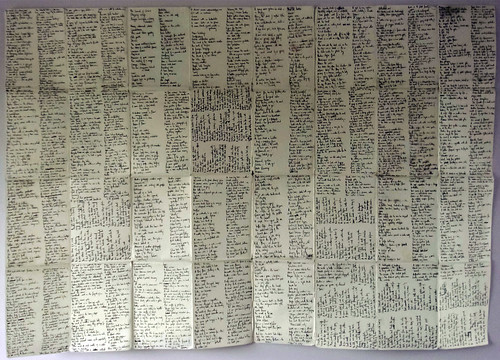
I’ve been wondering how I can develop this idea. I’ve already completed a ‘text map’ based on observations made over the course of several walks (below) but I want to develop the idea graphically as well.

I thought about the concept of a map and what the aesthetic of the folded paper alludes to. I came up with the following:

  • the idea of a specific place or of place in general
  • the sense of that place – through the map object – as belonging to an individual
  • the idea of the individual
  • the idea of movement in and through a place whether in the past, present or future
  • the idea of movement preserved in the folds

What I want to do is articulate the idea of empathy as a discourse between bodily experience and knowledge. The text map above is a document of bodily experience which when written down and presented as a ‘map’ becomes knowledge which other individuals could theoretically use. Its shape and its folds allude both to the idea of place and of possession (the concept of an individual as a place is something else which I’ve been exploring over the past few years). But what about the circular nature of experience and knowledge?

The fact is, when we think about the past, we can only ever build a picture through tiny fragments – whether pieces of pot, miscellaneous artefacts like coins, pieces of text, letters and anecdotes (unfolding through enfolding). Each of the phrases on my text map is a fragment from which the wider picture can be extrapolated, just as with a fragment of pot, one not only builds an image of the pot but extrapolates the wide world to which it once belonged.

Bartlemas Chapel Excavation

The piece of pottery has something in common with the phrase: “leaves drowned in disappearing puddles”which I noted on one of my walks. It is also interesting that when I found the above piece of pottery, I also discovered – almost at the same time – a leaf, which was almost identical in colour. The transient nowness of the leaf then, serves – through its colour – to articulate the idea of the fragment of pot as being similar to the fragment of text.

Filed Under: Archaeology Tagged With: Archaeology, Colour, Everydayness, Lines, Movement, Nowness, Tim Ingold, Trench Maps, Walks

Painted Trees

July 16, 2012 by Nicholas Hedges

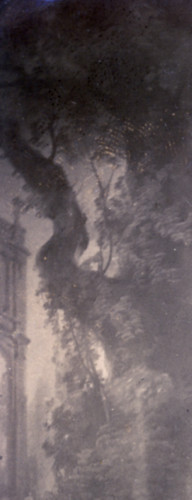
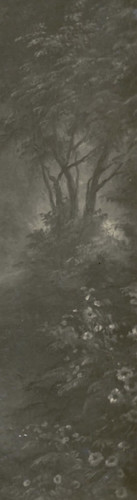
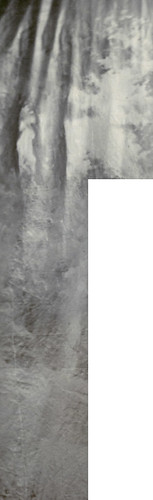
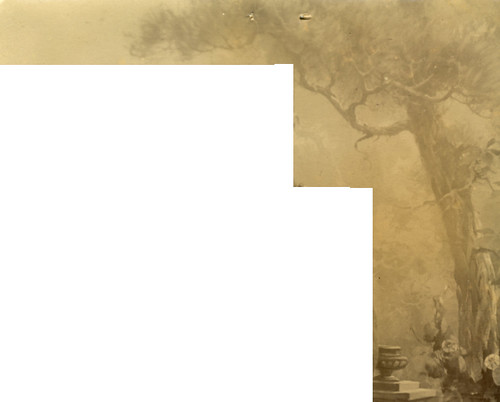
Taken from World War I studio portraits.

WW1 Backdrops

WW1 Backdrops

WW1 Backdrops

WW1 Backdrops

WW1 Backdrops

WW1 Backdrops

WW1 Backdrops

WW1 Backdrops

WW1 Backdrops

WW1 Backdrops

WW1 Backdrops

WW1 Backdrops

WW1 Backdrops

WW1 Backdrops

WW1 Backdrops

WW1 Backdrops

Filed Under: Trees, World War I Tagged With: Backdrops, The Trees, Trees, World War I, WWI, WWI Postcards

Maps and Ivory Gurney

July 16, 2012 by Nicholas Hedges

On the bus into work this morning I read the following in Robert Macfarlane’s ‘The Wild Places.’

“Woods and forests have been essential to the imagination of these islands, and of countries throughout the world, for centuries. It is for this reason that when woods are felled, when they are suppressed by tarmac and concrete and asphalt, it is not only unique species and habitats that disappear, but also unique memories, unique forms of thought. Woods, like other wild places, can kindle new ways of being or cognition in people, can urge their minds differently.”

Woods have always been places of intense interest to me, particularly as a boy when I would love to imagine England as being covered in ancient woodland. My interest in history wasnt so much an interest in the characters and machinations of past times, but a means of accessing the landscape of those times – a way into the woods. 

I would create maps of imagined places, all of which would be home to vast swathes of untouched and unspoiled forests. And while those maps were ‘of places’, they were much more a means into a place, a path into and through my imagination.

In the same book ‘The Wild Places,’ Macfarlane briefly discusses the poet, composer and songwriter Ivor Gurney (1890-1937) who like the poet Edward Thomas, loved to explore the countryside of his native county – Gloucestershire. In 1915, Gurney enlisted to fight in the Great War, and in the battlefields of the Ypres Salient, discovered what Macfarlane describes as an ‘anti-landscape,’ a place in which the only evidence of forests ‘were upright bare dead trunks, stripped of leaves, branches and bark by shrapnel and gunfire.’ As Macfarlane writes: ‘On the military maps of the area that Gurney used, some of the old names of the landscape remained. But many of the new names spoke of the avoidance of death, or of its arrival. Shrapnel Corner, Crump Farm, Hellfire Corner, Halfway House, Dead Dog Farm, Battle Wood, Sanctuary Wood. The woods were no longer there, however; these were ghost names only. The trees had been felled for revetting, or blasted from the earth by shells.’

As someone with an interest in maps and in trench maps, the above passage interested me, particularly as I’ve often thought about how the landscape of the First World war, replete with all its new names and new features, had been superimposed, or rather gouged out of the landsape, only to smoothed over with the passage of time. Its was a sudden landscape. A few scars, smoothed over with grass – or hidden by trees – are all that’s left, but the wounds are still weeping in its names – not so much those of soldiers inscribed on the thousands of headstones, but rather the names of places – Arras, The Somme, Ypres and Passchendaele. 

Trench Map 1916
Trench Map (1915)

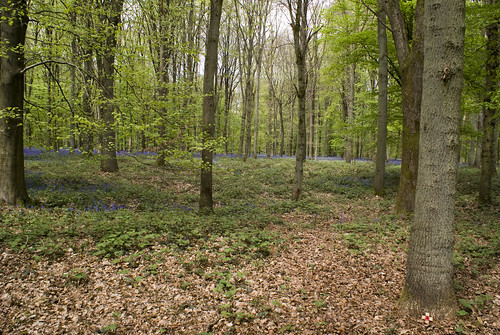
In many places the woods have returned, and while the landscape today bears little resemblance to that of the war  – in which ‘the rich and complicated pasts of the trees that Gurney cherished’ had been so utterly effaced, it is nonetheless within those woods that one’s imagination picks up the voices of the past – of the fallen; voices which spoke in the midst of battle, of places and people cherished back home.

The Somme
Woods in The Somme

After returning from the war, Ivor Gurney, like so many others suffered a breakdown (he’d suffered his first in 1913) and a passage in Macfarlane’s book, which describes the visits to Gurney – within the Dartford asylum – by Helen Thomas, the widow of Edward Thomas is particularly moving. Helen took with her one of her husband’s Ordnance survey maps of Gloucestershire:

‘She recalled afterwards that Gurney, on being shown the map, took it at once from her, and spread it out on his bed, in his hot little white-tiled room in the asylum, with the sunlight falling in patterns upon the floor. Then the two of them kneeled together by the bed and traced out, with their fingers, walks that they and Edward had taken in the past.’

The map they laid on the bed was one that showed the familiar trails and paths of the countryside. But it was also one which, like that I made in my childhood, gave Gurney access to his imagination – to his own past. Together, the patient and his visitor read it with their fingers, following the trails as one follows words on a page. A narrative of sorts was revealed, memories stitched together by the threads of roads, paths and trails.

Filed Under: Trees, World War I Tagged With: Edward Thomas, Ivor Gurney, Maps, The Somme, Trench Maps, War Poets, World War I, WWI

Completed Map

July 10, 2012 by Nicholas Hedges

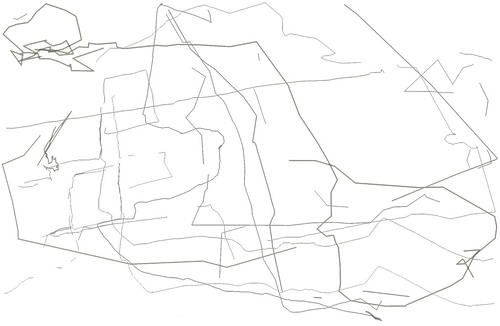
Today, on a walk around Oxford, I completed my first text map which I began in Ampney Crucis about a month ago. Below is both the map and an image of the walks as recorded on my GPS (and then ‘arranged’ in Photoshop).

Map Work
Map Work

Filed Under: Lists, World War I Tagged With: GPS, Lines, Listmaking, Lists, Map, Positioning, Text Work, Walks, World War I, WWI

Map Work

July 9, 2012 by Nicholas Hedges

I’ve almost completed my map of observations made during a number of walks over the past few weeks and am now looking to see how I can progress this line of work.

The paper shown above has started to soften, from being carried for so long in my pocket and being held in my hand as I walk. It’s started to feel almost like material. I like the way too that it’s acquired those tell-take signs of wear and tear; dog-eared corners, rips and holes and creases.

On the reverse, you can see the selotape used to keep it all together, indeed there is something about this side which I really like.

I like the idea of these pieces becoming maps of individuals rather than just a place, while at the same time representing people as places – or at least the product of places. I like the idea of them becoming patterns, such as clothing patterns, again giving a sense of the individual.

Another part of this process has been the recording of my walks using GPS. I have, for this work, been putting them all together in one image.

In our minds, when we think about our own past journeys, there is little sense of space, i.e. the physical space between the places in which we made those journeys. Everything is heaped together. Time, like physical space is also similarly compressed. All the walks I’ve made for this work therefore are heaped one on top of the other, with little regard to their geography or temporality. The past with which I seek to identify is also like this. Geography and time are compressed. Everything is fragmentary.

In any given place – for example, Oxford – we can, as we walk down an ancient road, follow the (fragmentary) course of a life lived centuries ago. But walking down another road, we turn and pick up the fragment of another life. And so on and so on.

It is this fragmentary nature of past time, and its compression of time and space, which makes it sometimes hard of for us to empathise with anonymous individuals who lived in the distant past. To make sense of the fragments, we need to see them in the context of the present – in the nowness of the present. By doing this, we can begin to unpick these matted strands of time and space.

History is the attempt to make sense of the fragments left behind by time – to construct a narrative of events with a beginning and an end. It has a point A and a point B, between which the narrative weaves a path, much like a script, novel or score. What I’m interested in however are those fragments, not as parts of a narrative progression, but as fragments of a moment in time – a moment which was once now. As I’ve written before:

Access to the past therefore comes…  through the careful observation of a part in which the whole can be observed. As Henri Bortoft writes in The Wholeness of Nature – Goethe’s Way of Seeing; ‘…thus the whole emerges simultaneously with the accumulation of the parts, not because it is the sum of the parts, but because it is immanent within them’.

Consider the span of an hour, and imagine a city over the course of that hour with everything that would happen throughout that period of time; history with its refined narrative thread, is rather like a line – a route – drawn through a map of that place. The line delineates space (in that it starts then ends elsewhere) but we know nothing of what happens around it – the mundane, everyday things which make the present – now – what it is. In my walks I capture moments, observations of mundane things happening around me as I walk.

For example:

A man talks holding his hat
A flag flies, fluttering in the growing wind
The next bus is due
A car beeps
Amber, red, the signal beeps
The brakes hiss on a bus

One could argue that these observations still represent a linear sequence rather than being fragments of a single moment in time. However, reading them, one does get a sense of the nowness of the past. The route as drawn by the GPS represents the narrative thread (history) whereas the text represents the individual moments from which the narrative is constructed.

Imagine if someone had done the same in 1897 at the time of last Diamond Jubilee.

A man talks holding his hat
A flag flies, fluttering in the growing wind
Suddenly, 1897 would seem there within our grasp. We could take any observation and extrapolate the wider scene around it. Below is a photograph taken in Oxford in 1897.

© Oxfordshire County Council

We get a sense of the nowness of a past time from images such as that above, but as Roland Bathes states, time in photographs is engorged. It doesn’t move. With the work I’ve made above however, the immediacy of a past time is captured, but, unlike photographs, is fluid. And it is this fluidity which is crucial to an empathetic engagement with the past. For the nowness of the present isn’t static, but rather flows within us and around us.

The following text from Robert Macfarlane’s ‘The Wild Places,’ interested me a great deal in light of what I’ve written:

“Much of what we know of the life of the monks of Enlli and places like it, is inferred from the rich literature which they left behind. Their poems speak eloquently of a passionate and precise relationship with nature, and of the blend of receptivity and detachment which characterised their interactions with it. Some of the poems read like jotted lists, or field-notes: ‘Swarms of bees, beetles, soft music of the world, a gentle humming; brent geese, barnacle geese, shortly before All Hallows, music of the dark wild torrent.'”

Filed Under: Lists, Photography Tagged With: GPS, Henri Bortoft, Listmaking, Lists, Maps, Nowness, Positioning, Stephen Hedges, Text Work, Vintage Photographs, Walks

Heavy Water Sleep (Paintings) III

July 1, 2012 by Nicholas Hedges

I worked again tonight on the studies for Heavy Water Sleep, working in landscape elements such as trees and sky. The original text from which the words are taken, ‘Pilgrims of the Wild’ by Grey Owl, is set chiefly in the forests of Canada. And in the ‘secondary text’ which inspired the work in the first place, ‘The Diaries of Adam Czerniakow’  there is a moving passage in which, following a visit outside the Warsaw Ghetto to the woods of Otwock, he writes simply, ‘… the air, the woods, breathing.’ Trees then seem integral to the work and have indeed been a recurring them in much of my work, particularly work to do with the Holocaust and World War I.

I wanted then to use trees in these works and found myself using a stylised form which I’d scribbled one day in my notebook based on lines you find in Family Tree diagrams.

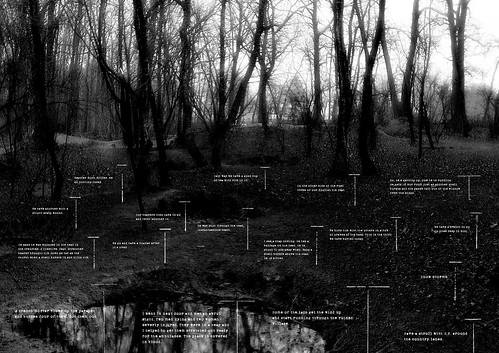
This symbolic tree was in part inspired by some work I did on the First World War in which I used the dividing lines on the backs of original wartime postcards to symbolise the bond between the anonymous individuals who died in the war and their families back at home. These ‘T’ shaped divides reminded me of photographs in which hastily dug graves were marked on battlefields with crude crucifixes. I therefore created landscapes (based on my visits to battlefield sites on what had been the Front) and used these T-shapes to represent graves.

Battle 2

From these T-shapes I derived the forms for the trees below.

Heavy Water Sleep

Heavy Water Sleep

The link between them and the Ts above is an obvious one – even more so when one considers the original inspiration for this work.

Filed Under: Heavy Water Sleep, Paintings, Trees Tagged With: Adam Czerniakow, Heavy Water Sleep, Holocaust, Paintings, Text Work, WWII

Heavy Water Sleep (Paintings) II

June 27, 2012 by Nicholas Hedges

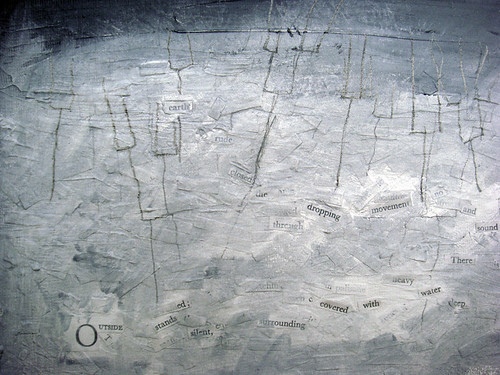
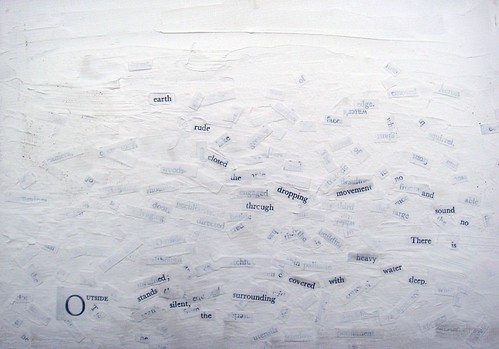
I worked again last night on the ‘Heavy Water Sleep’ paintings, continuing to concentrate on the texture. For the first board below I used a white acrylic paint mixed with an acrylic modelling paste.

DSC07384

The words are too chaotic in this one and the paint has dried very matt. I could add some gloss medium but it would make much more sense to use oil paint which I will for the final versions. I will add another layer to the painting above later.

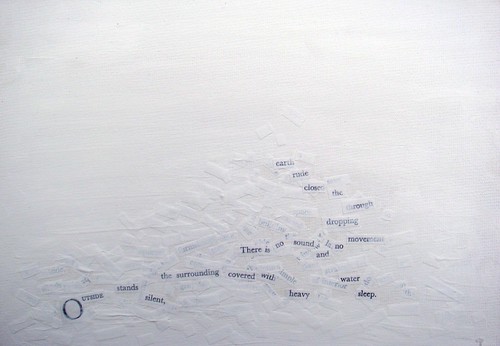
Having completed this painting I worked again on the one I did yesterday.

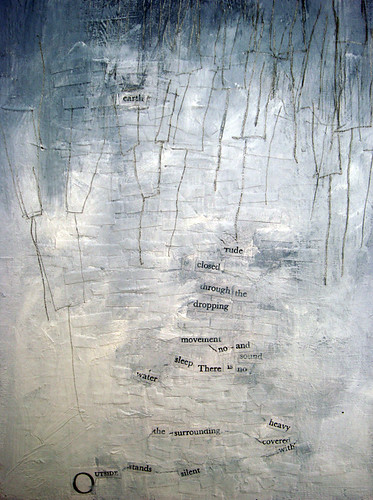
DSC07382

I like how the words are slightly more obscured now and much prefer their more ordered placement. The next thing I want to try is keeping the lines of the pages together rather than placing them in a random fashion.

Filed Under: Heavy Water Sleep, Paintings Tagged With: Heavy Water Sleep, Holocaust, Paintings, Text Work, WWII

Heavy Water Sleep (Paintings)

June 26, 2012 by Nicholas Hedges

I’ve started work on a new series of paintings based on the Heavy Water Sleep work I’ve been doing over the past few years. The idea is to create a series of paintings based on the idea of the words being a trail in a landscape (in turn derived from the idea that the book is a kind of map, leading me through the landscape of the past). The words from each page will be cut out with most painted over either wholly or in part. The words which make up the ‘poem’ of each page will be left, as per the image below.

DSC07376

The above sketch shows how the words might be placed.

What I realised after completing this sketch is how important it is to create a sense of depth in the work. At the moment the words are raised upon the surface, whereas they need to appear ‘sunk’ into the paint layer like footprints in the snow. Furthermore, the picture plane needs to be much bigger to give a greater sense of space – of wilderness; after all, this work represents the idea of the past as a place.

I shall continue – fo the time being – working on this scale in order to get the textures right, then progress to a larger canvas.

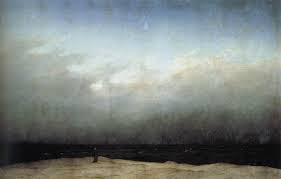
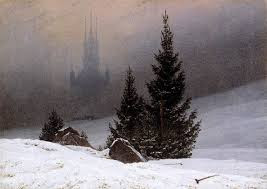
I suppose the ‘feeling’ I want to achieve with these paintings is that of the lone traveller, following in the footsteps of someone long since gone, and the one landscape painter who comes to mind is Caspar David Friedrich, two of whose pictures are reproduced below:

Of course I’m not aspiring to create something that looks like these paintings, but something which instills within the viewer the same sense of space, solitude and wilderness – not forgetting a sense of time’s inevitable passing.

Filed Under: Heavy Water Sleep, Paintings Tagged With: Caspar David Friedrich, Heavy Water Sleep, Paintings, Text Work

Maps: A Unifying Aesthetic

May 11, 2012 by Nicholas Hedges

For some time I have been searching for what one might describe as a unifying aesthetic; a process for creating a work with an aesthetic appearance which serves not only to appeal visually, but which also conveys meaning.

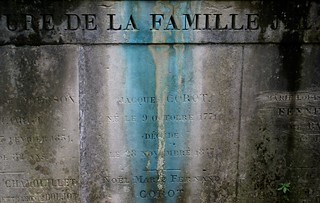
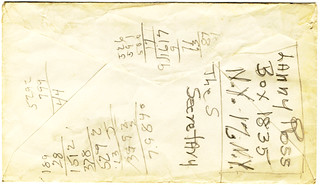
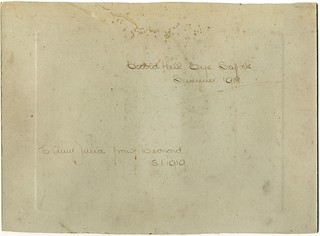
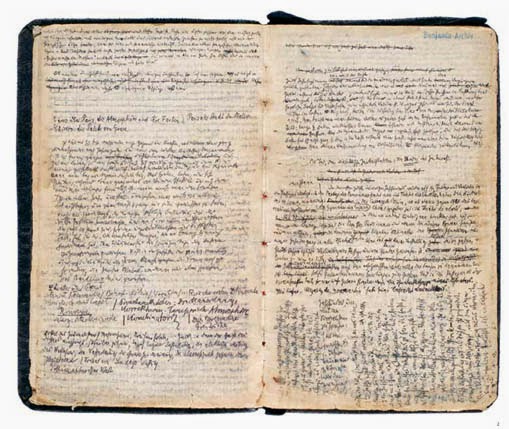
There are numerous things which appeal to me aesthetically such as (in no particular order); palimpsests (sheets of paper or parchment where words are erased but never completely and over which new text is added, to then be erased and so on), notebooks (such as those belonging to Walter Benjamin), patched up papers, maps (like old trench maps), lines (like scratches on surfaces or pencil marks), poster sites (where the posters have been pasted one on top of the other and ripped), drips and splashes of paint, blurs, text in paintings (particularly pencil), stains, things faded, fragments, old writing and so on.

Some examples of what I mean:

The Exercise Yard
The Exercise Yard
Lanzarote
Sicily

Trench Map 1916
Bartlemas Chapel Excavation

Untitled

Tintype - Family Group

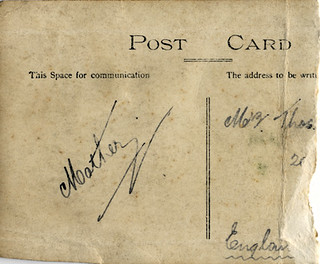
'Mother'

Dorset 1983

Warsaw

Venice

Pere Lachaise, Paris

Letter to Ray 1953 (Reverse)

House (Reverse)

Budapest

My work is about time, life, death and memory. It is concerned with empathy and in particular empathy as  an ever expanding dialogue between bodily experience and knowledge. But what form should my work take to encompass all these things?

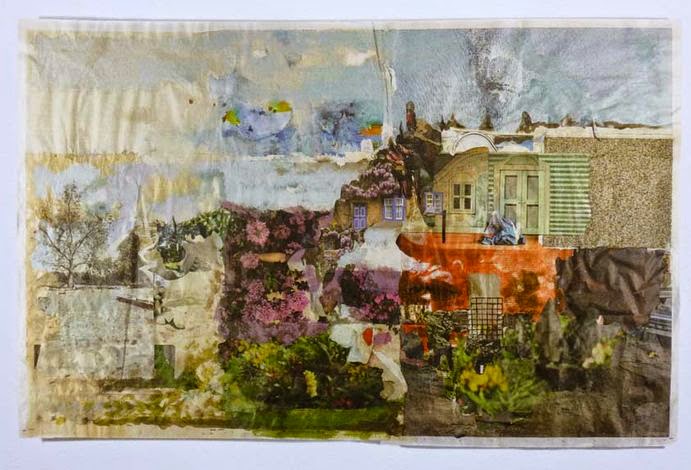
It was whilst in Edinburgh with my fiancee, that I began to find that form. It started with an exhibition of work by Tony Swain, who uses text as a source for his work, not so much in terms of the words, but in the substance on which they’re printed; in his case, newspapers. What I liked about his work in particular was its organic quality, the fact that it could be expanded, new sheets added to create large landscapes such as that below.

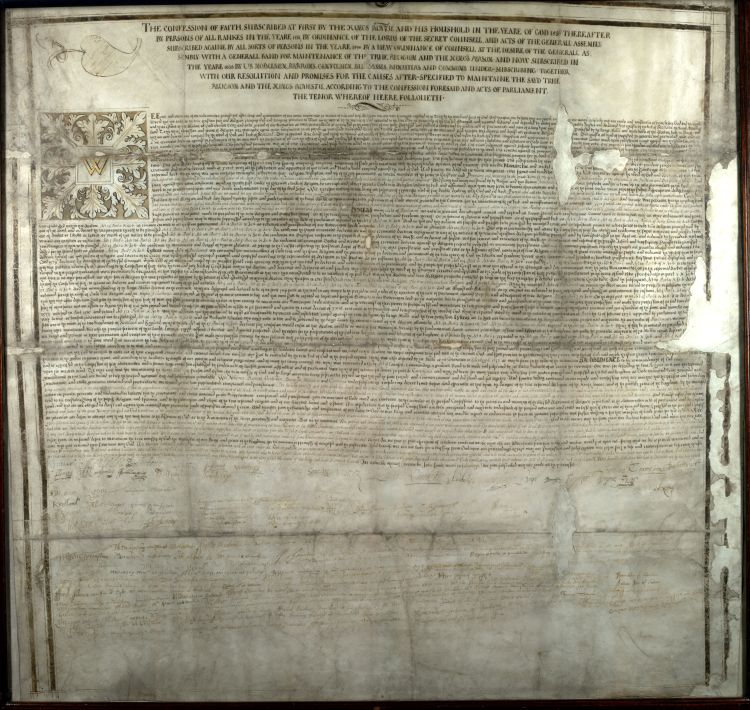
Then whilst visiting St. Giles church in Edinburgh, I saw the National Covenant on display; a 17th century document which I found – aesthetically speaking – quite beautiful. Comprising a large sheet of parchment, one could see the folds and also patches of parchment which had been added to the main sheet. The different sizes of writing also appealed, just as they do in notebooks – such as those of Walter Benjamin.

A version of the covenant can be seen below:

When I bought a World War I trench map a few months ago, I did some observation work on it and wrote the following regarding the way it had been folded:

“It doesn’t resist being folded again. First vertically and then horizontally.

I unfold it and instinctively flatten it down. The folds in places rise up. The fold which runs vertically through the red lines does especially. This part of the map won’t remain flat unless I press it down with my hand. As I do, my head instinctively lifts a little and my eyes move along the lines of red to rest around the village of Thiepval.

These actions would no doubt have been repeated in the past when the map was perhaps more pristine – when the folds were sharper and the map lay flat.

The map, when I lift it up, seems to want to fold into a particular shape. It doesn’t want to be put away, but rather be folded so that two columns remain in view. The folds which delineate this part are a darker brown than all the others. In this section of the map is a concentration of red lines and blue lines.

The way it folds suggests that this was what was most important. When I pick up the map to fold it completely, it folds so that the ‘front’ and ‘reverse’ are tucked away. The front now is one of the segments or ‘squares’ containing French words (Sondage) and their English equivalents (Boring – as in cut).

The past movements associated with this map are therefore recorded in its folds. It resists being folded any other way.”

The last line is particularly important. Empathy is an emotion felt with the body, requiring an embodied imagination to articulate the dialogue between bodily experience and knowledge. The folds in the map enable me to record the sense of past movement in a two dimensional space. And creating a kind of map allows me to explore the past in terms of its being a place. When I was a child, history was very much a way into a place, a world of woods and forests untouched by the mechanised age. Text was therefore a precursor to what would eventually emerge as an image and the two would often combine on the maps I created.

Creating some kind of map is what I want to do, but a map which evolves, that’s organic, which changes continuously.

Filed Under: Artist in Residence Tagged With: Artist in Residence, Australia, Maps, Photographs, Textures

Thoughts

May 10, 2012 by Nicholas Hedges

IMG_1029
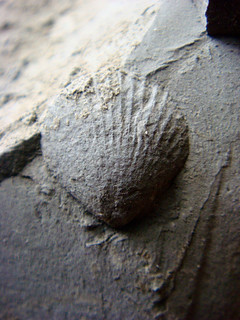
Fossilised shell, around 195 millions years old

“As physicists have pointed out, it is no accident that we see stars in our sky, for stars are a necessary part of any universe capable of generating us. Again, this does not imply that stars exist in order to make us. It is just that without stars there would be no atoms heavier than lithium in the periodic table, and a chemistry of only three elements is too impoverished to support life. Seeing is the kind of activity that can go on only in the kind of universe where what you see is stars.”
Richard Dawkins

Bartlemas Chapel Excavation
Mediaeval pottery shard

“Only God knows the reason for those changes linked with the mystery of the future: for men there are truths hidden in the depths of time; they come forth only with the help of the ages, just as there are stars so far removed from the earth that their light has not yet reached us.”
Chateaubriand

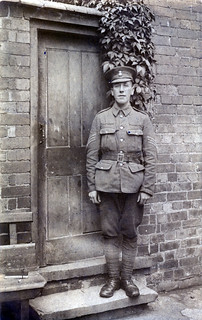
World War 1 Serviceman
Photograph of World War I serviceman 

“From a real body, which was there, proceed radiations which ultimately touch me, who am here; the duration of the transmission is insignificant; the photograph of the missing being as Sontag says, will touch me like the delayed rays of a star. A sort of umbilical cord links the body of the photographed thing to my gaze – light though impalpable, is here a carnal medium, a skin I share with anyone who has been photographed.”
Roland Barthes

Filed Under: Quotes Tagged With: Fossils, Fragments, Pottery, Quotes, Shells, Stars, Useful Quotes, WWI Postcards

Stars

May 10, 2012 by Nicholas Hedges

A second example of wholeness involves the ordinary experience of looking up at the sky at night and seeing the vast number of stars. We see this nighttime world by means of the light ‘carrying’ the stars to us, which means that this vast expanse of sky must all be present in the light which passes through the small hole of the pupil into the eye. Furthermore, other observers in different locations can see the same expanse of night sky.
Henri Bortoft

As physicists have pointed out, it is no accident that we see stars in our sky, for stars are a necessary part of any universe capable of generating us. Again, this does not imply that stars exist in order to make us. It is just that without stars there would be no atoms heavier than lithium in the periodic table, and a chemistry of only three elements is too impoverished to support life. Seeing is the kind of activity that can go on only in the kind of universe where what you see is stars.
Richard Dawkins

The light of the moon covers the earth, yet it can be contained in a single bowl of water.
Dogen Zenji (1200-1253)

Only God knows the reason for those changes linked with the mystery of the future : for men there are truths hidden in the depths of time; they come forth only with the help of the ages, just as there are stars so far removed from the earth that their light has not yet reached us.
Chateaubriand

From a real body, which was there, proceed radiations which ultimately touch me, who am here; the duration of the transmission is insignificant; the photograph of the missing being as Sontag says, will touch me like the delayed rays of a star. A sort of umbilical cord links the body of the photographed thing to my gaze – light though impalpable, is here a carnal medium, a skin I share with anyone who has been photographed.
Roland Barthes

Filed Under: Quotes Tagged With: Henri Bortoft, Quotes, Richard Dawkins, Stars, Useful Quotes

Jurassic Shell

April 8, 2012 by Nicholas Hedges

I discovered this fossilised seashell, whilst hunting for fossils on the beach at Charmouth. The beach is part of the Jurassic Coast in Dorset – a UNESCO World Heritage site – and is famous for the fossils which one can find there.

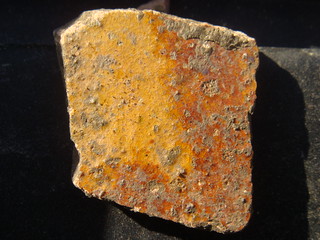
The fossil itself is small but rather beautiful. Its shape is clearly delineated and one can even see the different shades of grey on what was once its shell. Its shape is utterly familiar and yet it comes from a time beyond our wildest imaginations.

This shell, this familiar pattern of lines, is around 195 million years old. It was extant in this form throughout the time of the dinosaurs. It ‘witnessed’ their demise and the emergence of man millions of years later. It has ‘seen’ man evolve from the earliest ancestors to the first modern homo-sapiens.

On the way down to Dorset, we stopped off at Stonehenge and marvelled at the stones whose exact purpose still remains a mystery. What I find most incredible is their age, somewhere in the region of 4,500 years old. To think what has happened in the intervening years is incredible, yet its age pales into insignificance when one considers that the small piece of shell-shaped rock above is over 40,000 times its age.

But what is interesting is that whereas the stones of Stonehenge are ‘unfamiliar’ (not of course in the sense of not having seen them before but rather as everyday objects), the seashell is part of the everyday world today – at least that of the seaside (in fact I found one like it on the beach in Lyme Regis just a few miles away). In this sense, it becomes easier almost, to bridge the gap between now and a time 195 million years ago, than it does to that of the Neolithic.
But in discovering the fossil, I found myself beginning to contrast the moment I broke open the rock to reveal it, with all the moments that have filled the 195,000,000 years since the shell fell to the sea floor. Moments when dinosaurs walked the Earth; moments when the world changed shape to make the countries and continents with which we are familiar. Moments when the dinosaurs became extinct, when mankind emerged to become what we are today; when the ice age came and passed… etc.

Filed Under: Uncategorized Tagged With: Fossils, Shell, Stonehenge

Page from iPad Notebook

February 24, 2012 by Nicholas Hedges

Filed Under: Archaeology Tagged With: Archaeology, Fragments, iPad, Notebook, Pottery, Skeleton, Vintage Photographs

  • « Previous Page
  • 1
  • …
  • 9
  • 10
  • 11
  • 12
  • 13
  • …
  • 32
  • Next Page »
  • The ‘Now of Then’
  • Artist’s Statement
  • Designs for an Heirloom
  • Dissonance and rhyme
  • Wildflowers
  • Emptiness
  • Wave (goodbye)
  • Now In The Past Of An Unreal Place
  • Return to Graphite
  • Genius
  • Latest Backdrops
  • Extended Backdrops
  • Backdrops
  • Komorebi
  • Acorns
  • Scroll Work
  • Goethean Observation: Japanese Scroll
  • Mistakes
  • The Leaf Is Singing Still
  • Past Present
  • Scrolls
  • As Yet Untitled
  • Holes
  • Scroll
  • A Calligraphy of Shadows
  • More Paintings
  • Latest Paintings
  • Walking Meditation 2
  • Knowing We Are There
  • Venice by Moonlight 1840
  • Fragments and Additions
  • Reimagining The Past
  • Walking Meditation 1
  • Mindful Walking I
  • Grief II
  • Three New Paintings
  • Nana’s Mountain
  • Painting
  • Iridescence
  • Roman Bottle
  • Rinsho
  • Shadow Calligraphy
  • Becoming Memory
  • Fox Talbot’s Glassware
  • Goethean Observation: Diffuser II
  • Goethean Observation: Diffuser
  • A Remembrance of Things We Never Have Known
  • A Moment’s Language
  • Take Me Home
  • Arrival/Departure
  • Diffusers
  • Grief
  • Mum
  • Measuring the past
  • Disordered Time
  • Entropy
  • Wicked Magician, Fly
  • The Quanta of History
  • Empathy Forward
  • The Natural World of 978
  • The Gone Forest
  • Empathy/Exchange: 668 grams
  • Goethean Observation: Pilgrims of the Wild, 1935
  • Nazareth O
  • Several Johns and St. Thomas
  • Raspberry
  • Tokens and Shadows
  • Patterns Seeping (II)
  • ‘Missded’ 4 – Tokens
  • Patterns seeping
  • Cut Paintings
  • ‘Missded’ 4
  • Locks III
  • Locks II
  • ‘Missded’ 2 – Tokens
  • My Son’s Drawings II
  • ‘Missded’ 2
  • ‘Missded’ 3 – Tokens
  • ‘Missded’ 3
  • ‘Missded’ 1 – A Framed Token
  • Morning Has Broken
  • Tokens of absence
  • ‘Missded’ 1, stitched
  • More Little Words
  • Three Little Words
  • Spaces In Between
  • ‘Missded’ 3
  • ‘Missded’ 2
  • ‘Missded’ 1
  • Locks
  • Tracings
  • My Son’s Paintings
  • Writing Shadows
  • Samuel Borton’s Post Chaises
  • Dawid Sierakowiak
  • Pitchipoi
  • Latest Tree Drawings
  • Notebook
  • Somewhere Between Writing and Trees II
  • Somewhere Between Writing and Trees

© Nicholas Hedges 2024

  • Facebook
  • Instagram
  • Twitter
  • YouTube

Copyright © 2025 · Outreach Pro on Genesis Framework · WordPress · Log in