Nicholas Hedges

Art, Writing and Research

  • Amazon
  • Behance
  • Facebook
  • Instagram
  • Pinterest
  • YouTube
  • Art
    • Digital
    • Drawing
    • Grids
      • Correspondence
      • The Wall
      • The Tourist
    • Ink on paper
      • Shadow Calligraphy
    • Installation
      • Murder
      • Echo
    • Painting
    • Patterns
    • Mixed Media
    • Photographic installation
      • St. Giles Fair 1908
      • Cornmarket 1907
      • Headington Hill 1903
      • Queen Street 1897
    • Research/Sketches
    • Stitched Work
      • Missded 1
      • Missded 2
      • Missded 3
      • Missded 4
    • Text Work
  • Blogs
    • Family History
    • Goethean Observations
    • Grief
    • Light Slowed But Never Stilled
    • Lists
    • Present Empathy
    • Shadow Calligraphy
    • Trees
    • Time
    • Walking Meditations
  • Video
  • Photography
    • Pillars of Snow
    • Creatures
    • The Trees
    • Snow
    • St. Giles Fair 1908
    • Cornmarket 1907
    • Headington Hill 1903
    • Queen Street 1897
    • Travel
  • Illustration and Design
  • Music
  • Projects
    • Dissonance and Rhyme
    • Design for an Heirloom
    • Backdrops
    • Shadow Calligraphy
  • Exhibitions
    • A Line Drawn in Water
      • Artwork
    • A Line Drawn in Water (Blog)
    • Mine the Mountain 3
      • Artwork
    • Mine the Mountain 2
      • Artwork
      • The Wall
    • The Woods, Breathing
      • Artwork
    • Snow
      • Artwork
    • Echo
      • Artwork
    • Murder
      • Artwork
    • The Tourist
    • Dreamcatcher
    • Mine the Mountain
      • Artwork
      • The Tourist
    • M8
    • The Gate
    • Creatures
      • Artwork
    • Residue
      • Artwork
    • A visit to Auschwitz
      • Artwork
  • Me
    • Artist’s Statement

Diaries, Lists and Haiku

June 28, 2007 by Nicholas Hedges

Last night I watched Chris Marker’s film ‘Sans Soleil’ or ‘Sunless’, and having watched it, downloaded the text from the film. There was one passage in particular which interested me which was as follows:

“He spoke to me of Sei Shonagon, a lady in waiting to Princess Sadako at the beginning of the 11th century, in the Heian period. Do we ever know where history is really made? Rulers ruled and used complicated strategies to fight one another. Real power was in the hands of a family of hereditary regents; the emperor’s court had become nothing more than a place of intrigues and intellectual games. But by learning to draw a sort of melancholy comfort from the contemplation of the tiniest things this small group of idlers left a mark on Japanese sensibility much deeper than the mediocre thundering of the politicians. Shonagon had a passion for lists: the list of ‘elegant things,’ ‘distressing things,’ or even of ‘things not worth doing.’ One day she got the idea of drawing up a list of ‘things that quicken the heart.’ Not a bad criterion I realize when I’m filming; I bow to the economic miracle, but what I want to show you are the neighborhood celebrations.”

As part of my residency at OVADA, I spent a long time compiling lists of things I’d seen on a particular walk around the city centre and so this extract intrigued me because of my own efforts in the art of list making. There is something about the mundane that is more telling in respect to the bigger picture of the past than anything one might find in the pages of a history book.
The beginning of the film deals with this very fact:

“I’m just back from Hokkaido, the Northern Island. Rich and hurried Japanese take the plane, others take the ferry: waiting, immobility, snatches of sleep. Curiously all of that makes me think of a past or future war: night trains, air raids, fallout shelters, small fragments of war enshrined in everyday life. He liked the fragility of those moments suspended in time. Those memories whose only function it being to leave behind nothing but memories. He wrote: I’ve been round the world several times and now only banality still interests me. On this trip I’ve tracked it with the relentlessness of a bounty hunter. At dawn we’ll be in Tokyo.”

As one might guess from the extract above, the film had a predominantly Japanese theme, and I was reminded of the Haiku I wrote last year. Most of them were, on reflection, not particularly good, but there were a few which took me almost instantly back to the time they were written. I could remember everything about the time they were written and, more importantly, why they were written.Here are just a few.

In a vague garden
In the morning’s smallest light
The first bird’s singing

Insomniac bird
Sings though we should never know
This dark melody

The moon was a blur
On a long lost photograph
A timeless second

The cat spies the birds
While they look down from above
And I watch them all

Secrets of the deep
Are whispered by the Snowdrop
Missing its flower

Just for a moment
I swapped places with a cat
Sitting on the wall

Incongruous field
A horse without a rider
Stands like a shadow

The painted subway
A crow hovers on the wind
I think of angels

The tall girder-cross
Lone man sits in a cafe
She can’t stand his kiss

The sudden trees have
Grown before the constant gates
The violent field

I was listening to a discussion programme on ‘Diaries’ and in particular, what makes a good diary. I, like many people have tried keeping a diary or journal and actually managed to sustain one for about 10 years, between 1989 and 1999. Much of it, is of course of no interest to anyone else but me, and even then, the greater part of the entries are a little mundane (and not mundane in a good way – as described above). What was agreed, during the conversation, was that what makes a diary interesting is not what the author thinks, but rather what they see. It is again the small details which help to build the bigger picture of the time. Of course, this is by no means a rule, and there are many exceptions where the good and the great have opened their hearts and inspired nothing less than awe. But these are exceptions.

Turning back to Haiku, I read the following in a book (On Love and Barley) on the great Haiku poet, Basho (1644-1694) :

“So the poet presents an observation of a natural, often commonplace event, in plainest diction, without verbal trickery. The effect is one of spareness, yet the reader is aware of a microcosm related to transcendent unity. A moment, crystallised, distilled, snatched from time’s flow, and that is enough. All suggestion and implication, the haiku event is held precious because, in part, it demands the reader’s participation: without a sensitive audience it would appear unimpressive. Haiku’s great popularity is only partly due to its avoidance of the forbidding obscurities found in other kinds of verse: more important, it is likely to give the reader a glimpse of hitherto unrecognised depths in the self.”

There are two lines in the above which interest me the most. Firstly, the reference to a commonplace event, and secondly, the suggestion that the poems demand the reader’s participation. It is by sharing a moment that we become a part of that time which has long since passed.

The following is one of Basho’s haiku as printed in the book:

Old pond
leap-splash-
a frog.

In terms of taking us back to a moment, the three lines above do just that. It isn’t necessarily that we see the pond, see the frog, the poet, but rather that we experience a second or so of the seventeenth century as if it were happening now.
Filed Under: Artist in Residence, Lists, Trees Tagged With: Artist in Residence, Basho, Diaries, Haiku, Listmaking, Lists, Moments, Nowness, Residue

Random Memories: The 1983 General Election

June 26, 2007 by Nicholas Hedges

I have recently started to think more about my memories and how I should start writing them down, not because as a collection they would amount to a great memoir, but because it’s often the small snippets which come to us for no apparent reason that are amongst the most interesting. Reading the work of W.G Sebald has certainly precipitated this idea and so, here I am with a memory which came to me a few moments ago. I should point out that these memories are not stories or anecdotes; they do not have a punchline or cast new light on momentous moments of the past, but rather they are fragments which remind me of how life really was. Incidentally, I took delivery today of a copy of Walter Benjamin’s ‘The Arcade Project’, a large tome, made up of quotes, thoughts, ruminations etc. on the Parisian Arcades of the Nineteenth Century. To borrow, or rather steal, from the translators’ notes:

“Benjamin’s intention from the first, it would seem, was to grasp such diverse material under the general category of Urgeschichte signifying the ‘primal history’ of the nineteenth century. This was something that could be realized only indirectly, through ‘cunning’: it was not the great men and celebrated events of traditional historiography but rather the ‘refuse’ and ‘detritus’ of history, the half concealed, variegated traces of the daily life of ‘the collective,’ that was to be the object of study [my italics], and with the aid of methods more akin – above all, in their dependence of chance – to the methods of the nineteenth-century collector of antiquities and curiosities, or indeed to the methods of the nineteenth-century ragpicker, than to those of the modern historian. Not conceptual analysis but something like dream interpretation was the model.”

It’s often the case, that these small pieces of memory, these apparently inconsequential fragments, often build to give a much clearer, more defined image of a time, than a particular event or traditional historiography, and, as such, I will write as many that spring to mind over the coming months.

The first of these fragments concerns me riding my bike (I was going to write ‘cycling’ but ‘cycling’ wasn’t what I did when I was a boy. I ‘rode my bike’ as all boys did). I was ‘riding my bike’ up Ambleside Drive (one of the roads around where I grew up) at a time approaching an election. I’m not entirely sure as to which election it was, but given my age, I can only assume it was the General Election of 1983. Ambleside Drive itself was a very pleasant road which rose from the bottom of a hill (where was my old school) to the top – Eden Drive – where one would find a small collection of four shops, all of which have since disappeared: Kendal’s (groceries), Tucker’s (butcher), Shepherd’s (greengrocer) and the Post Office. I have many memories of this small parade which would fill several pages in themselves, but for the moment, here are just a few.

I remember buying sweets in Kendal’s (when this shop closed, the purchase of sweets was transferred to the Post Office opposite or Mallows at the bottom of the hill) and being amazed by the slicing machine with its circular blade. Here we purchased our sweets prior to going to the cinema up in Headington; they were a type of sweet I can’t quite put my finger on, although mint and lemon seems to ring a bell. The cinema was at the top of the road where my grandparents lived and it was here I saw Benji and Grizzly among many others. I remember little else about Kendal’s, apart from the slices of ham falling from the machine, the cheese slicer, the jars of sweets (a ‘quarter of pear drops’) up on the left, ‘Wavy Line’ and the path outside, which ran by the side of the shop to join the road. When the shop closed and became a house, I couldn’t quite believe I wasn’t able to walk on that path anymore, and the whole idea of a shop becoming a house seemed to go against the whole nature of things – just as it does today. In fact, there is something still quite ghostly and not a little sad about this small parade.
Mr Tucker the butcher (adjacent to Kendal’s) was a cheerful man, always in his dirty white coat, bald head, black-rimmed glasses and sporting large sideburns. I can see him now taking the pencil from behind his ears and writing the price on the paper packet, containing whatever meat Mum was cooking that week. I remember the beaded curtain to the back, the way he wrote his prices in deformed numerals, in the window display and on the board outside. And the handles of the doors – I remember them, along with the front wall, which, I believe is still there today.

Mr Shepherd, the greengrocer (opposite Tucker’s) was was a cheerful man. He too would always have a pen behind his ear and would wear a coat that was either green or grey. I seem to recall an orange biro, or even a collection of biros in his top pocket. Like Mr Tucker, his prices comprised deformed numerals, and whatever was requested, he would measure it into the bowl of his scales, which were without doubt the most formidable I have ever seen – the mass of numbers which made up the chart would however, be read in an instant – take the pen from behind his ear and write the product and price on the order pad. I can see his writing now, black biro, almost illegible, slanting to the right. In a deft manoeuvre, the bowl of the scales would be tipped up, the contents emptied into a brown paper bag, the open corners gripped and the bag swung over itself so as to close it, all done as if a conjurer on a stage.

Outside the shop was a figure of eight path which ran around two patches of grass. We would ride around these on our bikes or tricycles whilst Mum carried on with the shop inside. I vaguely remember Mr Shepherd’s brother. He too worked in the shop until one day he disappeared. I later learnt he’d hanged himself.

The Post Office was pretty much that, and was the last of the four shops to close.

Returning to the election, I must admit that I cannot remember much about it. Of course now I know the result (Conservative landslide) and its place in history, but in terms of my contemporary thoughts there are none – all except for the fact that even at that young age (I would have just turned 12) I couldn’t understand why anyone would be voting Conservative. Conservative? Quite where my disdain originated I don’t really know; one assumes it was at home, but my parents were never what I would call political. All I can remember is looking in bewilderment at the small blue posters in the windows of a few houses up the road. The posters were particularly neat and quite unlike the posters one sees displayed in windows these days; certainly, the current vogue of nailing one’s colours to huge boards in the front garden (as if one were selling the house) didn’t, as far as I recall, exist back then. No luminous-green posters with the red font of Labour (back then the liveries were simple; blue or red) , and certainly not the bright orange diamonds of the LibDems (who were then the SDP Liberal Alliance). In fact, there is something about Liberal Democrat posters which belie their power in parliament; perhaps the smaller a party’s tally of seats, the louder they have to ‘shout’ in the hustings. At the last election, some LibDem posters I saw were large to the point of obscene. Back then however, the conservative posters (which were actually more like postcards) were well mannered – much like those who looked out from behind the windows in which they were displayed. They didn’t shout but rather stated their allegiance as if introducing themselves at a wake.

And so I cycled on. Perhaps to post a letter or to just to go to the shops.

Corfe Castle 1983
Corfe Castle. Taken in 1983.

Filed Under: Uncategorized Tagged With: Arcades Project, Childhood, Memory, Walter Benjamin

On Old Photographs

June 13, 2007 by Nicholas Hedges

Over the course of the past week, I’ve been scanning in what amounts to almost my entire collection of family photographs. I started, initially, a while ago with just a few that I particularly liked, but after a time, began to think of scanning all those contained in various old albums, a plastic bag and a dilapidated cardboard box. The possibility that one day they would be lost was as good a reason as any; that and the fact it would be easier to view them and to organise them (through the joys of Flickr) were my principal motives.

So, staying up late into the night, I have, over the last few days become somewhat obsessive, and scanned in a few hundred photographs, covering a period of time between c.1946 to c.1997. And, although at first this was a purely practical exericse, it soon became much more than this. It was, and still is, a journey of discovery, for in these small, ‘chemical annexations’, I can see again faces long since lost to the past; revisit once familiar places, and perhaps most poignantly of all, find long lost objects as if I were rummaging through the contents of an attic.

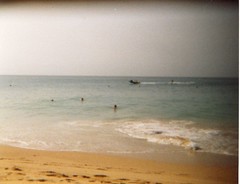
I will write about this experience at length, but will conclude with a summary of what I’ve been thinking when looking at these images. Firstly, I’ve come to realise how drawn I am to ‘bad’ photographs such as the one below:

Unknown Seaside

There is something about this photograph (and many others like it) which I find particulary haunting; something about its amateurishness, which makes it seem somehow more genuine. It has the freshness of a sketch as opposed to a finished painting and contains references to an experience which is both direct and profound. Perhaps it is the footprints in the sand, long since washed away which I find so affecting? Or maybe the unknown swimmers and the water-skiier: distant then, and as just as unknown to me now. What course did they take through life after this picture was taken? Did they yet survive the sea, in which, in time, we all will come to be drowned?
As Barthes said:

“I observe with horror an anterior future of which death is the stake… Whether or not the subject is already dead, every photograph is this catastrophe.”

The photograph above seems to illustrate this perfectly, as do many ‘bad photographs’ I have found. Perhaps it’s because they contain this reference to the less than falable human holding the camera (a difference between chemical and digital).

Following on from this, I’ve become very interested in the peripheral parts of photographs, particularly in relation to images taken near the sea (distant swimmers, ships and so on). I have already written about windows in relation to other photographs, but having recently scanned and observed so many images, I’ve come to realise that it’s these areas which are the most ‘genuine’, perhaps because those inhabiting the distance are freed from the artifice of a pose, or because at the moment the picture was taken (just as they were for the rest of their lives) they were oblivious to the photograph’s principal subject and the one taking the picture.

This obliviousness is something I find quite compelling, particularly in relation to my work on the Holocaust, whose victims were by and large anonymous, both in life and now in death. Although I wasn’t living at the time, many members of my family were; they were the ones on the periphery, the specks in the distance, oblivious to what was going on behind them.

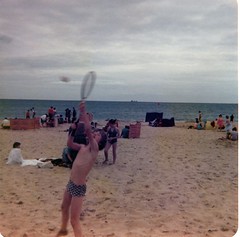
This is a photograph taken in c.1976. It shows my brother in the foreground playing tennis, a lovely image of a fondly remembered family holiday. But what interests me, in relation to my thinking, is the distance.

Looking out to sea we can see a ship, a tanker, sailing under the direction of more (and no doubt large numbers of) human beings, hidden away and quite unknowable. Yet for a time we shared the same stretch of the planet. Those onboard would have had no idea as to our existence, they would have seen at best a mass of coloured dots on the horizon. Yet this degree of separation does not make us any less human, any less feeling. Distance does not negate our hopes and our ambitions. Those few unknowable dots, in the eyes of the ship’s crew, were my family, and have in the years that followed, seen more members come and go. And whether the distance between us is measured in years or miles, we must never forget, that what we see as specs on the horizon, or dots that make the picture on the TV screen, are, in the end, the same people as us.

For more on this subject, click here.

Filed Under: Photography Tagged With: Bathes, Catastrophe, Childhood, Creatures, Details, Holocaust, Photographs, WWII

Jasenovac

June 9, 2007 by Nicholas Hedges

Whilst reading W.G Sebald’s ‘The Rings Around Saturn’ I was struck by his description of the Jasenovac concentration camp, situated in Croatia. I for one had never heard of it, but from the accounts in Sebald’s book, it was, even by the standards of other such appalling places, particularly horrific.

“Seven hundred thousand men, women and children were killed there alone in ways that made the hair of the Reich’s experts stand on end, as some of them were said to have admitted when they were amongst themselves.”

According to Sebald, the preferred instruments of execution were “saws and sabres, axes and hammers” and knives specially designed for cutting throats. The fascist Ustasha, who established the camp, were even regarded by the Nazis as particularly cruel. One German representative in Zagreb, Artur Hoeffner, wrote in his diary on November 18, 1942:

“Regardless of the propaganda, [Jasenovac] is a camp of the very worst kind and can be compared to Dante’s Inferno.”

Italians who visited or served in the area during the war were also sickened. Alfio Russo wrote in Revoluzione in Jugoslavia (Rome, 1944), “Even the most extraordinary massacres in the darkest era of history would not soil its name… “

Like most camps, the death toll is disputed, but the fact the figures range from 300,000 through to 860,000 speaks volumes.

The main victims were ethnic Serbs, although other groups, such as Jews and Gypsies perished there.

Filed Under: Holocaust Tagged With: Dante, Holocaust, Jasenovac, Sebald, WWII

Walking and Memorials

June 3, 2007 by Nicholas Hedges

Having written in the previous entry (about Belzec) ‘Walking is itself a vital part of the memorial’, I was interested to read the following in Neil Hanson’s book, The Unknown Soldier.

“However, no-one, not even a Prime Minister could impose a meaning unacceptable to the public on any memorial, which ‘by themselves remain inert and amnesiac, dependant on visitors for whatever memory they finally produce.

Filed Under: World War I Tagged With: Memorials, Neil Hanson, Walking, World War I, WWI

Poland

May 28, 2007 by Nicholas Hedges

I’ve just returned from another fantastic trip to Poland, this time taking in the east of the country through Lublin, Zamosc and the very picturesque Kazimierz Dolny. My girlfriend negotiated the less-than-brilliant Polish roads whilst I sat in the passenger seat armed with my GPS creating a record of the route. The weather was wonderful, over 30 degrees every day and very sunny.

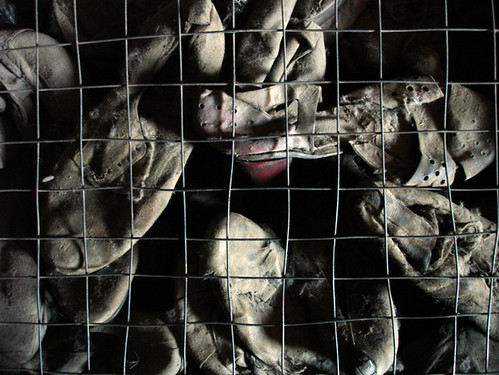
One of the reasons for the trip, aside from it being a holiday, was to visit two more Holocaust sites, these being the concentration camp at Majdanek and the death camp at Belzec. Having left Warsaw we made our way down to Lublin and on arrival, went to the Majdanek concentration camp, just on the outskirts of the city. I didn’t know much about this camp and even after reading a little about its history I didn’t expect what we found there. It is one of the best preserved camps in the country and in some respects is like a smaller version of Auschwitz and Birkenau in one. Like Auschwitz it has numerous exhibitions in each of the barracks, including piles and piles of old shoes. Yet whereas in Auschwitz these were held behind glass, here in Majdanek they are stored in cages; one can smell them.
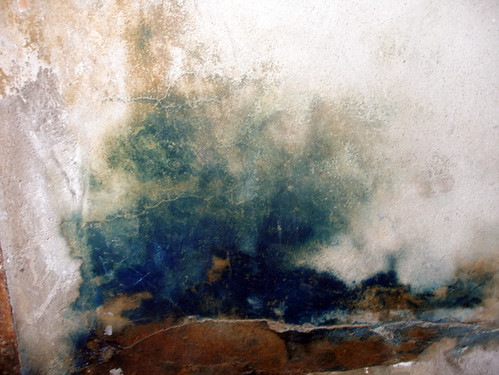
The gas chambers are still intact here along with the original washrooms, and walking through these was, as one would expect, particularly poignant. We noticed on the walls and ceilings of the chamber, that there were patches of blue. I assumed this was just mould caused by damp, but on returning home, I’ve since discovered these patches were caused by the residue of the Zyklon B gas. Indeed, one can see how dense the colours are on the ground and almost see the residue pale as it climbs the walls.

Colours have become a point of interest for me in my work. As above, the blueish tones on the grey walls were striking, not only because of their colour, but because of what they signified. The same was true in the barracks full of shoes. Amidst the rows of earth-brown shoes, one could occasionally glimpse a patch of colour, a red shoe (below) or a blue one.

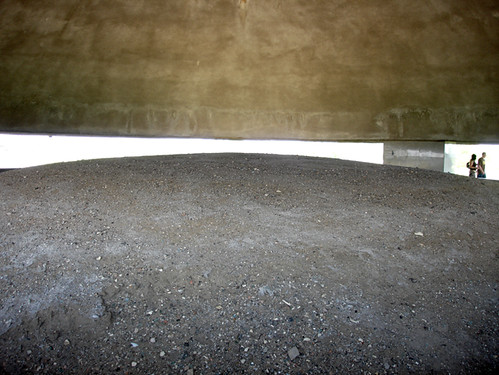
Another striking part of the camp was the memorial containing a mound of ash; the cremated remains of the camp’s thousands of victims. It’s hard to imagine this mass of ash was once a mass of people.

Lublin itself was very interesting. The city has a wonderful old town which more than hints at its original splendor. Sadly, some of the old houses are in a terrible state and one was left wondering whether they would survive.

Having spent the evening in the city, we had an good breakfast and made our way to Zamosc, a sixteenth century version of Milton Keynes, founded by Jan Zamoyski and built from scratch by the Italian architect Bernardo Morando in 1580. However, before sampling its various delights, we visited the second Holocaust site on our itinerary – the site of Belzec Death Camp.

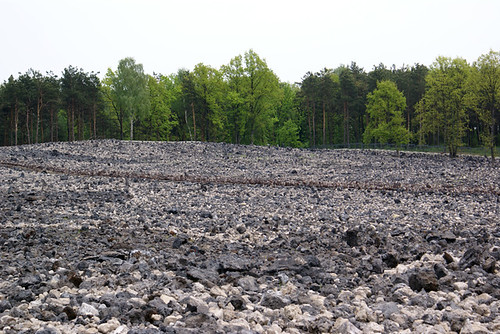
Driving through the village of Belzec, it was hard to tell exactly where the camp was; to be honest, neither of us knew quite what to expect. And whereas before, in the camp at Majdanek we found patches of colour in amidst the piles of shoes, so here in Belzec, as we drove down the road, we saw a shadow in amidst the countryside; a charcoal scar like a field ravaged by fire. This was it, and it took our breaths away.

Whereas the proximity of Majdanek to the centre of Lublin was shocking, here at Belzec, what was shocking was its size. Measuring just 275 metres on three of its sides and 265 on the other, this small space witnessed the deaths of around half a million people, all in the space of nine terrible months. But unlike camps such as Majdanek, Auschwitz and Auschwitz-Birkenau, nothing of this camp (which was liquidated by the Germans in December 1942) remains.

I must admit I wasn’t sure how I’d respond to visiting a place where nothing of the original camp remained, but of course what is important here is the land itself, for it’s the very soil upon which the victims walked and within which they were buried which holds their memories still. The scale of the site becomes the memorial and just as its countless victims walked upon this small piece of land to their deaths, so we walk around it, looking in, so as to remember them, staring at the rocks which litter the landscape as if each stone is a single individual.

Thinking about the hundreds of thousands of stones, I’ve been reminded since coming home of an old Jewish cemetery we visited in Kazimierz Dolny which was desecrated and destroyed by the Nazis. We wondered when we visited it about the practice of putting stones on graves and I have discovered that when the tradition started grave monuments were mounds of stones; visitors added stones to the mound to show we are never finished building the monument to the deceased. Another explanation was that it shows those visiting that others have come before to remember. The monument at Belzec therefore, covered as it is with hundreds of thousands of stones reminds us that this piece of land is a grave for hundreds of thousands of people who will not be forgotten; the memorial will never be finished. The fact that the stones look like the remnants of a demolished building is also significant.

Walking is itself a vital part of the memorial (it will never be finished as it is incomplete without people there to walk around), just as it has been important to me in my work on Belzec prior to my visit. I’m wondering now if stones will also become a feature?

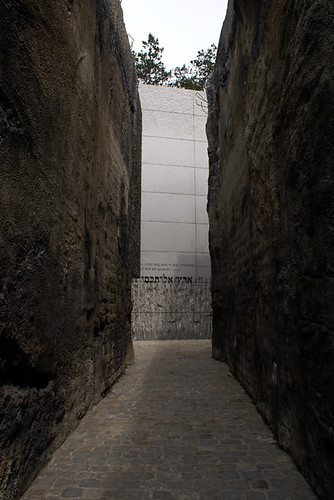
One of the most haunting parts of the memorial was the walk through the tunnel, a cutting made into the hill exposing the soil on both sides.

This brought to mind two things: one, the ‘tunnel’ through which the victims walked to the gas chambers, and secondly, the fact that we could see inside the ground, into the very place in which the victims had been buried.

From here we made our way to Zamosc and having spent a lovely night there, made our way to Kazimierz Dolny via the beautiful Kozlowka Palace, Zwierzyniec and the spa town of Nalenczow. Looking at the towns we passed through (including Zamosc which we left), one couldn’t help remember those very names as being places from which Jews had been deported to Belzec; the day before was never far from our thoughts.

Kazimierz was indeed a beautiful little town which had suffered much under the Nazi terror; half its population had been deported to camps such as Belzec. The weather was hot and having rested for the night, we spent the next day walking around the town, visiting King Kazimierz’s castle and walking through the forests by which it was surrounded. The landscape was indeed beautiful.
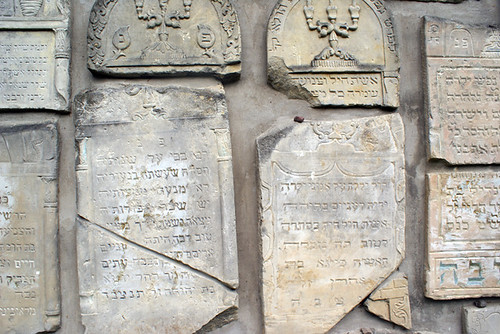
It was near the end of the day that we came upon the old Jewish cemetery, destroyed by the Nazis. After the war, a memorial was built using the old gravestones which again served to remind us of a recent and tragic past.

Filed Under: Holocaust Tagged With: Belzec, Holocaust, Lublin, Majdanek, Poland, WWII

Opening

May 13, 2007 by Nicholas Hedges

After five weeks, the Residue exhibition opened this evening, and, all in all, I was very pleased with how things turned out. (Click here for more photos from my installation).

The overall installation worked well as a whole, and the individual pieces in their own right, yet what was interesting about this installation was how the works changed and evolved once they were installed. For example, the cups (below) began to leak…

Clearly these cups are not designed to hold liquids for any length of time, and in particular the amount of water that was in each of them. So, my girlfriend Monika and I spent time removing water and in fact, as Monika said, the cups had more meaning with their varying amounts of liquid than when completely full; there was something more individual about them. And the fact they were leaking, becoming thin and ultimately disintegrating, was very apt in respect of my other works on mortality and memorialising. These ‘individuals’ (which the cups represent) are at different rates of time falling apart, at which point I remove them to the earth beneath the deckchairs (below).

This dialogue between the two works was, and is, very interesting. The earth beneath the deckchairs, which is actually compost, has always been a symbol of death – the final resting place into which mortal remains dissolve, so the fact there is now this dialogue between the two works accentuates aspect. Of course, those viewing the two works will have to be made aware of this fact, and the point of how much to explain to one’s audience comes once more to the fore.

Since the opening I have decided to re-write the information sheet I had made available to people and to edit down the blog to about twelve pages which can then be put on the wall, after all it is as much a piece of work as the works themselves. Putting it in a folder and leaving it on the table is all well and good, and indeed valuable, but displaying it this way makes it something of an accessory to the work when it is, as I’ve said, more important than that.

Filed Under: Artist in Residence Tagged With: Artist in Residence, Residue

The Final Week

May 4, 2007 by Nicholas Hedges

The final week before the exhibition opens and new ideas are presenting themselves. I wanted to do something with the dismantled typewriter and so I took the letters and the ribbon and printed the title on some paper ‘The War to End All Wars’.

What I liked about the result was how the red of the ribbon was smudged beneath the writing, giving the impression of blood. The unevenness too reminded me of some text-based work I did following a visit to Auschwitz and I wondered whether I could reprise this work. However, there would have to be differences. The dismantled typewriter, as a piece, has the title, as above, ‘The War to End All Wars’. Clearly we know that this wasn’t the case and that there have been hundreds of wars fought since 1918. Giving the typewriter such a title makes it a metaphor for the First World War (I originally arrived at the idea thinking about the names of all the dead being recorded on just such a machine) and so, as the First World War wasn’t the last, so the typewriter must be shown to still work somehow. Using the letters and the ribbon does this, but if the result is on paper, it doesn’t necessarily follow that the typewriter has been dismantled i.e. it could have been made before it was taken apart. Printing directly onto the wall however does make this connection; after all it is obviously impossible to type with a working typewriter onto a wall, this can only be done if the machine is in pieces. The First World War may be over, but man has continued to fight nevertheless.

Filed Under: Artist in Residence Tagged With: Artist in Residence, Auschwitz, Residue, World War I, WWI

The Tower of London

May 2, 2007 by Nicholas Hedges

During my degree in the early 1990s, I did a lot of work on the Tower of London, and in particular on the inscriptions made by prisoners incarcerated in the Beauchamp Tower. I worked with video at the time, mixing text taken from Dante’s journey through Hell with images of my own walk through the Tower. This weekend, while visiting the Tower, I relished the chance, in light of the work I’ve been doing on both my MA and this residency, of seeing them again, and, just as they did almost 15 years ago, these inscriptions once again captured my imagination.

Having visited Auschwitz and Ypres, I became aware, in this small room, of the nature of memorials. In Ypres, the main memorials are the graves and the names on the Menin Gate. At Auschwitz it is the possessions left by the victims. In this small room, prisoners who knew they would die, or at least feared for their lives, made their own memorials, sometimes carving very elaborate testaments to their own existence in the most difficult of conditions. Some would memorialise the long hours they endured and the torment which they suffered, such as that by William Tyrell. Carved in 1541 it is particularly poignant:

“Since Fortune has chosen that my hope should go to the wind to complain,
I wish the time were destroyed; my planet being ever sad and ungracious.”

In wishing ‘the time were destroyed,’ William Tyrell through carving the fact into the wall, has made not only time, but that particular moment, endure for as long as the walls remain standing, a moment which we can share some 465 years later. It’s strange how the moment remains yet his suffering has for centuries been at an end. He speaks to us directly and by hearing him in our own voices we can share more directly in his pain. Would the carving be so powerful if it was a fragment in a museum? No, I don’t think it would. The fact we are seeing it in situ, standing in the exact place he stood helps us to fill in the gaps more easily. We get a sense of his confinement, his life and the impossible sense of freedom as glimpsed through the window – the freedom which for us is not only possible, but certain. It is this same sensation which I felt in Auschwitz-Birkenau, the knowledge that I could at any time just walk out the gate. Here, I could simply turn and walk out the door. It is this rather uncomfortable contrast which makes the plight of William Tyrell, among many others all the more tragic.

The objects in Auschwitz, in particular the suitcases, were in many respects, memorials in their own time, unwitting memorials perhaps to a place (a home, a normal life) from which the victims had been driven. The names inscribed on the walls of the Beauchamp Tower however memorialise the place of confinement, the period of incarceration.

“We have been living this same moment ever since we were conceived. It is memory, and to some extent sleep, that gives the impression of a life of discrete parts, periods or sections, of certain times or ‘highlights’.”

This quote from Bill Viola is particularly pertinent when one imagines what it was like to be incarcerated in a space such as was William Tyrell. No doubt during his captivity, Tyrell spent time remembering, casting his mind back over periods in his life, over ‘discrete parts’ and ‘highlights’. And if ever a person is aware of living the same moment, then it must be the prisoner confined in his cell.
There is something else about this quote which is also pertinent to the room in the Beauchamp Tower. The myriad number of inscriptions covering the walls were carved over a period of almost two centuries and give us impressions of not only a single life as consisting of discrete parts, but of lives as being discrete parts of a greater whole or single moment of existence, an existence (the room) in which we are playing as much a part as the men once held prisoner within.

“If things are perceived as discrete parts or elements they can be rearranged. Gaps become more interesting as places of shadow.”

Using the example of the Beauchamp Tower, one can see how this rearrangement of which Bill Viola speaks takes place in the mind of the visitor. Time is collapsed into a moment, a period of almost two centuries is visible to us in one look around the room. Years and decades separate many of these carvings, yet we are aware of only the blur of the past. We are in effect rearranging these discreet periods, creating gaps – interesting (and ambiguous) places of shadow – which we fill with our own experience.

Filed Under: Quotes Tagged With: Bill Viola, Moments, Movement, Quotes, Tower of London, Useful Quotes

The Tower of London

May 1, 2007 by Nicholas Hedges

A beautiful but heart-rending quote from a prisoner, William Tyrell, carved into the walls of the Beauchamp Tower in 1541.

“Since Fortune has chosen that my hope should go to the wind to complain,
I wish the time were destroyed; my planet being ever sad and ungracious.”

Filed Under: Quotes Tagged With: Quotes, Tower of London, Useful Quotes

Day16

April 26, 2007 by Nicholas Hedges

Having moved things around for another show this evening, I put the canvas behind the deckchairs and found that I much preferred the way it looked, not so much on an aesthetic level but as regards the way it conveyed its meaning. On the floor, the words were – due to the fact the paint was drying – not so much difficult to read as of a very different quality to those written earlier. These earlier words had almost been inscribed into the paint, whereas those added more recently have been written onto the paint’s surface. This graphite of the pencil onto of the graphite of the canvas is itself interesting, but is served better by a vertical placement (see below).

It is difficult to tell from the photograph alone, but the material quality of the canvas surface is also more visible in this position. There is as well the practical aspect of the move in that it frees up more floor space so as to allow people to stand back and take in the works as a whole.

Filed Under: Artist in Residence Tagged With: Artist in Residence, Residue

A Memory Place

April 26, 2007 by Nicholas Hedges

Given that my walking around the same part of Oxford has over the last few weeks engrained the streets, buildings, objects and structures in my mind, I realised that I am some way towards creating a memory place – a place with which to explore those mnemonic arts practised by the Ancient Greeks. I have decided therefore to try and memorise a passage from a book. I will divide it up, and use relevant ‘objects’ to act as ‘triggers,’ placing them at various points along the route which I will then recall as I ‘walk’ in my mind.

The passage I will try and recall will be taken from the Polish writer, Bruno Schulz’s story, ‘The Street of Crocodiles’, which I have chosen in part because he was himself a victim of Nazi brutality, shot in the street by a Gestapo officer in 1942.

A part of the extract is as follows:

“But where the ground extended into a low-lying isthmus and dropped into the shadow of the back wall of a deserted soda factory, it became grimmer, overgrown and wild with neglect, untidy, fierce with thistles, bristling with nettles, covered with a rash of weeds, until, at the very end of the walls, in an open rectangular bay, it lost all moderation and became insane… It was there that I saw him first and for the only time in my life, at a noon hour crazy with heat. It was at a moment when time, demented and wild breaks away from the treadmill of events and like an escaping vagabond, runs shouting across the fields. Then the summer grows out of control, spreads at all points over space with a wild impetus, doubling and trebling itself into an unknown, lunatic dimension.”

Such a beautiful description of summer months calls to mind many summers which I myself have known, and, knowing how the author met his end makes the passage all the more poignant. This prose, although a fiction, is borne out of reality, an amalgam of memories which the author must’ve had of summers in the past, and as with the work I’m making with deckchairs, these memories call to mind happier times in the light of terrible adversity, contrasts which give us the chance, by filling in the gaps with our own memories, of ‘getting to know’ or at least understand a little better, individuals – such as Bruno Schulz – who suffered so terribly.

Filed Under: Artist in Residence Tagged With: Artist in Residence, Bruno Schulz, Residue, Writing

Gaps

April 25, 2007 by Nicholas Hedges

“Possibly the most startling thing about our individual existence is that it is continuous… We have been living this same moment ever since we were conceived. It is memory, and to some extent sleep, that gives the impression of a life of discrete parts, periods or sections, of certain times or ‘highlights’…

If things are perceived as discrete parts or elements they can be rearranged. Gaps become more interesting as places of shadow…”

Bill Viola, ‘Reasons for Knocking at an Empty House‘

Whilst flicking though my research journal this evening, I happened upon the above quote which I first read several months ago. I was startled by what I read, particularly in light of what I wrote yesterday (‘From Dinosaurs to Human Beings’). This continuous existence which Viola speaks of, could be said to be that same existence of which we and all our ancestors are a part, and to memory and sleep as creators of ‘discrete parts’ or ‘highlights’ we might add ‘death’.

These discrete elements can be rearranged, and in doing so, gaps will inevitably appear (I’ve discovered as much through the process of walking and making notes of objects etc.) and it is these gaps, these shadows which I have been working with and in which I am most interested.

Filed Under: Artist in Residence Tagged With: Artist in Residence, Bill Viola, Death, Residue

Day 15

April 25, 2007 by Nicholas Hedges

Another walk and subsequently, more work on the ‘Palimpsest’ and ‘Hollow Squares’. I started painting the paper cups (for ‘The Light of the Moon’) as well and coating them in graphite, the results of which (below) were quite interesting.

I like the messiness of them – the finger marks inside. They look as if they’ve been dusted for fingerprints, as if we’ve been searching for the individuals who held them and consumed their contents. They are each a fragment of the past, which we can fill (with water), so as to ‘fill the gap’, and thereby see (as per the title) the moon reflected inside, finding the bigger picture (the moon which covers the earth).

There is something interesting too, in the nature of their ‘throw away’ existence. The fact that – as Dogen Zenji says – the light of the moon can be contained within a single bowl of water (or in the case of this work, disposable paper cups) could itself be a metaphor for our own mortality – the bowls, the paper cups become, in effect, like our own eyes.

Filed Under: Artist in Residence Tagged With: Artist in Residence, Dogen Zenjii, Residue

From Dinosaurs to Human Beings

April 25, 2007 by Nicholas Hedges

After yesterday’s viewing, I began to think about the works I’ve produced so far on this residency and what it is that links them; not that there should be a link – I just know that there is one. Despite the differences, there is an underlying theme which unites the drawings, the text pieces, the deckchairs and the paintings. So what is it?

In answering this I have started to think about… dinosaurs. Not something which first springs to mind when looking at my work and if I mention Jurassic Park, then it might seem that I’m losing the plot altogether, but there is a sequence in this film which is relevant to my work.

In the film, the visitors to the Park are shown an animated film, which explains how the Park’s scientists created the dinosaurs. DNA, they explain, is extracted from mosquitoes trapped in amber and where there are gaps in the code sequence, so the gaps are filled with the DNA of frogs; the past is in effect brought back to life with fragments of the past and parts of the modern, living world. This ‘filling in the gaps’ is exactly what I have done throughout my life when trying to imagine the past, particularly the past of the city in which I live.

As well as reading about and drawing dinosaurs, I also as a child, liked to create and map worlds; countries which I would build from fragments of the world around me; forests, mountains and plains – unspoilt landscapes. And in these worlds there would exist towns and cities, created from ‘the best bits’ of those I had visited.

These invented worlds became, as I grew up, the ‘invented’ or imagined landscapes of Oxford’s past; landscapes that were – just as they still are – created from fragments, parts of the past which are still extant in the city; old buildings, walls, objects and so on. Between these structures, these fragments, I would fill the gaps, with my own imagination, with thoughts derived from my own experience. The city’s past and the past in general, as it exists within my mind, is then, to use the metaphor of cloning in Jurassic Park, a cloned dinosaur. The extant buildings, structures and objects within museums, are like the mosquitoes trapped inside the amber. They are broken strands of DNA. All that is required is for me to fill the gaps, and this I can do with my own DNA. I am in effect, the frog.

This metaphor is interesting in that DNA patterns are, of course, unique to everyone. My DNA is different to everybody else’s as there’s is to mine. Therefore, using my imagination to plug in the gaps of the past, means that the ‘past’ will comprise large parts of my own experience; my dinosaur will contain elements of my own being. (See ‘Postcard 1906’). But although my DNA is unique, it is nonetheless derived from my own past, elements have been passed down by my ancestors from time immemorial. The code which makes me who I am, comprises parts of people I know now (parents and grandmothers), people I knew (grandfathers and great-grandmother) and people lost to the past altogether (great-great grandparents and so on). What interests me about this, is that, through stating above how ‘my dinosaur will contain elements of my own being’ I can now see that ‘my dinosaur’ will contain elements of my own being, which is itself comprised of elements of hundreds – thousands – of people, the majority of whom I will of course never know and who have been dead for centuries. I like to think therefore, that ‘my dinosaur’ and my imagination aren’t entirely unique.

This leads me to look at paths – not the route I walk around the castle, or those recorded by my GPS receiver (although these are entirely relevant) but to the paths taken by my ancestors so that I might be brought into being. The chances of any of us being who we are is practically nil. In order for me to be born, I had to be conceived at the exact time I was conceived, any difference in time – even a split second – and I wouldn’t be me. Also, everything leading up to that moment had to be exactly as it was; anything done differently by my parents, no matter how small, how seemingly irrelevant, any deviation from the path and I would not be me. This is extraordinary enough (whenever I see old photographs of members of my family, I think that if it was taken a second sooner or later, I would not be here) but when one considers this is the same for my entire family tree, again, all the way back to time immemorial, then one realises how, to quote Eric Idle in ‘Monty Python’s Meaning of Life’, ‘incredibly unlikely is your [my] birth’. We are all impossibly unlikely. The chances of all our ancestors walking the exact paths through their lives which they walked is almost nil.

Therefore, my walks, my mapping, my identifying (seemingly irrelevant) objects, my recording them, my palimpsests, are all linked. Memorialising objects (disposable or otherwise), snatches of conversation and so on, inscribing them on a slab, shows how vital these fragments are to future generations and to me in terms of my own past. But how does this fit in with my work on Auschwitz-Birkenau, death camps and World War I?

These ‘arenas’ of death were constructions (although the carnage of a battlefield was often random, the battles themselves were always planned, ‘constructed’ for the purpose) in stark contrast to the rather arbitrary paths our ancestors took so that we might each be born. Death in these places was designed, it was planned, particularly with regards to the horrors of the death camps and by looking at these places, by visiting them, by looking at the seemingly irrelevant, everyday objects left behind, we can fill in the gaps, each using our own existence to imagine the lives and the deaths of others. We understand what it means to be human, the near impossibility of birth and the absolute certainty of death.
Imagining a group of a several hundred people walking to their deaths, whether down a path to the gas chambers, or on a road to the Front, we can easily imagine the route; we can in places walk the route today. But imagining the paths walked by thousands of people through time, to bring each of the victims into being is almost impossible: I say almost impossible, but, as I’ve written above regarding each of our births, it’s possible in the end.

Looking at death therefore is to to look at life and its inestimable value, whoever we are and wherever we live. It is to understand what it means to be human and to cherish the lives of others.

Filed Under: Artist in Residence Tagged With: Artist in Residence, DNA, Holocaust, Objects, Postcards, Residue, Vintage Photographs, World War I, WWI, WWII

Days 13 and 14

April 24, 2007 by Nicholas Hedges

Spent much of the day (day 13) walking and painting paper cups. I did make a few attempts at reading through and recording the prose versions of the walks but I wasn’t happy with the results. I also played around with data, downloaded from my new GPS receiver: very exciting. I surveyed the route of my walk around the castle but twice lost satellite reception in Bulwarks Lane which is a bit frustrating. Anyway, all quite amazing really, especially viewing the data on Google Earth and, via GPS Visualizer on Google Maps too (even if it goes a little wayward once in the city centre).

That was yesterday. Today (day 14) I showed the work so far as part of the Research and Development module, itself a part of my MA. The response to the work was a mix of muted and positive, but as always I was intrigued by which pieces made the most impact. As with last semester, it was my drawings which most people identified with, followed I would say by the text pieces. The word ‘memorialising,’ was also used which is very apt for that which I am doing.

The key now is to start pulling all the facets of my work together, to make a whole, not by forcing a common theme, but by seeing why I have made these various pieces and discovering exactly what unites them.

Filed Under: Artist in Residence Tagged With: Artist in Residence, GPS, Positioning, Residue, Walking

Day 12

April 22, 2007 by Nicholas Hedges

Today I walked the second walk in this series and made the following list of additional words:

engines roar
siren
cigarette
sightseeing bus
sunglasses
man in a suit
refuse sacks
red man
pushchair
spire
glass dome
Chinese characters
look both ways
dead end
green wheelie bin
barrier
family walk
girl with a trolley
mound
rucksack
loud music
car screeches
camera
parking tickets
small windows
tree
old railings
flag flutters
sound of a bin moved
shutters
padlock
bookshop
shopping bags
three ducks
bricks and old stones
new flats
rainbow flag
bicycle racks
chefs
traffic warden
worn out face
20 zone
absent baskets
pigeon descends
except cycles
pink bag
net curtain
palm trees
E1
smell of cooking
E2
library
engine
headphones
old sock
bus ticket
traffic cone
flat cap
red waistcoat
crossing sound
green sweet
broken bottle
mound
dropped chips
running water
dog shit
man walks through a green door
red flowers
coke can
libya libya
corner
black door
plastic coffee lid
old brick wall
thick trunk
metal boxes
corn exchange
knitted jumper
cordon around a tree
green dome
push to open
pigeon
market office
fans
With the new lists, I have written the words up on paper in ‘squares’, and in the example below, those words from the first walk which were not relevant in the second walk have been rubbed out. Of course, as with most things, the presence of the word, or the object is never fully removed; although it may not have been visible on the walk in a physical sense, it still existed a part of my memory.


I’ve made a similar work with the prose version of the list of words. Here is the prose version of the first walk:

and here the words and attached sentences have been removed.

As well as this method of constructing what one might term a ‘document of experience’, I have also used the typed versions as a means of recording. Following the second walk, I removed from the prose, all the words which I erased from the first list but left the surrounding words of their relevant sentences intact. Into the gaps I then inserted sections of prose from the second walk.
Everything leaves a mark somehow and whereby in the pencilled versions of the prose I can erase the pencil and still leave a trace, I cannot do the same with an electronic document. Leaving the rest of the sentence intact therefore works in the same way as the trace of rubbed out words. If someone is seen in a street one day, they inevitably leave a trace, somehow, and, when they are no longer visible in that place, this trace might still be seen.
The following prose is that of walks 1 and 2 combined, as described above:

An engine purrs. A woman with The engines of the buses roar. walks towards me. The Somewhere in town a siren is sounding. of a bus’s brakes, and then its A man walks towards me with a cigarette in his mouth. He hasn’t lit it yet. A sightseeing bus turns around, ready to begin its tour. telling of its departure. Outside the pub on a blackboard is advertised; a. Leffe is also served here. A man gives a A woman checks her sunglasses while behind her a man in a suit walks aimlessly as if he’s not long woken up. as I cross the zebra crossing. A man with a On the edge of the pavement, a heap of refuse sacks are left waiting to be collected walks towards and then past me. Ahead, on the opposite side of the street, a shop and a restaurant stand empty with boarded windows. A young man with a The red man is lit so I wait to cross. I look around. saunters down the road while a A woman pushes a pushchair and from amongst the rooftops a spire points to the sky. at the traffic lights. I see people with I notice a glass dome, I’m not sure I’ve ever noticed it before. making their way to the train station. The lights are red, then red and amber and the traffic moves. On the window ahead of me are written some Chinese characters and on the road, a sign cautions everyone to look both ways. are on patrol. A bus called the Having crossed the road and walked a little, a signs says dead end and down that dead end stands a green wheelie bin. drives past and a man gives his daughter a A barrier is down at the exit of the car park beside which a group of people are out for a family walk. There are two trees on this side of the street. I hear come from a car, while up ahead, a cuts the pavement in two. Up another road, in the distance, a man crouches. I walk past an iron gate and on some railings see a French flag – a poster advertising a market. A wedding party stands on the pavement. The A young girl with a trolley stands at the side of the road dominated by the mound. just before I reach the road and so I wait a while. On the lamppost, a sticker with 404 has been stuck on. I look up the empty street towards the city centre. A couple carry identical A man with a rucksack walks with a group of others; girlfriends and children. happy with their purchases. I cross the road and see A car stops at the junction, loud music pouring from its open window. The car screeches out. littering the pavement. One of the wedding guests talks about sales. Ahead is the castle tower. A Walking down the road I notice a camera hidden away like a big eye watching everything. hangs on a bollard and nearby lies a discarded blanket. Up ahead, a A car is parked with four parking tickets tucked beneath its windscreen wipers. I look; a takes my attention for some reason. On the pavement, old confetti appears stuck down. There’s a row of empty cycle racks. The street is quiet, a and I hear. A man wearing walks towards me. Round the corner, the I notice the small windows of the houses here and a tree which grows near the old railings by the river. Some are painted a different colour to the rest – just a few of them.. and ahead I see an arch over the entrance to a courtyard. Birdsong is mixed with the gentle sound of water. A flag flutters above the tower. and a group of To my right I hear the sound of a bin moved across the floor. A shop window has metal shutters pulled down and a padlock is coiled around the railings like a snake. Along the road is a bookshop. talk as they walk past. Dirty water gathers at the weir. On the road, a cordon contains sand, paving slabs and gravel. There’s litter too. Above me, the ancient windows of the tower look out. A lifebuoy waits for an emergency while the Two men carry shopping bags and down on the river, three ducks negotiate the litter in the water. on the water. A and I hear 118 is written on a sign. I don’t look at the rest of it. Below the bridge is a drowned bicycle and a submerged traffic cone. There are some old plastic bags snared in the branches. I walk beside the old walls. On the pavement is the stain of a splash just where the weeds grow and where petals gather like the paper confetti. Little Derick’s doin ok – a scrawled message on a hoarding says. I wonder who he is. A A building here is a mix of bricks and old stones, On the opposite side some new flats are being built. From a building opposite – a pub – a rainbow flag hangs. In the yards of a block of flats are some bicycle racks. Two chefs take a break for a chat while up ahead a traffic warden chats with someone less fortunate. A man in a luminous jacket with a worn out face looks out for litter. A sign says 20 zone. and on the wall of a building I’m made aware of CCTV. An arrow points towards another road while up ahead, the concrete monster looms large. Hooks on the front of a building wait for absent baskets of flowers. appears on his bike and we engage in A pigeon descends with a flap. mainly about the weather. Posters look tatty beside that ugly building – all bricks and shadow. A man with A sign says except cycles. on his arm waits while A woman carries a pink bag and behind a net curtain in a restaurant window a man sits, as if he is hiding from something. is erected nearby. Are they going to knock the ugly stuff down? I wish they would. A Here palm trees grow. E1 bus stop. Here the smell of cooking hangs in the air. E2 bus stop and a sign for the library. bobs on the opposite side of the street but on my side it’s all bird shit. A The sound of an engine – not heard by the man wearing headphones. An old sock lays incongruously on the pavement; where is the other one I wonder? scuttles across the path, in amongst the cigarette ends. E3 says a sign at one of the bus stops. Ahead I see the steps I’ll walk up. A strong shadow cuts across and in the distance I hear A bus ticket blows past and over the road I see the steps near which a traffic cone has been unceremoniously left. An old man with a flat cap walks past and opposite, waiting to cross the road is a man with a red waistcoat. Then comes the crossing sound. We walk across. – a wedding perhaps? Green lights but I cross anyway, there’s no traffic. A bottle of I walk up the steps and see a green sweet and further down a broken bottle. There’s a The mound rises up behind the walls while on the ground are some dropped chips from the night before. has been left by the steps. waiting for a visitor, but above it a roll of barbed wire warns against intrusion. A satellite dish sits silently on the wall of another house and above it, a green spire shoots like some massive flower. Here it’s I can hear the sound of running water. and On the pavement is a pile of dog shit. I pass lampposts no.2 and no.3 and see ivy clambering over the wall like a thief. Up ahead a man walks through a green door above which, tumbling on the wall are some red flowers. A coke can sits at the edge of the pavement and on a step someone has written the words libya libya; why I don’t know. Up ahead is a corner. There’s a black door and in the middle of the pavement a plastic coffee lid. Below the gutter runs, as if unsure of its path. Lamppost no.4. Like the ivy, a plastic sheet escapes over another wall. I see an old step over the lost gutter which now goes nowhere. Ahead is a half-painted bollard. A There’s an old brick wall above which the thick trunk of a vine twists and turns. has been left on a car parked on double-yellow lines. The driver’s seat is decorated with a Three metal boxes are stacked at the alley way to the street at the end of which is the corn exchange. Here is lamppost and a gathering of. says one of them. I notice an just as the smell of fills the air; someone is cleaning. Ahead is a litter bin past which a man pulls a. I pass a red door then a blue door, a bicycle and a pillar box. On the pavement is a A boy with a knitted jumper walks with his parents. Up ahead, a cordon has been placed around a tree and above the roof tops is a green dome. I round the corner and see two people Push to open says a sign. There are a few A pigeon wanders aimlessly. On the pavement is a load of spilled. There are French flags again. The market’s here. A girl in walks towards me and I walk past a stall selling and on towards a which snakes its way down one side of the square. A man in a luminous jacket walks past me. An engine purrs. Ahead, three telephone boxes wait for conversation, but for the moment, there’s just the sound of Here is the market office and back where the buses leave a number of fans are whirring.

I am also interested in the visual interpretation of memory, i.e. what it is that we remember. Of course it may be different for different people, but whenever I think of a part of the walk and think about what I am seeing, I realise that the image is a very vague interpretation of reality. Below is a drawing which is a drawing of my entire walk, drawn with my eyes closed so as to focus my mind on the memory image, from the left of the page to the right. The image below is my ‘memory’ of the first walk.

After the second walk, I rubbed the entire image out, leaving a trace of the original drawing on the paper. Over this I then drew my ‘memory’ of the second walk (below) and will repeat this process throughout the duration of my walking this particular route.

These examples are all in effect palimpsests: whereby even though I have erased words and images, traces of them can still be seen on the page, just as traces of the past can still be found everywhere throughout the city – the past is never fully effaced.

Filed Under: Artist in Residence, Lists Tagged With: Artist in Residence, Listmaking, Lists, Residue

Day 11

April 20, 2007 by Nicholas Hedges

I’ve been looking at my work so far and have started to think about what I will have to show and how I will show it.

“The Smell of an English Summer 1916 (Fresh Cut Grass)”

Deckchairs and Graphite
This piece takes the memory of a thing (in this case, lazy summer’s days before the outbreak of World War One) and using objects to symbolise this thing (e.g. deckchairs), reinterpret the objects so that they come to represent something new (the horrors of war, the hopeless wish for peace).

“Broken Hayes”
Oil, Pencil and Graphite on Canvas
This canvas will be covered with words written on each of the walks that I’ll make over the coming days, and where the words are crossed out on successive walks, so they’ll be rubbed out on the canvas, much like the names on old tombstones, smoothed over by feet. This link with feet, fits with the walks themselves.

The title ‘Broken Hayes’ is the old name for Gloucester Green and describes a place which, in a sense, no longer exists, although, like the ghostly dwellings on John Gwynn’s survey (1772) it’s ‘footprint’ is still visible in the boundaries of the Green. Many of the items rubbed out on the canvas no longer exist in the places where I ‘found’ them; they are, in name only memories, just like Broken Hayes, yet like the physical aspect of that place, they still exist.

“The Light of the Moon “
Found Disposable Cups, Graphite and Water
This will be an installation of paper cups found in the city centre. The contents of each have all been consumed by tourists and residents alike; people who now might be spread throughout the globe. This fits with Dogen Zenji’s quote: “The light of the moon covers the earth, yet it can be contained in a single bowl of water.”

Also, the act of looking in bins to make this installation has been interesting in that when I’m walking through town, I’m sure that no-one is looking; I’m just a part of the mass of people. Yet when I start rummaging through bins, I feel as if everyone is looking at me – I feel like an individual, a ‘single bowl of water.’
I’ve also started the walks again now that I know what I’m looking to do. I’m following the same route, the first words of which are as follows:

engine purrs
yellow clothes
hiss
reverse warning sounds
food
pie ‘n’ pint
Leffe
thumbs up
zebra crossing
fat stomach
boarded windows
hooded top
red car waits
suitcases
red
red and amber
two police officers
Jericho voyager
piggy back ride
two trees
tinny music
diagonal shadow
man crouches
iron gate
French flag
wedding party
green man disappears
404
empty street
shopping bags
new confetti
castle tower
child’s coat
discarded blanket
child cries
letterbox
old confetti
empty cycle tracks
gate slams
footsteps
sandals
sun shines on houses
arch
birdsong
gentle sound of water
a bird calls
Russians
dirty water
weir
sand
paving slabs
gravel
litter
ancient windows
lifebuoy
sun sparkles
car turns right
a distant siren
118
drowned bicycle
submerged traffic cone
plastic bags
old walls
the stain of a splash
weeds
petals
little Derick’s doin ok
car starts
CCTV
arrow
concrete monster
an old acquaintance
conversation
posters
bricks
plaster cast
scaffolding
balloon
bird shit
pigeon
cigarette ends
e3
steps
strong shadow
church bells
green lights
Leffe beer
doorbell
barbed wire
satellite dish
green spire
traffic noise
birdsong
no.2
no.3
ivy
gutter
no.4
plastic sheet
step over the gutter
half-painted
parking ticket
dragon
no.8
red bins
mixed glass only
arch in the wall
disinfectant
litter bin
suitcase
red door
blue door
bicycle
pillar box
plastic bottle
checking a map
confused faces
popcorn
French flags
pink sandals
ham
long queue
luminous jacket
engine purrs
telephone boxes
laughter

The prose version:

An engine purrs. A woman with yellow clothes walks towards me. The hiss of a bus’s brakes, and then its reverse warning sounds, telling of its departure. Outside the pub on a blackboard food is advertised; a pie ‘n’ pint. Leffe is also served here. A man gives a thumbs up as I cross the zebra crossing. A man with a fat stomach walks towards and then past me. Ahead, on the opposite side of the street, a shop and a restaurant stand empty with boarded windows. A young man with a hooded top saunters down the road while a red car waits at the traffic lights. I see people with suitcases making their way to the train station. The lights are red, then red and amber and the traffic moves. Two police officers are on patrol. A bus called the Jericho voyager drives past and a man gives his daughter a piggy back ride. There are two trees on this side of the street. I hear tinny music come from a car, while up ahead, a diagonal shadow cuts the pavement in two. Up another road, in the distance, a man crouches. I walk past an iron gate and on some railings see a French flag – a poster advertising a market. A wedding party stands on the pavement. The green man disappears just before I reach the road and so I wait a while. On the lamppost, a sticker with 404 has been stuck on. I look up the empty street towards the city centre. A couple carry identical shopping bags, happy with their purchases. I cross the road and see new confetti littering the pavement. One of the wedding guests talks about sales. Ahead is the castle tower. A child’s lost coat hangs on a bollard and nearby lies a discarded blanket. Up ahead, a child cries. I look; a letterbox takes my attention for some reason. On the pavement, old confetti appears stuck down. There’s a row of empty cycle tracks. The street is quiet, a gate slams and I hear footsteps. A man wearing sandals walks towards me. Round the corner, the sun shines on houses and ahead I see an arch over the entrance to a courtyard. Birdsong is mixed with the gentle sound of water. A bird calls and a group of Russians talk as they walk past. Dirty water gathers at the weir. On the road, a cordon contains sand, paving slabs and gravel. There’s litter too. Above me, the ancient windows of the tower look out. A lifebuoy waits for an emergency while the sun sparkles on the water. A car turns right and I hear a distant siren 118 is written on a sign. I don’t look at the rest of it. Below the bridge is a drowned bicycle and a submerged traffic cone. There are some old plastic bags snared in the branches. I walk beside the old walls. On the pavement is the stain of a splash just where the weeds grow and where petals gather like the paper confetti. Little Derick’s doin ok – a scrawled message on a hoarding says. I wonder who he is. A car starts and on the wall of a building I’m made aware of CCTV. An arrow points towards another road while up ahead, the concrete monster looms large. An old acquaintance appears on his bike and we engage in conversation, mainly about the weather. Posters look tatty beside that ugly building – all bricks and shadow. A man with plaster cast on his arm waits while scaffolding is erected nearby. Are they going to knock the ugly stuff down? I wish they would. A balloon bobs on the opposite side of the street but on my side it’s all bird shit. A pigeon scuttles across the path, in amongst the cigarette ends. E3 says a sign at one of the bus stops. Ahead I see the steps I’ll walk up. A strong shadow cuts across and in the distance I hear church bells – a wedding perhaps? Green lights but I cross anyway, there’s no traffic. A bottle of Leffe beer has been left by the steps. There’s a doorbell waiting for a visitor, but above it a roll of barbed wire warns against intrusion. A satellite dish sits silently on the wall of another house and above it, a green spire shoots like some massive flower. Here it’s traffic noise and birdsong. I pass lampposts no.2 and no.3 and see ivy clambering over the wall like a thief. Below the gutter runs, as if unsure of its path. Lamppost no.4. Like the ivy, a plastic sheet escapes over another wall. I see an old step over the lost gutter which now goes nowhere. Ahead is a half-painted bollard. A parking ticket has been left on a car parked on double-yellow lines. The driver’s seat is decorated with a dragon. Here is lamppost no.8 and a gathering of red bins. Mixed glass only says one of them. I notice an arch in the wall just as the smell of disinfectant fills the air; someone is cleaning. Ahead is a litter bin past which a man pulls a suitcase. I pass a red door then a blue door, a bicycle and a pillar box. On the pavement is a plastic bottle. I round the corner and see two people checking a map. There are a few confused faces. On the pavement is a load of spilled popcorn. There are French flags again. The market’s here. A girl in pink sandals walks towards me and I walk past a stall selling ham and on towards a long queue which snakes its way down one side of the square. A man in a luminous jacket walks past me. An engine purrs. Ahead, three telephone boxes wait for conversation, but for the moment, there’s just the sound of laughter.

Filed Under: Artist in Residence, Lists, Trees Tagged With: Artist in Residence, Dogen Zenjii, Listmaking, Lists, Quotes, Residue, Useful Quotes

Palimpsests

April 20, 2007 by Nicholas Hedges

With the prose version of the text, when I removed the words removed from the original list, I was left, not surprisingly, with many sentences which were incongruous, which no longer made sense. Reading through these and thinking about this project as a whole, I realised that these texts are like palimpsests, whereby words are removed but traces still remain, e.g. the words on either side of the removed words. This fits in with the fact I’m working within and writing about an area which is itself a palimpsest – an urban palimpsest, an area which has seen huge changes, but in which parts of the past are still present, albeit quite incongruous.

Perhaps it would be an idea for these lists and prose passages to be written up in pencil, and then words rubbed out, giving the work the look and feel of a genuine palimpsest.

Filed Under: Artist in Residence Tagged With: Artist in Residence, Residue

Day 10

April 19, 2007 by Nicholas Hedges

Finished priming the canvas and then painted a layer of Paynes Grey on top. Over this I’ll rub some white before working in the graphite powder. Into this I’ll then scratch the outlines of Loggan’s 1675 map which I will attempt to project on top.

I also did another walk following the same route and this time crossed out the words that were no longer appropriate (for example, objects that were no longer visible). As I did this, I decided to add new words that were appropriate to today.


The new list of words now reads:
voices
the sun
engine starts
Leffe
zebra crossing
waiting
boarded windows
remnants of posters
French market
a man on a bike
a dog being walked
all routes
missing letters
pencilled ‘e’
blue car
squeaking brakes
a woman carries a package
red lights
weeping willows
green mound
red man
cyclists wait
open window
Guinness Time
green man
20 zone
pull pull
discarded bottles
old confetti
cigarette butts
a man in sunglasses
crooked shadows
fire extinguishers
discarded blanket
weeds in pots
a man eats
the sun
a flag hangs
empty racks
doorbells
dirty water
orange jackets
taxi
lifebuoy in the river
cementing pavement
a broom
plastic bottle
two men in ties
pile of sand
gravel
weir
stone tower
scaffold
danger – high voltage
cygnet
sun sparkles
water sounds
lifebuoy
warning!
measuring post
submerged traffic cone
drowned bicycle
the stain of a splash
shopping trolley
birds twitter
a ladder
a barrier
a signpost
bright sun
hooded top
people talk
birds twitter
footsteps
CCTV
arrow
broken green glass
ornate gate
roar of bus
music
concrete
shadow
a man pulls up sleeve
a woman sits
tables and chairs
glass ashtray
trees
tinted windows
engine ticks over
bus shelter
green plastic bag
a woman eats a baguette
two yellow markers
green spire
amber light
the sound of a crossing
footsteps
blue plastic bag
graffiti
OX4
blue peeling door
two men talk
green door
satellite dish
sharp shadows
a drain
sound of keys
man opens green door
lamppost no.4 peers
old stone walls
lamppost no.6
a man talks on a phone
gutter
half-painted
weeds
three young women
locks for nothing
a suitcase pulled
a blue door
a blue door
a plastic bag on a saddle
a woman takes a photo
a man checks the films
a taxi
a sapling
black plastic bag
pigeons
checking tickets
a phone rings
fat stomach
bottle top

Filed Under: Artist in Residence, Lists, Trees Tagged With: Artist in Residence, Deckchairs, Listmaking, Lists, Paintings

  • « Previous Page
  • 1
  • …
  • 27
  • 28
  • 29
  • 30
  • 31
  • 32
  • Next Page »
  • Lydia’s Garden, Dusk, 1764
  • Lost and Found in Translation
  • Rhopography, Gesture, and the Occulting Past
  • The ‘Now of Then’
  • Artist’s Statement
  • Designs for an Heirloom
  • Dissonance and rhyme
  • Wildflowers
  • Emptiness
  • Wave (goodbye)
  • Now In The Past Of An Unreal Place
  • Return to Graphite
  • Genius
  • Latest Backdrops
  • Extended Backdrops
  • Backdrops
  • Komorebi
  • Acorns
  • Scroll Work
  • Goethean Observation: Japanese Scroll
  • Mistakes
  • The Leaf Is Singing Still
  • Past Present
  • Scrolls
  • As Yet Untitled
  • Holes
  • Scroll
  • A Calligraphy of Shadows
  • More Paintings
  • Latest Paintings
  • Walking Meditation 2
  • Knowing We Are There
  • Venice by Moonlight 1840
  • Fragments and Additions
  • Reimagining The Past
  • Walking Meditation 1
  • Mindful Walking I
  • Grief II
  • Three New Paintings
  • Nana’s Mountain
  • Painting
  • Iridescence
  • Roman Bottle
  • Rinsho
  • Shadow Calligraphy
  • Becoming Memory
  • Fox Talbot’s Glassware
  • Goethean Observation: Diffuser II
  • Goethean Observation: Diffuser
  • A Remembrance of Things We Never Have Known
  • A Moment’s Language
  • Take Me Home
  • Arrival/Departure
  • Diffusers
  • Grief
  • Mum
  • Measuring the past
  • Disordered Time
  • Entropy
  • Wicked Magician, Fly
  • The Quanta of History
  • Empathy Forward
  • The Natural World of 978
  • The Gone Forest
  • Empathy/Exchange: 668 grams
  • Goethean Observation: Pilgrims of the Wild, 1935
  • Nazareth O
  • Several Johns and St. Thomas
  • Raspberry
  • Tokens and Shadows
  • Patterns Seeping (II)
  • ‘Missded’ 4 – Tokens
  • Patterns seeping
  • Cut Paintings
  • ‘Missded’ 4
  • Locks III
  • Locks II
  • ‘Missded’ 2 – Tokens
  • My Son’s Drawings II
  • ‘Missded’ 2
  • ‘Missded’ 3 – Tokens
  • ‘Missded’ 3
  • ‘Missded’ 1 – A Framed Token
  • Morning Has Broken
  • Tokens of absence
  • ‘Missded’ 1, stitched
  • More Little Words
  • Three Little Words
  • Spaces In Between
  • ‘Missded’ 3
  • ‘Missded’ 2
  • ‘Missded’ 1
  • Locks
  • Tracings
  • My Son’s Paintings
  • Writing Shadows
  • Samuel Borton’s Post Chaises
  • Dawid Sierakowiak
  • Pitchipoi
  • Latest Tree Drawings

© Nicholas Hedges 2024

  • Facebook
  • Instagram
  • Twitter
  • YouTube

Copyright © 2026 · Outreach Pro on Genesis Framework · WordPress · Log in