Nicholas Hedges

Art, Writing and Research

  • Amazon
  • Behance
  • Facebook
  • Instagram
  • Pinterest
  • YouTube
  • Art
    • Digital
    • Drawing
    • Grids
      • Correspondence
      • The Wall
      • The Tourist
    • Ink on paper
      • Shadow Calligraphy
    • Installation
      • Murder
      • Echo
    • Painting
    • Patterns
    • Mixed Media
    • Photographic installation
      • St. Giles Fair 1908
      • Cornmarket 1907
      • Headington Hill 1903
      • Queen Street 1897
    • Research/Sketches
    • Stitched Work
      • Missded 1
      • Missded 2
      • Missded 3
      • Missded 4
    • Text Work
  • Blogs
    • Family History
    • Goethean Observations
    • Grief
    • Light Slowed But Never Stilled
    • Lists
    • Present Empathy
    • Shadow Calligraphy
    • Trees
    • Time
    • Walking Meditations
  • Video
  • Photography
    • Pillars of Snow
    • Creatures
    • The Trees
    • Snow
    • St. Giles Fair 1908
    • Cornmarket 1907
    • Headington Hill 1903
    • Queen Street 1897
    • Travel
  • Illustration and Design
  • Music
  • Projects
    • Dissonance and Rhyme
    • Design for an Heirloom
    • Backdrops
    • Shadow Calligraphy
  • Exhibitions
    • A Line Drawn in Water
      • Artwork
    • A Line Drawn in Water (Blog)
    • Mine the Mountain 3
      • Artwork
    • Mine the Mountain 2
      • Artwork
      • The Wall
    • The Woods, Breathing
      • Artwork
    • Snow
      • Artwork
    • Echo
      • Artwork
    • Murder
      • Artwork
    • The Tourist
    • Dreamcatcher
    • Mine the Mountain
      • Artwork
      • The Tourist
    • M8
    • The Gate
    • Creatures
      • Artwork
    • Residue
      • Artwork
    • A visit to Auschwitz
      • Artwork
  • Me
    • Artist’s Statement

Jews in 13th Century Oxford

February 12, 2008 by Nicholas Hedges

Text taken from ‘The Encyclopaedia of Oxford‘, Ed. Christopher Hibbert, Macmillan London, 1988.

“Jews first came to England in the wake of William I and settled first in London and then in provincial centres. A group of Jews was settled in Oxford early in the 12th century, and the community developed during the following decades, although always remaining comparatively small. Throughout mediaeval England Jews were restricted mainly to money-lending as a means of livelihood, and they were subject to heavy taxation and not infrequent property confiscation by the Crown: the earliest surviving document relating to Oxford Jews refers to a levy exacted from them in 1141, during the war between Stephen and Matilda.

The expansion of the University in the later 12th century attracted Jews to the city, and many were among the wealthiest in England. They were also scholarly but were prohibited, as Jews, from membership of the University, and their contacts with scholars were through lending money and letting lodgings. Jacob’s Hall, facing the present Town Hall in St Aldates’s, was probably let by a Jew as student accommodation, as was Moyses’ Hall, which was to become the property of Oriel College in 1362.

By the end of the 12th century Great Jewry, the street of the Jews, ran from the present Carfax to Folly Bridge. Many of the houses were owned by Jews, some of them let to Christians. There were also Jewish houses in Pennyfarthing Lane (now Pembroke Street), Lombard’s Lane (now Brewer Street) and around Wheatsheaf Yard. Jewish investment in house property was an important feature of mediaeval Oxford since the Jews rebuilt the lath-and-plaster dwellings in stone, often extending as well as improving them. Later documented transactions, such as those between Walter de Merton and Jacob of Oxford in the 13th century, show how these residences became part of the newly founded colleges of the University.

Two stone tablets, one on the wall of the town hall and the other at the entrance to the Botanic Gardens, commemorate the mediaeval Jewish community. David of Oxford, a noted financier, owned a house on the town hall site which was, at his death in 1244, expropriated and presented to the Domus Conversorum, the `home for converted Jews’. Some time after 1190 land outside the East Gate was acquired by the Jews for use as a cemetery. The plaque on the wall of the Botanic Garden gives the date of establishment as 1177, now accepted as too early. On the east side of St Aldate’s, just south of the north corner-tower of Christ Church, stood the 13th-century synagogue. The building comprised houses that belonged to Copin of Worcester, an Oxford Jew who had property dealings with St Frideswide’s Priory.

In general the Oxford Jews’ relationships with their Christian neighbours seem to have been friendly. On occasion the latter safeguarded the former’s property against confiscation; and Copin of Oxford, a prominent member of the 13th-century community, was cleared of one of the frequent ‘coin-clipping’ charges by an all-Christian jury.

The 13th century was characterised by extortionate and restrictive measures against Jews in England, culminating in their expulsion by Edward I on 1 November 1290. Oxford Jewry was impoverished and many fled the country. Under Henry III the Jews were urged to apostatise, and in 1221 a Dominican Friary was established in Great Jewry in Oxford, probably for this purpose. Accusations of crimes of violence, fraud and desecration against the Jews increased. In Oxford on Ascension Day, 17 May 1268, Jews were accused of desecrating the processional crucifix. The community was imprisoned and required to pay for its replacement as well as for the construction of a gold-and-marble crucifix, which was inscribed with an account of the alleged incident and erected opposite the synagogue.

During the years leading up to the expulsion, Queen Eleanor appropriated the property of Oxford’s Jews as `death duties’ due to the Crown and presented it to her favourite, Henry Owen. By 1290 the Oxford Jewish community numbered fewer than 100, of whom no more than nine remained home-owners; and, following the expulsion, surviving Jewish property, including the synagogue, was presented by King Edward to William Burnell, Provost of Wells, who subsequently bequeathed it to Balliol.

Although unable to take part in University life, through their business and personal contacts the Jews of mediaeval Oxford had had an influence on scholarship, as is evident early in the work Of Robert Grosseteste and of Roger Bacon. Both these scholars studied Jewish exegesis, and the latter was particularly interested in the work of an important Jewish scholar of the 13th century – Moses of Oxford.”

The following is a chronology of events (taken from the Jewish Communities and Records website):

1075 – First Jews settle in Oxford.

1141 – During the civil war between King Stephen and Matilda, Matilda imposes a levy on the Jews when she occupied the town. On Oxford’s recapture by King Stephen, he demands, by way of punishment for the Jews’ compliance, three and a half times as much. The Jews are unwilling for comply, until he burns down the home of the Aaron fil’ Isaac.

1177 – Jews permitted to purchase land outside London. Jews of Oxford purchase land for use as a cemetery.

1210 – Much of the property of Oxford Jews confiscated by King John.

1222 – A University deacon, Robert of Reading, converts to Judaism and marries a Jewess. He is burnt alive.

1222 – Council of Oxford orders Jews to wear yellow star on all clothing.

1231 – New Jewish cemetery to the East of the town centre, on the west bank of the River Cherwell, was acquired by the Jews.

1244 – Jewish homes attacked and looted by Oxford students.

1244 – Jewish Loan Rate to students fixed by King Henry III at two pence in the pound per week.

1255 – Oxford sees influx of large number of Jews who converted to Christianity and receive a allowance of one and half pence per day.

1290 – All Jews expelled. Jewish property granted to Provost of Wells.

1309 – The former Synagogue in Great Jewry, later Fish Street (now St. Aldates), was converted into a tavern called ‘Broadyates’ (and from 1520 ‘Dolphin’). It is now part of Christ Church.

Filed Under: Oxford Tagged With: Jewish History, Oxford

Projects 2

February 8, 2008 by Nicholas Hedges

Family Tree (Travel)
Mountain – Distance
Coal mines (chalk work?)
Tailor – suit
Dreamcatcher
Broken Hayes
Blackboard – Auschwitz Drawings (graphite/chalk) coal?
Twinned
Shoe Mountain
Deckchairs
Tour Stories
John Gwynn’s survey 1772
Trees (Hidden, Ignored, Denied)
Knot
Knot with cups
Wallpapered drawings
Wallpapered drawings (coloured) (Hansel and Gretel installation)
Net (see Dreamcatcher)
Rusted plates (tintype photographs)
Hansel and Gretel (illustrations)
Prints from rusted plates
Distance in photographs (Creatures)
Windows and bicycles in old photographs (Barthes) (Tintype of bicycle)
Geocaching
Pile of cut string
Pile of uncut string
Three Fates performance with single string
Three Fates performance with lots of string
Three Fates performance with audio tape
Three Fates performance with video tape
Bicycle wheel
Mirrors – etching
Mirrors – rusted plates
Windows – wire
John Malchair (Holywell Music Room)
Plucked (resonating) strings
Bowls of water (whole and parts)
String network (held by one person)
Hansel and Gretel (rocks in woods, piled)
Net/Clothes
Three Fates Performance – woollen clothes
Broken stained-glass window (Pere Lachaise)
Broken stained glass window with rusted plates
Barbed wire stained glass
Three Fates Performance (with typewriter ribbon: soft-ground etching)
Typewritten text
Rusted plates in mirror-frames
Rusted plates in photograph frames
Maps – invented landscapes (The Tempest)
Wax cubes – memory work
Old London Road
Object Zoo
Cat’s Cradle (Spinoza’s Causality)

Filed Under: Trees Tagged With: Projects

Hansel and Gretel

February 7, 2008 by Nicholas Hedges

Having worked on the Dreamcatcher installation, I have started researching another idea based on one centred around the story of Hansel and Gretel. This idea which is in itself a story, has become an installation through my working on the Dreamcatcher, in particular through the papering of drawings onto the walls. To me these drawings when pasted onto the walls reminded me of a child’s bedroom and this subsequently tied in with the idea of the fairytale. I thought if I reworked the drawings and drew them with coloured pencils, the overall effect might be more powerful.

Hansel and Gretel Installation

Hansel and Gretel Installation

Hansel and Gretel Installation

Filed Under: Holocaust Tagged With: Hansel and Gretel, Holocaust, WWII

Dreamcatcher V

February 7, 2008 by Nicholas Hedges

Due to the fact that my original idea for the MAO exhibition has had to be changed (instead of a whole room for the work I have now been allocated a corner) I have had to rethink the idea in relation to this new and smaller space. Clearly the original idea – which was to have given the impression of someone obsessed, with all four walls wallpapered with drawings – won’t work in just a corner. Far from being an installation, the work would become little more than a collection of drawings on the wall. Therefore I have had to rethink the piece which I’ve done by concentrating on the Dreamcatcher part of it, focussing on what a Dreamcatcher is in modern, contemporary culture. Of course changing the piece means changing the catalogue entry:

“While originating with Native American Indians, the Dreamcatcher today is more likely thought of as a negative symbol of cultural appropriation – little more than a trinket for the tourist derived from a decimated culture. Traditionally, they were said to let good dreams through whilst ensnaring nightmares and have become a part of my work through consideration of my role as a so-called ‘Dark Tourist,’ visiting – through my studies – sites such as Auschwitz. Death is described by the pieces of string – the thread of life drawn, measured and cut; each one tied to make the Dreamcatcher. We, like the good dreams can always pass through.”

I am currently negotiating the possibility of a show at a conference on ‘Dark Tourism’ in April this year and so this new angle on the work has intrigued me. It remains to be seen whether this will be accepted by the curators of the Brookes MAO show, but if not, it’s certainly something I can continue to explore and show elsewhere.

Filed Under: Holocaust Tagged With: Dreamcatcher, Holocaust, WWII

Berlin – City of Voids

February 4, 2008 by Nicholas Hedges

Berlin is a place I’ve wanted to visit for some time now, but one which, despite its history, remains quite unfamiliar to me. It is of course, a city synonymous with 20th century conflict, both through its partioning in the Cold War and as the place from which the Nazis directed years of murder and terror throughout Europe, and yet, despite this, it’s always stood somehow on the periphery of all that I know. Of course, that might just have been because I’d never been there, and yet, even after visiting, the true character of Berlin remains something of an enigma.

My knowledge of the city was pretty much limited to the Cold War divide, to the fall of the wall in 1989, and the tyrannical rule of the Nazis. I had also recently read something about the city in Andreas Huyssen’s book, ‘Present Pasts – Urban Palimpsests and the Politics of Memory’ in which, in a few chapters he discusses the renewal of Berlin in the wake of the collapse of communism. His view of the regeneration of the city is one that is rather pessimistic. He writes that ‘many of the major construction projects seem to have been designed against the city rather than for it. Some of them look like corporate spaceships reminiscent of the conclusion of Close Encounters of the Third Kind. The trouble is, they’re here to stay.’

It’s striking that after being destroyed by Allied bombs and an ideological schism which took the world to the brink of a third world war, one regrets (at least Huyssen does) the permanence of its new structures. But I understand how he feels. Berlin is an ugly city.

Berlin

In his beautifully evocative work Austerlitz, W.G. Sebald writes:

“At the most we gaze at it in wonder, a kind of wonder which in itself is a form of dawning horror, for somehow we know by instinct the outsize buildings cast the shadow of their own destruction before them, and are designed from the first with an eye to their later existence in ruins.”

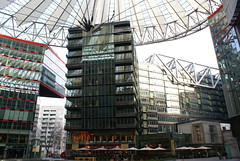
Look at the great stone buildings in any city and one can see exactly what is meant in this passage. And yet, in present day Berlin, there are few new buildings which one could imagine as a ruin. They are constructs of glass and steel, they would melt rather than fall, or shatter into millions of pieces. They cast no shadow – the sun passes through them as it does through high clouds in summer. They might one day burn away, but not through cataclysm or catastrophe, but simply through the fact that no-one will bother to look anymore. One’s eyes already find their way through to the other side.
Huyssen continues the passage above; ‘The void in the centre of Berlin will have been filled [he was writing in 1997]. But the memories of that haunting space from the months and years after the Wall came down will linger.’

In Berlin, history seems to creep up on you. Such is the level of trauma suffered by the city, it seems at first to forget itself, to be unaware of its own name. The visitor just arrived might walk its streets but they seem somehow unconnected, like individual roads recalled from other destinations. One walks but doesn’t have the feeling of going anywhere (something in part due to the lack on any particular centre). And yet, the more one questions the city with feet and roving eyes, the more the city begins to recall. At first it might remember just the names of its streets, those which are unconnected, as if a map of the city had been torn to pieces and its names read in fragments picked off the floor. It does not speak its memories aloud, but keeps quiet. There is I believe, a palpable sense of its history being a history of fear.

The Stasi, the infamous secret police of the GDR, have long since gone, but somehow one suspects that memory – which also in part seems to have been dismantled – has nonetheless its wiretaps, interrogation rooms and networks still intact. This decommissioned memory had long listened in on those who walked the streets, who sat in cafés, pored over maps and slept in hotel bedrooms, but now it is us that ask the questions, who attempt to listen. We can look upon its files, listen to the recordings made through its intricate devices. But everything seems disconnected. Memories seem fractured, just like the city itself. There is a caesura which exists between the past and the present, as if the wall, demolished in the city has somehow been rebuilt between them, as if the wide expanse of no-man’s land separates today from all that has gone before. And all these buildings built upon it do nothing to bridge this gap.
According to Huyssen, ‘the one architect who understood the nature of this empty space in the centre of Berlin was Daniel Liebskind, who, in 1992, made the following proposal.

“Rilke once said that everything is already there. We only must see it and protect it. We must develop a feel for places, streets, and houses which need our support. Take the open area at the Potsdamer Platz. I suggest a wilderness, one kilometer long, within which everything can stay as it is. The street simply ends in the bushes. Wonderful. After all, this area is the result of today’s divine natural law: nobody wanted it, nobody planned it, and yet it is firmly implanted in all our minds. And there in our minds, this image of the Potsdamer Platz void will remain for decades. Something like that cannot be easily erased, even if the whole area will be developed.”‘

As I said, I had little conception of what to expect of Berlin, but Potsdamer Platz has now been developed and in a sense Liebskind’s statement is true. The void cannot easily be erased and even though the area has been built upon, the buildings still convey a sense of emptiness. Perhaps memory should remain quiet despite our questions, perhaps through saying nothing it conveys much more than it ever could through words. Perhaps the city’s new buildings have been designed this way on purpose?
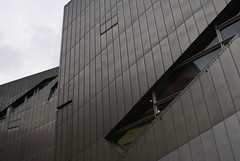
One building which cannot be said to be like any of those I’ve described (in general terms) above (at least in its exterior appearance), is the Jewish Museum (Judisches Museum) designed by Daniel Liebskind.

Berlin

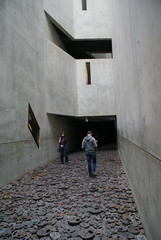
If ever there was a compliment to the spaces and voids which still exist in the physical aspect of the city, it is the history of the country’s Jewish population and Liebskind’s building – if not all its contents – allude starkly to that tragedy. It is a dark and foreboding structure which has no visible entrance (it is accessed through the adjacent Berlin Museum), and once inside, this sense of foreboding is conveyed through its corridors or, as they’re known – axis. What intrigued me most however as we made our way through the building, into the Holocaust Tower (itself a brilliantly evocative installation), back out and up to one of the building’s ‘voids'(home to an installation by Menashe Kadishman’s ‘Shalechet’) was how this building was not just housing an exhibition/display, but was itself an integral part of the story.

Berlin

In fact, as far as I was concerned, this building needed no contents; it is perhpas worthwhile stating that before the contents of the exhibitions were installed, 300,000 people came to visit the building anyway.
Huyssen states that the ‘…building has become a script. His building itself writes the discontinuous narrative that is Berlin, inscribes it physically into the very movement of the museum visitor and yet opens a space for remembrance to be articulated and read between the lines.” I would not disagree with any of this, however, I would say, that the exhibition itself hampers this overall effect. There is just too much information, too much too see, it is at odds with the building in terms of the style in which it is presented. The question is I think, ‘is this building a museum or a memorial?’ At the moment it doesn’t seem to know.

Berlin

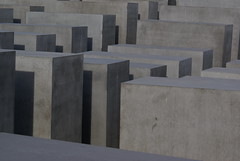
Something which knows exactly what it is, is the Memorial to the Murdered Jews of Europe. Of course there is controversy (one of many surrounding the project) as to why this memorial is only dedicated to one of the many groups persecuted by the Nazis, however, I do not wish to go into this matter here. What is worth looking at is the memorial above ground and its counterpart museum space below. When I first saw the memorial I must admit to feeling – despite its size – a little under-whelmed. I can’t say why, but it seemed a little messy somehow, a tad haphazard. Of course it is neither of these things but that is the impression it gave. However, when entering the memorial, this feeling changes, and in a sense that is part of its success. It pulls you in, it’s not something which can simply be observed and then left, it has to be experienced and understood.

Berlin

There is no definite beginning to the memorial. On the outside the stones are like the slabs of an individual tomb, but as one walks past others towards an opposing side, one quickly becomes dwarfed by the huge blocks in the centre. This for me resonates with something in which I’m particularly interested; the opposing poles of the individual and mass. The stones themselves – those towards the centre – are like the tombs one finds in a necropolis. But they are not named, the individual has quickly become effaced. And even though there are hundreds of these massive blocks, one is never lost amongst them, one can always see the other side. There is no mystery to the monument, it does not have the mystery of a maze or a labyrinth. We will find our way out. We can see the other side whereas none of the victims in their nightmare could. We walked into it as easily as Europe walked into atrocity, but reason – the other side – should always see that we never become lost again.
The museum below takes the shapes of the stones above and uses them throughout its displays, which, unlike the displays in the Jewish Museum, are perfectly weighted. In fact the whole experience is neither too long or too short. It’s simple and utterly compelling. In particular, the displays of families, including snapshots of happier times are devastating.

Berlin

And the room in which the names of individuals are displayed and a short biography read out is measured and particularly poignant. When one finally leaves the museum and emerges back within the memorial, the stones take on further meanings; each becomes a family group, reduced to nothing but a void realized in stone. Other people visiting the memorial appear ahead, or to the side, fleetingly to then disappear again in a moment; all part of the monument’s design.

Berlin

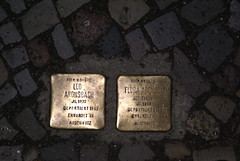
There were however other memorials dotted throughout the city, and perhaps the most poignant were those in Große Hamburger Straße. In the pavement, outside the former dwellings of Jews killed in the Holocaust, gold cobbles bearing the names of the victims and the location of their deaths have been installed. These simple, small yet visible monuments connect the person observing with the intimate lives of those who perished and in many ways reminded me of the plaques one finds on some of the schools in Paris. It is both as compelling and as heartbreaking to see the places from where people were taken, as it is to see the dreadful places they were taken to, and these cobbles are heartrending for that precise reason.

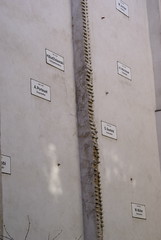
Also there was the work by artist Christian Boltanski, also on Große Hamburger Straße, ‘The Missing House’. This piece shows the names of residents on the walls of the houses either side which are of course still standing, and like the cobbles it’s poignant in how it links those who perished with dwellings which have also disappeared; another example of the city’s voids.

Berlin

Flying over Berlin, on my way back home, looking at the the tens of thousands of streetlights and the lights of buildings glittering below, I couldn’t help but think of the fires which raged throughout the city in the second world war. Every light was like the memory of the flames; fires now confined within glass spheres and tubes. And in between the lights are the dark patches, the voids which have burned themselves out. Berlin is indeed a city of voids and no amount of building will hide them; but then, perhaps that is the point.

Filed Under: Holocaust Tagged With: Andreas Huyssen, Berlin, Boltanski, Holocaust, Memorials, Sebald, WWII

Bereavement

February 4, 2008 by Nicholas Hedges

I wrote the following en-route to Berlin, shortly after my step-father, Robert Ross was first admitted to the Sobell House Hospice. I returned from Berlin yesterday and Robert, as I have written in a previous post, died peacefully this morning, aged 63.

“Mourning, or rather bereavement is the shock at discovering oneself, of seeing for the first time the shape, texture and colour of objects by which one has been surrounded for years. For some, this shock is too much to bear and things are given away, sold off or moved; suddenly ugly, the reason for their ever being placed on shelves impossible to fathom. Through the death of a loved being, we become through a period of mourning, the newly born child, existing for a time without a name. Without a name of our own we borrow that of the loved one, we hold on to it, we trace the shape of its letters, as if they were the contours of an effigy on their tomb.”

Filed Under: Uncategorized Tagged With: Bereavement, Death, Rob

Robert Ross (1944-2008)

February 4, 2008 by Nicholas Hedges

This morning, at Sobell House in Oxford, my step-father Robert Ross died peacefully aged 63. He’d been ill for many years although for much of that time one wouldn’t have known on account of the tremendously postive attitude he showed towards his illness. Diagnosed with cancer in 1996, he underwent major surgery and was later diagnosed with secondary cancer of the lungs and liver. Given a year to live, he started work on a book ‘Counselling as a Career’ which he later published, and continued to appear in musicals, plays and pantomimes put on by the Lime Walk Players; some of which he wrote himself, namely; ‘Climb Every Mountain,’ ‘The Awkward Squad,’ and ‘The Rub of the Green.’ He also wrote a play inspired by his experiences, ‘The Guiding Hand,’ which he put on at the Old Fire Station in Oxford. I myself was privileged to see him perform the title role in a musical I myself penned entitled ‘Merlin!’ in February 2004.

With the second diagnosis proving incorrect, Robert was diagnosed with a brain tumour in 2003. Two years ago, the stress of his illness began to take its toll and increasingly over the course of last year, despite moments when his health picked up a little, his condition, as a whole began to deteriorate. This deterioration increased at the end of the year and just over a week ago he was admitted to The Sobell Hospice.

Filed Under: Uncategorized Tagged With: Death, Rob

Creatures

January 30, 2008 by Nicholas Hedges

Yesterday, as part of my MA, I showed a collection of photographs entitled ‘Creatures’. Some of the photographs and the supporting text can be found in the Gallery section of this website, under ‘Creatures‘.

In the feedback session afterwards, the response was, I felt very positive, but what was interesting for me as an artist was the discussion around the different media I employed to show the images. There were of course the photographs on the wall, there was a book which contained the same sets of photographs, and finally the website, which comprised the supporting text and interactive versions of the images.

Different things appealed to different people, but what most people agreed was that the book was particularly engaging. Why was this? What is it about the book which holds our attention, or rather captures our attention so much more – or rather so differently – than pictures on a wall?

One aspect is the fact that on looking at the images on the wall (or any collection of images) one moves; one has to walk from one picture to the next. It may seem an obvious point but it’s one which I hadn’t considered when setting up the exhibition. With a book of course, one is sedentary. Obviously one can walk with a book, but even then there is a difference, with a book the viewer is in control, the viewer has control of time; when images are on a wall, there is inevitably a sense that at some point one must move on. There also is something very personal about a book of photographs as opposed again, to those on a wall. We are all familiar with photograph albums and have no doubt at one time or another spent idle moments looking through the pages of our own family collection. There is then, I believe, a sort of empathy which exists between viewer and artist when images such as these are presented in book form. It is the act of looking at a book which is very personal, it’s a remembered action, one which we do quite unconsciously which connects the viewer with the images.

When the images are on a wall, they become objects, that sense empathy is broken – or rather, it doesn’t exist. A phrase used by someone during the feedback was ‘mechanical’. The selection of the photograph, the enlarging of a detail soon becomes clear as a process which almost threatens the work in terms of its actual content. Someone said that he first viewed the work on an intellectual level, and then, at this point where the intellectual/process part of the work threatened to dominate, this intellectual engagement became an emotional one; this was when he realised the images were my old family photographs.

This was an interesting point in that during the feedback, I began to think that it would be better to show the original, unmounted, photographs rather than mounted copies, or at least, copies which more accurately reproduced the original image. There needs to be a greater distinction between the two. One set are my family photographs, they are intensely personal – the others are photographs of different people; they are not personal (although the contributed in some way to a personal moment). Also, someone suggested – in terms of work shown on the wall – that there needs to be fewer images and perhaps larger details. This however wouldn’t be the case with the book. Again, time is at play here; with a book, one has control over time, one can flick through the pages, put the book down, open it again moments, days or weeks later. In a gallery, or with images on a wall, that engagement is, as I’ve said of a very different quality. One has to (physically) leave images behind, and, in a sense, this is no bad thing. The present passes and moves behind us, the present exists for as long as we are consciously aware of it being present. We hold the image before us, as we consciously hold life before us, and then we move on.

So there is a sense – one that needs to be explored in greater depth – that the temporal aspects of perceiving an artwork are at play here. There is the emotional engagement which might be stronger when images are presented in a book. It is interesting in that during the show of work, a colleague told me about friends of his who’d been to Auschwitz and who had seen a wall of snapshots found in the camp. I told him that I had the book and after the feedback began to think about how different my engagement with these images would be in terms of seeing them on a wall and seeing them on the page. Turning pages makes one subconsciously think of one’s own family albums and this gives the photographs of a stranger a somewhat personal quality.

Thinking back to the suggestion then that there needs to be fewer images and details which are physically larger, I would suggest that the opposite might be true. Perhaps the details should be shown on a scale identical with those of the original photograph? Perhaps they should be places in an album all of their own? Perhaps they should be shown as a pile which one can pick though, or in a cardboard box or suitcase from which one can take them.

There are many possibilities which need to be explored. I believe the photographs as they are, work, but I am intrigued by the emotional and temporal aspects of the way in which they are shown.

Filed Under: Photography Tagged With: Creatures, Photographs

Dreamcatcher IV

January 27, 2008 by Nicholas Hedges

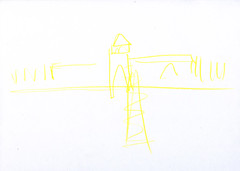
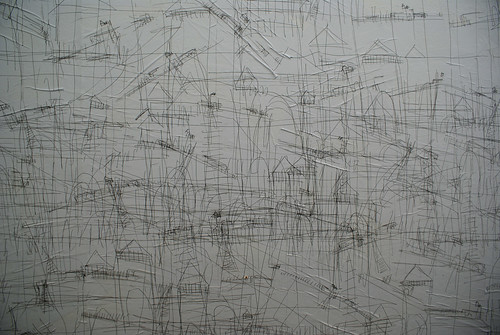
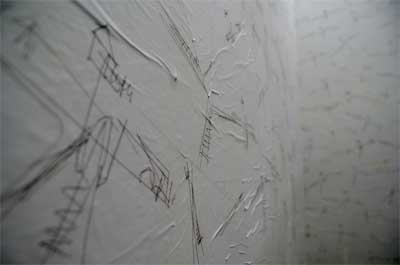
In my latest session of work on the Dreamcatcher installation, I have started to add to those drawings already wallpapered to the wall. The drawings as they stand work well, but with the string aspect of the installation they need to become more like a single mass of lines rather than a collection of individual works. Therefore, I have started to draw directly on the walls, drawing large and small versions of the image. This for me leant itself neatly to the notion of an obsessive mind working on the question of how such a thing could have happened. Also, the constant drawing on a large scale (scale in terms of the physical space of the images rather than a single image itself) called to mind a mathematician working out a puzzle – trying to find an answer. There was also the action of the drawing itself; for the first time I found myself drawing with my eyes open, and yet, despite this the image of the gatetower produced was identical with that made when my eyes were closed; it seems there is no answer to be had, just an endless puzzle to be worked on.

There is also the sense as I am drawing of becoming trapped by the lines, of becoming imprisoned or ensnared by them; the more lines I make the less the chance of escape – the less chance of an answer.
The net of course which will hang in the centre of the piece is the ‘dreamcatcher’, something which lets the good dreams through and ensnares the nightmares and therefore there is this correlation between the two aspects of the piece.

Dreamcatcher

I can easily imagine a piece of work in which this idea is explored – a performance piece in which standing before a large blackboard I make a series of chalk drawings as if I am trying to find an answer.
This I will explore in the coming weeks.

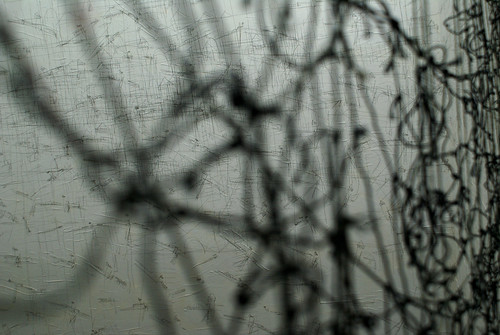
As things stand now, I need to start working on the string element of the piece. I have already worked on a ‘net-like’ piece using pieces of cut string (denoting both the lives of many individuals and an individual’s memories) and took a few pictures of the drawing through this net, just to start giving me a sense of the overall work.

Dreamcatcher

Having discussed the idea above, I couldn’t help but invert one of the photographs to see how a blackboard version might appear. The outcome reminded me of an animation I made from the first drawings I ever did in this series which can be found by clicking here.

Filed Under: Holocaust Tagged With: Dreamcatcher, Holocaust, WWII

Dreamcatcher III

January 21, 2008 by Nicholas Hedges

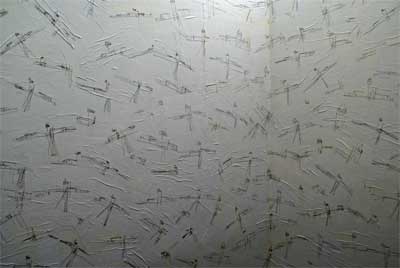
Having completed one side and a corner of the installation ‘prototype’, pasting approximately 300 A4 drawings onto my studio walls, I believe that my initial concerns about the sizes of the individual drawings may be unfounded. In fact, as the walls have dried, and more images have been pasted on top of one another, the overall effect is as I’d first envisaged it.

Dreamcatcher (Work in Progress)

Dreamcatcher (Work in Progress)

Working in a corner has been important in this respect, as I can get a better impression of how the whole room will come together. The next stage will be adding in the string.

Filed Under: Holocaust Tagged With: Dreamcatcher, Holocaust, WWII

Wallpaper

January 15, 2008 by Nicholas Hedges

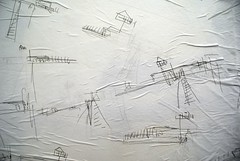
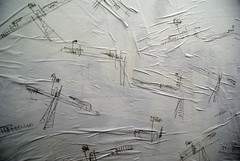
Today I started wallpapering the drawings I described in the previous entry to a wall in my studio in order to see how they would look and to see what techniques would be best for the installation at MAO. After a while, it became clear that the effect wasn’t quite what I was hoping for. I must admit I’d expected as much given that the drawings are all very similar – practically identical – being as they are, drawn on white A4 sheets of copy paper.

Dreamcatcher (Work in Progress)

What I need to to is to create many more drawings (still including those on A4 sheets), drawn on different types/qualities of paper and of various sizes. I need to give the impression that this is the work of an obsessive mind to some degree, and therefore, the idea of scribbling drawings on whatever comes to hand would best be served by this change in approach.

Another thing to consider is the installation of the work itself. How might I create readymade wallpapered walls?

As it stands, there are things about the way the work looks that interest me. One things is the way it calls to mind the wallpaper one might find in a child’s bedroom; repeated motifs – the stuff of nightmares after dark, which, incidentally, ties in with a related project based around the story of Hansel and Gretel.

Dreamcatcher (Work in Progress)

Talking of wallpaper has brought to mind an extract in Eric L. Santer’s book, ‘Of Creaturely Life, taken from Rainer Maria Rilke’s novel, ‘The Notebooks of Malte Laurids Brigge.’

“It was, so to speak, not the first wall of the existing house (as you would have supposed), but the last of the ones that were no longer there. You could see its inside. You could see, at its various stories, bedroom walls with wallpaper still sticking to them; and here and there a piece of floor or ceiling. Near these bedroom walls there remained, along the entire length of the outer wall, a dirty white space through which, in unspeakably nauseating, worm-soft digestive movements, the open, rust-spotted channel of the toilet pipe crawled. The gaslight jets had left dusty grey traces at the edges of the ceiling; they bent here and there, abruptly, ran along the walls, and plunged into the black, gaping holes that had been torn there. But the most unforgettable things were the walls themselves. The stubborn life of these rooms had not let itself be trampled out. It was still there; it clung to the nails that were left, stood on the narrow remnant of flooring, crouched under the corner beams where a bit of interior still remained. You could see it in the paint which it had changed, slowly, from year to year: blue into mouldy green, green into grey, yellow into a faded, rotting white. But it was also in the places that had been kept fresher behind mirrors, paintings, and wardrobes; for it had traced their outlines over and over, and had been with cobwebs and dust even in these hidden places, which were now laid bare. It was in every flayed strip of surface; it was in the dame blisters on the lower edges of the wallpaper; it fluttered in the torn-off shreds, and oozed from the foul stains which had appeared long before. And from these walls, once blue, green, and yellow, and now framed by the broken tracks of the demolished partitions, the air of these lives issued, the stubborn, sluggish, musty air which no wind had yet scattered. There the noons lingered, and the illnesses, and the exhalations, and the smoke of many years, and the sweat that trickles down from armpits and makes clothing heavy, and the stale breath of mouths, and the oily smell of sweltering feet. There the pungent odour of urine lingered, and the odour of soot, the grey odour of potatoes, and the heavy, sickening stench of rancid grease. The sweet smell of neglected infants lingered there, the smell of frightened schoolchildren, and the stuffiness from the beds of pubescent boys. And all the vapours that had risen from the street below, or fallen down from above with the filthy urban rain.”

Filed Under: Uncategorized Tagged With: Creatures, Drawings, Eric L Santer, Rilke

Forgetting

January 7, 2008 by Nicholas Hedges

Today I started work on my Dreamcatcher installation which will be installed in Modern Art Oxford in March 2008 as part of the Brookes Exhibition which runs for approximately nine days. Part of the installation comprises hundreds of drawings which I will wallpaper on the walls of a room, and in preparation for a trial version of the piece I created about 100 drawings this morning. And it was whilst making these drawings that I became aware of how, after a while, my hand seemed to be working quite independently of my mind. The lines of the drawing had come to form a pattern of sorts and my hand was simply going through the motions, churning out images not of the gate tower of Auschwitz-Birkenau per se, but rather drawings of drawings of the gate-tower of Auschwitz-Birkenau. My memory had become a pattern and although this did at first disconcert me, in the end I came to see it as something positive, insofar as my work on memory and memorials is concerned.

In his book ‘Present Pasts – Urban Palimpsests and the Politics of Memory,’ Andreas Huyssen asks:

“Is it the fear of forgetting that triggers the desire to remember, or is it perhaps the other way around? Could it be that the surfeit of memory in this media-saturated culture creates such overload that the memory system itself is in constant danger of imploding, thus triggering fear of forgetting?”

I would take this further and suggest that the overload of the memory system does not necessarily trigger a fear of forgetting, but rather it triggers forgetting itself. I was also reminded of Frances A. Yates’ book ‘The Art of Memory’ in which she discusses Socrates’ story of the invention of writing by the God Theuth.

“In the Phaedrus; Socrates tells the story of the God Theuth who invented numbers and arithmetic, geometry and astronomy, draughts and dice, and most importantly of all, letters. The king of all Egypt was the God Thamus who told Theuth that the invention of writing was not, as suggested, an elixir of memory and wisdom, but of reminding; the invention will produce forgetfulness.”

If one equates my line drawings with text, one can see how the re-remembering of the memory of Auschwitz-Birkenau through drawing has resulted (at least whilst making the drawings) in that memory being forgotten. What I’m actually remembering is not my visit, but a memory of that visit. And as such these drawings are somehow equivalent to post-memories; memories we might have of the Holocaust which of course we never experienced.

So what does this mean for the Dreamcatcher work?

The work itself is in part about how we can visit places such as Auschwitz-Birkenau, safe in the knowledge that we can leave; just as we know we’ll always wake from our nightmares. Dreams and nightmares will eventually fade – they will be forgotten; they are unreal, much like our own post-memories of unwitnessed events.

So what is brought into question therefore is how best to remember atrocities such as Auschiwtz, the Holocaust and War in general?

Filed Under: Holocaust Tagged With: Andreas Huyssen, Dreamcatcher, Frances Yates, Holocaust, WW2, WWII

Brief Notes on Boredom

December 13, 2007 by Nicholas Hedges

Notes from ‘On Creaturely Life’ by Eric Santner

“In being left empty by profound boredom, something vibrates, like an echo of that ‘essential disruption’ that arises in the animal from its being exposed and taken in an ‘other’ that is, however, never revealed to it as such. For this reason the man who becomes bored finds himself in the ‘closest proximity’ even if it is only apparent – to animal captivation.”

21

“‘The jewel set at the center of the human world and its Lichtung,’ Agamben writes, ‘is nothing but animal captivation; the wonder ‘that beings are’ is nothing but the grasping of the ‘essential disruption’ that occurs in the living being from its being exposed in a nonrevelation.’ But this means, Agamben continues, that Dasein is simply an animal that has learned to become bored; it has awakened from its own captivation to its own captivation. This awakening of the living being to its own being-captivated, this anxious and resolute opening to a not-open, is the human.”

Filed Under: Photography Tagged With: Agamben, Boredom, Eric L Santer, Photographs

Young Werther

December 7, 2007 by Nicholas Hedges

Whilst showing my tutor some of my research regarding photographs found in Auschwitz, she pointed out that on the reverse of one of them was a quote regarding Goethe.

The following photograph was taken in Bedzin in Poland in the 1930s.

The book from which this image was taken, states that it is a picture of: “Moniek Szwajcer (right) in front of the ruins in Bedzin. Dedicated possibly to Zygmunt Sztrochlic and Sabka Konińska.” And inscribed on the back in Polish were the words: “For my dear Zygmunt and lovely Sabka, in commemoration of beautiful years of work together at the school. From ‘Young Werther’, Moniek. Bedzin, 29 October 1937.

Young Werther refers to the book ‘The Sorrows of Young Werther,” by Goethe, which as a result of re-visiting this photograph, I have bought.

Filed Under: Photography Tagged With: Bedzin, Goethe, Holocaust, Vintage Photographs, WWII

Waving on the Mountain

December 7, 2007 by Nicholas Hedges

Yesterday I visited my paternal Grandmother and over a period of about three hours, talked with her about her childhood in South Wales and her early years in Oxford. All too often these days we don’t allow the old to speak; too often we try to speak for them, to tell them what they know (what we think they know) talking as if they are foreign and speaking at them slowly and loudly, as if that will help them ‘understand.’ I was keen with my Grandmother (Nana) to get her to just talk, and for her to make connections without my trying to prompt or ask too many questions.

As we get older, our brains lose connections, but sometimes things that may seem forgotten simply require a different map, another means of finding them, the longer way round – a longer path. Talking through events, one often stumbles upon something that leads somewhere else, a new route is found and that which was lost is rediscovered. But if we prompt too much things will remain obscured; forgotten.

Talking with my Grandmother was a very special experience and I wondered as I listened, when it was that she last spoke at length about her past? From memories of her father (who died in 1928), her Grandmother (born in 1864), to her own retirement, she took me on a journey from the mountains of Wales, to a public school in Cheltenham and on to the houses of Oxford, where she worked as a maid in the late 1920s and early 30s. But it was her reminiscences of her father which were particularly moving.

Through researching my family tree, I’ve got to know many of the names of family members, back as far as the beginning of the nineteenth century, but that, along with a few dates is all I know. My Grandmother wasn’t sure she’d be of any use to me in my research, but as I pointed out, her memories are worth their weight in gold. I can find names and dates, but it’s who these people were that matters most, and the only person who could help me was her.

Below is a photograph of my Grandmother’s father (my Great Grandfather), Elias Jones.

Elias Jones

Born in Trevethin, Monmouthshire in 1882, he worked as a miner in the pit at Llanhilleth, a short distance away from where he lived with his wife Mary Jane and their five children, Ruth, Lillian (my Grandmother), Doll, Ray and George (one girl, Florence or Flossie, died aged 2 c.1918). With just a photograph, a name, dates and occupation, it’s difficult to surmise what he might have been liked. One tends to assume (unfairly) that miners in those days must have been – due to the harshness of their work – rather dour or surly people, but talking to my Grandmother, it became clear that as regards Elias, this couldn’t have been further from the truth. Below are a couple of extracts from our conversation.

On his walking to work:
“I can see him now, because he went up our garden over the road and the mountain started from there up… and he’d go so far up and he’d turn back and wave to us.”
On his being at home:
“I can remember now he would always help our Mam wash our hair on a Friday night… our Ruth would go first, she would wash it and our Dad would dry it and mine next…”
On his death:
“I can always remember the doctor in the room when we realised he wasn’t going to come through, he said ‘don’t grieve for him Mrs Jones, you know what he said to me, “if I can’t work for my wife and children I don’t want to stay.”‘ And he just passed away. “

Just these few, brief extracts tell me a great deal about the man in the photograph; a man who clearly loved his family and who through his working in the mines, succumbed to a disease of the lungs (possibly pneumoconiosis or ‘black lung disease’) at the age of just 42. And the image of him turning on the mountain to wave at his children below is one which will not only stay with me forever, but one I which would like to ‘explore’ in my forthcoming work. I had wanted to draw the outline of the mountain, but I also think it will be necessary to follow the route Elias Jones took, from his house, over the mountain to the pit at Llanhilleth.
Deaths in the mines (as well as deaths as a consequence of working them) were sadly nothing exceptional. And as my Grandmother poignantly explained:

“…when there was a death you know every blind in that street would be drawn, we knew directly we heard of a death the women would draw their blinds down and they would nearly all turn out to a funeral down there… Kind of almost took it in our stride you know, oh dear there’s another one gone, killed in the mines.”

Filed Under: Family History Tagged With: Elias Jones, Family History, Family Jones, Hafodyrynys, Jones, Nana

The Memory of the Mountain

December 6, 2007 by Nicholas Hedges

Having considered my recent findings as to the meaning behind the name Pantygasseg, I realised that a visit to the area in the next few weeks was essential. I knew I had to draw the outline of the mountain, it’s shape, perhaps on a large wall, but as I considered the line, I began to think of ways of expressing it. Could there be a way of expressing it sonically for example? Perhaps, yes, but the more I thought about it, the more I thought about using material pertinent to the place itself, in this instance; coal.

My work is about mining the past, bringing the past to the surface, and coal is of course a product of the past (mined and brought to the surface). It’s a material composed of things which lived and which could be used to create, i.e. like charcoal – and could be used to draw the line of the mountain, or to be more precise, my memory of the line of the mountain. Coal is therefore a means of expressing my memory using the very substance of the mountain’s own; a means which also highlights the contrast between the human scale of time and History itself.

There’s also a contrast (with regards to my research on the Family Tree and my work on the Holocaust) between memory and forgetting, particularly when considering the metaphor of the ground as mind. The ground is mined, coal is extracted and the past is ‘remembered’. What the Nazis were hoping to accomplish, when they killed and buried hundreds of thousands in pits (at places such as Belzec) was, in a sense, to forget.

Filed Under: Holocaust Tagged With: Coal, Family History, Holocaust, Memory, Mountain, WWII

Invisible Cities

November 29, 2007 by Nicholas Hedges

Distance

“Irene is a name for a city in the distance, and if you approach, it changes. For those who pass it without entering, the city is one thing; it is another for those who are trapped by it and never leave. There is the city where you arrive for the first time; and there is another city which you leave never to return. Each deserves a different name; perhaps I have already spoken of Irene under other names; perhaps I have spoken only of Irene.”
Threads

“Also in Raissa, city of sadness, there runs an invisible thread that binds one living being to another for a moment, then unravels, then is stretched again between moving points as it draws new and rapid patterns so that every second the unhappy city contains a happy city unaware of its own existence.”
Postcards

“Beware of saying to them that sometimes different cities follow on from one another on the same site and under the same name, born and dying without knowing one another, without communication among themselves. At times even the names of the inhabitants remain the same, and their voices’ accent, and also the features of the faces; but gods who live beneath names and above places have gone off without a word and outsiders have settled in their place. It is pointless to ask whether the new ones are better or worse than the old, since there is no connection between them, just as old postcards do not depict Maurilia as it was, but a different city which, by chance, was called Maurilia, like this one.”
Measurements

“The city does not consist of this but of relationships between the measurements of its space and the events of its past; the height of a lamppost and the distance from the ground of a hanged usurper’s swaying feet; the line strung from the lamppost to the railing opposite and the festoons that decorate the course of the queen’s nuptial procession; the height of that railing and the leap of the adulterer who climbed over it at dawn; the tilt of a guttering and a cat’s progress along it as he slips into the same window; the firing range of a gunboat which has suddenly appeared beyond the cape and the bomb that destroys the guttering; the rips in the fish net and the three old men seated on the dock mending nets and telling each other for the hundredth time the story of the gunboat of the usurper, who some same was the queen’s illegitimate son, abandoned in his swaddling clothes there on the dock… As this wave of memories flows in, the city soaks it up like a sponge and expands. A description of Zaira as it is today should contain all Zaira’s past. The city, however, does not tell its past, but contains it like the lines of a hand, written in the corners of the streets, the gratings of the windows, the banisters of the steps, the antennae of the lightning rods, the poles of the flags, every segment marked in turn with scratches, indentations, scrolls.”
Memory

“Zora’s secret lies in the way your gaze runs over patterns following one another as in a musical score where not a note can be altered or displaced… The city which cannot be expunged from the mind is like an armature, a honeycomb in whose cells each of us can place the things he wants to remember: names of famous men, virtues, numbers, vegetable and mineral classifications, dates of battles, constellations, parts of speech. Between each idea and each point of the itinerary an affinity or a contrast can be established, serving as an immediate aid to memory.”
Contingency

“In Chloe, a great city, the people who move through the streets are all strangers. At each encounter, they imagine a thousand things about one another; meetings which could take place between them, conversations, surprises, caresses, bites… Something runs among them, an exchange of glances like lines that connect one figure with another and draws arrows, stars, triangles, until all combinations are used up in a moment…”

Memory
“Zora’s secret lies in the way your gaze runs over patterns following one another as in a musical score where not a note can be altered or displaced… The city which cannot be expunged from the mind is like an armature, a honeycomb in whose cells each of us can place the things he wants to remember: names of famous men, virtues, numbers, vegetable and mineral classifications, dates of battles, constellations ,parts of speech. Between each idea and each point of the itinerary an affinity or a contrast can be established, serving as an immediate aid to memory.”

Filed Under: Uncategorized Tagged With: Distance, Italo Calvino, Memory, Postcards

Pantygasseg

November 27, 2007 by Nicholas Hedges

It was – if my ‘facts’ are correct – either my great-grandfather or great-great-grandfather who worked in the Pantygasseg mine in South Wales and having Googled the place, I found the following on Wikipedia:

“Pantygasseg (Pant-y-gaseg) is the name given to a single row of houses on the mountain to the west of Pontypool in Torfaen county borough, South Wales. The name means ‘Hollow in the mare’s back’: mare’s (caseg>gaseg) hollow (pant). This is due to the shape of the mountain as it appears on the horizon.”

What interested me about this description was the meaning of the name, particularly as I’ve recently been working on photographs in which I’ve taken distant people and enlarged them so as to become the principal subjects of new versions of the images. Distance is a theme I wish to explore over the coming weeks and taking the description above, I could at once see its relevance, for the horizon is of course the horizon because its in the distance. Pantygasseg therefore gets its name through its being – in some respects – a part of (or identified with) the distance.

In his book, ‘Phenomenology of Perception’, Merleau-Ponty writes:

“I am the absolute source, my existence does not stem from my antecedents, from my physical and social environment; instead it moves out towards them and sustains them, for I alone bring into being for myself… the tradition which I elect to carry on, or the horizon whose distance from me would be abolished – since that distance is not one of its properties – if I were not there to scan it with my gaze.”

In this extract, Merleau-Ponty observes how a place cannot be distant in terms of its actual, physical properties; it can be big, small, rural, urban etc. but it cannot be distant; distance dependends on the location of the observer; without the observer distance would, as Merleau-Ponty states, be ‘abolished’. The fact that Pantygasseg is so named because of is being a part of the shape of the distance – a hollow in the horizon (shaped like a mare’s back) conjures up the image of an eternal stranger looking at it from far away; someone outside the village, who sees it, knows it well enough to know its name, but is not himself a part. I feel exactly like that stranger. Pantygasseg would have been a well known feature of the landscape of my great-great-great-grandfather’s life and those of his descendents including my grandmother (in her youth) and is therefore both part of my landscape (a landscape from which I have come) and at the same time utterly unknown, a metaphor for all those distant places I know, but of which I am not a part.

Thinking of the shape of the mountain I was reminded of a drawing I made in my diary whilst on holiday in Chania earlier this year.

Chania

It is a sketch of the mountains which dominate the horizon, and every day, as I looked at them and followed the contours with my eyes, I couldn’t help but think how those who lived in the city thousands of years ago would have seen that same shape, the same jagged line in the distance. There is something timeless about mountains which make one feel every bit the mortal we are. Pantygasseg as a place, at least through its name is a part of that timeless past and a part of my past, a line which my ancestors would have traced with their eyes and one which I realise I must also follow.

Returning again to the quote from Merleau-Ponty; he writes how his existence does not stem from his antecedents, or from his physical and social environment; instead it moves out towards them and sustains them. I was taken by this, as by going to Pantygasseg, I will be moving towards my antecedents, to sustain them in my memory.

Filed Under: Uncategorized Tagged With: Distance, Hafodyrynys, Merleau-Ponty, Pantygasseg, Phenomenology

The Moment

November 23, 2007 by Nicholas Hedges

Recently I was reading an article in the National Geographic about memory and was particularly interested in an explanation of how it works, i.e. the physical/chemical structure of a memory within the human brain. In layman’s terms, the brain is in a constant state of flux; neurons communicate with one another via a 1000 trillion synapses and a memory is a stored pattern of this communication. Every memory we have therefore is a pattern, the shape of a network, which ties in with the image I drew of a moment as being made up of numerous lines – pathways – knotted together, but always in flux, always being untied and retied with other paths to make new moments. Therefore, re-creating a memory (or a post-memory) in ‘artistic’ terms (string work) is, diagramatically how memory works in the human brain.

I have also been considering how my research into my family tree fits in with the projects I have been working on recently and over the past year or so. I made the following list of areas which have interested me:

My place in history (Holocaust, WW1)
My place in the spaces of history (Auschwitz-Birkenau, Oxford)
My relationship with people in the past and their relationship with me
Old photographs of Oxford
Old photographs of victims found in Auschwitz / found photographs
Old family photographs (holiday snaps/distance)
Memorials (as aids to memory and post-memory)
Objects (as aids to memory and post-memory)
Landscape (past, present and future)
Perception of history/the past (Frog and Dinosaur)
Maps, fictional and factual
Pathways
Moments as a combination of pathways
Potential Space
Windows and bicycles in old photographs
Twinned (GPS)
Parisian Cemeteries

The family tree is a living document. There is a big difference between a list of names on a memorial and those in a family tree. It is a social document which reveals my relationship with people in the past as well as the sheer number of people to whom I am related today; people who are as anonymous to me as I am to them.

It is a document of my coming into being and a blueprint for my own existence. It’s an impossible document, both certain and utterly implausible at the same time, and its impossibility, the unlikely combination of encounters from the late eighteenth century through to the present, is illustrated when births are mapped on a map of the British Isles. Ancestors from Norfolk, Lincolnshire, South Wales, Sussex, Warwickshire, Oxfordshire and Berkshire all moved from villages to towns, from one part of the country to another, following pathways which eventually led to my being born in Oxford in 1971. Every action they made, every thought they had (which of course would influence their actions) had to be exactly as it was for me to be who I am; anything different, no matter how small or irrelevant, and I would not be me. The more one thinks about the combination of actions and thoughts, things that were said and things that weren’t said, things seen and those which went unnoticed, the more impossible existence becomes.

This means of course that it isn’t simply the thoughts and actions of our ancestors which had to be the same; the thoughts and actions of everyone they knew, or strangers they met or saw in the street had to be as they were, for nothing exists in isolation.

These – till recently – unknown, anonymous relatives are like the distant people in my old holiday snaps, people with whom I shared a space and who therefore, unwittingly affected the path I took in life. Making these anonymous people the subjects of the photograph, places me and my family into the distance and therefore allows me to experience what it means to be anonymous to other people; the fact is, there is no difference at all.

I am related to thousands of people I do not know, who are distant, yet our lives have been brought into being through common elements; a shared ancestry.

Looking at holiday snaps as things in themselves we can say that they are two things; they are examples of both a memory and a moment. Of course, it could be argued that they are memories of moments and therefore one the same thing; however memories of that moment (sitting on the beach) are only linked to the main subjects (my family) and not the rest of the people who shared, or made that moment. Referring back to the maps of memories and moments, these photographs and indeed every photograph taken are themselves both these maps in one; they are the image of someone’s memory (the photographer’s) and the image of a combination of paths at a given moment in time.

When looking at photographs taken in times before our birth, we become a part of the moment and somehow witness that moment. To view, for example a photograph of Oxford taken in 1907 is to participate in that moment and in the photographer’s memory. We can use conjecture to imagine the immediate future and the past, but of course this then becomes a fiction, a made up country like the places I would invent as a child; a case of the frog and the dinosaur, where fragments of the past (dinosaur DNA in the bodies of mosquitoes trapped in amber) are combined with our own imaginal thought (frog DNA) to create our new Dinosaur (our picture of History).

As I’ve said before, this Jurassic Park metaphor is interesting in that our own DNA is itself derived from our ancestors, some of whom would have participated in the moment of the photograph, after all, a moment is not restricted by space, a moment is not defined by a physical place, but a period of time covering all places. In the photograph shown, I can wonder what my Great-Grandmother was doing the moment the shutter was released.

To some extent, we have all participated in all time because we are the outcome of an immense combination of moments, each comprising incredibly intricate paths, thoughts, conversations etc. We were imminent or potential in every moment, and as every moment required for our coming into being came and went as it should, so our potential grew until we were born. Anything different, anywhere in the world and we might not be here.

The non-confining of moments to space is illustrated by the boundaries of a photograph. Events pictured in a photograph did not happen in isolation. An open window reveals other spaces of that moment, spaces such as those inhabited in that moment by my forebears. Open windows are evidence of lives being led, oblivious to the photograph being taken.

A parked bicycle at the side of the road is also evidence of this. The owner of that bicycle has left the picture, but not the moment; he is completely unaware of the image being taken, and through his absence in the image, his presence in the moment is somehow heightened.

When looking at photographs of the Holocaust, in particular of transports arriving at Auschwitz-Birkenau, we must remember that these events did not happen in isolation. The moment did not exist solely behind the barbed wire fences or within the borders of the photograph, but across the entire world, and, as with my holiday snaps, reality is not that determined by the lens of the camera, it is not only a moment annexed by the chemical reactions which miraculously capture the image or solely the subject of a discriminating eye, but everything existing around it. Just as enlarging the distance of a photograph pushes the original subject into the distance (a subject made no less real because of it), so we can imagine the photographs taken at Auschwitz-Birkenau as being events in which my ancestors were simply the distance, in which they shared a moment in time; and it wouldn’t take a leap of the imagination to enlarge the distance of these images and make those who are distant, my ancestors, the subject.

Researching my family tree has heightened the sense of my participation in past events. Recalling Henri Bortoft’s book, ‘The Wholeness of Nature’ I thought about authentic wholes and how the whole is imminent in the parts. If we as individuals are the parts of the whole family tree then it might be said that the entire family tree, past, present and future is imminent in each and every one of us. I thought also of my work on the gesture of the apple tree in my garden and considered how much it shares with the gesture of individual existence.

Thinking about this and the idea of my ancestors being merely in the distance of the Holocaust, I thought about the gesture of the Holocaust, something which showed itself to me whilst watching Raul Hildberg in Claude Lanzmann’s ‘Shoah’, when he talked about a document detailing the journeys of death trains arriving and leaving Treblinka. The document was on the face of it a banal piece of bureaucracy, a timetable which, superficially, had all the significance of a timetable for trains taking tourists on holiday (it should be known that the same company which timetabled the trains for taking the Jews to the death camps, and which collected the fares they had to pay, was at the same time transporting people on their holidays, where they no doubt took photographs). Of course, these trains were taking, as I said, the Jews to their deaths. Therefore, when looking at photographs of trains at Birkenau, one mustn’t just see them as trains that have always been there within the confines of the image, just as the people being unloaded were never only victims. They were people who had lives before the war, brought in on trains, timetabled by bureaucrats from places all over Europe. With them they brought the banal objects of existence from which we can try and piece their lives together. But banal in this sense does not mean dull or boring, but rather normal in the face of what they were to experience.

Looking again at my map of where I came from, I get the sense of people not existing in isolation and also of moments not being confined to spaces or places; I understand with greater clarity, the sense of who these victims were; people just like me and my ancestors. And when researching, it is often the banal which is the most interesting, not as I said, the dull or boring, but what is normal in the face of History.

Filed Under: Uncategorized Tagged With: Biology, Henri Bortoft, Memory

Family Tree

November 20, 2007 by Nicholas Hedges

With both my Grandmothers still with us (both were born in 1912), I’m very fortunate to have living connections with the late nineteenth century. When they talk about their childhoods and youth, they are describing a world which has always seemed completely alien to that in which we live today, and using one’s imagination, to go beyond that world, further back into the past, that place, the world, becomes stranger still. This world, when conceived within the imagination is like a fiction. In a talk I gave as part of my residency at OVADA in May 2007, I stated that:

“…as a child, I liked to create and map worlds; countries which I would build from fragments of the world around me; forests, mountains and plains – unspoilt landscapes. And in these worlds there would exist towns and cities, created from ‘the best bits’ of those I had visited. 

These invented worlds became, as I grew up, the ‘invented’ or imagined landscapes of Oxford’s past; landscapes that were – just as they still are – created from fragments, parts of the past which are still extant in the city; old buildings, walls, objects and so on. Between these structures, these fragments, I would fill the gaps, with my own imagination, with thoughts derived from my own experience. The city’s past and the past in general, as it exists within my mind, is then, to use the metaphor of cloning in Jurassic Park, a cloned dinosaur. The extant buildings, structures and objects within museums, are like the mosquitoes trapped inside the amber. They are broken strands of DNA. All that is required is for me to fill the gaps, and this I can do with my own DNA. I am in effect, the frog.”

I will return to the frog later.

All I knew prior to my research, was that part of my family, on my father’s side, came from South Wales and worked in the mines, and that my family on my mother’s side heralded from Reading. My paternal grandfather was always an Oxford man and his family had been in the area for generations. My maternal great-grandmother (born in 1878 and who I can remember) was said to have come from Suffolk and was the daughter of a farmer (Norfolk as it would transpire).

Researching the family tree quickly becomes, not so much obsessive, but rather, compulsive; necessary. The dead, and at that, the anonymous dead, come back to life and make themselves known to you, and, what is more compelling, one feels oneself become more solid, more flesh and blood than ever before; one begins to exist in four dimensions rather than simply three (as if we, in the present, are not really a part of time) becoming part of a network whose strings vibrate like those plucked on an old musical instrument – whose sound, although feint, can nonetheless be heard or even felt. It’s rather like plugging a short-wave radio into the vast network of cables that comprise the national grid, and listening to the distant voices of ancestors telling you who you are; crackling like the damp wood of a fire which will never quite go out.

What has particularly interested me, aside from the obvious personal interest in finding lost relatives (one is also taken aback by the sheer volume of living relatives one must have but which one doesn’t know about), is how the whole project fits in so precisely with what I have been doing with my artwork; finding and identifying with the anonymous dead buried in the traumas of history, placing myself in the spaces of the past which have witnessed the most terrible catastrophes – placing myself, in effect, in the panorama of history itself. Through doing this over the past year, history has become overwhelming, its incomprehensible size as impossible to grasp as the distance of the stars. But through locating myself in the personal panorama of family history, History itself becomes a little less overwhelming; events of the past become known through great-great grandmothers and fathers – they are personalised, and yet, with this list of names and dates and with this new geography of the past, dwelling as it does in the villages of Monmouthshire and Norfolk, Lincolnshire and Oxon, one’s own impossibility is augmented still further. What were the chances of my great-great grandfather, Jabez, meeting his wife Elizabeth (what were the chances of either of them being born) and then having their son Albert? What were the odds against him doing everything he did in life exactly as he did; meeting my great-grandmother Elizabeth and having my grandfather Norman? The further one goes back into the shadows of family history, the less likely and more impossible one becomes, and this heightens, to a dramatic effect, one’s sense of place in both time and space.
Again, from the talk I gave as part of my residency, I stated:

“This metaphor [the frog and the dinosaur] is interesting in that DNA patterns are, of course, unique to everyone. My DNA is different to everybody else’s as there’s is to mine. Therefore, using my imagination to plug in the gaps of the past, means that the ‘past’ will comprise large parts of my own experience; my dinosaur will contain elements of my own being. But although my DNA is unique, it is nonetheless derived from my own past, elements have been passed down by my ancestors from time immemorial. The code which makes me who I am, comprises parts of people I know now (parents and grandmothers), people I knew (grandfathers and great-grandmother) and people lost to the past altogether (great-great grandparents and so on) [people whose names have since I wrote this become so familiar I feel as if I knew them, or rather know them]. What interests me about this, is that, through stating above how ‘my dinosaur will contain elements of my own being’ I can now see that it will also comprise elements of hundreds – indeed thousands – of people, the majority of whom I will of course never know and who have been dead for centuries. I like to think therefore, that ‘my dinosaur’ and my imagination aren’t entirely unique.
The philosopher Henri Bergson says of the past:
‘I believe that our whole physical existence is something just like this single sentence… I believe that our whole past still exists.’
Given that DNA strands are made up of letters I found this quote particularly interesting.”

The further back in time we go, the less unique we become, at least in terms of our DNA, and therefore, our individual dinosaur, that subjective sense of History created from fragments of the past (objects, buildings etc.) is increaingly attenuated; less individual and less subjective, because the ‘DNA’ (our individual selves) with which we plug the gaps is derived from that of hundreds, indeed thousands of people. That very history we are seeking to build inside myself is already there. What is more, the further back we go, with each step and every generation, the wider the family net is thrown and the greater number our number of relatives. Things which happen to other people, things on the news and so on, could be happening to people with whom we share a common past; and indeed, the same is true of events in the past. Separated by time and space, we may in fact be linked by the very fact of existence.

Filed Under: Family History Tagged With: DNA, Family History, Imagined Landscapes, Landscape, Maps, Nan, Nana

  • « Previous Page
  • 1
  • …
  • 24
  • 25
  • 26
  • 27
  • 28
  • …
  • 32
  • Next Page »
  • The ‘Now of Then’
  • Artist’s Statement
  • Designs for an Heirloom
  • Dissonance and rhyme
  • Wildflowers
  • Emptiness
  • Wave (goodbye)
  • Now In The Past Of An Unreal Place
  • Return to Graphite
  • Genius
  • Latest Backdrops
  • Extended Backdrops
  • Backdrops
  • Komorebi
  • Acorns
  • Scroll Work
  • Goethean Observation: Japanese Scroll
  • Mistakes
  • The Leaf Is Singing Still
  • Past Present
  • Scrolls
  • As Yet Untitled
  • Holes
  • Scroll
  • A Calligraphy of Shadows
  • More Paintings
  • Latest Paintings
  • Walking Meditation 2
  • Knowing We Are There
  • Venice by Moonlight 1840
  • Fragments and Additions
  • Reimagining The Past
  • Walking Meditation 1
  • Mindful Walking I
  • Grief II
  • Three New Paintings
  • Nana’s Mountain
  • Painting
  • Iridescence
  • Roman Bottle
  • Rinsho
  • Shadow Calligraphy
  • Becoming Memory
  • Fox Talbot’s Glassware
  • Goethean Observation: Diffuser II
  • Goethean Observation: Diffuser
  • A Remembrance of Things We Never Have Known
  • A Moment’s Language
  • Take Me Home
  • Arrival/Departure
  • Diffusers
  • Grief
  • Mum
  • Measuring the past
  • Disordered Time
  • Entropy
  • Wicked Magician, Fly
  • The Quanta of History
  • Empathy Forward
  • The Natural World of 978
  • The Gone Forest
  • Empathy/Exchange: 668 grams
  • Goethean Observation: Pilgrims of the Wild, 1935
  • Nazareth O
  • Several Johns and St. Thomas
  • Raspberry
  • Tokens and Shadows
  • Patterns Seeping (II)
  • ‘Missded’ 4 – Tokens
  • Patterns seeping
  • Cut Paintings
  • ‘Missded’ 4
  • Locks III
  • Locks II
  • ‘Missded’ 2 – Tokens
  • My Son’s Drawings II
  • ‘Missded’ 2
  • ‘Missded’ 3 – Tokens
  • ‘Missded’ 3
  • ‘Missded’ 1 – A Framed Token
  • Morning Has Broken
  • Tokens of absence
  • ‘Missded’ 1, stitched
  • More Little Words
  • Three Little Words
  • Spaces In Between
  • ‘Missded’ 3
  • ‘Missded’ 2
  • ‘Missded’ 1
  • Locks
  • Tracings
  • My Son’s Paintings
  • Writing Shadows
  • Samuel Borton’s Post Chaises
  • Dawid Sierakowiak
  • Pitchipoi
  • Latest Tree Drawings
  • Notebook
  • Somewhere Between Writing and Trees II
  • Somewhere Between Writing and Trees

© Nicholas Hedges 2024

  • Facebook
  • Instagram
  • Twitter
  • YouTube

Copyright © 2025 · Outreach Pro on Genesis Framework · WordPress · Log in