Nicholas Hedges

Art, Writing and Research

  • Amazon
  • Behance
  • Facebook
  • Instagram
  • Pinterest
  • YouTube
  • Art
    • Digital
    • Drawing
    • Grids
      • Correspondence
      • The Wall
      • The Tourist
    • Ink on paper
      • Shadow Calligraphy
    • Installation
      • Murder
      • Echo
    • Painting
    • Patterns
    • Mixed Media
    • Photographic installation
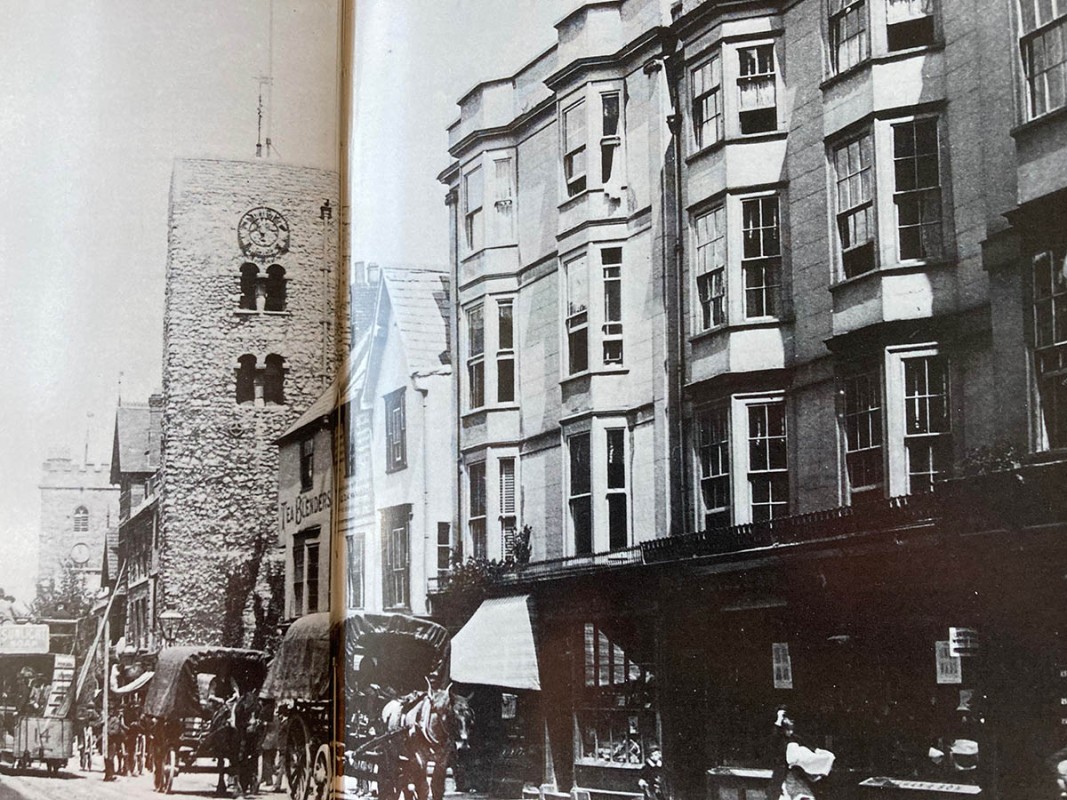
      • St. Giles Fair 1908
      • Cornmarket 1907
      • Headington Hill 1903
      • Queen Street 1897
    • Research/Sketches
    • Stitched Work
      • Missded 1
      • Missded 2
      • Missded 3
      • Missded 4
    • Text Work
  • Blogs
    • Family History
    • Goethean Observations
    • Grief
    • Light Slowed But Never Stilled
    • Lists
    • Present Empathy
    • Shadow Calligraphy
    • Trees
    • Time
    • Walking Meditations
  • Video
  • Photography
    • Pillars of Snow
    • Creatures
    • The Trees
    • Snow
    • St. Giles Fair 1908
    • Cornmarket 1907
    • Headington Hill 1903
    • Queen Street 1897
    • Travel
  • Illustration and Design
  • Music
  • Projects
    • Dissonance and Rhyme
    • Design for an Heirloom
    • Backdrops
    • Shadow Calligraphy
  • Exhibitions
    • A Line Drawn in Water
      • Artwork
    • A Line Drawn in Water (Blog)
    • Mine the Mountain 3
      • Artwork
    • Mine the Mountain 2
      • Artwork
      • The Wall
    • The Woods, Breathing
      • Artwork
    • Snow
      • Artwork
    • Echo
      • Artwork
    • Murder
      • Artwork
    • The Tourist
    • Dreamcatcher
    • Mine the Mountain
      • Artwork
      • The Tourist
    • M8
    • The Gate
    • Creatures
      • Artwork
    • Residue
      • Artwork
    • A visit to Auschwitz
      • Artwork
  • Me
    • Artist’s Statement

Painting

November 14, 2023 by Nicholas Hedges

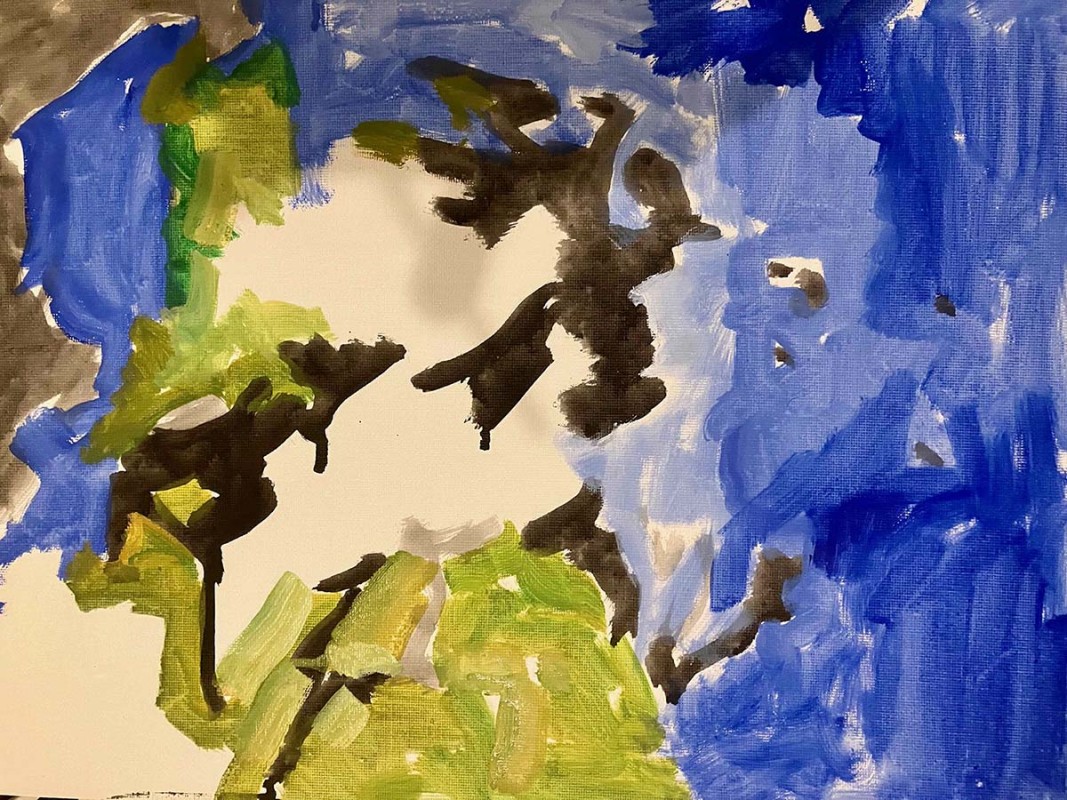
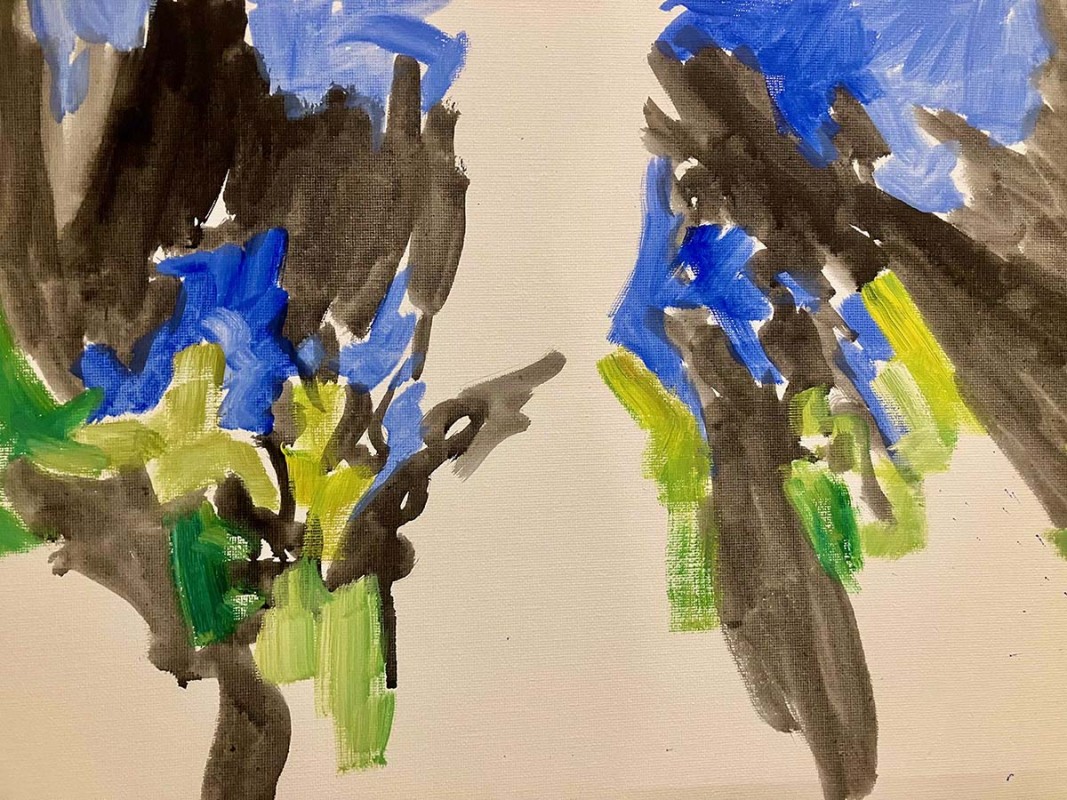
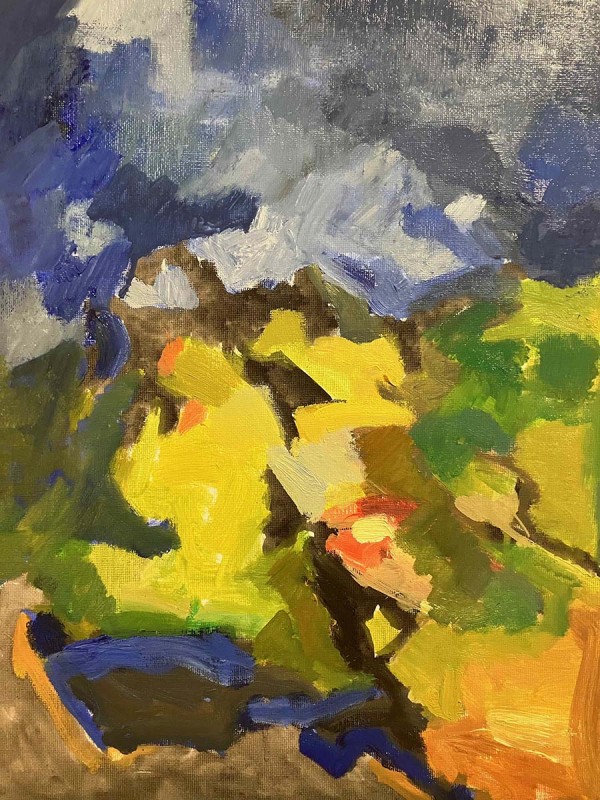
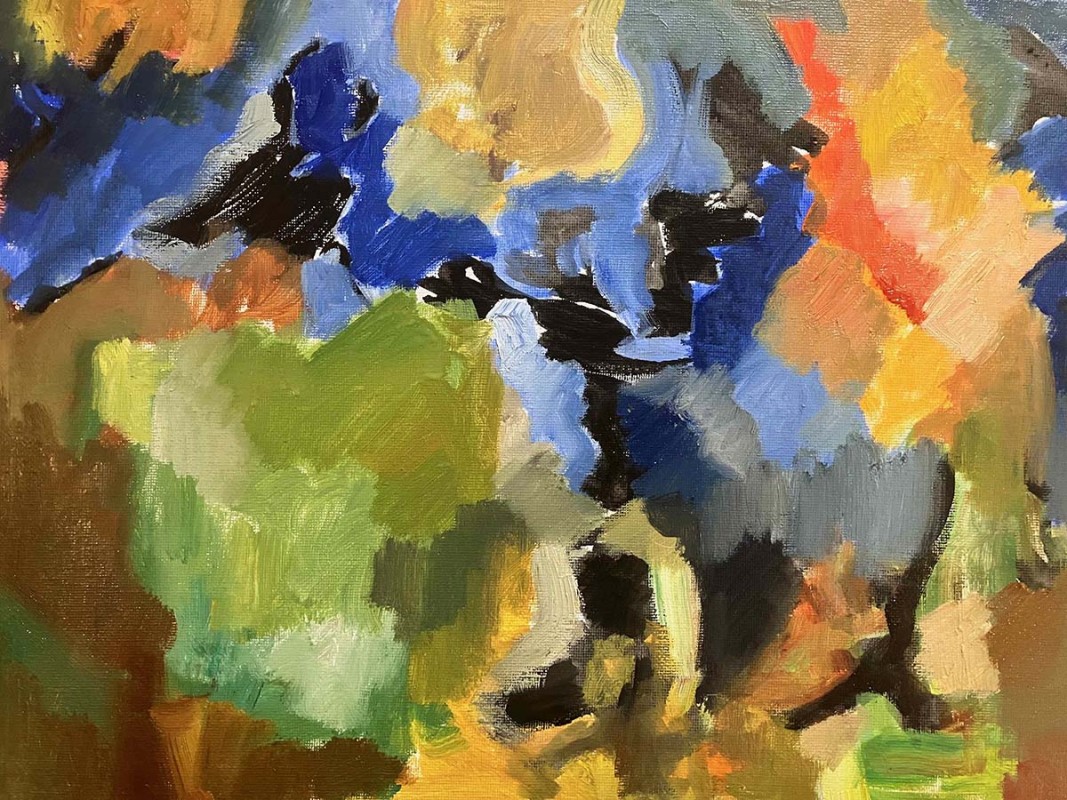
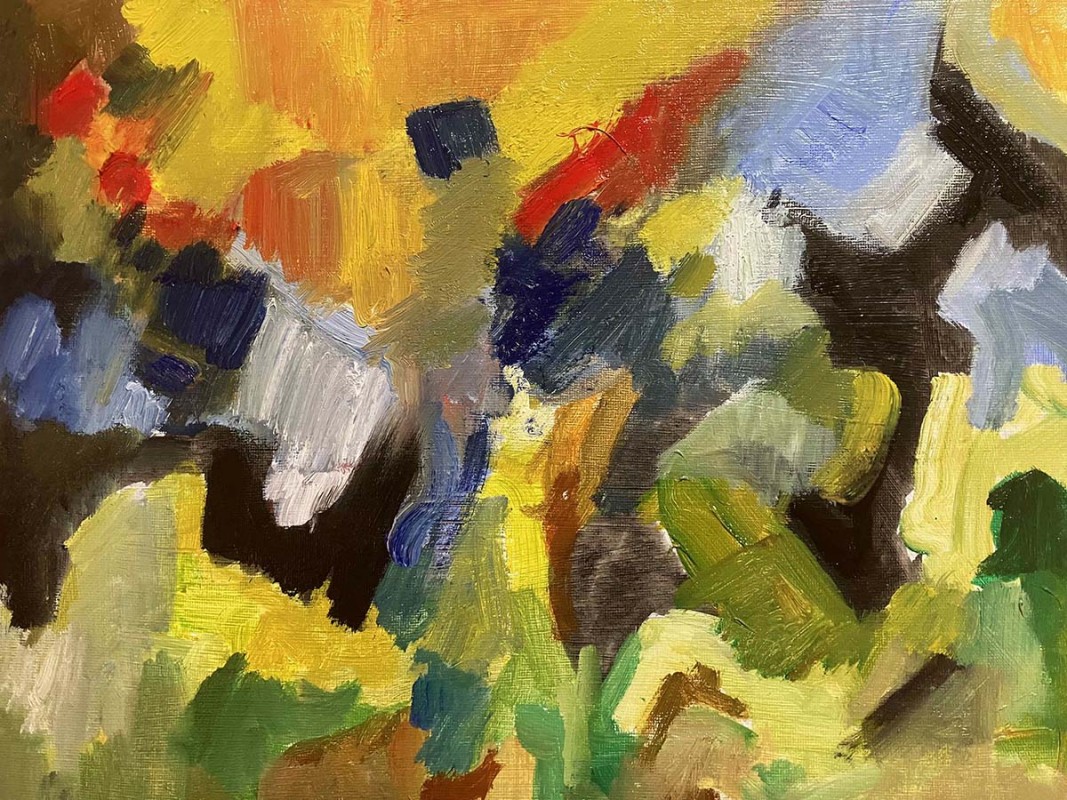
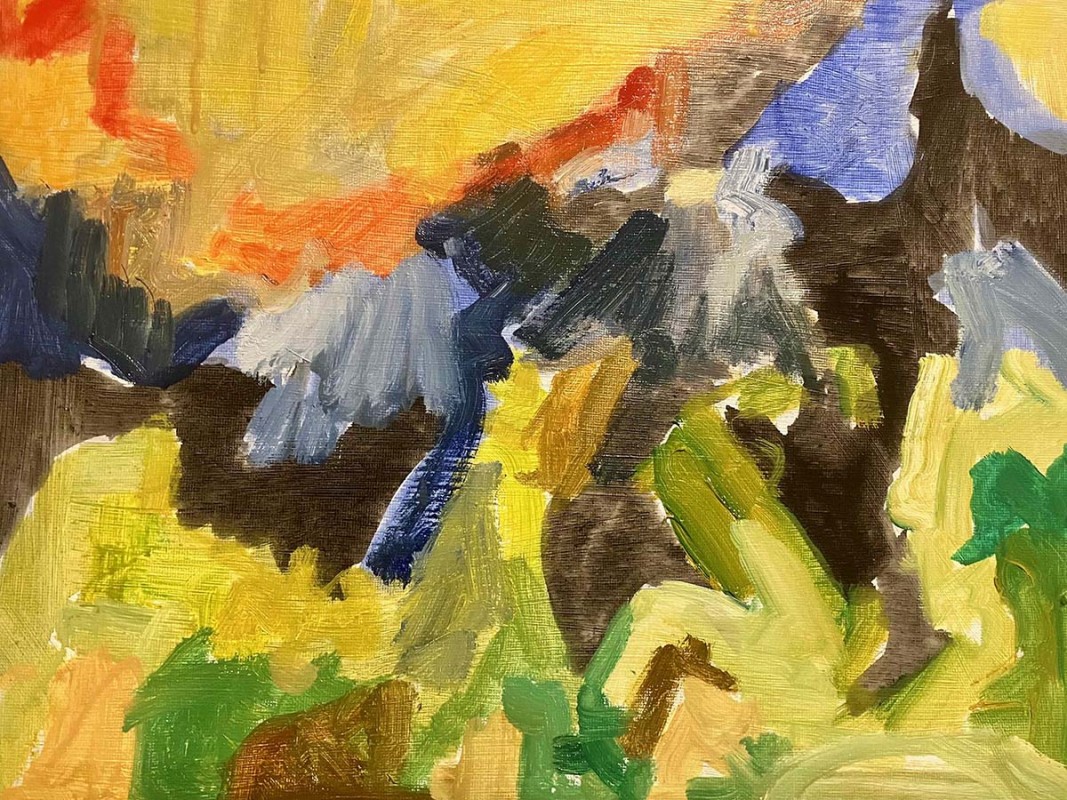
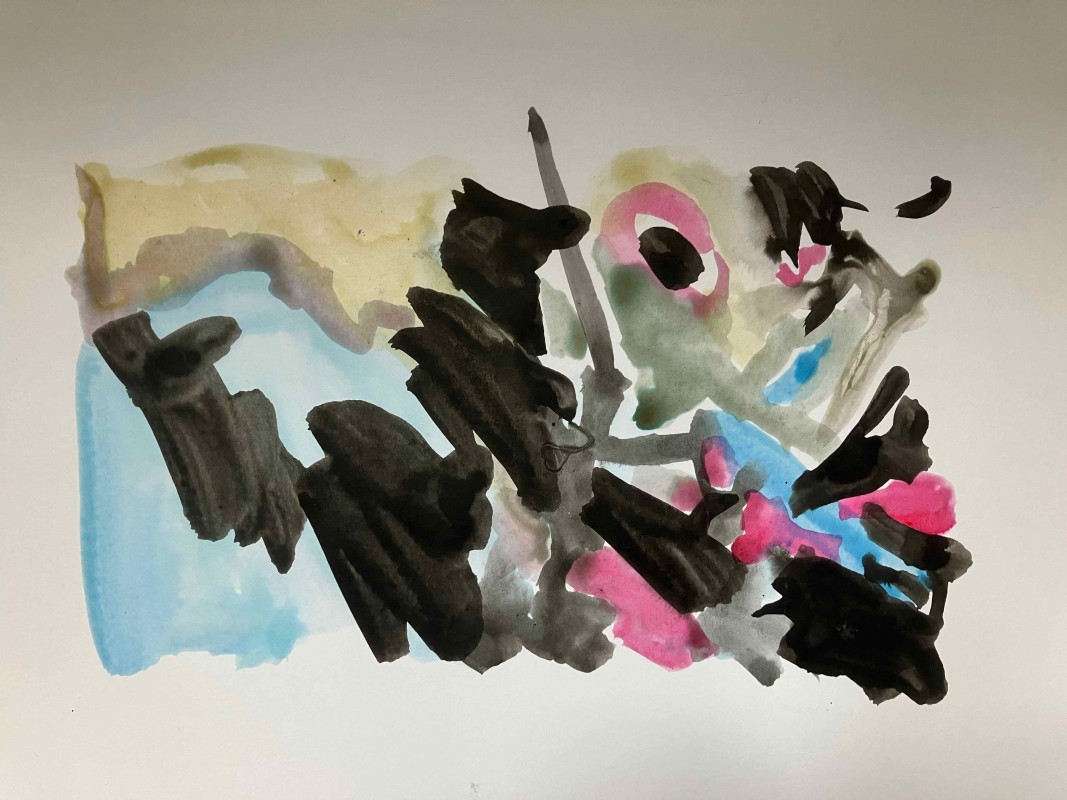
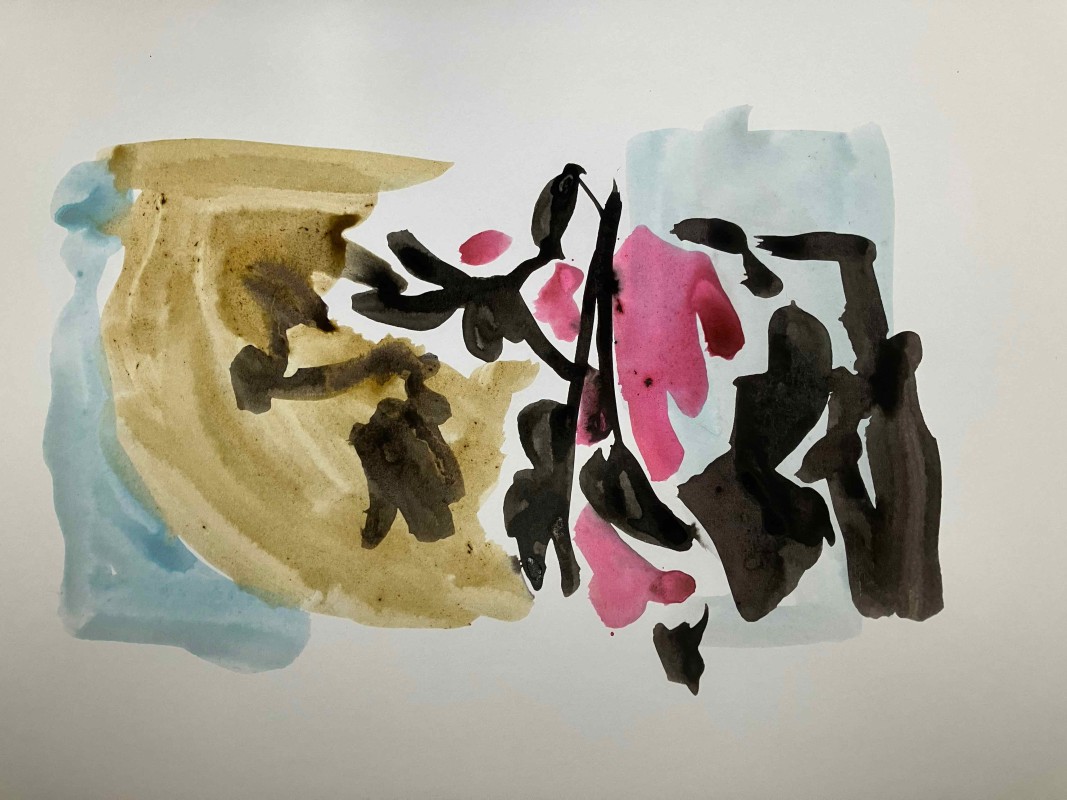
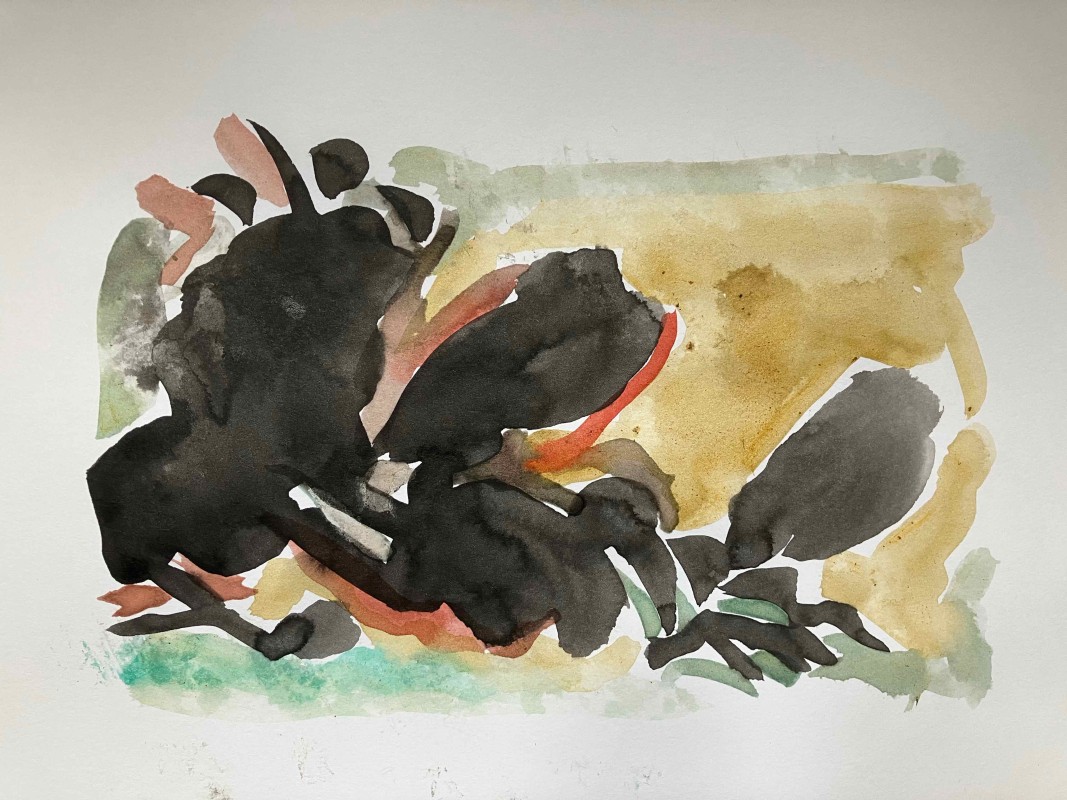
I’ve started painting again and have begun my journey using water-based oils which I must say are rather good. The question has been, at the start of this journey – what to paint?

Having worked on my tree shadow paintings using inks, I decided to do the same with the oils, projecting the video onto a canvas and tracing the shadows in black paint.
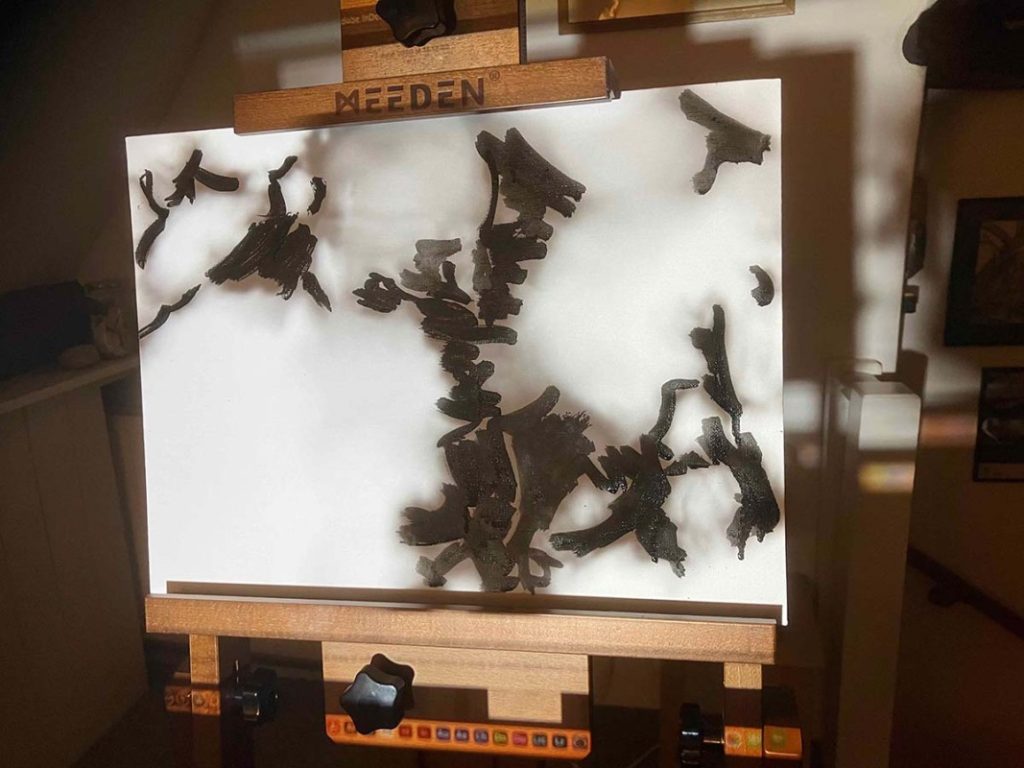
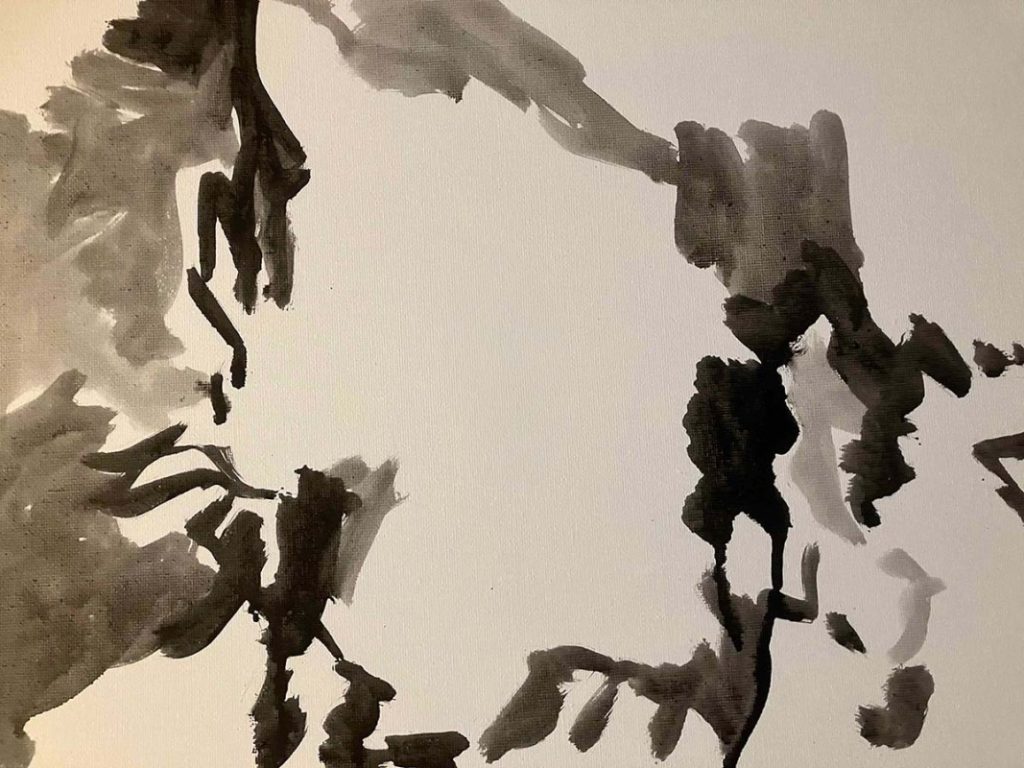
Having completed a few of these, I knew I wanted to look at the spaces between the shadows, as if to imagine the world in which the shadows were filmed – a world of colour (just like the world of black and white photographs and films). It’s been a while since I painted, so I was also interested in feeling my way with the paints again and getting back into painting onto canvas.
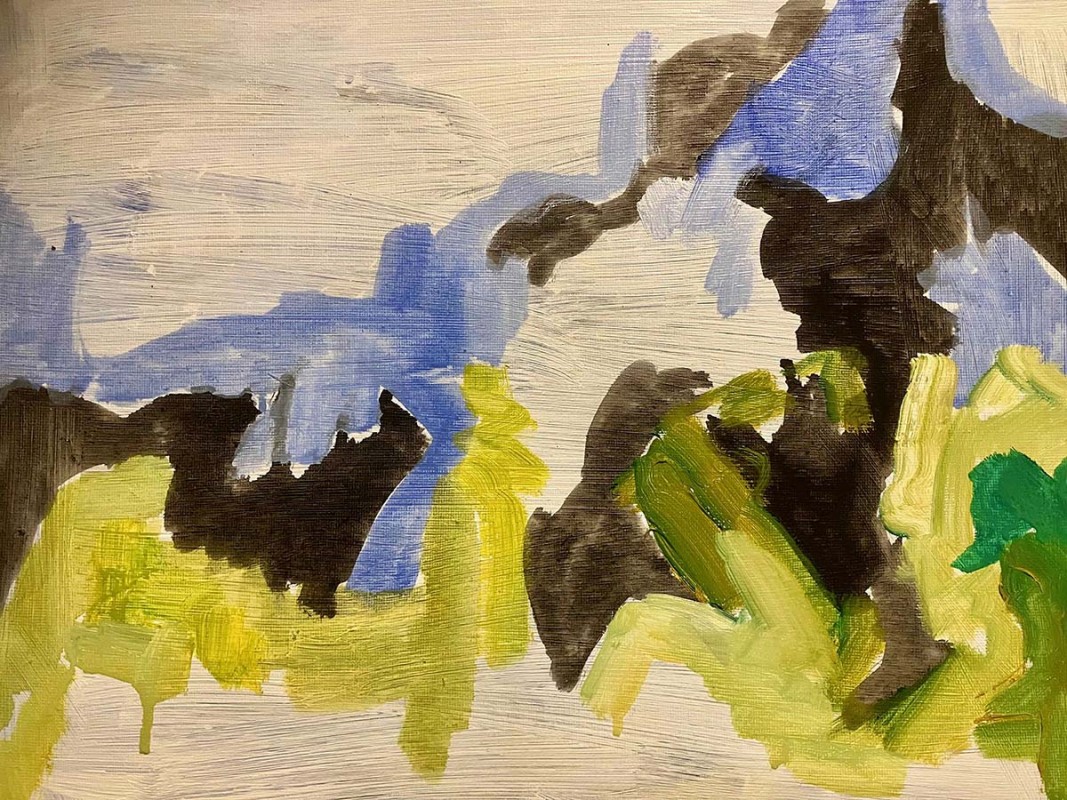
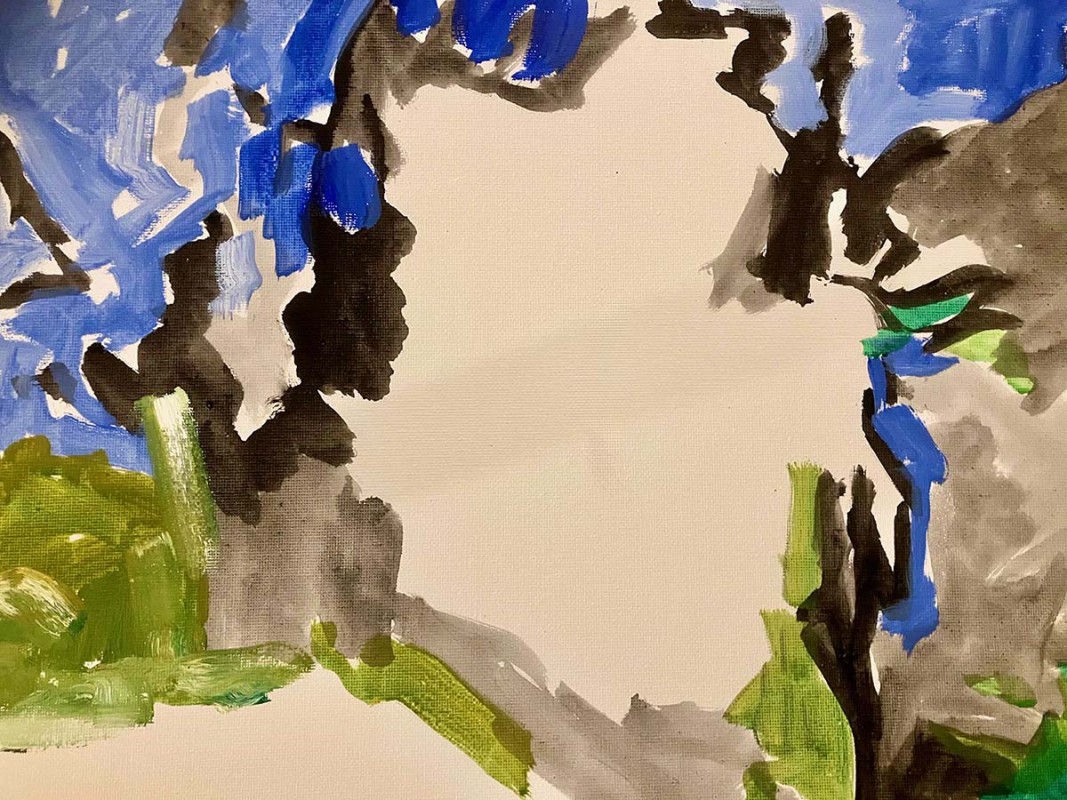
As well as painting again I’ve been reading about painting too, in particular about an artist I’ve admired for a while; Ivon Hitchens. I’ve been looking also at Howard Hodgkin and his attempts to paint memories, something which I’ve been interested in trying myself (see below).

So over the last week or so I’ve continued exploring the paint as a medium and the surface of the canvas, pushing the image and seeing where it leads which has been a very liberating experience.
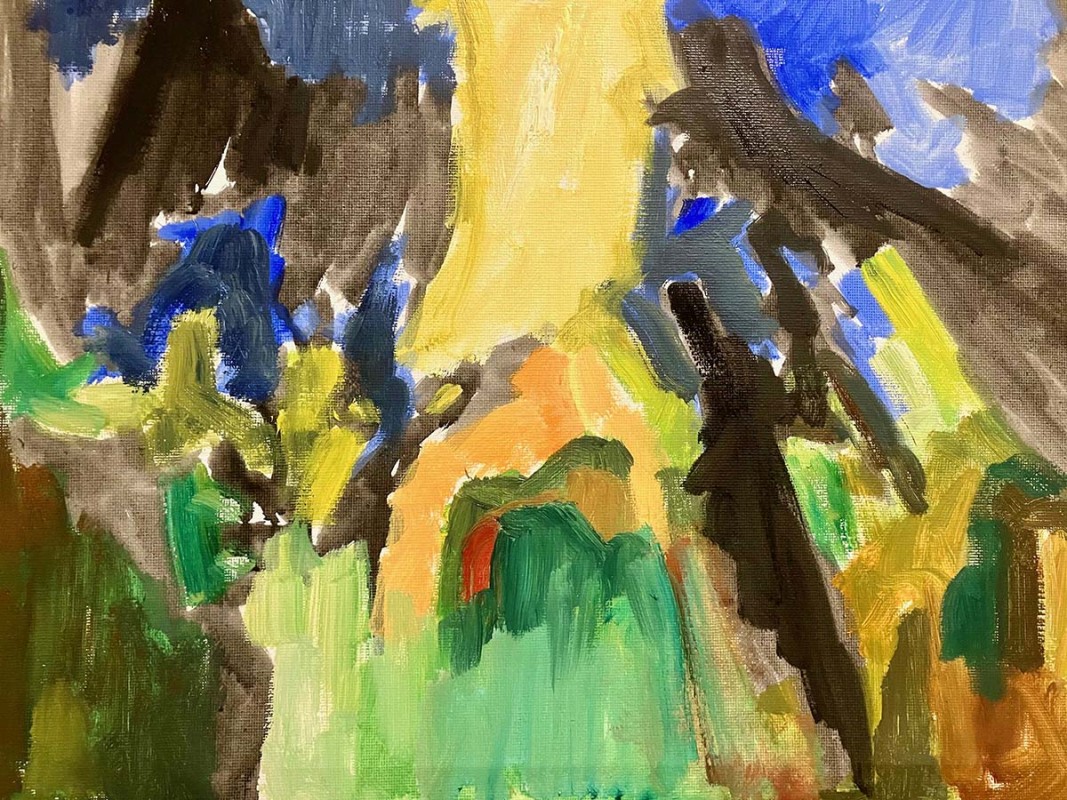
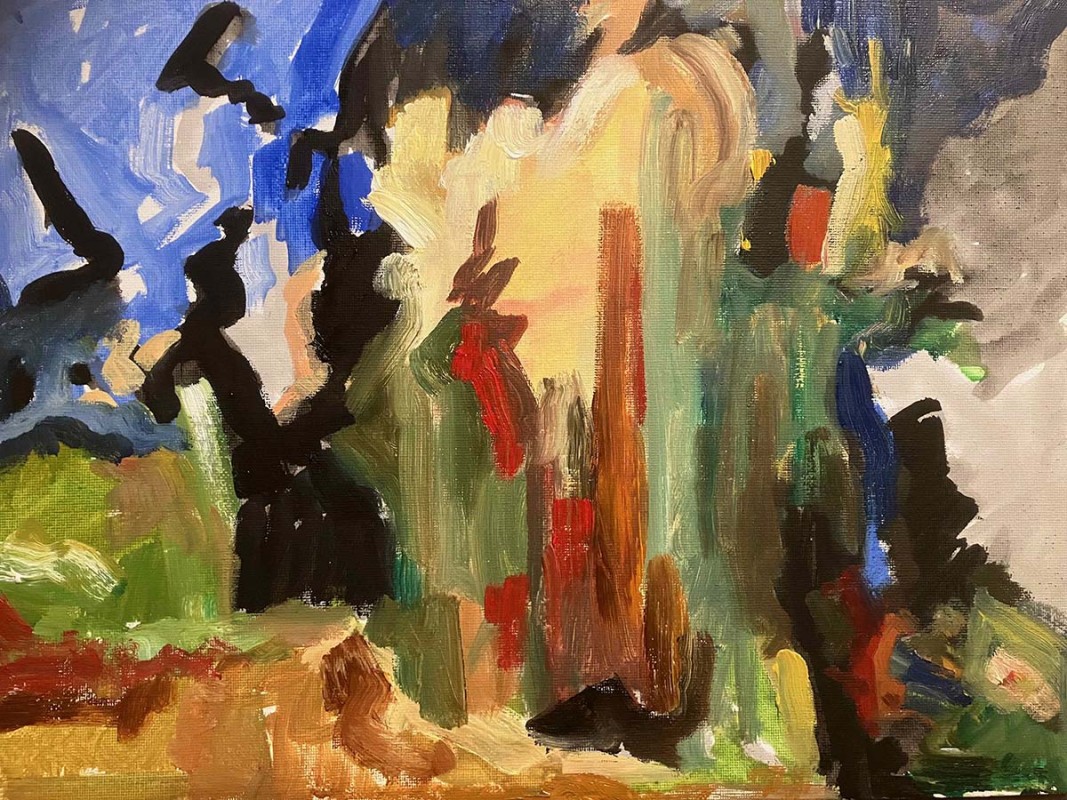
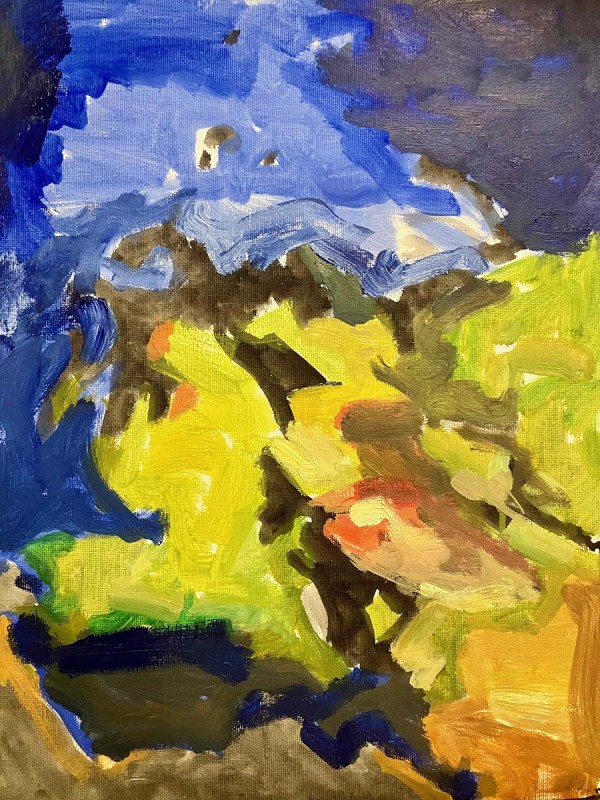
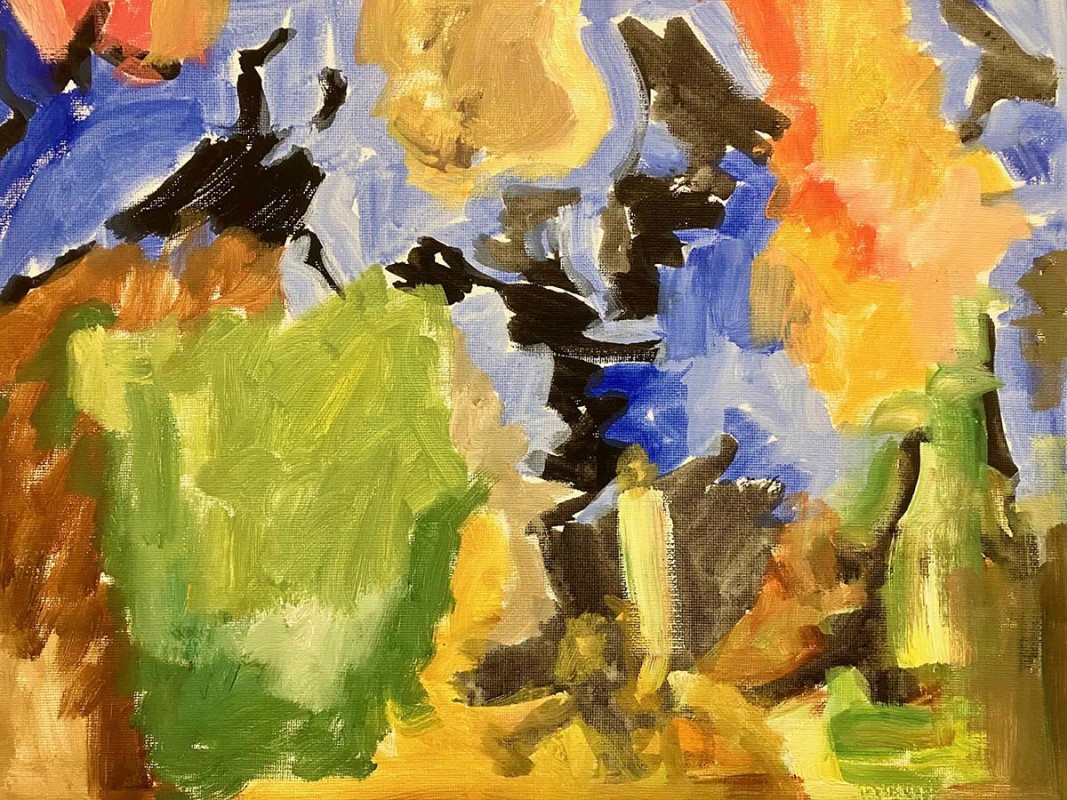
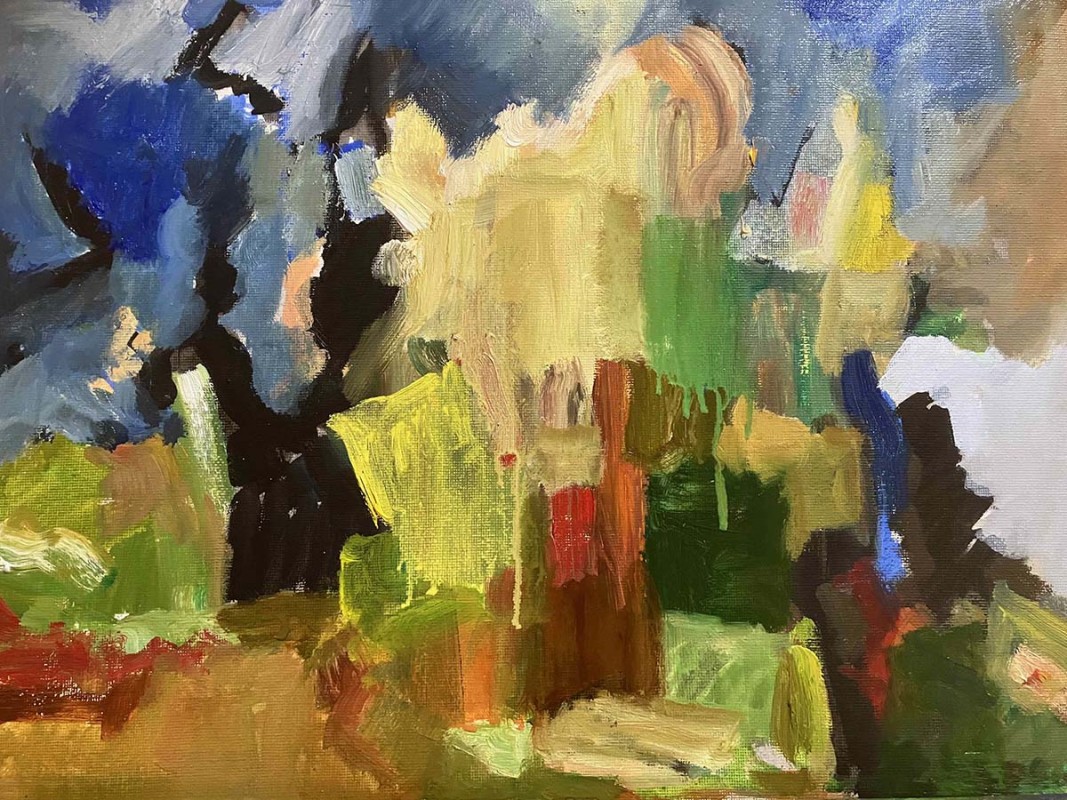
As well as these, I attempted tis evening to start painting memories. The first attempt was whilst listening to my late mum singing at St. Martin’s in the Fields in London in 1984. I’d expected to find myself painting a version of that night and the interior of the church, but found myself instead painting the garden of my childhood home as it was in my head – at dusk on a summer’s night.
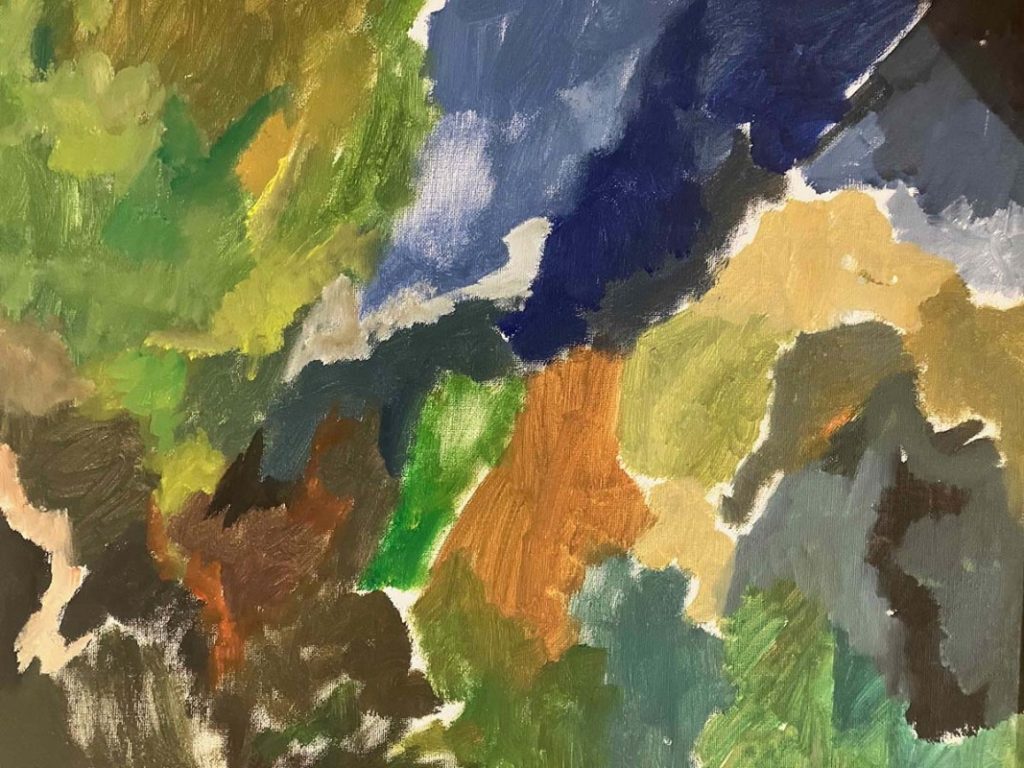
Now I’m not saying in anyway these are (even though they are not finished) successful images, but I just found it interesting to see what came out on the canvas. I did the same with a specific memory, again set in a garden, but this time that of my Nan and Grandad’s house when my brother and I were staying there. One summer’s night we couldn’t sleep, so my Nan came to our room and took us out in the garden to watch the storm. It’s one of my most vivid memories and again it was interesting to see what turned up on the canvas.
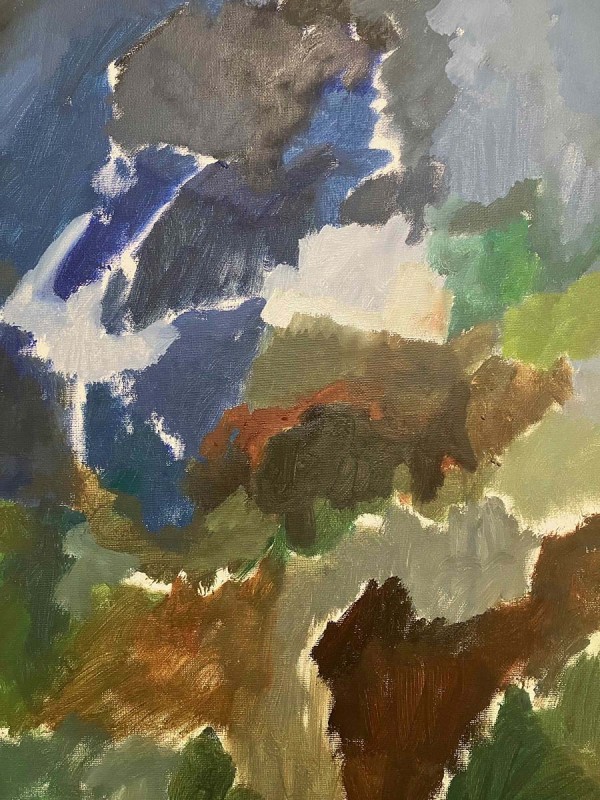
Filed Under: Present Empathy, Shadow Paintings Colour

Iridescence

November 2, 2023 by Nicholas Hedges

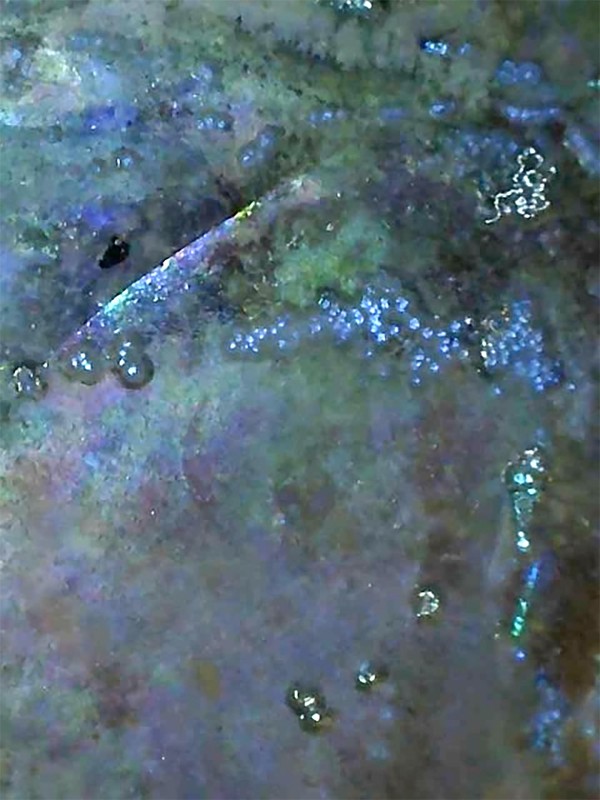
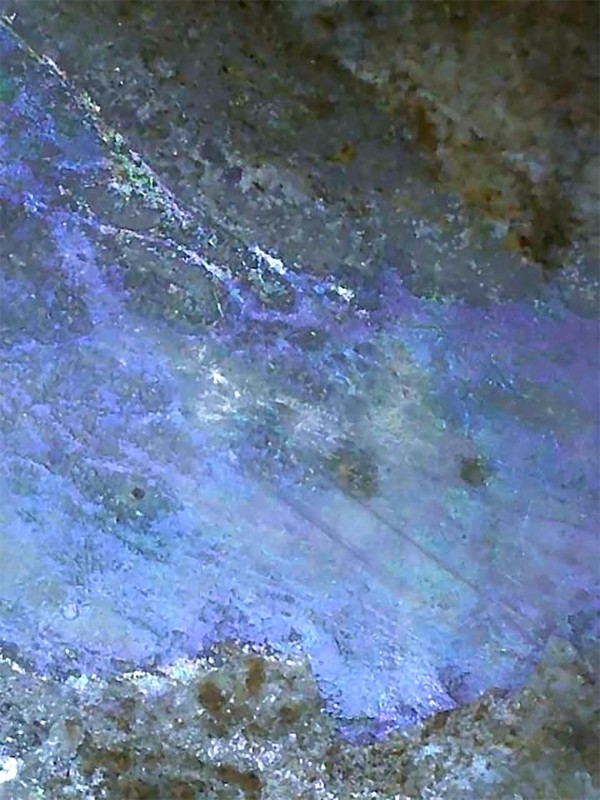
Since buying the piece of Roman glass I described in my previous post, I’ve been interested in its iridescent surface and what causes it.

Having done a quick search I discovered the following on an ancient glass website:

Caused by weathering on the surface, the iridescence… is due to the refraction of light by thin layers of weathered glass. How much a glass object weathers depends mainly on burial conditions and to a lesser extent the chemistry of it… The word iridescence comes from Iris, the Greek Goddess of rainbows and refers to rainbow-like colours seen on the glass which change in different lighting.  It is simply caused by alkali (soluble salt) being leached from the glass by slightly acidic water and then forming fine layers that eventually separate slightly or flake off causing a prism effect on light bouncing off and passing through the surface which reflects light differently, resulting in an iridescent appearance.

On another website:

Water leaches the alkali (soda) from the surface of the glass, especially in slightly acidic burial environments. This leaves behind fine layers of silica that can flake off the surface. The iridescence is purely a visual effect; in the same way that water droplets in the air cause rainbows, light is bent and split into its separate colours as it passes through the thin layers of deteriorated glass and air.

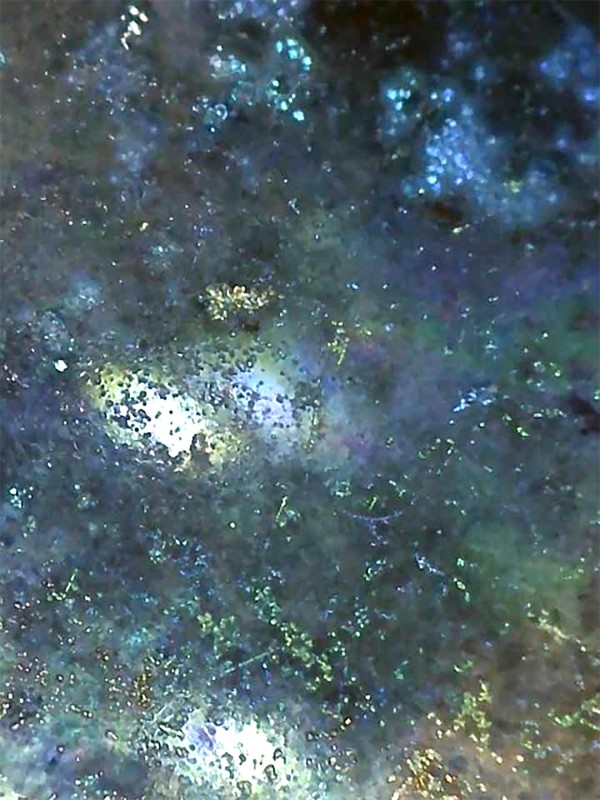
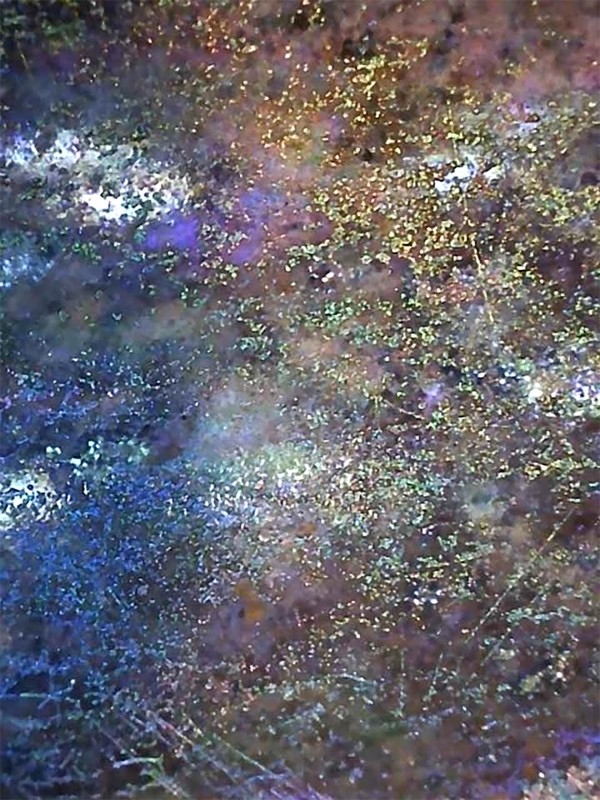
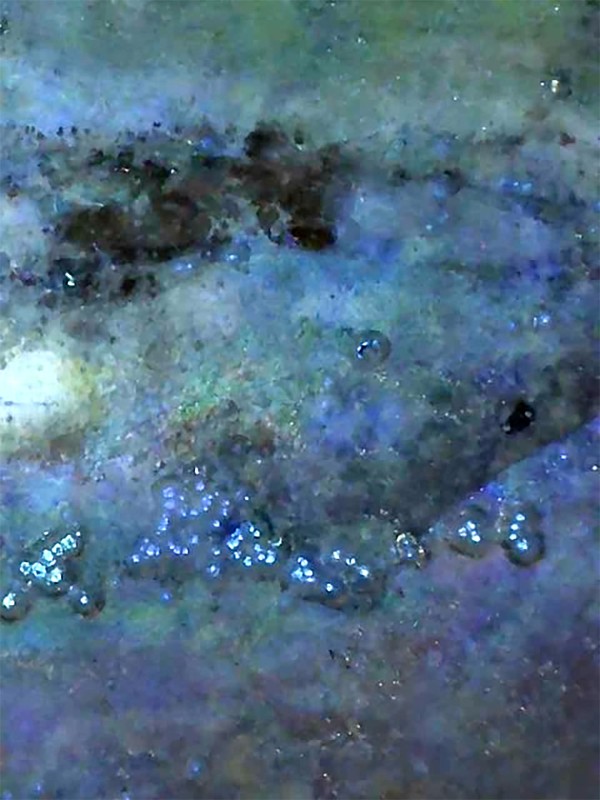
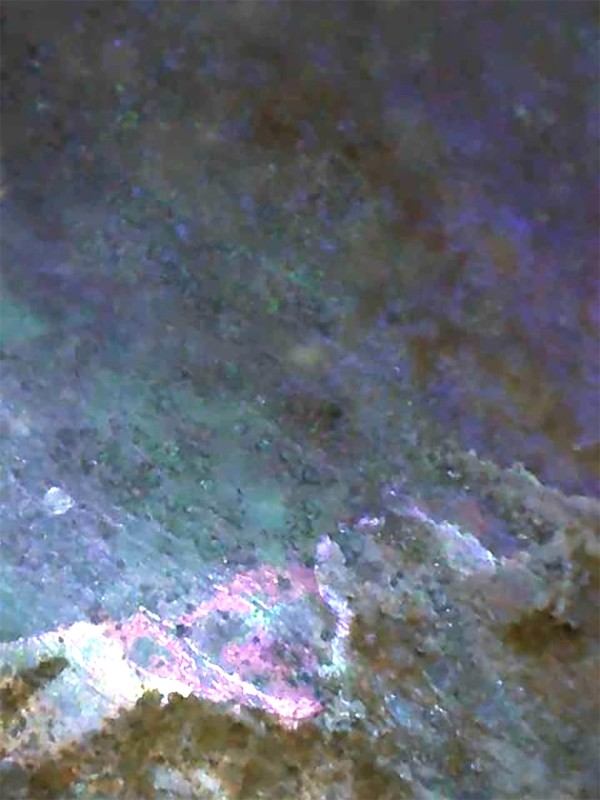
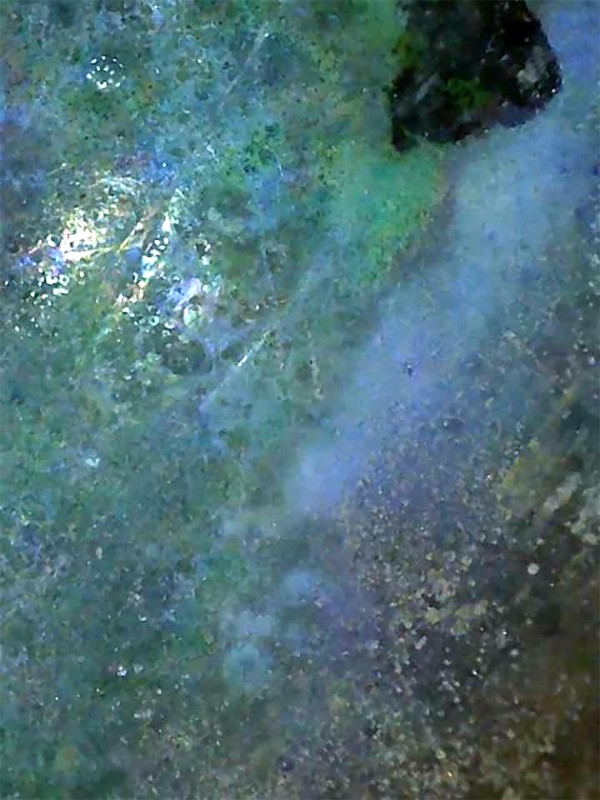
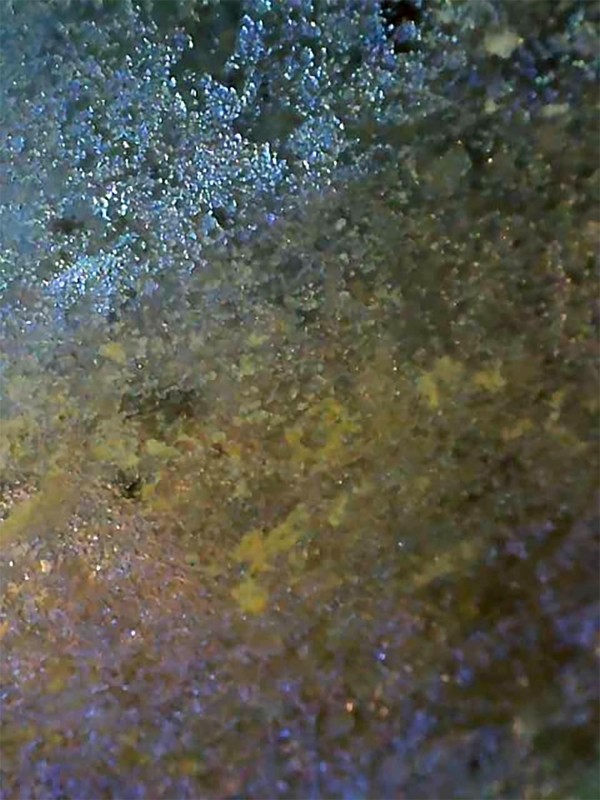
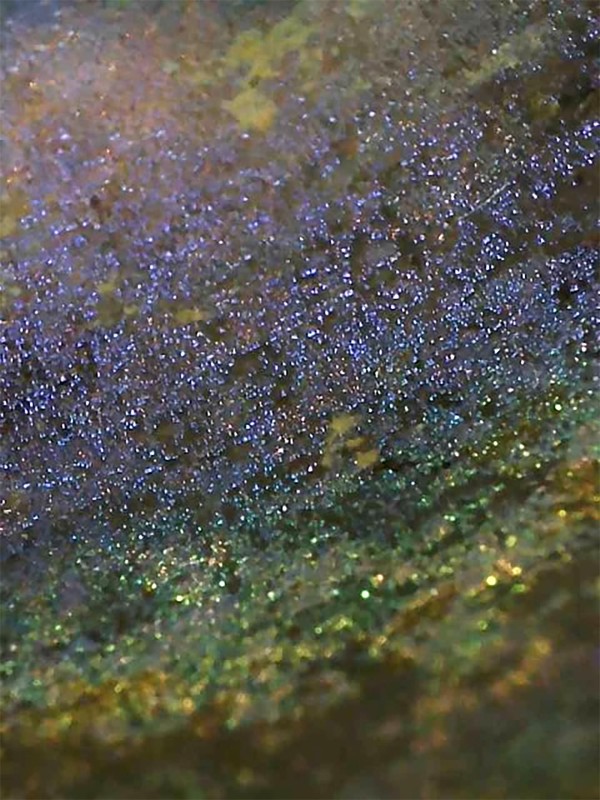
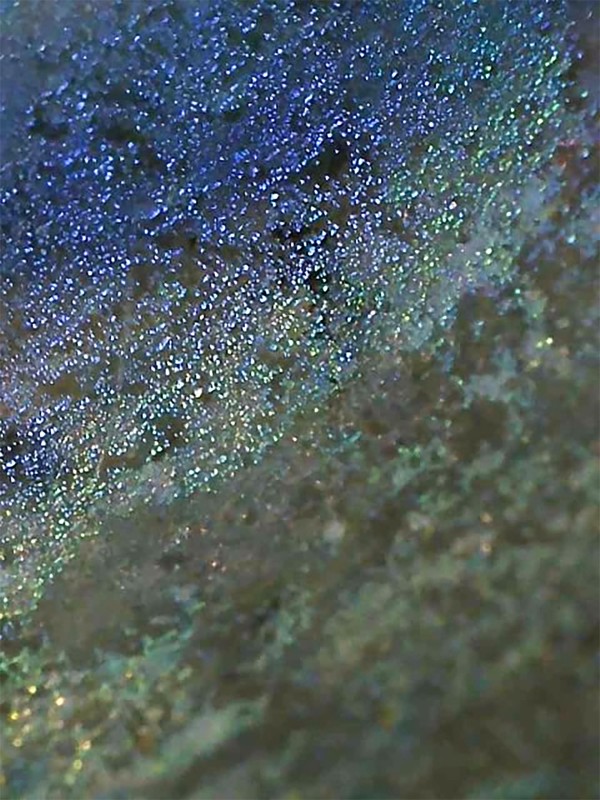
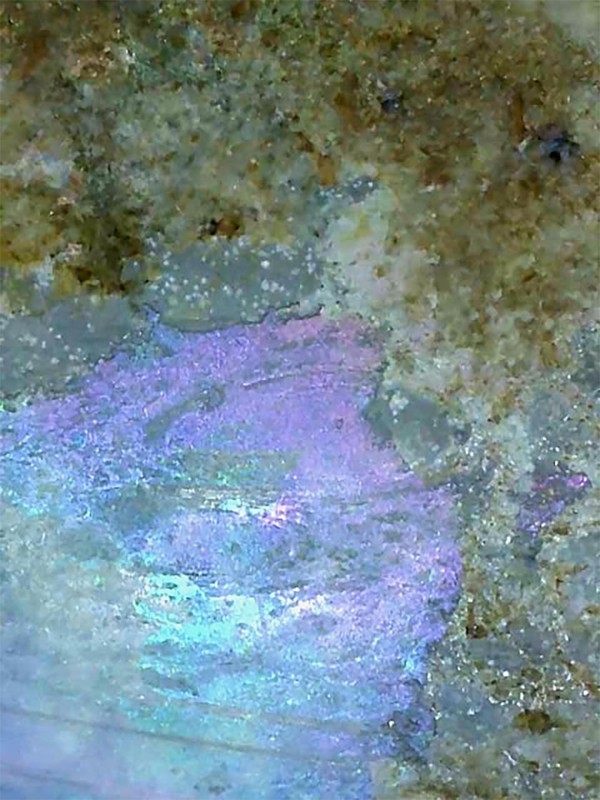
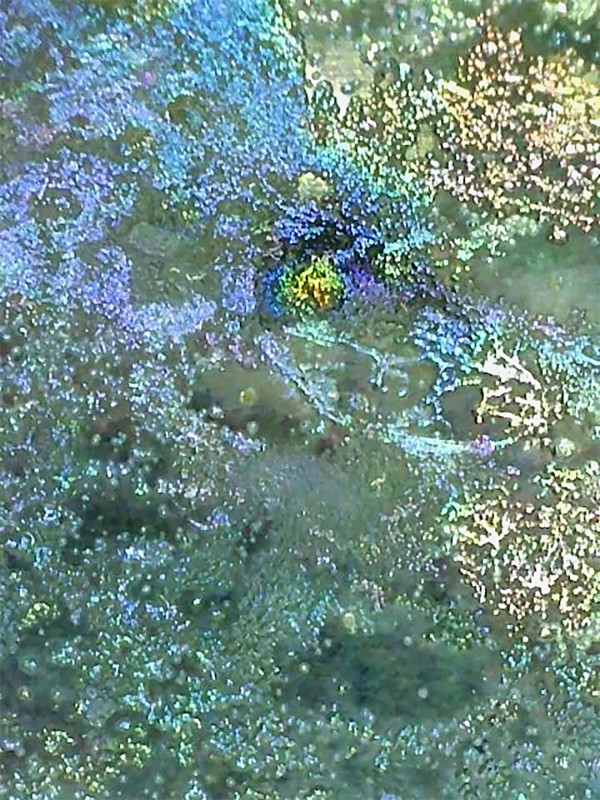
Having read the above, I decided to view the glass through a microscope, the rather beautiful results of which can be found below:

In these images you can see the fine, flaking layers and how they refract the light to create the iridescence visible on the glass.

Filed Under: Uncategorized

Roman Bottle

November 1, 2023 by Nicholas Hedges

I recently purchased a beautiful Roman Unguentarium (2nd or 3rd century AD) and have undertaken a Goethean observation of it. For information on this process, please see below.

The process of 'Goethean Observation'

Introduction

There are many different interpretations of the Geothean (a method of observing as described by Johann Wolfgang von Goethe (1749 – 1832)) method, but the one I prefer to use is that described by Iris Brook in her paper, “Goethean Science as a Way to Read Landscape,” which is, basically, as follows:

1. exact sense perception [bare facts: perception]
2. exact sensorial fantasy [time-life of object: imagination]
3. seeing in beholding [heartfelt getting to know – inspiration]
4. being one with the object [intuition]

1. Exact Sense Perception [Perception]

Now the observer attempt to approach the object from a clearer, more objective standpoint.. This stage was called by Goethe, exact sense perception and is characterised by a detailed observation of all the ‘bare facts’ of the phenomenon that are available to our ordinary senses. It is an attempt to see what is present with as little personal judgement and evaluation as possible.

An example of trying to let the facts speak for themselves from Goethe’s own work is his extraordinarily detailed observations of colour phenomena. Rather than draw hypotheses or work from a theory his investigations involve colour as experienced by himself, as used by artists, as created by dyers, as used symbolically, as seen in animals and plants and so on.

For the student attempting to carry out this stage with their own phenomenon, drawing can be a useful tool, because in drawing our attention is brought to previously unnoticed detail or patterns.

Another tool used is to ignore some knowledge, for example the names of things… Attempting to find another word to describe the part you are indicating to someone else often leads to a looking again.”

2. Exact Sensorial Fantasy [imagination]

“The second stage of looking at the phenomenon is what Goethe called ‘exact sensorial fantasy’ (Exact sinnliche Phantasie). An aspect of this activity is to perceive the time-life of the phenomenon, that is to see the phenomenon in time. This means no longer seeing the thing in an objective frozen present as prompted by the first stage, but as a thing with history. That history can be drawn from the phenomenon with the use of an imaginative faculty that cultivates temporal and physical relationships…

The shift between the two modes of seeing is a small one, but the world does look very different when seen in a state of flux.

In this phase the imagination can be used as a tool to vary what is seen and attempt to imagine it otherwise. The obvious link to the phenomenology here is with the use of free imaginative variation. First suggested by Husserl, this is a means of deriving the essence of a phenomenon by pushing the eidos of the thing beyond what can be imagined. The second stage could be seen as a training of the imaginative faculty in two directions: firstly to free up the imagination and then to constrain it within the realms of what is possible for the phenomenon being studied.”

3. Seeing in Beholding [Inspiration]

The first two stages of Goethean method could be characterised as an engagement with the phenomena, first by seeing its outer static appearance objectively and then by experiencing something of its inner processes. In the third stage one attempts to still active perception to allow the thing to express itself through the observer. We attempt to step outside of what has gone before and make space for the thing to articulate in its own way.

The detailed information is somehow transcended, but just as exact sensorial fantasy requires exact sense perception to anchor its dream-like activity, seeing in beholding needs the content and the preparation of the other two stages if the researcher is to articulate the thing. Goethe terms the changes necessary to our everyday consciousness as the development of ‘new organs of perception’.

To experience the being of a phenomenon requires a human gesture of ‘self-disspation’. This effort is a holding back of our own activity – a form of receptive attentiveness that offers the phenomenon a chance to express its own gesture.”

4. Being One with the Object [Intuition]

“The first three stages of the Goethean method involve different activities and ways of thinking and these could be characterised as first using perception to see the form, second using imagination to perceive its mutability, and, third, inviting inspiration to reveal the gesture. The fourth stage uses intuition both to combine and go beyond the previous stages.

Being one with the object in this fourth stage allows the human ability to conceptualise to serve the thing: we lend it this human capacity. When the phenomenon being explored does not have the ability to think, it is the most participatory part of Goethean observation.

Our ability to think creatively and to initiate future action is the faculty being used here and thus the dangers of abstract creation not tied to the phenomenon are great.

Being one with the object allows an appreciation of the content or meaning of the form as well as the form itself… At this stage of the process of Goethean observation it is acknowledged that the phenomenon is at its least independent of human reason.”

1

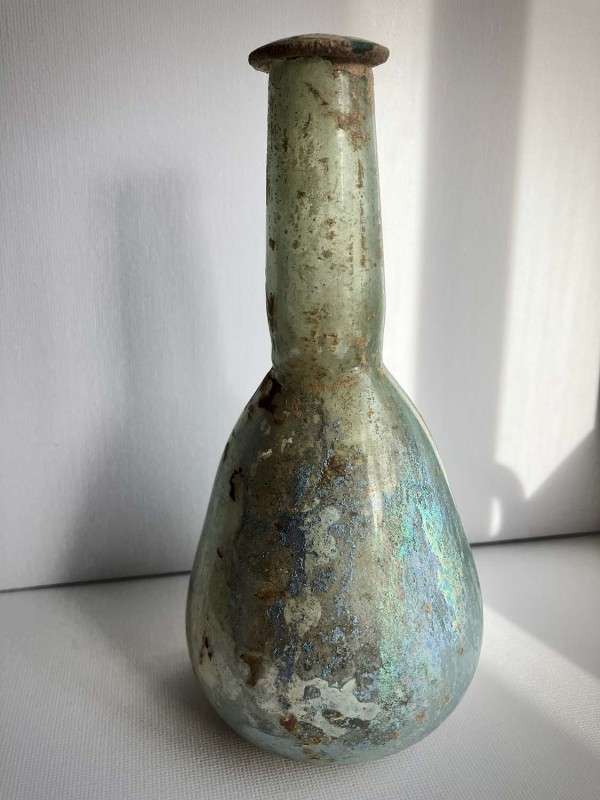
This is a bottle about a hand’s length in height. It has a bulblike shape tapering to a neck which is short of half the bottle’s height. Its base is flat allowing it to stand on the table. It is clearly an object designed to be held.

It is not perfectly shaped and is uneven in its symmetry. It has a lip at the top covered with a brown encrustation, which also runs a little down the neck from the rim.

It looks like glass, but the glass is not entirely transparent. It looks almost like marble with veins of colour running its length. It is a blue green colour with patches of silvery grey and gold-brown. Turning the bottle around, I can see the patches cover its surface but there are small patches where the glass is clear.

In the light of the lamps in my room, the bottle shimmers with iridescent hues of turquoise and purple-blues. Holding the object in my hand, I am struck by how light it is and how thin I suppose the glass is. As I turn in my hands, I can hear it against my skin. It almost rings when my hands turn it, and as I do so, I am more aware of the unevenness of its shape.

Picking it up. I look down inside the neck. All I see is the cloudy mottled glass, flecked here and there with brown. It is clearly a very fragile object, and picking up again. I can feel its cool surface. I see the lights reflected on its surface. It almost has the feel of a lightbulb, but its surface is much less smooth. Running my thumbs over its surface. I can feel that in small parts, it is rough, in others very smooth. This is where the glass is almost completely transparent. 

2

This bottle is almost 2000 years old, and the fact it has remained intact all that time is remarkable. It is a blown piece of glass, meaning that in the second or third century A.D. someone blew to make it shape. The fact that its shape is slightly irregular lends it a very human quality. Someone’s breath – the act of breathing out 1800 years ago – gave it its shape and with its beautiful iridescent surface, I think of a bubble, albeit one which is not a perfect sphere. This bottle has the fragility of a bubble; one which, after so many centuries still hasn’t burst. It’s as if the breath which made it is somehow contained within and with that sense of exhalation comes the expectation of a breath about to be taken; a breathing in to compliment the breathing out.

I now become aware of the life of its maker. Their breathing in and out; something they did – like we all do – without thinking. I’m aware of their heart beating, aware that it has long since stopped. And yet, in this bottle, the memory of a pulse remains.

It’s almost the opposite of my mum‘s final breath, when she breathed in and passed away. This bottle, instead, contains a breath exhaled, but with both my mother’s last breath and the breath of the bottle’s maker, there is the expectation of another. With my mum it never came. Now this bottle too seems to be waiting. It’s as if the bottle has been breathed out slowly over the course of 18 or 19 centuries. Picking it up. It’s like holding a breath, but one breathed out nearly 2 millennia ago.

I think about that moment when it was first breathed into existence, when it would have glowed white hot. Who made it? What was it like where it was made? Obviously it would have been hot, a stark contrast to its cool surface. Now I think of whoever made it watching its shape form, before setting it down to cool with the others they had made that day.

Once cooled and finished it would’ve been sold, I presume, and I wonder who bought it. Who used it? I know it was used to hold unguent. But what exactly did it contain? I imagine it being lifted and whatever was inside poured out. I find myself doing the action of pouring. It would have felt different then heavier with the liquid inside.

Back then it was just a bottle sitting on a shelf or a table witnessing a world which seems to us impossibly remote. What reflections found their way to its surface? Did it have a stopper – a piece of fabric perhaps? What did it smell like inside? It doesn’t smell of much now of course

I look at its shadow cast by my modern lamp; its harsh outline, and I wonder about its shadows all those years ago – shadows made by the sun which might also have pricked its surface as my lightbulb does this evening. Or perhaps the soft glow of a flame. Then its shadow would not be still and on its surface the flames would shift.

It was an everyday object, and yet it speaks now of many centuries. The person who made it those who owned it and used it have long since gone, their memory lost to the past. Generations of their descendants have also followed, and yet this insignificant, everyday and very fragile object has outlived them all. Yet, despite its age, it is vulnerable. It is therefore a curious mixture of extreme vulnerability and strength.

In its fragility, it has held the breath of whosoever made it for hundreds and hundreds of years. With that held breath comes  the ‘possibility’ of its breathing. It has the feel and look of a living thing. The breath exhaled by the maker becomes the inhalation of the bottle.

Patches of iridescence break to reveal patches of clear glass, through which, when the glass was untarnished, we might imagine one could see the unguent inside. The iridescence is caused by the deterioration of the glass, which draws a beautiful veil over its distant past. I wonder where the object has lain for so many years, where it has been, and how it could survive intact all those hundreds of years. Will the iridescence continue to cover its surface, cocooning it? Will the encrustation on the lip of the bottle and a part of the neck continue to grow, to cover this long-held breath. 

Before the bottle was even a bottle, it was the sand, the soda and lime, from which it was made, and the intention of the maker. The sand, perhaps part of a beach – an ancient shoreline on which the waves lapped just as they do today. But then they would come loaded with mystery. Back then there were lands still undiscovered and fantastical creatures beyond the horizon; creatures as ‘real’ as the sand on the beach. That sand would, in time, be gathered and used to make the glass. Sand which itself had been millions of years in the making. Its origins extend to a time before there were people people to imagine such fantastical creatures; a time when people were just as absent from the real world, as we now know these creatures to be. Reason is a clarity like glass which we can see through. Glass is the way we see beyond our own world, both at the ‘impossibly’ big universe to the ‘impossibly’ small realm of the particle.

On that ancient shoreline, the sand would’ve been gathered, and with the other ingredients turned into glass by the skill of the glassmaker; a skill which would’ve been learned over many years. The bottle is there for a mix, not only of the raw materials needed to make the glass, but also the skill of the glassmaker, learned and perfected over many years. In his hands, with his actions and his breath, the glass bottle would have come into existence. 

The bottle is almost like the memory of a moment; the moment when it was made; the memory of the maker, his actions, his breath, the hour of the bottle’s production. The memory was clear and then it became clouded, changing from what really was to a distorted version. Whoever owned the bottle (maybe it was several people) died and was buried. Perhaps the bottle was buried with them and for hundreds of years it lay in the dark, quiet of the ground, unseen by anyone until it’s rediscovery. Underground it underwent a change; chemical changes caused by water in the soil leached out the salt from the glass and over hundreds of years thin layers were built up on the surface of the glass. Only when the glass saw light again did that process reveal itself through the iridescence of its surface.

It’s almost as if the bottle, whilst underground, ceased to be a bottle (it’s only a bottle in the mind of someone looking at it instead it became a process. 

3

A breath given.
A breath held.
Held by the bottle.
Held in my hand.
Fragility and strength.
Air inside a bubble, its surface slipping with iridescence.

4

I find myself inside the bottle, looking out through the patches of clear glass, out at the room in which I stand. I see the room and everything in it. It’s rather vague, like my shadow cast by the candles and lamps. Now, all these centuries later, I am an object in my own right rather than a mere vessel for whatever I once contained. It’s as if my eyes have been turned in on myself. My shape is not that of the liquid I once contained. I have now become the shape. 

The shape of the breath that made me. 

The breath I hold which to exhale would see me break.

All the while I hold it, I can remember.

When I breathe out, then I will forget.

Filed Under: Goethean Observations

Rinsho

October 2, 2023 by Nicholas Hedges

After my last post I watched a video by calligrapher Tomoko Kawao in which she mentions the practice of Rinsho, where the calligrapher copies the work of ancient masters in order to enhance their own skills.

From what I have gleaned, Rinsho is not about crating the exact copy of given masterpiece but rather, it’s about the energy, spirit, dynamics, writing style, proportions, line characteristics, and so on. Rinsho is about copying the emotions, the mental state, the attitude, and the mood, that a given masterpiece comprises (see: http://www.ryuurui.com/blog/the-proper-way-to-study-chinese-japanese-calligraphy).

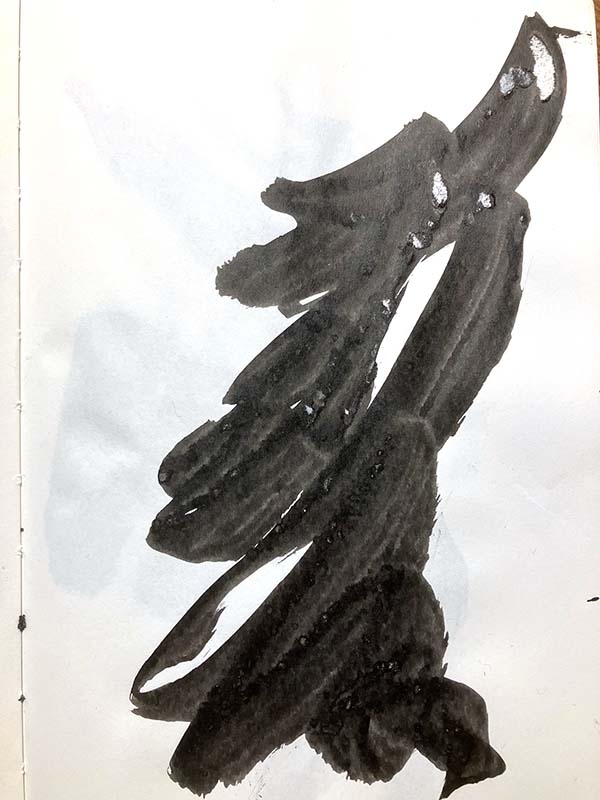
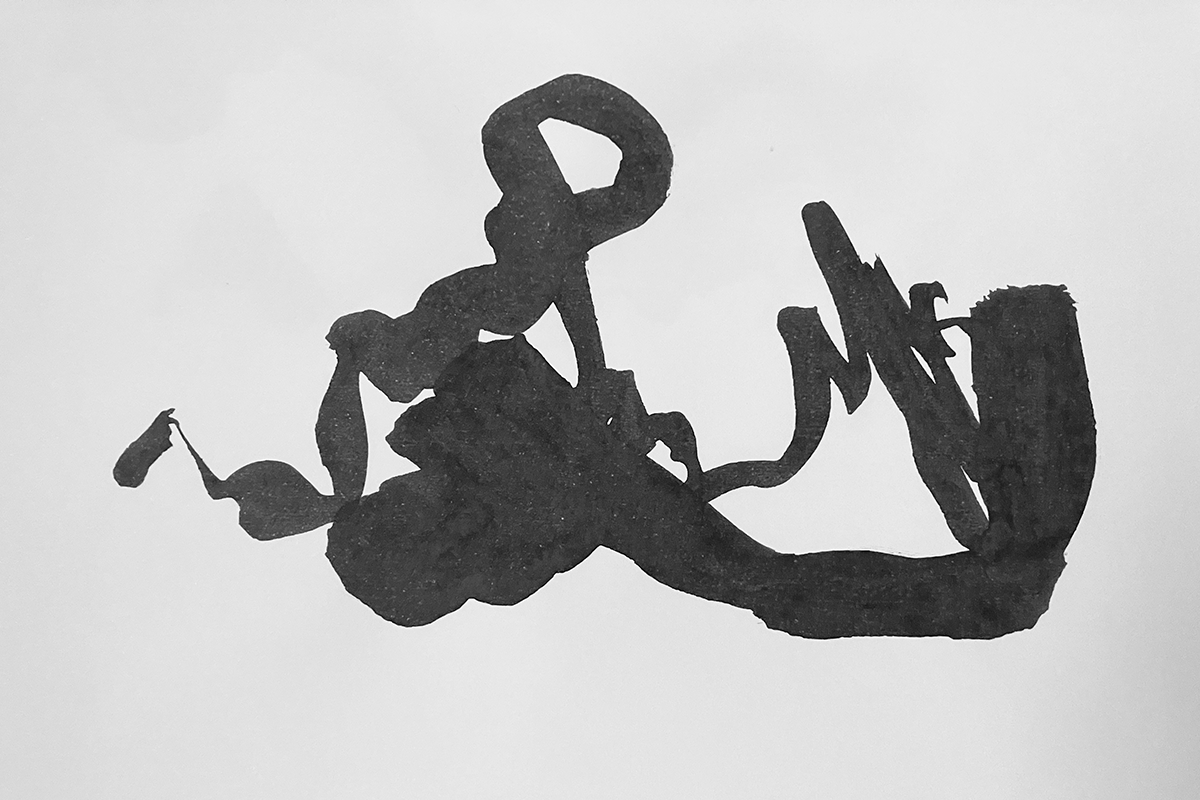
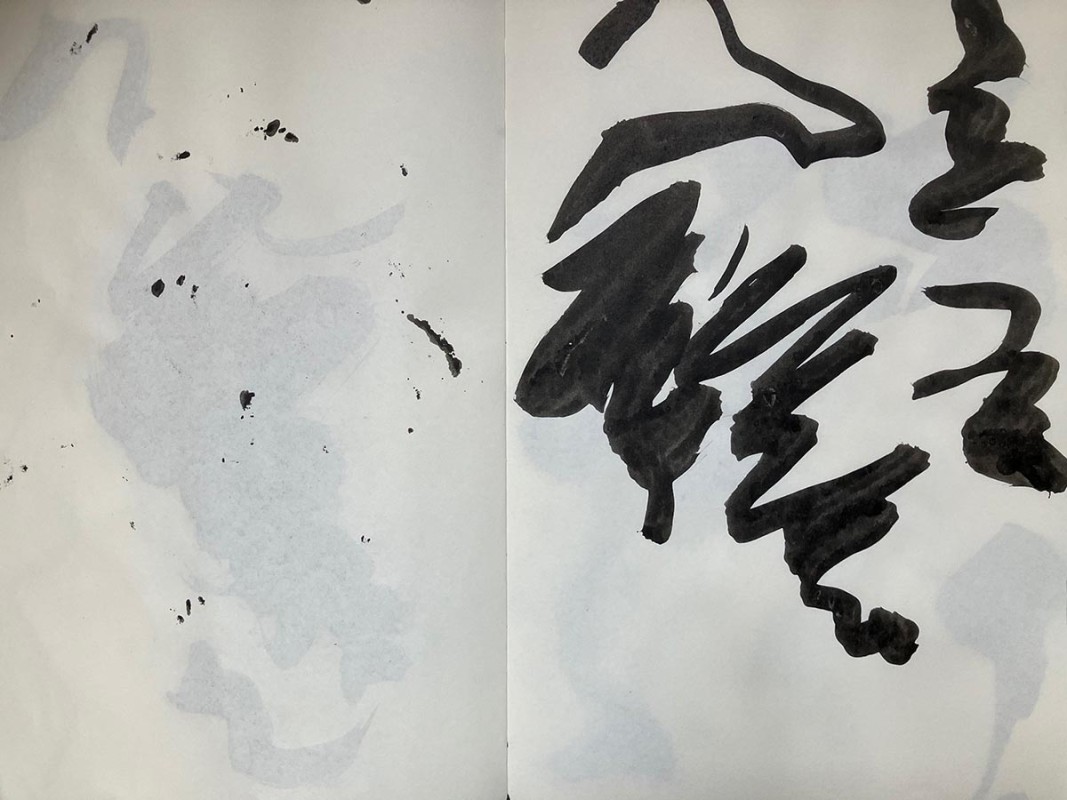
This interests me as regards the works I have made recently, such as the image below:

Having made this original image (and many others like it) at a particular moment in time, I’d been wondering whether I could do more with it. The practice of Rinsho gave me the answer.

Much of my work is about reimagining a past moment by trying to see that moment as it was when it was ‘now’. We can never know of course what a past moment was really like, but by understanding what makes the present moment for us ‘present’ we can use that knowledge to find our way back in time, at least just a little.

Copying the images I made – in the style of a calligrapher copying the work of an ancient master – seems to me to reflect this idea. As it says above, it’s not abut making a faithful copy (we can never go back in time) but using our experience to see something of the ‘energy, spirit, dynamics, writing style, proportions, line characteristics, and so on’. It’s about ‘copying’ the emotions, the mental state, the attitude, and the mood.

I have therefore started to use these original sketches as texts and to copy them, not to produce an exact copy, but to get a sense of that moment when they were first made.

Filed Under: Present Empathy, Shadow Calligraphy, Shadows

Shadow Calligraphy

August 18, 2023 by Nicholas Hedges

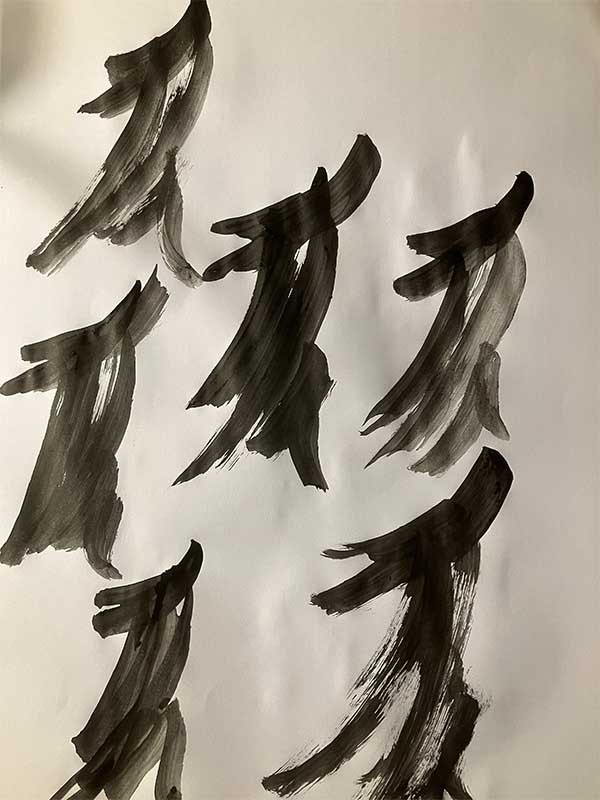
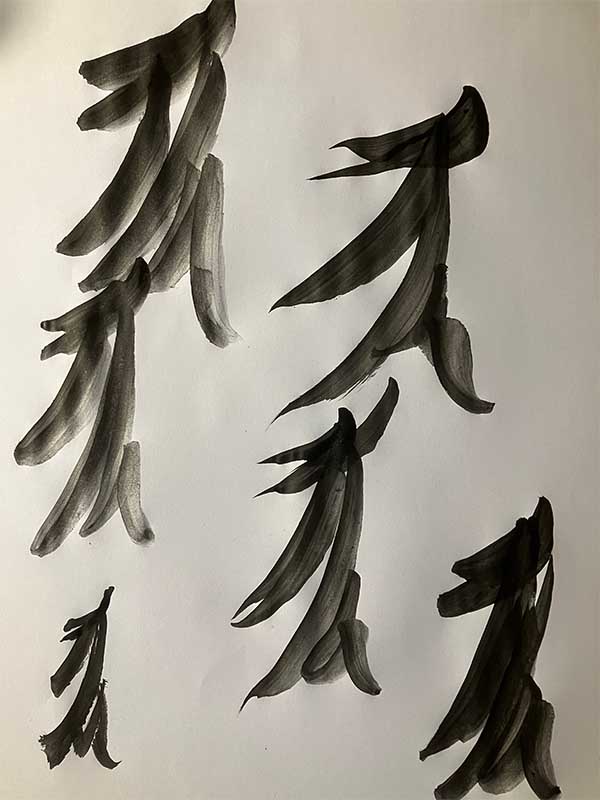
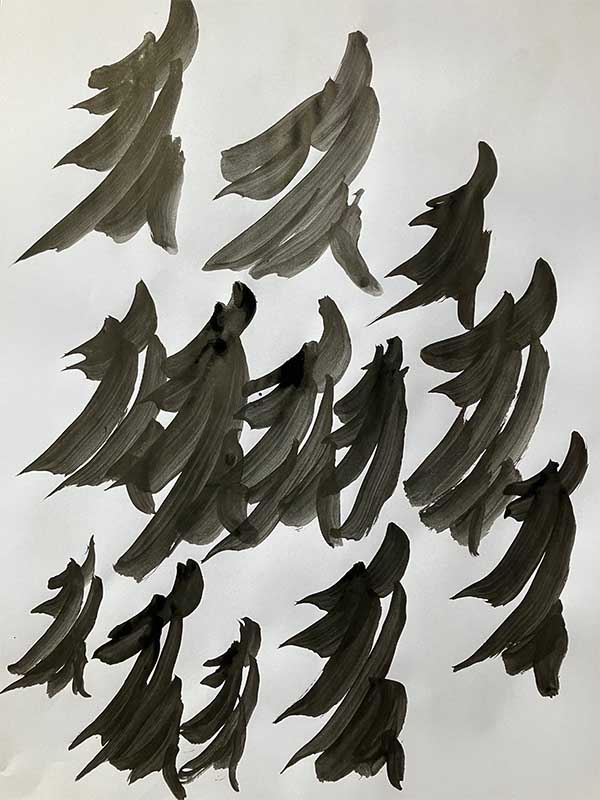
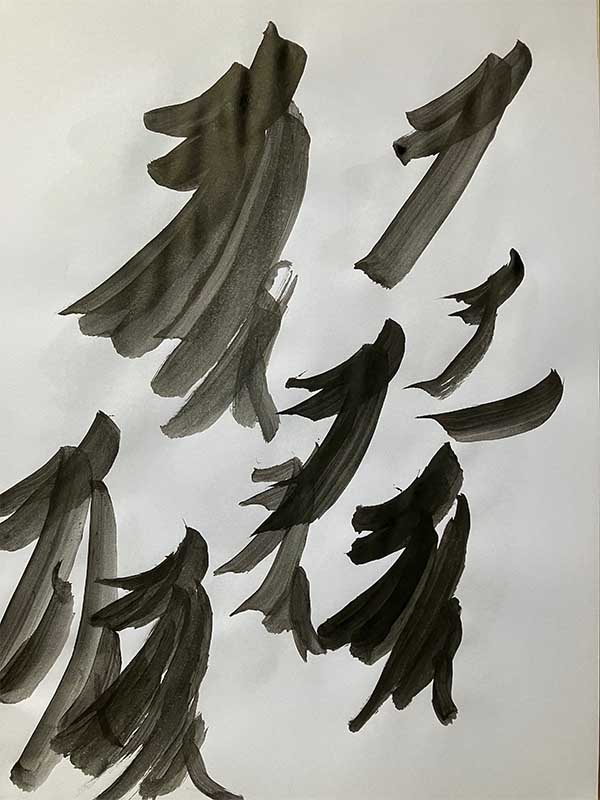
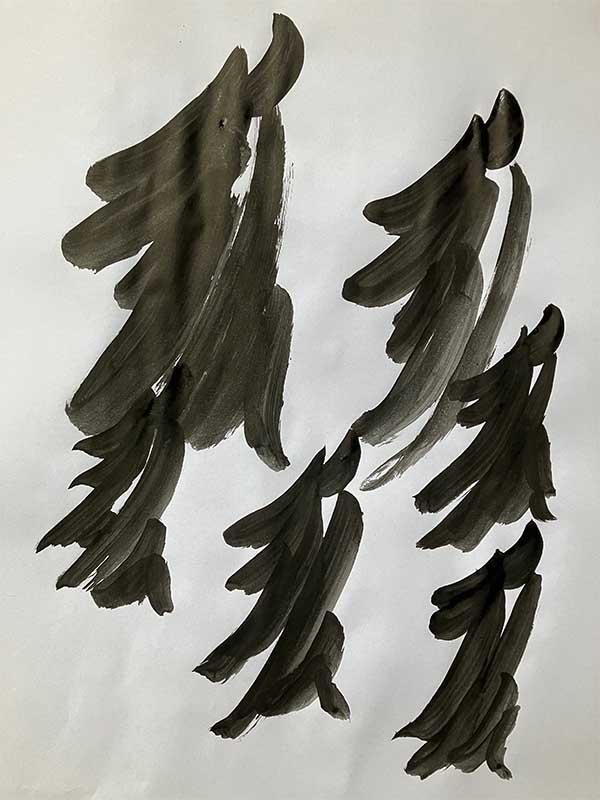
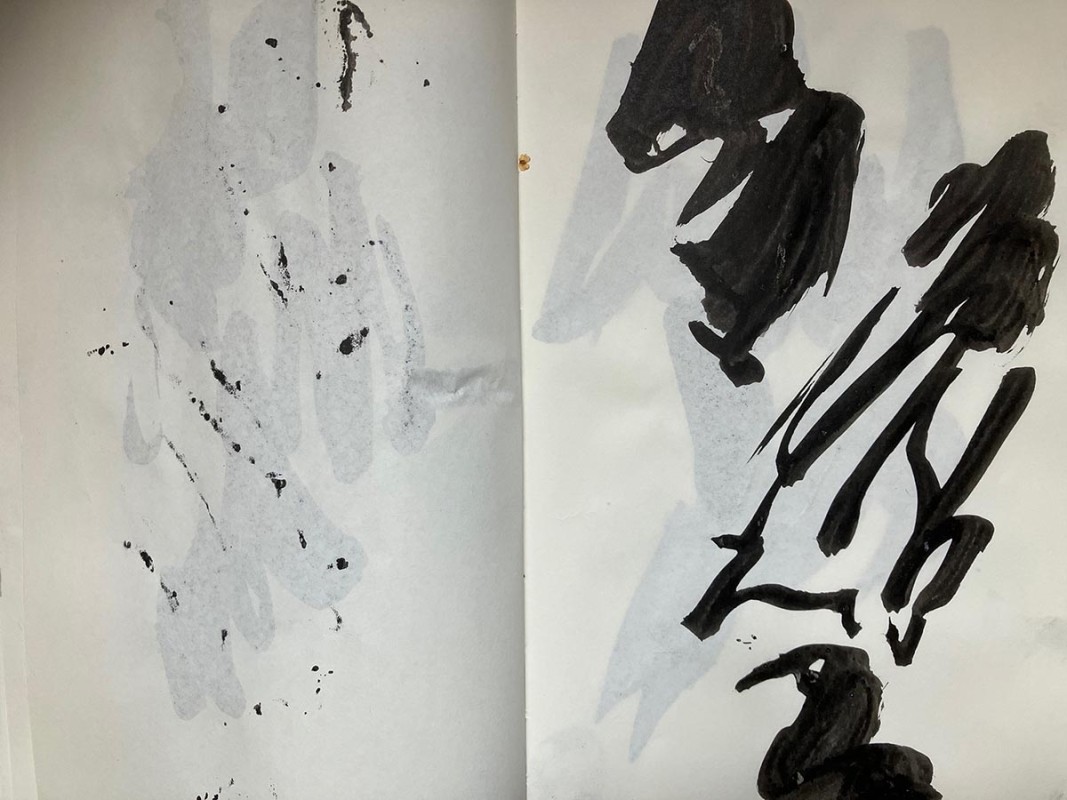
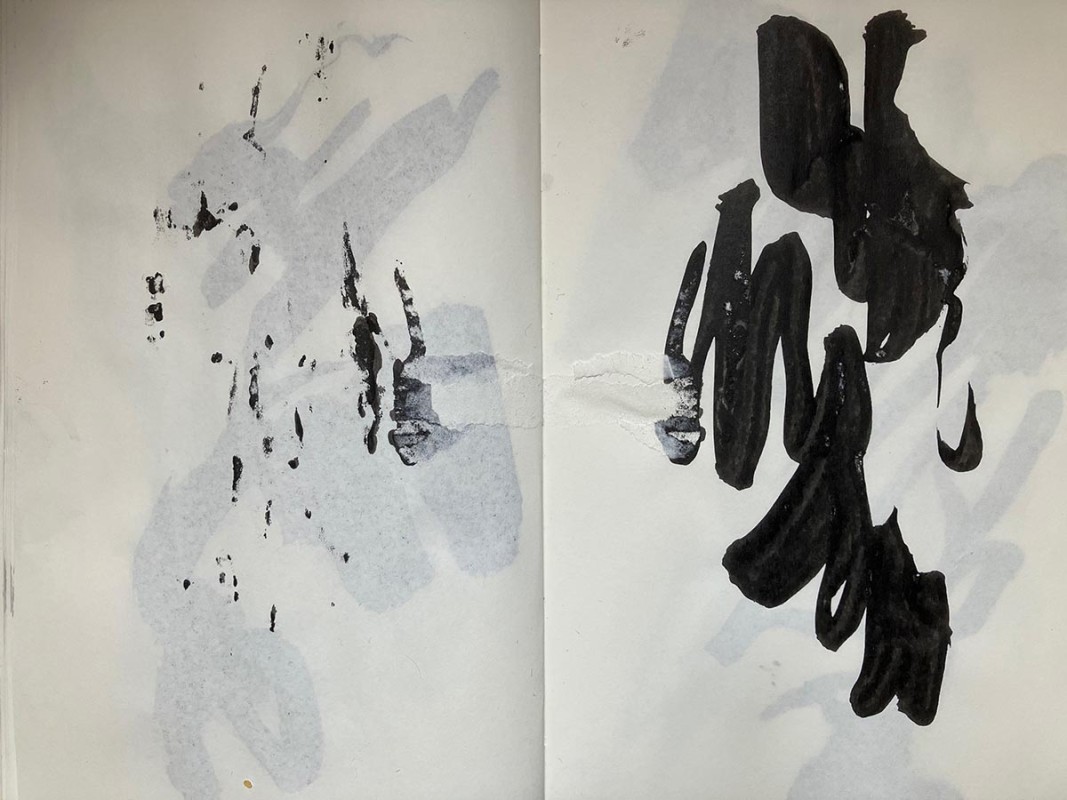
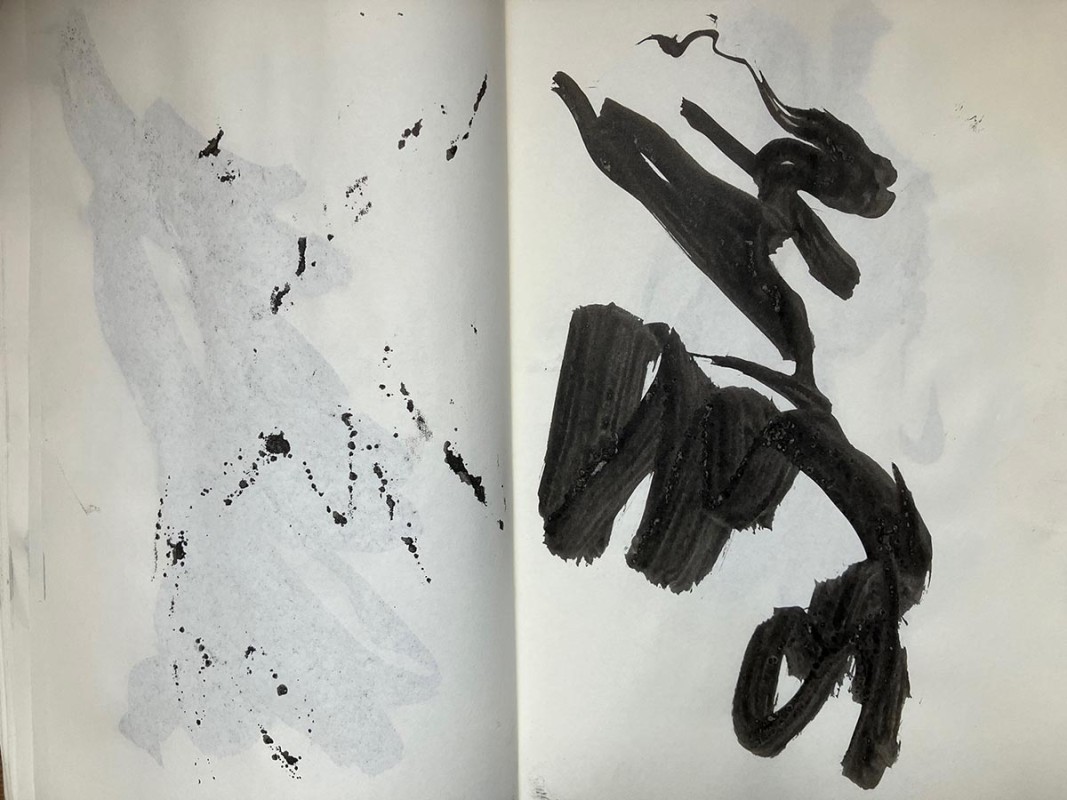
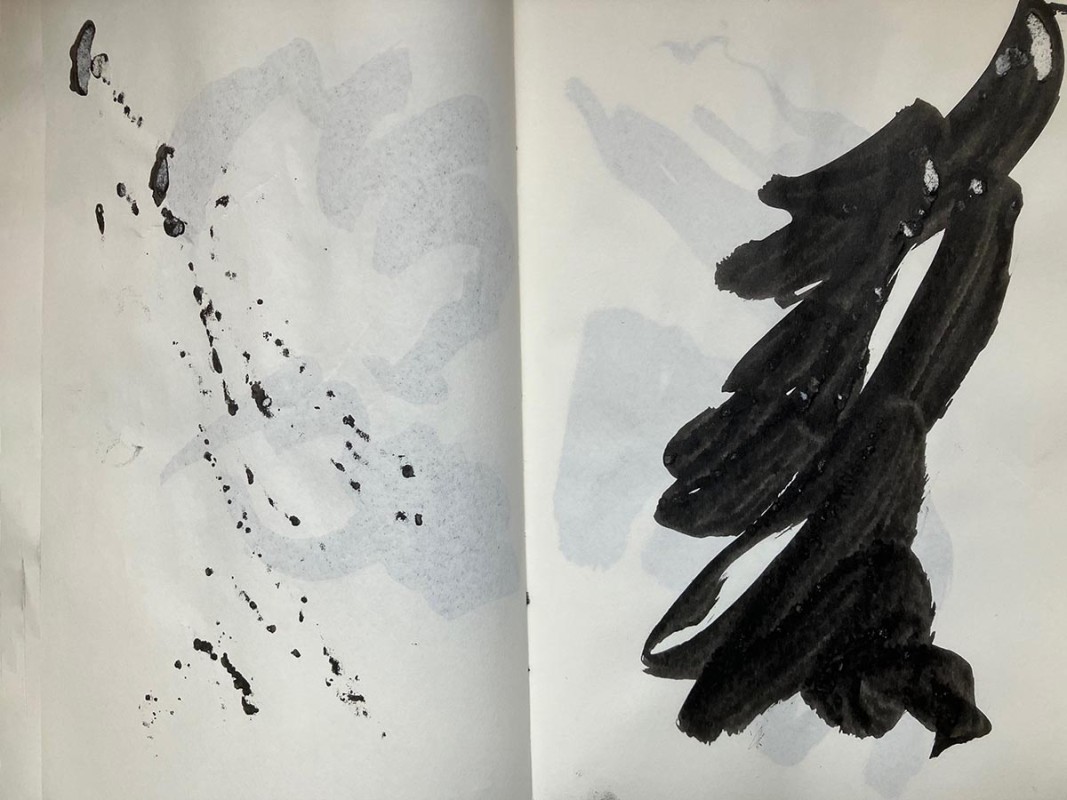
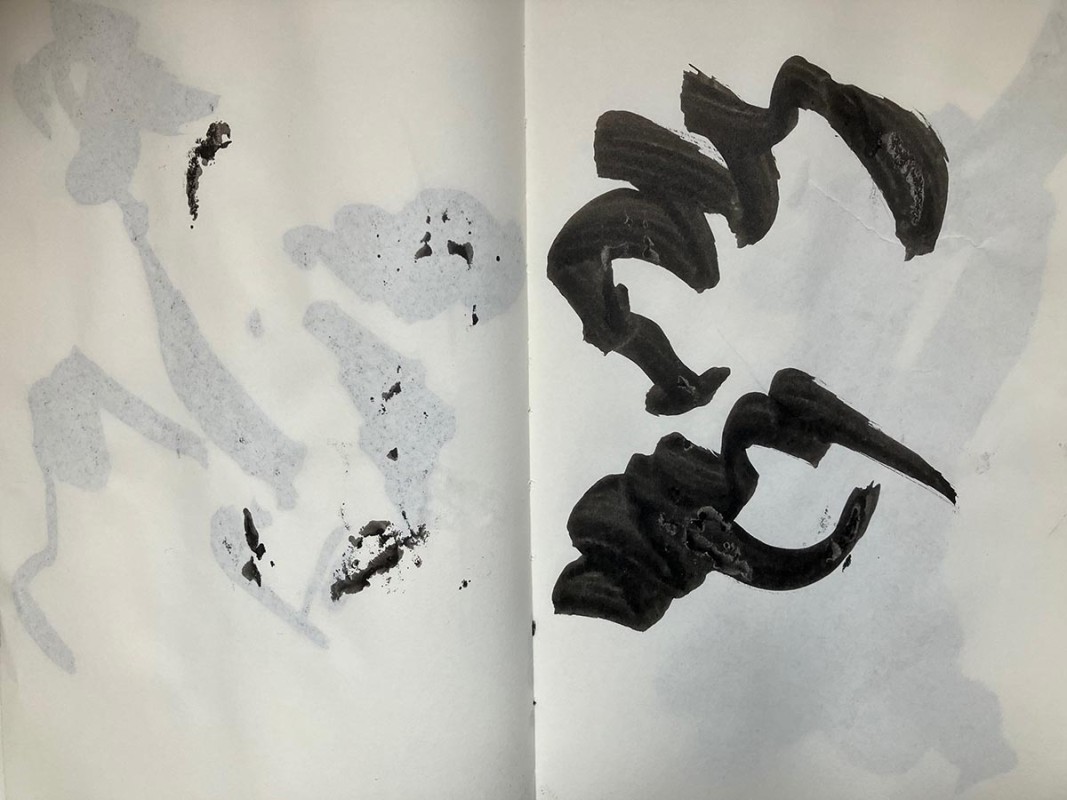
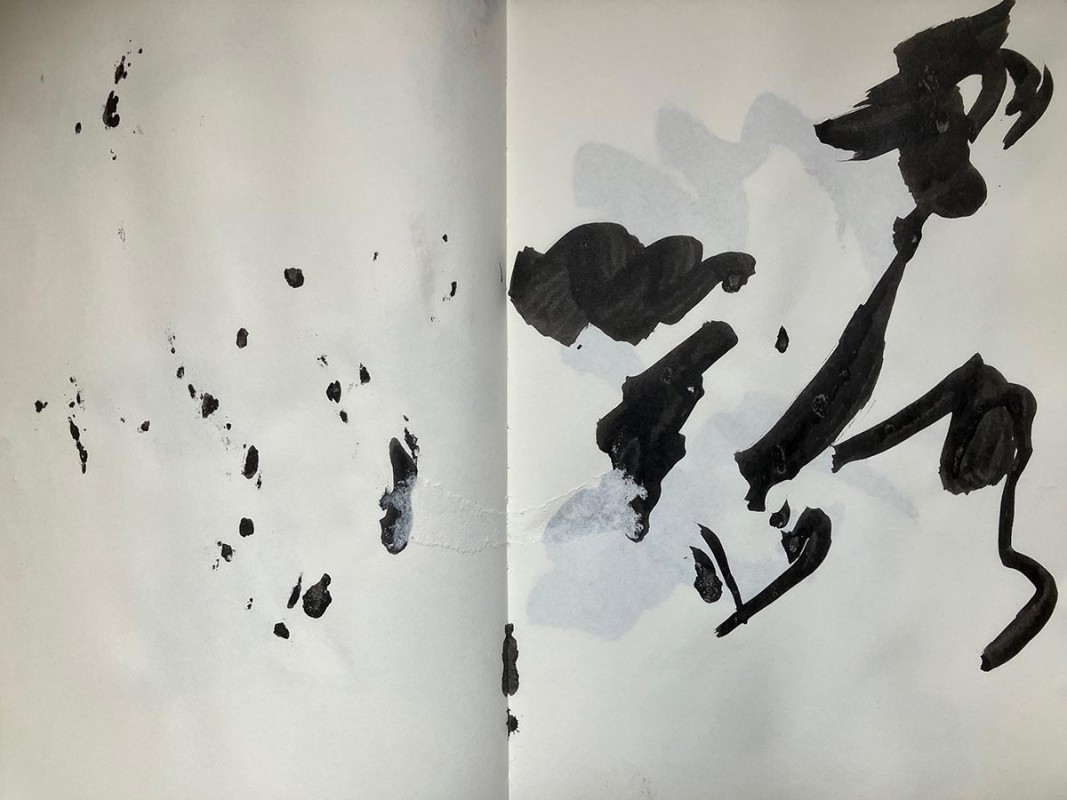
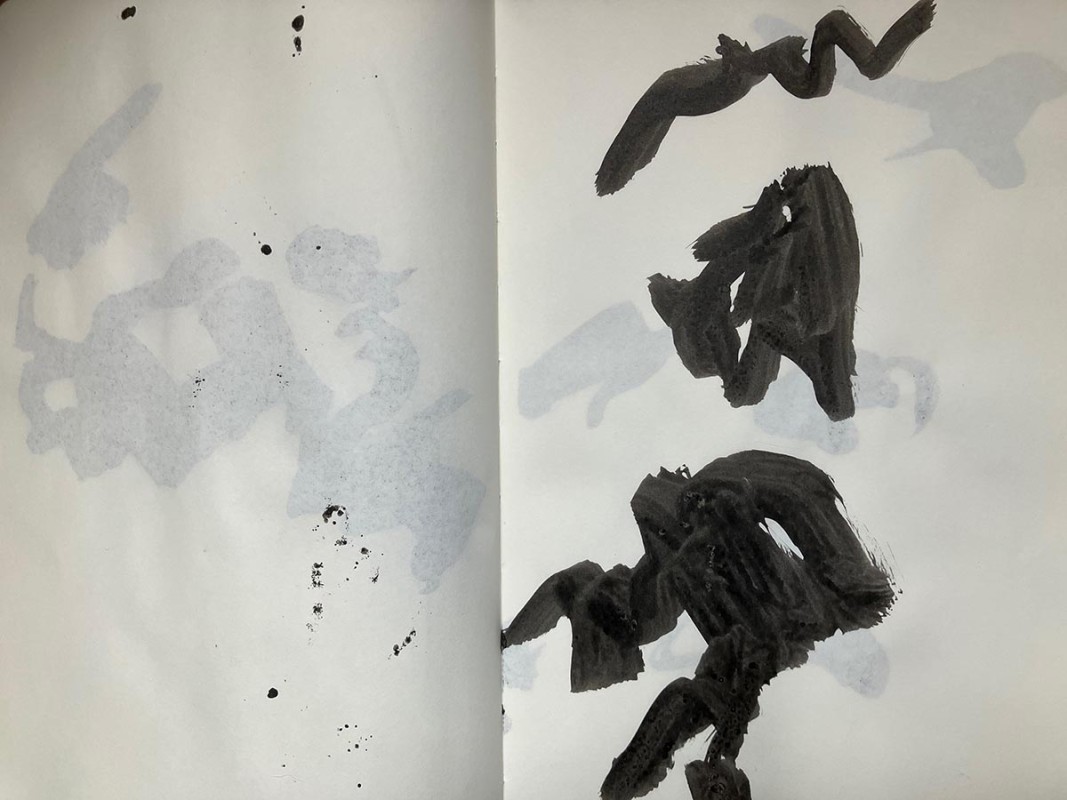
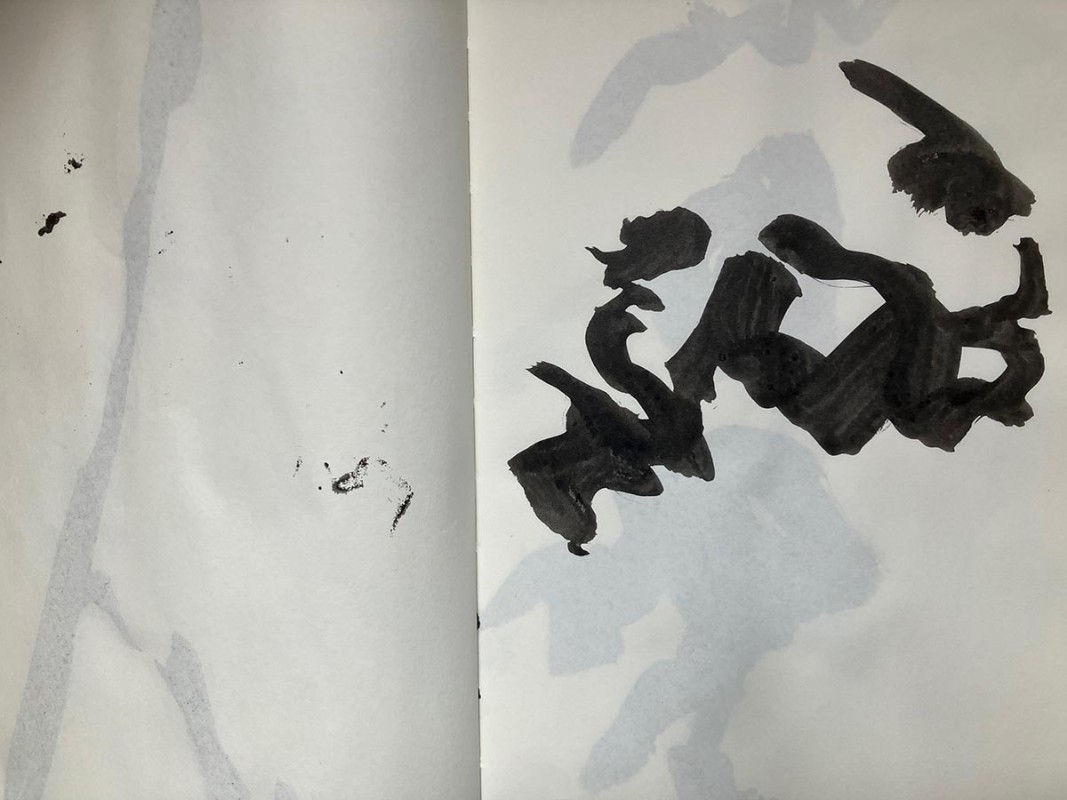
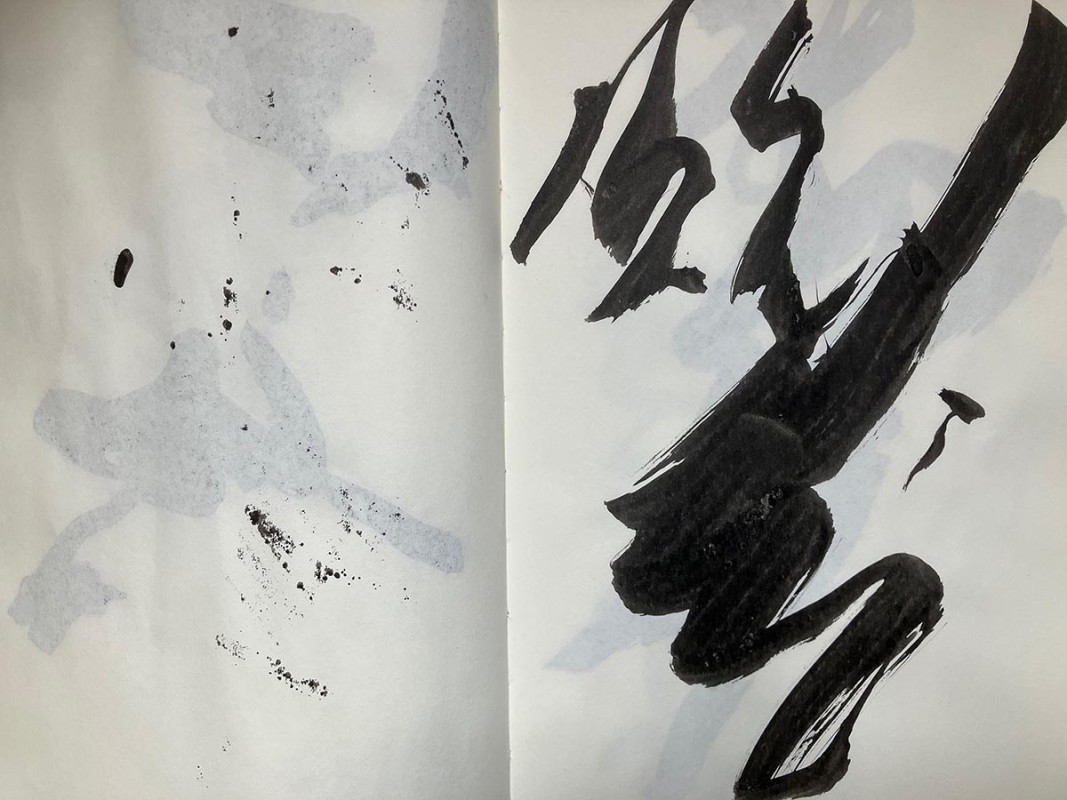
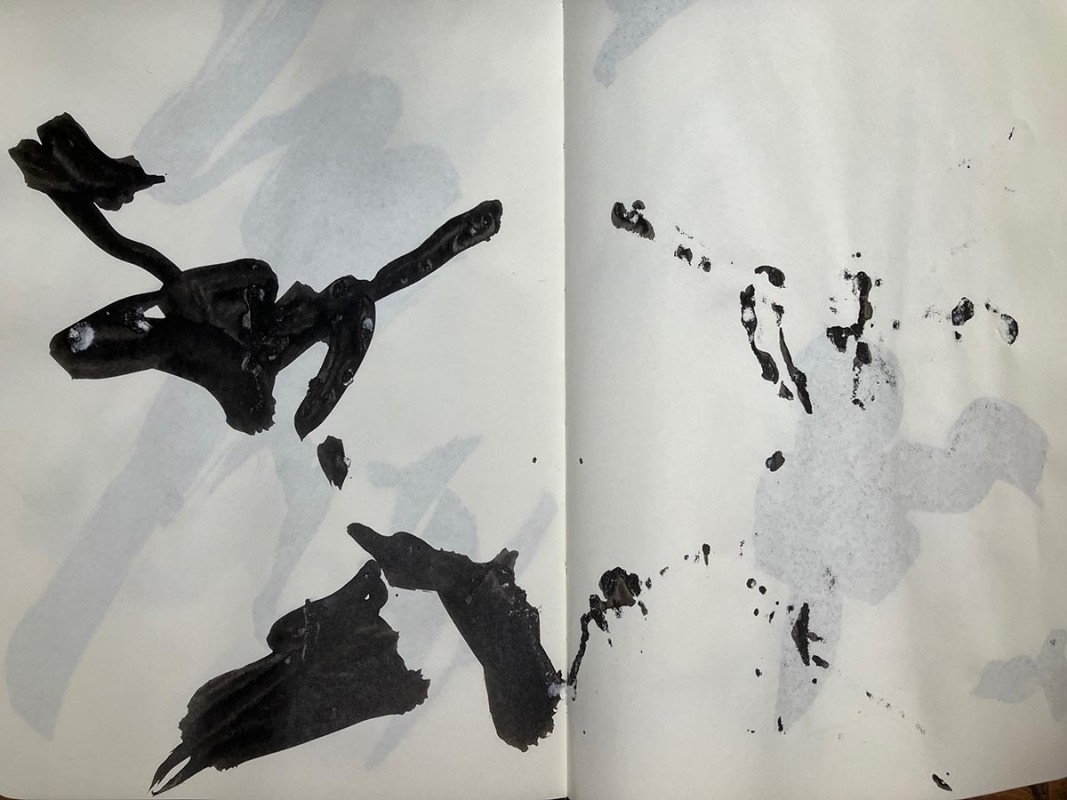
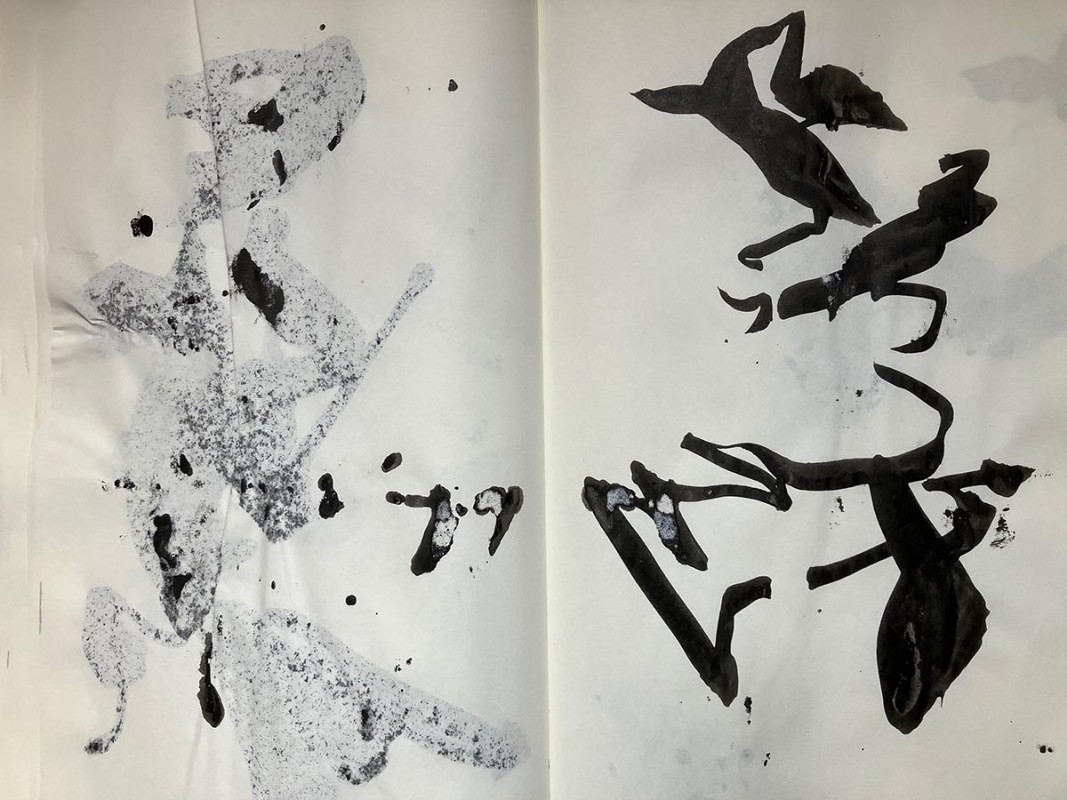
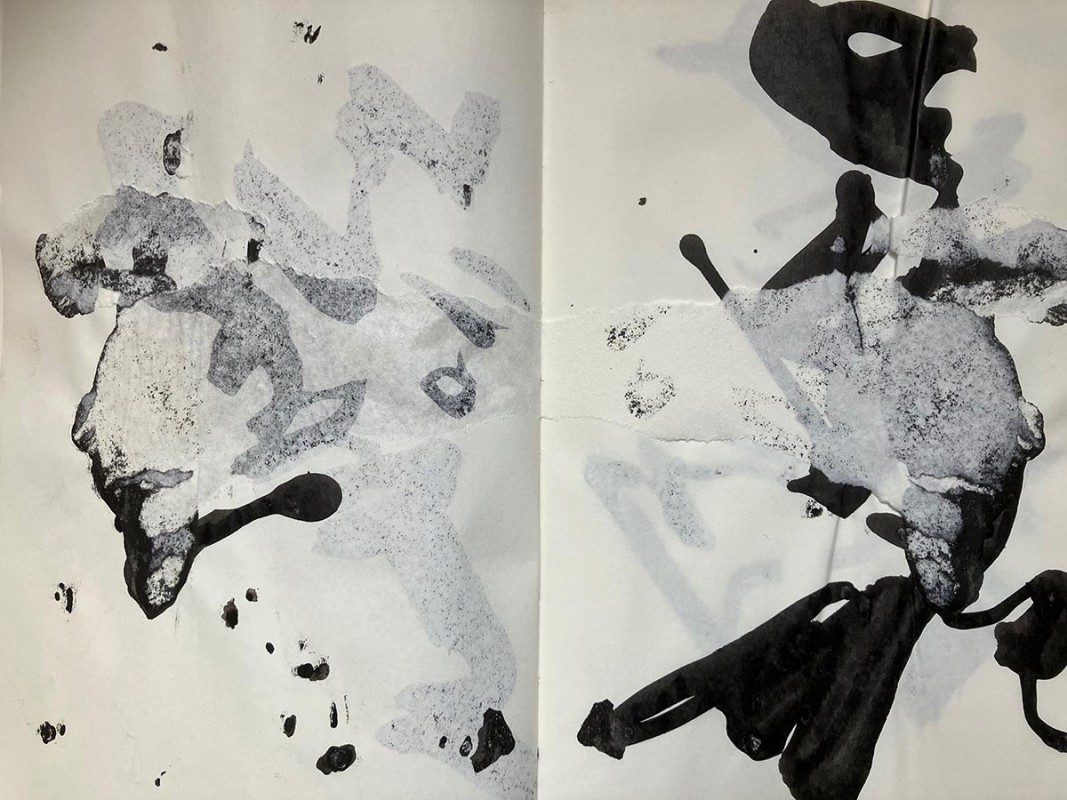
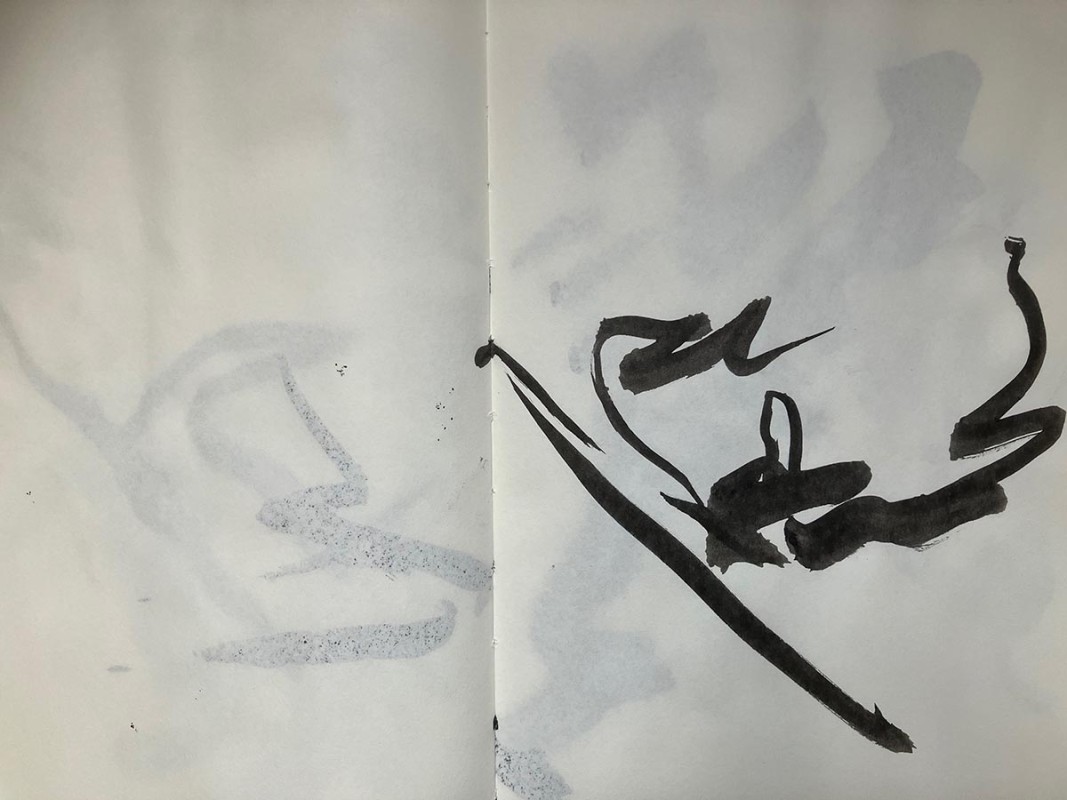
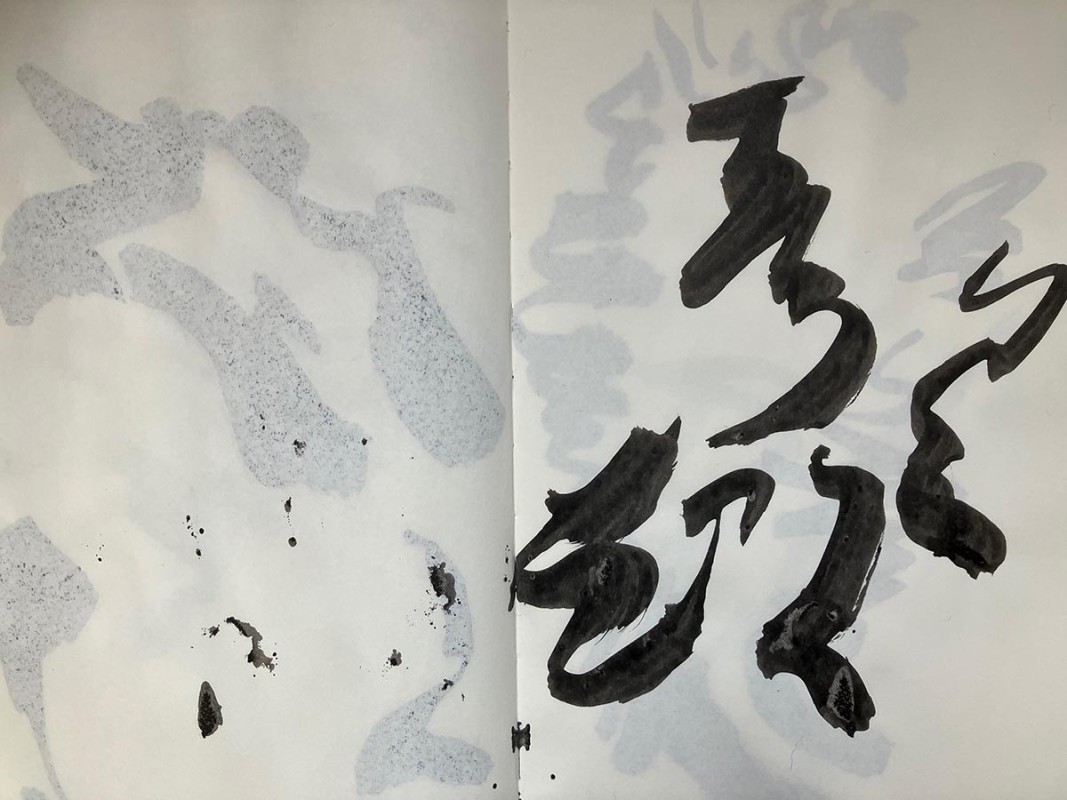
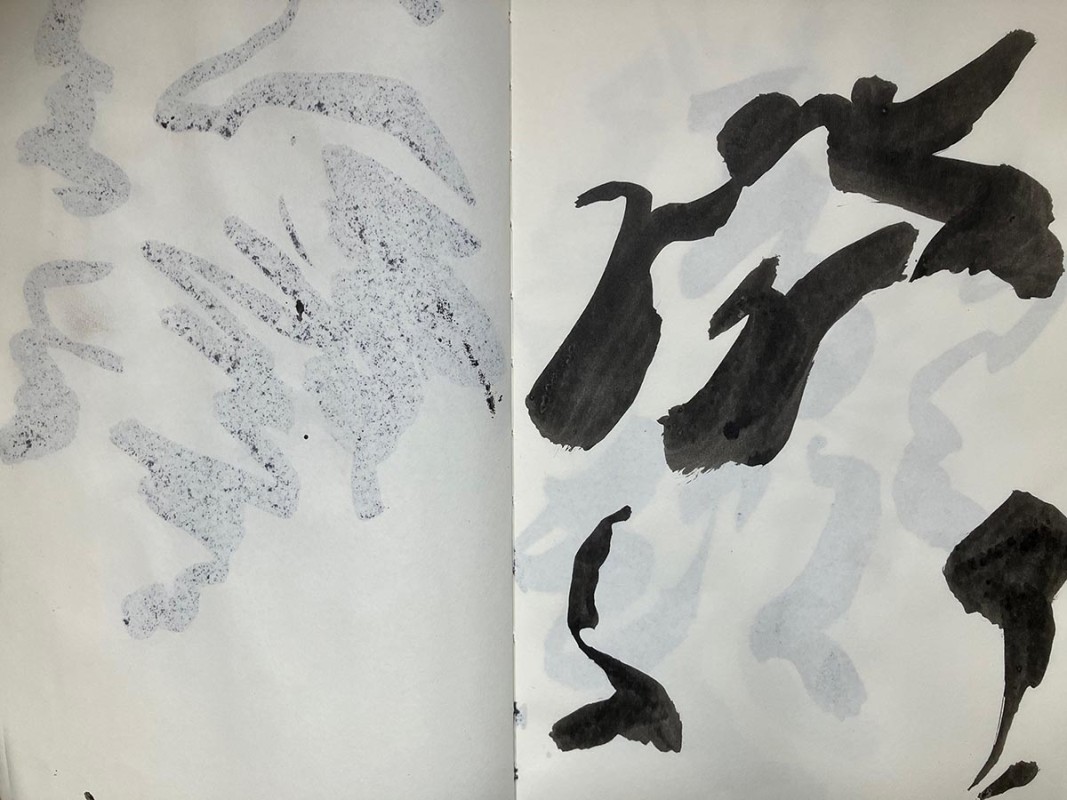
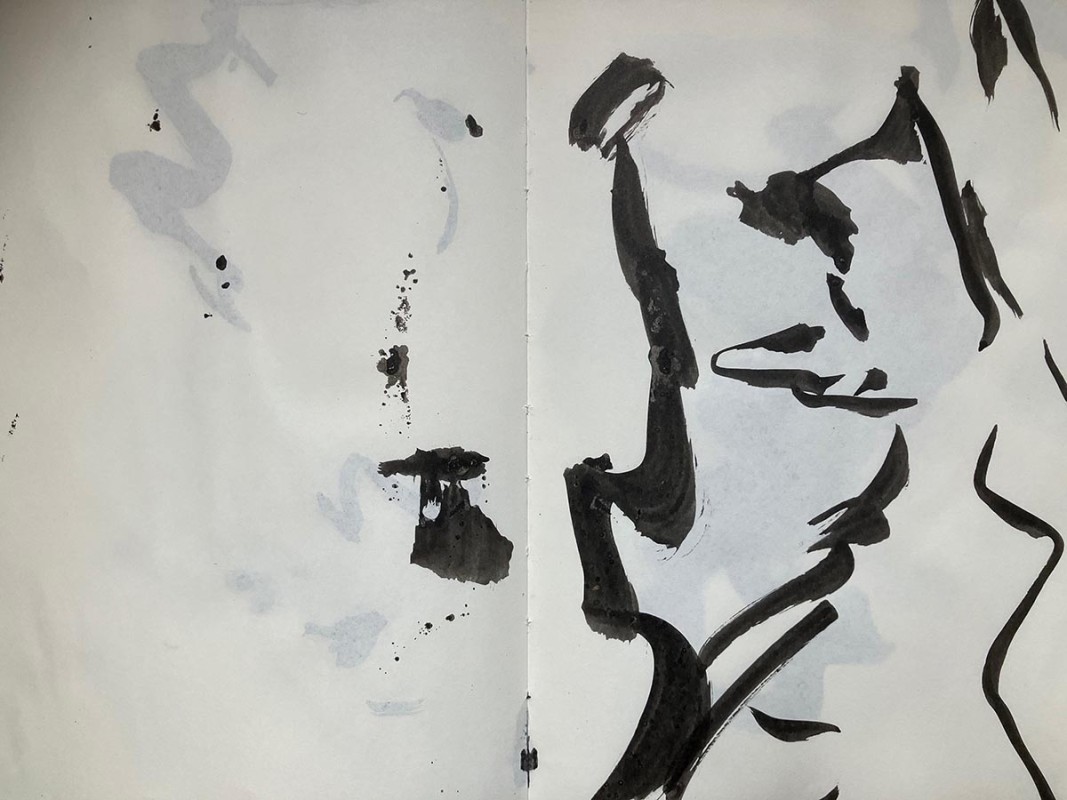
On Saturday, whilst at Shotover with the kids, I took some time – whilst they were climbing trees – to paint some of the shadows cast by the trees. I started working with shadows like these back in 2017 and have recently started exploring this idea again. Below are some examples from my sketchbook made on Saturday.

Filed Under: Present Empathy, Shadow Calligraphy, Shadows

Becoming Memory

March 22, 2023 by Nicholas Hedges

This is a short clip of a recording made at Easter in 1982. It’s part of a performance of a cantata, ‘Jerusalem Joy,’ which was performed at my mum’s church. My mum is the main voice you can hear and along with her I can hear my 10 year old self singing (with a high pitched voice) in the chorus.

https://www.nicholashedges.uk/wp-content/uploads/2023/03/no-you-cant-let-this-man-go.mp3

As I listen, a whole raft of emotions and memories are stirred up inside me, not least memories of my dear mum who we lost last year. There’s also the feel of Sundays, the look of the church, it’s smell even. There are all the faces that I would have known at the time, so many of whom have left us since. The key thing is that when I listen to the audio, my memory and the audio combine; my mind opens up the space and allows the moment to be played out as if in real time; as though I’m standing there; not as a 10 year old boy, but as I am now.

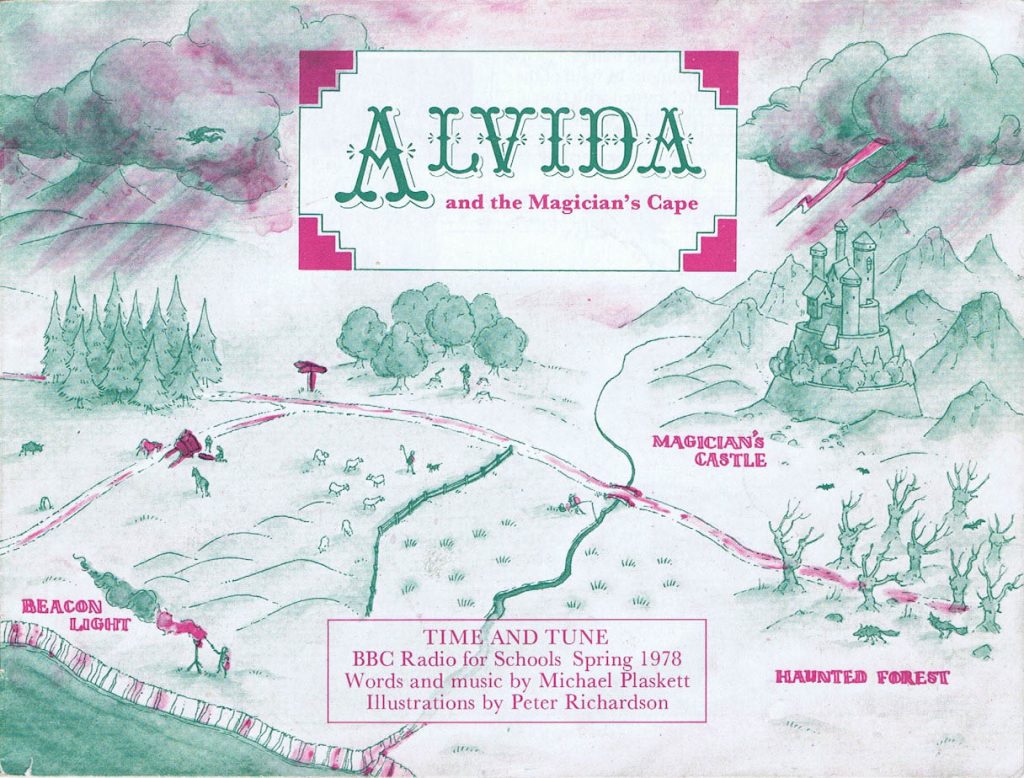
It’s a similar experience to that I felt when I listened to an old song for the first time in 45 years; one I’d heard as a child in 1978 at school, broadcast, as it was, on the radio when I was 6 years old. I wrote about it here (Wicked Magician, Fly), and listening to it again, I find myself back in the classroom at my primary school. just as I do in the church above.

https://www.nicholashedges.uk/wp-content/uploads/2023/03/Wicked-Magician-without-intro.mp3

With the display I mentioned in my previous blog, I of course have no memory of the space in the photograph; I wasn’t around 180 year ago.

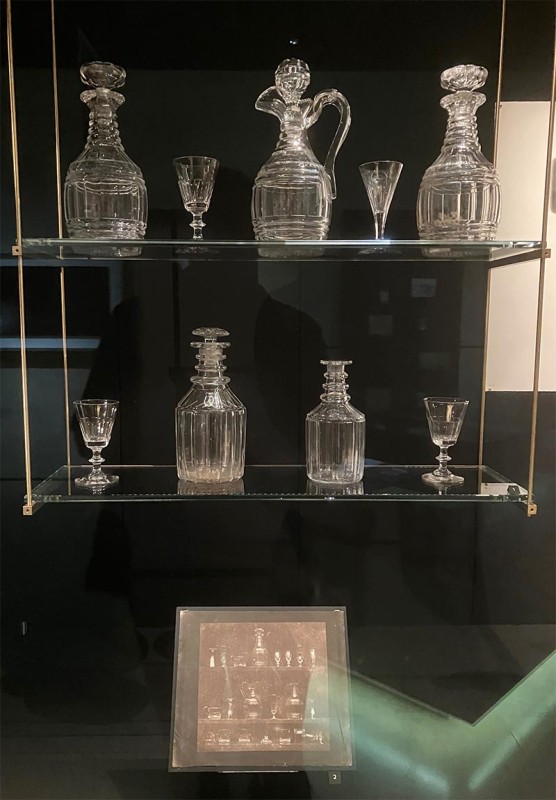
Fox Talbot's Glassware

The photograph in the picture (taken in 1844 and showing some of the glassware above it) is like the audio recording of the cantata, in that it’s a recording of a moment in time long gone. When I look at the photograph on its own, I can try to imagine the world of that lost moment; Fox Talbot setting up his display, the unwieldy camera, the rest of the room. But with some of the actual glassware above it, the process becomes much easier and the experience far more vivid. Even looking at just one of the objects (for example the jug, top centre) I am there in that vanished space. As with the audio mentioned above, the glassware acts like my memory. It becomes in itself a memory of that moment 180 years ago, and by looking at it, I am again transported in time.  (There is a link here with something I wrote on diffusers found in my mum’s house after she passed away.)

But what about when walking in an historic space like a ruined castle? I might know the history of the space and again, using my imagination, find my way back in time. But there is nothing else, save the bare stones, of what would have been a furnished and lived in space. I have no memory of the castle (as I did of the church in the audio) and there are no objects, like Fox Talbot’s glassware, to act as a surrogate memory. Instead, there is our own movement through the ruined rooms, tracing the paths others would have walked centuries before. In this regard, we become the memory and as such, are able to recall that long vanished past as if the ruin, with our help, is remembering.

Filed Under: Objects

Fox Talbot’s Glassware

March 21, 2023 by Nicholas Hedges

I recently visited The Weston Library in Oxford to see the ‘Bright Sparks: Photography and the Talbot Archive’ exhibition which runs until the 18th June. I have a deep fascination for 19th Century photography and it wasn’t a surprise to find myself captivated by the items on display. One of the most engaging displays was that which comprised a photograph taken in 1844 of several items of glassware, above which were some of those very pieces, arranged on two glass shelves.

Fox Talbot's Glassware

You can see, in the photo above, the decanter at the top of Fox Talbot’s photograph and the jug, both of which are displayed on the top shelf above. I’m not sure how long I stood there, my eyes flitting between the photograph and the glassware – but it was quite a while. To think that those objects in front of me, were the very same objects in the – almost – 180 year old photograph, was mind blowing.

But what was going on in my head while I stood there looking?

If the glass of the display case wasn’t there, I could easily reach out and touch one of the items. I could lift up the decanter for example, or the jug, and yet, there it was, pictured in 1844, 180 years away. It was like seeing the light of a star 180 lightyears from Earth and the star itself simultaneously. At that moment, now and a moment in 1844 were one and the same thing. The space in which I was standing could have been either.

There is an audio recording of my late mum singing in her church in 1982, one of many cantatas she and the church choir (which at times included me) sung at Easter and Christmas. Listening to it now, it’s almost as if I am inside the church looking down at the congregation and the choir. I can see my mum singing; as if now and that moment in 1982 were suddenly one and the same thing.
It’s as though, when looking at Fox Talbot’s photograph and the glassware above, one is replaying something; the visual equivalent of listening to the tape from forty years ago. The photograph ceases to be static, but instead it begins to move. But it’s not the material photograph that is moving, it’s the moment captured in the image. Listening to the recording of my mum, I find myself in 1982; with this display, I find myself some time in 1844.


Filed Under: Objects

Goethean Observation: Diffuser II

March 15, 2023 by Nicholas Hedges

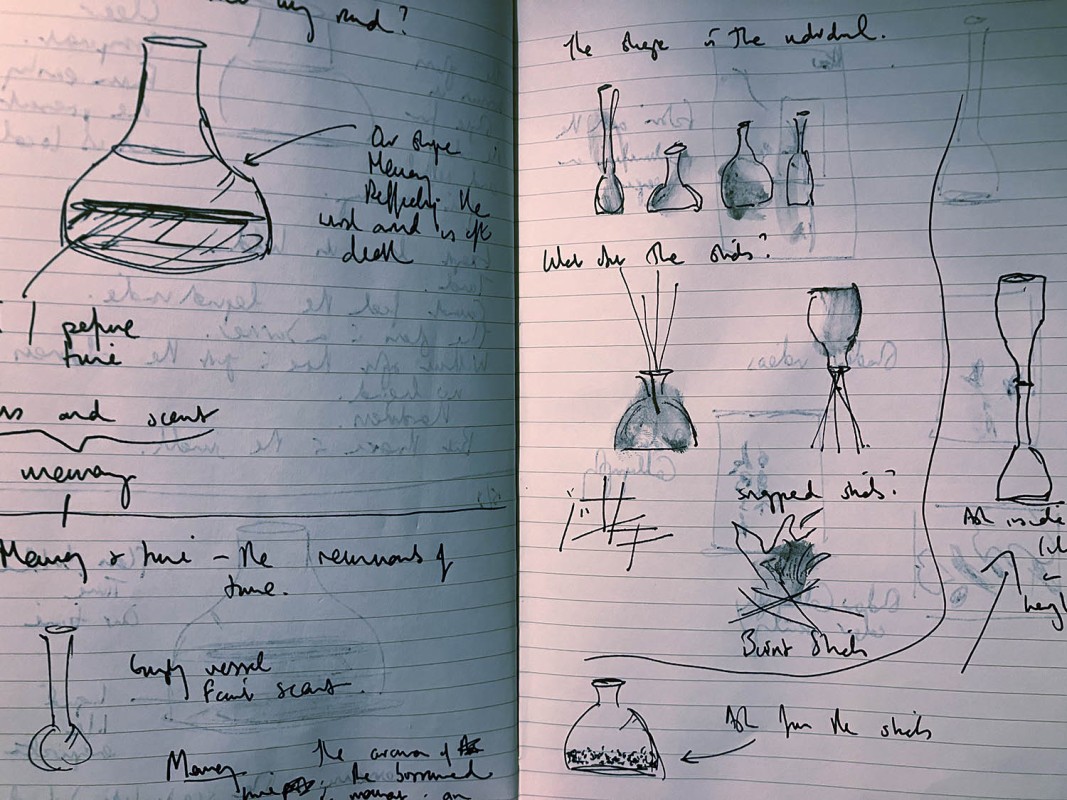
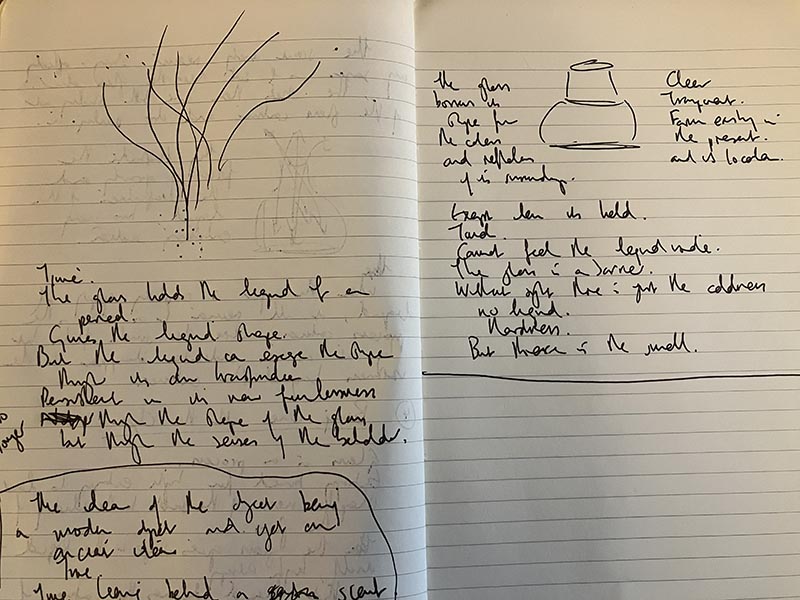
Thinking about the recent observation I did on the diffuser, I was picking through the words and was struck by a few of them. This is often how these observations work; one writes a lot which will, in the main, be discarded to find just a few words that lead somewhere.

This is part of the text from the final section:

Time.

The glass holds the liquid for a period.

The shape of time.

Gives the liquid shape.

The liquid escapes the shape through its own transformation.

Resilient in its new formlessness.
The glass itself borrows its shape from the colours and reflections of its surroundings.

Clear.

Transparent.

Its form borrowing from the present and its location.

I began to think of the glass bottle as representing time; the time of our individual lives and the liquid inside as our lives, slowly evaporating via the sticks. On our passing, we leave behind a memory – like the scent we can still detect.

However, the more I thought about it, the more I began to wonder whether it was the other way round?

Perhaps the glass represents our lives and time is the liquid within, slowly evaporating. After our passing, our form remains as a memory like the glass, borrowing the light and colours from the present day surroundings.

Time leaves behind a trace – a scent.

Memory, therefore, is both the glass and the scent; a shape of borrowed reflections and faint presence.

Filed Under: Goethean Observations

Goethean Observation: Diffuser

March 13, 2023 by Nicholas Hedges

After writing about the empty diffusers I found in  my late mum’s house, I’ve been wondering about how I might use them in a work. One of the strategies I learned on my MA (2006-08) was Goethean observation; a process I have used many times before and which I decided to use again with these objects. The method of observation can be found below.

The process of 'Goethean Observation'

Introduction

There are many different interpretations of the Geothean (a method of observing as described by Johann Wolfgang von Goethe (1749 – 1832)) method, but the one I prefer to use is that described by Iris Brook in her paper, “Goethean Science as a Way to Read Landscape,” which is, basically, as follows:

1. exact sense perception [bare facts: perception]
2. exact sensorial fantasy [time-life of object: imagination]
3. seeing in beholding [heartfelt getting to know – inspiration]
4. being one with the object [intuition]

1. Exact Sense Perception [Perception]

Now the observer attempt to approach the object from a clearer, more objective standpoint.. This stage was called by Goethe, exact sense perception and is characterised by a detailed observation of all the ‘bare facts’ of the phenomenon that are available to our ordinary senses. It is an attempt to see what is present with as little personal judgement and evaluation as possible.

An example of trying to let the facts speak for themselves from Goethe’s own work is his extraordinarily detailed observations of colour phenomena. Rather than draw hypotheses or work from a theory his investigations involve colour as experienced by himself, as used by artists, as created by dyers, as used symbolically, as seen in animals and plants and so on.

For the student attempting to carry out this stage with their own phenomenon, drawing can be a useful tool, because in drawing our attention is brought to previously unnoticed detail or patterns.

Another tool used is to ignore some knowledge, for example the names of things… Attempting to find another word to describe the part you are indicating to someone else often leads to a looking again.”

2. Exact Sensorial Fantasy [imagination]

“The second stage of looking at the phenomenon is what Goethe called ‘exact sensorial fantasy’ (Exact sinnliche Phantasie). An aspect of this activity is to perceive the time-life of the phenomenon, that is to see the phenomenon in time. This means no longer seeing the thing in an objective frozen present as prompted by the first stage, but as a thing with history. That history can be drawn from the phenomenon with the use of an imaginative faculty that cultivates temporal and physical relationships…

The shift between the two modes of seeing is a small one, but the world does look very different when seen in a state of flux.

In this phase the imagination can be used as a tool to vary what is seen and attempt to imagine it otherwise. The obvious link to the phenomenology here is with the use of free imaginative variation. First suggested by Husserl, this is a means of deriving the essence of a phenomenon by pushing the eidos of the thing beyond what can be imagined. The second stage could be seen as a training of the imaginative faculty in two directions: firstly to free up the imagination and then to constrain it within the realms of what is possible for the phenomenon being studied.”

3. Seeing in Beholding [Inspiration]

The first two stages of Goethean method could be characterised as an engagement with the phenomena, first by seeing its outer static appearance objectively and then by experiencing something of its inner processes. In the third stage one attempts to still active perception to allow the thing to express itself through the observer. We attempt to step outside of what has gone before and make space for the thing to articulate in its own way.

The detailed information is somehow transcended, but just as exact sensorial fantasy requires exact sense perception to anchor its dream-like activity, seeing in beholding needs the content and the preparation of the other two stages if the researcher is to articulate the thing. Goethe terms the changes necessary to our everyday consciousness as the development of ‘new organs of perception’.

To experience the being of a phenomenon requires a human gesture of ‘self-disspation’. This effort is a holding back of our own activity – a form of receptive attentiveness that offers the phenomenon a chance to express its own gesture.”

4. Being One with the Object [Intuition]

“The first three stages of the Goethean method involve different activities and ways of thinking and these could be characterised as first using perception to see the form, second using imagination to perceive its mutability, and, third, inviting inspiration to reveal the gesture. The fourth stage uses intuition both to combine and go beyond the previous stages.

Being one with the object in this fourth stage allows the human ability to conceptualise to serve the thing: we lend it this human capacity. When the phenomenon being explored does not have the ability to think, it is the most participatory part of Goethean observation.

Our ability to think creatively and to initiate future action is the faculty being used here and thus the dangers of abstract creation not tied to the phenomenon are great.

Being one with the object allows an appreciation of the content or meaning of the form as well as the form itself… At this stage of the process of Goethean observation it is acknowledged that the phenomenon is at its least independent of human reason.”

Observation: Diffuser

1. Exact Sense Perception [Perception]

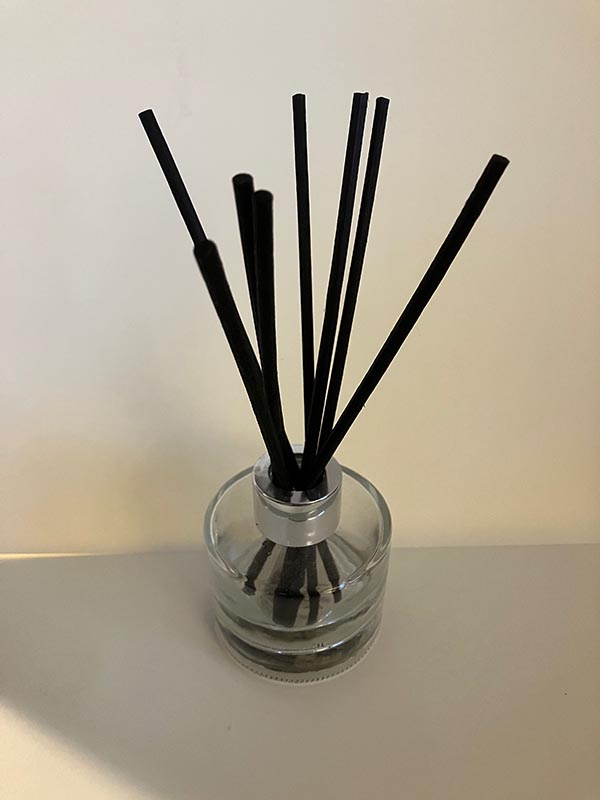
On first seeing the object it becomes apparent there are two main parts to it. One, a glass jar/container and second, eight black wooden sticks. The sticks are placed inside the container and protrude from the top several inches.

The glass container is approximately 3 inches in height and inside is a liquid; not much – just a few millimetres. The bottom of the sticks rest on the bottom of the container and in the liquid which coats the bottom of the sticks. There is some writing on the glass container which includes a description of the obvious scent coming from the container.

Placing my nose near the opening at the top of the container, the smell is very strong and quite overpowering.

I can see the lights of the room I am sitting in and that from the window reflected in the silver stopper at the top of the jar and in the glass; with highlights on the shoulder of the glass container  and again in the stopper.

I can feel my nose – full of the scent which becomes increasingly strong; almost too much.

I can hold the container in my hand. Looking at it from below I can see the viscous liquid move about the base. It is goldish in colour and syrupy.

Holding one of the sticks they are about 12cm long. One end is wet with the liquid, the other dry but there is a dry kind of stickiness to it. When I place the stick back in the glass container I can feel something on my finger. It smells like the scent from the bottle.

There are lots of reflections in the jar and the stopper; the brown of the table, the lights I’ve already mentioned; reflections of the sticks in the silver surface of the stopper.

I can see the base of the sticks through the glass of the jar, their shape distorted especially at the shoulder of the container.

Leaning back I can see the liquid on the base of the sticks catching the light in the room and from the window. The sticks form a random pattern as they stick out of the container, like fingers reaching out.

2. Exact Sensorial Fantasy [imagination]

Looking at the objectI think of its two parts; the glass container and the wooden sticks standing inside. To begin, I take the sticks out of the jar ad place them on the table beside me.

These two materials then are quite different entities. And there is the liquid too, created in a factory somewhere from all kinds of different scents – only some of it remaining in the bottom of the jar. The jar, as it stands on the table before e, looks empty – reflecting just the room round it. Only when I pick it up is the liquid apparent.

The liquid then must have once filled the container; the liquid created by people who could smell when the recipe was right, when a satisfying smell had been created.

The smell lingers; remaining strong even though so much of the liquid has gone; evaporated through the same hole through which it was poured before being sealed up.

The glass itself comprises ingredients mixed together to create the material. Although the object exists now, the method itself is ancient.

As is the idea of scented oil. There is something ancient about the glass jar – the idea of the container and the scented oil. The smell I can smell is strong and in that sense is something equally ancient.

The glass container and the liquid inside are a version of something much older,

The wooden sticks are products of trees; things grown, reaching toward the sky, year after year after year.

The wood from the tree has been turned into these small sticks and brought together with the container and its contents to help spread the aroma of the liquid.

The liquid will, in a short time, disappear leaving behind an empty jar – but one which is nevertheless full of scent which will remain for much longer.

The sticks will disappear before the glass jar and what had been 3 things will be one. The sticks will have gone; the liquid will have gone and all that will be left is the jar – and yet there will still be the scent. The jar is still full – and yet there will still be the scent. The jar is still full; an emptiness transformed into something else.

Goethean Observation notes

3. Seeing in Beholding [Inspiration]

An almost invisible transformation

Very slowly the liquid disappears into the air around the container.

It attached too to the glass and the sticks

The liquid leaves the jar and yet it remains, still able to affect the senses.

The container can never be empty.

Not entirely.

The liquid does not entirely disappear.

The sticks point upwards, drawing up the liquid; freeing some of the scent.

The rest remains inside.

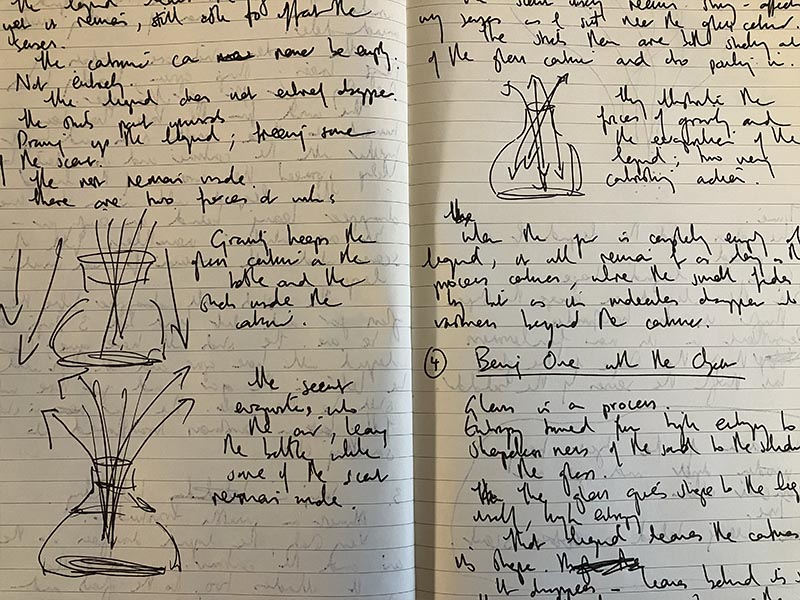
There are two forces at work. Gravity keeps the glass container on the table and the sticks inside the jar. The scent evaporates into the air leaving the bottle while some of the scent remains inside.

Te scent itself remains strong – affecting my senses as I sit near the glass container. The sticks then are both sticking out of the glass container ad also pointing in.

They illustrate the forces of gravity and the evaporation of the liquid; two very contrasting actions.

When the jar is completely empty of liquid, it will remain for as long as the process continues, when the smell fades bit by bit as its molecules disappear into te vastness beyond the container.

4. Being One with the Object [Intuition]

Glass is a process.

Entropy.

Turned from high entropy to low.

Shapelessness of the smell to the solidity of the glass.

The glass gives shape to the liquid – itself high entropy.

That liquid becomes the confines of its shape.

It disappears and leaves behind its smell.

That smell forms a shape in the mind.

Time.

The glass holds the liquid for a period.

The shape of time.

Gives the liquid shape.

The liquid escapes the shape through its own transformation.

Resilient in its new formlessness.

The glass itself borrows its shape from the colours and reflections of its surroundings.

Clear.

Transparent.

Its form borrowing from the present and its location.

Except when its held.

Touch.

Cannot feel the liquid inside.

The glass is a barrier.

Without sight there is just the coldness.

No liquid.

Hardness.

But there is the smell.

Filed Under: Goethean Observations

A Remembrance of Things We Never Have Known

March 2, 2023 by Nicholas Hedges

Following on from the shadow work I’ve been doing I decided to work in some colour. I suppose it would signify the idea that our concept of the near past is often framed by the black and white media of its production, whether that’s in its photography or film. Then there are the texts written about the more distant past, whether contemporary or otherwise which, in our minds, become a blend of forms and colours as we try to picture that which they describe.

There was a moment several years ago when I found a piece of mediaeval pottery on a dig in Oxford. From out of the dark brown earth, the vivid yellow of the shard was made visible for the first time in several hundred years; seen for the first time in that great span of time. In some ways it was quite unsettling as I described in a blog in 2014.

The introduction of colour changes these ‘shadow texts’ into something else; a remembrance of things we could never have known, the memory of which we can only imagine.

Filed Under: Uncategorized

A Moment’s Language

February 22, 2023 by Nicholas Hedges

I have long been meaning to work from some videos I made back in 2018, using a calligraphy brush and ink to follow the ‘text’ as it’s ‘written’.


Here are a few of the resulting paintings which I’m pleased with.

Painting of shadows cast by trees

Painting of shadows cast by trees

Painting of shadows cast by trees

Painting of shadows cast by trees

Filed Under: Present Empathy, Shadow Calligraphy, Shadows

Take Me Home

February 19, 2023 by Nicholas Hedges

After we lost mum in September last year, I found some old audio cassettes in her attic, one of which was a selection of tracks she recorded with my aunts in around 1975/76. The recordings had suffered a little through many years in a cupboard, but having restored them as best I could, I lifted the vocals from one track and wrote a new backing track. The song is ‘Take Me Home (Country Roads)’ by John Denver, and though it’s just a small thing, ‘collaborating’ with my mum (who is singing the lead) went some small way to making up for the conversations I miss having with her.

This is also dedicated to my Auntie Mo who also passed away in 2022.

Filed Under: Family, Grief

Arrival/Departure

February 19, 2023 by Nicholas Hedges

It was almost 5 years ago in 2018 that I made these videos in a forest in Oxford and I’ve always found them entrancing. The play of the shadows across the paper has, for me, the feel of Japanese or Chinese calligraphy, as if the trees themselves were writing.


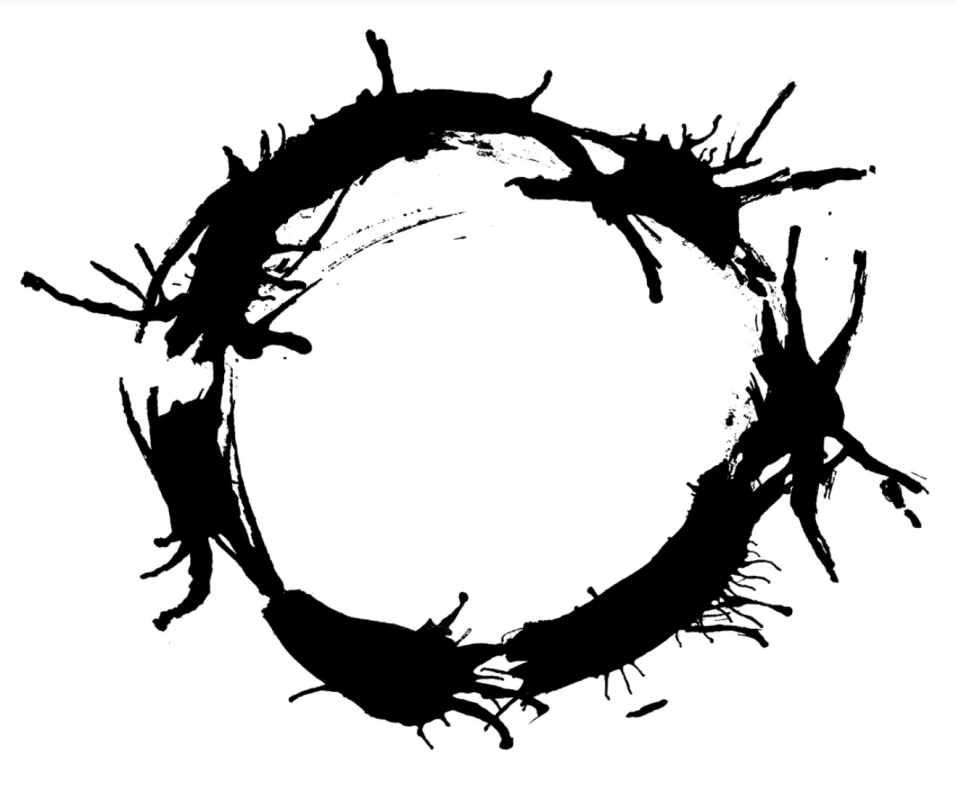
I have also, more lately, been reminded of the 2016 film ‘Arrival’ in which the writing made by the alien Heptapods has a similar look and feel. 

It was therefore a small step for me to begin looking at these video images as texts, ‘written’ in a language that, like the logogram above, has to be deciphered before it can be understood; a lost language belonging to a moment in time that has passed.

The ‘writing’ in these videos was made by the combination of trees, the sun and the wind, along with the person who filmed it – me. Indeed, it is the act of filming and framing these small areas of the forest floor which has rendered the shadows as something akin to ‘texts’ to be interpreted.

I’m reminded here of a passage I’ve often cited by Christopher Tilley who, in his book ‘The Materiality of Stone, Explorations in Landscape Phenomenology’, writes: “The trees ‘see’ the painter in a manner comparable to that in which the mirror ‘sees’ the painter: that is, the trees, like the mirror, let him become visible: they define a point of view on him which renders visible for him something that otherwise would remain invisible – his outside, his physiognomy, his carnal presence… The trees and mirror function as Other.”

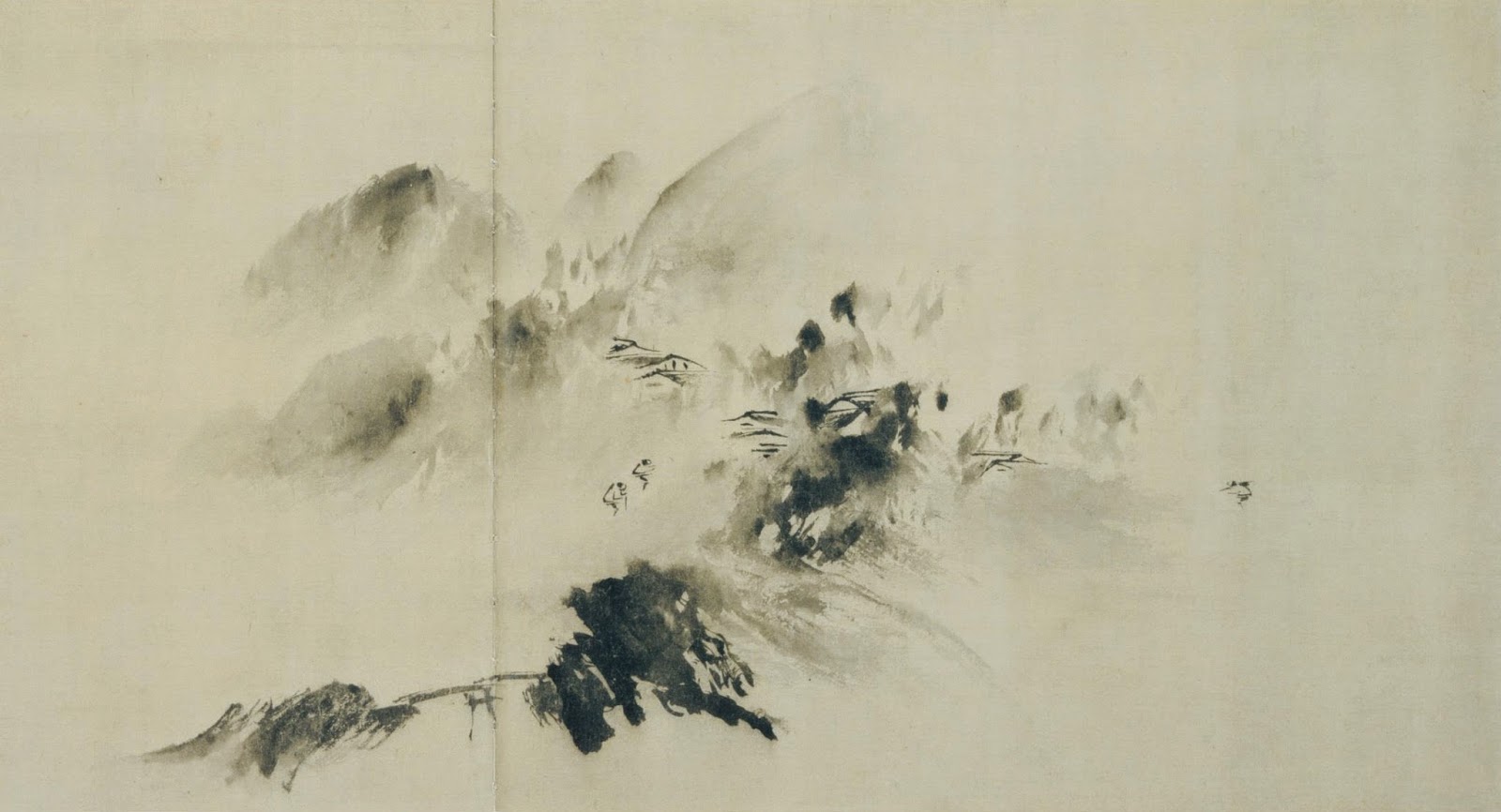
What these video ‘texts’ are describing is, I think, in part, presence, and what Tilley describes as ‘Other’. Something which would otherwise be invisible – my presence in nature – is, through the filming of the shadows, rendered visible. I must at this point bring in a passage from a book I wrote called ‘Brief Castles’ in which one of the main characters is describing his appreciation of a 13th century Chinese painting.

“Entitled Mountain Village in Clearing Mist by Yu Jian, the painting [shown below] was made all the more extraordinary on account of its age, made, as it was, around 800 years ago in the mid 13th century. This seemingly rapid work transported me to a time long gone. It revealed – much as with the Japanese haiku of Basho – an ancient and vanished moment, not so much through what it showed but how it was depicted. It was almost as if I could see the landscape before the painter himself. I could see the work as a whole (the landscape as a whole), but then, whilst picking through the gestures of the artist, evident enough in the brushstrokes, I could see the landscape as it was revealed. Yu Jian’s painting was not a painting of what was experienced, but rather the experiencing of what was experienced. It was almost as if the painting had become a painting, not of Yu Jian looking at the mountains, but of the mountain ‘seeing’ Yu Jian. It wasn’t the mountain that was made visible on the paper, but the artist himself – his presence at that moment. 800 years after his death, and Yu Jian was as good as sitting next to me. Or to put it another way, 800 years before I was born, I was as good as sitting next to him.”

Clearing in the mist by Yu Jian

The brushwork again reminds me of the videos and this line in particular resonates with what I wrote above: “It wasn’t the mountain that was made visible on the paper, but the artist himself – his presence at that moment.” 

These videos are about that which is both visible and invisible; an absent presence. The trees are not in shot and all we see in the videos are the shadows cast by the branches and leaves. The moment the videos were filmed has also passed – is absent; the video pointing to the presence of the now absent film maker just as the shadows point to the trees that have also gone. 

By tracing the ‘writing’ in these videos then, I am attempting, I think, to take that absence (that of the trees and the wind – the past moment as a whole) and turn it into a presence. It is a theme which has defined much of my work over the last 17 years; the idea that the past was once the present; that what has passed was once ‘now’.

We can never recover the past and by tracing the ‘texts’ in the video, I can’t recover the full ‘meaning’ of this lost ‘language’. All I can do, through the gesture of painting, is re-create that presence, which, just as with the videos, quickly becomes as much about absence, as another moment in time slips away.

I can ‘read’ the ‘texts’ and try to recover that past moment, just as I might ‘read’ an object in a museum and – by understanding how the object acts like the trees as ‘Other’ and has done with other individuals in times gone by – try to recover, though an understanding  of presence, the myriad moments to which the object once belonged; 

A key point here is intent. In his quote above, Tilley is describing an artist looking at the tree rather than someone seeing the tree – among many others – as they walk through the forest. This is like me intentionally filming the shadows on the forest floor as opposed to walking through the forest where the shadows play without my necessarily noticing them. Similarly, when walking through a museum we can’t help but see many of the objects on display without really looking at them. However, there are those moments when we look with intent at an object and that’s when we begin to see it as ‘Other’ and make visible (through the awareness of our own presence) what has until that time been invisible; the individual long since lost to the past.

One question I ask myself is why shadows? Why not just video the trees themselves? For one thing, there is the aesthetic quality of the shadows on the paper, but another reason is that shadows point to things beyond the frame; they take the viewer further into the world shown by the image. That is what I try to do when I look at objects in museums. I try to see the world beyond them – the world that has long gone, whether it’s a 15th century inn (as might be revealed by a fragment of mediaeval pot) or an 18th century house (hinted at by, for example, a painting).

I have explored this idea with boundaries and shadows before and described the work in previous blogs: Patterns Seeping II and Tokens and Shadows. The image below is taken from one of those blogs and is based on the fabric tokens left by mothers leaving their children in the care of The Foundling Hospital in London.  

Filed Under: Shadows

Diffusers

February 8, 2023 by Nicholas Hedges

In the months since my mum passed away we have been emptying her house ready for sale – one of those jobs which is difficult but, sadly, necessary. Saying that, the process hasn’t been as hard as I  had imagined it would be; perhaps because I have moved so much of my mum’s things into my own house! It’s strange seeing these very familiar objects occupy places in new constellations; strange and, at the same time, comforting.

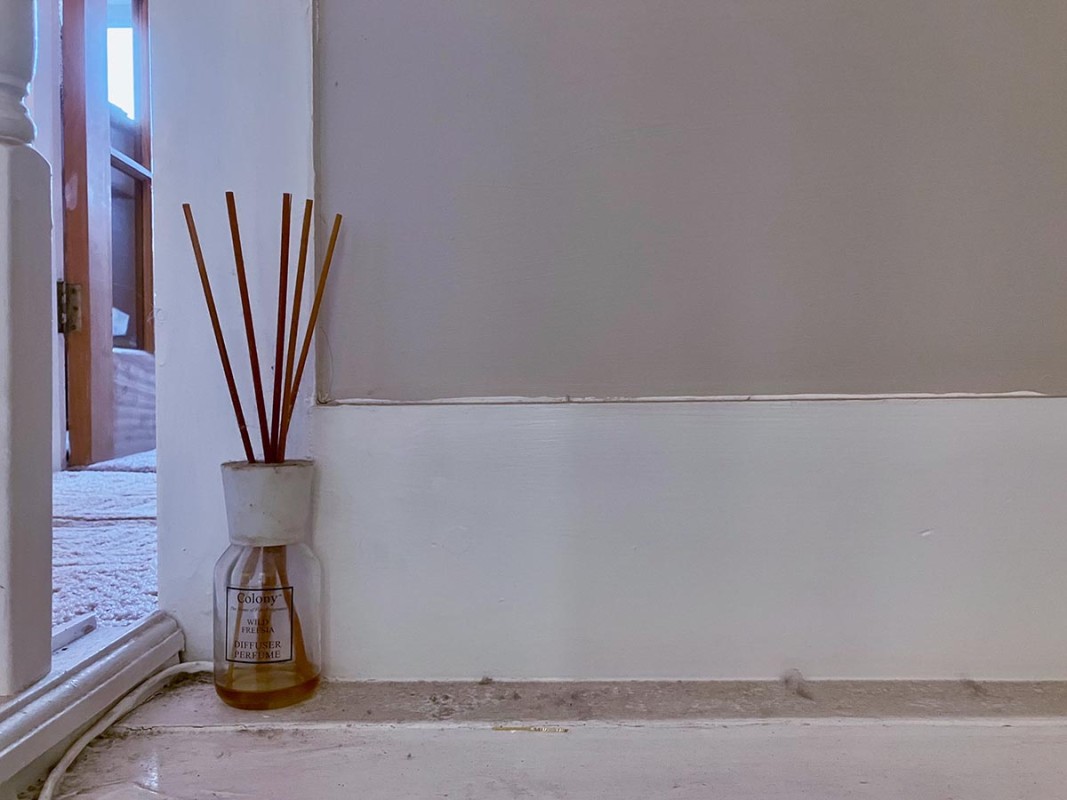
On one of my more recent visits, I noticed the empty diffusers sitting on windowsills and shelves and was struck, straight away, by the visual metaphor – the way they seemed to signify the absence of mum in our lives.

Empty diffusers in my late mother's house

Each one once contained something which, over time, has passed from the bottle into the air. Now they are empty. Nothing passes to nothing.

Standing in the house, I am of course aware of all that has gone before. Memories of times that were good and those that were sometimes hard. That is all that’s left there now. Like the bottles, the house is empty.

So, along with my mum’s possessions, I’ve brought home the empty diffusers so I can explore them as objects – as visual metaphors – for the loss I am feeling.

Filed Under: Family, Grief, Mum

Grief

November 25, 2022 by Nicholas Hedges

After my mum passed away in September I found some old cassettes in cupboards in her attic room and over the last few weeks have been converting them to digital files which I have more lately been restoring.

One of the tapes contains music mum recorded with her two sisters (as M3) around 1975/6. Among the recordings is a version of John Denver’s ‘Take Me Home (Country Roads)’ with my mum singing the lead. It was obviously very emotional to hear her and, thinking of the date it was recorded, I couldn’t help thinking of myself as I was back then – a small boy of 4 or 5 years old.

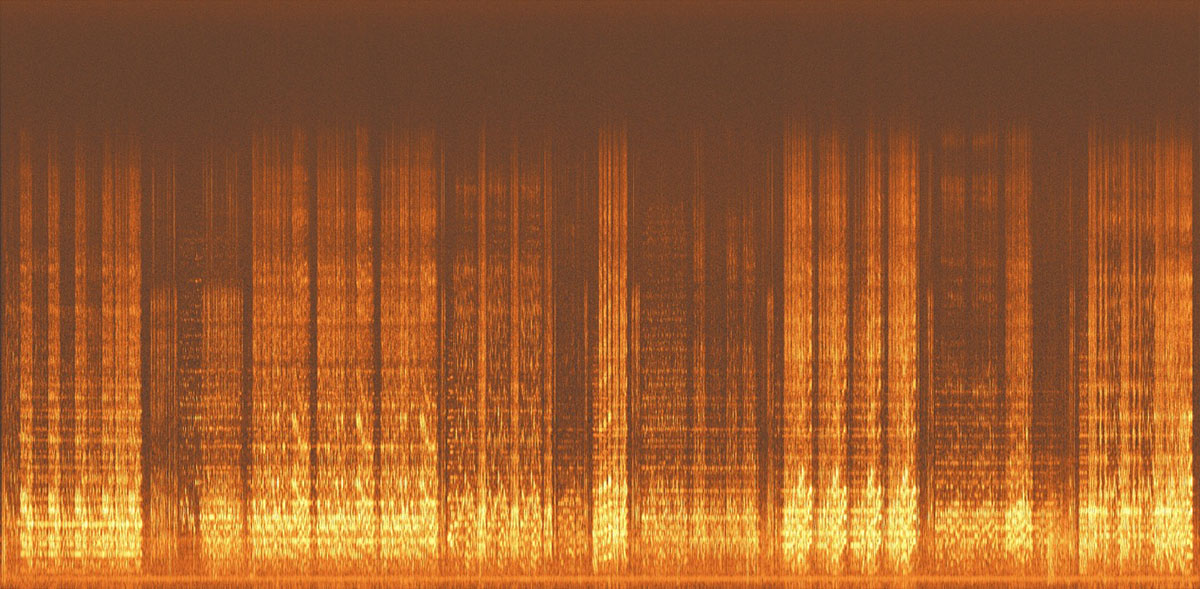
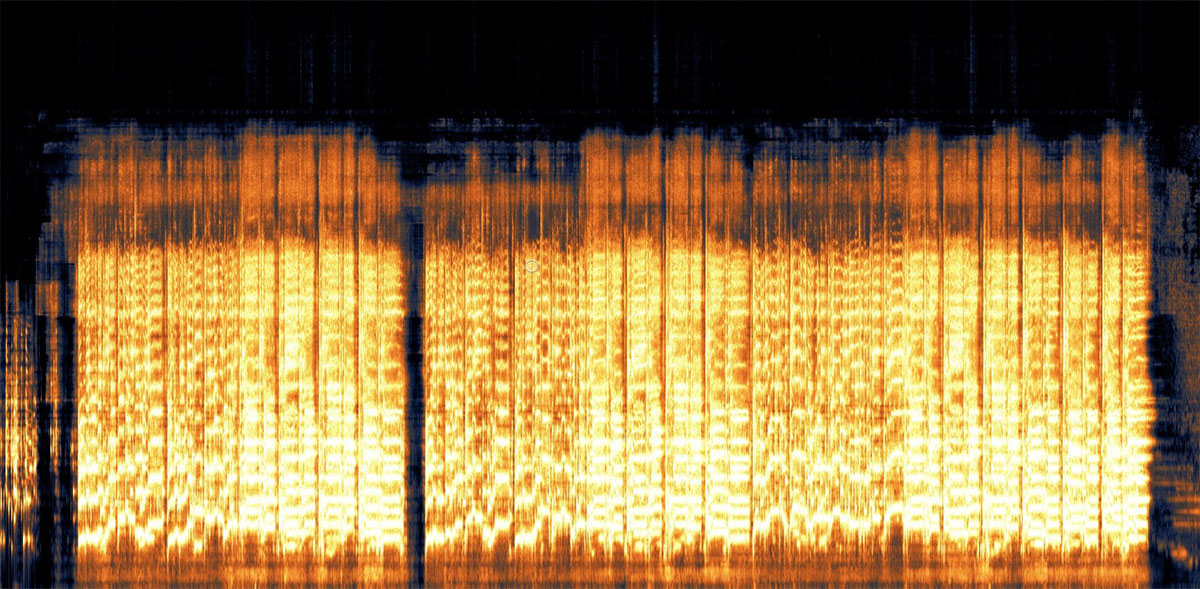
With the audio file converted and restored I then set about isolating the vocals so I could create my own backing track. Having done that I discovered that although the backing had been removed, there remained elements of the banjo bound up in with the voice. The software I was using has been called Photoshop for audio in that it shows the audio file as a spectrograph as per the image below.

Spectrogram image of an audio file

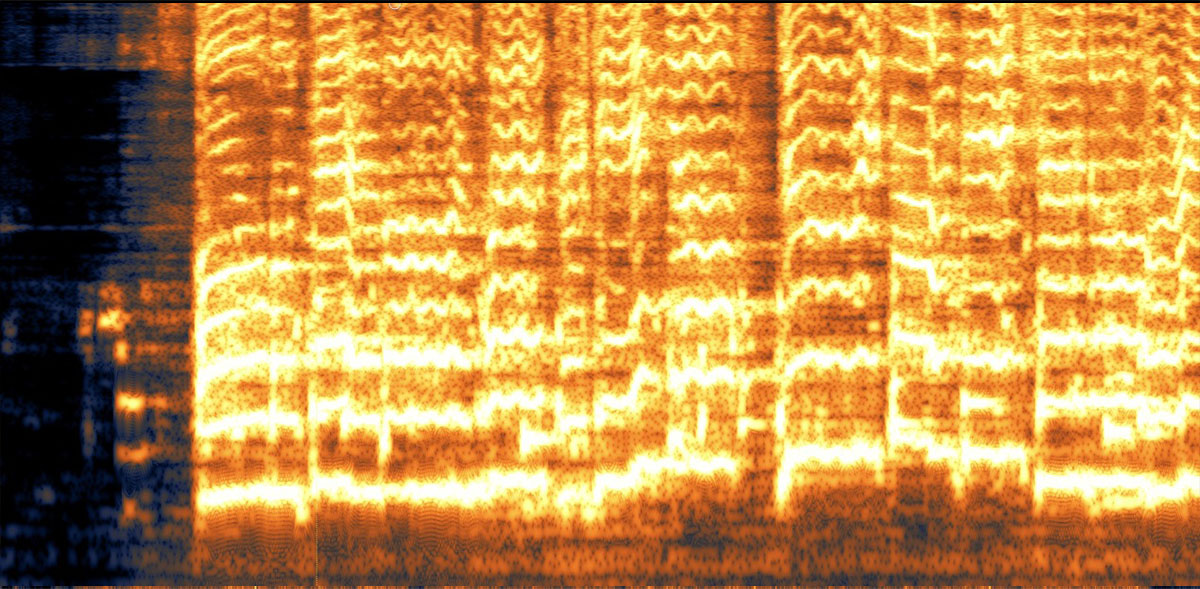
The file runs from left to right with the lower frequencies at the bottom and volume indicated through the brightness (the louder, the brighter). Zooming in, one can see different sounds, for example in the image below you can see my mum’s voice (bright at the bottom of the image) with the harmonics in layers above.

Zooming in between the harmonics (for example, between the brighter bottom two layers) I could see the bits of banjo, and, using the software’s brush, could paint these sounds into the background. As a result, mum’s voice (and that of her sisters) was even better isolated enabling me to create a new backing track for the vocal.

Spectrogram of an audio file

Creating a new backing track was great – a collaboration of sorts – but one of the things which struck me was how the act of removing the unwanted bts of audio, like an archaeologist removing dirt from a dug up artefact, was like those moments when grief is suddenly focussed by an object, a sound or a memory and the loved one is remembered against the inexplicable backdrop of their absence. These pointed moments of grief are not simply remembrances of a lost loved one, but sudden realisations, each time as if for the first time, that they have gone. 

Looking at the image above, one can see the yellow lines of my mum’s voice against the noise and silence, bright like those flashes of realisation.    

Filed Under: Family, Grief

Mum

October 24, 2022 by Nicholas Hedges

On Thursday, 29th September, my wonderful mum, Mary, passed away. She was 78 years old and had been diagnosed with both lung cancer and glioblastoma 15 months ago. Throughout that remaining time, she displayed her typical resilience in the face of adversity; carrying on with life as normal and living it to the full. Only in the last 3 months did things become difficult. In June, on Father’s Day, her condition worsened suddenly, and after 3 weeks in hospital, she returned home with round the clock care, where, 3 months later, she passed away peacefully with her family beside her.   

Seeing her in her own home, unable to look after herself was, perhaps for me, the hardest part of those last weeks. Mum was a very independent woman; strong and determined, and the fact she now had to rely on 24 hour care was as tough as it was necessary.

Over time however, that initial ‘shock’ wore off. Aunts, uncles and cousins popped in regularly, to help or visit, which was itself something mum, I’m sure, delighted in. Having such a large network of support, including that of neighbours and friends, was hugely important for me and my brother too, and the team of carers (including those from Sobell House and Marie Curie) were absolutely wonderful.

Because of the glioblastoma (her lung cancer had also matastasised to the brain), she – in terms of her character – was diminished  as the illness progressed, and, just as with someone who has dementia, she had to some extent, already left us before she passed away. 

In those last weeks, it became increasingly difficult to remember what mum was like before she was ill and when people are diminished in this way through illness, it’s often a relief when their suffering ends. That doesn’t mean, of course, that one isn’t, at the same time, desperately sad. But that part of one’s grief is, for a short time, suppressed. 

In preparing for her funeral however, looking at old photographs and watching videos of her performances on stage in the 1980s and 1990s, that diminished part of her – the mum we knew and loved; strong, fun, charismatic and hugely talented – took centre-stage once again, Suddenly, all memories of mum being so ill in those last weeks were gone.

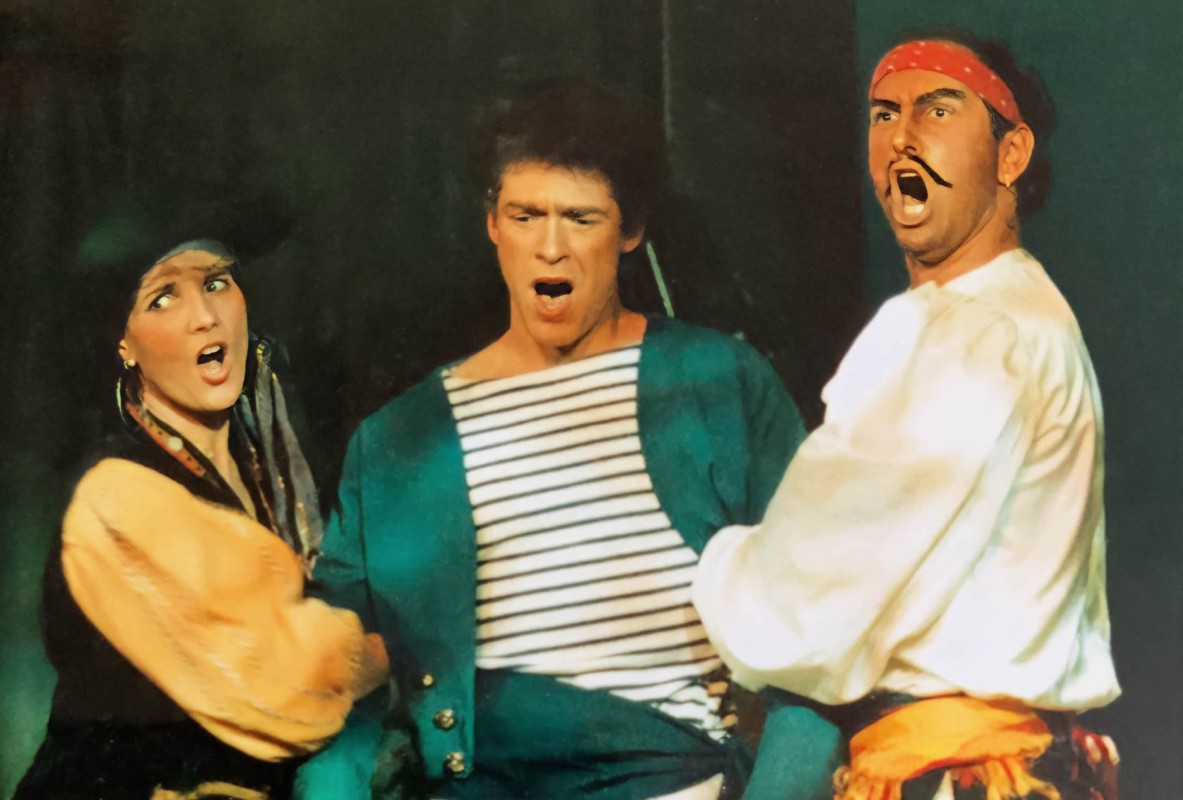
Mum in The Pirates of Penzance
My mum, pictured in The Pirates of Penzance (1998)

The mum we had lost had returned and, as a result, that sense of relief began its transformation into grief.

I always loved seeing mum perform, and for a couple of shows, I watched her from the wings, enjoying the buzz and the thrill of the whole performance. But it’s only now, as a 51 year old man, watching her performances as a woman in her early 40s, that I can appreciate just how good she was.


The videos themselves aren’t great quality (recorded from a distance on old VHS camcorders and then left in an attic cupboard for 30 years) but despite this, her talent and her wonderful voice shine through. And so, what I’m left with now, in these first weeks after her death, is, coupled with sadness, an overwhelming feeling of pride.

Filed Under: Family, Grief

Measuring the past

July 20, 2022 by Nicholas Hedges

“We have been living this same moment ever since we were conceived. It is memory, and to some extent sleep, that gives the impression of a life of discrete parts, periods or sections, of certain times or ‘highlights’.”
Bill Viola,‘Reasons for Knocking at an Empty House. Writings 1973-1994

“For although we know that the years pass, that youth gives way to old age, that fortunes and thrones crumble (even the most solid among them) and that fame is transitory, the manner in which—by means of a sort of snapshot—we take cognisance of this moving universe whirled along by Time, has the contrary effect of immobilising it.”
Marcel Proust, Time Regained

If the past is past and no longer exists and the future is yet to happen, then how do we, in the present, know about the past and experience the flow of time? In the here and now, there is no past and no future. So where are they? In Book XI of the Confessions, Augustine of Hippo concludes that they are within us:

“It is within my mind, then, that I measure time. I must not allow my mind to insist that time is something objective. When I measure time, I am measuring something in the present of my mind. Either this is time, or I have no idea what time is.”

In ‘The Order of Time,’ Carlo Rovelli writes; “…in the present, we see only the present; we can see things that we interpret as traces of the past, but there is a categorical difference between seeing traces of the past and perceiving the flow of time – and Augustine realises that the root of this difference, the awareness of the passing of time, is internal. It is integral to the mind. It is the traces left in the brain by the past.”

Things as events

In the same book, Rovelli writes:

“The world is not a collection of things, it is a collection of events… even the things that are most ‘thing-like’ are nothing more than long events.”

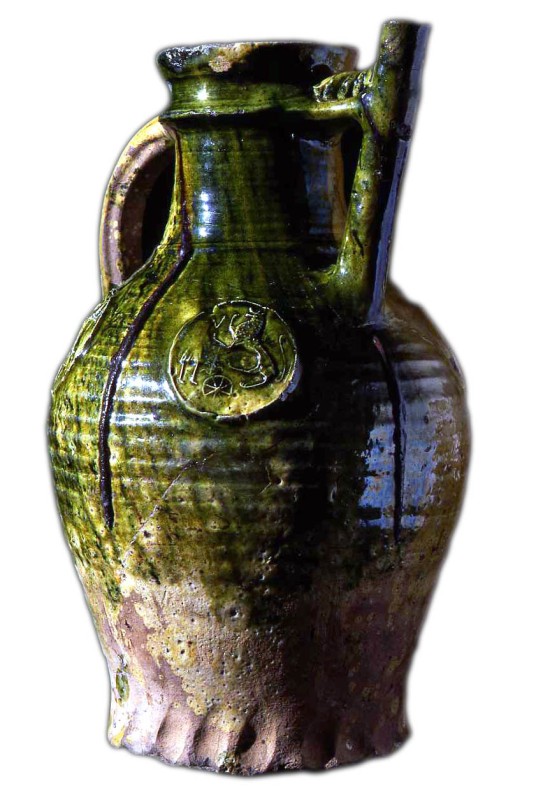
Mediaeval jug

Like us, an object in a museum (for example, a mediaeval jug) is an event, and as an event, is just as much a part of the world today as it’s always been. Its use, function or value might have changed but as an event, the fact of its nowness now, is the same as it was 800 years ago when it was experienced in much the same way as it is today.

To borrow `Bill Viola’s quote above, this event (our mediaeval jug) has been ‘living’ this same moment ever since it was made, but it’s the lives of those who have ‘experienced’ the jug (their lives and deaths) over the centuries that gives the impression of a ‘life’ of discrete parts, periods or sections – the difference between now and then; a sense of history.

“There will no longer be any more reason to say that the past effaces itself as soon as it’s perceived, than there is to suppose that individual objects cease to exist when we cease to perceive them.”
Henri Bergson (1859–1941)

Measuring the past

When we cease to look at an object, that object remains within us as a memory, a snapshot which straight away begins to bleed into vagueness, much like a drop of ink spreads on a piece of paper. Our perception of the time that’s passed is also vague. It’s hard to relive a past moment with any degree of clarity (although music, objects and, in particular, place, can certainly sharpen our remembering senses). It’s also difficult to measure the flow of time with any degree of accuracy. How often is it that on recalling when someone famous died, the time that’s passed appears much shorter than it’s actually been?

We know the length of a year, and can, with that knowledge, imagine the span of 100 years or more, but only as we might walk a mile and contemplate a journey to the moon. As a rule to measure our lived experience (the flow of time as opposed to the fact of our age) units of time (months, years, decades) are of little use. Even less so as a means of perceiving, with any degree of accuracy, a span of several centuries past.

“Time – that’s what makes death so terrifying. The very idea of not existing – forever. But when you consider the past without recourse to a clock, when the past becomes that cloth bag of moments, then the future too – there on the other side of this thing we call the present – is just another load of moments waiting to go in the bag, to be jumbled up with all that’s gone before.”
Brief Castles

To ‘measure’ the distance to a past event and contemplate that place on ‘arrival’, we need to use our own memories and relationships as a yardstick, all bound up in the presentness of our own existence. When we think of times in the distant past, we do not consider them precisely as we do when measuring distance. The years are not arrayed within us sequentially along a line, but like our memories are mixed up together. If we’re looking at something made in 1588, we know it’s 290 years older than something made in 1878. But when we consider those times in which they were made, and try to imagine what they were like, our imaginations can’t discriminate between them in terms of a quantifiable length of time.

As I’ve written above, we are all events and as events are continuously linked to hundreds of other events; a network which, like a cat’s cradle, changes with every passing second as relationships are broken and new ones created. When we imagine a moment in the distant past, we have to try and imagine its events and the links between them.

[The city consists of] “…relationships between the measurements of its space and the events of its past; the height of a lamppost and the distance from the ground of a hanged usurper’s swaying feet; the line strung from the lamppost to the railing opposite and the festoons that decorate the course of the queen’s nuptial procession; the height of that railing and the leap of the adulterer who climbed over it at dawn; the tilt of a guttering and a cat’s progress along it as he slips into the same window…”
Italo Calvino, Invisible Cities

“The trees ‘see’ the painter in a manner comparable to that in which the mirror ‘sees’ the painter: that is, the trees, like the mirror, let him become visible: they define a point of view on him which renders visible for him something that otherwise would remain invisible – his outside, his physiognomy, his carnal presence… The trees and mirror function as Other.”
Christopher Tilley, ‘The Materiality of Stone, Explorations in Landscape Phenomenology.’

Clearing in the mist by Yu Jian

“Entitled Mountain Village in Clearing Mist by Yu Jian, the painting [shown above] was made all the more extraordinary on account of its age, made, as it was, around 800 years ago in the mid 13th century. This seemingly rapid work transported me to a time long gone. It revealed – much as with the Japanese haiku of Basho – an ancient and vanished moment, not so much through what it showed but how it was depicted. It was almost as if I could see the landscape before the painter himself. I could see the work as a whole (the landscape as a whole), but then, whilst picking through the gestures of the artist, evident enough in the brushstrokes, I could see the landscape as it was revealed. Yu Jian’s painting was not a painting of what was experienced, but rather the experiencing of what was experienced. It was almost as if the painting had become a painting, not of Yu Jian looking at the mountains, but of the mountain ‘seeing’ Yu Jian. It wasn’t the mountain that was made visible on the paper, but the artist himself – his presence at that moment. 800 years after his death, and Yu Jian was as good as sitting next to me. Or to put it another way, 800 years before I was born, I was as good as sitting next to him.”
Brief Castles

The age of a memory

How do we process the age of a memory? How do we ascribe an age to a time we’re imagining? Is it through a subconscious comparison between now and then, where the number of links between us and other remembered events are diminished (disorder) and where those memories or imaginings with the fewer extant links we recognise as the oldest?

Then


Now

To ‘visit’ the past in our imaginations is to compare the world now with what the world was then (just as with our own memories we compare the same). It’s the scale of that difference (not the rule of years) which gives us the age – the degree of ‘pastness’. It’s the number of lines which link us to that past. When we look at our mediaeval jug we are linked to that jug by dint of the fact we’re observing it. When we walk in an historic place, the links – the lines – are greater, such is why, in these places, we can often gain a better sense of the past.

This internal time travel requires that entropy is reversed. We travel away from disorder. Relationships (links) are ‘re-established’ within our imaginations through the lens of our own memories and experience. When I was a child (and still as an adult), that meant rewilding the natural world; seeing the country still covered with ancient forests before they were felled.

Somewhere along the paths of those ancient woods, the long events (our family line) of which we are each a part continued in its presentness, coiled within people long since forgotten. Those forgotten people had memories of those paths – of the trees and dappled light on a summer’s day – just like the memories we have today of roads down which we’ve travelled. And those who carried these memories of the trees and the paths through the woods also carried their children, who in turn were to carry their own memories of their childhoods further down the line.

Of course once we’re travelled back in time, we have to imagine the world as if, like today, it was moving towards disorder; as if things were not fixed by history and that all its details were still filled with potential. Having established the links we need to break them.

In my previous post (‘Disordered Time’), I wrote with reference to some old photographs:

“These open windows therefore help us see the past moment as it happens rather than as it was. They ascribe the picture a duration and give it flow.”

That duration delimits a span of time – a flow – in the blankness of our own non-existence where a symmetry is found between now and then; between a time (now) when I’m alive and someone else is dead, and (then) when they are living and I am not yet born.

That duration – that flow – is a bridge; a means of establishing empathy.

“Trying to remember is itself a shock, a kind of detonation in the shadows, like dropping a stone into the silt at the bottom of a pond: the water that had seemed clear is now turbid and enswirled.”
Patrick McGuiness, ‘Other People’s Countries’

Also in my previous post, I looked at a photograph taken 125 years ago. I looked at a detail in the background of the image, of a man oblivious to the picture being taken.

Detail of a photograph taken in Oxford in 1897

“One can imagine him working and the effort he is making and the fact he’s unaware that he is part of the picture allows me to reach beyond the edges of the photograph. It’s as if, through his being unaware of the photograph, the boundaries of the photograph are dissolved and the moment is given rein to move.”

Boundaries of the photograph. Boundaries between life and non-existence.

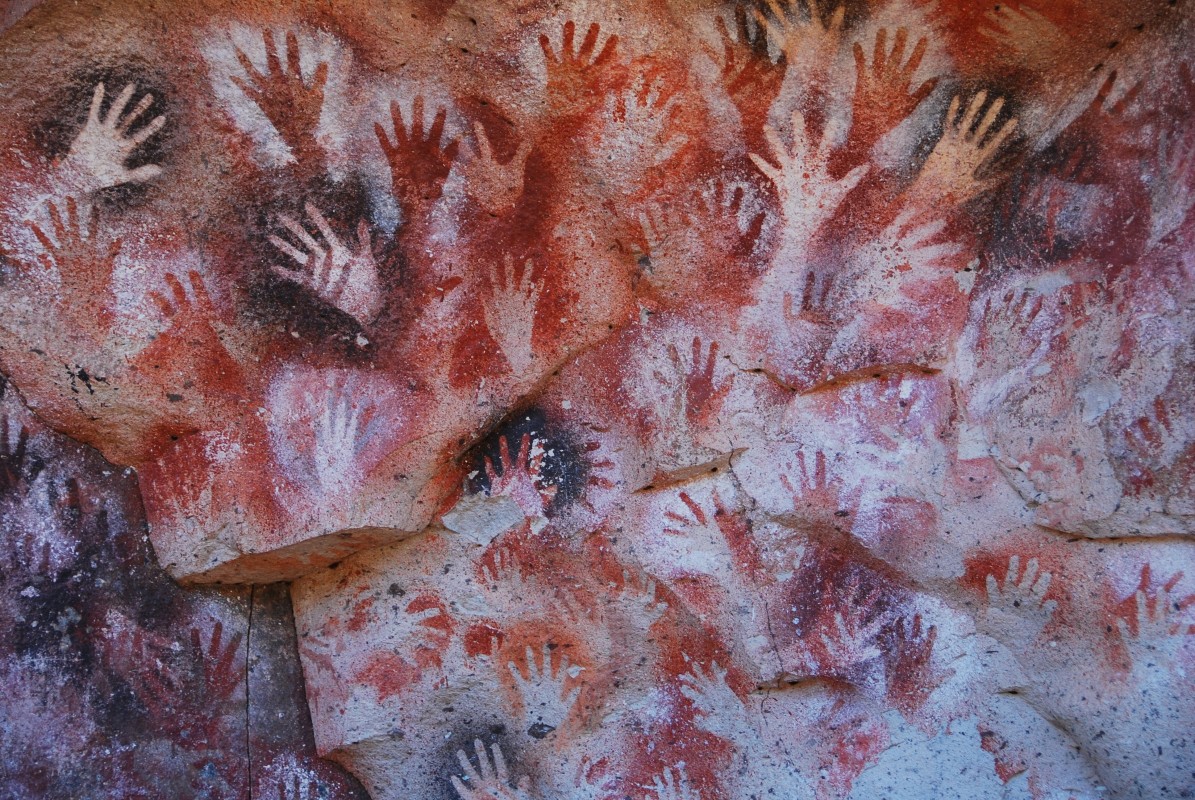
Those details, whether they are open windows in 19th century photographs, brushstrokes on an 800 year old painting or ancient handprints on a cave wall are, for me, what Patrick McGuiness describes above as detonations in the shadows. They are the dropped stones agitating the image and the object, disordering time and ‘increasing entropy’.

Hands on cave wall

If we imagine standing in the cave with these handprints before us, we can easily imagine the process of making them. If we were able to place our hands upon them, we could affect the same position as those who made them thousands of years ago. These links, lines or relationships help us back to the moment of their conception. But when we think of the world 35,000 years ago and what it looked like compared to ours, there are few links, lines or relationships left. The fewer the lines the older the time. The scale of disorder is vast. But that moment when a hand was painted is vivid and when set against the vast blankness of all the untold moments that make up the last 35,000 years, the sheer unlikeliness of our coming into being is dizzying. More so when we take that moment all those millennia ago and, like a ‘detonation in the shadows’, imagine its progress into the next moment and the next. And as we imagine the millions of lines, links and relationships which every second were, with the progress of those moments, made possible, we remember that 99.99999999% of them would have led to us never being born.

In a previous post (‘Entropy‘) I again referred to something Carlo Rovelli wrote in ‘The Order of Time’.

“The notion of particularity, is born only at the moment we begin to see the universe in a blurred and approximate way. Boltzmann has shown that entropy exists because we describe the world in a blurred fashion. He has demonstrated that entropy is precisely the quantity that counts how many are the different configurations that our blurred vision does not distinguish between.”

It was this line which took me a while to grasp: “He has demonstrated that entropy is precisely the quantity that counts how many are the different configurations that our blurred vision does not distinguish between.”

If we think back to the sandcastle and the pile of sand we can imagine the number of different configurations of each and can easily imagine that the number of configurations for the castle are far, far fewer than of the pile of sand. The castle therefore has few configurations that our ‘blurred vision does not distinguish between’ (low entropy) as opposed to the sand pile (high entropy).

When we think of a past moment whose future has been fixed in time we can borrow from the world of physics and say it has low entropy. But when we consider the details of a moment (the distant man oblivious to the photograph, Yu Jian’s painting in progress) and all the lines, links and relationships formed and broken with every passing second, we can say that, in our imaginations, the same fixed moment acquires greater entropy as we consider all the possible moments that could arise.

To climb the peaks of our imagination and see a time long before we were born is, at the same time, to descend into the depths of our own non-existence, wherein which dark expanse, our imagination lights the dark as it does the paths that lead away from our deaths. Imagination and memory come together to blur the boundaries of our beginnings and ends, as if, like a book, the unseen words that might have been written before and after are suddenly revealed in all their infinite number.

Filed Under: History

Disordered Time

June 27, 2022 by Nicholas Hedges

In my last post I talked about entropy, in particular with reference to a book I’ve recently re-read by Carlo Rovelli called ‘The Order of Time’. I ended with the question (one as much for myself as anyone else); what has this got to do with my work?

So, here goes with (the beginnings of) an answer.

As I’ve said, my work has often sought to imagine past moments as if they are ‘now’ in order to better empathise with those who lived at the time; in particular those who lived through traumatic events.

Borrowing from the world of physics and what I’ve gleaned about entropy, I can look at a past moment as something which has a very low entropy (and here, of course, I’m using these terms in a loose,  ‘poetic’ way rather than anything scientific). The past is like the sandcastle as opposed to the pile of sand (but with far fewer possible configurations of state than the castle).

This is because the past moment has happened and therefore its form is fixed; there are no different configurations by which it can enter the next moment as the next moment has also already happened. If we think of the moment we are living now, then we can think of it as having very high entropy as there are countless possible configurations by which we, as people living in this particular moment, can enter the next and so on. We are like the pile of sand as opposed to the castle.

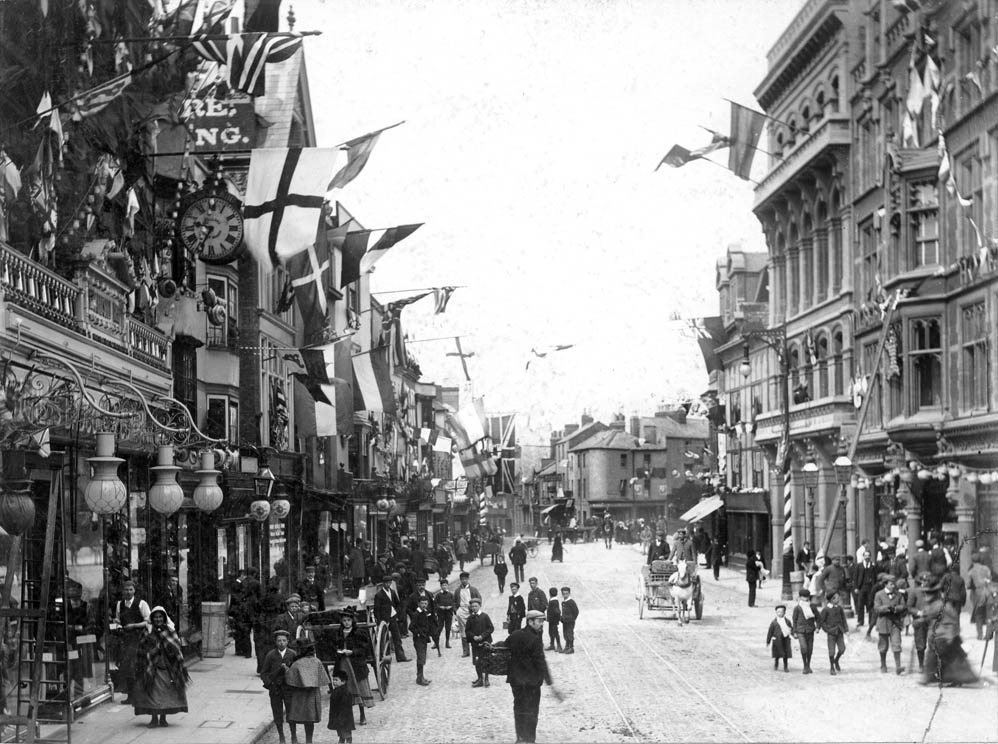
Below is a photograph taken in Oxford in 1897 to celebrate Queen Victoria’s Diamond Jubliee.

Queen Victoria's Diamond Jubilee, Oxford 1897
© Oxfordshire County Council

I want to look at this photograph as being illustrative of a moment in time rather than as an object in its own right. So what do we see?

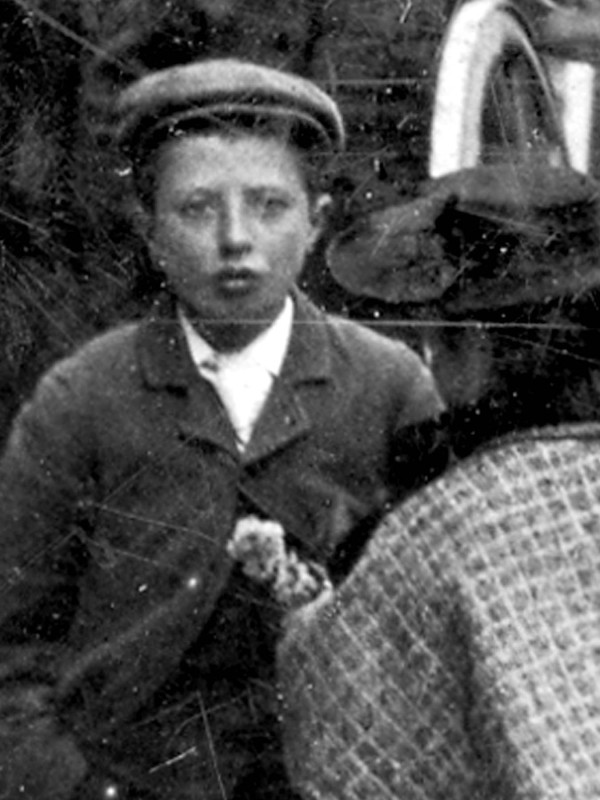
If we are going to try and recreate a past moment, we have to try and think of that moment as it happens, not as it was. So, when I look at an image like this, at a moment frozen in time 125 years ago, I try to imagine the scene just before the image was taken and for a short while after. To do that, I might zoom in on a detail – one of the people – and imagine them moving. I imagine the noise of the scene, the sounds they might have heard and think about what they might have been saying (if anything).

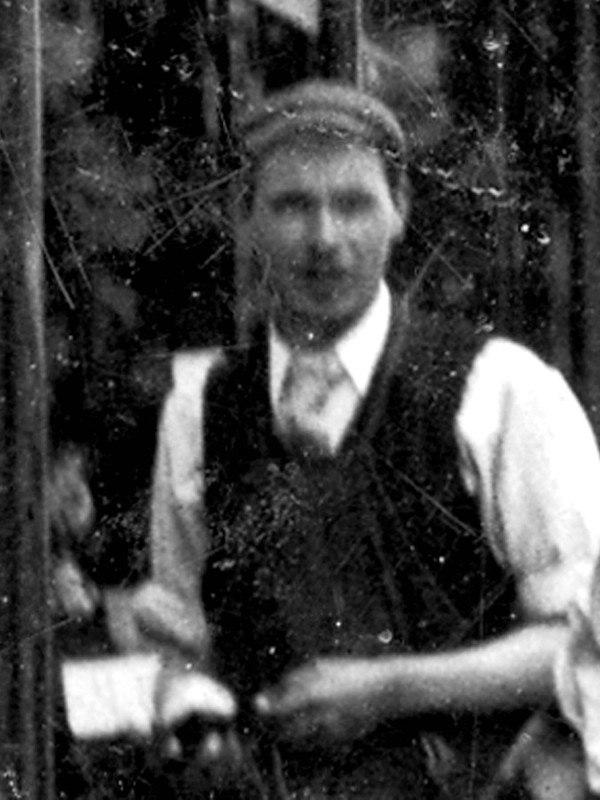
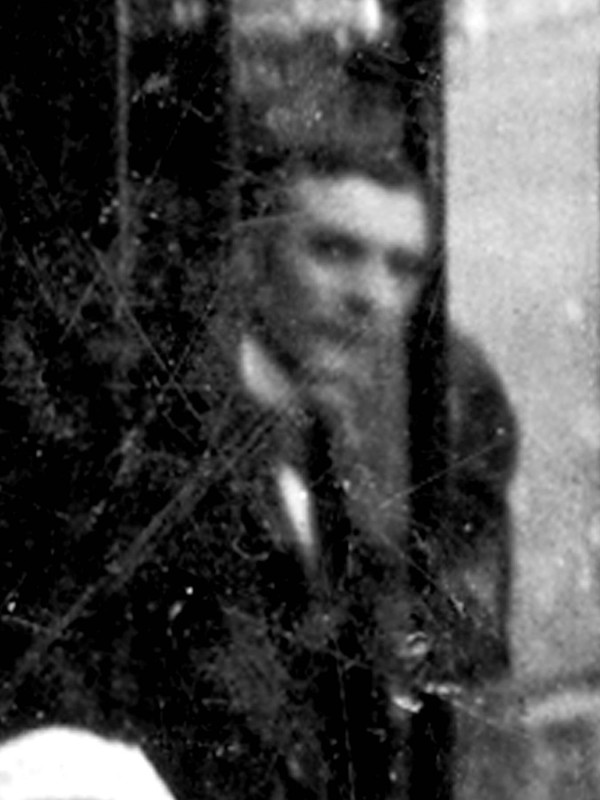
Detail from a scene in Oxford, 1897

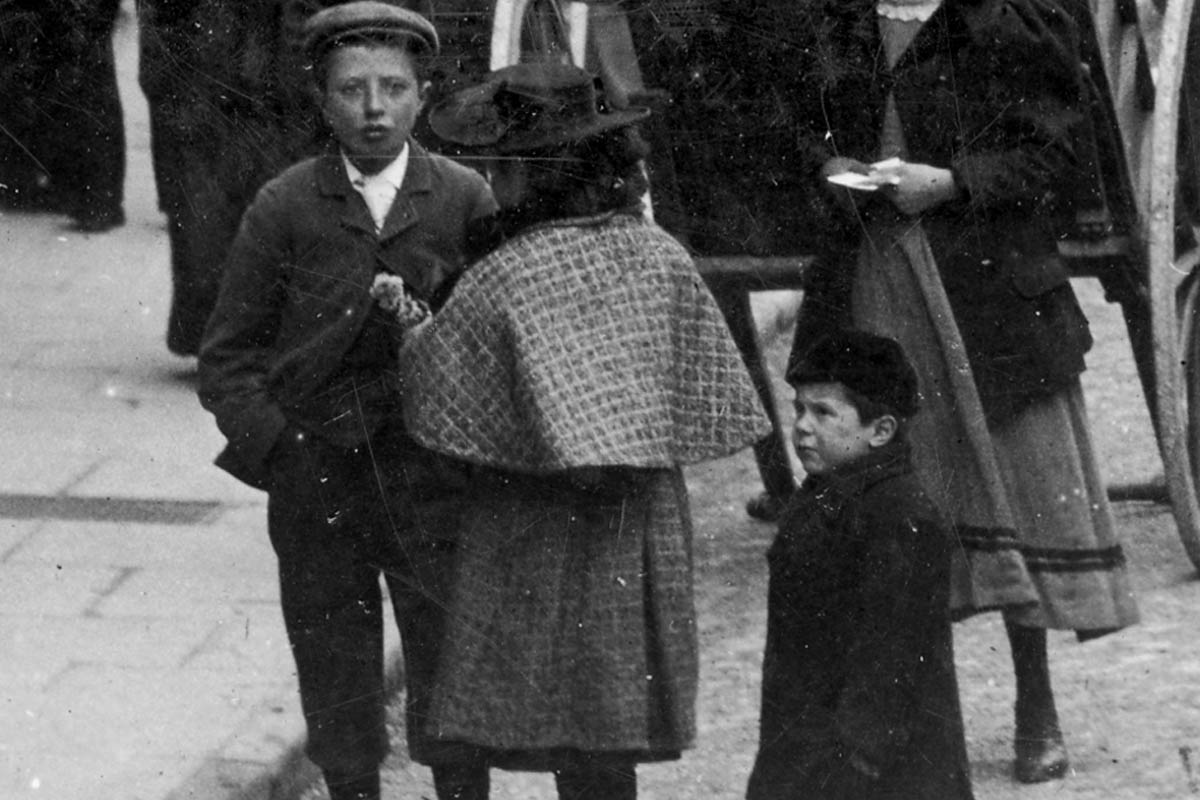
It’s easy to animate the faces above, but to animate the moment, I have to zoom out a little, to catch more of the scene around them. If we look at the boy in the first image for example, we can see that he is standing with a girl and a small boy. The girl is clearly talking to him but his eyes are on the camera. The small boy beside her looks impatient as if he wants to be doing something else.

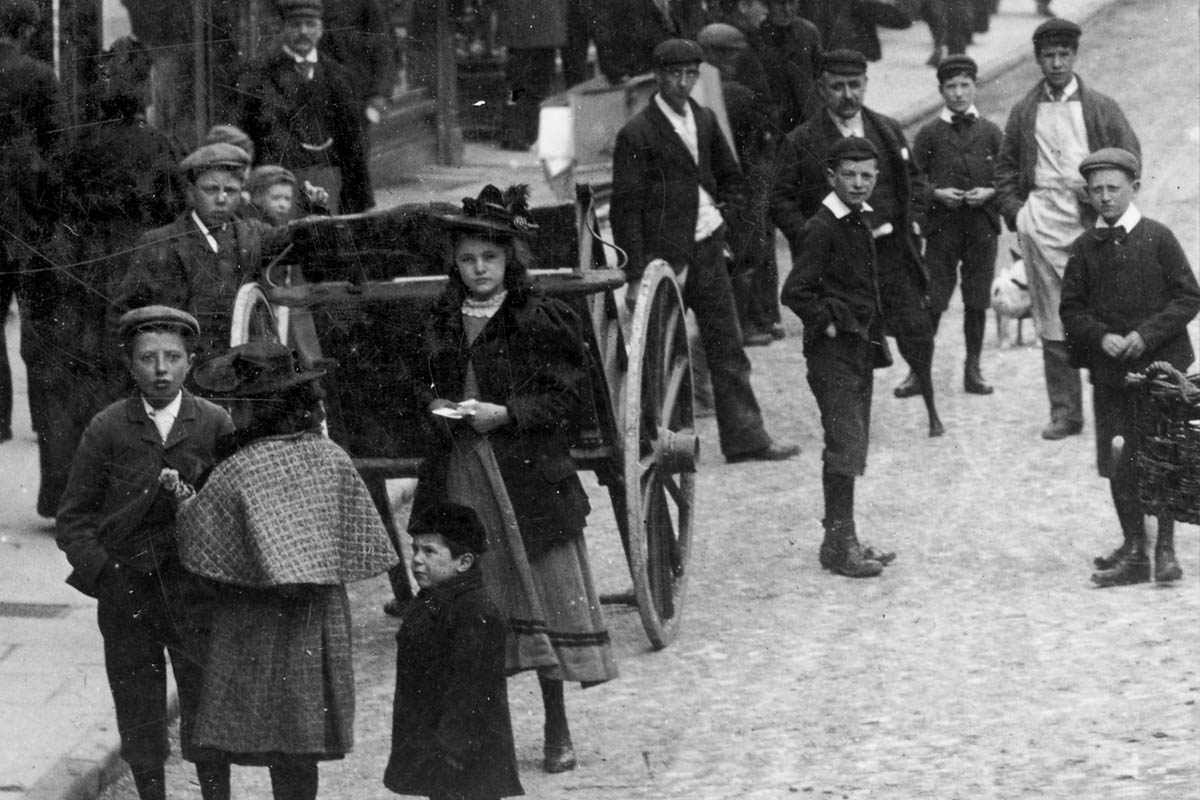
Detail from a photograph taken in Oxford in 1897

And we can continue to zoom out and allow more of the moment to reveal itself.

Detail from a scene in Oxford, taken in 1897

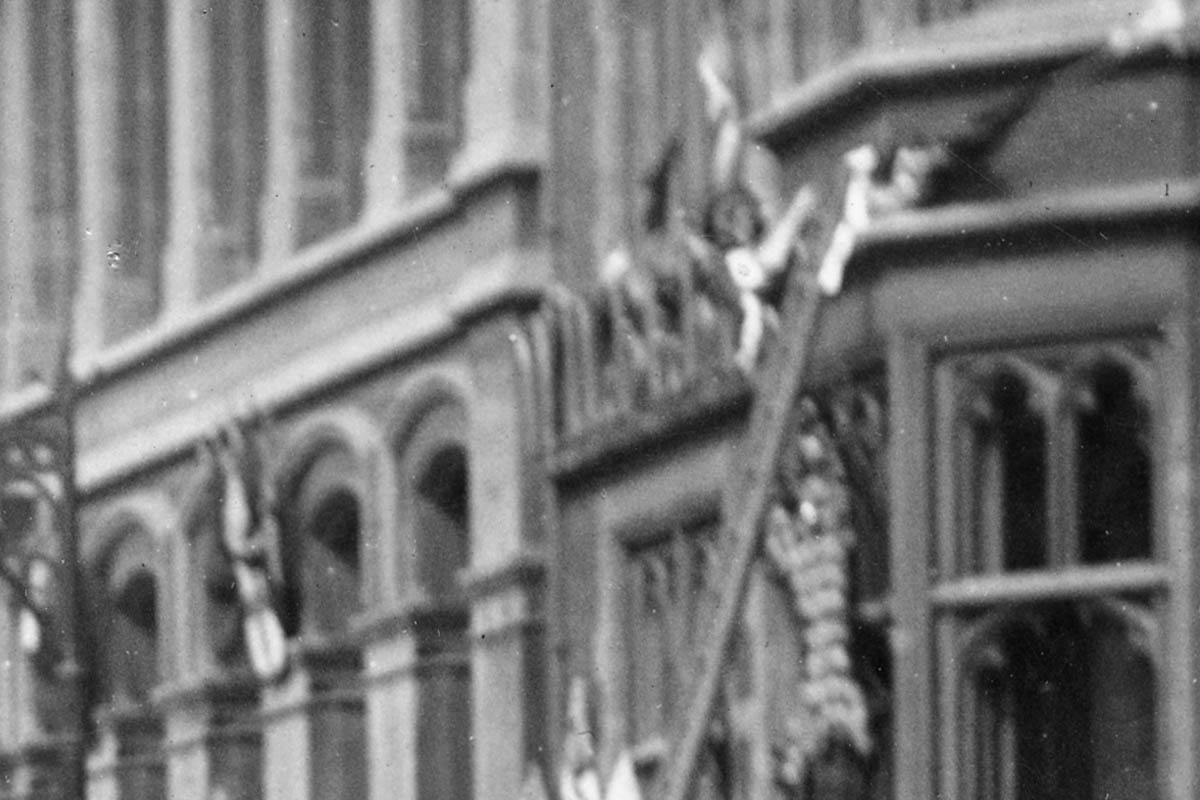
One thing I do find with photographs like this, is that it’s often those people who are in the background and who are completely oblivious to the picture being taken that allow me to animate the scene. For example, this man (below) up a ladder adjusting the bunting.

Detail of a photograph taken in Oxford in 1897

One can imagine him working and the effort he is making and the fact he’s unaware that he is part of the picture allows me to reach beyond the edges of the photograph. It’s as if, through his being unaware of the photograph, the boundaries of the photograph are dissolved and the moment is given rein to move (a piece I made as part of my MA several years ago – Creatures –  is concerned with this very idea).

But what has  this all got to do with entropy?

The present moment has ‘high entropy’ in that the number of possible configurations (the different configurations that our blurred vision does not distinguish between) which will take this moment into the next are vast. But for a past moment, such as the one above, the number is practically zero, in that the moment has come and gone. It’s ‘entropy’ is very low. So if we are to try and imagine this moment in 1897 as if it’s now, we have to ‘disorder time’ and imagine the scene as if its ‘entropy’ is as high as he moment in which we now exist.

In a post from several years ago (Windows, Bicycles and Catastrophe) I talked about these background details and how they can help bring a past moment to life.

In the picture above, the horses and carts locate the photograph in the early 1900s but it’s the windows – the open windows – which help me locate myself in the time. Why? Because the rooms behind the windows are spaces outside the photograph; spaces oblivious to the photograph being taken. It’s as if they have escaped the moment frozen by the camera. The open windows also speak of a time before the photograph was taken and therefore give the photograph a sense of duration which, like the rooms behind them, also extend the boundaries of the image. When the photographer took the photo, the windows had been open a while beforehand; people had (obviously) opened them and I can begin to imagine those moments. I can imagine being in one of those rooms, looking out through the open window and seeing the horses down on the street and hearing the sounds of the city. These open windows therefore can help us see the past moment as it happens rather than as it was. They ascribe the picture a duration and give it flow.

In his book, The Order of Time, Carlo Rovelli writes: “The growth of entropy itself happens to open new doors through which entropy can increase further.” In the case of this image, Rovelli’s doors are our windows but the effect is the same. We begin to disorder time and locate among these details, pockets of potential. Instead of everything being fixed, there is room for manoeuvre, for change; entropy increases.

As I wrote in my previous post: …our blurred view of the world equates to our recognition of things as things; objects with form, and it’s because of this that we experience the flow of time; the sandcastle collapsing on the beach and the castle falling slowly to ruin. 

This blurring is the term used to describe how we perceive the world. We see things as particular (things as things; objects with form as opposed to how they are at the microscopic level). Rovelli writes: “The notion of particularity is born only at the moment we begin to see the universe in a blurred and approximate way. Boltzmann has shown that entropy exists because we describe the world in a blurred fashion. He has demonstrated that entropy is precisely the quantity that counts how many are the different configurations that our blurred vision does not distinguish between.”

In the case of the past itself and our view of it, our ‘blurred view’ is that of the object, the photograph, the relic. It is the knowledge we derive from sources; diaries, letters etc.

Rovelli continues: “The difference between past and future is deeply linked to this blurring. So, if I could take into account all the details of the exact, microscopic state of the world, would the characteristic aspects of the flowing of time disappear? Yes. If I observe the microscopic state of things, then the difference between past and future vanishes.”

A quote from William Blake is pertinent to this point: “If the doors to perception were cleansed, then everything would appear to man as it is – infinite.”

If then, we imagine the entirety of the past as being akin to the world at the microscopic level, then as we look beyond what our blurred vision allows us to see of the past (beyond the relics and artefacts) and see the details (for example, the rooms beyond the windows), then, just as at the microscopic level, where the difference between past and future collapses, so it does when we focus our attention on those seemingly insignificant details; details which we might well experience in our own, everyday lives.

One aspect I want to return to is the flow of time. As I wrote above: “These open windows therefore help us see the past moment as it happens rather than as it was. They ascribe the picture a duration and give it flow.” But this will have to wait for my next post.

Filed Under: Time

Entropy

June 26, 2022 by Nicholas Hedges

My work has often involved an exploration of time, in particular, how we can best imagine a past moment as ‘now’. Recently I’ve been re-reading Carlo Rovelli’s ‘The Order of Time’ and have been particularly interested in entropy and the part it plays in the fact time always flows from the past towards the future.

But what is entropy and what has it got to do with time? Well, the answer is complex and would require a book to answer it properly. However, as a layman, and as far as I understand it, entropy is, at a very basic level, the measurement of how much atoms in a given substance are free to spread out, move and arrange themselves in random ways.

As ever, Professor Brian Cox describes it perfectly here:


The difference between past and future lies in this “natural disordering that leads to gradually less particular, less special structures” [Rovelli, The Order of Time]; structures like the piles of sand as opposed to the sandcastle.

One aspect of Rovelli’s book I took a while to grasp was the idea of ‘blurring’. Rovelli asks the question, why do phenomena that we observe around us in the cosmos begin in a state of lower entropy in the first place. He describes a pack of cards:

“If the first twenty-six cards in a pack are all red and the next twenty-six are all black, we say that the configuration of the cards is particular; that it is ordered. This order is lost when the pack is shuffled. The initial ordered configuration is a configuration ‘of low entropy. But notice that it is particular if we look at the colour of the cards – red or black. It is particular because I am looking at the colour. Another configuration will be particular if the first twenty-six cards consist of only hearts and spades. Or if they are all odd numbers, or the twenty- six most creased cards in the pack, or exactly the same twenty-six of three days ago … Or if they share any other characteristic.

If we think about it carefully, every configuration is particular; every configuration is singular, if we look at all of its details, since every configuration always has something about it that characterises it in a unique way. Just as, for its mother, every child is particular and unique. It follows that the notion of certain configurations being more particular than others (twenty-six red cards followed by twenty-six black, for example) makes sense only if I limit myself to noticing only certain aspects of the cards (in this case, the colours). If I distinguish between all the cards, the configurations are all equivalent: none of them is more or less particular than others. The notion of ‘particularity’ is born only at the moment we begin to see the universe in a blurred and approximate way.

The notion of particularity, is born only at the moment we begin to see the universe in a blurred and approximate way. Boltzmann has shown that entropy exists because we describe the world in a blurred fashion. He has demonstrated that entropy is precisely the quantity that counts how many are the different configurations that our blurred vision does not distinguish between.”

The difference between past and future is deeply linked to this blurring. So, if I could take into account all the details of the exact, microscopic state of the world, would the characteristic aspects of the flowing of time disappear? Yes. If I observe the microscopic state of things, then the difference between past and future vanishes.

The future of the world, for instance, is determined by its present state – though neither more nor less than is the past. We often say that causes precede effects and yet, in the elementary grammar of things, there is no distinction between ’cause’ and ‘effect’.”

It was this line which took me a while to grasp: “He has demonstrated that entropy is precisely the quantity that counts how many are the different configurations that our blurred vision does not distinguish between.”

If we think back to the sandcastle and the pile of sand we can imagine the number of different configurations of each and can easily imagine that the number of configurations for the castle are far, far fewer than of the pile of sand. The castle therefore has few configurations that our ‘blurred vision does not distinguish between’ (low entropy) as opposed to the sand pile (high entropy).

As far as I understand it then, our blurred view of the world equates to our recognition of things as things; objects with form, and it’s because of this that we experience the flow of time; the sandcastle collapsing on the beach and the castle falling slowly to ruin.

But what has this to do with my work?

See my next blog post to find out.

Filed Under: Time

Wicked Magician, Fly

June 14, 2022 by Nicholas Hedges

For many years I’ve had a song in my head, the lyrics for which I’ve always remembered as being:

The wicked magician flies through the night
With long wings to take him far out of sight
When you are safe in bed, he’s flying overhead
Wicked magician, fly!

I was, I thought, about 7 or 8 when, as a class, we all sang along to the recording. I would have been at New Marston First School and can recall the classroom we were in, and, for some reason, the view outside the window.

Years later, with the song still in my head, I decided to try and find out what it was and it didn’t take long to discover that the song was part of a broadcast for schools on BBC Radio; a series called ‘Time and Tune’ with this particular cantata entitled ‘Alvida and the Magician’s Cape’.

On the Broadcast for Schools website, it states:

“This cantata [by composer Michael Plaskett] , based on a Swedish folk tale, was the winning work in a national competition held by Time and Tune in 1977, calling for composers and authors to write an original work for children. Two concerts based on Alvida and the Magician’s Cape were given at Fairfield Halls in Croydon on Friday 10th March 1978.”

Alvida and the Magician's Cape

The series leading up tho this performance was broadcast on the BBC between January and March 1978 which would have made me 6 years old when I heard it. The fact I was so young and have remembered this song so vividly, illustrates how much of an impact the tune and the words had on me. Considering it was about a flying magician who captured children, that might hardly be surprising.

Despite looking, I couldn’t find a recording of the song (it has, apparently, been deleted) but recently on eBay I managed to find a copy.

The programme itself comprises a narrator who leads the children listening through each of the songs (explaining how they might play along and so on) as well as a final performance at Fairfield Halls in Croydon. The extract below is a very poor recording of the song I remembered, taken from that performance.

https://www.eliotpress.uk/wp-content/uploads/2022/06/Wicked-Magician-with-intro_01.mp3

Despite the quality of the recording, hearing it again after 45 years was incredible. Not only was the tune exactly as I’d remembered, but I could recall other parts around the song; the narrator’s intro for example, where he says menacingly:

“Whenever the magician needed another boy or girl, he would put on his finest clothes, dab his lips with honey to make sweet words come from his mouth and sprinkle magic dew in his eyes to make them sparkle with kindness. Then he would take out his special black cape, which he would change into gigantic wings and fly off to find another victim.“


Filed Under: Memories

  • « Previous Page
  • 1
  • 2
  • 3
  • 4
  • 5
  • …
  • 32
  • Next Page »
  • Lydia’s Garden, Dusk, 1764
  • Lost and Found in Translation
  • Rhopography, Gesture, and the Occulting Past
  • The ‘Now of Then’
  • Artist’s Statement
  • Designs for an Heirloom
  • Dissonance and rhyme
  • Wildflowers
  • Emptiness
  • Wave (goodbye)
  • Now In The Past Of An Unreal Place
  • Return to Graphite
  • Genius
  • Latest Backdrops
  • Extended Backdrops
  • Backdrops
  • Komorebi
  • Acorns
  • Scroll Work
  • Goethean Observation: Japanese Scroll
  • Mistakes
  • The Leaf Is Singing Still
  • Past Present
  • Scrolls
  • As Yet Untitled
  • Holes
  • Scroll
  • A Calligraphy of Shadows
  • More Paintings
  • Latest Paintings
  • Walking Meditation 2
  • Knowing We Are There
  • Venice by Moonlight 1840
  • Fragments and Additions
  • Reimagining The Past
  • Walking Meditation 1
  • Mindful Walking I
  • Grief II
  • Three New Paintings
  • Nana’s Mountain
  • Painting
  • Iridescence
  • Roman Bottle
  • Rinsho
  • Shadow Calligraphy
  • Becoming Memory
  • Fox Talbot’s Glassware
  • Goethean Observation: Diffuser II
  • Goethean Observation: Diffuser
  • A Remembrance of Things We Never Have Known
  • A Moment’s Language
  • Take Me Home
  • Arrival/Departure
  • Diffusers
  • Grief
  • Mum
  • Measuring the past
  • Disordered Time
  • Entropy
  • Wicked Magician, Fly
  • The Quanta of History
  • Empathy Forward
  • The Natural World of 978
  • The Gone Forest
  • Empathy/Exchange: 668 grams
  • Goethean Observation: Pilgrims of the Wild, 1935
  • Nazareth O
  • Several Johns and St. Thomas
  • Raspberry
  • Tokens and Shadows
  • Patterns Seeping (II)
  • ‘Missded’ 4 – Tokens
  • Patterns seeping
  • Cut Paintings
  • ‘Missded’ 4
  • Locks III
  • Locks II
  • ‘Missded’ 2 – Tokens
  • My Son’s Drawings II
  • ‘Missded’ 2
  • ‘Missded’ 3 – Tokens
  • ‘Missded’ 3
  • ‘Missded’ 1 – A Framed Token
  • Morning Has Broken
  • Tokens of absence
  • ‘Missded’ 1, stitched
  • More Little Words
  • Three Little Words
  • Spaces In Between
  • ‘Missded’ 3
  • ‘Missded’ 2
  • ‘Missded’ 1
  • Locks
  • Tracings
  • My Son’s Paintings
  • Writing Shadows
  • Samuel Borton’s Post Chaises
  • Dawid Sierakowiak
  • Pitchipoi
  • Latest Tree Drawings

© Nicholas Hedges 2024

  • Facebook
  • Instagram
  • Twitter
  • YouTube

Copyright © 2026 · Outreach Pro on Genesis Framework · WordPress · Log in