Nicholas Hedges

Art, Writing and Research

  • Amazon
  • Behance
  • Facebook
  • Instagram
  • Pinterest
  • YouTube
  • Art
    • Digital
    • Drawing
    • Grids
      • Correspondence
      • The Wall
      • The Tourist
    • Ink on paper
      • Shadow Calligraphy
    • Installation
      • Murder
      • Echo
    • Painting
    • Patterns
    • Mixed Media
    • Photographic installation
      • St. Giles Fair 1908
      • Cornmarket 1907
      • Headington Hill 1903
      • Queen Street 1897
    • Research/Sketches
    • Stitched Work
      • Missded 1
      • Missded 2
      • Missded 3
      • Missded 4
    • Text Work
  • Blogs
    • Family History
    • Goethean Observations
    • Grief
    • Light Slowed But Never Stilled
    • Lists
    • Present Empathy
    • Shadow Calligraphy
    • Trees
    • Time
    • Walking Meditations
  • Video
  • Photography
    • Pillars of Snow
    • Creatures
    • The Trees
    • Snow
    • St. Giles Fair 1908
    • Cornmarket 1907
    • Headington Hill 1903
    • Queen Street 1897
    • Travel
  • Illustration and Design
  • Music
  • Projects
    • Dissonance and Rhyme
    • Design for an Heirloom
    • Backdrops
    • Shadow Calligraphy
  • Exhibitions
    • A Line Drawn in Water
      • Artwork
    • A Line Drawn in Water (Blog)
    • Mine the Mountain 3
      • Artwork
    • Mine the Mountain 2
      • Artwork
      • The Wall
    • The Woods, Breathing
      • Artwork
    • Snow
      • Artwork
    • Echo
      • Artwork
    • Murder
      • Artwork
    • The Tourist
    • Dreamcatcher
    • Mine the Mountain
      • Artwork
      • The Tourist
    • M8
    • The Gate
    • Creatures
      • Artwork
    • Residue
      • Artwork
    • A visit to Auschwitz
      • Artwork
  • Me
    • Artist’s Statement

The Ruined Ruins of Madinat Al-Zahra

September 29, 2010 by Nicholas Hedges

For more than 700 years, from 711 to 1492, there was an Islamic presence in Spain, and for that, in the 21st century, with the legacy of its beautiful architecture, we can only be grateful. After all these years, the stunning buildings with their beautiful interiors still retain the power to beguile, and certainly, the Moorish sights of Andalucía are without doubt, amongst the most beautiful things I’ve ever seen.

From the well-preserved ruins of ancient baths in Granada and Ronda, to the strange and somewhat schizophrenic Mezquita in Córdoba, the sights reach their zenith in the awe-inspiring perfection of the Alhambra palace. The craftsmanship of the Islamic artists responsible for its creation are, I believe, quite without equal, and with every step and every space within, the sense of wonder increases, as if playing pass the parcel where you win every turn, unwrapping an increasingly bigger prize.

Built in the 10th century by Abd ar-Rahman III of Córdoba, the city of Medinat al-Zahra existed for less than a century, when in 1010 it was destroyed during a civil war. In 1911, the ruins were discovered buried beneath the earth and since that time 10 per cent of the site has been uncovered.

Given what we’d seen in the rest of Andalucía, we had high hopes for the ruins. Of course we weren’t expecting another Alhambra or Mezquita – far from it – but what we found was, in our minds, a disaster.

We arrived first at the new visitors centre, a low profile, modern building – all crisp lines and angles – in which we got our free ticket, used the loo and bought fridge magnets. There was, as far as I could see, little else on offer, and it seemed to me that apart from the shop and the toilet, it was little more than a glorified bus stop. It maybe that in hindsight, I’m being particularly unkind, but the very shape of it, its very contemporary feel, all found an unwelcome resonance at the top of the hill, in the ruins of the Medinat al-Zahra.

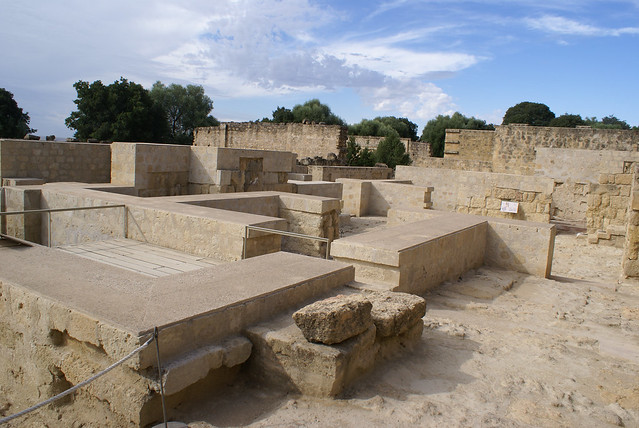
Having arrived on the bus and walked through the gates, we found ourselves with a view of the ruins, and at that moment our hearts sank. Everything was orderly, neat and clean, with far too many straight lines. We walked on, down concrete paths into what remained. The walls had been tidied up and neatened with concrete slabs, so that far from the tumbledown walls peppered with flora which make ruins so special, and which for centuries have delighted artists, writers and philosophers, visitors are presented with a series of modern facsimiles, of, amongst ther things, walls and gates.

Whole parts of the site have been ‘restored’, which is to say destroyed. Ruins of course are by their nature evidence of destruction. What we see in a ruin is the destructive passage of time as well as perhaps evidence of some historic trauma. Of course, the site has to be excavated, and again, by definition, archaeology – to some extent – destroys. But there is a huge difference between excavation and preservation on one hand, and restoration – or rather rebuilding – on the other. What visitors are offered at the site of Medinat al-Zahra isn’t the chance to see with their imaginations what it might have looked like 1000 years ago. Instead we are spoon-fed a vision of what someone else thinks it might have looked like.

On the Andalucía website, the following passage about the ruins speaks volumes:

To visit Madinat al-Zahra today does not mean entering an archaeological site where imagination has to make up for lack of volume. In al-Zahra, the huge amount of fragments found over many years of excavation made the experts seriously consider the question of how to present them. A museum would have meant metres and metres of display cabinets. Finally, it was decided to assemble the pieces of each palace over huge models at a scale of 1:1. This enable today’s visitors to perfectly visualise the setting for the tales of chroniclers and poets of the caliphate’s time.

It is then a model. Nothing more.

This response to what is a very important arcaheological site is rather like taking the recording of a song on a wax cylinder made in the late 19th century and embellishing it with new voices, new instruments and so on. While following the same melody, the new recording will ultimately drown out the original. Instead of listeners using their imaginations to enter the world of the 19th century room where the recording was made, and to hear how the voices would have sounded by using their experience of sound today – and there by doing become a part of that original moment – we get instead, nothing more than a replica.

Perhaps the most deplorable part of the extract from the Andalucía website is the first line: To visit Madinat al-Zahra today does not mean entering an archaeological site where imagination has to make up for lack of volume. It’s as if using one’s imagination is seen as bad, or at best a chore. You don’t have to do any of that here! We do it for you!

Imagining the ruins in our own minds, as they once might have looked, creates the space for us to imagine ourselves there. We’re never going to be able to recreate them as they really were, but that’s not the point. It does become a point however when someone tries to imagine them for us. As Christopher Woodward writes in his book ‘On Ruins’:

“A ruin is a dialogue between an incomplete reality and the imagination of the spectator…”

Furthermore, a city isn’t just a series of streets and buildings, it’s as much about the people who live there, who walk the streets, stand around, looking, chatting, getting on with their everyday lives. With ruins, in particular the ruins of cities, we have not only the fragmentary remains of physical structures, but the fragmentary remains of people – not in terms of their physical remains, i.e. their bones, but their movements.

This movement is bound up with what I call sightlines (and sightlines in turn with movement, for when we observe something, we do so as much with our bodies as our eyes). If you can imagine that when you look at something, the light between you and the thing observed remains once you’ve turned away, then we can imagine that bound up in every fragment within a ruin are hundreds and thousands of these lines.

In Roland Barthes’ Camera Lucida, we read:

“From a real body, which was there, proceed radiations which ultimately touch me, who am here; the duration of the transmission is insignificant; the photograph of the missing being as Sontag says, will touch me like the delayed rays of a star. A sort of umbilical cord links the body of the photographed thing to my gaze – light though impalpable, is here a carnal medium, a skin I share with anyone who has been photographed.”

When I look at the stones of a ruin, I’m sharing a similar skin with everyone who’s seen it.

In his novel Invisible Cities, the writer Italo Calvino writes of a city:

“Something runs among them, an exchange of glances like lines that connect one figure with another and draws arrows, stars, triangles, until all combinations are used up in a moment…”

In another extract:

“…there runs an invisible thread that binds one living being to another for a moment, then unravels, then is stretched again between moving points as it draws new and rapid patterns…”

Every place contains remanants of these threads which we can then pick up, and when we pick them up, we become for a moment part of one of these long since vanished patterns.

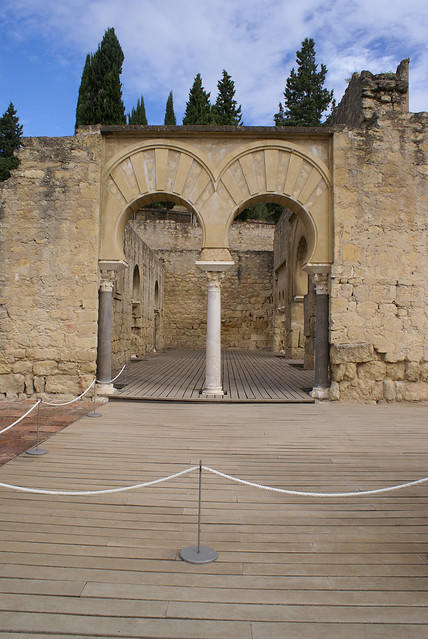
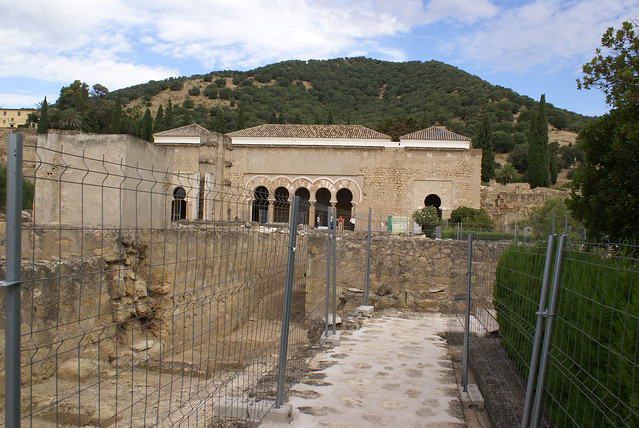
The picture below shows a reconstructed arch at the site.

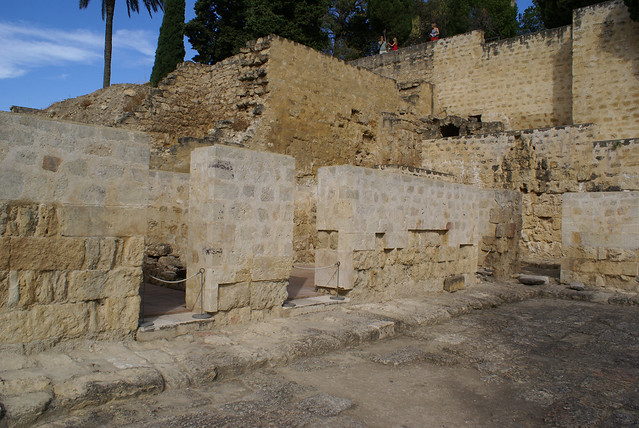
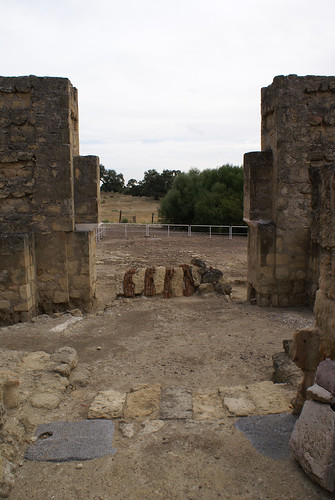
The following shows an arch which hasn’t been (completely) rebuilt, part of which still rests on the ground.

When I look at the remains on the ground, I imagine the sightlines associated with them. I imagine the people who would have looked at the arch every day – at those very stones lying on the ground. And by looking up at the gap where it once was, my body in some way mirrors that of the person looking centuries ago. The sightlines, as if they’re strings, become taut, and for a split second, a moment in the distant past is recovered. Part of a pattern (as Calvino describes) is restored; the dead light piled on the ground lives again.

A few years ago I described my view of history in terms of the cloning of dinosaurs in the film Jurassic Park. I explained how I took what fragments remained of a particular time or event (for example the old stones of a ruin) and filled the gaps with my embodied imagination. Embodied imagination in this instance, is an imagination anchored in the real world – in the sensory world around us. People in the past knew how it felt to feel the wind on their face; they saw the same sky and the clouds. They knew how it felt to have a body. In other words, it’s not a pure flight of fancy. It is just as Christopher Woodward explained – a dialogue. Not a monologue. We are not being dictated to by the ruins, and we are not dictating to them. Instead we are talking together, and it’s in this conversation that we find an authentic view of the vanished past.

At the Medinat al-Zahra however, what we experience is a monologue, but one which is spoken not by the ruins – but by those who have chosen to rebuild it. The gaps in the ‘DNA’ are filled not by our imaginations, but by concrete. Imagine a conversation between two people, with a third person – quite unknown to the others – shouting over the top of them. That is what it’s like here.

Filed Under: Uncategorized Tagged With: Barthes, Christopher Woodward, Italo Calvino, Ruins, Spain, Stars

Thoughts about my Nan

September 27, 2010 by Nicholas Hedges

As I stood in the church hall following the service of thanksgiving for my Nan who died on September 16th at the age of 98, I looked towards the stage at the back of the hall, through the door on the left hand side and into the short corridor behind. At that moment, in a split second, a number of memories crashed down around me, as if the way I was standing – the shape of my body – had unlocked the door behind which they’d been piled. The Christmas Bazaar, when I was a child was one of them, in particular the lucky dip box filled with sawdust and prizes. That was the first. It had stood there, just before the stage near the steps. I can still smell the sawdust; I can feel it on my hands as I search, in my mind, for a prize. Father Christmas had always made an appearance and would hand out gifts in his grotto. It was, in many ways when Christmas began, even though it was always held in the last week of November. It was at the Christmas Bazaar that I bought Nan a hideous ornament – china flowers in a china pot; gaudy coloured and chipped.

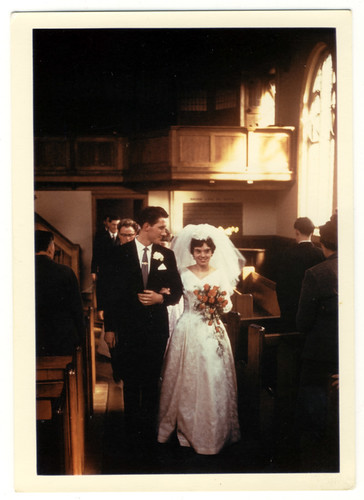
When I heard my Nan had died (I was on holiday in Spain at the time) my mind, for some reason, took me into the room which once ran the width of the church behind the large cross at the front. It was once an open gallery (you can see it in a photo of my aunt and uncle’s wedding), but had long since been blocked off from the church. Back then, when I was a child, it was always full of junk. It was where Father Christmas has his Grotto, and whatever the time of year, there was something of Grotto about it, with or without the old man in the red suit.

Back in the hall on the day of my Nan’s funeral, I could see the stage in my mind’s eye complete with the box at the front, one which ran the length of the stage, which when it was opened revealed a long line of lightbulbs. When I was a child, most of the bulbs were missing. You could see the sockets and the wires, but they hadn’t been used for years. There was a lighting box on the left hand side – just before the door through which I was looking – in which the old switches and levers had become grown over with time. In the single wooden panel, dividing it from the stage, was a hole through which you could see what was going on. My cousin and I had operated a tape player in there, some time in the mid 1980s for the performance of a pantomime whose name for the moment escapes me.

Inevitably, as I write, my thoughts are going to wander, as one memory leads to another, but back on the day of my Nan’s funeral, I thought about what I’d just remembered; the lucky dip, the Christmas Bazaar and the lightbulbs underneath the box. These were not isolated memories, they didn’t come to me like pictures in a gallery, one after the other. Instead they were physical and part of a web of memories, the threads of which seemed to vibrate with all that I had felt and experienced before. For a moment, when I moved, I could almost feel them again, I could hear the hubbub of the bazaar, see the stalls piled with jumble and the Christmas decorations hanging above. I was in the company of people who’d long since gone.

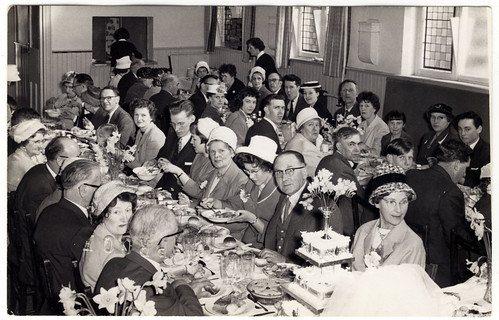
The photo below is of my Aunt and Uncle’s wedding reception, which took place in the hall. Very little has changed, apart from all the people.

Back to the day my Nan died – it’s interesting that my first thought was of the room immediately behind the church, but hardly surprising when you consider, that along with my Grandad, she’d lived in a house just opposite the hall. The house and the church were linked by Sundays, on which day we would cross the road to the house to select our sweets from the sweet-tin. Bon-bons, lemon sherbets, candied peanuts, mint imperials… we could choose 5, 6 or 7; the number changed from week to week. I can see the tin now – a round biscuit tin, I can hear the sweets rattle as the lid is prised off.

 Whenever we slept at Nan’s, my brother and I would find paper bags beneath our pillows in the morning, with a few sweets inside. Before bed, we’d have Ritz biscuits and grated cheese whilst watching TV. The television was one that had to warm up before the picture was fully revealed. I’m always reminded of Boxing Day when I think of the front room. That and the Two Ronnies – and in particular the Phantom Raspberry Blower. Seaside Summer Special too. I can feel the texture of the chairs and the sofa. It’s the afternoon on Boxing Day as I think of it now, and while some have gone to the football, everyone else stays in the warm, getting things ready for tea; cold meats, pickles etc.

I remember once, when I was 5 or 6, when my brother and I slept over at my Nan’s. It was in the summer, late at night. The night was warm and a storm was brewing. We couldn’t sleep and at about 11 or 12 o’clock, my Nan came upstairs and asked if we wanted to run around in the garden. Of course we did, and so out we went, into the garden with Nan as the storm approached. It was a simple thing, but in many ways a magical one. Back then, as can be seen from the photograph above, there was a large apple tree in the garden which I remember vividly that night. It’s gone now. A house has been built on top.

In the 1980s, the church was remodelled, with the space between the church and the church hall – which until then had been open to the elements – covered over. Many of the rooms were also remodelled. It was necessary, and no doubt it made the church more comfortable, but of course something was inevitably lost as a result, just as it was when the church itself was changed several years before. The corridor down which I’d looked from the front of the church hall, had once been part of a single room in which we had our Sunday school classes. I remember the tiny chairs and the out-of-tune piano in the corner. Leaving this room, you’d find yourself outside. A door straight ahead led to the toilet (always cold and full of spiders) and one to the left into the gallery room – or Santa’s Grotto. To the left, after the door to the Gallery Room and the just before the loo, a flight of metal steps led down to the church. A green gate blocked the way to the street, while the steps themselves were hazardous by today’s standards, especially in winter. I can still hear the sound they made as you walked down. At the bottom, you turned left and in front of you was another room (The Fellowship Room) and another toilet opposite (even colder and with even more spiders). In my mind it’s always damp here. I can always see puddles outside, and in the Fellowship Room there is the smell of old clothes; costumes which were always kept in a walk-in cupboard (blankets for Shepherds in the Nativity).

Filed Under: Family History Tagged With: Death, Family History, Memory, Nan

Convict Trail III

September 26, 2010 by Nicholas Hedges

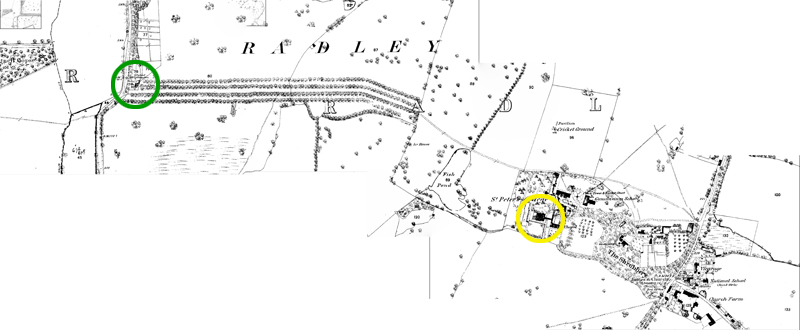
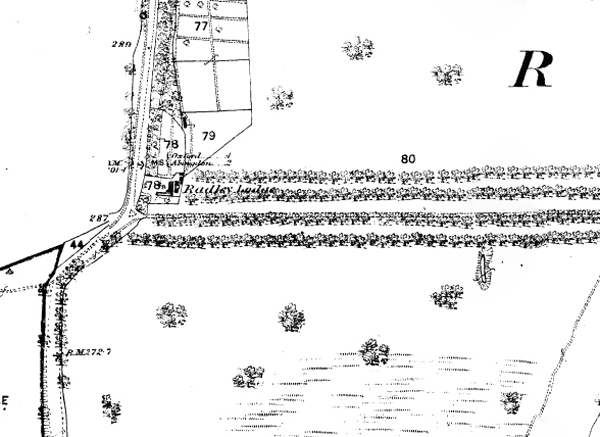
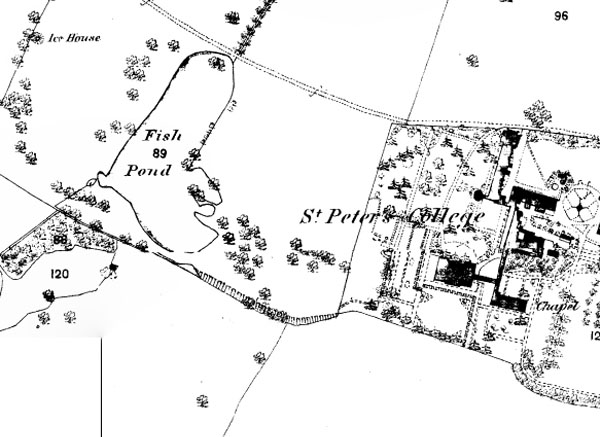
Having written to Radley College about my project, I received some very helpful information for which I’m very grateful. I was interested to know the location of Sir G.Bowyer’s lodge, next to which Richard Burgess was asked to stop by Stephen Hedges and his co-conspirators. Below is a map from 1875 showing St. Peter’s College, of which Radley Hall or House is a part. The house is circled in yellow. To the far left, is the lodge circled in green, at the end of a drive which leads out to the Oxford Road.

Below are two details taken from the map; first the lodge…

and then the house…

I think therefore we can assume that Richard Burgess was taking the route I suggested from Abingdon to Oxford. He stopped outside the Lodge whereupon Stephen Hedges, Stockwell and Harper left him to steal the lead from the ‘larder.’ The location of the larder is perhaps a little more difficult to ascertain. Benjamin Kent, who was renting the property from Sir George Bowyer, stated that the larder was about 100 yards from the ‘office’. In the painting of Radley Hall below, made by Turner in 1789 when he was just 14 years old, there is a collection a outbuildings on the left hand side, near to which, perhaps, the larder stood. Having stopped at the Lodge, Hedges and his accomplices left with a bag and returned five minutes later with the lead. If the larder was near the house, they must have worked very quickly to get to the larder, strip the roof, and return to the cart, suggesting perhaps they were well practiced in their ‘art’.

Filed Under: A Line Drawn in Water, Artist in Residence Tagged With: A Line Drawn In Water, Artist in Residence, Australia, Family Hedges, Family History, Hedges, Maps, Stephen Hedges

Convict Trail II

September 24, 2010 by Nicholas Hedges

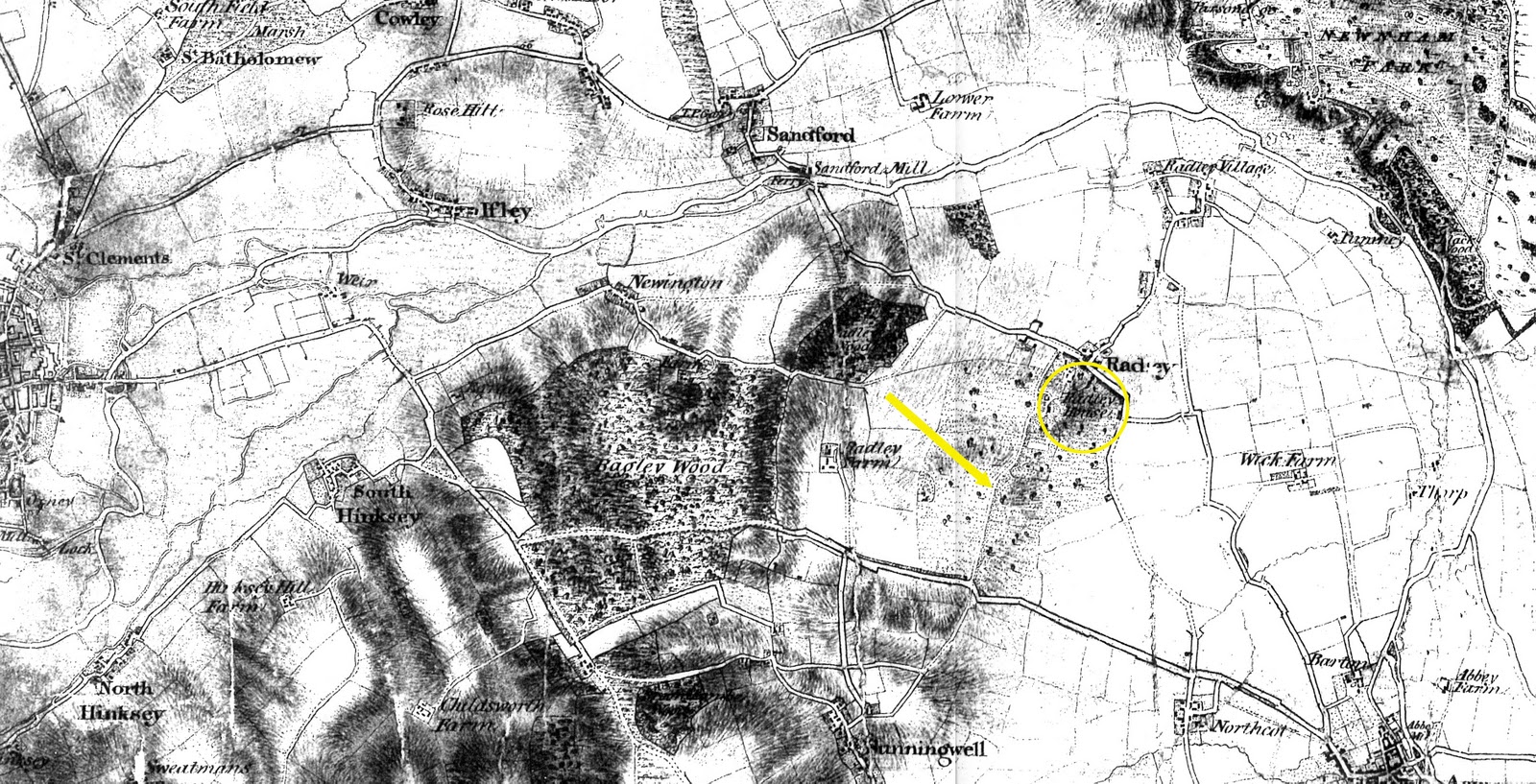
This afternoon I visited the library and found a map of Radley and its surrounds dating from 1811; 17 years before Stephen Hedges stole the lead from Radley Hall. On the map, Radley Hall (or House) is shown, along with a road – or drive – leading up, which, I think, corresponds to the satellite view I posted previously.

First the satellite view again:

And next, the 1811 map:

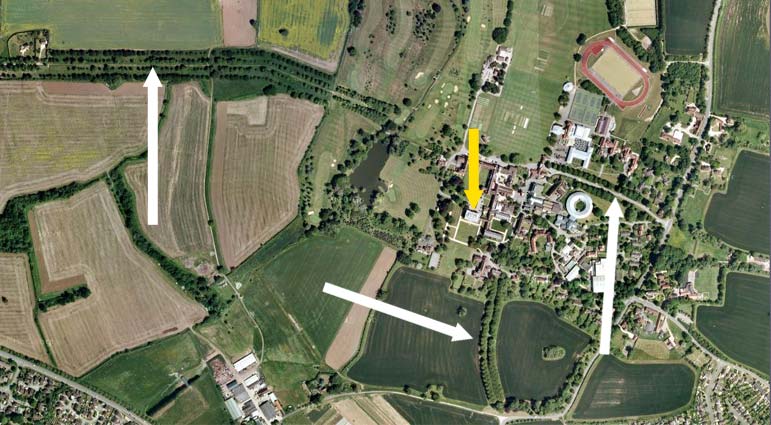
This map is aligned a little differently, but Radley Hall is circled in yellow and the drive indicated by the yellow arrow corresponds to that shown by the white arrow on the left hand side in the picture above. I’m not sure if the Lodge was located here, but the drive extends from the Oxford Road and would (I assume) have been the route taken by Richard Burgess on his way from Abingdon to Oxford. A little more research will be needed.

Having stolen the lead, I again assume that they would have travelled into the city via the Oxford Road through Bagley Wood, down Hinksey Hill and up the Abingdon Road. Once in the city, they made their way to the castle precincts and turned back up Butcher Row (modern day Queen Street) as indicated by the newspaper report. Of course I cannot be sure that this is how they travelled, but it seems much more likely compared with what I’d thought earlier.

Filed Under: A Line Drawn in Water, Artist in Residence Tagged With: A Line Drawn In Water, Artist in Residence, Australia, Family Hedges, Family History, Hedges, Maps, Stephen Hedges

Convict Trail

September 24, 2010 by Nicholas Hedges

Prior to my residency in Australia, I want to trace – as far as I can – the route my ancestor, Stephen Hedges, took with the lead stolen from Radley Hall. Radley Hall is now part of Radley College and in the newspaper article regarding the trial, the name of Sir G.Bowyer is given as the proprieter. Having Googled him, I was led to Wikipedia, where I discovered that he – George – was a Baronet and MP for Abingdon. In 1815, financial difficulties forced him to sell the contents of Radley Hall and by 1828, the house was being rented to Mr. Benjamin Kent. The article states that Richard Burgess – a sawyer – who was on his way from Abingdon to Oxford with a cart, met the defendents – Stockwell, Hedges and Harper – who asked if he could carry a parcel for them. He was asked to stop later on next to ‘Sir G. Bowyer’s Lodge’, after which the defendents went into a ‘plantation’ and returned with a heavy bag (full of lead).

Discovering the location of the Lodge will be important in helping me establish the route taken and looking at Google Maps, I have spotted a couple of possible locations for the old driveway. On the map below, the 18th century mansion is indicated with a yellow arrow, and the possible driveways with white arrows.

To be sure, I’ll need to try and find a map of the area as near to 1828 as I can, which means a trip to the library.

Filed Under: A Line Drawn in Water, Artist in Residence Tagged With: A Line Drawn In Water, Artist in Residence, Australia, Family Hedges, Family History, Hedges, Maps, Stephen Hedges

The Marquis of Hastings

September 5, 2010 by Nicholas Hedges

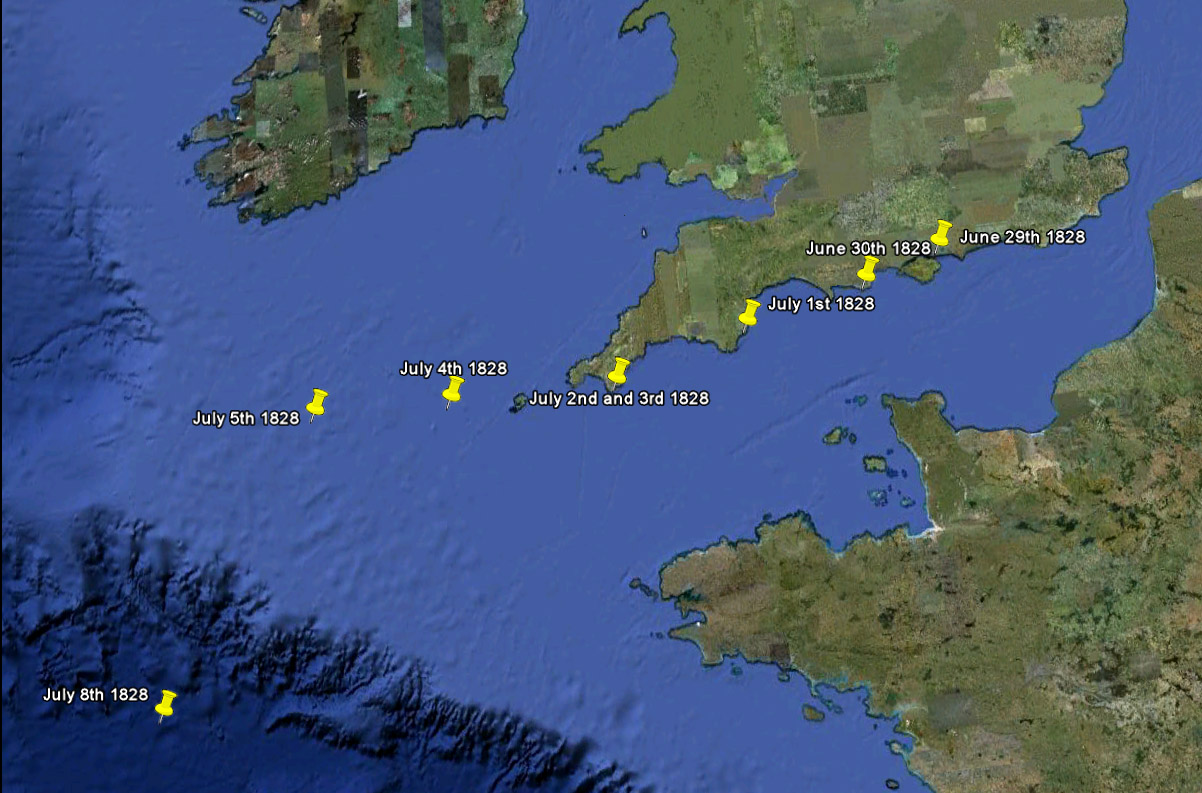
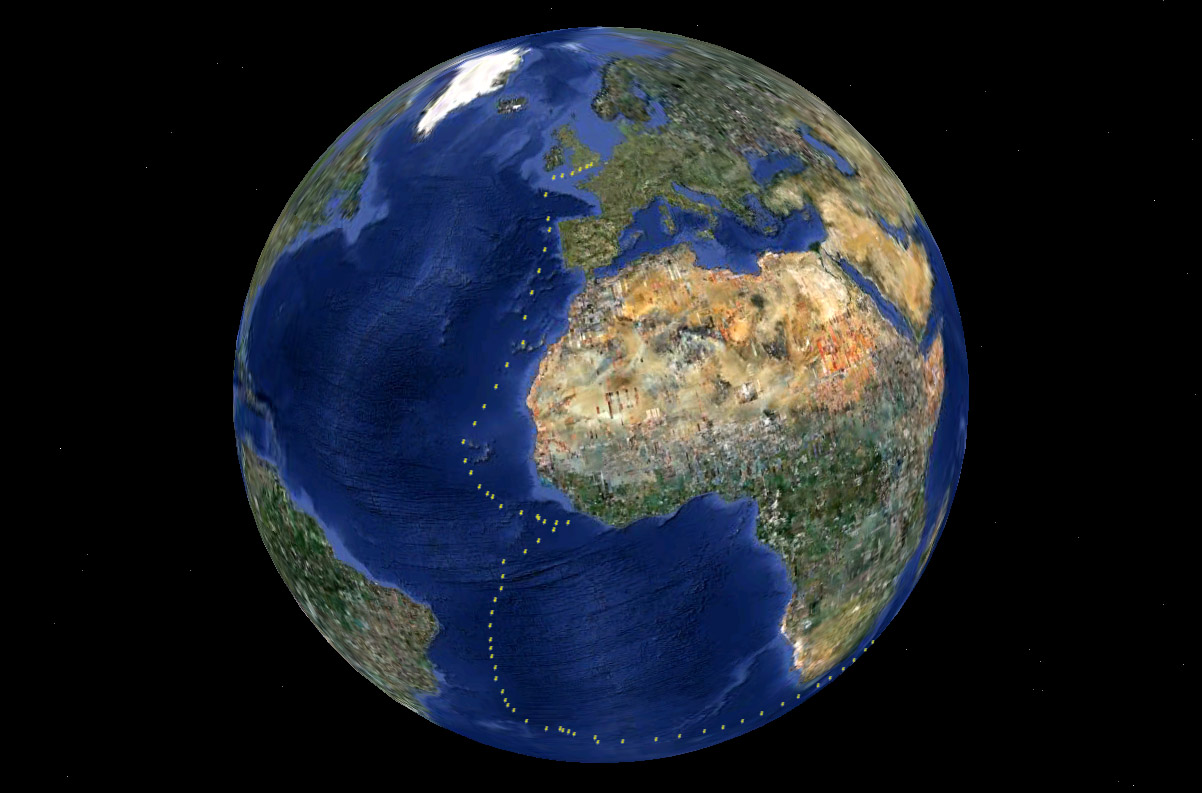
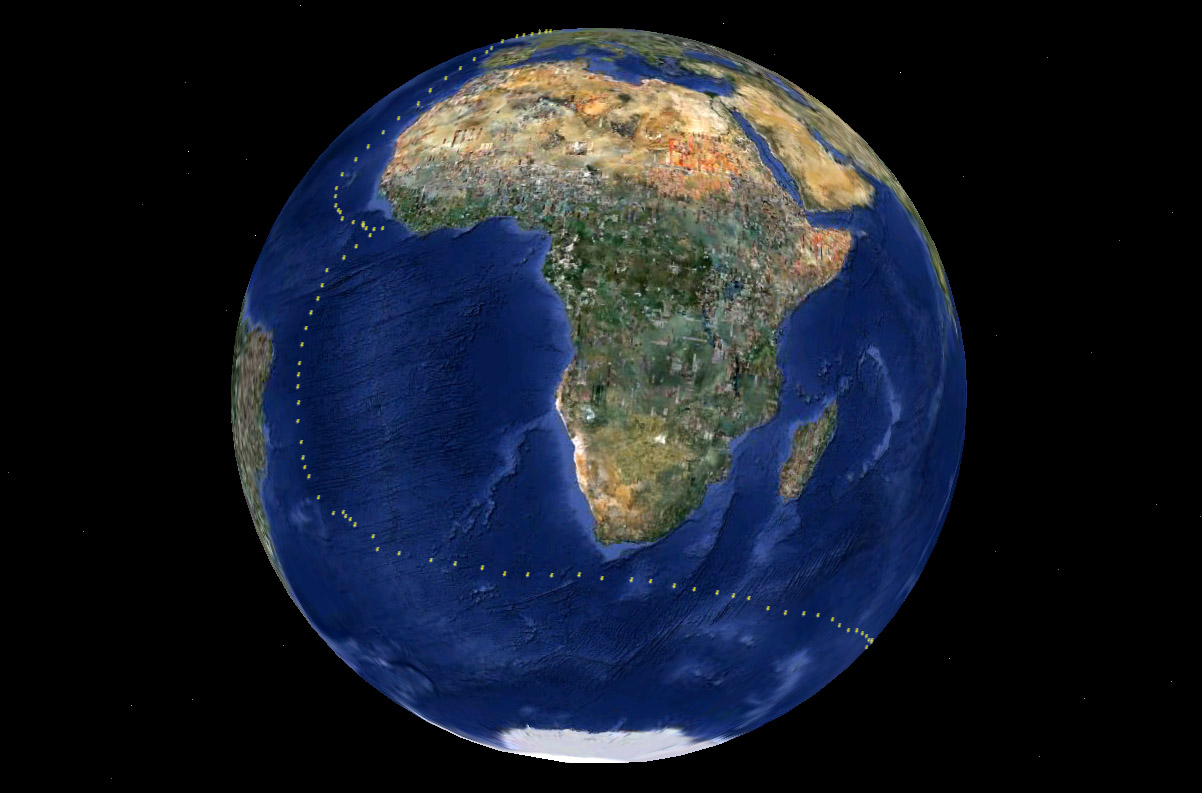
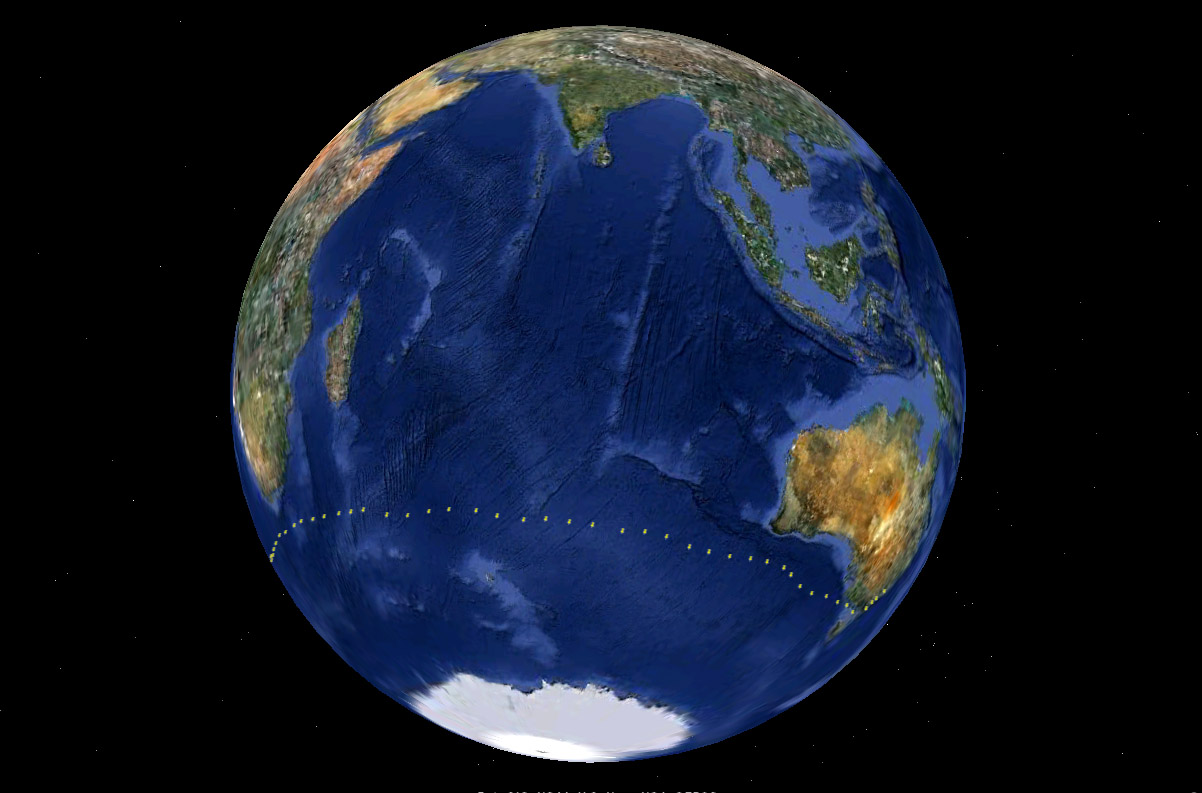
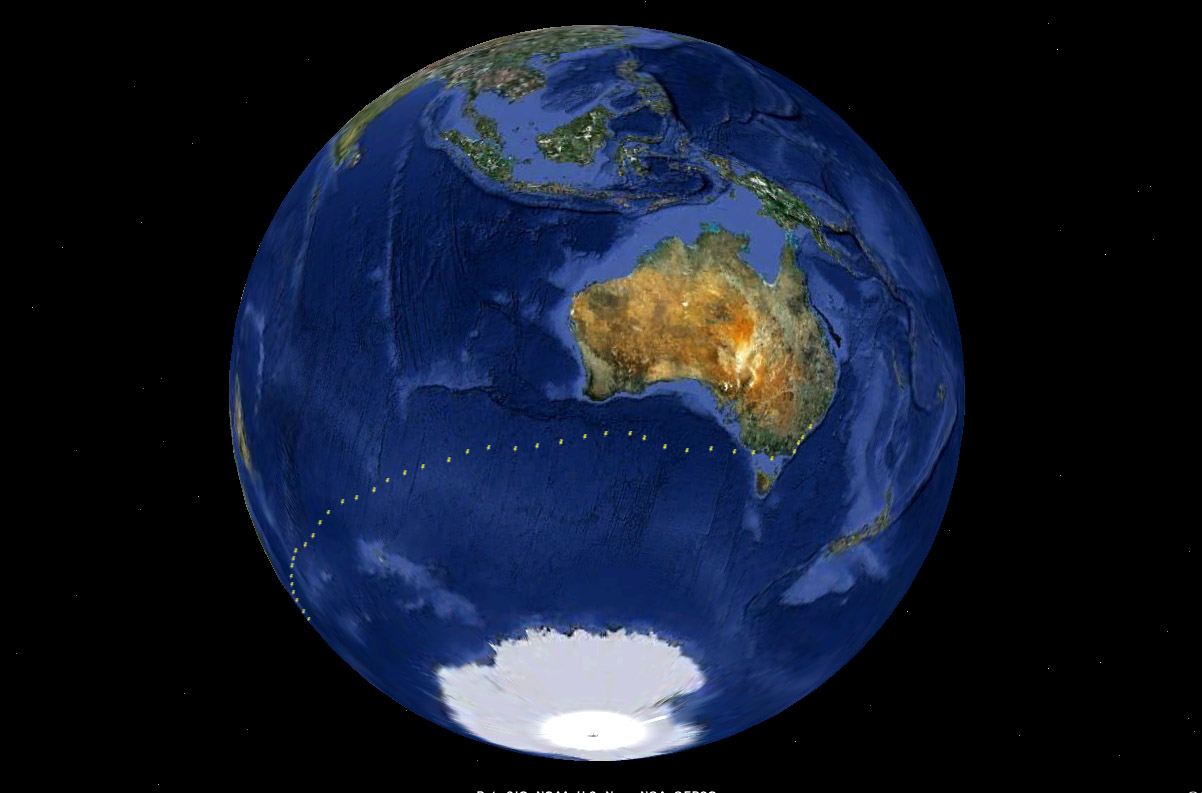
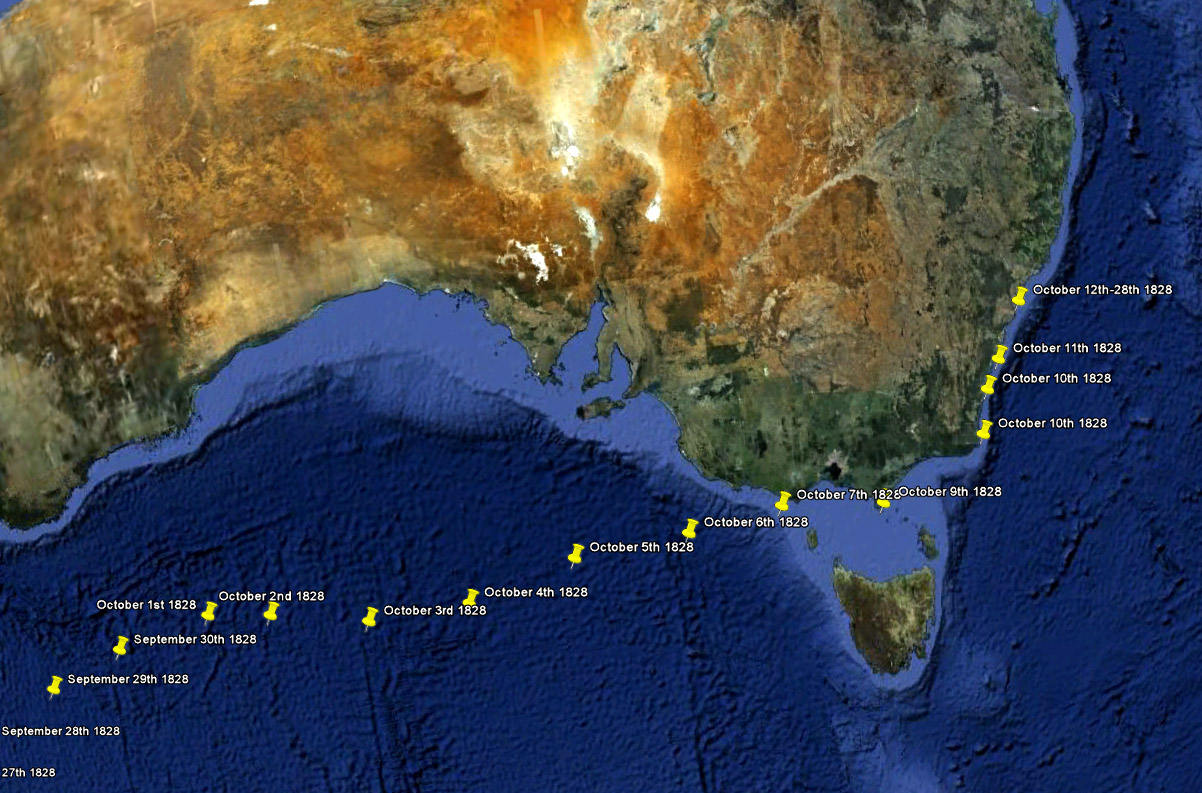
Prior to my residency in Australia, I’ve been researching my four-times great uncle Stephen Hedges (1811-1885) who was transported there in 1828 aboard the convict ship, the Marquis of Hastings (3). I wanted to find out more about the voyage which took 104 days between 30th June and 12th October 1828. In total, 178 convicts were transported, all of whom survived the journey, which, given the conditions in which they were kept is quite surprising. The following is a list of the men who were transported with my ancestor, with sentences of 7 years, 14 years and life.

John Birch
Thomas Smith
Charles Mason
William Smith
William Burgess
Charles Shearman
Stephen Hedges
Henry Stockwell
William Duncombe
William Edwards
Jake White
John Wright
Daniel Murrell
James Matthews
John Richardson
Joseph Dorman
Abraham Storr Junior
James Sewell
Robert Popple
James Goodey
Thomas Cherry
James Wilkinson
George Henley
David Rowland
Jas Briton
Thomas Inman
Samuel Le Count
James Unsworth
Thomas Wells
Abraham Scholfield
William Kinley
Henry Hammond Fleming
Jonathan Collis
James Dixon
Richard Grace
Matthew Green
John Mitchell
John Jones
Jonathan Knowles
William Watt
Roger Worthington
William Ford
John Marsden
Thomas Briant
John Marsh
William Finch
John Burrows
Isaac Jacobs
Thomas Booth
James Mackay
John Bywater
Michael Russell
Richard Hart
Francis Hayes
Henry Dignum
Thomas Hewitt
James Cobson
James Featherston
James Const
Steven Dace
Thomas Knight
William Longman
John Booty
William Orson
James Haines
Thomas Reynolds
John Hitchcock
William Keeven
William Baker
John Levy
William Hawkins
Robert Williams
James Herring
Michael Ryan
Bigley Hermitage
Richard Richardson
John Cavanah
Daniel McCarthy
William Allkin
George Newman
Jeremiah Crawley
Samuel Smith
Anthony Bernard
Martin Blaney
William Godfrey
John Kilminster
Thomas Floodgate
George Glover
Henry Nicholls
John Foot
Richard Jones
John Wilkie
William Mitchell
Andrew Keating
Thomas Holmes
William Cardinell
William Woodwill
James McCarthy
John Phipps
Nicholas Binken
Charles Brewhouse
James Pascoe
Thomas Willis
Joseph Griffiths
William Thompson
Thomas King
Thomas Northam
John Maxfield
Daniel Meney
Thomas Jones
John Kennedy
John McGinnis
James Moss
John Jarvis
William Reynolds
James Wiseman
Thomas Taylor
John Wade
John Jones
Philip Riches
Charles Sandy
Charles Westbury
James Pye
Thomas Burton
William Goodyer
Robert Stafford
Joseph Ockenden
William Nobes Junior
William Ockenden
William Burton
James Gumbrell
James Burraston
John Newberry
Charles Briggs
John Hockley
Offord Russ
Thomas Catley
Edward Leader
William Jones
John Smith
George Munday
Thomas Thompson
Henry Brown
Samuel Freestone
Joseph Callow
Henry Cox
Francis Barr
William Bavin
George Britton
William Jollan
Stephen Burnett
George Martin
James Millen
John Head
Martin Hall
James Bristow
Thomas Dennison
Thomas Montague
James Chambers
Edward Schofield
George Shot
James Walkins
James Binns
Joseph Smith
John Serjeantson
Thomas Winterburn
John Ledgard
William Field
George Spencer
Matthew Spencer
John Field
James Woodhead
James Lister
Joseph Quiby
Joseph Owen
Thomas Vickers
John Wild
Henry Fowler

Filed Under: A Line Drawn in Water, Artist in Residence Tagged With: A Line Drawn In Water, Emma Stevens, Family History, Stephen Hedges

Emma Stevens (1835-1873)

August 27, 2010 by Nicholas Hedges

Following on from my last blog entry, I ordered a copy of Emma Stevens’ death certificate to ascertain how she died and whether she was indeed the Emma Stevens (nee Fisher) to who I am, albeit indirectly, related. Sure enough, the death certificate showed that she was married at the time of her death to John Stevens, a tailor, who at the time was incarcerated in Moulsford Asylum, where he remained until his death in 1888. Emma’s age at death is given as 38, meaning she was actually born in 1835.

When her husband John was incarcerated in 1871, Emma and her two youngest children went to the Reading Union Workhouse. With no income coming from her husband it seems she had little choice. Two years later, on 12th August 1873, in what must have been extremely grim conditions, Emma died of cancer in the workhouse. The story of John Stevens’ epilepsy was sad enough, but through the lives of his wife and his children, we can see just how it affected the rest of the family.

The two young girls who went with their mother into the workhouse later married. Martha Stevens, who was 2 when she went in, married George Amor in 1888 and had 6 children. Her sister, Kate, who was 4 at the time she entered the workhouse, married Charles Plested in 1892. Together they had two children. Kate died in 1943 at the age of 73. Martha died 7 years later in 1950 at the age of 81.

Filed Under: Family History Tagged With: Emma Stevens, Family History, John Stevens, Moulsford Asylum, Stephen Hedges

Cornelius Squelch

August 20, 2010 by Nicholas Hedges

I’ve recently returned to my family tree and have been following up the story of my four-times-great-uncle John Stevens (1837-1888) who died in the Moulsford Asylum having suffered for many years with epilepsy. He had married Emma Fisher in 1857 and was incarcerated in the asylum in 1871. In the census for 1881, two of John and Emma’s sons (Henry and John) are listed as living with their uncle, Samuel Stevens – a tailor, whilst a daughter, Mary, is listed as living with her aunt, Rosetta Hunt. The couple’s youngest children, Martha and Kate are recorded, sadly, as being inmates at the Reading and Wokingham District school, which was in effect a workhouse.

I’ve wondered why the children had been left to such a fate? Was their mother unable to look after them? Or perhaps their relatives? Whilst looking for an answer, I discovered an Emma Stevens who died in Reading in 1873, and am assuming that this is Emma Fisher. I’ve ordered a copy of her death certificate to see, but if it is, then it marks another tragic episode in this family’s life, coming just two years after the incarceration of John in 1871.

If Emma Stevens died in 1873, aged just 36, then her two young daughters would have been just 4 and 2 respectively. Could they have entered the school/workhouse at that age? And what happened to them afterwards? Why could none of their aunts or uncles take them in? After all, there were 7 altogether. Given the conditions at the school/workhouse , it is quite hard to understand how they could have ended up there. More research is needed of course but I hope their stories are, eventually, happier ones.

As an aside, whilst looking at the list of inmates for the school/workhouse in 1881, one name stuck out above all others.The boy in question was there with his sister Emily. She was just 12 years old and he was 4 years younger. His name, like something from a children’s book was Cornelius Squelch. He has a story to tell, and I’d like to be the one to write it.

Filed Under: Family History Tagged With: Cornelius Squech, Emma Stevens, Family History, John Stevens

The Expiration

July 24, 2010 by Nicholas Hedges

SO, so, break off this last lamenting kiss,
Which sucks two souls, and vapours both away;
Turn thou ghost that way, and let me turn this,
And let ourselves benight our happiest day;
We ask none leave to love; nor will we owe
Any, so cheap a death as saying, Go.

Go; and if that word have not quite killed thee,
Ease me with death, by bidding me go too.
Oh, if it have, let my word work on me,
And a just office on a murderer do.
Except it be too late, to kill me so,
Being double dead, going, and bidding, go.

Filed Under: Poetry Tagged With: John Donne, Poem, Poetry

John Donne

July 24, 2010 by Nicholas Hedges

Be thine own palace, or
the world’s thy jail.

Filed Under: Poetry Tagged With: John Donne, Poetry, Quotes, Useful Quotes

Quote from Simon Schama

June 25, 2010 by Nicholas Hedges

“…to write history without the play of imagination is to dig in an intellectual graveyard…”
Preface to Citizens

Filed Under: Quotes Tagged With: History, Imagination, Quotes, Simon Schama, Useful Quotes

Ghosts of the Church of St. Clement

June 24, 2010 by Nicholas Hedges

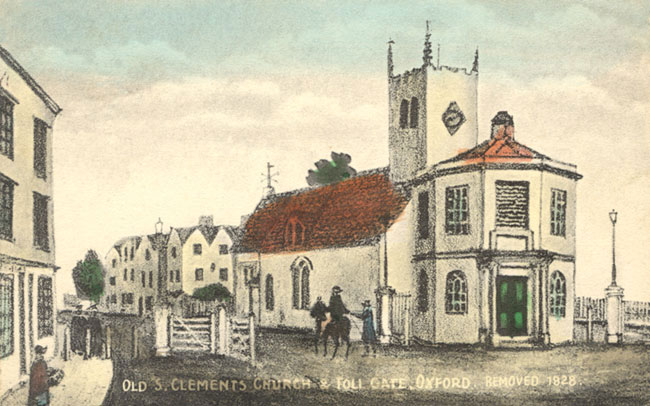
The old church of St. Clement, built around 1122 is a principal character in our story. It was described by the antiquary Thomas Hearne as “a very pretty little church,” but unable to serve the growing population of the parish, it was demolished in 1828 and a new church built on Hacklingcroft Meadow in Marston. The church’s three bells (one of which is the oldest bell in Oxford, dating to the 13th century) were taken to the new building. The church’s graveyard remained until 1950, when it too disappeared with the construction of The Plain roundabout.

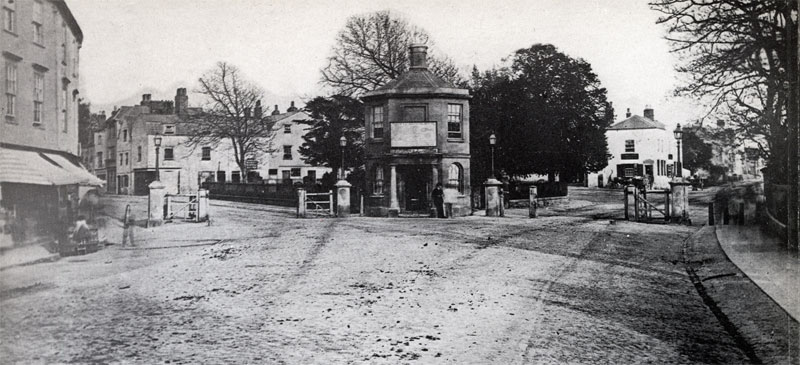
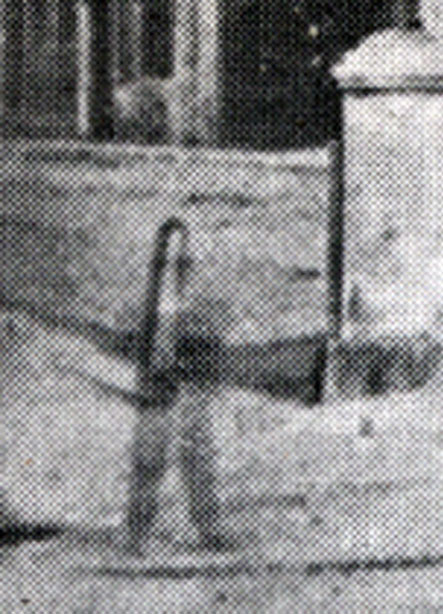
The toll house in front of the tower remained until the construction of the Victoria Fountain in 1899. The photograph below, taken in 1868, shows the old toll house and the churchyard behind.

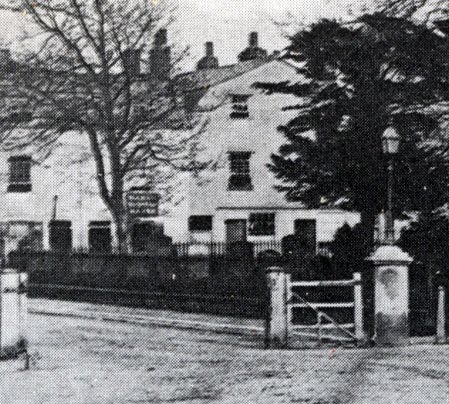
Looking closely one can see the gravestones…

…and the ghosts of those who walked too fast.

It’s interesting to compare the image above with the text of the newspaper notice. Both contain the likeness of a man on the same stretch of road, and yet that created 100 years earlier with words is, somehow, all the more clear. With the image above, we feel the same sensation as when we look at other very old photographs; a kind of vertigo which links – through a ‘carnal light’ – two poles of simultaneous existence and non-existence. We look at the image of a man in a time when he doesn’t exist, while he looks back from a time when we have yet to be born. Here we both are, and aren’t at the same time. The light, captured in the image, is, like an “umbilical cord” which as Sontag says, “links the body of the photographed thing to my gaze – light though impalpable, is here a carnal medium, a skin I share with anyone who has been photographed.”

In truth, we share this skin with anyone who’s ever been and it’s through our bodies that we identify with those who’ve gone before us. With the text, our sense of the man comes not only through that which the words describe,  but through the questions it asks and leaves unanswered. Furthermore, there is a sense of movement in the writing. We not only get a snapshot, but a full few minutes of this anonymous man’s life – a seemingly insignificant moment which serves, ironically, to make him all the more clear. It’s as if the blurs in the photograph above, caused by the long exposure and the movement of those in view, were instead a piece of film, one in which we don’t see a ghost, but a living, breathing individual.

This sense of movement is of course something we also share, and it’s this kinaesthetic aspect of the text which seems to count the man – whose more than likely been dead for more than two centuries –  among us. Because I’ve walked and experienced the insignificant, ‘everydayness’ of moments on the bridge, I seem to know him better than, for example, I do the man who stands against the toll house in the photograph. The man and the toll house have both disappeared. But the line of movement, the narrative line, and therefore the stranger of our tale, persists to this day.

Filed Under: Oxford, The Gentleman's Servant Tagged With: Oxford, St. Clements, The Gentleman's Servant, Vintage Photographs

The Narrative Line

June 24, 2010 by Nicholas Hedges

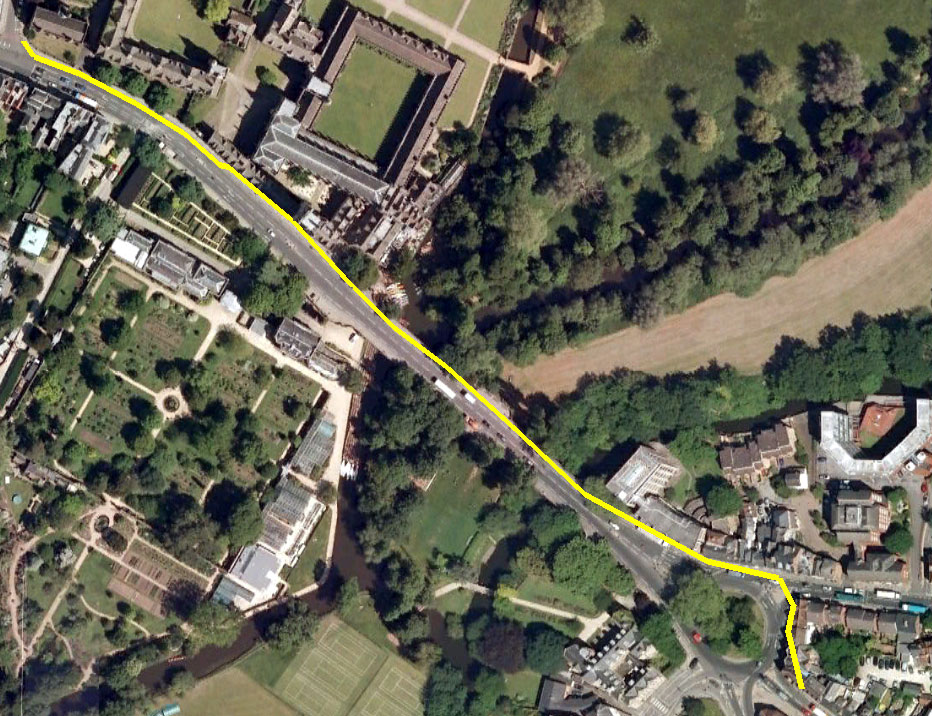
With my GPS, I traced the route we know the Gentleman’s Servant took across Magdalen Bridge up into modern day Cowley Road.  It was hard to imagine the scene in 1770 when the road would have been much quieter. Cars, buses and motorbikes were everywhere, the sound of their engines blocking out almost everything else.

But nevertheless, as I walked, I tried to take in everything around me, to capture all that made the present moment what it was, for even though the same place in 2010 is light years away from what it was 240 years ago, nevertheless, when the stranger rode over the bridge on December 12th 1770, it was something which for him was happening in the present. Now this might sound an obvious thing to say, but often when we read about the past, it’s almost as if we’re reading a fiction – a story which has a beginning, a middle and an end, and in which the characters follow a proscribed route laid down by the author: the narrative line in this instance comprises the text which makes up the tale. Of course life isn’t like this. When we walk, even if we’re going somewhere particular, we walk without knowing what may lie ahead of us. We might well know where we’re going, but how we’ll get there exactly, and what will happen as we travel, is something we only discover in the present moment.

As I wrote as part of a recent exhibition:

The Past is Time without a ticking clock. A place where paths and roads are measured in years. The Present is a place where the clock ticks but always only for a second. Where, upon those same paths and roads we continue, for that second, with our existence.

I want to read history in terms of its seconds – the small spaces within which life really happens. Every second in the present day – every moment – is a lens through which we can glimpse the past, no matter how distant it is. The more we know about the past (in particular the ‘geography’ of whatever we’re researching) the better the picture. But something in the space of every second reminds us, that what happened in the past happened in what was then a present just like ours; something as a simple, for example, as trees blowing in the wind.

The narrative line is like a piece of text; we follow it as we follow the words of a sentence, putting one foot in front of the other. But reading between the lines, we fill the gaps with what we see and experience around us. We are reminded that the stranger was moving all those years ago, unaware of what might lay before him. We become aware that he could feel the wind on his face, that he could see the sky, the river flowing beneath the bridge. And as we think, we realise that he himself was thinking, as was everyone around him – and this is the key to answering the questions I posed at the beginning of this project.

Every second the stranger rode along that line, he was part of a complex web of connections. These moments comprising his story were moments in many others – countless stories in a plot more complex that we can  imagine. The more we know about these moments, the more we can picture the scene and all who lived at the time, the better the chance we have of finding answers.

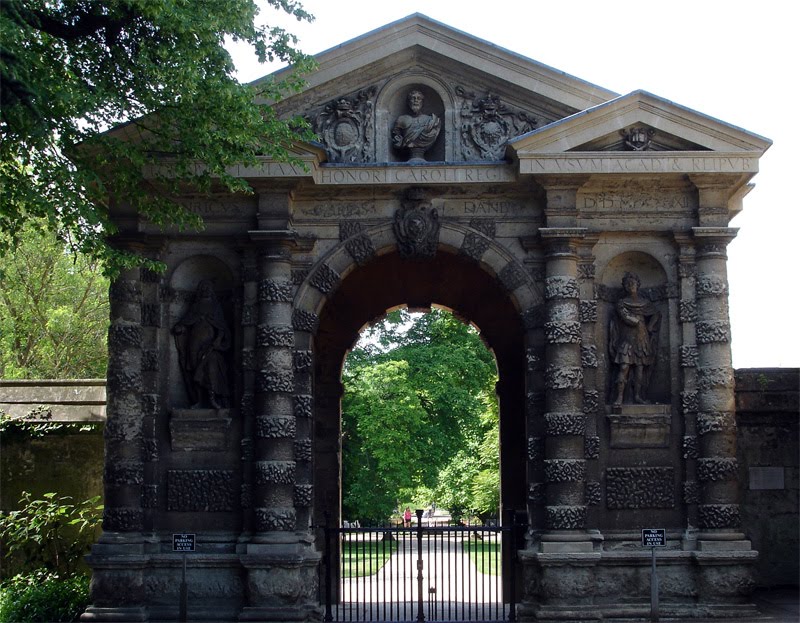
As I walked the length of the line, I looked to my right and glimpsed the 17th century gateway to the Botanic Gardens, and in that gesture, I found a connection with the stranger. The gateway is a witness to the moment I’m researching, and looking at it is one way of asking it for an answer.

Filed Under: Oxford, The Gentleman's Servant, Trees Tagged With: Gentlemans Servant, GPS, Lines, Maps, Oxford, Positioning, Servant, Survey, The Gentleman's Servant

John Gwynn’s Survey 1772 – Pt 2

June 24, 2010 by Nicholas Hedges

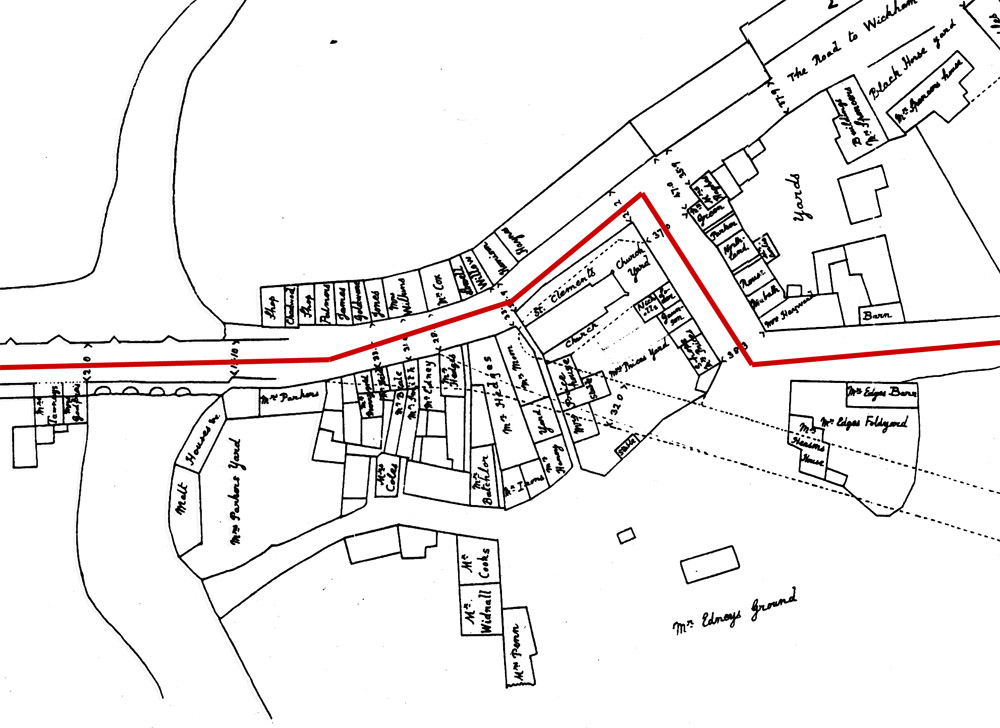
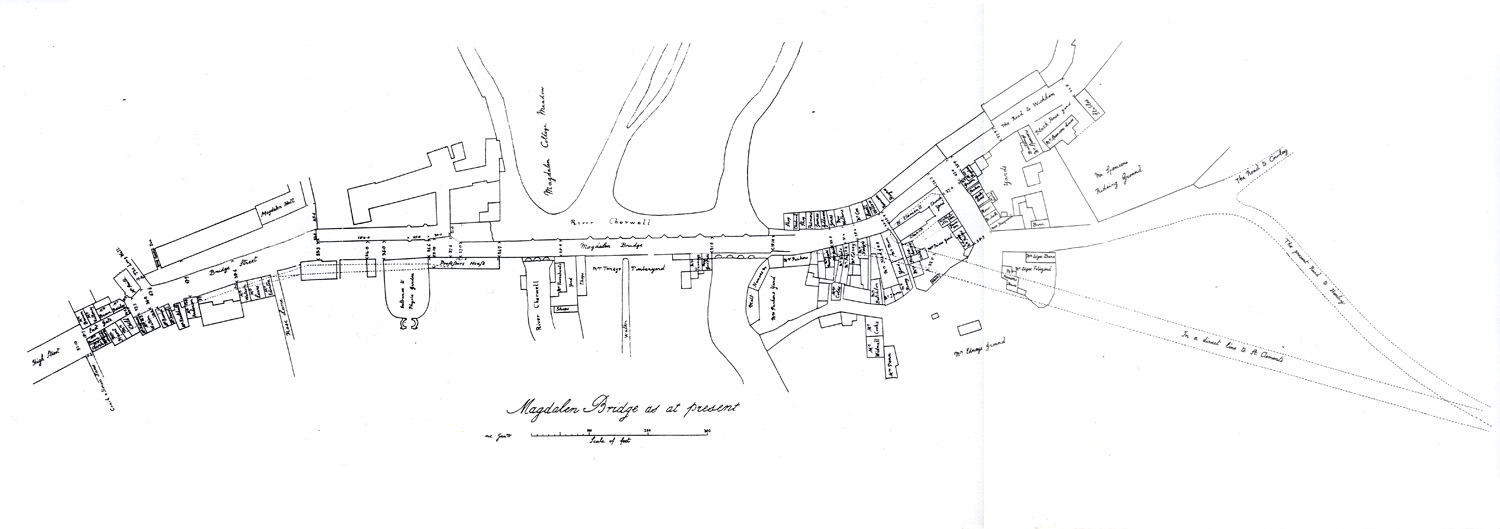
Whilst looking through some old research I did a few years ago, I came across the drawing reproduced below of Magdalen Bridge and its environs taken from John Gwynn’s survey of 1772.

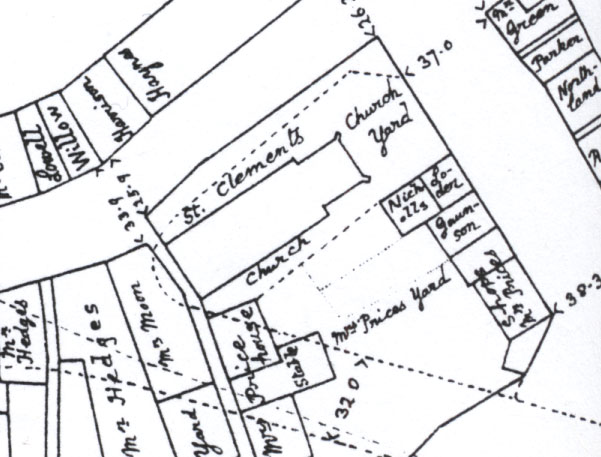
It shows the route we know the stranger took – the narrative line of this story – on December 12th 1770 along with the names of those who lived or owned properties bordering the street in 1771/72. Interestingly, my namesake – at least as far as my surname goes – owned property just in front of the old church of St. Clement which was demolished in 1828.

Filed Under: Oxford, The Gentleman's Servant Tagged With: John Gwynne, Maps, Oxford, Survey

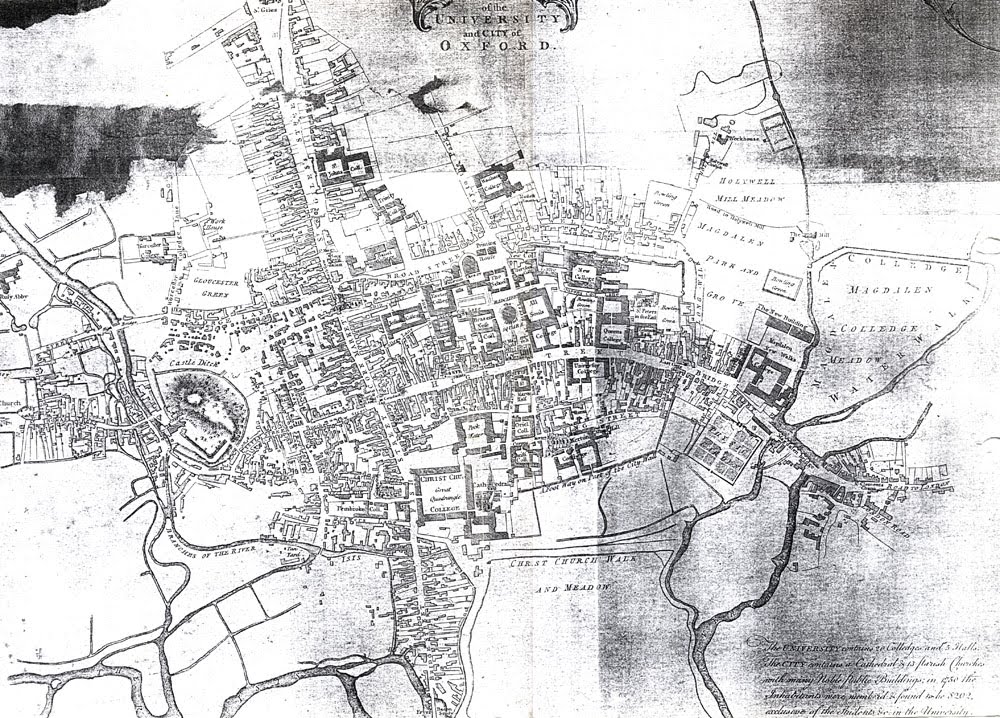
Map of Oxford 1750

June 24, 2010 by Nicholas Hedges

Although this map was made 20 years before the time which I’m researching, it gives nonetheless a good idea as to what the town looked like before the Mileways Act of 1771.

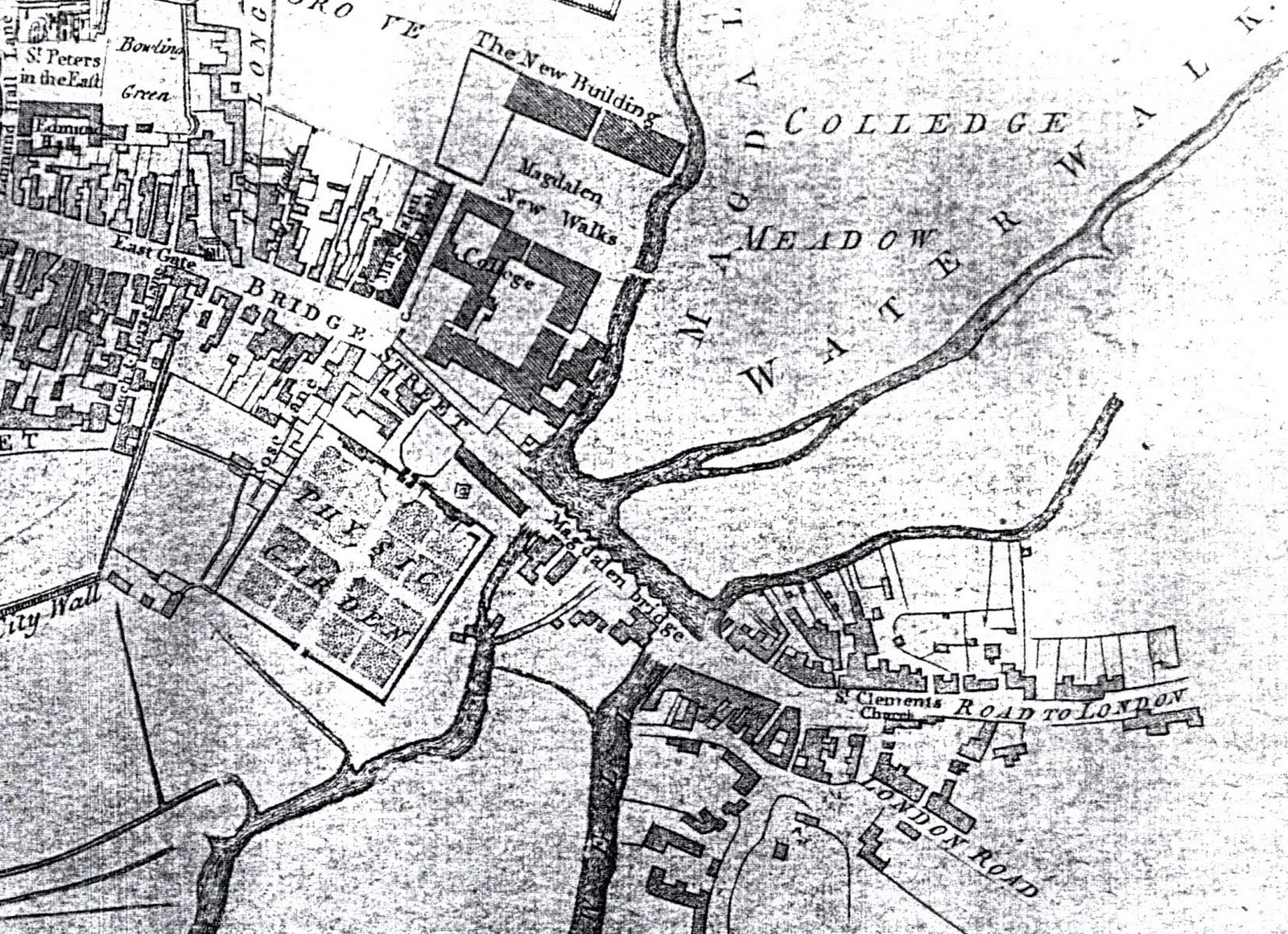
Magadalen Bridge is on the right hand side of the map, a detail of which can be found below.

The Gentleman’s Servant would have taken what’s described as the London Road at the bottom of the image.

Filed Under: Oxford Tagged With: 18th Century, Gentlemans Servant, Map, Maps, Oxford, Servant

John Malchair (1730-1812)

June 23, 2010 by Nicholas Hedges

I first encountered the work of John Malchair in 1998, at an exhibition in the Ashmolean Museum Oxford. Being as I am from Oxford, I was immediately struck by the beauty of his drawings which revealed through their own delicate rendering, the fragility of vanished places in and around the city.

According to Colin Harrison in the catalogue accompanying the exhibition, John Malchair was ‘the most important and influential drawing master in eighteenth century Oxford’. He was a German violinist who for over thirty years supplemented his earnings as leader of the band at the Holywell Music Room.

The following abridged text is taken from the catalogue; Malchair the Artist by Colin Harrison.

“He was baptised on 15th January 1730, in St. Peter’s Church, Cologne, the eldest son of a watchmaker, Joannes Malchair and Elizabetha Rogeri. They lived together in Sternen Grasse in a house next door to that where the Rubens family spent a difficult period between 1578 and 1587. After leaving his native city, he moved to Nancy and in 1754 arrived in England. Apart from short tours of Wales in his retirement, he never left his country of adoption.

After making his first appearance at the Three Choirs Festival in September 1759, where he was to play annually until 1776, Malchair came to Oxford to compete for the position of leader of the band at the Music Room after the death of Thomas Jackson. He won the competition and made his first appearance at the Widow Jackson’s benefit on 29th November or the choral concert on 12th December.

When Malchair arrived at Oxford, the city was essentially contained within the mediaeval city walls. As the first guidebook to the city – ‘A Gentleman of Oxford, The New Oxford Guide’ published in 1759 describes:

‘The town rises on a broad eminence which arises so gradually as to be hardly perceptible, in the midst of a beautiful extent of meadows, to the south, east and west and cornfields to the north. The vales on the east are watered by the river Cherwell and those on the west and south by the main stream and several branches of the Isis. Both rivers meet towards the north-east. The landscape is bounded on every side, the north excepted by a range of hills covered with woods….’

Walking was a popular pastime in such pleasant surroundings, in the streets, college gardens and father afield to nearby villages, such as Headington in the east, with its magnificent views from Shotover Hill.

Malchair quickly settled into the rhythm of rehearsals and concerts required at the Music Room and took his first pupils for drawing soon after he arrived. In 1760 he married Elizabeth Jenner who died ‘after a lingering illness’ on 14th August 1773. Malchair was deeply affected, and in later years frequently thought of their happy years together.

He died in 1812 and was buried in St. Michael’s church on 19th December 1812.”

In ‘Malchair the Musician’ also in the catalogue, Susan Wollenberg describes how Malchair “developed the idea of collecting tunes ‘on location'”.

“Interspersed with the many items from Playford and other published sources were his own discoveries. Numerous annotations to melodies in the collections… show Malchair’s eagerness in this regard. Beyond the academic and the musical aspects of his work are the pure ‘collector’s instinct’ and delight in acquisition. As Malchair remarked in his vivid English, ‘the leasure howers of many years were employed in forming this collection, ney, necessary busness was at time incrotched uppon when the fitt of collecting Grew Violent.”

Crotch (William Crotch, who, as a ‘Child in a Frock on his Mother’s Knee, performed the organ in the Music Room, to the great astonishment of a large audience’, on 3rd July 1779 – aged three) describes how No.156 of his Specimens was ‘written down by Mr. Malchair, who heard it sung in Harlech Castle’. Malchair himself notes that his version of ‘The Grand Duke of Tuscany’s March’ is ‘as played by a Savoyard on a barrill Organ in the Streets at Oxford. November 30 1784’.

The streets of Oxford were evidently a fertile source. Among the items gathered in the Cecil Sharpe House volume they yielded, besides the March already mentioned, such gems as La Rochelle, ‘played by a Piedmontese Girl on a Cymbal in Oxford Streets December 22 1784’ (and recorded together with Malchair’s instructions for reproducing the effect on the violin); an untitled tune resembling ‘Early One Morning’ transcribed ‘from the Singing of a Poor Woman and two femal [sic] Children Oxford May 18 1784’; a topical item, ‘The Budget for 1785. Sung in the Streete July 21 – 1785 – Oxon A Political Balad on Mr Pit’s Taxes,’ a tune for flute a bec [recorder] and Tambour’ which Malchair heard ‘play’d in the Streets at Oxford Ash Wednesday Feb: 25 1789’; and, most evocatively, the lively ‘Magpie Lane’ tune: ‘I heard a Man whistle this tune in Magpey Lane Oxon Dbr 22 1789. came home and noted it down directly.”

Filed Under: Oxford Tagged With: 18th Century, Gentlemans Servant, John Gwynne, John Malchair, Oxford, Servant

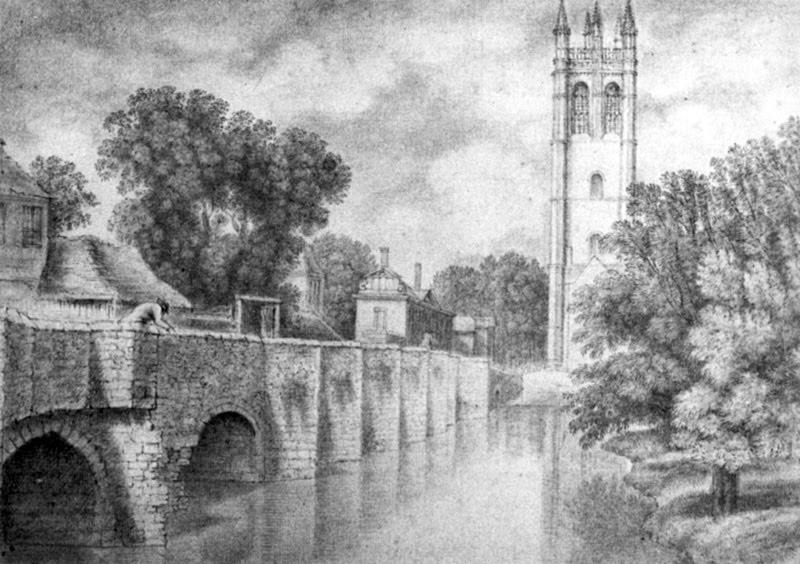
Magdalen Bridge c.1772

June 23, 2010 by Nicholas Hedges

The image below is a drawing of Magdalen Bridge made around 1772 by the German artist John Malchair. Following the passing of the Mileways Act in 1771, Malchair made a number of studies of the old bridge so as to record it for posterity.

With various parts of the mediaeval city threatened because of the Act, Malchair drew a number of views of buildings and structures including the North Gate and Bocardo Prison and Friar Bacon’s study which eventually fell in 1779.

This then is the bridge over which The Gentleman’s Servant crossed with two horses on December 12th 1770.

Filed Under: Oxford, The Gentleman's Servant Tagged With: 18th Century, Gentlemans Servant, John Gwynne, John Malchair, Oxford, Servant, The Gentleman's Servant

Annotations (Deadman’s Walk)

June 23, 2010 by Nicholas Hedges

A bastion of the old city wall, Deadman’s Walk, 1907
© Oxfordshire County Council

The same bastion today.

Filed Under: Oxford Tagged With: Annotations, City Wall, Oxford

John Gwynn’s Survey 1772

June 23, 2010 by Nicholas Hedges

Remarkable evidence of those who lived in Oxford around the time the notice appeared in Jackson’s Oxford Journal can be found in a survey carried out by John Gwynn in 1772 (John Gwynn also designed the new Magdalen Bridge). Made as part of continuing improvements originating with the Mileways Act of 1771, the actions of Gwynn (who could be seen around town measuring the fronts of houses and other buildings) aroused suspicion and even alarm among the city’s residents. The survey itself was required to calculate the costs of repaving the city’s streets for which each property was liable to pay a share depending on the size of their facades. What we have as a result is a wonderful record; a long list of names of all the city’s residents (or rather property owners), the streets on which they lived (or owned property) and the size of their dwellings – given in yards, feet and inches. It’s interesting for me that among the many Stevenses listed in the survey might well be my great-great-great-great-great-grandparents.

The page reproduced below, is taken from the survey and represents the bottom end of the High Street where it meets Magdalen Bridge – the Bridge can be seen listed below the name of a Dr. Sibthorpe. The Physick Garden above, is the old name for what is now the Botanic Gardens.

See also John Gwynn’s Survey 1772 – Part 2.

Filed Under: Oxford, The Gentleman's Servant Tagged With: 18th Century, John Gwynne, John Malchair, Oxford, Survey, The Gentleman's Servant

Magdalen Bridge 2010

June 23, 2010 by Nicholas Hedges

Although the present bridge is not that over which the enigmatic stranger crossed, it nonetheless marks the line he travelled and along that line are witnesses to the moment I’m researching. Below are a few photographs which I took today showing the famous landmark.

Magdalen Tower (above), as seen from the east, was completed in 1509 and would have seen the stranger pass below on his way over the bridge towards what was then the Watlington Road. The image below shows the route he would have taken with his two horses, from Magdalen Bridge on the right of the picture, towards what is now The Plain, but which in the stranger’s day would have been the church and churchyard of St. Clement, demolished in 1828.

The roundabout (below) stands on what was once the church and churchyard of St. Clement . To the right is the fountain, built in 1899 as a belated tribute to Queen Victoria who celebrated her Diamond Jubilee  in 1897. This was built on the site of the old toll house. The houses in the background stand on modern-day Cowley Road, the road up which the stranger rode into obscurity.

As I walked up the bridge I wondered who had seen the stranger pass and where they’d been when they saw him riding the two horses. In terms of more witnesses, the walls of the Botanic Gardens (founded in 1621) and its gateway (built by Inigo Jones’ master-mason Nicholas Stone in 1632) would have been standing at the time. The two statues and the bust, positioned in the gateway still look towards the road…

…and I like to imagine their eyes would somehow have seen him.

Filed Under: Oxford, The Gentleman's Servant Tagged With: Magdalen Bridge, Oxford, The Gentleman's Servant

  • « Previous Page
  • 1
  • …
  • 16
  • 17
  • 18
  • 19
  • 20
  • …
  • 32
  • Next Page »
  • The ‘Now of Then’
  • Artist’s Statement
  • Designs for an Heirloom
  • Dissonance and rhyme
  • Wildflowers
  • Emptiness
  • Wave (goodbye)
  • Now In The Past Of An Unreal Place
  • Return to Graphite
  • Genius
  • Latest Backdrops
  • Extended Backdrops
  • Backdrops
  • Komorebi
  • Acorns
  • Scroll Work
  • Goethean Observation: Japanese Scroll
  • Mistakes
  • The Leaf Is Singing Still
  • Past Present
  • Scrolls
  • As Yet Untitled
  • Holes
  • Scroll
  • A Calligraphy of Shadows
  • More Paintings
  • Latest Paintings
  • Walking Meditation 2
  • Knowing We Are There
  • Venice by Moonlight 1840
  • Fragments and Additions
  • Reimagining The Past
  • Walking Meditation 1
  • Mindful Walking I
  • Grief II
  • Three New Paintings
  • Nana’s Mountain
  • Painting
  • Iridescence
  • Roman Bottle
  • Rinsho
  • Shadow Calligraphy
  • Becoming Memory
  • Fox Talbot’s Glassware
  • Goethean Observation: Diffuser II
  • Goethean Observation: Diffuser
  • A Remembrance of Things We Never Have Known
  • A Moment’s Language
  • Take Me Home
  • Arrival/Departure
  • Diffusers
  • Grief
  • Mum
  • Measuring the past
  • Disordered Time
  • Entropy
  • Wicked Magician, Fly
  • The Quanta of History
  • Empathy Forward
  • The Natural World of 978
  • The Gone Forest
  • Empathy/Exchange: 668 grams
  • Goethean Observation: Pilgrims of the Wild, 1935
  • Nazareth O
  • Several Johns and St. Thomas
  • Raspberry
  • Tokens and Shadows
  • Patterns Seeping (II)
  • ‘Missded’ 4 – Tokens
  • Patterns seeping
  • Cut Paintings
  • ‘Missded’ 4
  • Locks III
  • Locks II
  • ‘Missded’ 2 – Tokens
  • My Son’s Drawings II
  • ‘Missded’ 2
  • ‘Missded’ 3 – Tokens
  • ‘Missded’ 3
  • ‘Missded’ 1 – A Framed Token
  • Morning Has Broken
  • Tokens of absence
  • ‘Missded’ 1, stitched
  • More Little Words
  • Three Little Words
  • Spaces In Between
  • ‘Missded’ 3
  • ‘Missded’ 2
  • ‘Missded’ 1
  • Locks
  • Tracings
  • My Son’s Paintings
  • Writing Shadows
  • Samuel Borton’s Post Chaises
  • Dawid Sierakowiak
  • Pitchipoi
  • Latest Tree Drawings
  • Notebook
  • Somewhere Between Writing and Trees II
  • Somewhere Between Writing and Trees

© Nicholas Hedges 2024

  • Facebook
  • Instagram
  • Twitter
  • YouTube

Copyright © 2025 · Outreach Pro on Genesis Framework · WordPress · Log in