Nicholas Hedges

Art, Writing and Research

  • Amazon
  • Behance
  • Facebook
  • Instagram
  • Pinterest
  • YouTube
  • Art
    • Digital
    • Drawing
    • Grids
      • Correspondence
      • The Wall
      • The Tourist
    • Ink on paper
      • Shadow Calligraphy
    • Installation
      • Murder
      • Echo
    • Painting
    • Patterns
    • Mixed Media
    • Photographic installation
      • St. Giles Fair 1908
      • Cornmarket 1907
      • Headington Hill 1903
      • Queen Street 1897
    • Research/Sketches
    • Stitched Work
      • Missded 1
      • Missded 2
      • Missded 3
      • Missded 4
    • Text Work
  • Blogs
    • Family History
    • Goethean Observations
    • Grief
    • Light Slowed But Never Stilled
    • Lists
    • Present Empathy
    • Shadow Calligraphy
    • Trees
    • Time
    • Walking Meditations
  • Video
  • Photography
    • Pillars of Snow
    • Creatures
    • The Trees
    • Snow
    • St. Giles Fair 1908
    • Cornmarket 1907
    • Headington Hill 1903
    • Queen Street 1897
    • Travel
  • Illustration and Design
  • Music
  • Projects
    • Dissonance and Rhyme
    • Design for an Heirloom
    • Backdrops
    • Shadow Calligraphy
  • Exhibitions
    • A Line Drawn in Water
      • Artwork
    • A Line Drawn in Water (Blog)
    • Mine the Mountain 3
      • Artwork
    • Mine the Mountain 2
      • Artwork
      • The Wall
    • The Woods, Breathing
      • Artwork
    • Snow
      • Artwork
    • Echo
      • Artwork
    • Murder
      • Artwork
    • The Tourist
    • Dreamcatcher
    • Mine the Mountain
      • Artwork
      • The Tourist
    • M8
    • The Gate
    • Creatures
      • Artwork
    • Residue
      • Artwork
    • A visit to Auschwitz
      • Artwork
  • Me
    • Artist’s Statement

Edmund Blunden

March 30, 2007 by Nicholas Hedges

Edmund Blunden (1896-1974) saw action at both Ypres and the Somme and was awarded the Military Cross. A friend of Siegfried Sassoon, he became a fellow of Merton College, Oxford in 1931 where he remained until 1944, returning to the city in 1968 as Professor of Poetry.

I found the following poem in The Penguin Book of First World War Poetry.

1916 seen from 1921

Tired with dull grief, grown old before my day,
I sit in solitude and only hear
Long silent laughters, murmurings of dismay,
The lost intensities of hope and fear;
In those old marshes yet the rifles lie,
On the thin breastwork flutter the grey rags,
The very books I read are there – and I
Dead as the men I loved, wait while life drags

Its wounded length from those sad streets of war
Into green places here, that were my own;
But now what once was mine is mine no more,
I seek such neighbours here and I find none.
With such strong gentleness and tireless will
Those ruined houses seared themselves in me,
Passionate I look for their dumb story still,
And the charred stub outspeaks the living tree.

I rise up at the singing of a bird
And scarcely knowing slink along the lane,
I dare not give a soul a look or word
Where all have homes and none’s at home in vain:
Deep red the rose burned in the grim redoubt,
The self-sown wheat around was like a flood,
In the hot path the lizard lolled time out,
The saints in broken shrines were bright as blood.

Sweet Mary’s shrine between the sycamores!
There we would go, my friend of friends and I,
And snatch long moments from the grudging wars,
Whose dark made light intense to see them by.
Shrewd bit the morning fog, the whining shots
Spun from the wrangling wire: then in warm swoon
The sun hushed all but the cool orchard plots,
We crept in the tall grass and slept till noon.

This is a beautiful poem, three lines of which struck me in particular:

Those ruined houses seared themselves in me,
Passionate I look for their dumb story still,
And the charred stub outspeaks the living tree.

As part of my research for my OVADA residency I have been looking at the area of Oxford in which the OVADA gallery is situated (Gloucester Green) a place which following the Black Death was known as ‘Broken Hayes’. At this time (c.1348/49) many parts of the town – decimated by the plague – were empty, and Blunden’s lines seem to describe perfectly this sense of emptiness, reflection and loss.

Filed Under: Poetry, World War I Tagged With: Uncategorized

Night and Day

March 29, 2007 by Nicholas Hedges

Reading through various documents regarding the period in Oxford after the Black Death, it’s clear there were many vacant buildings and plots around the city.

“In the later Middle Ages the town’s suburbs contracted, and within the walls there was structural decay and an abundance of vacant plots. Very little church building or restoration may be dated to the century following the Black Death. The gloomiest picture was that drawn by a jury in 1378 of a thirteen-acre site in the north-east corner of the town: the land, neither built-up nor enclosed, was a dump for filth and corpses, a resort of criminals and prostitutes…”

Although this does not refer to the area of Broken Hayes (but rather land now occupied by New College) it does paint a picture of what some parts of the town must have looked like.

By the 16th century the area (Broken Hayes) was surrounded by trees and for a few years from 1631 it served as a public bowling green. Throughout the 17th century it was used as a recreation area but one which Anthony Wood described in his journal as a ‘rude, broken and undigested place.” It might be an exaggeration to say so, but it would seem that the legacy of the Black Death lingered in this area centuries after the event.

It is the sense of emptiness in the years immediately proceeding the Black Death which interest me most at this point. Recently, I’ve been researching Memory, and have in this pursuit been reading Frances A. Yates’ book, ‘The Art of Memory,’ in which she discusses the use in Ancient Greece of Memory Places, buildings fixed in the mind which one could ‘walk through’ and by placement of certain objects in locations throughout that place recall whatever it was that was to be remembered – a speech for example. In a contemporary textbook ‘Ad Herennium‘ the anonymous author gives a description of what these Memory Places should be like:

“It is better to form one’s memory loci in a deserted and solitary place, for crowds of passing people tend to weaken the impression. Therefore the student intent on acquiring a sharp and well defined set of loci will choose one unfrequented building in which to memorise places…”

As with my linking impressions made on the soul’s block of wax (see Broken Hayes below) with the craters of Hill 62, here it’s easy to see the student’s mind as being the place itself. I can imagine the memory of a place (in this case Gloucester Green) as being sharper and more ‘accessible’ when that place is, as the Ad Herennium states, a ‘deserted and solitary’ one. One can imagine that deserted patch of ground, abandoned in the wake of the Black Death, as sharp with the memories of what had gone before. Today, this contrast between these two periods of [14th century] time might best be articulated in the contrast between night and day. In the day the area is full of people (particularly on market days) and at night, is empty, and some might say a place not so far removed from Anthony Wood’s ‘rude… and undigested place.’

Filed Under: Artist in Residence, Trees Tagged With: Uncategorized

Broken Hayes – Further Evidence

March 29, 2007 by Nicholas Hedges

In 1658, the Oxford Antiquary, Anthony Wood wrote the following in his diary:

“May 4, T., a maid was hanged at Greenditch neare Oxon, for murdering her infantbastard. After shee was cut downe and taken away to be anatomiz’d, Coniers a physitian of S. John’s Coll. and other yong physitians, did in short time bring life into her. But the bayllives of the towne hearing of it, they went between 12 and one of the clock at night to the house where she laid, and putting her into a coffin carried her into Broken hayes, and by a halter about her neck drew her out of it, and hung her on a tree there. She then was so sensible of what they were about to do, that she said ‘Lord have mercy upon me,’ &c. The women were exceedingly enraged at it, cut downe the tree whereon shee was hang’d, and gave very ill language to Henry Mallory one of the baillives when they saw him passing the streets, because he was the chief man that hang’d her. And because that he afterwards broke, or gave up his trade thro povertie (being a cutler), they did not stick to say that God’s judgments followed him for the cruelty he shew’d to the poore maid.”

Broken Hayes was also used as a place of execution for two Levellers, Private Biggs and Private Piggen who were shot on 18th September 1649 for their part in the second mutiny of the Oxford Garrison.

Filed Under: Artist in Residence Tagged With: Uncategorized

Broken Hayes

March 29, 2007 by Nicholas Hedges

Beginning my research into Gloucester Green, I read in the Encyclopaedia of Oxford (Macmillan 1988, ed. Christopher Hibbert) the following entry for Gloucester Green:

“The open area outside the City Wall bounded by Worcester Street, George Street, Gloucester Street and, to the north, by Beaumont Street. There was probably housing here in mediaeval times. After the Black Death in 1348 it became a derelict and decayed area known as Broken Hayes…”

The following is a detail from a map of Oxford made in 1675 by David Loggan. Carfax can be seen near the top left corner, the castle (now much reduced in size) opposite, and in the bottom right-hand corner, Broken Hayes or Hays – the present day Gloucester Green.

In support of those themes which I’ve outlined in my initial proposal I have started to look at contrasts which exists over a period of time within the same space. As I stated on the homepage of my website:

‘How does a place in the present relate to the same place in the past? How do I relate to these places? And how do those who inhabitant the past relate to those of us living today?”

My visits to Auschwitz-Birkenau and more lately Ieper (Ypres) have served to deepen this interest.

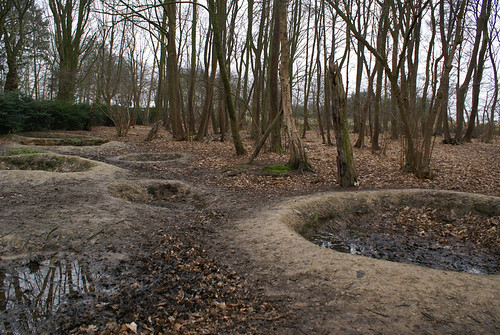
The photo above shows Hill 62 in Ieper (Ypres) as it looked during World War 1. Although not entirely clear, one can make out the sandbags and a soldier looking into the camera. Below is a photo of the same area, Sanctuary Wood, which I visited earlier this month.

Standing there in the wood, listening to the birds singing, it was hard to imagine what it must have been like to be there as a soldier in the trenches, deafened by shells and with death and destruction everywhere. In Plato’s ‘Theaetetus‘, Socrates assumes there is a block of wax in all our souls, onto which external stimuli are pressed so their shapes are left behind. This block of wax becomes like our memory and I thought of this as I saw the craters left by the shells. The very earth was the world’s own block of wax, it’s memory, into which the horrors of war had been impressed, never to be forgotten.

As with Auschwitz-Birkenau, the silence was somehow a testament to the scale of death suffered there. Here too, in Sanctuary Wood, the silence seemed to speak at length on the matter. Here and throughout Europe, hundreds of thousands of people, millions even, had simply disappeared.

So, here we have two ‘themes’; the contrast between the same place at two different times, and the disappearance (deaths) of unimaginable numbers of people. This takes me back to the start of this entry; to Broken Hayes.

It is estimated that between 1348 and 1350, between one and two thirds of the population of Europe succumbed to the Black Death. Oxford itself lost around a third to a half of its population and the contrast between the town before and after must have been appalling. In many ways, thinking of this difference, I’m reminded of my experience of standing in Auschwitz-Birkenau and the woods of Hill 62. In both these places, it was the silence which spoke of the terrible traumas suffered there, and in Oxford, on Broken Hayes, I’m sure it was silence which spoke of the town’s own tragedy.

Filed Under: Uncategorized Tagged With: Silence

The Moon

March 26, 2007 by Nicholas Hedges

“The light of the moon covers the earth, yet it can be contained in a single bowl of water.”
Dogen Zenji (1200 – 1253)

“Headlights illuminated a large area with a deep oval-shaped pit in the middle. At its bottom a pool of water had formed in which the moon was mirrored.”
Filip Muller – Eyewitness Auschwitz

“The Moon shines with so blue a light
Over the City,
Where a decaying generation
Lives cold and evil –
A dark future prepared
For the pale grandchild.”
Georg Trakl

Filed Under: Poetry, Quotes Tagged With: Uncategorized

Ieper (Ypres)

March 26, 2007 by Nicholas Hedges

The following text can be found on my website under Places. Click here for more on Ieper.

“I should like us to acquire the whole of the ruins of Ypres.. a more sacred place for the British race does not exist in the world.”

Winston Churchill’s quote regarding the fate of the ruined town provides an interesting backdrop to the whole subject of how to remember the past, particularly a past so bound up in the unimaginable violence of The Great War. How should we honour and remember the hundreds of thousands who fought and died in and around this area?

At 8.00pm every evening, The Last Post is played beneath the huge memorial that is the Menin Gate; massive yet dignified, somehow understated yet a great presence in the town. Crowds gather, tributes are laid, and the melancholic refrain coruscates around the gate’s vast interior. Perhaps the crowds and the cameras do correlate with what Siegfried Sassoon said about it being a ‘sight-seers centre’, but there was something particularly moving about the ceremony. Sassoon had seen as first hand the unimaginable horrors of what happened in the fields around Flanders, and just as I stated in my work with Auschwitz-Birkenau, we can never know what it was like to be there. No photographs, no poems, no letters written in the trenches can ever give us the full picture, but we can at least try, and personally, I found the ceremony gave me this chance.

Before we visited the gate, my girlfriend and I made our way to the two cemeteries within the town, The Ramparts Cemetery and the Ypres Reservoir Cemetery. I have seen countless photographs of places like this but nothing prepares you for what it’s like to be standing amidst two thousand immaculate graves, many without names. As I listened to the buglers play The Last Post, I closed my eyes and imagined how every night this same sound rang out from the gate, over the adjacent fields, searching out the bodies of the 54,896 men whose names are recorded on the gate’s walls. The tune is like a calling, a mother’s lament for a lost son. Every night it asks its question, and every night it is met with silence; the silence of the fields once deafened by death and violence.

Rebuilding or otherwise, preserving and restoring are all elements which feature in any tour around Ieper. The Sanctuary Wood museum (Hill 62) is to some controversial in that many believe the trenches preserved there are not actually genuine. Certainly there are aspects of the museum I didn’t particularly like. Personally I believe the trenches are genuine but are perhaps a little over-restored. With a party of school children running around them, there was the sense that this was little more than an adventure playground and not a place which one officer recalled in his dairy of 1917:

“Of the terrible and horrible scenes I have seen in the war, Sanctuary Wood is the worst… Sanctuary Wood in 1914 was a sanctuary, but today, Dante in his wildest imaginings never conceived a like.”

As I’ve said, we can never know what it was really like to be in that Hell on Earth, but I believe the residues of war, the shrapnel, the objects dug from out the ground, along with the craters and the blasted trees are testament enough to the horrors. If the trenches were left and allowed to be reclaimed (although not removed) by nature, I don’t think the impact would be lessened; quite the opposite – it would be enhanced.

Evidence supporting this claim can be found just a couple of miles away on Hill 60. Unlike Hill 62, this place has been left much as it was at the end of war and as such, it has an air of authenticity about it which one doesn’t quite get with the trenches of Hill 62 (I should state here that there is no doubt about the provenance of Sanctuary Wood itself, the craters, the shot trees and recovered objects). The craters of Hill 60, the undulating and wholly unnatural shape of the landscape, now grown over with grass are enough to inspire the imagination to thoughts of what happened there 90 years ago. It is perhaps this dramatic contrast between now and then which facilitates this: the grass, the trees, the birds; (the birds which inspired some of the most poignant words to come from out the trenches). That and the knowledge that many men from both sides still lay buried beneath the ground. I was also reminded as I walked over the grass, of the parks one might find back home – a place for people to relax, for children to play in – a place to forget all your worries. This contrast again served to remind me of the horror and futility of war.

Filed Under: Trees Tagged With: Silence

OVADA Residency

March 20, 2007 by Nicholas Hedges

I received news today that I have been offered a residency (entitled Residue) at OVADA in Oxford city centre. This will culminate in an exhibition at the gallery in May as part of Oxfordshire Artweeks. More details will follow in due course.

Filed Under: Artist in Residence Tagged With: Uncategorized

Minkowski

March 16, 2007 by Nicholas Hedges

A few days ago (Wednesday, 14th March) I looked at how people sometimes question the relevance of events such as the Holocaust and how some do not wish to participate in or view works (whether art, photography, documentary or film) which deal with such a difficult subject. I quoted Henri Begson and after reading Gaston Bachelard’s ‘The Poetics of Space’, I came upon this quote regarding Eugene Minkowski:

“Minkowski followed Bergson in accepting the notion on ‘elan vital’ as the dynamic origin of human life. Referring to Tymienwicka’s book ‘Phenomenology and Science’ we can say that for Minkowski, the essence of life is not ‘a feeling of being, of existence’ but a feeling of participation in flowing onward, necessarily expressed in terms of time and secondarily expressed in terms of space.”

In this quote, I read that we are all somehow partipants of the same past, the same space; that events 60 years ago in Poland are just as relevant as they are now. Bergson’s quote equating the past’s existence with that of objects warns us that just because we do not look does not mean that the past stops – in effect, one might say that the horrors of the past continue to this day; they are happening all the time.

Filed Under: Holocaust Tagged With: Uncategorized

Maps and Walking

March 16, 2007 by Nicholas Hedges

The main theme of much of my work has so far been the Holocaust and in particular its sites, such as those at Auschwitz-Birkenau, Belzec and Babi Yar. I’ve also been studying memory and how memories within objects and buildings might allow us a glimpse of the past; a theme which has fascinated me ever since I was a child. It was through reading Bill Viola’s writings a few months back that I was reminded of the mnemonic techniques practiced by the ancient Greeks:

“The idea of art as a kind of diagram has for the most part not made it down from the Middle Ages into modern European Consciousness. The Renaissance was the turning point… The structural aspect of art, and the idea of a ‘data-space’ was preserved through the Renaissance however in the continued relations between image and architecture. Painting became an architectural, spatial form which the viewer experienced by physically walking through it. The older concept of an idea and an image architecture, a memory ‘place’ like the mnemonic temples of the Greeks is carried through in the great European cathedrals and palaces, as is the relation between memory, spatial movement and storage (recording) of ideas.”

When I first read this quote, I was at the time researching The University Parks in Oxford, and in particular examining the plaques on the benches. I realised then, that my act of walking and ‘remembering’ those who have passed away, was in a broad and rather loose sense, like walking through one of those ‘mnemonic temples’ albeit in a physical sense. I was constructing a bigger picture of the place.

More recently, walking has started to play an important role in my work on the Holocaust (one of the themes which has struck me through my research has been that of walking. Many photos of the Holocaust show people walking, usually, and tragically, to their deaths). I’ve started to look at the Operation Reinhard camps and in particular Belzec. Laurence Rees, in his book, ‘Auschwitz’, describes the unimaginable scale of death and contrasts it with the disproportionately tiny size of Belzec Death Camp, which measured less less than 300m x 300m. I knew this was a small size, but it wasn’t until I walked around some familiar spaces in Oxford – including the University Parks – that I realised just how small it was.

Since then I’ve started looking for more evidence of the size of Belzec (and other camps) so that I might walk specific distances around the city, and have since discovered a number of maps drawn by survivors, SS men and archaeologists. These roughly sketched maps, these ‘memories,’ are a poignant reminder of the camp’s existence and might help me in my attempts to bring people closer to the Holocaust, which should never be forgotten.

“All things fade away in time, but time itself is made fadeless and undying by recollection.” Apollonius of Tyana
“We have to describe and to explain a building the upper story of which was erected in the nineteenth century; the ground-floor dates from the sixteenth century, and a careful examination of the masonry discloses the fact that it was reconstructed from a dwelling-tower of the eleventh century. In the cellar we discover Roman foundation walls, and under the cellar a filled-in cave, in the floor of which stone tool are found and remnants of glacial fauna is the layers below… Not only our memories, but the things we have forgotten are ‘housed’.” C.G. Jung
“Memory, whether individual or generational, political or public is always more than the prison house of the past.” Andreas Huyssen

Here I must return to the ancient Greeks and their mnenomic temples. With a place or loci, such as a house, fixed in the mind, the person remembering would place various objects in its rooms (“…what I have spoken of as being done in a house can also be done in public buildings, or on a long journey, or going through a city…”), objects which by association would remind them of part of the whole thing – such as a speech – to be remembered. Here I saw at once a correlation with my work on Belzec. The ancient Greeks were walking as a means of remembering, of not forgetting; their memory loci were in effect maps which one could sketch, maps of the mind. Therefore, the maps drawn by survivors, are in effect maps of their minds and bring us closer to the horrors of the time – closer to the individuals who suffered.

The fact that objects were used to create associations, and therefore build (through ‘walking’) a bigger ‘picture’ of something also fits in with the recent work I’ve been doing on Auschwitz, looking at the possessions left by the victims and trying to build a picture of the individuals before the Holocaust, to see them not only as victims, but people who lived lives before its horror.

Through walking distances which I’ve taken from descriptions of the camp, I have found myself walking back into my own past and the past of the city in general; for example, walking the route of Cuckoo Lane and the Old London Road at Shotover. My own past confirms my individuality and the past of the city confirms my place as a small part in the mass of memories associated with this place (this also correlates with my work on Auschwitz, trying to find the individuals amongst the huge number of dead, individual possessions from amongst the mountains, names rather than inconceivable numbers). The fact these walks have been derived from a map or a description of Belzec, helps me to identify further with the individuals who suffered there; not because I can in anyway conceive of their suffering – no-one could ever imagine the horrors they endured – but because I can imagine their own pasts and that of the places they knew so well, places from which they were taken to their deaths.

Filed Under: Oxford Tagged With: Andreas Huyssen, Auschwitz, Babi Yar, Belzec, Bill Viola, Death Camps, Holocaust, Jung, Laurence Rees, Oxford, Quotes, University Parks, Useful Quotes, WWII

Arie A. Galles

March 14, 2007 by Nicholas Hedges

I found this artist’s work whilst looking on the web for maps of Belzec. He’s created fourteen extraordinary charcoal drawings of different Holocaust sites and in a statement says the following:

“Under no condition can art express the Holocaust. To withdraw art from confronting this horror, however, is to assign victory to its perpetrators.”

Following on from some of the feedback I received yesterday, I found this particularly pertinent.

Filed Under: Holocaust Tagged With: Uncategorized

Bergson

March 14, 2007 by Nicholas Hedges

Following on from the collaborative work Austin and I presented yesterday, I was thinking about those comments from people who did not wish to engage with the work and the idea of people turning their backs (not out of spite) on difficult subjects. In respect of the Holocaust, people often say ‘it’s in the past, what relevance does it have for today?’ The following quote is from Henri Bergson:

“There will no longer be any more reason to say that the past effaces itself as soon as it’s perceived, than there is to suppose that individual objects cease to exist when we cease to perceive them.”

I find this quote particularly pertinent in that it suggests a correlation between how we perceive the past and how we perceive objects; in effect there is no difference at all. With much of my work focusing on objects and memory, its resonance is particularly striking.

Filed Under: Holocaust Tagged With: Uncategorized

A Young Man. A Middle-Aged Man.

March 13, 2007 by Nicholas Hedges

Today, I, along with fellow student, Austin, presented some work in progress which we’ve been developing over the last few weeks. The origins of the project was a piece which I’d planned concerning my difficulty in ‘finding individuals’ amongst the countless victims of the Holocaust – particularly when faced with a mountain of shoes and suitcases, as was the case in Auschwitz. I’d intended to ask people to bring in a piece of luggage containing a selection of personal items, and having seen Austin’s work with text and sound, thought it would be good to put the two together. His sound work consisted of a group of people reading the same prepared piece of text and resulted in a sound that was at first a mass of tangled voices, ending with just one. This illustrated perfectly the idea of looking for a single object, for an individual amongst a mass of objects; amongst countless numbers of dead.

The process of the piece was as follows. People brought in bags of objects as requested, whereupon, on my own, I emptied the luggage, and documented the contents. I then piled them in the middle of the room and asked people to come inside. Having had time to study the pile, Austin initiated the first sound work of the performance, dividing viewers into two (men and women) and then again, as if arranging a choir. They were then asked to read a prepared text – lists of people Austin had seen during specific intervals on a specific date: a young man, a middle-aged man etc. – which they did, the result of which was as hoped, a mass of voices ending with just one.

For the second part I sorted the possessions into six piles (one for shoes, one for clothes etc.) and then Austin asked everyone to read (this time positioned individually around the objects) from a second list which was itself a sorted version of the first text. Again the results were the same, albeit with a different sound; many voices becoming just one.

The last part of the piece was getting people to take their bags and reclaim their possessions from amongst the piles, in effect reclaiming their individuality.

Reactions to the piece were mixed. Some saw the sound work as being a separate thing altogether, others saw them both as a whole. Some felt the piece to be difficult and challenging (as expected) and one felt it ‘offensive’ (although not as far as I could tell in respect of the victims of the Holocaust). Dealing with a subject as emotional and as difficult as this presents the artist with many challenges, but ones which he or she must not shy away from. Equally, potential audiences should be encouraged not to ‘turn away’ from such works – some today clearly didn’t want to engage with the work at all – as this only serves to illustrate how easy it is for us now, just as it was then, to pretend that nothing bad is happening in the world.

This was a work primarily about the Holocaust, but atrocities occur every day; not on the scale of the Holocaust perhaps, but nevertheless, a murder is still the death of an individual, wherever, whenever or however it occurs.

Filed Under: Holocaust Tagged With: Uncategorized

Video

February 16, 2007 by Nicholas Hedges

Finally, I’ve got round to putting some video up on my website (and an entry in my blog); three clips, two of which are rough animations made from drawings made of Auscwhitz-Birkenau.
Click here to view video clips.

Filed Under: Holocaust Tagged With: Uncategorized

Panorama

January 12, 2007 by Nicholas Hedges

Just back from a New Year visit to Poland where I visited my girlfriend and saw more of the attractions the country has to offer. This time we took a trip to Wroclaw (a five hour train ride from Warsaw) and there saw amongst other things, the Panorama of Raclawicka. I had no idea what to expect of it, only that it was a large painting of a battle and that we were going to look at it for half an hour. At 3.30pm (our appointed slot) Monika and I made our way along with a number of others, up a slope inside what the Rough Guide describes as a ‘gargantuan wicker basket rendered in concrete’. I could see a part of the painting as we approached from below – the sky and some of the ‘set’ displayed in front of the painting, in this case what looked like a wheel from a cannon. On seeing this my heart sank a little, as the combination of a painting with ‘added scenery’ called to mind a set for some dodgy play, but on reaching the painting proper, and seeing the whole thing in its entirety, I was more than very pleasantly surprised.

The painting itself is 120m long and 15m high and is beautifully painted, and far from being a bit twee, the ‘set’ between the painting and the viewer works really well. And it got me to thinking about my own work and the paintings I made last semester. I want to create something like a panorama, in the style of the paintings I have already created, onto which I can project the shadows of those viewing. I’m not sure how, but it’s an idea nonetheless.

Filed Under: Paintings Tagged With: Uncategorized

Translocation

December 12, 2006 by Nicholas Hedges

Having showed work concerning my experience of Auschwitz-Birkenau, I began to think back to the work I started earlier in the semester which concerned another place; Oxford’s University Parks.

Although these places are – for obvious reasons – both very different, they are nevertheless open spaces in which people are remembered. In the case of Auschwitz-Birkenau it is the 1.1 million victims of Nazi Genocide who are remembered; in the case of the Parks, it’s a comparative scattering of people who knew and loved the place.

What I find interesting in these two places is the way in which the dead are remembered. In Auschwitz-Birkenau, it’s as if “the dead are still drilled“, still confined to Barracks, whereas in the Parks they sit on their benches and enjoy the place they loved while they were living.

I’ve also begun to wonder whether it is possible to describe one place in terms of another? Many in this city, will never get the chance to (or may not wish to) visit Auschwitz-Birkenau. So can I somehow describe its qualities – its scale, space, atmosphere – it terms of The Parks?

Filed Under: Holocaust Tagged With: Uncategorized

Bruno Schulz

November 26, 2006 by Nicholas Hedges

From ‘The Street of Crocodiles’

“But where the ground extended into a low-lying isthmus and dropped into the shadow of the back wall of a deserted soda factory, it became grimmer, overgrown and wild with neglect, untidy, fierce with thistles, bristling with nettles, covered with a rash of weeds, until, at the very end of the walls, in an open rectangular bay, it lost all moderation and became insane… It was there that I saw him first and for the only time in my life, at a noon hour crazy with heat. It was at a moment when time, demented and wild breaks away from the treadmill of events and like an escaping vagabond, runs shouting across the fields. Then the summer grows out of control, spreads at all points over space with a wild impetus, doubling and trebling itself into an unknown, lunatic dimension.”

Filed Under: Holocaust, Quotes Tagged With: Uncategorized

Bill Viola

November 14, 2006 by Nicholas Hedges

From ‘Reasons for Knocking at an Empty House – Writings 1973 – 1994’

“Chartres and other edifices like it have been described as ‘music frozen in stone’. References to sound and acoustics are twofold. Not only are there the actual sonic characteristics of the cavernous interior, but the form and structure of the building itself reflects the principles of sacred proportion and universal harmony – a sort of ‘acoustics of acoustics’. When one enters a Gothic sanctuary, it is immediately noticeable that sound commands the space. This is not just a simple echo effect at work, but rather all sounds, no matter how near, far or loud, appear to be originating at the same place. They seem to be detached from the immediate scene, floating somewhere where the point of view has become the entire space.”

Filed Under: Quotes Tagged With: Bill Viola, Quotes, Sound, Useful Quotes

Recent Book Purchases

November 10, 2006 by Nicholas Hedges

Species of Spaces and Other Pieces – Georges Perec
Memory, History, Forgetting – Paul Ricoeur
Present Pasts: Urban Palimpsests and the Politics of Memory (Cultural Memory in the Present) – Andreas Huyssen
Family Secrets: Acts of Memory and Imagination – Annette Kuhn
The Spell of the Sensuous: Perception and Language in a More-Than-Human World – David Abram
White Magic and Other Poems – Krzysztof Baczynski
The Art of Memory – Frances A. Yates
The Poetics of Space – Gaston Bachelard
Shadows and Enlightenment – Michael Baxandall
A Short History of the Shadow – Victor I. Stoichita
In Praise of Shadows – Jun’ichiro Tanizaki

Filed Under: Uncategorized Tagged With: Uncategorized

Charles Nodier

November 4, 2006 by Nicholas Hedges

“The different names for the soul, among nearly all peoples, are just so many breath variations and onomatopoeic expressions of breathing.”

Charles Nodier, Dictionnaire Raisonné des Onomatopées Françaises, 1828

Filed Under: Quotes Tagged With: Uncategorized

Thoughts on Auschwitz-Birkenau

November 3, 2006 by Nicholas Hedges

‘I can never know what it was like to be there, just as they could never know what it was like to leave.’
/auschwitz-birkenau/context.htm

Filed Under: Holocaust Tagged With: Uncategorized

  • « Previous Page
  • 1
  • …
  • 29
  • 30
  • 31
  • 32
  • Next Page »
  • The ‘Now of Then’
  • Artist’s Statement
  • Designs for an Heirloom
  • Dissonance and rhyme
  • Wildflowers
  • Emptiness
  • Wave (goodbye)
  • Now In The Past Of An Unreal Place
  • Return to Graphite
  • Genius
  • Latest Backdrops
  • Extended Backdrops
  • Backdrops
  • Komorebi
  • Acorns
  • Scroll Work
  • Goethean Observation: Japanese Scroll
  • Mistakes
  • The Leaf Is Singing Still
  • Past Present
  • Scrolls
  • As Yet Untitled
  • Holes
  • Scroll
  • A Calligraphy of Shadows
  • More Paintings
  • Latest Paintings
  • Walking Meditation 2
  • Knowing We Are There
  • Venice by Moonlight 1840
  • Fragments and Additions
  • Reimagining The Past
  • Walking Meditation 1
  • Mindful Walking I
  • Grief II
  • Three New Paintings
  • Nana’s Mountain
  • Painting
  • Iridescence
  • Roman Bottle
  • Rinsho
  • Shadow Calligraphy
  • Becoming Memory
  • Fox Talbot’s Glassware
  • Goethean Observation: Diffuser II
  • Goethean Observation: Diffuser
  • A Remembrance of Things We Never Have Known
  • A Moment’s Language
  • Take Me Home
  • Arrival/Departure
  • Diffusers
  • Grief
  • Mum
  • Measuring the past
  • Disordered Time
  • Entropy
  • Wicked Magician, Fly
  • The Quanta of History
  • Empathy Forward
  • The Natural World of 978
  • The Gone Forest
  • Empathy/Exchange: 668 grams
  • Goethean Observation: Pilgrims of the Wild, 1935
  • Nazareth O
  • Several Johns and St. Thomas
  • Raspberry
  • Tokens and Shadows
  • Patterns Seeping (II)
  • ‘Missded’ 4 – Tokens
  • Patterns seeping
  • Cut Paintings
  • ‘Missded’ 4
  • Locks III
  • Locks II
  • ‘Missded’ 2 – Tokens
  • My Son’s Drawings II
  • ‘Missded’ 2
  • ‘Missded’ 3 – Tokens
  • ‘Missded’ 3
  • ‘Missded’ 1 – A Framed Token
  • Morning Has Broken
  • Tokens of absence
  • ‘Missded’ 1, stitched
  • More Little Words
  • Three Little Words
  • Spaces In Between
  • ‘Missded’ 3
  • ‘Missded’ 2
  • ‘Missded’ 1
  • Locks
  • Tracings
  • My Son’s Paintings
  • Writing Shadows
  • Samuel Borton’s Post Chaises
  • Dawid Sierakowiak
  • Pitchipoi
  • Latest Tree Drawings
  • Notebook
  • Somewhere Between Writing and Trees II
  • Somewhere Between Writing and Trees

© Nicholas Hedges 2024

  • Facebook
  • Instagram
  • Twitter
  • YouTube

Copyright © 2025 · Outreach Pro on Genesis Framework · WordPress · Log in