Nicholas Hedges

Art, Writing and Research

  • Amazon
  • Behance
  • Facebook
  • Instagram
  • Pinterest
  • YouTube
  • Art
    • Digital
    • Drawing
    • Grids
      • Correspondence
      • The Wall
      • The Tourist
    • Ink on paper
      • Shadow Calligraphy
    • Installation
      • Murder
      • Echo
    • Painting
    • Patterns
    • Mixed Media
    • Photographic installation
      • St. Giles Fair 1908
      • Cornmarket 1907
      • Headington Hill 1903
      • Queen Street 1897
    • Research/Sketches
    • Stitched Work
      • Missded 1
      • Missded 2
      • Missded 3
      • Missded 4
    • Text Work
  • Blogs
    • Family History
    • Goethean Observations
    • Grief
    • Light Slowed But Never Stilled
    • Lists
    • Present Empathy
    • Shadow Calligraphy
    • Trees
    • Time
    • Walking Meditations
  • Video
  • Photography
    • Pillars of Snow
    • Creatures
    • The Trees
    • Snow
    • St. Giles Fair 1908
    • Cornmarket 1907
    • Headington Hill 1903
    • Queen Street 1897
    • Travel
  • Illustration and Design
  • Music
  • Projects
    • Dissonance and Rhyme
    • Design for an Heirloom
    • Backdrops
    • Shadow Calligraphy
  • Exhibitions
    • A Line Drawn in Water
      • Artwork
    • A Line Drawn in Water (Blog)
    • Mine the Mountain 3
      • Artwork
    • Mine the Mountain 2
      • Artwork
      • The Wall
    • The Woods, Breathing
      • Artwork
    • Snow
      • Artwork
    • Echo
      • Artwork
    • Murder
      • Artwork
    • The Tourist
    • Dreamcatcher
    • Mine the Mountain
      • Artwork
      • The Tourist
    • M8
    • The Gate
    • Creatures
      • Artwork
    • Residue
      • Artwork
    • A visit to Auschwitz
      • Artwork
  • Me
    • Artist’s Statement

The Unknown Soldier

April 17, 2007 by Nicholas Hedges

“The Post Office Rifles and the 6th Battalion – ‘the Cast-Iron Sixth – in turn would then pass through their lines to continue the advance to the next objectives on the downward slope of the ridge, the ‘Cough Drop,’ also known as ‘Leicester Square’, and the ‘Starfish Line’. The London Irish and the Poplar and Stepney Rifles were to lead the advance to the west of High Wood, before being succeeded by the 19th and 20th Battalions. ‘The postmen from quiet little hamlets or clerks who had spent their lives hitherto in snug offices, talked about these future regimental mortuaries with the homely names with astonishing calmness…'”

“By day, the screams and groans of the wounded and dying had been drowned by the deafening clamour of the battle. At nightfall, though still counterpointed by the rumble of the guns, their pitiful cries and please for help could be hear echoing through the shattered wood…”

“‘The reading of the battalion roll-call must have broken the hearts of all who heard it – ‘a hollow square of jaded, muddy figures… A strong voice… calls one name after another from a Roll lit by a fluttering candle, shaded by the hand of one of the remaining Sergeant Majors.’ Name after name went unanswered; each silence, another man wounded, missing or dead.'”

Filed Under: Artist in Residence Tagged With: Artist in Residence, Quotes, Residue, Silence, Useful Quotes, World War I, WWI

Day 8

April 13, 2007 by Nicholas Hedges

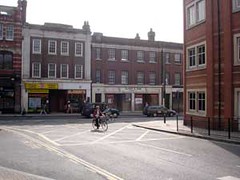
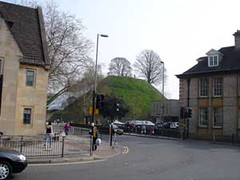
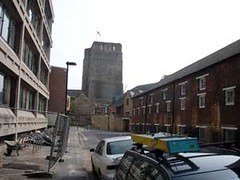
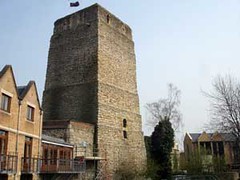
Having consulted two maps (one a Google map, the other David Loggan’s map of 1675), I finally planned a new route for my ‘walking work’ which is as follows:

Gloucester Green
Chain Alley
George Street
Worcester Street
Tidmarsh Lane
St. Thomas’ Street
Paradise Street
Castle Street
Bulwarks Lane
George Street
Gloucester Place
Gloucester Green

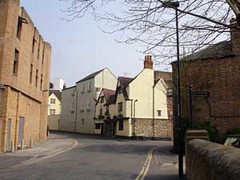
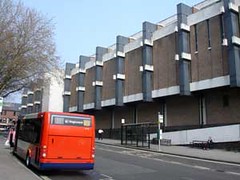
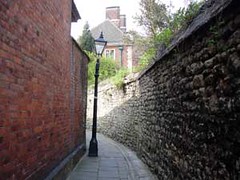
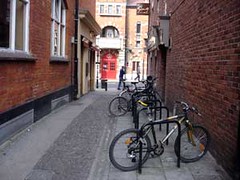
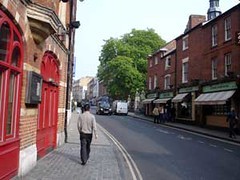
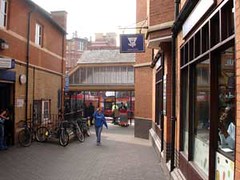
Below are some photographs of the route of the walk:

More photographs of this route can be seen on my Flickr pages. This isn’t an area I know that well – I’m not sure if I’ve ever walked the entire length of Paradise Street – and yet afterwards, when I looked at David Loggan’s map of 1675, it all seemed very familiar. I was surprised at how much was left after the upheaval of redevelopment, particularly when standing near St. George’s tower, near the junction of St. Thomas’ and Paradise Streets. Now, looking at John Gwynn’s surveys, I could make much more sense of the Oxford of 1772.

Filed Under: Artist in Residence, Lists Tagged With: Artist in Residence, Listmaking, Lists, Residue, Walks

Day 7

April 12, 2007 by Nicholas Hedges

I decided to do a walk today, one which I would record in single words or very short phrases. I am interested in how we relate to single words and phrases when trying to picture a past experience, particularly of someone else. The following passage from Neil Hanson’s book, ‘The Unknown Soldier,’ gives a very distinct and accurate picture of a scene one of the millions of soldiers witnessed:

“Decayed sandbags, new sandbags, boards, dropped ammunition, empty tins, corrugated iron, a smell of boots and stagnant water and burnt powder and oil and men, the occasional bang of a rifle and the click of a bolt, the occasional crack of a bullet coming over, or the wailing diminuendo of a ricochet. And over everything, the larks… and on the other side, nothing but a mud wall, with a few dandelions against the sky, until you look over the top or through a periscope and then you see the barbed wire and more barbed wire, and then fields with larks in them, and then barbed wire again.”

The simple use of words makes this passage very stark and easy to imagine. We can see it because in our own minds we can easily conjure objects such as sandbags, boards, empty tins and smells such as old boots and stagnant water. My walk around Oxford would therefore be described as a list of words.

The route was as follows:

Gloucester Green
Gloucester Place
George Street
Bulwarks Alley
New Road
Queen Street
St. Ebbe’s
Brewer Street
St. Aldates
Christ Church
Merton Grove
Deadman’s Walk
Rose Lane
High Street
Merton Street
Magpie Lane
High Street
Catte Street
Broad Street
Magdalen Street
Beaumont Street
Worcester Street
George Street
Chain Alley
Gloucester Green
In total the walk was around 4,300 steps and I wrote 631 words, some of which are listed below:
luminous jacket
suitcase
maps
market
bicycles
litter bin
jackets
mirror
coke can
boots
bicycles
taxis
sunshine – dappled
popcorn (smell)
cigarette smoked
sapling
buses
signs
“…do you remember…”
crutches
blue doors
letter box
chewing gum
‘topiaried’ trees
restaurants
cobbles
gutter
spire
bicycle
crunching wheels
cigarette butts
litter
broken glass
telephone
smell of rubbish
yellow lines
drain
graffiti
lampost
cobbles
stone wall
napkin
window
manhole cover
overhanging shrubs
green door
letter box
railings
fence panels
steps
man drinking
mound
sunshine
shadows
pedestrian zone
red telephone box
scaffolding
exhausts
litter bin
bus stop
taxi rank
colours
pinks, reds, blacks
flags
souvenirs
eating

and so on…

On returning the studio, I wrote up all 631 words on a long piece of paper stuck on the wall

What I was struck by, was how they reminded me of the names carved into the walls of the Menin Gate; column after column of words which at first meant nothing, but all of which had their own unique reference. I decided to create a virtual wall of these words which gave them a very different quality:

I had thought of writing all the words as in the extract above, in a prose form, i.e. something like: “a man wears a luminous jacket, another pulls a suitcase. There’s a machine for maps and the market is on. Bicycles are propped against the wall. Nearby is a litter bin…” Adding words however makes it less authentic, and writing them in this style at the time would be far too time consuming. What is interesting however, is how the mind knits the single words together and in a way the prose form is that process – the mind fills in the blanks.

luminous jacket
suitcase
maps
market
bicycles
litter bin
becomes…

“a man wears a luminous jacket, another pulls a suitcase. There’s a machine for maps and the market is on. Bicycles are propped against the wall. Nearby is a litter bin…”
I refer to a previous entry, Reading and Experience in which I quote the following extract from Filip Muller’s, ‘Eyewitness Auschwitz – Three Years in the Gas Chambers.’

“There was utter silence, broken only by the twitterings of the swallows darting back and forth.”

As I wrote: we were not there in Auschwitz at the moment this line describes (the moment before the doomed prisoner speaks up against the camp’s brutal regime), yet we all know silence and have seen and heard swallows. So although we were not there to witness at first hand this terrible event, we can imagine a silence, a particular one we might have felt some place before, and picture a time we saw a swallow fly. We can use fragments of evidence (photographs, documentary footage) to construct a fuller picture, and fill in the gaps with fragments of own experience. When we speak the words of others therefore, those words will form pictures in our own minds drawn from our own experience.
Taking the list above and adding words to turn it into prose, is in a way similar to this filling in the gaps. In this respect, it is worth doing.

I also tried to draw memories of the walk, taking individual words and drawing the corresponding image. It has always interested me, exactly what we see when we remember something. If we could print out a memory, what would it look like? Certainly what we remember is an approximation of what we actually saw, and again, we use words to ‘join the dots’, to fill in the gaps.
I am reminded again of what I read on Memory places:

“It is better to form one’s memory loci in a deserted and solitary place, for crowds of passing people tend to weaken the impression. Therefore the student intent on acquiring a sharp and well defined set of loci will choose one unfrequented building in which to memorise places…”

The image this passage conjures is of a deserted building, one which has seen better days and is perhaps in need of restoration, a shell which needs some gaps filled.

Filed Under: Artist in Residence, Lists Tagged With: Artist in Residence, Everydayness, Fragments, Listmaking, Lists, Memorials, Memory, Oxford, Residue, Silence

Day 6

April 11, 2007 by Nicholas Hedges

Another good day on which I completed the deckchairs (below).

Filed Under: Artist in Residence Tagged With: Artist in Residence, Deckchairs, Residue

Day 5

April 10, 2007 by Nicholas Hedges

A good day’s work today. I added graphite powder to the deckchairs and having done one I realised I’d have to rethink how I was going to display them; the graphite had given the canvas of the deckchair a metallic look, making it appear like the remnant of a battlefield which I liked very much. I’ve always thought that an empty chair is never completely empty, that it somehow contains the presence of a person, and with all three painted, they also collectively took on the appearance of the dead and wounded of the Front.

I’m now thinking of getting three more after my girlfriend considered them – when they were white (as above) – to be like the white gravestones of a military cemetery. I think the contrast between the two sets would be very interesting. There is also something of a shadow about the graphite deckchairs, which ties in nicely with what I wrote yesterday. These shadows are collapsing to the ground, recumbent; dead.

Filed Under: Artist in Residence Tagged With: Artist in Residence, Deckchairs, Residue

Shadows 1

April 9, 2007 by Nicholas Hedges

I’ve lately been reading ‘A Short History of the Shadow’ by Victor I. Stoichita which begins by explaining how the art of painting and sculpture first came into being (at least in the minds of men like Pliny and Athenagoras, before the cave painters of Lascaux, for example, were discovered) through the tracing of shadows. In his Natural History (xxxv, 43) Pliny says:

“Enough and more than enough has now been said about painting. It may be suitable to append to these remarks something about the plastic art. It was through the service of that same earth that modelling portraits from clay was first invented by Butades, a potter of Sicyon, at Corinth. He did this owing to his daughter, who was in love with a young man; and she, when he was going abroad, drew in outline on the wall the shadow of his face thrown by the lamp. Her father pressed clay on this and made a relief, which he hardened by exposure to fire with the rest of his pottery; and it is said that this likeness was preserved in the Shrine of the Nymphs…”

Athenagoras recounts the same story as follows:

“The manufacture of dolls was inspired by a young woman: very much enamoured of a man, she drew his shadow on the wall as he slept; then her father, charmed by the extraordinary likeness – he worked with clay – sculpted the image by filling the contours with earth.”

As Stoichita writes: “What is fairly apparent from both texts is that the primary purpose of basing a representation on the shadow was possibly that of turning it into a mnemonic aid; of making the absent become present. In this case the shadow’s resemblance (similitudo) to the original plays a crucial role… The constantly changing real shadow of the beloved man will escort him on his travels, while the image of his shadow, captured on the wall, will remain a memento opposed to the movement of the journey and will therefore have a propitiatory value. The real shadow accompanies the one who is leaving, while his outline, captured once and for all on the wall immortalizes a presence in the form of an image, captures an instant and makes it last.”

The verticalizing of the shadow – the projection of it onto a wall – and its likeness to the person from whom its being projected are both, according to Stoichita, “vital functions of this surrogate image… The lapidary details pertaining to the mechanism of verticalization are extremely important, since Pliny would certainly have been aware – as more than one passage from his work indicates – of a whole early metaphysics on the shadow (particularly on the shadow recumbent on the earth) and of its links with death. On close examination the text reveals its hidden meaning: on the eve of her beloved’s departure, Butades’ daughter ‘captured’, so to speak, the image of her lover in a verticality meant to last forever. Thus she exorcised the threat of death, and his image – making up for his absence – kept him forever upright, i.e. ‘alive’.”

Returning for a moment to the story of the lovers, Stoichita argues that this story appears incomplete, “Pliny has eliminated an important episode located somewhere between the young woman creating the silhouette and the final likeness being installed in the temple. This episode, without which the meaning of the extract is greatly diminished, is the death of the beloved.” Stoichita goes on to suggest that the story should actually read as follows:

1) The girl crates a surrogate image, which has a dual purpose: it must remind her of the face of the lover who is leaving (to go to war) and must exorcise the danger he is in.
2) The young man dies (probably heroically, probably on the battlefield).
3) (Because the beloved dies) the father creates a semblance whose function is to duplicate the one who has disappeared. This double has a ‘soul’ (in the form of a shadow) and a ‘body’ (in the form of the receptacle of this soul).
4) The clay semblance becomes a cult object in the temple at Corinth.

This semblance made by the girl’s father becomes therefore a funereal figure, an object “which ensures the young warrior – who, in the prime of life, falls on the battlefield – everlasting glory by immortalizing what he was in the eyes of subsequent generations: his name, his exploits, his career, the heroic end that establishes him once and for all as a man of excellence, one of the noble dead.”

I found this version of the story particularly interesting, as it ties in with the work I’ve been doing on World War I, during which of course millions of men left loved their ones, never to return. One can imagine each of their shadows drawn in outlines on wall right across the world, merging to become a single amorphous shadow blanketing the ground.

Stoichita also makes an interesting distinction between shadows cast in the day and at night. “Once the image is captured on the wall, time stands still… a shadow in sunlight denotes a moment in time and no more than that, but a nocturnal shadow is removed from the natural order of time, it halts the flow of progress.”

Filed Under: Artist in Residence Tagged With: Artist in Residence, Natural History, Residue, Shadows, Stoichita

Postcard 1906

April 7, 2007 by Nicholas Hedges

This morning I received a postcard which I’d purchased on eBay; an early twentieth century hand-tinted photograph of Magdalen Tower postmarked on the reverse Oxford 1906.

The text on the rear of the postcard reads as follows:

“My Dear Boy I am sorry that I will not manage to see you on my visit to Coombe. I go to Wallingford on the 13. Will visit when I get settled then you must come over, much love and blessing, your loving brother…”

It’s amazing as one reads this card, to think that it was posted over 100 years ago. Combe (the version written on the postcard – Combe – is actually a misspelling) is a village near Woodstock and a place where my Mum and Step-Dad once lived, and as I read it, I’m reminded of their cottage and the many memories associated with it. Secondly, at the end, the author signs off as ‘your loving brother’ and so, as I read the words in my own voice, I’m reminded of my own brother. In a text of just a few lines written 101 years ago, I have an image – or rather images – of my own family and a house from my own past. I imagine too the bond between the two brothers as being the same which exists between me and mine and as such I have an interest in their lives – lives which have almost certainly been over for several decades. Yet, although the author of this card is certainly dead, by reading his words, we somehow give him life, albeit for the time it takes to read the message. And in some ways, this message might be likened to the last words of a man killed in war, whose last letter reaches his loved ones after news of his death had already been received.

The fact the postcard features an image of Magdalen Tower, serves to strengthen this feeling of familiarity. The man who wrote the postcard, and his brother who received it, no doubt knew it well, just as I do now. It becomes – as indeed does the postcard as an object in its own right – a memory space, a “‘starting point’, and a place for the ‘purpose of recollecting'”. Reading these words, I am sharing the ‘space ‘ of the postcard as an object, as well as a recollection of the scene it shows, Magdalen Tower.

In his book, Camera Lucida, Roland Barthes says regarding photographs:

“From a real body, which was there, proceed radiations which ultimately touch me, who am here; the duration of the transmission is insignificant; the photograph of the missing being as Sontag says, will touch me like the delayed rays of a star. A sort of umbilical cord links the body of the photographed thing to my gaze – light though impalpable, is here a carnal medium, a skin I share with anyone who has been photographed.”

This quote precisely describes a memory space. “‘From a real body [the author of the postcard], which [who] was there [in 1906], proceed radiations which ultimately touch me, who am here [in 2007]; the duration of the transmission [101 years] is insignificant; the photograph of the missing being [the author] as Sontag says, will touch me like the delayed rays of a star. A sort of umbilical cord links the body of the photographed thing [or the author of the postcard] to my gaze – light though impalpable, is here a carnal medium, a skin [a memory space] I share with anyone who has been photographed [or seen the thing I’m seeing].”

Filed Under: Oxford Tagged With: Barthes, Magdalen Tower, Oxford, Postcards, Susan Sontag

Day 4

April 7, 2007 by Nicholas Hedges

Finally finished priming the deckchairs and coated them with a layer of white oil paint. I will definitely display them as they appear in the photo below, i.e. flat on the ground (not white) as this gives them each the look of a tomb stone, such as one might find in the floor of a church.

I’ve also decided on a title: ‘The smell of an English Summer (fresh cut grass) 1916’. This relates directly to the extract from Neil Hanson’s book, ‘The Unknown Soldier,’ which I quoted in the previous entry ‘Reading and Experience.’

Filed Under: Artist in Residence Tagged With: Artist in Residence, Deckchairs, Neil Hanson, Residue

Reading and Experience

April 6, 2007 by Nicholas Hedges

“Decayed sandbags, new sandbags, boards, dropped ammunition, empty tins, corrugated iron…”

These words are those of a German soldier – written at the Front just before the Battle of the Somme – and form just a small part of an extract in Neil Hanson’s book, ‘The Unknown Soldier.’ Instantly I read them, they called to mind the remnants dredged from the battlefield which I’d seen in the museum at Hill 62 in Ieper.

On their own, these artefacts are powerful – yet mute – witnesses to the Great War, but when reading a soldier write about them, even listing them as above, they change. They each regain their voice – their signifier, and re-emerge from the shadows.

In my painting ‘Auschwitz-Birkenau Remembered‘ I cut words up into individual letters and scattered them onto the painting, I also wrote directly into the paint itself to show how words failed to articulate the horror of such a place (the written words could barely be read). Another way of looking at this however, is to say that words are able to speak of such horror, but have simply lost their original voice. It then falls to us to speak the words for those who are no longer able to do so, to put them back together.

Subsequent to this, I’ve been thinking about the process of reading, for example an extract from Filip Muller’s powerful testimony, ‘Eyewitness Auschwitz – Three Years in the Gas Chambers,’ in which he describes the horrific murder of a fellow prisoner.

“There was utter silence, broken only by the twitterings of the swallows darting back and forth.”

We were not there in Auschwitz at the moment this line describes (the moment before the doomed prisoner speaks up against the camp’s brutal regime), yet we all know silence and have seen and heard swallows. So although we were not there to witness at first hand this terrible event, we can imagine a silence, a particular one we might have felt some place before, and picture a time we saw a swallow fly. We can use fragments of evidence (photographs, documentary footage) to construct a fuller picture, and fill in the gaps with fragments of own experience. When we speak the words of others therefore, those words will form pictures in our own minds drawn from our own experience.

“As the torrents of machine-gun bullets ripped through the grassy slopes up which the British troops were advancing, the smell of an English summer – fresh cut grass – filled the air. For thousands it would be the last scent they would ever smell.”

This extract, also from Neil Hanson’s book, ‘The Unknown Soldier,’ presents us with an image of slaughter, made all the more terrible (if that were possible) with a reference to the smell of cut grass – one of those smells which invokes in most of us, memories of lazy summer’s days. The two are, obviously, utterly incongruous, yet it somehow makes our task of imagining the horror a little easier. We know the smell of cut grass, and waves of associations and memories are no doubt triggered by the aroma. In the days before the battle, when the soldiers doomed to die waited for the day, they too might have smelled the grassy air and found their way back to times when things were better. It is again the contrast – something which I’ve described before in relation to my visits to Auschwitz-Birkenau and Ieper which makes this passage so heart-breaking.

Finally, I wrote earlier (Imagination and Memory) of how as a child I created a world, made up of fragments of landscapes which I loved, and how as I grew older, I created worlds that were ‘real’ – visions of Oxford as it might have looked centuries earlier. Just as when reading the quote above, I would – as I still do – use documentary evidence to start – images (photographs and drawings) of how the city looked, contemporary writings (such as those of Anthony Wood) – and then fill in the gaps using my own direct experience, in effect, the city as it looks today.

Filed Under: Holocaust Tagged With: Auschwitz, Filip Muller, Fragments, Landscape, Neil Hanson, Silence, World War I, WWI, Ypres

The Unknown Soldier

April 6, 2007 by Nicholas Hedges

Extract from Neil Hanson’s book, ‘The Unknown Soldier,’ concerning the infamous Battle of the Somme.

‘The next day, the regiment began the long march to the Front. In the heat of early summer, nature had made attempts to reclaim the violated ground and a deceptive air of somnolence lay on the landscape. “The fields over which the scythe has not passed for years are a mass of wild flowers. They bathe the trenches in a hot stream of scent,” “smelling to heaven like incense in the sun.” “Brimstone butterflies and chalk-blues flutter above the dugouts and settle on the green ooze of the shell holes.” “Then a bare field strewn with barbed wire, rusted to a sort of Titian red – out of which a hare came just now and sat up with fear in his eyes and the sun shining red through his ears. Then the trench… piled earth with groundsel and great flaming dandelions and chickweed and pimpernels running riot over it. Decayed sandbags, new sandbags, boards, dropped ammunition, empty tins, corrugated iron, a smell of boots and stagnant water and burnt powder and oil and men, the occasional bang of a rifle and the click of a bolt, the occasional crack of a bullet coming over, or the wailing diminuendo of a ricochet. And over everything, the larks… and on the other side, nothing but a mud wall, with a few dandelions against the sky, until you look over the top or through a periscope and then you see the barbed wire and more barbed wire, and then fields with larks in them, and then barbed wire again.”

As the torrents of machine-gun bullets ripped through the grassy slopes up which the British troops were advancing, the smell of an English summer – fresh cut grass – filled the air. For thousands it would be the last scent they would ever smell.’

Filed Under: World War I Tagged With: Neil Hanson, Soldiers, The Somme, World War I, WWI

Imagination and Memory

April 6, 2007 by Nicholas Hedges

Like many others, my imagination has played a central role in my life ever since I was a young boy, and recently, in connection with my recent work, I’ve been thinking about that role and how it has changed as I’ve grown up. As a child, I lived much of my life within imagined worlds; fictional countries which I would map and for which I would create entire histories. I would inhabit these places, hidden from everyone else, and while I walked, I would be walking not in the real world, but in my mind. I can still to this day remember one particular map in all its detail; the mountain ranges, the plains, the forests which were always a particular favourite of mine. I can even list the names of the towns and cities (Aquidos, Anasrehlon, Varimeere), yet while this ‘place’ has remained unchanged, whilst my imagination as a place is only a little different (one might say that the country I created was a map of my mind) the uses made of my imagination have altered. As a child I imagined the imagined, as an adult I imagine reality, and often the unimaginable.

Going back to my childhood, my imagination provided me with a means of escape (not that I needed to escape anywhere – I was fortunate enough to have the perfect upbringing). I’d always wanted to see the world unspoilt, an Arcadian vision without cars, planes, pollution, machines or any trace of the modern. And in a sense, this is I believe, what first fired my interest in the past. As a child and well into my teens – and perhaps early twenties – my interest in history ended at the late 17th century, certainly well before the Industrial Revolution, when the modern world began to develop and my vision of a rural Arcadia began to collapse. In some ways, my imagined world was a pick of the best bits of the (somewhat idealised) past; the ancient sprawling forests, beautiful timber-framed houses. When I looked at an old pair of 16th century shoes, a bottle from a 17th century tavern, I was picturing their place in a comparatively unspoiled landscape.

Of course, as a child, my impressions of the past were, as I said, somewhat idealised; they were little more than romantic impressions of an untamed idyll. In reality of course, the past, at least on a human level was, I came to understand, far from romantic; life was short, harsh and often brutal. So as I grew older, and while I still used my imagination to find my way back into the past, I didn’t imagine the imagined, but rather, as I said earlier, the unimaginable: the reality of the lives of others.

In recent years, this change in emphasis has seen the boundaries of my interest in history widen to include the twentieth century; in particular the unimaginable horrors of the Holocaust and the slaughter of World War One. Yet although these very difficult subjects are far removed from the invented landscapes of my childhood, my memories of maps and the stories created within them, provide an interesting, and I believe vital counterpoint to my understanding of such subjects. One of the problems with studying the Holocaust (and indeed World War One) is not only the sheer scale of the suffering, but also the fact that often the victims of both are, in the eyes of history, just that: victims. To say otherwise, i.e. to say that they weren’t only victims, is not to take away from the terrible suffering they endured, but rather to emphasise it, to focus our minds; they weren’t only victims, they were people with lives both behind them and ahead of them; pasts that for many were happy. They all had childhoods, and perhaps imagined their own fantasy worlds. Many, caught up in the Holocaust, were still inhabiting them – they were still of course, children.

As I’ve said, as a child, I would walk and imagine myself in my invented landscape, but as I grew older, although I still walked and imagined myself elsewhere, it wasn’t within an invented world that I walked, but rather a real world; that of my home town, Oxford’s past. Of course one might argue that this past was a much a fabrication as the map I drew as a child, but nevertheless, it was constructed from fragments of the past – drawings, paintings, descriptions in books, photographs. I could never know for sure what things looked like, or how it must have been to walk through the city’s streets (for example during the 14th century) but my imagination did its best to conjure a picture. Of course, as well as those things listed above, there are parts of the city which are contemporary with the past and these buildings and streets are particularly important when looking for that which has long since gone; just as I have found in Auschwitz-Birkenau and Ieper.

One man who did so much to capture Oxford before much of its past was demolished in the late 18th century was a German artist and musician called John Malchair. His drawings are amongst the most beautiful and indeed haunting images of a city I have seen, particularly his views of Friar Bacon’s study, an unusual edifice which was sadly demolished in 1779.

One particularly poignant drawing (below) shows the remaining arch, when all above it has been taken down.

In my mind, as I walk, I suppose one might say I am often trying to rebuild Friar Bacon’s Study. Walking as a means of remembering then is important to me although it does throw up interesting philosophical questions (which I’ve touched on before) namely, what is it we are remembering when we ‘remember’ events which we ourselves have not experienced. As Paul Ricoeur asks in his book, ‘Memory, History, Forgetting,’ ‘Of what are there memories? Whose memory is it?’.

The invented world I ‘walked in’ as a child was a fiction, an amalgam of all the fragments of an unspoiled landscape which I could see in parts around me. And, in a sense, when ‘remembering’ the past of Malchair’s Oxford, the Great War and the Holocaust, I am creating a fiction of sorts – a world created from fragments; photographs, drawings, letters and documentary evidence. The past becomes my imaginary world.

So what is it which separates the past and my past imaginary landscapes? It is this: it is the theme of this residency; Residue.

Filed Under: Artist in Residence Tagged With: 18th Century, Artist in Residence, Holocaust, Imagined Landscapes, John Malchair, Memory, Paul Ricoeur, Residue, WWII, Ypres

Day 3

April 5, 2007 by Nicholas Hedges

Spent much of the day – in fact all day – priming the three deckchairs which I’ve now almost finished; just one more coat on the canvas should be enough.


I like the positioning of these, although I will stick to my original idea of having them fixed to the wall. Maybe I need to buy three more so that I can play around with the idea of placement a bit more.

I also bought a 25 metre roll of white cartridge paper on which to do some drawings based on memory, just as I did with Auschwitz-Birkenau. I’m thinking of doing something based on a ‘tour’ of Oxford, somehow using the measurements of John Gwynn’s survey. With such a large space to work in, it seems a shame not to use the full length of the wall in some way.

Filed Under: Artist in Residence Tagged With: Artist in Residence, Deckchairs, Residue

Day 2

April 4, 2007 by Nicholas Hedges

With the help of my brother, I managed to get some of my stuff down to OVADA and began to prime the three red deckchairs. By the end of the day, I’d managed to get most of the frames done but the canvas itself is quite cheap, and the gesso not so easily applied. It maybe that I have to buy some proper canvas and use that instead but I shall see how I get on tomorrow.

As well as working inside the studio, I wandered around the market in Gloucester Green and took a few photos.

And some when the market began to close…

I also recorded around 10 minutes of sound; the shouts of the vendors, fragments of conversations etc.

MP3 of market sounds

Filed Under: Artist in Residence Tagged With: Artist in Residence, Deckchairs, Residue, Walk

Walking and Measuring

April 4, 2007 by Nicholas Hedges

A few years ago, I did some research into the 1771 Mileways Act which saw a range of ‘improvements’ made to Oxford; improvements which, unfortunately, resulted in the demolition of some of the city’s more interesting mediaeval buildings; the North and East gates, the Bocardo Gaol and Friar Bacon’s study on Folly Bridge. The streets were also repaved, and to pay for this, each resident paid according to the yardage of their property. John Gwynn, an architect who designed the Covered Market and the new Magdalen Bridge, therefore undertook a survey, in which all the frontages of all properties on the city’s streets were measured. Seeing him with his measure, residents at the time thought the worse – that he was measuring up properties so that they would be demolished; given the spate of demolitions at the time it was perhaps hardly surprising. I’ve since imagined Gwynn therefore as some kind of undertaker, measuring up the city for its doom, and image which fits nicely with my work on Broken Hayes.

The list of measurements is very interesting as it presents us with a window onto a world which has now almost disappeared; certainly those who inhabited the town (Mrs. Barret of Magpie Lane, Mr. Hedges of Broken Hayes, Mr. Badger of Fish Street) have all gone and left only their names and the size of their ghostly dwellings. But the layout of the streets (if not the buildings and their inhabitants) still remain, and so, by walking these streets, armed with a residual list of measurements, one can walk back in time and make a connection with this vanished population.

This correlation between time and distance had initially come through my thinking of how difficult it often is, to identify with people who live abroad in war-zones (Iraq and Afghanistan for example), for, even though these countries are only a comparatively short distance away, they might as well be years in the past, for it’s almost as difficult to relate to those who live (and die) there, as it is to those who lived and died, for example, during the first and second world wars, or the time of John Gwynn.

Filed Under: Uncategorized Tagged With: Family Hedges, Hedges, John Gwynne, Mileways Act, Mileways Act 1771, Susan Sontag

Day 1

April 3, 2007 by Nicholas Hedges

I’ve always thought there something about this place (Gloucester Green) which separates it from the rest of the city. Despite the extensive redevelopment carried out in the 1980s, it still retains something of that place which Anthony Wood described in the 17th century as ‘rude, broken and undigested.’ I’m not sure what it is exactly, but I was surprised, as I walked around, at just how empty it was. I have to say, I doubt as to whether there’ll be much of a contrast – in terms of numbers of people – between Gloucester Green at night and during the day. However, tomorrow is market day, and so perhaps with the the extra numbers, I might find some kind of contrast there.

Filed Under: Artist in Residence Tagged With: Artist in Residence, Gloucester Green, Oxford, Residue

Words

April 3, 2007 by Nicholas Hedges

Emptiness
Trauma
Silence
Contrast
Memory
Solitariness
Residue
Postcards
Deckchairs
Forgetting
Objects
Home
Journeys
Walking
Measurements
Space
Past

Filed Under: Uncategorized Tagged With: Silence, Text Work

Two Minutes Silence

April 2, 2007 by Nicholas Hedges

Every year, at the 11th hour, on the 11th day of the 11th month, we pause for two minutes and remember all those who died in two world wars and subsequent conflicts. We stand still and in silence, a tradition which, one hopes, will always be respected. Over the last few days, having written about the nature of silence in those places which have witnessed appalling human suffering, I’ve been thinking more about this tradition of silence – not so as to question it (as I’ve said, it is a tradition which must always be recognised and respected) but rather its process; what we think about when we stop and are quiet; what it is we are doing when we remember?

The silence temporarily turns the street, the office or wherever it is we’re standing into a different place; it creates a contrast, against which we might compare our normal everyday environment – that from which we step for two minutes to then rejoin at its end. This act of rejoining is, I believe, as important as the stopping and the silence, for as simple as it is, it’s nevertheless something which millions were unable to do, whether through disability or simply because they never came home at all.

Filed Under: World War I Tagged With: Memorials, Memory, Remembrance, Silence, World War I, WWI

Walking

April 2, 2007 by Nicholas Hedges

As part of my continuing work on sites of the Holocaust, I have been investigating Belzec death camp which I will be visiting next month. Even with a place as large as Auschwitz-Birkenau, it’s hard to equate its size with the number of people killed there (1.1 million). Yet this appalling correlation of camp size to victims, is perhaps at its most disturbing in Belzec, where in a space of less than 300 metres by 300 metres, approximately 600,000 people perished. Death on this scale, on the open fields of battle is hard enough to imagine, yet it somehow seems all the more sickening in a place the size of Belzec (and one designed for the purpose). In order to ascertain just how big (or rather small) 300m x 300m is, I bought a pedometer and looked for somewhere in Oxford which might, more or less, equate with these dimensions. The closest I got to those dimensions was in Christ Church Meadow, which if anything was bigger. As I’ve already documented my continuing investigations on this subject I won’t add any more here, but I would like to explore further the idea of using the memory of a place to understand the wider past; something which I touched on in Postcards.

During my walks, I found myself recalling a raft of memories from my own past, triggered by the sites I saw as I travelled. Even a short walk around Christ Church Meadow (the length of which, in terms of time, was itself indicative of the horror and magnitude of the suffering at Belzec) opened the floodgates, not only for my own memories to pour through, but those of the city itself . Here I was, an individual with my own recollections, walking amongst the hundreds of thousands of memories of people long since dead from which the city is inevitably constructed – an interesting metaphor for the individual swallowed by the world stage; swallowed by the violence war.

As I have already written, but something it’s worth stating again, the Italian author Italo Calvino discusses memory and its relationship to a place in his book Invisible Cities. The city he says, consists of:

“…relationships between the measurements of its space and the events of its past; the height of a lamppost and the distance from the ground of a hanged usurper’s swaying feet; the line strung from the lamppost to the railing opposite and the festoons that decorate the course of the queen’s nuptial procession; the height of that railing and the leap of the adulterer who climbed over it at dawn; the tilt of a guttering and a cat’s progress along it as he slips into the same window; the firing range of a gunboat which has suddenly appeared beyond the cape and the bomb that destroys the guttering; the rips in the fish net and the three old men seated on the dock mending nets and telling each other for the hundredth time the story of the gunboat of the usurper, who some say was the queen’s illegitimate son, abandoned in his swaddling clothes there on the dock…”

Could it also be said, that there is a relationship between the measurement of spaces within the city and the events of the past elsewhere?

Filed Under: Oxford Tagged With: Auschwitz, Belzec, Christ Church, Holocaust, Invisible Cities, Italo Calvino, Oxford, Postcards, WWII

Postcards

April 2, 2007 by Nicholas Hedges

I was thinking (given the theme of Residue) about the residues of war, and listed the following sorts of things one might expect to find in the wake of conflict: objects dredged from the battlefield, pieces of shrapnel, bullet casings, shell casings, shoes, photographs, letters, memoirs, bones, clothes, luggage, memories (sights, sounds, smells)… and as I wrote, I thought how important the idea of ‘home’ was, and what a dreadful contrast it must have been to the realities of the often appalling predicaments of those caught up in conflict, whether soldiers or civilians.

Reading various books about World War One, it’s been interesting (and indeed heart-breaking) to read extracts from soldiers’ letters and postcards sent from the trenches, and to read about the packages they received in turn from home. How difficult (as well as comforting) it must have been for them to receive these little pieces of home as they suffered in such unimaginable conditions, and how terrible for parents and relatives to receive the postcards and letters from a loved one after news of their death.
Given that I am exploring the theme of contrast (particularly with regards to the silence of a place following a traumatic event) I thought this was an interesting ‘contrast’ to explore, particularly as Gloucester Green is a place where people are in transit, perhaps travelling away from home.

To change the subject slightly for a moment, one way of identifying with people and events so long ago – for example the Great War – is by identifying with a place (with which we are particularly familiar) as it was at the time, i.e. 1914. I have for a long time been interested in the idea of memory spaces (spaces within the memory of someone either dead or living) and how by accessing these spaces we might gain access to their contemporary thoughts. Under ‘Objects‘ on this site I have written:

“These objects, each through their own unique provenance, allow us, if we use our imaginations, to glimpse people from the pages of history; they, along with tens of thousands of others, once held a place in the minds and memories of men and women long since dead. Now we hold these objects within our minds and memories and as such share a place, a single, common space with those who have long since vanished from the world. To read about the past and those people who made it is one thing, to share this common space with them through the power of objects is quite another.

Objects can be those found in a museum, or buildings contemporary with the time you wish to explore within your imagination; in the case of the Great and the Second World War, it is most of the city (Oxford) as it stands today. As I have already written (on Objects), Aristotle says in relation to systems of memory:

“We should also seek to recover an order of events or impressions which will lead us to the object of our search, for the movements of recollection follow the same order as the original events; and the things that are easiest to remember are those which have an order, like mathematical propositions. But we need a starting-point from which to initiate the effort of recollection.”

This starting point could be anything contemporary with the time we wish to explore. In respect of the Great War, there is a photograph showing men marching to war over Magdalen Bridge and past the Jubilee Fountain which stands near what is now The Plain roundabout. These men are as anonymous to us now, ‘living’ in this photograph, as they are dead, yet the landmarks past which they march are still in existence. That same fountain occupied a place in each of their minds, and so by choosing this as our starting point we might find our way into their thoughts by placing ourselves in their position.

“For remembering really depends upon the potential existence of the stimulating cause… But he must seize hold of the starting point. For this reason some use places for the purpose of recollecting.”

The fountain, in this example, is therefore our ‘stimulating cause’, our ‘starting point’, a place for the ‘purpose of recollecting’. We share in effect a common space with those men who are marching in the photograph and as such we have a starting point from which to ‘initiate the effort of recollection’.
Whilst looking for old prewar photographs of Oxford, I happened upon some old postcards and thought at once how these objects were the perfect metaphor or symbol for our being away from home; a small sliver of our journey away. What we choose to write on the back is largely inconsequential, what is important, is that we have written, that we are remembering those back home.
As I wrote above:

“…how important the idea of ‘home’ was, and what a dreadful contrast it must have been to the realities of their often appalling predicaments.”

Home is an ever-present contrast to that place in which we find ourselves, whenever we travel or make a journey, no matter how long or short, and postcards (now perhaps superseded by texts and emails) are a means by which we remember where it is we come from, by which we close that gap.

Filed Under: Artist in Residence Tagged With: Artist in Residence, Magdalen Bridge, Objects, Oxford, Residue, Silence, World War I, WWI

Silence

March 30, 2007 by Nicholas Hedges

It was after reading a poem by Edmund Blunden that I started to think much more about silence as a space in which to remember. In ‘1916 seen from 1921,’ we get a glimpse of what it was like for Blunden, for a survivor of the Great War, as he looks back at the horrors of the conflict and ahead towards the future.

“…Those ruined houses seared themselves in me,
Passionate I look for their dumb story still,
And the charred stub outspeaks the living tree…”

In my previous entry, ‘Night and Day’ I touched on emptiness as a means by which we (or a place) might best remember an event or events:

“It is better to form one’s memory loci in a deserted and solitary place, for crowds of passing people tend to weaken the impression…”

Emptiness equates of course with silence, and, particularly in the case of the war, and all proceeding wars, silence is the means by which we collectively remember those who lost their lives. It is only now, having visited Auschwitz-Birkenau and Ieper, that I see the two minutes silence as a metaphor for the holes left by those who died; holes made by the absence of sound, the absence of voices. It is not only our voices which are stopped as we remember, but rather those of the dead.

Filed Under: Poetry Tagged With: Auschwitz, Edmund Blunden, Emptiness, Poetry, Quotes, Silence, Useful Quotes, War Poets, World War I, WWI

  • « Previous Page
  • 1
  • …
  • 28
  • 29
  • 30
  • 31
  • 32
  • Next Page »
  • The ‘Now of Then’
  • Artist’s Statement
  • Designs for an Heirloom
  • Dissonance and rhyme
  • Wildflowers
  • Emptiness
  • Wave (goodbye)
  • Now In The Past Of An Unreal Place
  • Return to Graphite
  • Genius
  • Latest Backdrops
  • Extended Backdrops
  • Backdrops
  • Komorebi
  • Acorns
  • Scroll Work
  • Goethean Observation: Japanese Scroll
  • Mistakes
  • The Leaf Is Singing Still
  • Past Present
  • Scrolls
  • As Yet Untitled
  • Holes
  • Scroll
  • A Calligraphy of Shadows
  • More Paintings
  • Latest Paintings
  • Walking Meditation 2
  • Knowing We Are There
  • Venice by Moonlight 1840
  • Fragments and Additions
  • Reimagining The Past
  • Walking Meditation 1
  • Mindful Walking I
  • Grief II
  • Three New Paintings
  • Nana’s Mountain
  • Painting
  • Iridescence
  • Roman Bottle
  • Rinsho
  • Shadow Calligraphy
  • Becoming Memory
  • Fox Talbot’s Glassware
  • Goethean Observation: Diffuser II
  • Goethean Observation: Diffuser
  • A Remembrance of Things We Never Have Known
  • A Moment’s Language
  • Take Me Home
  • Arrival/Departure
  • Diffusers
  • Grief
  • Mum
  • Measuring the past
  • Disordered Time
  • Entropy
  • Wicked Magician, Fly
  • The Quanta of History
  • Empathy Forward
  • The Natural World of 978
  • The Gone Forest
  • Empathy/Exchange: 668 grams
  • Goethean Observation: Pilgrims of the Wild, 1935
  • Nazareth O
  • Several Johns and St. Thomas
  • Raspberry
  • Tokens and Shadows
  • Patterns Seeping (II)
  • ‘Missded’ 4 – Tokens
  • Patterns seeping
  • Cut Paintings
  • ‘Missded’ 4
  • Locks III
  • Locks II
  • ‘Missded’ 2 – Tokens
  • My Son’s Drawings II
  • ‘Missded’ 2
  • ‘Missded’ 3 – Tokens
  • ‘Missded’ 3
  • ‘Missded’ 1 – A Framed Token
  • Morning Has Broken
  • Tokens of absence
  • ‘Missded’ 1, stitched
  • More Little Words
  • Three Little Words
  • Spaces In Between
  • ‘Missded’ 3
  • ‘Missded’ 2
  • ‘Missded’ 1
  • Locks
  • Tracings
  • My Son’s Paintings
  • Writing Shadows
  • Samuel Borton’s Post Chaises
  • Dawid Sierakowiak
  • Pitchipoi
  • Latest Tree Drawings
  • Notebook
  • Somewhere Between Writing and Trees II
  • Somewhere Between Writing and Trees

© Nicholas Hedges 2024

  • Facebook
  • Instagram
  • Twitter
  • YouTube

Copyright © 2025 · Outreach Pro on Genesis Framework · WordPress · Log in