Nicholas Hedges

Art, Writing and Research

  • Amazon
  • Behance
  • Facebook
  • Instagram
  • Pinterest
  • YouTube
  • Art
    • Digital
    • Drawing
    • Grids
      • Correspondence
      • The Wall
      • The Tourist
    • Ink on paper
      • Shadow Calligraphy
    • Installation
      • Murder
      • Echo
    • Painting
    • Patterns
    • Mixed Media
    • Photographic installation
      • St. Giles Fair 1908
      • Cornmarket 1907
      • Headington Hill 1903
      • Queen Street 1897
    • Research/Sketches
    • Stitched Work
      • Missded 1
      • Missded 2
      • Missded 3
      • Missded 4
    • Text Work
  • Blogs
    • Family History
    • Goethean Observations
    • Grief
    • Light Slowed But Never Stilled
    • Lists
    • Present Empathy
    • Shadow Calligraphy
    • Trees
    • Time
    • Walking Meditations
  • Video
  • Photography
    • Pillars of Snow
    • Creatures
    • The Trees
    • Snow
    • St. Giles Fair 1908
    • Cornmarket 1907
    • Headington Hill 1903
    • Queen Street 1897
    • Travel
  • Illustration and Design
  • Music
  • Projects
    • Dissonance and Rhyme
    • Design for an Heirloom
    • Backdrops
    • Shadow Calligraphy
  • Exhibitions
    • A Line Drawn in Water
      • Artwork
    • A Line Drawn in Water (Blog)
    • Mine the Mountain 3
      • Artwork
    • Mine the Mountain 2
      • Artwork
      • The Wall
    • The Woods, Breathing
      • Artwork
    • Snow
      • Artwork
    • Echo
      • Artwork
    • Murder
      • Artwork
    • The Tourist
    • Dreamcatcher
    • Mine the Mountain
      • Artwork
      • The Tourist
    • M8
    • The Gate
    • Creatures
      • Artwork
    • Residue
      • Artwork
    • A visit to Auschwitz
      • Artwork
  • Me
    • Artist’s Statement

The Marquis of Hastings

September 5, 2010 by Nicholas Hedges

Prior to my residency in Australia, I’ve been researching my four-times great uncle Stephen Hedges (1811-1885) who was transported there in 1828 aboard the convict ship, the Marquis of Hastings (3). I wanted to find out more about the voyage which took 104 days between 30th June and 12th October 1828. In total, 178 convicts were transported, all of whom survived the journey, which, given the conditions in which they were kept is quite surprising. The following is a list of the men who were transported with my ancestor, with sentences of 7 years, 14 years and life.

John Birch
Thomas Smith
Charles Mason
William Smith
William Burgess
Charles Shearman
Stephen Hedges
Henry Stockwell
William Duncombe
William Edwards
Jake White
John Wright
Daniel Murrell
James Matthews
John Richardson
Joseph Dorman
Abraham Storr Junior
James Sewell
Robert Popple
James Goodey
Thomas Cherry
James Wilkinson
George Henley
David Rowland
Jas Briton
Thomas Inman
Samuel Le Count
James Unsworth
Thomas Wells
Abraham Scholfield
William Kinley
Henry Hammond Fleming
Jonathan Collis
James Dixon
Richard Grace
Matthew Green
John Mitchell
John Jones
Jonathan Knowles
William Watt
Roger Worthington
William Ford
John Marsden
Thomas Briant
John Marsh
William Finch
John Burrows
Isaac Jacobs
Thomas Booth
James Mackay
John Bywater
Michael Russell
Richard Hart
Francis Hayes
Henry Dignum
Thomas Hewitt
James Cobson
James Featherston
James Const
Steven Dace
Thomas Knight
William Longman
John Booty
William Orson
James Haines
Thomas Reynolds
John Hitchcock
William Keeven
William Baker
John Levy
William Hawkins
Robert Williams
James Herring
Michael Ryan
Bigley Hermitage
Richard Richardson
John Cavanah
Daniel McCarthy
William Allkin
George Newman
Jeremiah Crawley
Samuel Smith
Anthony Bernard
Martin Blaney
William Godfrey
John Kilminster
Thomas Floodgate
George Glover
Henry Nicholls
John Foot
Richard Jones
John Wilkie
William Mitchell
Andrew Keating
Thomas Holmes
William Cardinell
William Woodwill
James McCarthy
John Phipps
Nicholas Binken
Charles Brewhouse
James Pascoe
Thomas Willis
Joseph Griffiths
William Thompson
Thomas King
Thomas Northam
John Maxfield
Daniel Meney
Thomas Jones
John Kennedy
John McGinnis
James Moss
John Jarvis
William Reynolds
James Wiseman
Thomas Taylor
John Wade
John Jones
Philip Riches
Charles Sandy
Charles Westbury
James Pye
Thomas Burton
William Goodyer
Robert Stafford
Joseph Ockenden
William Nobes Junior
William Ockenden
William Burton
James Gumbrell
James Burraston
John Newberry
Charles Briggs
John Hockley
Offord Russ
Thomas Catley
Edward Leader
William Jones
John Smith
George Munday
Thomas Thompson
Henry Brown
Samuel Freestone
Joseph Callow
Henry Cox
Francis Barr
William Bavin
George Britton
William Jollan
Stephen Burnett
George Martin
James Millen
John Head
Martin Hall
James Bristow
Thomas Dennison
Thomas Montague
James Chambers
Edward Schofield
George Shot
James Walkins
James Binns
Joseph Smith
John Serjeantson
Thomas Winterburn
John Ledgard
William Field
George Spencer
Matthew Spencer
John Field
James Woodhead
James Lister
Joseph Quiby
Joseph Owen
Thomas Vickers
John Wild
Henry Fowler
Filed Under: A Line Drawn in Water, Artist in Residence Tagged With: A Line Drawn In Water, Emma Stevens, Family History, Stephen Hedges

Emma Stevens (1835-1873)

August 27, 2010 by Nicholas Hedges

Following on from my last blog entry, I ordered a copy of Emma Stevens’ death certificate to ascertain how she died and whether she was indeed the Emma Stevens (nee Fisher) to who I am, albeit indirectly, related. Sure enough, the death certificate showed that she was married at the time of her death to John Stevens, a tailor, who at the time was incarcerated in Moulsford Asylum, where he remained until his death in 1888. Emma’s age at death is given as 38, meaning she was actually born in 1835.

When her husband John was incarcerated in 1871, Emma and her two youngest children went to the Reading Union Workhouse. With no income coming from her husband it seems she had little choice. Two years later, on 12th August 1873, in what must have been extremely grim conditions, Emma died of cancer in the workhouse. The story of John Stevens’ epilepsy was sad enough, but through the lives of his wife and his children, we can see just how it affected the rest of the family.

The two young girls who went with their mother into the workhouse later married. Martha Stevens, who was 2 when she went in, married George Amor in 1888 and had 6 children. Her sister, Kate, who was 4 at the time she entered the workhouse, married Charles Plested in 1892. Together they had two children. Kate died in 1943 at the age of 73. Martha died 7 years later in 1950 at the age of 81.

Filed Under: Family History Tagged With: Emma Stevens, Family History, John Stevens, Moulsford Asylum, Stephen Hedges

Cornelius Squelch

August 20, 2010 by Nicholas Hedges

I’ve recently returned to my family tree and have been following up the story of my four-times-great-uncle John Stevens (1837-1888) who died in the Moulsford Asylum having suffered for many years with epilepsy. He had married Emma Fisher in 1857 and was incarcerated in the asylum in 1871. In the census for 1881, two of John and Emma’s sons (Henry and John) are listed as living with their uncle, Samuel Stevens – a tailor, whilst a daughter, Mary, is listed as living with her aunt, Rosetta Hunt. The couple’s youngest children, Martha and Kate are recorded, sadly, as being inmates at the Reading and Wokingham District school, which was in effect a workhouse.

I’ve wondered why the children had been left to such a fate? Was their mother unable to look after them? Or perhaps their relatives? Whilst looking for an answer, I discovered an Emma Stevens who died in Reading in 1873, and am assuming that this is Emma Fisher. I’ve ordered a copy of her death certificate to see, but if it is, then it marks another tragic episode in this family’s life, coming just two years after the incarceration of John in 1871.

If Emma Stevens died in 1873, aged just 36, then her two young daughters would have been just 4 and 2 respectively. Could they have entered the school/workhouse at that age? And what happened to them afterwards? Why could none of their aunts or uncles take them in? After all, there were 7 altogether. Given the conditions at the school/workhouse , it is quite hard to understand how they could have ended up there. More research is needed of course but I hope their stories are, eventually, happier ones.

As an aside, whilst looking at the list of inmates for the school/workhouse in 1881, one name stuck out above all others.The boy in question was there with his sister Emily. She was just 12 years old and he was 4 years younger. His name, like something from a children’s book was Cornelius Squelch. He has a story to tell, and I’d like to be the one to write it.

Filed Under: Family History Tagged With: Cornelius Squech, Emma Stevens, Family History, John Stevens

An Archaeology of the Moment

May 18, 2010 by Nicholas Hedges

I’m currently reading an excellent book by Colin Renfrew, Senior Fellow of the McDonald Institute for Archaeological Research, entitled ‘Figuring it Out’, in which the author examines what he describes as ‘the parallel visions of artists and archaeologists,’ with an emphasis on contemporary art practice. As an artist with a deep interest in archaeology, I had to buy the book, and I’m very glad I did, for it’s helped me pull together numerous strands of thinking which have emerged from my research over the course of the last four years; in particular, the idea of the physical or ‘sensed’ present as a lens through which to ‘see’ the past. Professor Renfrew writes: “The past reality too was made up of a complex of experiences and feelings, and it also was experienced by human beings similar in some ways to ourselves.” The way we experience the present then, tells us a great deal about how people experienced the past when it too was the present.

I’ve written before how one of the problems we have in considering past events is the temporal distance which separates us. Reading a history book, although we know its content is‘ factual’, is nonetheless an interpretation of events; an outline at best no matter how well researched and well written it is. There may be a structure, just as in a novel, with a beginning, a middle and an end. But of course reality isn’t really like that – the boundaries are much more fluid. Necessarily therefore, a history of any event will be full of holes and it’s these holes which interest me.

In October 2006, I stood on the Ramp at Auschwitz-Birkenau and my experience there is something with which I’ve been working ever since, even whilst researching different places – whether other camps such as Bełżec or the battlefields of World War One – it’s that particular moment which I have been researching, peeling back the layers comprising the moment, much as an archaeologist digs through layers of stratified soil to uncover a whole range of times.

History is, in some respects, like fiction. What is known and written about can only be surmised from surviving evidence and what we ‘see’ as receivers of that knowledge, can only be imagined. What’s always missing is a sense of the present, as if what happened in the past always followed a script, one in which the main protagonists took their cues and delivered their lines accordingly. Hindsight, which one can hardly escape, joins all the dots, but leaves many gaps between the lines.

In the foreword to Peter Weiss’ book The Aesthetics of Resistance, Frederic Jameson writes how for the critic Georges Lukács, the world historical individual should never be the novel’s main protagonist, but rather seen from afar by the average or mediocre witness. We could say the same for history; that events described in history books are ‘best’ when seen through the eyes of those ‘average’ or ‘mediocre’ witnesses; people which history labels as ‘the mob’ or the ‘masses’; who are often buried beneath unimaginable numbers – mass graves within which, their names and individual identities are forgotten.

I’ve produced numerous works which examine this idea of the anonymous individual in history, but there’s another element I try to show, and that’s the ‘everydayness’ of any historic event. This is, I believe, key to our understanding of the past, for not only is history best seen by the ‘average’ or ‘mediocre’ witness, but – for me at least – when the main event is glimpsed as a backdrop to an individual’s own life experience. That’s not to say the event should always be viewed through the eyes of someone far away from the scene, but that it should always be seen behind the individual, rather than the individual being buried somewhere beneath.

In the time after my visit to Auschwitz-Birkenau, I wanted to find a way of identifying with those who died there. That’s not to say that I can identify with what they went through, no-one who wasn’t there can ever claim to understand what it was like to suffer, but we can seek to separate the individual from the grim statistics and site the camp in the landscape of the everyday world. Again, that’s not to say that Auschwitz-Birkenau was an everyday place, but what’s important for me, in understanding the past, in filling in the gaps which history inevitably leaves behind, is an understanding that the everyday world was happening at the time. Whatever event in whatever period we’re researching, the world was happening around it. The wind blew in the trees; the birds sang and the rain fell. The sun rose in the morning; the sky was just as blue or grey as it is today. There were clouds with their shadows, and during the night, the moon might be reflected in small pools of water, like that described by Auschwitz survivor, Filip Muller – in a pit soon to be filled with bodies. The events like the place were not everyday, but they took place regardless in an everyday world and understanding this ‘everydayness’ can help us understand and picture much more clearly events of the past.

For example, we can read hundreds of titles about the Holocaust and World War One, but when we read in the Diary of Adam Czerniakow – the ‘mayor’ of the Warsaw Ghetto – what the weather was like on a particular day, suddenly, in words like ‘beautiful weather,’ the full horror of the Holocaust is revealed, because, with these words at least, we can identify and – albeit in a very small way – empathise with someone who suffered; the past in effect becomes very much present.

In Birkenau, it wasn’t so much the sight of the gas chambers which was so horrific, or even the gaze of the infamous gatetower, but rather the way the trees moved, just as they’ve always moved, right throughout history.

Similarly, on the battlefields of the Somme, just as we cannot comprehend the horrors faced by the soldiers – the incessant shelling and machine gun fire – we can nonetheless see and feel the ground beneath our feet; we can see the sun in the sky, and feel the wind on our faces, and it’s these everyday details which take us, albeit just a little, into the midst of a battle. Of course we still need history to draw in the outlines, but it’s these other details which prevent history being a script. Events in history were not preordained, people made choices and choices can only be made and acted upon in a moment – in the present. Understanding the present therefore – that space wherein reside all our hopes and fears, our dreams and ambitions, and into which we bring our memories – is key to our understanding of the past.

In a passage written by Tadeusz Borowski, another Auschwitz survivor, we read the following: “do you really think,” he asks, that without hope such a world is possible, that the rights of man will be restored again, we could stand the concentration camp even for a day? It is that very hope that makes people go without a murmur to the gas chambers, keeps them from risking a revolt, paralyses them into numb inactivity.” People often ask why, when faced with certain death people didn’t revolt or even attempt to escape? If we read history as a script we might well feel obliged to ask that question, but when one’s alive in a moment, that in which we continue to exist, we will do anything to maintain that existence, and second by second that was achieved by doing nothing, right up to the end, for up to the end there was always the hope that something would change. Again, it’s through understanding what it means to live in the present that we can understand the past a little better.

In his book ‘The Materiality of Stone, Explorations in Landscape Phenomenology,’ Christopher Tilley writes: ‘The painter sees the tree and the trees see the painter, not because the trees have eyes, but because the trees affect, move the painter, become part of the painting that would be impossible without their presence. In this sense the trees have agency and are not merely passive objects. Dillon comments: “The trees ‘see’ the painter in a manner comparable to that in which the mirror ‘sees’ the painter: that is, the trees, like the mirror, let him become visible: they define a point of view on him which renders visible for him something that otherwise would remain invisible – his outside, his physiognomy, his carnal presence… The trees and mirror function as Other.”’ Just as the trees function as Other therefore, so must the sun, the stars, the clouds, hills, mountains, the sea, rivers, the wind, the rain and so on. Objects too, excavated during digs or on display in museums, act in much the same way.

Through archaeology, we excavate moments. We might come to better understand epochs and eras, but revealing a stone beneath a field which once belonged to part of a road reveals the movement of individuals and thereby an individual. And as we in the present stand on that stone and sense the world around us, we can bridge the gap between the past and present, even if that gap is one, two or three thousands years. If we walk along the line of the road, what we know of any relevant history becomes animated. With the aid of the ‘everydayness’ of the world we can position ourselves within an event – even if that event took place many miles away. We can become the ‘average’ or ‘mediocre’ witness, and rather than seeing a past event as one sandwiched between two pasts (those more and those less distant) we can instead bring to that past, the concept of the present and consequently the unknown future.

At the beginning of his book, ‘Figuring it Out’, Professor Renfrew looks at Paul Gauguin’s painting ‘Where Do We Come From? What Are We? Where Are We Going to?’ (1897) a title, and a question, which many artists and archaeologists alike have tried to answer. The questions posed in the title of are of course about the past, the present and the future and in reading this book I could see how these questions have always been there behind my work. After visiting Auschwitz-Birkenau and in an attempt to find anonymous individuals in history to whom I was related I began to investigate my own family tree, and, over the course of the last few years I’ve found several hundred ancestors going back on some lines as far as 1550. A year before she died, my grandmother told me about her childhood in Wales and in particular about my great grandfather who died in 1929 after years working in the mines. The following is an extract from that conversation:

‘I can see him now because he went up our garden over the road and the mountain started from there up… and he’d go so far up and he’d turn back and wave to us, and if we went out to play, our Mam would say, ‘you can go up the mountain to play…’ but every now and then our Mam would come out in the garden and we had to wave to her to know that we were alright you know… always remember going up the mountain…’

On visiting Hafodyrynys, the small town where my grandmother grew up, I walked up the ‘mountain’ she’d described and followed the path my great grandfather would have taken to work in the mines at Llanhilleth. On top of the hill I stood and looked at the view. One hundred years ago, when I did not exist, he would have seen the very same thing. One hundred years later, long after his death, I found myself – through being in that place – identifying with him, not because I know what it was like to work in the mines (of course I don’t), but because I saw the same horizon, felt the same wind, saw the same sun and so on. I’d found him there on the path (one which would in time lead to my being born).

I realised too in Hafodyrynys, that I’m not only who I am because of the genes passed down by my ancestors, but because of the things they did throughout their lives, not least because of the roads and paths they travelled, such as that upon the ‘mountain’. Anything different, no matter how seemingly irrelevant and I would not be here, and in a sense, that which I described earlier in relation to my standing on the Ramp at Auschwitz-Birkenau, where the way the trees moved seemed pregnant with the horrors of the Holocaust, is relevant here, albeit for different reasons; the everyday, insignificant details which make up a moment, are key to our existences. Until the time of our conceptions, we were always one step away (many times over) from never existing and again this refers back to what I described at the beginning of this piece; the idea of my own non-existence in relation to past events.

For the catalogue to the third in my series of exhibitions entitled ‘Mine the Mountain’ I wrote the following, in an attempt to summarise my thinking: ‘The Past is Time without a ticking clock. A place where paths and roads are measured in years. The Present is a place where the clock ticks but always only for a second. Where, upon those same paths and roads we continue, for that second, with our existence.’

The last line resonates when considered alongside what I described earlier regarding hope – that emotion which Borowski describes as ‘paralysing’ those who died in the camp.

I wrote earlier too, that through archaeology we excavate moments, that although we might come to better understand epochs and eras, revealing a stone beneath a field which once belonged to part of a road reveals the movement of individuals and thereby an individual, one continuing his or her existence for a second along the way. Artist Bill Viola wrote: ‘We have been living this same moment ever since we were conceived. It is memory, and to some extent sleep, that gives the impression of a life of discrete parts, periods or sections, of certain times or highlights.’ If we take what he says regarding this ‘same moment’ – that which we’ve been living continuously – along with what I’ve written above regarding pathways taken by our ancestors, we can see that that ‘same moment’ extends beyond the limits of our own existence and that moments and epochs are in the end, one and the same thing. The gap between the past and present – however big or small the temporal divide – is removed.

To conclude…

An ancient road, uncovered beneath a field, may be thousands of years old but nonetheless it will have been ‘written’ in terms of moments, where one individual amongst many others has carried his or her existence from one moment to the next. And as we walk ahead towards the future, along the line of the road, carrying our own existence with us; as we feel the ground beneath our feet and watch the wind blowing through the trees. As we listen to the birds and smell the scent of the grass, we’ll find ourselves in empathy with every individual who’s gone that way before us. Somewhere, beyond the horizon, Stonehenge is being built; the Romans have landed in England and the Mary Rose is sinking beneath the waves.

Filed Under: Archaeology, Trees Tagged With: Archaeology, Auschwitz, Bill Viola, Borowski, Christopher Tilley, Death Camps, Empathy, Family History, Family Jones, Holocaust, Jones, Mine the Mountain, Moments, Paths, WWII

Waving Goodbye

May 11, 2010 by Nicholas Hedges

When I interviewed my Nana, a year before she died, she told me a story about her father who she remembered walking over what she called the mountain on his way to work. She said:

“I can see him now because he went up our garden over the road and the mountain started from there up… and he’d go so far up and he’d turn back and wave to us…”

That image of my great grandfather has stayed with me ever since, an image which seem to crystallise when I followed in his footsteps, walking from the back of my Nana’s old house in Hafodyrynys and up the slope of the ‘mountain’ as she used to call it.

Hafodyrynys and Surrounds

It was whilst reading The Duino Elegies by Rainer Maria Rilke, that I came upon the following passage:

“Who has twisted us this way round,
so no matter what we do we are always
in the position of one leaving? Just as,
on the last possible hill from which he can
glimpse his whole valley one final time,
he turns, stops there, he lingers –
so we live on, forever bidding goodbye.”

The image of my great grandfather, that which my Nana left me with, is almost exactly what Rilke has described in his poem. It isn’t just the image of him waving goodbye to his children, it’s also that of him saying goodbye to the world.

In his book, ‘The Past is a Foreign Country,’ David Lowenthal writes:

“‘Recognition does not always give us back the warmth of the past,’ writes Simone de Beauvoir; ‘we lived it in the present;… and all that is left is a skeleton.’ A long-ago scene recalled is ‘like a butterfly pinned in a glass case: the characters no longer move in any direction. Their relationships are numbed, paralysed.’ Her decaying ‘past is not a peaceful landscape lying there behind me, a country in which I can stroll wherever I please, and which will gradually show me all its secret hills and dales. As I was moving forward , so it was crumbling.’ Time’s erosion grievously afflicts what memories remain: ‘Most of the wreckage that can still be seen is colourless, distorted, frozen; its meaning escapes me.”

Filed Under: Family History Tagged With: David Lowenthal, Family History, Family Jones, Hafodyrynys, Jones, Nana, Rilke

Postcard From Corfe Castle – 1978

May 7, 2010 by Nicholas Hedges

The Past is Time without a ticking clock. A place whose paths and roads are measured in years. The Present is where the clock ticks but always only for a second; where, upon those same paths and roads we continue, for that second, with our existence.

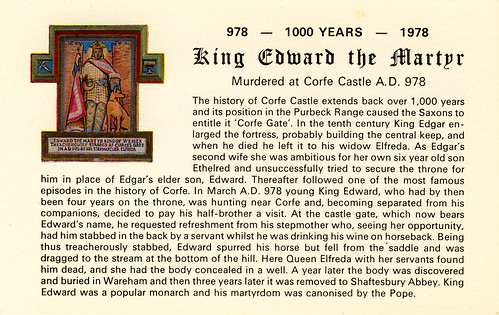
My first encounter with history, as far as I can recall, came when I was 7 years old. During a family holiday in Dorset, we visited Corfe Castle, a picture-postcard ruin which towers over the small village of Corfe below. I have two particular memories of that visit. The first is of a postcard which, in my mind’s eye I can still recall quite vividly and which I’ve since found for sale on the web (and purchased).

Corfe Castle 1978

Most of its design comprises text commemorating the assassination of Edward the Martyr (reigned 975-978) a millennium before. There are two dates at the top (978-1978) and I can remember clearly looking at the year 978 and trying to conceive of a date which didn’t begin with a ‘1’.

The very idea of a 1000 years ago fuelled my imagination; the very fact the place in which I was standing witnessed such an event a 1000 years before I was even born set in motion a chain of thought which has remained to this day. Even though I was only 7, I remember considering my own non-existence, albeit in ways a 7 year old might imagine such a thing. Three years before in 1975, my great-grandmother (born in 1878) became the first person I knew to die. It was shortly after her death, that the very idea of death began to trouble me and in some ways I think the thought of a 1000 years ago presented itself to me as death in reverse. Again, this way of thinking about the past has remained with me ever since, which might go some way to explaining why I tend to visit places synonymous with trauma and death.

It was in the small museum in Corfe Village that I remember staring at a cannonball fired during the English Civil War. I can recall trying to see it as it was hundreds of years before I was born. This wasn’t just an object sitting on display; it had once been handled by people, it had flown through the air and had played a part in the castle’s destruction. I wasn’t just looking at the cannonball, I was trying to imagine its flight.

 So in this postcard and the castle at Corfe my passion for history began, and this short text is the opening paragraph of a very long story which I’ve been reading ever since.

Filed Under: Family History Tagged With: Corfe Castle, Family History, Mine the Mountain 3

8th May

April 9, 2010 by Nicholas Hedges

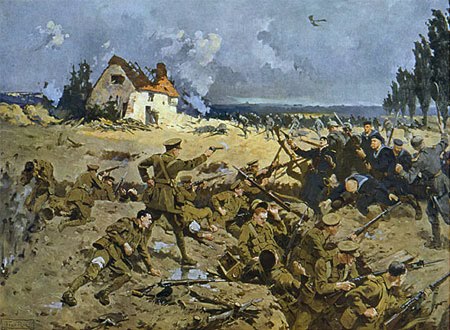
The following is a painting by Fred Roe (1864-1947) entitled The Eighth May which shows a scene from the Battle of Frezenberg Ridge, which took place on 8th May 1915 in what was to become known as the Second Battle of Ypres. My great-great-uncle, Jonah Rogers was killed that day near the farm depicted in the painting.

The painting is in the collection of Newport Museum and Art Gallery.

Filed Under: World War I Tagged With: Family History, Jonah Rogers, World War I, WWI, Ypres

The Victorians

March 19, 2010 by Nicholas Hedges

Today I discovered, much to my delight, that The British Library has on its website a database of 19th century newspapers including 100 years of Jackson’s Oxford Journal. From 1800-1900, every issue is available and fully searchable. It goes without saying how incredibly useful this is and no sooner had I logged on than I began to search for information about my ancestors, in particular those whose activities I have described in previous blogs.

Perhaps the most notorious of my ancestors is Elijah Noon, who murdered his wife Charlotte with a sword in Oxford in 1852. I dealt with this crime at length in an installation which I put on in the cemetery where Charlotte was buried (see www.nicholashedges.co.uk/murder for more information) but soon discovered, thanks to The British Library, a whole lot more that I would never have otherwise found.

The website also allows users to download articles or pages as PDFs. Those about the murder are available here:

Murder of a Wife by her Husband (8th May 1852) 
The Recent Murder in Oxford (17th July 1852)

I’ve read these stories before, but in another article, I discovered that a nephew of Elijah’s had recently been killed in a railway railway accident at Bicester, not so far from Oxford. Elijah’s older brother, Thomas Noon,  was a builder in Oxford and a man who it seems was very much respected. Having searched for news of an accident some time around 1852, I discovered that Thomas Noon’s son, also called Thomas, who was a Corporal in the 7th Company of Royal Sappers and Miners, had been killed in a railway accident on 6th September 1851. He was buried in the same cemetery (St. Sepulchre’s in Jericho) in which his aunt would be interred less than a year later, his funeral attended by ‘an immense concourse of persons.’

Frightful Railway Accident and Loss of Life at Bicester (13th September 1851)
Notice of the Funeral of Corporal Noon (13th September 1851)

Elijah Noon served just two years in prison for the murder (or ‘manslaughter’) of his wife. In 1880 and 1882, he is listed as a prize-winning ‘bird-fancier’.

One article I was shocked to read concerned a fight which took place in Summertown on 29th December 1869. The article reads:

“Elijah Noon and George Hedges were fined, the former 7s. 9d. and the latter 10s. 6d. for being drunk and riotous at Summertown on 29th Dec. last. P.C. Culverwell substantiated the accusation and stated that the defendants were stripped to fight, when he stopped the disturbance going on.”

Petty Sessions (19th February 1870)

The Elijah Noon in this story is the son of my great-great-great-grandfather, Elijah Noon Sr. who of course we know murdered his wife. George Hedges is my great-great-grandfather who married Elijah’s sister, Amelia in 1869, not long before the fight took place. What it was all about, of course I cannot say, but it seems that both George Hedges and Elijah Noon Jr. were often in trouble.

Elijah Jr. had something of a drink problem. In September 1883, William Francis Piggott of Summertown applied for the renewal of his licence, which it seemed had been revoked on account of Elijah’s drunkeness.

Licence Renewal (8th September 1883)

Elijah of course had had a traumatic childhood having witnessed the murder of his mother at the hands of his own father. It seems his was an unhappy life, one which ended tragically when he choked to death in The Grapes, George Street in 1885 (click here to read more).

What George’s excuse was I don’t know, but he was, as I’ve said, often in trouble. In 1861, at the age of 15, he was already in attendance at the Petty Sessions in County Hall. In 1867 he was sentenced to 21 days hard labour for stealing wood and in 1888, fined for a disturbance, again in Summertown.

George had a brother called Edwin. Their father, my great-great-great-grandfather, was called Richard, and in 1858, a Richard and Edwin Hedges were convicted of an assault on a certain John Harris. Whether this Richard and Edwin are my ancestors is debatable, but it would seem to concur with George’s general behaviour, and indeed that of the family. One story, which certainly involves George and indeed, it seems, the whole family, took place in Summertown in 1899. It’s described under the rather inappropriate heading of ‘Family Squabble’ and involves William Bowerman, who married Elizabeth Hedges – George and Amelia’s daughter – in 1894.

Bowerman and Elizabeth had been drinking in the Cherwell Tavern, Sunnymede when ‘there was a quarrel’. Elizabeth went to her parents’ house where she was followed by her husband. He knocked on the door, Amelia answered and Bowerman, so it was alleged, punched her in the face. Her son Harry and her husband George went out to ‘remonstrate.’ Bowerman hit them both and Harry hit him back. The scan of the report is a little ‘wonky’ but it can be read here.

Interestingly, I have a photograph of my ancestors taken in 1899 – one assumes before the brawl.

Christening 1899

I have (tentatively in some cases) identified them as follows:

(Top, left to right) Harry Hedges, Ernest Edges (my great-grandfather), Lily Bowerman (?), William Bowerman (?), George Hedges (my great-great-grandfather), Alfred Hedges
(Middle, left to right) Flo (Alfred’s wife) (?), Amelia Hedges (my great-great-grandmother), John Lafford (my great-great-grandfather), Alice Hedges, (?), Percy Hedges
(Bottom, left to right) Richard Hedges, Margaret Hemmings (nee Hedges), Margaret V Hemmings (on knee), Alice M Hemmings (on feet), Ellen Hedges (nee Lafford) (my great-grandmother), Winifred May Hedges (on lap), Eliza Hedges (nee Villebois), Jack Hedges (on knee), Olive Hedges (at feet), Elizabeth Bowerman (nee Hedges), Eliza M Bowerman (on knee), Ernest G Bowerman (at feet).

Filed Under: Family History Tagged With: Family Hedges, Family History, Hedges, Murder, Newspaper Cutting, Victorians

In Ruins

February 28, 2010 by Nicholas Hedges

“A ruin is a dialogue between an incomplete reality and the imagination of the spectator.”

Christopher Woodward, In Ruins

Photograph of Corfe Castle taken during a school trip in 1983.

I first visited Corfe Castle in the summer of 1978 whilst on holiday with my family. I was 7 at the time. I can remember a postcard commemorating the murder of Edward the Martyr (reigned 975-978) a 1000 years before. It’s the first historic place which really captured my imagination, and ever since my mind’s been in thrall to the past. The idea of a 1000 years ago seemed – as it does now – impossible, and in the museum below, in the village of Corfe, I remember staring at a cannon ball dating from the English Civil War, trying in my mind’s eye to picture it, as it was at the time of the siege, moving through the air.

Photograph of me and my brother at Corfe Castle c.1980.

Filed Under: Photography Tagged With: Christopher Woodward, Corfe Castle, Family History, Photographs, Ruins

Stories

February 12, 2010 by Nicholas Hedges

In his excellent book, ‘The Past is a Foreign Country’, David Lowenthal writes:

“Among the Swahili, the deceased who remain alive in the memory of others are called the ‘living-dead’; they become completely dead only when the last to have known them are gone.”

Having read this, I began to think about Henry Jones, my great-great-grandfather who took his own life in Cefn-y-Crib in 1889. For all intents and purposes, he had, until I (and another distant relative) had begun to research him, been ‘completely dead’ in that anyone with a knowledge of who he was would also have passed away. For many years therefore, he would have existed as a name, inscribed on his grave or recorded in various documents such as census returns. He would have been, apparently, nothing more than that.

Now however, he is part of my family tree, ‘reconnected’ – albeit abstractly – to his own loved ones and those who came both before and after he lived. But a list of names, connected or otherwise is only a part of the story. As Tim Ingold writes, in his book ‘Lines – a Brief History‘:

“The consanguineal line is not a thread or a trace but a connector.”

The line connecting Henry Jones to his forebears and descendants tells us nothing about him. As Ingold explains; ‘Reading the [genealogical] chart, is a matter not of following a storyline but of reconstructing a plot.’ What I want, as far as is possible, is the story, the narrative as it was written at the time.

As I wrote in my essay ‘What is History?‘:

“Human beings [Ingold writes] also leave reductive traces in the landscape, through frequent movement along the same route… The word writing originally referred to incisive trace-making of this kind.’ By walking and leaving our reductive traces on the ground therefore… we could be said to be writing or drawing ourselves upon the landscape – writing or drawing our own history.”

It was only when I visited Hafodyrynys in May 2008 that Henry Jones became – for want of an expression better suited to the 21st century – in the words of the Swahili, ‘living-dead’ again. It was only then, as I walked around the village where Henry Jones lived, walking the same roads and pathways, that I began to read – as far as was possible – a part of his story. I knew the dates of his birth and death (I’ve since learned of his suicide) but these are plot points. Only when retold as part of the story do they start to make an impact, and that story can only be read in the places where he walked.

As I walked, I felt as if I was both recording my own story on the roads and pathways around Cefn-y-Crib, whilst reading that of my ancestors, in particular my paternal grandmother, who lived as a child nearby in Hafodyrynys and who passed away a few months after my visit.

A quote from Christopher Tilley’s ‘The Materiality of Stone, Explorations in Landscape Phenomenology’ illustrates this point:

“The body carries time into the experience of place and landscape. Any moment of lived experience is thus orientated by and toward the past, a fusion of the two. Past and and present fold in upon each other. The past influences the present and the present rearticulates the past.”

As we walked (I visited with my dad and girlfriend, Monika), we would phone her up and tell her where we were, and I couldn’t help but feel that we were walking directly within her memories. Time it seemed had collapsed for a while.

As I wrote as part of an investigation in the Old London Road at Shotover:

“Thinking about it now one can take that analogy and think of it [the road] instead as piece of tape which runs and runs and runs and which every step upon it is like the recording head changing the ground, changing the particles on the tape just a little. And just as we record when we walk so we also play, play the ground which passes beneath our feet. We can hear very distantly the thoughts which came before us.”

So how do we read or hear these ‘stories’, written into the ground and the landscape so many years before we were even born? One clue comes in the following extract from Christopher Tilley’s book, ‘The Materiality of Stones, Explorations in Landscape Phenomenology‘.

“The painter sees the tree and the trees see the painter, not because the trees have eyes, but because the trees affect, move the painter, become part of the painting that would he impossible without their presence. In this sense the trees have agency and are not merely passive objects. Dillon comments: The trees ‘see’ the painter in a manner comparable to that in which the mirror ‘sees’ the painter: that is, the trees, like the mirror, let him become visible: they define a point of view on him which renders visible for him something that otherwise would remain invisible – his outside, his physiognomy, his carnal presence… The trees and mirror function as Other.”

If we take the analogy of the mirror for a moment and return again to my essay ‘What is History?‘:

“In a famous definition of the Metaphysical poets (a group of 17th century British poets including John Donne), Georg Lukács, a Hungarian philosopher and literary critic, described their common trait of ‘looking beyond the palpable’ whilst ‘attempting to erase one’s own image from the mirror in front so that it should reflect the not-now and not-here…’

Just as the trees function as ‘Other’ therefore, so must the sun, the stars, the clouds, hills, mountains, the sea, rivers and so on. Where we are in the world, where we stand or walk, which direction we are facing are all significant features in this respect. We are what we are because of where we are at a given moment. We exist in relation to [these ‘Others’] and are at any given moment defined by them….

Last year I visited Hafodyrynys in Wales, the village where my grandmother grew up. Whilst standing on top of the hill where she played as a child and across which her father walked on his way to work in the mines at Llanhilleth, I looked and saw a view I knew he would have seen. I found it strange to think that a hundred years ago he would have stood there, just where I was, at a time when I did not exist. A hundred years on and I was there when he did not exist. And yet we shared something in that view. We had both for a time been defined by it. It was as if the view could still recall him and even though it was new to me, that I was nonetheless familiar.”  

We are defined by the world around us and as such we might be said to be remembered by that world. But of course over time the world changes and where things disappear, so do, to some extent, memories. We therefore have to fill in the gaps. I once wrote something about this during a residency at OVADA in Oxford in 2007.

“In the film, the visitors to the Park are shown an animated film, which explains how the Park’s scientists created the dinosaurs. DNA, they explain, is extracted from mosquitoes trapped in amber and where there are gaps in the code sequence, so the gaps are filled with the DNA of frogs; the past is in effect brought back to life with fragments of the past and parts of the modern, living world. This ‘filling in the gaps’ is exactly what I have done throughout my life when trying to imagine the past, particularly the past of the city in which I live.”

I appreciate that my metaphors are beginning to stack up a little. However, where we can fill in the gaps with our own experience is where we can begin to see the past as it was when it was the present.

Filed Under: Artist in Residence, Trees Tagged With: Artist in Residence, Christopher Tilley, David Lowenthal, Family History, Family Jones, Hafodyrynys, History, Jones, Old London Road, Phenomenology, Shotover

No Man is an Island

February 12, 2010 by Nicholas Hedges

I have written a great deal about how I perceive the past and how I use objects and the landscape to find  ways back to times before I was born. In my text ‘What is History‘ I conclude with the following paragraph.

“History, as we have seen, [might be described as] an individual’s progression through life, an interaction between the present and the past. It follows, having seen how the material or psychical existence of things extends much further back than their creation that history spanning a period of time greater than an individual’s lifetime is like a knotted string comprising individual fragments; fragments within which – in the words of Henri Bortoft – the whole is immanent.  The whole history of all that’s gone before is imminent in every one of its parts; those parts being the individual.”

I was reminded as I read this paragraph – and in particular the last line – of the poet John Donne and the following words taken from his XVII Meditation:

“No man is an island, entire of itself; every man is a piece of the continent, a part of the main. If a clod be washed away by the sea, Europe is the less, as well as if a promontory were, as well as if a manor of thy friend’s or of thine own were: any man’s death diminishes me, because I am involved in mankind, and therefore never send to know for whom the bell tolls; it tolls for thee.”

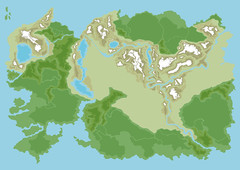
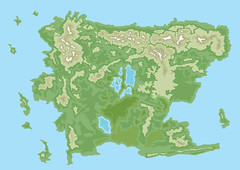
Having read this, I thought about some of the work I’ve been making for my forthcoming exhibition in Nottingham, Mine the Mountain. Two pieces are maps of invented landscapes, one of which (the first shown below) is based directly on a map I created as a child, the other based on the outline of Belzec Death Camp as seen in an aerial view of 1944.

If I Was A Place
If I was a Place, 2010

The Past is a Foreign Country
The Past is a Foreign Country, 2010

The first map, as I have said, is a contemporary reproduction of one I made as a child. It’s therefore essentially a map of an individual – of me, as I was at the time. It is a place that, although imagined, was real nonetheless, one based on fragments of my memory and my perception of the distant past.

Having been to Wales (in 2008) and imagined all my distant forebears walking the various tracks and roads around the village where my grandmother grew up, I realised how I was very much a part of those places and they in turn were part of who I was. I had existed – at least potentially – in those places long before I was born. All those roads, paths and trackways led in the ‘end’ to me. Of course that sounds a rather egocentric way of perceiving the world and its history, but then I’m not suggesting that I am the only intended outcome. Just as my invented world – my map of me – was made of all those bits of the past I loved to imagine as a child (the untouched forests, the unpolluted rivers and streams) so I can see how this foreshadowed my current thoughts on history; how I am indeed (as we all are) a place, one made of all those places in which my ancestors walked, lived and died. 

A quote from a source which is of huge importance to me and my work (Christopher Tilley’s ‘The Materiality of Stone, Explorations in Landscape Phenomenology’.)

“Lived bodies belong to places and help to constitute them so much so that the person can become the place (Gaffin 1996). The body is the medium through which we know place. Places constitute bodies, and vice versa, and bodies and places constitute landscapes. Places gather together persons, memories, structures, histories, myths and symbols.”

Alongside the second map I will be showing a piece of text taken from the diary of Rutka Laskier describing what appears to be an imaginary landscape, though one perhaps based on memories of family holidays to Zakopane, Poland. She was a child when she died in the Holocaust and by putting the two maps together, I want to reflect on the numbers of children who perished, as well as illustrating how within each child – within everyone – the whole of humanity is immanent.

John Donne’s words serve to illustrate this sentiment further still. No man, woman or child is an island. So whilst I have created two maps of individuals, through Donne’s words we can see how these islands comprise pieces of everybody else.

If a clod be washed away by the sea, Europe is the less.

Filed Under: Poetry Tagged With: Christopher Tilley, Family History, Family Jones, Henri Bortoft, History, John Donne, Jones, Maps, Mine the Mountain, Paths, Phenomenology, Poetry, Roads

Chance as a Draughtsman

September 15, 2009 by Nicholas Hedges

I have recently been reading Richard Dawkins’ fantastic book ‘The Blind Watchmaker’ and was struck by the following passage as regards the work I’ve been doing over the past few years:

“We have seen that living things are too improbable and too beautifully ‘designed’ to have come into existence by chance. How, then, did they come into existence? The answer, Darwin’s answer, is by gradual, step by-step transformations from simple beginnings, from primordial entities sufficiently simple to have come into existence by chance. Each successive change in the gradual evolutionary process was simple enough, relative to its predecessor, to have arisen by chance. But the whole sequence of cumulative steps constitutes anything but a chance process, when you consider the complexity of the final end-product relative to the original starting point. The cumulative process is directed by nonrandom survival. The purpose of this chapter is to demonstrate the power of this cumulative selection as a fundamentally nonrandom process.”

The first sentence in this passage struck a chord with me as regards thoughts I’ve had on the sheer unlikelihood of my ever being born – my entire existence. When one considers that in order for us as the individuals we are to be born as we were, everything every one of our ancestors did had to be done exactly as it was, the mind implodes beneath the weight of our sheer improbability. Indeed as individuals we are teetering on the cusp of impossiblity; it’s almost as if we have been designed to be who we are (which of course is not the case). In many respects this problem of coming to terms with our individual existences in light of what amounts to seemingly random acts on the part of our forebears mirrors what Richard Dawkins discusses in his book; the idea that we as human beings are a product of chance.

As he writes: “Each successive change in the gradual evolutionary process was simple enough, relative to its predecessor, to have arisen by chance. But the whole sequence of cumulative steps constitutes anything but a chance process, when you consider the complexity of the final end-product relative to the original starting point.”

Every step our ancestors took in the process of our eventual being was also simple enough. They were more often than not steps taken quite by chance. But the ‘whole sequence of cumulative steps,’ as Richard Dawkins writes regarding Evolution ‘constitutes anything but a chance process’. I’m not – at present – trying to come up with any conclusions to this line of thinking save to say there is something there, a link between the process of Evolution and our individual arrival in the world: the subtle changes which allow flora and fauna to evolve and the subtle actions of ancestors which cause us to be born. That link exists in the individual’s (animal, plant… or ancestor) progression through life – a progression which is a constant (battle might be too strong a word) will to survive.

We journey through life with intentions of doing things, going places and so on, always considering our own safety (survival) even if that consideration resides somewhere within our subconscious minds, rising to the surface every now and then when danger become more manifest. And along the way chance plays a part, altering our movements, delaying our progression, speeding it up, slowing it down and so on. Traffic Jams, the weather, forgetting keys… the list of things which impact upon us is endless; chance encounters with people we’ve never met or know very well etc.. If in retropsect we could map or list everything that happened to every one of our ancestors, such a map would appear to us (not only very big!) to have been designed (indeed, anything seen in hindsight appears to be so). It would seem utterly impossible for chance to be such a draughtsman; to create a specific individual from such an enormous number of utterly unlikely events in the course of what we call history.

But that is what chance did. As I said, I’m not looking at this moment to come up with any great conclusions, save to say that thanks to Richard Dawkins I’m looking at my work in a slighty new light…

Filed Under: Family History Tagged With: Family History, Richard Dawkins

Mr Stevens

August 11, 2009 by Nicholas Hedges

A year or so ago, I started work on a piece of work based around John Gwynn’s survey of 1772. The piece was called (as a working title) ‘6 Yards 0 Feet 6 inches’ based on the measurement of John Malchair‘s home in Broad Street. Having discovered an ancestor – John Stevens – born in the city in 1811, I wondered if there was any chance that one of the Mr Stevens’ listed on the survey was an ancestor of mine? It seemed a long shot but after today’s research I’m rather more optimistic.

If I did have an ancestor in Oxford at the time of the survey and if my research is correct, then that ancestor would be John Steven, the grandfather of the one previously mentioned. I’ve no idea when he was born but I do know that he was married in 1764 and is described as coming from St. Martin’s Parish, where his son Samuel, John Jr’s father was baptised in 1776. One could assume therefore that I did indeed have ancestors living in the parish of St. Martin’s at the time of the survey.
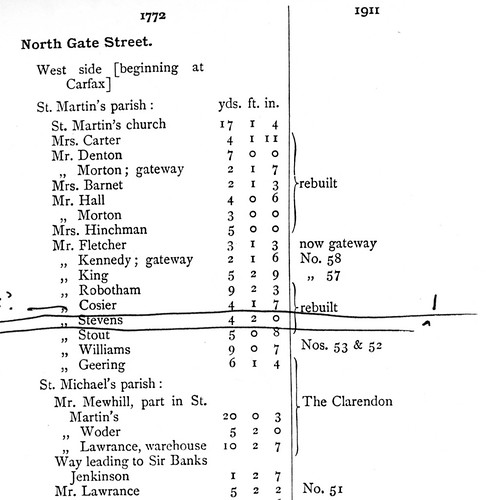
The images below are taken from the survey and show two Stevens one of which might well be my ancestor.

Gwynn fails to include (at least on the copy I have) first names from the survey but within the parish of St Martin’s two Mr Stevens are recorded along with a Mrs Stevens. One can assume however, that those most likely to be mine are the two Mr Stevens mentioned as living in the parish, one in Butcherrow (now Queen Street), the other in North Gate Street (now Cornmarket). The residence in Butcherrow is 7 yards 0 feet and 6 inches. That in North Gate Street is 4 yards 2 feet 0 inches.

John Gwynn's Survey 1772

John Gwynn's Survey 1772

Of course more work is required to see if one of these is indeed my ancestor, but I must admit to being very inspired by the prospect.

Filed Under: Oxford Tagged With: 18th Century, Family History, Family Stevens, John Gwynne, Oxford, Stevens, Survey

John Stevens (1811-1876)

August 11, 2009 by Nicholas Hedges

Researching John Stevens in the library today, I found what I’m sure must be his parents. Having looked at the Index of Baptisms for the time around his birth (1811) I found only one person matching his dates. John Stevens was born on 7th October 1811 in St. Aldate’s parish. His parents are given as Samuel and Mary Stevens, and looking at John Stevens’ children, I found that his second born son is named Samuel (his first son is called John). I decided to see if I could locate a Samuel Stevens in the Parish Registers. I couldn’t be sure that he was born in the city but it seemed quite likely. Sure enough I found a Samuel Stevens born on the 4th April 1776, baptised in St. Martin’s (now demolished). His parents were given as John and Lydia Stevens and so I looked for a record of their marriage in the city. Again my luck was in and I found that they were married on March 24th 1764 in St. Mary Magdalen. Lydia’s maiden name was Borton and the witnesses at the wedding were Sam Borton and Mary Stevens. John is described as being from St. Martin’s which is where Samuel was baptised.

Filed Under: Family History Tagged With: Family History, Family Stevens, John Stevens, Stevens

Stephen Hedges (1811-1885)

July 20, 2009 by Nicholas Hedges

I discovered Stephen Hedges about a year ago whilst researching my great-great-great-grandfather Richard Hedges (1808-1882). The two of them were brothers. Having noticed that Stephen died in Australia in 1885 I straight away wondered whether he’d been transported there. Sure enough, a descendent of the family, Julia, confirmed the fact. She herself is descended (like me) from William Hedges who was born in Abingdon in 1750 and his wife Jane (surname unknown) who was born in 1754. I am descended from their son Henry Hedges (1776-1844) and Julia from his brother James (born in 1787). Stephen and Richard were sons of Henry.

Stephen Hedges was convicted at the Berkshire Easter Sessions at Newbury on April 15th 1828. On trial with him were his co-defendents, H. Stockwell and J. Harper. They were all indicted for stealing 154 lbs of lead from a house in Radley and having been found guilty Stephen and Henry Stockwell were sentenced to be transported to Australia for 7 years.

Stephen Hedges (and his accomplice Henry) left England on June 27th 1828 aboard the Marquis of Hastings, arriving in Port Jackson, New South Wales on 12th October. Having served his sentence, Stephen remained in Australia, marrying Elizabeth Carter on Christmas Eve 1838.

Below is the first part of a report concerning Stephen Hedges’ conviction taken from Jackson’s Oxford Journal (April 26th 1828) – click on the image to open the full PDF.

Filed Under: A Line Drawn in Water, Artist in Residence Tagged With: A Line Drawn In Water, Family History, Newspaper Cutting, Stephen Hedges

Before Demolition

July 19, 2009 by Nicholas Hedges

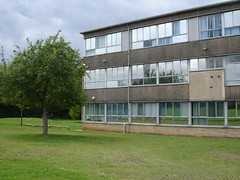
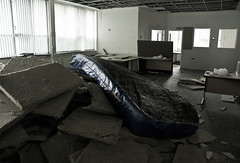
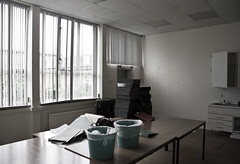
On Friday last week I paid a visit to my old school (Northway Midddle) which is due to be demolished in the next few weeks to make room for houses. I left the school in 1984, the year that it was closed, and even then it was clear that the preferred option of many was to pull it down and make room for houses. Ever since, the building has remained standing in a kind of limbo, part community centre, part office space and having heard the decision last week to finally put the place out of its misery – a decision which seems absurd given its potential (potential which the council couldn’t see if it picked up a football and did six hours of keepy-ups) – I decided to try and gain entry and take a few photographs before it’s lost forever.

Northway Middle School

Granted, Northway School is not the most beautiful of buildings, but with its gym and playing fields, art room (including a walk-in kiln) and stage it could have been turned into a first class sports and cultural centre. Of course the council were as unimaginative in 1984 as they are today and instead it became a wasted space. And whatever the merits – or otherwise – of the building itself, it’s nonetheless a piece of the area’s heritage. It’s played a major part in the lives of many people and deserves to be recorded.

Therefore with my camera I endeavoured to do just that. I had been warned that the interior of the building had been altered a great deal after 1984 but even so I wanted to find something, one image that encapuslated what the place meant to me and many others. Standing inside the building for the first time in 25 years I could see just how much it had changed (rather like myself), and as I walked around in the company of the caretaker, I found that my memories were somehow scrambled as if by by the stud walls and altered layouts of the rooms. Nevertheless I started taking pictures, attempting to jump start my memory, as if the camera was a defribulator for my brain.

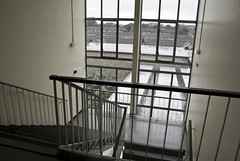
Before Demolition

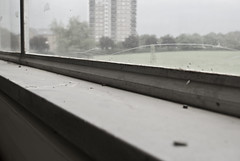
The stairwell hadn’t changed a bit and I could almost hear the sound of the school bell and voices chattering. But in most parts of the school’s trashed interior it was as if I was walking in a place I’d never been to before. Even the view through the windows had changed almost beyond recognition. The John Radcliffe hospital loomed ever larger and the playground had already been turned into houses. Only the imposing tower block on the estate anchored the view in the past, and catching a glimpse of it through a few of the windows started the memories coming.

Before Demolition

After about half an hour and having walked around the school from top to bottom, I began at last to recall things, to see memories much more clearly. I was able to remove the stud walls and new corridors and reimagine how the place had looked when I was there. I remembered the maths room and Mr Smith. I could recall how he’d turn on the lights before appearing. In looking out the window, I could also remember that I’d been in this room when my grandad had died on January 13th 1984. It was around 2.15pm when he passed away.

Before Demolition

Perhaps the room I remembered most clearly and that which was the most recognisable was Mrs. Bantam’s. She was my teacher in the first year and even though the room was just a shell, I could easily recall how things had looked, what it was like to move around inside. The way we move around a given space and the way memories are ‘attached’ to such a movement became very apparent here. Whereas before (except on the stairwell) familiar paths through the building had been blocked by ‘new’ partitions and so on (particularly in the third year area), here those paths remained intact. Memory isn’t only triggered by what we see and hear and what we smell, but the way we move through a space. Memory is kinaesthetic.

Before Demolition

After about an hour I had to leave, finishing with photographs of the windowsills into which some pupils had scratched their names.

Before Demolition

As I think back to my visit, I don’t so much see the things I saw then, the images which you can see on the photographs, but rather my memories, which despite the altered condition of the interior have become sharper – at least in places.

Before Demolition

The above picture was once the science room, the domain of Mr. Hipkiss. The room I remember as being dark. There were high wooden desks, a blackboard in the corner and the strange lingering smell of chemicals which were kept in a room at the front of the class. We had to cover our books in wallpaper (woodchip in my case) and it was in this room that I first heard the word Google. In fact, I now recall how Mr. Hipkiss had written the number (a Googleplex, one comprising umpteen noughts) on a long sheet of paper. I can see it now on the wall. I seem to remember black blinds which might account for the fuliginous aspect of my memory and the faces Mr. Hipkiss drew of eminent scientists which were always photocopied so the text and drawings were pink. They weren’t true likenesses, he told us. He had made them all up.

Before Demolition

The above picture shows the old art room and at the back was where we had cookery lessons with Mrs. Braybrooke.

Before Demolition

This room was a basic woodworking room and general craft area which had a walk-in kiln. So which photograph encapsulates my time at the school? Well it would have to be the second photograph in this blog, that which I reproduced below.

Before Demolition

Memories are, as I said kinaesthetic and nowhere are the paths through the school better preserved than on the stairwell. How many times did I walk up and down them? Impossible to say. All I know now is that I won’t ever again and soon no-one ever will.

Filed Under: Family History Tagged With: Childhood, Demolition, Family History, Memory, Northway School

A to B

February 24, 2009 by Nicholas Hedges

As part of a new project, I took a walk to Headington, going via the house where I grew up. I haven’t walked around that area for many years and was quite surprised at how run down it appeared to be, particularly my old house. Of course places change – it’s only natural, but many houses and gardens in what was once a very well maintained street looked – for want of a better word – shabby. Like a lot of places nowadays, the front gardens have been abandoned, either to cars or, through apathy, to the weeds. Walls and fences have been torn down. They’ve collapsed or been removed. There’s a profusion of signs too – a common complaint for many – which litter the streets; a far cry from the 1970s and 80s.

I was also aware as I walked of the huge increase in traffic in the area, at least since I’d lived there, particularly towards Old Headington which, I assume has something to do with the ever expanding John Radcliffe Hospital.

It was on my way to Old Headington that I became aware of two different qualities of memory – not specific ones as such, but those accumulated memories which help us know where we are. I’ve walked thousands of times up and down the streets where I lived (to and from school; to and from the shops), but on the road towards Old Headington my memories are much more of being driven, usually on my way to my Nan’s in the back of Dad’s car. Walking the street today, I noticed things that I’d never seen before whereas walking down the street on which I lived everything was much more familiar (even though they’d changed). This difference is due to the way memories of these places were formed. Of the street on which I lived they were formed, in the main, through walking. On the road to Old Headington, they were formed, again in the main, through a window in the back of the car.

As we walk, we accumulate a sense of place through the memories which are stored in the mind. These images are stronger and clearer when taken in through walking, and indeed when recalled through walking. The slower the pace (although not to the point of a standstill) the more we absorb of the world and thereby the better our sense of place.

The world today, or rather our interaction with and indeed within it is very ‘nodal’. We travel from A to B, usually (but not always) as quickly as we can. The bit in between A and B is taken up, in the case of the car, with looking at the road ahead of us. I should point out that I am in no way anti-car, anti-train or anti-plane; I rely on them as anyone does; my point is that we rely on them far too much at the expense of our engagement with the world around us.

When we walk from A to B however, we don’t ‘get’ just A and B but everything in between. The act of walking ‘anchors’ our destination and the place from which we travel, positioning them in the world. We have time to think, to see and to accumulate a sense of place. We have time to engage with the world and thereby position ourselves within it.

Whilst studying the Old London Road for another project, I began to get an understanding of how slowing our life down helps us to engage with the world around us. I also became aware of how roads today are much different to those in the past. Journeys were slower and roads were very much more a connection between two places. This may sound like a truism, but what I mean is that today, one could travel for mile after mile on roads without actually getting anywhere at all. Destination is not something built into the fabric of the road – something which I felt was very much the case on the Old London Road. Again I should point out that I am not in favour (were it possible) of a return to bumpy, uncomfortable, 16 hour journeys to London.

When the pace of life was slower, when people walked more than they did, I wonder whether their sense of place in the world was different (physical as opposed to social). Again I don’t want to sound as if I’m being naively romantic about the past – it was often grim and difficult to say the very least, but I do think it must have been the case that the world was perceived very differently, not because of the lack of technologies such as the camera, the internet, film or television per se, but because of the pace. Technology of course is a contributing factor to the increased pace of life (and not just through transport). Increasingly we use our mobile phones or email to contact one another (and a great thing both of them are too). But again, this form of contact reduces the world to nodes, to A and B. In the days before such technologies (even when phones were abundant – this applies to a time not so long ago) if we wanted to speak with someone, we would go to meet them, or write them a letter. Either way, our words were physical; they had a place in the world; it wasn’t just about A to B but, as with walking, A through to B.

I think what I’ve gleaned through my ramblings – both physical and verbal – is that we are missing the bits in between. Everything is being reduced to A, B and C. Where there are bit in between, they are little more than a hinterland, glimpses of which we snatch as we travel along roads, motorways, train tracks or even through the air. This brings me back to the houses of which I spoke earlier. They have the appearance, even to the walker, of something that is seen in transit, at speed. Even if one looks for a period of time at one of the houses I saw today (again by no means all of them) it’s as if one is looking through the window of a passing car.

Filed Under: Oxford Tagged With: Childhood, Family History, Memory, Oxford, Walk

Maps

January 8, 2009 by Nicholas Hedges

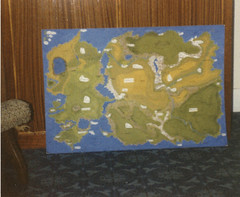
As a child I spent many hours drawing maps of imaginary lands to which in my mind I would often escape. Over time these worlds – and one in particular (see image below) – became a very real part of my existence; I knew its towns, forests, plains and mountains; I knew the seas by which it was surrounded, the lakes and rivers and potted histories of each location. I created characters and can still to this day remember them along with the geography of the world they inhabited.

My Invented World - Ehvfandar

As well as being a means of navigating my imagination, the maps were also guides to the real world. Whilst out walking, I would just as likely find myself walking in my fictional landscape and as such parallels between the real and the imagined were established. To some extent these parallels still exist but it wasn’t until I started researching trench maps of the area in which my great-great-uncle Jonah Rogers was killed (near Ypres) that I was again reminded of my fictional world.

I was interested in pinpointing the place in which Jonah Rogers was killed; to see what the terrain was like and thereby understand, at least in part, something of the world he would have known. One can often imagine that the trenches were more or less just rudimentary ditches cut into the ground in which soliders lived as best they could, just a matter of yards away from the enemy, and of course, in many respects that’s precisley what they were; but the trench system was actually very complex. Far from being two lines gouged into the ground, the trenches of the opposing armies were labyrinthine as the image below reveals.

This map shows an area just outside Ypres. One can see precisely how complex the system of trenches were and yet of course the map can only tell us so much. Sanctuary Wood (shown on the left of the detail above) was described in the diary of one officer as follows:

“Of the terrible and horrible scenes I have seen in the war, Sanctuary Wood is the worst… Sanctuary Wood in 1914 was a sanctuary, but today, Dante in his wildest imaginings never conceived a like.”

It’s hard to imagine Dante’s image of hell as being in any way less horrific than anything on earth, particularly when looking at the map above.

What one can also see on another part of this map are some of the names which soldiers gave to the trenches and the areas in which they were fighting. Often names that were difficult to pronnounce were changed so that, for example, Ploegsteert became Plug Street. However, in some cases, areas were given names that made sense in terms of their being familiar names from home.

On this image one can clearly see a place called Clapham Junction. Of course there was no Clapham Junction in Belgium before the war, but by naming unfamiliar (and often utterly destroyed areas) with familiar names, soldiers and officers could, one assumes, navigate areas more easily, whether physically or in terms of reconaissance and planning. To plan attacks on places which have become muddied wastelands (to put it mildly) with few features remaining (the woods on the maps, shown as collections of lollypop trees were of course little more than burned splinters) one would need names, just as one would need names for the complex network of trenches. Could it be that by naming places with names from home, such reduced and barren landscapes (the ‘topography of Golgotha’ as Wilfred Owen called the Western Front) would appear as belonging in some way to the soldiers who fought there – was it a way of inspiring them?

The closest map – in terms of date – I could find relating to my great-great-uncle’s war, was one of St. Julien which dates from July 1915, just two months after his death in the Second Battle of Ypres. I’d wanted to get an idea of the trench system he would have been known at first hand and as I looked at the trenches shown (only German trenches were shown on this map) I found a road named after my home town; Oxford Road. Ironically, alongside this road was a cottage (one must assume there was little left of it at the time) which had been dubbed Monmouth Cottage – my great-great-uncle was from Monmouthshire.

I couldn’t help but think there was something in this naming of unfamiliar places with more familiar names which paralleled thoughts I’d had as regards my family heritage and in particular how researching it has helped me relate more easily to the past.

History is of course full of gaps. If we try and picture a place as it appeared at a given date we have to use our imaginations to fill in the holes where, for example, buildings have been razed. If we read reports or stories about events in the past we have to use our imaginations to understand the moment as fully as possible, to understand how the average person responded at the time. In doing so, we project a part of ourselves onto the past, something which is of course familiar (see ‘From Dinosaurs to Human Beings,’ OVADA Residency Blog, 2007).

Like my childhood maps of invented places, my family tree is in many ways a map of a fictional landscape, or rather a route through it. That is not to say of course that my family’s past is itself a fiction, but rather that history, in terms of how we see it in our minds is. History is in many ways a wasteland having been obliterated by time and yet there are parts of its landscape which still remain standing despite the tumult. Extant buildings, contemporaneous documents all act as pointers to a disappeared world, a world which also hides untold numbers of anonymous people. To help me navigate this landscape , I can invent my own names just as I did as a child, only this time the names will relate to, or be those of my ancestors; they will refer to dates and facts I have gleaned about their lives. In this sense I am labelling an unfamiliar, temporal landscape with familiar names, a landscape that like the battlefields of the Front has been all but destroyed. I’m filling in the gaps, mapping myself not only onto the physical world but also the past.

The worlds I invented as a child were in many ways idealised views of the real world with unspoilt forests, mediaeval cities and unpolluted seas. What faced the man at the Front was the opposite, a terrible vision of what the world could be or had become. Labelling such a world with names like Piccadilly, Buckingham Palace Road, Marylebone Road, Liverpool Street, Trafalgar Square and so on, in some ways gave it a more human face; where there were gaps, such names would fill them in perhaps with memories of home.

In the end maps are there to guide us, to reveal something about a place or perhaps a person; it all depends of course on what the map represents. We might be looking at maps of countries or maps of the brain – Katherine Harmon’s book ‘Personal Geographies and other Maps of the Imagination‘ is a great resource in this respect. When I look at the map of my invented world, I am not so much presented with a means of navigating a fictional world but rather a map of my own childhood. Looking at the place names I can in fact see the real world as it was at the time. The map therefore becomes a representation of something entirely different. The same could be said of the Trench Maps. They are maps of something quite unimaginable; if we took one and stood on a battlefield today it might offer us a hint of the way things were. But with the names of the trenches, roads, farms and cottages, they become maps of somewhere entirely different – a fictional place built only from memories. But those memories conjured by the names listed above – Piccadilly, Trafalgar Square etc. – are our memories, we can only imagine Trafalgar Square as it is today or as it is within our own minds. What we can establish, with the help of these maps, is an understanding of a sense of dislocation, between the solider in the trenches and his life back home. They serve to make those who fought and died in the war much more real.

With regards a map of my family tree I can place my ancestors in different parts of the country but of course none of them lived their lives standing still. Again there are gaps to be filled and whereas to fill in the gaps of history one can use one’s imagination, with regards the mapping of my ancestry and individual people, it is through walking around the places that they inhabited that these gaps can be filled. To close, I return to the blog entry I made during a residency at OVADA. In it I wrote:

“These invented worlds became, as I grew up, the ‘invented’ or imagined landscapes of Oxford’s past; landscapes that were – just as they still are – created from fragments, parts of the past which are still extant in the city; old buildings, walls, objects and so on. Between these structures, these fragments, I would fill the gaps, with my own imagination, with thoughts derived from my own experience. The city’s past and the past in general, as it exists within my mind, is then, to use the metaphor of cloning in Jurassic Park, a cloned dinosaur. The extant buildings, structures and objects within museums, are like the mosquitoes trapped inside the amber. They are broken strands of DNA. All that is required is for me to fill the gaps, and this I can do with my own DNA. I am in effect, the frog.
This metaphor is interesting in that DNA patterns are, of course, unique to everyone. My DNA is different to everybody else’s as there’s is to mine. Therefore, using my imagination to plug in the gaps of the past, means that the ‘past’ will comprise large parts of my own experience; my dinosaur will contain elements of my own being. (See ‘Postcard 1906’). But although my DNA is unique, it is nonetheless derived from my own past, elements have been passed down by my ancestors from time immemorial. The code which makes me who I am, comprises parts of people I know now (parents and grandmothers), people I knew (grandfathers and great-grandmother) and people lost to the past altogether (great-great grandparents and so on). What interests me about this, is that, through stating above how ‘my dinosaur will contain elements of my own being’ I can now see that ‘my dinosaur’ will contain elements of my own being, which is itself comprised of elements of hundreds – thousands – of people, the majority of whom I will of course never know and who have been dead for centuries. I like to think therefore, that ‘my dinosaur’ and my imagination aren’t entirely unique.”

In the traditional diagram of the family tree each individual is isolated, joined to others by means of a single line, almost as if they appeared at one point, moved a bit and passed the baton on to the next in line. Of course things are much more complex than this; individuals overlap in terms of the length of their lives and if we were to try and represent an individual’s journey through life, the line would be impossibly complex. Inevitably there are gaps which as I’ve said I can fill (at least, in part) by walking in the places they would have walked. In Wales, where my Grandmother grew up I found it incredible to think that this place I’d never been to and the streets, lanes and hills I had never walked, had all played a part in my existence. Without them I would not be here, or indeed there. I was then filling in the gaps, like the frog DNA in Jurassic Park, but the dinosaur I spoke of in the extract above was not so much History in this case, but me.

Filed Under: Family History, Trees Tagged With: Childhood, Dante, Family History, Jonah Rogers, Map, The Trees, Trees, Trench Maps, Ypres

Amelia Hedges (nee Noon)

January 6, 2009 by Nicholas Hedges

I have written at length on the tragic story of my great-great-great-grandmother’s murder in 1852 and am in the process of using her story in a proposed public art installation in the cemetery where she’s buried. In the newspaper report of the time, mention is made of her children:

“He [Elijah Noon] appeared to feel very acutely the awful position in which he had placed himself and the irreparable loss which he had inflicted on his household, consisting of five children the youngest being only a few months old, and not weaned. The desolate condition in which these poor children are suddenly placed by the death of their mother, and imprisonment of their father is pitiable in the extreme and increases the painfulness of this most tragical event.”

One of these children was my great-great-grandmother, Amelia Noon. Born in 1846, she would have been 6 years of age at the time of her mother’s death and would have been in the house during the attack. What she saw or heard I cannot say, but one can assume that the whole event would have scarred her in some way.

I never thought I would ever see what she looked like but recently I received a photograph of my great-great-aunt’s christening. Winifred May was born in 1899 and was the daughter of my great-grandparents Ernest Hedges and Ellen Lafford. To celebrate the event of her christening, a group family portrait was taken in the back yard of the house and amongst that number was Amelia Hedges (nee Noon) pictured below.

Amelia Hedges (nee Noon)

She is the only one in the photograph looking down and it’s tempting to suggest her face and her expression reveal something of her past. Of course, to say that would be pushing the bounds of reasonable conjecture but there is nonetheless something sad about this image. It could be that she just happened to look down at the moment the picture was taken, but there is something about her downcast eyes which reveals, in the midst of a happy, family moment, a memory of her own family. As I have also written, the death of her mother and the imprsionment of her father was not the only tragic event of her life. Her brother, also called Elijah, choked to death in The Grapes public house fourteen year before this image was taken.

Filed Under: Family History Tagged With: Amelia Noon, Elijah Noon, Family History, Jericho Cemetery, Murder, St Sepulchres Cemetery

Elijah Noon (1838-1885)

November 19, 2008 by Nicholas Hedges

Elijah was the son of Elijah and Charlotte Noon whose tragic story I have already written about in ‘A Murder in Jericho‘. With Elijah Jr, tragedy it seems was waiting to strike the family again, for on 26th May 1885, at the Grapes Inn on George Street Oxford (which still stands today), he choked to death.
At an inquest held before the city coroner E. L. Hussey Esq. William Timms, a relative of Noon’s and the Landlord of the Inn gave evidence. The following is taken from the report in Jackson’s Oxford Journal, printed on May 30th 1885.

“On Wednesday at the Grapes Inn, George Street, on the body of Elijah Noon who died suddenly at that house on Tuesday – J Childs, landlord of the Inn, said he knew the deceased. He thought he was about 46 years of age. On Tuesday morning a little after ten, a man named Timms and his wife, relations of Noon, came in accompanied by the deceased. He heard Timms say he was going to Birmingham. He did not see Noon eat anything, but he had some beer which Timms gave him. The next thing he saw was the deceased gasping for breath. Timms caught him and thinking he was choking, patted him on the back, at the same time telling him to put his finger down his mouth. Noon soon after died, getting a little black in the face. He did not vomit. He sent for a doctor, but he came too late to be of any assistance – William Timms of Birmingham, a relative of the deceased, said that on the day in question they walked from Summertown with his (witness’s) wife. Deceased bought some pigs chitterlings at a shop in George Street which he eat [sic] going along. They all went into the Grapes Inn and had some beer. Noon began eating, and all at once he saw him turn black in the face. He patted him on the back but all the deceased did was to beat his chest, He managed to drink a little beer and then fell back dead into his arms. He had known him some years, and had not heard he was short of breath. A Juryman mentioned that the deceased was a well-known whistler which, he thought, showed he was in good health. Verdict ‘Death from Accidental Choking’.

Below is a contemporary (c.1900) photograph of the Grapes Inn. Of all the victorian facades, this is the only one left standing today.
The Grapes

Filed Under: Oxford Tagged With: Death, Elijah Noon, Family History, Newspaper Cutting, Oxford

  • « Previous Page
  • 1
  • 2
  • 3
  • 4
  • 5
  • Next Page »

© Nicholas Hedges 2024

  • Facebook
  • Instagram
  • Twitter
  • YouTube

Copyright © 2025 · Outreach Pro on Genesis Framework · WordPress · Log in