Nicholas Hedges

Art, Writing and Research

  • Amazon
  • Behance
  • Facebook
  • Instagram
  • Pinterest
  • YouTube
  • Art
    • Digital
    • Drawing
    • Grids
      • Correspondence
      • The Wall
      • The Tourist
    • Ink on paper
      • Shadow Calligraphy
    • Installation
      • Murder
      • Echo
    • Painting
    • Patterns
    • Mixed Media
    • Photographic installation
      • St. Giles Fair 1908
      • Cornmarket 1907
      • Headington Hill 1903
      • Queen Street 1897
    • Research/Sketches
    • Stitched Work
      • Missded 1
      • Missded 2
      • Missded 3
      • Missded 4
    • Text Work
  • Blogs
    • Family History
    • Goethean Observations
    • Grief
    • Light Slowed But Never Stilled
    • Lists
    • Present Empathy
    • Shadow Calligraphy
    • Trees
    • Time
    • Walking Meditations
  • Video
  • Photography
    • Pillars of Snow
    • Creatures
    • The Trees
    • Snow
    • St. Giles Fair 1908
    • Cornmarket 1907
    • Headington Hill 1903
    • Queen Street 1897
    • Travel
  • Illustration and Design
  • Music
  • Projects
    • Dissonance and Rhyme
    • Design for an Heirloom
    • Backdrops
    • Shadow Calligraphy
  • Exhibitions
    • A Line Drawn in Water
      • Artwork
    • A Line Drawn in Water (Blog)
    • Mine the Mountain 3
      • Artwork
    • Mine the Mountain 2
      • Artwork
      • The Wall
    • The Woods, Breathing
      • Artwork
    • Snow
      • Artwork
    • Echo
      • Artwork
    • Murder
      • Artwork
    • The Tourist
    • Dreamcatcher
    • Mine the Mountain
      • Artwork
      • The Tourist
    • M8
    • The Gate
    • Creatures
      • Artwork
    • Residue
      • Artwork
    • A visit to Auschwitz
      • Artwork
  • Me
    • Artist’s Statement

An Unfinished World

January 19, 2012 by Nicholas Hedges

First thoughts on Graham Sutherland, ‘An Unfinished World.’ Modern Art Oxford

Graham Sutherland, Dark Hill – Landscape with Hedges and Fields, 1940. Swindon Museum and Art Gallery © Estate of Graham Sutherland

 In his excellent book, ‘A History of Ancient Britain,’ historian Neil Oliver writes:

“All of Britain was a work in progress as nature set about reclaiming the land. The period of hundreds of thousands of years known to archaeologists as the Palaeolithic – Lower, Middle and Upper – was over. The remote world of the mammoth-hunters of Paviland, even the lives and times of the Creswell artists and the butchers of Cheddar Gorge belonged to the past. The ice of the Big Freeze had drawn a line that separates them from us, then from now.”

This line in our history, this schism carved through time in much the same way as valleys were carved and gouged by ice from rock, is a place I find myself observing when I look at some of Sutherland’s haunted landscapes. They are silent spaces, from which it seems humankind is quite estranged; banished even. In some, it’s as if Man has yet to appear, as if the world is part of a parallel universe, similar in some respects, but altogether different. There are, as well as those landscapes which seem divorced from knowable time (from history), landscapes from the recent past; ruined prospects of towns wracked by war. And while the source of this ruination is Man himself, the sense which Sutherland creates is one in which Man again ceases to exist. It’s almost as if through both types of landscape (those we might – very loosley- describe as rural on the one hand, urban/industrial on the other), Sutherland is reminding us that for the unimaginably greater part of its existence, the world did not know us; that for the equally ‘impossible’ span of time that stretches ahead, the world will have no need of us either.

This sense of oblivion haunts Sutherland’s landscapes; Earth’s indifference towards us – in the grand scheme of things – permeates almost every canvas and drawing, no matter how small. They each seem to echo the wonderful words of the 17th century writer Sir Thomas Browne, when he writes in ‘Urn Burial.’

“We whose generations are ordained in this setting part of time, are providentially taken off from such imaginations. And being necessitated to eye the remaining particle of futurity, are naturally constituted unto thoughts of the next world, and cannot excusably decline the consideration of that duration, which maketh Pyramids pillars of snow, and all that’s past a moment.”

On some of Sutherland’s drawings, the artist has drawn a grid of horizontal, vertical and diagonal lines. Grids like these would often be used when scaling drawings up to full-size works, and perhaps that is what the artist intended them for. When I see them however, I see them not as something detached from the work itself – a mere tool for reproduction – but rather an integral part of the work. It’s as if the artist is trying either to order the chaos which he’s rendered on the page (and which he’s no doubt observed in the real world), or do battle with Man’s certain oblivion and relative obscurity, imposing his mark on the landscape; his dominion over the world.

A Farmhouse in Wales 1940. Amgueddfa Cymru – National Museum Wales

If the Farmhouse in Wales above is slowly dissolving back into the landscape, then perhaps it can be seen as a metaphor for man’s own ineveitable fate. The grid therefore, this means for scaling up, for seeing more clearly and in greater detail (the bigger picture as it were) is perhaps then a means for trying to understand that fate, for comprehending those ‘pillars of snow,’ so beautifully described by Browne in 1658.
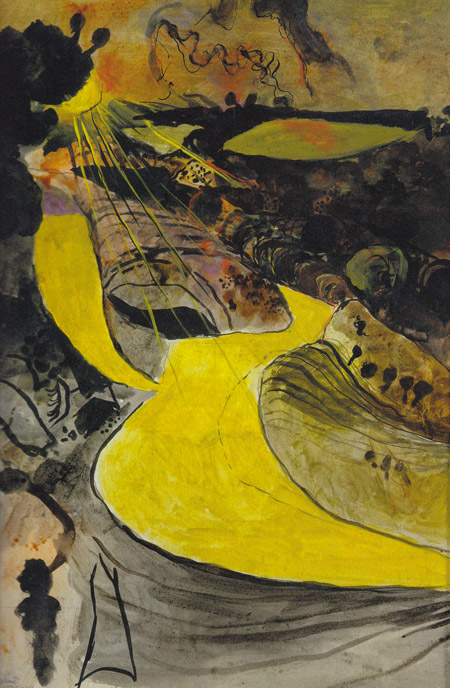
Welsh Landscape with Yellow Lane 1939-40. Private Collection, London

In a video to accompany the exhibition, curator (and artist) George Shaw, describes how the use of yellow gives the appearance of a landscape which is jaundiced; perhaps sick. I however see this sickness not as a part of the landscape, but a part of our own vision of ourselves; our place in the ‘grand scheme of things.’ Even where Sutherland has painted machines (which by their very existence would seem to point towards the existence – and therefore relevance – of mankind), there is still the sense of Man’s complete absence from the world. It’s as if, as I’ve said, these paintings depict those two great and awful spans of time, between which Man’s existence is pressed, like rocks beneath the vast sheets of ice, which once crawled and covered this place we call home. (Even those gargantuan glaciers – in places almost a mile thick – which smothered the country for so many thousands of years, would seem like Browne’s ‘pillars of snow’ when considered against the backdrop of eternity.)

In the exhibition’s first few paintings, we find these same desolate landscapes, replete with standing stones (for example, in ‘Sun Setting Between Hills’ below) such as those found at ancient sites throughout the country.
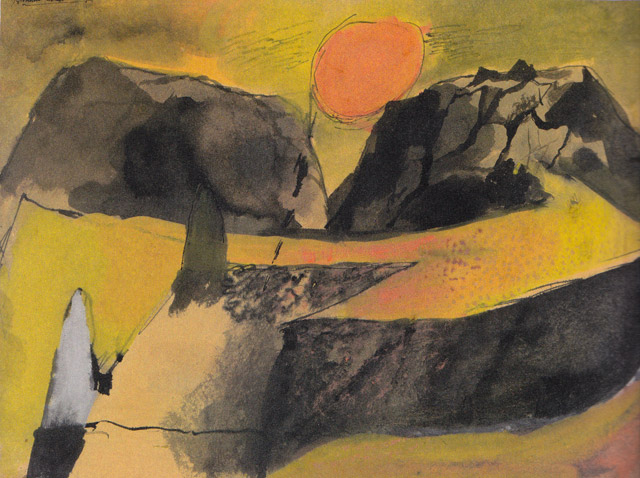
Sun Setting Between Hills 1937. Private Collection

At once these landscapes become charged with mystery, and like those paintings which show, for example, cranes gorging themselves on the landscape, we are presented with evidence of Man’s existence. The standing stone and the ruined urban landscape, mirror one another. Poles apart, they seem to delineate this landscape in which we, for a short time, have strutted the stage of our existence. No-one is likely to walk the yellow roads which cut through the world above – yet someone must have been there.
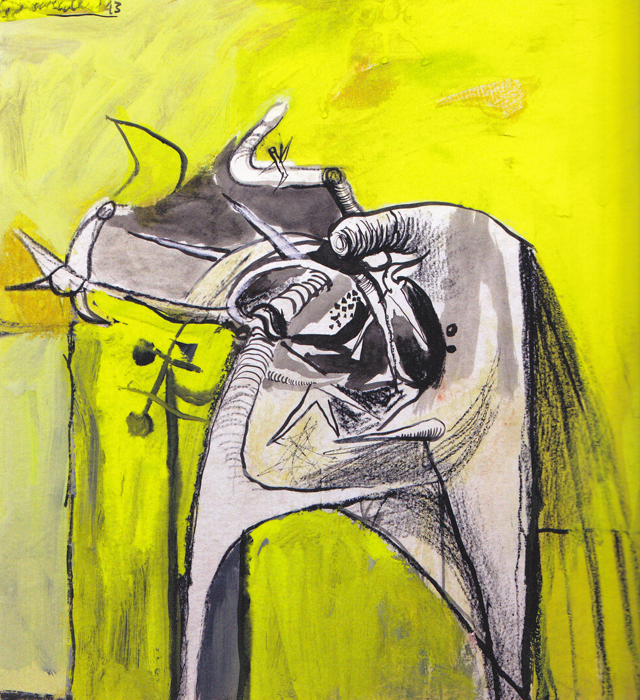
Interlocking Tree Form 1943. The Whitworth Gallery, University of Manchester

Despite this apparent absence of Man, the trees in some of Sutherland’s landscapes seem almost human, at least in their gestures. Some such gestures echo the agonies of Picasso’s ‘Guernica’, (for example, in ‘Interlocking Tree Form’ above) while ‘Study for a Blasted Tree,’ calls to mind Goya’s ‘Disasters of War.’
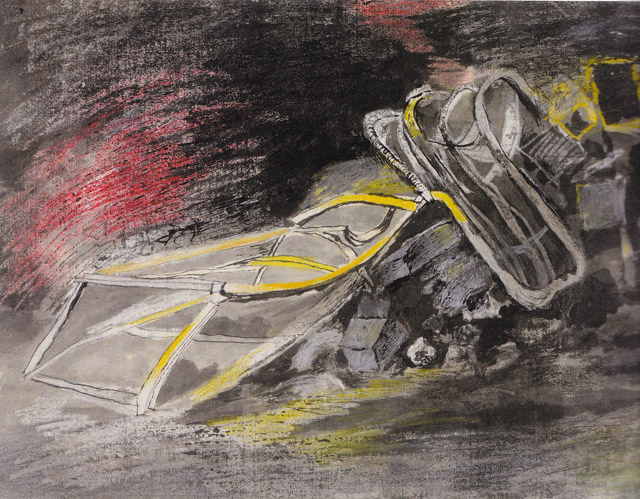
Fallen Lift Shaft 1941. Junior Common Room Art Collection, New College.

It was whilst looking at the painting above, that I found myself thinking of William Blake. In this work, ‘Fallen Lift Shaft,’ there is a small patch of red which is reminiscent of some of the poet’s own paintings. The lift is on the one hand a casualty of war, a victim of Man’s aggression. On the other it’s a symbol of his descent. It is perhaps the Fallen Angel.

The exhibition is titled ‘An Unfinished World‘ and whilst reading Richard Dawkins’ book ‘The Ancestor’s Tale,’ I found a quote, which for me encapulsates what that title means. The world, with or without Man, is always unfinished. Dawkins writes:

“The second connected temptation is the vanity of the present: of seeing the past as aimed at our own time, as though the characters in history’s play had nothing better to do with their lives than fore-shadow us.”

In other words, we are not the end, just as we weren’t the beginning. And it’s this conceit which Browne cautions against in his meditation on death discussed above. Sutherland’s landscapes are for me, the equivalent of trying to imagine one’s own non-existence in a world which is always, as Neil Oliver writes, ‘a work in progress,’ one in which nature will one day set about reclaiming from Man.

One might think it’s possible therefore to view Sutherland’s paintings as a warning against this conceit. But to do this is in itself a kind of conceit. The fact is, we are just another part of the landscape. The yellow road was there before us, and after us the yellow road rolls on. Sutherland’s paintings are not warnings, but statements of fact.

And while this might sound somewhat depressing, another quote from Dawkins (again from ‘The Ancestor’s Tale’) might just lift our spirits:

“As physicists have pointed out, it is no accident that we see stars in our sky, for stars are a necessary part of any universe capable of generating us. Again, this does not imply that stars exist in order to make us. It is just that without stars there would be no atoms heavier than lithium in the periodic table, and a chemistry of only three elements is too impoverished to support life. Seeing is the kind of activity that can go on only in the kind of universe where what you see is stars.”
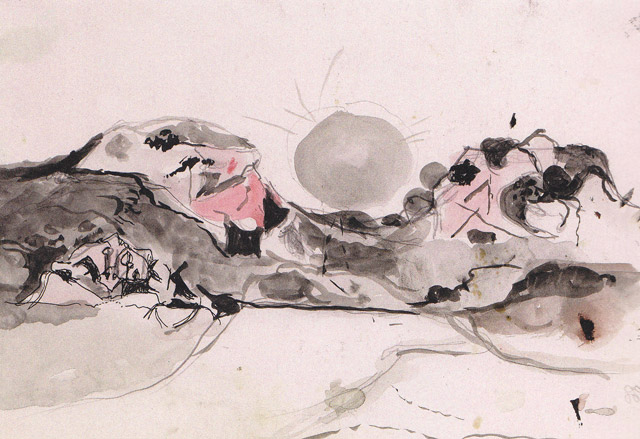
Landscape 1969. Harry Moore-Gwyn (Moore-Gwyn Fine Art)

In many of Sutherland’s works, our very own star, the sun, is present such as in the work above. In one of the first paintings within the exhibition, to the last (painted just four years before his death- see below) the same sun is in view.  
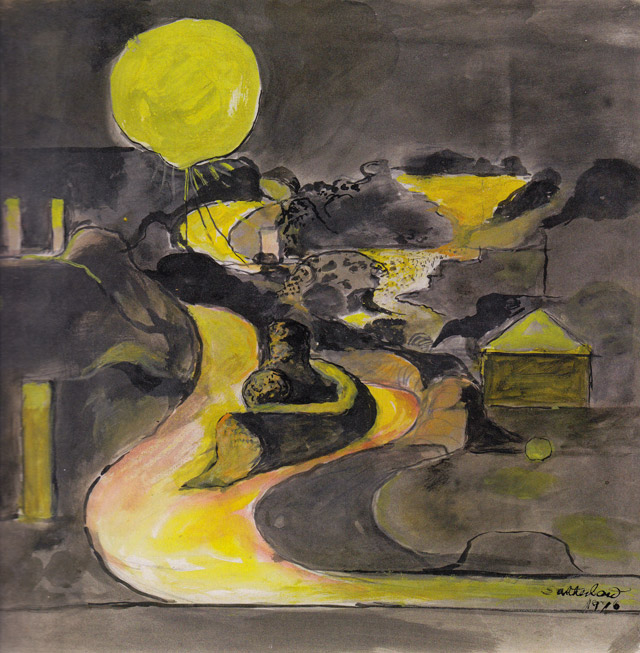
Twisting Roads 1976. Private Collection.

And we – like Sutherland – can only see it, we only know it, because we exist. 

Perhaps therefore, in Sutherland’s work, humankind is in evidence after all.

Filed Under: Trees Tagged With: Art, Exhibitions, Graham Sutherland, Stars

Leaf and Shard

October 17, 2011 by Nicholas Hedges

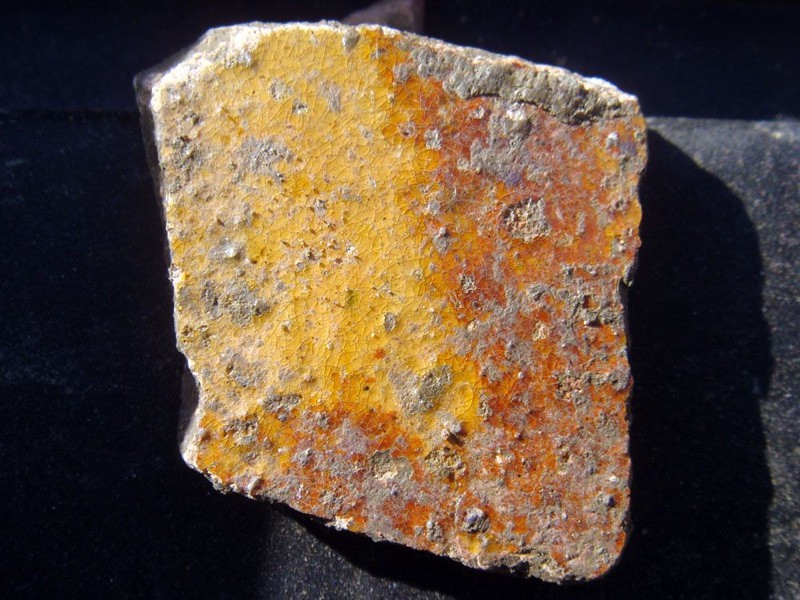
Out of a small pile of earth, greyish-brown in colour, a piece of brightly glazed pottery appeared as I scraped with my trowel. Although only a few centimetres across it was nonetheless striking given the colours of its glaze; an orangey-yellow and warm reddish-brown, as vivid perhaps as when it was a whole piece of pottery in use however many centuries ago.


Colour, in this example, becomes for me a vehicle for a more empathetic engagement with the past (a theme central to my work). The colour of the sky, the apples on the trees, the trees themselves and the grass were one with the colours of this small fragment of pottery, which until that moment had remained hidden for (perhaps) hundreds of years. It was as if, rather than a shard of pottery, a piece of colour (or colours) from a day hundreds of years ago had lain buried in the soil; colours which at once melted back into the world from which they’d been estranged so long .

Pulling this shard from the almost monochromatic soil, was like looking at an old black and white photograph, where one imagines colour then movement. And looking up at the chapel, at the world moving all around me, I could, in that split second, glimpse the mediaeval past, acknowledging that that distant time was (although very different) just like the world today; there were colours and movement, experienced by individuals just like me and whoever had used whatever the fragment had once been a part of.

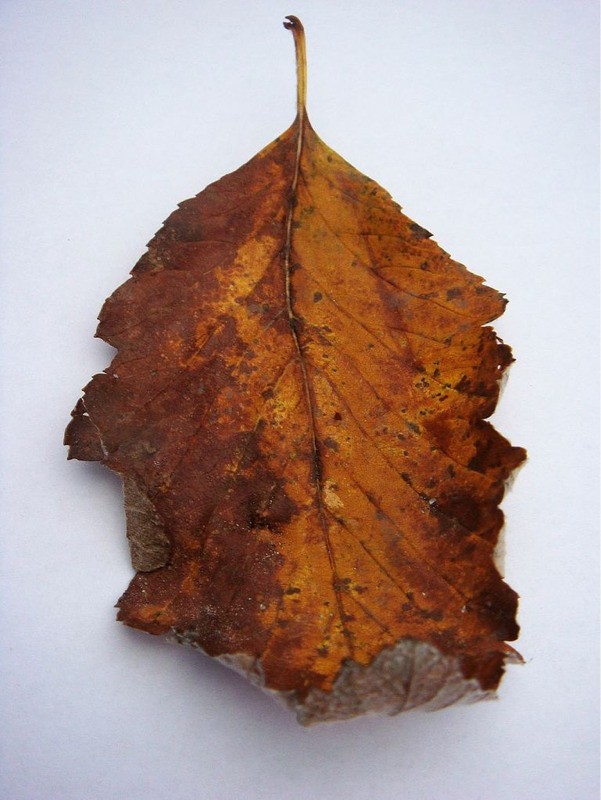
A little later as I continued to dig, I found a leaf inside my trench which had blown in from the side. The colours were very similar to that of the pottery (although they have darkened since). And once again this link between the past and present came to the fore. I was thrown back to a mediaeval autumn and imagined autumn in that very spot centuries ago. Like a chain reaction, I imagined the buildings, the road nearby, the walk into town. What was Oxford like at the time as the world moved towards the winter?


This single leaf (pictured above) is pregnant with the passage of time, the unrelenting march of time through another year, towards its end. The colours are like a sunset; the end of a year, the end of a day. But after night comes morning and after winter, the promise of spring. This idea of a continuous cycle seems embodied in both the leaf and the shard. One is young, the other very old – they turn or move in different ‘orbits’ – but nonetheless, in their colours, they have something in common; something I have in common with the individual who owned the pottery (from which the fragment comes) centuries ago; that is, we are part of the same world.

Filed Under: Archaeology, Trees Tagged With: Archaeology, Colour, Fragments, Leaf, Movement, Nowness, Pottery

Bartlemas Chapel Observation

September 20, 2011 by Nicholas Hedges

Taken from Artefact – a website concerning Contemporary Art and Archaeology.

I’m making this initial visit to the chapel a few days before archaeological excavations are due to begin within its grounds. I’m interested in how my initial observations might be tied in with both the archaeology discovered there and the chapel’s history. How far is empathy an augmented discourse between bodily experience and knowledge?

As usual, I began by observing the chapel using a Goethean methodology, which – as if often the case – ended up following its own course.

Pre-Observation

Leaving Cowley Road and walking up the track to the chapel was like leaving the modern world behind; not completely for the outside around the chapel and here inside once can still hear the traffic humming like an overhead cable carrying electricity.

The first thing I notice when entering the chapel is the smell; the smell of age, of the past – the smell of the rooms in the church I’d attended as a child. Old books, paper and damp.

The light is slowly beginning to fade being as it is 6pm and the weather grey and raining.

I shall endeavour to carry out the observation without electric light for as long as is possible.

Part 1

The chapel is small comprising two parts divided by a screen. The main door on the chapel’s western side is locked and one enters through a small door on the left hand (north) side. (I’m going to carry out my observation inside rather than out – not least because of the rain, but also because I can easily record outside at a later date).

The walls are all whitewashed; they are rough and bumpy beneath revealing the stone. There are five windows, each of which is arched and through which the last light of the day is creeping. Behind me to my left is a large door in front of which are stacked wooden chairs – no doubt for congregations when services are held here, which they still are. Along the left hand wall more chairs are lined up in a row – eight of them. At the end facing me and in front of the screen are two small pews. Running alongside the right hand wall is another row of chairs – nine of them. There is a radiator, an old wooden cupboard on the side of which are electric sockets and a light switch. I’m sitting on a small wooden bench. In the corner to my right is a large red candle holder replete with candle – no doubt for ceremonial purposes.

Ahead, either side of the doorway through the screen are two small stools. Beyond the screen, from my position, I can see a wooden altar with a crucifix and four candles. A stool stands before them on which rests a box. Above the altar is a window and on the left and right hand walls are also windows. In the wall in this half of the building, on the right hand side from where I am sitting is another window upon the sill of which – which is deep – sits a book, open on a small lectern. Another lectern stands next to me on my right with a book containing the names of visitors. I write my name in it now.

I get up and walk. The hum of the traffic is weak like the light. I can hear the wind rustling the trees outside. Outside the window above the book is an apple tree covered with fruit. My footsteps echo.

I measure the first part of the chapel which is approximately 8 paces. The floor in this part of the chapel is parquet. In the part ahead of me it’s stone.

The pew creaks as I sit down. There are two small pews divided in two to accommodate two people. There are candle stands with low candles (burned down) on my left, a crucifix on a pole and a blue bottle of gas. On the right hand side is another blue bottle, two more well-used candles, four chairs and a picture of Christ. I see now that the altar is stone. Either side in the corners are two wood burners. The window in the left wall is narrower than the others and has a deep sill. This part of the chapel again measures approximately 8 paces.

On a window sill (right) is the curled body of a dead fly. Outside I see the apple trees and the leaves on the wet grass.

The altar is covered by a cloth – green and another white one beneath.

The bible on what I now see is a folding lectern is open at John. Tomorrow’s reading, John 3:13-17.

The ceiling is wooden with numerous coloured shields placed between the beams. The light is fading and it’s getting harder to see.

As I stand before the altar my face is drawn up to the window above it and to the sky. I turn to my left and see the old building that stands alongside. The wind stirs again. There is a white iron work chair in the garden outside. No-one is sitting in it of course.

The window above the large door in the western end of the chapel is smaller than all the others. Again I find my eyes drawn up towards it, to the pale grey light of the sky. There is a large hole in the wall on the right hand side (as I look at it) no doubt where a wooden bolt was once used to secure the church.

There are two circles, unwhitewashed either side of the door.

There are four ‘arches’ supporting the ceiling. The wood appears to be very old. The stone of the floor around the altar is patterned almost as if something has spilled upon it and not quite dried.

The width of the chapel is 7 paces.

I look again at the book full of names and dates – someone from as far away as Australia has visited here. In just a few pages we’re back at the start of 2005. I think of what I’ve done in these few pages – I think of the people I know who have recently passed away.

As the light fades the windows become a stronger presence as they hold what remains of the light outside. I can hear the chimes of an ice-cream van – a sound from my childhood. But although the windows are dominant, I don’t find myself looking beyond – just at them.

Echoes and footsteps. Car horns.

Part 2

I allow the cars and the sounds of the modern world to fall away and instead I listen only to the wind blowing through the trees. I look outside at the trees. I imagine the fruit trees across hundreds of seasons, bearing fruit, dropping the fruit, surviving the winter, blooming again in the spring. I imagine how much more important apple trees would have been long ago; a vital source of food rather than something one might idly pick while strolling past. The book on the sill is open at a text on St. Bartholomew. The words are silent on the page.

I read the first few words on the saint. I turn the page – again the ice-cream van. The page creaks like the pew I sat on. I can hear the words as I read them in my head, although of course they make no sound. I imagine hundreds and thousands of internal voices of people who have stood inside the chapel.

The shadow cast by my hand is more prominent here before the window.

I pick a spot on the left hand side of the chapel looking towards the altar. I imagine all those who have stood here in my place over the centuries, looking to their right at whatever was outside; up ahead through the window; at the others standing there with them; and I begin to imagine those other people. I begin to try and imagine their presence.

The crows outside help dispel the modern world. I think of the floor – how it would have been. I imagine the city behind me, Oxford as it was a few hundred years ago.

I move around the chapel before the screen and glance behind me to the side and up ahead and where I see the walls and windows I imagine people. Each glance is accompanied with a thought – my thoughts.

I try and get a sense of my body in relation to the chapel.

The shadows grow across the floor, blurring to become the first signs of nightfall. Forms in the chapel, like the legs of the chairs against the walls begin to disappear. Everything becomes a shadow – perhaps even me.

I imagine the large locked door being opened and people filing into the light behind. I picture that light filling the chapel, chasing away the shadows.

I’m aware of my body – how my back is aching – how I’m hungry.

The green of the leaves outside is still very visible. Everything is brown, green and grey.

My shadow is faint on the wall.

I move to stand before the altar. I turn and face the large door. Lines of sight from people long since gone still linger. I turn and face the altar. My eyes are drawn to the window, following these eye lines behind me.

I imagine the candles flickering, casting shadows on the walls as the light continues to fade. These candles which are little more than stubs of wax with short blackened wicks and puddles of wax around them.

The sound of the traffic cannot be stopped. It’s always present like interference. The only way to hear the past is with my body.

Part 3

(Rather hard as I can hardly see to write.)

Fleeting, embodied shadows.

I try and think of myself as the chapel. There is, like everything, an outside (exterior) and an inside (interior). I can feel my body – my presence – not so much as me but as something within the chapel.

Contact with the floor, with the furniture means that the chapel and I are one.

NB I have to put on the light – and only then am I aware how dark it is outside. The shift from an external light and interior dark to interior light and external dark is striking. When I turn off the light it’s reversed.

I’m aware of my heart as I sit with my eyes closed – of my breathing. My back against the wall – my breathing and heartbeat becomes that of the chapel.

Exterior / interior.
Beyond the chapel and inside.
Beyond my own body and inside.
A reversal of the two.
Interior voice reading / exterior voice listening.

With the lights on, the light beyond the window is blueish above the door. Up ahead, the window above the altar is dark.

Again there is almost a grain in the building – of sight. Looking towards the altar one is aware of the individual; then turning round, of a crowd.

Filed Under: A Line Drawn in Water, Goethean Observations, Trees Tagged With: Archaeology, Bartlemas Chapel, Goethean Observation

Belzec Video: Snow 5

June 18, 2011 by Nicholas Hedges

The same idea as before applied to footage of trees at Belzec. The number of squares used is the same as an earlier work.

Filed Under: Holocaust, Trees Tagged With: Belzec, Death Camps, Empathy, Holocaust, Snow, Video, WWII

Belzec Video: Snow 3

June 18, 2011 by Nicholas Hedges

What interests me about the video footage from the archaeological dig at Belzec (1999) is the sense of colour and movement. Often, when one is researching the Holocaust and sites like Belzec, most of the imagery one encounters is black and white and often still (although of course there is a great deal of moving footage as well).

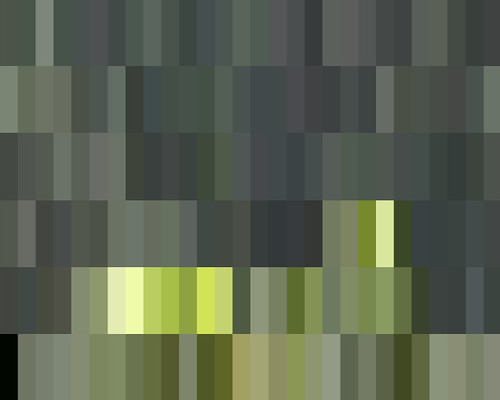
As I’ve said, it’s difficult, given the quality of the footage, to make anything that would resemble a narrative of the investigation carried out there. So taking the idea of colour and movement as something I wanted to work with, I decided to process the video and to use a mosaic filter to reduce the image to pure forms.

When I was an undergraduate in the early 1990s, I produced a series of paintings based on this idea in a work entitled ‘A Single Death is a Tragedy, a Million Deaths is a Statistic.’ I was looking at the idea of anonymity and the past as anonymous (something which I’m still looking at today) reducing the image of a man, through a series of canvases to a single coloured pixel.

One of the ways of understanding an event as horrific as the Holocaust on an empathetic level (as far as is possible) is through understanding that the past was once the present that what happened in places such as Belzec happened when the past was now. When I sit here now and look out the window, I see the trees move, I see their colours, I see the sky, the clouds drifting and so on. I see movement and colour.

Whenever I look at images of the past, especially those in black and white, I try to imagine the scene as if it was now. I colour it, I imagine what happened immediately after the shutter was released. The smallest details become especially important. When I myself visited Belzec in 2007, I was aware of the world moving all around me, of the trees especially; of the sounds they made and the colour. Putting this together with what I knew had happened there, enabled me in some small way to empathise with those who died.

The stills below are taken from the processed video and even though they reduce the place to pixels (and therefore render it anonymous) there is something about the individual squares of colour which serve somehow to represent both the anonymous individual and the nownes of the present.

Mosaic Stills

Mosaic Stills

Mosaic Stills

Filed Under: Holocaust, Trees Tagged With: Belzec, Colour, Death Camps, Empathy, Holocaust, Snow, Video, WWII

Empathy and the First World War (Part 5)

March 9, 2011 by Nicholas Hedges

The backgrounds of these postcards have become of great interest to me in as far as they help elicit a sense of empathy with those who are pictured. Some of the postcards feature no backgrounds at all and are simply headshots which make an empathetic response a little more difficult. What I want to look at here are natural and studio-based backgrounds, examples of which can be found below.

I’ve already looked at two postcards (see Part 3 and Part 4) with photographs taken in natural settings and these settings can be further subdivided into those which are domestic and non-domestic. It’s those taken in what are clearly domestic settings – for example the backyards of houses – which are the most poignant, for the obvious reason that they are photographs of homes these men would soon be leaving. And again the question begs to be asked, would they ever return?

This photograph was clearly taken in a back garden, one which seems to comprise little more than dirt. In the background, the backs of other houses are visible and next door appears to have what looks like a chicken coup, with chicken wire fixed above the fence. What is striking about this image is the cleanliness of the soldier’s uniform. His coat is spotless; it’s almost as if this young man is little more than a child playing soldiers in the garden, and it’s difficult to look at him knowing full well what he’s about to endure.

I’ve already discussed windows in old photographs and in the background of the image above one can see a window of one of the houses behind.

I wonder what the same scene would be like if I was standing behind, looking through the net curtains? I’d see the back of the young man being photographed and those who are taking the picture – more proud parents perhaps? I’d watch for a while, then turn my back and return to my own life within the terraced house. It’s imaginative wanderings like this which serve to animate the scene, to remind us that the past was once ‘now’.

I imagine this photograph was taken in the garden of the soldier’s parents’ house. I can imagine them holding this image, just as I’m doing now and walking outside to see that corner of the garden in which he’d been standing. The dilapidated fences, the dirt ground, the trees and the houses behind would all resonate with his presence. If I walk outside into my own garden, with this image in my hand, everything that makes ‘now’ what it is, would serve to animate it. The feel of the wind, the sounds of the birds in the trees, the feel of the ground beneath my feet etc.

This photograph was obviously taken in a studio and whereas in the previous image the backdrop is a real scene, the one above is like something from an 18th century painting. In the foreground we can see bunches of wild flowers growing alongside a quiet country track, leading off through an idealised landscape complete with ‘Rococoesque’ trees, a river and a picturesque bridge. One almost expects the solider to turn away from the incongruous chair and to walk off up the path and out of sight.

With the first image, the domestic backdrop of a garden, its fences, the chicken coup and the backs of neighbours’ houses provides a stark and disturbing contrast with what we know awaited the young man being photographed. This contrast is just as stark in the studio picture above, and in some respects even more disturbing.

Whereas the fictional scene could at least be imagined by the artist, what the man standing before it was about to face on the battlefield would never have been conceivable even with the keenest of imaginations. Reality was in a way even less real than this Arcadian backdrop which seems to depict something akin to Paradise. Perhaps this is why I find this image so haunting?

The reverse of the postcard contains text which reads: To Mr J Wade, With happy memories of past days spent at Waresley House. 

I did some research into Waresley House and discovered that it was once the home of both the Peel family (Robert Peel) and the Perrins family of Worcester Sauce fame. A large Georgian pile, I wondered what the soldier did there, who Mr J Wade was and whether or not he was the owner of the house. Having looked at the 1911 census however, I could find no record of Mr Wade. The house was owned by a Mr Gibbons, an 87 year old widower who lived there with his two daughters (both single and aged 49 and 47) and nine domestic servants.

It is possible that Mr Gibbons died soon after 1911 and that Mr Wade took over the house thereafter. Looking for Mr Gibbons on Ancestry, I found him in the same house in 1891 along with 13 children. The cook in 1911, Mary Pugh was also listed. 

Filed Under: Photography, Trees Tagged With: Empathy, Photographs, Vintage Photographs, World War I, WWI, WWI Postcards

Reading Roads

March 8, 2011 by Nicholas Hedges

Introduction

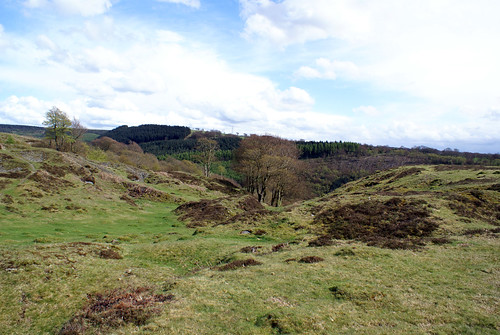
In Wales in 2008 I walked a path along which my great grandfather had walked every day from his home to the mines in which he worked. He died in 1929 (as a consequence of his work) and all I knew of him, before my visit, were what he looked like (from two photographs) and things my grandmother had told me. But on that path I felt I found him on a much deeper level. The feel of the wind, the way the clouds moved, the sound of the trees and the line of the horizon were all things he would have experienced in much the same way. It was as if these elements had combined to ‘remember’ him to me.

Hafodyrynys and Surrounds

As a consequence of my walk, the line which linked us on my genealogical chart changed to become instead a path, for when I follow lines in my family tree from one ancestor to the next and find myself at the end, so that path in Wales had led to my being born. That path on which I walked for the very first time, was as much a part of who I was as my great grandfather: “places belong to our bodies and our bodies belong to these places.” [i]
Roads (paths, tracks and traces) have become an important part of my research and it was whilst reading Edward Thomas’ poem Roads that I found connections between what he had written and what I was thinking. I’ve reproduced the poem below, and where necessary added my thoughts.

Roads by Edward Thomas (1878-1917)
I love roads:
The goddesses that dwell
Far along invisible
Are my favourite gods.
Roads go on
While we forget, and are
Forgotten like a star
That shoots and is gone.
The reference to stars (or a star) in this verse, reminds me of a quote (to which I often refer) from Roland Barthes’ book Camera Lucida, in which he writes:

“From a real body, which was there, proceed radiations which ultimately touch me, who am here; the duration of the transmission is insignificant; the photograph of the missing being as Sontag says, will touch me like the delayed rays of a star. A sort of umbilical cord links the body of the photographed thing to my gaze – light though impalpable, is here a carnal medium, a skin I share with anyone who has been photographed.”

The star shoots its light and is gone and similarly we walk and are gone. But what is left behind is the road, a version of the light left by the disappeared star; a ‘delayed’ ray which allows us to ‘see’ those who went before us. I use the word ‘see’, but we ‘see’ with our bodies. We see the light from the star, but we feel the road. This in turn brings me to the idea of empathy as something which is tactile and kinaesthetic.  Roads and paths become ‘a sort of umbilical cord… a carnal medium, a skin I share’ with those who’ve walked that road or path before – precisely what I’d felt in Wales.

On this earth ’tis sure
We men have not made
Anything that doth fade
So soon, so long endure:

In the third verse we might interpret the lines as a description of the difference between the act of walking and the road itself. We walk in the moment – a moment which fades in an instant (‘so soon’) and yet, behind us a record of the sum of all those moments is lined up along the road behind us – one which endures for centuries. It’s the same difference as that between speaking and writing; one is fleeting, the other endures. Christopher Tilley writes that “…if writing solidifies or objectifies speech into a material medium, a text which can be read and interpreted, an analogy can be drawn between a pedestrian speech act and its inscription or writing on the ground in the form of the path or track.” [ii] Paths and roads ‘record’ our movements, they are texts which we can read with our feet. 
The idea of the ‘moment’ is also discussed by artist Bill Viola who writes that:
“We have been living this same moment ever since we were conceived. It is memory, and to some extent sleep, that gives the impression of a life of discrete parts, periods or sections, of certain times or highlights. [iii]
This ‘same moment’ is in many respects like the act of walking and the road rolled into one; it fades and yet endures at one and the same time. There is an echo of this idea in Camera Lucida when Barthes writes:
“In the photograph, Time’s immobilisation assumes only an excessive, monstrous mode: Time is engorged…” [iv]
I described earlier, how the path on which I walked in Wales was as much a part of me as my great grandfather; it was the first time I’d ever walked it and yet I was a part of it long before I was born. There is then a continuous moment running along all paths and roads, and it’s memory and to some extent birth and death that gives the impression of discrete parts. This ‘universal’ moment is the ‘nowness’ of the present and it was this ‘nowness’ which I experienced on that path in Wales and which I’ve since been exploring in my work as regards empathy.
“The feel of the wind, the way the clouds moved, the sound of the trees and the line of the horizon were all things he would have experienced in much the same way.”
The third verse in Thomas’ poem seems to me to allude to the idea of experiencing the moment:

The hill road wet with rain
In the sun would not gleam
Like a winding stream
If we trod it not again.

The ‘we’ in the last line refers to us as individuals, whether ‘we’ were walking that path in 1915 or today in 2011; if ‘we’ weren’t there to see it, it wouldn’t be seen at all. 
In the fourth verse we read the following:

They are lonely
While we sleep, lonelier
For lack of the traveller
Who is now a dream only.

Before I look at this verse, I want to look at another quote; this time from the catalogue of a Paul Nash exhibition in which David Fraser Jenkins writes how Nash:
“…did not often show people in the landscape, even walking about in his lanes and paths, and as a result his pictures look deserted… Despite this absence, there is in his pictures a remarkable sense of drama, and it is this reaction between things – the trees or the buildings… that these pictures are about.” [v]
Looking at the fourth verse above, we can say that the ‘lack of the traveller’ alludes to the passing of that traveller, whether from the immediate scene, or perhaps life itself. Either way, all that’s left of what Sontag called ‘the missing being’ is the trace of the road on which they walked, the text written as they travelled. That traveller is now a dream, dreamt by the road and the elements by which it’s surrounded, a dream which I see expressed by David Fraser Jenkins as a ‘remarkable sense of drama’. The road might be lonely, but it’s never empty; the trees, the buildings, the feel of the wind and the way the clouds move all dream of the traveller – the missing being. There’s also a parallel to be found here in Rainer Maria Rilke’s Duino Elegies, where in the second elegy we read:
Look – trees exist.
The houses we live in continue to stand. Only we
pass away like air traded for air and everything
conspires to maintain silence about us, perhaps
half out of shame, half out of unspeakable hope. [vi]
This ‘silence’ alludes I think to what Jenkins describes as a ‘remarkable sense of drama’ and what I have called a ‘dream’. But how can we connect with these? In his book The Materiality of Stone,  Explorations in Landscape Phenomenology, Christopher Tilley writes:
“The painter sees the tree and the trees see the painter, not because the trees have eyes, but because the trees affect, move the painter, become part of the painting that would be impossible without their presence. In this sense the trees have agency and are not merely passive objects. [Martin] Dillon comments: “The trees ‘see’ the painter in a manner comparable to that in which the mirror ‘sees’ the painter: that is, the trees, like the mirror, let him become visible: they define a point of view on him which renders visible for him something that otherwise would remain invisible – his outside, his physiognomy, his carnal presence… The trees and mirror function as Other.” [vii]
Just as the trees function as what Dillon calls ‘Other’, so does everything else. It’s as if the shapes of disappeared travellers are somehow retained, like the people-shaped holes in the ash of Pompeii, which when filled with plaster, revealed the presence of people lost for almost 2000 years. Similarly, people-shaped holes exist along every road or path; gaps which can only be filled with our own bodies, by our own presence; by our experience of the nowness of the present.
In a definition of the Metaphysical poets, Georg Lukács described their common trait of ‘looking beyond the palpable’ whilst ‘attempting to erase one’s own image from the mirror in front so that it should reflect the not-now and not-here.’ [viii] For me, the road is the mirror which Lukács describes, and as I walk along it, I try to look beyond the palpable, to erase my own image so that the road reflects the not-­now and not-here. The palpable is the present (as opposed to the nowness of the past); the not-now and not-here is the nowness of that continuous moment in its entirety. To erase one’s image is to imagine one’s own non-existence, to see a part of that continuous moment when one did not exist, when that part was nonetheless now. It is about seeing the presentness of past events.  

From dawn’s twilight
And all the clouds like sheep
On the mountains of sleep
They wind into the night.

The next turn may reveal
Heaven: upon the crest
The close pine clump, at rest
And black, may Hell conceal.

Often footsore, never
Yet of the road I weary,
Though long and steep and dreary,
As it winds on for ever.

Helen of the roads,
The mountain ways of Wales
And the Mabinogion* tales
Is one of the true gods,

(*In the tale of Lludd and Lleuelys from the Mabinogion, you will find the following text: “Some time after that, Lludd had the island measured in length and breadth; the middle point was found to be in Oxford. There he had the earth dug up, and in that hole he put a vat full of the best mead that could be made, with a silk veil over the surface. He himself stood watch that night.” I discovered this passage whilst researching my Welsh ancestry, and being as I am from Oxford, found it rather appealing.)

Abiding in the trees,
The threes and fours so wise,
The larger companies,
That by the roadside be,

And beneath the rafter
Else uninhabited
Excepting by the dead;
And it is her laughter

At morn and night I hear
When the thrush cock sings
Bright irrelevant things,
And when the chanticleer

Calls back to their own night
Troops that make loneliness
With their light footsteps’ press,
As Helen’s own are light.

Now all roads lead to France
And heavy is the tread
Of the living; but the dead
Returning lightly dance:

Whatever the road bring
To me or take from me,
They keep me company
With their pattering,

Crowding the solitude
Of the loops over the downs,
Hushing the roar of towns
And their brief multitude.

The line ‘Now all roads lead to France’ reminds us that those who fell and are buried in France (and indeed other countries) were men with lives beyond the theatre of war – that the theatre of war extends well beyond the boundaries of any trench map. To know them and to know the missing, we have to follow the roads from France back to the towns and villages where they lived, just as to know ourselves we should follow the roads and paths from our own hometowns to those of our ancestors. To walk those streets, paths and tracks, is to turn them back into ‘consanguineal lines’; to restore lost connections in forgotten family trees; to remind us that those who fought and died were each part of a family as well as a wider community of friends and acquaintances.
The road brings and takes away and the dead keep us company at every step ‘with their pattering’. Again this could refer to the idea of the moment as being both fleeting and enduring. The moment is like a looped recording which plays and records at the same time, creating a kind of palimpsest, where all that’s gone before is contained in a moment, like light, tens of thousands of years old seen in a single second.
The line ‘Crowding the solitude,’ echoes what I wrote earlier, that roads might be lonely, but they’re never empty. And finally in the last two lines, Thomas reminds us of our own mortality; where the multitudes that make the towns roar are themselves brief. 


i Christopher Tilley, 1994, A Phenomenology of Landscape, Oxford, England, Berg
ii Christopher Tilley, 2004, The Materiality of Stone – Explorations in Landscape Phenomenology, Oxford, England, Berg
iii Bill Viola, 2005, Reasons for Knocking at an Empty House, Writings 1973-1994, Thames & Hudson
iv Camera Lucida, Roland Barthes, Vintage, 2000
v David Fraser Jenkins, 2010, Paul Nash – The Elements, London, Scala Publishers Ltd.
vi Rainer Maria Rilke, Tr. Martyn Crucefix, 2006, Duino Elegies, London, Enitharmon Press
vii Christopher Tilley, 2004, The Materiality of Stone – Explorations in Landscape Phenomenology, Oxford, England, Berg
viii http://en.wikipedia.org/wiki/Metaphysical_poets

Filed Under: Paintings, Trees Tagged With: Barthes, Bill Viola, Christopher Tilley, Family History, Family Jones, Jones, Paintings, Paths, Paul Nash, Rilke, Roads, Silence, Stars, War Poets, World War I, WWI

Roads by Edward Thomas (1878-1917)

March 8, 2011 by Nicholas Hedges


I love roads:
The goddesses that dwell
Far along invisible
Are my favourite gods.

Roads go on
While we forget, and are
Forgotten like a star
That shoots and is gone.

On this earth ’tis sure
We men have not made
Anything that doth fade
So soon, so long endure:

The hill road wet with rain
In the sun would not gleam
Like a winding stream
If we trod it not again.

They are lonely
While we sleep, lonelier
For lack of the traveller
Who is now a dream only.

From dawn’s twilight
And all the clouds like sheep
On the mountains of sleep
They wind into the night.

The next turn may reveal
Heaven: upon the crest
The close pine clump, at rest
And black, may Hell conceal.

Often footsore, never
Yet of the road I weary,
Though long and steep and dreary,
As it winds on for ever.

Helen of the roads,
The mountain ways of Wales
And the Mabinogion tales
Is one of the true gods,

Abiding in the trees,
The threes and fours so wise,
The larger companies,
That by the roadside be,

And beneath the rafter
Else uninhabited
Excepting by the dead;
And it is her laughter

At morn and night I hear
When the thrush cock sings
Bright irrelevant things,
And when the chanticleer

Calls back to their own night
Troops that make loneliness
With their light footsteps’ press,
As Helen’s own are light.

Now all roads lead to France
And heavy is the tread
Of the living; but the dead
Returning lightly dance:

Whatever the road bring
To me or take from me,
They keep me company
With their pattering,

Crowding the solitude
Of the loops over the downs,
Hushing the roar of towns
And their brief multitude.

Filed Under: Trees Tagged With: Edward Thomas, Poem, Roads, War Poets

Empathy and the First World War (Part 2)

March 4, 2011 by Nicholas Hedges

This image was taken almost a year after the end of the First World War, on August 27th 1919 and is unusual in that, unlike the vast majority of photographs from this period, it’s in colour. What it shares with the image I described previously however – see Empathy and the First World War (Part 1) – is that it shows the process of burying the dead, long after the last guns have fired. We don’t see any corpses here, but we see the holes in the ground. On the right hand side, three crosses mark recent burials, while seven men look at the camera. A man sitting down by the tree seems to be writing.
With this photograph I can, perhaps not surprisingly, engage much more easily on an empathetic level compared with that I discussed previously. The colour and the texture of the soil, which the colour conveys, means that I can almost feel the ground. I can imagine walking into it, whereas with the previous image I’m kept at a distance. This photograph is about the soil and if the previous image seemed to me, to be about the thin divide between life and death, this image seems to say much the same thing. Like the (living) men in the previous image, these men are also all dead. The graves they’ve dug could easily be their own. But whereas the men in the previous image were looking at the bodies of their fallen friends, the gravediggers in this image, look directly at us. This is what awaits us all.
In many respects then, this image is, for me, quite an unsettling one – even more than that I discussed before. ‘The men that we’re about to bury,’ the men seem to be saying, ‘are just like you’. (I was reminded, looking at this image, of the fact that when soldiers marched to the front, just before an attack, they sometimes saw the huge pits dug in preparation for their deaths.)

But would such interpretations arise if the image were black and white? My feeling is they wouldn’t and having made the image monochrome, I can see why.

For one thing, it ceases to be an image into which I feel I could step; it remains very much an image. Colour delineates distance, whereas in black and white the image seems a lot flatter. (I have to point out that I’m not suggesting black and white photos don’t convey distance, or that this colour image, made black and white accurately reflects how it would look if shot on black and white film. The autochrome process, when made black and white like this, makes the resulting image very grainy). Secondly, the men no longer seem to be looking at me, but rather at the photographer. But most importantly, as a black and white image, this picture ceases to be about the soil, the substance which, during the war claimed both the living and the dead. The distinction between the soil and the grass is lost – a distinction which, in light of the time (1919), is especially poignant. Nature returns to reclaim what’s hers, and following the gaze of the diggers, that includes us. World War I was about, amongst many other things, the soil and vast ruination – and that is what this image is about. The grass comes as it comes upon castles ruined over long stretches of time. But as Christopher Woodward writes in his book In Ruins ‘Nature’s agent does not have to be flowers or fig-trees. In the case of Van Gogh, it was the miserable mud of Flanders.’

I see this photograph very much in terms of its texture. I see its weight, as if its colour makes it synaesthetic: I see in terms of touch. Empathy – as regards an empathetic understanding of this image – does not mean I empathise with what these men were doing when the photograph was taken, or what they too had certainly endured in the preceding years of war, but that I can see this moment as having once been now. As I wrote before, if anything hinders an empathetic engagement with the war, it’s the sense that it’s always already happened. In this image, it has already happened, but the wounds are still raw.

Empathy is a dialogue between bodily experience and knowledge. Visiting a battlefield, what we know of the war influences our bodily experience and vice-versa. Empathy is in many respects articulated through metaphor. The same is true of the photograph; but whereas on a battlefield we stand in the landscape, we can only look at the image, such is where a synaesthetic response is so important, and synaesthesia is after all a kind of metaphorical discourse.

Filed Under: Photography, Trees Tagged With: Colour, Empathy, Photographs, Vintage Photographs, World War I, WWI, WWI Postcards

Windows 1

January 5, 2011 by Nicholas Hedges

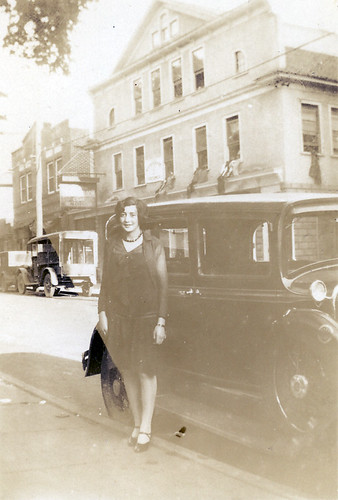
This image was part of a collection I bought a few years ago. I had no idea what I was buying at the time and was intrigued by the image reproduced below.

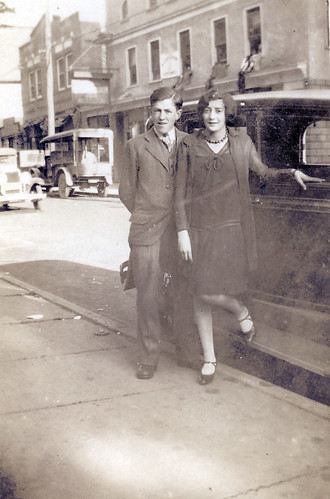
A young woman and a car

In the photograph, a young woman poses beside a car. The awkwardness of her pose and the uncertainty in her face suggests that she is attending a special occasion of some kind. In the second image below, she is joined moments later (or perhaps it was before) by a young man (her partner?) who also looks a little uncertain, not necessarily because of what he’s about to do, but rather because of what he’s doing at that exact moment, i.e. having his photo taken. Perhaps they are young lovers about to get married? Of course we’ll never know.

A young couple and a car

What intrigues me about these pictures are the details. Looking again at the second photo – which might of course, in the course of time, have come before the one above it (“…if things are perceived as discrete parts or elements they can be rearranged…” as Bill Viola writes) – a car has appeared on the left, moving into shot just as the shutter is released. Even though the young man has also ‘appeared,’ it’s nevertheless the car which gives us the sense of time passing; it is a vehicle for what Sontag describes in her book, ‘On Photography’ as “time’s relentless melt.”

Who was in the car as it drove past? Where was it going? Where had it come from?

History often comes to us ‘top ‘n’ tailed’, where all that went before the period in question, and all that came thereafter is removed, leaving us with an event which reads like a novel; conveniently packaged with a beginning, a middle and an end. To some extent, regarding this, the first image serves as an illustration, whereas with the second, the car tells us that something came before the ‘beginning’, and that something will follow ‘the end’. As a painter, Degas was inspired by photography, and used this device to give his works a greater sense of movement. It’s not so much a means of accentuating movement with regards to that which is shown, but moving the viewer into the world that’s hidden beyond its edges. 

Just as in the first photograph I looked at, my viewpoint shifts as I become aware of the image’s other protagonists. From in front of the couple, and in the guise of the person who took the photo, I glimpse the couple as if I can see them out the window of the car. It doesn’t last for long, but it shows how an image can be opened up by such small details.  

Windows in photographs have always interested me for much the same reason. Within the context of an image, like those above, they provide a means of escape, or again, as in the case of the first photograph I discussed, a means of concealment. They act as eyes, reflecting – literally – the world around them; the world beyond the limits of the picture’s edge. Spatially and temporally, there’s always more to a photograph that that contained within its borders; and for me, a photograph’s appeal, often resides in how it allows access to these spaces.

In the detail below, we can see in some of the windows, the sky and the trees reflected from beyond the frame of the camera; another way in which a camera can capture that beyond its reach.

Windows are also evidence (or perhaps reminders) of ordinary people living their everyday lives without a thought for the subject or subjects below – in this case the couple on the pavement. They conceal those who are perfectly oblivious to the chemical annexation of whatever inconsequential moment in time is being captured. And as a result, this invisible population can often breathe life into a photograph well beyond the stage upon which the action is taking place.

In his book ‘Camera Obscura,’  Roland Barthes describes a portrait by James van der Zee, of a Black American family taken in 1926. Barthes writes:

“On account of her necklace, the black woman in her Sunday best has had, for me, a whole life external to her portrait.”

What Barthes perhaps means, is that the necklace has a provenance, and therefore seems to speak more about the woman’s life than anything else in the photograph. It is a cherished object, worn perhaps for the occasion of the picture (just as the necklace has perhaps been worn by the young lady in the images above). For me, this is, in a way, analogous to the windows in the first picture and the car in the second, for they are small details compared with the picture’s subjects, but details which, nonetheless, build for us a bigger picture of the world the subjects inhabit.
 
The closed windows in the building then, reflect the world beyond the edges of the photograph, they provide evidence of a world beyond the stage. Furthermore, they are windows onto the stage, through which those sitting, standing or passing behind might, just like the driver in the car, catch a glimpse of the actors.
The open windows however provide us with something a little different. Open a window and the outside world pours in; sounds, smells, the noise of the traffic and passing conversations. In other words – life. They serve to animate the scene, again just like the car, and through them we can let our imaginations wander, to discover for themselves, more of this world long since vanished.

Filed Under: Photography, Trees Tagged With: Barthes, Bill Viola, Photographs, Vintage Photographs, Windows

Landscape DNA: The Simultaneity of Stories-So-Far

October 5, 2010 by Nicholas Hedges

The Past is Time without a ticking clock. A place where paths and roads are measured in years. The Present is a place where the clock ticks but always only for a second. Where, upon those same paths and roads we continue, for that second, with our existence.

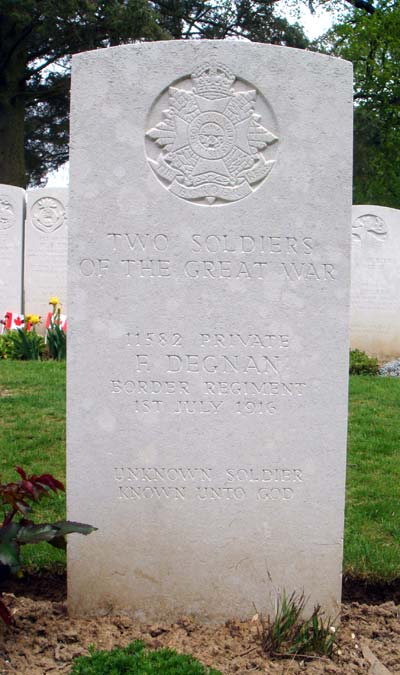
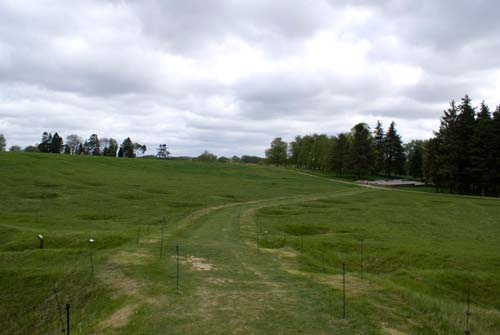
In 2006 I visited Auschwitz-Birkenau and since then have visited camps at Bełżec, Majdanek and Natzweiler-Struthof, as well as the battlefields of Ypres, Verdun and more recently, The Somme. All these sites present the visitor with numbers: 1.1 million dead at Auschwitz-Birkenau, 500,000 at Bełżec, 79,000 in Majdanek. At the start of the Battle of the Somme, on 1st July 1916, British and Commonwealth forces sustained 57,000 casualties, with almost 20,000 men killed in action on that day alone. These are all horrific statistics, but numbers rather than people and over the course of the last few years, I’ve looked for ways of identifying with the individuals behind the grim tolls. The tolls are only estimates, and the individuals to whom they allude have become themselves ‘estimates of existence’. Most have left nothing behind; no name, possessions, or photographs. Photographs, where they exist, are often nameless, names on graves are faceless, so how can we know them at all?

One of the most difficult things about my visit to Auschwitz-Birkenau was walking out the gate, performing an action that more than a million people could only ever dream about – if they had the time; most were killed within hours of their arrival. At Bełżec, the memorial to the dead is – in the main – a walk around the perimeter of where the camp once stood. During my visit in 2007, I recorded the walk using a GPS receiver and the fact that I, as an individual, one of several billion people on the planet, could be tracked in this place where half a million people perished, proved particularly resonant. The concept of walking as a means of remembering began to take hold in my work, evolving over time to become a means of empathising – in some small way – with those who’d perished.

In the book Walking, Writing and Performance by Deirdre Heddon, Carl Lavery and Phil Smith, artist Carl Lavery states the following:

“…pedestrian performance is a mode of resistance against the acceleration of the world, a desire, on the part of performance makers, to re-humanise space by encouraging spectators to experience the environment at a properly human pace, the bodily beat of three miles per hour. Implicit in this argument is the belief that walking is conducive to the production of place, a perfect technique for merging landscape, memory and imagination in a dynamic dialogue. Or as Michel de Certeau would have it: ‘The act of walking is to the urban system what the speech act is to language…’.”

In the passage quoted above, I was struck by the idea, as Lavery puts it, of “encouraging spectators to experience the environment at a properly human pace.” Merging landscape, memory and imagination (for which purpose, according to Lavery, walking is the perfect technique) has become central to my work. It’s also something I’ve done quite naturally since I was a child. For me, places have always been a conflation of these things, and as such, quite unique to me.

When I visit historic sites, landscape, memory and imagination merge to create something akin to what others have termed post-memories; ‘memories’ of events of which we can have no real recollection – in particular events that happened before we were even born. How this happens is something which has interested me throughout my research. A kinaesthetic engagement with a place, and our sense of the present are, it seems, both important in this regard.

Finally in the paragraph quoted above, I was struck by the words of Michel de Certeau; the idea that ‘the act of walking is to the urban system what the speech act is to language,’ reminded me very much of what I’ve read before in the work of Christopher Tilley, who in his book The Materiality of Stone – Explorations in Landscape Phenomenology, writes that ‘If writing solidifies or objectifies speech into a material medium, a text which can be read and interpreted, an analogy can be drawn between a pedestrian speech act and its inscription or writing on the ground in the form of the path or track.”

The idea of a path as ‘text’ is something which appeals to me; the notion that as we walk we ‘write’ ourselves in the landscape has a particularly poetic resonance. In his book Lines, a Brief History, Tim Ingold writes that “human beings leave reductive traces in the landscape, through frequent movement along the same route…”. The Old English word writan he tells us, meant to ‘incise runic letters in stone,’ and a  correlation can therefore be drawn between the act of walking and writing; a path is something written over years by many different people, incised into the landscape.

Just as when we speak we re-use the same words spoken over centuries – for example fragments of long forgotten conversations – so when we walk, we re-use fragments of other people’s ‘texts’, ‘written’ into the landscape. In this sense, we speak with our bodies words that other bodies have spoken or written before us. As Ingold notes: “retracing the lines of past lives is how we proceed along our own.”

In 2007, the year before she died, my grandmother told me about her childhood in Wales. The following is an extract from that conversation in which she describes her father, Elias Jones, who died in 1929, aged 47, as a result of working in the mines:

‘I can see him now because he went up our garden over the road and the mountain started from there up… and he’d go so far up and he’d turn back and wave to us…’

On visiting Hafodyrynys, the village where my grandmother grew up, I walked up the ‘mountain’ she’d described and followed the path my great grandfather would have taken to work in the mines at Llanhilleth. On top of the hill I turned and looked back down at the garden, imagining my grandmother and her siblings waving back at me from the past. Further on, I stood and looked at the view, rolled out all around me. A hundred years ago I thought, when I did not exist, he would have seen the very same thing. A hundred years later, long after his death, I found myself – through being in that place – identifying with him: I’d found him on the path – one which would in time lead to my being born.

Elias Jones, through frequent movement along that path had written himself into the landscape. A hundred years later, I was – through articulating my own presence through walking –  reading part of that text; speaking with my own body his simultaneous presence and absence. In many ways, I was speaking my own presence and absence too.

During that visit, I realised that as well as being a product of the ‘genetic text’ passed down the generations through a myriad number of genealogical lines, we are as much the consequence of pathways walked by every one of our ancestors. DNA is text – a kind of narrative sequence – and the paths which have led to our individual births are a vast text written across the landscape: self and environment, to borrow from Lavery, are umbilically connected.

People are therefore, in a sense, places, and in his book, Lavery quotes Mike Pearson, a performance maker and theorist who states that: “just as landscapes are constructed out of the imbricated actions and experiences of people, so people are constructed in and dispersed through their habituated landscape: each individual, significantly, has a particular set of possibilities in presenting an account of their own landscape: stories.”

Another passage in the book which interested me was that regarding the geographer Doreen Massey. Lavery writes how she offers a ‘conception of space that is interrelational, multiple and always under construction. In her book, For Space, she describes it [space] as ‘the dimension of multiple trajectories, a simultaneity of stories-so-far’.”

I like the idea of space being a ‘simultaneity of stories-so-far’, and it interested me insofar as it rang a bell with some thoughts I’d had previously regarding our own perception of the past. The following is taken from a piece I wrote on the nature of history:

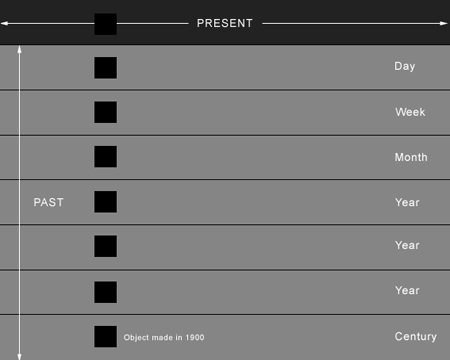
The past is often perceived much like the strata of a rock-face, wherein successive layers of geological time can be seen. We see the past as being built from the ‘ground up’ day upon day, year upon year, century upon century, like bricks in a wall. The problem with this ‘model’ however is that it makes the past difficult to access, the lines dividing each and every moment become like barriers inhibiting our movement between one and the other, particularly where one part is stacked so far below our own in what we perceive as being the present day. Another problem with this way of perceiving the past is that the layers necessarily contain objects, buildings and landscape features which, because of their age, appear in several different layers almost as if they were different things. For example, an object made a 100 years ago, would appear in each of the layers in the diagram below (see Figure 1). It’s rather like someone creating an animation, who draws the same scene a thousand times because it appears in a thousand frames, rather than using the same picture throughout them all.
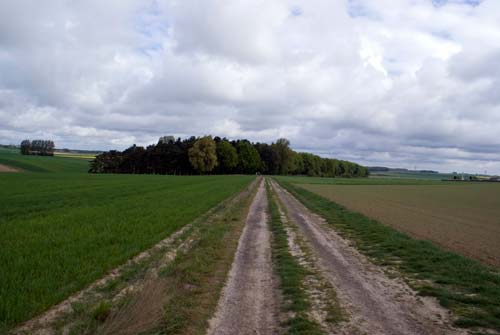
Figure 1

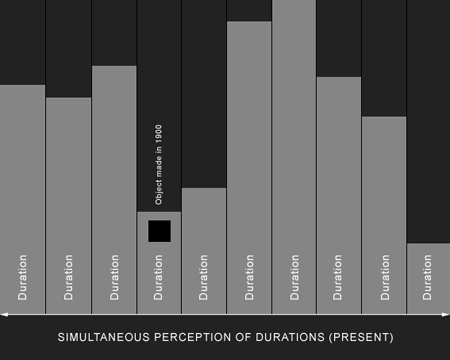
Whilst thinking about this and while considering the fact that any extant object, building or landscape feature, no matter what its age is always present, I realised that a better model for perceiving the past is one which turns the model above on its side – if not quite its head. Subsequently (see Figure 2), what we have is not a series of horizontal strata representing stacked moments in time (days, months, years, centuries etc.), but concurrent vertical lines, or what I have called ‘durations’ where each duration is an object, building or landscape feature and where the present is our simultaneous perception of those that are extant (of course, in the case of buildings, individual ‘objects’ can also contain many separate durations).
It was Bill Viola who said that ‘we have been living this same moment ever since we were conceived. It is memory, and to some extent sleep, that gives the impression of a life of discrete parts, periods or sections, of certain times or highlights’. Similarly we can say that every object, building or landscape feature has existed in one continuous moment and that it is to some extent the passing generations which gives the impression of the past as being a series of ‘discrete parts, periods or sections, i.e., the perceived layers or strata of our previous – first – model.

Figure 2

These ‘durations’ as I have described them, are indeed ‘stories so far,’ which move, as if they are being told, at the speed of walking – at a ‘properly human pace’ as Lavery puts it.

Returning to the idea of walking as writing, it’s true to say that we don’t always leave a physical trace of our presence when we walk – or at least a visible, physical trace. But, poetically speaking at least, we do leave something behind and this something is often augmented by objects, buildings or landscape features which are contemporaneous with past individuals.

Whenever I visit sites of historic trauma (death camps and the battlefields of World War One), even if they’re empty, I feel as if they’re full; not in a spiritual or pseudo-spiritual sense, but physically, as if they’re full of sculptures. Sculptor Antony Gormley describes his work as ‘confronting existence’ and that, in part, is what we do in places such as Auschwitz; death is, after all, another kind of existence. Walking itself is a means of confronting existence, being as it is a line drawn between absence and presence – just as I’d found in Wales.

“Part of my work,” Gormley writes, is to “give back immanence to both the body and art.” For archaeologist, Colin Renfrew, Gormley is “speaking of the existence of the individual, and the coming into being and self-awareness of the individual as the inhabitant of his or her body.” In reading these quotes, I began to see that the sites of trauma I’d visited, as well as those places relevant to my own family history, were full of what I can only describe as invisible sculptures – sculptures of absence, the physical presence/immanence of all who’ve gone before.

Gormley’s work comprises, in part, casts of his own body which reminds Renfrew of the bodies found in Pompeii; men, women and children frozen at the moment of their death almost 2000 years ago. Buried in ash, the spaces which had once contained their bodies remained after the bodies had decomposed, allowing archaeologists, to use them as moulds by pouring plaster into the cavities.

In light of this, I was reminded of the work of Christopher Tilley, who in his book, ‘The Materiality of Stone, Explorations in Landscape Phenomenology’ writes: “The painter sees the tree and the trees see the painter… in a manner comparable to that in which the mirror ‘sees’ the painter: that is, the trees, like the mirror, let him become visible: they define a point of view on him which renders visible for him something that otherwise would remain invisible – his outside, his physiognomy, his carnal presence… The trees and mirror function as Other.”

Just as the trees function as ‘Other’ therefore, so must the sun, the stars, the clouds, hills, mountains, the sea, rivers, the wind, the rain and so on. And in a sense, what Tilley is describing as Other, which ‘renders visible for him… his carnal presence,’ is a sense of being present in the present-day world.

In the book Walking, Writing and Performance, Lavery writes:

“…during… Mourning Walk I was aware of living more in the past than in the present. However at no time did this immersion in memory result in psychic saturation or disintegration. The natural world – the world of trees and stones – was stubbornly present and insisted on maintaining its autonomy and distance.”

When trying to access the past through walking, an awareness of the present – of being present in the world – is vital, and the natural world – the world of trees and stones – does that for us. Understanding the fact that the past was once the present, helps us in some small way to empathise with those lost to the past.

The present moment is a space, one which lasts only for a second – a space comprising the simultaneity of what Doreen Massey calls ‘stories so far’ or what I have called ‘durations’. And it’s in that space that life happens. Behind us and in front, beyond the physical boundaries of that second we are absent. The text is written, or yet to be written – the present being the moment of writing. Gormley’s sculptures then articulate this line between presence and absence, past and present.

In that space, in which we continue with our existence, we hear the birds, we see the sun, feel the wind and rain. In that space, all our hopes are held, all our fears and regrets. Into the space we carry our past in the form of memories. It’s the space of the everyday – one which we often take for granted. But it’s a space we share with everyone who’s ever gone before us.

Again, in his book, Lines. A Brief History, Tim Ingold tell us that:

‘…from late Antiquity right through to the Renaissance writing was valued above all as an instrument of memory. Its purpose was not to close off the past by providing a complete and objective account of what was said and done, but rather to provide the pathways along which the voices of the past could be retrieved and brought back into the immediacy of present experience, allowing readers to engage directly in dialogue with them and to connect what they have to say to the circumstances of their own lives. In short, writing was read not as a record but as a means of recovery.’

This paragraph has something in common with what I described earlier, the idea that just as when we speak we re-use the same words spoken over centuries – fragments of long forgotten conversations – so when we walk, we re-use fragments of other people’s ‘texts’, ‘written’ into the landscape. Walking becomes a means of recovery, where the past can be retrieved and ‘brought back into the immediacy of present experience’. As on the ‘mountain’ in Hafodyrynys, it’s  a means of engaging in a dialogue with those who’ve gone before us, and nowhere is this more keenly felt that in places of historic trauma.

It’s as if when walking through these places, we pick up – at random – the threads of other people’s texts. We tie them together, filling in the gaps with our own story. It’s rather like the film Jurassic Park, where dinosaurs are cloned using DNA extracted from mosquitoes frozen in amber. The gaps in the code are filled with modern frog DNA, creating a ‘modern’ dinosaur. Earlier, I stated that people were as much the product of places, and it figures therefore that places are as much the product of people; that the ‘DNA’ of any place comprises narrative lines laid down by everyone who’s ever been there. When we walk, we create new places based on the present day landscape. Our memory and memories, history and of course our imaginations all have a part to play. Within our imagination, we take with fragmentary strands of the landscape’s own ‘DNA’ (or history) and fill the gaps with our own presence and memory. These constantly created spaces (created then destroyed every second) are unique to us, and yet we share them, in that single moment, with all who’ve gone before us, not as part of a crowd, but as one body and mind.

The ‘stubborn’ presentness which Lavery describes is therefore vital to our empathising with the past, and in many ways the most terrifying thing at Auschwitz was the way the trees moved in Birkenau (Auschwitz II), simply because they would have moved that way during the Holocaust.

The writer Georges Perec once wrote that “the desire to find roots, the determination to work from memories or from the memory, is the will above all to stand out against death, against silence.”

I work from memories and the memory and I’m actively engaged in searching for my roots. Is this then a will to stand out ‘against death, against silence?’

Again, in Walking, Writing and Performance, Lavery writes:

“Is not all writing, all art, a response to a loss of some kind, an imaginative way of dealing with lack? …As I use it, the word recovery has nothing to do with re-experiencing the lost object in its original pristine state; rather, it designates a poetic or an enchanted process in which the subject negotiates the past from the standpoint of the present.”

This act of recovery is just the same as that which Ingold describes, where writing (in ancient times) was read not as a record but as a means of recovery. Walking as a means of ‘reading’ or ‘speaking’ the text of other people’s lives is a way of recovering a moment in the past; an ‘enchanted process’ to borrow from Lavery, where we ‘negotiate the past from the standpoint of the present.’

Empathy with the past therefore and in particular with individuals can be achieved, coming via a kinaesthetic response to the present mediated through memory and our embodied imaginations.

Filed Under: Trees Tagged With: Bill Viola, Carl Lavery, Death Camps, DNA, Georges Perec, GPS, History, Landscape, Michel de Certeau, Movement, Phenomenology, Positioning, Silence, Stars, Tim Ingold

The Narrative Line

June 24, 2010 by Nicholas Hedges

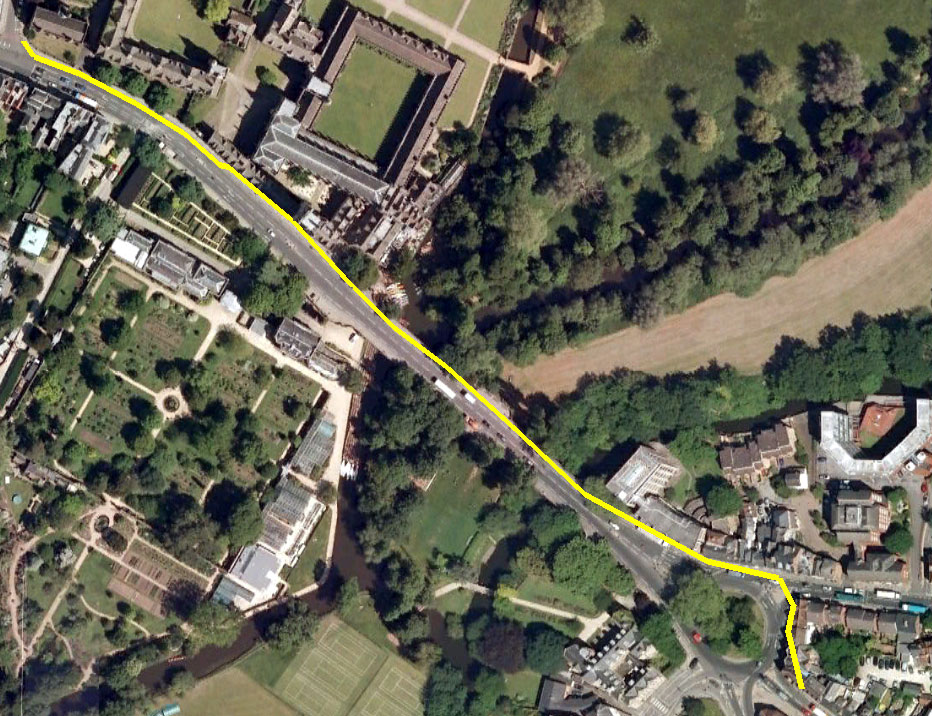
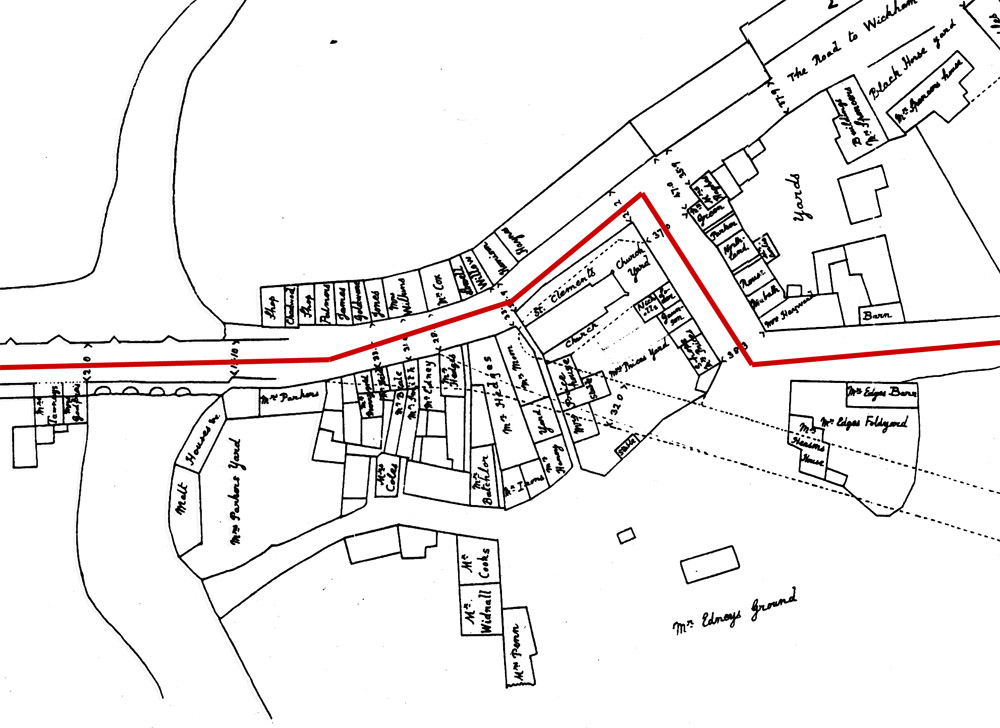
With my GPS, I traced the route we know the Gentleman’s Servant took across Magdalen Bridge up into modern day Cowley Road.  It was hard to imagine the scene in 1770 when the road would have been much quieter. Cars, buses and motorbikes were everywhere, the sound of their engines blocking out almost everything else.

But nevertheless, as I walked, I tried to take in everything around me, to capture all that made the present moment what it was, for even though the same place in 2010 is light years away from what it was 240 years ago, nevertheless, when the stranger rode over the bridge on December 12th 1770, it was something which for him was happening in the present. Now this might sound an obvious thing to say, but often when we read about the past, it’s almost as if we’re reading a fiction – a story which has a beginning, a middle and an end, and in which the characters follow a proscribed route laid down by the author: the narrative line in this instance comprises the text which makes up the tale. Of course life isn’t like this. When we walk, even if we’re going somewhere particular, we walk without knowing what may lie ahead of us. We might well know where we’re going, but how we’ll get there exactly, and what will happen as we travel, is something we only discover in the present moment.

As I wrote as part of a recent exhibition:

The Past is Time without a ticking clock. A place where paths and roads are measured in years. The Present is a place where the clock ticks but always only for a second. Where, upon those same paths and roads we continue, for that second, with our existence.

I want to read history in terms of its seconds – the small spaces within which life really happens. Every second in the present day – every moment – is a lens through which we can glimpse the past, no matter how distant it is. The more we know about the past (in particular the ‘geography’ of whatever we’re researching) the better the picture. But something in the space of every second reminds us, that what happened in the past happened in what was then a present just like ours; something as a simple, for example, as trees blowing in the wind.

The narrative line is like a piece of text; we follow it as we follow the words of a sentence, putting one foot in front of the other. But reading between the lines, we fill the gaps with what we see and experience around us. We are reminded that the stranger was moving all those years ago, unaware of what might lay before him. We become aware that he could feel the wind on his face, that he could see the sky, the river flowing beneath the bridge. And as we think, we realise that he himself was thinking, as was everyone around him – and this is the key to answering the questions I posed at the beginning of this project.

Every second the stranger rode along that line, he was part of a complex web of connections. These moments comprising his story were moments in many others – countless stories in a plot more complex that we can  imagine. The more we know about these moments, the more we can picture the scene and all who lived at the time, the better the chance we have of finding answers.

As I walked the length of the line, I looked to my right and glimpsed the 17th century gateway to the Botanic Gardens, and in that gesture, I found a connection with the stranger. The gateway is a witness to the moment I’m researching, and looking at it is one way of asking it for an answer.

Filed Under: Oxford, The Gentleman's Servant, Trees Tagged With: Gentlemans Servant, GPS, Lines, Maps, Oxford, Positioning, Servant, Survey, The Gentleman's Servant

Sculpture

June 2, 2010 by Nicholas Hedges

I am not, at least as far as I’m aware, a sculptor, but I think that what I’m striving to articulate in my work has perhaps more to do with sculpture than anything else. The following statements, from the book ‘Figuring it Out,’ by archaeologist Colin Renfrew were made by the sculptor Antony Gormley.

“I want to confront existence. It is obviously going to mean more if I use my own body… I turn to the body in an attempt to find a language that will transcend the limitations of race, creed and language, but which will be about the rootedness of identity… The body is a moving sensor. I want the body to be a sensing mechanism, so your response to the work does not have to be pre-informed and does not necessarily encourage discourse… If my subject is being, somehow I have to manage to engage the whole being of the viewer.”

“My body contains all possibilities. What I am working towards is a total identification of all existence with my point of contact with the material world: my body… Part of my work is to give back immanence both to the body and art.”

The last sentence particularly resonates with me, for part of the purpose of my work is I think to give back immanence to the past and to history, something which I have come to realise can only come about through the immanence of the body – the ‘moving sensor,’ which I have otherwise described as being like the recording/playback head of a tape player.

We are all familiar with the body-casts of Pompeii; men, women and children frozen at the moment of their death almost 2000 years ago. Buried in ash, the spaces which had once contained their bodies remained after the bodies had decomposed, allowing archaeologists, to use them as moulds by pouring plaster into the cavities. It was whilst reading about the casts in Colin Renfrew’s book ‘Figuring it Out’ that I began to think of the process of casting in terms of what I’ve been researching these past few years.

If we stand in a place, for example a wood, we can try to imagine those who’ve been there before us. By being aware of the moment of our own experience, of the wind, the light, the sound of the trees and so on, we can try to see the past through the immanent lens of the present. In a previous entry ‘An Archaeology of the Moment,’ I mentioned the writing of Christopher Tilley and the concept of Other and whilst reading Colin Renfrew’s book I realised how the process of creating the casts in Pompeii shared something with what I’ve been researching, albeit metaphorically.

If we stand in a place, we are defined not only by the shape of our bodies (our physiognomy), but by everything around us. To recap, as Tilley writes: “The painter sees the tree and the trees see the painter… in a manner comparable to that in which the mirror ‘sees’ the painter: that is, the trees, like the mirror, let him become visible: they define a point of view on him which renders visible for him something that otherwise would remain invisible – his outside, his physiognomy, his carnal presence… The trees and mirror function as Other.”

Just as the trees function as ‘Other’ therefore, so must the sun, the stars, the clouds, hills, mountains, the sea, rivers, the wind, the rain and so on.

Imagine that all these things, in the place where once someone stood are – metaphorically speaking – like the ash of Pompeii, in that the shape of the person’s body is somehow sculpted by them. Of course this shape is fleeting, but imagine again that it remains, delineated by the world around it. In order to ‘see’ the shape, we must learn to fill it, not, of course, with plaster but with our own bodies or rather our presence.

At any given moment, we are sculpted by the world around us. We are both looking for and filling in the gaps left by others. We are therefore artists, artwork and viewer simultaneously.

Imagine these two situations: One, you are standing in a gallery in front of a landscape painting, a picture of a wood with no-one in it. Two, you are standing on a path in a wood that is empty and in this wood, the trees and the wind blowing through the branches, the feel of your feet upon the ground, the sound of the birds, the dappled light and shadows all act as ‘Other’ rendering your outside – your presence – visible. The gallery too is empty, but like the wood, you are far from alone, for just as the painting also acts as ‘Other’ in terms of rendering your presence visible, so the spaces left by those ‘rendered’ before are made visible again by your presence; not least the space left by the artist. And after the artist come the spaces left by everyone who’s seen the painting before you, and in the woods the same is true; although there maybe no-one else on the path, the spaces left by everyone who’s ever walked upon it are filled with your presence; the present fills the spaces of the past.

Having found Antony Gormley’s words so interesting, I read the transcript of an interview between himself (AG) and Ernst Gombrich (EG). The following are sections which I found to be particularly pertinent.

AG I want to start where language ends.
EG But you want in a sense to make me feel what you feel.
AG But I also want you to feel what you feel. I want the works to be reflexive. So it isn’t simply an embodiment of a feeling I once had.
EG It’s not the communication.
AG I think it is a communication, but it is a meeting of two lives.

In many respects this conversation above reflects precisely what I am trying to do: to feel the way people felt in the past by feeling what I myself am feeling. It is the meeting of two lives.

AG I would be interested to know whether you feel that it is possible to convey a notion of embodiment without mimesis, without having to describe , for instance, movement or exact physiognomy?
EG I have no doubt that not only is it possible but it happens in our response to mountains, for example, we lend them our bodies.

–

AG I can’t be inside anyone else’s body so it’s very important that I use my own. And each piece comes from a unique moment in time. The process is simply the vehicle by which the event is captured, but it is very important to me that it’s my body.

–

AG I am interested in something that one could call the collective subjective. I really like the idea that if something is intensely felt by one individual that intensity can be felt, even if the precise cause of the intensity is not recognised. I think that is to do with the equation I am trying to make between an individual, highly personal experience and the very objective thing – a thing in the world amongst other things.

–

AG Then I go into the second stage which is making a journey from this very particularised moment to a more universal one.

–

As I’ve written before: In a famous definition of the Metaphysical poets (a group of 17th century British poets including John Donne), Georg Lukács, philosopher and literary critic, described their common trait of ‘looking beyond the palpable’ whilst ‘attempting to erase one’s own image from the mirror in front so that it should reflect the not-now and not-here.’ Thinking in terms of the metaphor I have described above (the trees and mirror function as Other), we could say that this erasing of one’s image is an attempt to see the space left behind us. I have also written in the past how history necessitates the consideration of our own non-existence; this space also reflects that state.

Filed Under: Archaeology, Trees Tagged With: Antony Gormley, Archaeology, Art, Georg Lukacs, John Donne, Pompeii, Sculpture, Stars

An Archaeology of the Moment

May 18, 2010 by Nicholas Hedges

I’m currently reading an excellent book by Colin Renfrew, Senior Fellow of the McDonald Institute for Archaeological Research, entitled ‘Figuring it Out’, in which the author examines what he describes as ‘the parallel visions of artists and archaeologists,’ with an emphasis on contemporary art practice. As an artist with a deep interest in archaeology, I had to buy the book, and I’m very glad I did, for it’s helped me pull together numerous strands of thinking which have emerged from my research over the course of the last four years; in particular, the idea of the physical or ‘sensed’ present as a lens through which to ‘see’ the past. Professor Renfrew writes: “The past reality too was made up of a complex of experiences and feelings, and it also was experienced by human beings similar in some ways to ourselves.” The way we experience the present then, tells us a great deal about how people experienced the past when it too was the present.

I’ve written before how one of the problems we have in considering past events is the temporal distance which separates us. Reading a history book, although we know its content is‘ factual’, is nonetheless an interpretation of events; an outline at best no matter how well researched and well written it is. There may be a structure, just as in a novel, with a beginning, a middle and an end. But of course reality isn’t really like that – the boundaries are much more fluid. Necessarily therefore, a history of any event will be full of holes and it’s these holes which interest me.

In October 2006, I stood on the Ramp at Auschwitz-Birkenau and my experience there is something with which I’ve been working ever since, even whilst researching different places – whether other camps such as Bełżec or the battlefields of World War One – it’s that particular moment which I have been researching, peeling back the layers comprising the moment, much as an archaeologist digs through layers of stratified soil to uncover a whole range of times.

History is, in some respects, like fiction. What is known and written about can only be surmised from surviving evidence and what we ‘see’ as receivers of that knowledge, can only be imagined. What’s always missing is a sense of the present, as if what happened in the past always followed a script, one in which the main protagonists took their cues and delivered their lines accordingly. Hindsight, which one can hardly escape, joins all the dots, but leaves many gaps between the lines.

In the foreword to Peter Weiss’ book The Aesthetics of Resistance, Frederic Jameson writes how for the critic Georges Lukács, the world historical individual should never be the novel’s main protagonist, but rather seen from afar by the average or mediocre witness. We could say the same for history; that events described in history books are ‘best’ when seen through the eyes of those ‘average’ or ‘mediocre’ witnesses; people which history labels as ‘the mob’ or the ‘masses’; who are often buried beneath unimaginable numbers – mass graves within which, their names and individual identities are forgotten.

I’ve produced numerous works which examine this idea of the anonymous individual in history, but there’s another element I try to show, and that’s the ‘everydayness’ of any historic event. This is, I believe, key to our understanding of the past, for not only is history best seen by the ‘average’ or ‘mediocre’ witness, but – for me at least – when the main event is glimpsed as a backdrop to an individual’s own life experience. That’s not to say the event should always be viewed through the eyes of someone far away from the scene, but that it should always be seen behind the individual, rather than the individual being buried somewhere beneath.

In the time after my visit to Auschwitz-Birkenau, I wanted to find a way of identifying with those who died there. That’s not to say that I can identify with what they went through, no-one who wasn’t there can ever claim to understand what it was like to suffer, but we can seek to separate the individual from the grim statistics and site the camp in the landscape of the everyday world. Again, that’s not to say that Auschwitz-Birkenau was an everyday place, but what’s important for me, in understanding the past, in filling in the gaps which history inevitably leaves behind, is an understanding that the everyday world was happening at the time. Whatever event in whatever period we’re researching, the world was happening around it. The wind blew in the trees; the birds sang and the rain fell. The sun rose in the morning; the sky was just as blue or grey as it is today. There were clouds with their shadows, and during the night, the moon might be reflected in small pools of water, like that described by Auschwitz survivor, Filip Muller – in a pit soon to be filled with bodies. The events like the place were not everyday, but they took place regardless in an everyday world and understanding this ‘everydayness’ can help us understand and picture much more clearly events of the past.

For example, we can read hundreds of titles about the Holocaust and World War One, but when we read in the Diary of Adam Czerniakow – the ‘mayor’ of the Warsaw Ghetto – what the weather was like on a particular day, suddenly, in words like ‘beautiful weather,’ the full horror of the Holocaust is revealed, because, with these words at least, we can identify and – albeit in a very small way – empathise with someone who suffered; the past in effect becomes very much present.

In Birkenau, it wasn’t so much the sight of the gas chambers which was so horrific, or even the gaze of the infamous gatetower, but rather the way the trees moved, just as they’ve always moved, right throughout history.

Similarly, on the battlefields of the Somme, just as we cannot comprehend the horrors faced by the soldiers – the incessant shelling and machine gun fire – we can nonetheless see and feel the ground beneath our feet; we can see the sun in the sky, and feel the wind on our faces, and it’s these everyday details which take us, albeit just a little, into the midst of a battle. Of course we still need history to draw in the outlines, but it’s these other details which prevent history being a script. Events in history were not preordained, people made choices and choices can only be made and acted upon in a moment – in the present. Understanding the present therefore – that space wherein reside all our hopes and fears, our dreams and ambitions, and into which we bring our memories – is key to our understanding of the past.

In a passage written by Tadeusz Borowski, another Auschwitz survivor, we read the following: “do you really think,” he asks, that without hope such a world is possible, that the rights of man will be restored again, we could stand the concentration camp even for a day? It is that very hope that makes people go without a murmur to the gas chambers, keeps them from risking a revolt, paralyses them into numb inactivity.” People often ask why, when faced with certain death people didn’t revolt or even attempt to escape? If we read history as a script we might well feel obliged to ask that question, but when one’s alive in a moment, that in which we continue to exist, we will do anything to maintain that existence, and second by second that was achieved by doing nothing, right up to the end, for up to the end there was always the hope that something would change. Again, it’s through understanding what it means to live in the present that we can understand the past a little better.

In his book ‘The Materiality of Stone, Explorations in Landscape Phenomenology,’ Christopher Tilley writes: ‘The painter sees the tree and the trees see the painter, not because the trees have eyes, but because the trees affect, move the painter, become part of the painting that would be impossible without their presence. In this sense the trees have agency and are not merely passive objects. Dillon comments: “The trees ‘see’ the painter in a manner comparable to that in which the mirror ‘sees’ the painter: that is, the trees, like the mirror, let him become visible: they define a point of view on him which renders visible for him something that otherwise would remain invisible – his outside, his physiognomy, his carnal presence… The trees and mirror function as Other.”’ Just as the trees function as Other therefore, so must the sun, the stars, the clouds, hills, mountains, the sea, rivers, the wind, the rain and so on. Objects too, excavated during digs or on display in museums, act in much the same way.

Through archaeology, we excavate moments. We might come to better understand epochs and eras, but revealing a stone beneath a field which once belonged to part of a road reveals the movement of individuals and thereby an individual. And as we in the present stand on that stone and sense the world around us, we can bridge the gap between the past and present, even if that gap is one, two or three thousands years. If we walk along the line of the road, what we know of any relevant history becomes animated. With the aid of the ‘everydayness’ of the world we can position ourselves within an event – even if that event took place many miles away. We can become the ‘average’ or ‘mediocre’ witness, and rather than seeing a past event as one sandwiched between two pasts (those more and those less distant) we can instead bring to that past, the concept of the present and consequently the unknown future.

At the beginning of his book, ‘Figuring it Out’, Professor Renfrew looks at Paul Gauguin’s painting ‘Where Do We Come From? What Are We? Where Are We Going to?’ (1897) a title, and a question, which many artists and archaeologists alike have tried to answer. The questions posed in the title of are of course about the past, the present and the future and in reading this book I could see how these questions have always been there behind my work. After visiting Auschwitz-Birkenau and in an attempt to find anonymous individuals in history to whom I was related I began to investigate my own family tree, and, over the course of the last few years I’ve found several hundred ancestors going back on some lines as far as 1550. A year before she died, my grandmother told me about her childhood in Wales and in particular about my great grandfather who died in 1929 after years working in the mines. The following is an extract from that conversation:

‘I can see him now because he went up our garden over the road and the mountain started from there up… and he’d go so far up and he’d turn back and wave to us, and if we went out to play, our Mam would say, ‘you can go up the mountain to play…’ but every now and then our Mam would come out in the garden and we had to wave to her to know that we were alright you know… always remember going up the mountain…’

On visiting Hafodyrynys, the small town where my grandmother grew up, I walked up the ‘mountain’ she’d described and followed the path my great grandfather would have taken to work in the mines at Llanhilleth. On top of the hill I stood and looked at the view. One hundred years ago, when I did not exist, he would have seen the very same thing. One hundred years later, long after his death, I found myself – through being in that place – identifying with him, not because I know what it was like to work in the mines (of course I don’t), but because I saw the same horizon, felt the same wind, saw the same sun and so on. I’d found him there on the path (one which would in time lead to my being born).

I realised too in Hafodyrynys, that I’m not only who I am because of the genes passed down by my ancestors, but because of the things they did throughout their lives, not least because of the roads and paths they travelled, such as that upon the ‘mountain’. Anything different, no matter how seemingly irrelevant and I would not be here, and in a sense, that which I described earlier in relation to my standing on the Ramp at Auschwitz-Birkenau, where the way the trees moved seemed pregnant with the horrors of the Holocaust, is relevant here, albeit for different reasons; the everyday, insignificant details which make up a moment, are key to our existences. Until the time of our conceptions, we were always one step away (many times over) from never existing and again this refers back to what I described at the beginning of this piece; the idea of my own non-existence in relation to past events.

For the catalogue to the third in my series of exhibitions entitled ‘Mine the Mountain’ I wrote the following, in an attempt to summarise my thinking: ‘The Past is Time without a ticking clock. A place where paths and roads are measured in years. The Present is a place where the clock ticks but always only for a second. Where, upon those same paths and roads we continue, for that second, with our existence.’

The last line resonates when considered alongside what I described earlier regarding hope – that emotion which Borowski describes as ‘paralysing’ those who died in the camp.

I wrote earlier too, that through archaeology we excavate moments, that although we might come to better understand epochs and eras, revealing a stone beneath a field which once belonged to part of a road reveals the movement of individuals and thereby an individual, one continuing his or her existence for a second along the way. Artist Bill Viola wrote: ‘We have been living this same moment ever since we were conceived. It is memory, and to some extent sleep, that gives the impression of a life of discrete parts, periods or sections, of certain times or highlights.’ If we take what he says regarding this ‘same moment’ – that which we’ve been living continuously – along with what I’ve written above regarding pathways taken by our ancestors, we can see that that ‘same moment’ extends beyond the limits of our own existence and that moments and epochs are in the end, one and the same thing. The gap between the past and present – however big or small the temporal divide – is removed.

To conclude…

An ancient road, uncovered beneath a field, may be thousands of years old but nonetheless it will have been ‘written’ in terms of moments, where one individual amongst many others has carried his or her existence from one moment to the next. And as we walk ahead towards the future, along the line of the road, carrying our own existence with us; as we feel the ground beneath our feet and watch the wind blowing through the trees. As we listen to the birds and smell the scent of the grass, we’ll find ourselves in empathy with every individual who’s gone that way before us. Somewhere, beyond the horizon, Stonehenge is being built; the Romans have landed in England and the Mary Rose is sinking beneath the waves.

Filed Under: Archaeology, Trees Tagged With: Archaeology, Auschwitz, Bill Viola, Borowski, Christopher Tilley, Death Camps, Empathy, Family History, Family Jones, Holocaust, Jones, Mine the Mountain, Moments, Paths, WWII

The Somme

May 7, 2010 by Nicholas Hedges

“Frontiers are lines. Millions of men are dead because of these lines.”
Georges Perec

The name Somme is, in the minds of many, synonymous with death, a byword for futile and indiscriminate slaughter. Think of the Somme and the image of men walking towards their deaths comes to mind. Think of the Somme and one date stands out above all others; 1st July 1916, the day the battle began. The battle itself lasted over four months, up until November 18th, but the 1st July is as infamous a date as any, being as it is the blackest day in British Military History. By the end of the first day’s fighting, British and Commonwealth forces had lost almost 60,000 men, with 20,000 of those killed or missing in action – a number which is almost impossible to comprehend. The exact number of casualties over the entire course of the battle (1st July – 18th November 1916) is unknown, but Allied forces lost some 620,000 men with over 145,000 killed or missing in action. Germany suffered around 465,000 casualties with almost 165,000 of those killed or missing.

These numbers are of course horrendous, but there’s always a danger that statistics such as these will only ever be numbers, rather than a single death multiplied several thousand times. Every one of those over 300,000 killed or missing in action was a son, husband or brother; an individual whose life was cut short for a small patch of ground. And we mustn’t forget the wounded whose injuries were often appalling – the result of a new type of warfare, where bodies were mauled and mangled by artillery shells, machine gun fire and shrapnel. Disfigurements and mental illness meant that even if they were lucky enough to return, many would never again lead a normal life.

Before visiting the battlefields, I recorded my thoughts on how I imagined the Somme. Drawing on old photographs, books I’ve read and contemporaneous records, I’d built up a picture – a collage of sorts – of devastated fields, cut through with trenches; craters and mud, machine gun fire and shells. I’d imagined woods reduced to spent matchsticks occupying a space on the horizon and the terrain as I saw it in my mind’s eye was almost always flat. The images themselves were silent, equivocal and without any weight or real sense of place. There was colour but like any specific detail the colours were always vague. Any imagined scene was removed from my senses. I could try to imagine the war, but of course any idea as to what it was like would – to say the very least – be well wide of the mark. I could imagine the rain, the blue sky, the smell of the grass, but still it was all divorced from my senses; an indeterminate collection of images wherein there was little sense of direction. I could try and imagine movement, but any progression derived only from a series of stills as if I was looking down a length of film found on a cutting-room floor.

Having arrived in the Somme, we drove towards our B&B, down the narrow roads which cut across the fields. The sun was setting, casting long shadows which lay down across the landscape like discarded coats and clothes. I couldn’t help but think of those who’d stood in the trenches on the morning of 1st July 1916, knowing they might never see another sunset again. For a moment, this sunset became the one they wouldn’t to see. The sunset of that terrible day.

On arriving at the B&B we found our first cemetery.

We had just over a day to explore the Somme battlefields and therefore took the ‘Circuit of Remembrance’ a route signposted with poppies which takes in the major sites of the battle. Starting at Beaumont Hamel, we travelled to Thiepval, Pozières, Longueval, Rancourt, Peronne and La Boiselle. The following morning, we travelled to Serre to see the place where, among others, the Accrington Pals suffered horrific losses on that first terrible day.

Travelling through the countryside and seeing signposts pointing the way to villages and towns such as Arras, Pozières and Thiepval, I felt a strange sensation, in that prior to visiting the Somme, these legendary names were almost fictions – places connected with a distant past found only in the pages of history. Temporal distance in some way then correlates with geographic distance, where places one has never been are like those times to which one can never go. It’s as if they are names of moments in time rather than places in another country; the past is indeed a foreign country, and yet one it seems can go there.

Of all the places we visited along the ‘Circuit of Remembrance,’ two stand out in particular; the site of the attack on Serre at what is now The Sheffield Memorial Park, and the Newfoundland Memorial Park at Beaumont-Hamel. Of course all other sites were extremely poignant, not least the Memorial to the Missing at Thiepval and the many cemeteries, all immaculately kept, which are found throughout the Somme countryside.

The first place we visited was the Newfoundland Memorial Park at Beaumont Hamel.

 It’s one of the few sites in the Somme region where the ground has remained largely untouched since the end of the First World War. The trenches are still visible, for example, St. John’s Road and Uxbridge Road which once led to Hyde Park Corner and Constitution Hill; trenches now filled in beneath a field of Rape (the line of the Uxbridge Road trench has been marked in white in the car park).

 The naming of the trenches has always interested me. It’s almost as if in the midst of the ruined landscape, whose pre-war character had all but been effaced, a new place was brought into being; not simply a ruin of that pre-existing world, but a new world entirely; a labyrinth of lines cut into the ground, named after streets or towns back home. It’s as if these ‘streets’, ‘lanes’ and ‘alleys’ were each a piece of the collective memory of those who fought and died there; fragments of a place called ‘home’ to which many would never return. Now of course the trenches have all but disappeared along with the men who made them, along with their individual memories. And yet they remain on maps and in books, and although the ruined towns and villages have been rebuilt, their own much older names seem to belong more to this other lost world than that before or after.


It was at Beaumont Hamel that the Newfoundland Regiment attacked on 1st July 1916, suffering as they did appalling losses. The following description is taken from the ‘Newfoundland and the Great War’ website:

“Thus it was that the Newfoundlanders moved off on their own at 9:15 a.m., their objective the first and second line of enemy trenches, some 650 to 900 metres away. In magnificent order, practiced many times before, they moved down the exposed slope towards No Man’s Land, the rear sections waiting until those forward reached the required 40-metre distance ahead…

 …No friendly artillery fire covered the advance. A murderous cross-fire cut across the advancing columns and men began to drop, at first not many but then in large numbers as they approached the first gaps in their own wire. Private Anthony Stacey, who watched the carnage from a forward trench with Lieutenant-Colonel Hadow, stated that “men were mown down in waves,” and the gaps cut the night before were “a proper trap for our boys as the enemy just set the sights of the machine guns on the gaps in the barbed wire and fired”. Doggedly, the survivors continued on towards The Danger Tree.”

The ‘Danger Tree’ still stands, and standing there today, looking at the sheep laying around its base, it’s hard to imagine the scene at that same place 96 years ago.

Like many who’ve read about the Somme, I was aware how close the opposing armies were to one another – at least in terms of stats – separated as they were by the void of No Man’s Land, but it was only in this place that the distance was made startlingly apparent; it was hardly any distance at all. Entering the memorial, one can see the British front lines. A leaflet guides you around and suddenly, you find yourself looking back from the German front line towards where you entered, a distance which is all but a few minutes’ walk away. And in between is a patch of ground, much like any other you might have seen before but upon which thousands lost their lives.

The following images show the Caribou Monument to the Newfoundland Regiment (shown on the map above) which stood at the British Front Line. The Danger Tree is that shown above which marked the furthest many men managed to get. The Y-Ravine is behind the German Front Line, the trenches of which are also shown below.

Of course it goes without saying that in 1916, the ground would have looked very different. Pockmarked by shells, cut through with trenches running on for miles and covered with swathes of barbed wire it would have presented advancing troops with considerable difficulties even without the horrors of enfilading machine gun fire and pounding artillery. 

As far as can be ascertained, 22 officers and 758 other ranks were directly involved in the advance that day. Of these, all the officers and around 650 other ranks became casualties.  Of the 780 men who went forward about 110 survived unscathed, of whom only 68 were available for roll call the following day. To all intents and purposes the Newfoundland Regiment had been wiped out, the unit as a whole having suffered a casualty rate of approximately 90%.

It goes without saying that as tourists today we can never imagine what it was like to be a part of this battle, not that we should be deterred from trying. Even so, one can appreciate things which sharpen the focus of any prior knowledge of the war and in particular any images which one might have imagined beforehand. I’d read about the attack on Beaumont Hamel in a book by Peter Hart and had imagined a vague collection of ‘ambiguous stills’ with which I did my best to appreciate the experiences of those who suffered the appalling violence of that first day. But standing in the middle of what had been No Man’s Land, with the British Front Line to my left, beside the Newfoundland Caribou Memorial, and the German Front Line to my right – just behind the memorial to the 51st Highland Division – I was struck by how small the battlefield, at that position,  was. As I’ve said, if this was any place in the countryside, it would constitute nothing more than a small part of a short walk, but in 1916 it was a great advance, in the pursuit of which, many thousands lost their lives.

There is a tendency at sites such as this, or rather in associated museums (for example that in Ypres) to create recreations of battles with sounds effects, waxworks, lighting effects and so on. For me, such recreations do nothing other than turn history into fantasy. They push history – which already borders on fiction (in that it can only be imagined)  – deeper into the world of make-believe. Recreations serve no other purpose than to ‘entertain’ and certainly do little by way of justice to memory of the men who fought there. It’s much better to be in a place, to hear the birds and see the trees… they might not be shells or machine guns, but they are real all the same.

I must admit I could have stood there in ‘No Man’s Land’ for hours, collecting together what I knew of the war and what I could glean from the guide and anchoring it to the reality of the world by which I was surrounded. What I could really appreciate here was the terrain, not only the pock-marked surface, but the level of the ground which,  superficially at least, appeared quite ‘flat’. Certainly, if one was out walking, one wouldn’t think it was particularly steep or hilly. However, from the point of view of those who left the British Front Line to attack the Germans, one could see what they were up against. The ground rose just enough to leave them exposed, while at the same time affording the German army at least a degree of shelter. Indeed, something which I found myself coming to understand in the Somme, were the subtle shifts of the terrain and how such changes, visible to the individual eye, shaped the war as a whole and determined the fates of so many hundreds of thousands of men.

The image below is taken in what was No Man’s Land. The Y Ravine Cemetery is on the right. Over the ridge in the distance is the German Front Line.

Over the course of the last few years, ever since my visit to Auschwitz, I’ve tried to understand what it is about being in a particular place that makes knowledge of a past associated with that place so much more compelling. It seems obvious that it should be the case, but why? I can watch countless DVDs about the Somme for example, view masses of photographs, read the testimonies of those who fought and look at the lists of the names of the dead. But only by standing there, in the middle of a field (upon which sheep were grazing) did the full horror make itself known.

I felt exactly the same thing at the Sheffield Memorial Park, situated on what was once the British Front Line between ‘Matthew Copse’ and ‘Mark Copse’ near the village of Serre. It was from here that an attack was made on what was then a fortified village by, amongst others, the Accrington Pals and Sheffield City Battalions, again on that infamous day, 1st July, 1916.

Again, staring ahead towards the Queens Cemetery, behind which the German Front Line would have run, one could see just how close the two sides were to one another. One could also read the terrain and see the advantage the Germans had when facing the approaching army. As a result therefore, one could also see just what the soldiers of the Pals Battalions were up against, even without the horrors of machine guns and artillery.

Again I have to stress, that we can never fully appreciate what the men who climbed from their trenches faced that fateful day. But as with my experience at the Newfoundland Memorial, I found that in looking towards where the German lines would have run, across the field over which the soldiers would have walked, the horrors of which I’d read became much clearer. I couldn’t see the guns of course, or the artillery and barbed-wire. I wasn’t walking into a hail of bullets with shrapnel flying from shells bursting all around me. But there in the tranquility of the present day, where one could hear the birds, I’d brought with me to that place, the whole of my existence – my past – and that was something at least I had in common with the brave men who fought there.

In La Boiselle, one can find the Lochnagar Crater, caused by a huge mine detonated at 7.28am on 1st July 1916. Containing 24 tons of explosives, it was at the time the largest ever man-made explosion.

 At 300 feet in diameter and 70 feet deep, the crater is still the largest caused by man in anger. Again, like the various battlefield sites, it’s a tranquil place, in stark contrast to the violence from which it was created. And yet, although one can’t hear the noise, one can see it in the vast space left in the ground. The sound has left a footprint; it’s become physical, just as sounds remain in the pock-marked battlefields found across the Somme.

In some respects, this idea of a ‘sonic footprint’ is akin to that of people leaving a trace on paths, roads, tracks and other lines found in the landscape. The trenches for example – those which one can see today – are not as they were in 1916 (i.e. they’re not as deep and are grown over with grass) but they are lines created by people many years ago. They might not call to mind a sound in quite the same way as the Lochnagar crater, but they’re nonetheless records of actions and movements.

In his book, ‘Lines, A Brief History’, anthropologist Tim Ingold writes that human beings, ‘leave reductive traces in the landscape, through frequent movement along the same route’. He considers this in light of the etymology of the word writing (derived from the Old English term writan – meaning to incise runic letters in stone) and surmises that human beings somehow ‘write’ themselves in the landscape. Henri Bergson wrote that our whole psychical existence was something just like a single sentence. I believe,’ he said, ‘that our whole past still exists.’ The whole past could be said to exist, upon and within these trenches, as ‘sentences’, ‘written’ in the landscape by men almost 100 years ago.

These lines can also – metaphorically speaking – be thought of as magnetic tapes, where as we walk, we record our presence; where what we see, hear, touch etc. at any given moment, is analogous to the recording head of a tape-player arranging the magnetic particles so as to record the sound or video image. Equally, when we walk down a particular street, path or track, we simultaneously play-back previous recordings, those laid down by people long since lost to the past and the battlefields of the Somme are a perfect place to illustrate this point.

At the battle for Serre on that fateful day – 1st July 1916, hundreds of men lost their lives on the ground between the village and the memorial where we were standing. The weather on the day of our visit was mixed, but mostly dry (the battle took place on a beautiful summer’s day). There were patches of blue sky and the odd cloud. Looking ahead, I could see the lie of the land. I could see the distance, the village of Serre and behind me the trees of the copse. I could hear the birds and feel the ground beneath my feet. Imagine then, that as I walked, the things I saw were somehow recorded in the ground upon which I was walking: the position of the sun, the colour of the sky, the sound of the birds and the distance. As a record-head receives information and translates it onto tape, so metaphorically, my body was doing the same.

Of course, recording-heads don’t just record, but play-back all that’s previously been recorded. Again we can think of the ground as being crossed by many lines and that along every one of those lines are hundreds of ‘recordings’ left by those who went before us. We can imagine that what they saw, what they heard and what they thought were all translated into the ground upon which they walked.

It was Bill Viola who said that ‘we have been living this same moment ever since we were conceived. It is memory, and to some extent sleep, that gives the impression of a life of discrete parts, periods or sections, of certain times or highlights’. If we think of the lines the soldiers left behind, lines which stopped abruptly in No Man’s Land, we can imagine them leading all the way back to the time they were born.

These long, individual lines are of course impossible for us to imagine in their entirety, but on sites such as the battlefields at Serre and Beaumont Hamel, where the lines of trenches can still be seen and where No Man’s Land stretches out ahead, we can be sure at least of seeing a small part. By following these fragmentary lines, our bodies in a very small way mirror that of the soldiers. Again I have to stress the words very small way and again make it clear that we can never know what it was like to experience what they did.

When we walk down the line of a trench, the gestures of our bodies are bound in some very small way to mirror those of people caught in the midst of war. When we look at the sky, down at our feet, turn our heads left or right, we can assume that an aspect of the way our bodies move is almost a mirror-image of those who went before us. We can imagine then, that when we plant a footstep, the way our body moves, what we see around us is akin to the idea of our bodies playing back that which has been recorded in the ground; the ground determines how we move – determines the shape of our body; thus we empathise kinaesthetically with those lost to the past.

These lines, as I’ve said, are only fractions of the total line carried by men into battle, i.e. the total span comprising the entire geography of their lives. But history is full of holes, and the gaps have holes of their own.
History tells us only a little about the past. It gives us the outline whereas the rest is all but missing. The history of an event, as told in a book, has a beginning, a middle and an end, but of course in reality the past is never like that. Historic events are about the people involved, many of whom are missed out altogether. For George Lukács, ‘the “world-historical individual” must never be the protagonist of the historical novel, but only viewed from afar, by the average or mediocre witness.’ In other words, those historic events written about in books, are best discovered through the eyes of those who are missing from the text, people who at best are either given the epithet ‘mob’ or ‘masses’ or are bundled into numbers and tables of statistics. It’s through the eyes of these people that I want to see the past.

 
To consider this a little further; in the film Jurassic Park, the visitors to the Park are shown an animated film, which explains how the Park’s scientists created the dinosaurs. DNA, they explain, is extracted from mosquitoes trapped in amber and where there are gaps in the code sequence, so the gaps are filled with the DNA of frogs; the past is in effect brought back to life with fragments of the past and parts of the modern, living world. This ‘filling in the gaps’ is exactly what I have done throughout my life when trying to imagine the past and it’s just what we do in terms of the fragments of lines upon which we can kinaesthetically engage with people lost to the past. Where there are gaps we use our own lives to fill the holes and thereby understand that those who died in places like the Somme, were people just the same as ourselves.

Something else which plays a key role in interpreting landscapes such as those at the Somme is something which we might describe as ‘Embodied Imagination.’ We all at some point in our lives try to imagine the past whether through photographs, paintings or literature, but what we imagine always comprises snapshots, static images animated to some degree by our imaginations. It’s exactly how I described my thoughts on the Somme before my visit.

“Before visiting the battlefields, I wanted to record how I imagined the Somme. Old photographs, books and contemporaneous records all made a picture – a collage of sorts, comprising devastated fields, cut through with networks of trenches. Craters and mud; machine gun fire and shells. Woods reduced to spent matchsticks occupying a space on the horizon. The terrain as I’d imagined it was always flat and the images themselves silent, equivocal, without any weight or sense of place. There was colour but like any specific detail it was always vague. Any imagined scene was removed from my senses.  I could try to imagine the war, but of course any idea as to what it was like would be well wide of the mark to say the very least. I could imagine the rain, the blue sky, the smell of the grass, but still it was all divorced from my senses; an indeterminate collection of images wherein there was little sense of direction. I could try and imagine movement, but any progression derived from a series of stills as if I was looking down a length of film found on a cutting-room floor.”

 
In his book ‘The Materiality of Stone: Explorations in Landscape Phenomenology,’ Christopher Tilley writes:
“At the basis of all, even the most abstract knowledge is the sensuous, sensing and sensed body in which all experience is embodied: subjectivity is physical… The body carries time into the experience of place and landscape. Any moment of lived experience is thus orientated by and toward the past, a fusion of the two. Past and present fold in upon each other. The past influences the present and the present rearticulates the past.”

In a ‘Phenomenology of Landscape,’ he writes: “Knowledge of place stems from human experiences, feeling and thought.”

We could say therefore that knowledge of the Serre battlefield, for example, stems from ‘human experiences’ (the experiences of those who fought in 1916), ‘feeling’ (my own kinaesthetic experience of the battlefield in the present day) and ‘thought’ (my embodied imagination where my knowledge of past human experience is animated by my own kinaesthetic experience). Knowledge of a place is both geography and biography, of both the place and the individual.
 
Again, Christopher Tilley’s work is useful here. In his book, ‘Body and Image,’ he writes:

“What the body does in relation to imagery [landscape], its motions, its postures, how that imagery [landscape] is sensed through the fingers or the ear or the nose, as much as through the organ of the eye, actively constitutes the mute significance of imagery [landscape] which to have its kinaesthetic impact does not automatically require translation into either thoughts or meanings. The kinaesthetic significance of imagery [landscape] is thus visceral. It works through the muscles and ligaments, through physical actions and postures which provide affordances for the perceptual apparatus of the body in relation to which meaning may be grafted on, or attached. Meaning is derived from and through the flesh, not a cognitive precipitate of the mind without a body, or a body without organs.”

 
The ‘perceptual apparatus of the body’ as described by Tilley is akin to what I’ve described as my kinaesthetic experience of the battlefield. ‘Meaning’ can then be ‘grafted on’ or ‘attached’, where that meaning is my knowledge of past human experience. The whole is what I’ve described as ‘embodied imagination.’ But we must be careful not to reduce experience down to a mind/body dualism. The mind is not divorced from the body, neither is the body separate from the mind. ‘Consciousness is corporeal.’

I mentioned earlier the names of the trenches; the fact that for four years, a strange, new and violent place was imposed upon a peaceful agricultural landscape; how it’s almost as if the names of the trenches were fragments of the collective memory of those who dug and occupied them. Today, when we walk along what remains, we engage kinaesthetically with those who knew them during the war and we carry with us the entire geography of our existence, stretching back in a line to the day we were born. In effect, we impose – just as we’ve done throughout our lives – our own world upon that which already exists. “In a fundamental way,” writes Christopher Tilley, “names create landscapes”  and in a sense, the names of those we have known, whether throughout our lives or for a few minutes are mixed with the names of streets, cities and buildings, to make a landscape unique to us as individuals. The landscape of the Somme, in the physical present or in books and maps has been created not only by the names which existed prior to the war, but by the names of the trenches, fortifications and not least the names of everyone who fell here.

 Inevitably in a place such as the battlefield at Serre where so may men fell on that small patch of ground, one’s thoughts will turn to death – the literal end of the line. In an interview in 1979 with Frank Venaille, writer Georges Perec was asked: “…don’t you think that… the determination to work from memories or from the memory, is the will above all to stand out against death, against silence?”

If we can empathise kinaesthetically with the lives of the men who fought, it’s almost inevitable that we will somehow engage with their deaths which inevitably means a contemplation of our own, and in that sense, the fact that we can then walk away means that to some extent we do indeed stand out against death and silence.

Death is at its most visible in the cemeteries and monuments of the Somme. The landscape is covered with hundreds. Immaculate and maintained by the Commonwealth War Graves Commission, they are strangely beautiful places wherein one’s breath is always taken away by the row upon row of white headstones. It’s only here the scale of the slaughter becomes apparent. Some headstones have names, many – where names are unknown – have just the words A Solider of the Great War. Often the date is familiar, coinciding with the start of a phase in the battle, July 1st 1916 for example. But many men too vanished altogether and over 72,000 of these men are commemorated on the Thiepval memorial to the missing.

In some respects, by being in the places where they fell, by walking the lines of the trenches and through ‘reading’ or ‘playing-back’ ‘recordings’ in the lines which cover the Somme as I’ve described above, we are, kinaesthetically, remembering the missing and all who never returned home. People are places and places are people. Remembrance is not an act solely of the mind, but of an embodied imagination.

Filed Under: Trees, World War I Tagged With: Bill Viola, Cemetery, Moments, Silence, The Somme, Tim Ingold, World War I, WWI

The Place That’s Always There (Trees)

April 21, 2010 by Nicholas Hedges

A new piece for the exhibition in June.

The Place That's Always There (Trees) 3

Filed Under: Trees Tagged With: Exhibition, Mine the Mountain, Mine the Mountain 3, The Place That's Always There, The Trees, Trees

Wordsworth and The Other

March 7, 2010 by Nicholas Hedges

On my journey back from Nottingham yesterday, I listened to a podcast of In Our Time about William Wordsworth’s The Prelude. Whilst listening to one of the panel talking (Stephen Gill) I was struck by his reading of a particular passage and what he said about it thereafter. The passage was from Book II of the poem and is as follows:

The garden lay
Upon a slope surmounted by the plain
Of a small Bowling-green; beneath us stood
A grove; with gleams of water through the trees
And over the tree-tops; nor did we want
Refreshment, strawberries and mellow cream.
And there, through half an afternoon, we play’d
On the smooth platform, and the shouts we sent
Made all the mountains ring. But ere the fall
Of night, when in our pinnace we return’d
Over the dusky Lake, and to the beach
Of some small Island steer’d our course with one,
The Minstrel of our troop, and left him there,
And row’d off gently, while he blew his flute
Alone upon the rock; Oh! then the calm
And dead still water lay upon my mind
Even with a weight of pleasure, and the sky
Never before so beautiful, sank down
Into my heart, and held me like a dream.

Stephen Gill said of this passage: “look at the language of this, it’s all about your body being taken over by the outside world, the dead still water lays upon thy mind, the sky sinks down into my heart and the pleasure of it all is a weight.”

I was struck by this passage and commentary as it seems to parallel the notion of the embodied mind; a corporeal consciousness engaging with the world through the physical body.

I bought a copy of The Prelude and read the first few lines which served to illustrate this point further:

Oh there is a blessing in this gentle breeze
That blows from the green fields and from the clouds
And from the sky: it beats against my cheek
And seems half conscious of the joy it gives.

The following passage is a lovely description of the act of wayfaring:

Whither shall I turn
By road or pathway or through an open field,
Or shall a twig or any floating thing
Upon a river, point me out my course.

In a piece I wrote on my website about history, I wrote the following:

In his book The Materiality of Stone,  Explorations in Landscape Phenomenology, Christopher Tilley writes: ‘The painter sees the tree and the trees see the painter, not because the trees have eyes, but because the trees affect, move the painter, become part of the painting that would he impossible without their presence. In this sense the trees have agency and are not merely passive objects. Dillon comments: “The trees ‘see’ the painter in a manner comparable to that in which the mirror ‘sees’ the painter: that is, the trees, like the mirror, let him become visible: they define a point of view on him which renders visible for him something that otherwise would remain invisible – his outside, his physiognomy, his carnal presence… The trees and mirror function as Other.”’

I am interested in how the landscape remembers the people it ‘sees’ and I find this ‘Other’ everywhere in Wordsworth’s poetry. Again in Book I of The Prelude.

How Wallace fought for Scotland, left the name
Of Wallace to be found like a wild flower,
All over his dear Country, left the deeds
Of Wallace, like a family of Ghosts,
To people the steep rocks and river banks

In Lines Written A Few Miles Above Tintern Abbey, Wordsworth addresses his sister Dorothy with the following words:

Therefore let the moon
Shine on thee in thy solitary walk;
And let the misty mountain-winds be free
To blow against thee: and, in after years,
When these wild ecstasies shall be matured
Into a sober pleasure; when thy mind
Shall be a mansion for all lovely forms,
Thy memory be as a dwelling-place
For all sweet sounds and harmonies; oh! then,
If solitude, or fear, or pain, or grief,
Should be thy portion, with what healing thoughts
Of tender joy wilt thou remember me,
And these my exhortations! Nor, perchance,
If I should be where I no more can hear
Thy voice, nor catch from thy wild eyes these gleams
Of past existence, wilt thou then forget
That on the banks of this delightful stream
We stood together

I like to think of this poem and this passage as addressing nature herself, that great ‘Other’ which remembers those whom she has seen.

Filed Under: Poetry, Trees Tagged With: Christopher Tilley, Phenomenology, Poetry, The Prelude, Wordsworth

Stories

February 12, 2010 by Nicholas Hedges

In his excellent book, ‘The Past is a Foreign Country’, David Lowenthal writes:

“Among the Swahili, the deceased who remain alive in the memory of others are called the ‘living-dead’; they become completely dead only when the last to have known them are gone.”

Having read this, I began to think about Henry Jones, my great-great-grandfather who took his own life in Cefn-y-Crib in 1889. For all intents and purposes, he had, until I (and another distant relative) had begun to research him, been ‘completely dead’ in that anyone with a knowledge of who he was would also have passed away. For many years therefore, he would have existed as a name, inscribed on his grave or recorded in various documents such as census returns. He would have been, apparently, nothing more than that.

Now however, he is part of my family tree, ‘reconnected’ – albeit abstractly – to his own loved ones and those who came both before and after he lived. But a list of names, connected or otherwise is only a part of the story. As Tim Ingold writes, in his book ‘Lines – a Brief History‘:

“The consanguineal line is not a thread or a trace but a connector.”

The line connecting Henry Jones to his forebears and descendants tells us nothing about him. As Ingold explains; ‘Reading the [genealogical] chart, is a matter not of following a storyline but of reconstructing a plot.’ What I want, as far as is possible, is the story, the narrative as it was written at the time.

As I wrote in my essay ‘What is History?‘:

“Human beings [Ingold writes] also leave reductive traces in the landscape, through frequent movement along the same route… The word writing originally referred to incisive trace-making of this kind.’ By walking and leaving our reductive traces on the ground therefore… we could be said to be writing or drawing ourselves upon the landscape – writing or drawing our own history.”

It was only when I visited Hafodyrynys in May 2008 that Henry Jones became – for want of an expression better suited to the 21st century – in the words of the Swahili, ‘living-dead’ again. It was only then, as I walked around the village where Henry Jones lived, walking the same roads and pathways, that I began to read – as far as was possible – a part of his story. I knew the dates of his birth and death (I’ve since learned of his suicide) but these are plot points. Only when retold as part of the story do they start to make an impact, and that story can only be read in the places where he walked.

As I walked, I felt as if I was both recording my own story on the roads and pathways around Cefn-y-Crib, whilst reading that of my ancestors, in particular my paternal grandmother, who lived as a child nearby in Hafodyrynys and who passed away a few months after my visit.

A quote from Christopher Tilley’s ‘The Materiality of Stone, Explorations in Landscape Phenomenology’ illustrates this point:

“The body carries time into the experience of place and landscape. Any moment of lived experience is thus orientated by and toward the past, a fusion of the two. Past and and present fold in upon each other. The past influences the present and the present rearticulates the past.”

As we walked (I visited with my dad and girlfriend, Monika), we would phone her up and tell her where we were, and I couldn’t help but feel that we were walking directly within her memories. Time it seemed had collapsed for a while.

As I wrote as part of an investigation in the Old London Road at Shotover:

“Thinking about it now one can take that analogy and think of it [the road] instead as piece of tape which runs and runs and runs and which every step upon it is like the recording head changing the ground, changing the particles on the tape just a little. And just as we record when we walk so we also play, play the ground which passes beneath our feet. We can hear very distantly the thoughts which came before us.”

So how do we read or hear these ‘stories’, written into the ground and the landscape so many years before we were even born? One clue comes in the following extract from Christopher Tilley’s book, ‘The Materiality of Stones, Explorations in Landscape Phenomenology‘.

“The painter sees the tree and the trees see the painter, not because the trees have eyes, but because the trees affect, move the painter, become part of the painting that would he impossible without their presence. In this sense the trees have agency and are not merely passive objects. Dillon comments: The trees ‘see’ the painter in a manner comparable to that in which the mirror ‘sees’ the painter: that is, the trees, like the mirror, let him become visible: they define a point of view on him which renders visible for him something that otherwise would remain invisible – his outside, his physiognomy, his carnal presence… The trees and mirror function as Other.”

If we take the analogy of the mirror for a moment and return again to my essay ‘What is History?‘:

“In a famous definition of the Metaphysical poets (a group of 17th century British poets including John Donne), Georg Lukács, a Hungarian philosopher and literary critic, described their common trait of ‘looking beyond the palpable’ whilst ‘attempting to erase one’s own image from the mirror in front so that it should reflect the not-now and not-here…’

Just as the trees function as ‘Other’ therefore, so must the sun, the stars, the clouds, hills, mountains, the sea, rivers and so on. Where we are in the world, where we stand or walk, which direction we are facing are all significant features in this respect. We are what we are because of where we are at a given moment. We exist in relation to [these ‘Others’] and are at any given moment defined by them….

Last year I visited Hafodyrynys in Wales, the village where my grandmother grew up. Whilst standing on top of the hill where she played as a child and across which her father walked on his way to work in the mines at Llanhilleth, I looked and saw a view I knew he would have seen. I found it strange to think that a hundred years ago he would have stood there, just where I was, at a time when I did not exist. A hundred years on and I was there when he did not exist. And yet we shared something in that view. We had both for a time been defined by it. It was as if the view could still recall him and even though it was new to me, that I was nonetheless familiar.”  

We are defined by the world around us and as such we might be said to be remembered by that world. But of course over time the world changes and where things disappear, so do, to some extent, memories. We therefore have to fill in the gaps. I once wrote something about this during a residency at OVADA in Oxford in 2007.

“In the film, the visitors to the Park are shown an animated film, which explains how the Park’s scientists created the dinosaurs. DNA, they explain, is extracted from mosquitoes trapped in amber and where there are gaps in the code sequence, so the gaps are filled with the DNA of frogs; the past is in effect brought back to life with fragments of the past and parts of the modern, living world. This ‘filling in the gaps’ is exactly what I have done throughout my life when trying to imagine the past, particularly the past of the city in which I live.”

I appreciate that my metaphors are beginning to stack up a little. However, where we can fill in the gaps with our own experience is where we can begin to see the past as it was when it was the present.

Filed Under: Artist in Residence, Trees Tagged With: Artist in Residence, Christopher Tilley, David Lowenthal, Family History, Family Jones, Hafodyrynys, History, Jones, Old London Road, Phenomenology, Shotover

Back to my First School

June 20, 2009 by Nicholas Hedges

Today, my brother Simon and I took a trip down memory lane and visited New Marston First School which had opened its doors as part of its anniversary celebrations. The school had opened in 1949 and 27 years later, in 1976 I began my time there, leaving four years later to attend Northway Middle school. Simon had started three years earlier than me and it was hard to believe that some 30 years and more had passed since that time. I can still recall quite clearly my time at nursery (a stone’s throw away) and my first visit to the school when I was four years old. I’d made a picture of a lamb with polystyrene balls – or rather out of polystyrene balls I should perhaps say. And so there I was today, almost ten times the age I’d be when I first walked through the gates; if I was to return ten times my current age I’d be getting on for 400; dead in other words and a little upsetting for the children of 2409.

Almost straight away, as soon as we walked through the gates I began to feel a wave of nostalgia flooding not so much over me, but within me; ‘welling within me’ would perhaps be a better phrase for I could sense the place physically; I could recall walking there as a child. Much of it looks much the same, although of course things have changed, a few new doors, a new bicycle shed (or is it shelter now?) and so on, but essentially little else had been altered. However, after 30 years or more things are bound to be different and nowhere was this more evident than at what had been the swimming pool; a place beloved by my nostalgic mind, but loathed at the time by my feeble little body.

New Marston First School

The changing rooms were always, to say the least, basic; sheds (or were they shelters?) comprising holes, breezeblocks and a corrugated roof. They were insubstantial then and just about standing in their decrepitude now, but the pool itself, if anything does remain is now lost in a jungle of trees, brambles and weeds. I couldn’t imagine a scene more different from what I could remember; indeed, if the whole plot had been cleared and a new block built in its place it wouldn’t have seemed as changed. It was shocking to see that part of my childhood had already become in part a ruin – but not just a ruin, rather, one undiscovered in the midst of sprawling vegetation. The swimming pool had become the equivalent – albeit less dramatic – of a Mayan temple lost in a Mexican jungle.

New Marston First School

Nature was reclaiming a part of my childhood, much as it had recovered the graves I’d seen at Highgate cemetery and I was reminded of the words of Walter Benjamin and his concept of ‘Natural History’ which is not, as we might suppose, the history of nature, but rather a term to describe the manner in which the ‘artefacts of human history acquire an aspect of mute, natural being at the point where they begin to lose their place in a viable form of life.’ I’d always thought about this definition in respect to ruins and other monuments of the past, and yet here it was, perfectly illustrated at the remains of a pool in which I used to swim (and in which I’d gained my 10 metre swimming badge).
Standing at the back of the pool and looking into the undergrowth, I could almost hear the sound of the water; I could remember the grey clouds which always seemed to gather whenever it was swim-day. And looking at the backs of the changing rooms, I could see in my mind’s eye, the board on which the temperature was always chalked and which was never above 16oC.

New Marston First School

Inside, the school had changed very little. The main hall straight in front was everything I remembered it being – although there was a new floor (the old floor was a brown tiled one with a tennis court marked – for some reason – in tape) but before we could go inside we were greeted and taken to the ‘anniversary display’ in what was, in our day at least, the east-end of the school and a very different place to the west. It has to be said that the display left something to be desired. There were a few documents from the 1950s and 90s, but very little from the 70s which rather surprised me. Still, I was rather more interested in looking around and walking the length of the ‘east-end’ corridor the memories soon returned. But these memories were not so much of specific things but rather a general sense of having been there before a long time ago. They were memories insofar as I could recall images, albeit vague, and could recognise differences (it’s in the differences – what’s not there and what has been added – that memories are perhaps most clearly defined), but these memories were as much physical as cerebral; they were sensations rather than impressions. Now this may not be the time to begin discussing the kinaesthetic nature of memory or the notion of consciousness as corporeal (embodied mind as opposed to a mind/body dualism) but I was interested in how my visit to the school would help me in my recent work with phenomenological perception… but more of that later.

New Marston First School

At the end of the east-end corridor is a small incline on which we used to stand in line to get our dinner. The canteen itself has now been moved (to what was a cloakroom) but looking at the room from the outside I couldn’t get over how small it was. My memories of the canteen have always been of a large room, full of echoes in which hundreds of children sat and ate their food. Looking at it today I could see how my memory had ‘grown’ the interior to match my body in the years that had passed. It was a fraction of the size I’d remembered.
New Marston First School

Looking at what is now called the sports hall – opposite what was the canteen – I could see that something was different but couldn’t tell exactly what that something was. Initially, and consciously at least, I thought that nothing much had changed, but a change had been registered somewhere, because when we went outside, I could see straight away that most of the old large windows had been blocked off which answered the question ‘what’s different?’ that had been there all the time.
The more we walked through the school, so more changes became apparent. Where the school had previously been one long corridor, there were now several doors dividing it up. This, I would imagine, has as much to do with fire safety as anything else and called to mind how when we were at school the fire alarm was the headmaster, Mr. Norris, who during drills walked through the school ringing a bell. In the event of a real fire, one imagines he might well have run rather than walked and shouted ‘Fire! Get out! Get out!’ just to be sure.

New Marston First School

In the main hall, which we’d glimpsed when we first arrived, things – apart from the floor and a scattering of technology – had changed very little. The wall-bars still stood against one of the walls and the stage still stood musing upon my past successes.
New Marston First School

Boy in dressing gown was one notable part. A snake-charmer in Little Mookra another. But the crowning achievement was Prince Florenzel in Snow White. When I was meant to be proclaiming to the audience of my love for Snow White I was indisposed in the toilet. The stone steps leading to the stage (from the toilet) are still as they were; as clear and as sparkly as the memory itself. Indeed, along with these steps, there was a lot that was quite unchanged.

New Marston First School

The clothes pegs, benches and shoe-baskets of one of the old cloakrooms were still in place. But it wasn’t so much things still in situ or things that had changed which prompted a rush of memories, as the line we were walking.
New Marston First School

What was most familiar to me as we walked through the school was the shape of the corridor, the shape of the ‘line’ we followed. Therefore, the nostalgia pangs (for want of a better way of putting it) weren’t so much the result of a mental response to the school but also a physical one. Or, to take the argument I alluded to previously, the response was that of an embodied mind; in other words, we don’t remember things in the mind and as a consequence feel a physical response, but rather they are one and the same thing. The recollection isn’t only triggered through our senses (in this case our vision) but by our physical position in a place, by our being in that place; we sense and think with our bodies.
New Marston First School

I felt this particularly strongly in the playground in which there was a notable absence of climbing frames – proper climbing frames that is, with metal bars and concrete underneath. As I walked across the playground to the door which led back into the west-end corridor I found myself ‘physically thinking’ of times associated with my being at the school; my nan’s garden, summer holidays and our house in Coniston Avenue. It wasn’t so much just recalling memories but somehow experiencing them.
After 40 minutes or so we left, and it was a very strange feeling to walk back through the gates, doing something so clearly connected with going home, to where we lived as children. The view up the hill only served to pull the body in that direction.
New Marston First School

Instead however we turned left and walked towards our old Middle School – Northway, which is now something of a community centre; I say something, as from the outside it looks more than a little care-worn. Again, the same pangs of nostalgia took a hold as I walked through the gate, and again these sensations came about as a result of being in that particular place. Seeing a photograph brings back memories, but that is very different to feeling them. In looking at a images of something as it was may bring about visual memories. But being in a place makes them physical
Like the swimming pool at New Marston, I haven’t seen something so fundamentally altered (and which has made such an impact on me) as the playground – or rather, the place where the playground used to be. The whole area including a large piece of land surrounding what was the second year area has now become a small housing development. The problem is that part of the school or community centre or whatever it’s meant to be now appears utterly incongruous.
Northway Middle School

To have a school gym abutting a bungalow is odd at the very least; in terms of my remembering the past and how things used to be it was utterly absurd. Of course things change, but one would have thought that planners could have been a little more imaginative in how the school was incorporated into the development and how in turn the development was incorporated into the school.

Northway Middle School

The gym and the second year classrooms, of which I have very fond memories, looked like a limb tied off from the body of the school, and as a result they appeared lifeless and in need of removal
Northway Middle School

Having left the school and returned to the car we drove past our childhood home in Coniston Avenue. All roads from the two schools we’d visited seemed to take us there but when we drove past we saw clearly how the passage of time could change things, again for the worse. Since my dad left a few years back the house has gradually fallen into a state of disrepair, but this has become a whole lot worse and the house looks on its way to becoming derelict. The fences have gone, the garage is boarded up and most shockingly of all, the large oak tree which played such a part in my childhood, being feature of the small world that I knew and fuelling my imagination has been cut down. We drove past quickly so I didn’t have time to take it all in, but in that split second I found a gap which couldn’t be filled by a hundred years of looking.

Filed Under: Trees Tagged With: Childhood, Memory, Natural History, New Marston, Ruins, Swimming, Walter Benjamin

Highgate Cemetery

May 6, 2009 by Nicholas Hedges

I’d known about Highgate cemetery, principally as the last resting place of Karl Marx, but this was the first time I had visited it. Having left Archways Tube station, I walked up Highgate Hill, through the pleasant surroundings of Waterlow Park and found my outside a large iron gate, standing amongst a small group of people waiting to go in. The cemetery itself is divided into two sections; the older West and the newer East. The East side can be visited at any time, but the West can only be accessed as part of a guided tour. It was for this tour that we along with a dozen others waited our turn.

I had the feeling that we were queuing to be let inside a prison. Not that I’ve ever queued for such a reason. It was simply the fact that we were locked outside waiting for our appointed time to visit, when those kept behind the walls would be allowed to receive us (there is something similar too in the architecture of the gatehouse and that which one sees in some Victorian prisons). Also, I couldn’t help but think of King Kong – the wall and the gates behind which the giant beast was kept. There was certainly a sense of anticipation, which had, it seems, been in part been created by the cemetery’s architect Stephen Geary.

Highgate Cemetery

The way into the cemetery itself, from the courtyard, is via a flight of steps. When standing in the courtyard, the cemetery cannot be seen; it’s only when walking through the archway leading to the steps, at the top of which one can see the greenery and the first of the monuments, that this vast cemetery is slowly revealed.

There is certainly more than a hint of theatre in how one enters, and the fact one ascends the stairs into the world of the dead serves to reflect a belief in the continuity of life after death; by ascending the steps we follow in the footsteps of those long since passed away, as if they were not borne here by pallbearers, horses and hearse, but had walked here themselves. Their lives continue and of course life continues through our present-day visiting.

It is this which makes the place feel strangely alive. That is not to suggest of course that those interred within are indeed still living in the physical sense of the word, but that the memory of their lives is almost tangible. Many of those buried here would have enjoyed the finer things that Victorian life could offer, things which we modern-day visitors can only know through books, films and television. These people lived the lives that we can only imagine.

Highgate Cemetery

I do not wish however to over-romanticise their lives, by suggesting that they were all happy and spent their time at balls, dressed in splendid costumes; that their lives were indeed little more than costume dramas; that would be naive to say the least. But nonetheless, as I walked around the cemetery, I was aware as I read the names on the tumbledown, but nonetheless impressive monuments, that the names inscribed upon them – or at least some of them, particularly in the Circle of Lebanon (which reminded me, in some respects, of the Great Crescent in Bath which we’d visited the day before) – would have been known in society. They would have called to mind faces, voices, attitudes and characters where today they are labels for empty spaces.

The Victorian attitude to death – the strong belief in the afterlife which I’ve already mentioned – is clearly apparent in this cemetery; religion was of course very important to them. Strange then that they should choose to design their funerary monuments in the style of Ancient Egyptian tombs and temples. Perhaps this was as much down to the fashion of the time as anything else, but could it also be that the Ancient Egyptians’ attitude to death and remembrance was somehow a confirmation of a continued existence? That’s not to say – and this goes without saying – that Victorians shared in the Polytheistic beliefs of the Pharaohs, but that the very age and ancient duration of their (the Pharaohs’) memory, which had and has spanned several millennia, promised an afterlife of a different kind; one that would be shared with living. Alongside the immortality of the soul, the endurance of the name was also important.

Highgate Cemetery

Such large and elaborate monuments are rebuttals of death itself. They are large and elaborate parts of the living world and, it could be argued, belie the uncertainty of a continued heavenly existence. They occupy a space in the land of the living, just as did the deceased, and when we read a name, we hear within our minds, albeit silently, the sound of a name that was spoken countless times. We hear it muffled, like bells were muffled at times of death.

I was reminded when reflecting on this of some work I did on Old Musical Instruments in the Ashmolean Museum in Oxford. It might sound obvious, but having studied materials used in the making of a Lira di Braccio as well as its shape, I became aware that it was so designed and made so as to make a sound. Names too are like this. They are given so as to be said.

Considering the perpetuity of names and memory amidst the slow convulsions of the ground , I coudn’t help but think of the writings of Sir Thomas Browne, who in Urne Burial, published in 1658, wrote some of the most beautiful lines ever put down on the subject of mortality and remembrance:

“And therefore restlesse inquietude for the diuturnity of our memories unto present considerations seems vanity almost out of date, and superanuated peece of folly. We cannot hope to live so long in our names as some have done in their persons, one face of Janus holds no proportion unto the other. ‘Tis too late to be ambitious. The great mutations of the world are acted, our time may be too short for our designes. To extend our memories by Monuments, whose death we dayly pray for, and whose durations we cannot hope, without injury to our expectations in the advent of the last day, were a contradiction to our beliefs. We whose generations are ordained in this setting part of time, are providentially taken off from such imaginations. And being necessitated to eye the remaining particle of futurity, are naturally constituted unto thoughts of the next world, and cannot excusably decline the consideration of that duration, which maketh Pyramids pillars of snow, and all that’s past a moment.
[…]There is no antidote against the Opium of time, which temporally considereth all things; Our Fathers finde their graves in our short memories, and sadly tell us how we may be buried in our Survivors. Grave-stones tell truth scarce fourty years; Generations passe while some trees stand, and old Families last not three Oaks. To be read by bare Inscriptions like many in Gruter, to hope for Eternity by Ænigmaticall Epithetes, or first letters of our names, to be studied by Antiquaries, who we were, and have new Names given us like many of the Mummies, are cold consolations unto the students of perpetuity, even by everlasting Languages.
[…]Darknesse and light divide the course of time, and oblivion shares with memory a great part even of our living beings; we slightly remember our felicities, and the smartest stroaks of affliction leave but short smart upon us.”

Walking in the Circle of Lebanon (reached by a gateway which itself could be a cast off from a production of Aida) one couldn’t help but think of the families entombed within the sepulchres and, as I’ve already written, the lives which they led in Victorian society. The dead names carved in the stone were now as hollow and as empty as whatever lay behind the closed doors. And up beyond the Circle of Lebanon, the once wealthy inhabitants of the cemetery, far from the whirligig of their colourful lives were now just bones turned over in the soil. The trees, growing all around, seemed to be reaching with their roots deep into the ground like a man searching for change in his pockets, elbowing their way between the tombstones, staggering amongst the ivy trusses, as if driven mad by the idea of nothing.

Highgate Cemetery

In a recent study of another cemetery, this time in Wolvercote, Oxford, I came to the conclusion through a particular process of observation, that there were no such things as cemeteries. Well, of course there are cemeteries, but in a wider, more holistic view there is just the cycle of birth, life and death, whether those cycles are applied to the existences of human beings, animals or leaves. Where those leaves fall and where bodies are laid to rest is in the end quite irrelevant.

Highgate Cemetery itself was saved because of the threat of development. For many years it was left to decay, grown over with ivy, brambles and trees and suffering from vandalism. Unchecked, this cemetery could have disappeared along with all the names and their monuments. Thankfully, through the dedication of a relatively small number of people, the cemetery remains a place that we can visit today. But why is it we do so?

Highgate Cemetery

There are of course many reasons why a place like Highgate is of interest, not least from a purely historical perspective. The Victorian attitude towards death is a subject in itself, as are the styles and designs of the various funerary monuments. But for many of us who visit I think the reasons run much deeper.

The monuments we see were put there for us. As we walk, we try to imagine the lives of those who lived a century before we were even born, when we did not exist. And now, when the those who lived back then, exist only in the hollow shell of their names, so we cast our eyes to the future when our names will also no longer be spoken.
Back in 2007, Monika and I visited Pere Lachaise and Montmartre cemeteries in Paris, and reflecting on our visits I wrote:

“Cemeteries have something in common with old photographs, particularly when we consider the the writing of Roland Barthes who writes that photographs have within them the ‘catastrophe of death,’ and that, ‘in the photograph, Time’s immobilisation assumes only an excessive, monstrous mode: Time is engorged…’. In cemeteries too, Time is somehow engorged and contains in abundance that catastophe. One has the impression of time standing still, stopped by the dates of death carved into the many gravestones and tombs, yet we know, all too well, that time continues.”

Perhaps it’s Time, engorged within the bounds of the cemetery that skews the gravestones and monuments.

As I wrote earlier, the people buried in this cemetery lived lives that we can only imagine. Similarly, their existence now is one that we can only conceive at the very limits of our imaginations. My aunt once said to me, “you have to believe in something,” ergo, you can’t believe in nothing. And this is certainly true, I can’t imagine nothing, whether that nothing is all the time before I was born or all the time that will come after my death. Cemeteries, like any historical record, building or object tell us there was something and that there always will be something.

Cemeteries point to both our past and future non-existence at a moment when we feel the present most acutely.

As Sir Thomas Browne wrote in his conclusion to Urne Burial:

“‘Tis all one to lye in St Innocents* Church-yard, as in the Sands of Ægypt: Ready to be any thing, in the extasie of being ever, and as content with six foot as the Moles of Adrainus**.
*in Paris where bodies soon consume.
**A stately Mausoleum or sepulchral pyle built by Adrianus in Rome, where now standeth the Castle of St. Angelo.

Filed Under: Goethean Observations, Trees Tagged With: Barthes, Catastrophe, Cemetery, Death, Goethean Observation, Highgate Cemetery, Instruments, Montmartre, Music, Sir Thomas Browne, Urne Burial

  • « Previous Page
  • 1
  • 2
  • 3
  • 4
  • Next Page »

© Nicholas Hedges 2024

  • Facebook
  • Instagram
  • Twitter
  • YouTube

Copyright © 2025 · Outreach Pro on Genesis Framework · WordPress · Log in