Nicholas Hedges

Art, Writing and Research

  • Amazon
  • Behance
  • Facebook
  • Instagram
  • Pinterest
  • YouTube
  • Art
    • Digital
    • Drawing
    • Grids
      • Correspondence
      • The Wall
      • The Tourist
    • Ink on paper
      • Shadow Calligraphy
    • Installation
      • Murder
      • Echo
    • Painting
    • Patterns
    • Mixed Media
    • Photographic installation
      • St. Giles Fair 1908
      • Cornmarket 1907
      • Headington Hill 1903
      • Queen Street 1897
    • Research/Sketches
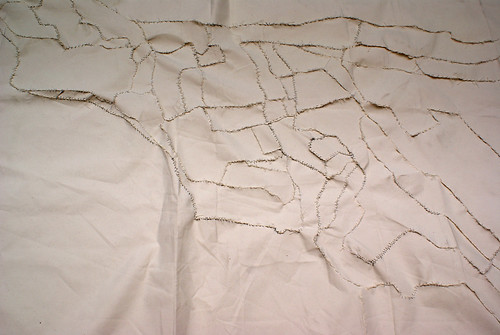
    • Stitched Work
      • Missded 1
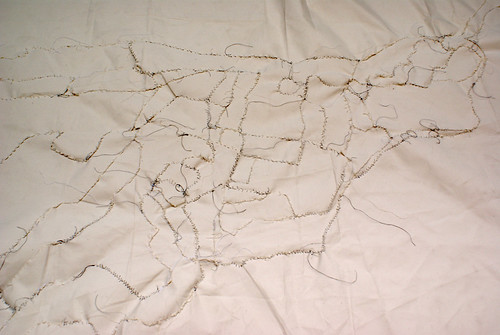
      • Missded 2
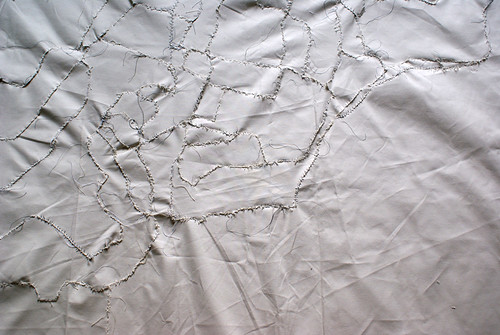
      • Missded 3
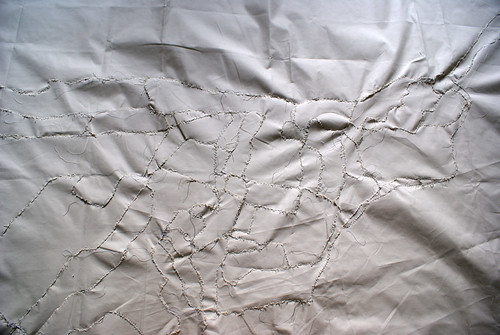
      • Missded 4
    • Text Work
  • Blogs
    • Family History
    • Goethean Observations
    • Grief
    • Light Slowed But Never Stilled
    • Lists
    • Present Empathy
    • Shadow Calligraphy
    • Trees
    • Time
    • Walking Meditations
  • Video
  • Photography
    • Pillars of Snow
    • Creatures
    • The Trees
    • Snow
    • St. Giles Fair 1908
    • Cornmarket 1907
    • Headington Hill 1903
    • Queen Street 1897
    • Travel
  • Illustration and Design
  • Music
  • Projects
    • Dissonance and Rhyme
    • Design for an Heirloom
    • Backdrops
    • Shadow Calligraphy
  • Exhibitions
    • A Line Drawn in Water
      • Artwork
    • A Line Drawn in Water (Blog)
    • Mine the Mountain 3
      • Artwork
    • Mine the Mountain 2
      • Artwork
      • The Wall
    • The Woods, Breathing
      • Artwork
    • Snow
      • Artwork
    • Echo
      • Artwork
    • Murder
      • Artwork
    • The Tourist
    • Dreamcatcher
    • Mine the Mountain
      • Artwork
      • The Tourist
    • M8
    • The Gate
    • Creatures
      • Artwork
    • Residue
      • Artwork
    • A visit to Auschwitz
      • Artwork
  • Me
    • Artist’s Statement

Silence in the Woods

May 23, 2015 by Nicholas Hedges

I’ve discussed previously, three extracts from newspapers in which a moment of silence serves to amplify all that happened before and after. To recap, those three extracts were [my italics in all]:

“On Sunday last, at the close of the evening service, the Society Meeting was held, and references to the death of Private Rogers were made by several members of the Church. Private Rogers’s mother is one of the oldest members of the Church. The meeting passed a vote of condolence with the relatives, all present standing in silence.” (1915) 

“Shortly after dusk, the lightning appeared in the south and western horizon, and soon became most vivid, blue sheets of lightning following each other in rapid succession, but unaccompanied by thunder.” (1842)  

“Her mother got up and tried the door but it was locked by [the] witness when her father and mother came in. Her father took the sword out of the sheath which he threw to the floor and then struck her mother on the back with the flat side of sword; neither her father nor mother spoke.” (1852)

In each of these three passages, the moment of silence is set in opposition to the text preceding it, and, as a result, it serves, as I’ve said, to amplify that text. As I was thinking about this, I became aware that the pieces of work, Heavy Water Sleep and The Woods, Breathing also reflected this opposition.

Both projects use a moment in the life of Adam Czerniakow. As I’ve written before:

“For almost three years, Adam Czerniakow was ‘mayor’ of the Warsaw Ghetto. One of the inspirations for this work is a line taken from his diary, which he kept whilst living in Warsaw in occupied Poland from 1939 to his death in 1942. On September 14th 1941 he wrote:

‘ In Otwock. The air, the woods, breathing.’

On occasion, Czerniakow was allowed to leave the ghetto to visit the Jewish Sanatorium at Otwock just outside Warsaw. It was one place he could find some respite from the horror and torment he endured in the ghetto.”

In reading his diary, this effort and the toll which it took on both his physical and mental health is evident and in these few words – the air, the woods, breathing – words with which we can easily identify, we can glimpse his relief at being able, just for a short time, to stand in the woods and breathe. In that simple, everyday, action we see the other side of his life; the world far beyond our own comprehension.

Czerniakow would also seek solace in reading. One night, on January 19th 1940, he wrote:

“…During the night I read a novel, ‘Pilgrims of the Wild’ – Grey Owl… The forest, little wild animals – a veritable Eden.”

Given what we know about the Holocaust and what Adam Czerniakow went through, these silent moments – in the woods at Otwock and reading at home – are set in stark contrast to what was going on around him. As a result, these two moments serve to amplify the horrors of the war; everything that had happened and everything that had yet to occur.

In my previous blog, I quoted Jorge Luis Borges who wrote:

“A single moment suffices to unlock the secrets of life, and the key to all secrets is History and only History, that eternal repetition and the beautiful name of horror.”

The word moment crops up a lot in my work, as it has in this entry. I’ve long thought that one can only empathise with people in the past through an awareness of present day moments – moments of the everyday. Borges’ quote seems to bear this out. In the case of Adam Czerniakow I have given two such moments. Then there are the three moments of silence in the passages above.

History is a cycle, an eternal repetition of single moments. When I read the same book that Czerniakow read (Pilgrims of the Wild) I am repeating that same single moment. Likewise, when I stand in a wood I am repeating another of those single moments.

So the silence amplifies History and the nature of that silence serves as a moment of connection with the past. The nature of silence and its opposition to violence is interesting too. I return to a favourite quote of mine:

“…if the opposite of war is peace, the opposite of experiencing moments of war is proposing moments of pastoral.”

Peace equates with pastoral, and, perhaps, with silence. I shall end with a quote from Rilke which also seems to fit with what I’ve been saying:

“Look, trees exist.
The houses we live in continue to stand. Only we
pass away like air traded for air and everything
conspires to maintain silence about us, perhaps
half out of shame, half out of unspeakable hope.”
Filed Under: Heavy Water Sleep, Holocaust, Trees Tagged With: Everydayness, Heavy Water Sleep, Holocaust, Jorge Luis Borges, Moments, Pastoral, Pilgrim of the Wild, Silence, The Woods Breathing

A Victorian Storm

February 12, 2015 by Nicholas Hedges

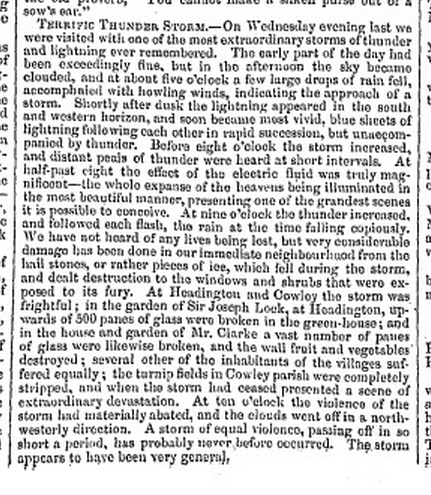
Whilst researching Jackson’s Oxford Journal, I randomly selected an edition from 1842 in which I found the following:

weather1842

Following on from my last blog and my interest in the perception of time in the past as time passing I’m drawn to this piece which serves, I think, to illustrate the point.

For example, the first line:

“On Wednesday evening last we were visited with one of the most extraordinary storms of thunder and lightning ever remembered.”

Firstly, the words “Wednesday evening last,” pinpoints the storm in terms that are not ‘historical’. It’s not as if we’ve read in a book, “on September 7th 1842, a great storm hit the city.” Rather the event is located in time using a phrase we might use today. It locates the storm in relation to the present – even if that present is September 10th 1842 – and at once feels fresh and contemporary.

Secondly, the phrase “ever remembered,” reminds us, if you pardon the truism, that there was a time before this time. But whereas we know that before 1842 there was 1841 and so on, what this phrase describes is living memory. Again, if we were reading about the storm in terms of its being an historical one, we would know that everyone who experienced it was dead. Reading this article, they are very much alive. Not only that, but the whole of the nineteenth century – and perhaps a part of the eighteen is alive within them too.

It isn’t only this storm which lives within these words, but many others stretching back as far as the late 1700s.

The next description is something with which we have all experienced:

“Shortly after dusk, the lightning appeared in the south and western horizon, and soon became most vivid, blue sheets of lightning following each other in rapid succession, but unaccompanied by thunder.”

That lack of thunder is the punctum of this text. (Ironically, the last time I mentioned punctum in a blog was in an entry entitled ‘Silence‘ about the death of my great-great-uncle, Jonah Rogers.) All the sounds of Victorian Oxford, on that September night in 1842 are contained in that silence. Even within our imaginations, it would seem that the the absence of one sense, heightens all the others. We can sense the approaching storm, feel its presence on the horizon. We can see the muted colours of dusk, muted further still.

Then the thunder comes – “distant peals of thunder” as the writer puts it – which increase until by 9 o’clock, it accompanies every flash. This means of course that the storm was right above the city. The rain falls hard, and with it hail – or “pieces of ice,” which damage numerous properties and the turnip fields of Cowley. By 10 o’clock it was over.

One of the names mentioned in the piece is Sir Joseph Lock whose greenhouse was damaged to the tune of 500 panes of glass. An unpopular man, he built Bury Knowle House in 1800 (the gardens of which feature in another recent blog). Here in Headington, as it was in Cowley, the storm “was frightful” and we can imagine Mr Lock looking out the window of his house as the storm lashed his garden, his face, in the dark midsts of the past, illuminated for a moment by the lightning.

Filed Under: Oxford Tagged With: Everydayness, History, Newspaper Cutting, Nowness, Old Newspapers, Oxford, Silence, Victorians

Lines Drawn in Water

October 22, 2012 by Nicholas Hedges

The following passage is taken from ‘The Old Ways: A Journey on Foot’ by Robert Macfarlane. In a chapter on water he writes:

“The second thing to know about sea roads is that they are not arbitrary. There are optimal routes to sail across open sea, as there are optimal routes to walk across open land. Sea roads are determined by the shape of the coastline (they bend out to avoid headlands, they dip towards significant ports, archipelagos and skerry guards) as well as by marine phenomena. Surface currents, tidal streams and prevailing winds all offer limits and opportunities for sea travel between certain places…”

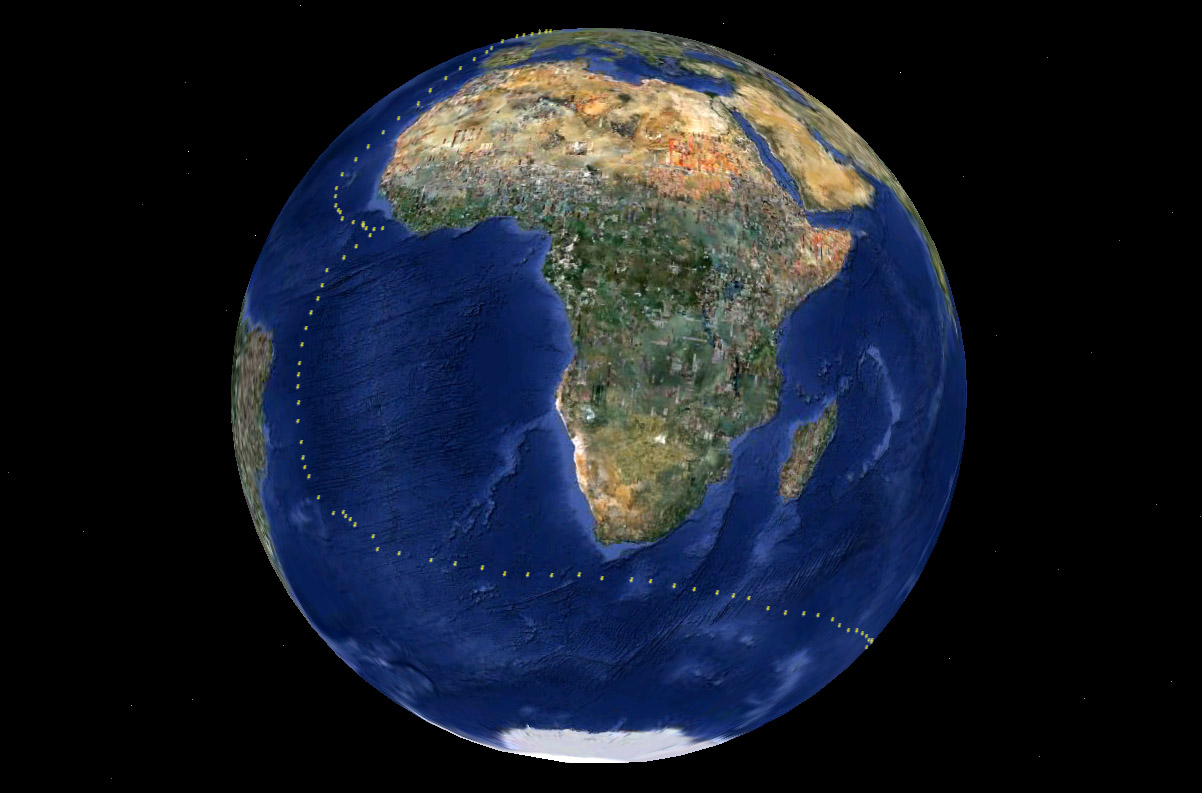
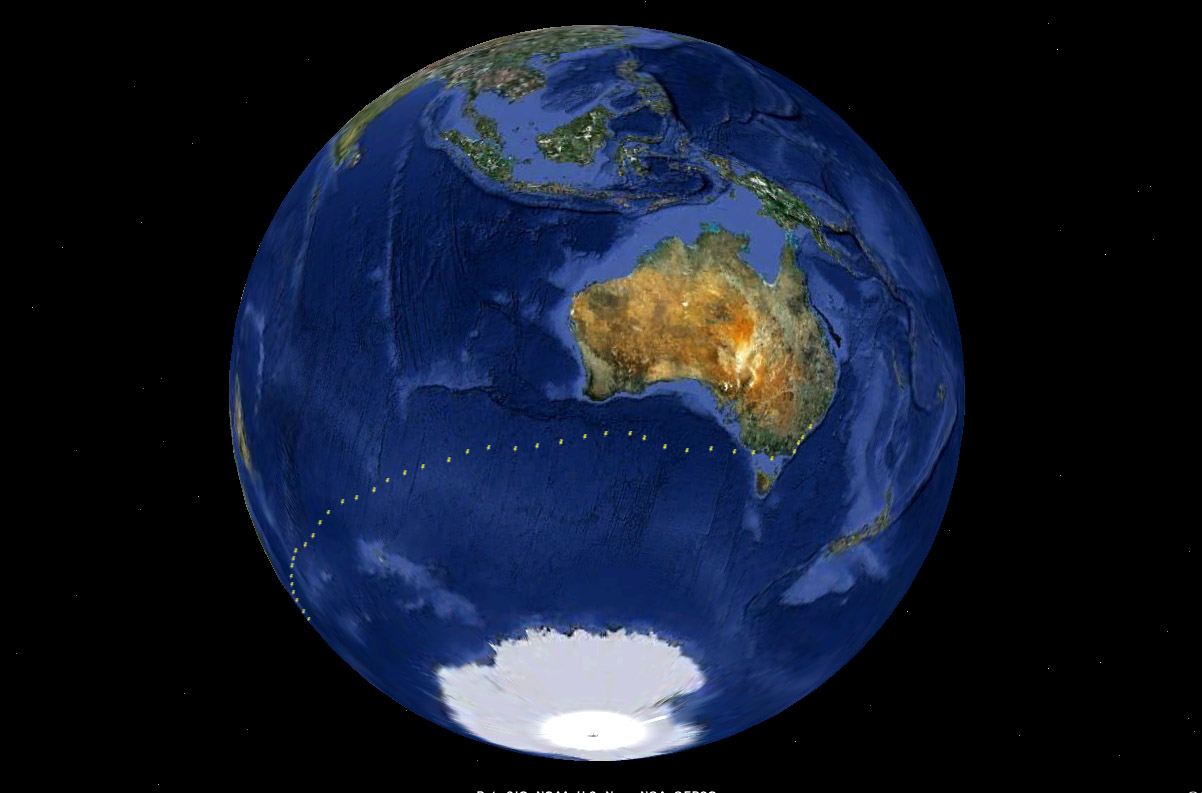
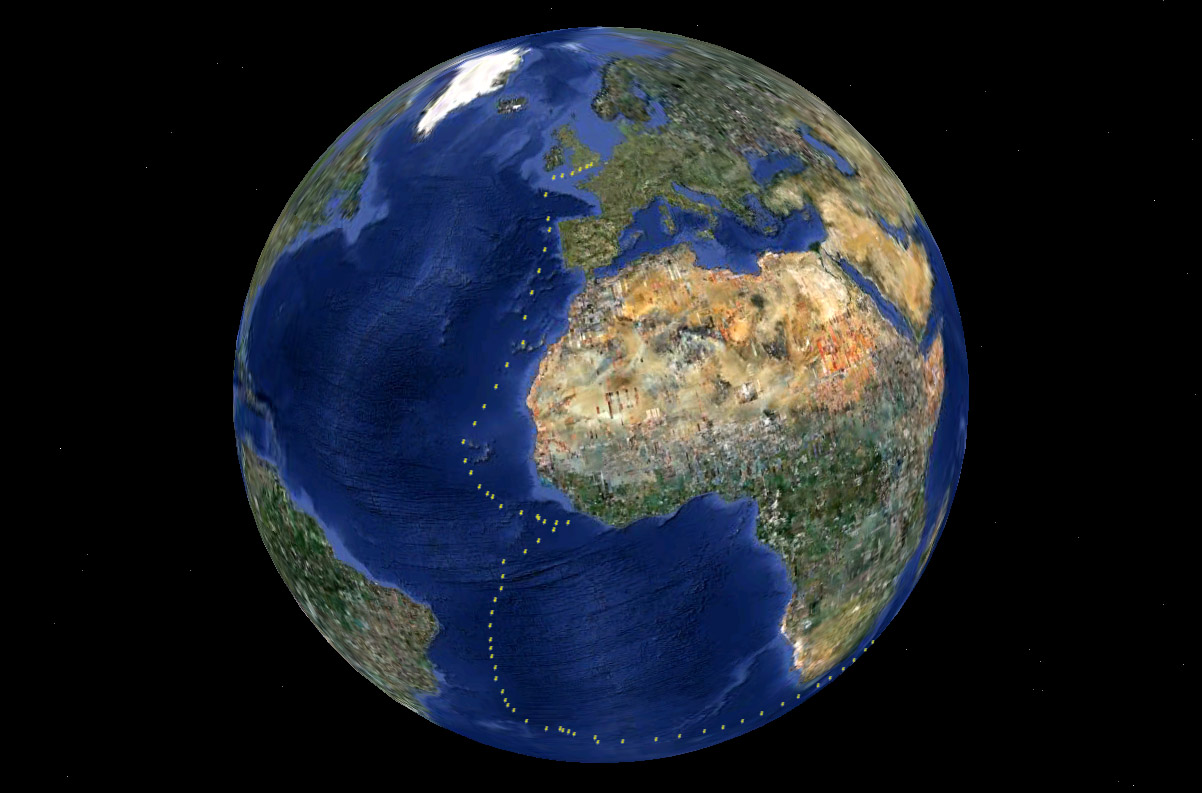
This reminded me of some work I did on my ancestor Stephen Hedges who was transported to Australia in 1828. In particular I thought about the route The Marquis of Hastings (the ship on which he sailed) took from Portsmouth to Port Jackson (Sydney) which I mapped using Google Earth and coordinates written down in a logbook by the ship’s surgeon, William Rae.

Macfarlane also writes:

“Such methods would have allowed early navigators to keep close to a desired track, and would have contributed over time to a shared memory map of the coastline and the best sea routes, kept and passed on as story and drawing…

Such knowledge became codified over time in the form of rudimentary charts and peripli, and then as route books in which sea paths were recorded as narratives and poems…

To Ian, traditional stories, like traditional songs, are closely kindred to the traditional seaways, in that they are highly contingent and yet broadly repeatable. ‘A song is different every time it’s sung,’ he told me, ‘and variations of wind, tide, vessel and crew mean that no voyage along a sea route will ever be the same.’ Each sea route, planned in the mind, exists first as anticipation, then as dissolving wake and then finally as logbook data. Each is ‘affected by isobars, / the stationing of satellites, recorded ephemera / hands on helms’. I liked that idea; it reminded me both of the Aboriginal Songlines, and of [Edward] Thomas’s vision of path as story, with each new walker adding a new note or plot-line to the way.”

One of the things I like about William Rae’s logbook of the journey aboard the Marquis of Hastings is the description of the weather. The world aboard a prison ship in 1828 is far removed from our experience, but we know weather and can therefore use his descriptions to bridge the gap between now and then; moving from – to use Macfarlane’s words – “logbook data” through “dissolving wake” and “anticipation,” all the way back to “planned in the mind.” The description of the weather therefore becomes a poem of sorts, echoing what Macfarlane writes above; how sea paths become narratives and poems, allowing me to step back into the mind of my ancestor.

Fresh Breeze. Mist and rain.
Strong Breeze. Cirro stratus. Horizon hazy.
Hard gale & raining. Heavy Sea.
Hard rain & Violent Squalls. Hail & rain.

Click here for a PDF transcript I made of the journey.

Filed Under: A Line Drawn in Water, Artist in Residence Tagged With: A Line Drawn In Water, Artist in Residence, Everydayness, Family Hedges, Family History, GPS, Hedges, Listmaking, Lists, Positioning, Stephen Hedges, Walks, Weather

Movement, Knowledge and Description

July 17, 2012 by Nicholas Hedges

Having read Tim Ingold’s book ‘Lines – a Brief History‘, I downloaded another of his books entitled ‘Being Alive, Essays in Movement, Knowledge and Description‘ as the title seemed to suggest it would be of interest to me insofar as my work on empathy and the past has found itself returning time and again to ideas of movement and knowledge; empathy is, I believe, an augmented discourse between bodily experience and knowledge, and my aim as an artist is to articulate empathy through the description of this conversation between individuals and the landscape.

“It is by moving that we know, and it is by moving, too, that we describe,” writes Ingold early on in the book, which seems to bode well for my research and my search for the form that on an artistic level my research should take .

I’ve recently been working with the form of the folded map, inspired as I’ve written before by an old trench map which I recently purchased. In particular, I’m interested in the folds of the map, the creases which show that the map was used and in the possession of an individual. In ‘Lines – a Brief History‘ Ingold draws a parallel between creases in materials such as paper and the creases one finds on the palm of your hand which reinforces the connection between owner and object.

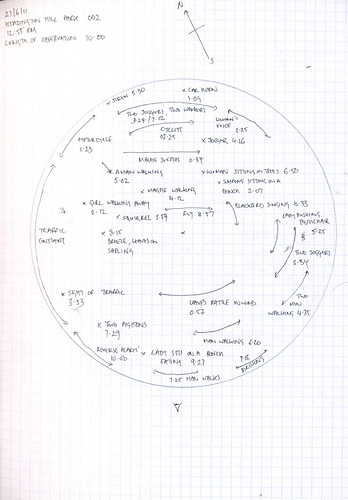
I’ve been wondering how I can develop this idea. I’ve already completed a ‘text map’ based on observations made over the course of several walks (below) but I want to develop the idea graphically as well.

I thought about the concept of a map and what the aesthetic of the folded paper alludes to. I came up with the following:

  • the idea of a specific place or of place in general
  • the sense of that place – through the map object – as belonging to an individual
  • the idea of the individual
  • the idea of movement in and through a place whether in the past, present or future
  • the idea of movement preserved in the folds

What I want to do is articulate the idea of empathy as a discourse between bodily experience and knowledge. The text map above is a document of bodily experience which when written down and presented as a ‘map’ becomes knowledge which other individuals could theoretically use. Its shape and its folds allude both to the idea of place and of possession (the concept of an individual as a place is something else which I’ve been exploring over the past few years). But what about the circular nature of experience and knowledge?

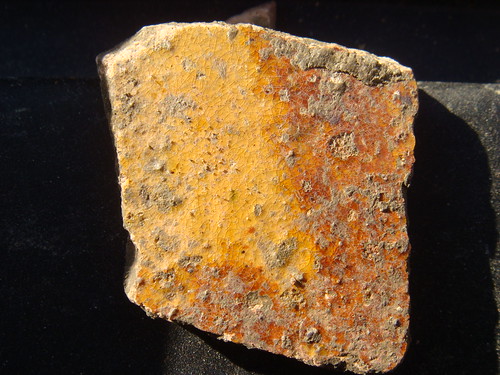
The fact is, when we think about the past, we can only ever build a picture through tiny fragments – whether pieces of pot, miscellaneous artefacts like coins, pieces of text, letters and anecdotes (unfolding through enfolding). Each of the phrases on my text map is a fragment from which the wider picture can be extrapolated, just as with a fragment of pot, one not only builds an image of the pot but extrapolates the wide world to which it once belonged.

Bartlemas Chapel Excavation

The piece of pottery has something in common with the phrase: “leaves drowned in disappearing puddles”which I noted on one of my walks. It is also interesting that when I found the above piece of pottery, I also discovered – almost at the same time – a leaf, which was almost identical in colour. The transient nowness of the leaf then, serves – through its colour – to articulate the idea of the fragment of pot as being similar to the fragment of text.

Filed Under: Archaeology Tagged With: Archaeology, Colour, Everydayness, Lines, Movement, Nowness, Tim Ingold, Trench Maps, Walks

Everyday Surveys

June 27, 2011 by Nicholas Hedges

An area in which I’m interested is the idea of the past as having once been the present – an obvious point maybe, but often a more empathetic engagement with the past is made more difficult by the way in which history is packagaed or received – as a story with a beginning, a middle and an end. It’s almost as if those whom it concerns are characters in a work of fiction, whose actions are somehow predetermined.

Of course all historic events and the actions comprising them were made as part of an everyday world; that’s not to say major events such as war are ‘everyday’, but that they’re set against a backdrop of ‘everydayness.’

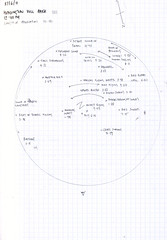
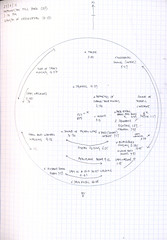
Having carried out a Plane Table Survey, I wanted to find a way of surveying the everyday diagrammatically. I’ve made everyday ‘surveys’ before in the form of lists but the images below are an attempt to articulate the everyday – as I’ve said – visually.

Everyday Surveys

Everyday Surveys

Everyday Surveys

Filed Under: Archaeology Tagged With: Archaeology, Everyday Surveys, Everydayness, Moments, Nowness

Windows, Bicycles and Catastrophe

January 9, 2011 by Nicholas Hedges

Windows in images are, as I’ve discussed previously, evidence of people living their lives without a thought for the subject or subjects in the photograph. This entry examines a number of details taken from photographs of Oxford at the beginning of the 20th century.

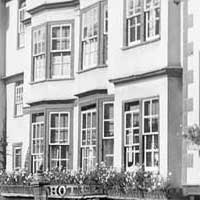
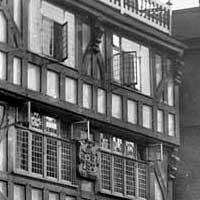
This detail below, from a view of the High Street taken in 1907, shows the open windows of what was then the Mitre Hotel.

Perhaps these windows were opened by guests visiting the city over 100 years ago, or perhaps by maids in preparation for their visit. But what was taking place behind these windows when the photograph was taken? What conversations were being had? As I’ve said above, whatever they were and whatever was happening within, the open windows serve to give life back to a place from which the photograph was taken. The rooms become portals to unseen parts of the image, not just in the rest of the city, but rather the wider world. It is perhaps then, rather appropriate, that this image shows a hotel.

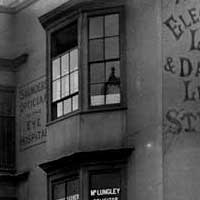
The image above, taken from a photograph of 1909 (amazing how we can just skip a couple of years) is particularly interesting, in that as well as being open, we can also see clear reflections within the window’s glass. This window serves again to take us beyond the boundaries of the image, into its hidden interiors, from where we might look upon that view reflected in the window. The same can be said to some degree about the image below, also from a photograph of 1909.

As an aside, it’s interesting how these two images, because they were taken in the same year, constitute in our mind’s eye a single moment; the year (in this case 1909) becomes just that – a moment in time. But what period of time separates the photographs from which these details are taken? Is it minutes, hours, days, weeks or several months? What happened between the taking of one picture and the other?

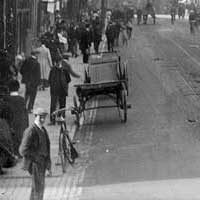
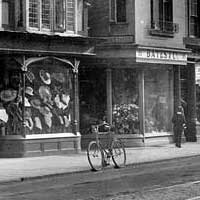
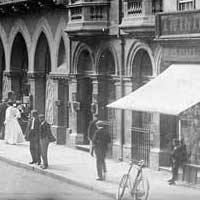
In the detail below (from a photograph of 1907)  my eyes are drawn to the the bicycle; not the make or the style, but the way it seems to reveal the presence of time, or rather an inconsequential moment in time. For me, it’s in these everday, unremarkable moments that the past is revealed – where history really comes alive.

Of course the man in the foreground looking at the camera, and those people walking up the High Street are subjects of a particular moment (cameras are, Barthes beautifully put it, ‘clocks for seeing’), but there’s something about the bicycle which expresses it better. Below is another a detail from a photograph of 1911. Taken again in the High Street, a few metres back from the one above, Carfax Tower in visible the distance.

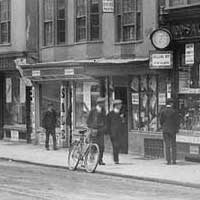
In the image below, something in the window of a shop on the High Street in 1909 has caught they eye of the man looking in as well as the two men walking towards him. The man with his hands in his pockets also describes a specific moment in time; the way he’s standing seems to suggest that he’s just that second stopped; something very different to being ‘stopped’ – as in the case of the two men walking – by the shutter of the camera. But again it’s the bicycle parked at the side of the road which, for me, best describes the moment; or more accurately, its continuity – its place in a passage of time. Even though the two men walking have clearly come from somewhere and will no doubt go somewher else, the bicycle is still much the better way of representing a moment within the passage of consectuive moments, both before and after.

But why is this the case?

One might assume that in a photograph there’s no better means of indicating someone’s presence than someone’s image. The detail above shows such a person on the right. But somehow, the bike and the absence of its rider are more indicative of presence than the man we can actually see, just as it is – as I’ve described above – a better indicator of a single moment in a wider sequence of moments.

In Camera Lucida, Barthes writes:

“I observe with horror an anterior future of which death is the stake… I shudder… over a catastrophe which has already occurred. Whether or not the subject is already dead, every photograph is this catastrophe.”
Forgetting the bicycle for a moment and looking instead at the man in the photograph, one knows that he is dead. His frozen pose alludes to this anterior future of which Barthes speaks. He also writes:

“In the photograph, Time’s immobilisation assumes only an excessive, monstrous mode: Time is engorged…”
The idea of time engorged conjures up apocalyptic images of disaster; Time not able to proceed but growing nonetheless, swelling within the frame of the picture, the world shaking as it struggles to chew and to swallow. The man in the picture above must and will fall victim to this catastrophe (he must and will die), but the man who’s left his bicycle (and as such the photograph) will instead be sure to survive.

I’d assumed it was the act of leaving the bicycle which gave the bicycle its status in the photograph; the fact that whoever left it would be sure to return and pick it up in a matter of seconds or at most minutes; that it was the idea of these few moments which countered the blurring of time I described above (where entire years can implode to fit the space a second – which itself alludes to the idea of engorged time). But in fact, I believe it’s the rider’s escape from the photograph which instills in them – the bicycles – their appeal to the viewer.We know the rider must be somewhere and it’s as if he’s still there; as if the moment from when he left his bike (for example in 1909), to picking it up again is still ongoing.

The detail above is taken from a photograph of Cornmarket in 1889. Looking at the entire image, one can see that all the buildings shown have since been demolished, and as sad as this is when one sees what stands there now, one doesn’t find it hard to imagine. Buildings are demolished all the time – it’s a fact of life. But when looking at the detail above, with its open window, it seems less conceivable that it’s since been destroyed, that it no longer exists.

Such a thought doesn’t occur however when I look at images of people.

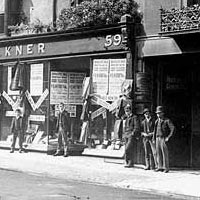
The image above is a detail from the same photograph. Like the building they stand against, all these men are gone. But this, unlike with the detail of the window, does not strike me as inconceivable in any way; quite the opposite. Perhaps it’s the open window which makes the building’s demise (or non existence) seem so unlikely. The open window is indicative of life, of the everyday aspect of life. Who would open a window in a building set to be demolished? But then, who would dress and pose for death?

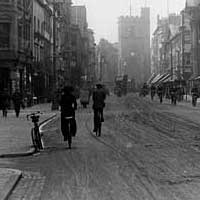
Above, Cornmarket 1907. Another rider has escaped impending disaster.

Also Cornmarker 1907. A group of people talk at the southern end, nearest to Carfax. Their clothes (particularly those of the women) position them unequivocally in the time in which they lived.

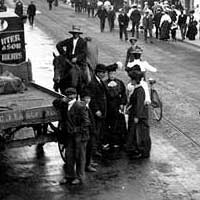
A number of questions come to mind as I look at them and the scene around them. What are they talking about? What were the hot topics of the day? Where is the woman pushing her bike? (Wherever it is, it’s too late to escape the imminent catastrophe). In this image however, that which captures my interest above all is the rain on the pavement.

Just as shadows give life to a photograph (without the sun beyond the frame of the photograph there can be no shadows within it) so puddles and reflections on wet pavements point to a time before the photograph was taken and, – like shadows with the sun – to the clouds above and beyond the gaze of the lens. Barthes declares that “the photograph is without a future” and while this might be the case, there’s is no doubt they have a past.
Sometimes, photographs (without shadows, puddles, windows open and closed) can look flat and lifeless, as if they’re merely constructions (tableau vivant) designed in their entirety, as counterfeits for the reality they purport to be. They have no future, but, more importantly perhaps, no past. The rain in the photograph above however counters this; it gives the photograph its validity, it is a recognisable sign that something came before.

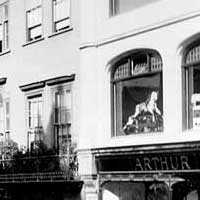
The detail above is taken from the same picture (Cornmarket 1907), and, rather sentimentally perhaps, I was drawn to the rocking horse in the window. One can’t help but wonder what happened to this somewhat peripheral object (peripheral in terms of the overall photograph). I can well imagine it languishing in some dusty attic, forgotten, even broken… although, of course it might be in very rude health, respected as an old family heirloom. And herein lies its point of interest. Whatever its current state – if indeed it still exists – here, in the picture, it’s yet to occupy the mind of the person to whom it belonged. It’s yet to form the memories which that person would have carried with them throughout their life, memories which they might have passed down and which might, to this day be talked about. Perhaps this rocking horse no longer exists as a physical object, but maybe somewhere, it continues to move in words, written or spoken.

Filed Under: Photography Tagged With: Barthes, Bicycles, Catastrophe, Everydayness, Nowness, Photographs, Vintage Photographs, Windows

Sail

November 27, 2010 by Nicholas Hedges

Carrying on with the work I did in Australia, I’ve spent the last couple of days videoing the canvas ‘sail’ that I made there, which was itself made from the pattern of several walks made around Newcastle, NSW. This work (‘Repaired Sail of HMS York (1828)’) is in many respects linked to a piece I made for my third Mine the Mountain exhibition called  ‘Old Battle Flags‘ and is about the feel of the wind – the wind being something which although one may read about in history (particularly in the context of sailing) one can only experience in the present (of course the same could be said of everything else, but in light of the theme of this residency, the wind is especially pertinent).

This piece is about the disparity between language and experience. The wind we feel today is the same wind that’s blown over – and indeed through – the centuries and millennia. In winter the wind may blow from the east, from the vast and distant land of Siberia – a place well beyond the horizon but nevertheless a place which exists all the same. 

The sail is made from my own past experiences, and the wind a reminder of movement in the past – that which is missing from the pages of history. It’s also about the everydayness of the past – something which we take often for granted like so much else but which is integral to our experience of the world.

Filed Under: A Line Drawn in Water, Artist in Residence Tagged With: A Line Drawn In Water, Artist in Residence, Australia, Everydayness, Family Hedges, Family History, Hedges, Lines, Stephen Hedges, Walks

The Geographer

November 21, 2010 by Nicholas Hedges

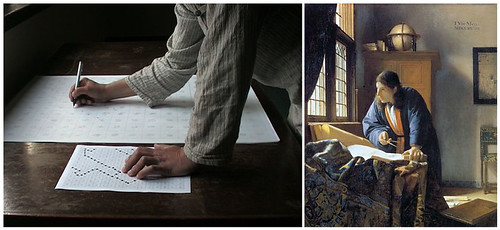
The Geographer

A still from some video footage of me in Australia, drawing out a map of one of the walks I did there alongside Vermeer’s ‘Geographer.’ I’m interested in the idea of performance and had something like Vermeer’s image in mind whilst I was creating my work.

Filed Under: A Line Drawn in Water, Artist in Residence Tagged With: A Line Drawn In Water, Artist in Residence, Australia, Everydayness, Family Hedges, Family History, Hedges, Lines, Stephen Hedges, Walks

Birds and Words

November 21, 2010 by Nicholas Hedges

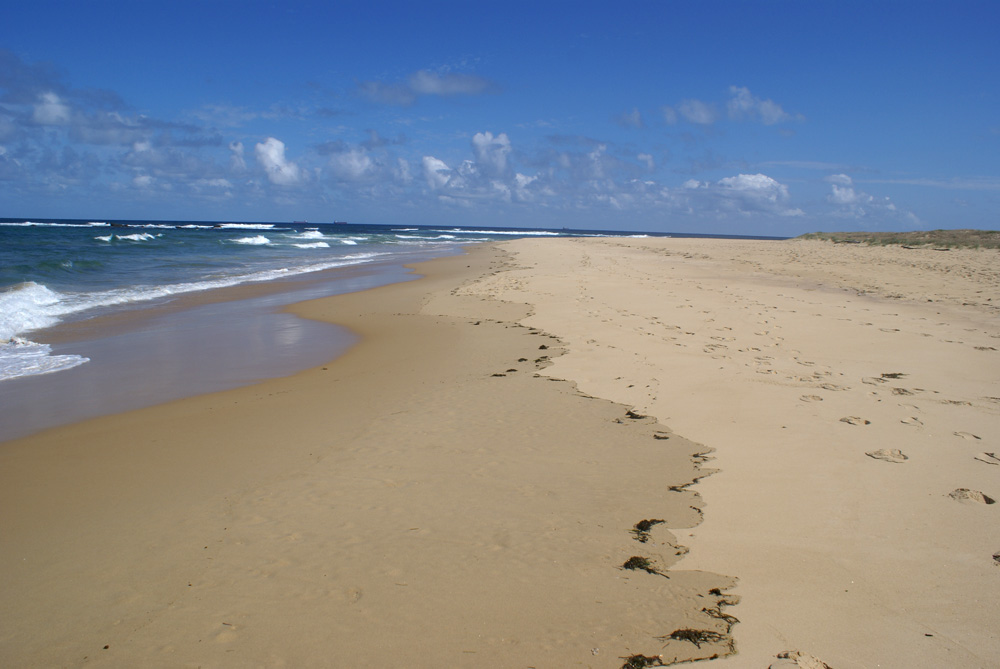
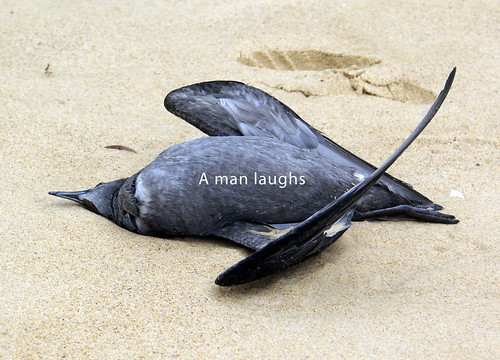
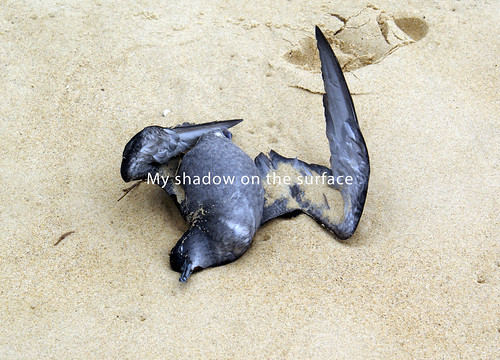
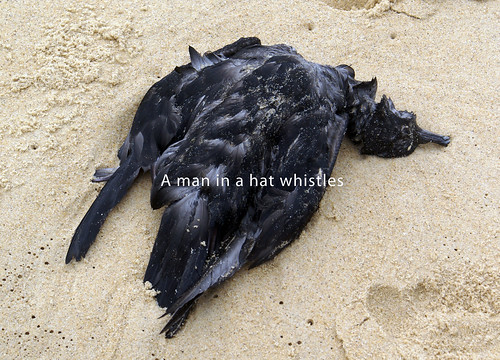
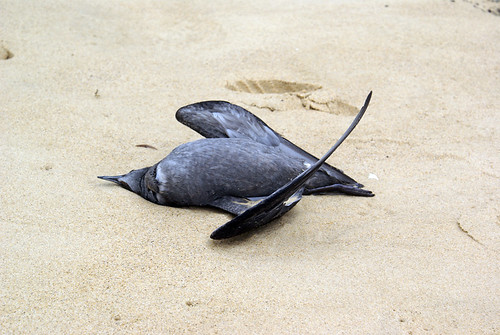
The photographs of dead birds which I took on Newcastle beach are particularly poignant; the lifeless bodies which had once soared high in the sky above are analogous with lost moments in time and, indeed, with the photograph itself. Dying out at sea, the birds had been washed up on the beach, joined in a line marked by that of the tide, rather like the words in my sketchbook, joined by the trace of the line of a walk.

Putting the two together seems to make sense; the words of the walks referring to moments which once lived and which in the instant they were written down fell to the ground like the birds themselves. With every reading they are as those birds washed back up on the beach, joined again by a line – this time, the act of reading in sequence, or of reading them out loud.

Birds and Words

Birds and Words

Birds and Words

Filed Under: Artist in Residence Tagged With: A Line Drawn In Water, Artist in Residence, Australia, Birds, Everydayness, Family Hedges, Family History, Hedges, Lines, Stephen Hedges, Walks

Return to England

November 20, 2010 by Nicholas Hedges

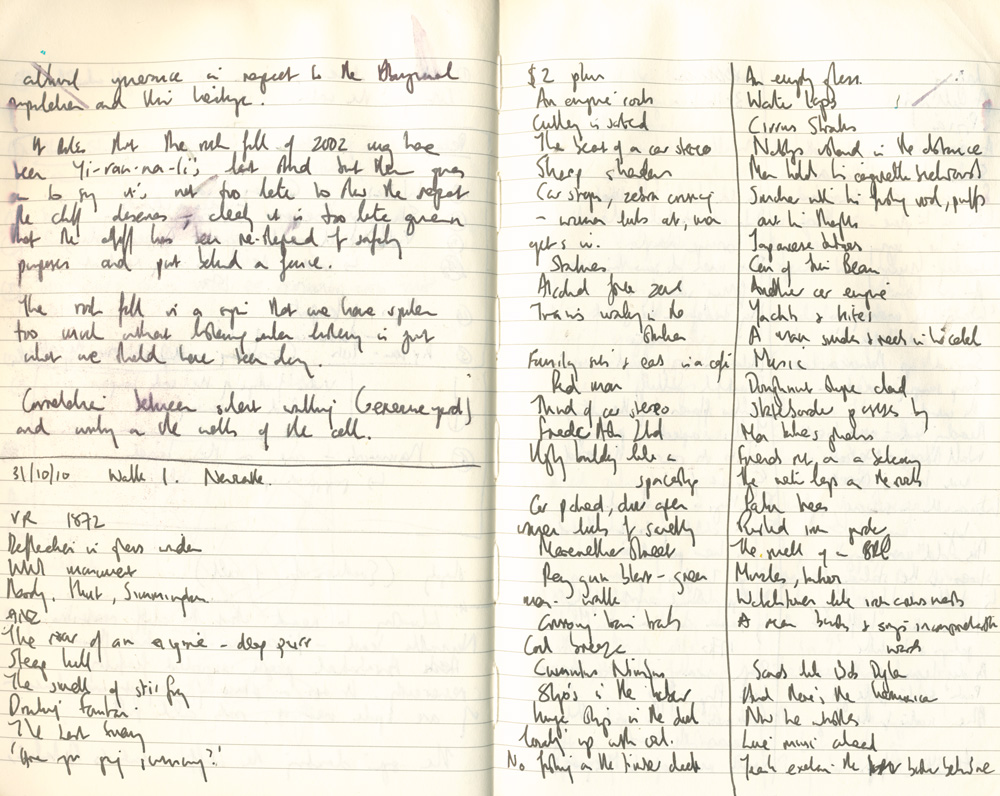
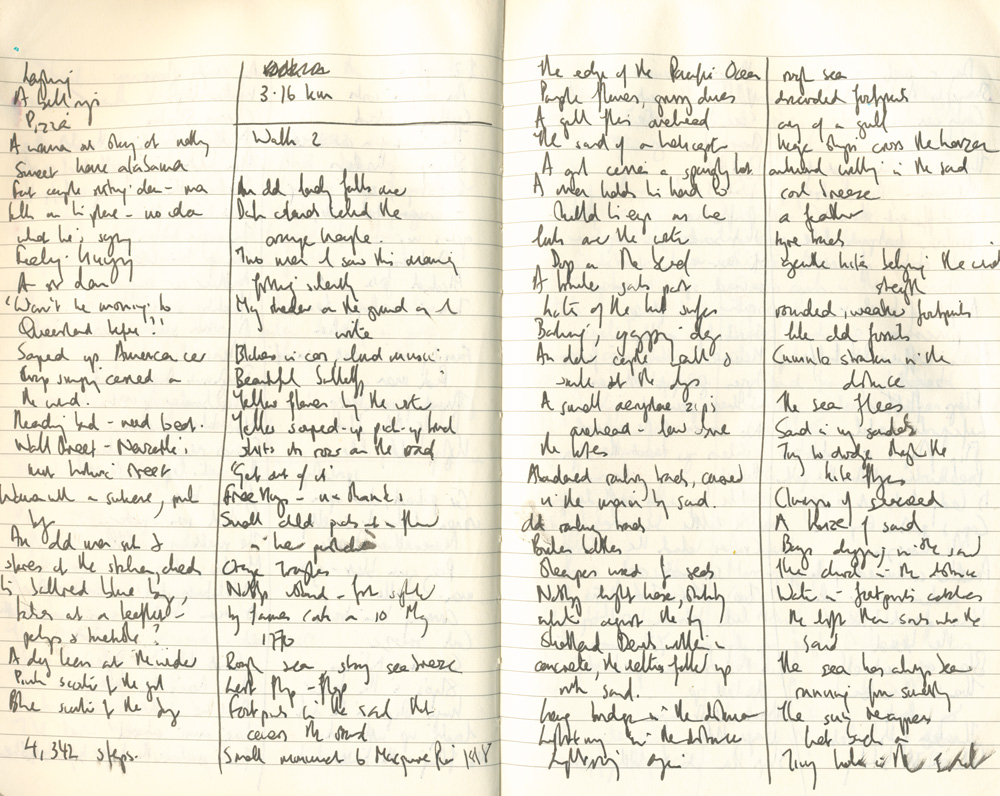
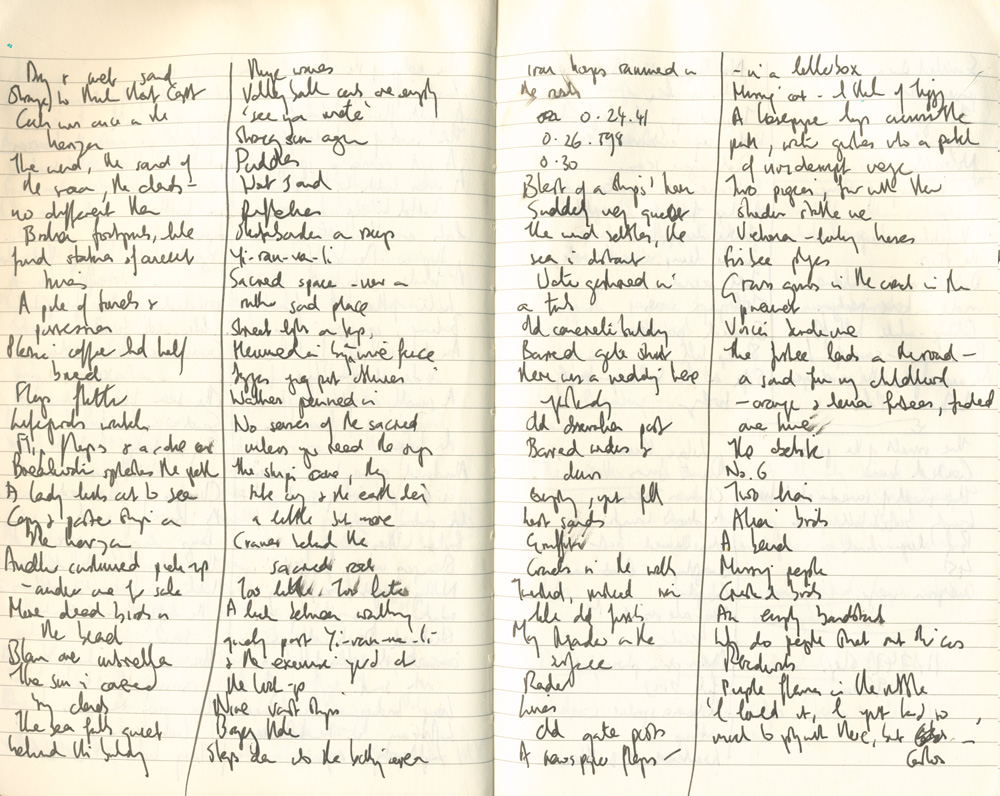
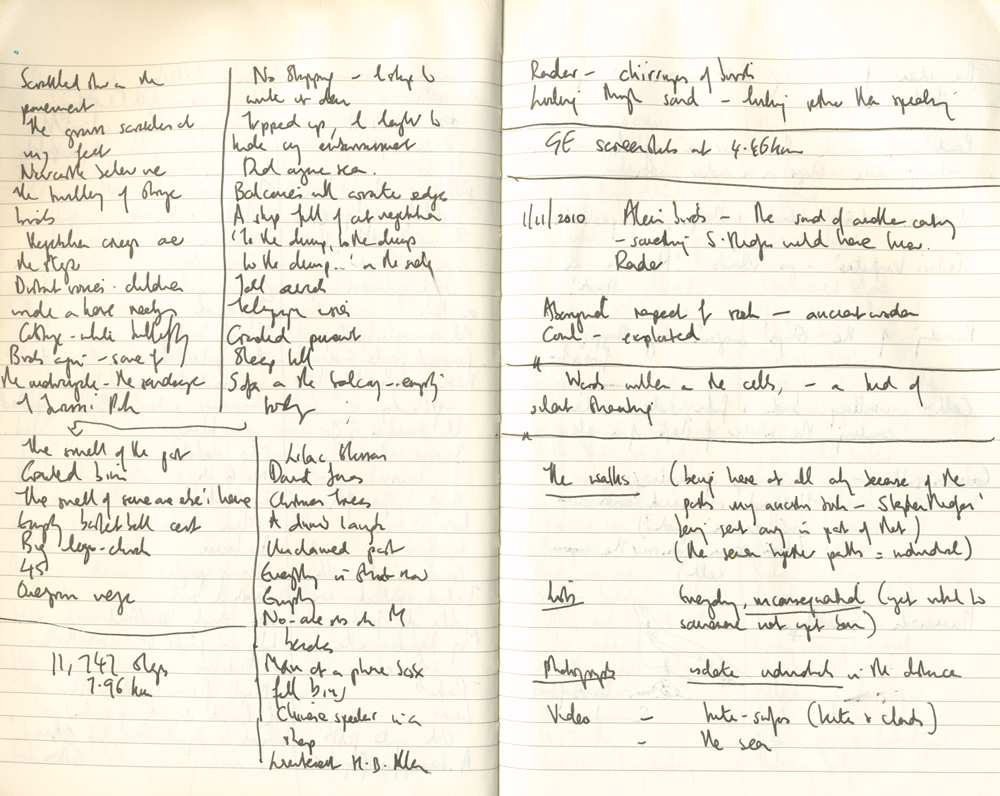
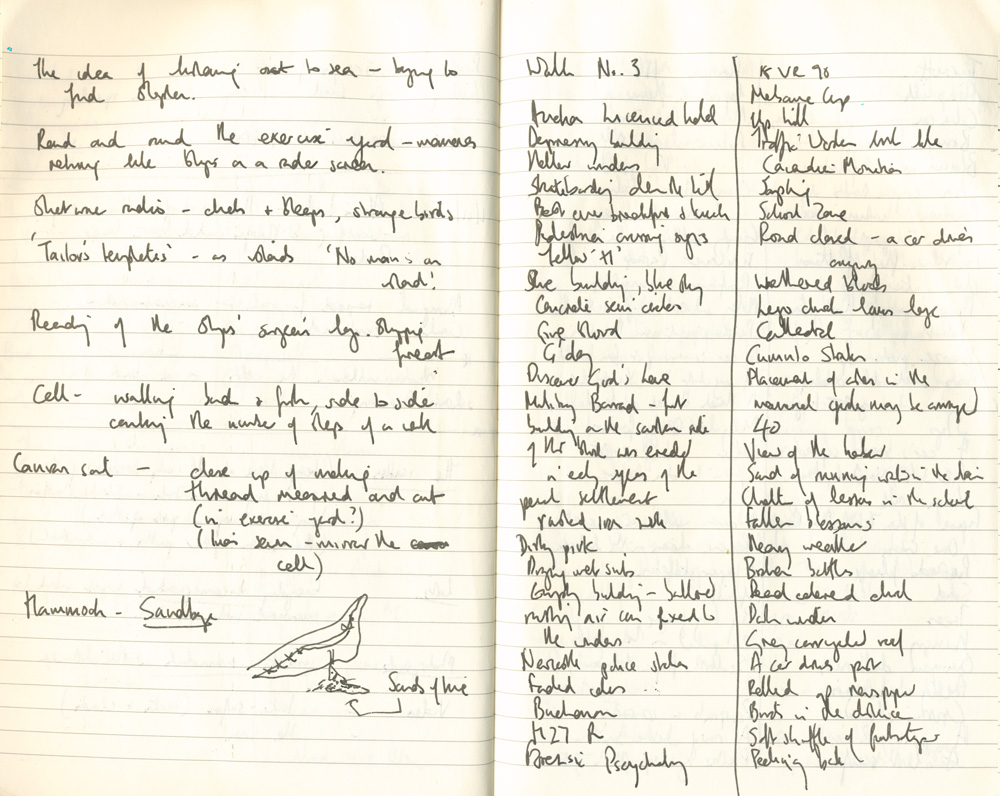
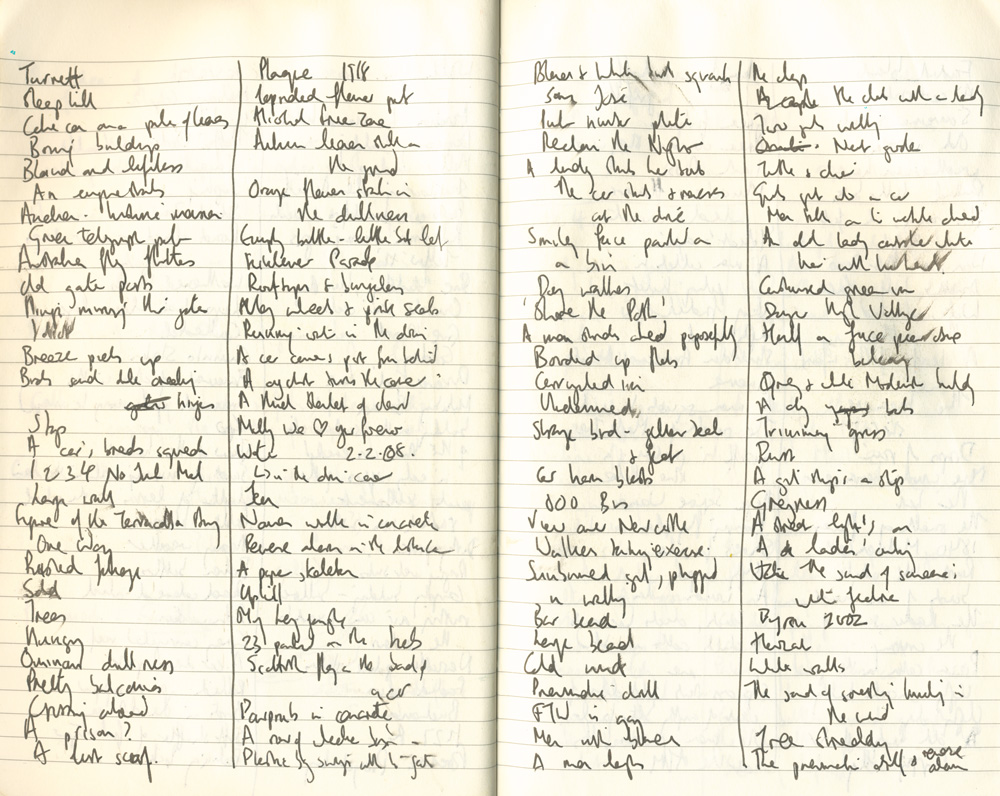
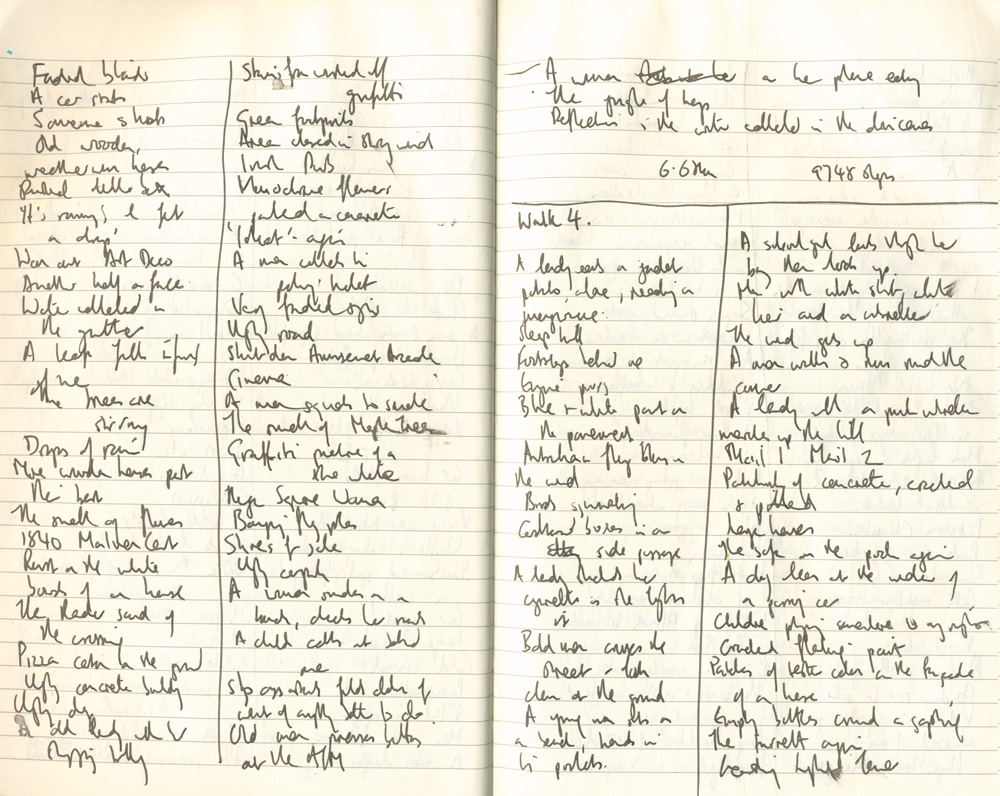
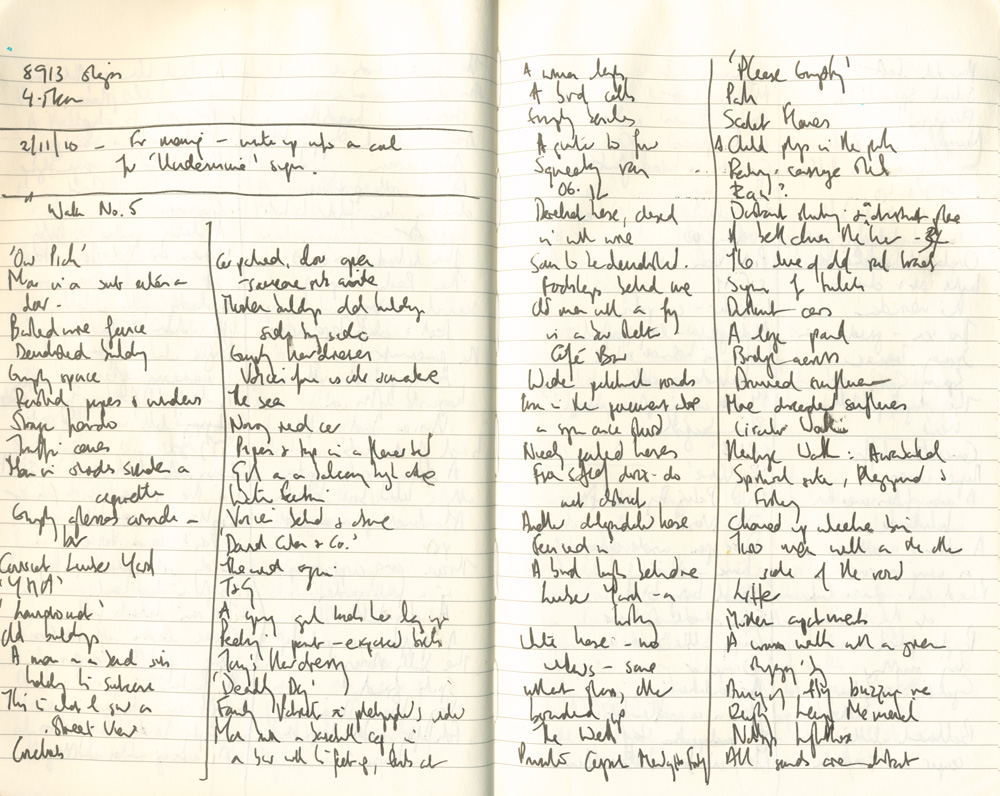
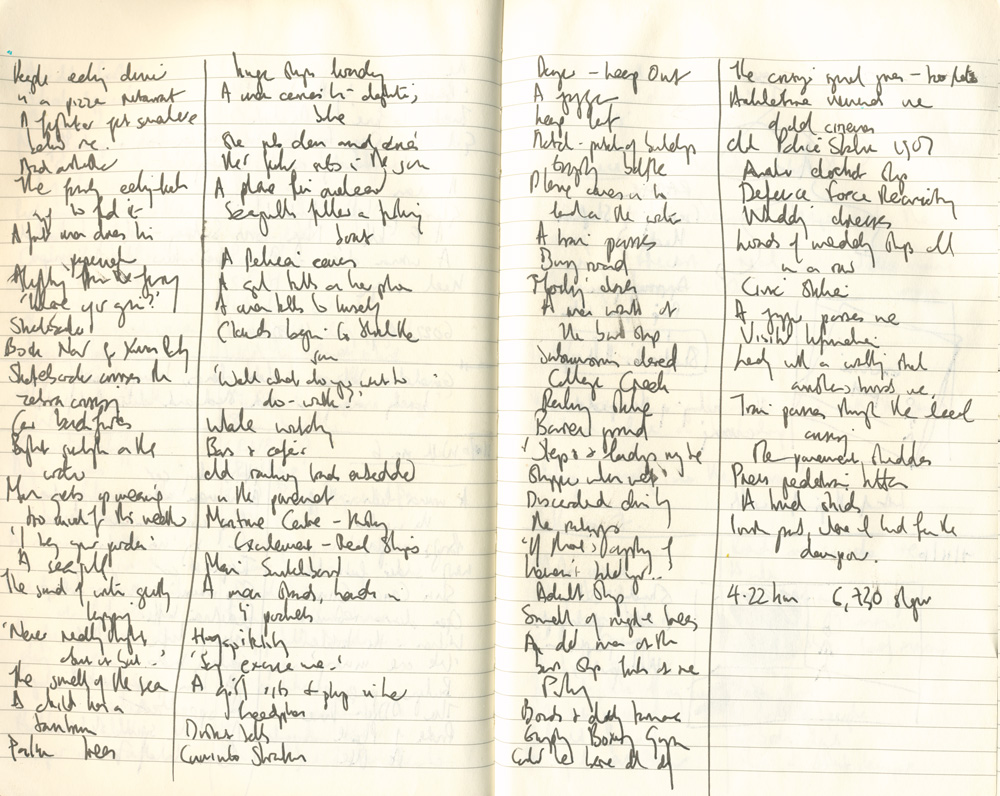
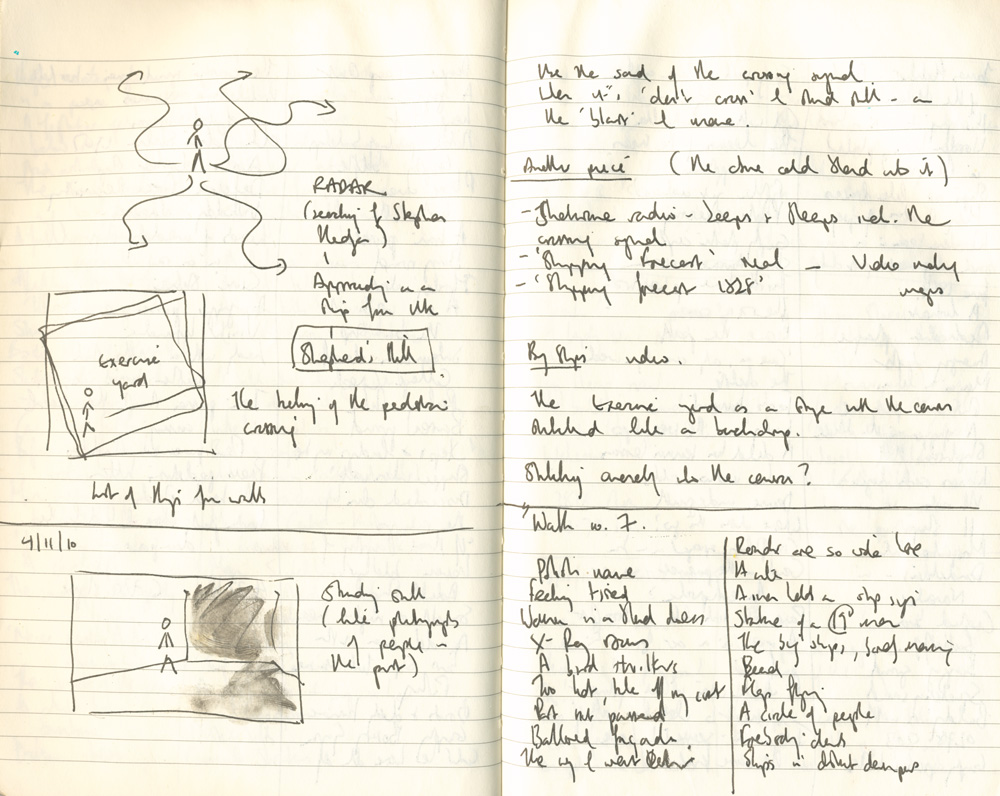
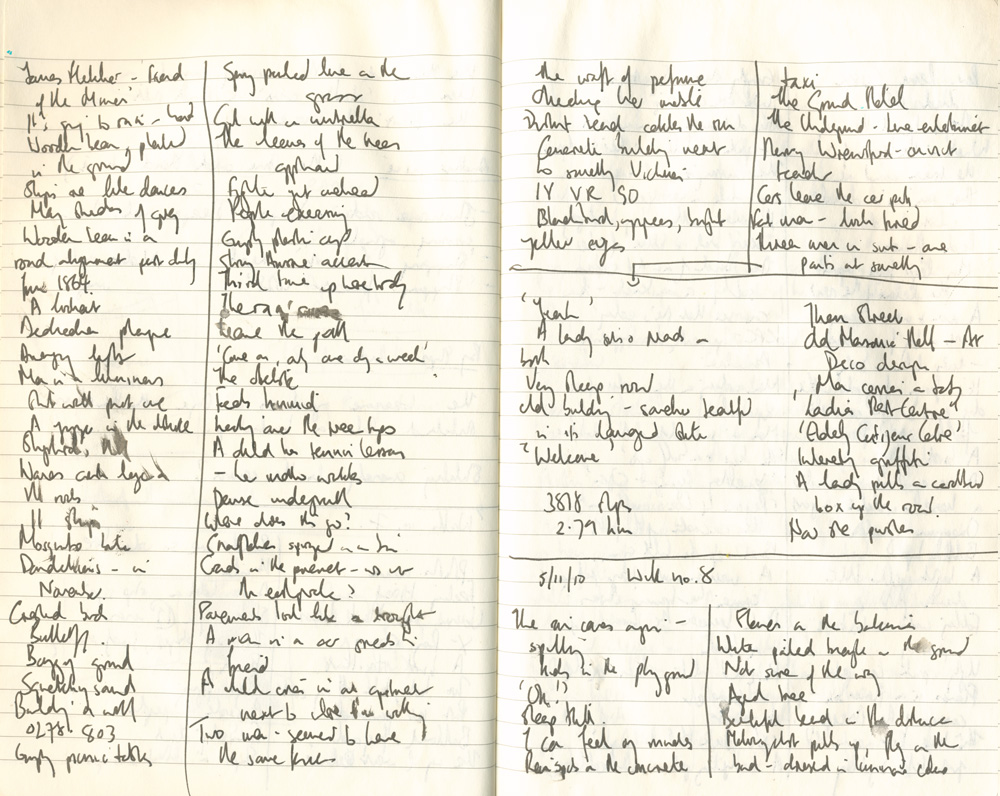
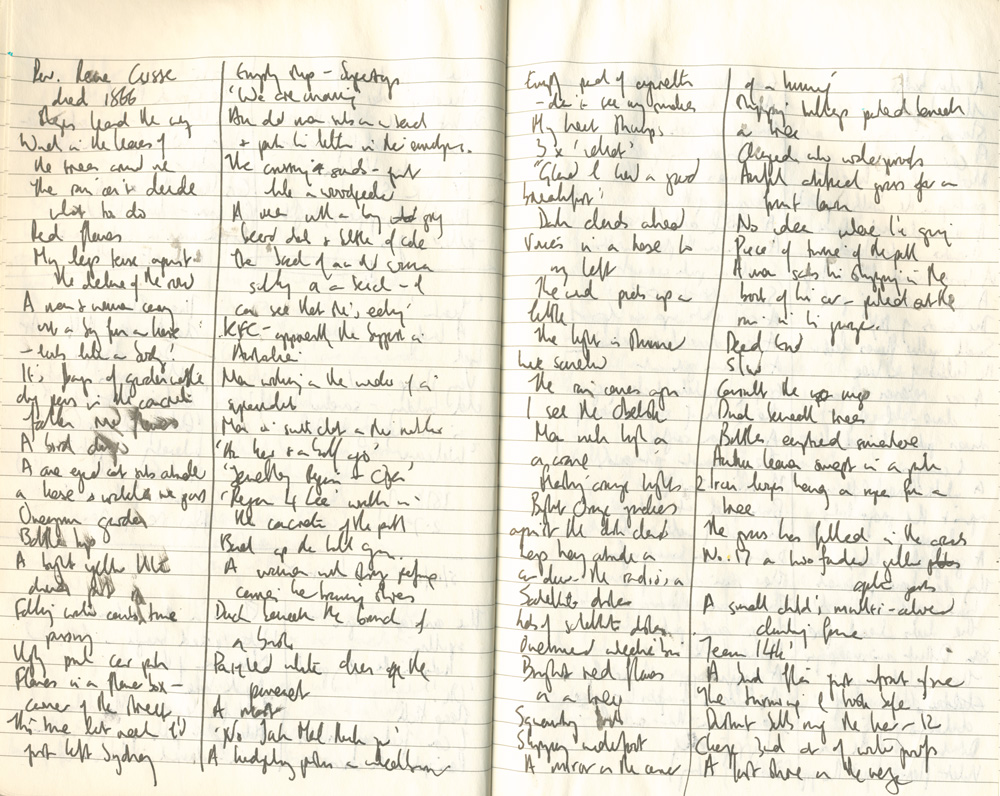
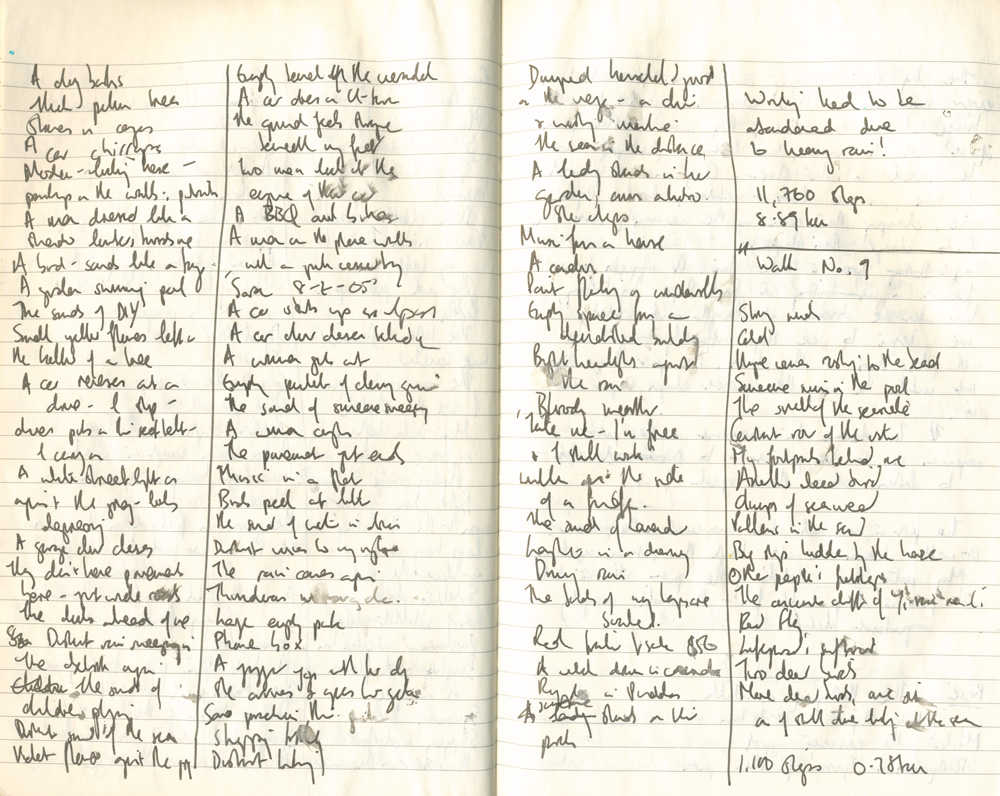
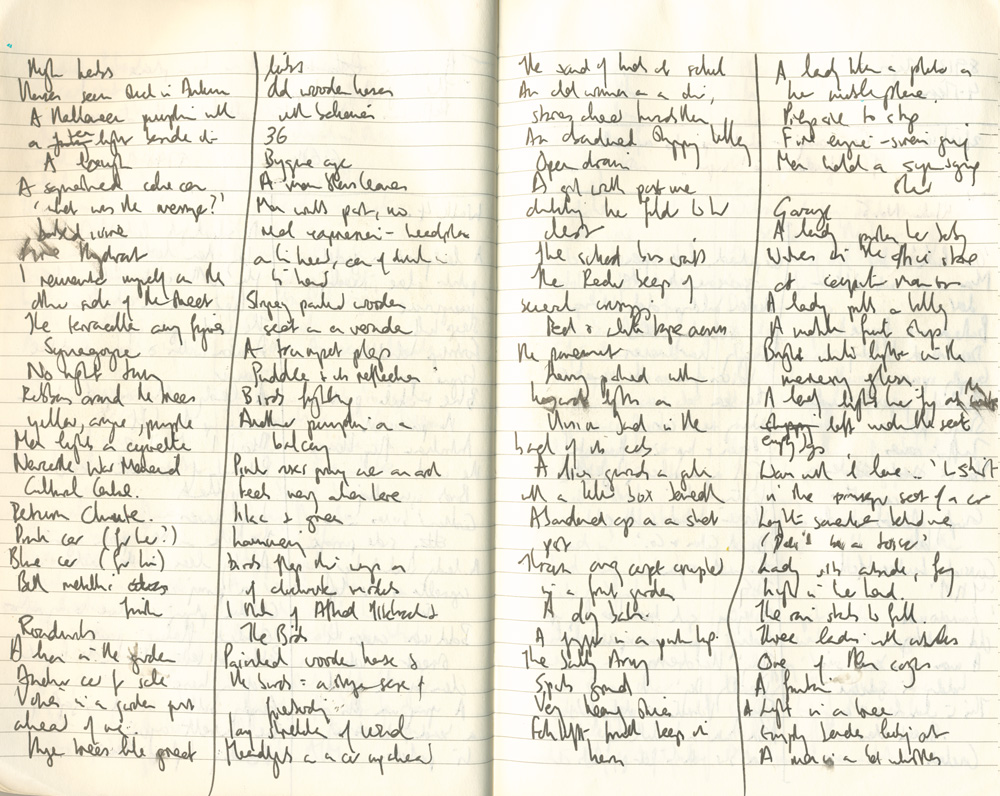
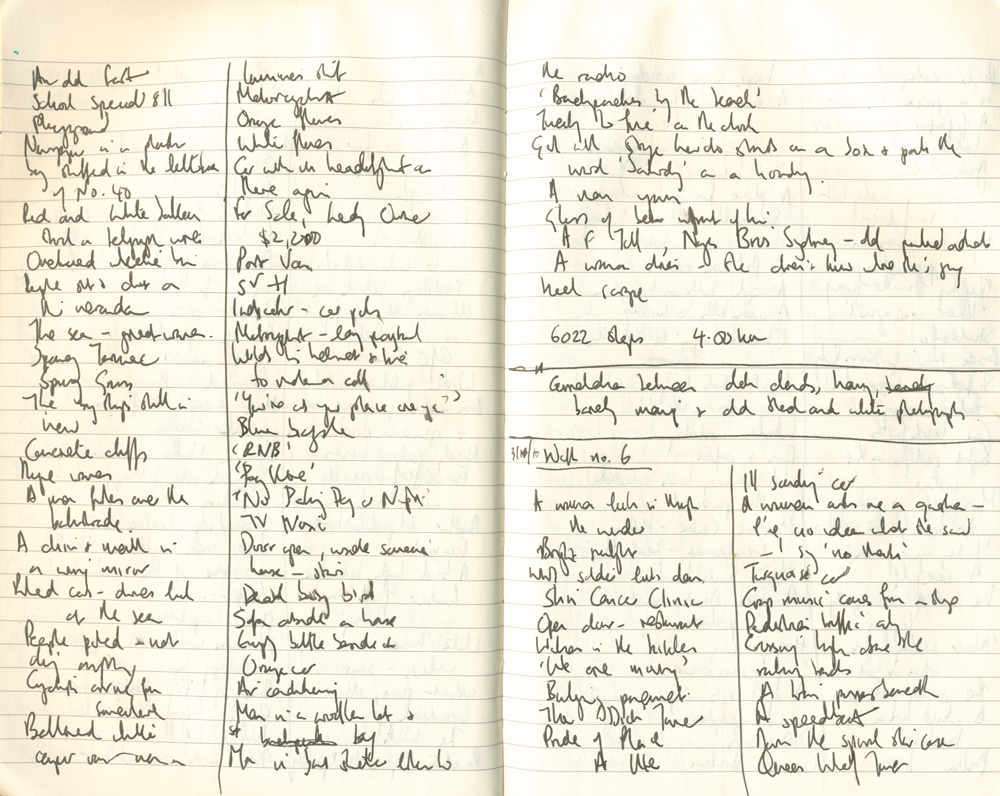
Since returning to England this morning after my residency in Australia, I’ve been looking at my notebook, and feel it’s worthwhile putting the pages up on, in particular those relating to the walks I did. So reproduced with this blog are those pages, written as I was walking (such is why the handwriting is atrocious whereas normally its little better than poor).

Filed Under: A Line Drawn in Water, Artist in Residence, Lists Tagged With: A Line Drawn In Water, Artist in Residence, Australia, Everydayness, Family Hedges, Family History, Hedges, Lines, Listmaking, Lists, Stephen Hedges, Walks

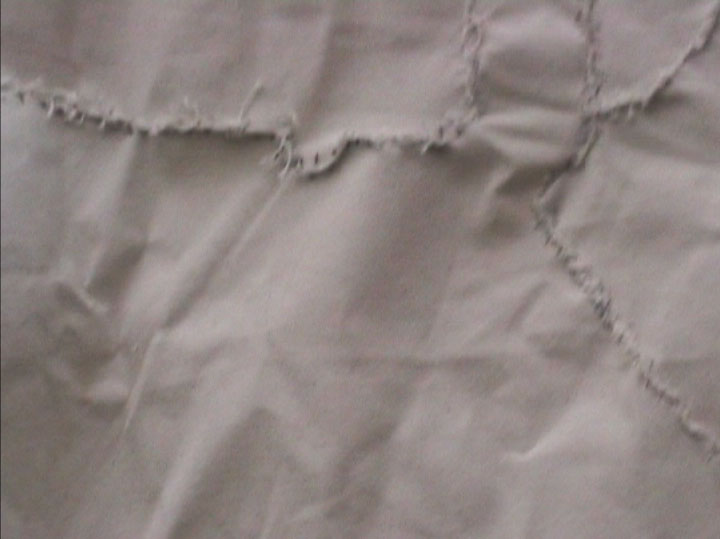
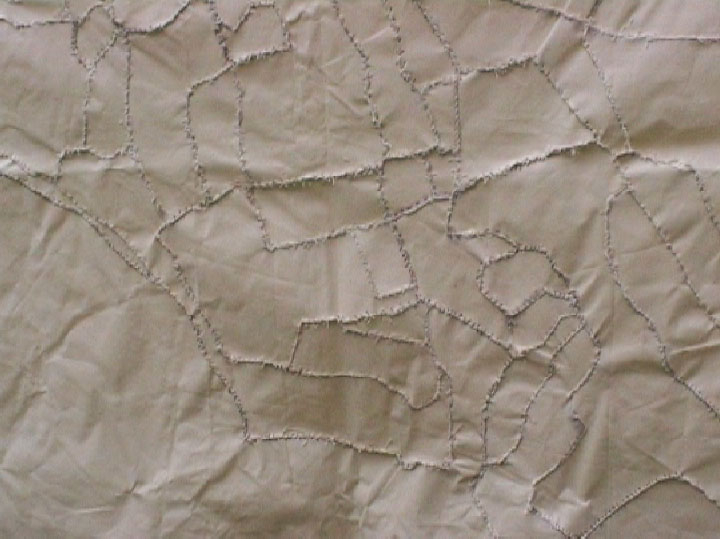
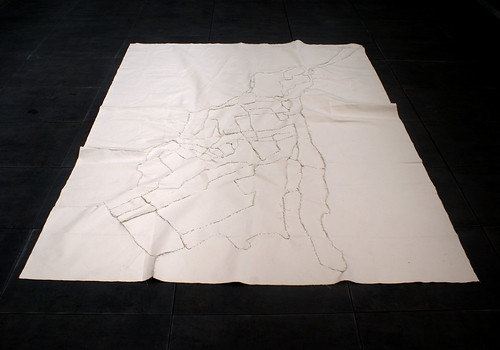
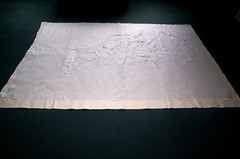
Repaired Sail of HMS York (1828)

November 17, 2010 by Nicholas Hedges

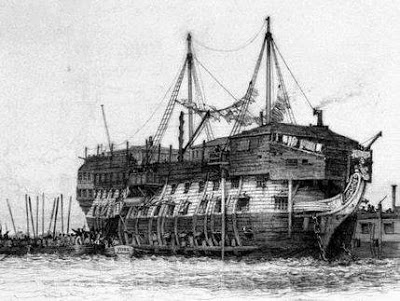
Yesterday, I finally finished stitching together the canvas pieces for a workI have tentatively called Repaired Sail of HMS York (1828), refrerring to the prison hulk on which Stephen Hedges was incarcerated before being transported to Australia. The hulk was a demasted ship and on contemporary images (such as that below) one can see how clothes were strung across the ship, almost as if replacement sails themselves.

This piece also alludes to an earlier work of mine called ‘Old Battle Flags‘ which I exhibited as part of my  recent Mine the Mountain exhibition. This work – Repaired Sail of HMS York (1828) – was made in response to the old battle flags one finds sometimes hanging in cathedrals. As I wrote in a text accompanying the work:

“Whenever I see them, hanging from their poles, still and lifeless, I think of the wind that would have once shaped them, a wind which would have once blown and turned the pages of history as it was being written. It reminds me that the flags had a place in what was then the present, rather than a scripted, preordained past. I can remember as a child, sitting on the beach when the weather was less than clement, when the wind whipped the sand, drilled the waves and flapped the canvas of the deckchairs. These deckchairs on display still have their colours, and in the main, their shape, but now they are broken; metaphors for times which cannot be revisited.“

The flags hang lifeless without the wind – the past hangs lifeless too. HMS York in this sense is a metaphor for the past – demasted and without a sail, lifeless almost, a prison for the past which in its own present criss-crossed the globe. To re-witness that past we need to see it move again, to catch the wind: we need a new sail.

The sail in this work is made of canvas, and is derived from a pattern made from data recorded on a GPS. The data itself represents a series of nine walks made during the first week or so of the residency here in Newcastle, NSW. As I have discovered through my work over the last few years, walking and being in a particular place and experiencing the everydayness of a place, is vital in our understanding of associated historical events. It is relevant therefore, that this ‘sail’, made to catch the wind and ‘move’ HMS York once again, is constructed from a series of walks.

Below are a number of images of the sail.

Repaired sail of HMS York 1828

Repaired sail of HMS York 1828

Repaired sail of HMS York 1828

Repaired sail of HMS York 1828

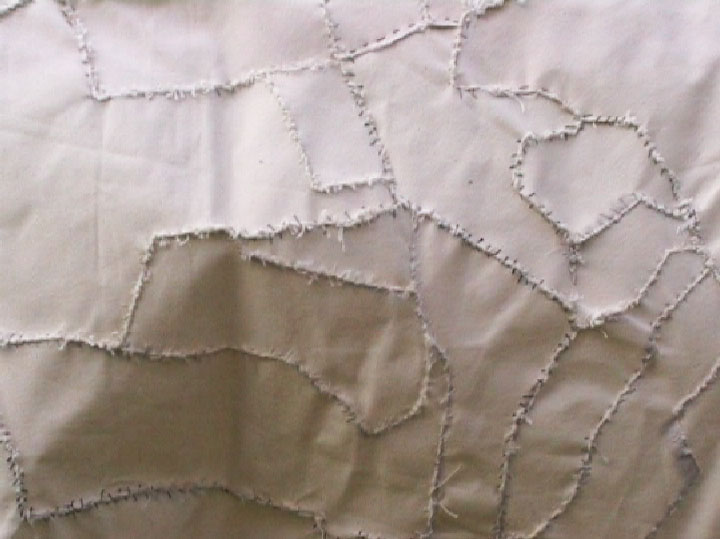
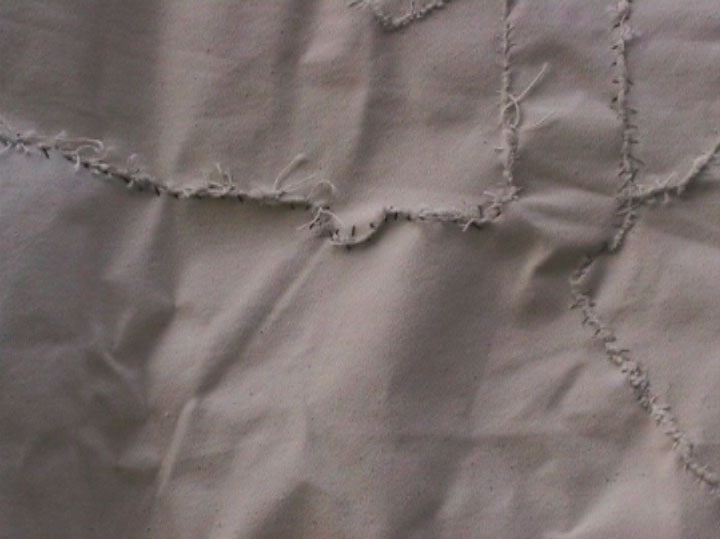
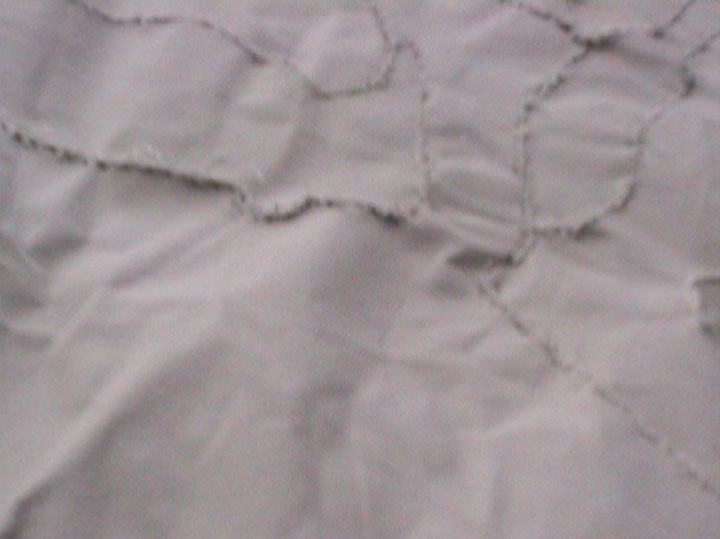
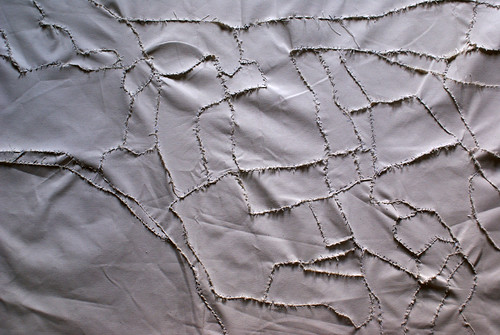
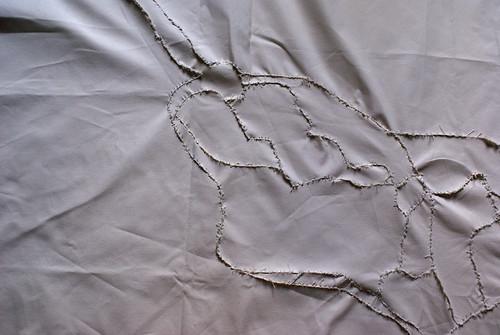
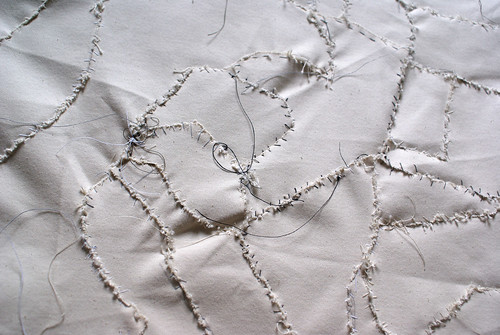
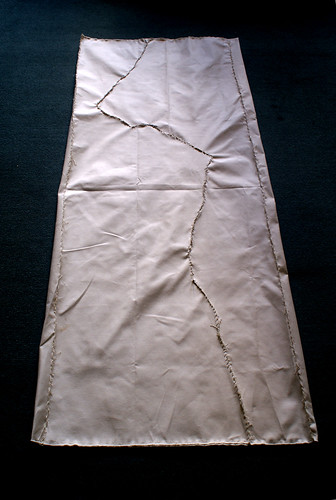
Often, it’s the reverse side of a piece like this which proves to be the most interesting, and indeed the most aesthetically satisfying. This particular canvas is no exception. When I turned it over and laid it out, I found the loose threads and knots particularly interesting. Perhaps they remind me the cut lines of past lives or the unwritten lines of text of which, for the most part, history is comprised. Below are images of the reverse side of the canvas.

Repaired sail of HMS York 1828

Repaired sail of HMS York 1828

Repaired sail of HMS York 1828

Repaired sail of HMS York 1828

Filed Under: A Line Drawn in Water, Artist in Residence Tagged With: A Line Drawn In Water, Artist in Residence, Australia, Everydayness, Family Hedges, Family History, Hedges, Lines, Stephen Hedges, Stitchwork, Walks

Cutting and Stitching III

November 15, 2010 by Nicholas Hedges

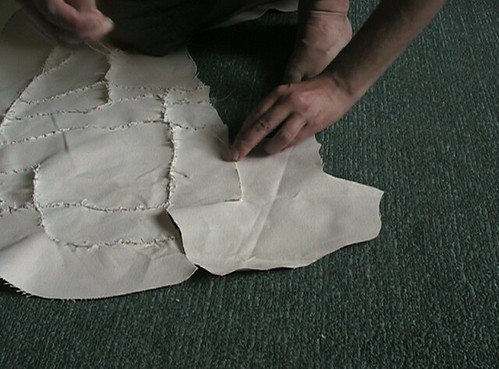
After a very nice weekend in Sydney, it’s back to work on the canvas; more cutting and stitching. With just two days left of the residency, it’s going to be a close run thing as to whether I get everything done – hopefully tomorrow I shall complete the canvas at least.

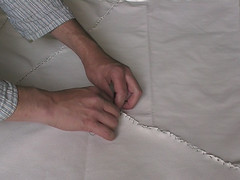
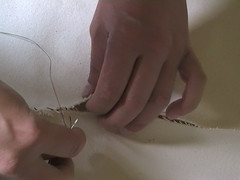
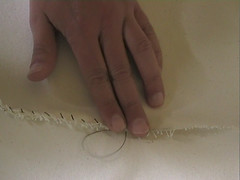
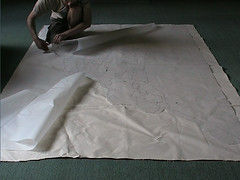
Cutting and Stitching

Cutting and Stitching

Cutting and Stitching

Cutting and Stitching

Cutting and Stitching

Filed Under: Artist in Residence Tagged With: A Line Drawn In Water, Artist in Residence, Australia, Everydayness, Family Hedges, Family History, Hedges, Lines, Stephen Hedges, Stitchwork, Walks

Cutting and Stitching II

November 12, 2010 by Nicholas Hedges

I’ve made a lot of progress over the last couple of days with video work and with the sticthed map of walks I’m creating, the title of which will be something like ‘The Lost Sail of HMS York’ referring to the prison hulk on which Stephen Hedges was incarcerated in 1828 prior to being transported to New South Wales.

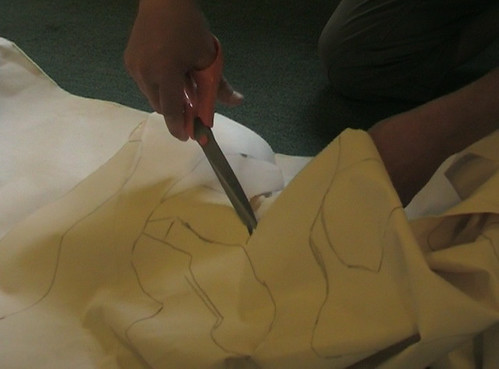
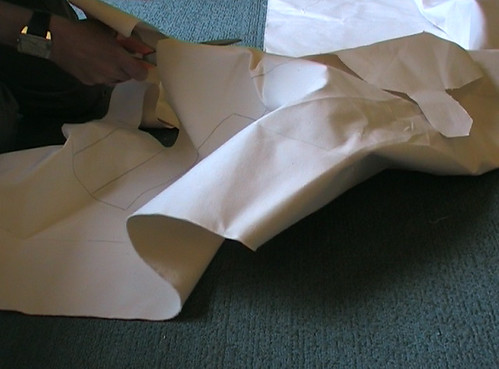
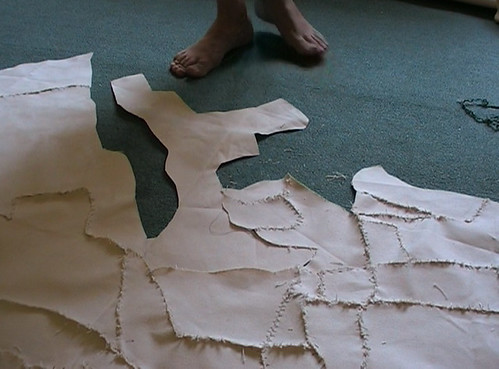
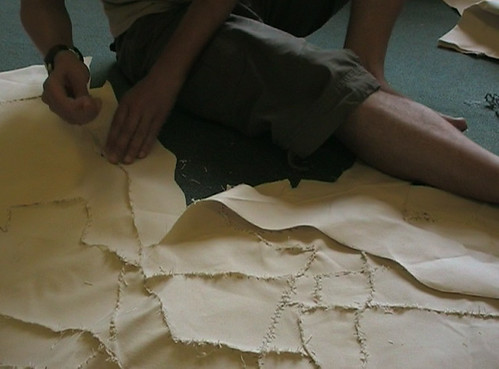
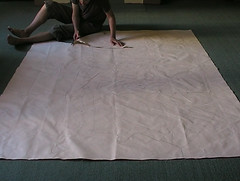
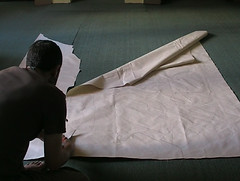
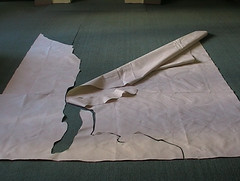
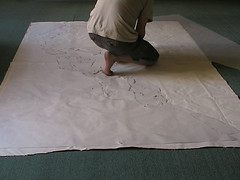
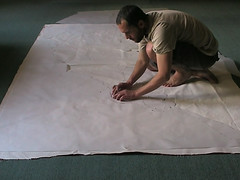
Having cut the templates and pinned them to the canvas, I then drew around each one directly onto the canvas so that I could begin cutting them out and stitching the piece together. To make things easier I will cut each piece as and when I need it so that I don’t get lost as regards where the pieces are meant to go.

The followng stills are taken from further documentary footage I’ve filmed of the process.

Template making

Template making

Template making

Template making

Template making

Filed Under: A Line Drawn in Water, Artist in Residence Tagged With: A Line Drawn In Water, Artist in Residence, Australia, Everydayness, Family Hedges, Family History, Hedges, Lines, Stephen Hedges, Stitchwork, Walks

Cutting and Stitching

November 10, 2010 by Nicholas Hedges

A busy day today working on a piece tentatively titled ‘Hammock’ and another which has yet to acquire even a working title. The hammock piece (shown in the photograph imemdiately below) alludes to when sailors died at sea and were sewn up in their hammocks before being cast into the water. The stitching on this particular hammock/body bag is the line recorded on my GPS when I walked the route Stephen Hedges walked from Radley House to Oxford in January 1828.

Stitching and Cutting

The hammock no longer has a body inside but what is left is the line. In many respects, the body inside was never meant to be that of Stephen, but rather his life in England, cast overboard along with his clothes when he entered the Prison Hulk York in Portsmouth following his conviction.

I want to dirty-up the canvas a bit and am thinking of taking it down to the sea tomorrow and videoing it lapping at the shore with the waves; something which would lend the work greater resonance.

The images below show the piece being made.

Work in Progress

Work in Progress

Work in Progress

The following images are taken from the second, much bigger piece, which is a canvas comprising all the walks I have made in Newcastle NSW. The walks have been transferred to tracing paper (see Making the Map) and have now been cut up and pinned to the canvas ready for the material to be cut.

The images below are taken from documentary footage of the process.

Work in Progress

Work in Progress

Work in Progress

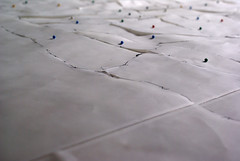
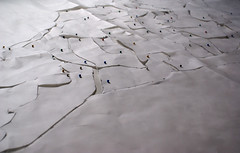
The map itself isn’t so easy to photograph, but I like the way it looks in its current state, with the cut out templates and the pins. Ideally I would like to inject something of a perfomative aspect into this work, so that the template creation has something to do with the process of tailoring – preparing fabric for an individual.

Stitching and Cutting

Stitching and Cutting

Stitching and Cutting

Filed Under: A Line Drawn in Water, Artist in Residence Tagged With: A Line Drawn In Water, Artist in Residence, Australia, Everydayness, Family Hedges, Family History, Hedges, Lines, Stephen Hedges, Stitchwork, Walks

A Walk of 4,342 Steps

November 9, 2010 by Nicholas Hedges

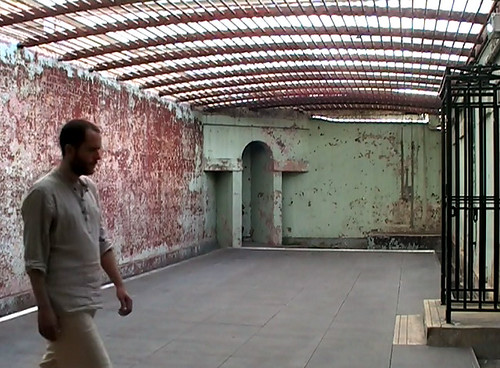
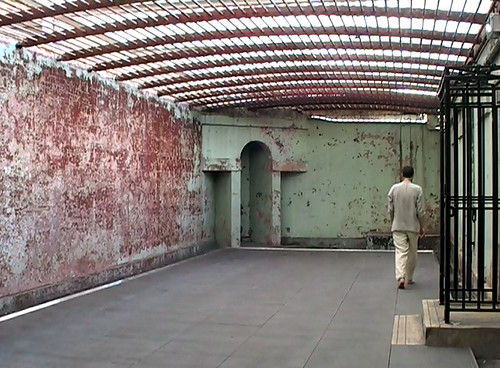
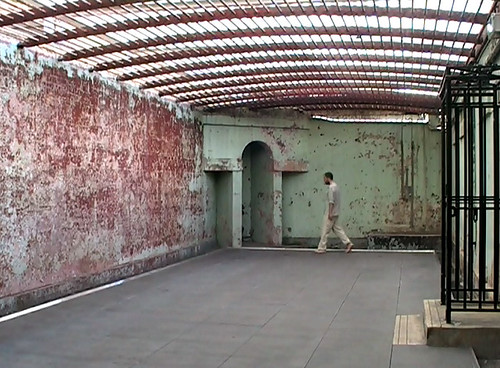
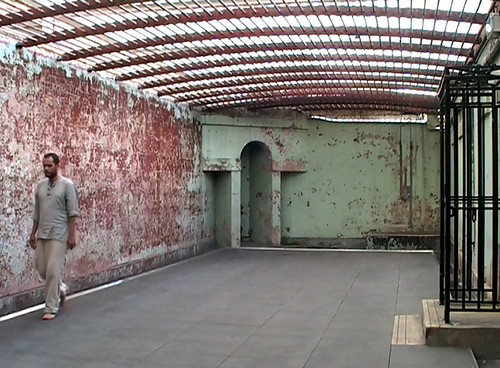
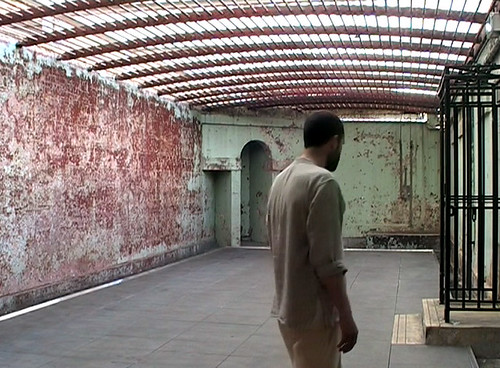
The video-based performance piece I want to make involves my walking around the exercise yard – in this case for about an hour. The ‘Walk of 4,342 Steps’ refers to a walk I did on 31st October (the first walk in a series of 9 made during the residency) and the final video will comprise my walking with details of the walk read out over the top.

The following stills are taken from the video.

Video Work

Video Work

Video Work

Video Work

Video Work

As I walked, and as I felt my body tense up and stiffen (in particular my jaw for some reason) I found myself listening to the sounds from outside, coming through the bars in the ceiling. Again this seemed to illustrate my work, as regards the idea of the constrained walk being analogous to history’s relationship with the past, where the wider past can only be ‘glimpsed’ to some degree through the bars.

Filed Under: Artist in Residence Tagged With: A Line Drawn In Water, Artist in Residence, Australia, Everydayness, Family Hedges, Family History, Hedges, Lines, Stephen Hedges, Stitchwork, Video, Walk, Walks

The Exercise Yard

November 9, 2010 by Nicholas Hedges

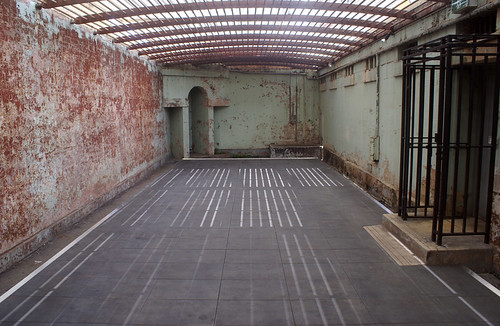
One of the most interesting spaces in the Lock Up is the exercise yard in which inmates housed in the cells would walk, sit or stand for a period of time. The space has recently been made weather-proof and a floor added to the original floor beneath so as to allow the space to be used for exhibitions and so forth. I wanted to use it in a video-based perfomance piece based on the idea of history and its relationship to the past; the idea that history is in a sense heaviliy constrained in what it can tell us about the world long gone; it is hemmed in, not free to roam, but follow a prescribed path based on the sources available to us today.

The Exercise Yard

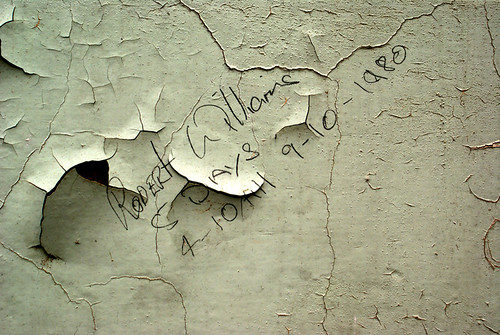
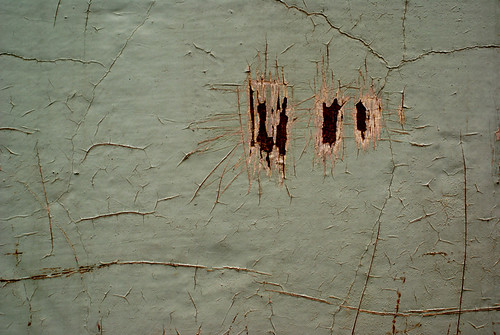
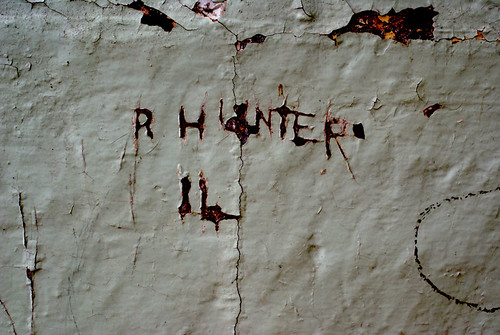
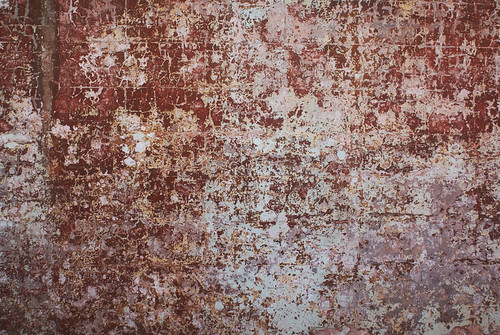
Before working on the piece (which would involve an hour’s walk around the yard), I photographed the walls, all of which have amazing textures redolent of the passage of time: peeling paint, cracked surfaces, palimpsests of paintwork and decay, as well as the inscriptions of prisoners scratched into the walls.

Below are some details from the exercise yard.

The Exercise Yard

The Exercise Yard

The Exercise Yard

The Exercise Yard

Filed Under: Artist in Residence Tagged With: A Line Drawn In Water, Artist in Residence, Australia, Everydayness, Family Hedges, Family History, Hedges, Stephen Hedges, Walks

Making the Map

November 8, 2010 by Nicholas Hedges

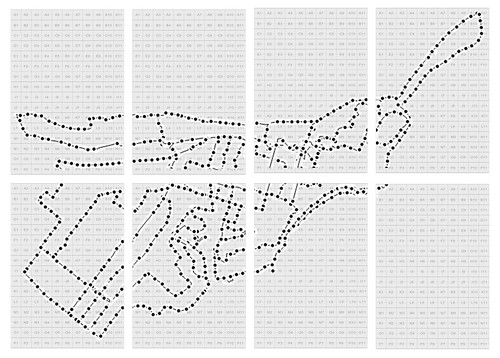
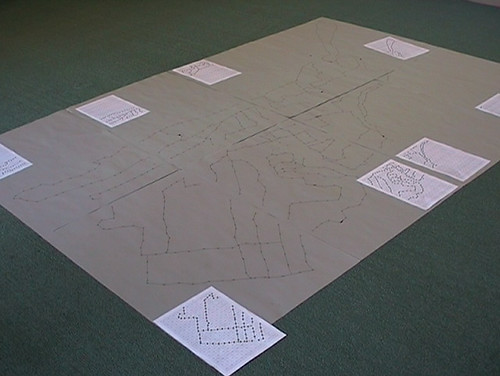
Having completed all the walks the next task is to tranfer them all to tracing paper so that templates can be cut and the map re-made on – or rather with – canvas. Taking the GPS plan, I divided it up into 8 segments, each of which I printed out onto A4 pieces of paper.

8 Sections of the Main Map

I then began scaling each piece up onto A1 heavyweight tracing paper, first marking all the dots and then joining them together. I would like to develop this whole aspect of the work, using the metaphor of sea-faring and map-making generally. Given time constraints however, the process will have to remain absent of any ‘performative’ aspect.

Marking the Dots

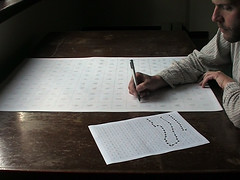
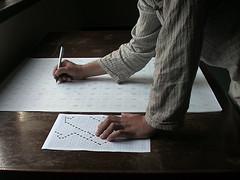
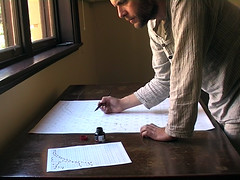
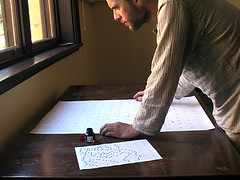
Marking the Dots

Having plotted the position of the dots, I then set about drawng in the lines.

Video Work

Video Work

Once copied, I joined the sheets together to make the fullsize version of the map which is now ready to be cut into templates.

Video Work

Filed Under: Artist in Residence Tagged With: A Line Drawn In Water, Artist in Residence, Australia, Everydayness, Family Hedges, Family History, Hedges, Lines, Maps, Stephen Hedges, Stitchwork, Walks

Light

November 7, 2010 by Nicholas Hedges

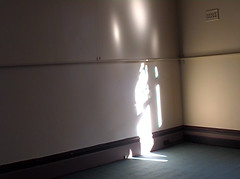
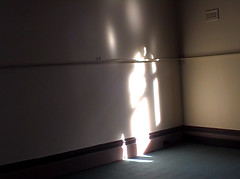
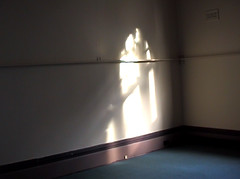
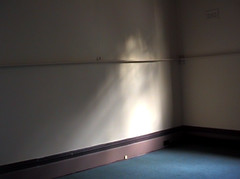
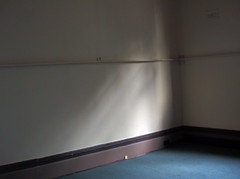
This evening I started filiming – for documentary purposes – my work on creating the templates for the ‘sail’ which I will start to sew soon. As I set up the video, I noticed, in the corner of the room, a patch of light on the wall and the floor. It reminded me of the paintings of Hammershoi, such as the image below which I wrote about in a previous blog entry back in March this year.

I put the video camera on the patch and started filiming for a couple of minutes, but as I watched the subtle changes in light I decided to leave it running until the tape ran out some 50 minutes later. The results were rather beautiful; an illustration of the passing of time, the end of a day and the the ‘nowness’ of the present – something which Hammershoi reveals beautifully in his paintings. Although painted at the beginning of the 20th century, the patch on the light keeps them very much a part of the present – the shape of the light cast by the window is something with which we are all familiar.

The stills below – taken from the video – show the light over a period of about 50 minutes.

The Map Room

The Map Room

The Map Room

The Map Room

The Map Room

Filed Under: Artist in Residence Tagged With: A Line Drawn In Water, Artist in Residence, Australia, Everydayness, Family Hedges, Family History, Hammershoi, Hedges, Light, Lines, Stephen Hedges, Video

Dead Birds and Footprints

November 7, 2010 by Nicholas Hedges

Yesterday I walked along Newcastle Beach and discovered, as I’d seen before, dozens of dead birds washed up on the sand. The shape in which the sea had left them was, in many cases, beautiful and so I began to photograph them.

Dead Birds and Footprints

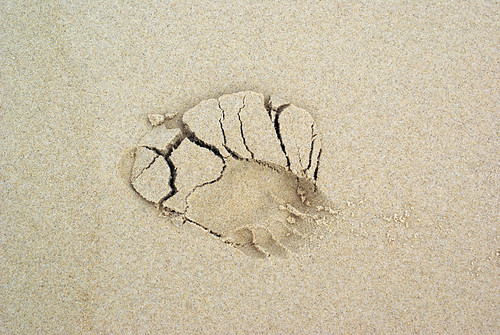
As I did so, I also became aware of the many footprints left in the sand, all different shapes and sizes, and so I started to photograph those as well, and in doing so, began connecting one with the other.

Dead Birds and Footprints

To see all photos, visit my Flickr pages.

Filed Under: Artist in Residence Tagged With: A Line Drawn In Water, Artist in Residence, Australia, Birds, Everydayness, Family Hedges, Family History, Hedges, Lines, Stephen Hedges, Walks

Completed Walks

November 6, 2010 by Nicholas Hedges

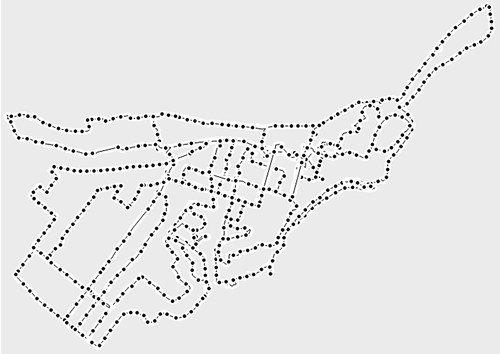
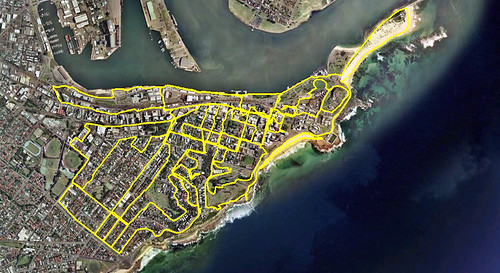
During the first week of this residency, I carried out a number of walks, the routes of which I recorded using GPS.Collecting all these walks together, I created a map of all the walks which can be seen in two images below. The first shows the pattern as revealed in the GPS software, the second in Google Earth.

Final Map of Walks

all as of 05-11-10

The next phase for this work is to divide the the first image into segments, each of which can then be tranferred to heavyweight tracing paper, after which the lines will be cut and the pieces left behind (i.e. the spaces in between the walks) transferred to canvas.

Filed Under: Artist in Residence Tagged With: A Line Drawn In Water, Artist in Residence, Australia, Everydayness, Family Hedges, Family History, GPS, Hedges, Lines, Positioning, Stephen Hedges, Stitchwork, Walks

  • 1
  • 2
  • Next Page »

© Nicholas Hedges 2024

  • Facebook
  • Instagram
  • Twitter
  • YouTube

Copyright © 2025 · Outreach Pro on Genesis Framework · WordPress · Log in