Nicholas Hedges

Art, Writing and Research

  • Amazon
  • Behance
  • Facebook
  • Instagram
  • Pinterest
  • YouTube
  • Art
    • Digital
    • Drawing
    • Grids
      • Correspondence
      • The Wall
      • The Tourist
    • Ink on paper
      • Shadow Calligraphy
    • Installation
      • Murder
      • Echo
    • Painting
    • Patterns
    • Mixed Media
    • Photographic installation
      • St. Giles Fair 1908
      • Cornmarket 1907
      • Headington Hill 1903
      • Queen Street 1897
    • Research/Sketches
    • Stitched Work
      • Missded 1
      • Missded 2
      • Missded 3
      • Missded 4
    • Text Work
  • Blogs
    • Family History
    • Goethean Observations
    • Grief
    • Light Slowed But Never Stilled
    • Lists
    • Present Empathy
    • Shadow Calligraphy
    • Trees
    • Time
    • Walking Meditations
  • Video
  • Photography
    • Pillars of Snow
    • Creatures
    • The Trees
    • Snow
    • St. Giles Fair 1908
    • Cornmarket 1907
    • Headington Hill 1903
    • Queen Street 1897
    • Travel
  • Illustration and Design
  • Music
  • Projects
    • Dissonance and Rhyme
    • Design for an Heirloom
    • Backdrops
    • Shadow Calligraphy
  • Exhibitions
    • A Line Drawn in Water
      • Artwork
    • A Line Drawn in Water (Blog)
    • Mine the Mountain 3
      • Artwork
    • Mine the Mountain 2
      • Artwork
      • The Wall
    • The Woods, Breathing
      • Artwork
    • Snow
      • Artwork
    • Echo
      • Artwork
    • Murder
      • Artwork
    • The Tourist
    • Dreamcatcher
    • Mine the Mountain
      • Artwork
      • The Tourist
    • M8
    • The Gate
    • Creatures
      • Artwork
    • Residue
      • Artwork
    • A visit to Auschwitz
      • Artwork
  • Me
    • Artist’s Statement

Dreamcatcher III

January 21, 2008 by Nicholas Hedges

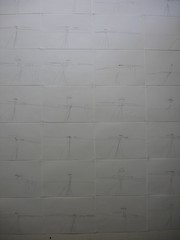
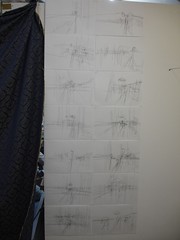
Having completed one side and a corner of the installation ‘prototype’, pasting approximately 300 A4 drawings onto my studio walls, I believe that my initial concerns about the sizes of the individual drawings may be unfounded. In fact, as the walls have dried, and more images have been pasted on top of one another, the overall effect is as I’d first envisaged it.
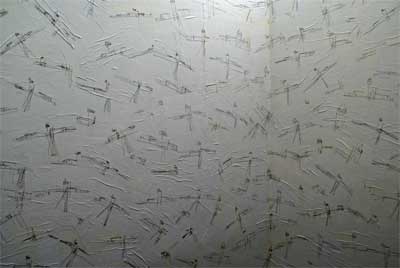
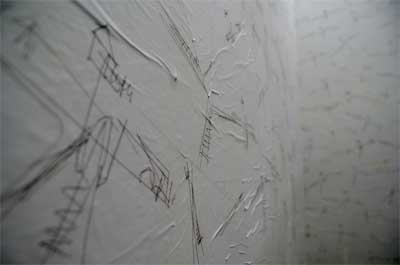
Dreamcatcher (Work in Progress)

Dreamcatcher (Work in Progress)

Working in a corner has been important in this respect, as I can get a better impression of how the whole room will come together. The next stage will be adding in the string.

Filed Under: Holocaust Tagged With: Dreamcatcher, Holocaust, WWII

Forgetting

January 7, 2008 by Nicholas Hedges

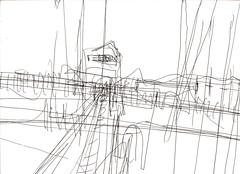
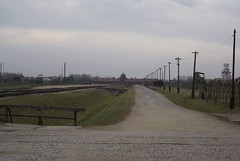
Today I started work on my Dreamcatcher installation which will be installed in Modern Art Oxford in March 2008 as part of the Brookes Exhibition which runs for approximately nine days. Part of the installation comprises hundreds of drawings which I will wallpaper on the walls of a room, and in preparation for a trial version of the piece I created about 100 drawings this morning. And it was whilst making these drawings that I became aware of how, after a while, my hand seemed to be working quite independently of my mind. The lines of the drawing had come to form a pattern of sorts and my hand was simply going through the motions, churning out images not of the gate tower of Auschwitz-Birkenau per se, but rather drawings of drawings of the gate-tower of Auschwitz-Birkenau. My memory had become a pattern and although this did at first disconcert me, in the end I came to see it as something positive, insofar as my work on memory and memorials is concerned.

In his book ‘Present Pasts – Urban Palimpsests and the Politics of Memory,’ Andreas Huyssen asks:

“Is it the fear of forgetting that triggers the desire to remember, or is it perhaps the other way around? Could it be that the surfeit of memory in this media-saturated culture creates such overload that the memory system itself is in constant danger of imploding, thus triggering fear of forgetting?”

I would take this further and suggest that the overload of the memory system does not necessarily trigger a fear of forgetting, but rather it triggers forgetting itself. I was also reminded of Frances A. Yates’ book ‘The Art of Memory’ in which she discusses Socrates’ story of the invention of writing by the God Theuth.

“In the Phaedrus; Socrates tells the story of the God Theuth who invented numbers and arithmetic, geometry and astronomy, draughts and dice, and most importantly of all, letters. The king of all Egypt was the God Thamus who told Theuth that the invention of writing was not, as suggested, an elixir of memory and wisdom, but of reminding; the invention will produce forgetfulness.”

If one equates my line drawings with text, one can see how the re-remembering of the memory of Auschwitz-Birkenau through drawing has resulted (at least whilst making the drawings) in that memory being forgotten. What I’m actually remembering is not my visit, but a memory of that visit. And as such these drawings are somehow equivalent to post-memories; memories we might have of the Holocaust which of course we never experienced.

So what does this mean for the Dreamcatcher work?

The work itself is in part about how we can visit places such as Auschwitz-Birkenau, safe in the knowledge that we can leave; just as we know we’ll always wake from our nightmares. Dreams and nightmares will eventually fade – they will be forgotten; they are unreal, much like our own post-memories of unwitnessed events.

So what is brought into question therefore is how best to remember atrocities such as Auschiwtz, the Holocaust and War in general?

Filed Under: Holocaust Tagged With: Andreas Huyssen, Dreamcatcher, Frances Yates, Holocaust, WW2, WWII

Young Werther

December 7, 2007 by Nicholas Hedges

Whilst showing my tutor some of my research regarding photographs found in Auschwitz, she pointed out that on the reverse of one of them was a quote regarding Goethe.

The following photograph was taken in Bedzin in Poland in the 1930s.

The book from which this image was taken, states that it is a picture of: “Moniek Szwajcer (right) in front of the ruins in Bedzin. Dedicated possibly to Zygmunt Sztrochlic and Sabka Konińska.” And inscribed on the back in Polish were the words: “For my dear Zygmunt and lovely Sabka, in commemoration of beautiful years of work together at the school. From ‘Young Werther’, Moniek. Bedzin, 29 October 1937.

Young Werther refers to the book ‘The Sorrows of Young Werther,” by Goethe, which as a result of re-visiting this photograph, I have bought.

Filed Under: Photography Tagged With: Bedzin, Goethe, Holocaust, Vintage Photographs, WWII

The Memory of the Mountain

December 6, 2007 by Nicholas Hedges

Having considered my recent findings as to the meaning behind the name Pantygasseg, I realised that a visit to the area in the next few weeks was essential. I knew I had to draw the outline of the mountain, it’s shape, perhaps on a large wall, but as I considered the line, I began to think of ways of expressing it. Could there be a way of expressing it sonically for example? Perhaps, yes, but the more I thought about it, the more I thought about using material pertinent to the place itself, in this instance; coal.

My work is about mining the past, bringing the past to the surface, and coal is of course a product of the past (mined and brought to the surface). It’s a material composed of things which lived and which could be used to create, i.e. like charcoal – and could be used to draw the line of the mountain, or to be more precise, my memory of the line of the mountain. Coal is therefore a means of expressing my memory using the very substance of the mountain’s own; a means which also highlights the contrast between the human scale of time and History itself.

There’s also a contrast (with regards to my research on the Family Tree and my work on the Holocaust) between memory and forgetting, particularly when considering the metaphor of the ground as mind. The ground is mined, coal is extracted and the past is ‘remembered’. What the Nazis were hoping to accomplish, when they killed and buried hundreds of thousands in pits (at places such as Belzec) was, in a sense, to forget.

Filed Under: Holocaust Tagged With: Coal, Family History, Holocaust, Memory, Mountain, WWII

Dreamcatcher

November 14, 2007 by Nicholas Hedges

In March 2008, Brookes will be showing a select number of works at MAO (Modern Art Oxford) and so I have decided to submit two proposals, one of which is entitled ‘Dreamcatcher’. The following extracts are taken from that proposal, the first section being ‘about me’ and the second ‘about the work’.

“As an artist, my main areas of interest are time, memory and remembering, with a particular emphasis on postmemory and its formation within the individual consciousness. Examining past events such as World War 1 and the Holocaust, my work seeks to explore how we formulate memories of times when we were not born, or of events to which we were not witness. What strategies do we employ in reconstructing the past? Contemporaneous objects, documents, photographs, verbal and written testimonies/narratives can all be used by the imagination to create postmemories, but what role do they play in the present-day, real-time, world?”

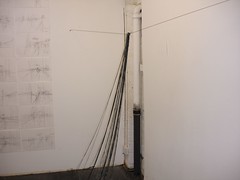
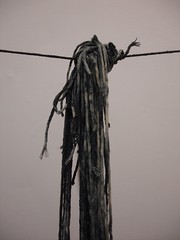
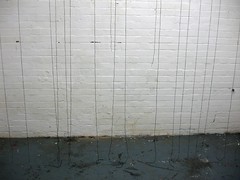
“An installation comprising a single room, all four walls of which are wallpapered with hundreds of drawings (see attached images for completed examples). These are drawings of the gate-tower at Auschwitz-Birkenau as remembered by myself following my visit there in October 2006. In the centre of the room, a net is suspended from the ceiling, created from hundreds of pieces of black string knotted together; a physical version of all the drawings, as if they were shown on a single piece of paper, and as if the ink had been turned into string.
The drawings themselves could be said to represent a last, snatched glance at the gate-tower of Birkenau and their number a testament to the number of people who died there. It could also be said to reveal my own incomprehension of standing in a place where over a million people died (a conflict between memory and postmemory), each death a piece of string – the thread of life drawn, measured and cut, as according to Greek Mythology – and tied to make the Dreamcatcher. Dreamcatchers are said to let good dreams through and ensnare nightmares, and for all the victims, Auschwitz-Birkenau was exactly that – a catastrophic nightmare.”

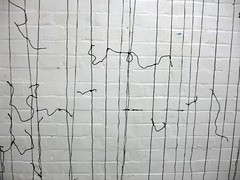
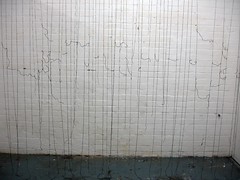
Today I started to create a prototype net at my studio and like all these things, it proved quite different in the way it began to develop off the page. Firstly, I tied a piece of string across my space about 7 feet off the ground and then attached vertical pieces which extended down to the floor. Almost straight away, I found myself thinking of a gallows.

Dreamcatcher (work in progress)

When it came to tying the horizontal strings, I used the pile of cut strings which proved rather difficult to use, but I used them nevertheless, and the action of tying, again proved interesting albeit for very different reasons than before. Each knot felt just like an act of remembrance. It was a positive act rather than a negative one.

Having completed a number of the horizontal strings, a colleague in the studio told me that she thought it looked like a musical score of some kind. I was thinking that it looked like writing; but this idea of it being musical was interesting.

Dreamcatcher (work in progress)

Dreamcatcher (work in progress)

Filed Under: Holocaust Tagged With: Dreamcatcher, Holocaust, String, WWII

Colour

November 12, 2007 by Nicholas Hedges

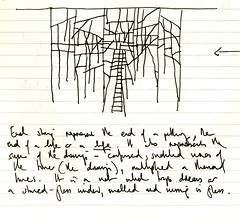
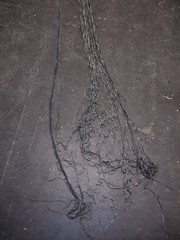
Each string (in what I have so far called the ‘net’) represents in its ‘cut end’ the end of a path, the end of a life. Each string also represents a life entire as measured by the three fates. Furthermore they could be said, as a group to represent the combination of paths which, at a specific moment in time created one of the many terrible moments of the Holocaust. Also, the image of the whole represents the sum of the snatched visions of the tower at Birkenau (the drawings).

Of the physical appearance of the net, the following quote from Fernando Pessoa’s ‘The Book of Disquiet’ is very pertinent:

“I also have my crochet,
It dates from when I began to think,
Stitch on stitch forming a whole without a whole,
A cloth, and I don’t know if it’s for a garment or for nothing,
A soul, and I don’t know if it’s for feeling or living.”

The image of the net looks like a ‘dream-catcher’ and in many ways that works in respect of this theme; dreams which many would have had of going back home, trapped in its strings. (There is also the idea of the writes of the telegraph poles carrying messages out of the camp and across Europe).

I was also thinking today about work by two of my colleagues which was very much to do with colour. This made me look at my own work (which is anything but colourful) and the subsequent contrast interested me. It reminded me of a television programme I watched last night about the photographer Albert-Kahn who documented the First World War in colour photographs. When we think of the past, in terms of the war, pre-war and Victorian periods, we think of it in terms of black and white. When we see colour photographs of the First World War they seem to validate reality – the very fact of time before we were born.

In my work there is no colour as such, but it is there, just as colour is there in Black and White photographs.

12-11-07
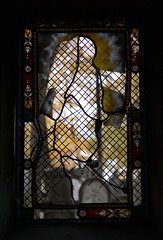
In the image above, I was reminded of the stained glass windows in the many tombs of Montmartre and Pere Lachaise cemeteries. The lines of the image (of the net) could just as easily be the lead work of a broken stained-glass window; what is missing of course is the colour.

Pere Lachaise, Paris

Colour could be a validating factor in this case. Often when we think of the Holocaust or World War One for example, we see them in Black and White (like the cats (although evidence suggests they may have limited colour vision) we saw in the cemetery); we often think of the weather as being dull, grey, miserable, always winter, and when we read evidence of the time that talks of blue sky and sun, it always seems somehow shocking. The following is an extract from Tadeusz Borowski’s “This Way for the Gas Ladies and Gentlemen.”

“‘…You have no idea how tremendous the world looks when you fall out of a closed, packed freight car! The sky is so high…’
‘…and blue…’
‘Exactly, blue, and the trees smell wonderful. The forest – you want to take it in your hand!'”

When imagining arrival at somewhere like Birkenau, one imagines it being night, or the smoke from the chimneys hiding the sky like a fog. But of course, people would have arrived on beautiful summer days, when colour was abundant.

Filed Under: Holocaust, Trees Tagged With: Borowski, Colour, Fernando Pessoa, Holocaust, String, World War I, WWI, WWII

Gesture of the Holocaust

October 25, 2007 by Nicholas Hedges

I recently received a copy of the transcript of Claude Lanzmann’s Shoah, his epic documentary about the Holocaust and read over the part of the film which had, on watching it, affected me so much. In that part, historian Raul Hilberg discusses a document, the Fahrplananordnung 587, an innocuous looking typewritten document (save perhaps for the word ‘Treblinka’) which he reveals, bit by bit, as being anything but innocuous; rather it is a document which in the beaurocratic language of timetables, represents the deaths of some 10,000 Jews. It is just one of many hundreds (the number 587 tells us how many); each of which is a cipher for unimaginable misery and suffering. What follows is part of that transcript:
This is the Fahrplananordnung 587, which is typical for special trains. The number of the order goes to show you how many of them there were, Underneath: Nur fur den Dienstgebrauch – ‘Only for internal use.’ But this turns out to be a very low classification for secrecy. And the fact that in this entire document, which after all deals with death trains, one cannot see – not only on this one, one cannot see it on others – the word geheim, ‘secret’ is astonishing to me. That they would not have done that is very astonishing.
On second thought, I believe that has they labelled it secret, they would have invited a great many enquiries from people who got hold of it. They would then perhaps have raised more questions; they would have focused attention on the thing. And the key to the entire operation from the psychological standpoint was never to utter the words that would be appropriate to the action being taken. Say nothing; do these things; do not describe them. So therefore this ‘Nur fur den Dienstgebrauch.’ And now notice to how many recipients this particular order goes. ‘Bfe’ – Bahnhofe. On this stretch there are one, two, three, four, five, six, seven, eight, and here we are in Malkinia, which is of course the station near Treblinka. But notice that is takes eight recipients for this relatively short distance through Radom to the Warsaw district – eight, because the train passes through these stations. Therefore, each one has to know. Not only that, but of course you’re not going to write two pieces of paper if you can write only one.
Therefore, we find here not only PKR, which is a death train, going here in the plan labelled thus, but we also see the empty train after it has arrived in Treblinka, now originating in Treblinka, and you can always know whether it’s an empty train with the letter L in front of it, leer, and now –
Ruckleitung des Leerzuges, which means ‘return of the empty train’.
– the train returns empty. And now we’re going back. Then we have another train. Now notice that there is very little subtlety to this numbering system. We are going from 9228 to 9229, to 9230, to 9231, to 9232. Hardly any originality here. It’s just very regular traffic.
Death traffic.
Death traffic. And here we see that starting out in one ghetto, which is obviously being emptied, the train leaves for Treblinka. It leaves on the thirtieth of September, 1942, eighteen minutes after four o’clock – by the schedule at least – and arrives there at eleven twenty four on the next morning. This is also a very long train, which may be the reason it is so slow. It’s a 50G – fünfzig Güterwagen – fifty freight cars filled with people.
That’s an exceptionally heavy transport. Now once the train has been loaded at Treblinka – and you notice there are two numbers here: 11:24, that’s in the morning, and 15:59, which is to say almost four o’clock in the afternoon – in that interval of time the train has to be unloaded, cleaned and turned around. And you see here the same numbers appear as the Leerzug, the now empty train, goes to another place. And it leaves at four o’clock in the afternoon and goes now to that other place where is yet another small town where it picks up victims. And there you are at three o’clock in the morning. It leaves on the twenty-third at three o’clock in the morning. And arrives there the next day.

What is that? It seems to be the same train.

It is the same – quite obviously the same. The number has to be changed quite obviously. Correct. Then it goes back to Treblinka and this is again a long trip; and it now goes back to yet another place – the same situation, the same trip. And then yet another. Goes to Treblinka and then arrives in Czestochowa the twenty-ninth of September and then the cycle is complete. And this is called a Fahrplananordnung. If you count up the number of not empty trains but full ones – PKRs – there’s one – there’s one here, that’s two, that’s three, that’s four – we may be talking about ten thousand dead Jews on this Fahrplananordnung here.

What I saw as being described here was in many respects a gesture of the Holocaust. The gesture of a thing, whether it is an object or a system, is essentially a movement and with this passage, the underlying movement of all the documented horrors becomes apparent. To borrow from Hannah Arendt, it is banal. So can I really discover the gesture of the Holocaust? Or at least a part of it?

Filed Under: Holocaust Tagged With: Claude Lanzmann, Gesture, Holocaust, WWII

Weeping

October 20, 2007 by Nicholas Hedges

The following drawing is part of a series I’ve been working on regarding Auschwitz-Birkenau and the theme of pathways.

Untitled-9

Looking at the picture, I was reminded of something which for a while escaped me. There was something about the tower in particular which I was sure bore a striking resemblance with another, famous painting.

The following is a detail from the drawing.

Looking at it closely, at the apparent anguish and suffering in the ‘face’ of the tower (the tower as suffering goes against all I have written about it so far: “…the gate house is different, it knows its time has passed but doesn’t seem ashamed in anyway. Its almost as if it relives every moment in its glass eyes, glass eyes which are far from being blind. They don’t reflect what they see around them now but rather what has been, what the tower wants to remember…”) made me think at once of the painting I’d been thinking of, an image painted in 1937 and again, one of the utmost despair: Picasso’s ‘Weeping Woman’.

Filed Under: Holocaust Tagged With: 'Blind' Drawing, Drawings, Holocaust, Picasso, String, WWII

New Studio, New Work

October 19, 2007 by Nicholas Hedges

I have finally got myself into gear as regards moving into my studio at Magdalen Road and have now started to get some work done. I started with putting some pictures up on the wall (those I made after my visit to Auschwitz-Birkenau) and was struck by how different they appeared when shown all together. When I first showed them they were on two walls and all in a row, but having them all on one wall lent them a whole different – and more sinister – aspect.

Old Drawings

They’ve always been rather intimidating images, but now there was something relentless and almost obsessive about them; as a group they seemed to talk more; but this was not a dialogue between the pictures and the viewer (me in this case, but I believe it would have the same effect with anyone else) it was now more like an internal monologue – the externalisation of a guilty conscience. I thought about wallpapering them to the walls which would I think strengthen their obsessive quality.
I also drew more of the ‘collective views’ which are interesting. They too have the same relentless, clawing quality, but do not have quite the same connotations of guilt which one gets from repeated and near identical images.

New Drawings

As I drew these images, I ‘found my way’ back inside the camp, seeing it clearly in my mind as I drew with my eyes closed. I followed the various lines, in particular the railways tracks, the wire fences and the telegraph wires. And as my pen marked them on the page, I began to think about their functions. The train tracks were a means to the outside world, they were defined by their end points – outside, beyond the camp – connected to the great European cities and the home towns of many who died there. The telegraph wires were likewise a means of communicating with the outside world, which for those in the camp was an impossible dream – something quite unreal. All I could think as I drew, was the ‘image’ of screams being carried down the wires. Sadly the outside world wasn’t listening.

Auschwitz-Birkenau

Having worked on the drawings for a while, I then began to work on an idea I sketched out a while ago.

I started working on the knot using the balls of string which I dyed last week and as I began to build up the knot I found that the dye hadn’t taken properly which nevertheless produced and interesting effect as the knot grew.
Knot
.
Knot

Any work associated with the Holocaust and which is realised with fabric has certain connotations, but what interested me particularly was what I’d thought about whilst drawing earlier – in particular the telegraph wires. The cut strings trailing on the floor – which represent the cut threads of life – became telegraph wires in my mind.

DSC05144

Could I perhaps use wires instead of string?

Filed Under: Holocaust Tagged With: Auschwitz, Holocaust, String, WWII

Printmaking – A Reflection III

October 18, 2007 by Nicholas Hedges

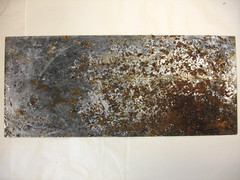
Yesterday I carried on with the process I initiated two weeks ago, that of burying an engraved plate, leaving it a week and then printing the rusted version. Having dug up the plate after a second period in the ground, I was pleased with the resulting pattern of rust which I hoped would be lifted onto the paper by some of the ink during the printing process.

Printing Plate

The resulting print from this plate was as follows.

Print 3 (Photo)

The thing I realised with printing from such a rusted plate was the fact that the rust has quite a pull on the ink, and so once the paper has been through the press and one lifts it from the plate, it has a tendency to be left behind. With the print above, I was somewhat disappointed that the rust was ‘drowned out’ by the ink – hardly surprising when I think how thickly it was applied. Of course this is normal, but whereas one can use the scrim to take the ink off, and use quite a bit of pressure to do so, with the rust one doesn’t want to rub so much (and thereby remove it) and so the ink remains too thick in these areas.

I took a second print of the plate without re-inking and and the texture of the rust was well preserved.

3rd Print detail (2nd Proof)

For the next print (after a third week in the ground the plate will be even rustier) I need to ink the particularly rusted sections less and perhaps moisten the rust to encourage it to lift off the plate.
As well as continuing this experiment, I also started working with photo-polymer plates. A photograph is printed onto acetate (with all black areas ‘removed’/greyed) and this positive is then used to ‘etch’ the plate. The plate is sensitive to UV light and so this is done in a darkroom in a UV box. The light passes through the acetate and exposes the plate in the darker areas. When the plate is washed and inked, these areas then take the ink which is then printed onto the page.

In order to get a good print, one needs to make two or three proofs, the results of which are below (those on the left being the first).

Photo-Etching

Photo-Etching

Photo-Etching

The question I have to ask myself now is what does it mean to print these photographs as etchings? Something to consider over the next few days.

Filed Under: Photography Tagged With: Holocaust, Printmaking, Vintage Photographs, WWII

Anne Frank’s Tree

October 5, 2007 by Nicholas Hedges

With the work I’ve been doing on trees at the sites of death camps in Poland, I found the following article, taken from the BBC News site very interesting.

The chestnut tree that comforted Anne Frank as she hid from the Nazis in Amsterdam during World War II has won a reprieve from being felled. Amsterdam city council ruled in March that the rotting 150-year-old tree must be felled as a danger to the public. Following protests the council has given those who want to save the tree until January to come up with a plan.

The tree was a ray of hope for the famous diary writer as she hid in the attic of the canal-side warehouse.The Jewish teenager remained indoors with her family for 25 months until they were arrested in August 1944.She died of typhus in the Bergen-Belsen camp in March 1945.

The attic window from which Anne Frank could see the tree was the only one that had not been blacked out.In an entry dated February 23, 1944, she wrote: “From my favourite spot on the floor I look up at the blue sky and the bare chestnut tree, on whose branches little raindrops shine, appearing like silver, and at the seagulls and other birds as they glide on the wind…

“As long as this exists, I thought, and I may live to see it, this sunshine, the cloudless skies, while this lasts I cannot be unhappy.”

Ton Boon of the Amsterdam Centrum borough told Agence France-Presse news agency there was “only one Anne Frank tree” and it had been agreed to allow time for a possible rescue plan.

Experts say the 27-tonne tree is too diseased from fungi to be saved and the owner wants it cut down as he would be liable for any damage caused should it fall. The tree is adjacent to the building that now houses the Anne Frank Museum. A Utrecht-based firm, Trees Institute, has suggested a salvage plan involving treatment and support for the trunk and limbs.

Spokesman Edwin Koot told Associated Press: “The tree represented freedom… to Anne Frank. We must go the extra mile to try to save it.”

Filed Under: Holocaust, Trees Tagged With: Anne Frank, Holocaust, The Trees, Trees, WWII

Chania

August 22, 2007 by Nicholas Hedges

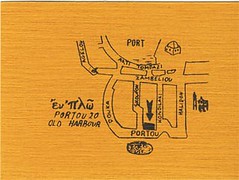
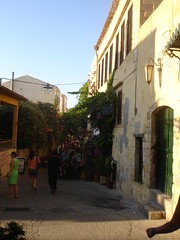
It was in the small square, at southern end of Kondylaki Street, where we met two brothers, coaxing as best they could, passing tourists into their restaurant. “My brother and I are having a party,” they told us, “at 7.30.” They handed us a card. “You’re nice people, where are you from?” They’d asked the same question, albeit more pointedly (and with a heavy dose of irony) to those who’d ignored their advances. England, I said, and Monika, from Poland. Funny how when speaking English to foreigners, I do so with an accent; one which I presume is something akin to – as in this case – the Greek way of speaking. I’d done as much in Spain a few weeks back, ordering a beer as if I was Speedy Gonzalez. “Ah, Poland! Where in Poland? Krakow? Warszawa? Katowice? Czestochowa?” Warszawa, came the reply. “The best!” one of the brothers replied, with acute comic timing; it was clear they’d been doing this for quite some time. “It starts at 7.30 and…” one added, as an aside, but yet, with a certain flourish, “I assure you, my mother and my sister are in the kitchen…” As if we needed such assurances.

Restaurant   Advertisment

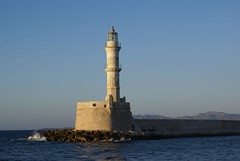
Having already walked around much of Chania, I had the impression that aside from the 15th century lighthouse, many of the town’s landmarks, or architectural points of interest, somehow lurked around streets such as this one. They stood in corners, perched above the roads (or lay below ground level) stealing themselves away in shadows, rather than standing out as buildings often do, waiting like dressed up grandparents for a visit. This is certainly not a criticism (far from it), and there are of course exceptions to this – for want of a better word – rule. But generally speaking, Chania’s visual history is there to be found rather than simply observed. Of course, no building in any town or city gives up its secrets through simple observation; one must enter into some sort of a dialogue. But in the way in which a building might give up its secrets, so Chania gives up its buildings.

Crete

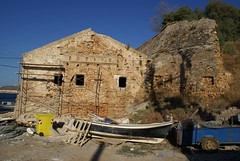
The history of the town is as interesting as it is often tragic, and the scars of war and conquest are manifest in its palimpsestic array of buildings, many of whose origins date back to the Venetian era (13th to mid 17th century). It is the site of the ancient Minoan settlement of Cydonia (evidence of which can be seen in the Kasteli district in the Old Town), and has been ruled successively by Byzantines, Arabs, Ventians and Ottamans, who overran the city in 1645. Finally, in 1941, the Nazis took control and another tragic page in Chania’s history was written.

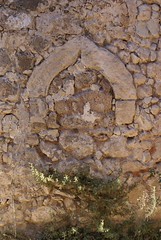
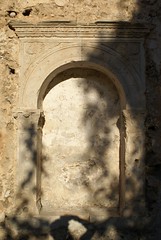
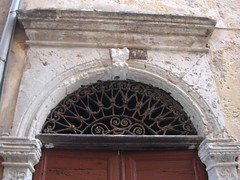
Walking around the town, we found evidence of this tumultuous past in churches turned into mosques and mosques turned back into churches; Islamic arches filled in and plain windows set within the stones. I’ve always harboured an interest in blocked up doors and windows, and here in Chania there were many examples. And this is what I find so fascinating about the town; the fact that ruins are not isolated but are used again in other buildings, that successive architectural values give rise to conflated, unique, and idiosyncratic styles; that where one regime follows another, the past is not torn down, but is modified (one is reminded here of recent debates surrounding communist buildings in post-communist countries).

Crete

Crete

Crete

The Janissaries Mosque for example on the western harbour, built in 1645 is now an art gallery, and on its facade one can still see portions of Arabic reliefs – scripts carved from out of the stone. The calligraphy is worn and whispering, yet its presence is a clear reminder of the past. And all around Chania, it is these shards which pierce the consciousness of the traveller; Venetian windows and doorways plugged into tumbledown houses appear like childhood memories from nowhere, and one realises that Chania is not a town of buildings at all, but rather one constructed entirely of fragments. And such is the the number of fragments revealed to those who walk the streets, I found myself – as a typical tourist – taking numerous photographs. My camera was readied as if I was on safari, ready to capture an exquisite Venetian architrave, which might, at any moment disappear back into the shadows. I remember writing a while back, a novel set in my home town Oxford, where the young protagonist observed through an iron gate, one of the last remaining Bastions of the old city wall. “St. Cross was the daughter church of St. Peter in the East and was situated not far from that church in a street of the same name. It was approached by Longwall Street, towards the end of which, just before the junction with Hollywell and St. Cross Road, Adam’s pace slowed in anticipation of the gate through which could be glimpsed a remnant of Oxford’s mediaeval past. It was one of his favourite monuments, but no matter how contrived and deliberate his steps, the lone bastion of the old city wall seemed to fall from sight as if glimpsed from a passing car, as though no mortal eyes could frame it for longer than the time it took to blink. It was as if through the bars, the centuries passed still lingered, appearing in a space built for a second.” This is how I felt, when finding evidence of the past in these remnants of windows and doors. I would stand and try to build the past around them, that from which they were – for a few seconds at least – conspicuously estranged. But no matter how long I looked, for example at the window below, my gaze could never do justice to the scale of the past behind it.

Crete

Even when looking at the photographs, I find the same thing applies, and I’m reminded of a quote from Proust, as discussed in a text by Samuel Beckett: “But were I granted time to accomplish my work, I would not fail to stamp it with the seal of that Time, now so forcibly present to my mind, and in it I would describe men, even at the risk of giving them the appearance of monstrous beings, as occupying in Time a much greater piece than that so sparingly conceded to them in Space, a place indeed extended beyond measure, because, like giants plunged in the years, they touch at once those periods of their lives – separated by so many days – so far apart in Time.” These elements, these architectural shards, are like parts of those same-said giants, parts of limbs touching the present day. We cannot observe with one look the beings as a whole, we can only walk and see in pieces what constitutes the sum, a sum which can only ever be imagined.

I’d thought, whilst walking around Chania, how with every step it seemed to change, as if one were walking through a huge kaleidoscope – a image enhanced by the colour in the streets; the kitsch fodder for tourists, the pink hues of the closing day and the swarms of people, emerging to devour the night, flitting about the myriad lights. The town’s character is revealed through whatever fragment it chooses to present the viewer, at whatever time: a window’s architrave, a decorative lintel, an old vaulted ceiling in one of the many restaurants. I could imagine a mass of giants, writhing beneath the cover of Chania’s single facade, itself like a blanket – a patchwork quilt by which the past is covered.

On the bus to Heathrow, just the week before we found ourselves in Chania, I had been considering my work on the Holocaust and considering the question which so many ask me, ‘why are you interested?’ There is, I have since realised, a reason why, but in the process of finding the answer, I found myself considering other traumatic events and in particular the places where these events were played out, whether Auschwitz-Birkenau, the battlefields of World War 1 or a single cell in the Tower of London. Recently too, I’ve been watching Claude Lanzmann’s ‘Shoah’ and whilst listening to the testimonies of survivors, I thought of those places I had visited; Auschwitz-Birkenau, Majdanek and Belzec. Listening to (and indeed watching) the testimonies of those who perpetrated such crimes (‘may I takes notes?’ asks one, as if learning the facts of the crimes for the first time and thereby denying his own involvement), I found it hard to see, in the faces of men who looked like any other grandfather, the face of the monsters they were (excepting Josef Oberhauser, interviewed by Lanzmann in a Berlin bar). The truth is – and this is what makes the Holocaust all the more terrible – ordinary people, who outside of war would, in all likelihood, have led ordinary lives, did in war, unspeakable things. Likewise, ordinary places became sites of gross inhumanity, trees became soldiers, as if beneath the surface, there exists a poison, which surfaces in history and debases everything and everyone it touches, disappearing to leave the world silent, the victims dead and perpetrators old, old men, hoping that age might rob them of what they’ve done.

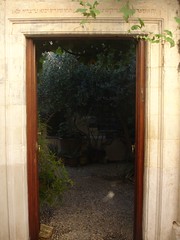
Walking up Kondylaki street, away from the harbour, we saw a sign for the the Etz Hayyim Synagogue. We followed the sign, and as if the giants moved beneath the surface of Chania’s long facade, a doorway opened up to us.

Crete

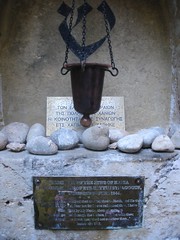
The free literature explained how: ‘the synagogue was reconstructed under the aegis of the World Monuments Fund in New York and the Central Board of Jewish Communities of Greece…’ and that ‘…while committed to its Jewish character Etz Hayyim is also sensitive to the multi-ethnic and religious needs of our times and its doors are open to provide a haven for all persons seeking a place of spiritual repose and regeneration.’

Indeed it was a place of great tranquility; a peace at odds with the past, and the sad history of those who once prayed there.

Crete

Turning back to the pamphlet supplied by the synagogue, I read the following section, entitled ‘The 2nd World War and the Jews of Hania – 1941-1944’. It read: Suddenly, just before dawn on the 29th May 1944, the entire area in which the Jews lived was blocked off by trucks and loudspeakers ordered the Jews out into the street. They were not allowed to take anything with them and were assembled at the south end of Kondylaki Street in the small square and in the square adjacent to the harbour to the north. Within an hour they were driven by trucks to the prison of Ayas not far from Hania. The Jewish Quarter was immediately looted – first by the soldiers. In the late afternoon they synagogue of Etz Hayyim was stripped of all its religious artefacts and left to be rented by squatters. After almost two weeks of imprisonment at Ayas, with little food and no changes of clothes, the Jews of Hania were loaded onto trucks and driven to the east of the island to Herakleion. The official count is that 265 men, women and children arrived there on the 9th June and were put on board a converted tanker called the Tanais that set sail for Athens that evening at 8.00. Along with them were some 600 Greek and Italian prisoners of war. At 3.15am on the morning of the 10th June the ship was sighted just off the island of Milos by a British submarine and immediately given a torpedo broadside that broke the ship apart. All who were aboard were drowned. Had the ship arrived in Athens the Jews on board would have been sent by cattle-cars to Auschwitz-Birkenau for immediate gassing and cremation which is what had already happened to the Jews of Salonika and elsewhere in Greece. 94% of the Jews of Greece perished in the ‘Final Solution’ of the Nazis.

It was hard to imagine, walking back up this street and around those of the old Jewish Quarter, how such a thing could have happened here. But it did.

Crete

“You are nice people…” one of the brothers said. He was again being sarcastic. The group of tourists had declined his advances and so he fixed his eyes on a female member of the party, and drew his hands down, as if to trace her curves. He looked at me and winked, nodding in her direction. I smiled and walked on.

Filed Under: Holocaust, Trees Tagged With: Chania, Holocaust, WWII

On Old Photographs

June 13, 2007 by Nicholas Hedges

Over the course of the past week, I’ve been scanning in what amounts to almost my entire collection of family photographs. I started, initially, a while ago with just a few that I particularly liked, but after a time, began to think of scanning all those contained in various old albums, a plastic bag and a dilapidated cardboard box. The possibility that one day they would be lost was as good a reason as any; that and the fact it would be easier to view them and to organise them (through the joys of Flickr) were my principal motives.

So, staying up late into the night, I have, over the last few days become somewhat obsessive, and scanned in a few hundred photographs, covering a period of time between c.1946 to c.1997. And, although at first this was a purely practical exericse, it soon became much more than this. It was, and still is, a journey of discovery, for in these small, ‘chemical annexations’, I can see again faces long since lost to the past; revisit once familiar places, and perhaps most poignantly of all, find long lost objects as if I were rummaging through the contents of an attic.

I will write about this experience at length, but will conclude with a summary of what I’ve been thinking when looking at these images. Firstly, I’ve come to realise how drawn I am to ‘bad’ photographs such as the one below:

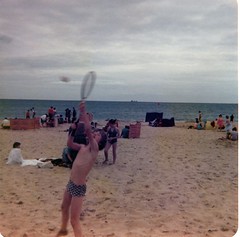
Unknown Seaside

There is something about this photograph (and many others like it) which I find particulary haunting; something about its amateurishness, which makes it seem somehow more genuine. It has the freshness of a sketch as opposed to a finished painting and contains references to an experience which is both direct and profound. Perhaps it is the footprints in the sand, long since washed away which I find so affecting? Or maybe the unknown swimmers and the water-skiier: distant then, and as just as unknown to me now. What course did they take through life after this picture was taken? Did they yet survive the sea, in which, in time, we all will come to be drowned?
As Barthes said:

“I observe with horror an anterior future of which death is the stake… Whether or not the subject is already dead, every photograph is this catastrophe.”

The photograph above seems to illustrate this perfectly, as do many ‘bad photographs’ I have found. Perhaps it’s because they contain this reference to the less than falable human holding the camera (a difference between chemical and digital).

Following on from this, I’ve become very interested in the peripheral parts of photographs, particularly in relation to images taken near the sea (distant swimmers, ships and so on). I have already written about windows in relation to other photographs, but having recently scanned and observed so many images, I’ve come to realise that it’s these areas which are the most ‘genuine’, perhaps because those inhabiting the distance are freed from the artifice of a pose, or because at the moment the picture was taken (just as they were for the rest of their lives) they were oblivious to the photograph’s principal subject and the one taking the picture.

This obliviousness is something I find quite compelling, particularly in relation to my work on the Holocaust, whose victims were by and large anonymous, both in life and now in death. Although I wasn’t living at the time, many members of my family were; they were the ones on the periphery, the specks in the distance, oblivious to what was going on behind them.

This is a photograph taken in c.1976. It shows my brother in the foreground playing tennis, a lovely image of a fondly remembered family holiday. But what interests me, in relation to my thinking, is the distance.

Looking out to sea we can see a ship, a tanker, sailing under the direction of more (and no doubt large numbers of) human beings, hidden away and quite unknowable. Yet for a time we shared the same stretch of the planet. Those onboard would have had no idea as to our existence, they would have seen at best a mass of coloured dots on the horizon. Yet this degree of separation does not make us any less human, any less feeling. Distance does not negate our hopes and our ambitions. Those few unknowable dots, in the eyes of the ship’s crew, were my family, and have in the years that followed, seen more members come and go. And whether the distance between us is measured in years or miles, we must never forget, that what we see as specs on the horizon, or dots that make the picture on the TV screen, are, in the end, the same people as us.

For more on this subject, click here.

Filed Under: Photography Tagged With: Bathes, Catastrophe, Childhood, Creatures, Details, Holocaust, Photographs, WWII

Jasenovac

June 9, 2007 by Nicholas Hedges

Whilst reading W.G Sebald’s ‘The Rings Around Saturn’ I was struck by his description of the Jasenovac concentration camp, situated in Croatia. I for one had never heard of it, but from the accounts in Sebald’s book, it was, even by the standards of other such appalling places, particularly horrific.

“Seven hundred thousand men, women and children were killed there alone in ways that made the hair of the Reich’s experts stand on end, as some of them were said to have admitted when they were amongst themselves.”

According to Sebald, the preferred instruments of execution were “saws and sabres, axes and hammers” and knives specially designed for cutting throats. The fascist Ustasha, who established the camp, were even regarded by the Nazis as particularly cruel. One German representative in Zagreb, Artur Hoeffner, wrote in his diary on November 18, 1942:

“Regardless of the propaganda, [Jasenovac] is a camp of the very worst kind and can be compared to Dante’s Inferno.”

Italians who visited or served in the area during the war were also sickened. Alfio Russo wrote in Revoluzione in Jugoslavia (Rome, 1944), “Even the most extraordinary massacres in the darkest era of history would not soil its name… “

Like most camps, the death toll is disputed, but the fact the figures range from 300,000 through to 860,000 speaks volumes.

The main victims were ethnic Serbs, although other groups, such as Jews and Gypsies perished there.

Filed Under: Holocaust Tagged With: Dante, Holocaust, Jasenovac, Sebald, WWII

Poland

May 28, 2007 by Nicholas Hedges

I’ve just returned from another fantastic trip to Poland, this time taking in the east of the country through Lublin, Zamosc and the very picturesque Kazimierz Dolny. My girlfriend negotiated the less-than-brilliant Polish roads whilst I sat in the passenger seat armed with my GPS creating a record of the route. The weather was wonderful, over 30 degrees every day and very sunny.

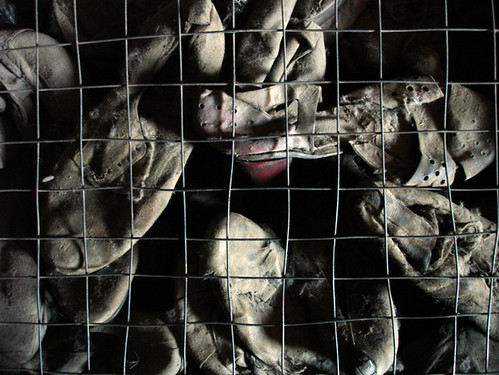
One of the reasons for the trip, aside from it being a holiday, was to visit two more Holocaust sites, these being the concentration camp at Majdanek and the death camp at Belzec. Having left Warsaw we made our way down to Lublin and on arrival, went to the Majdanek concentration camp, just on the outskirts of the city. I didn’t know much about this camp and even after reading a little about its history I didn’t expect what we found there. It is one of the best preserved camps in the country and in some respects is like a smaller version of Auschwitz and Birkenau in one. Like Auschwitz it has numerous exhibitions in each of the barracks, including piles and piles of old shoes. Yet whereas in Auschwitz these were held behind glass, here in Majdanek they are stored in cages; one can smell them.
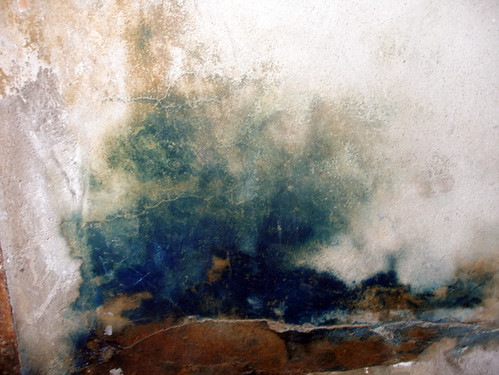
The gas chambers are still intact here along with the original washrooms, and walking through these was, as one would expect, particularly poignant. We noticed on the walls and ceilings of the chamber, that there were patches of blue. I assumed this was just mould caused by damp, but on returning home, I’ve since discovered these patches were caused by the residue of the Zyklon B gas. Indeed, one can see how dense the colours are on the ground and almost see the residue pale as it climbs the walls.

Colours have become a point of interest for me in my work. As above, the blueish tones on the grey walls were striking, not only because of their colour, but because of what they signified. The same was true in the barracks full of shoes. Amidst the rows of earth-brown shoes, one could occasionally glimpse a patch of colour, a red shoe (below) or a blue one.

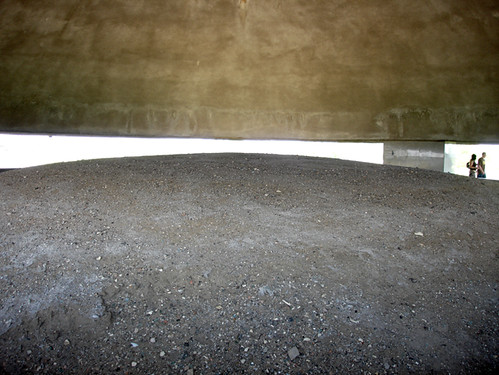
Another striking part of the camp was the memorial containing a mound of ash; the cremated remains of the camp’s thousands of victims. It’s hard to imagine this mass of ash was once a mass of people.

Lublin itself was very interesting. The city has a wonderful old town which more than hints at its original splendor. Sadly, some of the old houses are in a terrible state and one was left wondering whether they would survive.

Having spent the evening in the city, we had an good breakfast and made our way to Zamosc, a sixteenth century version of Milton Keynes, founded by Jan Zamoyski and built from scratch by the Italian architect Bernardo Morando in 1580. However, before sampling its various delights, we visited the second Holocaust site on our itinerary – the site of Belzec Death Camp.

Driving through the village of Belzec, it was hard to tell exactly where the camp was; to be honest, neither of us knew quite what to expect. And whereas before, in the camp at Majdanek we found patches of colour in amidst the piles of shoes, so here in Belzec, as we drove down the road, we saw a shadow in amidst the countryside; a charcoal scar like a field ravaged by fire. This was it, and it took our breaths away.

Whereas the proximity of Majdanek to the centre of Lublin was shocking, here at Belzec, what was shocking was its size. Measuring just 275 metres on three of its sides and 265 on the other, this small space witnessed the deaths of around half a million people, all in the space of nine terrible months. But unlike camps such as Majdanek, Auschwitz and Auschwitz-Birkenau, nothing of this camp (which was liquidated by the Germans in December 1942) remains.

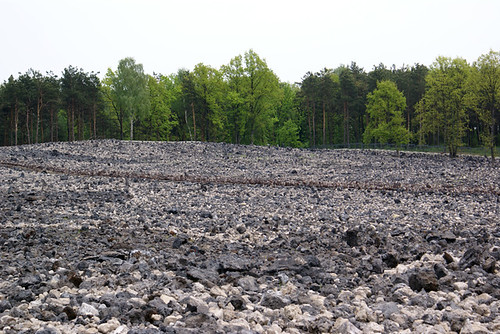
I must admit I wasn’t sure how I’d respond to visiting a place where nothing of the original camp remained, but of course what is important here is the land itself, for it’s the very soil upon which the victims walked and within which they were buried which holds their memories still. The scale of the site becomes the memorial and just as its countless victims walked upon this small piece of land to their deaths, so we walk around it, looking in, so as to remember them, staring at the rocks which litter the landscape as if each stone is a single individual.

Thinking about the hundreds of thousands of stones, I’ve been reminded since coming home of an old Jewish cemetery we visited in Kazimierz Dolny which was desecrated and destroyed by the Nazis. We wondered when we visited it about the practice of putting stones on graves and I have discovered that when the tradition started grave monuments were mounds of stones; visitors added stones to the mound to show we are never finished building the monument to the deceased. Another explanation was that it shows those visiting that others have come before to remember. The monument at Belzec therefore, covered as it is with hundreds of thousands of stones reminds us that this piece of land is a grave for hundreds of thousands of people who will not be forgotten; the memorial will never be finished. The fact that the stones look like the remnants of a demolished building is also significant.

Walking is itself a vital part of the memorial (it will never be finished as it is incomplete without people there to walk around), just as it has been important to me in my work on Belzec prior to my visit. I’m wondering now if stones will also become a feature?

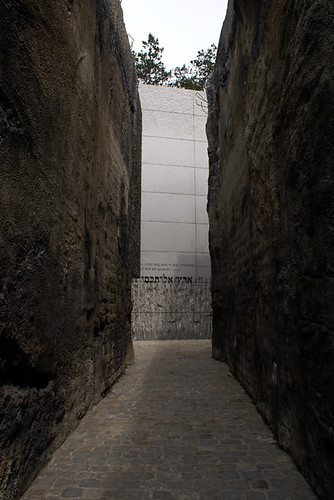
One of the most haunting parts of the memorial was the walk through the tunnel, a cutting made into the hill exposing the soil on both sides.

This brought to mind two things: one, the ‘tunnel’ through which the victims walked to the gas chambers, and secondly, the fact that we could see inside the ground, into the very place in which the victims had been buried.

From here we made our way to Zamosc and having spent a lovely night there, made our way to Kazimierz Dolny via the beautiful Kozlowka Palace, Zwierzyniec and the spa town of Nalenczow. Looking at the towns we passed through (including Zamosc which we left), one couldn’t help remember those very names as being places from which Jews had been deported to Belzec; the day before was never far from our thoughts.

Kazimierz was indeed a beautiful little town which had suffered much under the Nazi terror; half its population had been deported to camps such as Belzec. The weather was hot and having rested for the night, we spent the next day walking around the town, visiting King Kazimierz’s castle and walking through the forests by which it was surrounded. The landscape was indeed beautiful.
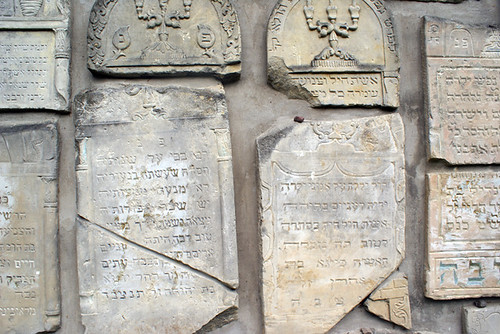
It was near the end of the day that we came upon the old Jewish cemetery, destroyed by the Nazis. After the war, a memorial was built using the old gravestones which again served to remind us of a recent and tragic past.

Filed Under: Holocaust Tagged With: Belzec, Holocaust, Lublin, Majdanek, Poland, WWII

From Dinosaurs to Human Beings

April 25, 2007 by Nicholas Hedges

After yesterday’s viewing, I began to think about the works I’ve produced so far on this residency and what it is that links them; not that there should be a link – I just know that there is one. Despite the differences, there is an underlying theme which unites the drawings, the text pieces, the deckchairs and the paintings. So what is it?

In answering this I have started to think about… dinosaurs. Not something which first springs to mind when looking at my work and if I mention Jurassic Park, then it might seem that I’m losing the plot altogether, but there is a sequence in this film which is relevant to my work.

In the film, the visitors to the Park are shown an animated film, which explains how the Park’s scientists created the dinosaurs. DNA, they explain, is extracted from mosquitoes trapped in amber and where there are gaps in the code sequence, so the gaps are filled with the DNA of frogs; the past is in effect brought back to life with fragments of the past and parts of the modern, living world. This ‘filling in the gaps’ is exactly what I have done throughout my life when trying to imagine the past, particularly the past of the city in which I live.

As well as reading about and drawing dinosaurs, I also as a child, liked to create and map worlds; countries which I would build from fragments of the world around me; forests, mountains and plains – unspoilt landscapes. And in these worlds there would exist towns and cities, created from ‘the best bits’ of those I had visited.

These invented worlds became, as I grew up, the ‘invented’ or imagined landscapes of Oxford’s past; landscapes that were – just as they still are – created from fragments, parts of the past which are still extant in the city; old buildings, walls, objects and so on. Between these structures, these fragments, I would fill the gaps, with my own imagination, with thoughts derived from my own experience. The city’s past and the past in general, as it exists within my mind, is then, to use the metaphor of cloning in Jurassic Park, a cloned dinosaur. The extant buildings, structures and objects within museums, are like the mosquitoes trapped inside the amber. They are broken strands of DNA. All that is required is for me to fill the gaps, and this I can do with my own DNA. I am in effect, the frog.

This metaphor is interesting in that DNA patterns are, of course, unique to everyone. My DNA is different to everybody else’s as there’s is to mine. Therefore, using my imagination to plug in the gaps of the past, means that the ‘past’ will comprise large parts of my own experience; my dinosaur will contain elements of my own being. (See ‘Postcard 1906’). But although my DNA is unique, it is nonetheless derived from my own past, elements have been passed down by my ancestors from time immemorial. The code which makes me who I am, comprises parts of people I know now (parents and grandmothers), people I knew (grandfathers and great-grandmother) and people lost to the past altogether (great-great grandparents and so on). What interests me about this, is that, through stating above how ‘my dinosaur will contain elements of my own being’ I can now see that ‘my dinosaur’ will contain elements of my own being, which is itself comprised of elements of hundreds – thousands – of people, the majority of whom I will of course never know and who have been dead for centuries. I like to think therefore, that ‘my dinosaur’ and my imagination aren’t entirely unique.

This leads me to look at paths – not the route I walk around the castle, or those recorded by my GPS receiver (although these are entirely relevant) but to the paths taken by my ancestors so that I might be brought into being. The chances of any of us being who we are is practically nil. In order for me to be born, I had to be conceived at the exact time I was conceived, any difference in time – even a split second – and I wouldn’t be me. Also, everything leading up to that moment had to be exactly as it was; anything done differently by my parents, no matter how small, how seemingly irrelevant, any deviation from the path and I would not be me. This is extraordinary enough (whenever I see old photographs of members of my family, I think that if it was taken a second sooner or later, I would not be here) but when one considers this is the same for my entire family tree, again, all the way back to time immemorial, then one realises how, to quote Eric Idle in ‘Monty Python’s Meaning of Life’, ‘incredibly unlikely is your [my] birth’. We are all impossibly unlikely. The chances of all our ancestors walking the exact paths through their lives which they walked is almost nil.

Therefore, my walks, my mapping, my identifying (seemingly irrelevant) objects, my recording them, my palimpsests, are all linked. Memorialising objects (disposable or otherwise), snatches of conversation and so on, inscribing them on a slab, shows how vital these fragments are to future generations and to me in terms of my own past. But how does this fit in with my work on Auschwitz-Birkenau, death camps and World War I?

These ‘arenas’ of death were constructions (although the carnage of a battlefield was often random, the battles themselves were always planned, ‘constructed’ for the purpose) in stark contrast to the rather arbitrary paths our ancestors took so that we might each be born. Death in these places was designed, it was planned, particularly with regards to the horrors of the death camps and by looking at these places, by visiting them, by looking at the seemingly irrelevant, everyday objects left behind, we can fill in the gaps, each using our own existence to imagine the lives and the deaths of others. We understand what it means to be human, the near impossibility of birth and the absolute certainty of death.
Imagining a group of a several hundred people walking to their deaths, whether down a path to the gas chambers, or on a road to the Front, we can easily imagine the route; we can in places walk the route today. But imagining the paths walked by thousands of people through time, to bring each of the victims into being is almost impossible: I say almost impossible, but, as I’ve written above regarding each of our births, it’s possible in the end.

Looking at death therefore is to to look at life and its inestimable value, whoever we are and wherever we live. It is to understand what it means to be human and to cherish the lives of others.

Filed Under: Artist in Residence Tagged With: Artist in Residence, DNA, Holocaust, Objects, Postcards, Residue, Vintage Photographs, World War I, WWI, WWII

The Unknown Soldier

April 17, 2007 by Nicholas Hedges

“The Post Office Rifles and the 6th Battalion – ‘the Cast-Iron Sixth – in turn would then pass through their lines to continue the advance to the next objectives on the downward slope of the ridge, the ‘Cough Drop,’ also known as ‘Leicester Square’, and the ‘Starfish Line’. The London Irish and the Poplar and Stepney Rifles were to lead the advance to the west of High Wood, before being succeeded by the 19th and 20th Battalions. ‘The postmen from quiet little hamlets or clerks who had spent their lives hitherto in snug offices, talked about these future regimental mortuaries with the homely names with astonishing calmness…'”

What struck me about this quote from Neil Hanson’s book, was how soldiers used the names of well known and familiar places, to name those places which were not only unfamiliar, but also terrifying, often places of horror and death on a scale which could never be imagined within those more familiar places back home. Trenches were named in a similar fashion: Oxford Circus, Oxford Street, George Street, Broad Street and so on.

“By day, the screams and groans of the wounded and dying had been drowned by the deafening clamour of the battle. At nightfall, though still counterpointed by the rumble of the guns, their pitiful cries and please for help could be hear echoing through the shattered wood…”

This quote reiterates how this war was a war of sounds; how men could be reduced to tears and much worse by sounds; those of the incessant shells or the solitary man crying in a dark wood.

“‘The reading of the battalion roll-call must have broken the hearts of all who heard it – ‘a hollow square of jaded, muddy figures… A strong voice… calls one name after another from a Roll lit by a fluttering candle, shaded by the hand of one of the remaining Sergeant Majors.’ Name after name went unanswered; each silence, another man wounded, missing or dead.'”

This very poignant passage reminded me of some text-based work I did whilst investigating the site of Auschwitz-Birkenau. These text-based pieces started as free-written prose and through a process of increasing the spacing between the letters changed to become squares where the words were reduced to a scattering of letters. As soon as I read the words ‘a hollow square’ I thought at once of those.

Filed Under: Artist in Residence Tagged With: Artist in Residence, Auschwitz, Holocaust, Neil Hanson, Quotes, Residue, Silence, Useful Quotes, World War I, WWI, WWII

Imagination and Memory

April 6, 2007 by Nicholas Hedges

Like many others, my imagination has played a central role in my life ever since I was a young boy, and recently, in connection with my recent work, I’ve been thinking about that role and how it has changed as I’ve grown up. As a child, I lived much of my life within imagined worlds; fictional countries which I would map and for which I would create entire histories. I would inhabit these places, hidden from everyone else, and while I walked, I would be walking not in the real world, but in my mind. I can still to this day remember one particular map in all its detail; the mountain ranges, the plains, the forests which were always a particular favourite of mine. I can even list the names of the towns and cities (Aquidos, Anasrehlon, Varimeere), yet while this ‘place’ has remained unchanged, whilst my imagination as a place is only a little different (one might say that the country I created was a map of my mind) the uses made of my imagination have altered. As a child I imagined the imagined, as an adult I imagine reality, and often the unimaginable.

Going back to my childhood, my imagination provided me with a means of escape (not that I needed to escape anywhere – I was fortunate enough to have the perfect upbringing). I’d always wanted to see the world unspoilt, an Arcadian vision without cars, planes, pollution, machines or any trace of the modern. And in a sense, this is I believe, what first fired my interest in the past. As a child and well into my teens – and perhaps early twenties – my interest in history ended at the late 17th century, certainly well before the Industrial Revolution, when the modern world began to develop and my vision of a rural Arcadia began to collapse. In some ways, my imagined world was a pick of the best bits of the (somewhat idealised) past; the ancient sprawling forests, beautiful timber-framed houses. When I looked at an old pair of 16th century shoes, a bottle from a 17th century tavern, I was picturing their place in a comparatively unspoiled landscape.

Of course, as a child, my impressions of the past were, as I said, somewhat idealised; they were little more than romantic impressions of an untamed idyll. In reality of course, the past, at least on a human level was, I came to understand, far from romantic; life was short, harsh and often brutal. So as I grew older, and while I still used my imagination to find my way back into the past, I didn’t imagine the imagined, but rather, as I said earlier, the unimaginable: the reality of the lives of others.

In recent years, this change in emphasis has seen the boundaries of my interest in history widen to include the twentieth century; in particular the unimaginable horrors of the Holocaust and the slaughter of World War One. Yet although these very difficult subjects are far removed from the invented landscapes of my childhood, my memories of maps and the stories created within them, provide an interesting, and I believe vital counterpoint to my understanding of such subjects. One of the problems with studying the Holocaust (and indeed World War One) is not only the sheer scale of the suffering, but also the fact that often the victims of both are, in the eyes of history, just that: victims. To say otherwise, i.e. to say that they weren’t only victims, is not to take away from the terrible suffering they endured, but rather to emphasise it, to focus our minds; they weren’t only victims, they were people with lives both behind them and ahead of them; pasts that for many were happy. They all had childhoods, and perhaps imagined their own fantasy worlds. Many, caught up in the Holocaust, were still inhabiting them – they were still of course, children.

As I’ve said, as a child, I would walk and imagine myself in my invented landscape, but as I grew older, although I still walked and imagined myself elsewhere, it wasn’t within an invented world that I walked, but rather a real world; that of my home town, Oxford’s past. Of course one might argue that this past was a much a fabrication as the map I drew as a child, but nevertheless, it was constructed from fragments of the past – drawings, paintings, descriptions in books, photographs. I could never know for sure what things looked like, or how it must have been to walk through the city’s streets (for example during the 14th century) but my imagination did its best to conjure a picture. Of course, as well as those things listed above, there are parts of the city which are contemporary with the past and these buildings and streets are particularly important when looking for that which has long since gone; just as I have found in Auschwitz-Birkenau and Ieper.

One man who did so much to capture Oxford before much of its past was demolished in the late 18th century was a German artist and musician called John Malchair. His drawings are amongst the most beautiful and indeed haunting images of a city I have seen, particularly his views of Friar Bacon’s study, an unusual edifice which was sadly demolished in 1779.

One particularly poignant drawing (below) shows the remaining arch, when all above it has been taken down.

In my mind, as I walk, I suppose one might say I am often trying to rebuild Friar Bacon’s Study. Walking as a means of remembering then is important to me although it does throw up interesting philosophical questions (which I’ve touched on before) namely, what is it we are remembering when we ‘remember’ events which we ourselves have not experienced. As Paul Ricoeur asks in his book, ‘Memory, History, Forgetting,’ ‘Of what are there memories? Whose memory is it?’.

The invented world I ‘walked in’ as a child was a fiction, an amalgam of all the fragments of an unspoiled landscape which I could see in parts around me. And, in a sense, when ‘remembering’ the past of Malchair’s Oxford, the Great War and the Holocaust, I am creating a fiction of sorts – a world created from fragments; photographs, drawings, letters and documentary evidence. The past becomes my imaginary world.

So what is it which separates the past and my past imaginary landscapes? It is this: it is the theme of this residency; Residue.

Filed Under: Artist in Residence Tagged With: 18th Century, Artist in Residence, Holocaust, Imagined Landscapes, John Malchair, Memory, Paul Ricoeur, Residue, WWII, Ypres

Walking

April 2, 2007 by Nicholas Hedges

As part of my continuing work on sites of the Holocaust, I have been investigating Belzec death camp which I will be visiting next month. Even with a place as large as Auschwitz-Birkenau, it’s hard to equate its size with the number of people killed there (1.1 million). Yet this appalling correlation of camp size to victims, is perhaps at its most disturbing in Belzec, where in a space of less than 300 metres by 300 metres, approximately 600,000 people perished. Death on this scale, on the open fields of battle is hard enough to imagine, yet it somehow seems all the more sickening in a place the size of Belzec (and one designed for the purpose). In order to ascertain just how big (or rather small) 300m x 300m is, I bought a pedometer and looked for somewhere in Oxford which might, more or less, equate with these dimensions. The closest I got to those dimensions was in Christ Church Meadow, which if anything was bigger. As I’ve already documented my continuing investigations on this subject I won’t add any more here, but I would like to explore further the idea of using the memory of a place to understand the wider past; something which I touched on in Postcards.

During my walks, I found myself recalling a raft of memories from my own past, triggered by the sites I saw as I travelled. Even a short walk around Christ Church Meadow (the length of which, in terms of time, was itself indicative of the horror and magnitude of the suffering at Belzec) opened the floodgates, not only for my own memories to pour through, but those of the city itself . Here I was, an individual with my own recollections, walking amongst the hundreds of thousands of memories of people long since dead from which the city is inevitably constructed – an interesting metaphor for the individual swallowed by the world stage; swallowed by the violence war.

As I have already written, but something it’s worth stating again, the Italian author Italo Calvino discusses memory and its relationship to a place in his book Invisible Cities. The city he says, consists of:

“…relationships between the measurements of its space and the events of its past; the height of a lamppost and the distance from the ground of a hanged usurper’s swaying feet; the line strung from the lamppost to the railing opposite and the festoons that decorate the course of the queen’s nuptial procession; the height of that railing and the leap of the adulterer who climbed over it at dawn; the tilt of a guttering and a cat’s progress along it as he slips into the same window; the firing range of a gunboat which has suddenly appeared beyond the cape and the bomb that destroys the guttering; the rips in the fish net and the three old men seated on the dock mending nets and telling each other for the hundredth time the story of the gunboat of the usurper, who some say was the queen’s illegitimate son, abandoned in his swaddling clothes there on the dock…”

Could it also be said, that there is a relationship between the measurement of spaces within the city and the events of the past elsewhere?

Filed Under: Oxford Tagged With: Auschwitz, Belzec, Christ Church, Holocaust, Invisible Cities, Italo Calvino, Oxford, Postcards, WWII

Maps and Walking

March 16, 2007 by Nicholas Hedges

The main theme of much of my work has so far been the Holocaust and in particular its sites, such as those at Auschwitz-Birkenau, Belzec and Babi Yar. I’ve also been studying memory and how memories within objects and buildings might allow us a glimpse of the past; a theme which has fascinated me ever since I was a child. It was through reading Bill Viola’s writings a few months back that I was reminded of the mnemonic techniques practiced by the ancient Greeks:

“The idea of art as a kind of diagram has for the most part not made it down from the Middle Ages into modern European Consciousness. The Renaissance was the turning point… The structural aspect of art, and the idea of a ‘data-space’ was preserved through the Renaissance however in the continued relations between image and architecture. Painting became an architectural, spatial form which the viewer experienced by physically walking through it. The older concept of an idea and an image architecture, a memory ‘place’ like the mnemonic temples of the Greeks is carried through in the great European cathedrals and palaces, as is the relation between memory, spatial movement and storage (recording) of ideas.”

When I first read this quote, I was at the time researching The University Parks in Oxford, and in particular examining the plaques on the benches. I realised then, that my act of walking and ‘remembering’ those who have passed away, was in a broad and rather loose sense, like walking through one of those ‘mnemonic temples’ albeit in a physical sense. I was constructing a bigger picture of the place.

More recently, walking has started to play an important role in my work on the Holocaust (one of the themes which has struck me through my research has been that of walking. Many photos of the Holocaust show people walking, usually, and tragically, to their deaths). I’ve started to look at the Operation Reinhard camps and in particular Belzec. Laurence Rees, in his book, ‘Auschwitz’, describes the unimaginable scale of death and contrasts it with the disproportionately tiny size of Belzec Death Camp, which measured less less than 300m x 300m. I knew this was a small size, but it wasn’t until I walked around some familiar spaces in Oxford – including the University Parks – that I realised just how small it was.

Since then I’ve started looking for more evidence of the size of Belzec (and other camps) so that I might walk specific distances around the city, and have since discovered a number of maps drawn by survivors, SS men and archaeologists. These roughly sketched maps, these ‘memories,’ are a poignant reminder of the camp’s existence and might help me in my attempts to bring people closer to the Holocaust, which should never be forgotten.

“All things fade away in time, but time itself is made fadeless and undying by recollection.” Apollonius of Tyana
“We have to describe and to explain a building the upper story of which was erected in the nineteenth century; the ground-floor dates from the sixteenth century, and a careful examination of the masonry discloses the fact that it was reconstructed from a dwelling-tower of the eleventh century. In the cellar we discover Roman foundation walls, and under the cellar a filled-in cave, in the floor of which stone tool are found and remnants of glacial fauna is the layers below… Not only our memories, but the things we have forgotten are ‘housed’.” C.G. Jung
“Memory, whether individual or generational, political or public is always more than the prison house of the past.” Andreas Huyssen

Here I must return to the ancient Greeks and their mnenomic temples. With a place or loci, such as a house, fixed in the mind, the person remembering would place various objects in its rooms (“…what I have spoken of as being done in a house can also be done in public buildings, or on a long journey, or going through a city…”), objects which by association would remind them of part of the whole thing – such as a speech – to be remembered. Here I saw at once a correlation with my work on Belzec. The ancient Greeks were walking as a means of remembering, of not forgetting; their memory loci were in effect maps which one could sketch, maps of the mind. Therefore, the maps drawn by survivors, are in effect maps of their minds and bring us closer to the horrors of the time – closer to the individuals who suffered.

The fact that objects were used to create associations, and therefore build (through ‘walking’) a bigger ‘picture’ of something also fits in with the recent work I’ve been doing on Auschwitz, looking at the possessions left by the victims and trying to build a picture of the individuals before the Holocaust, to see them not only as victims, but people who lived lives before its horror.

Through walking distances which I’ve taken from descriptions of the camp, I have found myself walking back into my own past and the past of the city in general; for example, walking the route of Cuckoo Lane and the Old London Road at Shotover. My own past confirms my individuality and the past of the city confirms my place as a small part in the mass of memories associated with this place (this also correlates with my work on Auschwitz, trying to find the individuals amongst the huge number of dead, individual possessions from amongst the mountains, names rather than inconceivable numbers). The fact these walks have been derived from a map or a description of Belzec, helps me to identify further with the individuals who suffered there; not because I can in anyway conceive of their suffering – no-one could ever imagine the horrors they endured – but because I can imagine their own pasts and that of the places they knew so well, places from which they were taken to their deaths.

Filed Under: Oxford Tagged With: Andreas Huyssen, Auschwitz, Babi Yar, Belzec, Bill Viola, Death Camps, Holocaust, Jung, Laurence Rees, Oxford, Quotes, University Parks, Useful Quotes, WWII

  • « Previous Page
  • 1
  • 2
  • 3

© Nicholas Hedges 2024

  • Facebook
  • Instagram
  • Twitter
  • YouTube

Copyright © 2025 · Outreach Pro on Genesis Framework · WordPress · Log in