Nicholas Hedges

Art, Writing and Research

  • Amazon
  • Behance
  • Facebook
  • Instagram
  • Pinterest
  • YouTube
  • Art
    • Digital
    • Drawing
    • Grids
      • Correspondence
      • The Wall
      • The Tourist
    • Ink on paper
      • Shadow Calligraphy
    • Installation
      • Murder
      • Echo
    • Painting
    • Patterns
    • Mixed Media
    • Photographic installation
      • St. Giles Fair 1908
      • Cornmarket 1907
      • Headington Hill 1903
      • Queen Street 1897
    • Research/Sketches
    • Stitched Work
      • Missded 1
      • Missded 2
      • Missded 3
      • Missded 4
    • Text Work
  • Blogs
    • Family History
    • Goethean Observations
    • Grief
    • Light Slowed But Never Stilled
    • Lists
    • Present Empathy
    • Shadow Calligraphy
    • Trees
    • Time
    • Walking Meditations
  • Video
  • Photography
    • Pillars of Snow
    • Creatures
    • The Trees
    • Snow
    • St. Giles Fair 1908
    • Cornmarket 1907
    • Headington Hill 1903
    • Queen Street 1897
    • Travel
  • Illustration and Design
  • Music
  • Projects
    • Dissonance and Rhyme
    • Design for an Heirloom
    • Backdrops
    • Shadow Calligraphy
  • Exhibitions
    • A Line Drawn in Water
      • Artwork
    • A Line Drawn in Water (Blog)
    • Mine the Mountain 3
      • Artwork
    • Mine the Mountain 2
      • Artwork
      • The Wall
    • The Woods, Breathing
      • Artwork
    • Snow
      • Artwork
    • Echo
      • Artwork
    • Murder
      • Artwork
    • The Tourist
    • Dreamcatcher
    • Mine the Mountain
      • Artwork
      • The Tourist
    • M8
    • The Gate
    • Creatures
      • Artwork
    • Residue
      • Artwork
    • A visit to Auschwitz
      • Artwork
  • Me
    • Artist’s Statement

Feedback

September 1, 2008 by Nicholas Hedges

Continuing in my research into the murder (or manslaughter as it transpired in the Assizes) of Charlotte Noon by her husband Elijah, I looked – in the Oxfordshire Record Office – at the original burial records for the Parish of St. Paul’s which includes Jericho where the Noons lived in Portland Place, Cardigan Street. I had my suspicions that Charlotte Noon would have been laid to rest in St. Sepulchre’s cemetery off Walton Street and in the records I found this to indeed be the case. I could even see the original plot number ‘G7’ which unfortunately today, won’t help in the identifying of her grave.

Despite this, yesterday I went a second time to St. Sepulchre’s and began to look again for the grave of Charlotte Noon. Maybe, just maybe, it would be one of those which had defied the passage of time and which could still be read – even if with fingers, but I knew this was unlikely to be the case; for one thing, I assume, as they were not a wealthy family, that the grave stone would be have been rather modest and less likely to survive the last 153 years; indeed this seems to be the case. Many of the graves have melted into the ground and only their outlines in the depressed turf indicate their presence. Nevertheless, there was something very poignant about walking around the cemetery knowing that I was in the immediate vicinity of her last resting place – there was, for those moemnts – a physical link between us.

I have walked around the cemetery on several occasions before, but was always oblivious to what it contained; now, as I walk, the whole place feels very different, as indeed does Jericho as a whole.
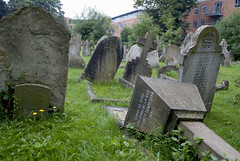
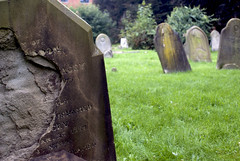
St. Sepulchre Cemetery

St. Sepulchre Cemetery

St. Sepulchre Cemetery

The cemetery along with streets Jericho are a part of my ‘geographic biography’. Writing about the piece of work I’m showing at the Botanic Gardens – 100 Mirrors (Dolls), I borrowed a quote from the artist Bill Viola, who wrote:

“Looking closely into the eye, the first thing to be seen, indeed the only thing to be seen, is one’s own self-image. This leads to the awareness of two curious properties of pupil gazing. The first is the condition of infinite reflection, the first visual feedback.”

This ‘feedback’ is precisely what I experience when I walk in these places – indeed any places where I know named ancestors of mine once walked – as if we are for that moment, both walking at the same time.
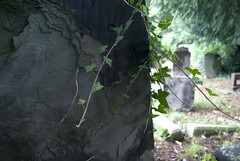
St. Sepulchre Cemetery

Filed Under: Oxford Tagged With: Bill Viola, Charlotte Noon, Elijah Noon, Family History, Jericho Cemetery, Murder, Oxford, Quotes, St Sepulchres Cemetery, Useful Quotes

North Star Public House

August 22, 2008 by Nicholas Hedges

In the Oxford Journal reports into the murder of Elizabeth Noon by her husband Elijah, it’s stated that:

“He had been drinking at the North Star public House, in St. Giles’s, on Saturday night; that house is kept by the daughter of her [Elizabeth Noon, daughter of Elizabeth and Elijah] uncle Mr Thomas Noon, who paid his men there, and where her father, who worked for him, received his wages which were 20s.”

Like dozens of pubs, the North Star public house has long since vanished and is one which I have never heard of. However, on researching the pub in the library today I discovered the following information:

“North Star public house, 3 Broad Street. Very few records of this pub, but seems to have been mainly licenced by women; Isabella Gittins in 1832 and Mrs. Marsh in 1871. Not known when it closed, but the premises could have been the house of W.B. Yeats the poet while he lived in Oxford. The whole of the site was demolished in 19828 and became Boswell’s department store [which it still is].”

Broad Street, Oxford

On another site, Headington.org the following information about the North Star is given:

Among the building which had to be demolished to make way for the present Boswell’s was… the eighteenth-century North Star pub. At the time of the 1851 census the North Star pub was occupied by John White and his wife and four young children, while in 1881 the publican was a widow, Mrs Eliza Smith, who lived there with her two sons.

According to the newspaper, the pub was, in 1852, run by the daughter of Thomas Noon, brother of Elijah Noon. It is interesting however, that the surname ‘White’ is the maiden name of Elizabeth (Charlotte). To understand the report I decided to take a look at the census for 1851.

Indeed, John White was the publican so one can only surmise that between the date of the census being taken and the date of the murder, the tenancy was taken over by Thomas Noon’s daughter, the cousin of Elizabeth Noon (daughter). Looking again at my family tree however, I could see clearly that the Thomas Noon I had down as being Elijah’s brother would be too young to have a daughter running a pub at that time. Therefore I could again surmise that I had made a mistake and that Thomas Noon must be older (it made sense too given that Elijah worked for him).

Searching the records again, I found a Thomas Noon, born in Burton Dassett in 1796 and living in Oxford in 1851. I knew this was Elijah Noon’s older brother. Looking at the census details I could see also that he was a builder and was married to to a woman called Ann who was born around the same time. They both lived in Little Clarendon Street.
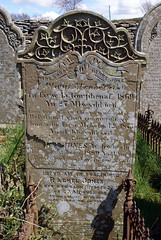
As far as things stand, I haven’t found the name of their daughter, or any of their children for that matter, but it’s interesting how I’m using Ancestry not only to find people to whom I am directly related, but to track and place people in a particular moment in time – an event, which in this case happens to be a murder.

Filed Under: Oxford Tagged With: Charlotte Noon, Elijah Noon, Family History, Murder, Oxford

A Murder in Jericho

August 21, 2008 by Nicholas Hedges

Through my research these past few months, I’ve uncovered several tragic stories surrounding the lives and deaths of my ancestors; John Stevens, my great-great-great-uncle, spent 17 years incarcerated in Moulsford Asylum, Berkshire until his death in 1888 at the age of 51; Jonah Rogers my great-great-uncle, was killed in the second battle of Ypres on May 8th 1915 at just 22 years of age; and Henry Jones, my great-great-grandfather took his own life in Cefn-y-Crib, Wales in June 1889, whilst, as his death certificate records, ‘temporary insane’. Death certificates can, as I discovered with that of Henry Jones tell one a great deal about a person’s life as well as their death, and knowing that my great-great-great-grandmother, Charlotte Noon, had died in Oxford at the age of just 33, I was intrigued to see how she’d met her end, assuming that it was as a consequence of disease.

Having received the certificate in the post however, I was stunned to see the cause of death given as follows:

“Wilful murder bythe said Elijah Noon, the husband of the deceased.” Place of death, “Portland Place, Cardigan Street, St. Thomas’, Oxford.”

I must admit it took a while for the fact to sink in and questions such as how he had killed her began to demand answers. But there were other questions too arising from my research which didn’t seem to fit with the facts as presented by the certificate. If Elijah Noon had, as the certificate stated, wilfully murdered his wife in May 1852, how was it he married Sophia Kinch in December 1854? Surely in those days, if you were guilty of murder, you were hanged?

I decided the next phase of my research would be to look at local papers for the time – namely, Jackson’s Oxford Journal in which I assumed I would find some mention of the case. The next issue following the date of the murder was that published on Saturday 8th May 1852 in which I found a very lengthy report on the murder, the inquest and the subsequent hearing at which Elijan Noon was committed for trial at the next Assizes.

As with the stories I’ve previously mentioned, my ancestors in this case were, in reading the report, certainly brought my to life, even in the retelling of what was a terrible death. Reading their words; “Oh, good God Almighty what shall I do?” “Pray let some one come for I shall die,” I found myself hearing them speak. “Oh my dear boy,” some of the last words of Elizabeth (Charlotte) Noon to her eldest son Elijah. Of course the account is tinged in places with a degree of Victorian melodrama, and at times that which to the modern reader, might seem absurd understatement (“oh dear, what shall I do?”) but the sincerity of the writing is evident and indeed compelling enough to get a sense of the whole tragic affair, the drama not only of the murder itself, but the impact it had in Oxford as a whole.
In the final paragraph of the piece, under the heading “Examination of the Prisoner by the City Magistrates” the words of Elijah Noon, a man “undone” by his actions, say it all.

“The prisoner was then asked by the Mayor if he had anything to say? when he replied ‘I have nothing to say, gentlemen.'”

One can almost hear his tone of voice, see him standing with his head bowed, his whole world and that of his family turned completely upside down. Committed to trial for the wilful murder of his wife, he must have supposed he would hang.

In stories such as this, names become people. Parents and children become more than just past facts in a family tree and the last line of the report illustrates this clearly:

“The announcement [commital for trial at the next Assizes] increased the distress of the prisoner which had manifested throughout the investigation and the parting with his son and daughter was of the most painful nature.”

I have made as best I can from the two prints of the report in Jackson’s Oxford Journal, a PDF copy which is available to download.

So given the dire position in which my great-great-great-grandfather found himself in May 1852, how was it that he lived to marry Sophia Kinch and father seven more children before his death in 1889? Returning to the library I turned again to Jackson’s Oxford Journal. I had thought at first to try and look at the Assizes records but these are held at Kew. I also tried to find the dates of the Assizes held in 1852 but to no avail. However, knowing that there were three Assizes in the year including one in summer, I assumed that Elijah’s trial would take place soon after his appearance before the magistrates at which he was committed for trial.

In the same newspaper I eventually found notice of the Oxfordshire Summer Assizes and the trial of Elijah Noon. It was to take place at 9 o’clock on the morning of Thursday 15th July and in the edition for the 17th July, a full report was given. Again I have created a PDF of the report, but have transcribed a little of it below.

“The trial of Elijah Noon for the murder of his wife, Elizabeth Noon, was fixed to take place at nine o’clock this morning, and by that time every part of the Court was crowded. The prisoner on being placed at the bar, looked very ill, and appeared to feel his position very acutely. Mr. Cripps and Mr. Sawyer were engaged for the prosecution, and Mr Pigott and Mr. Huddlestone for the defence.

Mr. Cripps opened the case by adverting to its painful character, a husband being charged with the wilful murder of his wife, and that it was rendered the more painful because the principal witness in the case as the daughter of the prisoner. Mr. Cripps then detailed the facts of the case, as given in the evidence, and concluded by saying that he felt assured that after they had heard all the evidence, the defence, and his Lordship’s summing up, they would return such a verdict as would be satisfactory to their own consciences and to the public.

Elizabeth Noon, the daughter of the prisoner, was then examined, and was about detailing the facts, when the prisoner: fainted, and was obliged to be taken out of Court. He looked ghastly pale, and his daughter burst into tears, and a more painful and distressing scene has rarely been witnessed in a Court of Justice. The trial was delayed for nearly half an hour, and as soon as the prisoner had revived, he returned into Court, and the case proceeded.”

It is no wonder Elijah Noon looked so ‘ghastly pale.’ He had killed his wife, spent two months in the city gaol and had been separated from his children. Furthermore he was staring at the gallows. The judge in the case had already directed the jury that “no amount of provocation given with words could have the effect of reducing the crime from murder to that of manslaughter,” and this it seems to me was all he could really rely on. “Great allowances must certainly be made for the infirmities of human nature, and when death ensued by means which did not show actual malice, then, in most cases, the crime would be that of manslaughter; but short of that, and if the provocation given were only in words, and death ensued, then the party must be considered as guilty of murder.”

Yet despite the odds seemingly being stacked against him, Elijah Noon was found guilty of the lesser charge of manslaughter and sentenced to two years imprisonment with hard labour. Bizarrely, at the same Assizes, two men on trial for stealing a pair of trousers were given 7 years transportation due to it being their second offence.

Further to studying the newspapers, I was interested in discovering the location of Portland Place. I know Cardigan Street which is listed as being part of the address in the newspaper and on the death-certificate, but Portland Place has disappeared since then. On looking at a map of 1850 however, I found that Cardigan Street continued into Portland Place, whereas today it is all Cardigan Street.

Having studied the map, I walked to Cardigan Street, the layout of which has changed a great deal since that time, but the part of the street which was Portland Place still exists, and walking down there, even though the houses have all changed and the views completely different, I still felt a chill run down my spine.

We are, as I’ve often said, a product not only of everyone that went before us, but everything they did. Anything different and we would not be here. It felt strange then to think that I was only able to walk down that street because, in some small part, of the terrible incident which happened there over 150 years before.

Filed Under: Oxford Tagged With: Charlotte Noon, Elijah Noon, Family History, Murder, Oxford

X, II

July 25, 2008 by Nicholas Hedges

Having worked some more on what I have come to call my ‘X’ paintings, I realised there was something interesting in the contrast between the rough, physical paintwork, and the crosses marked on the canvas in pencil, which appear almost spoken by comparison. Perhaps this contrast was all the more appreciable after what I’d written earlier in the day regarding the suicide of my great-great-grandfather.

X, II

The crosses, barely distinguishable in the scraped and painterly landscape call to mind how nature can overwhelm us; not only in its beauty and its tempests, but in its age, which, in many respects, is as much a storm as any hurricane. At the moment of death, the world ceases to exist, as if all the storms of a lifetime are condensed into a dying breath. In this reversed storm, the living stand outside in the eye, whilst the dead are collapsed like shacks; stars imploding at the centre of the universe. And the ‘X’ becomes a marker on the landscape, of what was once but is no more; an absence marked by a presence.

How does a man who cannot write his name, leave his farewells as he contemplates the taking of his own life? The repeated mark-making of Xs on the canvas call to mind my drawings of Auschwitz-Birkenau. There, having considered my own non-existence (death), I was through the act of drawing confirming my life and my existence. I was also, through the rapidity of the drawing, trying to capture the present – the moment; the gap between the past and the future, the interval of the shutter’s release.

The Xs on the canvas therefore are in some ways like these drawings; they are confirmations of existence, not of many people, but of one person.

Recalling how these paintings began, as images concerned with Jonah Rogers, my great-great-uncle, I looked again at the landscape which inspired them – or at least the photographs of this landscape.

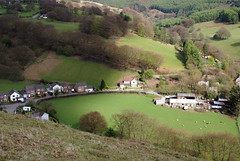
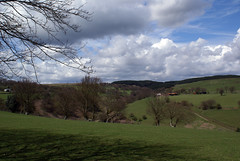
Hafodyrynys and Surrounds

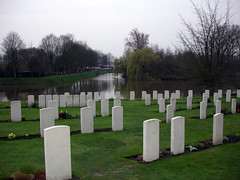
Jonah Rogers was killed in the Second Battle of Ypres, and the white of the buildings amongst the vivid green of the landscape called to mind the white gravestones of military cemeteries.

Ieper

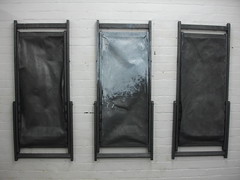
They also reminded me of another project on which I am working: Deckchairs, and it is with deckchairs that I am turning to again a regards my painting of this subject, using them as canvases. Having placed them on the wall of my studio, the effect they had was strong. They seem to become instant memorials, their shape and their very essence denoting the human, or in this instance, presence through absence.

X, II and Deckchairs

Filed Under: Holocaust Tagged With: Deckchairs, Family History, Family Jones, Hafodyrynys, Holocaust, Jonah Rogers, Jones, WWII, X, Ypres

A Suicide in Cefn-y-Crib

July 24, 2008 by Nicholas Hedges

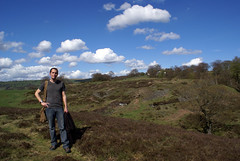
Back in the spring when I visited Hafodyrynys with my Dad and my girlfriend Monika, we found ourselves – whilst clambering over what my grandmother has always called the ‘Mountain’ – in the company of a farmer, who, with his two sheepdogs, took us on a short tour of his land overlooking the village. He was a man who having been brought up in the area knew that part of the world intimately, and who, as he traced the blue horizon with his hand, reeled off a list of villages resting amongst the hills and fields rolled out below. As we looked over towards the town of Llanhilleth, where my great-grandfather, Elias Jones, had worked as a miner, I couldn’t help but imagine him standing there 100 years before, looking at the same villages and reeling off the same names. Down below, in Rectory Road, he would see the house in which he lived, and in which also lived my grandmother as a child.
Elias Jones died of lung disease in 1929 at the age of 47, caused as a result of breathing in coal dust down the mine in which he worked. He was buried in the churchyard at Cefn-y-Crib, where his wife, Mary Jane, would be buried 40 years later. Also buried in the same churchyard, as we saw that day, was Elias Jones’ father, my great-great-grandfather, Henry, who died in 1889 at the age of 49 when Elias was just 7 years old.

Hafodyrynys and Surrounds

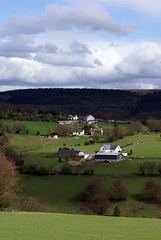
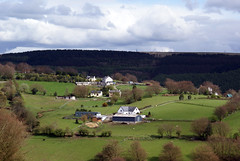
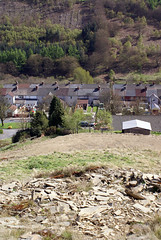
We could see the churchyard from the brow of a hill as we stood in the company of the farmer and his dogs, and in between, a scattering of buildings, vivid and white against the green of the fields, made darker for a moment by the looming presence of clouds which gathered around us as if to experience a view which they would know for only a very short time.

Hafodyrynys and Surrounds

It was as we looked that the farmer pointed to one of the buildings and explained how in December the previous year a young woman was found hanged inside. It was a story which seemed at odds with the beauty of the landscape – a landscape which, nevertheless, just as it had shaped the existence of my paternal family, had shaped the death of this young woman.

In amidst the fields, the seemingly empty barns and houses, and bordered by the forests which clung to the hills surrounding us, one could feel very small and insignificant. In a place such as this one’s awareness of self is augmented, or at least, one’s awareness of individuals. Indeed, of all the people I have researched so far, the two which to me are perhaps the most clearly defined are my great-grandfather, Elias, and my great-great-uncle, Jonah Rogers, who was killed in 1915 in the second battle of Ypres. Perhaps this is in part because of the place in which they lived (and in which that day I was standing), not so much because it’s changed so little, but because its shape, its beauty and its timelessness, serve to delineate the individual better than any city.

I’d always heard that one of my ancestors on the Welsh side of the family had been killed in a mining accident, but I’ve never found anything to even vaguely corroborate the story. Of course accidents were common as my grandmother recalled, remembering how blinds would be drawn in all the windows when another body was brought back up to the surface. Having seen Henry Jones’ grave, I decided to obtain a copy of his death certificate to see if perhaps he – having died young – had been killed in an accident of some kind. As it turned out, the truth was indeed tragic, but for altogether different reasons.
It took me a while to decipher the spider-like writing of the registrar, but suddenly it hit me; cause of death, “suicide while temporary insane,” place of death; Cefn-y-Crib.

Filed Under: Family History Tagged With: Death, Elias Jones, Family History, Family Jones, Hafodyrynys, Jonah Rogers, Jones

Ancestry

July 22, 2008 by Nicholas Hedges

I’m very pleased to announce that my forthcoming exhibition, Mine the Mountain, will be sponsored by Ancestry.co.uk.

I have been researching my family tree for almost a year now and in that time have used Ancestry to search thousands of records (census returns; births, marriages and deaths etc.) to build what has now become quite an extensive tree with roots stretching back to the mid eighteenth century. And although most of this research has been carried out alone, through using the Ancestry website I have been able to join forces with a relative (a second cousin) who I have never met and who lives on the other side of the Atlantic in Canada. He had already made good progress on one line of my family (that of my maternal grandmother) and through the website, I was able to merge much of that information into my own research (and indeed, share with him my own first hand knowledge of people he’d never met).
Using the website I made very quick progress, discovering hundreds of people, some of whom had been completely forgotten, swallowed up by time and almost lost to the past altogether. And it was in response to this idea of the anonymous mass, that what had started as a hobby became an integral part of my artistic practice.

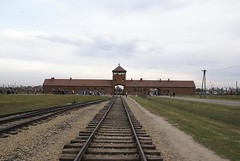
I have always been interested in history and the past was always going to feature in the work I wanted to make and much of my work over the last two years has stemmed from a visit I made to Auschwitz-Birkenau in October 2006.

Auschwitz-Birkenau

As with many historical and indeed contemporary traumas (whether ‘man-made’ or natural disasters), one of the most difficult things to comprehend at Auschwitz (and indeed with the Holocaust as a whole) was not only the sheer brutality and inhumanity of the place, but the scale of the suffering experienced there. How can one possibly comprehend over 1 million victims (6 million in the Holocaust as a whole)? The only way I could even begin to try, was to find the individuals amongst the many dead; that’s not to say I looked for named individuals, but what it meant to be one.
One of the many strategies I used to explore the individual was that of researching my own past; not just that of my childhood, but a past in which I did not yet exist.

Ieper (Ypres)

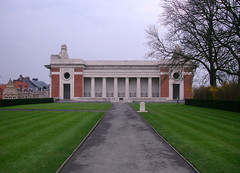
Using the Ancestry website I began to uncover names, lots of names which seemed to exist, disembodied in the ether of cyberspace like the names one reads on memorials (such as on the Menin Gate in Ypres), and I was reminded all the while I searched of a quote from Rainer Maria Rilke’s poem ‘The Duino Elegies,’ in which he writes that on dying we
“…leave even our name behind us as a child leaves off playing with a broken toy…”

It is interesting that in looking back on our lives and beyond, we inevitably pass through our own childhood, and indeed, I can remember mine replete with all its toys – a fair few of which were inevitably broken. In Rilke’s phrase above, we have an implied progression from childhood to adulthood and the fate that comes to all of us, but travelling back, we move away from death and think of our childhoods, remembering those toys which in our mind’s eye are always new, or at least, always mended. This sense of moving back and the idea of toys, or things, that are mended again, resonates for me with my research and my using the Ancestry website. One can think of the 800 million names stored in their databases as each being a broken toy, one that when it’s found again is slowly put back together.

Having discovered hundreds of names (or broken toys) in my own family tree, I’ve started to put the pieces back together, looking beyond the names to discover who these people were, and therefore, who I really am. And the more I discover, the more I find myself looking at history in an altogether different way. History is sometimes seen as being nothing but a list of dates, but like the names on Ancestry, there are of course a myriad number of things behind the letters and the numbers (the broken toy in the attic has been to places other than just the attic – and has been things other than just a toy).
Now when I think of an historical date, I relate that to my family tree and consider who was alive at the time. For example, when reading about the Great Exhibition of 1851, I know that at that time Richard Hedges, Ann Jordan, Elijah Noon, Charlotte White, William Lafford, Elizabeth Timbrill, John Stevens, Charles Shackleford, Mary Ann Jones among many others were all alive; what is for me a distant event described in books and early black and white photographs, was for them a lived moment whether or not they visited the exhibition itself.
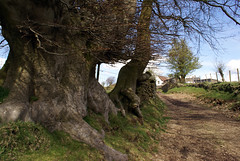
When this photograph inside the exhibition hall was taken in 1851, they were a part of the moment, even when farming in Norfolk. When the guillotine fell upon Marie Antoinette on October 16th 1791 (I’ve just been reading about the French Revolution), Thomas Sarjeant, Ann Warfare Hope, David Barnes, Mary Burgess and William Deadman were going about their normal lives somewhere across the channel in England, and it’s by understanding their lives – of which I am of course a consequence and therefore a part, that I can begin to understand history as not some set, concrete thing that has happened, but something fluid, made of millions of moments which were at one time happening. Every second in history comprises these millions of moments when the world is seen at once by millions of pairs of eyes.

Therefore, as well as being a huge database of names, Ancestry can be seen as being a database of moments, the more of which we discover for ourselves, the greater our understanding of history becomes. This, in light of the project’s origins at Auschwitz-Birkenau, is particularly pertinent; the Holocaust, as a defined historical event, becomes millions of moments and the Holocaust itself not one single tragedy, but a single tragedy repeated six million times.

In effect, Ancestry allows users to map themselves onto history and the family tree becomes not just a network of relationships between hundreds of people but a kind of physical and geographic biography of the individual. Places we have heard of but never been to, places we have never known before become as much a part of our being as the place in which we were born and in which we live. For example, if there’s a place with which I can most identify physically or geographically, then that place would be Oxford, the town in which I was born, grew up and in which I live. Its streets which I have walked and its buildings which I have seen countless numbers of times, all hold memories – and what are we in the end but these.

18

Of course there are numerous other places which I have visited and which make me who I am (seaside towns in Dorset where I holidayed as a child for example) but as well as these places are those which, until I began my research, I had either never heard of or never visited: Hafodyrynys, Dorchester, Burton Dassett, Southam, Ampney St. Peter, Minety, Ampney Crucis, Cefn-y-Crib, Kingswood, Usk, Eastleach, Wisbech, Walpole St. Andrew and so on. Furthermore, places I had known and visited were shown to contain memories extending way beyond my own lifetime but of which I am nonetheless a part, or at least, a consequence. I have been to Brighton many times and have many memories of that place, but all the times I have been there, never did I realise how much it and the surrounding area had come to make me who I am.

Hafodyrynys and Surrounds

So, as well as being a vast database of moments, Ancestry can be seen as an equally vast set of blueprints, each for a single individual – not only those who are living, but those who’ve passed away. And just as the dead, through the lives they led, have given life to those of us in the present, so we, living today can give life back to those who have all but been forgotten. Merleau-Ponty, in his ‘Phenomenology of Perception’, wrote:

“I am the absolute source, my existence does not stem from my antecedents, from my physical and social environment; instead it moves out towards them and sustains them.”

Of course our existence does indeed stem from our antecedents (and as we have seen, our physical environment), but what I like about this quote is the idea of our sustaining the existence of our ancestors in return. The natural, linear course of life from birth to death, from one generation to the next, younger generation, is reversed. Generations long since gone depend on us for life, as much as we have depended on them.

In his novel, ‘The Notebooks of Malte Laurids Brigge,’ Rilke wrote the following:

“Is it possible that the whole history of the world has been misunderstood? Is it possible that the past is false, because one has always spoken of its masses just as though one were telling of a coming together of many human beings, instead of speaking of the individual around whom they stood because he was a stranger and was dying?”

Mine the Mountain - Creatures

This quote brings me back round to what I spoke of earlier; the idea that the past is made up of countless millions of moments – that History is not the concrete thing that has happened, but something more fluid, something which was once happening, and which, given Merleau-Ponty’s assertion above, is still happening, or at least being sustained. These moments are the world as seen by individuals. In Rilke’s quote, the history of the world, represented by the masses, has its back turned against us. We cannot see its face or faces, only the clothes that it wears. But the stranger in the middle, around whom history crowds is looking out towards us, and if we meet their gaze, we make a connection, we see the individual. And for a moment they might be a stranger, but through the dialogue which inevitably begins, we get to know them and the world to which they, and indeed, we, belong.

As I’ve said, Ancestry is more than a network of discovered (and undiscovered) relationships between hundreds of people; it’s also an immense collection of dialogues; one can imagine the lines which connect individuals as being like telephone wires carrying conversations between the past and the present. And the more one thinks of all these nodes and connections, the more one begins to see that Ancestry is also a metaphor for memory – after all, what are memories but maps in the brain, patterns of connections between millions of neurons which make a picture of what once was: history as it really is.

Mine the Mountain will run between 1st and 8th October 2008 in Oxford. Download a PDF for venues.

Filed Under: Photography Tagged With: Ancestry, Creatures, Family History, Hafodyrynys, History, Holocaust, Mine the Mountain, Rilke, Vintage Photographs, World War I, WWI, WWII

John Stevens (1837-1888)

July 18, 2008 by Nicholas Hedges

In my previous post ‘Real People‘ I wrote a little on the life of John Stevens, my great-great-great-uncle (my great-great-grandfather, Jabez’s older brother) who was born in Reading in 1837. Firstly, I must correct something I wrote in that entry; John Stevens was never in Broadmoor . Before entering the Moulsford Asylum, he was first an inmate at the Littlemore Asylum in Oxfordshire to which he was admitted on 24th March 1871. He was suffering from mania caused by epilepsy and had been ill for three months.

He was 34 years of age when admitted to the Moulsford Asylum on 17th May 1871. He was a tailor, married to Emma and had been subject to fits from the age of 17. This was not his first attack of insanity the cause of which was epilepsy. He told the doctor on admission that “he has been all around the world this morning; that he was seen John the Baptist; that he is John the Baptist; that he in a fighting attitude is addressing God.” He had been observed “standing for an hour in one attitude looking at the sky, squaring his fist to fight the Nurse and ill-treating his wife a few days after her confinement.” In the same year he was admitted, his wife Emma gave birth to a daughter, Kate.

As a patient, he still worked in his trade as a tailor as the asylum had its own tailoring shop. However he was still subject to frequent and severe epileptic fits.

On July 28th 1877 he was attacked by another patient, Harry Mulford, who knocked him down and kicked him breaking one of his ribs. Two years later in 1879 he stopped working as his condition began deteriorating.

In December 1886 he suffered with pneumonia and in March 1887 records state that John “is a wretched epileptic, frequently getting wounds in the head.” A year later in December 1887, he was so weak he was spending the entire day in bed, still suffering frequent fits. The next and last entry in the records of Moulsford Asylum regarding John is dated 10th February 1888. It states that he had:

“…been constantly in bed, at times noisy but thoroughly exhausted. He quietly passed away today at 2.30pm.” His cause of death was “exhaustion from epilepsy.”

Filed Under: Family History Tagged With: Family History, Family Stevens, John Stevens, Moulsford Asylum, Stevens

Real People

June 22, 2008 by Nicholas Hedges

For about seven months now I have been researching my family tree through Ancestry.com and in that time I have been quite successful, tracing four lines (Hedges, Stevens, Jones and Sarjeant) back to the beginning of the nineteenth century and in some cases well beyond. I have exchanged emails with a second cousin in Canada (to whom I owe a great deal as regards his efforts with the Sarjeant tree), visited the graves of ancestors I never knew I had in Wales and, having visited the Menin Gate in Ypres a year ago, discovered that my great-great-uncle is commemorated upon it having been killed in the second battle of Ypres in 1915 (there may be a second great-great-uncle who died at the Somme, but until I receive his death certificate I cannot be certain). Having done all this and talked with both my 95 year old grandmothers about their respective childhoods, and having looked at various photographs, these people I have drawn from the past have come alive, but it was only at the end of last week, that the fact these were once real people became truly apparent.

The furthest I’ve gone back with the Stevens family is to a certain John Stevens, a tailor, who was born in Oxford around 1812. The Stevens side of the family (my maternal grandfather) came to Oxford in 1952 from Reading, so it was strange therefore to find that they’d originated in the twon where I was born. He had six children by his wife Charlotte; John (1837), Samuel (1839), Elizabeth (1843), Rosetta (1844), Henry (1846) and finally, my great-great-grandfather, Jabez (1848). Having turned my attention recently to those to whom I am not directly descended, i.e. the siblings of great-grandparents and so on, I decided to look at the eldest sibling in this family, John.

Born in 1837, I traced him through the censuses and discovered that in 1857 he married Emma Fisher and with her had seven children; Emma (1859), William (1861), Henry (1863), Mary (1865), John (1867), Martha (1869) and Kate (1871). All of these I found listed on the 1871 census along with their mother, but, there was no mention of the father John. I looked ahead to 1881 and while I couldn’t find Emma, I found her children and her husband, and it was here in this document that the whole tree assumed a much more tangible dimension. In 1881 John was listed as a Pauper Patient in the Berkshire County Moulsford Asylum (now Fair Mile Hospital). Why he was in there I couldn’t say, but next to his name was his trade ‘Tailor’ (the same as his father) and the word ‘lunatic’.

Suddenly, this man seemed more real than any of those I’d previously discovered; so for that matter did his wife and their children, after all, if he was in an asylum, what had become of them? I couldn’t find any mention of Emma, but some of his children had been separated; Henry and John were living with their Uncle Samuel, also a Tailor; Mary was living with her Aunt Rosetta, and sadly, Martha and Kate, the two youngest sisters, were inmates at the Reading and Wokingham District School (workhouse).
Turning back to the fate of their father, John, I tried to find him in the 1871 census, and eventually I discovered him; it seemed his misfortune had come much earlier for he was at this time an inmate at ‘Broadmoor Asylum for the criminally insane.’ I’ve no idea yet what he did but clearly it was serious. Reading about the asylum I read that those found ‘not guilty’ of serious crimes through their insanity were at the end of their sentences assessed, and if found to be unfit for release were sent to county asylums which seems to have been the case with John.

As regards his wife Emma, I have yet to find any trace of her in the 1881 census. It might be of course that she died in the 1870s but a search for the record of her death yields a more likely date of 1885; this will of course require more research. As regards John, I found reference to a John Stevens, born in 1837 who died in the district of Wallingford (in which Cholsey – the location of the Moulsford Asylum would fall) in 1885. No doubt he never recovered his sanity or his freedom.
As to the fate of their children, that will of course need further research.

Filed Under: Family History Tagged With: Family History, Family Stevens, Stevens

Henry Jones’ First Wife

June 17, 2008 by Nicholas Hedges

I have been looking to find the first wife of Henry Jones for a while now having got it wrong first time round, albeit getting her first name right. I had – for reasons I cannot recall – listed her as being Mary Carey, but have since discounted that having found no matching record for their marriage.
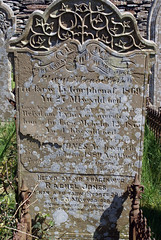
In May, we visited the graveyard in Cefn-y-Crib which some of my Welsh ancestors are buried, and there found the grave of Henry Jones, which we could see was also the grave of his second wife Rachel and his first wife Mary and daughter Lydia.

Hafodyrynys and Surrounds

The gravestone was a little damaged and the name of his first wife a little bit obscured, but one could nevertheless make out the name, Mari – the Welsh spelling of Mary. But what was her surname?
Having searched through the marriage indexes I came across a few possibilities that fitted in with the dates they would have been wed; Mary Lewis (1859), Mary Harris (1860) and Mary Issacs (1860). The last of these names rang a bell, and when I looked at the certificate for Henry’s marriage to his second wife Rachel, I saw the name Anne Isaac as being one of the witnesses.

Edmund Jones, the other witness, was the father of Rachel Jones (Jones was also her maiden name) and so I can only assume that both Henry’s parents were dead at the time. Of course, Isaac is not Isaacs but then spelling mistakes were made. Furthermore, when searching for Mary Issacs’ birth, I found only a few, all of whom would have been too young to have married Henry in 1860. Could the name have been wrong on the marriage index? Should it have been Isaac?
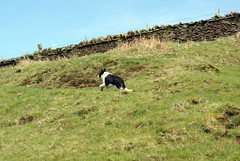
We know that she died in 1869 at the age of 27 and having searched for Mary Isaac in the birth records I found one Mary Isaac, born in the Pontypool district in 1843. But what of the other contenders; Mary Lewis and Mary Harris? There were a number of Mary Lewises born in 1842 (which one assumes is the correct year of birth), as indeed there were a number of Mary Harrises also born in 1842.

Filed Under: Family History Tagged With: Family History, Family Jones, Hafodyrynys, Jones, X

Rogers Conundrum II

May 12, 2008 by Nicholas Hedges

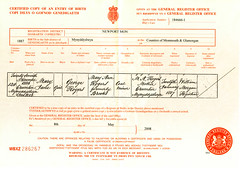
Following on from my previous post on this subject (see Rogers Conundrum) I obtained today a copy of my great-grandmother’s birth certificate.

On the certificate, it clearly states that Mary Jane Rogers was born on 27th November, 1886 in Crumlin, Mynyddyslwyn; that her father was George Rogers and her motherMary Ann, formerly Brooks. Having Mary Ann’s maiden name is obviously a great help, but it just goes to show that censuses can be wrong.

Below is a detail of that census.

In this entry there are two errors; one the name of George’s spouse which should read Mary A and not Sarah A, and secondly the name of their daughter (my great-grandmother) Mary Jane which is given as Bessie J.

Filed Under: Family History Tagged With: Family History, Family Jones, Jones, Rogers

Rogers Conundrum

May 5, 2008 by Nicholas Hedges

Having made the recent trip to Wales, I decided to try and get a bit further with a line on my family tree – that of my grandmother’s mother’s parents. My grandmother’s maternal grandparents were George and Mary Ann Rogers.

In my family tree I have them and their children listed as follows:
George Rogers (1864-1944)
Mary Ann Rogers (1864-1941)
Alfred John Rogers (1886-1954)
Mary Jane Rogers (1887-1969)
William George Rogers (1887-1897)
Ruth Rogers (1890-1925)
Evan Rogers (1892-?)
Jonah Rogers (1894-1915)
Enoch Rogers (1896-?)
George Rogers (1898-1916)

Although these dates aren’t all 100% accurate, they are for the most part within a year or two. I discovered them through a combination of the 1901 Welsh Census and a visit to the churchyard at Cefn-y-Crib, but what I want to know now is the maiden name of Mary Ann Rogers which I began to look for by searching for details of her marriage to George, narrowing my range between 1880 and the date of their first born. However, having located several possible entries for George Rogers I found that none of them tallied with anyone called Mary Ann; in fact, I could find no evidence at all for their marriage within this range.

I began to wonder whether (as was the case with my great great-grandfather Henry Jones) George Rogers was married twice. Perhaps this was the reason I could not find the dates I expected. I therefore noted down all the references for George Rogers and looked up all the female names which correlated. There were a fair few names one of which stood out as the most likely. This was a lady called Sarah Hiley who was married in Pontypool in the second quarter of 1885 to one of two possible grooms, one of which was a George Rogers. Given that his first child was born in 1886, this date seemed to lend credence to this theory.

It was then as I looked through the Wales Census of 1891 that I found the following entry along with the ages of those listed:

George Rogers (28)
Sarah A Rogers (26)
Alfred J Rogers (7)
William G Rogers (4)
Bessie J Rogers (5)
Ruth Rogers (1)

What struck me was of course the names, all of whom (except for Bessie and William (who died in 1897)) I’d found in the 1901 census albeit with a different mother. But what about my great grandmother Mary Jane? Having run through a number of permutations as to what might have caused her to be missing in the 1891 census (a search for her name revealed nothing) I suddenly realised that Bessie J Rogers, born around 1886 must be her; they were one and the same person.

George Rogers I believe was once married to a woman called Sarah and by 1891 they’d had four children together. By 1901, Sarah was, one presumes, dead, and George had married Mary Ann. Whether the other children were hers or Sarah’s I don’t know at this point. I decided to look for an entry for their marriage and eventually I found a possible wedding between a George Rogers and a Mary Ann Pritchard in the last quarter of 1894. What I haven’t been able to find however are any entries for Sarah Rogers’ death.

I have now ordered a wedding certificate for George Rogers and Sarah Hiley (if indeed they were married) and a birth certificate for my great grandmother Mary Jane. At least these should shed some light on what has become quite a mystery.

Filed Under: Family History Tagged With: Family History, Family Jones, Jones, Rogers

Hafodyrynys

May 5, 2008 by Nicholas Hedges

A few months ago when I interviewed my Grandmother about her childhood, she talked about the mountain around which she’d grown up in the village of Hafodyrynys, South Wales, not far from Pontypool. Her words about this mountain, which is in fact more of a hill, were very moving, for it was on this hill she played as a child and where she would watch her father as he walked to work in the mine at Llanhilleth. Below is part of that conversation:

“I can see him now because he went up our garden over the road and the mountain started from there up… and he’d go so far up and he’d turn back and wave to us, and if we went out to play, our Mam would say, “you can go up the mountain to play…” but every now and then our Mam would come out in the garden and we had to wave to her to know that we were alright you know… always remember going up the mountain…”

One of my main objectives for visiting Hafodyrynys was to see this mountain and to walk from the back of my Grandmother’s old garden in Rectory Road, up the side of the mountain, and to turn and look down at the house, just as her father had done on his way to the mines, and as she had done when playing. Another objective was to visit the graveyard in which a number of my ancestors are buried. Among those I wanted to find were:

Elias Jones (1882-1929)
Great-Grandfather

Mary Jane Rogers (1887-1969)
Great-Grandmother

Henry Jones (1839-1889)
Great Great-Grandfather

Rachel Jones (1853-1916)
Great Great-Grandmother

Mary Carey (1843-1869)
First wife of Henry Jones

George Rogers (1864-1944)
Great Great-Grandfather

Mary Ann Rogers (1864-1941)
Great Great-Grandmother

As well as being places where one can remember the dead, graves are also important evidence for the genealogist, and as I was to find out in the churchyard at Cefn-y-Crib (a small village between Hafodyrynys and Pantygasseg), the graves of my ancestors both confirmed my research as regards certain individuals, and opened up a new avenue of investigation, which, given my interest in World War One battlefields was to prove particularly interesting.

After visiting the ruins of Raglan Castle, we made our way towards Hafodyrynys and having taken a back road came first to Pantygasseg, a village I knew through my research as being the place where my Great-Uncle amongst many others had worked as a miner. Looking at the census records for the area, almost every man was employed in the mines. The village (which is no more than a single street with houses on one side) also interested me as regards the meaning behind its name, which in Welsh means, ‘hollow in the mare’s back’. This description derives from the shape of the mountain as it appears on the horizon and having researched the theme of ‘distance’ some time ago for an art project, I found it interesting that the village got its name from how it was seen from afar. Pantygasseg is so named through its being a part of (or identified with) the distance.

Hafodyrynys and Surrounds

Standing in Pantygasseg and looking at the surrounding hills therefore, I got the sensation that I had become a part of that distance, or that I was at least closer to it than I had ever been. I was reminded at this point of a quote from Rainer Maria Rilke’s ‘The Notebooks of Malte Laurids Brigge’ where he writes:

“Is it possible that one believed it necessary to retrieve what happened before one was born? Is it possible that one would have to remind every individual that he is indeed sprung from all who have gone before, has known this therefore and should not let himself be persuaded by others who knew otherwise?”

In Pantygasseg, I was indeed ‘retrieving’ the past and reminding myself that I was not only sprung from all who have gone before, but that I was also sprung from this very place.

Hafodyrynys and Surrounds

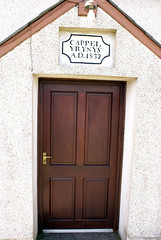
Just a few minutes down the narrow road from Pantygasseg, we arrived at the churchyard in Cefn-y-Crib (looking through a Welsh dictionary, I’ve tried to get an idea as to what it might mean, and ‘back of the ridge’ is my best guess thus far). According to my Grandmother , the Cefn was regarded (at least by her mother) as a rather rough place, but it was here that a number of my ancestors were buried in the small churchyard of the ‘Cappel Yr Ynys,’ a Congregational Church built according to the plaque above the door in 1832 (I’ve since discovered that a number of my ancestors also lived here).

Hafodyrynys and Surrounds

It was also to this church that my Grandmother came as a child and so for many reasons it was quite an emotional visit for me and my Dad, who, at each stage of the journey (which was indeed something akin to a pilgrimage) phoned my Grandmother to tell her where we were. The knowledge that we were standing at her parents’ graveside brought tears to her eyes and memories back which she could only know and there was something about this relaying of the journey back to her which was particularly engaging. I knew she’d be sitting in her chair back home and couldn’t help but imagine what she was thinking, what she was remembering about those places in which we were now standing of which I at least had no memory; it was as if we were walking within her memories.

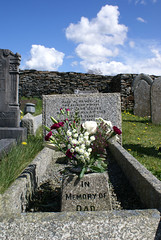
My Grandmother had given us some flowers to put on the grave of her parents, and this, along with the grave of her mother’s parents were the only ones for sure that we knew of.

Hafodyrynys and Surrounds

I’d been struggling to find the date of my Great-Grandfather’s (Elias Jones’) death, but on the side of the grave he shares with his wife, I found it; September 2nd 1929. He was just 47 years of age and died as a result of the coal-dust he breathed in through his work in the mines. With the Rogers’ grave, I had the dates already, but it was poignant to stand next to them (just as it was with all the graves) and realise that the grave marked the end of the path of their lives; a path around this area and it surrounds, which if it had been any different at all would have meant my not being here. I could only stand there by their being in the first place; my coming into being had not only been shaped by them, but also by the shape of the landscape itself, that of which I was now a part.

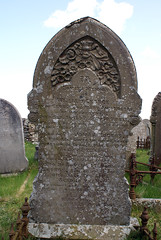
The next grave Monika found was that of my great great-grandfather, Henry Jones who died in 1889. Looking at the age at which he died and the date of birth I had for him in my family tree, I was relieved that I had indeed got the right man and below his name was – as expected – the name of his second wife – my great great-Grandmother Rachel, who died in 1916. But according to my research he’d been married before, to – if I was correct – Mary Carey, who’d died in 1869 aged 26.

Hafodyrynys and Surrounds

I looked around the graveyard for her grave but found nothing, and it wasn’t until we arrived home later and, again with the help of a Welsh dictionary, translated a few of the words on Henry and Rachel Jones’ grave, that we realised this stone had initially been cut for his first wife Mary. The words ‘Mari. Gwraig [wife] of Henry Jones,’ can be seen at the top along with the date of death (1869) and the age 27 (I’ve since adjusted her date of birth by one year). Also, listed below Mary, is a daughter, Lydia, who died in 1873 at the age of just 4 years. This would put her date of birth at around 1869, the same year as Jacob and the same year as Mary’s death; could it be that Jacob and Lydia were twins and that Mary died in childbirth?

The next gravestone which was to prove particularly interesting was one which began:

Hafodyrynys and Surrounds

“In loving memory of William George, son of George and Mary Ann Rogers, of Hafodyrynys, Died Sep. 3rd 1897, Aged 10 years.”

George and Mary Ann Rogers are my great great-grandparents. I hadn’t got William George listed amongst their children, but I had got the man named beneath, Jonah Rogers. I knew that he had been killed in the First World War, but was intrigued to find on the grave his rank and his regiment as well as the date and location of his death. Again, once home, I looked up his details on the website of the Commonwealth War Graves Commission and found that he’d been killed in Ypres and that his name was on the Menin Gate, places which Monika and I had visited last year and my Dad the year before. Not only that, but given the date of his death, I could trace him to the Battle of Frezenberg Ridge (8th – 13th May 1915), part of the Second Battle of Ypres.

Ieper

The man below, George, I also had listed. Ruth Hall, who is listed at the bottom of the gravestone I’m
assuming is my great great-aunt Ruth Rogers, the daughter of George and Mary Ann who was born in 1890 and died on April 5th 1925 aged 35 years.

Working on one’s family tree, one is of course deluged with lists of names of both people and places, and it’s only when you stand at the graves of those you have found in the surrounds they knew so well in life, that you can begin to make a real connection, and this connection, in this small churchyard was extremely powerful.

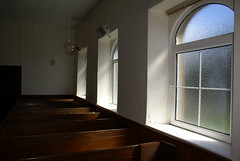
May 1st, the day of our visit, was election day and the annexe attached to the church was being used as a polling station. Having asked whether we might be allowed a look inside the church we were told we’d be welcome to pay a quick visit, and as we stood inside the small chapel, it felt strange to think that as a child my Grandmother had once sat in the pews facing where we were standing. Perhaps all of my forebears buried in the churchyard had once occupied these pews; given the date of the church’s foundation it didn’t seem unlikely. The bible which rested next to the pulpit looked as if it might have been there since that time, and I couldn’t help but imagine the minister reading from its pages as my ancestors listened.

Hafodyrynys and Surrounds

Having left the churchyard, we made our way down into Hafodyrynys, admiring as we drove the scenery and the trees which lined the road. There was something about the trees which particularly fascinated me, they didn’t seem to grow so much as writhe, twisting around themselves, confounding themselves with the fact of their own existence.

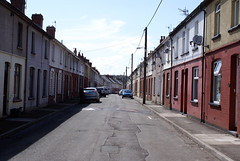
Once in Hafodyrynys, we parked the car and made our way towards Rectory Road, the street in which my Grandmother was born, and of which she’d spoken so fondly when we talked a while ago. Having stopped to ask a resident where we might find it (a man who said he knew my Grandmother) we eventually found the rather nondescript row of houses which looked to me as if they’d seen better days.

Hafodyrynys and Surrounds

It wasn’t that they were neglected in anyway, but with satellite dishes on almost everyone, they seemed to all recall simpler times. Perhaps that was as much to do with what I recalled my Grandmother telling me, about how she would play on the ‘mountain’ behind her garden and how her father had walked over it on his way to work in Llanhilleth.

Hafodyrynys and Surrounds

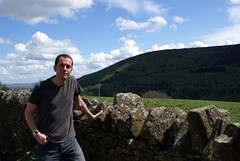
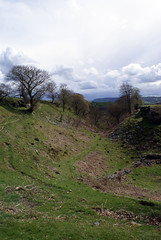
Having found the house in which she’d been born, we walked up an alleyway just a few doors down and made our way to the mountain. I wanted to walk up it and look back down on her garden, imagining my great-grandfather, looking down on his family and my Grandmother looking and waving at her mother as she played. And having walked to the top I did just that, taking in the view of the beautiful countryside, taking in the shape of the landscape which had in the way it shaped the paths of my ancestors served in part to bring about my own ‘coming into being’.

Hafodyrynys and Surrounds

I also reflected on Jonah Rogers, my great great-uncle, and thought about the misery he’d endured in Ypres and the horrors he must had seen, contrasting them with the view from the mountain, the view he must have known so well and dreamt about in all the mud and nightmare of Flanders. Having been in Ypres last year and now standing in Hafodyrynys, I couldn’t help but feel I had fulfilled a dream of his, to leave Ypres and see his home again.

Hafodyrynys and Surrounds

Having followed the directions of a man we’d met on the side of the mountain, we found ourselves not so much lost, as uncertain of where we should be heading. We walked through the second of two gates on a farm which we’d been told to pass through and found ourselves suddenly in the company of a very young border-collie who came bounding down to meet us before heading off again in the direction of the farmer who was at that point having a rest somewhere up a track which rose to our right.

Hafodyrynys and Surrounds

Hafodyrynys and Surrounds
Unsure as to whether we should take this track or that straight ahead of us, we too made our way up to the farmer who proceeded to take us on a tour of his farm. And so, in the company of him and his two dogs, we saw his fields, his sheep and were given some historical and geographical information pertaining to the area which lay all around us. It was as if for a few moments he were the voice young Jonah’s consciousness, recalling to himself all the familiar place names as he sat amongst those that were unfamiliar, colouring in the lush green fields where he could see only mud, and remembering the trees where in his nightmare all the trees had been gunned down, like soldiers shot at dawn.

Hafodyrynys and Surrounds

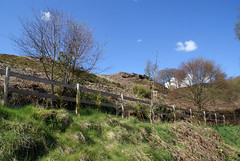
In amongst the hills and the patchwork of fields, the farmer told us the names of the various hamlets and villages; Penwaen, Pen-Twyn, Glandwr, but the most interesting thing for me (even more than the fact a walking stick made from a Holly Tree will make your hand turn black) was the stile which the farmer told us had not changed in his lifetime. It might not sound an exceptional fact, but it was interesting in that to me, looking at it for the first time, it was just an old, ramshackle stile, but for the farmer it was an abundant source of memories; memories one assumes about people he recalls from his childhood up to the present day, people who had since passed away, who once walked the road we were walking. It served to remind me of how the shape of the places in which we live serve to shape our lives as well as those who come after us, how the most insignificant thing in the world can harbour the most significant memories; and stiles of course help us on our way, it helps us cross a threshold – a theme which recently I have thought about a great deal.
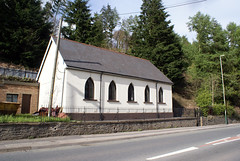
Hafodyrynys and Surrounds

Having left the farmer and made our way back to the car, we visited another of my Grandmother ‘s churches, one in which my great Grandmother Mary Ann Rogers was a preacher (she was also the town midwife). Following this we made our way home back to Oxford, following the footsteps of my Grandmother and her family, who followed her to Oxford in the 1930s, leaving the Valleys so her brother George would not have to work down the mines. From Pantygasseg, to Llanhilleth, even on the farmer’s land, there was abundant evidence of mining, and one was reminded of the strange duality inherent in this beautiful landscape; the threshold between light and dark, play and the harsh reality of hard, dangerous, often fatal work.

Hafodyrynys and Surrounds

Back in Oxford I looked again at my family tree and though I can’t put faces to most of those at whose graves we’d stood that day, I can at least, and more importantly, put them in their landscape, and, furthermore, by walking in that landscape, put myself not only in their shoes, but somehow in their memories.

Hafodyrynys and Surrounds

Filed Under: Family History, Trees Tagged With: Family History, Family Jones, Hafodyrynys, Jones

Clocks

March 24, 2008 by Nicholas Hedges

Working on the tree last night I discovered, through the Ancestry website, a lady who is descended from a common ancestor. The ancestor in question is my great-grandmother, on my father’s side, Ellen E Lafford whose brother Albert is the direct descendent of the lady I mentioned. Looking at her family tree (I couldn’t help but feel I was somehow intruding, especially as she’s put up quite a few photographs) and looking at the faces of all these strangers, it was odd to think of how we share this common link, albeit one which goes back to the late nineteenth century, and to consider the different paths our families have taken. It’s strange too, to consider the thought that my descendants will, one day down the line, be complete strangers… and then of course the mind begins to wander – or rather run with it all – and positively boggles when considering all those others living today with whom I share so many ancestors; people to whom, however distantly, I am related.

This of course brings me back round to the point of much of my artwork, the idea of all those anonymous people swallowed up by history; the faces on the photographs of Oxford which I’ve started to collect, names on memorials, names lost altogether, and I’m reminded again of the words of Rilke in his novel, ‘The Notebooks of Malte Laurids Brigge’ when he says (always worth quoting in full):

“Is it possible that the whole history of the world has been misunderstood? Is it possible that the past is false, because one has always spoken of its masses just as though one were telling of a coming together of many human beings, instead of speaking of the individual around whom they stood because he was a stranger and was dying?
Yes it is possible.
Is it possible that one believed it necessary to retrieve what happened before one was born? Is it possible that one would have to remind every individual that he is indeed sprung from all who have gone before, has known this therefore and should not let himself be persuaded by others who knew otherwise?
Yes it is possible.
Is it possible that all these people know with perfect accuracy a past that has never existed? Is it possible that all realities are nothing to them; that their life is running down, unconnected with anything, like a clock in an empty room?
Yes it is possible.”

Researching my family tree is a desire perhaps to be anything but a clock in an empty room. Rather, to quote Roland Barthes, I would prefer to be what he describes as cameras being; a clock for seeing.
I was recently reading a book of work by Georges Perec, and in particular a transcription of a conversation he had with someone called Frank Venaille. In it he describes himself as a unanimist:

“a literary movement that didn’t produce much but whose name I very much like. A movement that starts with yourself and goes towards others. It’s what I call sympathy, a sort of projection, and at the same time an appeal!”

Again, this describes what my research is all about, something which starts with myself and goes towards others, a sort of sympathy with history, or at least, with those who have been lost to history. It is a projection of oneself onto the face of the past and as Perec states (although this might not be his meaning) an appeal to be remembered.

Filed Under: Quotes Tagged With: Family History, Georges Perec, Quotes, Rilke, Useful Quotes

Waving on the Mountain

December 7, 2007 by Nicholas Hedges

Yesterday I visited my paternal Grandmother and over a period of about three hours, talked with her about her childhood in South Wales and her early years in Oxford. All too often these days we don’t allow the old to speak; too often we try to speak for them, to tell them what they know (what we think they know) talking as if they are foreign and speaking at them slowly and loudly, as if that will help them ‘understand.’ I was keen with my Grandmother (Nana) to get her to just talk, and for her to make connections without my trying to prompt or ask too many questions.

As we get older, our brains lose connections, but sometimes things that may seem forgotten simply require a different map, another means of finding them, the longer way round – a longer path. Talking through events, one often stumbles upon something that leads somewhere else, a new route is found and that which was lost is rediscovered. But if we prompt too much things will remain obscured; forgotten.

Talking with my Grandmother was a very special experience and I wondered as I listened, when it was that she last spoke at length about her past? From memories of her father (who died in 1928), her Grandmother (born in 1864), to her own retirement, she took me on a journey from the mountains of Wales, to a public school in Cheltenham and on to the houses of Oxford, where she worked as a maid in the late 1920s and early 30s. But it was her reminiscences of her father which were particularly moving.

Through researching my family tree, I’ve got to know many of the names of family members, back as far as the beginning of the nineteenth century, but that, along with a few dates is all I know. My Grandmother wasn’t sure she’d be of any use to me in my research, but as I pointed out, her memories are worth their weight in gold. I can find names and dates, but it’s who these people were that matters most, and the only person who could help me was her.

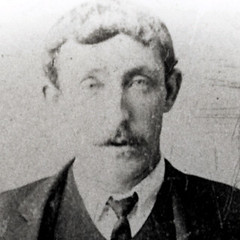
Below is a photograph of my Grandmother’s father (my Great Grandfather), Elias Jones.

Elias Jones

Born in Trevethin, Monmouthshire in 1882, he worked as a miner in the pit at Llanhilleth, a short distance away from where he lived with his wife Mary Jane and their five children, Ruth, Lillian (my Grandmother), Doll, Ray and George (one girl, Florence or Flossie, died aged 2 c.1918). With just a photograph, a name, dates and occupation, it’s difficult to surmise what he might have been liked. One tends to assume (unfairly) that miners in those days must have been – due to the harshness of their work – rather dour or surly people, but talking to my Grandmother, it became clear that as regards Elias, this couldn’t have been further from the truth. Below are a couple of extracts from our conversation.

On his walking to work:
“I can see him now, because he went up our garden over the road and the mountain started from there up… and he’d go so far up and he’d turn back and wave to us.”
On his being at home:
“I can remember now he would always help our Mam wash our hair on a Friday night… our Ruth would go first, she would wash it and our Dad would dry it and mine next…”
On his death:
“I can always remember the doctor in the room when we realised he wasn’t going to come through, he said ‘don’t grieve for him Mrs Jones, you know what he said to me, “if I can’t work for my wife and children I don’t want to stay.”‘ And he just passed away. “

Just these few, brief extracts tell me a great deal about the man in the photograph; a man who clearly loved his family and who through his working in the mines, succumbed to a disease of the lungs (possibly pneumoconiosis or ‘black lung disease’) at the age of just 42. And the image of him turning on the mountain to wave at his children below is one which will not only stay with me forever, but one I which would like to ‘explore’ in my forthcoming work. I had wanted to draw the outline of the mountain, but I also think it will be necessary to follow the route Elias Jones took, from his house, over the mountain to the pit at Llanhilleth.
Deaths in the mines (as well as deaths as a consequence of working them) were sadly nothing exceptional. And as my Grandmother poignantly explained:

“…when there was a death you know every blind in that street would be drawn, we knew directly we heard of a death the women would draw their blinds down and they would nearly all turn out to a funeral down there… Kind of almost took it in our stride you know, oh dear there’s another one gone, killed in the mines.”

Filed Under: Family History Tagged With: Elias Jones, Family History, Family Jones, Hafodyrynys, Jones, Nana

The Memory of the Mountain

December 6, 2007 by Nicholas Hedges

Having considered my recent findings as to the meaning behind the name Pantygasseg, I realised that a visit to the area in the next few weeks was essential. I knew I had to draw the outline of the mountain, it’s shape, perhaps on a large wall, but as I considered the line, I began to think of ways of expressing it. Could there be a way of expressing it sonically for example? Perhaps, yes, but the more I thought about it, the more I thought about using material pertinent to the place itself, in this instance; coal.

My work is about mining the past, bringing the past to the surface, and coal is of course a product of the past (mined and brought to the surface). It’s a material composed of things which lived and which could be used to create, i.e. like charcoal – and could be used to draw the line of the mountain, or to be more precise, my memory of the line of the mountain. Coal is therefore a means of expressing my memory using the very substance of the mountain’s own; a means which also highlights the contrast between the human scale of time and History itself.

There’s also a contrast (with regards to my research on the Family Tree and my work on the Holocaust) between memory and forgetting, particularly when considering the metaphor of the ground as mind. The ground is mined, coal is extracted and the past is ‘remembered’. What the Nazis were hoping to accomplish, when they killed and buried hundreds of thousands in pits (at places such as Belzec) was, in a sense, to forget.

Filed Under: Holocaust Tagged With: Coal, Family History, Holocaust, Memory, Mountain, WWII

Family Tree

November 20, 2007 by Nicholas Hedges

With both my Grandmothers still with us (both were born in 1912), I’m very fortunate to have living connections with the late nineteenth century. When they talk about their childhoods and youth, they are describing a world which has always seemed completely alien to that in which we live today, and using one’s imagination, to go beyond that world, further back into the past, that place, the world, becomes stranger still. This world, when conceived within the imagination is like a fiction. In a talk I gave as part of my residency at OVADA in May 2007, I stated that:

“…as a child, I liked to create and map worlds; countries which I would build from fragments of the world around me; forests, mountains and plains – unspoilt landscapes. And in these worlds there would exist towns and cities, created from ‘the best bits’ of those I had visited. 

These invented worlds became, as I grew up, the ‘invented’ or imagined landscapes of Oxford’s past; landscapes that were – just as they still are – created from fragments, parts of the past which are still extant in the city; old buildings, walls, objects and so on. Between these structures, these fragments, I would fill the gaps, with my own imagination, with thoughts derived from my own experience. The city’s past and the past in general, as it exists within my mind, is then, to use the metaphor of cloning in Jurassic Park, a cloned dinosaur. The extant buildings, structures and objects within museums, are like the mosquitoes trapped inside the amber. They are broken strands of DNA. All that is required is for me to fill the gaps, and this I can do with my own DNA. I am in effect, the frog.”

I will return to the frog later.

All I knew prior to my research, was that part of my family, on my father’s side, came from South Wales and worked in the mines, and that my family on my mother’s side heralded from Reading. My paternal grandfather was always an Oxford man and his family had been in the area for generations. My maternal great-grandmother (born in 1878 and who I can remember) was said to have come from Suffolk and was the daughter of a farmer (Norfolk as it would transpire).

Researching the family tree quickly becomes, not so much obsessive, but rather, compulsive; necessary. The dead, and at that, the anonymous dead, come back to life and make themselves known to you, and, what is more compelling, one feels oneself become more solid, more flesh and blood than ever before; one begins to exist in four dimensions rather than simply three (as if we, in the present, are not really a part of time) becoming part of a network whose strings vibrate like those plucked on an old musical instrument – whose sound, although feint, can nonetheless be heard or even felt. It’s rather like plugging a short-wave radio into the vast network of cables that comprise the national grid, and listening to the distant voices of ancestors telling you who you are; crackling like the damp wood of a fire which will never quite go out.

What has particularly interested me, aside from the obvious personal interest in finding lost relatives (one is also taken aback by the sheer volume of living relatives one must have but which one doesn’t know about), is how the whole project fits in so precisely with what I have been doing with my artwork; finding and identifying with the anonymous dead buried in the traumas of history, placing myself in the spaces of the past which have witnessed the most terrible catastrophes – placing myself, in effect, in the panorama of history itself. Through doing this over the past year, history has become overwhelming, its incomprehensible size as impossible to grasp as the distance of the stars. But through locating myself in the personal panorama of family history, History itself becomes a little less overwhelming; events of the past become known through great-great grandmothers and fathers – they are personalised, and yet, with this list of names and dates and with this new geography of the past, dwelling as it does in the villages of Monmouthshire and Norfolk, Lincolnshire and Oxon, one’s own impossibility is augmented still further. What were the chances of my great-great grandfather, Jabez, meeting his wife Elizabeth (what were the chances of either of them being born) and then having their son Albert? What were the odds against him doing everything he did in life exactly as he did; meeting my great-grandmother Elizabeth and having my grandfather Norman? The further one goes back into the shadows of family history, the less likely and more impossible one becomes, and this heightens, to a dramatic effect, one’s sense of place in both time and space.
Again, from the talk I gave as part of my residency, I stated:

“This metaphor [the frog and the dinosaur] is interesting in that DNA patterns are, of course, unique to everyone. My DNA is different to everybody else’s as there’s is to mine. Therefore, using my imagination to plug in the gaps of the past, means that the ‘past’ will comprise large parts of my own experience; my dinosaur will contain elements of my own being. But although my DNA is unique, it is nonetheless derived from my own past, elements have been passed down by my ancestors from time immemorial. The code which makes me who I am, comprises parts of people I know now (parents and grandmothers), people I knew (grandfathers and great-grandmother) and people lost to the past altogether (great-great grandparents and so on) [people whose names have since I wrote this become so familiar I feel as if I knew them, or rather know them]. What interests me about this, is that, through stating above how ‘my dinosaur will contain elements of my own being’ I can now see that it will also comprise elements of hundreds – indeed thousands – of people, the majority of whom I will of course never know and who have been dead for centuries. I like to think therefore, that ‘my dinosaur’ and my imagination aren’t entirely unique.
The philosopher Henri Bergson says of the past:
‘I believe that our whole physical existence is something just like this single sentence… I believe that our whole past still exists.’
Given that DNA strands are made up of letters I found this quote particularly interesting.”

The further back in time we go, the less unique we become, at least in terms of our DNA, and therefore, our individual dinosaur, that subjective sense of History created from fragments of the past (objects, buildings etc.) is increaingly attenuated; less individual and less subjective, because the ‘DNA’ (our individual selves) with which we plug the gaps is derived from that of hundreds, indeed thousands of people. That very history we are seeking to build inside myself is already there. What is more, the further back we go, with each step and every generation, the wider the family net is thrown and the greater number our number of relatives. Things which happen to other people, things on the news and so on, could be happening to people with whom we share a common past; and indeed, the same is true of events in the past. Separated by time and space, we may in fact be linked by the very fact of existence.

Filed Under: Family History Tagged With: DNA, Family History, Imagined Landscapes, Landscape, Maps, Nan, Nana

  • « Previous Page
  • 1
  • …
  • 3
  • 4
  • 5

© Nicholas Hedges 2024

  • Facebook
  • Instagram
  • Twitter
  • YouTube

Copyright © 2025 · Outreach Pro on Genesis Framework · WordPress · Log in