Nicholas Hedges

Art, Writing and Research

  • Amazon
  • Behance
  • Facebook
  • Instagram
  • Pinterest
  • YouTube
  • Art
    • Digital
    • Drawing
    • Grids
      • Correspondence
      • The Wall
      • The Tourist
    • Ink on paper
      • Shadow Calligraphy
    • Installation
      • Murder
      • Echo
    • Painting
    • Patterns
    • Mixed Media
    • Photographic installation
      • St. Giles Fair 1908
      • Cornmarket 1907
      • Headington Hill 1903
      • Queen Street 1897
    • Research/Sketches
    • Stitched Work
      • Missded 1
      • Missded 2
      • Missded 3
      • Missded 4
    • Text Work
  • Blogs
    • Family History
    • Goethean Observations
    • Grief
    • Light Slowed But Never Stilled
    • Lists
    • Present Empathy
    • Shadow Calligraphy
    • Trees
    • Time
    • Walking Meditations
  • Video
  • Photography
    • Pillars of Snow
    • Creatures
    • The Trees
    • Snow
    • St. Giles Fair 1908
    • Cornmarket 1907
    • Headington Hill 1903
    • Queen Street 1897
    • Travel
  • Illustration and Design
  • Music
  • Projects
    • Dissonance and Rhyme
    • Design for an Heirloom
    • Backdrops
    • Shadow Calligraphy
  • Exhibitions
    • A Line Drawn in Water
      • Artwork
    • A Line Drawn in Water (Blog)
    • Mine the Mountain 3
      • Artwork
    • Mine the Mountain 2
      • Artwork
      • The Wall
    • The Woods, Breathing
      • Artwork
    • Snow
      • Artwork
    • Echo
      • Artwork
    • Murder
      • Artwork
    • The Tourist
    • Dreamcatcher
    • Mine the Mountain
      • Artwork
      • The Tourist
    • M8
    • The Gate
    • Creatures
      • Artwork
    • Residue
      • Artwork
    • A visit to Auschwitz
      • Artwork
  • Me
    • Artist’s Statement

Remembrance

November 14, 2008 by Nicholas Hedges

During this week of Remembrance, a few days after the 90th anniversary of the end of the First World War, I’ve been thinking about how it is that an event which happened almost a century ago still holds such a powerful draw on our consciences today. What is it that makes the Great War seem anything but distant when events which proceeded it only by a few years seem twice as far in the past?

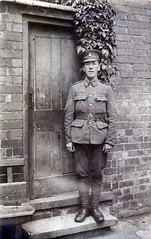
In the last couple of days I’ve been continuing my research into my great-great-uncle Jonah Rogers, who was killed on the 8th May 1915 at the Battle of Frezenberg Ridge.

Jonah Rogers (1893-1915)

I have now been able to locate the positions he held as part of the 2nd Monmouthshire Battalion, on the day of the battle, being as they were part of the 12th Brigade in the 4th Division (thanks to Martyn Gibson and David Nicholas for their help with this).
In a ‘History of the 2nd Battalion Monmouthshire Regiment,’ compiled by Captain G.A. Brett, D.S.O., M.C., I read the following account of the battle in which Jonah lost his life.

“By the 8th May the British had withdrawn from the most advanced points of the Ypres salient, and the Germans, striving to obliterate the salient completely, made further determined efforts to gain ground. Desperate fighting ensued, the six days, 8th to 13th May, of the Battle of Frezenberg Ridge, giving many anxious hours to British commanders. When the storm broke the Battalion was on the right of the brigade still holding Mouse Trap Farm…”
Looking at a diagram of the Battle of Frezenberg Ridge, one can see clearly where the Battalion would have been stationed; to the left of the 84th Brigade at Mouse Trap Farm.
The Battle of Frezenberg Ridge

The more I ‘get to know’ Jonah, the more the war as an historic event, changes. Whereas before I could only know it as a thing in its own right, an homogenous mass observed from a distance, like a planet in the night sky, now, with a shift in focus, I see Jonah first, and then, through him the war. The telescope becomes in effect, a microscope, with Jonah the lens through which the war, in all its millions of parts, is magnified.
I do not know the exact details of how Jonah died. Given the ferocity of the artillery bombardment and the use prior to this of poison gas, there are any number of possibilities. And although knowing the nature of his death would add to the emotional weight of his story, it is the possibility of pinning down the location of his death which makes more of an impact upon me. It serves to make him – and the war – more vivid, more real. By locating him in the places where he lived and where he died, and by alternating one’s thoughts between the two, one can imagine too his loved ones, shifting their thoughts between memories of him at home and thoughts of him at war. And in that space between – a kind of No Man’s Land – one can locate their fears and their prayers. The same can be said for Jonah, who no doubt during the months he was at the Front, staring across at the enemy, thought a great deal of the place in which he lived.

For his family, left behind in Hafodyrynys, the war could only be imagined but would permeate everything they did. Whatever they did, however mundane, there would be the war. Even in the landscape, in its shape, its colour, its sounds, the war would be contained but never spilled beyond the outlines. And in these shapes and spaces, their hopes and fears would vie against each other.
Perhaps the fact I can share at least some of this space, in the movement of my own thoughts between the place he lived and the place he died, helps explain the reason why, although I know what happened to him, and where and when it happened, I still feel, when reading about the war prior to May 1915, a sense of concern for his wellbeing. If I read any account of the war after the day he died, every word is permeated with his absence. That is not to say I mourn as such (as his immediate family would of course have mourned) but I do sense his absence, I do sense the anxiety of his separation (in the end, eternal separation) from home.
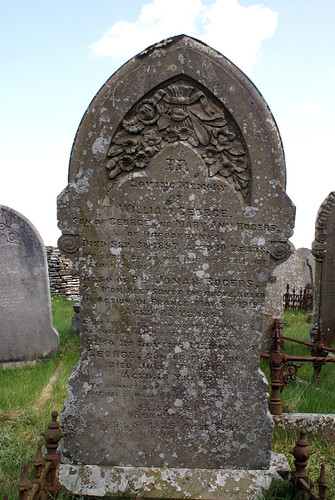
Without a known grave, this separation – his death – must have been all the more difficult for his family. On the gravestone of his older brother, William, who died aged 10 in 1897, the following inscription has been added:
Also of Pte. Jonah Rogers, 2nd Mon Regt. Son of the above Killed in Action in France, May 8th 1915.
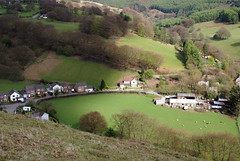
Hafodyrynys and Surrounds

Jonah has no known grave, save that within the minds of those of us who remember him. Perhaps then, my concern is for the wellbeing of his memory?

We must all as individuals continue to remember. We must remember that the millions who died in the slaughter, were not an anonymous mass brought into play by History (just as we are not an anonymous mass brought together to remember) but young individuals, taken from their homes and loved ones; individuals to whom we are all related. A million British and Commonwealth soldiers lost their lives in the War. A million graves, known and unknown lay in the fields of Flanders and France. Back home, a million holes, will only ever be filled with the thoughts of those who come after them. Thoughts that pass with our passing. Holes to be filled again by successive generations.
Filed Under: World War I Tagged With: Jonah Rogers, Soldiers, World War I, WWI, Ypres

Connections

August 7, 2008 by Nicholas Hedges

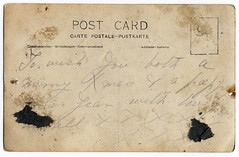
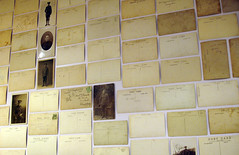
This evening I began working on an idea I’ve had for a while which incorporates the World War 1 postcards I was given by Tom Phillips. The idea was to show these postcards on a wall but with only a few the right way round i.e. showing the portrait (they are all portrait postcards of soldiers, most individual, some with other people). The rest would be displayed reversed showing either writing or, as is mostly the case, nothing – they would just be blank. I wasn’t sure how this would look and so I began putting the postcards up on my bedroom wall and fairly quickly I could see that the postcards, displayed in this way had an impact.

Very Lights

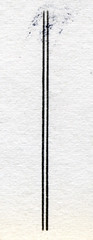
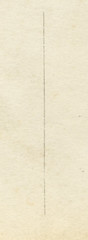
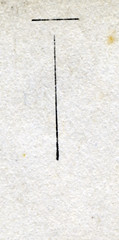
There was something about the blank postcards which was particularly resonant and the more I looked, the more I could see what it was that leant them this quality. On most of the blank postcards there is a motif running down the centre of the card (dividing the address from the text). These lines are of various designs, some very simple, others more elaborate. I decided to scan a few which can be found below.

Reverse Motif

Reverse Motif

Reverse Motif

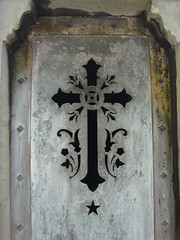
For me these motifs have something of the grave about them, perhaps because they are each shaped a little like a crucifix, and they reminded me of some of the memorials I had seen in the Montparnasse Cemetery in Paris.

Paris

And as I started making connections, I thought of the X paintings and those I discussed in a previous entry – Black Mirrors and thought about how these marks could be incorporated into a work just like the symbol of the ‘X’.
X (Mine)

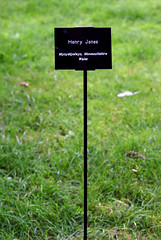
I also thought how these various motifs/symbols resembled the botanic labels I’ve had made, each engraved with the name of one of my ancestors such as that of Henry Jones (below).

Deadman's Walk (Henry Jones)

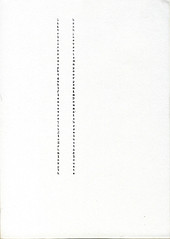
And finally, one last connection between the motifs and a work I made in November 2006, soon after a visit made to Auschwitz-Birkenau.

Reverse Motif

7

Reverse Motif

Filed Under: Holocaust Tagged With: Cemetery, Connections, Holocaust, World War I, WWI, WWI Postcards, WWI Postcards, WWII, X

Kisses

July 31, 2008 by Nicholas Hedges

Following on from my previous two entries regarding ‘Xs‘ (the signature of the illiterate, a secret location marked on a map), I wanted to look briefly at another use of the mark, that of course being the kiss. I was prompted to do this whilst selecting a number of World War One postcards for a new project website; www.8may.org – a project I hope to carry out next year. Most of the postcards are blank, but on a few there is some writing; the scrawl of a soldier or a more recent label, ‘Mum’s uncle.’ for example. One particular card however took my interest for it contained the mark I had recently been applying to my paintings. In my most recent versions of the ‘X’ paintings (those which have been obliterated by graphite powder) I have been scratching the symbol into the dust whilst considering the many anonymous miners who lost their lives deep underground at the time my great, great-great and great-great-great grandfathers were working in the pits of South Wales.

As I’ve written before, Rainer Maria Rilke wrote that those who die leave their names behind as a child leaves off playing with a broken toy. Those who died in the mines left their names underground; most would not have known how to write them, doing instead what my ancestors did and marking documents only with an ‘X’. And many of those men from the 19th century have all but been forgotten, their names discarded, swept away like Rilke’s broken toys. Even their graves might be lost, their remains buried and marked with an ‘X’, secrets known only by the earth itself.

X - Kisses

The Xs on the postcard above are also marks of anonymity. We know they are kisses but we don’t know who they’re for or who gave them. But we know they are symbols of a relationship which once existed, whether between lovers, friends or relations; someone loved someone else. Many of those who fought in the Great War never returned home – all that did return were a few words on a postcard; and ‘Xs‘ – farewell kisses as they came to be. Hundreds of thousands of men not only lost their lives, but they have no known grave. Many too lost their names altogether. These Xs on the postcard therefore become symbols for their future anonymity, their unknown graves; their lost names.

And the Xs which I’ve scratched into dust on my paintings also become a kind of farewell; a broken name, a secret location in time. They also become a farewell kiss to the world.

Filed Under: World War I Tagged With: Rilke, World War I, WWI, WWI Postcards, WWI Postcards, X

Ancestry

July 22, 2008 by Nicholas Hedges

I’m very pleased to announce that my forthcoming exhibition, Mine the Mountain, will be sponsored by Ancestry.co.uk.

I have been researching my family tree for almost a year now and in that time have used Ancestry to search thousands of records (census returns; births, marriages and deaths etc.) to build what has now become quite an extensive tree with roots stretching back to the mid eighteenth century. And although most of this research has been carried out alone, through using the Ancestry website I have been able to join forces with a relative (a second cousin) who I have never met and who lives on the other side of the Atlantic in Canada. He had already made good progress on one line of my family (that of my maternal grandmother) and through the website, I was able to merge much of that information into my own research (and indeed, share with him my own first hand knowledge of people he’d never met).
Using the website I made very quick progress, discovering hundreds of people, some of whom had been completely forgotten, swallowed up by time and almost lost to the past altogether. And it was in response to this idea of the anonymous mass, that what had started as a hobby became an integral part of my artistic practice.

I have always been interested in history and the past was always going to feature in the work I wanted to make and much of my work over the last two years has stemmed from a visit I made to Auschwitz-Birkenau in October 2006.

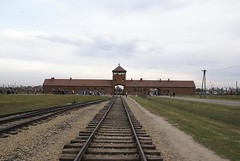
Auschwitz-Birkenau

As with many historical and indeed contemporary traumas (whether ‘man-made’ or natural disasters), one of the most difficult things to comprehend at Auschwitz (and indeed with the Holocaust as a whole) was not only the sheer brutality and inhumanity of the place, but the scale of the suffering experienced there. How can one possibly comprehend over 1 million victims (6 million in the Holocaust as a whole)? The only way I could even begin to try, was to find the individuals amongst the many dead; that’s not to say I looked for named individuals, but what it meant to be one.
One of the many strategies I used to explore the individual was that of researching my own past; not just that of my childhood, but a past in which I did not yet exist.

Ieper (Ypres)

Using the Ancestry website I began to uncover names, lots of names which seemed to exist, disembodied in the ether of cyberspace like the names one reads on memorials (such as on the Menin Gate in Ypres), and I was reminded all the while I searched of a quote from Rainer Maria Rilke’s poem ‘The Duino Elegies,’ in which he writes that on dying we
“…leave even our name behind us as a child leaves off playing with a broken toy…”

It is interesting that in looking back on our lives and beyond, we inevitably pass through our own childhood, and indeed, I can remember mine replete with all its toys – a fair few of which were inevitably broken. In Rilke’s phrase above, we have an implied progression from childhood to adulthood and the fate that comes to all of us, but travelling back, we move away from death and think of our childhoods, remembering those toys which in our mind’s eye are always new, or at least, always mended. This sense of moving back and the idea of toys, or things, that are mended again, resonates for me with my research and my using the Ancestry website. One can think of the 800 million names stored in their databases as each being a broken toy, one that when it’s found again is slowly put back together.

Having discovered hundreds of names (or broken toys) in my own family tree, I’ve started to put the pieces back together, looking beyond the names to discover who these people were, and therefore, who I really am. And the more I discover, the more I find myself looking at history in an altogether different way. History is sometimes seen as being nothing but a list of dates, but like the names on Ancestry, there are of course a myriad number of things behind the letters and the numbers (the broken toy in the attic has been to places other than just the attic – and has been things other than just a toy).
Now when I think of an historical date, I relate that to my family tree and consider who was alive at the time. For example, when reading about the Great Exhibition of 1851, I know that at that time Richard Hedges, Ann Jordan, Elijah Noon, Charlotte White, William Lafford, Elizabeth Timbrill, John Stevens, Charles Shackleford, Mary Ann Jones among many others were all alive; what is for me a distant event described in books and early black and white photographs, was for them a lived moment whether or not they visited the exhibition itself.

When this photograph inside the exhibition hall was taken in 1851, they were a part of the moment, even when farming in Norfolk. When the guillotine fell upon Marie Antoinette on October 16th 1791 (I’ve just been reading about the French Revolution), Thomas Sarjeant, Ann Warfare Hope, David Barnes, Mary Burgess and William Deadman were going about their normal lives somewhere across the channel in England, and it’s by understanding their lives – of which I am of course a consequence and therefore a part, that I can begin to understand history as not some set, concrete thing that has happened, but something fluid, made of millions of moments which were at one time happening. Every second in history comprises these millions of moments when the world is seen at once by millions of pairs of eyes.

Therefore, as well as being a huge database of names, Ancestry can be seen as being a database of moments, the more of which we discover for ourselves, the greater our understanding of history becomes. This, in light of the project’s origins at Auschwitz-Birkenau, is particularly pertinent; the Holocaust, as a defined historical event, becomes millions of moments and the Holocaust itself not one single tragedy, but a single tragedy repeated six million times.

In effect, Ancestry allows users to map themselves onto history and the family tree becomes not just a network of relationships between hundreds of people but a kind of physical and geographic biography of the individual. Places we have heard of but never been to, places we have never known before become as much a part of our being as the place in which we were born and in which we live. For example, if there’s a place with which I can most identify physically or geographically, then that place would be Oxford, the town in which I was born, grew up and in which I live. Its streets which I have walked and its buildings which I have seen countless numbers of times, all hold memories – and what are we in the end but these.

18

Of course there are numerous other places which I have visited and which make me who I am (seaside towns in Dorset where I holidayed as a child for example) but as well as these places are those which, until I began my research, I had either never heard of or never visited: Hafodyrynys, Dorchester, Burton Dassett, Southam, Ampney St. Peter, Minety, Ampney Crucis, Cefn-y-Crib, Kingswood, Usk, Eastleach, Wisbech, Walpole St. Andrew and so on. Furthermore, places I had known and visited were shown to contain memories extending way beyond my own lifetime but of which I am nonetheless a part, or at least, a consequence. I have been to Brighton many times and have many memories of that place, but all the times I have been there, never did I realise how much it and the surrounding area had come to make me who I am.

Hafodyrynys and Surrounds

So, as well as being a vast database of moments, Ancestry can be seen as an equally vast set of blueprints, each for a single individual – not only those who are living, but those who’ve passed away. And just as the dead, through the lives they led, have given life to those of us in the present, so we, living today can give life back to those who have all but been forgotten. Merleau-Ponty, in his ‘Phenomenology of Perception’, wrote:

“I am the absolute source, my existence does not stem from my antecedents, from my physical and social environment; instead it moves out towards them and sustains them.”

Of course our existence does indeed stem from our antecedents (and as we have seen, our physical environment), but what I like about this quote is the idea of our sustaining the existence of our ancestors in return. The natural, linear course of life from birth to death, from one generation to the next, younger generation, is reversed. Generations long since gone depend on us for life, as much as we have depended on them.

In his novel, ‘The Notebooks of Malte Laurids Brigge,’ Rilke wrote the following:

“Is it possible that the whole history of the world has been misunderstood? Is it possible that the past is false, because one has always spoken of its masses just as though one were telling of a coming together of many human beings, instead of speaking of the individual around whom they stood because he was a stranger and was dying?”

Mine the Mountain - Creatures

This quote brings me back round to what I spoke of earlier; the idea that the past is made up of countless millions of moments – that History is not the concrete thing that has happened, but something more fluid, something which was once happening, and which, given Merleau-Ponty’s assertion above, is still happening, or at least being sustained. These moments are the world as seen by individuals. In Rilke’s quote, the history of the world, represented by the masses, has its back turned against us. We cannot see its face or faces, only the clothes that it wears. But the stranger in the middle, around whom history crowds is looking out towards us, and if we meet their gaze, we make a connection, we see the individual. And for a moment they might be a stranger, but through the dialogue which inevitably begins, we get to know them and the world to which they, and indeed, we, belong.

As I’ve said, Ancestry is more than a network of discovered (and undiscovered) relationships between hundreds of people; it’s also an immense collection of dialogues; one can imagine the lines which connect individuals as being like telephone wires carrying conversations between the past and the present. And the more one thinks of all these nodes and connections, the more one begins to see that Ancestry is also a metaphor for memory – after all, what are memories but maps in the brain, patterns of connections between millions of neurons which make a picture of what once was: history as it really is.

Mine the Mountain will run between 1st and 8th October 2008 in Oxford. Download a PDF for venues.

Filed Under: Photography Tagged With: Ancestry, Creatures, Family History, Hafodyrynys, History, Holocaust, Mine the Mountain, Rilke, Vintage Photographs, World War I, WWI, WWII

X

June 30, 2008 by Nicholas Hedges

It was whilst I was cycling home from the studio this morning that the idea first came to me. I was thinking about the two paintings on which I am currently working, both of which are based on the landscape around Hafodyrynys, Wales (the village in which my Grandmother grew up) and one of which I intend to show, veiled, at the Mine the Mountain exhibition in October.
The paintings themselves were going quite well, but remembering the original idea behind them, I realised that there was something missing. The original idea was that these paintings, or rather the final selected painting would be based on both the death of my great-great-uncle, Jonah Rogers who was killed in action in the Second Battle of Ypres on May 8th 1915 and my birthday, May 8th 1971. The title of the piece was provisionally May 8th, but as is often the case, the painting has led me away from this. That isn’t to say the subject has been lost completely; I still want to think about Jonah, but how do I show him in the painting? How do I show the ambiguity between existence and nonexistence/death?
The answer came as I thought about names and some of the documents I have obtained through researching my family tree. Almost without exception, none of my ancestors from Wales at this time could read or write and all of them signed their name (or rather, indicated their presence) with an ‘x’. The ‘x’ therefore becomes a sign of a presence, but one which is anonymous.

Of course the ‘x’ is usually accompanied by the line; ‘the mark of…’ (as above) but without that, the human becomes relegated to this nondescript, anonymous sign (one could argue of course that we are all, in our names, reduced to signs, but the ability to write allows us to transfer to the page – and therefore leave to posterity – much more than just the name by which we are known). The act of making that mark instead of writing one’s name is also very significant. It levels all those who make it; it renders everyone the same – at least in the eyes of history. One could say that the greatest leveller of all is death and that the ‘x’ becomes the mark of death; presence is defined by absence.

We know much of what happened in the past through the written word although there are of course many other sources in which it’s also revealed; paintings, artworks, newspaper stories, oral histories/stories, fingerprints, photographs and so on, but for the most part, we know about the past through what we read. I have written about the limits of the written word before in relation to the work I did on ‘The Gate’, but looking at it again in relation to these paintings and to my previous work/research, there is something very poignant about these anonymous signatures; I can’t help but think of the names we see on memorials, carved into walls and so on. Imagine if they simply read ‘x’… For many who died in the Great War and whose bodies were either never found, names have been lost and an ‘x’ is perhaps all one could write on their behalf.

In relation to the landscape, ‘x’ has different connotations; on maps it marks a spot – it denotes the presence of something, a thing which is present and yet absent – hidden away from sight and mind like buried treasure. Marking the canvas with an ‘x’ would give the painting the meaning I was looking for; the presence of someone absent; the reduction of everyone in time to complete obscurity. Furthermore, taking what I wrote in the paragraph above, ‘x’ marks the last resting place of all those (including my great-great-uncle) whose bodies were never found.

X

The paintings are still in the early stages but there was instantly something about the marks which appealed. In some respects I saw them (those in the sky) as angels which given the nature of the work seemed relevant. They also reminded me of the stars one sometimes finds painted on the ceilings of cathedrals or in mediaeval manuscripts. But those ‘on the ground’ called to mind something else, something which given Jonah Rogers’ fate gave the paintings another dimension; first the shape reminded me of the deckchairs I made for the Residue exhibition (The Smell of an English Summer 1916 (Fresh Cut Grass))..

The Smell of an English Summer 1916 (Fresh Cut Grass)

…and secondly, the x-shape defences one sees on wartime photographs such as those of the Normandy landings below…

Filed Under: Artist in Residence Tagged With: Artist in Residence, Hafodyrynys, Mine the Mountain, Residue, World War I, WWI, X

Verdun

April 30, 2008 by Nicholas Hedges

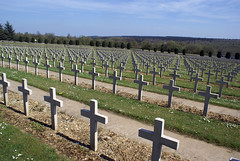
On 26th April I visited the battlefields and sites of Verdun. The name, like that of the Somme and Ypres, calls to mind visions of unimaginable horror; thousands upon thousands of men turned into names carved in monuments in towns throughout Europe, or lost completely, names and all, in the churned and pulverised fields. In my imagination, such places are always wet, cold, dark and desolate, as frozen in their appearance as they are fixed in old black and white photographs.

I won’t at this point discuss the battle’s history, suffice to say it’s a place in which around 500,000 men lost their lives, a figure which like so many grim statistics (I’m thinking here of my work on the Holocaust) is almost impossible to imagine (as much as it’s impossible to correlate). 26,000,000 shells rained upon the battlefield, six shells for every square metre. But difficult as these facts are to process, we must at least try.

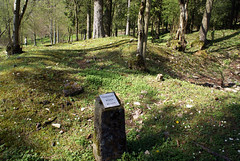
Having arrived in Verdun, we stopped the car at a track leading into a wood and no sooner had we started to walk amongst the trees than we became aware of the undulating ground; the shell craters and trenches, around and from within which this new wood had grown. At once we recalled the craters and trenches of Sanctuary Wood in Ypres, but the contrast between the two was clear; in Sanctuary Wood the trenches had been, at least, ‘over-preserved’ (some suggest they were dug for tourists after the war) but here they’d remained untouched since the end of hostilities. They were rounded and smoothed, and all the more powerful. At Sanctuary Wood, the whole place had the feel of a playground, whilst in this wood, the peace and quiet provided a stark counterpoint to the horrors of war.

Verdun

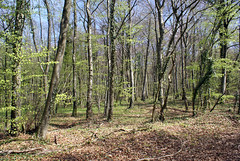
This counterpoint came in the birdsong and the colour of the sky, which on what was a glorious day was tinted by the brown of the trees and last year’s leaves filling the craters and trenches; a curious bruising as if a part of the dusk was somehow stained upon it. And between the carpet of leaves and the blue of the sky, was the green of this year’s growth; the whole scene a complete contrast to what the name, Verdun, had until now conjured in my mind. This place was simply beautiful.

Verdun

Save for a few tourists, we walked the woods alone, and yet, even then, the trees like those we’d encountered at other sites of trauma, seemed more than what they were. But whereas those which grow in Auschwitz-Birkenau and Belzec are strangely complicit in the events of the past, those in Verdun had grown from its wreckage; they did not hide what happened there. And stranger still was the sense that in this place Mankind was older than nature; Man had shaped the ground through his own destruction; he had made the void – the quagmire of mud – from which nature had risen, giving the trees a human quality, as if they carried with them the memory of all who fell – as if they were the fallen soldiers. And the resilience of Nature, it’s ability to rise from such appalling devastation, was one of the most striking aspects of our visit; despite the human feel of the trees, I realised how small humans are, even when they are made big through war. No matter what we do, Nature will in the course of time return. Long after we have finally gone, she will still be here, just as she was that day, in blue sky and birdsong, and as such, to walk through the woods was like being the last two people left on Earth.
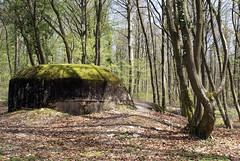
This scarred idyll was littered with other wartime detritus; the pillboxes within which men would hide, seeking out their fellow man beyond the apertures through which their guns were trained. They sat like concrete bells, still ringing with the war, like the ringing heard in silence, after exposure to something loud. (I am reminded here of the idea of sympathetic vibrations, where when a bell is struck, another bell across the room begins vibrating, giving off the same sound. These pillboxes which litter the landscape around Verdun, and which we saw in Ypres, seem to contain within their walls and deep impenetrable interiors, a sound which finds sympathy in all the others. I can imagine these vibrations ringing in sites all across the world, again long after man has gone.)

Verdun

Having recorded the sounds of the birds (and on playback I notice the insects – and I start to think of flies trapped in amber) we left the wood and made our way to Fort Vaux, the second to fall in the Battle of Verdun and a place I will return to later.

This persistence of Nature was nowhere more apparent than in one of the ruined villages which we visited towards the end of the day. There was nothing left of Fleury-devant-Douaumont save for the street names preserved on signposts along with signs indicating where there’d been a farm, the cafe, Town Hall and the workshop of a weaver.

Verdun

One of the interesting things about the numerous ruined villages is how they each have a Major, a post created to preserve the memory of the place as well as those who lived there. Like the woods, the landscape was blistered beneath the lush grass, undulating like immeasurably slow ripples following the impact of thousands of shells. It was pockmarked with craters some of which had filled with water to make ponds, beautiful beneath the dappled shade of the trees. Again, one had the feel of Man being older than Nature, with the new wood growing out of what remained of the village; despite the unimaginable numbers of shells which ploughed the soil, the sheer number of dead, the poison of the gas used in the battle, the ground had somehow made this beautiful landscape. And just as a corpse can tell us much about its demise through what nature has written upon it – the time of death for example – so the woods grown out from the corpse of the landscape speak of the time that has passed; and here is the curious enigma of the Great War. Despite the fact that almost a hundred years separates us, it doesn’t seem that long ago.

Verdun

Fort Vaux is a name synonymous with the suffering, endurance and the bravery of the soldiers who fought there. Even after the French were forced to surrender, the Germans presented arms as a mark of respect. The following is an extract from H.P. Willmott’s book on the First World War.

Verdun

“The German bombardment of the Fort began on June 1st 1916, at one point firing shells at the rate of 1,500 to 2,000 of the per hour. Inside were 600 troops under the command of Major Raynal. Just before dawn on the 2nd the barrage stopped and two German battalions moved forward. By mid-afternoon they had overwhelmed the defenders and occupied a large part of the superstructure. Raynal was determined to resist, and he and his men withdrew to the underground corridors where a grim battle was fought in the darkness with grenades and machine guns. On June 4th the Germans used flamethrowers in an attempt to drive the French out with asphyxiating black smoke…”
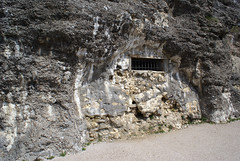
It’s a curious shell, a skull like structure cut into the rock which belies the horrors it has witnessed. Standing on top, one could see why it was so important, commanding spectacular views of the surrounding countryside and here, the contrast between the view of the tourist and that of the soldier becomes stark. What would they have seen from this same position? Hard to imagine that it was such a wasteland.

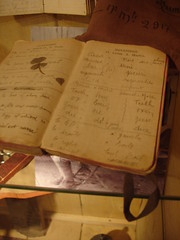
From Fort Vaux we made our way to the Memorial Museum and then to the Douaumont Ossuary. At the Museum, there was one object in particular which interested me, and that was a notebook containing handwritten translations of English words into French.

Verdun

The first line is the translation for Dead; Mort.

Verdun

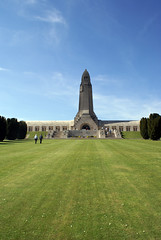
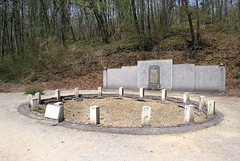
The structure of the ossuary is very much of its time and has the appearance of something which wouldn’t look out of place in Fritz Lang’s vision of the future, Metropolis. And this fact reminds us that it was just twenty years later when Europe and the world would be plunged into yet another catastrophe, indeed, during our journey around Verdun, we found evidence of this catastrophe in a memorial to 16 people killed in the second world war whose mutilated bodies were found dumped in a ditch which itself formed their memorial.

Verdun

From the top of the tower, one is again presented with spectacular views of the battlefields and again one can’t imagine what it would have looked like in those dark months of 1916. The tower itself houses the Victory Bell and the Lantern of the Dead which shines out over the battlefield.
Most of the structure is taken up by the 137 metre long cloister where each tomb shows a precise area of the battlefield from where the bodies were recovered. What one does notice – especially on a warm sunny day like that on which we visited – was how cold it is inside. One expects it to be colder given the thick stone walls, but there is something of an extra dimension to the chill, one is made all the more aware of being in the presence of the dead. And yet, this cold defines the living, it shows up our breath and for me, this was one of the most powerful aspects of the building.

Verdun

Outside the ossuary, through a row of small windows, one can see the bones of the 130,000 dead entombed within. Seeing the piles of leg bones, shoulder blades, vertebrae and skulls, one is reminded of the randomness of war, the arbitrariness of death on the battlefield. Like numbers and lists of names, it’s hard to imagine that these mountain of bones were once thousands of individuals, just as walking amongst the graves of the 15,000 men in front of the ossuary, one cannot imagine that many dead. Multiply that number, that space by thirty, see where it stretches out into the distance, and one begins to understand – in part – the horror of the war.

But one can never know what it was really like, and that to some extent is the point. Would we want to? We must do everything we can to never know. The inability to contemplate such horror in the face of such natural beauty is exactly its power. What we see when we walk through the woods is in some respects the world as it was before the war, the world of better days as remembered by those caught in the ‘meat-grinder’ of battle. The trenches gouged in the ground and the shell-craters pock-marking the soil are reminders of a brutal past, and yet they are also a warning about the future.
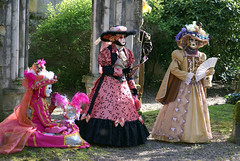
Having left the ossuray we made our way into the town of Verdun itself. Music was playing from speakers attached to all the lamposts, and at the appearance of people dressed in costume and sporting masks, we realised we had come at the time of a carnival. But there was something sinister about these people, the way in which they were a part of the town but detached, within but without. Something about their featureless, anonymous faces; the way they looked at us but we could not look at them, just a version of their selves.

Verdun

And seeing all these colourfully dressed people on the steps of the town’s huge memorial served to illustrate the continuity of life, but also the fact that those who died on the battlefields outside the town would have known brighter, happier, more colourful times, a juxtaposition which is everywhere in Verdun and which was to be found in the town’s Cathedral, itself hit on the first day of the battle – February 21st 1916.

Verdun

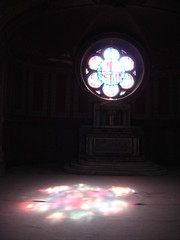
The Cathedral still bears the scars of war, but on the inside, one finds again the colour.

Verdun

Filed Under: Trees, World War I Tagged With: Place, Silence, The Somme, World War I, WWI, Ypres

Zuleika Dobson

March 31, 2008 by Nicholas Hedges

It was through reading E.M. Forster’s lectures (collected in a book entitled ‘Aspects of the Novel’ and first published in 1927) delivered under the auspices of Trinity College, Cambridge, that I first came across a reference to Max Beerbohm’s satirical novel Zuleika Dobson. In particular it was a passage quoted by Forster as ‘this most exquisite of funeral palls… Has,” he goes on to say “not a passage like this a beauty unattainable by serious litertature?” The answer to that is in some respects yes and below is that very passage:

“Through the square, across the High Street and down Grove Street they passed. The Duke looked up at the tower of Merton… Strange that tonight it would still be standing there, in all its sober and solid beauty – still be gazing over the roofs and chimneys, at the tower of Magdalen, its rightful bride. Through untold centuries of the future it would stand thus, gaze thus. He winced. Oxford walls have a way of belittling us; and the Duke was loth to regard his doom as trivial.

Aye by all the minerals we are mocked. Vegetables, yearly deciduous are far more sympathetic. The lilac and laburnum making lovely now the railed pathway to Christ Church Meadow were all a-swaying and a-nodding to the Duke as he passed by – ‘Adieu, adieu your Grace,’ they were whispering. ‘We are very sorry for you – very sorry indeed. We never dared suppose you would predecease us. We think your death a very great tragedy. Adieu!”

The premise of the novel concerns the arrival into Oxford of the beautiful Zuleika Dobson, a woman of such beauty, any man who sees her cannot help but fall in love.

“To these Emperors, for whom none weeps, time will give no surcease. Surely, it is sign of some grace in them that they rejoiced not, this bright afternoon, in the evil that was to befall the city of their penance.”

Broad Street

The problem is that Miss Dobson herself cannot love any man who loves her in return and so, having fallen in love with the brilliant Duke of Dorset, her love is immediately lost on hearing of his reciprocal feelings. Spurned, there is only one course of action left to the Duke and that is suicide by drowning in the Isis during Eights Week. But such is the esteem in which he’s held, and such is the love every undergraduate holds for Miss Dobson, that almost the entire undergraduate population of Oxford plunges into the river and is lost.

Taking the plaintive tones of the passage above and some other extracts of the novel, I assumed (not recalling the date of its first publication) that Beerbohm’s novel was something of an allegory about the lost generation of the First World War, of the lost innocence of Edwardian Oxford. However, the novel was first published in 1911, and as such, the book is not unlike the pair of black owls which perch on the battlements of the Duke’s ancestral home and foretell of his death.

“Young Oxford! Here, in this mass of boyish faces, all fused and obliterated, was the realisation of that phrase. Two or three thousands of human bodies, human souls? Yet the effect of them in the moonlight was as of one great passive monster.”

Just after reading the novel, I started reading again Peter Vansittart’s survey of the First World War, Voices From the Great War. Comprising quotes, poems, letters and so on, the book paints a picture of the war through the long lost contemporaneous voices. I first bought the book following a visit made to Ypres and turned to it again having received a gift of almost 200 postcards from the time of the Great War.

World War 1 Serviceman

Taking the three together – Beerbohm’s novel, the postcards and the quotes – one begins to read the absurd fantasy of Zuleika Dobson in an altogether different way. We have all seen images of men cheerfully marching to the Front, waving their hats and shouting, and when one reads of the mass (almost cheerful) suicide of all the young men in the novel, one cannot help but compare.

“There was a confusion of shouts from the raft of screams from the roof. Many youths-all the youths there-cried ‘Zuleika!’ and leapt emulously headlong into the water. ‘Brave fellows!’ shouted the elder men, supposing rescue-work. The rain pelted, the thunder pealed. Here and there was a glimpse of a young head above water-for an instant only.
Shouts and screams now from the infected barges on either side. A score of fresh plunges. ‘Splendid fellows!'”

And from Vansitartt’s book…

“The enormous expansion of wealth in the peaceful years between 1908 and 1914 brought not happiness but fear, and fear so powerful that it could be expressed only in images of fear and destruction. When war came, it was almost universally accepted as something foreseen and foretold. Even those who loathed the notion of it acquiesced in it as inevitable, and it is not foolish to conclude that what ultimately brought the war was not the ambitions and fears of Germany, but a death-wish in the peoples of Europe, a half-conscious desire to break away from their humdrum or horrifying circumstances to something more exciting or more exalted.” C.M. Bowra

“War might drive a man till he dropped: it could be a dangerous and bloody business; we believed, however, that it still offered movement, colour, adventure, and drama. Later, when the murderous, idiotic machinery of the Western Front was grinding away, of course all was different.” J.B. Priestly

Of course it was different – the reality of the situation. And having turned the last few pages of Beerbohm’s novel, I wondered what it would have looked like, all those dead young men lying prone in the waters of the Isis.

Filed Under: World War I Tagged With: Memory, Nowness, World War I, WWI, WWI Postcards, WWI Postcards, Zuleika Dobson

Colour

November 12, 2007 by Nicholas Hedges

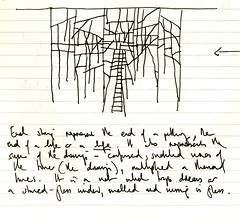
Each string (in what I have so far called the ‘net’) represents in its ‘cut end’ the end of a path, the end of a life. Each string also represents a life entire as measured by the three fates. Furthermore they could be said, as a group to represent the combination of paths which, at a specific moment in time created one of the many terrible moments of the Holocaust. Also, the image of the whole represents the sum of the snatched visions of the tower at Birkenau (the drawings).

Of the physical appearance of the net, the following quote from Fernando Pessoa’s ‘The Book of Disquiet’ is very pertinent:

“I also have my crochet,
It dates from when I began to think,
Stitch on stitch forming a whole without a whole,
A cloth, and I don’t know if it’s for a garment or for nothing,
A soul, and I don’t know if it’s for feeling or living.”

The image of the net looks like a ‘dream-catcher’ and in many ways that works in respect of this theme; dreams which many would have had of going back home, trapped in its strings. (There is also the idea of the writes of the telegraph poles carrying messages out of the camp and across Europe).

I was also thinking today about work by two of my colleagues which was very much to do with colour. This made me look at my own work (which is anything but colourful) and the subsequent contrast interested me. It reminded me of a television programme I watched last night about the photographer Albert-Kahn who documented the First World War in colour photographs. When we think of the past, in terms of the war, pre-war and Victorian periods, we think of it in terms of black and white. When we see colour photographs of the First World War they seem to validate reality – the very fact of time before we were born.

In my work there is no colour as such, but it is there, just as colour is there in Black and White photographs.

12-11-07
In the image above, I was reminded of the stained glass windows in the many tombs of Montmartre and Pere Lachaise cemeteries. The lines of the image (of the net) could just as easily be the lead work of a broken stained-glass window; what is missing of course is the colour.

Pere Lachaise, Paris

Colour could be a validating factor in this case. Often when we think of the Holocaust or World War One for example, we see them in Black and White (like the cats (although evidence suggests they may have limited colour vision) we saw in the cemetery); we often think of the weather as being dull, grey, miserable, always winter, and when we read evidence of the time that talks of blue sky and sun, it always seems somehow shocking. The following is an extract from Tadeusz Borowski’s “This Way for the Gas Ladies and Gentlemen.”

“‘…You have no idea how tremendous the world looks when you fall out of a closed, packed freight car! The sky is so high…’
‘…and blue…’
‘Exactly, blue, and the trees smell wonderful. The forest – you want to take it in your hand!'”

When imagining arrival at somewhere like Birkenau, one imagines it being night, or the smoke from the chimneys hiding the sky like a fog. But of course, people would have arrived on beautiful summer days, when colour was abundant.

Filed Under: Holocaust, Trees Tagged With: Borowski, Colour, Fernando Pessoa, Holocaust, String, World War I, WWI, WWII

Walking and Memorials

June 3, 2007 by Nicholas Hedges

Having written in the previous entry (about Belzec) ‘Walking is itself a vital part of the memorial’, I was interested to read the following in Neil Hanson’s book, The Unknown Soldier.

“However, no-one, not even a Prime Minister could impose a meaning unacceptable to the public on any memorial, which ‘by themselves remain inert and amnesiac, dependant on visitors for whatever memory they finally produce.

Filed Under: World War I Tagged With: Memorials, Neil Hanson, Walking, World War I, WWI

The Final Week

May 4, 2007 by Nicholas Hedges

The final week before the exhibition opens and new ideas are presenting themselves. I wanted to do something with the dismantled typewriter and so I took the letters and the ribbon and printed the title on some paper ‘The War to End All Wars’.

What I liked about the result was how the red of the ribbon was smudged beneath the writing, giving the impression of blood. The unevenness too reminded me of some text-based work I did following a visit to Auschwitz and I wondered whether I could reprise this work. However, there would have to be differences. The dismantled typewriter, as a piece, has the title, as above, ‘The War to End All Wars’. Clearly we know that this wasn’t the case and that there have been hundreds of wars fought since 1918. Giving the typewriter such a title makes it a metaphor for the First World War (I originally arrived at the idea thinking about the names of all the dead being recorded on just such a machine) and so, as the First World War wasn’t the last, so the typewriter must be shown to still work somehow. Using the letters and the ribbon does this, but if the result is on paper, it doesn’t necessarily follow that the typewriter has been dismantled i.e. it could have been made before it was taken apart. Printing directly onto the wall however does make this connection; after all it is obviously impossible to type with a working typewriter onto a wall, this can only be done if the machine is in pieces. The First World War may be over, but man has continued to fight nevertheless.

Filed Under: Artist in Residence Tagged With: Artist in Residence, Auschwitz, Residue, World War I, WWI

From Dinosaurs to Human Beings

April 25, 2007 by Nicholas Hedges

After yesterday’s viewing, I began to think about the works I’ve produced so far on this residency and what it is that links them; not that there should be a link – I just know that there is one. Despite the differences, there is an underlying theme which unites the drawings, the text pieces, the deckchairs and the paintings. So what is it?

In answering this I have started to think about… dinosaurs. Not something which first springs to mind when looking at my work and if I mention Jurassic Park, then it might seem that I’m losing the plot altogether, but there is a sequence in this film which is relevant to my work.

In the film, the visitors to the Park are shown an animated film, which explains how the Park’s scientists created the dinosaurs. DNA, they explain, is extracted from mosquitoes trapped in amber and where there are gaps in the code sequence, so the gaps are filled with the DNA of frogs; the past is in effect brought back to life with fragments of the past and parts of the modern, living world. This ‘filling in the gaps’ is exactly what I have done throughout my life when trying to imagine the past, particularly the past of the city in which I live.

As well as reading about and drawing dinosaurs, I also as a child, liked to create and map worlds; countries which I would build from fragments of the world around me; forests, mountains and plains – unspoilt landscapes. And in these worlds there would exist towns and cities, created from ‘the best bits’ of those I had visited.

These invented worlds became, as I grew up, the ‘invented’ or imagined landscapes of Oxford’s past; landscapes that were – just as they still are – created from fragments, parts of the past which are still extant in the city; old buildings, walls, objects and so on. Between these structures, these fragments, I would fill the gaps, with my own imagination, with thoughts derived from my own experience. The city’s past and the past in general, as it exists within my mind, is then, to use the metaphor of cloning in Jurassic Park, a cloned dinosaur. The extant buildings, structures and objects within museums, are like the mosquitoes trapped inside the amber. They are broken strands of DNA. All that is required is for me to fill the gaps, and this I can do with my own DNA. I am in effect, the frog.

This metaphor is interesting in that DNA patterns are, of course, unique to everyone. My DNA is different to everybody else’s as there’s is to mine. Therefore, using my imagination to plug in the gaps of the past, means that the ‘past’ will comprise large parts of my own experience; my dinosaur will contain elements of my own being. (See ‘Postcard 1906’). But although my DNA is unique, it is nonetheless derived from my own past, elements have been passed down by my ancestors from time immemorial. The code which makes me who I am, comprises parts of people I know now (parents and grandmothers), people I knew (grandfathers and great-grandmother) and people lost to the past altogether (great-great grandparents and so on). What interests me about this, is that, through stating above how ‘my dinosaur will contain elements of my own being’ I can now see that ‘my dinosaur’ will contain elements of my own being, which is itself comprised of elements of hundreds – thousands – of people, the majority of whom I will of course never know and who have been dead for centuries. I like to think therefore, that ‘my dinosaur’ and my imagination aren’t entirely unique.

This leads me to look at paths – not the route I walk around the castle, or those recorded by my GPS receiver (although these are entirely relevant) but to the paths taken by my ancestors so that I might be brought into being. The chances of any of us being who we are is practically nil. In order for me to be born, I had to be conceived at the exact time I was conceived, any difference in time – even a split second – and I wouldn’t be me. Also, everything leading up to that moment had to be exactly as it was; anything done differently by my parents, no matter how small, how seemingly irrelevant, any deviation from the path and I would not be me. This is extraordinary enough (whenever I see old photographs of members of my family, I think that if it was taken a second sooner or later, I would not be here) but when one considers this is the same for my entire family tree, again, all the way back to time immemorial, then one realises how, to quote Eric Idle in ‘Monty Python’s Meaning of Life’, ‘incredibly unlikely is your [my] birth’. We are all impossibly unlikely. The chances of all our ancestors walking the exact paths through their lives which they walked is almost nil.

Therefore, my walks, my mapping, my identifying (seemingly irrelevant) objects, my recording them, my palimpsests, are all linked. Memorialising objects (disposable or otherwise), snatches of conversation and so on, inscribing them on a slab, shows how vital these fragments are to future generations and to me in terms of my own past. But how does this fit in with my work on Auschwitz-Birkenau, death camps and World War I?

These ‘arenas’ of death were constructions (although the carnage of a battlefield was often random, the battles themselves were always planned, ‘constructed’ for the purpose) in stark contrast to the rather arbitrary paths our ancestors took so that we might each be born. Death in these places was designed, it was planned, particularly with regards to the horrors of the death camps and by looking at these places, by visiting them, by looking at the seemingly irrelevant, everyday objects left behind, we can fill in the gaps, each using our own existence to imagine the lives and the deaths of others. We understand what it means to be human, the near impossibility of birth and the absolute certainty of death.
Imagining a group of a several hundred people walking to their deaths, whether down a path to the gas chambers, or on a road to the Front, we can easily imagine the route; we can in places walk the route today. But imagining the paths walked by thousands of people through time, to bring each of the victims into being is almost impossible: I say almost impossible, but, as I’ve written above regarding each of our births, it’s possible in the end.

Looking at death therefore is to to look at life and its inestimable value, whoever we are and wherever we live. It is to understand what it means to be human and to cherish the lives of others.

Filed Under: Artist in Residence Tagged With: Artist in Residence, DNA, Holocaust, Objects, Postcards, Residue, Vintage Photographs, World War I, WWI, WWII

The Unknown Soldier

April 17, 2007 by Nicholas Hedges

“The Post Office Rifles and the 6th Battalion – ‘the Cast-Iron Sixth – in turn would then pass through their lines to continue the advance to the next objectives on the downward slope of the ridge, the ‘Cough Drop,’ also known as ‘Leicester Square’, and the ‘Starfish Line’. The London Irish and the Poplar and Stepney Rifles were to lead the advance to the west of High Wood, before being succeeded by the 19th and 20th Battalions. ‘The postmen from quiet little hamlets or clerks who had spent their lives hitherto in snug offices, talked about these future regimental mortuaries with the homely names with astonishing calmness…'”

What struck me about this quote from Neil Hanson’s book, was how soldiers used the names of well known and familiar places, to name those places which were not only unfamiliar, but also terrifying, often places of horror and death on a scale which could never be imagined within those more familiar places back home. Trenches were named in a similar fashion: Oxford Circus, Oxford Street, George Street, Broad Street and so on.

“By day, the screams and groans of the wounded and dying had been drowned by the deafening clamour of the battle. At nightfall, though still counterpointed by the rumble of the guns, their pitiful cries and please for help could be hear echoing through the shattered wood…”

This quote reiterates how this war was a war of sounds; how men could be reduced to tears and much worse by sounds; those of the incessant shells or the solitary man crying in a dark wood.

“‘The reading of the battalion roll-call must have broken the hearts of all who heard it – ‘a hollow square of jaded, muddy figures… A strong voice… calls one name after another from a Roll lit by a fluttering candle, shaded by the hand of one of the remaining Sergeant Majors.’ Name after name went unanswered; each silence, another man wounded, missing or dead.'”

This very poignant passage reminded me of some text-based work I did whilst investigating the site of Auschwitz-Birkenau. These text-based pieces started as free-written prose and through a process of increasing the spacing between the letters changed to become squares where the words were reduced to a scattering of letters. As soon as I read the words ‘a hollow square’ I thought at once of those.

Filed Under: Artist in Residence Tagged With: Artist in Residence, Auschwitz, Holocaust, Neil Hanson, Quotes, Residue, Silence, Useful Quotes, World War I, WWI, WWII

The Unknown Soldier

April 17, 2007 by Nicholas Hedges

“The Post Office Rifles and the 6th Battalion – ‘the Cast-Iron Sixth – in turn would then pass through their lines to continue the advance to the next objectives on the downward slope of the ridge, the ‘Cough Drop,’ also known as ‘Leicester Square’, and the ‘Starfish Line’. The London Irish and the Poplar and Stepney Rifles were to lead the advance to the west of High Wood, before being succeeded by the 19th and 20th Battalions. ‘The postmen from quiet little hamlets or clerks who had spent their lives hitherto in snug offices, talked about these future regimental mortuaries with the homely names with astonishing calmness…'”

“By day, the screams and groans of the wounded and dying had been drowned by the deafening clamour of the battle. At nightfall, though still counterpointed by the rumble of the guns, their pitiful cries and please for help could be hear echoing through the shattered wood…”

“‘The reading of the battalion roll-call must have broken the hearts of all who heard it – ‘a hollow square of jaded, muddy figures… A strong voice… calls one name after another from a Roll lit by a fluttering candle, shaded by the hand of one of the remaining Sergeant Majors.’ Name after name went unanswered; each silence, another man wounded, missing or dead.'”

Filed Under: Artist in Residence Tagged With: Artist in Residence, Quotes, Residue, Silence, Useful Quotes, World War I, WWI

Reading and Experience

April 6, 2007 by Nicholas Hedges

“Decayed sandbags, new sandbags, boards, dropped ammunition, empty tins, corrugated iron…”

These words are those of a German soldier – written at the Front just before the Battle of the Somme – and form just a small part of an extract in Neil Hanson’s book, ‘The Unknown Soldier.’ Instantly I read them, they called to mind the remnants dredged from the battlefield which I’d seen in the museum at Hill 62 in Ieper.

On their own, these artefacts are powerful – yet mute – witnesses to the Great War, but when reading a soldier write about them, even listing them as above, they change. They each regain their voice – their signifier, and re-emerge from the shadows.

In my painting ‘Auschwitz-Birkenau Remembered‘ I cut words up into individual letters and scattered them onto the painting, I also wrote directly into the paint itself to show how words failed to articulate the horror of such a place (the written words could barely be read). Another way of looking at this however, is to say that words are able to speak of such horror, but have simply lost their original voice. It then falls to us to speak the words for those who are no longer able to do so, to put them back together.

Subsequent to this, I’ve been thinking about the process of reading, for example an extract from Filip Muller’s powerful testimony, ‘Eyewitness Auschwitz – Three Years in the Gas Chambers,’ in which he describes the horrific murder of a fellow prisoner.

“There was utter silence, broken only by the twitterings of the swallows darting back and forth.”

We were not there in Auschwitz at the moment this line describes (the moment before the doomed prisoner speaks up against the camp’s brutal regime), yet we all know silence and have seen and heard swallows. So although we were not there to witness at first hand this terrible event, we can imagine a silence, a particular one we might have felt some place before, and picture a time we saw a swallow fly. We can use fragments of evidence (photographs, documentary footage) to construct a fuller picture, and fill in the gaps with fragments of own experience. When we speak the words of others therefore, those words will form pictures in our own minds drawn from our own experience.

“As the torrents of machine-gun bullets ripped through the grassy slopes up which the British troops were advancing, the smell of an English summer – fresh cut grass – filled the air. For thousands it would be the last scent they would ever smell.”

This extract, also from Neil Hanson’s book, ‘The Unknown Soldier,’ presents us with an image of slaughter, made all the more terrible (if that were possible) with a reference to the smell of cut grass – one of those smells which invokes in most of us, memories of lazy summer’s days. The two are, obviously, utterly incongruous, yet it somehow makes our task of imagining the horror a little easier. We know the smell of cut grass, and waves of associations and memories are no doubt triggered by the aroma. In the days before the battle, when the soldiers doomed to die waited for the day, they too might have smelled the grassy air and found their way back to times when things were better. It is again the contrast – something which I’ve described before in relation to my visits to Auschwitz-Birkenau and Ieper which makes this passage so heart-breaking.

Finally, I wrote earlier (Imagination and Memory) of how as a child I created a world, made up of fragments of landscapes which I loved, and how as I grew older, I created worlds that were ‘real’ – visions of Oxford as it might have looked centuries earlier. Just as when reading the quote above, I would – as I still do – use documentary evidence to start – images (photographs and drawings) of how the city looked, contemporary writings (such as those of Anthony Wood) – and then fill in the gaps using my own direct experience, in effect, the city as it looks today.

Filed Under: Holocaust Tagged With: Auschwitz, Filip Muller, Fragments, Landscape, Neil Hanson, Silence, World War I, WWI, Ypres

The Unknown Soldier

April 6, 2007 by Nicholas Hedges

Extract from Neil Hanson’s book, ‘The Unknown Soldier,’ concerning the infamous Battle of the Somme.

‘The next day, the regiment began the long march to the Front. In the heat of early summer, nature had made attempts to reclaim the violated ground and a deceptive air of somnolence lay on the landscape. “The fields over which the scythe has not passed for years are a mass of wild flowers. They bathe the trenches in a hot stream of scent,” “smelling to heaven like incense in the sun.” “Brimstone butterflies and chalk-blues flutter above the dugouts and settle on the green ooze of the shell holes.” “Then a bare field strewn with barbed wire, rusted to a sort of Titian red – out of which a hare came just now and sat up with fear in his eyes and the sun shining red through his ears. Then the trench… piled earth with groundsel and great flaming dandelions and chickweed and pimpernels running riot over it. Decayed sandbags, new sandbags, boards, dropped ammunition, empty tins, corrugated iron, a smell of boots and stagnant water and burnt powder and oil and men, the occasional bang of a rifle and the click of a bolt, the occasional crack of a bullet coming over, or the wailing diminuendo of a ricochet. And over everything, the larks… and on the other side, nothing but a mud wall, with a few dandelions against the sky, until you look over the top or through a periscope and then you see the barbed wire and more barbed wire, and then fields with larks in them, and then barbed wire again.”

As the torrents of machine-gun bullets ripped through the grassy slopes up which the British troops were advancing, the smell of an English summer – fresh cut grass – filled the air. For thousands it would be the last scent they would ever smell.’

Filed Under: World War I Tagged With: Neil Hanson, Soldiers, The Somme, World War I, WWI

Two Minutes Silence

April 2, 2007 by Nicholas Hedges

Every year, at the 11th hour, on the 11th day of the 11th month, we pause for two minutes and remember all those who died in two world wars and subsequent conflicts. We stand still and in silence, a tradition which, one hopes, will always be respected. Over the last few days, having written about the nature of silence in those places which have witnessed appalling human suffering, I’ve been thinking more about this tradition of silence – not so as to question it (as I’ve said, it is a tradition which must always be recognised and respected) but rather its process; what we think about when we stop and are quiet; what it is we are doing when we remember?

The silence temporarily turns the street, the office or wherever it is we’re standing into a different place; it creates a contrast, against which we might compare our normal everyday environment – that from which we step for two minutes to then rejoin at its end. This act of rejoining is, I believe, as important as the stopping and the silence, for as simple as it is, it’s nevertheless something which millions were unable to do, whether through disability or simply because they never came home at all.

Filed Under: World War I Tagged With: Memorials, Memory, Remembrance, Silence, World War I, WWI

Postcards

April 2, 2007 by Nicholas Hedges

I was thinking (given the theme of Residue) about the residues of war, and listed the following sorts of things one might expect to find in the wake of conflict: objects dredged from the battlefield, pieces of shrapnel, bullet casings, shell casings, shoes, photographs, letters, memoirs, bones, clothes, luggage, memories (sights, sounds, smells)… and as I wrote, I thought how important the idea of ‘home’ was, and what a dreadful contrast it must have been to the realities of the often appalling predicaments of those caught up in conflict, whether soldiers or civilians.

Reading various books about World War One, it’s been interesting (and indeed heart-breaking) to read extracts from soldiers’ letters and postcards sent from the trenches, and to read about the packages they received in turn from home. How difficult (as well as comforting) it must have been for them to receive these little pieces of home as they suffered in such unimaginable conditions, and how terrible for parents and relatives to receive the postcards and letters from a loved one after news of their death.
Given that I am exploring the theme of contrast (particularly with regards to the silence of a place following a traumatic event) I thought this was an interesting ‘contrast’ to explore, particularly as Gloucester Green is a place where people are in transit, perhaps travelling away from home.

To change the subject slightly for a moment, one way of identifying with people and events so long ago – for example the Great War – is by identifying with a place (with which we are particularly familiar) as it was at the time, i.e. 1914. I have for a long time been interested in the idea of memory spaces (spaces within the memory of someone either dead or living) and how by accessing these spaces we might gain access to their contemporary thoughts. Under ‘Objects‘ on this site I have written:

“These objects, each through their own unique provenance, allow us, if we use our imaginations, to glimpse people from the pages of history; they, along with tens of thousands of others, once held a place in the minds and memories of men and women long since dead. Now we hold these objects within our minds and memories and as such share a place, a single, common space with those who have long since vanished from the world. To read about the past and those people who made it is one thing, to share this common space with them through the power of objects is quite another.

Objects can be those found in a museum, or buildings contemporary with the time you wish to explore within your imagination; in the case of the Great and the Second World War, it is most of the city (Oxford) as it stands today. As I have already written (on Objects), Aristotle says in relation to systems of memory:

“We should also seek to recover an order of events or impressions which will lead us to the object of our search, for the movements of recollection follow the same order as the original events; and the things that are easiest to remember are those which have an order, like mathematical propositions. But we need a starting-point from which to initiate the effort of recollection.”
This starting point could be anything contemporary with the time we wish to explore. In respect of the Great War, there is a photograph showing men marching to war over Magdalen Bridge and past the Jubilee Fountain which stands near what is now The Plain roundabout. These men are as anonymous to us now, ‘living’ in this photograph, as they are dead, yet the landmarks past which they march are still in existence. That same fountain occupied a place in each of their minds, and so by choosing this as our starting point we might find our way into their thoughts by placing ourselves in their position.

“For remembering really depends upon the potential existence of the stimulating cause… But he must seize hold of the starting point. For this reason some use places for the purpose of recollecting.”

The fountain, in this example, is therefore our ‘stimulating cause’, our ‘starting point’, a place for the ‘purpose of recollecting’. We share in effect a common space with those men who are marching in the photograph and as such we have a starting point from which to ‘initiate the effort of recollection’.
Whilst looking for old prewar photographs of Oxford, I happened upon some old postcards and thought at once how these objects were the perfect metaphor or symbol for our being away from home; a small sliver of our journey away. What we choose to write on the back is largely inconsequential, what is important, is that we have written, that we are remembering those back home.
As I wrote above:

“…how important the idea of ‘home’ was, and what a dreadful contrast it must have been to the realities of their often appalling predicaments.”

Home is an ever-present contrast to that place in which we find ourselves, whenever we travel or make a journey, no matter how long or short, and postcards (now perhaps superseded by texts and emails) are a means by which we remember where it is we come from, by which we close that gap.

Filed Under: Artist in Residence Tagged With: Artist in Residence, Magdalen Bridge, Objects, Oxford, Residue, Silence, World War I, WWI

Silence

March 30, 2007 by Nicholas Hedges

It was after reading a poem by Edmund Blunden that I started to think much more about silence as a space in which to remember. In ‘1916 seen from 1921,’ we get a glimpse of what it was like for Blunden, for a survivor of the Great War, as he looks back at the horrors of the conflict and ahead towards the future.

“…Those ruined houses seared themselves in me,
Passionate I look for their dumb story still,
And the charred stub outspeaks the living tree…”

In my previous entry, ‘Night and Day’ I touched on emptiness as a means by which we (or a place) might best remember an event or events:

“It is better to form one’s memory loci in a deserted and solitary place, for crowds of passing people tend to weaken the impression…”

Emptiness equates of course with silence, and, particularly in the case of the war, and all proceeding wars, silence is the means by which we collectively remember those who lost their lives. It is only now, having visited Auschwitz-Birkenau and Ieper, that I see the two minutes silence as a metaphor for the holes left by those who died; holes made by the absence of sound, the absence of voices. It is not only our voices which are stopped as we remember, but rather those of the dead.
Filed Under: Poetry Tagged With: Auschwitz, Edmund Blunden, Emptiness, Poetry, Quotes, Silence, Useful Quotes, War Poets, World War I, WWI

  • « Previous Page
  • 1
  • 2
  • 3
  • 4

© Nicholas Hedges 2024

  • Facebook
  • Instagram
  • Twitter
  • YouTube

Copyright © 2025 · Outreach Pro on Genesis Framework · WordPress · Log in