Nicholas Hedges

Art, Writing and Research

  • Amazon
  • Behance
  • Facebook
  • Instagram
  • Pinterest
  • YouTube
  • Art
    • Digital
    • Drawing
    • Grids
      • Correspondence
      • The Wall
      • The Tourist
    • Ink on paper
      • Shadow Calligraphy
    • Installation
      • Murder
      • Echo
    • Painting
    • Patterns
    • Mixed Media
    • Photographic installation
      • St. Giles Fair 1908
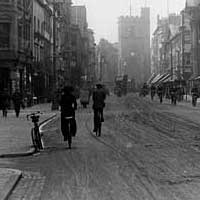
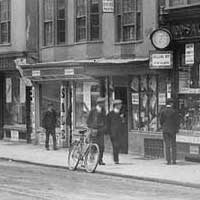
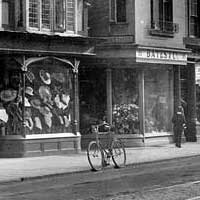
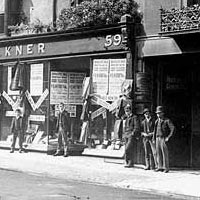
      • Cornmarket 1907
      • Headington Hill 1903
      • Queen Street 1897
    • Research/Sketches
    • Stitched Work
      • Missded 1
      • Missded 2
      • Missded 3
      • Missded 4
    • Text Work
  • Blogs
    • Family History
    • Goethean Observations
    • Grief
    • Light Slowed But Never Stilled
    • Lists
    • Present Empathy
    • Shadow Calligraphy
    • Trees
    • Time
    • Walking Meditations
  • Video
  • Photography
    • Pillars of Snow
    • Creatures
    • The Trees
    • Snow
    • St. Giles Fair 1908
    • Cornmarket 1907
    • Headington Hill 1903
    • Queen Street 1897
    • Travel
  • Illustration and Design
  • Music
  • Projects
    • Dissonance and Rhyme
    • Design for an Heirloom
    • Backdrops
    • Shadow Calligraphy
  • Exhibitions
    • A Line Drawn in Water
      • Artwork
    • A Line Drawn in Water (Blog)
    • Mine the Mountain 3
      • Artwork
    • Mine the Mountain 2
      • Artwork
      • The Wall
    • The Woods, Breathing
      • Artwork
    • Snow
      • Artwork
    • Echo
      • Artwork
    • Murder
      • Artwork
    • The Tourist
    • Dreamcatcher
    • Mine the Mountain
      • Artwork
      • The Tourist
    • M8
    • The Gate
    • Creatures
      • Artwork
    • Residue
      • Artwork
    • A visit to Auschwitz
      • Artwork
  • Me
    • Artist’s Statement

Gardens

August 15, 2014 by Nicholas Hedges

In Camera Lucida, Roland Barthes describes the concept of punctum thus:

“…it is this element which rises from the scene, shoots out of it like an arrow, and pierces me. A Latin word exists to designate this wound, this prick, this mark made by a pointed instrument… punctum; for punctum is also: sting, speck, cut, little hole – and also a cast of the dice. A photograph’s punctum is that accident which pricks me (but also bruises me, is poignant to me).”

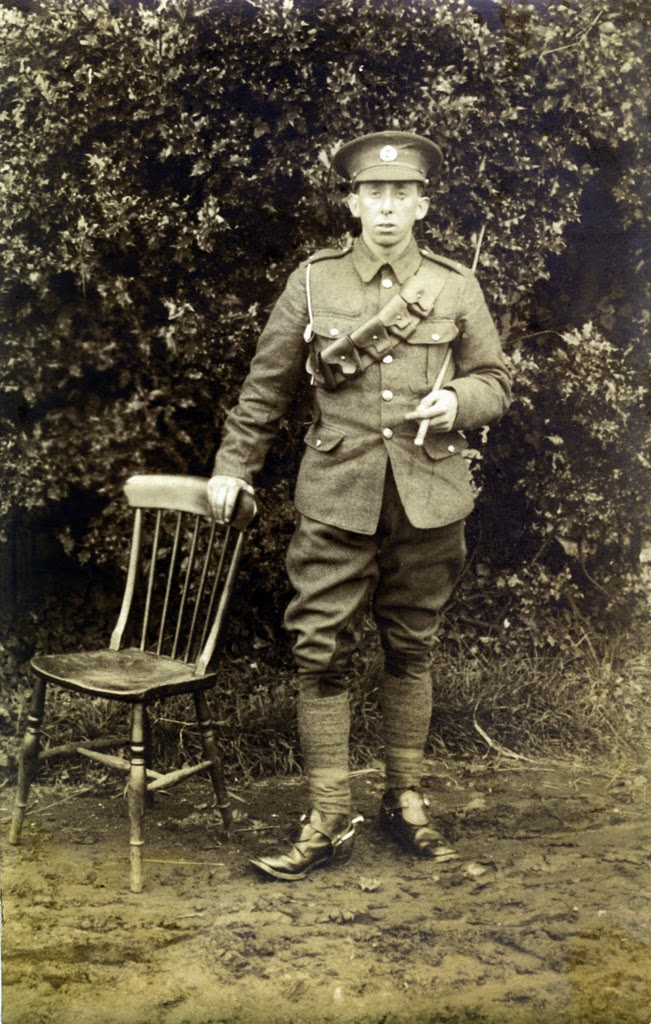
Looking again at the photo of Jonah Rogers, I became aware of something which, as Barthes might have put it, ‘pricked me’.

This is the photo…
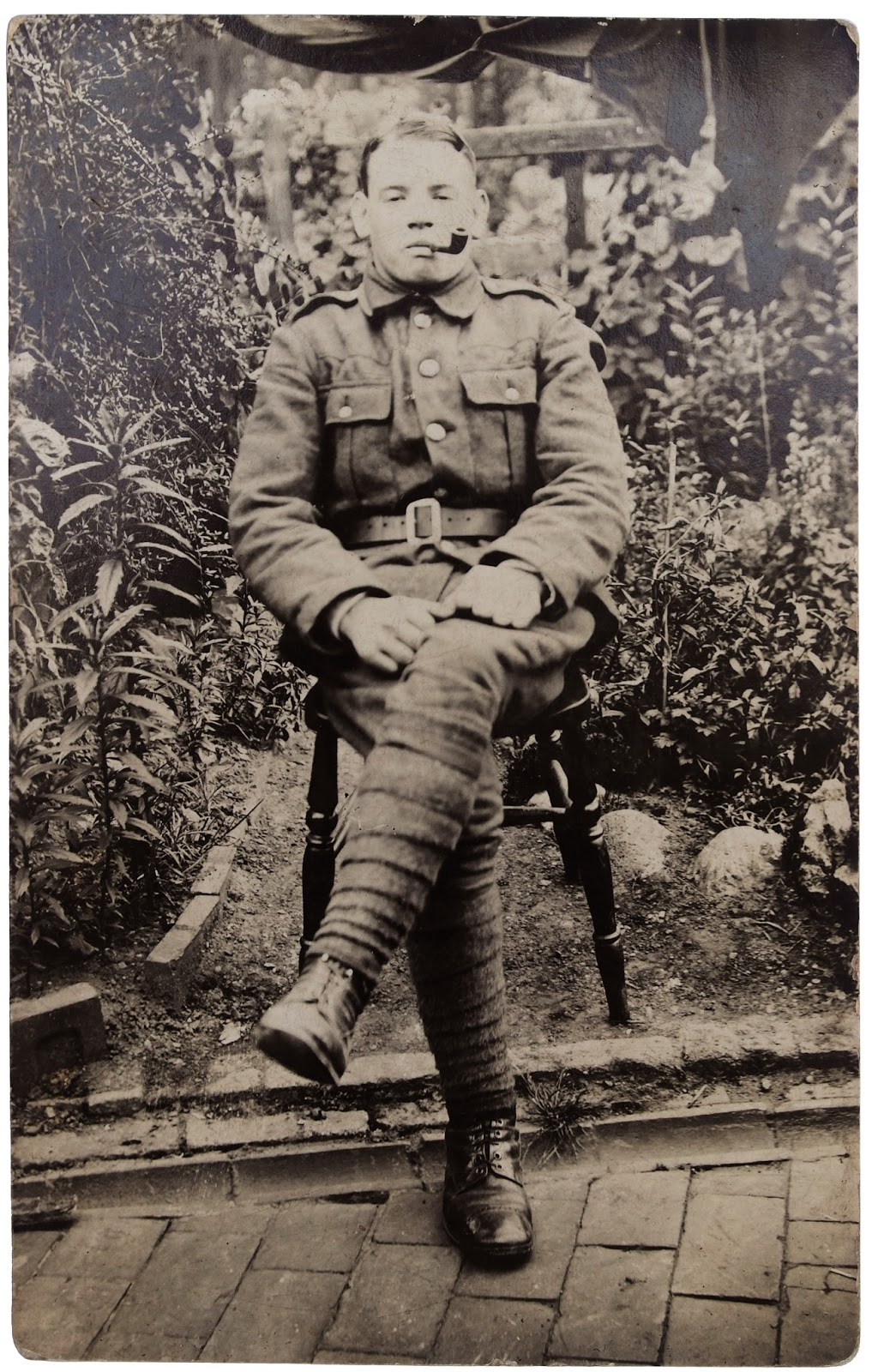
…and here is the ‘punctum‘.
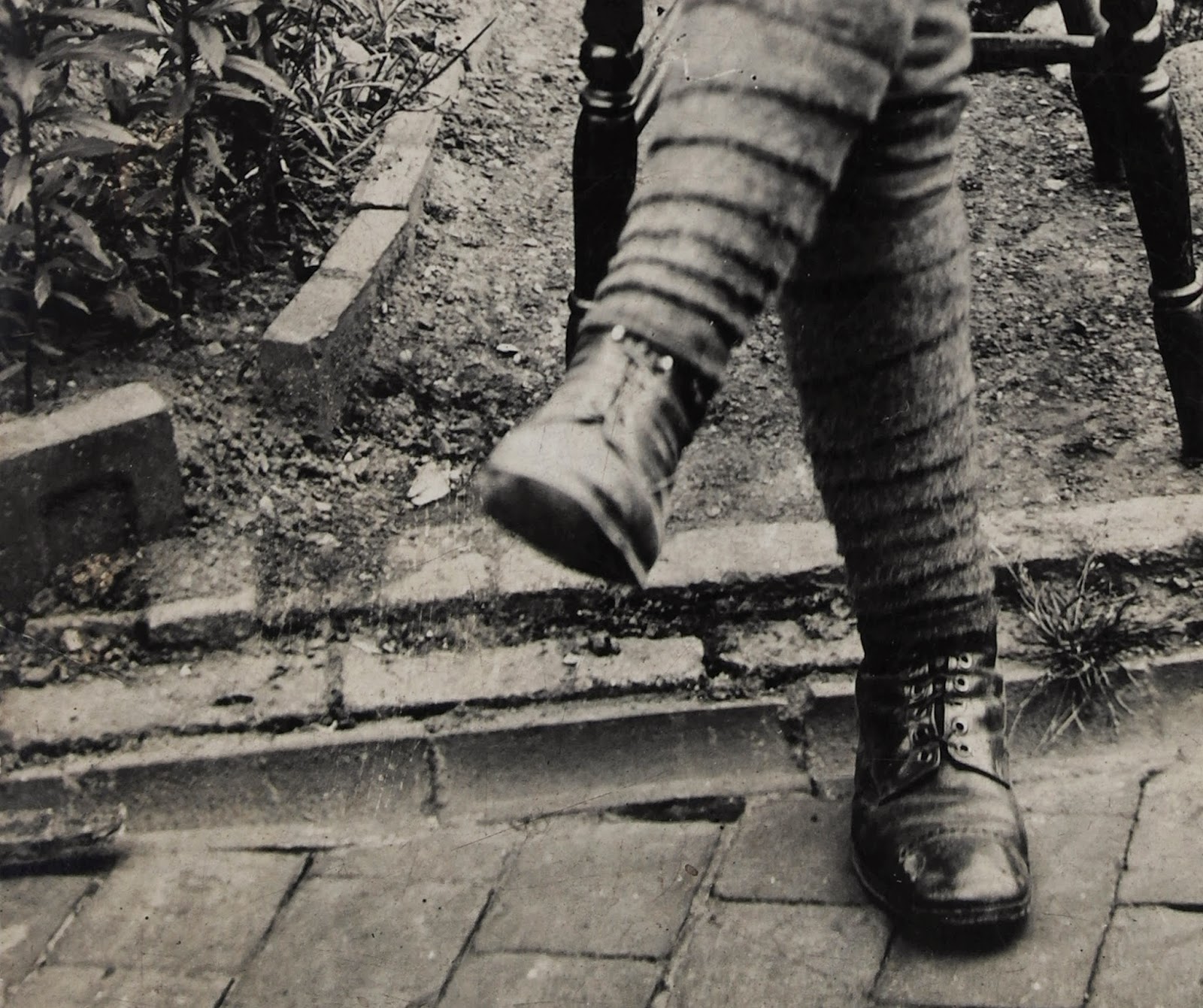
In actual fact there are two things about this detail which interest me.

First, the left foot.

The fact it’s blurred implies that it was moving when the picture was taken. Otherwise Jonah appears stock still, unnaturally rigid, his hands curled into fists on his lap. One detects through this foot a sense of anxiety – not so much because of what he’d have to face on the battlefield, but rather because he was having his picture taken; he doesn’t seem comfortable in front of the camera – his foot is constantly moving. The pipe in his mouth also seems a little incongruous – especially when one considers those clenched fists; his hands look as if they’ve never held a pipe before. It’s almost as if someone has placed the pipe in his mouth.

The second thing is the ‘missing’ brick in the flower bed.

That there must have been a brick implies a passage of time between when the brick was laid and when it became dislodged – kicked perhaps out of place. That brick hasn’t been replaced, the flower bed and path have tumbled into one another and time has fallen from the photograph like the mud and mulching leaves. Or perhaps there was never a brick at all and the gap is some sort of conduit for water – the gutter running across the photograph implies this might be the case. This would still suggest a sense of time bound up in the thinking of whosoever laid the bricks in the garden, and indeed the flow of water itself. Whatever the gap is – drain or accident – both possibilities point to a time before the picture was taken; they give the photograph – to use an apt metaphor – temporal roots.

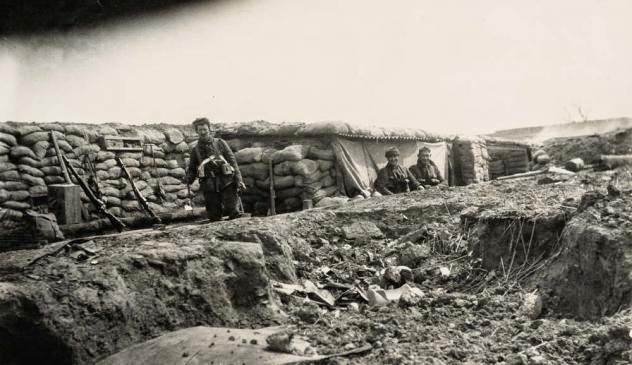
Jonah was killed in 1915 in the second battle of Ypres and I can’t help drawing a parallel between the soil of the garden and the infamous mud of the trenches such as those pictured below in which some of the 2nd Monmouthsires (Jonah’s battalion) can be seen.
This then brings me to the Paul Fussell quote I often return to:

“…if the opposite of war is peace, the opposite of experiencing moments of war is proposing moments of pastoral.”

I have for a time been thinking of the phrase ‘moments of pastoral’ and have come to regard it on a domestic level, i.e. moments of pastoral as experienced in a garden. I have always considered it vital, when establishing an empathetic link with those who died in the war, to consider their lives before the war. As I’ve written in a previous blog:

Neil Hanson, writing in ‘The Unknown Soldier’ talks of how, on the eve of the Battle of the Somme, the smell in the air was that of an English summer – of fresh cut grass; the smell – one could say – of memories; of childhood.

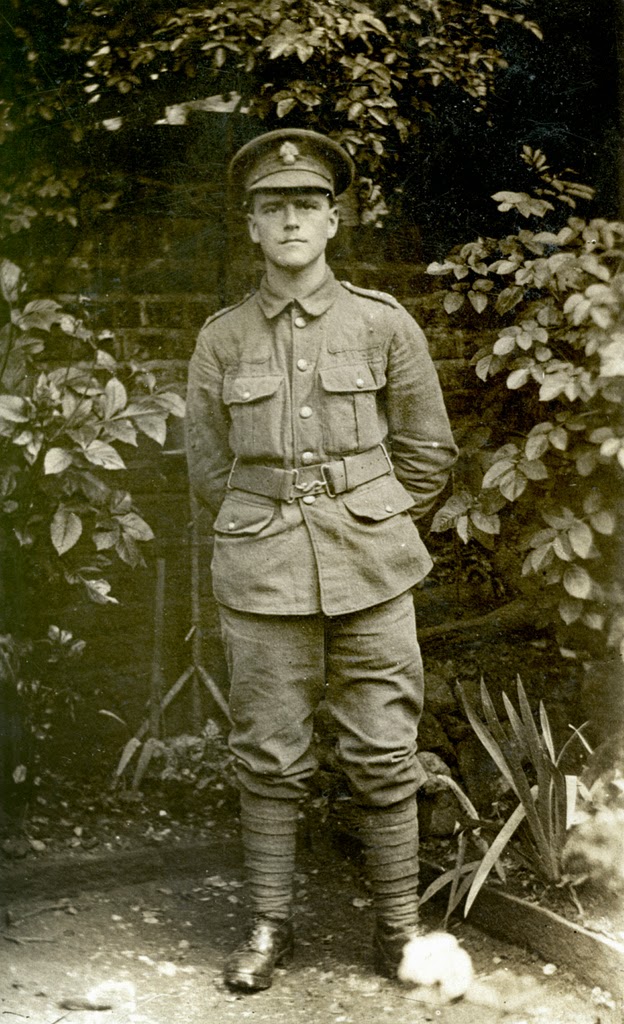
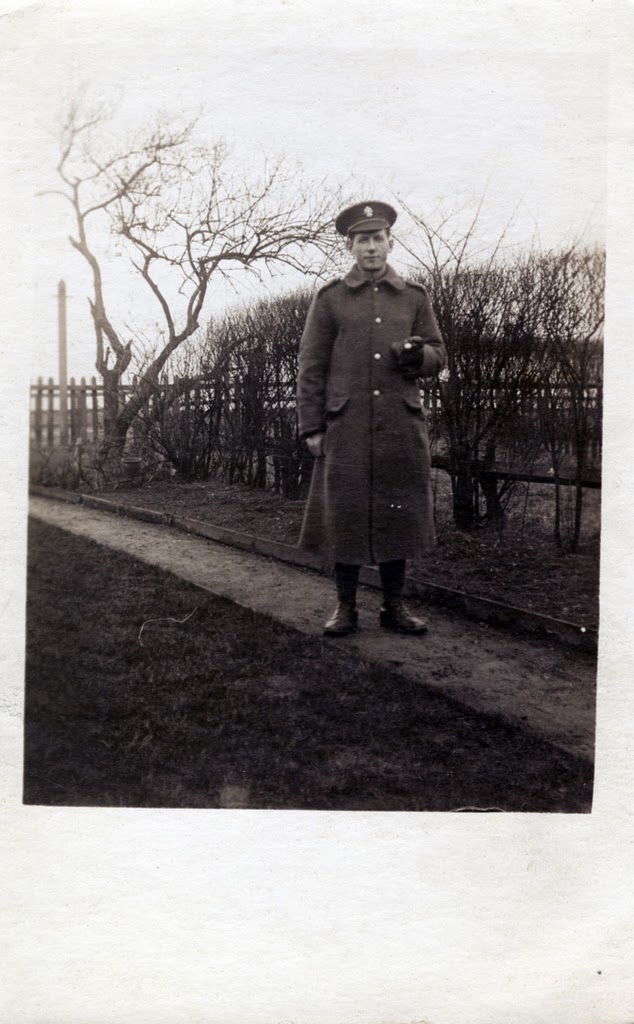
The garden then is a link to a time before the war and again this is reflected in some of the postcard portraits I have in my collection, where soldiers were photographed – prior to leaving – in their gardens.
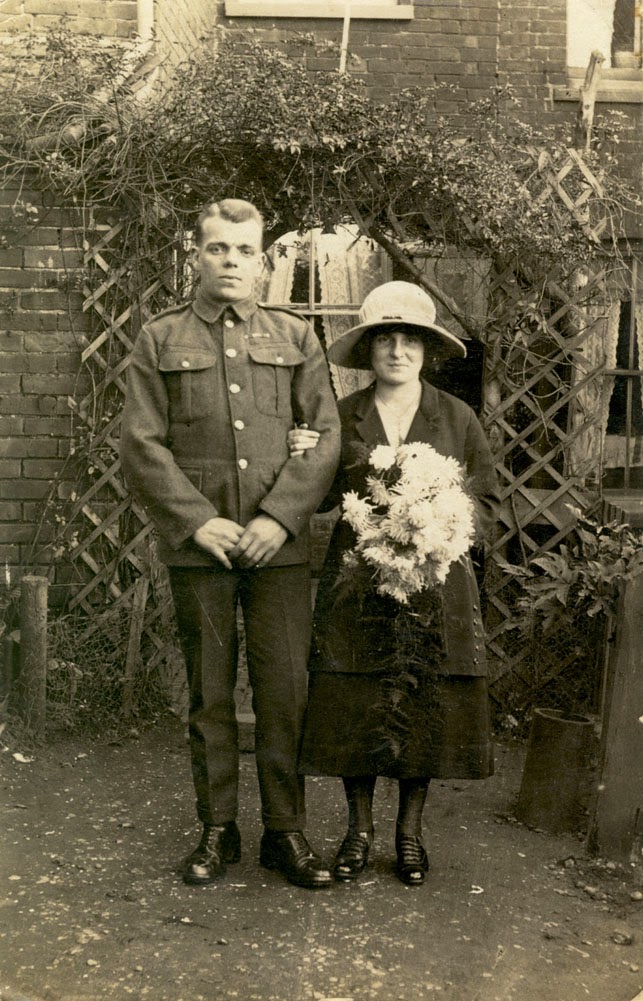
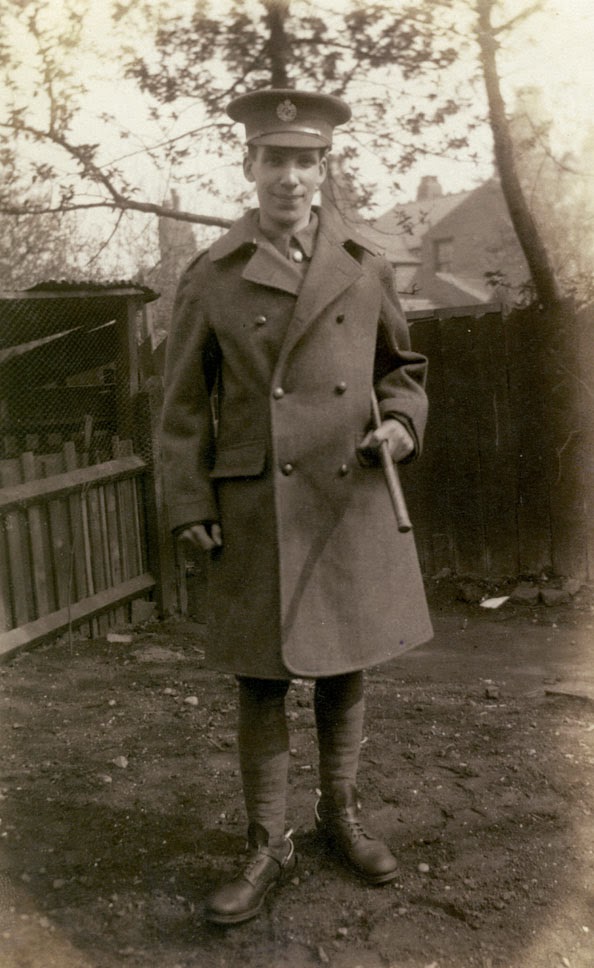
I have always found these images especially poignant and have written about them before but there is something here I want to explore further; that is the empathetic link between ourselves and soldiers who fought and died in the war and the idea of the garden as a shared space of memory and experience, a conduit through which an empathetic link might be established.
Filed Under: Photography Tagged With: Gardens, Jonah Rogers, Pastoral, Photographs, Roland Barthes, WWI, WWI Postcards

Maps: A Unifying Aesthetic

May 11, 2012 by Nicholas Hedges

For some time I have been searching for what one might describe as a unifying aesthetic; a process for creating a work with an aesthetic appearance which serves not only to appeal visually, but which also conveys meaning.

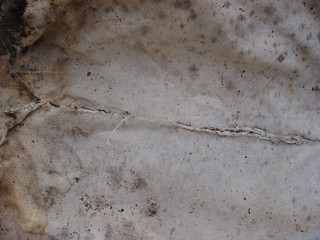
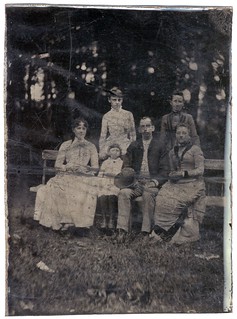
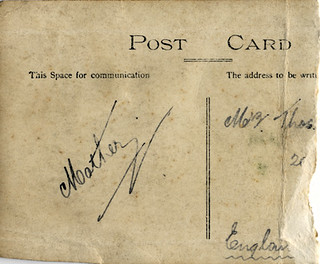
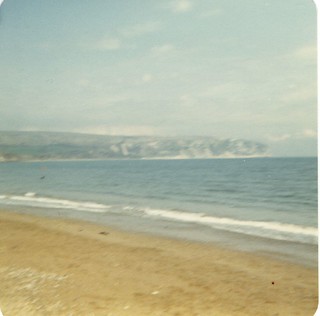
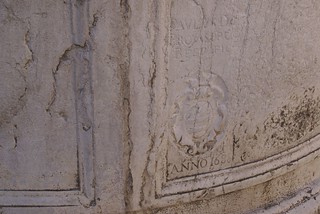
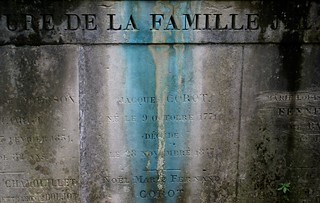
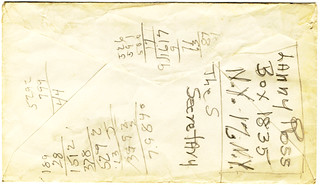
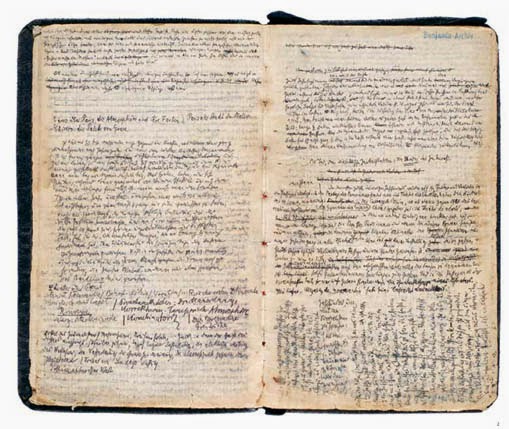
There are numerous things which appeal to me aesthetically such as (in no particular order); palimpsests (sheets of paper or parchment where words are erased but never completely and over which new text is added, to then be erased and so on), notebooks (such as those belonging to Walter Benjamin), patched up papers, maps (like old trench maps), lines (like scratches on surfaces or pencil marks), poster sites (where the posters have been pasted one on top of the other and ripped), drips and splashes of paint, blurs, text in paintings (particularly pencil), stains, things faded, fragments, old writing and so on.

Some examples of what I mean:

The Exercise Yard
The Exercise Yard
Lanzarote
Sicily

Trench Map 1916
Bartlemas Chapel Excavation

Untitled

Tintype - Family Group

'Mother'

Dorset 1983

Warsaw

Venice

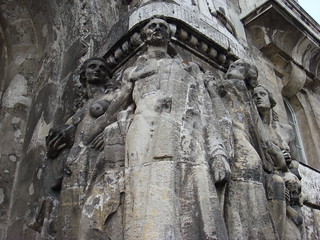
Pere Lachaise, Paris

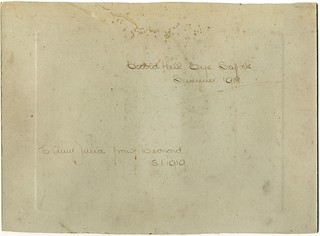
Letter to Ray 1953 (Reverse)

House (Reverse)

Budapest

My work is about time, life, death and memory. It is concerned with empathy and in particular empathy as  an ever expanding dialogue between bodily experience and knowledge. But what form should my work take to encompass all these things?

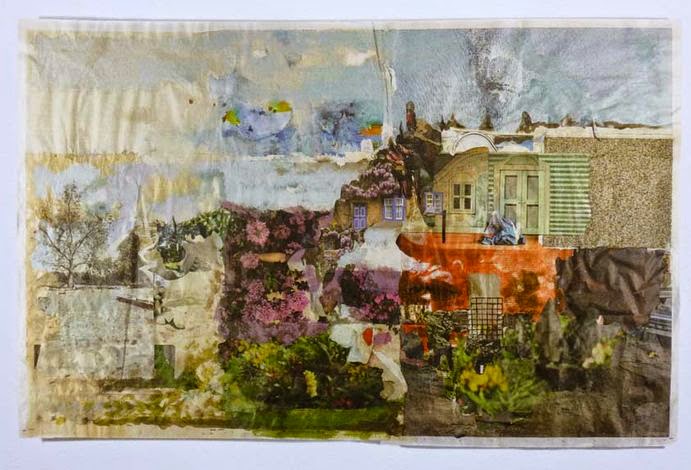
It was whilst in Edinburgh with my fiancee, that I began to find that form. It started with an exhibition of work by Tony Swain, who uses text as a source for his work, not so much in terms of the words, but in the substance on which they’re printed; in his case, newspapers. What I liked about his work in particular was its organic quality, the fact that it could be expanded, new sheets added to create large landscapes such as that below.

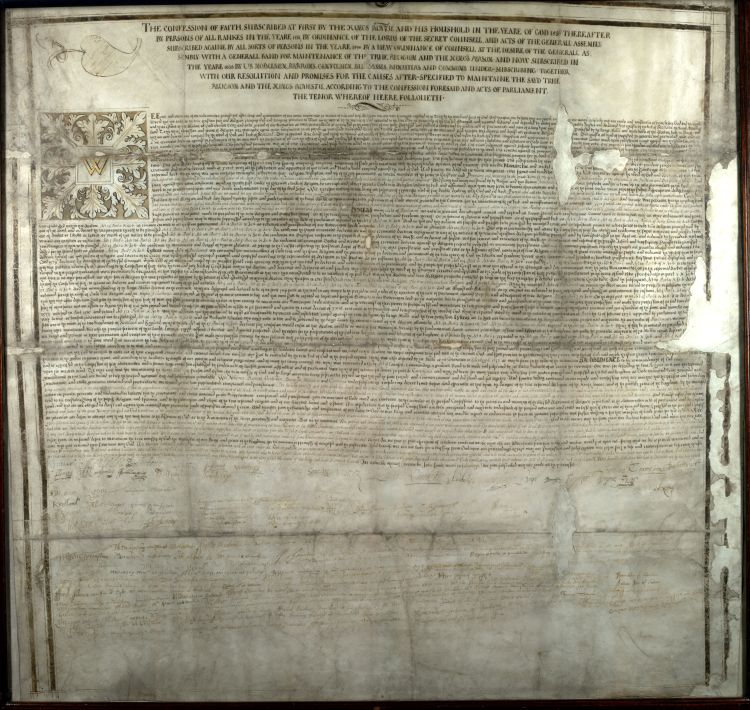
Then whilst visiting St. Giles church in Edinburgh, I saw the National Covenant on display; a 17th century document which I found – aesthetically speaking – quite beautiful. Comprising a large sheet of parchment, one could see the folds and also patches of parchment which had been added to the main sheet. The different sizes of writing also appealed, just as they do in notebooks – such as those of Walter Benjamin.

A version of the covenant can be seen below:

When I bought a World War I trench map a few months ago, I did some observation work on it and wrote the following regarding the way it had been folded:

“It doesn’t resist being folded again. First vertically and then horizontally.

I unfold it and instinctively flatten it down. The folds in places rise up. The fold which runs vertically through the red lines does especially. This part of the map won’t remain flat unless I press it down with my hand. As I do, my head instinctively lifts a little and my eyes move along the lines of red to rest around the village of Thiepval.

These actions would no doubt have been repeated in the past when the map was perhaps more pristine – when the folds were sharper and the map lay flat.

The map, when I lift it up, seems to want to fold into a particular shape. It doesn’t want to be put away, but rather be folded so that two columns remain in view. The folds which delineate this part are a darker brown than all the others. In this section of the map is a concentration of red lines and blue lines.

The way it folds suggests that this was what was most important. When I pick up the map to fold it completely, it folds so that the ‘front’ and ‘reverse’ are tucked away. The front now is one of the segments or ‘squares’ containing French words (Sondage) and their English equivalents (Boring – as in cut).

The past movements associated with this map are therefore recorded in its folds. It resists being folded any other way.”

The last line is particularly important. Empathy is an emotion felt with the body, requiring an embodied imagination to articulate the dialogue between bodily experience and knowledge. The folds in the map enable me to record the sense of past movement in a two dimensional space. And creating a kind of map allows me to explore the past in terms of its being a place. When I was a child, history was very much a way into a place, a world of woods and forests untouched by the mechanised age. Text was therefore a precursor to what would eventually emerge as an image and the two would often combine on the maps I created.

Creating some kind of map is what I want to do, but a map which evolves, that’s organic, which changes continuously.

Filed Under: Artist in Residence Tagged With: Artist in Residence, Australia, Maps, Photographs, Textures

Empathy and the First World War (Part 5)

March 10, 2011 by Nicholas Hedges

The backgrounds of these postcards have become of great interest to me in as far as they help elicit a sense of empathy with those who are pictured. Some of the postcards feature no backgrounds at all and are simply headshots which make an empathetic response a little more difficult. What I want to look at here are natural and studio-based backgrounds, examples of which can be found below.
I’ve already looked at two postcards with photographs taken in natural settings and these settings can be further subdivided into those which are domestic and non-domestic. It’s those taken in what are clearly domestic settings – for example the backyards of houses – which are the most poignant, for the obvious reason that they are photographs of homes these men would soon be leaving. And again the question begs to be asked, would they ever return?
This photograph is clear

Filed Under: Photography Tagged With: Empathy, Photographs, Vintage Photographs, World War I, WWI, WWI Postcards

Empathy and the First World War (Part 5)

March 9, 2011 by Nicholas Hedges

The backgrounds of these postcards have become of great interest to me in as far as they help elicit a sense of empathy with those who are pictured. Some of the postcards feature no backgrounds at all and are simply headshots which make an empathetic response a little more difficult. What I want to look at here are natural and studio-based backgrounds, examples of which can be found below.

I’ve already looked at two postcards (see Part 3 and Part 4) with photographs taken in natural settings and these settings can be further subdivided into those which are domestic and non-domestic. It’s those taken in what are clearly domestic settings – for example the backyards of houses – which are the most poignant, for the obvious reason that they are photographs of homes these men would soon be leaving. And again the question begs to be asked, would they ever return?

This photograph was clearly taken in a back garden, one which seems to comprise little more than dirt. In the background, the backs of other houses are visible and next door appears to have what looks like a chicken coup, with chicken wire fixed above the fence. What is striking about this image is the cleanliness of the soldier’s uniform. His coat is spotless; it’s almost as if this young man is little more than a child playing soldiers in the garden, and it’s difficult to look at him knowing full well what he’s about to endure.

I’ve already discussed windows in old photographs and in the background of the image above one can see a window of one of the houses behind.

I wonder what the same scene would be like if I was standing behind, looking through the net curtains? I’d see the back of the young man being photographed and those who are taking the picture – more proud parents perhaps? I’d watch for a while, then turn my back and return to my own life within the terraced house. It’s imaginative wanderings like this which serve to animate the scene, to remind us that the past was once ‘now’.

I imagine this photograph was taken in the garden of the soldier’s parents’ house. I can imagine them holding this image, just as I’m doing now and walking outside to see that corner of the garden in which he’d been standing. The dilapidated fences, the dirt ground, the trees and the houses behind would all resonate with his presence. If I walk outside into my own garden, with this image in my hand, everything that makes ‘now’ what it is, would serve to animate it. The feel of the wind, the sounds of the birds in the trees, the feel of the ground beneath my feet etc.

This photograph was obviously taken in a studio and whereas in the previous image the backdrop is a real scene, the one above is like something from an 18th century painting. In the foreground we can see bunches of wild flowers growing alongside a quiet country track, leading off through an idealised landscape complete with ‘Rococoesque’ trees, a river and a picturesque bridge. One almost expects the solider to turn away from the incongruous chair and to walk off up the path and out of sight.

With the first image, the domestic backdrop of a garden, its fences, the chicken coup and the backs of neighbours’ houses provides a stark and disturbing contrast with what we know awaited the young man being photographed. This contrast is just as stark in the studio picture above, and in some respects even more disturbing.

Whereas the fictional scene could at least be imagined by the artist, what the man standing before it was about to face on the battlefield would never have been conceivable even with the keenest of imaginations. Reality was in a way even less real than this Arcadian backdrop which seems to depict something akin to Paradise. Perhaps this is why I find this image so haunting?

The reverse of the postcard contains text which reads: To Mr J Wade, With happy memories of past days spent at Waresley House. 

I did some research into Waresley House and discovered that it was once the home of both the Peel family (Robert Peel) and the Perrins family of Worcester Sauce fame. A large Georgian pile, I wondered what the soldier did there, who Mr J Wade was and whether or not he was the owner of the house. Having looked at the 1911 census however, I could find no record of Mr Wade. The house was owned by a Mr Gibbons, an 87 year old widower who lived there with his two daughters (both single and aged 49 and 47) and nine domestic servants.

It is possible that Mr Gibbons died soon after 1911 and that Mr Wade took over the house thereafter. Looking for Mr Gibbons on Ancestry, I found him in the same house in 1891 along with 13 children. The cook in 1911, Mary Pugh was also listed. 

Filed Under: Photography, Trees Tagged With: Empathy, Photographs, Vintage Photographs, World War I, WWI, WWI Postcards

Empathy and the First World War (Part 4)

March 9, 2011 by Nicholas Hedges

Another postcard from my World War One collection:

It’s a rather faded image but we can see that it shows a man standing outside a gate to what looks like the back yard of a house. Like the previous image (see Part 3) the man is dressed in his uniform, ready to head off to war. Or perhaps he’s returned, on leave maybe, about to go back to the Front? We’ll never know, but looking at his face, there’s something about his expression which looks weary at the very least. Of course this is probably reading too much into the picture, but there is something about his face which makes me wonder. To make it easier to see, I’ve enhanced the image a little:

Detail of the soldier’s face:

Like the previous postcard, I can well imagine the scene without the soldier standing there; the feel and the colour of the ivy, the bricks and the old, rather battered door. My imagination colours the image, and through this colouring, the textures of the bricks and the door become apparent. And like the other postcard, it is in itself a tactile object which speaks of the soldier’s absence more than his presence – after all, a postcard is a form of communication sent by someone who is, at the moment, absent from the life of the receiver. Turning it over and looking at the reverse, I could see that it had been addressed to a Miss V. J. Edwards. I wondered if she was the man’s fiancee, but looking at his hands, I could see that he was wearing what appears to be a wedding ring. And again the hands are like those I’ve discussed previously (see Part 1 and Part 3).

Could Miss Edwards be his sister? As I hold the postcard, and turn it over in my hand, I find myself performing an action she herself would have performed. What would she have thought as she read the rather enigmatic text?


1919 16.Puzzle BLA.

I’m assuming that the number at the top is the date (1919) which means we can perhaps also assume the soldier on the front survived the war. Was the photograph itself taken when the war was over? Would that account for his rather tired expression? It seems unlikely, and given the rest of the text, it might be that this isn’t the date at all. Sadly, the franking mark on the stamp isn’t clear enough to tell. What does 16.Puzzle BLA mean? Is it No.16 in a series of puzzles? Is BLA itself the puzzle – a secret code shared between the two; between the soldier and Miss Edwards? Interestingly, in the image itself, we can see in the bottom left hand corner, a notebook on a wooden bench. Did the soldier conceive his puzzles within its pages?

 
A hand rolled cigarette lays next to it, and the two together serve to animate the image – or rather the soldier in the image; I can picture him smoking, writing in his notebook, in a hand like that on the reverse. Holding the postcard and reading it, I can also ‘animate’ the person to whom it was sent.

With this single image then, a relationship long forgotten has been re-established.

Filed Under: Photography Tagged With: Empathy, Photographs, Vintage Photographs, World War I, WWI, WWI Postcards

Empathy and the First World War (Part 3)

March 8, 2011 by Nicholas Hedges

It’s hard to tell where this image was taken, whether in a garden or a public park, but clearly it shows a young man in his new army uniform about to head to war.  He stands to attention, albeit somewhat awkwardly, staring into the camera – almost through it, into the distance. I wonder as I look at him who is on the other side taking the photograph? A proud parent perhaps, an anxious one? A friend or maybe some other relative? The young man in question would, I imagine, have left soon after the image was taken and the question is there to be asked: would they – whoever it was – have seen him again? Behind him a tangle of brambles foreshadows the barbed wire entanglements laid out in front of the trenches, wire on which so many like this young man lost their lives.

As with the previous images I’ve discussed (see Empathy and the First World War Part 1 and Part 2) I’m interested in how I can find a way of empathising with this individual, a young man whose name has been lost and who, for all I know, exists only within the image on this postcard. The difference between this ‘image’ and those discussed previously are that this is a physical object – a postcard; one of a number printed as keepsakes. However, as I look at it, I try as I do with other photographs to imagine the moment in which it was taken. I imagine the click of the camera , satisfied comments from the photographer, after which the young man picks up his cap, puts it on and walks off down the path. The crunch of footsteps dissipates along with the voices and I am for that moment left standing looking at the brambles and the undergrowth.

For some reason it’s hard for me to visualise this young man in colour – there’s something in his face which prevents me from seeing him talk. But without him there I can picture the rest of the scene easily enough in colour; I can see the colour of the bricks, the undergrowth and the path. I can see the leaves move and then imagine myself moving, turning and seeing people walking in the distance. I can hear sounds – birds and so on, perhaps because I can hear them outside my window on what is a beautiful spring-like day. It’s a photograph which depicts the presence of the young man in the picture and yet speaks of his absence, which is of course hardly surprising given that it was taken almost 100 years ago. Whether he survived the war or not he’s going to be absent from the world today.

The way in which I hold the postcard and look at the image is important, for it no doubt echoes that of those who knew him, who whilst he was away looked at the image and remembered their friend or loved one; someone who was present in their minds and yet absent from their immediate world.

On the reverse are the words ‘POST CARD’ and a ‘T’ shaped divide between correspondence and address. The postcard itself is blank, save for the 15p pencilled in the corner – the apparent monetary value of the image. I’ve worked before on the idea of the ‘T’ shape as being like a makeshift grave-marker and having looked at the photograph on the other side and having imagined him walking away – leaving just the image of the brambles – it becomes all the more poignant. There is no message, no address. Just ’15p’.

When looking at the previous images (see Empathy and the First World War Part 1 and Part 2)  there was one moment with which I could attempt to empathise – that being when the image was captured, but with the postcard there are many more which I can narrow down to two, one specific, the other more general. The first of course is again when the image was taken, the second an amalgamation of all the times it was handled, held between two hands just as I’ve been holding it today. The postcard, as an object, fits physically into a sequence of ‘gestures’, a moment in which the stark boundary between now and then – as described when a photograph is taken – is blurred. Empathy in this respect is not necessarily with the young man, but with those who remembered him; not with the man within the image, but with those who held the image.

Thinking about my hands holding the postcard, turning it round now, I find myself looking at the young man’s hands hanging at his side. They remind me of the hands of the corpse in the first image I looked at (see Part 1) and again an empathetic link is established. I wrote earlier how I found it hard to imagine his face moving in any way – it seems definitively frozen by the camera – and yet looking at his hands the opposite is true. I can well imagine them twitching nervously, unsure of what to do as he stands to attention.

I think too of the grass in the second image (see Part 2) growing over the turned earth and can well imagine the brambles behind the man doing the same.

I’ve written before how empathy is a kind of feedback loop, where our own bodily experience is influenced by our knowledge and vice-versa, growing all the while so that bodily experience influences knowledge whether, in the case of this subject, standing on a battlefield or looking at a photograph. I can see this loop working as regards the images I’ve discussed so far, how empathy accumulates slowly over time.

Filed Under: Photography Tagged With: Empathy, Photographs, Vintage Photographs, World War I, WWI, WWI Postcards

Empathy and the First World War (Part 2)

March 4, 2011 by Nicholas Hedges

This image was taken almost a year after the end of the First World War, on August 27th 1919 and is unusual in that, unlike the vast majority of photographs from this period, it’s in colour. What it shares with the image I described previously however – see Empathy and the First World War (Part 1) – is that it shows the process of burying the dead, long after the last guns have fired. We don’t see any corpses here, but we see the holes in the ground. On the right hand side, three crosses mark recent burials, while seven men look at the camera. A man sitting down by the tree seems to be writing.
With this photograph I can, perhaps not surprisingly, engage much more easily on an empathetic level compared with that I discussed previously. The colour and the texture of the soil, which the colour conveys, means that I can almost feel the ground. I can imagine walking into it, whereas with the previous image I’m kept at a distance. This photograph is about the soil and if the previous image seemed to me, to be about the thin divide between life and death, this image seems to say much the same thing. Like the (living) men in the previous image, these men are also all dead. The graves they’ve dug could easily be their own. But whereas the men in the previous image were looking at the bodies of their fallen friends, the gravediggers in this image, look directly at us. This is what awaits us all.

In many respects then, this image is, for me, quite an unsettling one – even more than that I discussed before. ‘The men that we’re about to bury,’ the men seem to be saying, ‘are just like you’. (I was reminded, looking at this image, of the fact that when soldiers marched to the front, just before an attack, they sometimes saw the huge pits dug in preparation for their deaths.)

But would such interpretations arise if the image were black and white? My feeling is they wouldn’t and having made the image monochrome, I can see why.

For one thing, it ceases to be an image into which I feel I could step; it remains very much an image. Colour delineates distance, whereas in black and white the image seems a lot flatter. (I have to point out that I’m not suggesting black and white photos don’t convey distance, or that this colour image, made black and white accurately reflects how it would look if shot on black and white film. The autochrome process, when made black and white like this, makes the resulting image very grainy). Secondly, the men no longer seem to be looking at me, but rather at the photographer. But most importantly, as a black and white image, this picture ceases to be about the soil, the substance which, during the war claimed both the living and the dead. The distinction between the soil and the grass is lost – a distinction which, in light of the time (1919), is especially poignant. Nature returns to reclaim what’s hers, and following the gaze of the diggers, that includes us. World War I was about, amongst many other things, the soil and vast ruination – and that is what this image is about. The grass comes as it comes upon castles ruined over long stretches of time. But as Christopher Woodward writes in his book In Ruins ‘Nature’s agent does not have to be flowers or fig-trees. In the case of Van Gogh, it was the miserable mud of Flanders.’

I see this photograph very much in terms of its texture. I see its weight, as if its colour makes it synaesthetic: I see in terms of touch. Empathy – as regards an empathetic understanding of this image – does not mean I empathise with what these men were doing when the photograph was taken, or what they too had certainly endured in the preceding years of war, but that I can see this moment as having once been now. As I wrote before, if anything hinders an empathetic engagement with the war, it’s the sense that it’s always already happened. In this image, it has already happened, but the wounds are still raw.

Empathy is a dialogue between bodily experience and knowledge. Visiting a battlefield, what we know of the war influences our bodily experience and vice-versa. Empathy is in many respects articulated through metaphor. The same is true of the photograph; but whereas on a battlefield we stand in the landscape, we can only look at the image, such is where a synaesthetic response is so important, and synaesthesia is after all a kind of metaphorical discourse.

Filed Under: Photography, Trees Tagged With: Colour, Empathy, Photographs, Vintage Photographs, World War I, WWI, WWI Postcards

Empathy and the First World War (Part 1)

March 4, 2011 by Nicholas Hedges

Windmill Military Cemetery, Monchy le Preux, east of Arras, 1918

This image was taken during the last months of World War I and shows a scene which became all too common during the long and bloody years it lasted. The four men at the back, almost silhouetted against the grey sky, locate the image in its context, reminiscent as they are of the lone figure in Ernest Brooks’ photo taken on Pilkem Ridge near Ypres in 1917.

The shadow figure of a survivor reflecting at the side of a grave is the image of the Great War and while these men are not quite silhouettes, they are nonetheless unknowable, just like the dead next to whom they stand. In Brook’s iconographic photo the silhouetted man and the corpse are one and the same thing, as if the dead man’s shadow, is for a time, living a while longer. There is then little to divide the four men and the two on either side from those over whom they stand, just as throughout the war, the gap between life and death could be measured by the thickness of a cigarette paper.

In the image from the Windmill Military Cemetery, over a dozen men await burial, some with makeshift crosses on which their names and dates of death would have been inscribed. Behind the men, crosses planted in the ground, stand like a wood, broken into matchsticks by the relentless pounding of shells. Everything in this image has been reduced. Men have been reduced to corpses, corpses reduced to names, the landscape reduced to ruin. On top of it all, the whole scene has been reduced to a picture; time itself reduced to a moment. There’s no colour and little by way of life.
An area in which I’ve become particularly interested as regards historic trauma and in particular, World War I, is our ability to empathise with those who suffered. If anything hinders an empathetic engagement with the war, it’s the sense that it’s always already happened, that its victims have always been dead. Reminding ourselves that the past was once the present, through an awareness of our own contemporary experience, is a vital part of the empathetic process. In this image we see a number of men. Those who ‘live’ within the image we know are now dead. Those who are dead, seem always to have been so. So how can we empathise with an image such as this; an image which is very much of its time and very much removed from our own?
The bodies are clearly dead, but the difference between them and the six men surrounding is, as I’ve said, slight. Looking at the hand of the body in the bottom right hand corner of the image, I can easily imagine how it once moved, once wrote a letter to a loved one back home, one touched a loved one, held a cigarette or a pint of beer.

There is something about it that’s painfully alive, as if it reminds us, that this photograph is a moment in time behind which there were many more moments, that those who died lived as we do today. Beneath the crosses in the background are many more bodies, of men who once lived. Their presence, or rather absent-presence, extends well beyond the limits of the moment, just as the landscape extends well beyond the limits of the photograph.
A photograph is captured in an instant and yet we ourselves are rarely aware of an instant in time. Of course we are aware of time passing and the difference between now and a few moments ago, but the moment we experience as ‘now’ is smudged to take in a part of the past. And of course, within our bodies, we carry our entire past, albeit one accessible only through the fragments of what we can remember. When a photograph is taken, the difference between the past and the present in which it was captured is much more stark. The shutter is like a knife, cutting one away from the other. But through thinking about ourselves and our own experience of the world, that sharp edge can be softened.
In an image like this, that process is made more difficult, not only because it was taken so long ago, but because what it depicts is so far beyond our own understanding. But the hand of the body I’ve described helps us bridge the divide. It’s something with which we can all easily identify; a way, albeit small, in which we can begin to empathise. 

Filed Under: Photography Tagged With: Empathy, Photographs, Vintage Photographs, World War I, WWI, WWI Postcards

Windows, Bicycles and Catastrophe

January 9, 2011 by Nicholas Hedges

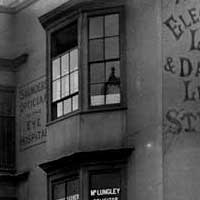
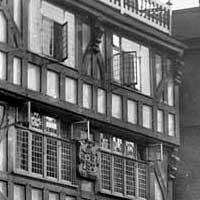
Windows in images are, as I’ve discussed previously, evidence of people living their lives without a thought for the subject or subjects in the photograph. This entry examines a number of details taken from photographs of Oxford at the beginning of the 20th century.

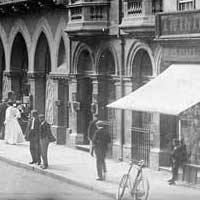
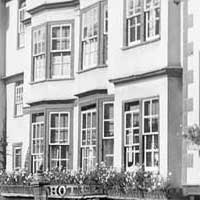
This detail below, from a view of the High Street taken in 1907, shows the open windows of what was then the Mitre Hotel.

Perhaps these windows were opened by guests visiting the city over 100 years ago, or perhaps by maids in preparation for their visit. But what was taking place behind these windows when the photograph was taken? What conversations were being had? As I’ve said above, whatever they were and whatever was happening within, the open windows serve to give life back to a place from which the photograph was taken. The rooms become portals to unseen parts of the image, not just in the rest of the city, but rather the wider world. It is perhaps then, rather appropriate, that this image shows a hotel.

The image above, taken from a photograph of 1909 (amazing how we can just skip a couple of years) is particularly interesting, in that as well as being open, we can also see clear reflections within the window’s glass. This window serves again to take us beyond the boundaries of the image, into its hidden interiors, from where we might look upon that view reflected in the window. The same can be said to some degree about the image below, also from a photograph of 1909.

As an aside, it’s interesting how these two images, because they were taken in the same year, constitute in our mind’s eye a single moment; the year (in this case 1909) becomes just that – a moment in time. But what period of time separates the photographs from which these details are taken? Is it minutes, hours, days, weeks or several months? What happened between the taking of one picture and the other?

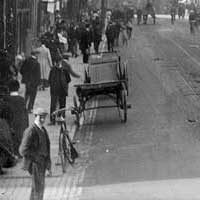
In the detail below (from a photograph of 1907)  my eyes are drawn to the the bicycle; not the make or the style, but the way it seems to reveal the presence of time, or rather an inconsequential moment in time. For me, it’s in these everday, unremarkable moments that the past is revealed – where history really comes alive.

Of course the man in the foreground looking at the camera, and those people walking up the High Street are subjects of a particular moment (cameras are, Barthes beautifully put it, ‘clocks for seeing’), but there’s something about the bicycle which expresses it better. Below is another a detail from a photograph of 1911. Taken again in the High Street, a few metres back from the one above, Carfax Tower in visible the distance.

In the image below, something in the window of a shop on the High Street in 1909 has caught they eye of the man looking in as well as the two men walking towards him. The man with his hands in his pockets also describes a specific moment in time; the way he’s standing seems to suggest that he’s just that second stopped; something very different to being ‘stopped’ – as in the case of the two men walking – by the shutter of the camera. But again it’s the bicycle parked at the side of the road which, for me, best describes the moment; or more accurately, its continuity – its place in a passage of time. Even though the two men walking have clearly come from somewhere and will no doubt go somewher else, the bicycle is still much the better way of representing a moment within the passage of consectuive moments, both before and after.

But why is this the case?

One might assume that in a photograph there’s no better means of indicating someone’s presence than someone’s image. The detail above shows such a person on the right. But somehow, the bike and the absence of its rider are more indicative of presence than the man we can actually see, just as it is – as I’ve described above – a better indicator of a single moment in a wider sequence of moments.

In Camera Lucida, Barthes writes:

“I observe with horror an anterior future of which death is the stake… I shudder… over a catastrophe which has already occurred. Whether or not the subject is already dead, every photograph is this catastrophe.”

Forgetting the bicycle for a moment and looking instead at the man in the photograph, one knows that he is dead. His frozen pose alludes to this anterior future of which Barthes speaks. He also writes:

“In the photograph, Time’s immobilisation assumes only an excessive, monstrous mode: Time is engorged…”

The idea of time engorged conjures up apocalyptic images of disaster; Time not able to proceed but growing nonetheless, swelling within the frame of the picture, the world shaking as it struggles to chew and to swallow. The man in the picture above must and will fall victim to this catastrophe (he must and will die), but the man who’s left his bicycle (and as such the photograph) will instead be sure to survive.

I’d assumed it was the act of leaving the bicycle which gave the bicycle its status in the photograph; the fact that whoever left it would be sure to return and pick it up in a matter of seconds or at most minutes; that it was the idea of these few moments which countered the blurring of time I described above (where entire years can implode to fit the space a second – which itself alludes to the idea of engorged time). But in fact, I believe it’s the rider’s escape from the photograph which instills in them – the bicycles – their appeal to the viewer.We know the rider must be somewhere and it’s as if he’s still there; as if the moment from when he left his bike (for example in 1909), to picking it up again is still ongoing.

The detail above is taken from a photograph of Cornmarket in 1889. Looking at the entire image, one can see that all the buildings shown have since been demolished, and as sad as this is when one sees what stands there now, one doesn’t find it hard to imagine. Buildings are demolished all the time – it’s a fact of life. But when looking at the detail above, with its open window, it seems less conceivable that it’s since been destroyed, that it no longer exists.

Such a thought doesn’t occur however when I look at images of people.

The image above is a detail from the same photograph. Like the building they stand against, all these men are gone. But this, unlike with the detail of the window, does not strike me as inconceivable in any way; quite the opposite. Perhaps it’s the open window which makes the building’s demise (or non existence) seem so unlikely. The open window is indicative of life, of the everyday aspect of life. Who would open a window in a building set to be demolished? But then, who would dress and pose for death?

Above, Cornmarket 1907. Another rider has escaped impending disaster.

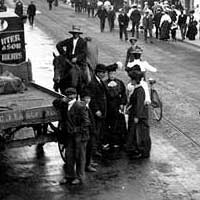
Also Cornmarker 1907. A group of people talk at the southern end, nearest to Carfax. Their clothes (particularly those of the women) position them unequivocally in the time in which they lived.

A number of questions come to mind as I look at them and the scene around them. What are they talking about? What were the hot topics of the day? Where is the woman pushing her bike? (Wherever it is, it’s too late to escape the imminent catastrophe). In this image however, that which captures my interest above all is the rain on the pavement.

Just as shadows give life to a photograph (without the sun beyond the frame of the photograph there can be no shadows within it) so puddles and reflections on wet pavements point to a time before the photograph was taken and, – like shadows with the sun – to the clouds above and beyond the gaze of the lens. Barthes declares that “the photograph is without a future” and while this might be the case, there’s is no doubt they have a past.

Sometimes, photographs (without shadows, puddles, windows open and closed) can look flat and lifeless, as if they’re merely constructions (tableau vivant) designed in their entirety, as counterfeits for the reality they purport to be. They have no future, but, more importantly perhaps, no past. The rain in the photograph above however counters this; it gives the photograph its validity, it is a recognisable sign that something came before.

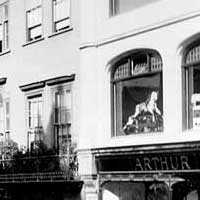
The detail above is taken from the same picture (Cornmarket 1907), and, rather sentimentally perhaps, I was drawn to the rocking horse in the window. One can’t help but wonder what happened to this somewhat peripheral object (peripheral in terms of the overall photograph). I can well imagine it languishing in some dusty attic, forgotten, even broken… although, of course it might be in very rude health, respected as an old family heirloom. And herein lies its point of interest. Whatever its current state – if indeed it still exists – here, in the picture, it’s yet to occupy the mind of the person to whom it belonged. It’s yet to form the memories which that person would have carried with them throughout their life, memories which they might have passed down and which might, to this day be talked about. Perhaps this rocking horse no longer exists as a physical object, but maybe somewhere, it continues to move in words, written or spoken.

Filed Under: Photography Tagged With: Barthes, Bicycles, Catastrophe, Everydayness, Nowness, Photographs, Vintage Photographs, Windows

Windows 1

January 5, 2011 by Nicholas Hedges

This image was part of a collection I bought a few years ago. I had no idea what I was buying at the time and was intrigued by the image reproduced below.

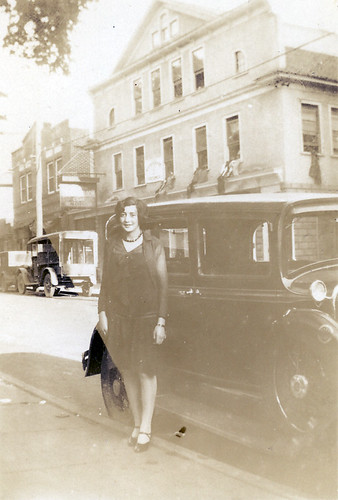
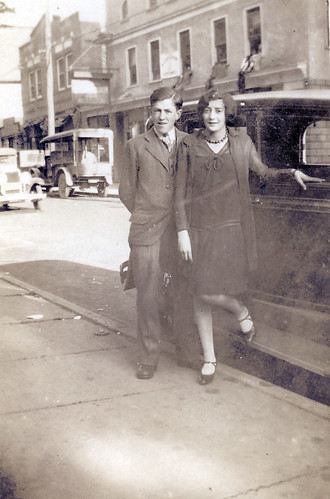
A young woman and a car

In the photograph, a young woman poses beside a car. The awkwardness of her pose and the uncertainty in her face suggests that she is attending a special occasion of some kind. In the second image below, she is joined moments later (or perhaps it was before) by a young man (her partner?) who also looks a little uncertain, not necessarily because of what he’s about to do, but rather because of what he’s doing at that exact moment, i.e. having his photo taken. Perhaps they are young lovers about to get married? Of course we’ll never know.

A young couple and a car

What intrigues me about these pictures are the details. Looking again at the second photo – which might of course, in the course of time, have come before the one above it (“…if things are perceived as discrete parts or elements they can be rearranged…” as Bill Viola writes) – a car has appeared on the left, moving into shot just as the shutter is released. Even though the young man has also ‘appeared,’ it’s nevertheless the car which gives us the sense of time passing; it is a vehicle for what Sontag describes in her book, ‘On Photography’ as “time’s relentless melt.”

Who was in the car as it drove past? Where was it going? Where had it come from?

History often comes to us ‘top ‘n’ tailed’, where all that went before the period in question, and all that came thereafter is removed, leaving us with an event which reads like a novel; conveniently packaged with a beginning, a middle and an end. To some extent, regarding this, the first image serves as an illustration, whereas with the second, the car tells us that something came before the ‘beginning’, and that something will follow ‘the end’. As a painter, Degas was inspired by photography, and used this device to give his works a greater sense of movement. It’s not so much a means of accentuating movement with regards to that which is shown, but moving the viewer into the world that’s hidden beyond its edges. 

Just as in the first photograph I looked at, my viewpoint shifts as I become aware of the image’s other protagonists. From in front of the couple, and in the guise of the person who took the photo, I glimpse the couple as if I can see them out the window of the car. It doesn’t last for long, but it shows how an image can be opened up by such small details.  

Windows in photographs have always interested me for much the same reason. Within the context of an image, like those above, they provide a means of escape, or again, as in the case of the first photograph I discussed, a means of concealment. They act as eyes, reflecting – literally – the world around them; the world beyond the limits of the picture’s edge. Spatially and temporally, there’s always more to a photograph that that contained within its borders; and for me, a photograph’s appeal, often resides in how it allows access to these spaces.

In the detail below, we can see in some of the windows, the sky and the trees reflected from beyond the frame of the camera; another way in which a camera can capture that beyond its reach.

Windows are also evidence (or perhaps reminders) of ordinary people living their everyday lives without a thought for the subject or subjects below – in this case the couple on the pavement. They conceal those who are perfectly oblivious to the chemical annexation of whatever inconsequential moment in time is being captured. And as a result, this invisible population can often breathe life into a photograph well beyond the stage upon which the action is taking place.

In his book ‘Camera Obscura,’  Roland Barthes describes a portrait by James van der Zee, of a Black American family taken in 1926. Barthes writes:

“On account of her necklace, the black woman in her Sunday best has had, for me, a whole life external to her portrait.”

What Barthes perhaps means, is that the necklace has a provenance, and therefore seems to speak more about the woman’s life than anything else in the photograph. It is a cherished object, worn perhaps for the occasion of the picture (just as the necklace has perhaps been worn by the young lady in the images above). For me, this is, in a way, analogous to the windows in the first picture and the car in the second, for they are small details compared with the picture’s subjects, but details which, nonetheless, build for us a bigger picture of the world the subjects inhabit.
 
The closed windows in the building then, reflect the world beyond the edges of the photograph, they provide evidence of a world beyond the stage. Furthermore, they are windows onto the stage, through which those sitting, standing or passing behind might, just like the driver in the car, catch a glimpse of the actors.
The open windows however provide us with something a little different. Open a window and the outside world pours in; sounds, smells, the noise of the traffic and passing conversations. In other words – life. They serve to animate the scene, again just like the car, and through them we can let our imaginations wander, to discover for themselves, more of this world long since vanished.

Filed Under: Photography, Trees Tagged With: Barthes, Bill Viola, Photographs, Vintage Photographs, Windows

Secret Police 2

January 4, 2011 by Nicholas Hedges

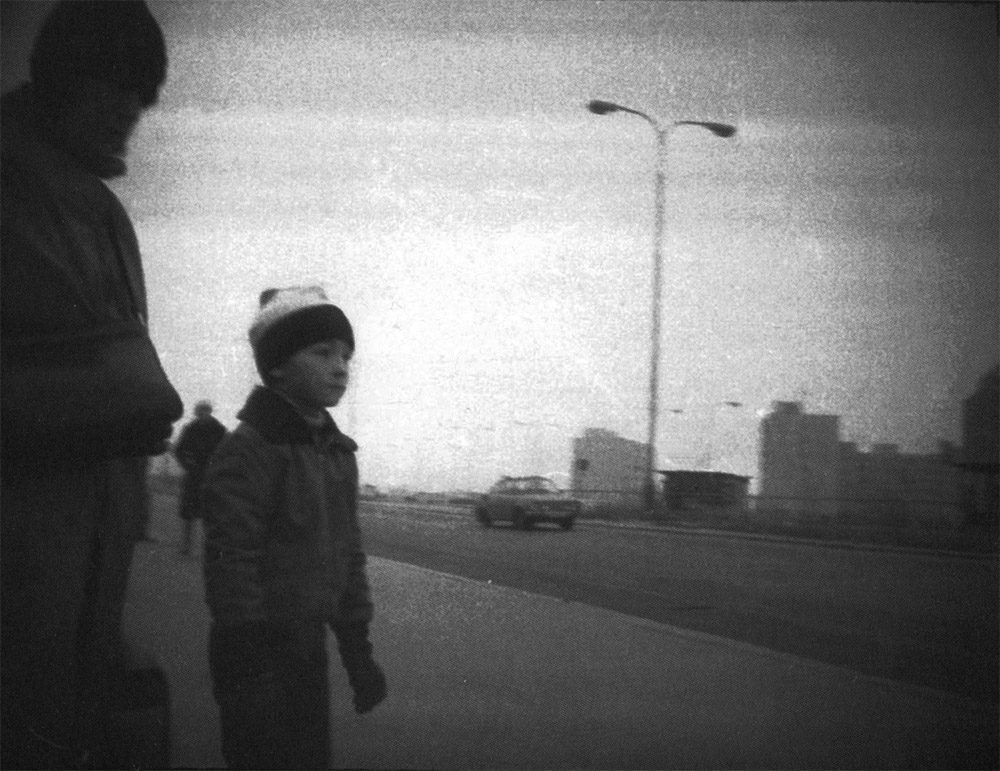
I want to look at another photograph from the book ‘Prague Through the Lens of the Secret Police.’

Leaving aside how the photograph came to be taken, this is, I think, a stunningly beautiful shot. Its tonal quality, the grain of the picture’s surface, the soft focus and the gradation of light from the centre of the photograph to shadow at its edges, all make for an image which revolves around the child and which, we might say, celebrates the innocence of childhood. There’s a sense of wonder in the boy’s face, his eyes staring at something we cannot see in the distance. And yet there’s also a sense of foreboding (light becomes shadow); in the figure on the pavement behind them, in the solitary car on the road, the grey concrete blocks and the double lights of the lampost which mirror the shape of the child’s eyes as if they too are watching, not what lies ahead, but what is down below. There is perhaps no point in looking ahead to the future, but the boy does it anyway.

Besides the boy and the street lamps, only the car has eyes. The woman beside him is wearing dark glasses, the figure behind is little more than a blur, and even the tower blocks seem blind without their windows. No-one inside is looking out. People are there to be looked at, nothing else. And yet the boy stares ahead, oblivious. His body is tense – perhaps from the cold – as if he’s about to run towards the future.

Of course there is one person in this image I haven’t mentioned, and that’s the person who took the picture; a  member of the Czech secret police following the woman and her child. However, unlike with the previous photograph, I do not feel I’m there within the frame. I’m very much an outsider looking in. But given how the photograph was taken (perhaps from the surveillance officer’s waist) my viewpoint is subsequently low, as if I too am a child, accentuating the sense that this is a photograph about the boy, or rather childhood: innoncence in contrast to its loss under such a regime. But these of course are interpretations made some 27 years in the future. The fact is, that this was a photograph taken for the purposes of surveillance, for control. In reality, it’s far from being the beautiful photograph I said it was earlier.

Yet it is still that: beautiful.

Over time its purpose,  as an object of surveillance, has slipped away, leaving it open to aesthetic appreciation. But there is an awkwardness here, something uncomfortable in the fact, and this is an area to whcih I’ll be returning.

Filed Under: Photography Tagged With: Photographs, Secret Police, Vintage Photographs

Secret Police 1

January 2, 2011 by Nicholas Hedges

The first image I want to look at (taken from a book called ‘Prague Through the Lens of the Secret Police’ from the Institute for the Study of Totalitarian Regimes; ÚSTR, Prague 2009, 1st edition) shows a scene captured from the window of an apartment block in May 1980.

The net curtain hanging in front of the closed window serves to conceal the identity of the photographer, not only from those outside, but also from us as we look at the picture; more so even, than the fact the photographer is standing behind the camera. Nevertheless, despite the fact they can’t be seen, one is aware of the photographer’s presence. It’s almost as if the camera has captured something beyond the reach of its lens; the secret policeman is out of sight, but never out of mind, just as he was every single day, throughout the time of Communist rule in what was then Czechoslovakia.
The net curtain serves to obscure our view of the world outside, but far from removing us from what is taking place down in the street, it seems instead to immerse us in its here and now (or rather there and then). It becomes the means by which the light from that single moment in May 1980 is frozen, rather than the click of the camera’s shutter.

As I look at the photograph, the identity of the voyeur is both concealed and revealed. The space before the net curtain (that inside the room) becomes the world around me now, here in the present. I look at the image in silence (or to put it another way, I watch the image) and become aware of my breathing as well as every little noise around me; the hum of my computer, the ticking of a clock, a bird singing in the garden. It’s as if the plane of the photograph has moved a few inches forward, as if the photograph begins just beyond the curtain, with the pot of old flowers on the window sill. We are the secret police, watching through the window 30 years in the future.

This paradox is one of the consequences of photography, whatever the particular photograph we’re studying. In fact, however we research the past, we become like secret police, following people, keeping notes, putting notes in files. We document their lives as if we’re trailing them, following them down the street, around buildings or even in their own homes. And yet of course we’re always far in the distance. We follow on behind, yet we’re always way ahead. 

Returning to our image, we can assume the person being followed is the woman entering the apartment block opposite. She turns a little, as if she’s aware that she is being watched. At first glance, it’s as if she’s also being watched by the children on the right, but when we follow their gaze, we can see that two of them are looking beyond the frame of the photograph, somewhere down the street to the left. The woman being followed – our ‘target’ – is glancing that way too, as if something has made a noise. Perhaps that noise startled whoever was watching enough to take the picture?
As I look at the photograph, I rewind the scene a little. There’s the noise and its aftermath, then, in a flash I’m there walking through the doorway, stepping into the shadows beyond, my footsteps clattering, mixed in with the noise which slowly falls away in a receding echo. And as my viewpoint shifts as the observer, so I move between the scene’s protagonists at which the plane of the photograph falls away completely. Was it perhaps a broken window they heard?
Back in the room (and here in my room in the present day) I lean back, as if to avoid the possibility the target might turn her head completely and look up at the window behind, at that from behind which I’m looking 30 years in the future. I look away from her and ahead at the windows opposite. There are two of them, one open, the other closed, both dressed in the same net curtains through which I’m also peering. The sound I’ve described has found its way through the open window, carried on the wind,   along with the children’s conversation and the woman’s footsteps below. Is there someone there too, hiding behind the curtain? A neighbour looking to see what the noise was, or another member of the secret police following the same person, or even someone else? Or perhaps it’s someone else entirely who stands opposite, looking like me at a photograph somewhere in the future, one in which I’m looking back from behind a net curtain, there in the window across the street. 

Filed Under: Photography Tagged With: Photographs, Secret Police, Silence, Vintage Photographs, Windows

An Introduction

January 2, 2011 by Nicholas Hedges

“Such is the photograph: it cannot say what it lets us see.”
Roland Barthes

The aim of this project is to write about photographs; about those things they let me see but which they cannot say. I will select, mostly at random, photographs from some of my books, as well as those in my own collection and write whatever comes to mind as I look at them. From time to time I might discuss them in light of the work of writers like Roland Barthes and Susan Sontag, but my aim is to keep things simple, insofar as I will write about my own personal experience of looking at, and on occasion, holding each of the images.

Photographs are like the night sky, or as Susan Sontag writes – ‘the delayed rays of a star.’ They show us something that was and is, but which at the same time isn’t any longer. Each one is a paradox where the act of looking creates a space in which the observer and observed (as regards photographs taken before we were born) are both absent and present at one and the same time. A whole new dimenison is opened up, where the presentness of the past becomes most apparent. It’s as if the act of photographing slows the light from the photographed being or beings to the point of being still, without it actually coming to a complete stop.

Looking at a photograph is not only a visual thing, but something which brings into play our embodied imagination. The term ‘kinaesthetic empathy’ is often used to describe the phenomenon of watching dance on stage, where members of the audience feel with their bodies what is happening in front of them. And while photographs might seem like static images, the image itself, like the light which caused it to be made, is merely slowed rather than stilled. With our embodied imaginations, we can speed the light up and see, indeed participate in what came next in the seconds which followed.

Filed Under: Photography Tagged With: Barthes, Photographs, Vintage Photographs

John Malchair 1770

December 31, 2010 by Nicholas Hedges

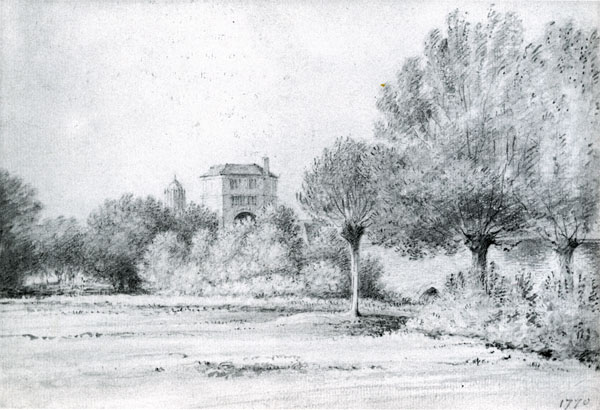
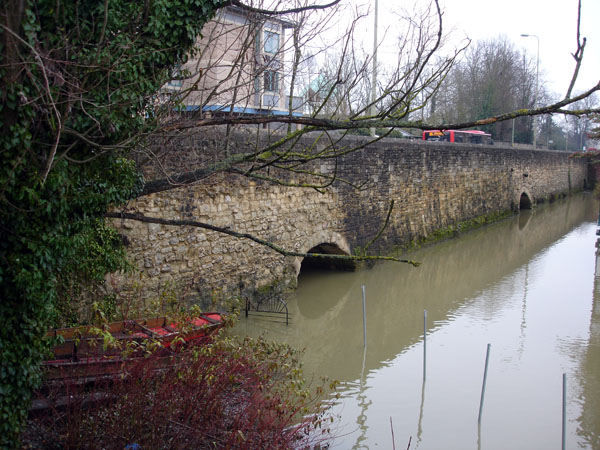
The following is a drawing made by John Malchair showing the causeway of what is now Abingdon Road. The rather unusual building is Friar Bacon’s Study which was demolished in 1779. Beneath the drawing is a photograph showing the same causeway, with two arches, a little bit like the arch which can be seen in the drawing.
Filed Under: Photography, The Gentleman's Servant Tagged With: Drawings, John Malchair, Photographs

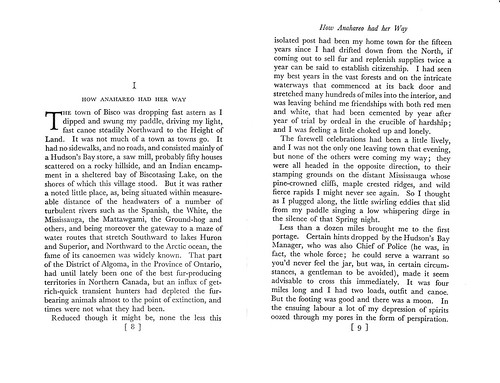
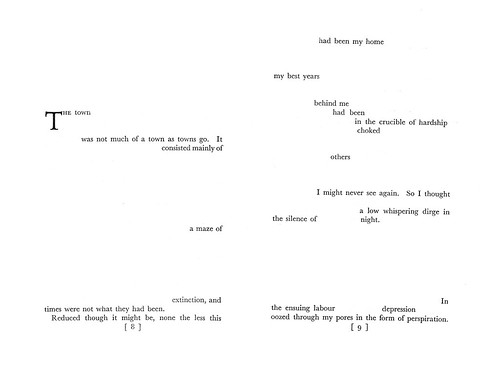
Heavy Water Sleep: Pages 8 & 9

December 29, 2010 by Nicholas Hedges

Original Version

08-09

Version 1

08-09 [29-12-2010]

Version 2

08-09

Filed Under: Heavy Water Sleep, Photography Tagged With: Heavy Water Sleep, Holocaust, Photographs, Text Work, WWII

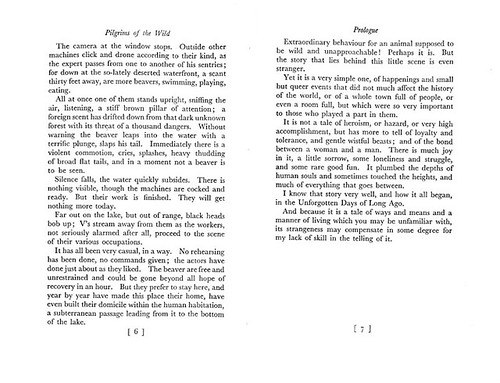
Heavy Water Sleep: Pages 6 & 7

December 22, 2010 by Nicholas Hedges

Original Version

06-07

Version 1

06/07 - Version 2 [22-12-2010]

Version 2

06/07 - Version 2 [22-12-2010]

Filed Under: Heavy Water Sleep, Photography Tagged With: Heavy Water Sleep, Holocaust, Photographs, Text Work, WWII

Big Ships on the Horizon

November 6, 2010 by Nicholas Hedges

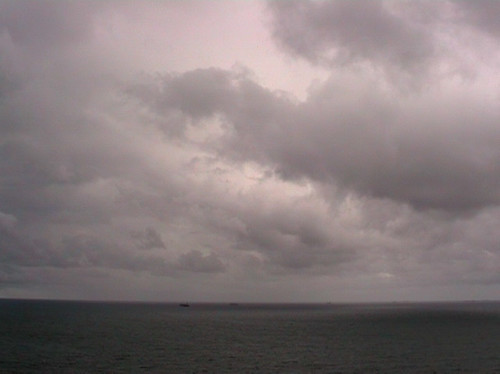
The big coal ships have fascinated me ever since I first saw them when I arrived in Newcastle. Like the huge clouds above them, they seem on the face of it not to be moving, but rather – like a photograph – fixed in their shape. Only over a period of time, as one watches, do the ships reveal themselves as moving, changing their course, just as the seemingly immutable clouds change their shape.

Coal Ships - Video Stills

The past too is like this. It appears to us fixed in its final shape by history, but when we observe at length we begin to see things differently – just as with the ships and the clouds, the past changes shape not unlike the way the present constantly changes its shape around us; because the past was once the present.

I have for a long while been interested in old photographs, in the distant parts of photographs where things are not the ‘subject’ of the picture. For example, the image below is a detail from a holiday snap taken some time in the early 1980s. I’ve no idea who the girl is and only noticed her when I enlarged the image.

16

Merleau-Ponty once wrote how distance was not a property of the horizon, and distance too – we might say – is not a property of those people occupying the background of these photographs. They are – or were – as much a part of the scene as those of us in the foreground – the subjects of the photograph. We are always as much a part of the distance and the foreground as everyone else; we are both these things at one and the same time. In terms of history, we in the present are like the subject of a photograph, and those in the past are like those in the distance. Everything is the same part of the present, just seen from different perspectives.

The past is as much about movement as is the present (just as the distance contains as much movement as the foreground) and to observe this movement in the past (or the distance) requires us to be patient – to watch and to listen.

It is interesting that watching and listening to the distance has become a theme during my residency here, and that the image above – a video still of the ships and the sky – was filmed from Shepherd’s Point, a place from which the Services would listen and watch for the enemy during World War 2.

Filed Under: Artist in Residence Tagged With: A Line Drawn In Water, Artist in Residence, Australia, Creatures, Family Hedges, Family History, GPS, Hedges, Lines, Merleau-Ponty, Photographs, Positioning, Stephen Hedges, Walks

Useful Quote for Future Work

May 21, 2010 by Nicholas Hedges

“It’s as if the Photograph always carries its referent with itself, both affected by the same amorous or funereal immobility, at the very heart of the moving world: they are glued together, limb by limb, like the condemned man and the corpse… two leaves cannot be separated without destroying them both: the window-pane and the landscape…”

Roland Barthes, Camera Lucida

Filed Under: Photography Tagged With: Barthes, Photographs, Quotes, Useful Quotes

An Act of Imagination

March 1, 2010 by Nicholas Hedges

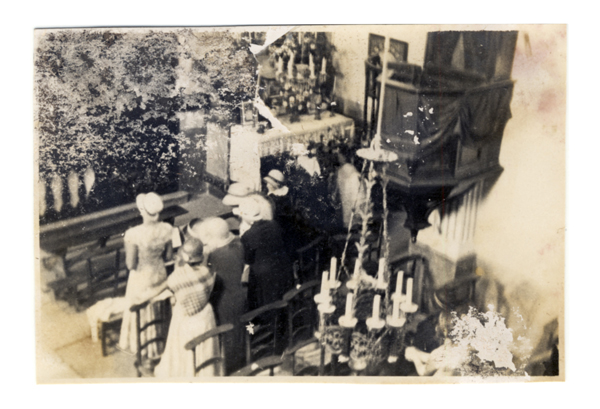
There’s a shop in Paris where I like to go, whenever I am there. In a box you can rummage through a small pile of photographs, miscellaneous images, nothing overly special, but for a few Euros one of them can be yours. That shown below is the last one I bought.

The photograph is small; two and a half by three and a quarter inches. It’s damaged and indistinct; blurred in parts, but nonetheless one can see the interior of a church, within which a small group of women and girls stand facing towards the altar. The photograph was taken from above, perhaps from a gallery opposite the pulpit which one can see on the opposite wall. The pulpit’s draped in material, whether that’s normal or for a special occasion I cannot say. I cannot tell what is going in, but clearly something’s happening beyond the frame of the picture (the world is happening beyond the frame of the picture – as are we, the viewer). As for a date; given the hats, I would say it was taken sometime in the 1920s.

The photograph is fragile. It has the feel of an Autumn leaf, dried and picked from the ground the following Spring. When I hold it in both my hands, my thumbs discover very slight depressions where others have looked before me. The way the paper’s warped, the way that it bends, tells me it’s been looked at many times.

Where the picture contains the trace of someone who was loved, the paper carries the gesture of the lover.

Of course we cannot know this, not for certain. But history is an act of imagination.

Who is the object of his or her attention? My eyes move to the girl at the front, dressed in white or pale colours and wearing a matching hat. My left thumb, in its slight depression almost seems to touch her, mimicking the gesture of the one to whom it belonged. There’s something secret about the image, as if whoever took it shouldn’t have been there, shouldn’t have possessed her. It’s an image that’s meant to be kissed, secreted away in a wallet. Affection has caused the wear in the corner.

She knows she’s being photographed. She knows that someone loves her. She can see in her mind’s eye the gallery behind. She can sense the gaze of her admirer. But then the paper tells me she didn’t turn around, she never returned the gaze. Ever.

Filed Under: Photography Tagged With: Junkshop Photographs, Photographs, Vintage Photographs

A Well Staring at the Sky

February 28, 2010 by Nicholas Hedges

The title of this piece takes its name from a passage in Fernando Pessoa’s The Book of Disquiet;

“We never know self-realization. We are two abysses – a well staring at the sky.”

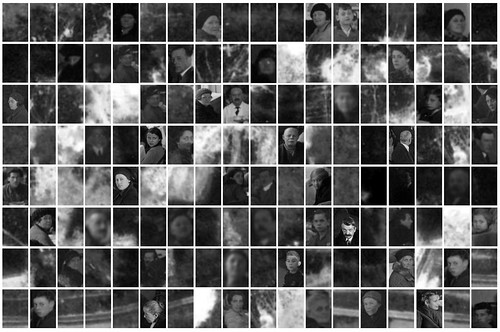
For me, this quote describes the act of looking at a photograph, at people in the past who are likely no longer with us. I look at them from a time when they do not exist, and they look at me from a time when my existence was wholly unlikely. They are reflections left in the water of the well, and I, for the moment am the person looking in. The portraits in the work are from a single photograph taken in Vienna c.1938. The faces are mixed with images cropped from an aerial view of the Bełżec Death Camp photographed in 1944. History too is a well staring at the sky. Again in the well’s water, we see the sky reflected with some of its stars and all of its gaps. But no gap is truly empty and all the holes in what we call history are full of traces; the residue of a glance perhaps shared between two people.

To see more work from this exhibition, please follow this link.

Filed Under: Photography Tagged With: A Well Staring at the Sky, Belzec, Detail, Fernando Pessoa, Mine the Mountain 2, Mine the Mountain 3, Photographs

  • 1
  • 2
  • Next Page »

© Nicholas Hedges 2024

  • Facebook
  • Instagram
  • Twitter
  • YouTube

Copyright © 2025 · Outreach Pro on Genesis Framework · WordPress · Log in