Nicholas Hedges

Art, Writing and Research

  • Amazon
  • Behance
  • Facebook
  • Instagram
  • Pinterest
  • YouTube
  • Art
    • Digital
    • Drawing
    • Grids
      • Correspondence
      • The Wall
      • The Tourist
    • Ink on paper
      • Shadow Calligraphy
    • Installation
      • Murder
      • Echo
    • Painting
    • Patterns
    • Mixed Media
    • Photographic installation
      • St. Giles Fair 1908
      • Cornmarket 1907
      • Headington Hill 1903
      • Queen Street 1897
    • Research/Sketches
    • Stitched Work
      • Missded 1
      • Missded 2
      • Missded 3
      • Missded 4
    • Text Work
  • Blogs
    • Family History
    • Goethean Observations
    • Grief
    • Light Slowed But Never Stilled
    • Lists
    • Present Empathy
    • Shadow Calligraphy
    • Trees
    • Time
    • Walking Meditations
  • Video
  • Photography
    • Pillars of Snow
    • Creatures
    • The Trees
    • Snow
    • St. Giles Fair 1908
    • Cornmarket 1907
    • Headington Hill 1903
    • Queen Street 1897
    • Travel
  • Illustration and Design
  • Music
  • Projects
    • Dissonance and Rhyme
    • Design for an Heirloom
    • Backdrops
    • Shadow Calligraphy
  • Exhibitions
    • A Line Drawn in Water
      • Artwork
    • A Line Drawn in Water (Blog)
    • Mine the Mountain 3
      • Artwork
    • Mine the Mountain 2
      • Artwork
      • The Wall
    • The Woods, Breathing
      • Artwork
    • Snow
      • Artwork
    • Echo
      • Artwork
    • Murder
      • Artwork
    • The Tourist
    • Dreamcatcher
    • Mine the Mountain
      • Artwork
      • The Tourist
    • M8
    • The Gate
    • Creatures
      • Artwork
    • Residue
      • Artwork
    • A visit to Auschwitz
      • Artwork
  • Me
    • Artist’s Statement

Goethean Observation: Compost Heap

January 19, 2014 by Nicholas Hedges

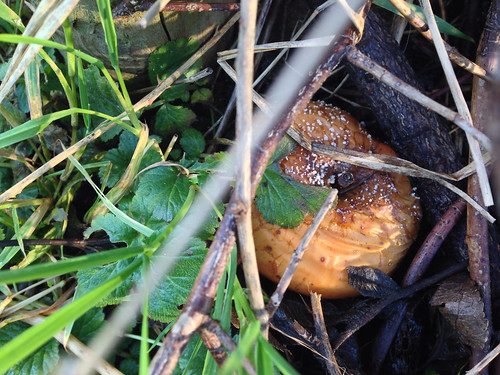
The compost heap is some eight feet in circumference and about three feet high at its highest point. It comprises many different types of vegetative matter, at a glance; apples, the branches of the Christmas tree, twigs, cut-down shrubs, leaves and soil. There are numerous stones too, snail shells and new plants.

[a crow calls behind me]

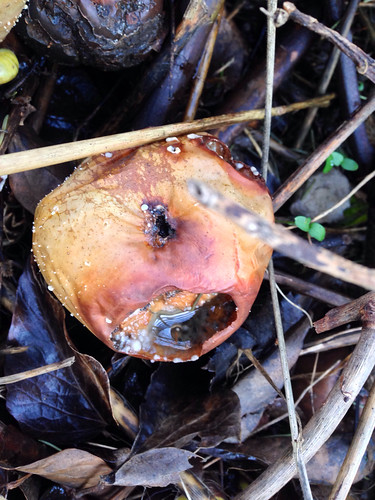
The apples are in various states of decay, from ripe (and seemingly edible) down through papery brown to black. The black apples, split open, remind me of old leather shoes such as those you might find in a museum.
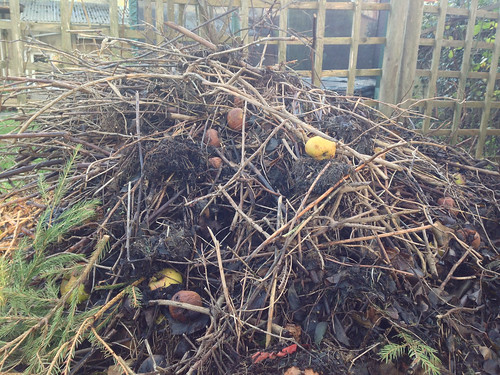
The sun catches the left-hand side of the heap [a blackbird is calling above the traffic]. There is also a piece of plastic – white and dirty. As I look more closely, I see a number of roots, rusty-brown in colour, stretching across the pile. The wind agitates some of the lighter twigs and the leaves which still cling to their branches. The colour of the leaves is pretty much uniform; brown to darker brown, and with all the dampness of the outer part of the pile – almost black., like the most decayed apples.

The crown of the compost heap is covered with lighter branches no more than a centimetre in diameter.
They stick out to the left of the heap like the spines / quills of a porcupine. Tangled within them are clumps of earth intermingled with dried grass – now the same shadow of brown as the branches. The colour of the heap, taken as a whole is the dark brown of those darkest leaves. (*From a distance of ten feet or so, the compost heap is a single entity onto which some things have fallen. It is predominantly a dark brown colour, but as one approaches, it forms fragments, as those things of which it’s comprised throw out their shapes towards my incoming eyes.)

A few yellowish-green apples prick it and from these the eye gravitates towards the browner types, wrinkled and spotted/flecked. One apple looks like it is made of paper, its skin depressed as if a thumb and forefinger has marked it so.
There is a definite boundary between where the compost heap begins/ends and the rest of the garden, but looking more closely that boundary isn’t as stark as grass and dandelion and other small plants start to encroach. Parts of the heap too have tumbled beyond this boundary.

Near my foot, a black apple has burst its skin and inside, its brown flesh looks like tapenade.

[The crow, sitting on a rooftop behind to my left is persistent in his calling. I can hear too the whistle of a wood pigeon’s wings.]

The compost heap although an entity in its own right comprises thousands of different things. A bright apple catches the sun and is made brighter sill.

Walking around I take up position to the left of where I’ve been. I can see a plastic straw – so at odds with the rest of the heap. A piece of flower pot seems however quite at home next to the apples – large and bruised, brown and putrid. There is a beautiful apple – a pale rust colour ridged and wrinkled, spotted with tiny white fungi. Above that, another rotting apple has abandoned its shape altogether and is now a dollop of brown, gooey flesh.

The core of the compost heap is more exposed here, and upon it, tiny green weeds have planted themselves.

[I have in my head the image of a star – perhaps because of the apples; their spherical shapes and the stages of their decay which go hand in hand – towards their implosion – with their different colours, ending at black, like black holes.]

Around the compost heap is the rest of the garden – the shed, the apple tree, the lawn and the cracked path, on which I am currently sitting.

I cannot smell the compost heap – at least not from where I’m sitting. I move closer and breathe in and see two decaying rose-hips each of which comprises a myriad number of colours and shades. I step around it. The branches crack beneath my feet like branches in a fire. I notice too the thorns snagging the air which agitates the hair-like splinters of some of the branches.

The compost heap makes no sound – at least not that I can hear. Without the breeze it would seem entirely still, a fact belied by its very appearance, vis a vis its changing parts.

Pine needles from the Christmas tree are caked in the mud, a small pool of water has collected inside a hollow eaten out of an apple. The apple behind it appears almost turquoise. Holes in others are perfectly round. The wrinkled skin of some of the apples appear almost like human skin – that of the old.
The perfect shape of the empty snail shell – the random shape of decay.

Part 2

Looking at the papery brown apple, one imagines its flesh returning to fill the depressions in its skin. One imagines its skin colour changing as the apple itself grows bigger, becoming once again green like some of those around it. Freed of the mud gathered around it, it returns to the tree and begins to grow smaller in size until it becomes a blossom, then a bud on a branch in the summer. If it was left now (in its present state), it would over time reduce further still becoming just a collection of pips from which in time other trees would grow.
The branches of the Christmas tree once hung with decorations, bought from a shop, cut down in a forest or a managed plantation. How old was it? You can see the rings in the branches like ripples on a pond. They decrease to nothing, the tree folds itself away, takes refuge in the soil.
The empty snail shells would have their snails, the cut down branches would await the spring when they could surge with sap and grow.

But this compost heap isn’t dead. Nothing is dying here. When it was ‘fresh’ after I had finished gardening last year, it was four times the size. Some of it has been packed up and recycled, but much of it has reduced. There is still colour, even in the blackest apples. There is still shape, fragile like the snail shells.

Left to its own devices the heap would disappear entirely, but what would have disappeared exactly? In the end nothing truly disappears. Familiar shapes change.

The compost heap is never still and never silent, it changes by degrees which we cannot perceive, as with our own faces ageing in the mirror every day.

The leaves too would drift and change their colour, their shape, joining the tree again. Rewinding time they disappear. Fast-forwarding time they disappear but something remains.

Only the plastic straw will stay the same, not knowing what to do. The plastic straw is the one thing that’s truly dead.

Part 3

Feeding on itself.
It is what it consumes, its roots are the flows of energy released into the soil.
Colours are consumed.
It is blind. Deaf.
It feels. Drawing in to its core.
A star imploding.
All that will remain is the memory of its having been there.
It is for the most part invisible.
Just as it cannot see, we cannot truly see it, for it isn’t the shape of its composite parts – the apples, the branches, the clods of earth and pine needles. It is a flow – a slow progress of energy, released by colours, shapes to its heart, to the soil.
The compost heap is a pulse. It is the most un-dead thing in the garden.
It is a conduit.
It is slow, but far from dead.
Filed Under: Goethean Observations, Trees Tagged With: Goethean Observation

Goethean Observation of a Fosslised Shell

August 3, 2013 by Nicholas Hedges

Shells
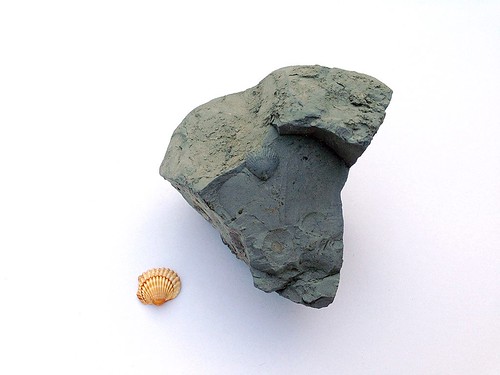
Fossilised shell (right)

Part 1

The object is a lump of soft grey rock. It is irregular in its appearance except for a small part about 1cm square, which is extremely regular in its form. The piece of rock is heavy and feels quite dense and sits comfortably in the palm of my hand. If I scratch the surface with my finger nail a mark is left behind. The texture of the piece of rock is rough but at the same time its softness makes it feel quite smooth to the touch. Part of its surface is smoother than that on the other side and it is on this side I can see the regular pattern of lines and a couple of other circular imprints. This smooth part of the rock feels softer than that on the outside – indeed there seems to be a distinction between an outside and an inside. The inside is defined in some respects by what looks like a cut. The ridge is about a centimetre deep and is irregular in shape, although it seems, compared with the other side, more regular.

The very distinguishable pattern is a shell. I can see the ridges running from its outer edge at the top to the bottom. There also seems to be a dark patch running from one side to the other about a third of the way down from the top. There is a distinguishable bulge at the bottom of the shell where all the lines meet.

The rock feels cool but not cold (as I write my observations outside in the garden, a breeze is blowing, turning the pages and agitating the protective wrappings in which I keep the rock). Looking carefully at the surface of the rock, on what I have called its outside, I can see small patches of grey which unlike the rather dull complexion of the rock are quite shiny, reflecting the light of the evening. The rock seems encrusted with crumbs of rock which it seems I could easily rub off with my thumb.

The rock has about nine surfaces or faces including the ridge mentioned earlier and the face on which you can find the form of the shell. Whereas the crumbs of rock and the lines, imprints and grey shining patches seem an integral part of the rock; the shell-like form seems (although it is made of the same thing) separate somehow. It is both the rock and something entirely different.

As the wind blows a little, everything moves it seems, save for the rock (and the table on which it is resting). It feels in my hand extremely fragile, as if should I drop it, it would break apart. Certainly I feel as if I could break pieces off with my bare hands.

Although to the eye there are faces of the rock which seem rough and those which seem much smoother, it feels nonetheless as I hold it in my hand the same texture all over. It has in some respects the look of a piece of bone (like a hip joint) or a worked piece of stone – an ancient tool for example.
As I write I can hear the odd shout in the street.

Part 2

The piece of rock is a fossil found in a large piece of rock next to cliffs at Charmouth. The rock is dated to around 195 million years old. The whole of this piece of rock has therefore been part of an inside for a period of time that is unimaginable in my human brain. It was once part of the cliff and therefore one can imagine that it would have been under a great weight. Of course the piece of rock only became a piece of rock because the cliff face eroded. Then part of the face collapsed, a smaller piece was broken open and inside the shell was revealed. For much of its incredible life span then, it wouldn’t have been a piece but rather a whole. And, therefore, this piece wouldn’t have born the whole weight of the cliff upon its shoulders; this weight would have been distributed throughout the layer of which it was a part.

The shell would, like the rest of the rock, have been covered (surrounded by ‘other rocks’). It is the breaking open of it which gives it a sense of being ‘inside’. Imagining it surrounded by rock, a seamless expanse of rock, one does have a sense of darkness and a sense of weight – immense dark and immense weight. When I found it and broke it open, there was, suddenly the sense of lightness and indeed light, whereupon the pattern of the shell’s form was revealed for the first time in over 195 million years.

The light from the sun in the present day allows me to see the lines – the same sun that would have shined above the sea 195 million years ago.

This sense of an outside and an inside: the inside is hidden from view – invisible, and yet it exists. Looking at a cliff one sees colossal weight, density and reaching my eyes inside, I can picture only darkness. And yet, looking at this rock, one sees a form which is fragile, delicate, regular, light. The cliffs must be full of such tiny shapes – full of fragility; a delicate, lightness of touch. This mirrors the time before the rock was formed, when the shell was a living creature in the seas. One can imagine the light of the sun on the sea, the lightness of the creature – its fragility as it lived. There is a sense of the sea being light (in terms of sunlight and a lack of weight) and yet the sea is also impenetrably dark and heavier than the cliffs which we see today.

(The cliffs are little different then to the sea. They are not static, but are moving, slowly – too slow for our eyes until the second they slide.)

The shell would have been compressed on the sea floor over tens of thousands, hundreds of thousands, millions of years. Its outline, its shape, its ridges and perhaps its surface pattern were fixed as lines of incredible delicacy. The sea levels fell, the rocks shifted: huge, unimaginable forces, acting over vast, incomprehensible spaces of time – and yet this shape and these lines have remained. And all the while these lines have existed – this tiny shape has existed, whole epochs have come and gone – creatures have evolved ; whole species, including the dinosaurs have come and gone; the great mammals and so on. And finally man has evolved too. There is the sense that I’m looking only at the shell rather than the rock of which it is a part.

This lump of ‘unremarkable’ rock, shapeless, rough, grey, ugly, is just as ancient and incredible as the beautiful, perfect shell which is a small part of it.

Part 3

Movement. Frozen.
The individual object which is not a part but a whole.
Air, light, water, colour condensed to make this soft, grey mass.
Delicacy of life translated into the delicacy of the small pattern on the rock’s surface.
(The light fades outside where I write and the shape of the shell begins to dissolve into the rock).
Movement of the shell. Movement of continents.
Movements of creatures, of time on an evolutionary scale. The weight of time which this patten of lines has withstood for 195 million years.
(What can humans withstand as individuals and as a species?)
(Colours begin to face into darkness).

Part 4

Movement returned to the rock from the moment it was found and carried in my hand – carried into the garden this evening.
Movement of that creature, of everything that sank to the seabed, of the water above, whose weight pressed upon it – now becomes/joins with my own movement through time/this world.
The light that allows me to see the lines of the shell – its shape, eyes which would have evolved since that shell was in the sea.
The delicacy of light, of eyes.
Lightness. Weight. Pressure.
Light. Vision.
Lines.

Filed Under: Goethean Observations Tagged With: Fossils, Goethean Observation, Shells

Goethean Observation: World War I Trench Map

February 2, 2012 by Nicholas Hedges

Less a Goethean observation and a more general observation with reference to the Goethean method (click here to read more about Goethean Observation).

Note: The aim of this observation is not to write a beautiful prose account of the map, but rather to look, observe and find a hook upon which to hang the next piece of research into this subject.

Trench Map 1916

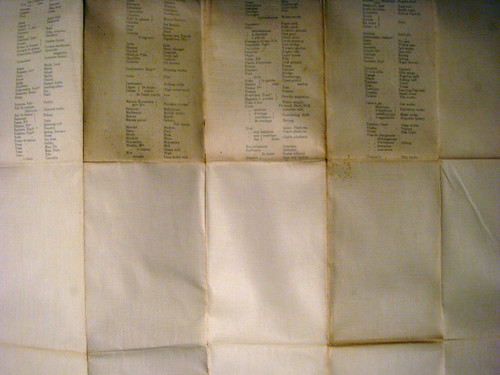
The map has been printed on a large sheet of paper creased vertically and horizontally with lines where the map has been folded and opened. The paper itself is a brownish-white, darker along the lines of the folds and around the edges in places. The corners on the left hand side are a little dog-eared.

The map on one side shows the area concerned – a part of France as the map tells me at the top. This side of the paper is smooth to the touch, but on the reverse I can feel a tooth. Folding over the first fold, I can see the tooth on the ‘reverse’ very clearly. The [fabric of the] paper is made up of very straight vertical lines, with wonkier lines running horizontally. There are four ‘squares’ (actually rectangles) to each folded column and eight folded columns (7 creases) in all. There are four folded rows (3 creases).

The ‘square’ at the top of the first vertical fold on the reverse side of the map tells me this is a ‘Trench Map’. Like the bottom square, the colour of the paper is much darker than the rest. The two squares in between are like the colour of the map on the reverse side – possibly even lighter. This shows how the map, when folded, has a front and a reverse side. Having turned over the map so that this first fold appears on the right I can see all 32 ‘squares’ that make up the map. The folds are particularly prominent, some darker than others. Some of the squares show no sign – or at least – very little sign of wear. There are some splits in some of the folds – caused of course by the repeated action of opening and closing the map.

Trench Map 1916

Six ‘squares’ along the top two are covered with words – French words and their English translations. The words are the names of landscape features such as tree (arbre), gate/stile (barrière), oak tree (chêne) and pond (etang). The rest of the squares, including one on this top row are blank. All one can see is the pattern of the paper’s fabric.

Turning the map over, one is aware of the holes and the sound the paper makes. It reminds me of a soft version of the crackle of a fire.

The drawing of the landscape takes up much of this side of the paper with explanatory texts and a key beneath as well as to the right of the map.

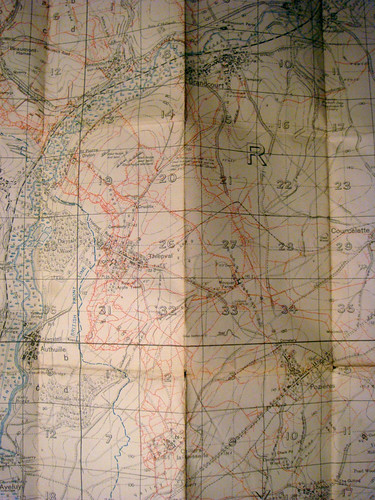
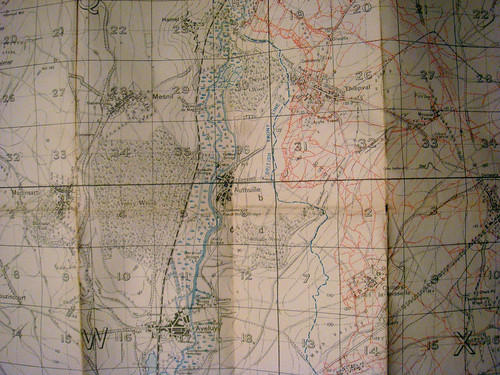
Looking at the details of the map, one can see the various features of the landscape – the woods, roads, hills (through contour lines), rivers, ponds or lakes and of course various towns and villages. All these features, along with the names and the grid are printed in a ‘black’ ink which actually appears as a light ‘browny’ grey.

Trench Map 1916

What one’s eye is drawn to straight away however are the patches of colour on the right hand side of the map; blue and red. The colours have been used to colour a multitude of lines which run from the top of the page to the bottom. The majority of these are red. There is one dashed blue line which snakes from top to bottom to the left of the furthest-most red line and to the left of that, the same colour has been used to mark out the landscape features showing rivers, lakes and what appears to be marshy land.

The red lines themselves have been drawn in a sort of ‘stepped’ way and cover a quarter of the map up to the right hand side. Looking closely at these lines, one is made aware of the other lines of the map – black curved lines, straight vertical and horizontal lines; straight vertical and horizontal dotted lines – these lines divide each square (delineated by the other straight lines) into four quarters.

In each of the large squares there are numbers, the greatest of which appears to be 36. Among some of these numbers, there are also letters – P, Q, R, V, W, X.

As I look at the map I begin to notice the mix of French and English words/names. The place names are clearly French; La Boiselle, Thiepval, Authuille, Contelmaison, Beaumont-Hamel. In amongst these however are names like Tara Hill, The Crucifix, Railway Copse, Brickworks, Pond Bridge and Cemetery. There also appear to be instructions: ‘35 to 40 ft deep: Impractical for Cavalry.’ There is also a largish hole above Pozières.

Folding the paper up, it fits entirely in my hand. It is like a concertina, about an inch thick without too much pressure applied.

Trench Map 1916

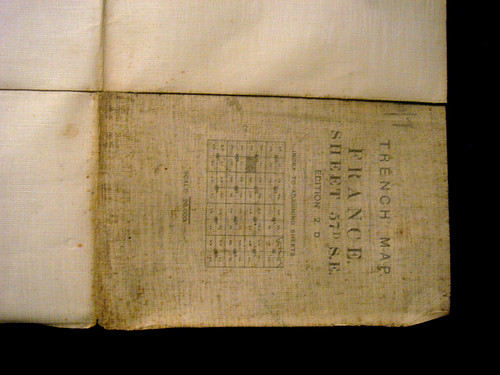
Looking more closely at the front of the folded map, I can see the words:

Trench Map
France
Sheet 57D S.E.
Edition 2.D.

There is then a diagram – an ‘index to adjoining sheets’ beneath which are the words and numerals:

Scale: 1/20,000

On the left hand side of this ‘face’ are what appear to be two initials, DM. The map smells of its age, a musty smell of something that for a long time was forgotten.

On the diagram I can see a small square which has been shaded in to distinguish it from all the others. One can see that this piece of paper is part of a much larger map measuring ‘eight maps’ wide and ‘eight maps’ high.

The map is clearly old. The date 1916 has been printed on the ‘map’ side, but even without this, the style of the printing and the condition tells me it’s of some age. Through its age it has expanded in its folded form. The folds aren’t as crisp as they were. It has no doubt lain forgotten in an attic or some such place, acquiring its patina and its smell. As the dust has grown, the text has faded, although the edges of each letter are crisp. And still I can see the ‘DM’ in pencil on the left hand side.

It doesn’t resist being folded again. First vertically and then horizontally.

I unfold it and instinctively flatten it down. The folds in places rise up. The fold which runs vertically through the red lines does especially. This part of the map won’t remain flat unless I press it down with my hand. As I do, my head instinctively lifts a little and my eyes move along the lines of red to rest around the village of Thiepval.

These actions would no doubt have been repeated in the past when the map was perhaps more pristine – when the folds were sharper and the map lay flat.

The map, when I lift it up, seems to want to fold into a particular shape. It doesn’t want to be put away, but rather be folded so that two columns remain in view. The folds which delineate this part are a darker brown than all the others. In this section of the map is a concentration of red lines and blue lines.

The way it folds suggests that this was what was most important. When I pick up the map to fold it completely, it folds so that the ‘front’ and ‘reverse’ are tucked away. The front now is one of the segments or ‘squares’ containing French words (Sondage) and their English equivalents (Boring – as in cut).
The past movements associated with this map are therefore recorded in its folds. It resists being folded any other way.

We know the map was made in 1916 with minor corrections to details on 15.8.16. This is just six weeks after the first offensive in the Battle of the Somme. Shortly after this period the map would have been replaced with another as the landscape changed with each offensive.

When I look at this map from the comfort of my own front room I see history – albeit one written in a less conventional way. It still has words and pictures.

For much of its life it was no doubt a curiosity. Maybe it was a reminder for those that were there who when looking at the lines would have seen something very different – not on the map but in their minds.

Those who used the map would have seen something else. By August 1916, the colossal tragedy of the first day of the Somme would have been etched on everyone’s mind. The contour lines can hardly tell the reality of the ground’s undulations, and yet it was these which meant the difference between life and death. The map serves to distance us from reality.

Considering its past, the action of being folded and then unfolded over and over, one can almost imagine a bellows lifting and then depressing, letting out air like a breath – a last gasp.

The map is like a palimpsest, albeit one which is just a single print. One can see the original landscape which over the years changed as landscape features assumed English monikers. It is a place that appears at once to be real and imagined – a non sort of place.

‘The Poodles’, ‘The Dingle’, ‘Willow Patch’, ‘Round Wood’, ‘Birch Tree Wood’, – they all have the sound of something made up – a children’s story. ‘Middle Wood’, ‘Villa Wood’, ‘Lonely Copse’. There is even marked ‘a row of apple trees’. These names – these alien names – all appear on the right hand side of the map; on the left, large swathes of woodland go unnamed.

The same is true of road names.

Observation of certain parts of the map has changed the way it moves – these movements seem impressed into the map’s fabric.

When I stand to look at the map, I stand as, no doubt, others stood around it. I can again imagine the creases as sharper, the colour of the paper whiter, the lines more vivid.

Looking at the map, unfolding it and folding it, smoothing down the paper, one gets the sense of an individual. 1/20,000. The map as an object tells me about the individual who looked at it. What is pictured tells me – when I think of the scale – about the thousands of men killed on that first day of the Somme.

One gets the sense of other maps printed before this one, upon which this one is based – each one covering over the horror of the most recent losses of life. They become like shrouds.

Each one would have been used to plan the next map, and the next, and so on, until there weren’t any red lines left.

Filed Under: Goethean Observations, Trees Tagged With: Goethean Observation, Trench Maps, World War I, WWI

Absent Presence

September 25, 2011 by Nicholas Hedges

See also: Artefact.

At a recent meeting with the East Oxford Archaeology Project we were given a short talk about an upcoming dig at Bartlemas Chapel. A number of things interested me in light of the work I’ve already done there, one of which was the image of a resistance survey carried out in the grounds of the chapel. At once, a sort of chain reaction of images flicked through my mind, which I’ve tried to recreate below.

The first image is a Resistance Survey image from Iffley village. The dark patches indicate areas of low resistance while the lighter patches indicate areas of high resistance – such as the remains of buildings, roads, walls etc. I like the fact that images such as these can reveal a footprint of the past, not only in terms of where structures such as these once stood, but where people once walked, following specific paths. What might today be just a large field where one can walk in any direction is revealed through techniques such as these as being a place where people walked along certain lines. The ground is revealed as a palimpsest of movement, where, just as fragments of pottery etc might be found, fragments of movement can also be revealed.

Ideas

Looking at a Resistance survey image (such as that above) during the meeting, I was reminded of an image from a previous work of mine which I exhibited last year. The image was part of an overall picture of the Belzec Death Camp in Poland, photographed from a plane in 1944. It was a place where in 1942, over half a million people were murdered, but walking there now, one cannot image that many people. Walking around the memorial, following a prescribed path, you find yourself looking in at the space enclosed, contemplating the half a million lines of movement that ended there. Where did these lines stretch back to? Where had they come from?

Thinking this way is one small way to establish empathy with those who died in places such as Belzec and the image below, when coupled with the image above resonates with this idea.

Ideas

The next image is a detail from a photograph taken of someone in 1903. This person has of course long since disappeared from the world and yet they remain. They aren’t of course visible in the places where they lived and worked (for example on Headington Hill where this image was taken) but through light (just as with electricity in the Reistance survey) their trace is revealed. The aesthetic link with the images above strengthens this connection.

Ideas

During my observation at Bartlemas Chapel last week, I wrote the following:

“The book on the sill is open at a text on St. Bartholomew. The words are silent on the page.
I read the first few words on the saint. I turn the page – again the ice-cream van. The page creaks like the pew I sat on. I can hear the words as I read them in my head, although of course they make no sound. I imagine hundreds and thousands of internal voices of people who have stood inside the chapel.”

Looking at the bible in the chapel, I saw the words as being like the fragmenetary image of past movement revealed through a Resistance survey, or the image of someone frozen in a photograph. These are words that in this small space have been heard over the course of hundreds of years; words that have mingled with the thoughts of those listening. Reading the bible within that space, I could hear the words in my mind – just as I could hear my thoughts – and yet everything was silent. (Silence here equates with (apparent) emptiness – the field where once there were buildings and people. Words read silently mirrors the electric current passing into the ground, revealing a pattern of movement beneath – lost movement, lost thoughts).

I tried to imagine the thoughts of those who’ve listened over countless generations. If they could be written down what would they tell us? After the meeting, I thought about the aesthetic of the Resistance survey and the photographs above, then pictured fragments of words in much the same way – just like the image below.

Ideas

Filed Under: Goethean Observations Tagged With: Archaeology, Bartlemas Chapel, Fragments, Geophysics, Goethean Observation, Silence

Bartlemas Chapel Observation

September 20, 2011 by Nicholas Hedges

Taken from Artefact – a website concerning Contemporary Art and Archaeology.

I’m making this initial visit to the chapel a few days before archaeological excavations are due to begin within its grounds. I’m interested in how my initial observations might be tied in with both the archaeology discovered there and the chapel’s history. How far is empathy an augmented discourse between bodily experience and knowledge?

As usual, I began by observing the chapel using a Goethean methodology, which – as if often the case – ended up following its own course.

Pre-Observation

Leaving Cowley Road and walking up the track to the chapel was like leaving the modern world behind; not completely for the outside around the chapel and here inside once can still hear the traffic humming like an overhead cable carrying electricity.

The first thing I notice when entering the chapel is the smell; the smell of age, of the past – the smell of the rooms in the church I’d attended as a child. Old books, paper and damp.

The light is slowly beginning to fade being as it is 6pm and the weather grey and raining.

I shall endeavour to carry out the observation without electric light for as long as is possible.

Part 1

The chapel is small comprising two parts divided by a screen. The main door on the chapel’s western side is locked and one enters through a small door on the left hand (north) side. (I’m going to carry out my observation inside rather than out – not least because of the rain, but also because I can easily record outside at a later date).

The walls are all whitewashed; they are rough and bumpy beneath revealing the stone. There are five windows, each of which is arched and through which the last light of the day is creeping. Behind me to my left is a large door in front of which are stacked wooden chairs – no doubt for congregations when services are held here, which they still are. Along the left hand wall more chairs are lined up in a row – eight of them. At the end facing me and in front of the screen are two small pews. Running alongside the right hand wall is another row of chairs – nine of them. There is a radiator, an old wooden cupboard on the side of which are electric sockets and a light switch. I’m sitting on a small wooden bench. In the corner to my right is a large red candle holder replete with candle – no doubt for ceremonial purposes.

Ahead, either side of the doorway through the screen are two small stools. Beyond the screen, from my position, I can see a wooden altar with a crucifix and four candles. A stool stands before them on which rests a box. Above the altar is a window and on the left and right hand walls are also windows. In the wall in this half of the building, on the right hand side from where I am sitting is another window upon the sill of which – which is deep – sits a book, open on a small lectern. Another lectern stands next to me on my right with a book containing the names of visitors. I write my name in it now.

I get up and walk. The hum of the traffic is weak like the light. I can hear the wind rustling the trees outside. Outside the window above the book is an apple tree covered with fruit. My footsteps echo.

I measure the first part of the chapel which is approximately 8 paces. The floor in this part of the chapel is parquet. In the part ahead of me it’s stone.

The pew creaks as I sit down. There are two small pews divided in two to accommodate two people. There are candle stands with low candles (burned down) on my left, a crucifix on a pole and a blue bottle of gas. On the right hand side is another blue bottle, two more well-used candles, four chairs and a picture of Christ. I see now that the altar is stone. Either side in the corners are two wood burners. The window in the left wall is narrower than the others and has a deep sill. This part of the chapel again measures approximately 8 paces.

On a window sill (right) is the curled body of a dead fly. Outside I see the apple trees and the leaves on the wet grass.

The altar is covered by a cloth – green and another white one beneath.

The bible on what I now see is a folding lectern is open at John. Tomorrow’s reading, John 3:13-17.

The ceiling is wooden with numerous coloured shields placed between the beams. The light is fading and it’s getting harder to see.

As I stand before the altar my face is drawn up to the window above it and to the sky. I turn to my left and see the old building that stands alongside. The wind stirs again. There is a white iron work chair in the garden outside. No-one is sitting in it of course.

The window above the large door in the western end of the chapel is smaller than all the others. Again I find my eyes drawn up towards it, to the pale grey light of the sky. There is a large hole in the wall on the right hand side (as I look at it) no doubt where a wooden bolt was once used to secure the church.

There are two circles, unwhitewashed either side of the door.

There are four ‘arches’ supporting the ceiling. The wood appears to be very old. The stone of the floor around the altar is patterned almost as if something has spilled upon it and not quite dried.

The width of the chapel is 7 paces.

I look again at the book full of names and dates – someone from as far away as Australia has visited here. In just a few pages we’re back at the start of 2005. I think of what I’ve done in these few pages – I think of the people I know who have recently passed away.

As the light fades the windows become a stronger presence as they hold what remains of the light outside. I can hear the chimes of an ice-cream van – a sound from my childhood. But although the windows are dominant, I don’t find myself looking beyond – just at them.

Echoes and footsteps. Car horns.

Part 2

I allow the cars and the sounds of the modern world to fall away and instead I listen only to the wind blowing through the trees. I look outside at the trees. I imagine the fruit trees across hundreds of seasons, bearing fruit, dropping the fruit, surviving the winter, blooming again in the spring. I imagine how much more important apple trees would have been long ago; a vital source of food rather than something one might idly pick while strolling past. The book on the sill is open at a text on St. Bartholomew. The words are silent on the page.

I read the first few words on the saint. I turn the page – again the ice-cream van. The page creaks like the pew I sat on. I can hear the words as I read them in my head, although of course they make no sound. I imagine hundreds and thousands of internal voices of people who have stood inside the chapel.

The shadow cast by my hand is more prominent here before the window.

I pick a spot on the left hand side of the chapel looking towards the altar. I imagine all those who have stood here in my place over the centuries, looking to their right at whatever was outside; up ahead through the window; at the others standing there with them; and I begin to imagine those other people. I begin to try and imagine their presence.

The crows outside help dispel the modern world. I think of the floor – how it would have been. I imagine the city behind me, Oxford as it was a few hundred years ago.

I move around the chapel before the screen and glance behind me to the side and up ahead and where I see the walls and windows I imagine people. Each glance is accompanied with a thought – my thoughts.

I try and get a sense of my body in relation to the chapel.

The shadows grow across the floor, blurring to become the first signs of nightfall. Forms in the chapel, like the legs of the chairs against the walls begin to disappear. Everything becomes a shadow – perhaps even me.

I imagine the large locked door being opened and people filing into the light behind. I picture that light filling the chapel, chasing away the shadows.

I’m aware of my body – how my back is aching – how I’m hungry.

The green of the leaves outside is still very visible. Everything is brown, green and grey.

My shadow is faint on the wall.

I move to stand before the altar. I turn and face the large door. Lines of sight from people long since gone still linger. I turn and face the altar. My eyes are drawn to the window, following these eye lines behind me.

I imagine the candles flickering, casting shadows on the walls as the light continues to fade. These candles which are little more than stubs of wax with short blackened wicks and puddles of wax around them.

The sound of the traffic cannot be stopped. It’s always present like interference. The only way to hear the past is with my body.

Part 3

(Rather hard as I can hardly see to write.)

Fleeting, embodied shadows.

I try and think of myself as the chapel. There is, like everything, an outside (exterior) and an inside (interior). I can feel my body – my presence – not so much as me but as something within the chapel.

Contact with the floor, with the furniture means that the chapel and I are one.

NB I have to put on the light – and only then am I aware how dark it is outside. The shift from an external light and interior dark to interior light and external dark is striking. When I turn off the light it’s reversed.

I’m aware of my heart as I sit with my eyes closed – of my breathing. My back against the wall – my breathing and heartbeat becomes that of the chapel.

Exterior / interior.
Beyond the chapel and inside.
Beyond my own body and inside.
A reversal of the two.
Interior voice reading / exterior voice listening.

With the lights on, the light beyond the window is blueish above the door. Up ahead, the window above the altar is dark.

Again there is almost a grain in the building – of sight. Looking towards the altar one is aware of the individual; then turning round, of a crowd.

Filed Under: A Line Drawn in Water, Goethean Observations, Trees Tagged With: Archaeology, Bartlemas Chapel, Goethean Observation

Archaeological Dig – Roman Coin 2

June 22, 2011 by Nicholas Hedges

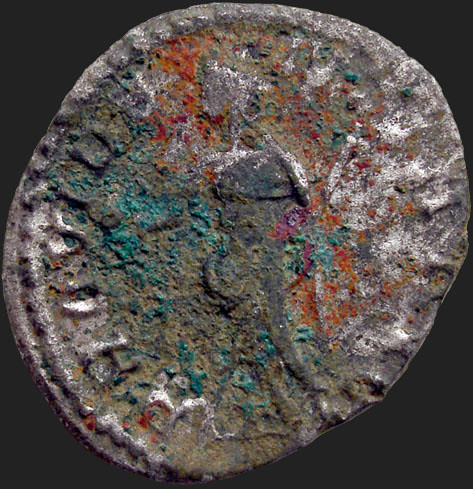
Since carrying out the observation of the Roman Coin discovered during a dig on 11th June I’ve been thinking about the coin in greater detail. One of the things which interests me about it are the vivid colours formed during its time in the ground; in particular those on the reverse side of the head, as can be seen in the image below:

Colours on a Roman Coin

It’s easy to think of the coin as having occupied two distinct periods (i.e. the 3rd century and today) and that it’s almost two distinct entities; the ‘new’ coin of some 1700 years ago, and the clipped and rather decayed coin it is now.  But of course this coin is a singular entity which has occupied a span of time covering a range of years difficult for us to imagine. To borrow from Bill Viola, this coin has ‘lived’ this same continuous moment ever since it was ‘conceived’ – or in this case minted – and for much of its existence, it’s been laying out of sight, in silence, underground.

At some point 1700 years ago,  the coin (we might assume) was lost and during the dig a week or so ago it was found. I find it easier however, to conceive of the coin’s entire existence if I forget these two ‘divisions’ and think instead of the coin as always existing – not lost or found, just always there – somewhere. Stating that it was first lost and then found creates a kind of void in between, in which the coin just sits – not really existing at all. Of course the coin was in existence for hundreds of years; before the city of Oxford was even established, and throughout the time during which it was made ancient. And in that time, beneath the ground, things were acting upon it, slowly changing its shape and colour; to make the beautiful colours we see today. The colours therefore can be linked to the passing of time – to the coin’s continuous existence. There’s a correlation between the passing of time and the formation of the various colours.

There is also something rather poetic about this as regards the way we imagine the past. For me, the distant past is often a dark and silent place (in the sense that it’s largely unknowable – not that it really was dark and silent) but one in which there was movement and colour – just as with the coin beneath the ground. Although out of sight to us today, we know that that things moved, that things were formed, that entities acted upon or influenced other entities. That there was of course colour.

Thinking about the coin a little more, I realised how else it’s changed from the 3rd century AD. Back then it wouldn’t have been valued as an object in its own right per se, but rather in regards to what it represented, i.e. a monetary unit. If I have a pound coin in my hand, I don’t value the object (the coin) so much as what it represents (a pound sterling). Now of course, the Roman coin’s original monetary value has been lost and it’s the coin as an object which has become important.

Filed Under: Goethean Observations Tagged With: Archaeology, Artefacts, Bill Viola, Colour, Goethean Observation, Silence

Archaeological Dig – Roman Coin

June 16, 2011 by Nicholas Hedges

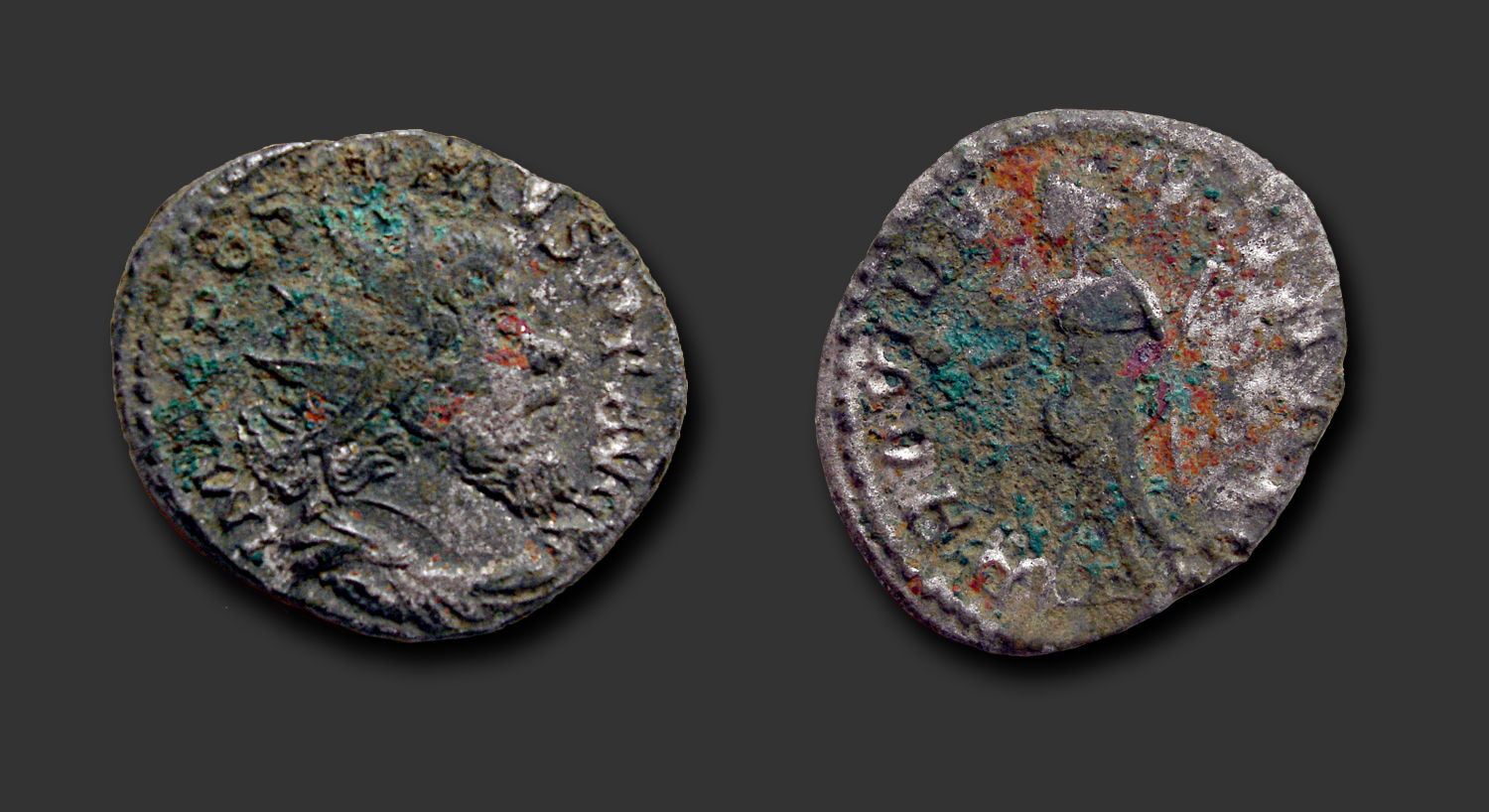
Further to my entry on the archaeological dig in Iffley, Oxford, I have carried out some extra work on the Roman coin we discovered whilst excavating the test-pit. The coin in question, dating from the reign of Emperor Postumus (260-269 AD) can be seen below.

Click here for the text of the observation.

See also: Archaeological Dig – Roman Coin 2.

Filed Under: Goethean Observations Tagged With: Archaeology, Artefacts, Goethean Observation

Music and Names

May 11, 2009 by Nicholas Hedges

Over a year ago I wrote about the beginnings of a project concerned with Music and Text. I must admit that I’ve not followed up this project what with my MA Show and other things taking over, however, recently, in working on another project (see: Wolvercote Cemetery) I have come around to picking up where I left off. It was whilst considering the cemetery in Wolvercote, but whilst visiting another cemetery in Highgate that I was struck whilst looking at the hundreds of names carved into the stone how once these names would have had a sound.

As I wrote after my visit: “…when we read a name, we hear within our minds, albeit silently, the sound of a name that was spoken countless times. We hear it muffled, like bells were muffled at times of death.”

I then began to think back to another line of research which I’d started sometime earlier. This was in regards to Old Musical Instruments which I studied in the Ashmolean Museum. The reason for the research was to try out a method of observation the results of which led me to assert (a point which may appear rather obvious) that the design of the instruments, sitting silently behind their glass; the materials used and so forth, were as such so that the instrument would make the perfect sound.

The silent instrument sitting in its display case was made to make a sound, just as a name, carved on a tombstone was there to be spoken.

A Lira da Braccio in the Ashmolean Museum.

Highgate Cemetery

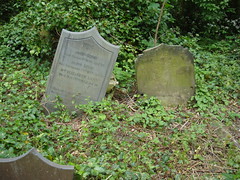
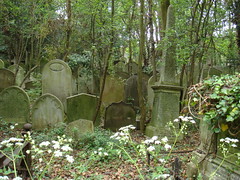
Graves in Highgate Cemetery.

Filed Under: Goethean Observations Tagged With: Cemetery, Goethean Observation, Highgate Cemetery, Instruments, Music

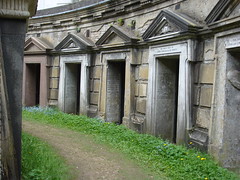
Highgate Cemetery

May 6, 2009 by Nicholas Hedges

I’d known about Highgate cemetery, principally as the last resting place of Karl Marx, but this was the first time I had visited it. Having left Archways Tube station, I walked up Highgate Hill, through the pleasant surroundings of Waterlow Park and found my outside a large iron gate, standing amongst a small group of people waiting to go in. The cemetery itself is divided into two sections; the older West and the newer East. The East side can be visited at any time, but the West can only be accessed as part of a guided tour. It was for this tour that we along with a dozen others waited our turn.

I had the feeling that we were queuing to be let inside a prison. Not that I’ve ever queued for such a reason. It was simply the fact that we were locked outside waiting for our appointed time to visit, when those kept behind the walls would be allowed to receive us (there is something similar too in the architecture of the gatehouse and that which one sees in some Victorian prisons). Also, I couldn’t help but think of King Kong – the wall and the gates behind which the giant beast was kept. There was certainly a sense of anticipation, which had, it seems, been in part been created by the cemetery’s architect Stephen Geary.

Highgate Cemetery

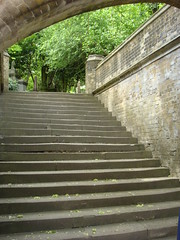
The way into the cemetery itself, from the courtyard, is via a flight of steps. When standing in the courtyard, the cemetery cannot be seen; it’s only when walking through the archway leading to the steps, at the top of which one can see the greenery and the first of the monuments, that this vast cemetery is slowly revealed.

There is certainly more than a hint of theatre in how one enters, and the fact one ascends the stairs into the world of the dead serves to reflect a belief in the continuity of life after death; by ascending the steps we follow in the footsteps of those long since passed away, as if they were not borne here by pallbearers, horses and hearse, but had walked here themselves. Their lives continue and of course life continues through our present-day visiting.

It is this which makes the place feel strangely alive. That is not to suggest of course that those interred within are indeed still living in the physical sense of the word, but that the memory of their lives is almost tangible. Many of those buried here would have enjoyed the finer things that Victorian life could offer, things which we modern-day visitors can only know through books, films and television. These people lived the lives that we can only imagine.

Highgate Cemetery

I do not wish however to over-romanticise their lives, by suggesting that they were all happy and spent their time at balls, dressed in splendid costumes; that their lives were indeed little more than costume dramas; that would be naive to say the least. But nonetheless, as I walked around the cemetery, I was aware as I read the names on the tumbledown, but nonetheless impressive monuments, that the names inscribed upon them – or at least some of them, particularly in the Circle of Lebanon (which reminded me, in some respects, of the Great Crescent in Bath which we’d visited the day before) – would have been known in society. They would have called to mind faces, voices, attitudes and characters where today they are labels for empty spaces.

The Victorian attitude to death – the strong belief in the afterlife which I’ve already mentioned – is clearly apparent in this cemetery; religion was of course very important to them. Strange then that they should choose to design their funerary monuments in the style of Ancient Egyptian tombs and temples. Perhaps this was as much down to the fashion of the time as anything else, but could it also be that the Ancient Egyptians’ attitude to death and remembrance was somehow a confirmation of a continued existence? That’s not to say – and this goes without saying – that Victorians shared in the Polytheistic beliefs of the Pharaohs, but that the very age and ancient duration of their (the Pharaohs’) memory, which had and has spanned several millennia, promised an afterlife of a different kind; one that would be shared with living. Alongside the immortality of the soul, the endurance of the name was also important.

Highgate Cemetery

Such large and elaborate monuments are rebuttals of death itself. They are large and elaborate parts of the living world and, it could be argued, belie the uncertainty of a continued heavenly existence. They occupy a space in the land of the living, just as did the deceased, and when we read a name, we hear within our minds, albeit silently, the sound of a name that was spoken countless times. We hear it muffled, like bells were muffled at times of death.

I was reminded when reflecting on this of some work I did on Old Musical Instruments in the Ashmolean Museum in Oxford. It might sound obvious, but having studied materials used in the making of a Lira di Braccio as well as its shape, I became aware that it was so designed and made so as to make a sound. Names too are like this. They are given so as to be said.

Considering the perpetuity of names and memory amidst the slow convulsions of the ground , I coudn’t help but think of the writings of Sir Thomas Browne, who in Urne Burial, published in 1658, wrote some of the most beautiful lines ever put down on the subject of mortality and remembrance:

“And therefore restlesse inquietude for the diuturnity of our memories unto present considerations seems vanity almost out of date, and superanuated peece of folly. We cannot hope to live so long in our names as some have done in their persons, one face of Janus holds no proportion unto the other. ‘Tis too late to be ambitious. The great mutations of the world are acted, our time may be too short for our designes. To extend our memories by Monuments, whose death we dayly pray for, and whose durations we cannot hope, without injury to our expectations in the advent of the last day, were a contradiction to our beliefs. We whose generations are ordained in this setting part of time, are providentially taken off from such imaginations. And being necessitated to eye the remaining particle of futurity, are naturally constituted unto thoughts of the next world, and cannot excusably decline the consideration of that duration, which maketh Pyramids pillars of snow, and all that’s past a moment.
[…]There is no antidote against the Opium of time, which temporally considereth all things; Our Fathers finde their graves in our short memories, and sadly tell us how we may be buried in our Survivors. Grave-stones tell truth scarce fourty years; Generations passe while some trees stand, and old Families last not three Oaks. To be read by bare Inscriptions like many in Gruter, to hope for Eternity by Ænigmaticall Epithetes, or first letters of our names, to be studied by Antiquaries, who we were, and have new Names given us like many of the Mummies, are cold consolations unto the students of perpetuity, even by everlasting Languages.
[…]Darknesse and light divide the course of time, and oblivion shares with memory a great part even of our living beings; we slightly remember our felicities, and the smartest stroaks of affliction leave but short smart upon us.”

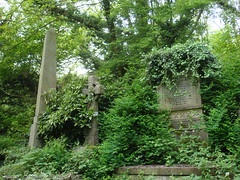
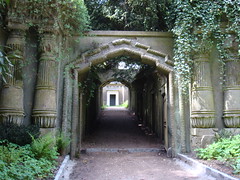
Walking in the Circle of Lebanon (reached by a gateway which itself could be a cast off from a production of Aida) one couldn’t help but think of the families entombed within the sepulchres and, as I’ve already written, the lives which they led in Victorian society. The dead names carved in the stone were now as hollow and as empty as whatever lay behind the closed doors. And up beyond the Circle of Lebanon, the once wealthy inhabitants of the cemetery, far from the whirligig of their colourful lives were now just bones turned over in the soil. The trees, growing all around, seemed to be reaching with their roots deep into the ground like a man searching for change in his pockets, elbowing their way between the tombstones, staggering amongst the ivy trusses, as if driven mad by the idea of nothing.

Highgate Cemetery

In a recent study of another cemetery, this time in Wolvercote, Oxford, I came to the conclusion through a particular process of observation, that there were no such things as cemeteries. Well, of course there are cemeteries, but in a wider, more holistic view there is just the cycle of birth, life and death, whether those cycles are applied to the existences of human beings, animals or leaves. Where those leaves fall and where bodies are laid to rest is in the end quite irrelevant.

Highgate Cemetery itself was saved because of the threat of development. For many years it was left to decay, grown over with ivy, brambles and trees and suffering from vandalism. Unchecked, this cemetery could have disappeared along with all the names and their monuments. Thankfully, through the dedication of a relatively small number of people, the cemetery remains a place that we can visit today. But why is it we do so?

Highgate Cemetery

There are of course many reasons why a place like Highgate is of interest, not least from a purely historical perspective. The Victorian attitude towards death is a subject in itself, as are the styles and designs of the various funerary monuments. But for many of us who visit I think the reasons run much deeper.

The monuments we see were put there for us. As we walk, we try to imagine the lives of those who lived a century before we were even born, when we did not exist. And now, when the those who lived back then, exist only in the hollow shell of their names, so we cast our eyes to the future when our names will also no longer be spoken.
Back in 2007, Monika and I visited Pere Lachaise and Montmartre cemeteries in Paris, and reflecting on our visits I wrote:

“Cemeteries have something in common with old photographs, particularly when we consider the the writing of Roland Barthes who writes that photographs have within them the ‘catastrophe of death,’ and that, ‘in the photograph, Time’s immobilisation assumes only an excessive, monstrous mode: Time is engorged…’. In cemeteries too, Time is somehow engorged and contains in abundance that catastophe. One has the impression of time standing still, stopped by the dates of death carved into the many gravestones and tombs, yet we know, all too well, that time continues.”

Perhaps it’s Time, engorged within the bounds of the cemetery that skews the gravestones and monuments.

As I wrote earlier, the people buried in this cemetery lived lives that we can only imagine. Similarly, their existence now is one that we can only conceive at the very limits of our imaginations. My aunt once said to me, “you have to believe in something,” ergo, you can’t believe in nothing. And this is certainly true, I can’t imagine nothing, whether that nothing is all the time before I was born or all the time that will come after my death. Cemeteries, like any historical record, building or object tell us there was something and that there always will be something.

Cemeteries point to both our past and future non-existence at a moment when we feel the present most acutely.

As Sir Thomas Browne wrote in his conclusion to Urne Burial:

“‘Tis all one to lye in St Innocents* Church-yard, as in the Sands of Ægypt: Ready to be any thing, in the extasie of being ever, and as content with six foot as the Moles of Adrainus**.
*in Paris where bodies soon consume.
**A stately Mausoleum or sepulchral pyle built by Adrianus in Rome, where now standeth the Castle of St. Angelo.

Filed Under: Goethean Observations, Trees Tagged With: Barthes, Catastrophe, Cemetery, Death, Goethean Observation, Highgate Cemetery, Instruments, Montmartre, Music, Sir Thomas Browne, Urne Burial

Herodotus and the Morning Paper

November 10, 2007 by Nicholas Hedges

One has to remove the future from a past event to really understand its ‘presentness’. One has to view historical (‘Herodotus’ – see Walter Benjamin and Objects) events as being on the periphery, whilst the mean and the commonplace (‘morning paper’) take centre stage. It is the distance which interests me, the distance from the heroic or ‘main’ event and the historical perspective this gives us.

“Thus the whole emerges simultaneously with the accumulation of the parts, not because it is the sum of the parts, but because it is immanent within them.”

Bortoft’s theory of authentic wholeness could be applied to history. A great event, such as a coronation (let’s say, that of Elizabeth I), is not a whole in itself. Step outside the ceremony, outside the city and into the countryside; walk into a tavern… what is happening there, at the exact moment of the coronation? Let’s say a man sits at a table eating his dinner, enjoying a drink. The moment of the coronation is not simply about the ceremony but the moment in time (some time on January 15, 1559); that moment, of which the Queen and the man in the house are equal parts, although history has forgotten one and kept alive the other. Within both these people (parts), the moment (the whole) is immanent.

The man in the tavern pours his wine from a jug; 450 years later and that jug is in a display case in a museum, freed as Benjamin would have it from the ‘drudgery of its usefulness.’ For us to see it properly as it stands behind the glass, we need to re-impose that drudgery, we need to see it as it was, when it was useful.

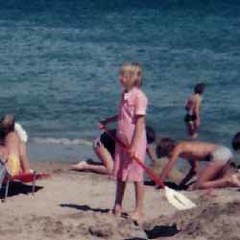
Returning to the idea of distance and perspective: the distant elements in my old holiday photographs on which I have been doing some work, as well as those in old photographs (windows and bicycles) coincide to some degree with what I have written above. When I look at a photograph, taken during a family holiday in the late 1970s, I see the people I recognise, whether that’s myself, my brother, parents or grandparents. But there are often others, all of whom were a part of that moment (such as the girl below who was standing in the distance of one of our snaps).

20

Returning to objects: how do we re-impose the ‘drudgery of an object’s usefulness’ back onto the object? Think of the old musical instruments in the museum. How did I give it back its usefulness? By using the Goethean method of observing, and, in particular, by placing it back – through use of the imagination – in its own time. Although I wasn’t looking at the specific ‘gesture’ of things at that time, I believe I found the gesture of the lira di braccio nonetheless.

So, returning to the man in the tavern; what are the elements of that place which one would need to understand in order to re-construct it through the imagination? Objects (contemporary and old), environments (the room itself and elements thereof), conversations…

Filed Under: Goethean Observations Tagged With: Creatures, Goethean Observation, Henri Bortoft, Herodotus, Objects, Vintage Photographs, Walter Benjamin

The Goethean Method and Haiku

October 15, 2007 by Nicholas Hedges

I have recently studied, as part of my MA in Social Sculpture, a couple of articles on the use of Goethe’s Scientific method in observing both objects (Talking with History: Using Goethe’s Scientific Approach with Human Artefacts by Jim Davis) and landscape (Goethean Science as a Way to Read Landscape by Iris Brook). Both these articles, whilst using different methodologies, share the same aim; to show how Goethe’s approach to phenomena, can lead to an understanding of the subject (in these instances, an object and the landscape) which runs much deeper than a more ‘traditional’ objective view.

For his approach, Jim Davis uses “a series of questions that Floris Lowndes (2000) uses for organising one of Rudolf Steiner’s meditation exercises.” The questions in his methodology are (preceded by a defining keyword):

a) physical: What is it made of? What are its properties?
b) historical: How is it made? How is it used?
c) emotional: Why this design? What are my feelings about it?
d) creative: Who created it? Invented it?
e) desire/need: What need or desire led to its invention?
f) origins, background: What preceded it? What was its context?
g) archetype: What is the concept of the thing? Other forms?

These questions are, he explains, “are a set of ‘canned riddles’ that formalize and direct the conversation which leads from the physical objects to a form that can only be grasped imaginatively or intuitively. By working through the questions from a) to g), the process follows Goethe’s ‘genetic method’ of proceeding from empirical observation to archetype.”

I have written in detail about my application of this methodology in a ‘conversation’ I had with a Lira da Braccio in The Ashmolean Museum in Oxford, but what I was particularly interested in, was how this method allowed me, through my imagination, to visit the past of this musical instrument more directly than I would have managed before.

The second article by Iris Brook, describes her use of “Goethean observation as a means of surveying and appraising landscape…”. She describes her methodology as follows:

a) Exact sense perception: “…the observer attempt[s] to approach the object from a clearer, more objective standpoint.. This stage was called by Goethe, exact sense perception and is characterised by a detailed observation of all the ‘bare facts’ of the phenomenon that are available to our ordinary senses. It is an attempt to see what is present with as little personal judgement and evaluation as possible.”

b) Exact sensorial fantasy: “The second stage of looking at the phenomenon is what Goethe called ‘exact sensorial fantasy’ (Exact sinnliche Phantasie). An aspect of this activity is to perceive the time-life of the phenomenon, that is to see the phenomenon in time. This means no longer seeing the thing in an objective frozen present as prompted by the first stage, but as a thing with history. That history can be drawn from the phenomenon with the use of an imaginative faculty that cultivates temporal and physical relationships…”

c) Seeing in beholding: “In the third stage one attempts to still active perception to allow the thing to express itself through the observer. We attempt to step outside of what has gone before and make space for the thing to articulate in its own way.”

d) Being one with the subject: “Being one with the object in this fourth stage allows the human ability to conceptualise to serve the thing: we lend it this human capacity. When the phenomenon being explored does not have the ability to think, it is the most participatory part of Goethean observation.”

What interested me about Iris Brook’s approach was how it allowed the landscape she was studying to reveal itself (its gesture), while Brook herself, through her ‘perception, imagination, inspiration and intuition’, becomes “one with nature”, understanding the landscape’s position within the wider landscape not only in a physical sense but also in a temporal one.

The phrase “one with nature” comes not from any book on Goethe (although there might be just such a phrase in one of the many available) but a book by Lucien Stryk on the Haiku of Massuo Kinsaku (1644-94) who later became known as Basho; it’s in his collection of travel sketches, The Records of a Travel-Worn Satchel, that he writes:

“… All who achieve greatness in art… possess one thing in common: they are one with nature.”

This phrase shares much with Goethe’s approach, in that following the methodology as described by Brook, one does indeed become “one with the subject” which in her case was a “60-acre parcel of land that lies at the foot of the north-facing slopes of the Lammermuir Hills, 20 miles east of Edinburgh.”

Stryk states: “Basho’s discussion of poetry was always tinged by Zen thought, and what in his maturity he advocated above all was the realization on muga [no-self, selflessness, non-ego or ecstasy] so close an identification with the things one writes of that self is forgotten. As Zen’s Sixth Patriarch, Hui-neng (637-712), put it, one should not look at, but as, the object.”

The forgetting of self and becoming the object, are absolutely the same as what Brook describes in the fourth stage of the methodology

One of Basho’s disciples, Doho, writes of a conversation he had with the poet: “The master said, ‘Learn about a pine tree from a pine tree, and about a bamboo stalk from a bamboo stalk.’

What he meant was that the poet should detach his mind from self… and enter into the object, sharing its delicate life and feelings whereupon a poem forms itself. Description of the object is not enough: unless a poem contains feelings which have come from the object, the object and the poet’s self will be separate things.”

The similarities between this advice and that offered by Goethe is striking. Regarding the advice recalled by Doho, Stryk writes: “To give an indication of the influence of such comments on subsequent practice of the art, a contemporary haiku school, Tenro, possesses a creed, Shasei (on-the-spot composition, with the subject ‘traced to its origin’), virtually based on the theoretical statements and practice of Basho. Tenro has some two thousand members all over Japan, and it is customary for groups to meet at a designated spot, perhaps a Zen temple in a place famous for its pines or bamboo, and there write as many as one hundred haiku in a day, attempting to enter the object,’ share its delicate life and feelings.'”

Filed Under: Goethean Observations Tagged With: Goethean Observation, Haiku

© Nicholas Hedges 2024

  • Facebook
  • Instagram
  • Twitter
  • YouTube

Copyright © 2025 · Outreach Pro on Genesis Framework · WordPress · Log in