Nicholas Hedges

Art, Writing and Research

  • Amazon
  • Behance
  • Facebook
  • Instagram
  • Pinterest
  • YouTube
  • Art
    • Digital
    • Drawing
    • Grids
      • Correspondence
      • The Wall
      • The Tourist
    • Ink on paper
      • Shadow Calligraphy
    • Installation
      • Murder
      • Echo
    • Painting
    • Patterns
    • Mixed Media
    • Photographic installation
      • St. Giles Fair 1908
      • Cornmarket 1907
      • Headington Hill 1903
      • Queen Street 1897
    • Research/Sketches
    • Stitched Work
      • Missded 1
      • Missded 2
      • Missded 3
      • Missded 4
    • Text Work
  • Blogs
    • Family History
    • Goethean Observations
    • Grief
    • Light Slowed But Never Stilled
    • Lists
    • Present Empathy
    • Shadow Calligraphy
    • Trees
    • Time
    • Walking Meditations
  • Video
  • Photography
    • Pillars of Snow
    • Creatures
    • The Trees
    • Snow
    • St. Giles Fair 1908
    • Cornmarket 1907
    • Headington Hill 1903
    • Queen Street 1897
    • Travel
  • Illustration and Design
  • Music
  • Projects
    • Dissonance and Rhyme
    • Design for an Heirloom
    • Backdrops
    • Shadow Calligraphy
  • Exhibitions
    • A Line Drawn in Water
      • Artwork
    • A Line Drawn in Water (Blog)
    • Mine the Mountain 3
      • Artwork
    • Mine the Mountain 2
      • Artwork
      • The Wall
    • The Woods, Breathing
      • Artwork
    • Snow
      • Artwork
    • Echo
      • Artwork
    • Murder
      • Artwork
    • The Tourist
    • Dreamcatcher
    • Mine the Mountain
      • Artwork
      • The Tourist
    • M8
    • The Gate
    • Creatures
      • Artwork
    • Residue
      • Artwork
    • A visit to Auschwitz
      • Artwork
  • Me
    • Artist’s Statement

Lines Drawn in Water

October 22, 2012 by Nicholas Hedges

The following passage is taken from ‘The Old Ways: A Journey on Foot’ by Robert Macfarlane. In a chapter on water he writes:

“The second thing to know about sea roads is that they are not arbitrary. There are optimal routes to sail across open sea, as there are optimal routes to walk across open land. Sea roads are determined by the shape of the coastline (they bend out to avoid headlands, they dip towards significant ports, archipelagos and skerry guards) as well as by marine phenomena. Surface currents, tidal streams and prevailing winds all offer limits and opportunities for sea travel between certain places…”

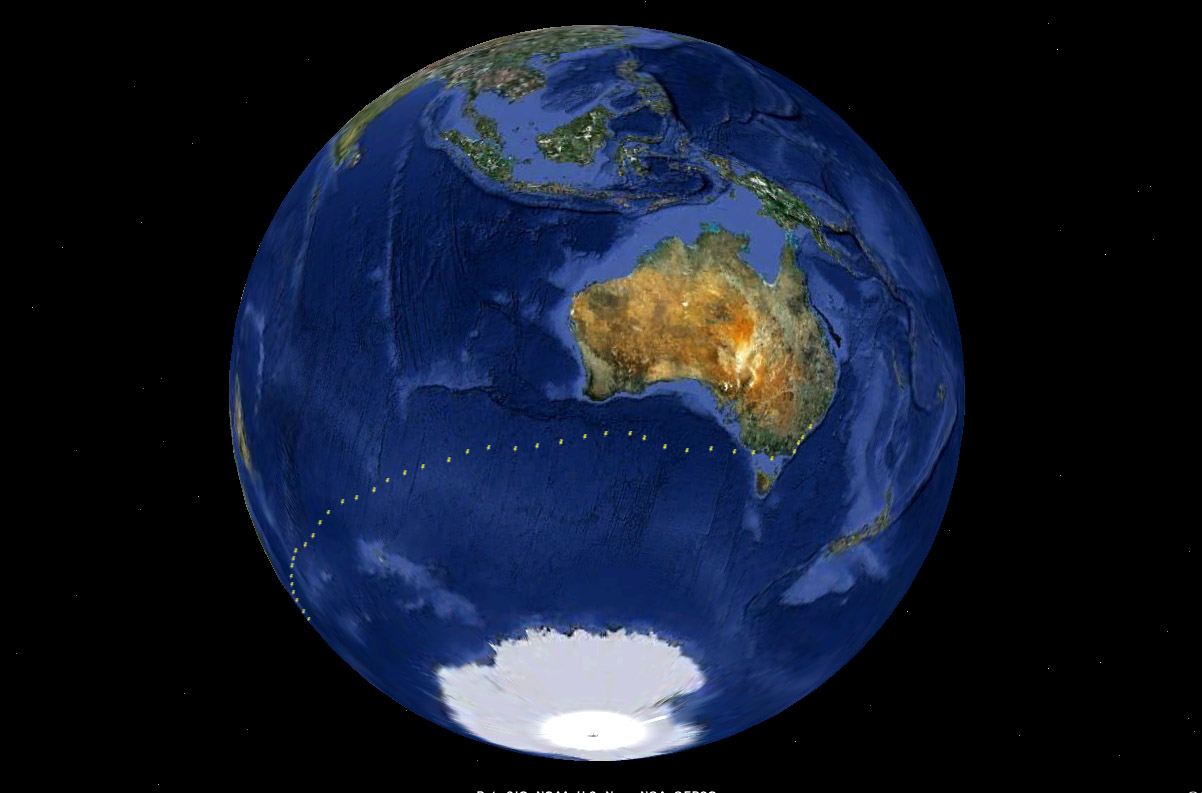
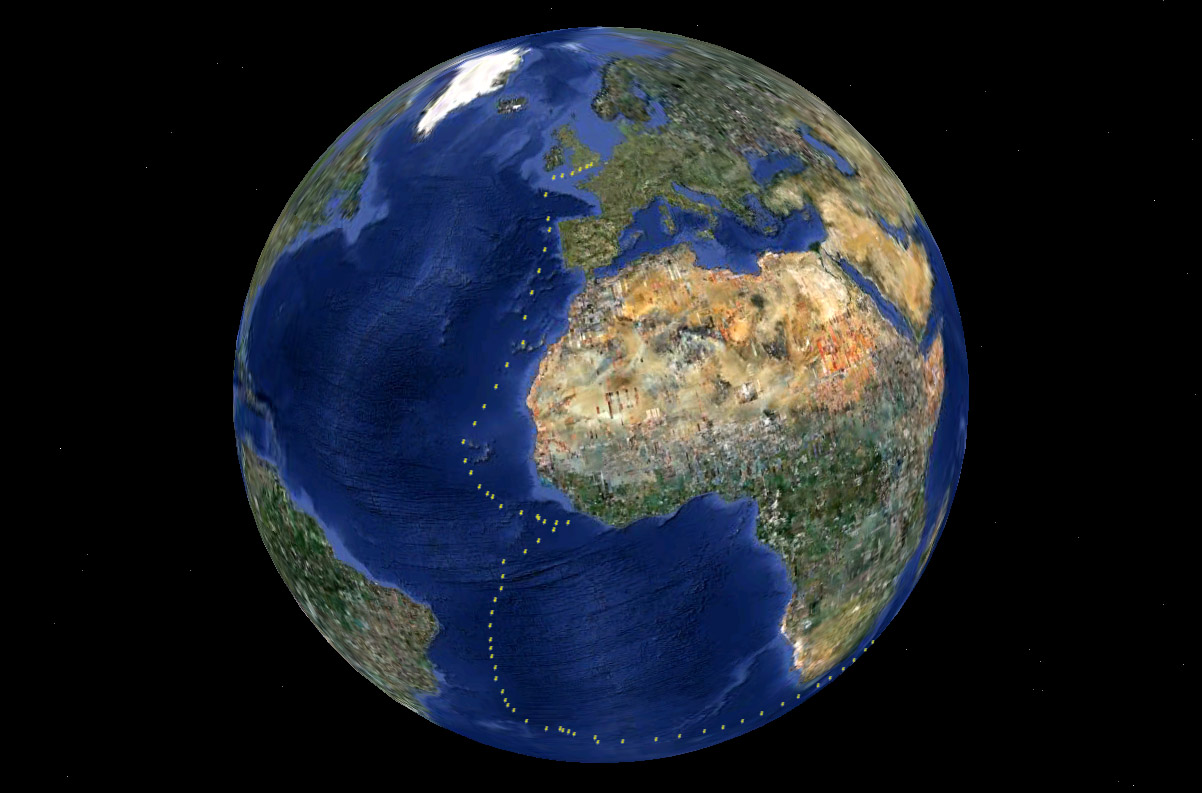
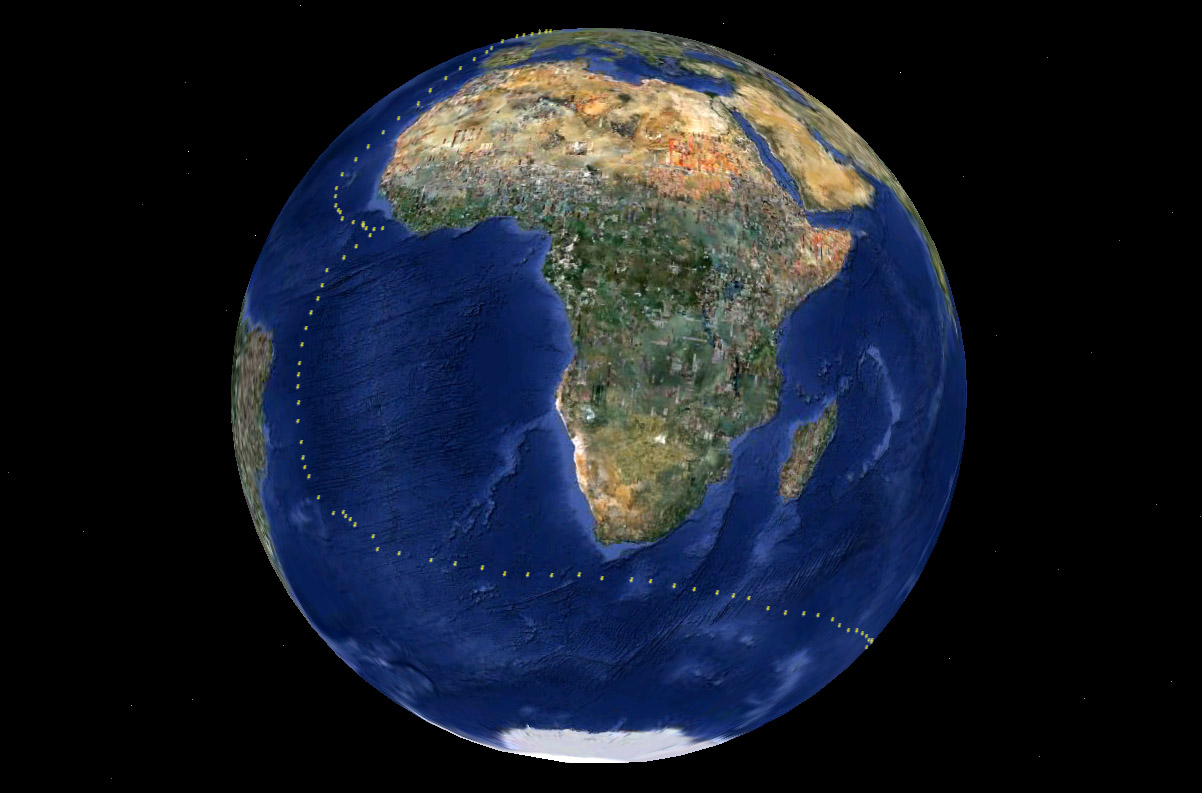
This reminded me of some work I did on my ancestor Stephen Hedges who was transported to Australia in 1828. In particular I thought about the route The Marquis of Hastings (the ship on which he sailed) took from Portsmouth to Port Jackson (Sydney) which I mapped using Google Earth and coordinates written down in a logbook by the ship’s surgeon, William Rae.
Macfarlane also writes:

“Such methods would have allowed early navigators to keep close to a desired track, and would have contributed over time to a shared memory map of the coastline and the best sea routes, kept and passed on as story and drawing…

Such knowledge became codified over time in the form of rudimentary charts and peripli, and then as route books in which sea paths were recorded as narratives and poems…

To Ian, traditional stories, like traditional songs, are closely kindred to the traditional seaways, in that they are highly contingent and yet broadly repeatable. ‘A song is different every time it’s sung,’ he told me, ‘and variations of wind, tide, vessel and crew mean that no voyage along a sea route will ever be the same.’ Each sea route, planned in the mind, exists first as anticipation, then as dissolving wake and then finally as logbook data. Each is ‘affected by isobars, / the stationing of satellites, recorded ephemera / hands on helms’. I liked that idea; it reminded me both of the Aboriginal Songlines, and of [Edward] Thomas’s vision of path as story, with each new walker adding a new note or plot-line to the way.”

One of the things I like about William Rae’s logbook of the journey aboard the Marquis of Hastings is the description of the weather. The world aboard a prison ship in 1828 is far removed from our experience, but we know weather and can therefore use his descriptions to bridge the gap between now and then; moving from – to use Macfarlane’s words – “logbook data” through “dissolving wake” and “anticipation,” all the way back to “planned in the mind.” The description of the weather therefore becomes a poem of sorts, echoing what Macfarlane writes above; how sea paths become narratives and poems, allowing me to step back into the mind of my ancestor.

Fresh Breeze. Mist and rain.
Strong Breeze. Cirro stratus. Horizon hazy.
Hard gale & raining. Heavy Sea.
Hard rain & Violent Squalls. Hail & rain.
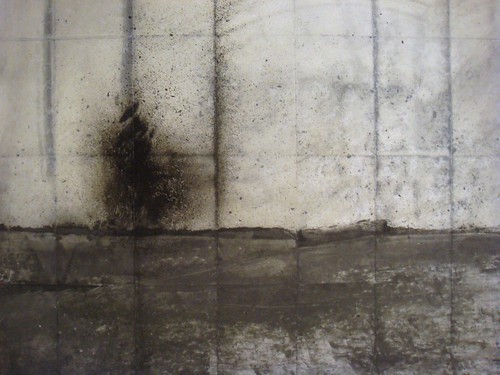
Click here for a PDF transcript I made of the journey.

Filed Under: A Line Drawn in Water, Artist in Residence Tagged With: A Line Drawn In Water, Artist in Residence, Everydayness, Family Hedges, Family History, GPS, Hedges, Listmaking, Lists, Positioning, Stephen Hedges, Walks, Weather

Glimmerings: The War Poets, Paths and Folds

October 16, 2012 by Nicholas Hedges

One of the nicest compliments I received during Friday’s private view was ‘…these remind me of Siegfried Sassoon…’. The works in question were those images of imagined World War I landscapes painted onto folded paper, one of which I have shown below:

DSC07879

In fact, the war poets were brought up a number of times in relation to these works which – for obvious reasons – pleased me enormously. But, I wondered what it was about these pieces which called to mind the poets?

One of the poets I’ve become increasingly interested in, is Edward Thomas – killed at the battle of Arras in 1917. I first became aware of his work whilst reading a book of World War I poetry, in which I found his poem ‘Roads’ (a poem I’ve already discussed in relation to my work). It was then in Robert Macfarlane’s book ‘Wild Places’ that I encountered Thomas again, this time in relation to another poet, Ivor Gurney. In a previous blog I wrote:

After returning from the war, Ivor Gurney, like so many others suffered a breakdown (he’d suffered his first in 1913) and a passage in Macfarlane’s book, which describes the visits to Gurney – within the Dartford asylum – by Helen Thomas, the widow of Edward Thomas is particularly moving. Helen took with her one of her husband’s Ordnance survey maps of Gloucestershire:

‘She recalled afterwards that Gurney, on being shown the map, took it at once from her, and spread it out on his bed, in his hot little white-tiled room in the asylum, with the sunlight falling in patterns upon the floor. Then the two of them kneeled together by the bed and traced out, with their fingers, walks that they and Edward had taken in the past.’

Macfarlane discusses Thomas in another book, ‘The Old Ways: A Journey on Foot,’ in which he writes how for Thomas, paths “connected real places but… also led outwards to metaphysics, backwards to history and inwards to the self. These traverses – between the conceptual, the spectral and the personal – occur often without signage in his writing, and are among its most characteristic events. He imagined himself in topographical terms. Corners, junctions, stiles, fingerposts, forks, crossroads, trivia, beckoning over-the-hill paths, tracks that led to danger, death or bliss: he internalized the features of path-filled landscapes such that they gave form to his melancholy and his hopes. Walking was a means of personal myth-making, but it also shaped his everyday longings: he not only thought on paths and of them, but also with them.”

DSC07578

Ever since I walked a path in Wales on which I knew my great-great grandfather walked every day to the mine in which he worked, I’ve been interested in the idea of people as place (and vice-versa) – see Landscape DNA – the simultaneity of stories so far. The path from the small town of Hafodyrynys to Llanhilleth where he worked, not only connected those two places, it also connected me with my ancestor. It did just what Thomas suggested; connected real places but also went backwards to the past and inwards to my own self. As Macfarlane puts it: “paths run through people as surely as they run through places.”

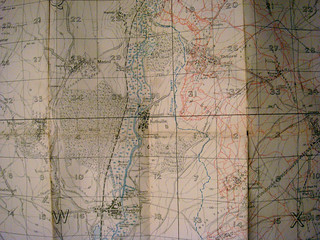
It was important for me that the images shown above did not appear so much as pictures – objects stuck on a wall – as objects of use. I wanted them to appear as if they’d been unfolded rather than simply painted, that like maps, they could be read rather than simply looked at. I wanted them to retain the potential for being folded (which, if they were framed, wouldn’t have been possible) for this inherent potential of folding and unfolding refers back to an observation I made whilst studying an old trench map.

DSC07754

During that observation I wrote, “…the past movements associated with this map are therefore recorded in its folds. It resists being folded any other way.”

The folds in the map are like ancient paths in a landscape. We can walk (within reason) wherever we like through a place, but more often than not, we will follow the way of countless others before us. Paths are themselves like folds within the landscape, and we, like the map, resist being folded any other way.

Trench Map 1916

Macfarlane again writes how for Thomas “…map-reading approached mysticism: he described it as an ‘old power’, of which only a few people had the ‘glimmerings’.”

These glimmerings reminded me of a passage I read in Merlin Coverley’s book Psychogeography, in which he writes: “Certain shifting angles, certain receding perspectives, allow us to glimpse original conceptions of space, but this vision remains fragmentary…”

These ‘glimmerings’or ‘shifting angles’ are best seen or accessed through the everyday; observations of which I record in other map works.

Map Work

This is something which Macfarlane again seems to allude to in ‘The Old Ways: A Journey on Foot’, when he writes: “The journeys told here take their bearings from the distant past, but also from the debris and phenomena of the present, for this is often a double insistence of old landscapes: that they be read in the then but felt in the now. The waymarkers of my walks were not only dolmens, tumuli and long barrows, but also last year’s ash-leaf frails (brittle in the hand), last night’s fox scat (rank in the nose), this minute’s bird call (sharp in the ear), the pylon’s lyric crackle and the crop-sprayer’s hiss.”

As I have recorded in my text-maps:

A man talks holding his hat
A flag flies, fluttering in the growing wind
The next bus is due
A car beeps
Amber, red, the signal beeps
The brakes hiss on a bus

Maps are objects which we fold and unfold. We unfold them to find our place within the landscape. We fold them and carry them with us. The process or unfolding and (en)folding: the idea that the past can be seen as being enfolded within the smallest objects and everyday observations in vital to my work; as is the way in which we are enfolded (written) into the landscape as we walk; the way in which the landscape is unfolded as we travel across it. Knowledge, likewise, is also unfolded in this way. As Tim Ingold writes in ‘Being Alive: Essays on Movement, Knowledge and Description’:

“…knowledge is perpetually ‘under construction… the things of this world are their stories, identified not by fixed attributes but by their paths of movement in an unfolding [my italics] field of relations. Each is the focus of ongoing activity. Thus in the storied world… things do not exist, they occur. Where things meet, occurrences intertwine, as each becomes bound up in the other’s story. Every such binding is a place or topic. It is in this binding that knowledge is generated.”

Empathy is another important aspect of my work and I’ve stated before that empathy is an augmented discourse between bodily experience and knowledge. I like to think that with these works I’ve discovered a means of expressing that.

Finally, the works I’ve made are fragile pieces, and in another passage on Thomas, I found in Macfarlane’s prose a sentence which describes why they should be so: “His poems are thronged with ghosts, dark doubles, and deep forests in which paths peter out; his landscapes are often brittle surfaces, prone to sudden collapse.”

Perhaps this, in part, answers my question above.

Filed Under: Lists, Poetry Tagged With: Broken Landscape, Edward Thomas, Ivor Gurney, Listmaking, Lists, Maps, Paths, Poetry, Trench Maps, Walks, War Poets, World War I, WWI

Movement, Knowledge and Description

July 17, 2012 by Nicholas Hedges

Having read Tim Ingold’s book ‘Lines – a Brief History‘, I downloaded another of his books entitled ‘Being Alive, Essays in Movement, Knowledge and Description‘ as the title seemed to suggest it would be of interest to me insofar as my work on empathy and the past has found itself returning time and again to ideas of movement and knowledge; empathy is, I believe, an augmented discourse between bodily experience and knowledge, and my aim as an artist is to articulate empathy through the description of this conversation between individuals and the landscape.

“It is by moving that we know, and it is by moving, too, that we describe,” writes Ingold early on in the book, which seems to bode well for my research and my search for the form that on an artistic level my research should take .

I’ve recently been working with the form of the folded map, inspired as I’ve written before by an old trench map which I recently purchased. In particular, I’m interested in the folds of the map, the creases which show that the map was used and in the possession of an individual. In ‘Lines – a Brief History‘ Ingold draws a parallel between creases in materials such as paper and the creases one finds on the palm of your hand which reinforces the connection between owner and object.

I’ve been wondering how I can develop this idea. I’ve already completed a ‘text map’ based on observations made over the course of several walks (below) but I want to develop the idea graphically as well.

I thought about the concept of a map and what the aesthetic of the folded paper alludes to. I came up with the following:

  • the idea of a specific place or of place in general
  • the sense of that place – through the map object – as belonging to an individual
  • the idea of the individual
  • the idea of movement in and through a place whether in the past, present or future
  • the idea of movement preserved in the folds

What I want to do is articulate the idea of empathy as a discourse between bodily experience and knowledge. The text map above is a document of bodily experience which when written down and presented as a ‘map’ becomes knowledge which other individuals could theoretically use. Its shape and its folds allude both to the idea of place and of possession (the concept of an individual as a place is something else which I’ve been exploring over the past few years). But what about the circular nature of experience and knowledge?

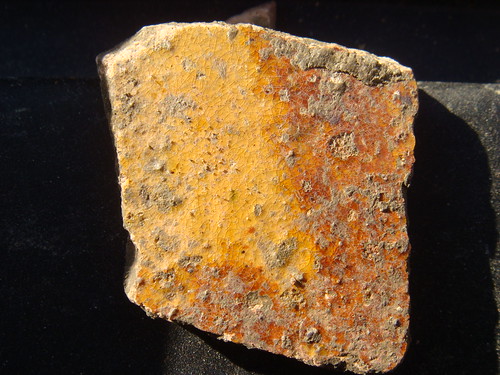
The fact is, when we think about the past, we can only ever build a picture through tiny fragments – whether pieces of pot, miscellaneous artefacts like coins, pieces of text, letters and anecdotes (unfolding through enfolding). Each of the phrases on my text map is a fragment from which the wider picture can be extrapolated, just as with a fragment of pot, one not only builds an image of the pot but extrapolates the wide world to which it once belonged.

Bartlemas Chapel Excavation

The piece of pottery has something in common with the phrase: “leaves drowned in disappearing puddles”which I noted on one of my walks. It is also interesting that when I found the above piece of pottery, I also discovered – almost at the same time – a leaf, which was almost identical in colour. The transient nowness of the leaf then, serves – through its colour – to articulate the idea of the fragment of pot as being similar to the fragment of text.

Filed Under: Archaeology Tagged With: Archaeology, Colour, Everydayness, Lines, Movement, Nowness, Tim Ingold, Trench Maps, Walks

Completed Map

July 10, 2012 by Nicholas Hedges

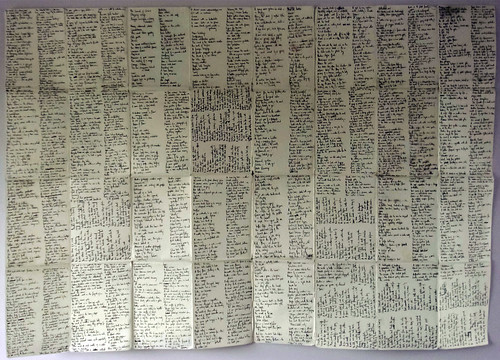
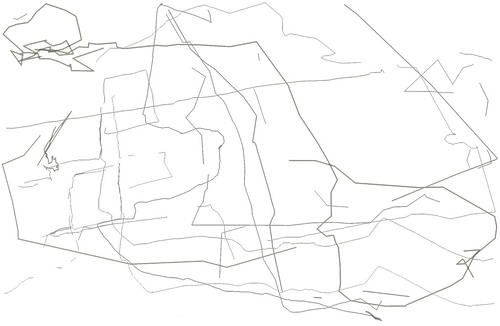
Today, on a walk around Oxford, I completed my first text map which I began in Ampney Crucis about a month ago. Below is both the map and an image of the walks as recorded on my GPS (and then ‘arranged’ in Photoshop).

Map Work
Map Work

Filed Under: Lists, World War I Tagged With: GPS, Lines, Listmaking, Lists, Map, Positioning, Text Work, Walks, World War I, WWI

Map Work

July 9, 2012 by Nicholas Hedges

I’ve almost completed my map of observations made during a number of walks over the past few weeks and am now looking to see how I can progress this line of work.

The paper shown above has started to soften, from being carried for so long in my pocket and being held in my hand as I walk. It’s started to feel almost like material. I like the way too that it’s acquired those tell-take signs of wear and tear; dog-eared corners, rips and holes and creases.

On the reverse, you can see the selotape used to keep it all together, indeed there is something about this side which I really like.

I like the idea of these pieces becoming maps of individuals rather than just a place, while at the same time representing people as places – or at least the product of places. I like the idea of them becoming patterns, such as clothing patterns, again giving a sense of the individual.

Another part of this process has been the recording of my walks using GPS. I have, for this work, been putting them all together in one image.

In our minds, when we think about our own past journeys, there is little sense of space, i.e. the physical space between the places in which we made those journeys. Everything is heaped together. Time, like physical space is also similarly compressed. All the walks I’ve made for this work therefore are heaped one on top of the other, with little regard to their geography or temporality. The past with which I seek to identify is also like this. Geography and time are compressed. Everything is fragmentary.

In any given place – for example, Oxford – we can, as we walk down an ancient road, follow the (fragmentary) course of a life lived centuries ago. But walking down another road, we turn and pick up the fragment of another life. And so on and so on.
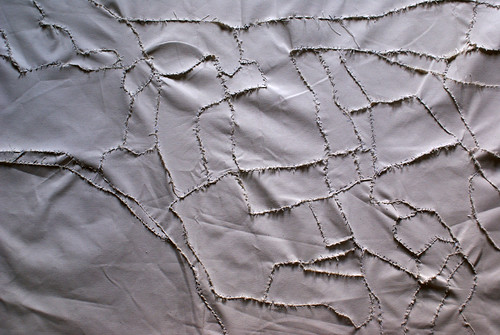
It is this fragmentary nature of past time, and its compression of time and space, which makes it sometimes hard of for us to empathise with anonymous individuals who lived in the distant past. To make sense of the fragments, we need to see them in the context of the present – in the nowness of the present. By doing this, we can begin to unpick these matted strands of time and space.
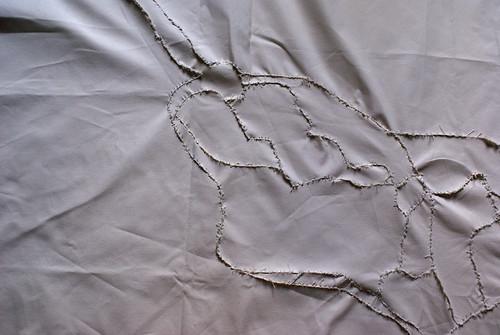
History is the attempt to make sense of the fragments left behind by time – to construct a narrative of events with a beginning and an end. It has a point A and a point B, between which the narrative weaves a path, much like a script, novel or score. What I’m interested in however are those fragments, not as parts of a narrative progression, but as fragments of a moment in time – a moment which was once now. As I’ve written before:

Access to the past therefore comes…  through the careful observation of a part in which the whole can be observed. As Henri Bortoft writes in The Wholeness of Nature – Goethe’s Way of Seeing; ‘…thus the whole emerges simultaneously with the accumulation of the parts, not because it is the sum of the parts, but because it is immanent within them’.

Consider the span of an hour, and imagine a city over the course of that hour with everything that would happen throughout that period of time; history with its refined narrative thread, is rather like a line – a route – drawn through a map of that place. The line delineates space (in that it starts then ends elsewhere) but we know nothing of what happens around it – the mundane, everyday things which make the present – now – what it is. In my walks I capture moments, observations of mundane things happening around me as I walk.

For example:

A man talks holding his hat
A flag flies, fluttering in the growing wind
The next bus is due
A car beeps
Amber, red, the signal beeps
The brakes hiss on a bus

One could argue that these observations still represent a linear sequence rather than being fragments of a single moment in time. However, reading them, one does get a sense of the nowness of the past. The route as drawn by the GPS represents the narrative thread (history) whereas the text represents the individual moments from which the narrative is constructed.

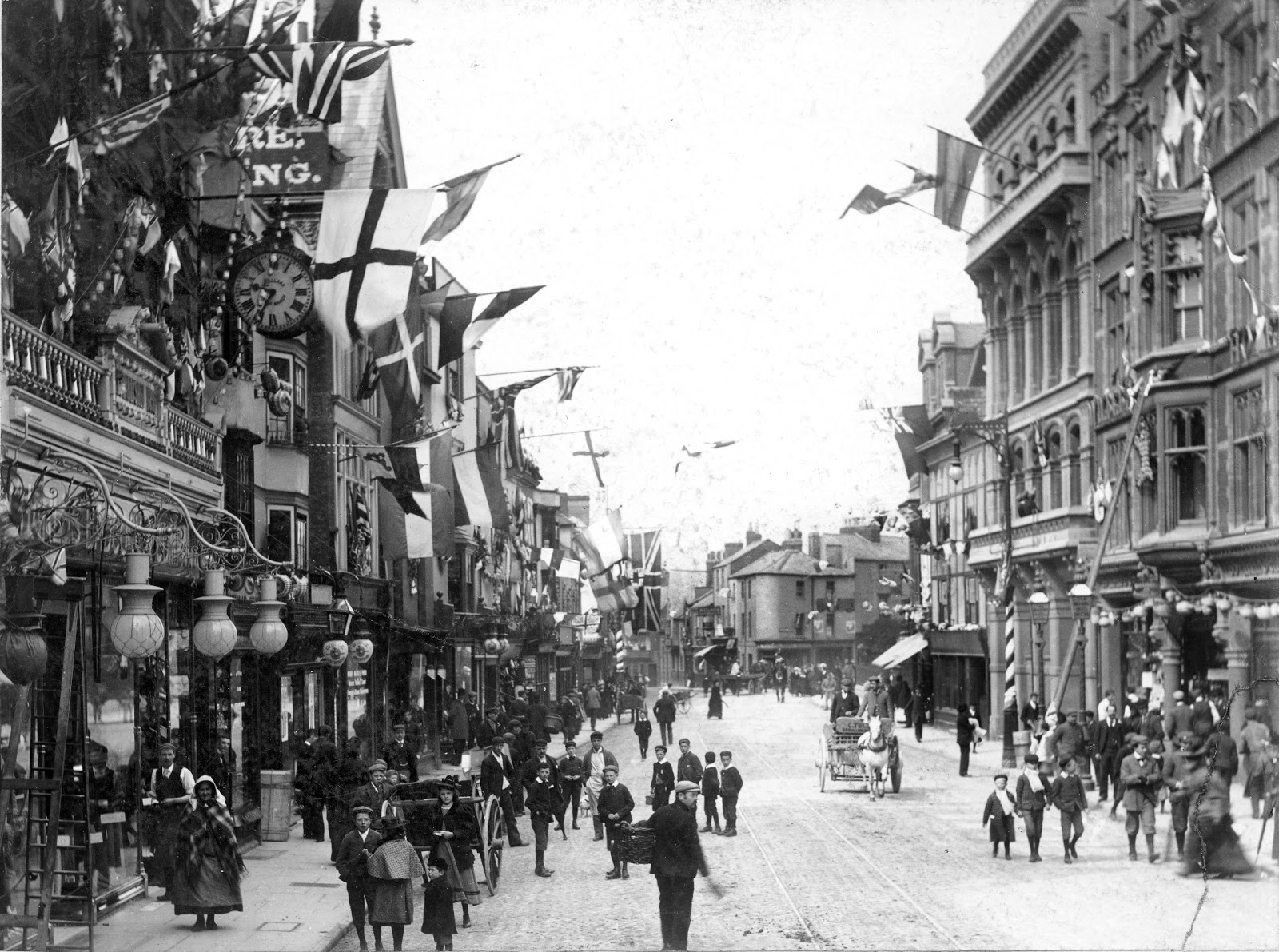
Imagine if someone had done the same in 1897 at the time of last Diamond Jubilee.

A man talks holding his hat
A flag flies, fluttering in the growing wind
Suddenly, 1897 would seem there within our grasp. We could take any observation and extrapolate the wider scene around it. Below is a photograph taken in Oxford in 1897.

© Oxfordshire County Council

We get a sense of the nowness of a past time from images such as that above, but as Roland Bathes states, time in photographs is engorged. It doesn’t move. With the work I’ve made above however, the immediacy of a past time is captured, but, unlike photographs, is fluid. And it is this fluidity which is crucial to an empathetic engagement with the past. For the nowness of the present isn’t static, but rather flows within us and around us.

The following text from Robert Macfarlane’s ‘The Wild Places,’ interested me a great deal in light of what I’ve written:

“Much of what we know of the life of the monks of Enlli and places like it, is inferred from the rich literature which they left behind. Their poems speak eloquently of a passionate and precise relationship with nature, and of the blend of receptivity and detachment which characterised their interactions with it. Some of the poems read like jotted lists, or field-notes: ‘Swarms of bees, beetles, soft music of the world, a gentle humming; brent geese, barnacle geese, shortly before All Hallows, music of the dark wild torrent.'”

Filed Under: Lists, Photography Tagged With: GPS, Henri Bortoft, Listmaking, Lists, Maps, Nowness, Positioning, Stephen Hedges, Text Work, Vintage Photographs, Walks

Ridge and Furrow

February 14, 2011 by Nicholas Hedges

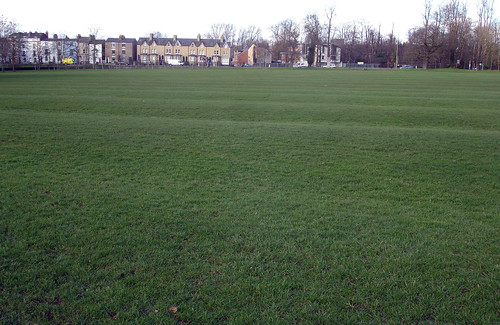
South Park in Oxford is a place which holds many memories for me; from cross-country runs at school, to Fun in the Parks, Firework displays and Radiohead in 2001. A view from South Park features in a Laurel and Hardy film ‘Chumps at Oxford’ and it’s been suggested (probably erroneously) that it’s the inspiration behind the Small Faces’ 1967 hit ‘Itchycoo Park’.What interests me most about the park however are the undulations with which it’s covered as shown the image below.

Mediaeval Ridge and Furrow

These undulations are landscape features created as a result of mediaeval farming methods known as ridge and furrow. Strips of land owned by individuals would be ploughed in such as way as to cause the ridges and furrows to form. Crops would be planted on the ridges while the furrows would help with drainage, and even today, one finds oneself walking along the ridges as the furrows are often boggy.

I find it amazing that an activity performed by people many centuries ago can still be seen so vividly in the landscape today. One expects to find features such as castle mounds, ditches and defensive (or siege) works,  but to see something created as a result of man’s interaction with the landscape over the course of time (in the growing of crops) is particularly interesting – not to say poetic. Individuals, long since lost to the past, worked the land so as to feed themselves – or make a living – and so perpetuate their ‘line’, and in the landscape, centuries later, the line still continues.

The lines continue too whenever we walk the ridges, for as we walk, we’re doing something people did hundreds of years ago (albeit without a plough) in exactly the same place.  As if the ridges are the grooves of a record, we find ourselves replaying a time when much of the land around the city comprised fields and meadows.

Filed Under: Archaeology Tagged With: Archaeology, Movement, Ridge and Furrow, Walks

Sail

November 27, 2010 by Nicholas Hedges

Carrying on with the work I did in Australia, I’ve spent the last couple of days videoing the canvas ‘sail’ that I made there, which was itself made from the pattern of several walks made around Newcastle, NSW. This work (‘Repaired Sail of HMS York (1828)’) is in many respects linked to a piece I made for my third Mine the Mountain exhibition called  ‘Old Battle Flags‘ and is about the feel of the wind – the wind being something which although one may read about in history (particularly in the context of sailing) one can only experience in the present (of course the same could be said of everything else, but in light of the theme of this residency, the wind is especially pertinent).

This piece is about the disparity between language and experience. The wind we feel today is the same wind that’s blown over – and indeed through – the centuries and millennia. In winter the wind may blow from the east, from the vast and distant land of Siberia – a place well beyond the horizon but nevertheless a place which exists all the same. 

The sail is made from my own past experiences, and the wind a reminder of movement in the past – that which is missing from the pages of history. It’s also about the everydayness of the past – something which we take often for granted like so much else but which is integral to our experience of the world.

Filed Under: A Line Drawn in Water, Artist in Residence Tagged With: A Line Drawn In Water, Artist in Residence, Australia, Everydayness, Family Hedges, Family History, Hedges, Lines, Stephen Hedges, Walks

The Geographer

November 21, 2010 by Nicholas Hedges

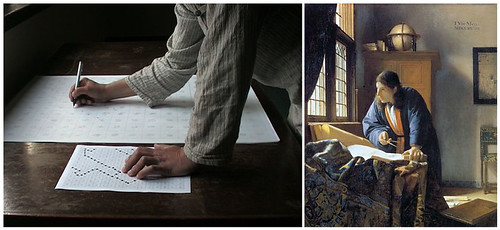
The Geographer

A still from some video footage of me in Australia, drawing out a map of one of the walks I did there alongside Vermeer’s ‘Geographer.’ I’m interested in the idea of performance and had something like Vermeer’s image in mind whilst I was creating my work.

Filed Under: A Line Drawn in Water, Artist in Residence Tagged With: A Line Drawn In Water, Artist in Residence, Australia, Everydayness, Family Hedges, Family History, Hedges, Lines, Stephen Hedges, Walks

Birds and Words

November 21, 2010 by Nicholas Hedges

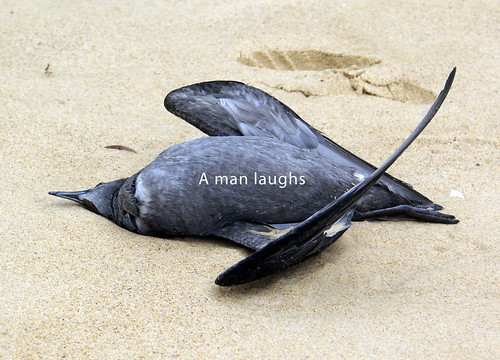
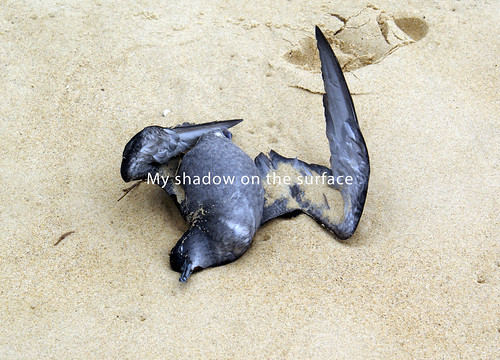
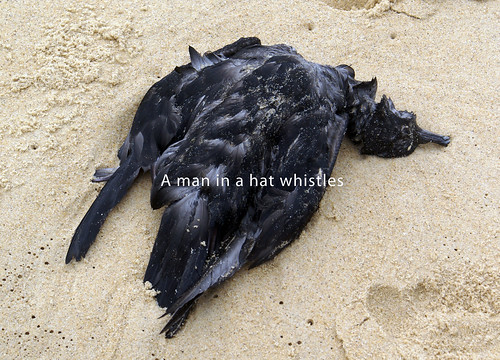
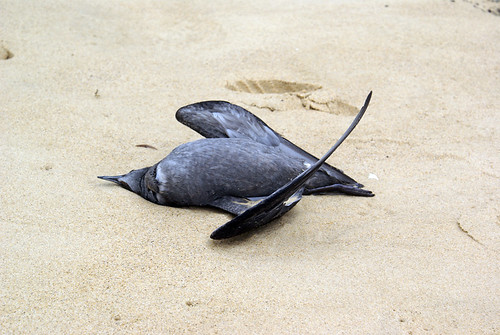
The photographs of dead birds which I took on Newcastle beach are particularly poignant; the lifeless bodies which had once soared high in the sky above are analogous with lost moments in time and, indeed, with the photograph itself. Dying out at sea, the birds had been washed up on the beach, joined in a line marked by that of the tide, rather like the words in my sketchbook, joined by the trace of the line of a walk.

Putting the two together seems to make sense; the words of the walks referring to moments which once lived and which in the instant they were written down fell to the ground like the birds themselves. With every reading they are as those birds washed back up on the beach, joined again by a line – this time, the act of reading in sequence, or of reading them out loud.

Birds and Words

Birds and Words

Birds and Words

Filed Under: Artist in Residence Tagged With: A Line Drawn In Water, Artist in Residence, Australia, Birds, Everydayness, Family Hedges, Family History, Hedges, Lines, Stephen Hedges, Walks

Return to England

November 20, 2010 by Nicholas Hedges

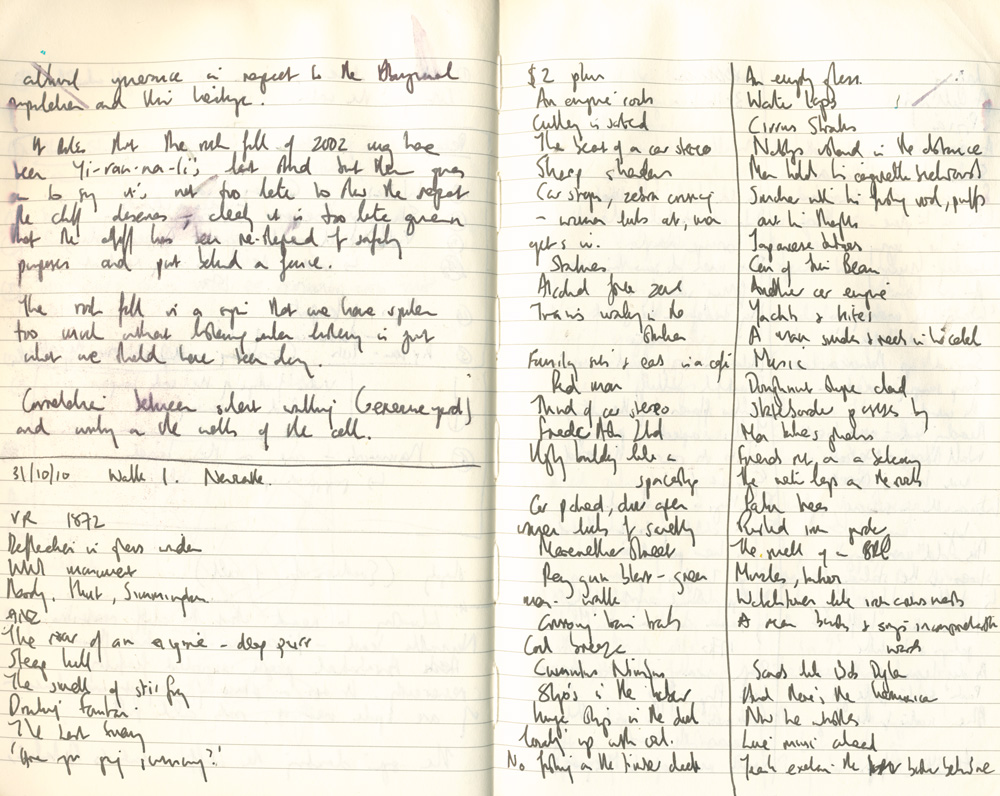
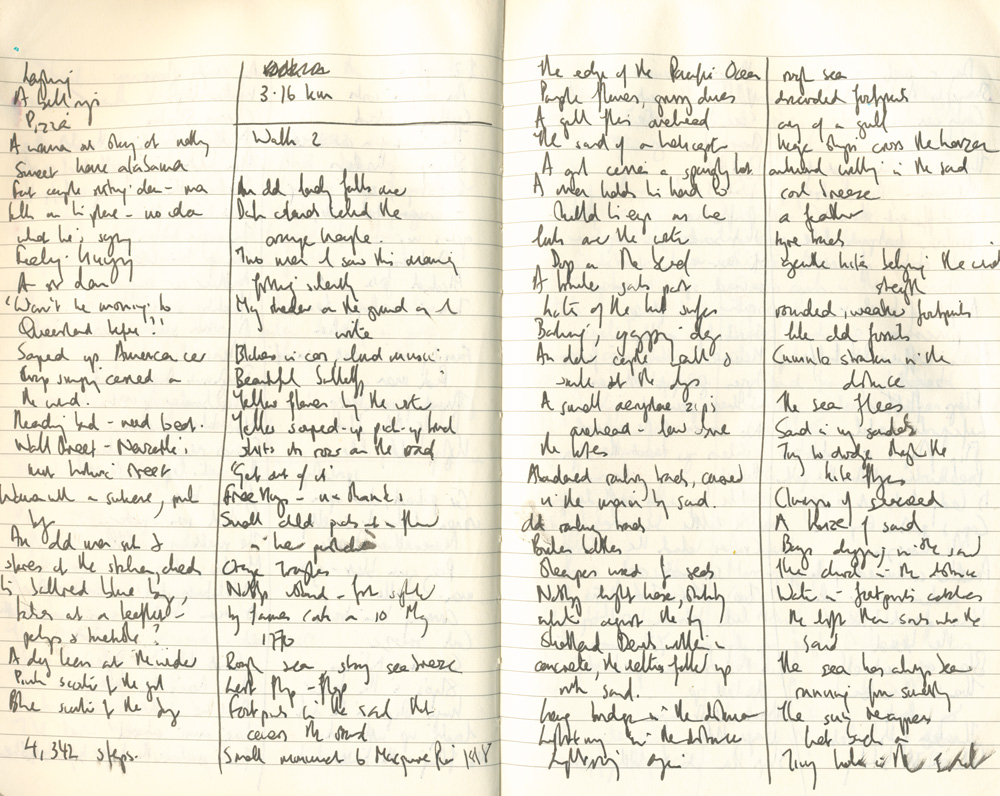
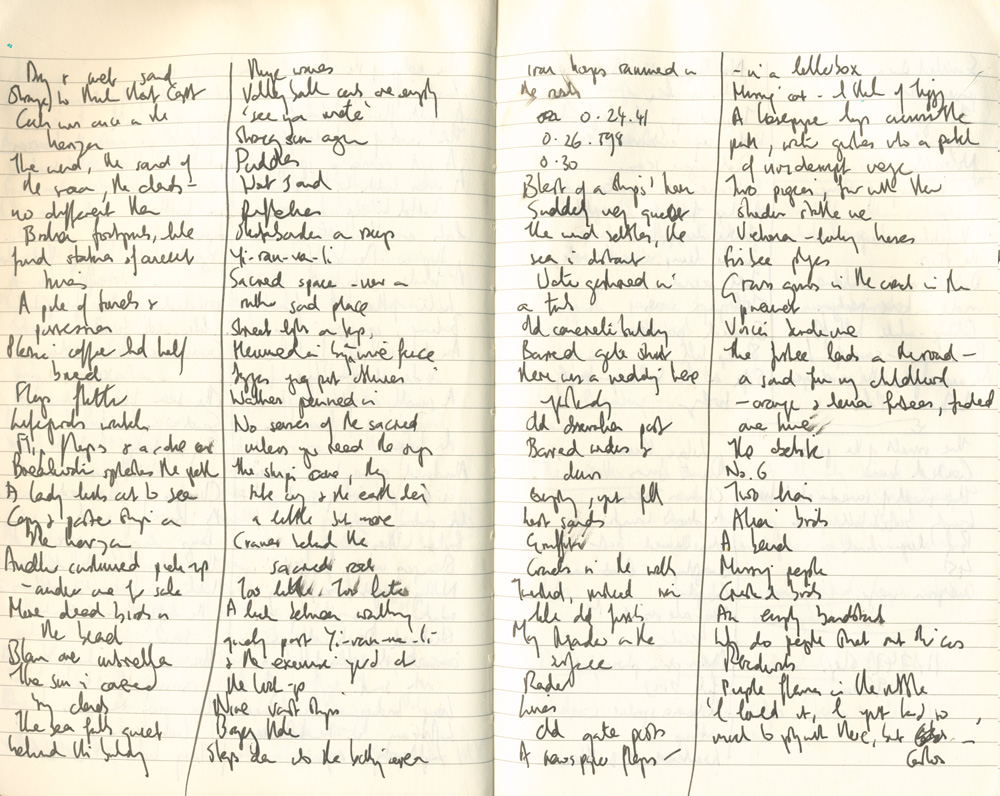
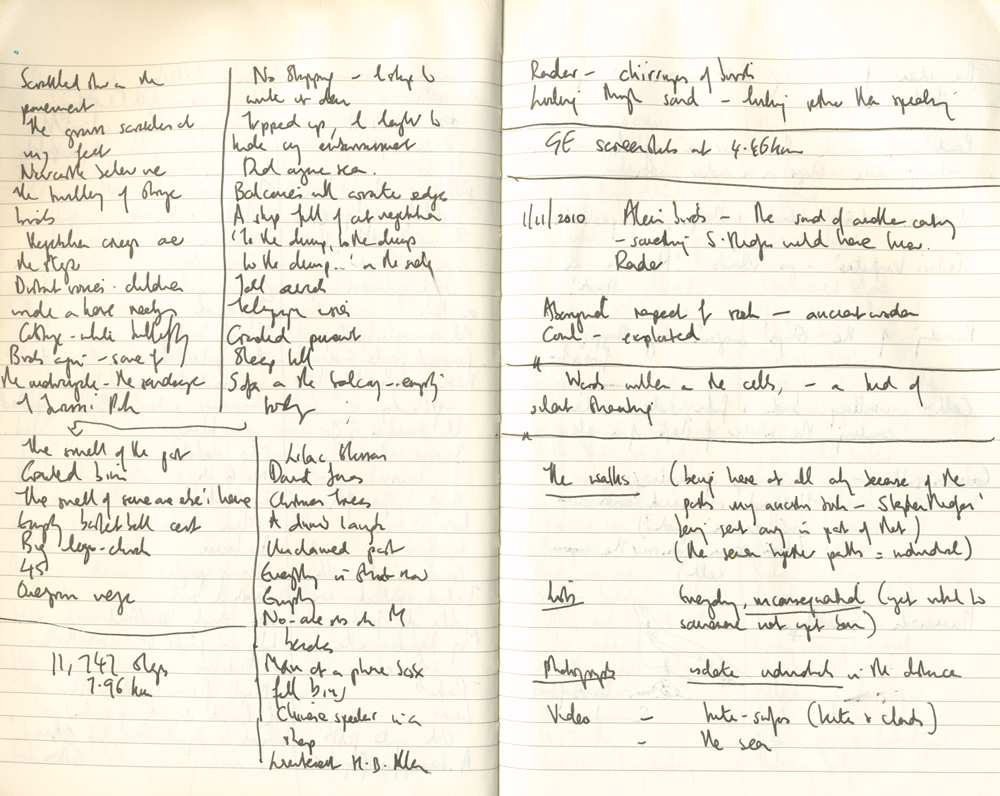
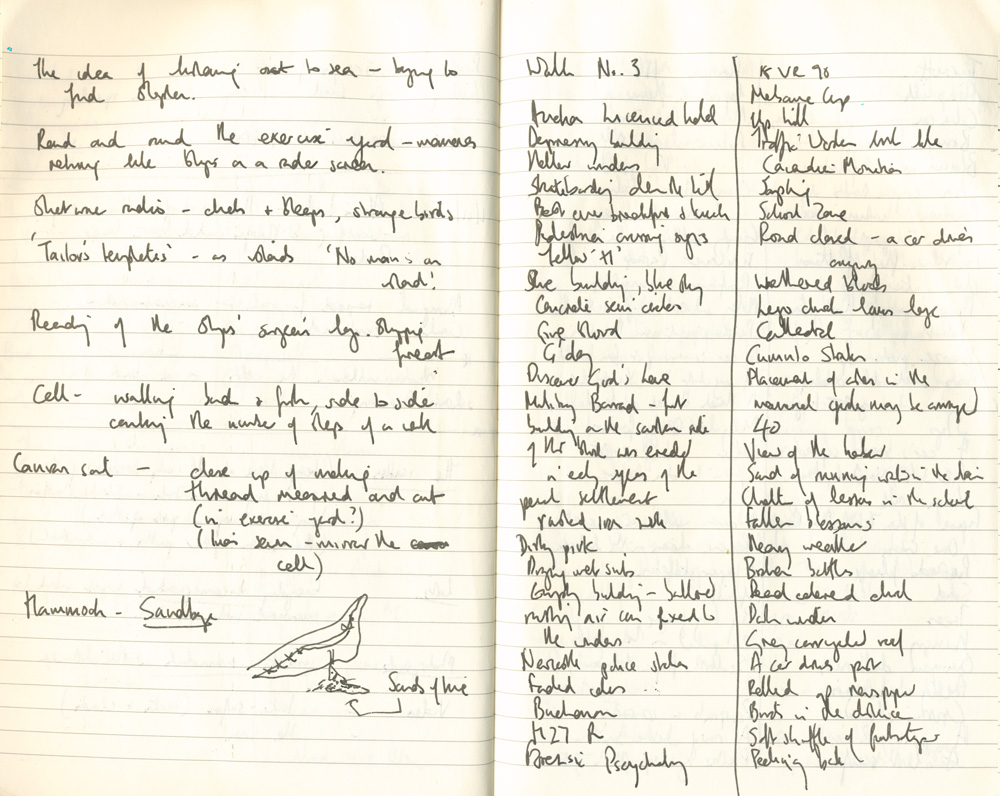
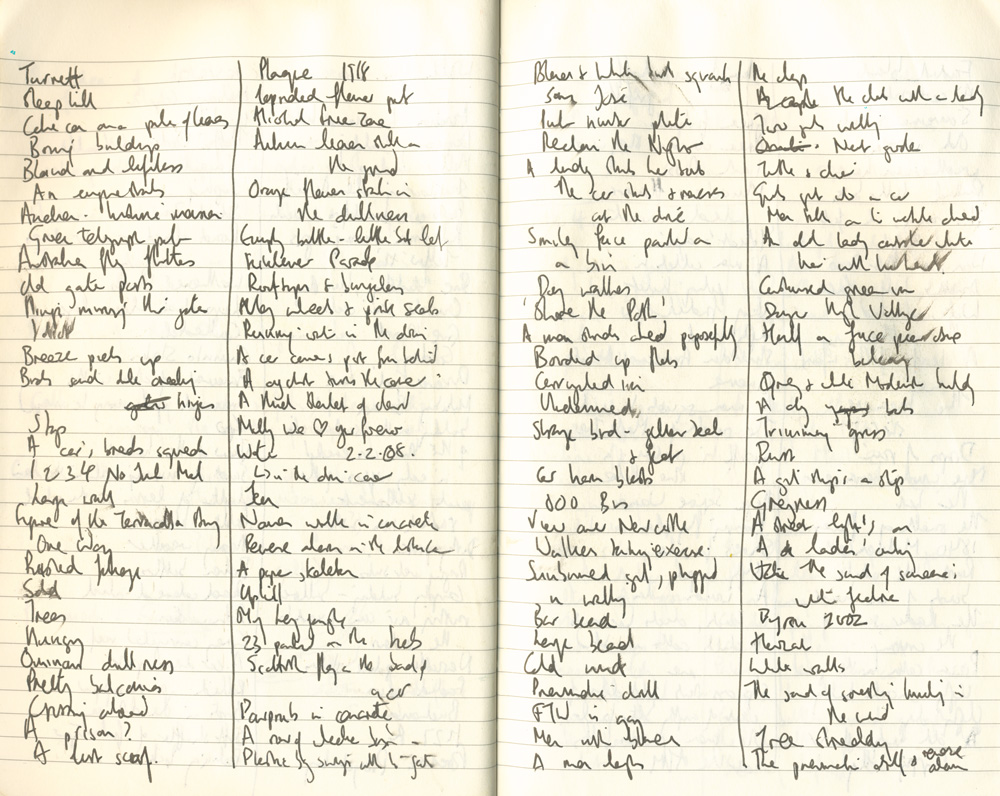
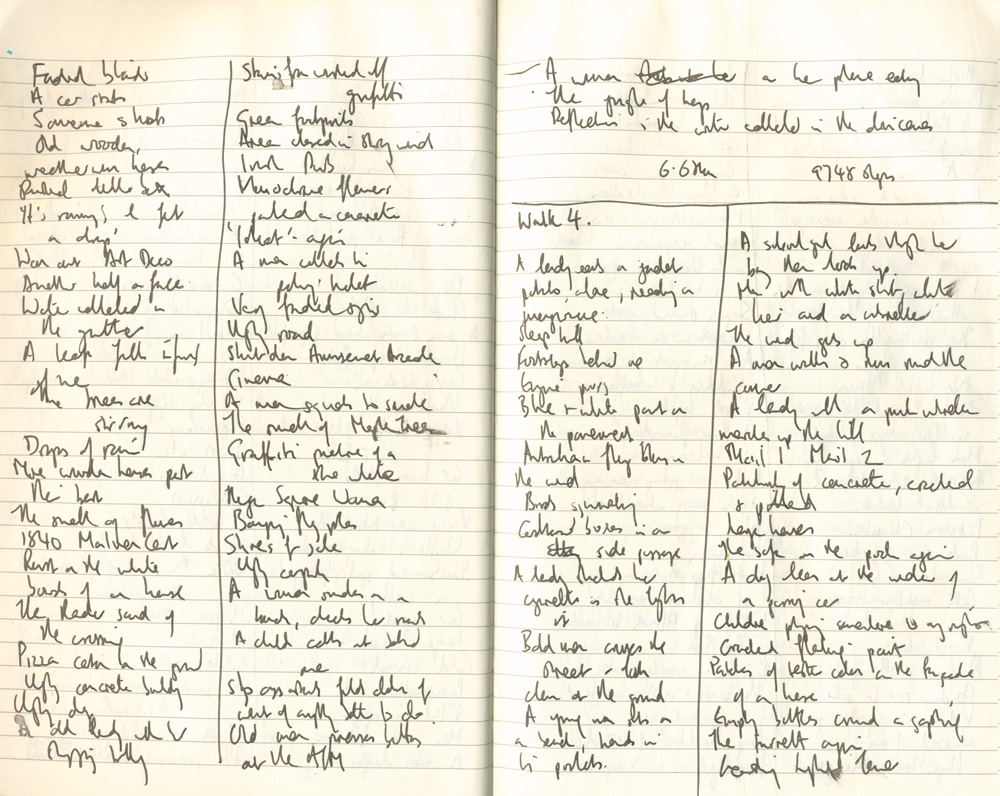
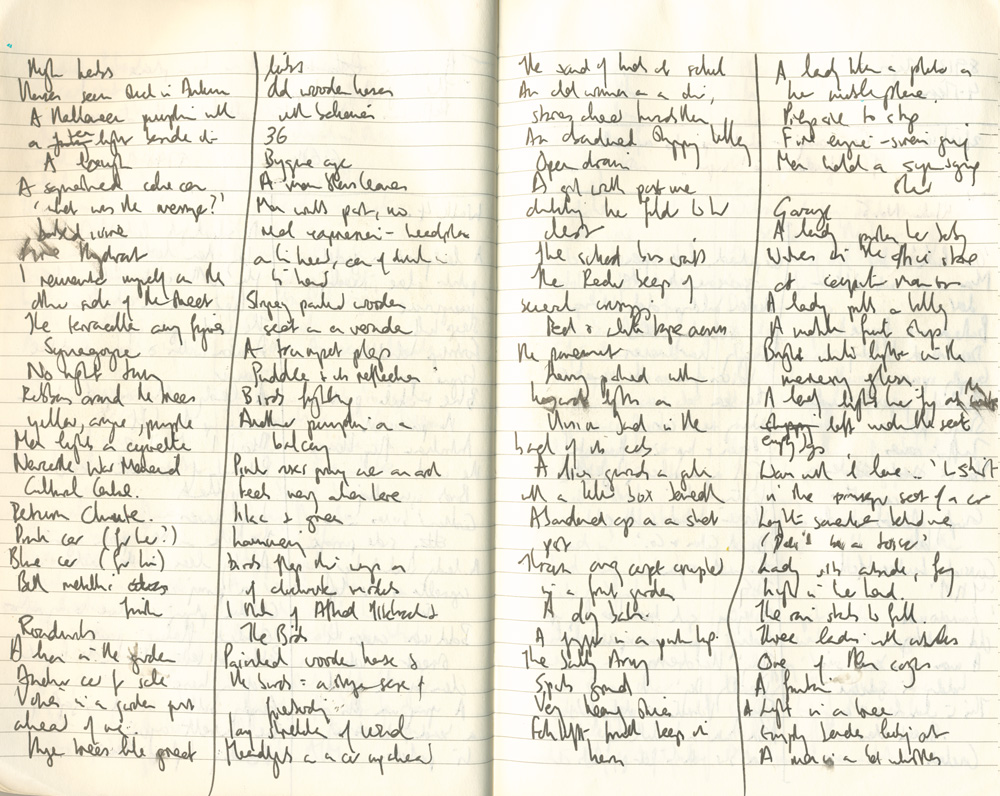
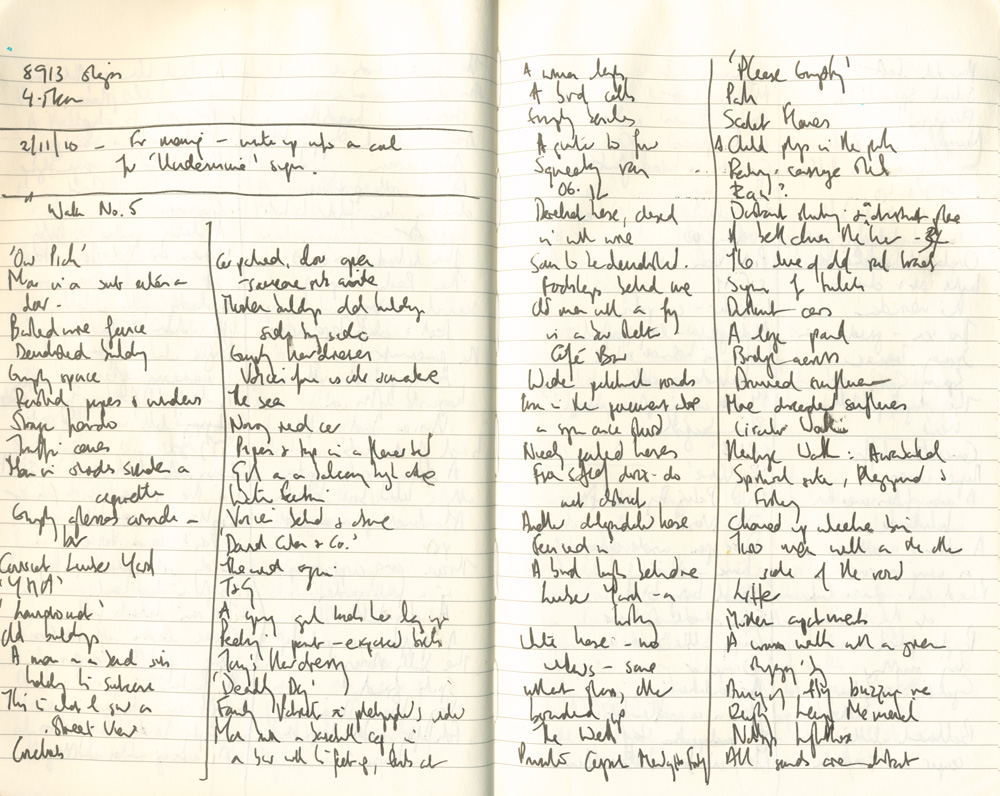
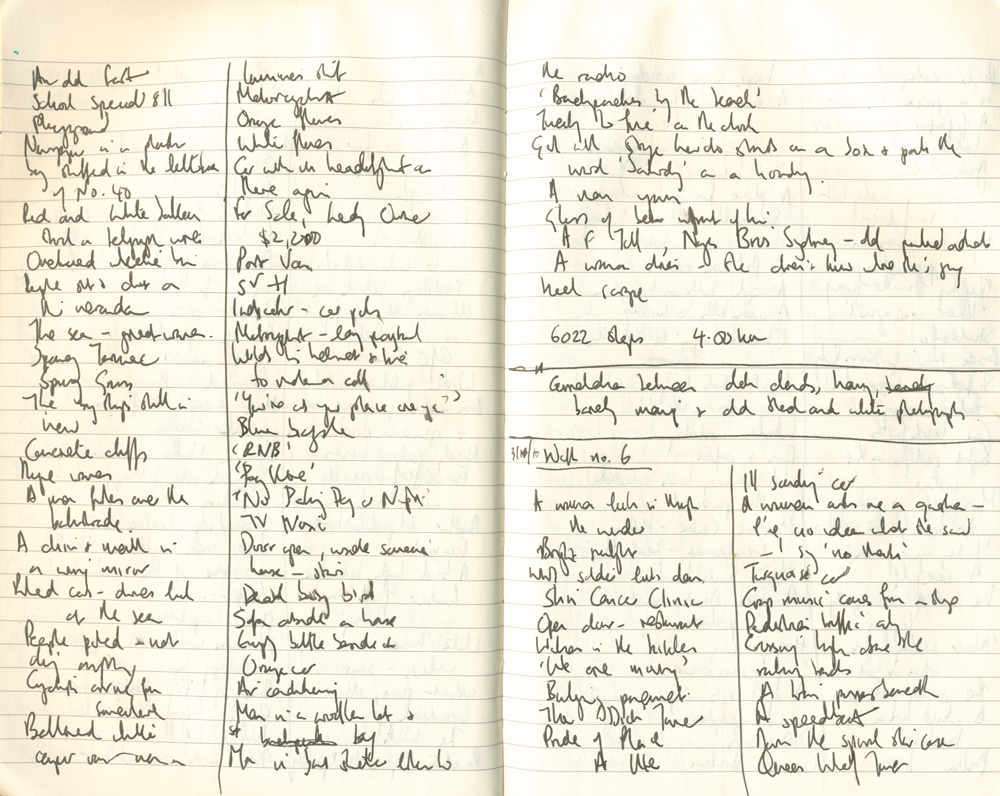
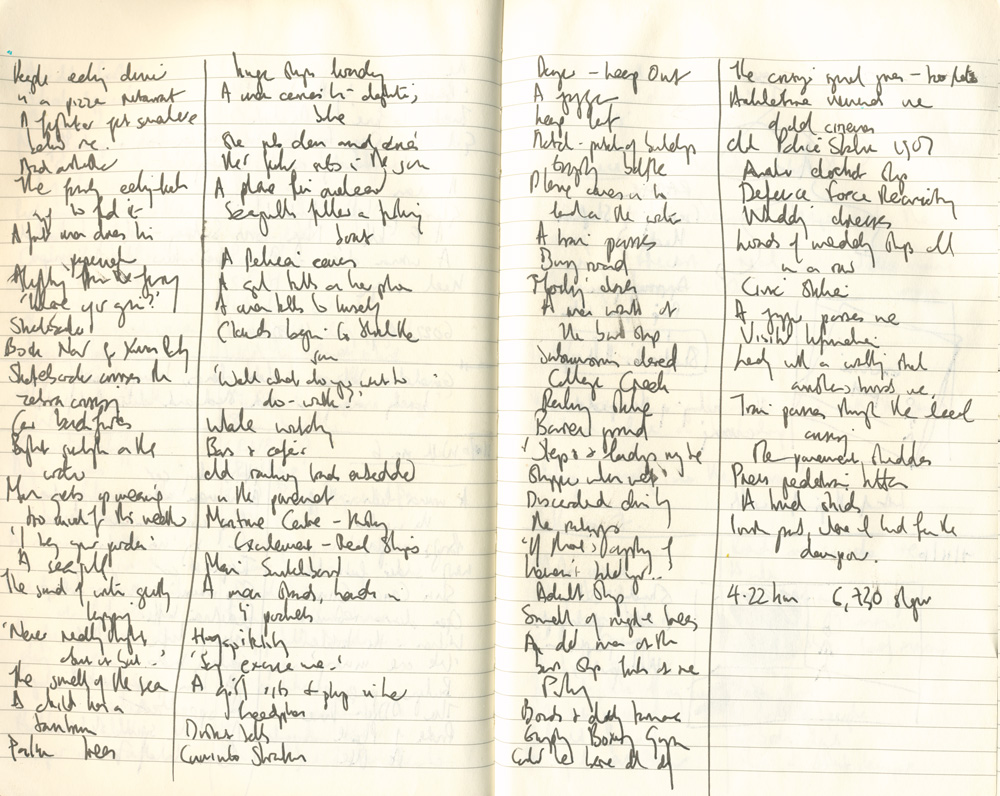
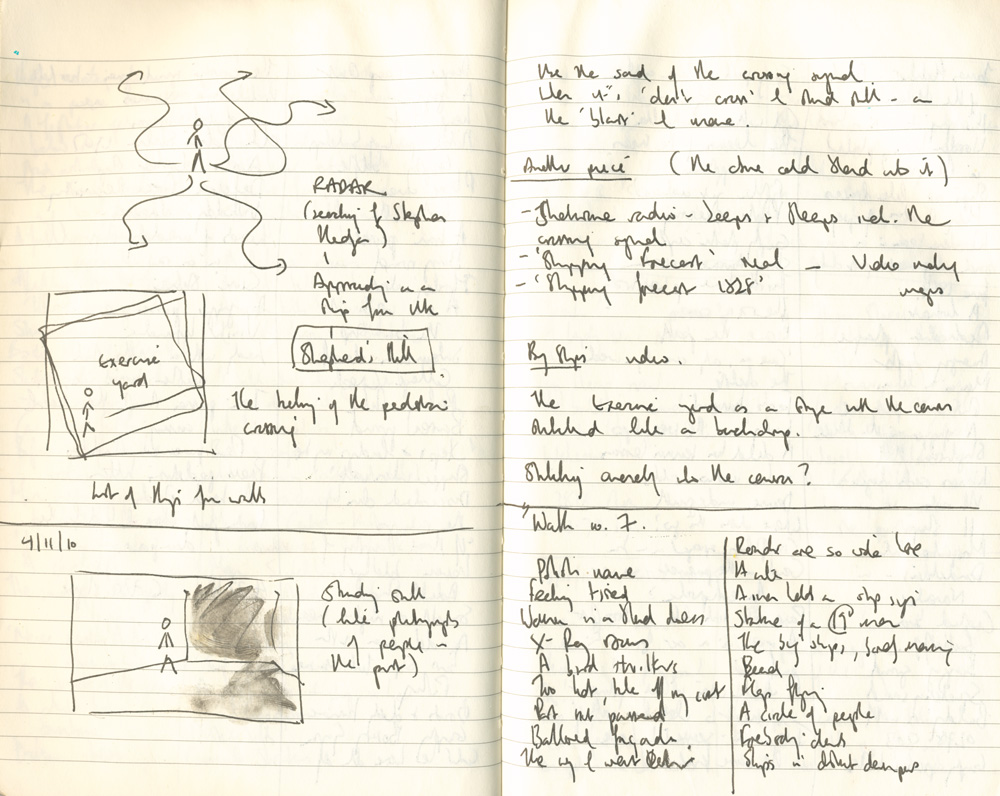
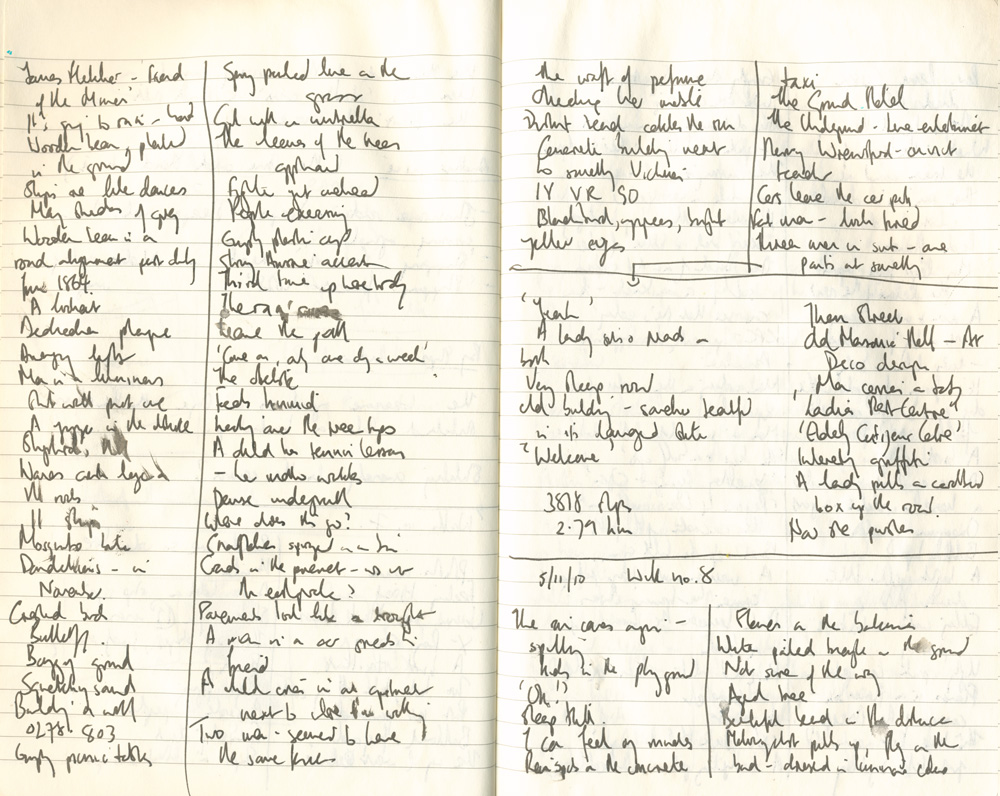
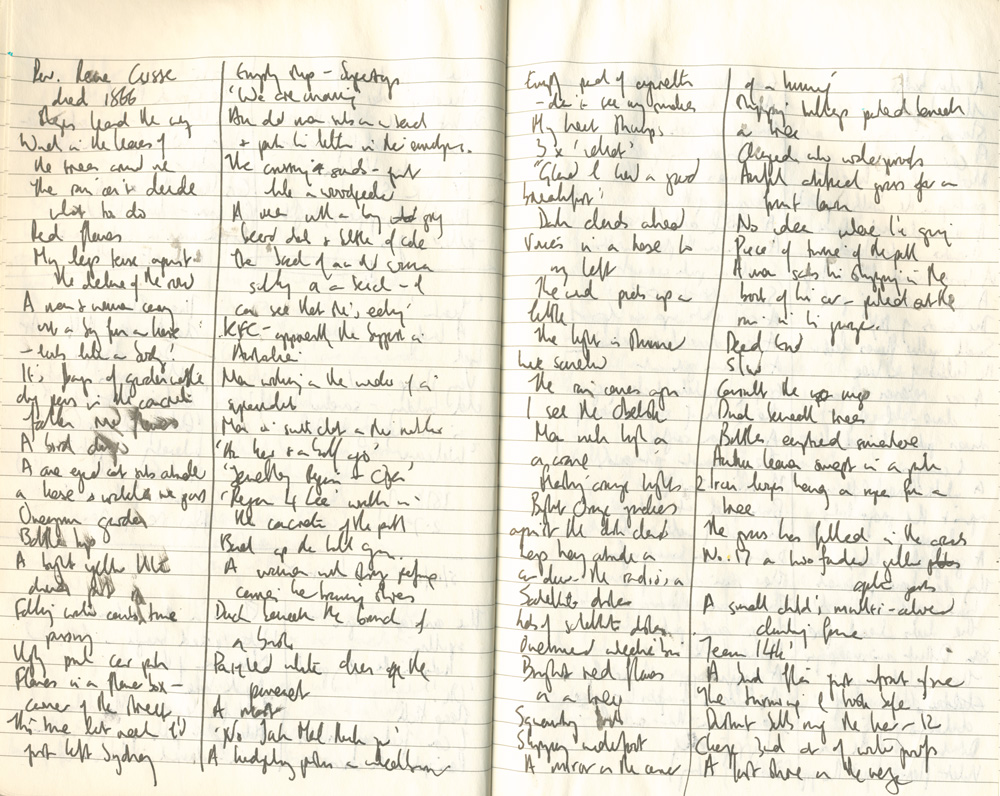
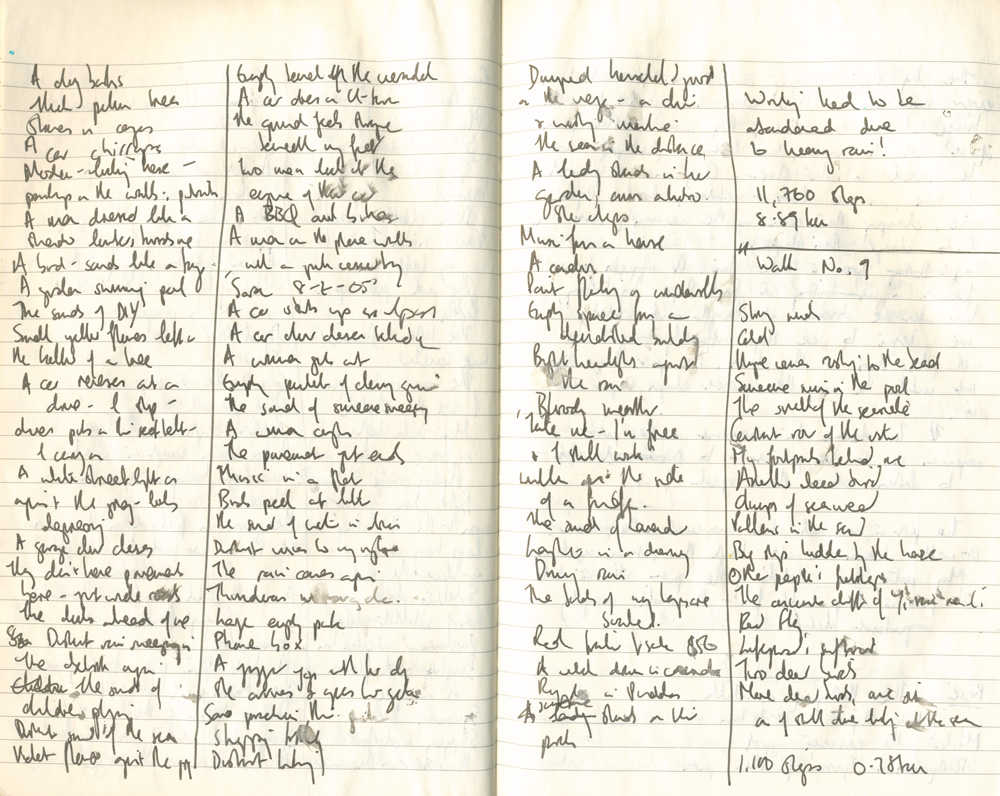
Since returning to England this morning after my residency in Australia, I’ve been looking at my notebook, and feel it’s worthwhile putting the pages up on, in particular those relating to the walks I did. So reproduced with this blog are those pages, written as I was walking (such is why the handwriting is atrocious whereas normally its little better than poor).

Filed Under: A Line Drawn in Water, Artist in Residence, Lists Tagged With: A Line Drawn In Water, Artist in Residence, Australia, Everydayness, Family Hedges, Family History, Hedges, Lines, Listmaking, Lists, Stephen Hedges, Walks

Repaired Sail of HMS York (1828)

November 17, 2010 by Nicholas Hedges

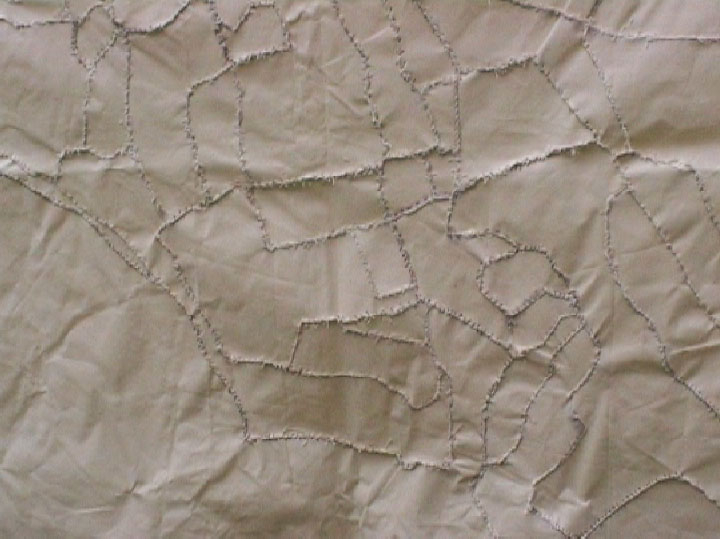
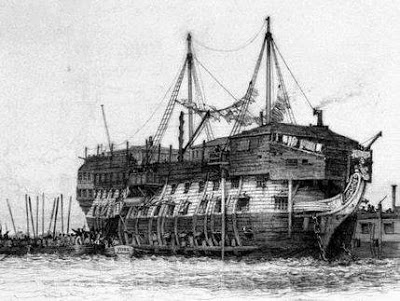
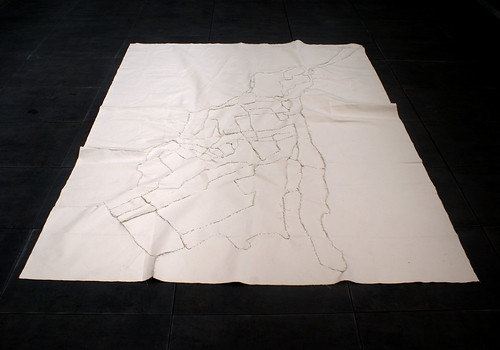
Yesterday, I finally finished stitching together the canvas pieces for a workI have tentatively called Repaired Sail of HMS York (1828), refrerring to the prison hulk on which Stephen Hedges was incarcerated before being transported to Australia. The hulk was a demasted ship and on contemporary images (such as that below) one can see how clothes were strung across the ship, almost as if replacement sails themselves.

This piece also alludes to an earlier work of mine called ‘Old Battle Flags‘ which I exhibited as part of my  recent Mine the Mountain exhibition. This work – Repaired Sail of HMS York (1828) – was made in response to the old battle flags one finds sometimes hanging in cathedrals. As I wrote in a text accompanying the work:

“Whenever I see them, hanging from their poles, still and lifeless, I think of the wind that would have once shaped them, a wind which would have once blown and turned the pages of history as it was being written. It reminds me that the flags had a place in what was then the present, rather than a scripted, preordained past. I can remember as a child, sitting on the beach when the weather was less than clement, when the wind whipped the sand, drilled the waves and flapped the canvas of the deckchairs. These deckchairs on display still have their colours, and in the main, their shape, but now they are broken; metaphors for times which cannot be revisited.“

The flags hang lifeless without the wind – the past hangs lifeless too. HMS York in this sense is a metaphor for the past – demasted and without a sail, lifeless almost, a prison for the past which in its own present criss-crossed the globe. To re-witness that past we need to see it move again, to catch the wind: we need a new sail.

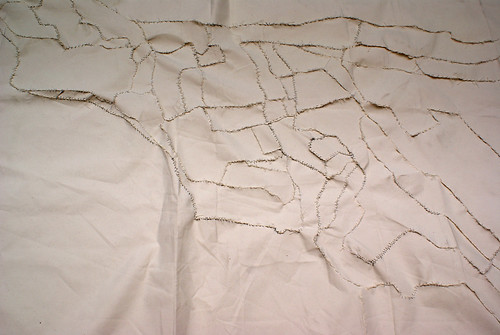
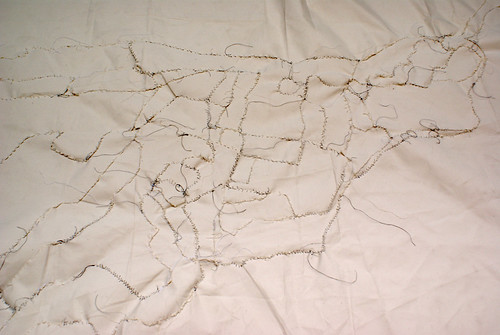
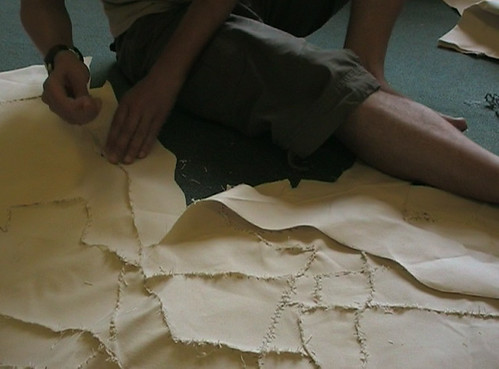
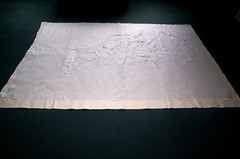
The sail in this work is made of canvas, and is derived from a pattern made from data recorded on a GPS. The data itself represents a series of nine walks made during the first week or so of the residency here in Newcastle, NSW. As I have discovered through my work over the last few years, walking and being in a particular place and experiencing the everydayness of a place, is vital in our understanding of associated historical events. It is relevant therefore, that this ‘sail’, made to catch the wind and ‘move’ HMS York once again, is constructed from a series of walks.

Below are a number of images of the sail.

Repaired sail of HMS York 1828

Repaired sail of HMS York 1828

Repaired sail of HMS York 1828

Repaired sail of HMS York 1828

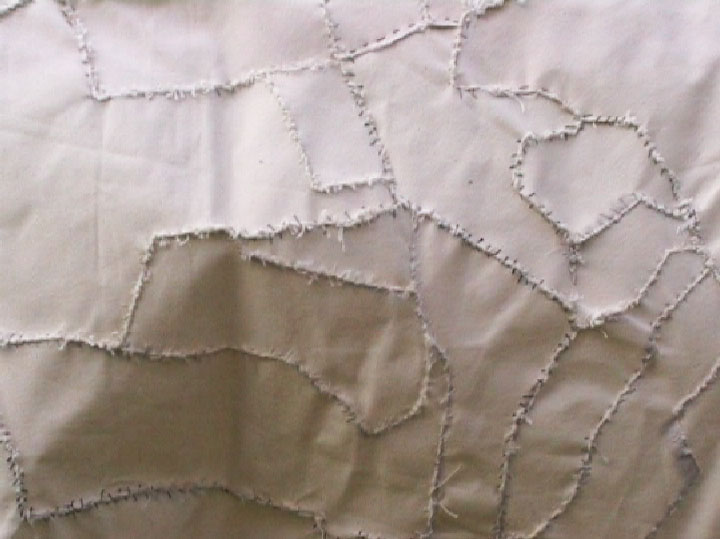
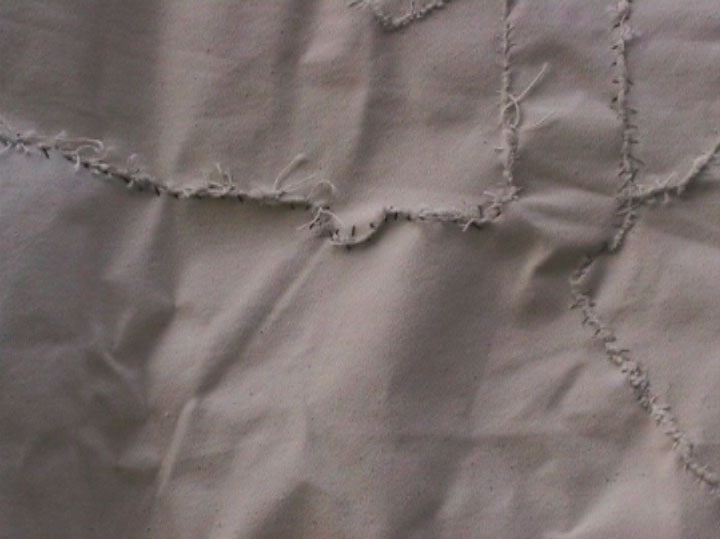
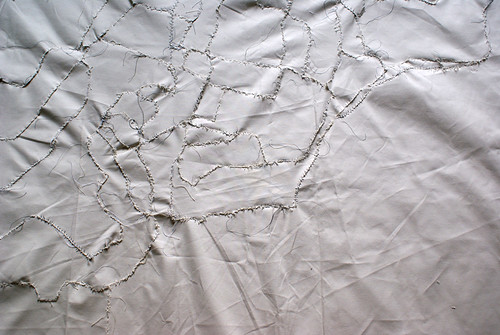
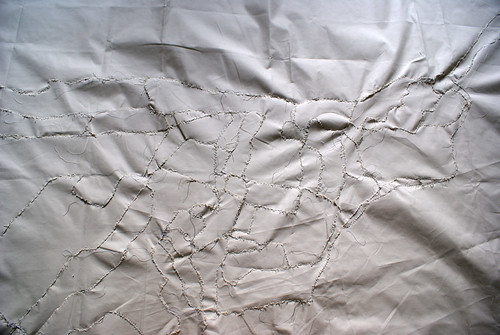
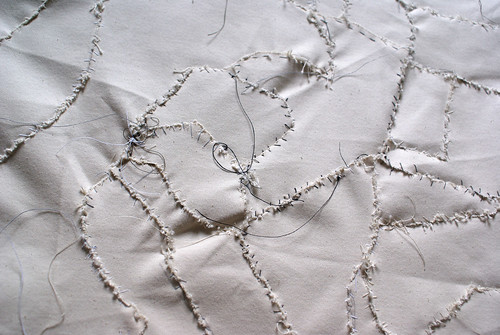
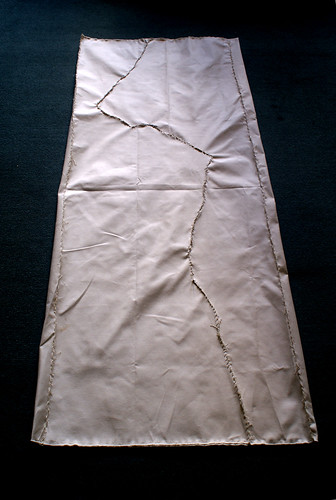
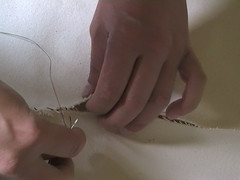
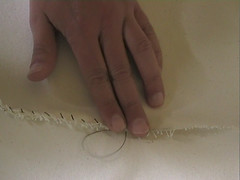
Often, it’s the reverse side of a piece like this which proves to be the most interesting, and indeed the most aesthetically satisfying. This particular canvas is no exception. When I turned it over and laid it out, I found the loose threads and knots particularly interesting. Perhaps they remind me the cut lines of past lives or the unwritten lines of text of which, for the most part, history is comprised. Below are images of the reverse side of the canvas.

Repaired sail of HMS York 1828

Repaired sail of HMS York 1828

Repaired sail of HMS York 1828

Repaired sail of HMS York 1828

Filed Under: A Line Drawn in Water, Artist in Residence Tagged With: A Line Drawn In Water, Artist in Residence, Australia, Everydayness, Family Hedges, Family History, Hedges, Lines, Stephen Hedges, Stitchwork, Walks

Cutting and Stitching III

November 15, 2010 by Nicholas Hedges

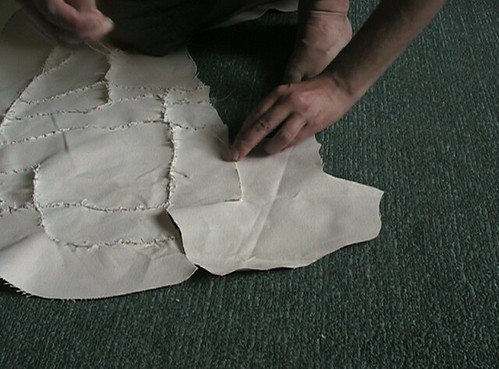
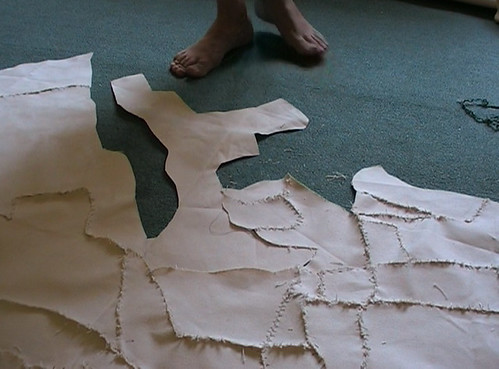
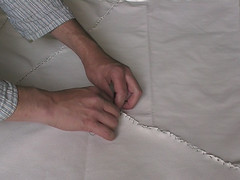
After a very nice weekend in Sydney, it’s back to work on the canvas; more cutting and stitching. With just two days left of the residency, it’s going to be a close run thing as to whether I get everything done – hopefully tomorrow I shall complete the canvas at least.

Cutting and Stitching

Cutting and Stitching

Cutting and Stitching

Cutting and Stitching

Cutting and Stitching

Filed Under: Artist in Residence Tagged With: A Line Drawn In Water, Artist in Residence, Australia, Everydayness, Family Hedges, Family History, Hedges, Lines, Stephen Hedges, Stitchwork, Walks

Cutting and Stitching II

November 12, 2010 by Nicholas Hedges

I’ve made a lot of progress over the last couple of days with video work and with the sticthed map of walks I’m creating, the title of which will be something like ‘The Lost Sail of HMS York’ referring to the prison hulk on which Stephen Hedges was incarcerated in 1828 prior to being transported to New South Wales.

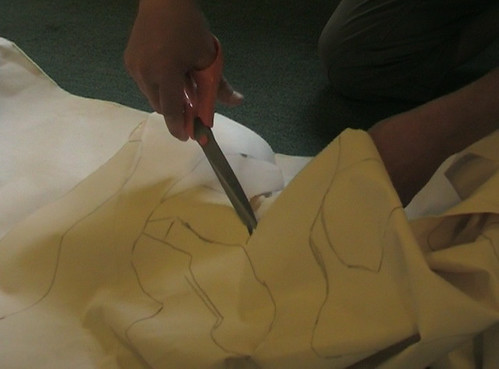
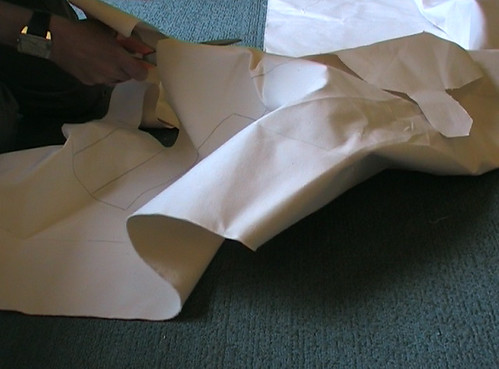
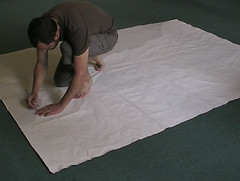
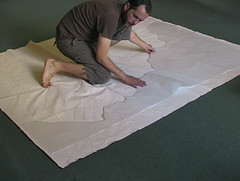
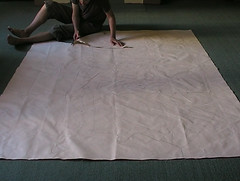
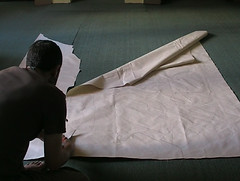
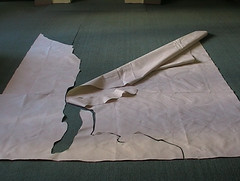
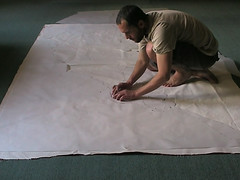
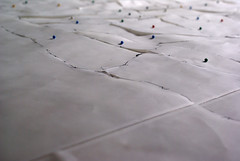
Having cut the templates and pinned them to the canvas, I then drew around each one directly onto the canvas so that I could begin cutting them out and stitching the piece together. To make things easier I will cut each piece as and when I need it so that I don’t get lost as regards where the pieces are meant to go.

The followng stills are taken from further documentary footage I’ve filmed of the process.

Template making

Template making

Template making

Template making

Template making

Filed Under: A Line Drawn in Water, Artist in Residence Tagged With: A Line Drawn In Water, Artist in Residence, Australia, Everydayness, Family Hedges, Family History, Hedges, Lines, Stephen Hedges, Stitchwork, Walks

Cutting and Stitching

November 10, 2010 by Nicholas Hedges

A busy day today working on a piece tentatively titled ‘Hammock’ and another which has yet to acquire even a working title. The hammock piece (shown in the photograph imemdiately below) alludes to when sailors died at sea and were sewn up in their hammocks before being cast into the water. The stitching on this particular hammock/body bag is the line recorded on my GPS when I walked the route Stephen Hedges walked from Radley House to Oxford in January 1828.

Stitching and Cutting

The hammock no longer has a body inside but what is left is the line. In many respects, the body inside was never meant to be that of Stephen, but rather his life in England, cast overboard along with his clothes when he entered the Prison Hulk York in Portsmouth following his conviction.

I want to dirty-up the canvas a bit and am thinking of taking it down to the sea tomorrow and videoing it lapping at the shore with the waves; something which would lend the work greater resonance.

The images below show the piece being made.

Work in Progress

Work in Progress

Work in Progress

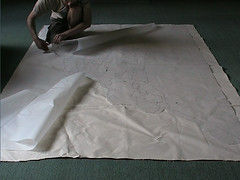
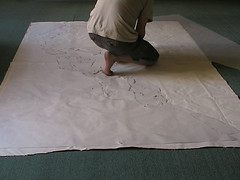
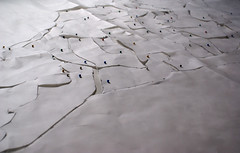
The following images are taken from the second, much bigger piece, which is a canvas comprising all the walks I have made in Newcastle NSW. The walks have been transferred to tracing paper (see Making the Map) and have now been cut up and pinned to the canvas ready for the material to be cut.

The images below are taken from documentary footage of the process.

Work in Progress

Work in Progress

Work in Progress

The map itself isn’t so easy to photograph, but I like the way it looks in its current state, with the cut out templates and the pins. Ideally I would like to inject something of a perfomative aspect into this work, so that the template creation has something to do with the process of tailoring – preparing fabric for an individual.

Stitching and Cutting

Stitching and Cutting

Stitching and Cutting

Filed Under: A Line Drawn in Water, Artist in Residence Tagged With: A Line Drawn In Water, Artist in Residence, Australia, Everydayness, Family Hedges, Family History, Hedges, Lines, Stephen Hedges, Stitchwork, Walks

A Walk of 4,342 Steps

November 9, 2010 by Nicholas Hedges

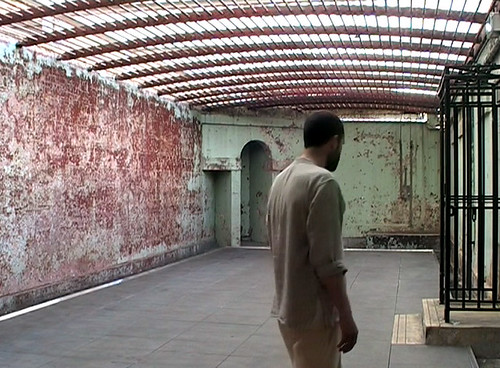
The video-based performance piece I want to make involves my walking around the exercise yard – in this case for about an hour. The ‘Walk of 4,342 Steps’ refers to a walk I did on 31st October (the first walk in a series of 9 made during the residency) and the final video will comprise my walking with details of the walk read out over the top.

The following stills are taken from the video.

Video Work

Video Work

Video Work

Video Work

Video Work

As I walked, and as I felt my body tense up and stiffen (in particular my jaw for some reason) I found myself listening to the sounds from outside, coming through the bars in the ceiling. Again this seemed to illustrate my work, as regards the idea of the constrained walk being analogous to history’s relationship with the past, where the wider past can only be ‘glimpsed’ to some degree through the bars.

Filed Under: Artist in Residence Tagged With: A Line Drawn In Water, Artist in Residence, Australia, Everydayness, Family Hedges, Family History, Hedges, Lines, Stephen Hedges, Stitchwork, Video, Walk, Walks

The Exercise Yard

November 9, 2010 by Nicholas Hedges

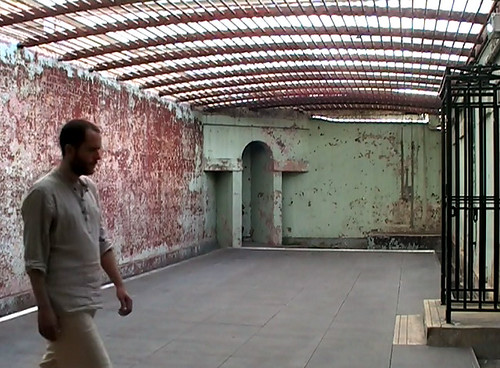
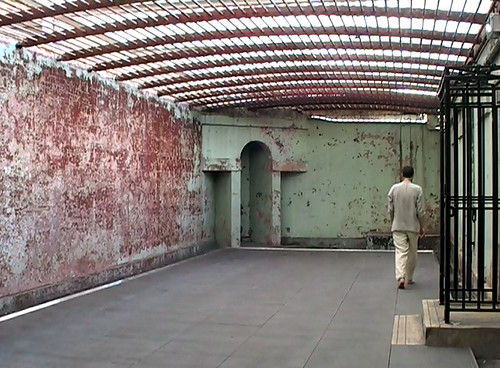
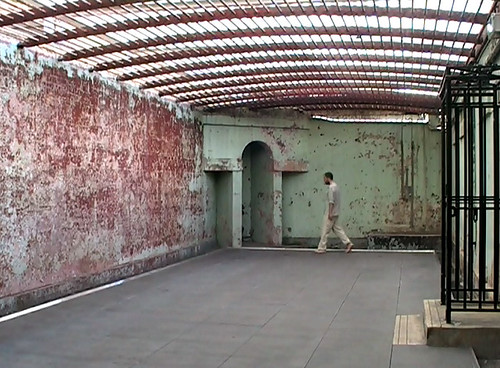
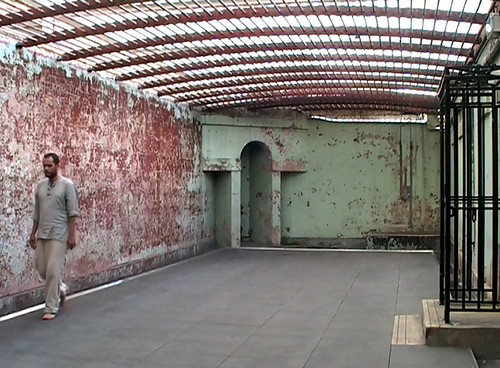
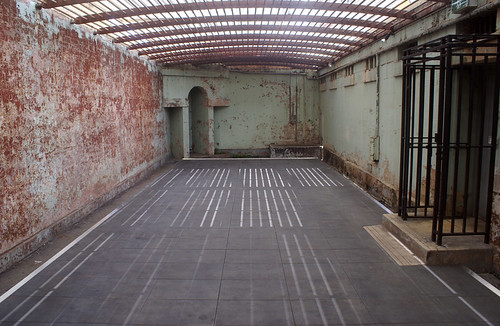
One of the most interesting spaces in the Lock Up is the exercise yard in which inmates housed in the cells would walk, sit or stand for a period of time. The space has recently been made weather-proof and a floor added to the original floor beneath so as to allow the space to be used for exhibitions and so forth. I wanted to use it in a video-based perfomance piece based on the idea of history and its relationship to the past; the idea that history is in a sense heaviliy constrained in what it can tell us about the world long gone; it is hemmed in, not free to roam, but follow a prescribed path based on the sources available to us today.

The Exercise Yard

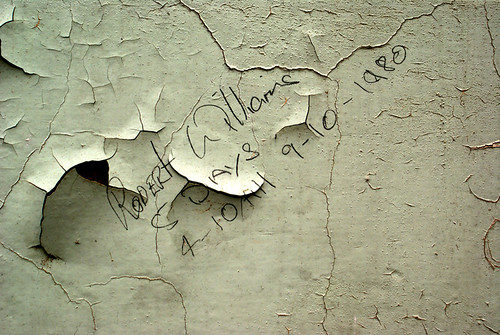
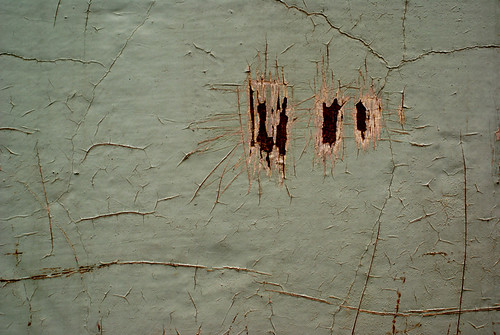
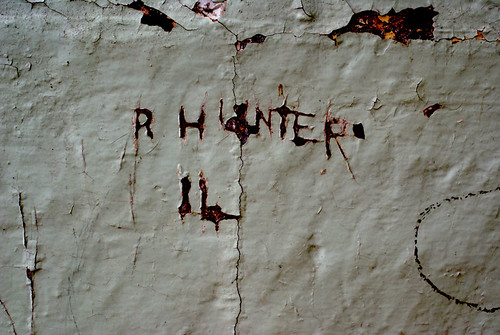
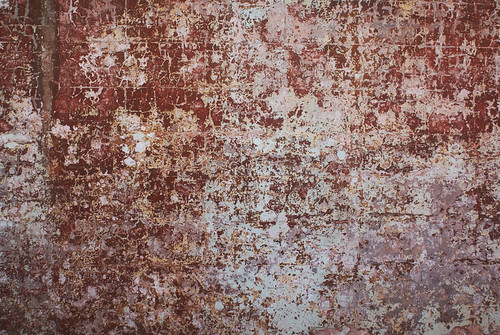
Before working on the piece (which would involve an hour’s walk around the yard), I photographed the walls, all of which have amazing textures redolent of the passage of time: peeling paint, cracked surfaces, palimpsests of paintwork and decay, as well as the inscriptions of prisoners scratched into the walls.

Below are some details from the exercise yard.

The Exercise Yard

The Exercise Yard

The Exercise Yard

The Exercise Yard

Filed Under: Artist in Residence Tagged With: A Line Drawn In Water, Artist in Residence, Australia, Everydayness, Family Hedges, Family History, Hedges, Stephen Hedges, Walks

Making the Map

November 8, 2010 by Nicholas Hedges

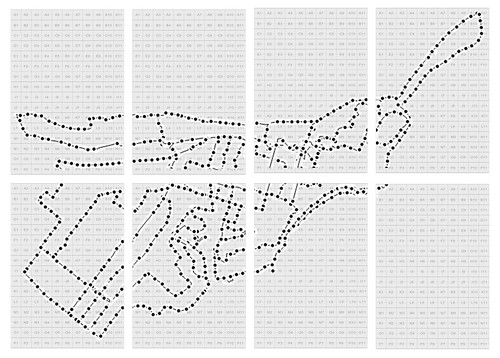
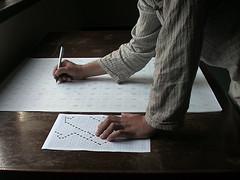
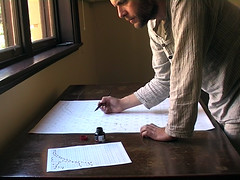
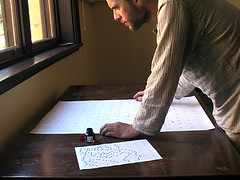
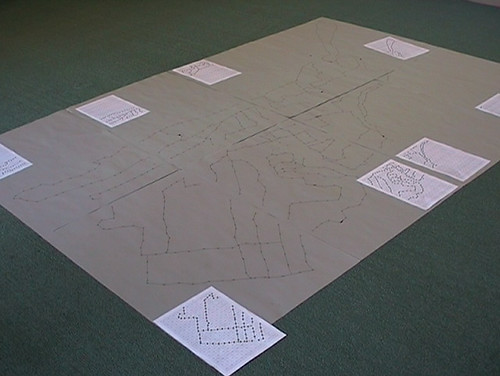
Having completed all the walks the next task is to tranfer them all to tracing paper so that templates can be cut and the map re-made on – or rather with – canvas. Taking the GPS plan, I divided it up into 8 segments, each of which I printed out onto A4 pieces of paper.

8 Sections of the Main Map

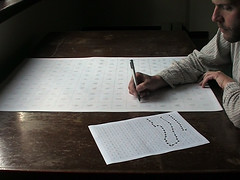
I then began scaling each piece up onto A1 heavyweight tracing paper, first marking all the dots and then joining them together. I would like to develop this whole aspect of the work, using the metaphor of sea-faring and map-making generally. Given time constraints however, the process will have to remain absent of any ‘performative’ aspect.

Marking the Dots

Marking the Dots

Having plotted the position of the dots, I then set about drawng in the lines.

Video Work

Video Work

Once copied, I joined the sheets together to make the fullsize version of the map which is now ready to be cut into templates.

Video Work

Filed Under: Artist in Residence Tagged With: A Line Drawn In Water, Artist in Residence, Australia, Everydayness, Family Hedges, Family History, Hedges, Lines, Maps, Stephen Hedges, Stitchwork, Walks

Dead Birds and Footprints

November 7, 2010 by Nicholas Hedges

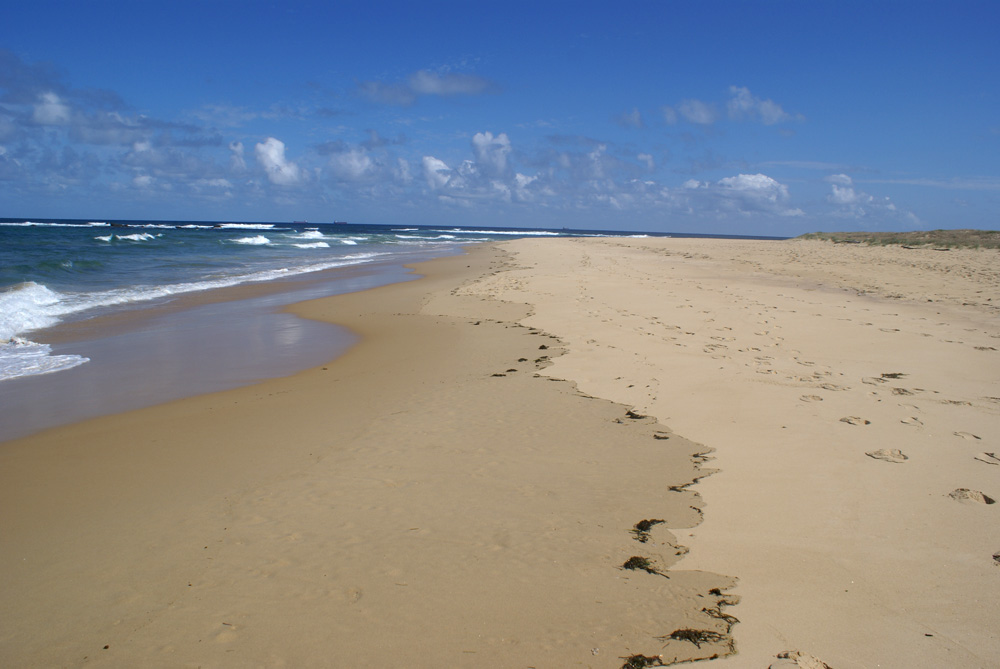
Yesterday I walked along Newcastle Beach and discovered, as I’d seen before, dozens of dead birds washed up on the sand. The shape in which the sea had left them was, in many cases, beautiful and so I began to photograph them.

Dead Birds and Footprints

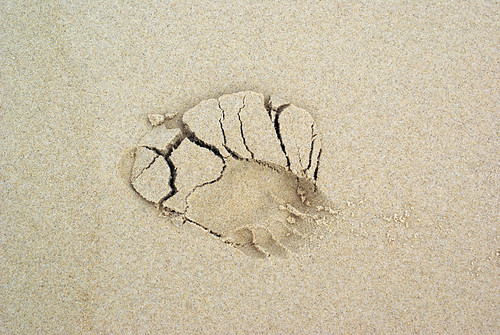
As I did so, I also became aware of the many footprints left in the sand, all different shapes and sizes, and so I started to photograph those as well, and in doing so, began connecting one with the other.

Dead Birds and Footprints

To see all photos, visit my Flickr pages.

Filed Under: Artist in Residence Tagged With: A Line Drawn In Water, Artist in Residence, Australia, Birds, Everydayness, Family Hedges, Family History, Hedges, Lines, Stephen Hedges, Walks

Completed Walks

November 6, 2010 by Nicholas Hedges

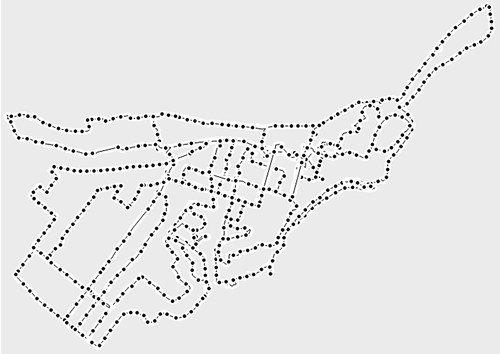
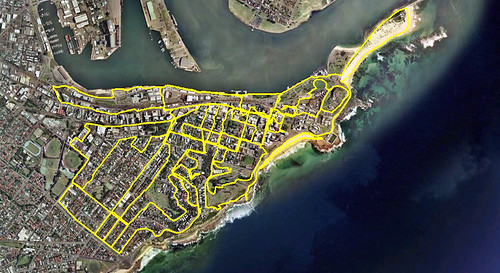
During the first week of this residency, I carried out a number of walks, the routes of which I recorded using GPS.Collecting all these walks together, I created a map of all the walks which can be seen in two images below. The first shows the pattern as revealed in the GPS software, the second in Google Earth.

Final Map of Walks

all as of 05-11-10

The next phase for this work is to divide the the first image into segments, each of which can then be tranferred to heavyweight tracing paper, after which the lines will be cut and the pieces left behind (i.e. the spaces in between the walks) transferred to canvas.

Filed Under: Artist in Residence Tagged With: A Line Drawn In Water, Artist in Residence, Australia, Everydayness, Family Hedges, Family History, GPS, Hedges, Lines, Positioning, Stephen Hedges, Stitchwork, Walks

Big Ships on the Horizon

November 6, 2010 by Nicholas Hedges

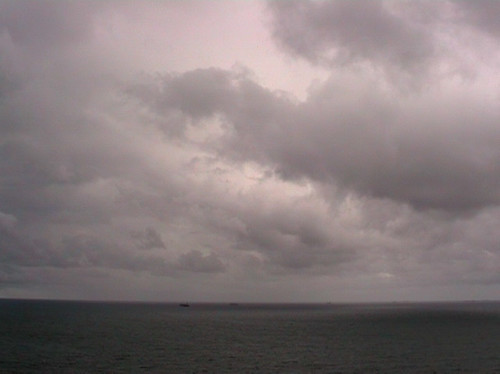
The big coal ships have fascinated me ever since I first saw them when I arrived in Newcastle. Like the huge clouds above them, they seem on the face of it not to be moving, but rather – like a photograph – fixed in their shape. Only over a period of time, as one watches, do the ships reveal themselves as moving, changing their course, just as the seemingly immutable clouds change their shape.

Coal Ships - Video Stills

The past too is like this. It appears to us fixed in its final shape by history, but when we observe at length we begin to see things differently – just as with the ships and the clouds, the past changes shape not unlike the way the present constantly changes its shape around us; because the past was once the present.

I have for a long while been interested in old photographs, in the distant parts of photographs where things are not the ‘subject’ of the picture. For example, the image below is a detail from a holiday snap taken some time in the early 1980s. I’ve no idea who the girl is and only noticed her when I enlarged the image.

16

Merleau-Ponty once wrote how distance was not a property of the horizon, and distance too – we might say – is not a property of those people occupying the background of these photographs. They are – or were – as much a part of the scene as those of us in the foreground – the subjects of the photograph. We are always as much a part of the distance and the foreground as everyone else; we are both these things at one and the same time. In terms of history, we in the present are like the subject of a photograph, and those in the past are like those in the distance. Everything is the same part of the present, just seen from different perspectives.

The past is as much about movement as is the present (just as the distance contains as much movement as the foreground) and to observe this movement in the past (or the distance) requires us to be patient – to watch and to listen.

It is interesting that watching and listening to the distance has become a theme during my residency here, and that the image above – a video still of the ships and the sky – was filmed from Shepherd’s Point, a place from which the Services would listen and watch for the enemy during World War 2.

Filed Under: Artist in Residence Tagged With: A Line Drawn In Water, Artist in Residence, Australia, Creatures, Family Hedges, Family History, GPS, Hedges, Lines, Merleau-Ponty, Photographs, Positioning, Stephen Hedges, Walks

  • 1
  • 2
  • Next Page »

© Nicholas Hedges 2024

  • Facebook
  • Instagram
  • Twitter
  • YouTube

Copyright © 2025 · Outreach Pro on Genesis Framework · WordPress · Log in