Nicholas Hedges

Art, Writing and Research

  • Amazon
  • Behance
  • Facebook
  • Instagram
  • Pinterest
  • YouTube
  • Art
    • Digital
    • Drawing
    • Grids
      • Correspondence
      • The Wall
      • The Tourist
    • Ink on paper
      • Shadow Calligraphy
    • Installation
      • Murder
      • Echo
    • Painting
    • Patterns
    • Mixed Media
    • Photographic installation
      • St. Giles Fair 1908
      • Cornmarket 1907
      • Headington Hill 1903
      • Queen Street 1897
    • Research/Sketches
    • Stitched Work
      • Missded 1
      • Missded 2
      • Missded 3
      • Missded 4
    • Text Work
  • Blogs
    • Family History
    • Goethean Observations
    • Grief
    • Light Slowed But Never Stilled
    • Lists
    • Present Empathy
    • Shadow Calligraphy
    • Trees
    • Time
    • Walking Meditations
  • Video
  • Photography
    • Pillars of Snow
    • Creatures
    • The Trees
    • Snow
    • St. Giles Fair 1908
    • Cornmarket 1907
    • Headington Hill 1903
    • Queen Street 1897
    • Travel
  • Illustration and Design
  • Music
  • Projects
    • Dissonance and Rhyme
    • Design for an Heirloom
    • Backdrops
    • Shadow Calligraphy
  • Exhibitions
    • A Line Drawn in Water
      • Artwork
    • A Line Drawn in Water (Blog)
    • Mine the Mountain 3
      • Artwork
    • Mine the Mountain 2
      • Artwork
      • The Wall
    • The Woods, Breathing
      • Artwork
    • Snow
      • Artwork
    • Echo
      • Artwork
    • Murder
      • Artwork
    • The Tourist
    • Dreamcatcher
    • Mine the Mountain
      • Artwork
      • The Tourist
    • M8
    • The Gate
    • Creatures
      • Artwork
    • Residue
      • Artwork
    • A visit to Auschwitz
      • Artwork
  • Me
    • Artist’s Statement

Maps

January 8, 2009 by Nicholas Hedges

As a child I spent many hours drawing maps of imaginary lands to which in my mind I would often escape. Over time these worlds – and one in particular (see image below) – became a very real part of my existence; I knew its towns, forests, plains and mountains; I knew the seas by which it was surrounded, the lakes and rivers and potted histories of each location. I created characters and can still to this day remember them along with the geography of the world they inhabited.
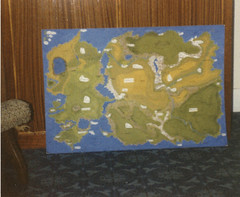
My Invented World - Ehvfandar

As well as being a means of navigating my imagination, the maps were also guides to the real world. Whilst out walking, I would just as likely find myself walking in my fictional landscape and as such parallels between the real and the imagined were established. To some extent these parallels still exist but it wasn’t until I started researching trench maps of the area in which my great-great-uncle Jonah Rogers was killed (near Ypres) that I was again reminded of my fictional world.

I was interested in pinpointing the place in which Jonah Rogers was killed; to see what the terrain was like and thereby understand, at least in part, something of the world he would have known. One can often imagine that the trenches were more or less just rudimentary ditches cut into the ground in which soliders lived as best they could, just a matter of yards away from the enemy, and of course, in many respects that’s precisley what they were; but the trench system was actually very complex. Far from being two lines gouged into the ground, the trenches of the opposing armies were labyrinthine as the image below reveals.

This map shows an area just outside Ypres. One can see precisely how complex the system of trenches were and yet of course the map can only tell us so much. Sanctuary Wood (shown on the left of the detail above) was described in the diary of one officer as follows:

“Of the terrible and horrible scenes I have seen in the war, Sanctuary Wood is the worst… Sanctuary Wood in 1914 was a sanctuary, but today, Dante in his wildest imaginings never conceived a like.”

It’s hard to imagine Dante’s image of hell as being in any way less horrific than anything on earth, particularly when looking at the map above.

What one can also see on another part of this map are some of the names which soldiers gave to the trenches and the areas in which they were fighting. Often names that were difficult to pronnounce were changed so that, for example, Ploegsteert became Plug Street. However, in some cases, areas were given names that made sense in terms of their being familiar names from home.

On this image one can clearly see a place called Clapham Junction. Of course there was no Clapham Junction in Belgium before the war, but by naming unfamiliar (and often utterly destroyed areas) with familiar names, soldiers and officers could, one assumes, navigate areas more easily, whether physically or in terms of reconaissance and planning. To plan attacks on places which have become muddied wastelands (to put it mildly) with few features remaining (the woods on the maps, shown as collections of lollypop trees were of course little more than burned splinters) one would need names, just as one would need names for the complex network of trenches. Could it be that by naming places with names from home, such reduced and barren landscapes (the ‘topography of Golgotha’ as Wilfred Owen called the Western Front) would appear as belonging in some way to the soldiers who fought there – was it a way of inspiring them?

The closest map – in terms of date – I could find relating to my great-great-uncle’s war, was one of St. Julien which dates from July 1915, just two months after his death in the Second Battle of Ypres. I’d wanted to get an idea of the trench system he would have been known at first hand and as I looked at the trenches shown (only German trenches were shown on this map) I found a road named after my home town; Oxford Road. Ironically, alongside this road was a cottage (one must assume there was little left of it at the time) which had been dubbed Monmouth Cottage – my great-great-uncle was from Monmouthshire.

I couldn’t help but think there was something in this naming of unfamiliar places with more familiar names which paralleled thoughts I’d had as regards my family heritage and in particular how researching it has helped me relate more easily to the past.

History is of course full of gaps. If we try and picture a place as it appeared at a given date we have to use our imaginations to fill in the holes where, for example, buildings have been razed. If we read reports or stories about events in the past we have to use our imaginations to understand the moment as fully as possible, to understand how the average person responded at the time. In doing so, we project a part of ourselves onto the past, something which is of course familiar (see ‘From Dinosaurs to Human Beings,’ OVADA Residency Blog, 2007).

Like my childhood maps of invented places, my family tree is in many ways a map of a fictional landscape, or rather a route through it. That is not to say of course that my family’s past is itself a fiction, but rather that history, in terms of how we see it in our minds is. History is in many ways a wasteland having been obliterated by time and yet there are parts of its landscape which still remain standing despite the tumult. Extant buildings, contemporaneous documents all act as pointers to a disappeared world, a world which also hides untold numbers of anonymous people. To help me navigate this landscape , I can invent my own names just as I did as a child, only this time the names will relate to, or be those of my ancestors; they will refer to dates and facts I have gleaned about their lives. In this sense I am labelling an unfamiliar, temporal landscape with familiar names, a landscape that like the battlefields of the Front has been all but destroyed. I’m filling in the gaps, mapping myself not only onto the physical world but also the past.

The worlds I invented as a child were in many ways idealised views of the real world with unspoilt forests, mediaeval cities and unpolluted seas. What faced the man at the Front was the opposite, a terrible vision of what the world could be or had become. Labelling such a world with names like Piccadilly, Buckingham Palace Road, Marylebone Road, Liverpool Street, Trafalgar Square and so on, in some ways gave it a more human face; where there were gaps, such names would fill them in perhaps with memories of home.

In the end maps are there to guide us, to reveal something about a place or perhaps a person; it all depends of course on what the map represents. We might be looking at maps of countries or maps of the brain – Katherine Harmon’s book ‘Personal Geographies and other Maps of the Imagination‘ is a great resource in this respect. When I look at the map of my invented world, I am not so much presented with a means of navigating a fictional world but rather a map of my own childhood. Looking at the place names I can in fact see the real world as it was at the time. The map therefore becomes a representation of something entirely different. The same could be said of the Trench Maps. They are maps of something quite unimaginable; if we took one and stood on a battlefield today it might offer us a hint of the way things were. But with the names of the trenches, roads, farms and cottages, they become maps of somewhere entirely different – a fictional place built only from memories. But those memories conjured by the names listed above – Piccadilly, Trafalgar Square etc. – are our memories, we can only imagine Trafalgar Square as it is today or as it is within our own minds. What we can establish, with the help of these maps, is an understanding of a sense of dislocation, between the solider in the trenches and his life back home. They serve to make those who fought and died in the war much more real.

With regards a map of my family tree I can place my ancestors in different parts of the country but of course none of them lived their lives standing still. Again there are gaps to be filled and whereas to fill in the gaps of history one can use one’s imagination, with regards the mapping of my ancestry and individual people, it is through walking around the places that they inhabited that these gaps can be filled. To close, I return to the blog entry I made during a residency at OVADA. In it I wrote:

“These invented worlds became, as I grew up, the ‘invented’ or imagined landscapes of Oxford’s past; landscapes that were – just as they still are – created from fragments, parts of the past which are still extant in the city; old buildings, walls, objects and so on. Between these structures, these fragments, I would fill the gaps, with my own imagination, with thoughts derived from my own experience. The city’s past and the past in general, as it exists within my mind, is then, to use the metaphor of cloning in Jurassic Park, a cloned dinosaur. The extant buildings, structures and objects within museums, are like the mosquitoes trapped inside the amber. They are broken strands of DNA. All that is required is for me to fill the gaps, and this I can do with my own DNA. I am in effect, the frog.
This metaphor is interesting in that DNA patterns are, of course, unique to everyone. My DNA is different to everybody else’s as there’s is to mine. Therefore, using my imagination to plug in the gaps of the past, means that the ‘past’ will comprise large parts of my own experience; my dinosaur will contain elements of my own being. (See ‘Postcard 1906’). But although my DNA is unique, it is nonetheless derived from my own past, elements have been passed down by my ancestors from time immemorial. The code which makes me who I am, comprises parts of people I know now (parents and grandmothers), people I knew (grandfathers and great-grandmother) and people lost to the past altogether (great-great grandparents and so on). What interests me about this, is that, through stating above how ‘my dinosaur will contain elements of my own being’ I can now see that ‘my dinosaur’ will contain elements of my own being, which is itself comprised of elements of hundreds – thousands – of people, the majority of whom I will of course never know and who have been dead for centuries. I like to think therefore, that ‘my dinosaur’ and my imagination aren’t entirely unique.”

In the traditional diagram of the family tree each individual is isolated, joined to others by means of a single line, almost as if they appeared at one point, moved a bit and passed the baton on to the next in line. Of course things are much more complex than this; individuals overlap in terms of the length of their lives and if we were to try and represent an individual’s journey through life, the line would be impossibly complex. Inevitably there are gaps which as I’ve said I can fill (at least, in part) by walking in the places they would have walked. In Wales, where my Grandmother grew up I found it incredible to think that this place I’d never been to and the streets, lanes and hills I had never walked, had all played a part in my existence. Without them I would not be here, or indeed there. I was then filling in the gaps, like the frog DNA in Jurassic Park, but the dinosaur I spoke of in the extract above was not so much History in this case, but me.
Filed Under: Family History, Trees Tagged With: Childhood, Dante, Family History, Jonah Rogers, Map, The Trees, Trees, Trench Maps, Ypres

Hafodyrynys

May 5, 2008 by Nicholas Hedges

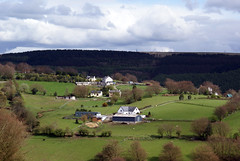
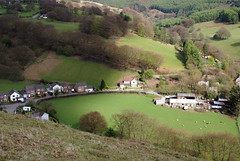
A few months ago when I interviewed my Grandmother about her childhood, she talked about the mountain around which she’d grown up in the village of Hafodyrynys, South Wales, not far from Pontypool. Her words about this mountain, which is in fact more of a hill, were very moving, for it was on this hill she played as a child and where she would watch her father as he walked to work in the mine at Llanhilleth. Below is part of that conversation:

“I can see him now because he went up our garden over the road and the mountain started from there up… and he’d go so far up and he’d turn back and wave to us, and if we went out to play, our Mam would say, “you can go up the mountain to play…” but every now and then our Mam would come out in the garden and we had to wave to her to know that we were alright you know… always remember going up the mountain…”

One of my main objectives for visiting Hafodyrynys was to see this mountain and to walk from the back of my Grandmother’s old garden in Rectory Road, up the side of the mountain, and to turn and look down at the house, just as her father had done on his way to the mines, and as she had done when playing. Another objective was to visit the graveyard in which a number of my ancestors are buried. Among those I wanted to find were:

Elias Jones (1882-1929)
Great-Grandfather

Mary Jane Rogers (1887-1969)
Great-Grandmother

Henry Jones (1839-1889)
Great Great-Grandfather

Rachel Jones (1853-1916)
Great Great-Grandmother

Mary Carey (1843-1869)
First wife of Henry Jones

George Rogers (1864-1944)
Great Great-Grandfather

Mary Ann Rogers (1864-1941)
Great Great-Grandmother

As well as being places where one can remember the dead, graves are also important evidence for the genealogist, and as I was to find out in the churchyard at Cefn-y-Crib (a small village between Hafodyrynys and Pantygasseg), the graves of my ancestors both confirmed my research as regards certain individuals, and opened up a new avenue of investigation, which, given my interest in World War One battlefields was to prove particularly interesting.

After visiting the ruins of Raglan Castle, we made our way towards Hafodyrynys and having taken a back road came first to Pantygasseg, a village I knew through my research as being the place where my Great-Uncle amongst many others had worked as a miner. Looking at the census records for the area, almost every man was employed in the mines. The village (which is no more than a single street with houses on one side) also interested me as regards the meaning behind its name, which in Welsh means, ‘hollow in the mare’s back’. This description derives from the shape of the mountain as it appears on the horizon and having researched the theme of ‘distance’ some time ago for an art project, I found it interesting that the village got its name from how it was seen from afar. Pantygasseg is so named through its being a part of (or identified with) the distance.

Hafodyrynys and Surrounds

Standing in Pantygasseg and looking at the surrounding hills therefore, I got the sensation that I had become a part of that distance, or that I was at least closer to it than I had ever been. I was reminded at this point of a quote from Rainer Maria Rilke’s ‘The Notebooks of Malte Laurids Brigge’ where he writes:

“Is it possible that one believed it necessary to retrieve what happened before one was born? Is it possible that one would have to remind every individual that he is indeed sprung from all who have gone before, has known this therefore and should not let himself be persuaded by others who knew otherwise?”

In Pantygasseg, I was indeed ‘retrieving’ the past and reminding myself that I was not only sprung from all who have gone before, but that I was also sprung from this very place.

Hafodyrynys and Surrounds

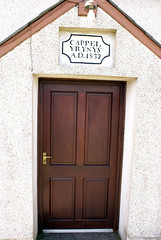
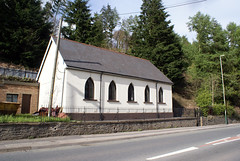
Just a few minutes down the narrow road from Pantygasseg, we arrived at the churchyard in Cefn-y-Crib (looking through a Welsh dictionary, I’ve tried to get an idea as to what it might mean, and ‘back of the ridge’ is my best guess thus far). According to my Grandmother , the Cefn was regarded (at least by her mother) as a rather rough place, but it was here that a number of my ancestors were buried in the small churchyard of the ‘Cappel Yr Ynys,’ a Congregational Church built according to the plaque above the door in 1832 (I’ve since discovered that a number of my ancestors also lived here).

Hafodyrynys and Surrounds

It was also to this church that my Grandmother came as a child and so for many reasons it was quite an emotional visit for me and my Dad, who, at each stage of the journey (which was indeed something akin to a pilgrimage) phoned my Grandmother to tell her where we were. The knowledge that we were standing at her parents’ graveside brought tears to her eyes and memories back which she could only know and there was something about this relaying of the journey back to her which was particularly engaging. I knew she’d be sitting in her chair back home and couldn’t help but imagine what she was thinking, what she was remembering about those places in which we were now standing of which I at least had no memory; it was as if we were walking within her memories.

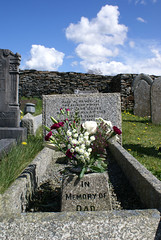
My Grandmother had given us some flowers to put on the grave of her parents, and this, along with the grave of her mother’s parents were the only ones for sure that we knew of.

Hafodyrynys and Surrounds

I’d been struggling to find the date of my Great-Grandfather’s (Elias Jones’) death, but on the side of the grave he shares with his wife, I found it; September 2nd 1929. He was just 47 years of age and died as a result of the coal-dust he breathed in through his work in the mines. With the Rogers’ grave, I had the dates already, but it was poignant to stand next to them (just as it was with all the graves) and realise that the grave marked the end of the path of their lives; a path around this area and it surrounds, which if it had been any different at all would have meant my not being here. I could only stand there by their being in the first place; my coming into being had not only been shaped by them, but also by the shape of the landscape itself, that of which I was now a part.

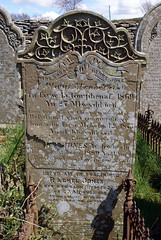
The next grave Monika found was that of my great great-grandfather, Henry Jones who died in 1889. Looking at the age at which he died and the date of birth I had for him in my family tree, I was relieved that I had indeed got the right man and below his name was – as expected – the name of his second wife – my great great-Grandmother Rachel, who died in 1916. But according to my research he’d been married before, to – if I was correct – Mary Carey, who’d died in 1869 aged 26.

Hafodyrynys and Surrounds

I looked around the graveyard for her grave but found nothing, and it wasn’t until we arrived home later and, again with the help of a Welsh dictionary, translated a few of the words on Henry and Rachel Jones’ grave, that we realised this stone had initially been cut for his first wife Mary. The words ‘Mari. Gwraig [wife] of Henry Jones,’ can be seen at the top along with the date of death (1869) and the age 27 (I’ve since adjusted her date of birth by one year). Also, listed below Mary, is a daughter, Lydia, who died in 1873 at the age of just 4 years. This would put her date of birth at around 1869, the same year as Jacob and the same year as Mary’s death; could it be that Jacob and Lydia were twins and that Mary died in childbirth?

The next gravestone which was to prove particularly interesting was one which began:

Hafodyrynys and Surrounds

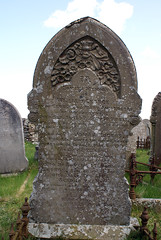
“In loving memory of William George, son of George and Mary Ann Rogers, of Hafodyrynys, Died Sep. 3rd 1897, Aged 10 years.”

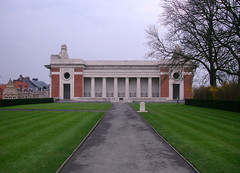
George and Mary Ann Rogers are my great great-grandparents. I hadn’t got William George listed amongst their children, but I had got the man named beneath, Jonah Rogers. I knew that he had been killed in the First World War, but was intrigued to find on the grave his rank and his regiment as well as the date and location of his death. Again, once home, I looked up his details on the website of the Commonwealth War Graves Commission and found that he’d been killed in Ypres and that his name was on the Menin Gate, places which Monika and I had visited last year and my Dad the year before. Not only that, but given the date of his death, I could trace him to the Battle of Frezenberg Ridge (8th – 13th May 1915), part of the Second Battle of Ypres.

Ieper

The man below, George, I also had listed. Ruth Hall, who is listed at the bottom of the gravestone I’m
assuming is my great great-aunt Ruth Rogers, the daughter of George and Mary Ann who was born in 1890 and died on April 5th 1925 aged 35 years.

Working on one’s family tree, one is of course deluged with lists of names of both people and places, and it’s only when you stand at the graves of those you have found in the surrounds they knew so well in life, that you can begin to make a real connection, and this connection, in this small churchyard was extremely powerful.

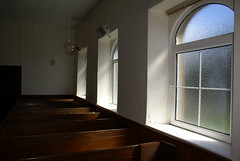
May 1st, the day of our visit, was election day and the annexe attached to the church was being used as a polling station. Having asked whether we might be allowed a look inside the church we were told we’d be welcome to pay a quick visit, and as we stood inside the small chapel, it felt strange to think that as a child my Grandmother had once sat in the pews facing where we were standing. Perhaps all of my forebears buried in the churchyard had once occupied these pews; given the date of the church’s foundation it didn’t seem unlikely. The bible which rested next to the pulpit looked as if it might have been there since that time, and I couldn’t help but imagine the minister reading from its pages as my ancestors listened.

Hafodyrynys and Surrounds

Having left the churchyard, we made our way down into Hafodyrynys, admiring as we drove the scenery and the trees which lined the road. There was something about the trees which particularly fascinated me, they didn’t seem to grow so much as writhe, twisting around themselves, confounding themselves with the fact of their own existence.

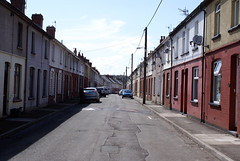
Once in Hafodyrynys, we parked the car and made our way towards Rectory Road, the street in which my Grandmother was born, and of which she’d spoken so fondly when we talked a while ago. Having stopped to ask a resident where we might find it (a man who said he knew my Grandmother) we eventually found the rather nondescript row of houses which looked to me as if they’d seen better days.

Hafodyrynys and Surrounds

It wasn’t that they were neglected in anyway, but with satellite dishes on almost everyone, they seemed to all recall simpler times. Perhaps that was as much to do with what I recalled my Grandmother telling me, about how she would play on the ‘mountain’ behind her garden and how her father had walked over it on his way to work in Llanhilleth.

Hafodyrynys and Surrounds

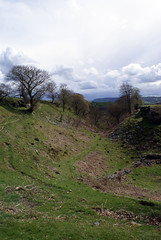
Having found the house in which she’d been born, we walked up an alleyway just a few doors down and made our way to the mountain. I wanted to walk up it and look back down on her garden, imagining my great-grandfather, looking down on his family and my Grandmother looking and waving at her mother as she played. And having walked to the top I did just that, taking in the view of the beautiful countryside, taking in the shape of the landscape which had in the way it shaped the paths of my ancestors served in part to bring about my own ‘coming into being’.

Hafodyrynys and Surrounds

I also reflected on Jonah Rogers, my great great-uncle, and thought about the misery he’d endured in Ypres and the horrors he must had seen, contrasting them with the view from the mountain, the view he must have known so well and dreamt about in all the mud and nightmare of Flanders. Having been in Ypres last year and now standing in Hafodyrynys, I couldn’t help but feel I had fulfilled a dream of his, to leave Ypres and see his home again.

Hafodyrynys and Surrounds

Having followed the directions of a man we’d met on the side of the mountain, we found ourselves not so much lost, as uncertain of where we should be heading. We walked through the second of two gates on a farm which we’d been told to pass through and found ourselves suddenly in the company of a very young border-collie who came bounding down to meet us before heading off again in the direction of the farmer who was at that point having a rest somewhere up a track which rose to our right.

Hafodyrynys and Surrounds

Hafodyrynys and Surrounds
Unsure as to whether we should take this track or that straight ahead of us, we too made our way up to the farmer who proceeded to take us on a tour of his farm. And so, in the company of him and his two dogs, we saw his fields, his sheep and were given some historical and geographical information pertaining to the area which lay all around us. It was as if for a few moments he were the voice young Jonah’s consciousness, recalling to himself all the familiar place names as he sat amongst those that were unfamiliar, colouring in the lush green fields where he could see only mud, and remembering the trees where in his nightmare all the trees had been gunned down, like soldiers shot at dawn.

Hafodyrynys and Surrounds

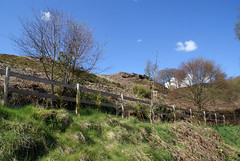
In amongst the hills and the patchwork of fields, the farmer told us the names of the various hamlets and villages; Penwaen, Pen-Twyn, Glandwr, but the most interesting thing for me (even more than the fact a walking stick made from a Holly Tree will make your hand turn black) was the stile which the farmer told us had not changed in his lifetime. It might not sound an exceptional fact, but it was interesting in that to me, looking at it for the first time, it was just an old, ramshackle stile, but for the farmer it was an abundant source of memories; memories one assumes about people he recalls from his childhood up to the present day, people who had since passed away, who once walked the road we were walking. It served to remind me of how the shape of the places in which we live serve to shape our lives as well as those who come after us, how the most insignificant thing in the world can harbour the most significant memories; and stiles of course help us on our way, it helps us cross a threshold – a theme which recently I have thought about a great deal.

Hafodyrynys and Surrounds

Having left the farmer and made our way back to the car, we visited another of my Grandmother ‘s churches, one in which my great Grandmother Mary Ann Rogers was a preacher (she was also the town midwife). Following this we made our way home back to Oxford, following the footsteps of my Grandmother and her family, who followed her to Oxford in the 1930s, leaving the Valleys so her brother George would not have to work down the mines. From Pantygasseg, to Llanhilleth, even on the farmer’s land, there was abundant evidence of mining, and one was reminded of the strange duality inherent in this beautiful landscape; the threshold between light and dark, play and the harsh reality of hard, dangerous, often fatal work.

Hafodyrynys and Surrounds

Back in Oxford I looked again at my family tree and though I can’t put faces to most of those at whose graves we’d stood that day, I can at least, and more importantly, put them in their landscape, and, furthermore, by walking in that landscape, put myself not only in their shoes, but somehow in their memories.

Hafodyrynys and Surrounds

Filed Under: Family History, Trees Tagged With: Family History, Family Jones, Hafodyrynys, Jones

Verdun

April 30, 2008 by Nicholas Hedges

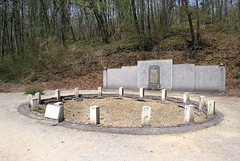
On 26th April I visited the battlefields and sites of Verdun. The name, like that of the Somme and Ypres, calls to mind visions of unimaginable horror; thousands upon thousands of men turned into names carved in monuments in towns throughout Europe, or lost completely, names and all, in the churned and pulverised fields. In my imagination, such places are always wet, cold, dark and desolate, as frozen in their appearance as they are fixed in old black and white photographs.

I won’t at this point discuss the battle’s history, suffice to say it’s a place in which around 500,000 men lost their lives, a figure which like so many grim statistics (I’m thinking here of my work on the Holocaust) is almost impossible to imagine (as much as it’s impossible to correlate). 26,000,000 shells rained upon the battlefield, six shells for every square metre. But difficult as these facts are to process, we must at least try.

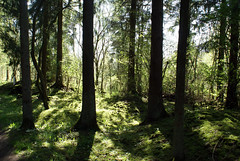
Having arrived in Verdun, we stopped the car at a track leading into a wood and no sooner had we started to walk amongst the trees than we became aware of the undulating ground; the shell craters and trenches, around and from within which this new wood had grown. At once we recalled the craters and trenches of Sanctuary Wood in Ypres, but the contrast between the two was clear; in Sanctuary Wood the trenches had been, at least, ‘over-preserved’ (some suggest they were dug for tourists after the war) but here they’d remained untouched since the end of hostilities. They were rounded and smoothed, and all the more powerful. At Sanctuary Wood, the whole place had the feel of a playground, whilst in this wood, the peace and quiet provided a stark counterpoint to the horrors of war.

Verdun

This counterpoint came in the birdsong and the colour of the sky, which on what was a glorious day was tinted by the brown of the trees and last year’s leaves filling the craters and trenches; a curious bruising as if a part of the dusk was somehow stained upon it. And between the carpet of leaves and the blue of the sky, was the green of this year’s growth; the whole scene a complete contrast to what the name, Verdun, had until now conjured in my mind. This place was simply beautiful.

Verdun

Save for a few tourists, we walked the woods alone, and yet, even then, the trees like those we’d encountered at other sites of trauma, seemed more than what they were. But whereas those which grow in Auschwitz-Birkenau and Belzec are strangely complicit in the events of the past, those in Verdun had grown from its wreckage; they did not hide what happened there. And stranger still was the sense that in this place Mankind was older than nature; Man had shaped the ground through his own destruction; he had made the void – the quagmire of mud – from which nature had risen, giving the trees a human quality, as if they carried with them the memory of all who fell – as if they were the fallen soldiers. And the resilience of Nature, it’s ability to rise from such appalling devastation, was one of the most striking aspects of our visit; despite the human feel of the trees, I realised how small humans are, even when they are made big through war. No matter what we do, Nature will in the course of time return. Long after we have finally gone, she will still be here, just as she was that day, in blue sky and birdsong, and as such, to walk through the woods was like being the last two people left on Earth.
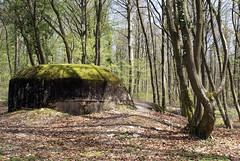
This scarred idyll was littered with other wartime detritus; the pillboxes within which men would hide, seeking out their fellow man beyond the apertures through which their guns were trained. They sat like concrete bells, still ringing with the war, like the ringing heard in silence, after exposure to something loud. (I am reminded here of the idea of sympathetic vibrations, where when a bell is struck, another bell across the room begins vibrating, giving off the same sound. These pillboxes which litter the landscape around Verdun, and which we saw in Ypres, seem to contain within their walls and deep impenetrable interiors, a sound which finds sympathy in all the others. I can imagine these vibrations ringing in sites all across the world, again long after man has gone.)

Verdun

Having recorded the sounds of the birds (and on playback I notice the insects – and I start to think of flies trapped in amber) we left the wood and made our way to Fort Vaux, the second to fall in the Battle of Verdun and a place I will return to later.

This persistence of Nature was nowhere more apparent than in one of the ruined villages which we visited towards the end of the day. There was nothing left of Fleury-devant-Douaumont save for the street names preserved on signposts along with signs indicating where there’d been a farm, the cafe, Town Hall and the workshop of a weaver.

Verdun

One of the interesting things about the numerous ruined villages is how they each have a Major, a post created to preserve the memory of the place as well as those who lived there. Like the woods, the landscape was blistered beneath the lush grass, undulating like immeasurably slow ripples following the impact of thousands of shells. It was pockmarked with craters some of which had filled with water to make ponds, beautiful beneath the dappled shade of the trees. Again, one had the feel of Man being older than Nature, with the new wood growing out of what remained of the village; despite the unimaginable numbers of shells which ploughed the soil, the sheer number of dead, the poison of the gas used in the battle, the ground had somehow made this beautiful landscape. And just as a corpse can tell us much about its demise through what nature has written upon it – the time of death for example – so the woods grown out from the corpse of the landscape speak of the time that has passed; and here is the curious enigma of the Great War. Despite the fact that almost a hundred years separates us, it doesn’t seem that long ago.

Verdun

Fort Vaux is a name synonymous with the suffering, endurance and the bravery of the soldiers who fought there. Even after the French were forced to surrender, the Germans presented arms as a mark of respect. The following is an extract from H.P. Willmott’s book on the First World War.

Verdun

“The German bombardment of the Fort began on June 1st 1916, at one point firing shells at the rate of 1,500 to 2,000 of the per hour. Inside were 600 troops under the command of Major Raynal. Just before dawn on the 2nd the barrage stopped and two German battalions moved forward. By mid-afternoon they had overwhelmed the defenders and occupied a large part of the superstructure. Raynal was determined to resist, and he and his men withdrew to the underground corridors where a grim battle was fought in the darkness with grenades and machine guns. On June 4th the Germans used flamethrowers in an attempt to drive the French out with asphyxiating black smoke…”
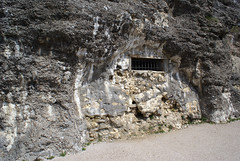
It’s a curious shell, a skull like structure cut into the rock which belies the horrors it has witnessed. Standing on top, one could see why it was so important, commanding spectacular views of the surrounding countryside and here, the contrast between the view of the tourist and that of the soldier becomes stark. What would they have seen from this same position? Hard to imagine that it was such a wasteland.

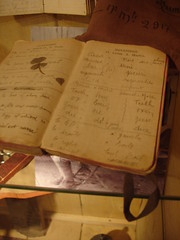
From Fort Vaux we made our way to the Memorial Museum and then to the Douaumont Ossuary. At the Museum, there was one object in particular which interested me, and that was a notebook containing handwritten translations of English words into French.

Verdun

The first line is the translation for Dead; Mort.

Verdun

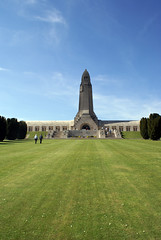
The structure of the ossuary is very much of its time and has the appearance of something which wouldn’t look out of place in Fritz Lang’s vision of the future, Metropolis. And this fact reminds us that it was just twenty years later when Europe and the world would be plunged into yet another catastrophe, indeed, during our journey around Verdun, we found evidence of this catastrophe in a memorial to 16 people killed in the second world war whose mutilated bodies were found dumped in a ditch which itself formed their memorial.

Verdun

From the top of the tower, one is again presented with spectacular views of the battlefields and again one can’t imagine what it would have looked like in those dark months of 1916. The tower itself houses the Victory Bell and the Lantern of the Dead which shines out over the battlefield.
Most of the structure is taken up by the 137 metre long cloister where each tomb shows a precise area of the battlefield from where the bodies were recovered. What one does notice – especially on a warm sunny day like that on which we visited – was how cold it is inside. One expects it to be colder given the thick stone walls, but there is something of an extra dimension to the chill, one is made all the more aware of being in the presence of the dead. And yet, this cold defines the living, it shows up our breath and for me, this was one of the most powerful aspects of the building.

Verdun

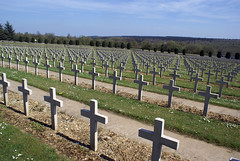
Outside the ossuary, through a row of small windows, one can see the bones of the 130,000 dead entombed within. Seeing the piles of leg bones, shoulder blades, vertebrae and skulls, one is reminded of the randomness of war, the arbitrariness of death on the battlefield. Like numbers and lists of names, it’s hard to imagine that these mountain of bones were once thousands of individuals, just as walking amongst the graves of the 15,000 men in front of the ossuary, one cannot imagine that many dead. Multiply that number, that space by thirty, see where it stretches out into the distance, and one begins to understand – in part – the horror of the war.

But one can never know what it was really like, and that to some extent is the point. Would we want to? We must do everything we can to never know. The inability to contemplate such horror in the face of such natural beauty is exactly its power. What we see when we walk through the woods is in some respects the world as it was before the war, the world of better days as remembered by those caught in the ‘meat-grinder’ of battle. The trenches gouged in the ground and the shell-craters pock-marking the soil are reminders of a brutal past, and yet they are also a warning about the future.
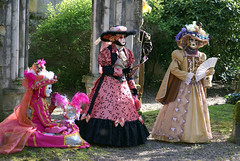
Having left the ossuray we made our way into the town of Verdun itself. Music was playing from speakers attached to all the lamposts, and at the appearance of people dressed in costume and sporting masks, we realised we had come at the time of a carnival. But there was something sinister about these people, the way in which they were a part of the town but detached, within but without. Something about their featureless, anonymous faces; the way they looked at us but we could not look at them, just a version of their selves.

Verdun

And seeing all these colourfully dressed people on the steps of the town’s huge memorial served to illustrate the continuity of life, but also the fact that those who died on the battlefields outside the town would have known brighter, happier, more colourful times, a juxtaposition which is everywhere in Verdun and which was to be found in the town’s Cathedral, itself hit on the first day of the battle – February 21st 1916.

Verdun

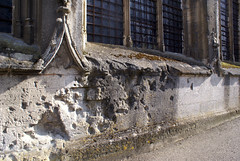
The Cathedral still bears the scars of war, but on the inside, one finds again the colour.

Verdun

Filed Under: Trees, World War I Tagged With: Place, Silence, The Somme, World War I, WWI, Ypres

The Gate

April 9, 2008 by Nicholas Hedges

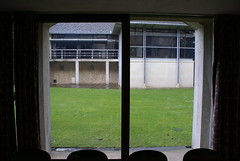
The project I am working on for the Travel and Trauma (Dark Tourism) conference (11-12th April) is now – in light of Elie Wiesel’s comments regarding the Holocaust’s visual representation – called The Gate. I shall be writing on the windows of the Larkin Room at St. John’s college (see photograph below) using text I wrote whilst sitting and looking out the window for a period of one hour on 26th March 2008, between 12 and 1pm.

Larkin Room, St. John's College

The text to go on the glass is as follows:

Looking outside the windows I can see the following. A modern complex straight ahead in front of which is a lawn. The bells are chiming twelve o’clock. The lawn is uneven, partly covered with weeds and daisies. To my left are a few shrubs, most bare except for the first green leaves of Spring. A small tree grows beside it and through the brambles I can see that the sky has turned dark; I expect it will rain soon, or even given the recent weather it may even snow. Beside the shrubs are a few daffodils which already seem weary. Last years leaves are mixed with the pebbles just by the bottom of the windows and the earth is peppered with acorns. Ivy grows up the exterior wall. To my right – another tree and more shrubs which are looking in a somewhat healthier state. Again a few meagre daffodils seem uncertain as to whether they should come out or not. The shrubs have been pruned here and the leaves are moving slightly in the breeze. Across the path grows a much older and larger tree – I’m not sure of the type – is it an oak? That might account for the acorns. Surrounding it is a large flower bed – more shrubs, another tree and a much larger crop of daffodils. I start to wonder about the wall; a number of people walk up the path and disappear from view from behind the concrete pillar. I can hear voices and also the rumble of traffic from town. There’s only voices and the sound of birds. I return to the wall and wonder about its provenance. How old is it? Did it mark the boundary of something? A man with glasses and a bald head walks down the path. Someone outside is coming down the stairs – there are two of them, a man and a woman. They disappear and the birds start singing again – not that they really stopped. The wall runs round the perimeter of this garden, except on one side where it has become a part of the modern building – concrete pillars, girders and glass. A small strip light is on and seems very ugly in this place. A girl walks past checking her phone. She walks without looking as if she knows this place so well she hardly needs to look – like a ghost following the trail of their lives. There are two litter bins; one is made of concrete and has a lid – the other is dark grey – plastic and much smaller. I think it must be a blackbird I can hear – much louder than any other. Next to the modern building is another – a different design and just as ugly. It’s hard to tell its age, whether it’s newer or older than that which faces me, or even that in which I am sitting. There is a long grey piece of guttering running down its entire length; I notice as I look at it that rain is beginning to fall; not as heavy as I thought it might be, just a veil of rain. Following my eyes to the left of the gutter , I find myself looking at a row of houses. From the design and the brick work I imagine that they’re nineteenth century. Strange how they seem much more human than those ahead of me and that behind which I am sitting. A girl walks past with a purple scarf and a bag – dark hair – she’s gone. A door slams somewhere behind me. In the corner of this garden (here comes the man I mentioned earlier, bald with glasses; he’s carrying a book) is another tree; strange how they seem to appear, how I didn’t notice them earlier. Another man in a short-sleeved shirt walks past. I see his reflection in the windows as he walks behind me. I think I can see a shield engraved on one of the windows ahead of me; is it the crest of the college? I can’t tell what it is – it actually looks like a cockerel. A pigeon wanders about on the grass – another tree! A silver birch sapling. I can hear footsteps and I see someone’s reflection in the window. A girl with a dark jacket, hand in pockets head bowed against the rain. I notice now, that the roof of the building straight ahead (another man in a t-shirt – then a couple, a man and a woman wearing a hood – then one carrying an umbrella) is made from what look like old tiles. Was there a building here before from which they were taken? If not, where have they come from? A bird flies across in front of me, I didn’t notice what it was. I see now that the wall around the garden is actually breached by a passage which goes somewhere – I’ve no idea where. Also, just next to the large flower bed (a man in a blue sweater walks past, his keys or something clanking with each step he takes) there is a flight of steps. They must lead to a raised pathway. The girl I mentioned earlier with the purple scarf walks across carrying a large pink bag. There are voices just outside . They greet each other? The couple – the girl with the hood and the young man walk back. An aeroplane roars overhead as another shadowed figure drenched in a wet coat walks past. More footsteps and again I cannot see where they come from. Then I see a young woman with a purple hat. Her steps echo as she walks through the passage to my right. A young man with glasses saunters past carrying a bottle of something, he walks around the lawn and down the passage I didn’t see earlier. The pigeon takes off and flies over the wall. In the windows of the building opposite I see the pale grey sky and the reflections of the older buildings. Two reflections just like ghosts appear in the glass ahead of me then disappear just like the rising tide of the traffic. And suddenly, for the first time since I sat down, I can hear the sound of a clock ticking somewhere in the room, counting of the passing time, just as the words of the those who walk around the lawn. Another aeroplane – or is it thunder? The sky is much brighter now although the rain is falling no less hard. As I speak however it starts to come down harder. I can hear it now, before it fell and didn’t make a sound. Now I can hear it scratching at the glass – I can see how it makes people run whereas before they were happy just to walk. I notice a drain cover down to the left – on it more acorns. A young man runs down the path to my right. Someone is talking behind me. The path is now reflecting the world through the fact it is so wet. The concrete pillars opposite are fragmented in the pattern of the slabs, as is the concrete bin. A couple walk past – the girl is carrying a pinkish patterned umbrella. The rain comes even harder now; I can hear it on the leaves of the shrubs, it drowns out the clock, as if each drop is a second and all the seconds that came before are returning to the earth. The drain cover has a distinct puddle now. Someone bangs something. Voices come behind me. I see their reflections in the windows, but I don’t see them. The sky appears to be becoming blue now, but yet it continues to pour with rain. I can hear the clock but I can’t see where it is. I just know time is passing without knowing how much. Someone is whistling; there is no tune to speak of, just a vague collection of notes strung together with a breath. There is, I realise another – what looks like a flower bed to my left, surrounding the tree. I wonder how it looks in the summer. My eye holds the image of a young man in a luminous jacket. He’s gone now but I can still see him. Where does everyone go, I can’t tell from where I am sitting. The rain is easing now, and the sound of the traffic intensifies, pricked by the footsteps which echo behind me. I can hear words but do not understand them, they are shapeless. I can see another light – a round, globe light in the building ahead and to the left; there’s something so depressing about them – lights on during the day. It’s stopped. The rain, but all around, the colours are by a few degrees darker. , the pathways reflect the world around them. A door opens to my right with a creak and closes. Footsteps. The sky is brightening up and the sun picks up the wet branches of the trees,, as if the sky itself has been cut to shape and laid upon them. And some are decorated with small droplets – of course now it’s started to rain again. What’s beyond the wall? There is the drone of an aeroplane, the percussion of rain and footsteps. Harder and harder it comes now. I can see it strike the path ahead of me. It’s actually hail. The rain seems to fall as lengths rather than drops. In front of me, on the step just outside, I watch the drops strike the puddle which has formed like the arms of an old typewriter striking the letters on the page. A few hailstones leap upon the lawn, as if they have been spat from the ground rather than fallen from the sky. The pigeon takes flight – a blue and green umbrella – one with a proper wooden handle. Three people walk past. They laugh through the passage. The girl is wearing a pink coat. I wonder what they are laughing about? A man walks but I couldn’t hear what he said – now I can – his friend is talking about something with flowers on. He laughs and they’re gone. The puddle on the manhole cover gets bigger, but the drops are falling slowly now; the typewriter is slowing down, the world has a little less to say. Funny how the walls surrounding this garden seem so unmoved by the rain – how much rain has fallen upon them in the years they have existed? Who have they seen walk past? Are we a blur to them? Do we pass by so quickly that we are not seen? I see a reflection walk slowly past in the glass, as if the glass is ice and the image is slowed to the speed of its molecules. Abstract patterns in the glass ahead of me like modern stained glass. A girl walks past and into the building. I see her through the windows at the top. I see her walk all the way to the left before she is swallowed by the dark of the glass as if she was never anything but a reflection. The clock strikes the hour. One o’clock.

Filed Under: Holocaust, Trees Tagged With: Dark Tourism, Holocaust, The Gate, WWII

Projects 2

February 8, 2008 by Nicholas Hedges

Family Tree (Travel)
Mountain – Distance
Coal mines (chalk work?)
Tailor – suit
Dreamcatcher
Broken Hayes
Blackboard – Auschwitz Drawings (graphite/chalk) coal?
Twinned
Shoe Mountain
Deckchairs
Tour Stories
John Gwynn’s survey 1772
Trees (Hidden, Ignored, Denied)
Knot
Knot with cups
Wallpapered drawings
Wallpapered drawings (coloured) (Hansel and Gretel installation)
Net (see Dreamcatcher)
Rusted plates (tintype photographs)
Hansel and Gretel (illustrations)
Prints from rusted plates
Distance in photographs (Creatures)
Windows and bicycles in old photographs (Barthes) (Tintype of bicycle)
Geocaching
Pile of cut string
Pile of uncut string
Three Fates performance with single string
Three Fates performance with lots of string
Three Fates performance with audio tape
Three Fates performance with video tape
Bicycle wheel
Mirrors – etching
Mirrors – rusted plates
Windows – wire
John Malchair (Holywell Music Room)
Plucked (resonating) strings
Bowls of water (whole and parts)
String network (held by one person)
Hansel and Gretel (rocks in woods, piled)
Net/Clothes
Three Fates Performance – woollen clothes
Broken stained-glass window (Pere Lachaise)
Broken stained glass window with rusted plates
Barbed wire stained glass
Three Fates Performance (with typewriter ribbon: soft-ground etching)
Typewritten text
Rusted plates in mirror-frames
Rusted plates in photograph frames
Maps – invented landscapes (The Tempest)
Wax cubes – memory work
Old London Road
Object Zoo
Cat’s Cradle (Spinoza’s Causality)

Filed Under: Trees Tagged With: Projects

Colour

November 12, 2007 by Nicholas Hedges

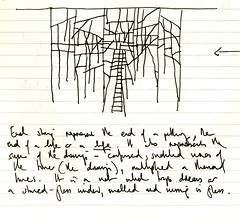
Each string (in what I have so far called the ‘net’) represents in its ‘cut end’ the end of a path, the end of a life. Each string also represents a life entire as measured by the three fates. Furthermore they could be said, as a group to represent the combination of paths which, at a specific moment in time created one of the many terrible moments of the Holocaust. Also, the image of the whole represents the sum of the snatched visions of the tower at Birkenau (the drawings).

Of the physical appearance of the net, the following quote from Fernando Pessoa’s ‘The Book of Disquiet’ is very pertinent:

“I also have my crochet,
It dates from when I began to think,
Stitch on stitch forming a whole without a whole,
A cloth, and I don’t know if it’s for a garment or for nothing,
A soul, and I don’t know if it’s for feeling or living.”

The image of the net looks like a ‘dream-catcher’ and in many ways that works in respect of this theme; dreams which many would have had of going back home, trapped in its strings. (There is also the idea of the writes of the telegraph poles carrying messages out of the camp and across Europe).

I was also thinking today about work by two of my colleagues which was very much to do with colour. This made me look at my own work (which is anything but colourful) and the subsequent contrast interested me. It reminded me of a television programme I watched last night about the photographer Albert-Kahn who documented the First World War in colour photographs. When we think of the past, in terms of the war, pre-war and Victorian periods, we think of it in terms of black and white. When we see colour photographs of the First World War they seem to validate reality – the very fact of time before we were born.

In my work there is no colour as such, but it is there, just as colour is there in Black and White photographs.

12-11-07
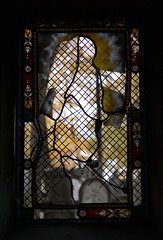
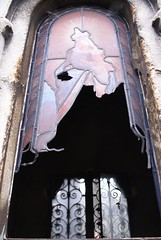
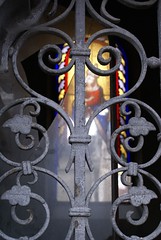
In the image above, I was reminded of the stained glass windows in the many tombs of Montmartre and Pere Lachaise cemeteries. The lines of the image (of the net) could just as easily be the lead work of a broken stained-glass window; what is missing of course is the colour.

Pere Lachaise, Paris

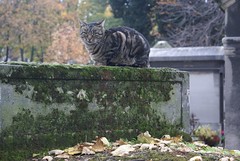
Colour could be a validating factor in this case. Often when we think of the Holocaust or World War One for example, we see them in Black and White (like the cats (although evidence suggests they may have limited colour vision) we saw in the cemetery); we often think of the weather as being dull, grey, miserable, always winter, and when we read evidence of the time that talks of blue sky and sun, it always seems somehow shocking. The following is an extract from Tadeusz Borowski’s “This Way for the Gas Ladies and Gentlemen.”

“‘…You have no idea how tremendous the world looks when you fall out of a closed, packed freight car! The sky is so high…’
‘…and blue…’
‘Exactly, blue, and the trees smell wonderful. The forest – you want to take it in your hand!'”

When imagining arrival at somewhere like Birkenau, one imagines it being night, or the smoke from the chimneys hiding the sky like a fog. But of course, people would have arrived on beautiful summer days, when colour was abundant.

Filed Under: Holocaust, Trees Tagged With: Borowski, Colour, Fernando Pessoa, Holocaust, String, World War I, WWI, WWII

Paris, Capital of the Nineteenth Century

November 8, 2007 by Nicholas Hedges

On the first day of this month, I travelled to Paris on Eurostar and met my girlfriend Monika at the Gare de Nord station, she having travelled in from Luxembourg by TGV to Gare de l’Est. I was last in Paris in 1992/93 (the exact date eludes me) on a visit made as part of my degree in Art History, and although my memories of the city were rather vague and (before re-visiting) few, my impression of it was nonetheless intact and fairly lucid. From the pretend statue at Sacre Coeur (a woman, painted white, standing still), to being lost somewhere near Les Halles, from the pastels of Odilon Redon in the Musee D’Orsay, to Rodin’s ‘Balzac’, from the Musee Moreau to a few trips made on the Metro, I could adduce that Paris was beautiful, and, as Walter Benjamin described it in his Arcades Project, the ‘Capital of the Nineteenth Century.’

This sense of it being a nineteenth century city might owe as much to the fact that much of it was indeed built (or rebuilt) in that period (with the extensive renovations by Haussmann in the 1860s) and that its ‘symbol’ the Eiffel Tower, was constructed between 1887-89 as the entrance arch for the Exposition Universelle (the novelist Guy de Maupassant, who claimed to hate the tower, supposedly ate lunch at the tower’s restaurant every day. When asked why, he answered that it was the one place in Paris where you couldn’t see it).

The city’s character is formed as much by an abundance of 19th century literature (Zola, Baudelaire, Balzac, Huysmans…) and art (Realism, Impressionism, Post-Impressionism, Symbolism…) than simply ‘bricks and mortar’, yet, despite this sense, it’s by no means a city stuck in the past at all, rather it’s very much of the present, as if the intervening time had not intervened, as if there was nothing to intervene between.

November the 1st is All Saints Day, and by tradition, people in many European countries, including France, take flowers to the graves of dead relatives. Our hotel room, overlooked the cemetery at Montmartre which, having unpacked, we visited.

Paris

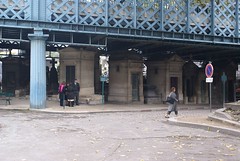
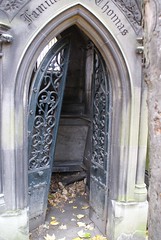
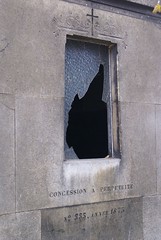
For Monika, being Polish, the day was very much part of her own tradition, and one of the first things we saw as we walked around, was a group of Poles reciting a prayer for a fellow countryman laid to rest in the cemetery. The cemetery itself was interesting inasmuch as it was very much a part of the city, rather than a place divorced from life – a sense augmented by the bridge which ran above it, beneath which the tombs of the dead resembled makeshift dwellings erected by the homeless; constructions for the purpose of temporary habitation, rather than eternal rest. Indeed, given the occasional broken pane of glass we wondered whether or not they were in fact used as shelters; where the living tap the dead for respite from life.

These little dwellings were beautiful, especially where time, which ought to have let the dead alone, had scratched away at the doors, much like the vagrants seeking shelter from the rain.

Paris

The first grave we saw took my interest, since a cat was laying on top of it, dead centre, looking towards the headstone. I took a photograph (which I have since, accidentally deleted) and immediately, a lady, standing with a man (I presume was her husband) asked me in French, ‘why did you take a picture?’ I must confess here that I do not speak French and relied on Monika who does. I explained that I was interested in the cat and was amazed then to discover that the grave was that of her mother. Suddenly, from an anonymous grave with an anonymous name, the memorial had come to mean much more. There was a physical, living connection. She explained in polite conversation, that the cat had been there most of the day and hadn’t moved even when she busied herself about the grave arranging flowers and so on. Cats, we were to discover, were a common feature of the cemetery.

One sculpted tomb was especially beautiful. It showed what I presume to be the deceased, not as he was whilst living, but as he was dead. His sunken features, his closed eyes, and the exposed shoulder all pointed to something deeper than sleep. The eyes in particular were striking, in that one could see they were the eyes of a man who would never open them again. The shroud had been pulled back, to allow one last look at his face, a look which had lasted over a century. I say, as he was dead, but of course he still is dead, and this sculpture serves in a way to remind us, that even in death we are not free from ‘time’s relentless melt’.

Montmartre Cemetery, Paris

On our second day in Paris, we visited the Louvre which, I remembered, I hadn’t visited during my first stay in the city. The building is indeed impressive, as are the queues which inevitably form outside. Nevertheless, having joined the queue outside we soon found our way to the queue inside which as well as being much longer was even slower to move. In fact, it took almost an hour to get a ticket which wasn’t surprising considering that one of the two tills serving our queue was closed and when that which was closed finally opened, the open one, for the purposes of consistency, closed, and this fat caterpillar of people continued chewing on its incredulity.

Once in, I found the Louvre to be almost worth the wait, although the queue had sapped our strength somewhat, and what one needs when walking around the palace is all the strength one can muster; mental as well as physical. What did strike me was the bizarre behaviour of most of the other visitors, something which I remembered as having struck me when I visited what I think was the Grand Palais during my first visit. Back then, a number of people walked around the galleries videoing continuously, looking at everything through the eyepiece of a video-camera, and now, in this increasingly digital age, the same is true but on a much larger scale. Maybe it is something to do with our contemporary culture which means we cannot see something unless it’s reproduced, we cannot know it except through facsimile, that things are not received as being experienced unless captured by a camera. Imagine, you’re approaching a painting, a genuine da Vinci (not the Mona Lisa in this instance). You are about to see something which you know the great man saw himself, something with a provenance dating back over five centuries, an image which countless numbers have looked at since its creation. What do you do? Well, the woman in front of us framed it in her camera, took its picture and walked off looking at the image on her camera’s display. The difference between something original and a copy (and by copy I mean a skewed, 5 megapixel digital photograph) has, it seems, been attenuated to such an extent that there’s no longer any perceived difference at all.

Near to where this ‘incident’ took place is the room which houses the Mona Lisa, a painting whose popularity is, in part, due to the viral-like profusion of its myriad reproductions. On posters, postcards, badges, T-shirts, calendars, mugs and so on, the image is better known than any other in the world, and so, as if she were a celebrity, people crowd about her – as she gazes out from behind her bullet-proof screen – all wanting a copy of their own. Phones are raised amidst the clamorous throng like numerous periscopes; cameras snap at her heels. It really beggars belief.

There were no throngs of people slobbering around Holbein’s portrait of Erasmus, or Vermeer’s Astronomer, and there was no-one standing in front of Ingres sublime portrait of Louis Francois Bertin, a painting which at 116 x 95cm, is, if not in scale, truly epic. Bertin looks out from across almost two hundred years, as alive as he was then. He looks at you as you dare to return his dismissive gaze. One can almost hear him scoff. You are mortal. You can almost hear him say it. He is immortal and you know that he is thinking it. He looks right through you at the centuries to come when you will be long gone from his gaze. “I will still be here,” he says. It really is one of the great portraits.

An artist well known for his monumental works, Anselm Kiefer, was at the time of our visit exhibiting three new works commissioned by the Louvre. It took us a while to find them, and when we did I must say I was rather disappointed. Whereas Ingres more modest-sized portrait was made vast in the palace, Kiefer’s painting ‘Athanor’ despite its scale was rendered rather small. The two sculptures either side were somewhat peripheral and reminded me of Christmas trees which after New Year start to outstay their welcome. This is not to say that any of these works are bad, they’re not – far from it. But somehow in this setting they just didn’t seem to work.

After the Louvre, we were given a guided tour by one of Monika’s friends of the Marais district, which was a real treat. The Marais district (meaning marsh or swamp), spreads across the 3rd and 4th arrondissements on the Rive Droit, or Right Bank of the Seine. According to one of the many websites on The Marais, it was:

“… in fact a swamp until the 13th century; when it was converted for agricultural use. In the early 1600s, Henry IV built the Place des Vosges, turning the area into the Paris’s most fashionable residential district and attracting wealthy aristocrats who erected luxurious but discreet hotels particuliers (private mansions). When the aristocracy moved to Versailles and Faubourg Saint Germain during the late 17th and 18th centuries, the Marais and its mansions passed into the hands of ordinary Parisians. Today, the Marais is one of the few neighborhoods of Paris that still has almost all of its pre-Revolutionary architecture. In recent years the area has become trendy, but it’s still home to a long-established Jewish community.”

Evidence of the Jewish community, and, in particular, the traumas suffered at the hands of the Nazis and the Vichy government can be found in the Holocaust Memorial, as well as the memorial in the Alle des Justes, dedicated to all those who helped the Jews in such dangerous and terrible times; thousands of anonymous names (unknown at least to visitors) who nevertheless did so much, to do good in a very bleak world.

On numerous walls of various buildings were plaques dedicated to the hundreds of children deported from the district’s schools. Having visited some of the terrible places where some of these children ended up, it’s somehow even more distressing to see the place from where they were taken.

Paris

Evidence of the area’s mediaeval past can be seen in its surviving ancient wall, the only section left of the Philippe Auguste fortifications which date back to the 11th and 12th centuries. It’s just one of the many features which distinguishes this part of Paris from the rest of Benjamin’s ‘Capital of the Nineteenth Century’.

Paris

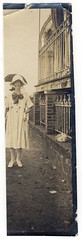
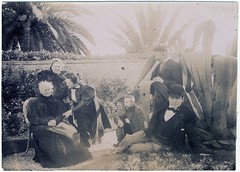
But it’s more than just the old buildings, the place has a character which is quite unique; it’s quite understated (although not entirely); most unlike the sweeping brovado of Haussmann’s boulevards. In one part of Marais, there is a group of antique shops, called Village St. Paul, where we came across a photographic shop selling old photographs. This shop, called ‘Des Photographies’ was a place in which I could have spent several hours sifting through snapshots of times long gone, and although we were pushed for time, we did purchase two photographs, or rather one and a half, for one of the photos had been cut from a bigger picture.

The first shows a young woman, standing in the rain. I cannot tell exactly when it was taken, but I would imagine it’s some time in the 1920s or 30s.

A Lady

I liked this for the fact it had been cut from a bigger photograph. But why was it cut? Was it malicious? Was it through heartbreak? Was someone cutting this woman, this memory, from their life? Of course it could have been anything but malicious.

The second photograph, which Monika bought for me, is a group portrait, perhaps a family, taken around the end of the nineteenth century.

Group Portrait

This photograph is interesting for many reasons, one being that no-one is looking in the same direction. Only one person, the woman standing behind the old lady (seated) is looking at the camera. The photograph itself, judging from the back, had at one point been part of an album, and one can’t help wonder when looking at it what other pictures accompanied it within that collection. Individual portraits of those within the picture perhaps? Images of where they came from? Who were these people, these men and women who have since lost their names? It’s strange, but sometimes names outlive the body (on plaques and tombstones) or bodies (or at least their alchemical equivalents) outlive the names (such as with these photographs), but rarely do the two continue to coexist.

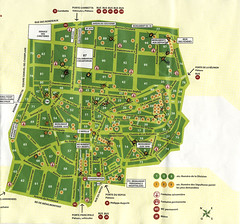
The following morning we made our way to the largest and most famous cemetery in the city, Pere Lachaise. The cemetery takes its name from Pere François de la Chaise (1624-1709), confessor to Louis XIV, and is reputed to be the world’s most visited cemetery, not that it seemed particularly busy as we walked around. Armed with a map upon which we’d marked the graves we wanted to see, we spent a few hours wandering through the streets and avenues of this vast necropolis.

Pere Lachaise Map

Among the graves we visisted were those of, Apollinaire, Balzac, Sarah Bernhardt, Bizet, Gustave Caillebote, Chopin, Corot, Daumier, David, Delacroix, Paul Eluard, Gericault, Ingres, Moliere, Piaf, Pissarro, Proust, Seurat, Gertrude Stein and Oscar Wilde.

Paris
Theodore Gericault (1791-1824)

Paris
Jean-Baptiste Camille Corot (1796-1875)

Pere Lachaise, Paris
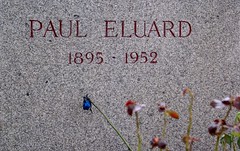
Paul Eluard (1895-1952)

Paris
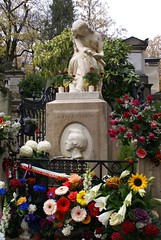
Frederic Chopin (1810-1849)

Paris
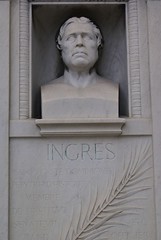
Jean Auguste Dominique Ingres (1780-1867)

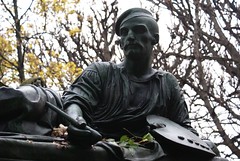
And there was something quite strange about seeing the graves of painters whose works we had seen in the Louvre the previous day, artists such as Ingres, who’d given Louis Francois Bertin immortality through his portrait. It was hard to reconcile the fact the he – Ingres – had been dead and buried in this place for 140 years, over a hundred years before I was even born, whilst fresh in my memory was an image which would have once occupied a space in his own: the intervening time had not, as I said earlier, intervened at all.

As with the cemetery at Montmartre, what I found myself drawn to were the graves of those who’ve not left behind a tangible heritage (paintings, discoveries, books etc.). Those names without bodies; scratched like grafitti, by a vagrant time who wanders amongst the stacked sepulchres. Names which do not ring bells when you read them, into whose shapes the moss has grown; names around which death has become less eternal; fragile like glass, broken in the bent and buckled leading of once replete windows.

Pere Lachaise, Paris

In broken windows such as these, we see the passing, not just of a life, but of memories; the passing of those who came after the deceased with whom the increasingly vague memories of a distant relative melt into further graves. In every cemetery, you will find hundreds, maybe thousands of anonymous names; names and numbers from which we are separated by generations, decades or even centuries, and of course the ultimate experience: death. And in a cemetery, perhaps somewhere in France, are the names of those people in the photographs I bought in Le Marais; the single woman cut from the bigger picture (in more ways than one), the old lady seated on a chair in the sunlit garden, the two women beside her, and the three men all looking in different directions.

Having said goodbye to Monika at Gare de l’Est, I listened to ‘In Our Time’, a podcast from the BBC. The episode I was listening to was on the 17th century philosopher Spinoza, whose work George Eliot had translated in the 19th century, and whilst discussing Eliot’s epic novel Middlemarch, one of the speakers paraphrased an extract from its conclusion, an extract which I have since discovered, just as she had written it:

“But the effect of her being on those around her was incalculably diffusive: for the growing good of the world is partly dependent on unhistoric acts; and that things are not so ill with you and me as they might have been, is half owing to the number who lived faithfully a hidden life, and rest in unvisited tombs.”

What we leave behind (our legacy) is not justified solely by its apparent value or greatness; whether or not it’s great art or literature, or a discovery which will prove a catalyst for even greater advances. It is not dependent on whether or not we have made some kind of sacrifice or acted with courage in times of great affliction. It is also those unhistoric acts of which Eliot speaks, by people who in many cases are not even names anymore. It’s often the decidely average which plays the greater part. Everything, even the mundane has an influence on the world.

In the translator’s forward to Walter Benjamin’s even more epic Arcades Project, Howard Eiland and Kevin McLaughlin write of Bejmain’s intentions as being:

“to grasp such diverse material under the general category of Urgeschichte, signifying the ‘primal history’ of the nineteenth century. This was something that could be realized only indirectly, through ‘cunning’: it was not the great men and celebrated events of traditional historiography but rather the ‘refuse’ and ‘detritus’ of history, the half concealed, variegated traces of the daily life of ‘the collective,’ that was to be the object of study, and with the aid of methods more akin – above all, in their dependence of chance – to the methods of the nineteenth-century collector of antiquities and curiosities, or indeed to the methods of the nineteenth-century ragpicker, than to those of the modern historian.”

Paris is indeed the capital of the nineteenth century, but what of the nineteenth century itself? As the French philosopher Henri Bergson wrote, who is himself commemorated in the Pantheon:

“There will no longer be any more reason to say that the past effaces itself as soon as it’s perceived, than there is to suppose that individual objects cease to exist when we cease to perceive them.”

Somewhere, the century still exists and Paris is still its capital.

Filed Under: Photography, Trees Tagged With: Arcades Project, Cemetery, George Eliot, Junkshop Photographs, Paris, Pere la Chaise, Spinoza, Vintage Photographs, Walter Benjamin

Parisian Cemeteries

November 7, 2007 by Nicholas Hedges

Whilst on a trip to Paris with Monika, we paid a visit to two cemeteries; one, the cemetery at Montmartre, near our hotel, and the other, the famous Pere Lachaise cemetery in the east of the city. The cemetery at Montmartre was interesting in the way it was very much a part of the city, rather than a place divorced from life. This feeling was enhanced by the bridge which ran above it, beneath which the tombs of the dead reminded me of the makeshift dwellings put up by the homeless.

Paris

The first grave we saw took my interest, since a cat was laying on to of it, dead centre, looking towards the headstone. I took a photograph (which I have since, accidentally deleted) and immediately, a lady, standing with a man (I presume was her husband) asked me in French, ‘why did you take a picture?’ I must confess here that I do not speak French and relied on Monika who does. I explained that I was interested in the cat and was amazed to discover that the grave was that of her mother. Suddenly, from an anonymous grave with an anonymous name, the memorial had come to mean much more. There was a physical, living connection. She explained in polite conversation, that the cat had been there most of the day and hadn’t moved even when she busied herself about the grave arranging flowers and so on. Cats, we were to discover, were a common feature of the cemetery.

Paris

The day we visited was November 1st, a public holiday and the Day of the Dead, a time in some European countries when people visit the graves of loved ones. I knew, through Monika, that it was an important time in Poland, and, sure enough, where there were Polish graves in the cemetery, there were Poles, laying flowers, saying prayers, and remembering those of their country who had long since died; a tradition which is both poignant and to be admired. Later, when we visited Pere Lachaise, we found the grave of Chopin bedecked with flowers and a sashes of the Polish colours.

Paris

Some of the graves in the Montmartre Cemetery were particularly beautiful. Many were like tiny dwellings replete with doors and windows (usually stained glass), and although many had decayed through the ravages of time, their wearied state accentuated the romantacism inherent in many such cemeteries.

Montmartre Cemetery, Paris

One sculpted tomb was particularly beautiful. It showed what I presume to be the deceased, not as he was whilst living, but as he was dead. His sunken features, his closed eyes, and the exposed shoulder all pointed to something deeper than sleep. The eyes in particular were striking, in that one could see they were the eyes of a man who would never open them again. The shroud had been pulled back, to allow one last look at his face, a look which had lasted over a century. I say, as he was dead, but of course he still is dead, and this sculpture serves in a way to remind us, that even in death we are not free from ‘time’s relentless melt’.

Montmartre Cemetery, Paris

At Pere Lachaise, I was keen to visit the graves of artists, writers and composers such as Ingres, Moliere, Pissarro, Proust, Chopin, Gericault, Delacroix and Wilde amongst many others and having bought a map of the cemetery (which is vast) Monika and I planned our visit and began to seek them out.

Pere Lachaise Map

It was strange – in the case of the various painters buried there – that having seen their work in the Louvre, we were now standing above their remains. One painting, for example, which we had seen in the Louvre, stuck in my mind as I stood next to the grave of Ingres (1780-1867). It was his portrait, painted in 1832, of Louis Francois Bertin, one of the most famous works by the artist, and one which is so full of life, it hardly seemed possible that the man in the painting and the man who painted it were long since dead. How was it, that I had seen something I know Ingres had also (obviously) seen, yet here I was, standing above his grave where he had lay for over a century before I was even born. That is the power of painting; they are objects into which the artist paints him or herself, in brushstrokes (particularly in the case of the Impressionist and Post-Impressionist works we saw) which made in moment can exist for all time.

On the way home from Paris, as I passed beneath the sea in the channel tunnel, I began to write about the visit to Pere Lachaise. What I had been aware of as we walked around, was the content of the photographs I was taking, some of which follow:

Paris

Paris

Paris

Paris

They were all images of decay, the gradual fall into disrepair of the numerous memorials in this vast necropolis, and, given the work I have lately been doing on the ‘gestures’ of things, I began to consider the ‘gesture’ of this particular cemetery. What follows is what I wrote on the way home:

(The gesture is) like mould, lichen, which grows slowly in small patches over a long period of time. But these spores are invisible, we cannot see them except in the broken panes of glass, the flaked paint, the verdigris patinas on the doors to individual tombs, the chipped stones; every trace of time’s slow, considered vandalism. It’s always present in the cemetery and every now and then, one detects a trace of its fleeting presence – the scent of vinegar which lingers around a tomb where the glass is missing, where the door is open, or where the iron gates have corroded and been worn through by time’s relentless scratching; time’s relentlessness.

Even when all trace of the bones has gone, long after the burial clothes and the casket, time will continue its malevolence, picking at the fabric of memory, wearing down the words, smoothing over names, dismantling the dead and our memories of them, withering through slow alchemy these parts into atoms. Candles lit and placed beside the graves will soon be extinguished, flowers will be wilted, trees will be naked, picked of their leaves and left like confetti, to remind the living of this withering certainty.

Cemeteries are not just places where the dead are dismantled, where the names by which these parts were held together are also broken apart. They are as much for the living, who fight with death to keep the parts together, to deny death, to deny its certainty; to deny their own futures. The living wander the graves to maintain the present. Inside cemeteries the present is stretched.

We walk through cemeteries, and with our minds like nets try and catch this butterfly called Time, but we are assailed by its beauty, we stand open-mouthed and wait for the crysalis to be spun with invisible thread around us.”

Cemeteries have something in common with old photographs, particularly when we consider the the writing of Roland Barthes who writes that photographs have within them the ‘catastrophe of death,’ and that, ‘in the photograph, Time’s immobilisation assumes only an excessive, monstrous mode: Time is engorged…’. In cemeteries too, Time is somehow engorged and obviously contains – in abundance – that catastophe. One has the impression of time standing still, stopped by the dates of death carved into the many gravestones and tombs, yet we know, all too well, that time continues…

Filed Under: Photography, Trees Tagged With: Barthes, Catastrophe, Cemetery, Gesture, Montmartre, Paris, Pere la Chaise, Vintage Photographs

Spinoza, Eliot and Pere Lachaise

November 4, 2007 by Nicholas Hedges

Written in transit from Gare du Nord to Waterloo, listening in part to In Our Time on Spinoza.

Social Scuplture – Gesture work for the next week.

Cemetery (Pere Lachaise) Like mould, lichen, which grows slowly in small patches over a long period of time. But these spores are invisible, we cannot see them except in the broken panes of glass, the flaked paint, the verdigris patinas on the doors to individual tombs, the chipped stones; every trace of time’s slow, considered vandalism. It’s always present in the cemetery and every now and then, one detects a trace of its fleeting presence – the scent of vinegar which lingers around a tomb where the glass is missing, where the door is open, or where the iron gates have corroded and been worn through by time’s relentless scratching; time’s relentlessness.

Even when all trace of the bones has gone, long after the burial clothes and the casket, time will continue its malevolence, picking at the fabric of memory, wearing down the words, smoothing over names, dismantling the dead and our memories of them, withering through slow alchemy these parts into atoms. Candles lit and placed beside the graves will soon be extinguished, flowers will be wilted, trees will be naked, picked of their leaves and left like confetti, to remind the living of this withering certainty.

[Look at Spinoza – nothing in nature that can be called contingent. Connections (if we could see them) determine what we do through a network of causation]

Cemeteries are not just places where the dead are dismantled, where the names by which these parts were held together are also broken apart. They are as much for the living, who fight with death to keep the parts together, to deny death, to deny its certainty; to deny their own futures. The living wander the graves to maintain the present. Inside cemeteries the present is stretched.

We walk through cemeteries, and with our minds like nets try and catch this butterfly called Time, but we are assailed by its beauty, we stand open-mouthed and wait for the chrysalis to be spun with invisible thread around us.

[Marcus Aureolis – “In the thought that I am part of the whole, I will be content with all that comes to pass. IOT. Spinoza. 30.21]

Paraphrasing George Eliot – end of Middlemarch. “We must be forgiving to people because what people do is not really up to them, it’s much more influenced by the outside than they expect. But that things are better with us than they might be is due to many unremembered, unhistoric acts by people who sleep in unvisited graves.”

The way people perceive the world must be determined by the language they speak, the sound of their words etc.

Filed Under: Trees Tagged With: George Eliot, Middlemarch, Paris, Pere la Chaise, Spinoza, Trace

Hidden. Ignored. Denied.

October 8, 2007 by Nicholas Hedges

In a session today on my MA in Social Sculpture, we considered the following three words: Hidden, Ignored, Denied. What do we understand by these words? Not simply in their meaning but in their relationship to one another, to us and to the world around us. As we began to discuss the words, it quickly became apparent that we had different views on their significance, e.g. which was the stronger word, ignored or denied? Was hidden a positive or a negative word?

Initially, I began to think about what hidden means to me, and, in my sketchbook, I wrote down that what is denied to me, I hide, or, to put it another way, I hide it because it is denied to me. So, far from (as someone else said) the word being positive, I started by seeing it as negative. When a thing is hidden, someone suggested, we embrace it, we protect it; much like we would a treasure. Of course I wouldn’t argue with this, we do indeed sometimes hide what we cherish. And as I thought about it, I took the idea of embracing and applied it to the ‘ignored’. I had started by suggesting that we ignore something in the hope that it goes away. The thing ignored and the thing hidden are both external to us (even if they are part of us), but the difference is that while we might embrace a hidden thing, the thing ignored embraces us, it hold us.

I then began to think about ‘denied’. Is ignoring stronger than denial? One girl suggested that ignoring was passive and denial was something much more active, but as I thought about it, I began to see that for me, it was the other way round. Denial was the more passive of the two. To ignore something requires a concerted conscious effort, even if the act of ignoring is brief, the thing ignored remains with us for longer. Denial can be as simple as changing the channel on a television; we might deny time to the news of an atrocity for example. That is different to ignoring it; to ignore the atrocity is to give it space in our minds but not in our mouths.

The difference between ignoring a thing and denying a thing became something very important to me, particularly in relation to my work on The Trees, a project concerned with ‘denial in the landscape of atrocity and suffering’. I thought about ignoring and how when I ignore something, I am in effect denying something in myself. If I (a subject rather than myself) deny time on the television to an atrocity, or a natural disaster like an earthquake, I am in effect, ignoring (or attempting to ignore) my own lack of concern – my apathy, just as a Holocaust denier is not denying the fact of the Holocaust per se, but rather, trying to ignore their own belief that it was no bad thing, that they got what they deserved.

Taking this further (the subjective ‘ignore’ and the objective ‘deny’), I figured that if I have something about me I want to hide, I can ignore it, but with others I have to deny it. To ignore is to be silent, to deny requires words. It’s easy to deny something when talking with another, it is, as I first suggested, a passive action. But to ignore something is almost a physical action, it requires effort and is anything but passive.

I wanted to create some kind of framework for considering how we hide, how we ignore and how we deny, and so I simply asked myself those same questions. How?

How do we hide something? By not talking about it. By not giving shape to the thing we wish to hide. To cover it, to deny it form. How do we ignore something? First we must acknowledge it. It cannot be covered, obfuscated, blurred. Its form must be clear, defined. And what of denial? How do we deny? Again, the thing must be defined in order for us to deny it, but whereas the ignored thing’s form is of itself, the denied form is somehow changed. To deny is to give the thing a different form, to externalise an internal emotion in the guise of something else. For example, returning to the Holocaust denier; he denies the Holocaust so as to ignore his own hatred and prejudice; if it did not happen, he cannot be guilty. The same is true when someone we love is seriously ill. Often we will deny the illness by clothing it in something less serious so as to ignore, as far as we can, the possible (and feared) outcomes that we are considering. We often deny death, but we can never ignore it.

Of course there are different degrees of meaning in every word. There are passive and active ends of a word’s spectrum of meaning amd words themselves occupy different places in other word’s spectrums. Hidden, ignored and denied can all be placed at points on a spectrum of ‘invisibility’. What I have outlined above is not a set of definitive meanings for these three words, but rather a way of exploring words, and arriving at meaning through a process of questioning, such as one might use when observing any other phenomema.

Filed Under: Trees Tagged With: Hidden Ignored Denied, The Trees, Trees

Anne Frank’s Tree

October 5, 2007 by Nicholas Hedges

With the work I’ve been doing on trees at the sites of death camps in Poland, I found the following article, taken from the BBC News site very interesting.

The chestnut tree that comforted Anne Frank as she hid from the Nazis in Amsterdam during World War II has won a reprieve from being felled. Amsterdam city council ruled in March that the rotting 150-year-old tree must be felled as a danger to the public. Following protests the council has given those who want to save the tree until January to come up with a plan.

The tree was a ray of hope for the famous diary writer as she hid in the attic of the canal-side warehouse.The Jewish teenager remained indoors with her family for 25 months until they were arrested in August 1944.She died of typhus in the Bergen-Belsen camp in March 1945.

The attic window from which Anne Frank could see the tree was the only one that had not been blacked out.In an entry dated February 23, 1944, she wrote: “From my favourite spot on the floor I look up at the blue sky and the bare chestnut tree, on whose branches little raindrops shine, appearing like silver, and at the seagulls and other birds as they glide on the wind…

“As long as this exists, I thought, and I may live to see it, this sunshine, the cloudless skies, while this lasts I cannot be unhappy.”

Ton Boon of the Amsterdam Centrum borough told Agence France-Presse news agency there was “only one Anne Frank tree” and it had been agreed to allow time for a possible rescue plan.

Experts say the 27-tonne tree is too diseased from fungi to be saved and the owner wants it cut down as he would be liable for any damage caused should it fall. The tree is adjacent to the building that now houses the Anne Frank Museum. A Utrecht-based firm, Trees Institute, has suggested a salvage plan involving treatment and support for the trunk and limbs.

Spokesman Edwin Koot told Associated Press: “The tree represented freedom… to Anne Frank. We must go the extra mile to try to save it.”

Filed Under: Holocaust, Trees Tagged With: Anne Frank, Holocaust, The Trees, Trees, WWII

Chania

August 22, 2007 by Nicholas Hedges

It was in the small square, at southern end of Kondylaki Street, where we met two brothers, coaxing as best they could, passing tourists into their restaurant. “My brother and I are having a party,” they told us, “at 7.30.” They handed us a card. “You’re nice people, where are you from?” They’d asked the same question, albeit more pointedly (and with a heavy dose of irony) to those who’d ignored their advances. England, I said, and Monika, from Poland. Funny how when speaking English to foreigners, I do so with an accent; one which I presume is something akin to – as in this case – the Greek way of speaking. I’d done as much in Spain a few weeks back, ordering a beer as if I was Speedy Gonzalez. “Ah, Poland! Where in Poland? Krakow? Warszawa? Katowice? Czestochowa?” Warszawa, came the reply. “The best!” one of the brothers replied, with acute comic timing; it was clear they’d been doing this for quite some time. “It starts at 7.30 and…” one added, as an aside, but yet, with a certain flourish, “I assure you, my mother and my sister are in the kitchen…” As if we needed such assurances.

Restaurant   Advertisment

Having already walked around much of Chania, I had the impression that aside from the 15th century lighthouse, many of the town’s landmarks, or architectural points of interest, somehow lurked around streets such as this one. They stood in corners, perched above the roads (or lay below ground level) stealing themselves away in shadows, rather than standing out as buildings often do, waiting like dressed up grandparents for a visit. This is certainly not a criticism (far from it), and there are of course exceptions to this – for want of a better word – rule. But generally speaking, Chania’s visual history is there to be found rather than simply observed. Of course, no building in any town or city gives up its secrets through simple observation; one must enter into some sort of a dialogue. But in the way in which a building might give up its secrets, so Chania gives up its buildings.

Crete

The history of the town is as interesting as it is often tragic, and the scars of war and conquest are manifest in its palimpsestic array of buildings, many of whose origins date back to the Venetian era (13th to mid 17th century). It is the site of the ancient Minoan settlement of Cydonia (evidence of which can be seen in the Kasteli district in the Old Town), and has been ruled successively by Byzantines, Arabs, Ventians and Ottamans, who overran the city in 1645. Finally, in 1941, the Nazis took control and another tragic page in Chania’s history was written.

Walking around the town, we found evidence of this tumultuous past in churches turned into mosques and mosques turned back into churches; Islamic arches filled in and plain windows set within the stones. I’ve always harboured an interest in blocked up doors and windows, and here in Chania there were many examples. And this is what I find so fascinating about the town; the fact that ruins are not isolated but are used again in other buildings, that successive architectural values give rise to conflated, unique, and idiosyncratic styles; that where one regime follows another, the past is not torn down, but is modified (one is reminded here of recent debates surrounding communist buildings in post-communist countries).

Crete

Crete

Crete

The Janissaries Mosque for example on the western harbour, built in 1645 is now an art gallery, and on its facade one can still see portions of Arabic reliefs – scripts carved from out of the stone. The calligraphy is worn and whispering, yet its presence is a clear reminder of the past. And all around Chania, it is these shards which pierce the consciousness of the traveller; Venetian windows and doorways plugged into tumbledown houses appear like childhood memories from nowhere, and one realises that Chania is not a town of buildings at all, but rather one constructed entirely of fragments. And such is the the number of fragments revealed to those who walk the streets, I found myself – as a typical tourist – taking numerous photographs. My camera was readied as if I was on safari, ready to capture an exquisite Venetian architrave, which might, at any moment disappear back into the shadows. I remember writing a while back, a novel set in my home town Oxford, where the young protagonist observed through an iron gate, one of the last remaining Bastions of the old city wall. “St. Cross was the daughter church of St. Peter in the East and was situated not far from that church in a street of the same name. It was approached by Longwall Street, towards the end of which, just before the junction with Hollywell and St. Cross Road, Adam’s pace slowed in anticipation of the gate through which could be glimpsed a remnant of Oxford’s mediaeval past. It was one of his favourite monuments, but no matter how contrived and deliberate his steps, the lone bastion of the old city wall seemed to fall from sight as if glimpsed from a passing car, as though no mortal eyes could frame it for longer than the time it took to blink. It was as if through the bars, the centuries passed still lingered, appearing in a space built for a second.” This is how I felt, when finding evidence of the past in these remnants of windows and doors. I would stand and try to build the past around them, that from which they were – for a few seconds at least – conspicuously estranged. But no matter how long I looked, for example at the window below, my gaze could never do justice to the scale of the past behind it.

Crete

Even when looking at the photographs, I find the same thing applies, and I’m reminded of a quote from Proust, as discussed in a text by Samuel Beckett: “But were I granted time to accomplish my work, I would not fail to stamp it with the seal of that Time, now so forcibly present to my mind, and in it I would describe men, even at the risk of giving them the appearance of monstrous beings, as occupying in Time a much greater piece than that so sparingly conceded to them in Space, a place indeed extended beyond measure, because, like giants plunged in the years, they touch at once those periods of their lives – separated by so many days – so far apart in Time.” These elements, these architectural shards, are like parts of those same-said giants, parts of limbs touching the present day. We cannot observe with one look the beings as a whole, we can only walk and see in pieces what constitutes the sum, a sum which can only ever be imagined.

I’d thought, whilst walking around Chania, how with every step it seemed to change, as if one were walking through a huge kaleidoscope – a image enhanced by the colour in the streets; the kitsch fodder for tourists, the pink hues of the closing day and the swarms of people, emerging to devour the night, flitting about the myriad lights. The town’s character is revealed through whatever fragment it chooses to present the viewer, at whatever time: a window’s architrave, a decorative lintel, an old vaulted ceiling in one of the many restaurants. I could imagine a mass of giants, writhing beneath the cover of Chania’s single facade, itself like a blanket – a patchwork quilt by which the past is covered.

On the bus to Heathrow, just the week before we found ourselves in Chania, I had been considering my work on the Holocaust and considering the question which so many ask me, ‘why are you interested?’ There is, I have since realised, a reason why, but in the process of finding the answer, I found myself considering other traumatic events and in particular the places where these events were played out, whether Auschwitz-Birkenau, the battlefields of World War 1 or a single cell in the Tower of London. Recently too, I’ve been watching Claude Lanzmann’s ‘Shoah’ and whilst listening to the testimonies of survivors, I thought of those places I had visited; Auschwitz-Birkenau, Majdanek and Belzec. Listening to (and indeed watching) the testimonies of those who perpetrated such crimes (‘may I takes notes?’ asks one, as if learning the facts of the crimes for the first time and thereby denying his own involvement), I found it hard to see, in the faces of men who looked like any other grandfather, the face of the monsters they were (excepting Josef Oberhauser, interviewed by Lanzmann in a Berlin bar). The truth is – and this is what makes the Holocaust all the more terrible – ordinary people, who outside of war would, in all likelihood, have led ordinary lives, did in war, unspeakable things. Likewise, ordinary places became sites of gross inhumanity, trees became soldiers, as if beneath the surface, there exists a poison, which surfaces in history and debases everything and everyone it touches, disappearing to leave the world silent, the victims dead and perpetrators old, old men, hoping that age might rob them of what they’ve done.

Walking up Kondylaki street, away from the harbour, we saw a sign for the the Etz Hayyim Synagogue. We followed the sign, and as if the giants moved beneath the surface of Chania’s long facade, a doorway opened up to us.

Crete

The free literature explained how: ‘the synagogue was reconstructed under the aegis of the World Monuments Fund in New York and the Central Board of Jewish Communities of Greece…’ and that ‘…while committed to its Jewish character Etz Hayyim is also sensitive to the multi-ethnic and religious needs of our times and its doors are open to provide a haven for all persons seeking a place of spiritual repose and regeneration.’

Indeed it was a place of great tranquility; a peace at odds with the past, and the sad history of those who once prayed there.

Crete

Turning back to the pamphlet supplied by the synagogue, I read the following section, entitled ‘The 2nd World War and the Jews of Hania – 1941-1944’. It read: Suddenly, just before dawn on the 29th May 1944, the entire area in which the Jews lived was blocked off by trucks and loudspeakers ordered the Jews out into the street. They were not allowed to take anything with them and were assembled at the south end of Kondylaki Street in the small square and in the square adjacent to the harbour to the north. Within an hour they were driven by trucks to the prison of Ayas not far from Hania. The Jewish Quarter was immediately looted – first by the soldiers. In the late afternoon they synagogue of Etz Hayyim was stripped of all its religious artefacts and left to be rented by squatters. After almost two weeks of imprisonment at Ayas, with little food and no changes of clothes, the Jews of Hania were loaded onto trucks and driven to the east of the island to Herakleion. The official count is that 265 men, women and children arrived there on the 9th June and were put on board a converted tanker called the Tanais that set sail for Athens that evening at 8.00. Along with them were some 600 Greek and Italian prisoners of war. At 3.15am on the morning of the 10th June the ship was sighted just off the island of Milos by a British submarine and immediately given a torpedo broadside that broke the ship apart. All who were aboard were drowned. Had the ship arrived in Athens the Jews on board would have been sent by cattle-cars to Auschwitz-Birkenau for immediate gassing and cremation which is what had already happened to the Jews of Salonika and elsewhere in Greece. 94% of the Jews of Greece perished in the ‘Final Solution’ of the Nazis.

It was hard to imagine, walking back up this street and around those of the old Jewish Quarter, how such a thing could have happened here. But it did.

Crete

“You are nice people…” one of the brothers said. He was again being sarcastic. The group of tourists had declined his advances and so he fixed his eyes on a female member of the party, and drew his hands down, as if to trace her curves. He looked at me and winked, nodding in her direction. I smiled and walked on.

Filed Under: Holocaust, Trees Tagged With: Chania, Holocaust, WWII

Alsace

August 1, 2007 by Nicholas Hedges

I have just returned from a visit to Luxembourg to see my girlfriend, during which time we took a trip to Alsace. As per usual, I had little idea as to what I should expect of the place, but had heard that it was particularly pretty. The traffic jam on the approach to Metz didn’t bode well, but once we were past this we made our way at a good pace towards our first destination. However, before reaching it, we passed through the village of Molsheim (not so far from our ultimate destination of Colmar) and if ever there was a word to describe it then pretty would be it. The weather was a little overcast, but nevertheless, the village’s obvious picturesque charm shone through.

Molsheim, Alsace

It was we thought rather like something from of a fairytale. One would have hardly been surprised if Shrek had passed by on the street, followed by Donkey and Puss in Boots.
We stayed long enough for a quick stroll, during which time I snapped several pictures, and made our way back to the car. In truth I thought it was a one off, but driving on, we soon discovered that every village was a similar, chocolate-box place; one might have expected to eat the houses, let alone take photos of them.

All this however was in stark contrast to our next stop.

Before making our way to Colmar, we took a detour on a meandering road which led us up into the Vosges mountains. The scenery was breathtaking. The clouds fell and trees rose like arrows to pierce them, whilst the drop at the side of the took one’s breath and cast it over the edges of the road. After a twisting ascent, we finally arrived at the concentration camp of Natzweiler-Struthof.

Natweiler-Struthof

The following is taken from the guide:

“On 1st May 1941, the Nazis opened the KL-Natzweiler concentration camp in a place called Struthof. Nearly 52,000 people from all over Europe were deported to this camp or one of hits annexes. 22,000 of them never returned. On the 23rd Novemeber 1944, Allied Forces discovered the site, abandoned by the Nazis in September 1944.”

It was here that Hitler’s architect Albert Speer surveyed the area and recognised its rich resources of red granite. A camp was therefore established so that slave labourers could be used to work in the quarries. It also housed large numbers of so-called Night and Fog (Nacht Und Nebel) prisoners, so called because they disappeared as if into the night or the fog.

The camp itself is dominated by a large memorial to the many who died here, including many Poles and members of the French Resistance. And, although not a Death Camp per se, the two barracks at the bottom (two of the few which now remain intact) reeked of death and untold misery. Even here, amidst the natural splendour and beauty of the Vosges, there is a room with a hole in the ground to let the blood run through, a white tiled morturary slab and white painted windows, not so much to stop people looking out, but to prevent anyone looking in.

Natweiler-Struthof

It’s strange how they appear gagged; prevented from talking rather than seeing, and taken with the camp’s isolation, they serve to reinforce the silence which hangs over the place like the clouds.
Whether it’s because of the camp’s comparatively small size (certainly compared with somewhere like Auschwitz-Birkenau or Majdanek) or the relatively ‘smaller’ death toll, again compared with somewhere like Auschwitz-Birkenau, the sense of the individual was particularly apparent here – or at least, the sense of ‘individual death’. Perhaps the location – the natural geography of the place – helped foster this feeling, primarily through the sheer size of the landscape by which the camp is surrounded. As a visitor, you feel isolated, you are aware of yourself, and the sheer scale and colour of distance. The blue mountains rising from the horizon like massive cardboard cutout waves in which you might drown; you might well shout but little would be heard, and yet, in just such terrain, echoes rebound; voices and anguished cries from the past, directed at the future of which we are a part.
As with all visits to places such as this (Auschwitz, Birkenau, Majdanek, Belzec) it is the leaving that is most affecting, walking through the gate to rejoin the real world, something which in the case of Natzweiler Struthof, 22,000 people were never able to do.

From Natzweiler-Struthof, we made our way to the town of Colmar, home to the artist (as I was later to discover) Martin Schongauer (1448-1491). It would be, I was told by Monika, like Molsheim, but bigger and she wasn’t wrong. Having arrived in the evening and checked into our hotel, we went for a brief stroll, with the main aim of finding somewhere to eat, which we did in a very attractive courtyard.

Colmar, Alsace

It was clear that this was a beautiful town, yet the next day, when the sun came out, it seemed to open itself like a flower, or as I thought at the time, like a knot, unpicked and unwound. And for several hours we followed this unravelling string of roads and lanes, amazed at every turn at just how pretty it was. Most towns (by no means all) have their more attractive quarters, a sprinkling of timber-framed houses leaning into the streets, peering circumspectively from the past into the present day, yet Colmar seemed to consist almost entirely of buildings such as these. There were of course the odd tower block and less elegant structures, but unlike other towns, where such buildings are in the majority, in Colmar they appeared very much in the minority.

Colmar, Alsace

Having walked the streets, sat and sampled the local wine, we drove back towards Luxembourg, visiting the castle of Haut Koenigsbourg on the way. From a distance it does indeed look very impressive, perched on one of the wooded mountains, but up close you realise you’ve been fooled. It makes no apologies for the deception, and tourists, including ourselves still pay the 7 euros and wander through its make-believe rooms, hallways and chambers. It shares something with Colmar, that being the sense that neither would not look out of place in a fairytale. Colmar seems too good to be true, almost contrived, yet walking the streets you feel as if you are in the company of everyone who has ever lived there. They walk with the tourists, the streets they know so well, admiring the houses in which they once lived, telling each other what’s changed since that time. They listen to the stories told by the tour guides, pitting them against their own recollections. But in Haut-Koenigsbourg, we have nothing more than an elaborate film set.

Alsace

Built on top of the ruins of a genuine castle, the present day structure, constructed around 1905, is neither of the ancient past, or the past of a hundred years ago. It says nothing to us, not because it does not remember the past, but rather because it has none. It’s a mayfly, existing only for the day of your visit. It tells you nothing new, but simply echoes what you know already, expecting nonetheless that you might be impressed. Even the photographs displayed in some of its rooms seem phoney. As we left I was reminded of King Arthur in ‘Monty Python and the Holy Grail’, when after the Camelot song he says to his knights; “On second thoughts, let’s not go to Camelot. It is a silly place”. Our sentiments exactly.

Our visit was quick (at least it afforded spectacular views of the surrounding countryside) and from here we made our way back to Molsheim for dinner. Of course we arrived too early (dinner was at 6.30 and not a minute earlier) and so we enjoyed a drink and waited for the hour to arrive, which soon enough it did.

Molsheim, Alsace

And on that hour (or demi-heure) people emerged to occupy the empty tables and chairs by which we were surrounded, as if an invisible signal had been given to which we were not privy. I was reminded of one of the children television shows of the late 60s and early 70s – Trumpton, Camberwick Green and Chigley. In Chigley, a whistle is blown at the end of the programme and all the workers in the factory, and all the town’s residents repair to the bandstand to hear the band. Somewhere in Molsheim, the whistle had been blown. We just couldn’t hear it.

Filed Under: Trees Tagged With: Alsace, Silence

Diaries, Lists and Haiku

June 28, 2007 by Nicholas Hedges

Last night I watched Chris Marker’s film ‘Sans Soleil’ or ‘Sunless’, and having watched it, downloaded the text from the film. There was one passage in particular which interested me which was as follows:

“He spoke to me of Sei Shonagon, a lady in waiting to Princess Sadako at the beginning of the 11th century, in the Heian period. Do we ever know where history is really made? Rulers ruled and used complicated strategies to fight one another. Real power was in the hands of a family of hereditary regents; the emperor’s court had become nothing more than a place of intrigues and intellectual games. But by learning to draw a sort of melancholy comfort from the contemplation of the tiniest things this small group of idlers left a mark on Japanese sensibility much deeper than the mediocre thundering of the politicians. Shonagon had a passion for lists: the list of ‘elegant things,’ ‘distressing things,’ or even of ‘things not worth doing.’ One day she got the idea of drawing up a list of ‘things that quicken the heart.’ Not a bad criterion I realize when I’m filming; I bow to the economic miracle, but what I want to show you are the neighborhood celebrations.”

As part of my residency at OVADA, I spent a long time compiling lists of things I’d seen on a particular walk around the city centre and so this extract intrigued me because of my own efforts in the art of list making. There is something about the mundane that is more telling in respect to the bigger picture of the past than anything one might find in the pages of a history book.
The beginning of the film deals with this very fact:

“I’m just back from Hokkaido, the Northern Island. Rich and hurried Japanese take the plane, others take the ferry: waiting, immobility, snatches of sleep. Curiously all of that makes me think of a past or future war: night trains, air raids, fallout shelters, small fragments of war enshrined in everyday life. He liked the fragility of those moments suspended in time. Those memories whose only function it being to leave behind nothing but memories. He wrote: I’ve been round the world several times and now only banality still interests me. On this trip I’ve tracked it with the relentlessness of a bounty hunter. At dawn we’ll be in Tokyo.”

As one might guess from the extract above, the film had a predominantly Japanese theme, and I was reminded of the Haiku I wrote last year. Most of them were, on reflection, not particularly good, but there were a few which took me almost instantly back to the time they were written. I could remember everything about the time they were written and, more importantly, why they were written.Here are just a few.

In a vague garden
In the morning’s smallest light
The first bird’s singing

Insomniac bird
Sings though we should never know
This dark melody

The moon was a blur
On a long lost photograph
A timeless second

The cat spies the birds
While they look down from above
And I watch them all

Secrets of the deep
Are whispered by the Snowdrop
Missing its flower

Just for a moment
I swapped places with a cat
Sitting on the wall

Incongruous field
A horse without a rider
Stands like a shadow

The painted subway
A crow hovers on the wind
I think of angels

The tall girder-cross
Lone man sits in a cafe
She can’t stand his kiss

The sudden trees have
Grown before the constant gates
The violent field

I was listening to a discussion programme on ‘Diaries’ and in particular, what makes a good diary. I, like many people have tried keeping a diary or journal and actually managed to sustain one for about 10 years, between 1989 and 1999. Much of it, is of course of no interest to anyone else but me, and even then, the greater part of the entries are a little mundane (and not mundane in a good way – as described above). What was agreed, during the conversation, was that what makes a diary interesting is not what the author thinks, but rather what they see. It is again the small details which help to build the bigger picture of the time. Of course, this is by no means a rule, and there are many exceptions where the good and the great have opened their hearts and inspired nothing less than awe. But these are exceptions.

Turning back to Haiku, I read the following in a book (On Love and Barley) on the great Haiku poet, Basho (1644-1694) :

“So the poet presents an observation of a natural, often commonplace event, in plainest diction, without verbal trickery. The effect is one of spareness, yet the reader is aware of a microcosm related to transcendent unity. A moment, crystallised, distilled, snatched from time’s flow, and that is enough. All suggestion and implication, the haiku event is held precious because, in part, it demands the reader’s participation: without a sensitive audience it would appear unimpressive. Haiku’s great popularity is only partly due to its avoidance of the forbidding obscurities found in other kinds of verse: more important, it is likely to give the reader a glimpse of hitherto unrecognised depths in the self.”

There are two lines in the above which interest me the most. Firstly, the reference to a commonplace event, and secondly, the suggestion that the poems demand the reader’s participation. It is by sharing a moment that we become a part of that time which has long since passed.

The following is one of Basho’s haiku as printed in the book:

Old pond
leap-splash-
a frog.

In terms of taking us back to a moment, the three lines above do just that. It isn’t necessarily that we see the pond, see the frog, the poet, but rather that we experience a second or so of the seventeenth century as if it were happening now.

Filed Under: Artist in Residence, Lists, Trees Tagged With: Artist in Residence, Basho, Diaries, Haiku, Listmaking, Lists, Moments, Nowness, Residue

Day 11

April 20, 2007 by Nicholas Hedges

I’ve been looking at my work so far and have started to think about what I will have to show and how I will show it.

“The Smell of an English Summer 1916 (Fresh Cut Grass)”

Deckchairs and Graphite
This piece takes the memory of a thing (in this case, lazy summer’s days before the outbreak of World War One) and using objects to symbolise this thing (e.g. deckchairs), reinterpret the objects so that they come to represent something new (the horrors of war, the hopeless wish for peace).

“Broken Hayes”
Oil, Pencil and Graphite on Canvas
This canvas will be covered with words written on each of the walks that I’ll make over the coming days, and where the words are crossed out on successive walks, so they’ll be rubbed out on the canvas, much like the names on old tombstones, smoothed over by feet. This link with feet, fits with the walks themselves.

The title ‘Broken Hayes’ is the old name for Gloucester Green and describes a place which, in a sense, no longer exists, although, like the ghostly dwellings on John Gwynn’s survey (1772) it’s ‘footprint’ is still visible in the boundaries of the Green. Many of the items rubbed out on the canvas no longer exist in the places where I ‘found’ them; they are, in name only memories, just like Broken Hayes, yet like the physical aspect of that place, they still exist.

“The Light of the Moon “
Found Disposable Cups, Graphite and Water
This will be an installation of paper cups found in the city centre. The contents of each have all been consumed by tourists and residents alike; people who now might be spread throughout the globe. This fits with Dogen Zenji’s quote: “The light of the moon covers the earth, yet it can be contained in a single bowl of water.”

Also, the act of looking in bins to make this installation has been interesting in that when I’m walking through town, I’m sure that no-one is looking; I’m just a part of the mass of people. Yet when I start rummaging through bins, I feel as if everyone is looking at me – I feel like an individual, a ‘single bowl of water.’
I’ve also started the walks again now that I know what I’m looking to do. I’m following the same route, the first words of which are as follows:

engine purrs
yellow clothes
hiss
reverse warning sounds
food
pie ‘n’ pint
Leffe
thumbs up
zebra crossing
fat stomach
boarded windows
hooded top
red car waits
suitcases
red
red and amber
two police officers
Jericho voyager
piggy back ride
two trees
tinny music
diagonal shadow
man crouches
iron gate
French flag
wedding party
green man disappears
404
empty street
shopping bags
new confetti
castle tower
child’s coat
discarded blanket
child cries
letterbox
old confetti
empty cycle tracks
gate slams
footsteps
sandals
sun shines on houses
arch
birdsong
gentle sound of water
a bird calls
Russians
dirty water
weir
sand
paving slabs
gravel
litter
ancient windows
lifebuoy
sun sparkles
car turns right
a distant siren
118
drowned bicycle
submerged traffic cone
plastic bags
old walls
the stain of a splash
weeds
petals
little Derick’s doin ok
car starts
CCTV
arrow
concrete monster
an old acquaintance
conversation
posters
bricks
plaster cast
scaffolding
balloon
bird shit
pigeon
cigarette ends
e3
steps
strong shadow
church bells
green lights
Leffe beer
doorbell
barbed wire
satellite dish
green spire
traffic noise
birdsong
no.2
no.3
ivy
gutter
no.4
plastic sheet
step over the gutter
half-painted
parking ticket
dragon
no.8
red bins
mixed glass only
arch in the wall
disinfectant
litter bin
suitcase
red door
blue door
bicycle
pillar box
plastic bottle
checking a map
confused faces
popcorn
French flags
pink sandals
ham
long queue
luminous jacket
engine purrs
telephone boxes
laughter

The prose version:

An engine purrs. A woman with yellow clothes walks towards me. The hiss of a bus’s brakes, and then its reverse warning sounds, telling of its departure. Outside the pub on a blackboard food is advertised; a pie ‘n’ pint. Leffe is also served here. A man gives a thumbs up as I cross the zebra crossing. A man with a fat stomach walks towards and then past me. Ahead, on the opposite side of the street, a shop and a restaurant stand empty with boarded windows. A young man with a hooded top saunters down the road while a red car waits at the traffic lights. I see people with suitcases making their way to the train station. The lights are red, then red and amber and the traffic moves. Two police officers are on patrol. A bus called the Jericho voyager drives past and a man gives his daughter a piggy back ride. There are two trees on this side of the street. I hear tinny music come from a car, while up ahead, a diagonal shadow cuts the pavement in two. Up another road, in the distance, a man crouches. I walk past an iron gate and on some railings see a French flag – a poster advertising a market. A wedding party stands on the pavement. The green man disappears just before I reach the road and so I wait a while. On the lamppost, a sticker with 404 has been stuck on. I look up the empty street towards the city centre. A couple carry identical shopping bags, happy with their purchases. I cross the road and see new confetti littering the pavement. One of the wedding guests talks about sales. Ahead is the castle tower. A child’s lost coat hangs on a bollard and nearby lies a discarded blanket. Up ahead, a child cries. I look; a letterbox takes my attention for some reason. On the pavement, old confetti appears stuck down. There’s a row of empty cycle tracks. The street is quiet, a gate slams and I hear footsteps. A man wearing sandals walks towards me. Round the corner, the sun shines on houses and ahead I see an arch over the entrance to a courtyard. Birdsong is mixed with the gentle sound of water. A bird calls and a group of Russians talk as they walk past. Dirty water gathers at the weir. On the road, a cordon contains sand, paving slabs and gravel. There’s litter too. Above me, the ancient windows of the tower look out. A lifebuoy waits for an emergency while the sun sparkles on the water. A car turns right and I hear a distant siren 118 is written on a sign. I don’t look at the rest of it. Below the bridge is a drowned bicycle and a submerged traffic cone. There are some old plastic bags snared in the branches. I walk beside the old walls. On the pavement is the stain of a splash just where the weeds grow and where petals gather like the paper confetti. Little Derick’s doin ok – a scrawled message on a hoarding says. I wonder who he is. A car starts and on the wall of a building I’m made aware of CCTV. An arrow points towards another road while up ahead, the concrete monster looms large. An old acquaintance appears on his bike and we engage in conversation, mainly about the weather. Posters look tatty beside that ugly building – all bricks and shadow. A man with plaster cast on his arm waits while scaffolding is erected nearby. Are they going to knock the ugly stuff down? I wish they would. A balloon bobs on the opposite side of the street but on my side it’s all bird shit. A pigeon scuttles across the path, in amongst the cigarette ends. E3 says a sign at one of the bus stops. Ahead I see the steps I’ll walk up. A strong shadow cuts across and in the distance I hear church bells – a wedding perhaps? Green lights but I cross anyway, there’s no traffic. A bottle of Leffe beer has been left by the steps. There’s a doorbell waiting for a visitor, but above it a roll of barbed wire warns against intrusion. A satellite dish sits silently on the wall of another house and above it, a green spire shoots like some massive flower. Here it’s traffic noise and birdsong. I pass lampposts no.2 and no.3 and see ivy clambering over the wall like a thief. Below the gutter runs, as if unsure of its path. Lamppost no.4. Like the ivy, a plastic sheet escapes over another wall. I see an old step over the lost gutter which now goes nowhere. Ahead is a half-painted bollard. A parking ticket has been left on a car parked on double-yellow lines. The driver’s seat is decorated with a dragon. Here is lamppost no.8 and a gathering of red bins. Mixed glass only says one of them. I notice an arch in the wall just as the smell of disinfectant fills the air; someone is cleaning. Ahead is a litter bin past which a man pulls a suitcase. I pass a red door then a blue door, a bicycle and a pillar box. On the pavement is a plastic bottle. I round the corner and see two people checking a map. There are a few confused faces. On the pavement is a load of spilled popcorn. There are French flags again. The market’s here. A girl in pink sandals walks towards me and I walk past a stall selling ham and on towards a long queue which snakes its way down one side of the square. A man in a luminous jacket walks past me. An engine purrs. Ahead, three telephone boxes wait for conversation, but for the moment, there’s just the sound of laughter.
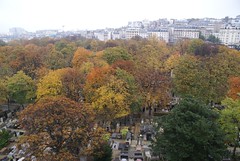
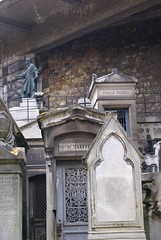
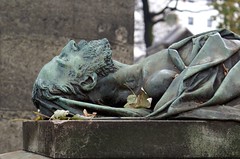
Filed Under: Artist in Residence, Lists, Trees Tagged With: Artist in Residence, Dogen Zenjii, Listmaking, Lists, Quotes, Residue, Useful Quotes

Day 10

April 19, 2007 by Nicholas Hedges

Finished priming the canvas and then painted a layer of Paynes Grey on top. Over this I’ll rub some white before working in the graphite powder. Into this I’ll then scratch the outlines of Loggan’s 1675 map which I will attempt to project on top.

I also did another walk following the same route and this time crossed out the words that were no longer appropriate (for example, objects that were no longer visible). As I did this, I decided to add new words that were appropriate to today.


The new list of words now reads:
voices
the sun
engine starts
Leffe
zebra crossing
waiting
boarded windows
remnants of posters
French market
a man on a bike
a dog being walked
all routes
missing letters
pencilled ‘e’
blue car
squeaking brakes
a woman carries a package
red lights
weeping willows
green mound
red man
cyclists wait
open window
Guinness Time
green man
20 zone
pull pull
discarded bottles
old confetti
cigarette butts
a man in sunglasses
crooked shadows
fire extinguishers
discarded blanket
weeds in pots
a man eats
the sun
a flag hangs
empty racks
doorbells
dirty water
orange jackets
taxi
lifebuoy in the river
cementing pavement
a broom
plastic bottle
two men in ties
pile of sand
gravel
weir
stone tower
scaffold
danger – high voltage
cygnet
sun sparkles
water sounds
lifebuoy
warning!
measuring post
submerged traffic cone
drowned bicycle
the stain of a splash
shopping trolley
birds twitter
a ladder
a barrier
a signpost
bright sun
hooded top
people talk
birds twitter
footsteps
CCTV
arrow
broken green glass
ornate gate
roar of bus
music
concrete
shadow
a man pulls up sleeve
a woman sits
tables and chairs
glass ashtray
trees
tinted windows
engine ticks over
bus shelter
green plastic bag
a woman eats a baguette
two yellow markers
green spire
amber light
the sound of a crossing
footsteps
blue plastic bag
graffiti
OX4
blue peeling door
two men talk
green door
satellite dish
sharp shadows
a drain
sound of keys
man opens green door
lamppost no.4 peers
old stone walls
lamppost no.6
a man talks on a phone
gutter
half-painted
weeds
three young women
locks for nothing
a suitcase pulled
a blue door
a blue door
a plastic bag on a saddle
a woman takes a photo
a man checks the films
a taxi
a sapling
black plastic bag
pigeons
checking tickets
a phone rings
fat stomach
bottle top

Filed Under: Artist in Residence, Lists, Trees Tagged With: Artist in Residence, Deckchairs, Listmaking, Lists, Paintings

Day 9

April 18, 2007 by Nicholas Hedges

I received the canvas today and so made a start on priming it.

I also walked my new route and made a list of objects, sounds etc. The full list is as follows:

voices
a siren burst
the sun
engine starts
Leffe
zebra crossing
fat stomach
boarded windows
remnants of posters
black cloak
yellow glasses
sweet smoke
quiet street
red bus
missing letters
pencilled ‘e’
water collected in cobbles
roar of a plane
red lights
cool breeze
weeping willows
a wedding
green mound
old woman
shopping trolley
red man
heart-shaped balloon
Guinness Time
green man
fingers point
pull pull
paper cup
old confetti
cigarette butts
a siren
the sun
a flag hangs
empty racks
wheelie bins
man on a phone
doorbells
dirty water
washing hangs
a broom
plastic bottle
weir
stone tower
scaffold
dead pigeon
sun sparkles
water sounds
lifebuoy
warning!
man with walking stick
drowned bicycle
the stain of a splash
the sound of a coat
scraping tools
a barrier
a signpost
bright sun
people talk
birds twitter
footsteps
CCTV
arrow
ornate gate
traffic cones
roar of bus
music
concrete
shadow
a woman sits
tables and chairs
an empty glass
sun on plastic wrapper
trees
tinted windows
engine ticks over
bus shelter
old people queue
two yellow markers
the sound of a crossing
footsteps
blue plastic bag
graffiti
blue peeling door
sound of a child
green door
carrying shopping
man leaves door
a lamppost peers
old stone walls
plastic bag tumbles
libya libya
lamppost no.6
gutter
half-painted
weeds
hazard lights
painting a window
locks for nothing
purple trousers
a suitcase pulled
footsteps in sand
a taxi
a sapling
arrivals
fruit-boxes
music
soiled blanket
a sink
a mop
checking phone
checking leaflet
bottle top

This evening I read and recorded all the words as an MP3 file. It reminded me to some extent of the extract I published in yesterday’s entry, concerning the reading of the ‘battalion roll-call’, where ‘name after name went unanswered; each silence, another man wounded, missing or dead.’ Tomorrow, armed with this list of words, I will walk the route again, and photograph as much of what is on this original list as possible. Obviously certain things won’t be there any more, certain words on the ‘roll call’ will go ‘unanswered’. The signified objects of other words however will still be in existence, but there will be less, and these missing words will, in a way, act as metaphors for the missing men who did not answer their names in the ‘hollow square.’
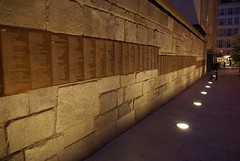
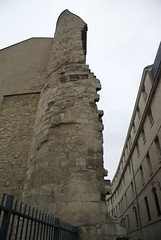
I took these words and made them into one paragraph:

voices a siren burst the sun engine starts Leffe zebra crossing fat stomach boarded windows remnants of posters black cloak yellow glasses sweet smoke quiet street red bus missing letters pencilled ‘e’ water collected in cobbles roar of a plane red lights cool breeze weeping willows a wedding green mound old woman shopping trolley red man heart-shaped balloon Guinness Time green man fingers point pull pull paper cup old confetti cigarette butts a siren the sun a flag hangs empty racks wheelie bins man on a phone doorbells dirty water washing hangs a broom plastic bottle weir stone tower scaffold dead pigeon sun sparkles water sounds lifebuoy warning! man with walking stick drowned bicycle the stain of a splash the sound of a coat scraping tools a barrier a signpost bright sun people talk birds twitter footsteps CCTV arrow ornate gate traffic cones roar of bus music concrete shadow a woman sits tables and chairs an empty glass sun on plastic wrapper trees tinted windows engine ticks over bus shelter old people queue two yellow markers the sound of a crossing footsteps blue plastic bag graffiti blue peeling door sound of a child green door carrying shopping man leaves door a lamppost peers old stone walls plastic bag tumbles libya libya lamppost no.6 gutter half-painted weeds hazard lights painting a window locks for nothing purple trousers a suitcase pulled footsteps in sand a taxi a sapling arrivals fruit-boxes music soiled blanket a sink a mop checking phone checking leaflet bottle top

And then to reconstruct the walk, I joined in the gaps with more words drawn from what I remember of the afternoon.

There are voices and then a siren burst cuts through the air, just like the sun. An engine starts and in the window of the pub I see a sign for Leffe beer. I make my way to the zebra crossing and cross the road. A man with a fat stomach walks towards me. Ahead, I see the boarded windows and on them the remnants of posters pasted on and pulled off. A woman in a black cloak wearing yellow glasses walks past me and in her wake I smell the scent of sweet smoke. The quiet street is not normally like this. A red bus pulls in and restores normality. Walking past the boarded up restaurant I see the missing letters of its name. Someone has drawn around them – a pencilled ‘e’ sticks out. To my left is a road with water collected in cobbles and above me I hear the roar of a plane. The red lights stop the traffic and the cool breeze moves the weeping willows in the distance. I see a wedding party move on down the road. To my left is the green mound past which and old woman pushes her shopping trolley. The red man tells me to wait and in the distance I see a heart-shaped balloon bobbing above those who have been to the wedding. A sign on another pub reads Guinness Time and now the red man becomes a green man and I walk over the road. Fingers point, two women look at something, I don’t know what it is. To my left, up some stairs are two doors. The words pull pull invite me up the steps. I carry on walking and pick up a paper cup. On the road are remnants of old confetti and cigarette butts. I hear a siren and the sun makes its presence felt. On top of the tower, a flag hangs – there is no wind. The empty racks wait for bikes and the wheelie bins wait for rubbish. A man on a phone stands ahead of me. I walk past him and see a panel of doorbells. The river is full of dirty water and in a garden, washing hangs and a broom is propped against the wall. In the dirty river a plastic bottle is collected with other muck and litter around the weir above which the stone tower stands, surrounded in part by a scaffold. A dead pigeon lies beneath the bridge and beside it the sun sparkles. The water sounds as it pours through the weir, a lifebuoy is stored on the pavement just in case. There’s a warning! sign. A man with walking stick stands on the bridge and looks down into the water. A drowned bicycle shimmers beneath the water and on the pavement the stain of a splash colours the faded tar. A young boy walks past and the sound of a coat, one made of waterproof material is the only one for a while. Then I hear scraping tools and through a doorway leading to a yard I see a man cleaning his tools. There’s a barrier to my right and up ahead a signpost pointing somewhere. A bright sun lights up the pavement and people talk – three of them. The birds twitter unseen and footsteps ricochet around me. A CCTV signs warns me I’m being watched and a white arrow on a blue background points in another direction. A beautiful, old ornate gate stands incongruously as the traffic cones warn me of the traffic. The roar of bus after bus does not drown the music coming from above me. To my right is the concrete hulk of a building which casts a great shadow over everything. Within it, a woman sits and on the opposite side of the road a number of tables and chairs on which remains an empty glass are positioned. Here the sun on plastic wrapper make a star as trees stand lining the road. Tinted windows forbid the sun and behind me an engine ticks over. There’s a bus shelter and old people queue for their journey home. In the pavement, like gravestones, two yellow markers stand. I hear the sound of a crossing and footsteps cross from one side to the other. Near the steps is a blue plastic bag and on the walls plenty of graffiti. A blue peeling door needs a lick of paint and the sound of a child comes behind me. Up ahead on the right is a green door. A woman carrying shopping walks towards me just as a man leaves door. I notice how a lamppost peers ahead of me, looking at the old stone walls past which a small plastic bag tumbles. Someone has written libya libya on a step. Ahead is lamppost no.6 and from a wall a piece of a gutter protrudes. Two bollards, ones half-painted block the traffic. The weeds grow wherever they can and hazard lights flash on a lorry. A man is painting a window and locks for nothing remain locked around the cycle stands. A boy walks towards me in purple trousers. Another man walks with a suitcase pulled behind him. There are footsteps in sand which is sprinkled on the pavements. There’s a taxi and in its cage, a sapling. The arrivals bag a cab and fruit-boxes are piled high. There’s music and in a small yard a soiled blanket. I walk past an open door and inside I see a sink and a mop. A woman is checking phone and an elderly couple are checking leaflet. There’s a bottle top on the pavement.

Filed Under: Artist in Residence, Lists, Trees Tagged With: Artist in Residence, Listmaking, Lists, Residue, Silence

Night and Day

March 29, 2007 by Nicholas Hedges

Reading through various documents regarding the period in Oxford after the Black Death, it’s clear there were many vacant buildings and plots around the city.

“In the later Middle Ages the town’s suburbs contracted, and within the walls there was structural decay and an abundance of vacant plots. Very little church building or restoration may be dated to the century following the Black Death. The gloomiest picture was that drawn by a jury in 1378 of a thirteen-acre site in the north-east corner of the town: the land, neither built-up nor enclosed, was a dump for filth and corpses, a resort of criminals and prostitutes…”

Although this does not refer to the area of Broken Hayes (but rather land now occupied by New College) it does paint a picture of what some parts of the town must have looked like.

By the 16th century the area (Broken Hayes) was surrounded by trees and for a few years from 1631 it served as a public bowling green. Throughout the 17th century it was used as a recreation area but one which Anthony Wood described in his journal as a ‘rude, broken and undigested place.” It might be an exaggeration to say so, but it would seem that the legacy of the Black Death lingered in this area centuries after the event.

It is the sense of emptiness in the years immediately proceeding the Black Death which interest me most at this point. Recently, I’ve been researching Memory, and have in this pursuit been reading Frances A. Yates’ book, ‘The Art of Memory,’ in which she discusses the use in Ancient Greece of Memory Places, buildings fixed in the mind which one could ‘walk through’ and by placement of certain objects in locations throughout that place recall whatever it was that was to be remembered – a speech for example. In a contemporary textbook ‘Ad Herennium‘ the anonymous author gives a description of what these Memory Places should be like:

“It is better to form one’s memory loci in a deserted and solitary place, for crowds of passing people tend to weaken the impression. Therefore the student intent on acquiring a sharp and well defined set of loci will choose one unfrequented building in which to memorise places…”

As with my linking impressions made on the soul’s block of wax (see Broken Hayes below) with the craters of Hill 62, here it’s easy to see the student’s mind as being the place itself. I can imagine the memory of a place (in this case Gloucester Green) as being sharper and more ‘accessible’ when that place is, as the Ad Herennium states, a ‘deserted and solitary’ one. One can imagine that deserted patch of ground, abandoned in the wake of the Black Death, as sharp with the memories of what had gone before. Today, this contrast between these two periods of [14th century] time might best be articulated in the contrast between night and day. In the day the area is full of people (particularly on market days) and at night, is empty, and some might say a place not so far removed from Anthony Wood’s ‘rude… and undigested place.’

Filed Under: Artist in Residence, Trees Tagged With: Uncategorized

Ieper (Ypres)

March 26, 2007 by Nicholas Hedges

The following text can be found on my website under Places. Click here for more on Ieper.

“I should like us to acquire the whole of the ruins of Ypres.. a more sacred place for the British race does not exist in the world.”

Winston Churchill’s quote regarding the fate of the ruined town provides an interesting backdrop to the whole subject of how to remember the past, particularly a past so bound up in the unimaginable violence of The Great War. How should we honour and remember the hundreds of thousands who fought and died in and around this area?

At 8.00pm every evening, The Last Post is played beneath the huge memorial that is the Menin Gate; massive yet dignified, somehow understated yet a great presence in the town. Crowds gather, tributes are laid, and the melancholic refrain coruscates around the gate’s vast interior. Perhaps the crowds and the cameras do correlate with what Siegfried Sassoon said about it being a ‘sight-seers centre’, but there was something particularly moving about the ceremony. Sassoon had seen as first hand the unimaginable horrors of what happened in the fields around Flanders, and just as I stated in my work with Auschwitz-Birkenau, we can never know what it was like to be there. No photographs, no poems, no letters written in the trenches can ever give us the full picture, but we can at least try, and personally, I found the ceremony gave me this chance.

Before we visited the gate, my girlfriend and I made our way to the two cemeteries within the town, The Ramparts Cemetery and the Ypres Reservoir Cemetery. I have seen countless photographs of places like this but nothing prepares you for what it’s like to be standing amidst two thousand immaculate graves, many without names. As I listened to the buglers play The Last Post, I closed my eyes and imagined how every night this same sound rang out from the gate, over the adjacent fields, searching out the bodies of the 54,896 men whose names are recorded on the gate’s walls. The tune is like a calling, a mother’s lament for a lost son. Every night it asks its question, and every night it is met with silence; the silence of the fields once deafened by death and violence.

Rebuilding or otherwise, preserving and restoring are all elements which feature in any tour around Ieper. The Sanctuary Wood museum (Hill 62) is to some controversial in that many believe the trenches preserved there are not actually genuine. Certainly there are aspects of the museum I didn’t particularly like. Personally I believe the trenches are genuine but are perhaps a little over-restored. With a party of school children running around them, there was the sense that this was little more than an adventure playground and not a place which one officer recalled in his dairy of 1917:

“Of the terrible and horrible scenes I have seen in the war, Sanctuary Wood is the worst… Sanctuary Wood in 1914 was a sanctuary, but today, Dante in his wildest imaginings never conceived a like.”

As I’ve said, we can never know what it was really like to be in that Hell on Earth, but I believe the residues of war, the shrapnel, the objects dug from out the ground, along with the craters and the blasted trees are testament enough to the horrors. If the trenches were left and allowed to be reclaimed (although not removed) by nature, I don’t think the impact would be lessened; quite the opposite – it would be enhanced.

Evidence supporting this claim can be found just a couple of miles away on Hill 60. Unlike Hill 62, this place has been left much as it was at the end of war and as such, it has an air of authenticity about it which one doesn’t quite get with the trenches of Hill 62 (I should state here that there is no doubt about the provenance of Sanctuary Wood itself, the craters, the shot trees and recovered objects). The craters of Hill 60, the undulating and wholly unnatural shape of the landscape, now grown over with grass are enough to inspire the imagination to thoughts of what happened there 90 years ago. It is perhaps this dramatic contrast between now and then which facilitates this: the grass, the trees, the birds; (the birds which inspired some of the most poignant words to come from out the trenches). That and the knowledge that many men from both sides still lay buried beneath the ground. I was also reminded as I walked over the grass, of the parks one might find back home – a place for people to relax, for children to play in – a place to forget all your worries. This contrast again served to remind me of the horror and futility of war.

Filed Under: Trees Tagged With: Silence

  • « Previous Page
  • 1
  • 2
  • 3
  • 4

© Nicholas Hedges 2024

  • Facebook
  • Instagram
  • Twitter
  • YouTube

Copyright © 2025 · Outreach Pro on Genesis Framework · WordPress · Log in