Nicholas Hedges

Art, Writing and Research

  • Amazon
  • Behance
  • Facebook
  • Instagram
  • Pinterest
  • YouTube
  • Art
    • Digital
    • Drawing
    • Grids
      • Correspondence
      • The Wall
      • The Tourist
    • Ink on paper
      • Shadow Calligraphy
    • Installation
      • Murder
      • Echo
    • Painting
    • Patterns
    • Mixed Media
    • Photographic installation
      • St. Giles Fair 1908
      • Cornmarket 1907
      • Headington Hill 1903
      • Queen Street 1897
    • Research/Sketches
    • Stitched Work
      • Missded 1
      • Missded 2
      • Missded 3
      • Missded 4
    • Text Work
  • Blogs
    • Family History
    • Goethean Observations
    • Grief
    • Light Slowed But Never Stilled
    • Lists
    • Present Empathy
    • Shadow Calligraphy
    • Trees
    • Time
    • Walking Meditations
  • Video
  • Photography
    • Pillars of Snow
    • Creatures
    • The Trees
    • Snow
    • St. Giles Fair 1908
    • Cornmarket 1907
    • Headington Hill 1903
    • Queen Street 1897
    • Travel
  • Illustration and Design
  • Music
  • Projects
    • Dissonance and Rhyme
    • Design for an Heirloom
    • Backdrops
    • Shadow Calligraphy
  • Exhibitions
    • A Line Drawn in Water
      • Artwork
    • A Line Drawn in Water (Blog)
    • Mine the Mountain 3
      • Artwork
    • Mine the Mountain 2
      • Artwork
      • The Wall
    • The Woods, Breathing
      • Artwork
    • Snow
      • Artwork
    • Echo
      • Artwork
    • Murder
      • Artwork
    • The Tourist
    • Dreamcatcher
    • Mine the Mountain
      • Artwork
      • The Tourist
    • M8
    • The Gate
    • Creatures
      • Artwork
    • Residue
      • Artwork
    • A visit to Auschwitz
      • Artwork
  • Me
    • Artist’s Statement

The elusive Samuel Stevens (1776 – ?)

February 27, 2014 by Nicholas Hedges

I’ve turned my attention to my 4 x great-grandfather Samuel Stevens who I know was born in Oxford in 1776. I know too that he married a woman called Mary and that they had a child called John (my 3 x great-grandfather) in 1811.

In the library this afternoon I tried to find details of other children they might have had and the date and location of their wedding; however I couldn’t find anything save for details of a daughter, Frances, born in St. Aldate’s Parish in 1809, two years before John. However that was it, which led me to suspect that either one or both had died after John’s birth, or that they had moved away – which seemed the more likely.

Given that John lived in Reading for much of his life, it seemed plausible that it was actually his parents who moved some time after his birth in 1811. Searching through the records online, I eventually found a Samuel Stevens who married a Mary Pecover in St. Lawrence Parish, Reading on May 14th 1807. This I’m sure must be my ancestor; not only does the place fit – along with the name of his wife – but the date of the wedding – two years before the birth of Frances – also fits the wider picture. It seems therefore that having married Mary in Reading, they moved to Oxford but left shortly after to return to Reading.
Filed Under: Family History Tagged With: Family History, Family Stevens, Samuel Stevens, Stevens

The (Georgian) Stevens Family

February 26, 2014 by Nicholas Hedges

Having done a bit more research in the library this afternoon, I believe I have discovered the dates of birth and death of Lydia Stevens’ husband John.

I know he died before Lydia (1822) and that he was alive in 1777 when his son William was born. Looking through the parish registers for St. Martin’s (the parish in which Lydia lived at the time of her death) I discovered a John Stevens who died in 1803 at the age of 66. This would put his birth year at 1737: Lydia, his widow, was born in 1734/5 which leads me to think that this is indeed my John.

I then looked at their children and found the following, all baptised in the same parish:

  • Lydia Stevens
 (Jan 18 1765)
  • John Stevens
 (Dec 26 1765)
  • Samuel Stevens
 (Jan 29 1767)
  • James Stevens
 (Oct 23 1768) 
  • Frances Stevens
 (May 15 1770)
  • Mary Stevens
 (Sep 28 1771) 
  • John Stevens
 (Aug 20 1773)
  • John Stevens
 (Dec 1 1774) 
  • Samuel Stevens
 (Apr 4 1776) 
  • William Stevens
 (Dec 31 1777) 

Given that there are 3 Johns and 2 Samuels, one can assume that the first John died some time before 1773 and that the second John died before 1774. Clearly the name John was important which leads me to believe that John’s father might have been called John as well.

The first Samuel must have died some time before 1776 when my direct ancestor was born.

Looking again at the wedding of John and Lydia, I found that the witnesses were Sam Borton and Mary Stevens. I’ve no idea of course what their relationship was to the couple; Sam could have been Lydia’s father or brother, but clearly the name Samuel or Sam was important and seems to have come from that side of the family. Mary Stevens might have been John’s mother or sister. The couple’s third daughter was named Mary so I’m no clearer on whether this was John’s mother’s name or not.

Filed Under: Family History Tagged With: Family History, Family Stevens, John Stevens, Lydia Stevens, Stevens

Lydia Stevens (1734-1822)

February 26, 2014 by Nicholas Hedges

Almost five years ago, I published a blog entry about my 3 x great-grandfather John Stevens (1811-1876):

Researching John Stevens in the library today, I found what I’m sure must be his parents. Having looked at the Index of Baptisms for the time around his birth (1811) I found only one person matching his dates. John Stevens was born on 7th October 1811 in St. Aldate’s parish. His parents are given as Samuel and Mary Stevens, and looking at John Stevens’ children, I found that his second born son is named Samuel (his first son is called John). I decided to see if I could locate a Samuel Stevens in the Parish Registers. I couldn’t be sure that he was born in the city but it seemed quite likely. Sure enough I found a Samuel Stevens born on the 4th April 1776, baptised in St. Martin’s (now demolished). His parents were given as John and Lydia Stevens and so I looked for a record of their marriage in the city. Again my luck was in and I found that they were married on March 24th 1764 in St. Mary Magdalen. Lydia’s maiden name was Borton and the witnesses at the wedding were Sam Borton and Mary Stevens. John is described as being from St. Martin’s which is where Samuel was baptised.

At the same time I also wrote the following:

A year or so ago, I started work on a piece of work based around John Gwynn’s survey of 1772. The piece was called (as a working title) ‘6 Yards 0 Feet 6 inches’ based on the measurement of John Malchair‘s home in Broad Street. Having discovered an ancestor – John Stevens – born in the city in 1811, I wondered if there was any chance that one of the Mr Stevens’ listed on the survey was an ancestor of mine? It seemed a long shot but after today’s research I’m rather more optimistic. 

If I did have an ancestor in Oxford at the time of the survey and if my research is correct, then that ancestor would be John Steven, the grandfather of the one previously mentioned. I’ve no idea when he was born but I do know that he was married in 1764 and is described as coming from St. Martin’s Parish, where his son Samuel, John Jr’s father was baptised in 1776. One could assume therefore that I did indeed have ancestors living in the parish of St. Martin’s at the time of the survey. 

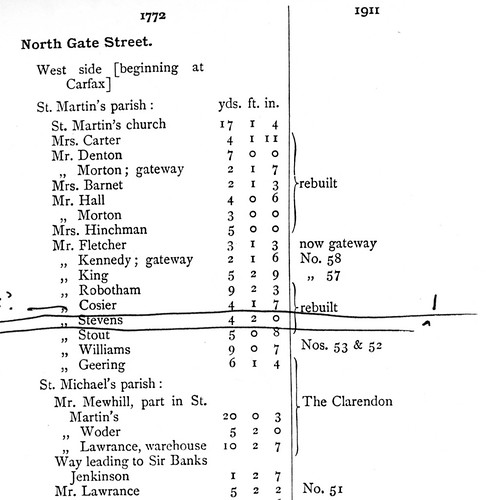
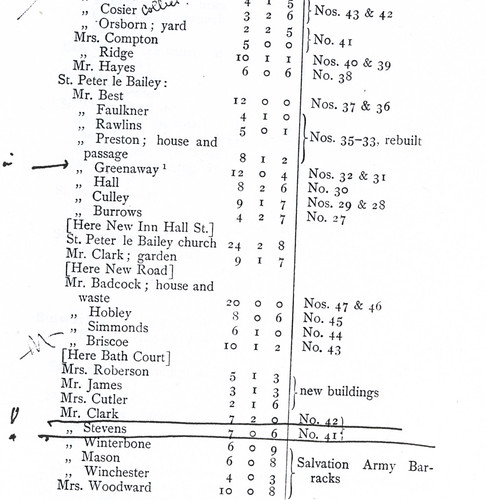
The images below are taken from the survey and show two Stevens one of which might well be my ancestor.

Gwynn fails to include (at least on the copy I have) first names from the survey but within the parish of St Martin’s two Mr Stevens are recorded along with a Mrs Stevens. One can assume however, that those most likely to be mine are the two Mr Stevens mentioned as living in the parish, one in Butcherrow (now Queen Street), the other in North Gate Street (now Cornmarket). The residence in Butcherrow is 7 yards 0 feet and 6 inches. That in North Gate Street is 4 yards 2 feet 0 inches.

John Gwynn's Survey 1772

John Gwynn's Survey 1772

Of course more work is required to see if one of these is indeed my ancestor, but I must admit to being very inspired by the prospect.

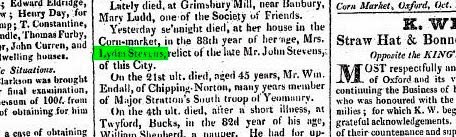
Yesterday, I was looking through Jackson’s Oxford Journal online and decided to search for a number of my ancestors. I’d already done as much with the Hedges side of the family (discovering in the process that they were often in trouble – see ‘The Victorians‘) and decided to check on my maternal side. I searched for Lydia Stevens (my 5 x great-grandmother) and discovered the following from an edition of the newspaper printed on November 2nd 1822:

‘Yesterday se’nnight [a week] died, at her house in the Corn-market, in the 88th year of her age, Mrs. Lydia Stevens, relict [widow] of the late Mr. John. Stevens, of this city.’

Not only did this notice give me her dates of birth and death (1734 – Friday, 25th October 1822), it also seemed to indicate that the Mr. Stevens recorded in John Gwynn’s survey on 1772 was my 5 x great-grandfather. Of course there is a 50 year gap between the date of the survey and the date of Lydia’s death, but it seems quite probable nonetheless.

Filed Under: Family History Tagged With: Cornmarket, Family History, Family Stevens, History, John Stevens, Lydia Stevens, Stevens

Beneath the floor

May 5, 2013 by Nicholas Hedges

I’ve always found it amazing, when, on a programme like Time Team, an apparently empty field is shown to have once been the site of some vast Roman villa; how something so grand and seemingly permanent can one day be lost to both memory and the landscape; a memento mori of inscribed lines on quite an epic scale. The recent discovery of the tomb of Richard III is perhaps the most vivid illustration of this; how the grave of so eminent a man could be buried (albeit hastily) in the choir of a friary, only for all trace (of both the grave and the friary) to be lost beneath the tarmac of a nondescript car park. In Urne Burial (1658), Sir Thomas Browne wrote:

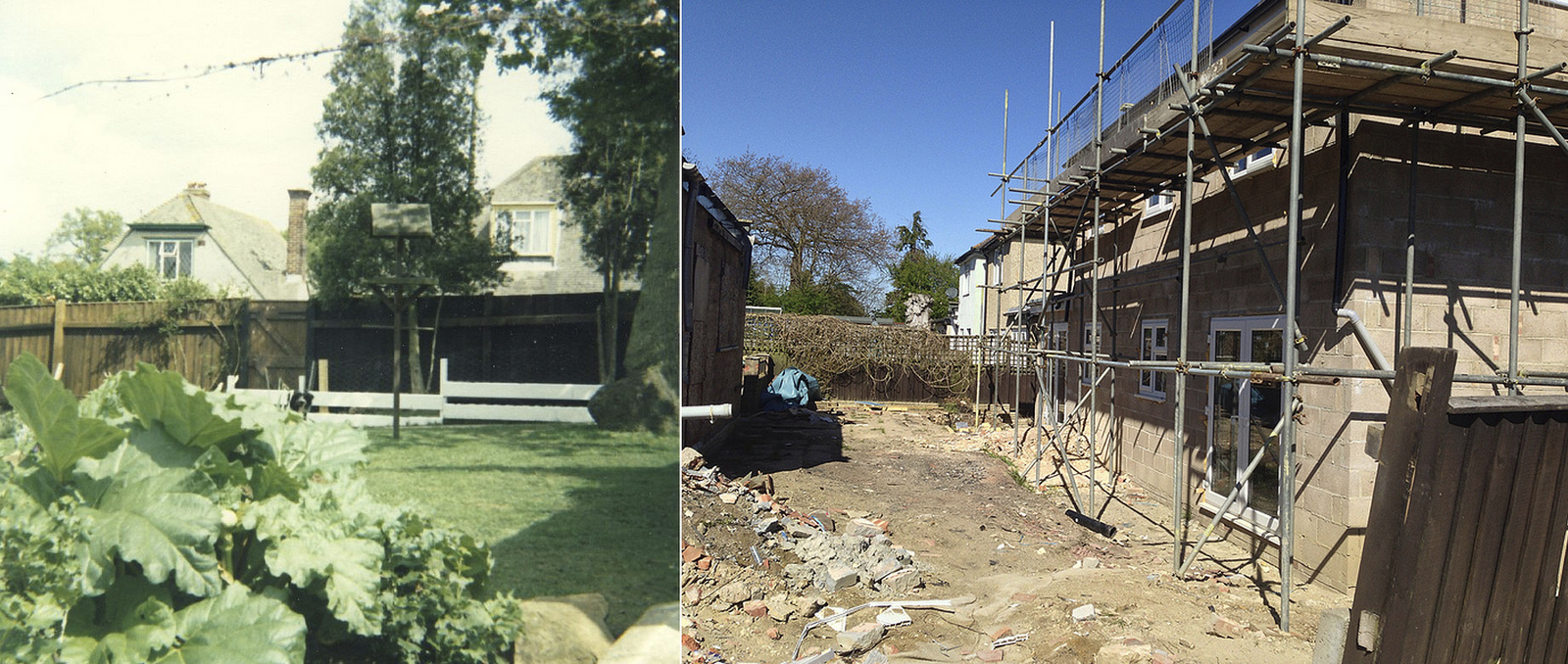
“There is no antidote against the Opium of time, which temporally considereth all things; Our Fathers finde their graves in our short memories, and sadly tell us how we may be buried in our Survivors. Grave-stones tell truth scarce fourty years; Generations passe while some trees stand, and old Families last not three Oaks.” In the garden of the house in which I grew up, there was an oak tree – now lost; a victim of the relentless drive to build flats and houses on every scrap of space ‘available’.

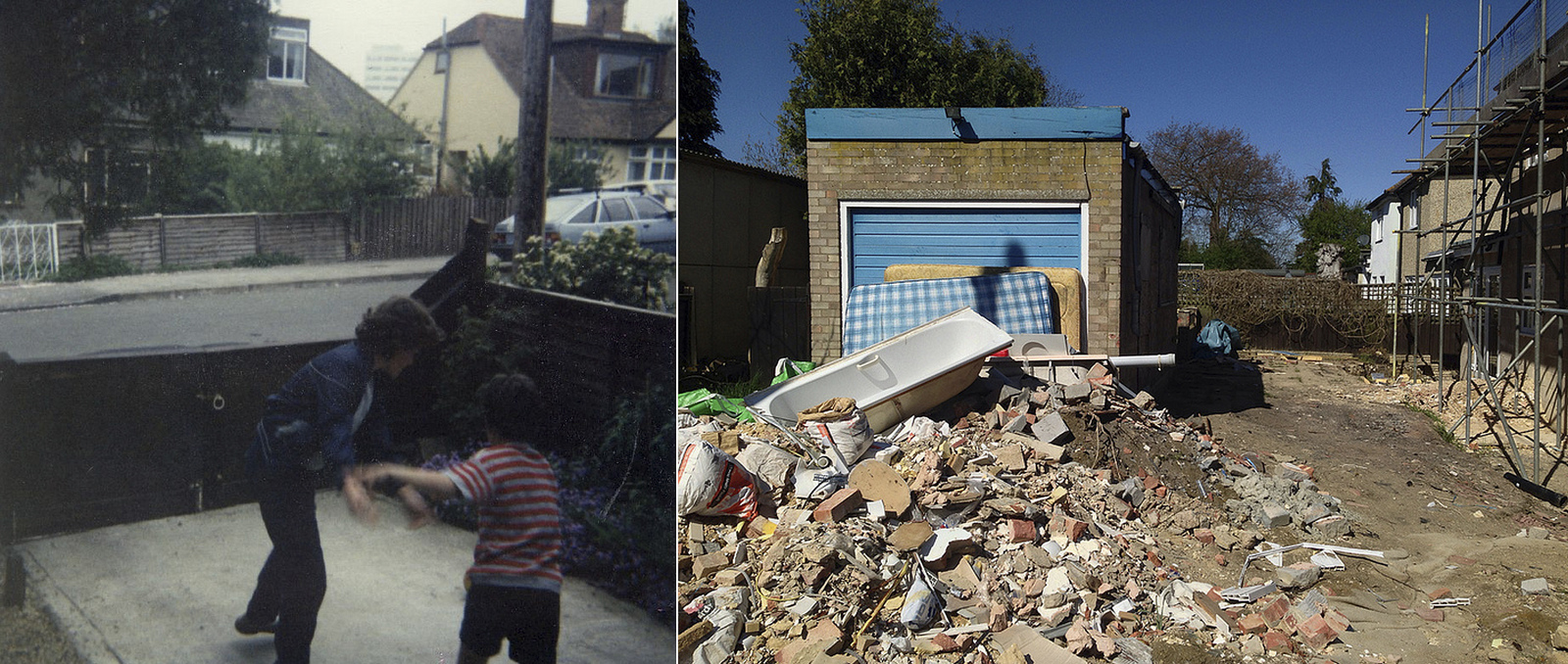
In the shade of that tree (visible above on the right hand side) and the lawn beyond its reach, I spent many childhood days, playing football, high-jumping (badly), playing at being ‘The Professionals’ and, on one occasion, holding a sale to raise money for charity. But in the last year, a few years since my dad sold up and left, half the house has been pulled down (including most of my bedroom) and a new one built alongside, covering most of the garden.

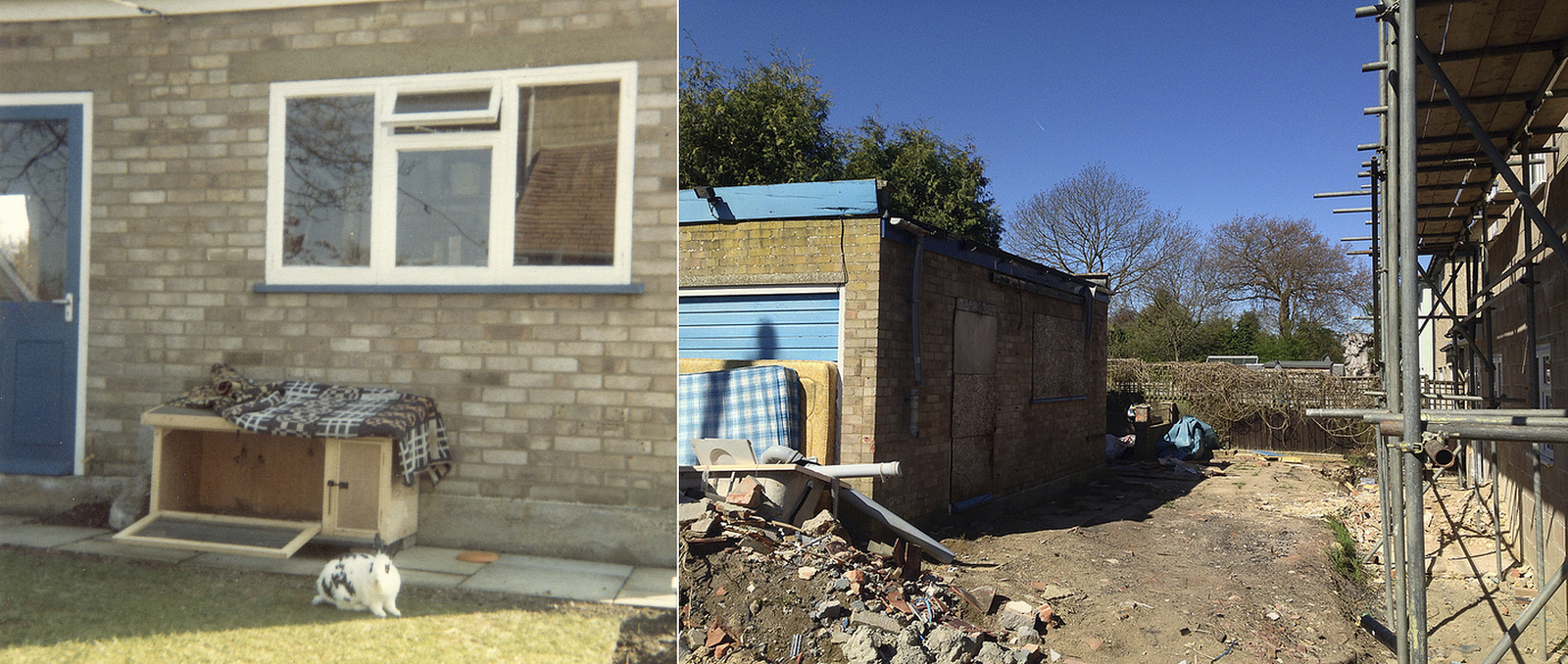
The lawn on which we had picnics, over which the rabbit – Patch – thundered, chasing Sammy the cat – and the beds beneath which those same animals, amongst many others, were interred, is now itself buried beneath new concrete floors and builder’s rubble.

It’s strange to think of someone standing in a kitchen, or sitting in a living room, on the exact same space where we once played.

And that’s what made me think of those Roman villas lost to the past beneath the ground; all those memories attached to those buildings which have soaked away like water, into the ground over the course of two millennia.

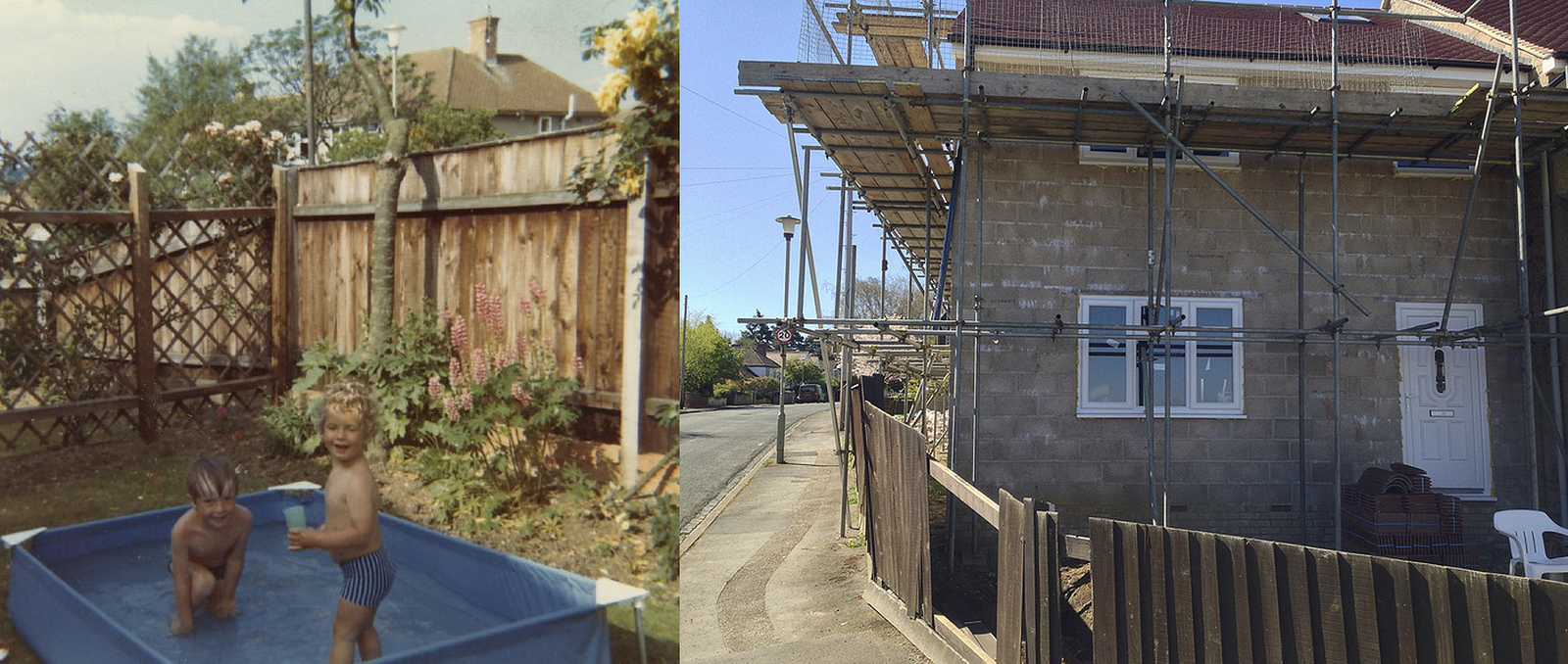
The garage is now a particularly mournful sight. Here, I spent many hours (often with enormous hair as evidenced by the photograph) on the drive, playing football with my brother and friends – or sometimes by myself (I can still hear the sound of the plastic ball skitting across the concrete and the bash of the blue metal door which was sometimes the goal). The sounds too at night of my dad arriving home in the car, the radio blaring as the wooden gates were opened; the whoosh of the garage door being lifted, are memories more permanent than the concrete drive itself. Now the garage is a sorry looking creature, whose full demise is certain, along with the shed tucked away behind (in which we sometimes slept on warm summer nights).

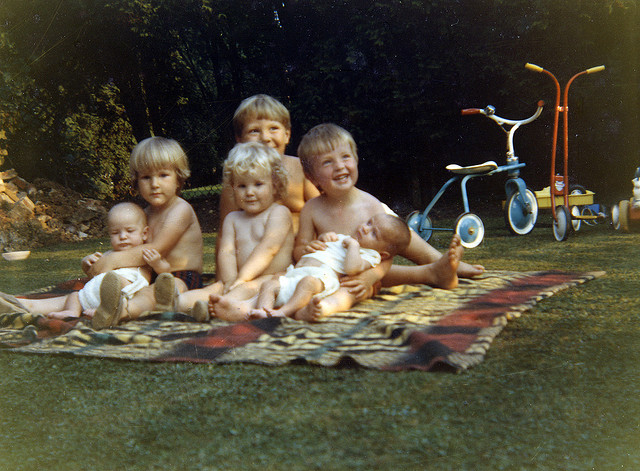
The photo below of me and my cousins (on my dad’s side) was taken when I was a baby in the summer of 1971.

The patch of grass on which we’re sitting would soon become the garage….

Filed Under: Family History, Trees Tagged With: Childhood, Coniston Avenue, Family History, Memory, Place

Light and Sound

December 22, 2010 by Nicholas Hedges

Whilst updating the Family Tree section of my website, I listened again to part of an interview I recorded with my Nana in December 2007. She died just under a year later and the three hours I spent with her that afternoon, talking about her life have come to be amongst the most important I can remember. And whilst the content of our conversations were often moving, listening to it now, two years after her death, I began to think about how the act of listening to her, now that she is no longer with us affected me, comparing it to how I feel, when looking at photographs of those who have died. Does the difference between the two media, between light and sound, change the way we respond to the past? And if so, how?

Filed Under: Family History Tagged With: Family History, Family Jones, Interview, Jones, Nana

Thoughts about my Nan

September 27, 2010 by Nicholas Hedges

As I stood in the church hall following the service of thanksgiving for my Nan who died on September 16th at the age of 98, I looked towards the stage at the back of the hall, through the door on the left hand side and into the short corridor behind. At that moment, in a split second, a number of memories crashed down around me, as if the way I was standing – the shape of my body – had unlocked the door behind which they’d been piled. The Christmas Bazaar, when I was a child was one of them, in particular the lucky dip box filled with sawdust and prizes. That was the first. It had stood there, just before the stage near the steps. I can still smell the sawdust; I can feel it on my hands as I search, in my mind, for a prize. Father Christmas had always made an appearance and would hand out gifts in his grotto. It was, in many ways when Christmas began, even though it was always held in the last week of November. It was at the Christmas Bazaar that I bought Nan a hideous ornament – china flowers in a china pot; gaudy coloured and chipped.

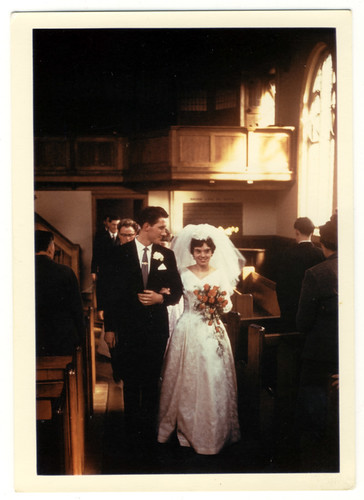
When I heard my Nan had died (I was on holiday in Spain at the time) my mind, for some reason, took me into the room which once ran the width of the church behind the large cross at the front. It was once an open gallery (you can see it in a photo of my aunt and uncle’s wedding), but had long since been blocked off from the church. Back then, when I was a child, it was always full of junk. It was where Father Christmas has his Grotto, and whatever the time of year, there was something of Grotto about it, with or without the old man in the red suit.

Back in the hall on the day of my Nan’s funeral, I could see the stage in my mind’s eye complete with the box at the front, one which ran the length of the stage, which when it was opened revealed a long line of lightbulbs. When I was a child, most of the bulbs were missing. You could see the sockets and the wires, but they hadn’t been used for years. There was a lighting box on the left hand side – just before the door through which I was looking – in which the old switches and levers had become grown over with time. In the single wooden panel, dividing it from the stage, was a hole through which you could see what was going on. My cousin and I had operated a tape player in there, some time in the mid 1980s for the performance of a pantomime whose name for the moment escapes me.

Inevitably, as I write, my thoughts are going to wander, as one memory leads to another, but back on the day of my Nan’s funeral, I thought about what I’d just remembered; the lucky dip, the Christmas Bazaar and the lightbulbs underneath the box. These were not isolated memories, they didn’t come to me like pictures in a gallery, one after the other. Instead they were physical and part of a web of memories, the threads of which seemed to vibrate with all that I had felt and experienced before. For a moment, when I moved, I could almost feel them again, I could hear the hubbub of the bazaar, see the stalls piled with jumble and the Christmas decorations hanging above. I was in the company of people who’d long since gone.

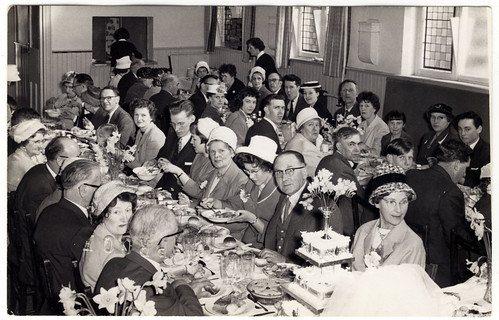
The photo below is of my Aunt and Uncle’s wedding reception, which took place in the hall. Very little has changed, apart from all the people.

Back to the day my Nan died – it’s interesting that my first thought was of the room immediately behind the church, but hardly surprising when you consider, that along with my Grandad, she’d lived in a house just opposite the hall. The house and the church were linked by Sundays, on which day we would cross the road to the house to select our sweets from the sweet-tin. Bon-bons, lemon sherbets, candied peanuts, mint imperials… we could choose 5, 6 or 7; the number changed from week to week. I can see the tin now – a round biscuit tin, I can hear the sweets rattle as the lid is prised off.

 Whenever we slept at Nan’s, my brother and I would find paper bags beneath our pillows in the morning, with a few sweets inside. Before bed, we’d have Ritz biscuits and grated cheese whilst watching TV. The television was one that had to warm up before the picture was fully revealed. I’m always reminded of Boxing Day when I think of the front room. That and the Two Ronnies – and in particular the Phantom Raspberry Blower. Seaside Summer Special too. I can feel the texture of the chairs and the sofa. It’s the afternoon on Boxing Day as I think of it now, and while some have gone to the football, everyone else stays in the warm, getting things ready for tea; cold meats, pickles etc.

I remember once, when I was 5 or 6, when my brother and I slept over at my Nan’s. It was in the summer, late at night. The night was warm and a storm was brewing. We couldn’t sleep and at about 11 or 12 o’clock, my Nan came upstairs and asked if we wanted to run around in the garden. Of course we did, and so out we went, into the garden with Nan as the storm approached. It was a simple thing, but in many ways a magical one. Back then, as can be seen from the photograph above, there was a large apple tree in the garden which I remember vividly that night. It’s gone now. A house has been built on top.

In the 1980s, the church was remodelled, with the space between the church and the church hall – which until then had been open to the elements – covered over. Many of the rooms were also remodelled. It was necessary, and no doubt it made the church more comfortable, but of course something was inevitably lost as a result, just as it was when the church itself was changed several years before. The corridor down which I’d looked from the front of the church hall, had once been part of a single room in which we had our Sunday school classes. I remember the tiny chairs and the out-of-tune piano in the corner. Leaving this room, you’d find yourself outside. A door straight ahead led to the toilet (always cold and full of spiders) and one to the left into the gallery room – or Santa’s Grotto. To the left, after the door to the Gallery Room and the just before the loo, a flight of metal steps led down to the church. A green gate blocked the way to the street, while the steps themselves were hazardous by today’s standards, especially in winter. I can still hear the sound they made as you walked down. At the bottom, you turned left and in front of you was another room (The Fellowship Room) and another toilet opposite (even colder and with even more spiders). In my mind it’s always damp here. I can always see puddles outside, and in the Fellowship Room there is the smell of old clothes; costumes which were always kept in a walk-in cupboard (blankets for Shepherds in the Nativity).

Filed Under: Family History Tagged With: Death, Family History, Memory, Nan

Emma Stevens (1835-1873)

August 27, 2010 by Nicholas Hedges

Following on from my last blog entry, I ordered a copy of Emma Stevens’ death certificate to ascertain how she died and whether she was indeed the Emma Stevens (nee Fisher) to who I am, albeit indirectly, related. Sure enough, the death certificate showed that she was married at the time of her death to John Stevens, a tailor, who at the time was incarcerated in Moulsford Asylum, where he remained until his death in 1888. Emma’s age at death is given as 38, meaning she was actually born in 1835.

When her husband John was incarcerated in 1871, Emma and her two youngest children went to the Reading Union Workhouse. With no income coming from her husband it seems she had little choice. Two years later, on 12th August 1873, in what must have been extremely grim conditions, Emma died of cancer in the workhouse. The story of John Stevens’ epilepsy was sad enough, but through the lives of his wife and his children, we can see just how it affected the rest of the family.

The two young girls who went with their mother into the workhouse later married. Martha Stevens, who was 2 when she went in, married George Amor in 1888 and had 6 children. Her sister, Kate, who was 4 at the time she entered the workhouse, married Charles Plested in 1892. Together they had two children. Kate died in 1943 at the age of 73. Martha died 7 years later in 1950 at the age of 81.

Filed Under: Family History Tagged With: Emma Stevens, Family History, John Stevens, Moulsford Asylum, Stephen Hedges

Cornelius Squelch

August 20, 2010 by Nicholas Hedges

I’ve recently returned to my family tree and have been following up the story of my four-times-great-uncle John Stevens (1837-1888) who died in the Moulsford Asylum having suffered for many years with epilepsy. He had married Emma Fisher in 1857 and was incarcerated in the asylum in 1871. In the census for 1881, two of John and Emma’s sons (Henry and John) are listed as living with their uncle, Samuel Stevens – a tailor, whilst a daughter, Mary, is listed as living with her aunt, Rosetta Hunt. The couple’s youngest children, Martha and Kate are recorded, sadly, as being inmates at the Reading and Wokingham District school, which was in effect a workhouse.

I’ve wondered why the children had been left to such a fate? Was their mother unable to look after them? Or perhaps their relatives? Whilst looking for an answer, I discovered an Emma Stevens who died in Reading in 1873, and am assuming that this is Emma Fisher. I’ve ordered a copy of her death certificate to see, but if it is, then it marks another tragic episode in this family’s life, coming just two years after the incarceration of John in 1871.

If Emma Stevens died in 1873, aged just 36, then her two young daughters would have been just 4 and 2 respectively. Could they have entered the school/workhouse at that age? And what happened to them afterwards? Why could none of their aunts or uncles take them in? After all, there were 7 altogether. Given the conditions at the school/workhouse , it is quite hard to understand how they could have ended up there. More research is needed of course but I hope their stories are, eventually, happier ones.

As an aside, whilst looking at the list of inmates for the school/workhouse in 1881, one name stuck out above all others.The boy in question was there with his sister Emily. She was just 12 years old and he was 4 years younger. His name, like something from a children’s book was Cornelius Squelch. He has a story to tell, and I’d like to be the one to write it.

Filed Under: Family History Tagged With: Cornelius Squech, Emma Stevens, Family History, John Stevens

Waving Goodbye

May 11, 2010 by Nicholas Hedges

When I interviewed my Nana, a year before she died, she told me a story about her father who she remembered walking over what she called the mountain on his way to work. She said:

“I can see him now because he went up our garden over the road and the mountain started from there up… and he’d go so far up and he’d turn back and wave to us…”

That image of my great grandfather has stayed with me ever since, an image which seem to crystallise when I followed in his footsteps, walking from the back of my Nana’s old house in Hafodyrynys and up the slope of the ‘mountain’ as she used to call it.

Hafodyrynys and Surrounds

It was whilst reading The Duino Elegies by Rainer Maria Rilke, that I came upon the following passage:

“Who has twisted us this way round,
so no matter what we do we are always
in the position of one leaving? Just as,
on the last possible hill from which he can
glimpse his whole valley one final time,
he turns, stops there, he lingers –
so we live on, forever bidding goodbye.”

The image of my great grandfather, that which my Nana left me with, is almost exactly what Rilke has described in his poem. It isn’t just the image of him waving goodbye to his children, it’s also that of him saying goodbye to the world.

In his book, ‘The Past is a Foreign Country,’ David Lowenthal writes:

“‘Recognition does not always give us back the warmth of the past,’ writes Simone de Beauvoir; ‘we lived it in the present;… and all that is left is a skeleton.’ A long-ago scene recalled is ‘like a butterfly pinned in a glass case: the characters no longer move in any direction. Their relationships are numbed, paralysed.’ Her decaying ‘past is not a peaceful landscape lying there behind me, a country in which I can stroll wherever I please, and which will gradually show me all its secret hills and dales. As I was moving forward , so it was crumbling.’ Time’s erosion grievously afflicts what memories remain: ‘Most of the wreckage that can still be seen is colourless, distorted, frozen; its meaning escapes me.”

Filed Under: Family History Tagged With: David Lowenthal, Family History, Family Jones, Hafodyrynys, Jones, Nana, Rilke

Postcard From Corfe Castle – 1978

May 7, 2010 by Nicholas Hedges

The Past is Time without a ticking clock. A place whose paths and roads are measured in years. The Present is where the clock ticks but always only for a second; where, upon those same paths and roads we continue, for that second, with our existence.

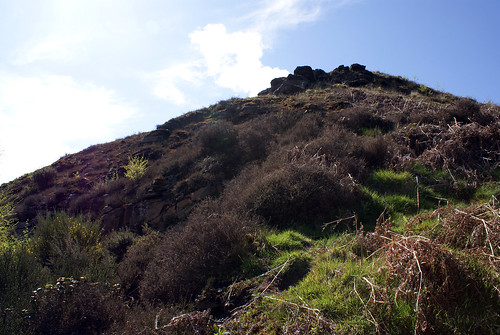
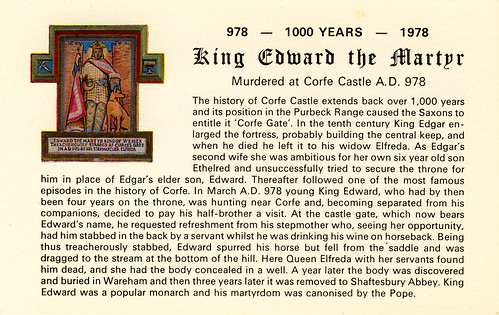
My first encounter with history, as far as I can recall, came when I was 7 years old. During a family holiday in Dorset, we visited Corfe Castle, a picture-postcard ruin which towers over the small village of Corfe below. I have two particular memories of that visit. The first is of a postcard which, in my mind’s eye I can still recall quite vividly and which I’ve since found for sale on the web (and purchased).

Corfe Castle 1978

Most of its design comprises text commemorating the assassination of Edward the Martyr (reigned 975-978) a millennium before. There are two dates at the top (978-1978) and I can remember clearly looking at the year 978 and trying to conceive of a date which didn’t begin with a ‘1’.

The very idea of a 1000 years ago fuelled my imagination; the very fact the place in which I was standing witnessed such an event a 1000 years before I was even born set in motion a chain of thought which has remained to this day. Even though I was only 7, I remember considering my own non-existence, albeit in ways a 7 year old might imagine such a thing. Three years before in 1975, my great-grandmother (born in 1878) became the first person I knew to die. It was shortly after her death, that the very idea of death began to trouble me and in some ways I think the thought of a 1000 years ago presented itself to me as death in reverse. Again, this way of thinking about the past has remained with me ever since, which might go some way to explaining why I tend to visit places synonymous with trauma and death.

It was in the small museum in Corfe Village that I remember staring at a cannonball fired during the English Civil War. I can recall trying to see it as it was hundreds of years before I was born. This wasn’t just an object sitting on display; it had once been handled by people, it had flown through the air and had played a part in the castle’s destruction. I wasn’t just looking at the cannonball, I was trying to imagine its flight.

 So in this postcard and the castle at Corfe my passion for history began, and this short text is the opening paragraph of a very long story which I’ve been reading ever since.

Filed Under: Family History Tagged With: Corfe Castle, Family History, Mine the Mountain 3

The Victorians

March 19, 2010 by Nicholas Hedges

Today I discovered, much to my delight, that The British Library has on its website a database of 19th century newspapers including 100 years of Jackson’s Oxford Journal. From 1800-1900, every issue is available and fully searchable. It goes without saying how incredibly useful this is and no sooner had I logged on than I began to search for information about my ancestors, in particular those whose activities I have described in previous blogs.

Perhaps the most notorious of my ancestors is Elijah Noon, who murdered his wife Charlotte with a sword in Oxford in 1852. I dealt with this crime at length in an installation which I put on in the cemetery where Charlotte was buried (see www.nicholashedges.co.uk/murder for more information) but soon discovered, thanks to The British Library, a whole lot more that I would never have otherwise found.

The website also allows users to download articles or pages as PDFs. Those about the murder are available here:

Murder of a Wife by her Husband (8th May 1852) 
The Recent Murder in Oxford (17th July 1852)

I’ve read these stories before, but in another article, I discovered that a nephew of Elijah’s had recently been killed in a railway railway accident at Bicester, not so far from Oxford. Elijah’s older brother, Thomas Noon,  was a builder in Oxford and a man who it seems was very much respected. Having searched for news of an accident some time around 1852, I discovered that Thomas Noon’s son, also called Thomas, who was a Corporal in the 7th Company of Royal Sappers and Miners, had been killed in a railway accident on 6th September 1851. He was buried in the same cemetery (St. Sepulchre’s in Jericho) in which his aunt would be interred less than a year later, his funeral attended by ‘an immense concourse of persons.’

Frightful Railway Accident and Loss of Life at Bicester (13th September 1851)
Notice of the Funeral of Corporal Noon (13th September 1851)

Elijah Noon served just two years in prison for the murder (or ‘manslaughter’) of his wife. In 1880 and 1882, he is listed as a prize-winning ‘bird-fancier’.

One article I was shocked to read concerned a fight which took place in Summertown on 29th December 1869. The article reads:

“Elijah Noon and George Hedges were fined, the former 7s. 9d. and the latter 10s. 6d. for being drunk and riotous at Summertown on 29th Dec. last. P.C. Culverwell substantiated the accusation and stated that the defendants were stripped to fight, when he stopped the disturbance going on.”

Petty Sessions (19th February 1870)

The Elijah Noon in this story is the son of my great-great-great-grandfather, Elijah Noon Sr. who of course we know murdered his wife. George Hedges is my great-great-grandfather who married Elijah’s sister, Amelia in 1869, not long before the fight took place. What it was all about, of course I cannot say, but it seems that both George Hedges and Elijah Noon Jr. were often in trouble.

Elijah Jr. had something of a drink problem. In September 1883, William Francis Piggott of Summertown applied for the renewal of his licence, which it seemed had been revoked on account of Elijah’s drunkeness.

Licence Renewal (8th September 1883)

Elijah of course had had a traumatic childhood having witnessed the murder of his mother at the hands of his own father. It seems his was an unhappy life, one which ended tragically when he choked to death in The Grapes, George Street in 1885 (click here to read more).

What George’s excuse was I don’t know, but he was, as I’ve said, often in trouble. In 1861, at the age of 15, he was already in attendance at the Petty Sessions in County Hall. In 1867 he was sentenced to 21 days hard labour for stealing wood and in 1888, fined for a disturbance, again in Summertown.

George had a brother called Edwin. Their father, my great-great-great-grandfather, was called Richard, and in 1858, a Richard and Edwin Hedges were convicted of an assault on a certain John Harris. Whether this Richard and Edwin are my ancestors is debatable, but it would seem to concur with George’s general behaviour, and indeed that of the family. One story, which certainly involves George and indeed, it seems, the whole family, took place in Summertown in 1899. It’s described under the rather inappropriate heading of ‘Family Squabble’ and involves William Bowerman, who married Elizabeth Hedges – George and Amelia’s daughter – in 1894.

Bowerman and Elizabeth had been drinking in the Cherwell Tavern, Sunnymede when ‘there was a quarrel’. Elizabeth went to her parents’ house where she was followed by her husband. He knocked on the door, Amelia answered and Bowerman, so it was alleged, punched her in the face. Her son Harry and her husband George went out to ‘remonstrate.’ Bowerman hit them both and Harry hit him back. The scan of the report is a little ‘wonky’ but it can be read here.

Interestingly, I have a photograph of my ancestors taken in 1899 – one assumes before the brawl.

Christening 1899

I have (tentatively in some cases) identified them as follows:

(Top, left to right) Harry Hedges, Ernest Edges (my great-grandfather), Lily Bowerman (?), William Bowerman (?), George Hedges (my great-great-grandfather), Alfred Hedges
(Middle, left to right) Flo (Alfred’s wife) (?), Amelia Hedges (my great-great-grandmother), John Lafford (my great-great-grandfather), Alice Hedges, (?), Percy Hedges
(Bottom, left to right) Richard Hedges, Margaret Hemmings (nee Hedges), Margaret V Hemmings (on knee), Alice M Hemmings (on feet), Ellen Hedges (nee Lafford) (my great-grandmother), Winifred May Hedges (on lap), Eliza Hedges (nee Villebois), Jack Hedges (on knee), Olive Hedges (at feet), Elizabeth Bowerman (nee Hedges), Eliza M Bowerman (on knee), Ernest G Bowerman (at feet).

Filed Under: Family History Tagged With: Family Hedges, Family History, Hedges, Murder, Newspaper Cutting, Victorians

Chance as a Draughtsman

September 15, 2009 by Nicholas Hedges

I have recently been reading Richard Dawkins’ fantastic book ‘The Blind Watchmaker’ and was struck by the following passage as regards the work I’ve been doing over the past few years:

“We have seen that living things are too improbable and too beautifully ‘designed’ to have come into existence by chance. How, then, did they come into existence? The answer, Darwin’s answer, is by gradual, step by-step transformations from simple beginnings, from primordial entities sufficiently simple to have come into existence by chance. Each successive change in the gradual evolutionary process was simple enough, relative to its predecessor, to have arisen by chance. But the whole sequence of cumulative steps constitutes anything but a chance process, when you consider the complexity of the final end-product relative to the original starting point. The cumulative process is directed by nonrandom survival. The purpose of this chapter is to demonstrate the power of this cumulative selection as a fundamentally nonrandom process.”

The first sentence in this passage struck a chord with me as regards thoughts I’ve had on the sheer unlikelihood of my ever being born – my entire existence. When one considers that in order for us as the individuals we are to be born as we were, everything every one of our ancestors did had to be done exactly as it was, the mind implodes beneath the weight of our sheer improbability. Indeed as individuals we are teetering on the cusp of impossiblity; it’s almost as if we have been designed to be who we are (which of course is not the case). In many respects this problem of coming to terms with our individual existences in light of what amounts to seemingly random acts on the part of our forebears mirrors what Richard Dawkins discusses in his book; the idea that we as human beings are a product of chance.

As he writes: “Each successive change in the gradual evolutionary process was simple enough, relative to its predecessor, to have arisen by chance. But the whole sequence of cumulative steps constitutes anything but a chance process, when you consider the complexity of the final end-product relative to the original starting point.”

Every step our ancestors took in the process of our eventual being was also simple enough. They were more often than not steps taken quite by chance. But the ‘whole sequence of cumulative steps,’ as Richard Dawkins writes regarding Evolution ‘constitutes anything but a chance process’. I’m not – at present – trying to come up with any conclusions to this line of thinking save to say there is something there, a link between the process of Evolution and our individual arrival in the world: the subtle changes which allow flora and fauna to evolve and the subtle actions of ancestors which cause us to be born. That link exists in the individual’s (animal, plant… or ancestor) progression through life – a progression which is a constant (battle might be too strong a word) will to survive.

We journey through life with intentions of doing things, going places and so on, always considering our own safety (survival) even if that consideration resides somewhere within our subconscious minds, rising to the surface every now and then when danger become more manifest. And along the way chance plays a part, altering our movements, delaying our progression, speeding it up, slowing it down and so on. Traffic Jams, the weather, forgetting keys… the list of things which impact upon us is endless; chance encounters with people we’ve never met or know very well etc.. If in retropsect we could map or list everything that happened to every one of our ancestors, such a map would appear to us (not only very big!) to have been designed (indeed, anything seen in hindsight appears to be so). It would seem utterly impossible for chance to be such a draughtsman; to create a specific individual from such an enormous number of utterly unlikely events in the course of what we call history.

But that is what chance did. As I said, I’m not looking at this moment to come up with any great conclusions, save to say that thanks to Richard Dawkins I’m looking at my work in a slighty new light…

Filed Under: Family History Tagged With: Family History, Richard Dawkins

John Stevens (1811-1876)

August 11, 2009 by Nicholas Hedges

Researching John Stevens in the library today, I found what I’m sure must be his parents. Having looked at the Index of Baptisms for the time around his birth (1811) I found only one person matching his dates. John Stevens was born on 7th October 1811 in St. Aldate’s parish. His parents are given as Samuel and Mary Stevens, and looking at John Stevens’ children, I found that his second born son is named Samuel (his first son is called John). I decided to see if I could locate a Samuel Stevens in the Parish Registers. I couldn’t be sure that he was born in the city but it seemed quite likely. Sure enough I found a Samuel Stevens born on the 4th April 1776, baptised in St. Martin’s (now demolished). His parents were given as John and Lydia Stevens and so I looked for a record of their marriage in the city. Again my luck was in and I found that they were married on March 24th 1764 in St. Mary Magdalen. Lydia’s maiden name was Borton and the witnesses at the wedding were Sam Borton and Mary Stevens. John is described as being from St. Martin’s which is where Samuel was baptised.

Filed Under: Family History Tagged With: Family History, Family Stevens, John Stevens, Stevens

Before Demolition

July 19, 2009 by Nicholas Hedges

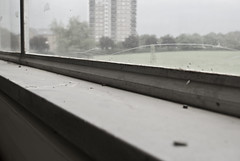
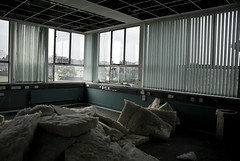
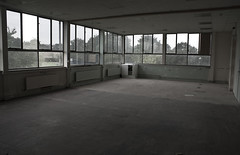
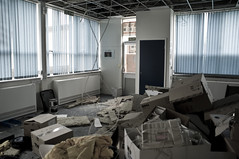
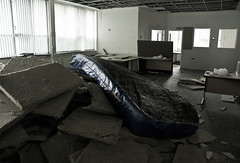
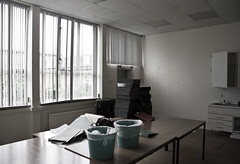
On Friday last week I paid a visit to my old school (Northway Midddle) which is due to be demolished in the next few weeks to make room for houses. I left the school in 1984, the year that it was closed, and even then it was clear that the preferred option of many was to pull it down and make room for houses. Ever since, the building has remained standing in a kind of limbo, part community centre, part office space and having heard the decision last week to finally put the place out of its misery – a decision which seems absurd given its potential (potential which the council couldn’t see if it picked up a football and did six hours of keepy-ups) – I decided to try and gain entry and take a few photographs before it’s lost forever.

Northway Middle School

Granted, Northway School is not the most beautiful of buildings, but with its gym and playing fields, art room (including a walk-in kiln) and stage it could have been turned into a first class sports and cultural centre. Of course the council were as unimaginative in 1984 as they are today and instead it became a wasted space. And whatever the merits – or otherwise – of the building itself, it’s nonetheless a piece of the area’s heritage. It’s played a major part in the lives of many people and deserves to be recorded.

Therefore with my camera I endeavoured to do just that. I had been warned that the interior of the building had been altered a great deal after 1984 but even so I wanted to find something, one image that encapuslated what the place meant to me and many others. Standing inside the building for the first time in 25 years I could see just how much it had changed (rather like myself), and as I walked around in the company of the caretaker, I found that my memories were somehow scrambled as if by by the stud walls and altered layouts of the rooms. Nevertheless I started taking pictures, attempting to jump start my memory, as if the camera was a defribulator for my brain.

Before Demolition

The stairwell hadn’t changed a bit and I could almost hear the sound of the school bell and voices chattering. But in most parts of the school’s trashed interior it was as if I was walking in a place I’d never been to before. Even the view through the windows had changed almost beyond recognition. The John Radcliffe hospital loomed ever larger and the playground had already been turned into houses. Only the imposing tower block on the estate anchored the view in the past, and catching a glimpse of it through a few of the windows started the memories coming.

Before Demolition

After about half an hour and having walked around the school from top to bottom, I began at last to recall things, to see memories much more clearly. I was able to remove the stud walls and new corridors and reimagine how the place had looked when I was there. I remembered the maths room and Mr Smith. I could recall how he’d turn on the lights before appearing. In looking out the window, I could also remember that I’d been in this room when my grandad had died on January 13th 1984. It was around 2.15pm when he passed away.

Before Demolition

Perhaps the room I remembered most clearly and that which was the most recognisable was Mrs. Bantam’s. She was my teacher in the first year and even though the room was just a shell, I could easily recall how things had looked, what it was like to move around inside. The way we move around a given space and the way memories are ‘attached’ to such a movement became very apparent here. Whereas before (except on the stairwell) familiar paths through the building had been blocked by ‘new’ partitions and so on (particularly in the third year area), here those paths remained intact. Memory isn’t only triggered by what we see and hear and what we smell, but the way we move through a space. Memory is kinaesthetic.

Before Demolition

After about an hour I had to leave, finishing with photographs of the windowsills into which some pupils had scratched their names.

Before Demolition

As I think back to my visit, I don’t so much see the things I saw then, the images which you can see on the photographs, but rather my memories, which despite the altered condition of the interior have become sharper – at least in places.

Before Demolition

The above picture was once the science room, the domain of Mr. Hipkiss. The room I remember as being dark. There were high wooden desks, a blackboard in the corner and the strange lingering smell of chemicals which were kept in a room at the front of the class. We had to cover our books in wallpaper (woodchip in my case) and it was in this room that I first heard the word Google. In fact, I now recall how Mr. Hipkiss had written the number (a Googleplex, one comprising umpteen noughts) on a long sheet of paper. I can see it now on the wall. I seem to remember black blinds which might account for the fuliginous aspect of my memory and the faces Mr. Hipkiss drew of eminent scientists which were always photocopied so the text and drawings were pink. They weren’t true likenesses, he told us. He had made them all up.

Before Demolition

The above picture shows the old art room and at the back was where we had cookery lessons with Mrs. Braybrooke.

Before Demolition

This room was a basic woodworking room and general craft area which had a walk-in kiln. So which photograph encapsulates my time at the school? Well it would have to be the second photograph in this blog, that which I reproduced below.

Before Demolition

Memories are, as I said kinaesthetic and nowhere are the paths through the school better preserved than on the stairwell. How many times did I walk up and down them? Impossible to say. All I know now is that I won’t ever again and soon no-one ever will.

Filed Under: Family History Tagged With: Childhood, Demolition, Family History, Memory, Northway School

Maps

January 8, 2009 by Nicholas Hedges

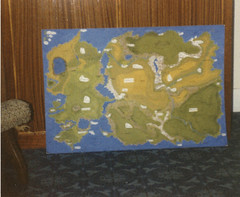
As a child I spent many hours drawing maps of imaginary lands to which in my mind I would often escape. Over time these worlds – and one in particular (see image below) – became a very real part of my existence; I knew its towns, forests, plains and mountains; I knew the seas by which it was surrounded, the lakes and rivers and potted histories of each location. I created characters and can still to this day remember them along with the geography of the world they inhabited.

My Invented World - Ehvfandar

As well as being a means of navigating my imagination, the maps were also guides to the real world. Whilst out walking, I would just as likely find myself walking in my fictional landscape and as such parallels between the real and the imagined were established. To some extent these parallels still exist but it wasn’t until I started researching trench maps of the area in which my great-great-uncle Jonah Rogers was killed (near Ypres) that I was again reminded of my fictional world.

I was interested in pinpointing the place in which Jonah Rogers was killed; to see what the terrain was like and thereby understand, at least in part, something of the world he would have known. One can often imagine that the trenches were more or less just rudimentary ditches cut into the ground in which soliders lived as best they could, just a matter of yards away from the enemy, and of course, in many respects that’s precisley what they were; but the trench system was actually very complex. Far from being two lines gouged into the ground, the trenches of the opposing armies were labyrinthine as the image below reveals.

This map shows an area just outside Ypres. One can see precisely how complex the system of trenches were and yet of course the map can only tell us so much. Sanctuary Wood (shown on the left of the detail above) was described in the diary of one officer as follows:

“Of the terrible and horrible scenes I have seen in the war, Sanctuary Wood is the worst… Sanctuary Wood in 1914 was a sanctuary, but today, Dante in his wildest imaginings never conceived a like.”

It’s hard to imagine Dante’s image of hell as being in any way less horrific than anything on earth, particularly when looking at the map above.

What one can also see on another part of this map are some of the names which soldiers gave to the trenches and the areas in which they were fighting. Often names that were difficult to pronnounce were changed so that, for example, Ploegsteert became Plug Street. However, in some cases, areas were given names that made sense in terms of their being familiar names from home.

On this image one can clearly see a place called Clapham Junction. Of course there was no Clapham Junction in Belgium before the war, but by naming unfamiliar (and often utterly destroyed areas) with familiar names, soldiers and officers could, one assumes, navigate areas more easily, whether physically or in terms of reconaissance and planning. To plan attacks on places which have become muddied wastelands (to put it mildly) with few features remaining (the woods on the maps, shown as collections of lollypop trees were of course little more than burned splinters) one would need names, just as one would need names for the complex network of trenches. Could it be that by naming places with names from home, such reduced and barren landscapes (the ‘topography of Golgotha’ as Wilfred Owen called the Western Front) would appear as belonging in some way to the soldiers who fought there – was it a way of inspiring them?

The closest map – in terms of date – I could find relating to my great-great-uncle’s war, was one of St. Julien which dates from July 1915, just two months after his death in the Second Battle of Ypres. I’d wanted to get an idea of the trench system he would have been known at first hand and as I looked at the trenches shown (only German trenches were shown on this map) I found a road named after my home town; Oxford Road. Ironically, alongside this road was a cottage (one must assume there was little left of it at the time) which had been dubbed Monmouth Cottage – my great-great-uncle was from Monmouthshire.

I couldn’t help but think there was something in this naming of unfamiliar places with more familiar names which paralleled thoughts I’d had as regards my family heritage and in particular how researching it has helped me relate more easily to the past.

History is of course full of gaps. If we try and picture a place as it appeared at a given date we have to use our imaginations to fill in the holes where, for example, buildings have been razed. If we read reports or stories about events in the past we have to use our imaginations to understand the moment as fully as possible, to understand how the average person responded at the time. In doing so, we project a part of ourselves onto the past, something which is of course familiar (see ‘From Dinosaurs to Human Beings,’ OVADA Residency Blog, 2007).

Like my childhood maps of invented places, my family tree is in many ways a map of a fictional landscape, or rather a route through it. That is not to say of course that my family’s past is itself a fiction, but rather that history, in terms of how we see it in our minds is. History is in many ways a wasteland having been obliterated by time and yet there are parts of its landscape which still remain standing despite the tumult. Extant buildings, contemporaneous documents all act as pointers to a disappeared world, a world which also hides untold numbers of anonymous people. To help me navigate this landscape , I can invent my own names just as I did as a child, only this time the names will relate to, or be those of my ancestors; they will refer to dates and facts I have gleaned about their lives. In this sense I am labelling an unfamiliar, temporal landscape with familiar names, a landscape that like the battlefields of the Front has been all but destroyed. I’m filling in the gaps, mapping myself not only onto the physical world but also the past.

The worlds I invented as a child were in many ways idealised views of the real world with unspoilt forests, mediaeval cities and unpolluted seas. What faced the man at the Front was the opposite, a terrible vision of what the world could be or had become. Labelling such a world with names like Piccadilly, Buckingham Palace Road, Marylebone Road, Liverpool Street, Trafalgar Square and so on, in some ways gave it a more human face; where there were gaps, such names would fill them in perhaps with memories of home.

In the end maps are there to guide us, to reveal something about a place or perhaps a person; it all depends of course on what the map represents. We might be looking at maps of countries or maps of the brain – Katherine Harmon’s book ‘Personal Geographies and other Maps of the Imagination‘ is a great resource in this respect. When I look at the map of my invented world, I am not so much presented with a means of navigating a fictional world but rather a map of my own childhood. Looking at the place names I can in fact see the real world as it was at the time. The map therefore becomes a representation of something entirely different. The same could be said of the Trench Maps. They are maps of something quite unimaginable; if we took one and stood on a battlefield today it might offer us a hint of the way things were. But with the names of the trenches, roads, farms and cottages, they become maps of somewhere entirely different – a fictional place built only from memories. But those memories conjured by the names listed above – Piccadilly, Trafalgar Square etc. – are our memories, we can only imagine Trafalgar Square as it is today or as it is within our own minds. What we can establish, with the help of these maps, is an understanding of a sense of dislocation, between the solider in the trenches and his life back home. They serve to make those who fought and died in the war much more real.

With regards a map of my family tree I can place my ancestors in different parts of the country but of course none of them lived their lives standing still. Again there are gaps to be filled and whereas to fill in the gaps of history one can use one’s imagination, with regards the mapping of my ancestry and individual people, it is through walking around the places that they inhabited that these gaps can be filled. To close, I return to the blog entry I made during a residency at OVADA. In it I wrote:

“These invented worlds became, as I grew up, the ‘invented’ or imagined landscapes of Oxford’s past; landscapes that were – just as they still are – created from fragments, parts of the past which are still extant in the city; old buildings, walls, objects and so on. Between these structures, these fragments, I would fill the gaps, with my own imagination, with thoughts derived from my own experience. The city’s past and the past in general, as it exists within my mind, is then, to use the metaphor of cloning in Jurassic Park, a cloned dinosaur. The extant buildings, structures and objects within museums, are like the mosquitoes trapped inside the amber. They are broken strands of DNA. All that is required is for me to fill the gaps, and this I can do with my own DNA. I am in effect, the frog.
This metaphor is interesting in that DNA patterns are, of course, unique to everyone. My DNA is different to everybody else’s as there’s is to mine. Therefore, using my imagination to plug in the gaps of the past, means that the ‘past’ will comprise large parts of my own experience; my dinosaur will contain elements of my own being. (See ‘Postcard 1906’). But although my DNA is unique, it is nonetheless derived from my own past, elements have been passed down by my ancestors from time immemorial. The code which makes me who I am, comprises parts of people I know now (parents and grandmothers), people I knew (grandfathers and great-grandmother) and people lost to the past altogether (great-great grandparents and so on). What interests me about this, is that, through stating above how ‘my dinosaur will contain elements of my own being’ I can now see that ‘my dinosaur’ will contain elements of my own being, which is itself comprised of elements of hundreds – thousands – of people, the majority of whom I will of course never know and who have been dead for centuries. I like to think therefore, that ‘my dinosaur’ and my imagination aren’t entirely unique.”

In the traditional diagram of the family tree each individual is isolated, joined to others by means of a single line, almost as if they appeared at one point, moved a bit and passed the baton on to the next in line. Of course things are much more complex than this; individuals overlap in terms of the length of their lives and if we were to try and represent an individual’s journey through life, the line would be impossibly complex. Inevitably there are gaps which as I’ve said I can fill (at least, in part) by walking in the places they would have walked. In Wales, where my Grandmother grew up I found it incredible to think that this place I’d never been to and the streets, lanes and hills I had never walked, had all played a part in my existence. Without them I would not be here, or indeed there. I was then filling in the gaps, like the frog DNA in Jurassic Park, but the dinosaur I spoke of in the extract above was not so much History in this case, but me.

Filed Under: Family History, Trees Tagged With: Childhood, Dante, Family History, Jonah Rogers, Map, The Trees, Trees, Trench Maps, Ypres

Amelia Hedges (nee Noon)

January 6, 2009 by Nicholas Hedges

I have written at length on the tragic story of my great-great-great-grandmother’s murder in 1852 and am in the process of using her story in a proposed public art installation in the cemetery where she’s buried. In the newspaper report of the time, mention is made of her children:

“He [Elijah Noon] appeared to feel very acutely the awful position in which he had placed himself and the irreparable loss which he had inflicted on his household, consisting of five children the youngest being only a few months old, and not weaned. The desolate condition in which these poor children are suddenly placed by the death of their mother, and imprisonment of their father is pitiable in the extreme and increases the painfulness of this most tragical event.”

One of these children was my great-great-grandmother, Amelia Noon. Born in 1846, she would have been 6 years of age at the time of her mother’s death and would have been in the house during the attack. What she saw or heard I cannot say, but one can assume that the whole event would have scarred her in some way.

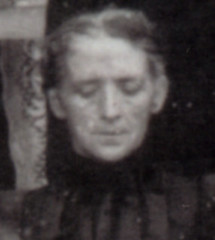
I never thought I would ever see what she looked like but recently I received a photograph of my great-great-aunt’s christening. Winifred May was born in 1899 and was the daughter of my great-grandparents Ernest Hedges and Ellen Lafford. To celebrate the event of her christening, a group family portrait was taken in the back yard of the house and amongst that number was Amelia Hedges (nee Noon) pictured below.

Amelia Hedges (nee Noon)

She is the only one in the photograph looking down and it’s tempting to suggest her face and her expression reveal something of her past. Of course, to say that would be pushing the bounds of reasonable conjecture but there is nonetheless something sad about this image. It could be that she just happened to look down at the moment the picture was taken, but there is something about her downcast eyes which reveals, in the midst of a happy, family moment, a memory of her own family. As I have also written, the death of her mother and the imprsionment of her father was not the only tragic event of her life. Her brother, also called Elijah, choked to death in The Grapes public house fourteen year before this image was taken.

Filed Under: Family History Tagged With: Amelia Noon, Elijah Noon, Family History, Jericho Cemetery, Murder, St Sepulchres Cemetery

Jonah Rogers (1893-1915)

November 3, 2008 by Nicholas Hedges

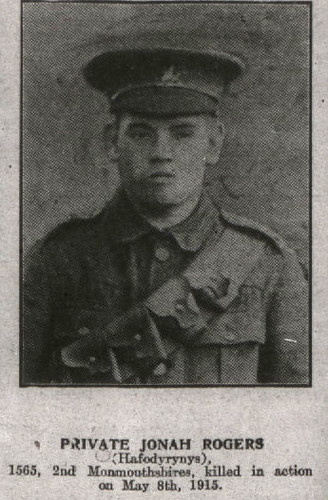
Thanks to the efforts of Martyn Gibson and David Nicholas and their work on the 1st, 2nd and 3rd Battalions of the Monmouthshire regiment, I have managed to get hold of a photograph of my great-great-uncle, Jonah Rogers, whose image was published in David Nicholas’ history of the 2nd Monmouthshire’s experiences in the Great War ‘They Fought With Pride‘.

The image, taken from a newspaper cutting (the notice of his death) can be seen below:

Jonah Rogers (1893-1915)

Filed Under: Family History Tagged With: A Line Drawn In Water, Jonah Rogers, World War I, WWI

A Suicide in Cefn-y-Crib

July 24, 2008 by Nicholas Hedges

Back in the spring when I visited Hafodyrynys with my Dad and my girlfriend Monika, we found ourselves – whilst clambering over what my grandmother has always called the ‘Mountain’ – in the company of a farmer, who, with his two sheepdogs, took us on a short tour of his land overlooking the village. He was a man who having been brought up in the area knew that part of the world intimately, and who, as he traced the blue horizon with his hand, reeled off a list of villages resting amongst the hills and fields rolled out below. As we looked over towards the town of Llanhilleth, where my great-grandfather, Elias Jones, had worked as a miner, I couldn’t help but imagine him standing there 100 years before, looking at the same villages and reeling off the same names. Down below, in Rectory Road, he would see the house in which he lived, and in which also lived my grandmother as a child.
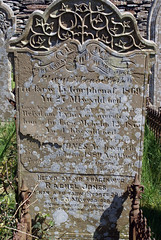
Elias Jones died of lung disease in 1929 at the age of 47, caused as a result of breathing in coal dust down the mine in which he worked. He was buried in the churchyard at Cefn-y-Crib, where his wife, Mary Jane, would be buried 40 years later. Also buried in the same churchyard, as we saw that day, was Elias Jones’ father, my great-great-grandfather, Henry, who died in 1889 at the age of 49 when Elias was just 7 years old.

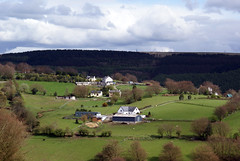
Hafodyrynys and Surrounds

We could see the churchyard from the brow of a hill as we stood in the company of the farmer and his dogs, and in between, a scattering of buildings, vivid and white against the green of the fields, made darker for a moment by the looming presence of clouds which gathered around us as if to experience a view which they would know for only a very short time.

Hafodyrynys and Surrounds

It was as we looked that the farmer pointed to one of the buildings and explained how in December the previous year a young woman was found hanged inside. It was a story which seemed at odds with the beauty of the landscape – a landscape which, nevertheless, just as it had shaped the existence of my paternal family, had shaped the death of this young woman.

In amidst the fields, the seemingly empty barns and houses, and bordered by the forests which clung to the hills surrounding us, one could feel very small and insignificant. In a place such as this one’s awareness of self is augmented, or at least, one’s awareness of individuals. Indeed, of all the people I have researched so far, the two which to me are perhaps the most clearly defined are my great-grandfather, Elias, and my great-great-uncle, Jonah Rogers, who was killed in 1915 in the second battle of Ypres. Perhaps this is in part because of the place in which they lived (and in which that day I was standing), not so much because it’s changed so little, but because its shape, its beauty and its timelessness, serve to delineate the individual better than any city.

I’d always heard that one of my ancestors on the Welsh side of the family had been killed in a mining accident, but I’ve never found anything to even vaguely corroborate the story. Of course accidents were common as my grandmother recalled, remembering how blinds would be drawn in all the windows when another body was brought back up to the surface. Having seen Henry Jones’ grave, I decided to obtain a copy of his death certificate to see if perhaps he – having died young – had been killed in an accident of some kind. As it turned out, the truth was indeed tragic, but for altogether different reasons.
It took me a while to decipher the spider-like writing of the registrar, but suddenly it hit me; cause of death, “suicide while temporary insane,” place of death; Cefn-y-Crib.

Filed Under: Family History Tagged With: Death, Elias Jones, Family History, Family Jones, Hafodyrynys, Jonah Rogers, Jones

John Stevens (1837-1888)

July 18, 2008 by Nicholas Hedges

In my previous post ‘Real People‘ I wrote a little on the life of John Stevens, my great-great-great-uncle (my great-great-grandfather, Jabez’s older brother) who was born in Reading in 1837. Firstly, I must correct something I wrote in that entry; John Stevens was never in Broadmoor . Before entering the Moulsford Asylum, he was first an inmate at the Littlemore Asylum in Oxfordshire to which he was admitted on 24th March 1871. He was suffering from mania caused by epilepsy and had been ill for three months.

He was 34 years of age when admitted to the Moulsford Asylum on 17th May 1871. He was a tailor, married to Emma and had been subject to fits from the age of 17. This was not his first attack of insanity the cause of which was epilepsy. He told the doctor on admission that “he has been all around the world this morning; that he was seen John the Baptist; that he is John the Baptist; that he in a fighting attitude is addressing God.” He had been observed “standing for an hour in one attitude looking at the sky, squaring his fist to fight the Nurse and ill-treating his wife a few days after her confinement.” In the same year he was admitted, his wife Emma gave birth to a daughter, Kate.

As a patient, he still worked in his trade as a tailor as the asylum had its own tailoring shop. However he was still subject to frequent and severe epileptic fits.

On July 28th 1877 he was attacked by another patient, Harry Mulford, who knocked him down and kicked him breaking one of his ribs. Two years later in 1879 he stopped working as his condition began deteriorating.

In December 1886 he suffered with pneumonia and in March 1887 records state that John “is a wretched epileptic, frequently getting wounds in the head.” A year later in December 1887, he was so weak he was spending the entire day in bed, still suffering frequent fits. The next and last entry in the records of Moulsford Asylum regarding John is dated 10th February 1888. It states that he had:

“…been constantly in bed, at times noisy but thoroughly exhausted. He quietly passed away today at 2.30pm.” His cause of death was “exhaustion from epilepsy.”

Filed Under: Family History Tagged With: Family History, Family Stevens, John Stevens, Moulsford Asylum, Stevens

Real People

June 22, 2008 by Nicholas Hedges

For about seven months now I have been researching my family tree through Ancestry.com and in that time I have been quite successful, tracing four lines (Hedges, Stevens, Jones and Sarjeant) back to the beginning of the nineteenth century and in some cases well beyond. I have exchanged emails with a second cousin in Canada (to whom I owe a great deal as regards his efforts with the Sarjeant tree), visited the graves of ancestors I never knew I had in Wales and, having visited the Menin Gate in Ypres a year ago, discovered that my great-great-uncle is commemorated upon it having been killed in the second battle of Ypres in 1915 (there may be a second great-great-uncle who died at the Somme, but until I receive his death certificate I cannot be certain). Having done all this and talked with both my 95 year old grandmothers about their respective childhoods, and having looked at various photographs, these people I have drawn from the past have come alive, but it was only at the end of last week, that the fact these were once real people became truly apparent.

The furthest I’ve gone back with the Stevens family is to a certain John Stevens, a tailor, who was born in Oxford around 1812. The Stevens side of the family (my maternal grandfather) came to Oxford in 1952 from Reading, so it was strange therefore to find that they’d originated in the twon where I was born. He had six children by his wife Charlotte; John (1837), Samuel (1839), Elizabeth (1843), Rosetta (1844), Henry (1846) and finally, my great-great-grandfather, Jabez (1848). Having turned my attention recently to those to whom I am not directly descended, i.e. the siblings of great-grandparents and so on, I decided to look at the eldest sibling in this family, John.

Born in 1837, I traced him through the censuses and discovered that in 1857 he married Emma Fisher and with her had seven children; Emma (1859), William (1861), Henry (1863), Mary (1865), John (1867), Martha (1869) and Kate (1871). All of these I found listed on the 1871 census along with their mother, but, there was no mention of the father John. I looked ahead to 1881 and while I couldn’t find Emma, I found her children and her husband, and it was here in this document that the whole tree assumed a much more tangible dimension. In 1881 John was listed as a Pauper Patient in the Berkshire County Moulsford Asylum (now Fair Mile Hospital). Why he was in there I couldn’t say, but next to his name was his trade ‘Tailor’ (the same as his father) and the word ‘lunatic’.

Suddenly, this man seemed more real than any of those I’d previously discovered; so for that matter did his wife and their children, after all, if he was in an asylum, what had become of them? I couldn’t find any mention of Emma, but some of his children had been separated; Henry and John were living with their Uncle Samuel, also a Tailor; Mary was living with her Aunt Rosetta, and sadly, Martha and Kate, the two youngest sisters, were inmates at the Reading and Wokingham District School (workhouse).
Turning back to the fate of their father, John, I tried to find him in the 1871 census, and eventually I discovered him; it seemed his misfortune had come much earlier for he was at this time an inmate at ‘Broadmoor Asylum for the criminally insane.’ I’ve no idea yet what he did but clearly it was serious. Reading about the asylum I read that those found ‘not guilty’ of serious crimes through their insanity were at the end of their sentences assessed, and if found to be unfit for release were sent to county asylums which seems to have been the case with John.

As regards his wife Emma, I have yet to find any trace of her in the 1881 census. It might be of course that she died in the 1870s but a search for the record of her death yields a more likely date of 1885; this will of course require more research. As regards John, I found reference to a John Stevens, born in 1837 who died in the district of Wallingford (in which Cholsey – the location of the Moulsford Asylum would fall) in 1885. No doubt he never recovered his sanity or his freedom.
As to the fate of their children, that will of course need further research.

Filed Under: Family History Tagged With: Family History, Family Stevens, Stevens

  • « Previous Page
  • 1
  • 2
  • 3
  • Next Page »

© Nicholas Hedges 2024

  • Facebook
  • Instagram
  • Twitter
  • YouTube

Copyright © 2025 · Outreach Pro on Genesis Framework · WordPress · Log in