Nicholas Hedges

Art, Writing and Research

  • Amazon
  • Behance
  • Facebook
  • Instagram
  • Pinterest
  • YouTube
  • Art
    • Digital
    • Drawing
    • Grids
      • Correspondence
      • The Wall
      • The Tourist
    • Ink on paper
      • Shadow Calligraphy
    • Installation
      • Murder
      • Echo
    • Painting
    • Patterns
    • Mixed Media
    • Photographic installation
      • St. Giles Fair 1908
      • Cornmarket 1907
      • Headington Hill 1903
      • Queen Street 1897
    • Research/Sketches
    • Stitched Work
      • Missded 1
      • Missded 2
      • Missded 3
      • Missded 4
    • Text Work
  • Blogs
    • Family History
    • Goethean Observations
    • Grief
    • Light Slowed But Never Stilled
    • Lists
    • Present Empathy
    • Shadow Calligraphy
    • Trees
    • Time
    • Walking Meditations
  • Video
  • Photography
    • Pillars of Snow
    • Creatures
    • The Trees
    • Snow
    • St. Giles Fair 1908
    • Cornmarket 1907
    • Headington Hill 1903
    • Queen Street 1897
    • Travel
  • Illustration and Design
  • Music
  • Projects
    • Dissonance and Rhyme
    • Design for an Heirloom
    • Backdrops
    • Shadow Calligraphy
  • Exhibitions
    • A Line Drawn in Water
      • Artwork
    • A Line Drawn in Water (Blog)
    • Mine the Mountain 3
      • Artwork
    • Mine the Mountain 2
      • Artwork
      • The Wall
    • The Woods, Breathing
      • Artwork
    • Snow
      • Artwork
    • Echo
      • Artwork
    • Murder
      • Artwork
    • The Tourist
    • Dreamcatcher
    • Mine the Mountain
      • Artwork
      • The Tourist
    • M8
    • The Gate
    • Creatures
      • Artwork
    • Residue
      • Artwork
    • A visit to Auschwitz
      • Artwork
  • Me
    • Artist’s Statement

Projections

October 7, 2011 by Nicholas Hedges

Having completed my last stitching project based on trench maps from World War I, I decided to try and superimpose some postcard portraits onto them, of soldiers headed for the Front. In the first (below) I used the photograph of a family which I ‘projected’ onto the map as shown hanging on a washing line.
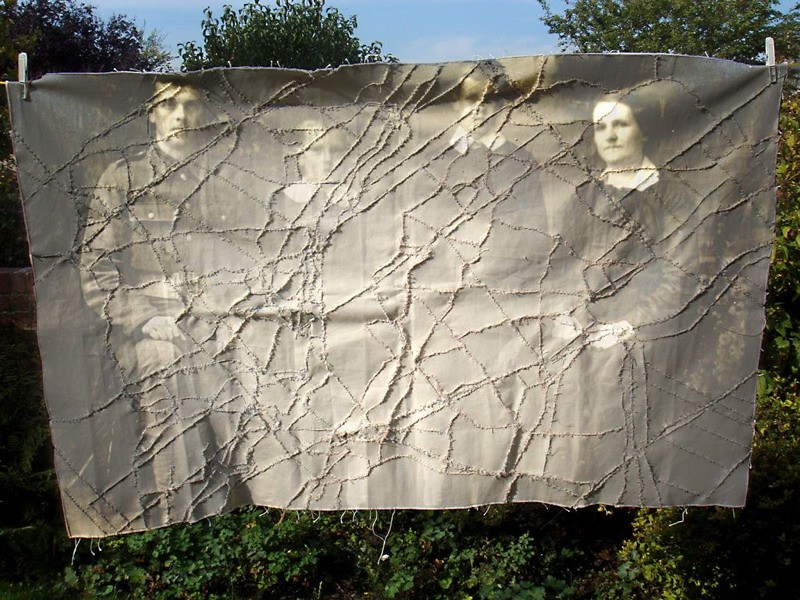

What strikes me about this image as a whole, is the contrast between now and then as it exists in the contrast between the black and white of the photograph and the colour of the day. This colour, and the sense of the nowness of the present, helps strengthen my own empathetic feelings towards those long since lost – and all but forgotten – to history.

The fact the map hangs on a line like an item of washing, also reinforces the sense of domesticity which is a theme running through some of the postcard portraits, many of which were taken in the backyards of soldiers (or their parents), where evidence of the everydayness of domestic life is in abundance.

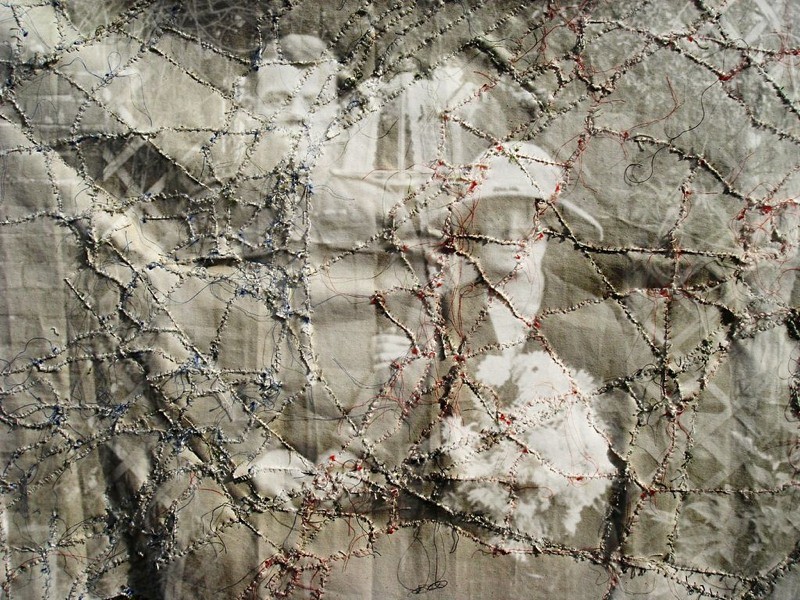
One such photograph shows a young couple who’ve recently been married. They stand, unsure of what the future brings, both wearing a look full of apprehension, staring into the lens of the camera, as if this ‘clock for seeing’ as Barthes once referred to them, really could show them the future.

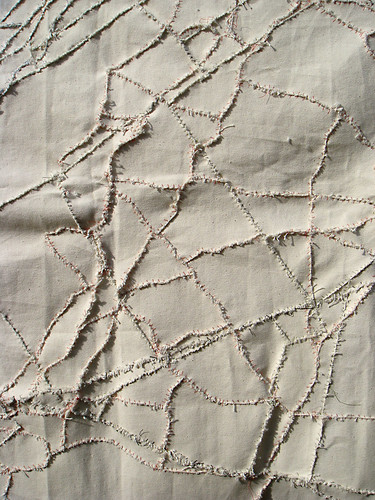
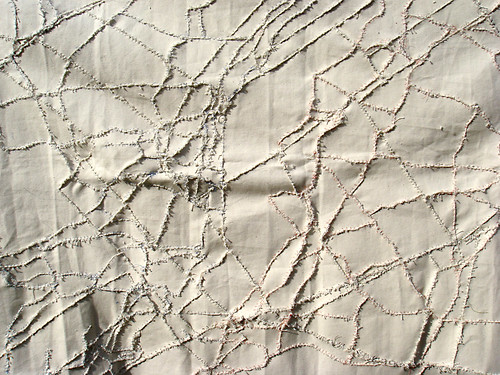
The image onto which their portrait has been projected shows the reverse side of the map, where the threads used to stitch the past together hang like the cut threads of countless lives.
Filed Under: World War I Tagged With: Empathy, Serre Palimpsest, Stitchwork, Trench Maps, World War I, WWI, WWI Postcards, WWI Postcards

Serre Palimpsest (completed)

October 1, 2011 by Nicholas Hedges

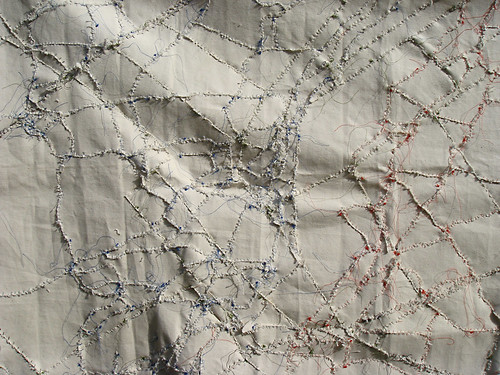
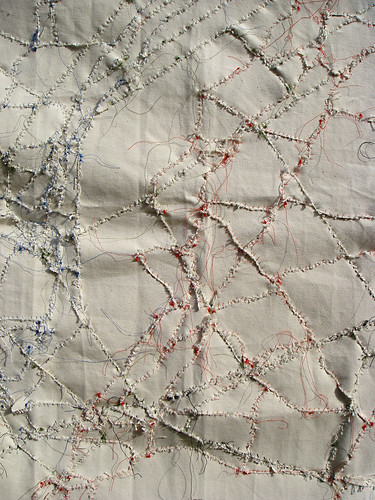
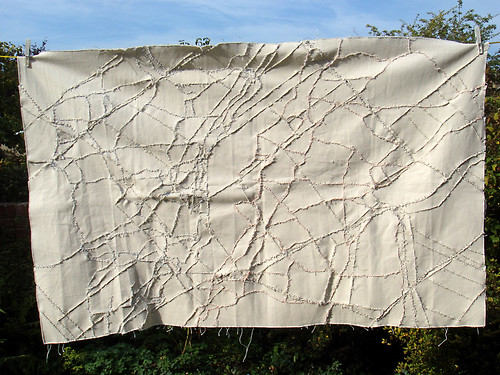
I’ve just completed – after several weeks of stitching – a piece of work called ‘Serre Palimpsest’ the creation of which I’ve been documenting on my blog. It became apparent soon after I started this work that this was a piece with two sides which may seem an obvious thing to say, but it seemed to me that the two sides we’re saying different things, just as things below the surface say something different to those above, whilst as the same time remaining connected.

The two images below show the completed work. The first, the front:

Serre Palimpsest

The second, the reverse:

Serre Palimpsest

The lines stitched in black show the roads before the war (the modern day road system is pretty much the same), the blue stitching and red show the British and German trenches respectively – with No Man’s Land between, and the green stitching shows the modern day field boundaries.

What was interesting about creating the work was how the threads from the reverse of the piece would emerge into the front, mirroring the way pieces of the past (bits of old shell etc.) find their way to the surface after many years below the ground. The cut lines on the reverse made me think of the paths soldiers would have taken to get there; paths which in many cases were cut in the Somme.

Serre Palimpsest

Serre Palimpsest

Occasionally, the threads would be tied together on the reverse which again made me think of how our lives today are similar to those who died in that their lives were lived lives too; of course their circumstances couldn’t have been more different, but the fact is that the vast statistics of the Somme comprise real individuals.

To take the photographs I hung the piece on the washing line. The weather was unseasonably hot and sunny, much like the weather would have been on the first day of the Battle of the Somme (1st July 1916). As I looked as the work swaying gently in the breeze, I thought about the photographs taken in the back gardens of those who were about to set off for the Front. I was reminded too of the backdrops used in studio-based photographs.

Serre Palimpsest

World War 1 Serviceman

World War 1 Serviceman

Filed Under: World War I Tagged With: Lines, Serre Palimpsest, Stitchwork, Trench Maps, World War I, WWI, WWI Postcards, WWI Postcards

Empathy and the First World War (Part 5)

March 10, 2011 by Nicholas Hedges

The backgrounds of these postcards have become of great interest to me in as far as they help elicit a sense of empathy with those who are pictured. Some of the postcards feature no backgrounds at all and are simply headshots which make an empathetic response a little more difficult. What I want to look at here are natural and studio-based backgrounds, examples of which can be found below.
I’ve already looked at two postcards with photographs taken in natural settings and these settings can be further subdivided into those which are domestic and non-domestic. It’s those taken in what are clearly domestic settings – for example the backyards of houses – which are the most poignant, for the obvious reason that they are photographs of homes these men would soon be leaving. And again the question begs to be asked, would they ever return?
This photograph is clear

Filed Under: Photography Tagged With: Empathy, Photographs, Vintage Photographs, World War I, WWI, WWI Postcards

Empathy and the First World War (Part 5)

March 9, 2011 by Nicholas Hedges

The backgrounds of these postcards have become of great interest to me in as far as they help elicit a sense of empathy with those who are pictured. Some of the postcards feature no backgrounds at all and are simply headshots which make an empathetic response a little more difficult. What I want to look at here are natural and studio-based backgrounds, examples of which can be found below.

I’ve already looked at two postcards (see Part 3 and Part 4) with photographs taken in natural settings and these settings can be further subdivided into those which are domestic and non-domestic. It’s those taken in what are clearly domestic settings – for example the backyards of houses – which are the most poignant, for the obvious reason that they are photographs of homes these men would soon be leaving. And again the question begs to be asked, would they ever return?

This photograph was clearly taken in a back garden, one which seems to comprise little more than dirt. In the background, the backs of other houses are visible and next door appears to have what looks like a chicken coup, with chicken wire fixed above the fence. What is striking about this image is the cleanliness of the soldier’s uniform. His coat is spotless; it’s almost as if this young man is little more than a child playing soldiers in the garden, and it’s difficult to look at him knowing full well what he’s about to endure.

I’ve already discussed windows in old photographs and in the background of the image above one can see a window of one of the houses behind.

I wonder what the same scene would be like if I was standing behind, looking through the net curtains? I’d see the back of the young man being photographed and those who are taking the picture – more proud parents perhaps? I’d watch for a while, then turn my back and return to my own life within the terraced house. It’s imaginative wanderings like this which serve to animate the scene, to remind us that the past was once ‘now’.

I imagine this photograph was taken in the garden of the soldier’s parents’ house. I can imagine them holding this image, just as I’m doing now and walking outside to see that corner of the garden in which he’d been standing. The dilapidated fences, the dirt ground, the trees and the houses behind would all resonate with his presence. If I walk outside into my own garden, with this image in my hand, everything that makes ‘now’ what it is, would serve to animate it. The feel of the wind, the sounds of the birds in the trees, the feel of the ground beneath my feet etc.

This photograph was obviously taken in a studio and whereas in the previous image the backdrop is a real scene, the one above is like something from an 18th century painting. In the foreground we can see bunches of wild flowers growing alongside a quiet country track, leading off through an idealised landscape complete with ‘Rococoesque’ trees, a river and a picturesque bridge. One almost expects the solider to turn away from the incongruous chair and to walk off up the path and out of sight.

With the first image, the domestic backdrop of a garden, its fences, the chicken coup and the backs of neighbours’ houses provides a stark and disturbing contrast with what we know awaited the young man being photographed. This contrast is just as stark in the studio picture above, and in some respects even more disturbing.

Whereas the fictional scene could at least be imagined by the artist, what the man standing before it was about to face on the battlefield would never have been conceivable even with the keenest of imaginations. Reality was in a way even less real than this Arcadian backdrop which seems to depict something akin to Paradise. Perhaps this is why I find this image so haunting?

The reverse of the postcard contains text which reads: To Mr J Wade, With happy memories of past days spent at Waresley House. 

I did some research into Waresley House and discovered that it was once the home of both the Peel family (Robert Peel) and the Perrins family of Worcester Sauce fame. A large Georgian pile, I wondered what the soldier did there, who Mr J Wade was and whether or not he was the owner of the house. Having looked at the 1911 census however, I could find no record of Mr Wade. The house was owned by a Mr Gibbons, an 87 year old widower who lived there with his two daughters (both single and aged 49 and 47) and nine domestic servants.

It is possible that Mr Gibbons died soon after 1911 and that Mr Wade took over the house thereafter. Looking for Mr Gibbons on Ancestry, I found him in the same house in 1891 along with 13 children. The cook in 1911, Mary Pugh was also listed. 

Filed Under: Photography, Trees Tagged With: Empathy, Photographs, Vintage Photographs, World War I, WWI, WWI Postcards

Empathy and the First World War (Part 4)

March 9, 2011 by Nicholas Hedges

Another postcard from my World War One collection:

It’s a rather faded image but we can see that it shows a man standing outside a gate to what looks like the back yard of a house. Like the previous image (see Part 3) the man is dressed in his uniform, ready to head off to war. Or perhaps he’s returned, on leave maybe, about to go back to the Front? We’ll never know, but looking at his face, there’s something about his expression which looks weary at the very least. Of course this is probably reading too much into the picture, but there is something about his face which makes me wonder. To make it easier to see, I’ve enhanced the image a little:

Detail of the soldier’s face:

Like the previous postcard, I can well imagine the scene without the soldier standing there; the feel and the colour of the ivy, the bricks and the old, rather battered door. My imagination colours the image, and through this colouring, the textures of the bricks and the door become apparent. And like the other postcard, it is in itself a tactile object which speaks of the soldier’s absence more than his presence – after all, a postcard is a form of communication sent by someone who is, at the moment, absent from the life of the receiver. Turning it over and looking at the reverse, I could see that it had been addressed to a Miss V. J. Edwards. I wondered if she was the man’s fiancee, but looking at his hands, I could see that he was wearing what appears to be a wedding ring. And again the hands are like those I’ve discussed previously (see Part 1 and Part 3).

Could Miss Edwards be his sister? As I hold the postcard, and turn it over in my hand, I find myself performing an action she herself would have performed. What would she have thought as she read the rather enigmatic text?


1919 16.Puzzle BLA.

I’m assuming that the number at the top is the date (1919) which means we can perhaps also assume the soldier on the front survived the war. Was the photograph itself taken when the war was over? Would that account for his rather tired expression? It seems unlikely, and given the rest of the text, it might be that this isn’t the date at all. Sadly, the franking mark on the stamp isn’t clear enough to tell. What does 16.Puzzle BLA mean? Is it No.16 in a series of puzzles? Is BLA itself the puzzle – a secret code shared between the two; between the soldier and Miss Edwards? Interestingly, in the image itself, we can see in the bottom left hand corner, a notebook on a wooden bench. Did the soldier conceive his puzzles within its pages?

 
A hand rolled cigarette lays next to it, and the two together serve to animate the image – or rather the soldier in the image; I can picture him smoking, writing in his notebook, in a hand like that on the reverse. Holding the postcard and reading it, I can also ‘animate’ the person to whom it was sent.

With this single image then, a relationship long forgotten has been re-established.

Filed Under: Photography Tagged With: Empathy, Photographs, Vintage Photographs, World War I, WWI, WWI Postcards

Two Soldiers

March 8, 2011 by Nicholas Hedges

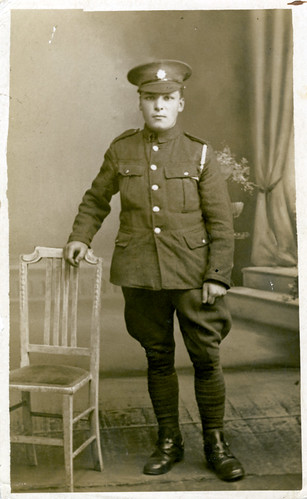
I was once given a collection of 200 World War I postcards featuring portraits of soldiers and have always wanted to trace some of those featured. Through research on the National Archives website and through deciphering rather bad handwriting I discovered that the man immediately below is one Walter Henry Chevalier who served in the Army Service Corps and Northumberland Fusiliers. I think, if my research is correct, that he survived the war, dying in 1962 aged 64.

Below, another World War I soldier and another survivor. The rather splendid surname ‘Dangerfield’ is written on the back and having searched for him and got over 100 Dangerfields I had a closer look at the image. The spurs and the crop suggest of course something to do with horses and the cap badge as far as I can see is that of the Royal Horse Artillery. Having refined my search, I found Edward Paul Dangerfield, Second Lieutenant in the Royal Horse Artillery. Again, if my research is correct, he survived the war and died in 1978.

Filed Under: World War I Tagged With: Soldiers, World War I, WWI, WWI Postcards, WWI Postcards

Empathy and the First World War (Part 3)

March 8, 2011 by Nicholas Hedges

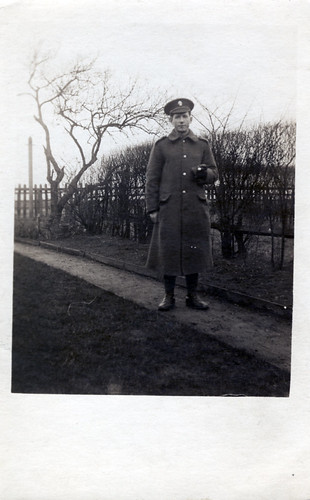
It’s hard to tell where this image was taken, whether in a garden or a public park, but clearly it shows a young man in his new army uniform about to head to war.  He stands to attention, albeit somewhat awkwardly, staring into the camera – almost through it, into the distance. I wonder as I look at him who is on the other side taking the photograph? A proud parent perhaps, an anxious one? A friend or maybe some other relative? The young man in question would, I imagine, have left soon after the image was taken and the question is there to be asked: would they – whoever it was – have seen him again? Behind him a tangle of brambles foreshadows the barbed wire entanglements laid out in front of the trenches, wire on which so many like this young man lost their lives.

As with the previous images I’ve discussed (see Empathy and the First World War Part 1 and Part 2) I’m interested in how I can find a way of empathising with this individual, a young man whose name has been lost and who, for all I know, exists only within the image on this postcard. The difference between this ‘image’ and those discussed previously are that this is a physical object – a postcard; one of a number printed as keepsakes. However, as I look at it, I try as I do with other photographs to imagine the moment in which it was taken. I imagine the click of the camera , satisfied comments from the photographer, after which the young man picks up his cap, puts it on and walks off down the path. The crunch of footsteps dissipates along with the voices and I am for that moment left standing looking at the brambles and the undergrowth.
For some reason it’s hard for me to visualise this young man in colour – there’s something in his face which prevents me from seeing him talk. But without him there I can picture the rest of the scene easily enough in colour; I can see the colour of the bricks, the undergrowth and the path. I can see the leaves move and then imagine myself moving, turning and seeing people walking in the distance. I can hear sounds – birds and so on, perhaps because I can hear them outside my window on what is a beautiful spring-like day. It’s a photograph which depicts the presence of the young man in the picture and yet speaks of his absence, which is of course hardly surprising given that it was taken almost 100 years ago. Whether he survived the war or not he’s going to be absent from the world today.

The way in which I hold the postcard and look at the image is important, for it no doubt echoes that of those who knew him, who whilst he was away looked at the image and remembered their friend or loved one; someone who was present in their minds and yet absent from their immediate world.

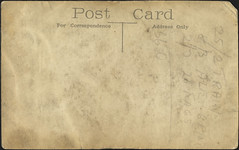
On the reverse are the words ‘POST CARD’ and a ‘T’ shaped divide between correspondence and address. The postcard itself is blank, save for the 15p pencilled in the corner – the apparent monetary value of the image. I’ve worked before on the idea of the ‘T’ shape as being like a makeshift grave-marker and having looked at the photograph on the other side and having imagined him walking away – leaving just the image of the brambles – it becomes all the more poignant. There is no message, no address. Just ’15p’.
When looking at the previous images (see Empathy and the First World War Part 1 and Part 2)  there was one moment with which I could attempt to empathise – that being when the image was captured, but with the postcard there are many more which I can narrow down to two, one specific, the other more general. The first of course is again when the image was taken, the second an amalgamation of all the times it was handled, held between two hands just as I’ve been holding it today. The postcard, as an object, fits physically into a sequence of ‘gestures’, a moment in which the stark boundary between now and then – as described when a photograph is taken – is blurred. Empathy in this respect is not necessarily with the young man, but with those who remembered him; not with the man within the image, but with those who held the image.

Thinking about my hands holding the postcard, turning it round now, I find myself looking at the young man’s hands hanging at his side. They remind me of the hands of the corpse in the first image I looked at (see Part 1) and again an empathetic link is established. I wrote earlier how I found it hard to imagine his face moving in any way – it seems definitively frozen by the camera – and yet looking at his hands the opposite is true. I can well imagine them twitching nervously, unsure of what to do as he stands to attention.

I think too of the grass in the second image (see Part 2) growing over the turned earth and can well imagine the brambles behind the man doing the same.

I’ve written before how empathy is a kind of feedback loop, where our own bodily experience is influenced by our knowledge and vice-versa, growing all the while so that bodily experience influences knowledge whether, in the case of this subject, standing on a battlefield or looking at a photograph. I can see this loop working as regards the images I’ve discussed so far, how empathy accumulates slowly over time.

Filed Under: Photography Tagged With: Empathy, Photographs, Vintage Photographs, World War I, WWI, WWI Postcards

Empathy and the First World War (Part 1)

March 4, 2011 by Nicholas Hedges

Windmill Military Cemetery, Monchy le Preux, east of Arras, 1918

This image was taken during the last months of World War I and shows a scene which became all too common during the long and bloody years it lasted. The four men at the back, almost silhouetted against the grey sky, locate the image in its context, reminiscent as they are of the lone figure in Ernest Brooks’ photo taken on Pilkem Ridge near Ypres in 1917.

The shadow figure of a survivor reflecting at the side of a grave is the image of the Great War and while these men are not quite silhouettes, they are nonetheless unknowable, just like the dead next to whom they stand. In Brook’s iconographic photo the silhouetted man and the corpse are one and the same thing, as if the dead man’s shadow, is for a time, living a while longer. There is then little to divide the four men and the two on either side from those over whom they stand, just as throughout the war, the gap between life and death could be measured by the thickness of a cigarette paper.

In the image from the Windmill Military Cemetery, over a dozen men await burial, some with makeshift crosses on which their names and dates of death would have been inscribed. Behind the men, crosses planted in the ground, stand like a wood, broken into matchsticks by the relentless pounding of shells. Everything in this image has been reduced. Men have been reduced to corpses, corpses reduced to names, the landscape reduced to ruin. On top of it all, the whole scene has been reduced to a picture; time itself reduced to a moment. There’s no colour and little by way of life.
An area in which I’ve become particularly interested as regards historic trauma and in particular, World War I, is our ability to empathise with those who suffered. If anything hinders an empathetic engagement with the war, it’s the sense that it’s always already happened, that its victims have always been dead. Reminding ourselves that the past was once the present, through an awareness of our own contemporary experience, is a vital part of the empathetic process. In this image we see a number of men. Those who ‘live’ within the image we know are now dead. Those who are dead, seem always to have been so. So how can we empathise with an image such as this; an image which is very much of its time and very much removed from our own?
The bodies are clearly dead, but the difference between them and the six men surrounding is, as I’ve said, slight. Looking at the hand of the body in the bottom right hand corner of the image, I can easily imagine how it once moved, once wrote a letter to a loved one back home, one touched a loved one, held a cigarette or a pint of beer.

There is something about it that’s painfully alive, as if it reminds us, that this photograph is a moment in time behind which there were many more moments, that those who died lived as we do today. Beneath the crosses in the background are many more bodies, of men who once lived. Their presence, or rather absent-presence, extends well beyond the limits of the moment, just as the landscape extends well beyond the limits of the photograph.
A photograph is captured in an instant and yet we ourselves are rarely aware of an instant in time. Of course we are aware of time passing and the difference between now and a few moments ago, but the moment we experience as ‘now’ is smudged to take in a part of the past. And of course, within our bodies, we carry our entire past, albeit one accessible only through the fragments of what we can remember. When a photograph is taken, the difference between the past and the present in which it was captured is much more stark. The shutter is like a knife, cutting one away from the other. But through thinking about ourselves and our own experience of the world, that sharp edge can be softened.
In an image like this, that process is made more difficult, not only because it was taken so long ago, but because what it depicts is so far beyond our own understanding. But the hand of the body I’ve described helps us bridge the divide. It’s something with which we can all easily identify; a way, albeit small, in which we can begin to empathise. 

Filed Under: Photography Tagged With: Empathy, Photographs, Vintage Photographs, World War I, WWI, WWI Postcards

A Poignant Postcard

April 23, 2010 by Nicholas Hedges

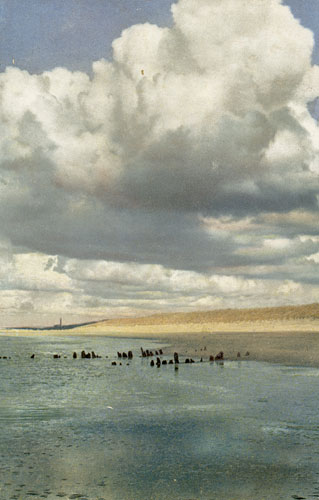
As part of my forthcoming exhibition, I’ve been purchasing a few postcards for a piece of work, one which mirrors previous works I’ve made with postcards of World War One soldiers. One of my recent acquisitions can be found below.

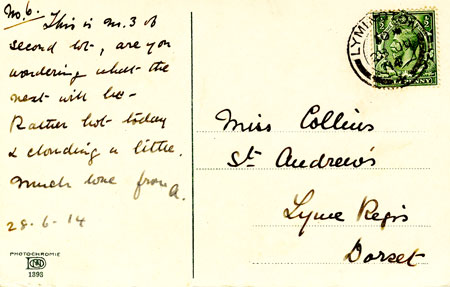
The postcard shows a quiet, tranquil beach scene, which when one looks at the reverse becomes particularly poignant.

It was posted in the summer of 1914, just a few weeks before the outbreak of World War One. What’s more, the date at the bottom, 28th June 1914, is the date that Archduke Franz Ferdinand, heir apparent to the Austro-Hungarian throne was assassinated in Sarajevo.

Filed Under: World War I Tagged With: Coast, Sea, With Love From A, World War I, WWI, WWI Postcards, WWI Postcards

Future Work

March 7, 2010 by Nicholas Hedges

Unless you’re me, this blog entry won’t make much sense.

Filed Under: World War I Tagged With: WWI Postcards, WWI Postcards

Mine the Mountain 2

February 27, 2010 by Nicholas Hedges

Postcards are a kind of conversation, inasmuch as they’re a connection between two places; one that’s unfamiliar and one that’s known. That’s not always the case of course, but their form’s a framework – a metaphor – with which I try to engage with the past.; to find its lost, anonymous individuals. ‘The Past is a foreign country’, wrote the author L.P. Hartley in the first line of his novel The Go-Between. Whatever information we receive about that place, whether in writing, an object, a painting or a photograph, it comes like a postcard from a foreign shore.

Postcards are fragments, pieces of a world which has vanished, often carrying information of little or no consequence. In the translator’s foreword to The Arcade’s Project, Walter Benjamin’s ‘monumental ruin,’ we read:

“It was not the great men and celebrated events of traditional historiography but rather the ‘refuse’ and ‘detritus’ of history, the half concealed, variegated traces of the daily life of ‘the collective,’ that was to be the object of study.”

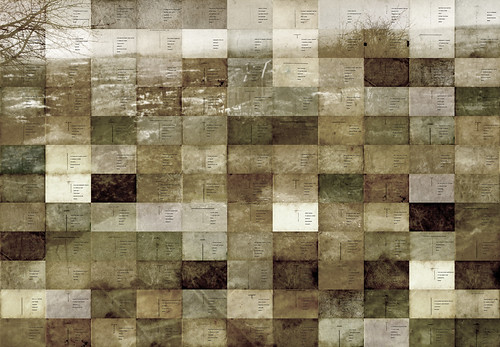
The ‘collective’ is represented in this exhibition by the sheer number of postcards and the pictures which they make when grouped together as a whole. What their component images say, echoes my attempt to find the individual so often subsumed, both in unimaginable numbers and the history which we read in books or know through film and television.

In photographs we often come closest to finding individuals when – ironically – they’re distant, when they’re blurred and unaware of the picture being taken. These are genuine moments of history. With words, it’s often the smallest of details which brings the past alive, for in these parts the whole of the time from which they’re now estranged is immanent.

Tom Phillips, in the preface to his book ‘The Postcard Century’ writes that with postcards:

“High history vies with everyday pleasures and griefs and there are glimpses of all kinds of lives and situations.”

High history sits in every word, even in the ‘x’ of a single kiss. Or the words in the postcard below; prices for Train, Ale and Fags.

Reverse WW1 Postcard

A postcard too is often the physical trace of a journey, one connecting the dots from the place in which it was posted to its final destination. But this destination’s never really reached, and as such, a conversation which may have begun 100 years ago, is never finished. We read the words today, written before we’d ever the hope of existing, sent by those who don’t exist anymore.

The images in this exhibition are not ‘genuine’ postcards per se, but they are (for the most part) postcard-sized, inspired by a collection dating from the First World War. It’s the idea of the part (the individual image) as being a part of a whole which interests me and the whole being immanent in the part, just as humanity is immanent in every individual.

Filed Under: World War I Tagged With: LP Hartley, Postcards, Tom Phillips, World War I, WWI, WWI Postcards, WWI Postcards

Front and Back Battlefield

February 11, 2009 by Nicholas Hedges

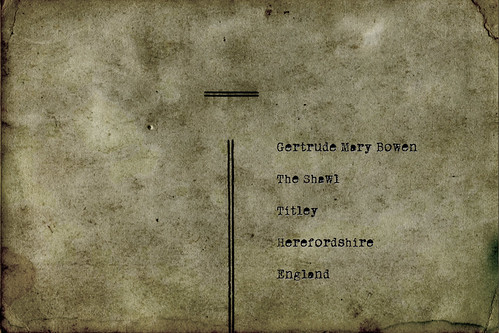
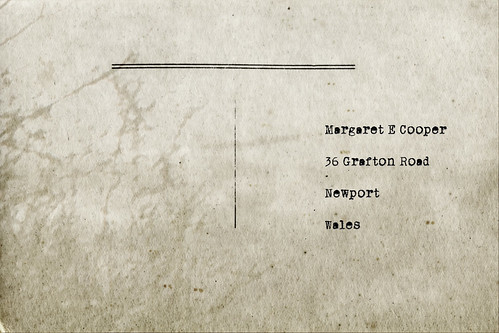
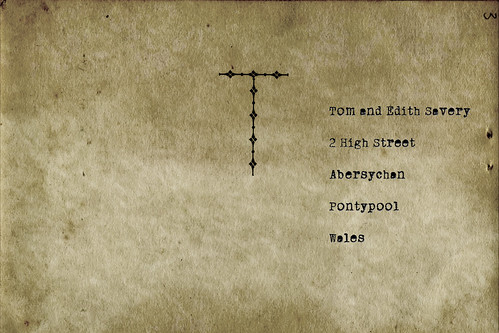
Below are examples of the postcards I have made featuring the names and addresses of next-of-kin of men of the 2nd Monmouthshire Battalion who fell in the Fisrt World War. I’m making the work for a conference in Tourist Experiences: Meanings, Motivations, Behaviours at UCLa in April. The first image shows the postcards in their entirety.
Front and Back Battlefield Full View

Front and Back Battlefield

Front and Back Battlefield

Front and Back Battlefield

Front and Back Battlefield

Filed Under: World War I Tagged With: Front and Back, World War I, WWI, WWI Postcards, WWI Postcards

Front and Back (2nd Mons)

January 27, 2009 by Nicholas Hedges

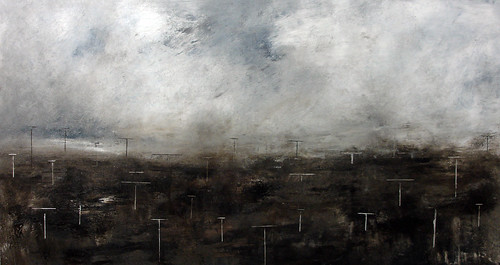
I started work on a new painting today based on the work I made as part of my Mine the Mountain exhibition. This piece, Front and Back (2nd Mons), uses the ‘T’ shaped divides on the backs of postcards which are then stencilled onto the canvas, already painted with a generic battlefield scene. I would really like to paint this on a large scale but we’ll see how this goes first.

Front and Back (2nd Mons)

Filed Under: Paintings Tagged With: A Line Drawn In Water, Front and Back, Paintings, World War I, WWI, WWI Postcards

Connections

August 7, 2008 by Nicholas Hedges

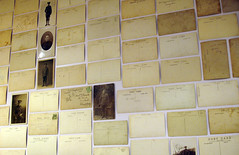
This evening I began working on an idea I’ve had for a while which incorporates the World War 1 postcards I was given by Tom Phillips. The idea was to show these postcards on a wall but with only a few the right way round i.e. showing the portrait (they are all portrait postcards of soldiers, most individual, some with other people). The rest would be displayed reversed showing either writing or, as is mostly the case, nothing – they would just be blank. I wasn’t sure how this would look and so I began putting the postcards up on my bedroom wall and fairly quickly I could see that the postcards, displayed in this way had an impact.

Very Lights

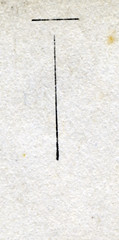
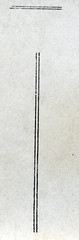
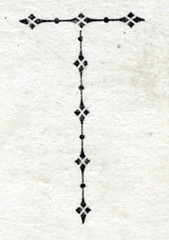
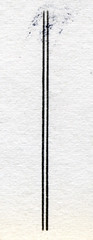
There was something about the blank postcards which was particularly resonant and the more I looked, the more I could see what it was that leant them this quality. On most of the blank postcards there is a motif running down the centre of the card (dividing the address from the text). These lines are of various designs, some very simple, others more elaborate. I decided to scan a few which can be found below.

Reverse Motif

Reverse Motif

Reverse Motif

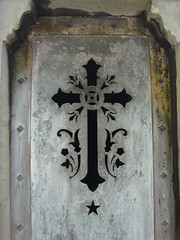
For me these motifs have something of the grave about them, perhaps because they are each shaped a little like a crucifix, and they reminded me of some of the memorials I had seen in the Montparnasse Cemetery in Paris.

Paris

And as I started making connections, I thought of the X paintings and those I discussed in a previous entry – Black Mirrors and thought about how these marks could be incorporated into a work just like the symbol of the ‘X’.
X (Mine)

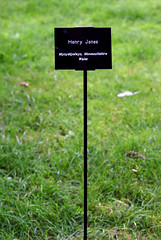
I also thought how these various motifs/symbols resembled the botanic labels I’ve had made, each engraved with the name of one of my ancestors such as that of Henry Jones (below).

Deadman's Walk (Henry Jones)

And finally, one last connection between the motifs and a work I made in November 2006, soon after a visit made to Auschwitz-Birkenau.

Reverse Motif

7

Reverse Motif

Filed Under: Holocaust Tagged With: Cemetery, Connections, Holocaust, World War I, WWI, WWI Postcards, WWI Postcards, WWII, X

Kisses

July 31, 2008 by Nicholas Hedges

Following on from my previous two entries regarding ‘Xs‘ (the signature of the illiterate, a secret location marked on a map), I wanted to look briefly at another use of the mark, that of course being the kiss. I was prompted to do this whilst selecting a number of World War One postcards for a new project website; www.8may.org – a project I hope to carry out next year. Most of the postcards are blank, but on a few there is some writing; the scrawl of a soldier or a more recent label, ‘Mum’s uncle.’ for example. One particular card however took my interest for it contained the mark I had recently been applying to my paintings. In my most recent versions of the ‘X’ paintings (those which have been obliterated by graphite powder) I have been scratching the symbol into the dust whilst considering the many anonymous miners who lost their lives deep underground at the time my great, great-great and great-great-great grandfathers were working in the pits of South Wales.

As I’ve written before, Rainer Maria Rilke wrote that those who die leave their names behind as a child leaves off playing with a broken toy. Those who died in the mines left their names underground; most would not have known how to write them, doing instead what my ancestors did and marking documents only with an ‘X’. And many of those men from the 19th century have all but been forgotten, their names discarded, swept away like Rilke’s broken toys. Even their graves might be lost, their remains buried and marked with an ‘X’, secrets known only by the earth itself.

X - Kisses

The Xs on the postcard above are also marks of anonymity. We know they are kisses but we don’t know who they’re for or who gave them. But we know they are symbols of a relationship which once existed, whether between lovers, friends or relations; someone loved someone else. Many of those who fought in the Great War never returned home – all that did return were a few words on a postcard; and ‘Xs‘ – farewell kisses as they came to be. Hundreds of thousands of men not only lost their lives, but they have no known grave. Many too lost their names altogether. These Xs on the postcard therefore become symbols for their future anonymity, their unknown graves; their lost names.

And the Xs which I’ve scratched into dust on my paintings also become a kind of farewell; a broken name, a secret location in time. They also become a farewell kiss to the world.

Filed Under: World War I Tagged With: Rilke, World War I, WWI, WWI Postcards, WWI Postcards, X

Zuleika Dobson

March 31, 2008 by Nicholas Hedges

It was through reading E.M. Forster’s lectures (collected in a book entitled ‘Aspects of the Novel’ and first published in 1927) delivered under the auspices of Trinity College, Cambridge, that I first came across a reference to Max Beerbohm’s satirical novel Zuleika Dobson. In particular it was a passage quoted by Forster as ‘this most exquisite of funeral palls… Has,” he goes on to say “not a passage like this a beauty unattainable by serious litertature?” The answer to that is in some respects yes and below is that very passage:

“Through the square, across the High Street and down Grove Street they passed. The Duke looked up at the tower of Merton… Strange that tonight it would still be standing there, in all its sober and solid beauty – still be gazing over the roofs and chimneys, at the tower of Magdalen, its rightful bride. Through untold centuries of the future it would stand thus, gaze thus. He winced. Oxford walls have a way of belittling us; and the Duke was loth to regard his doom as trivial.

Aye by all the minerals we are mocked. Vegetables, yearly deciduous are far more sympathetic. The lilac and laburnum making lovely now the railed pathway to Christ Church Meadow were all a-swaying and a-nodding to the Duke as he passed by – ‘Adieu, adieu your Grace,’ they were whispering. ‘We are very sorry for you – very sorry indeed. We never dared suppose you would predecease us. We think your death a very great tragedy. Adieu!”

The premise of the novel concerns the arrival into Oxford of the beautiful Zuleika Dobson, a woman of such beauty, any man who sees her cannot help but fall in love.

“To these Emperors, for whom none weeps, time will give no surcease. Surely, it is sign of some grace in them that they rejoiced not, this bright afternoon, in the evil that was to befall the city of their penance.”

Broad Street

The problem is that Miss Dobson herself cannot love any man who loves her in return and so, having fallen in love with the brilliant Duke of Dorset, her love is immediately lost on hearing of his reciprocal feelings. Spurned, there is only one course of action left to the Duke and that is suicide by drowning in the Isis during Eights Week. But such is the esteem in which he’s held, and such is the love every undergraduate holds for Miss Dobson, that almost the entire undergraduate population of Oxford plunges into the river and is lost.

Taking the plaintive tones of the passage above and some other extracts of the novel, I assumed (not recalling the date of its first publication) that Beerbohm’s novel was something of an allegory about the lost generation of the First World War, of the lost innocence of Edwardian Oxford. However, the novel was first published in 1911, and as such, the book is not unlike the pair of black owls which perch on the battlements of the Duke’s ancestral home and foretell of his death.

“Young Oxford! Here, in this mass of boyish faces, all fused and obliterated, was the realisation of that phrase. Two or three thousands of human bodies, human souls? Yet the effect of them in the moonlight was as of one great passive monster.”

Just after reading the novel, I started reading again Peter Vansittart’s survey of the First World War, Voices From the Great War. Comprising quotes, poems, letters and so on, the book paints a picture of the war through the long lost contemporaneous voices. I first bought the book following a visit made to Ypres and turned to it again having received a gift of almost 200 postcards from the time of the Great War.

World War 1 Serviceman

Taking the three together – Beerbohm’s novel, the postcards and the quotes – one begins to read the absurd fantasy of Zuleika Dobson in an altogether different way. We have all seen images of men cheerfully marching to the Front, waving their hats and shouting, and when one reads of the mass (almost cheerful) suicide of all the young men in the novel, one cannot help but compare.

“There was a confusion of shouts from the raft of screams from the roof. Many youths-all the youths there-cried ‘Zuleika!’ and leapt emulously headlong into the water. ‘Brave fellows!’ shouted the elder men, supposing rescue-work. The rain pelted, the thunder pealed. Here and there was a glimpse of a young head above water-for an instant only.
Shouts and screams now from the infected barges on either side. A score of fresh plunges. ‘Splendid fellows!'”

And from Vansitartt’s book…

“The enormous expansion of wealth in the peaceful years between 1908 and 1914 brought not happiness but fear, and fear so powerful that it could be expressed only in images of fear and destruction. When war came, it was almost universally accepted as something foreseen and foretold. Even those who loathed the notion of it acquiesced in it as inevitable, and it is not foolish to conclude that what ultimately brought the war was not the ambitions and fears of Germany, but a death-wish in the peoples of Europe, a half-conscious desire to break away from their humdrum or horrifying circumstances to something more exciting or more exalted.” C.M. Bowra

“War might drive a man till he dropped: it could be a dangerous and bloody business; we believed, however, that it still offered movement, colour, adventure, and drama. Later, when the murderous, idiotic machinery of the Western Front was grinding away, of course all was different.” J.B. Priestly

Of course it was different – the reality of the situation. And having turned the last few pages of Beerbohm’s novel, I wondered what it would have looked like, all those dead young men lying prone in the waters of the Isis.

Filed Under: World War I Tagged With: Memory, Nowness, World War I, WWI, WWI Postcards, WWI Postcards, Zuleika Dobson

  • « Previous Page
  • 1
  • 2

© Nicholas Hedges 2024

  • Facebook
  • Instagram
  • Twitter
  • YouTube

Copyright © 2025 · Outreach Pro on Genesis Framework · WordPress · Log in