Nicholas Hedges

Art, Writing and Research

  • Amazon
  • Behance
  • Facebook
  • Instagram
  • Pinterest
  • YouTube
  • Art
    • Digital
    • Drawing
    • Grids
      • Correspondence
      • The Wall
      • The Tourist
    • Ink on paper
      • Shadow Calligraphy
    • Installation
      • Murder
      • Echo
    • Painting
    • Patterns
    • Mixed Media
    • Photographic installation
      • St. Giles Fair 1908
      • Cornmarket 1907
      • Headington Hill 1903
      • Queen Street 1897
    • Research/Sketches
    • Stitched Work
      • Missded 1
      • Missded 2
      • Missded 3
      • Missded 4
    • Text Work
  • Blogs
    • Family History
    • Goethean Observations
    • Grief
    • Light Slowed But Never Stilled
    • Lists
    • Present Empathy
    • Shadow Calligraphy
    • Trees
    • Time
    • Walking Meditations
  • Video
  • Photography
    • Pillars of Snow
    • Creatures
    • The Trees
    • Snow
    • St. Giles Fair 1908
    • Cornmarket 1907
    • Headington Hill 1903
    • Queen Street 1897
    • Travel
  • Illustration and Design
  • Music
  • Projects
    • Dissonance and Rhyme
    • Design for an Heirloom
    • Backdrops
    • Shadow Calligraphy
  • Exhibitions
    • A Line Drawn in Water
      • Artwork
    • A Line Drawn in Water (Blog)
    • Mine the Mountain 3
      • Artwork
    • Mine the Mountain 2
      • Artwork
      • The Wall
    • The Woods, Breathing
      • Artwork
    • Snow
      • Artwork
    • Echo
      • Artwork
    • Murder
      • Artwork
    • The Tourist
    • Dreamcatcher
    • Mine the Mountain
      • Artwork
      • The Tourist
    • M8
    • The Gate
    • Creatures
      • Artwork
    • Residue
      • Artwork
    • A visit to Auschwitz
      • Artwork
  • Me
    • Artist’s Statement

All Present Standing in Silence

November 21, 2014 by Nicholas Hedges

“On Sunday last, at the close of the evening service, the Society Meeting was held, and references to the death of Private Rogers were made by several members of the Church. Private Rogers’s mother is one of the oldest members of the Church. The meeting passed a vote of condolence with the relatives, all present standing in silence.”

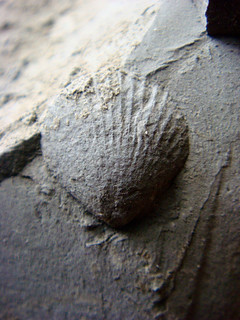
It’s strange to think these words have lain silent for 100 years – hidden like fossil-shells pressed between the pages of a cliff face. Recounting, as the fossil recalls a vanished sea, a contemplative scene of remembrance, the scene now remembers as much itself as it does the fallen soldier.

A few years ago, I happened upon a quote of Rilke’s, paraphrased as part of an exhibition. The ‘depth of time’ it said, was revealed more in human gestures than in archaeological remains or fossilised organisms. The gesture is a ‘fossil of movement’; it is, at the same time, the very mark of the fleeting present and of desire in which our future is formed’

Reading the passage with which I began, I am struck in particular by the last few words: ‘all present standing in silence.’ As I read the words, the quiet gestures of my ancestors 100 years ago are made visible, felt. Like the lines on a fossil-shell – such as that pictured below – recalling in their pattern the vanished seas in which their signified others once lived, so in the words of Jonah Rogers’ obituary, one can hear the faintest echoes of World War I, not the sound of the battlefield, but the speeches and reciprocal silence of those inside the chapel.

But it’s not only their gestures – those inside the chapel – which, as I read the text, I can see and feel. It’s also those of a time before the war; times which like the gestures released by the text, were no doubt remembered by the mourners, recalled by limbs, nerves and twitching muscles as well as the very fabric of the place in which they were standing. Perhaps those who made “references to the death of Private Rogers” were talking about such times.
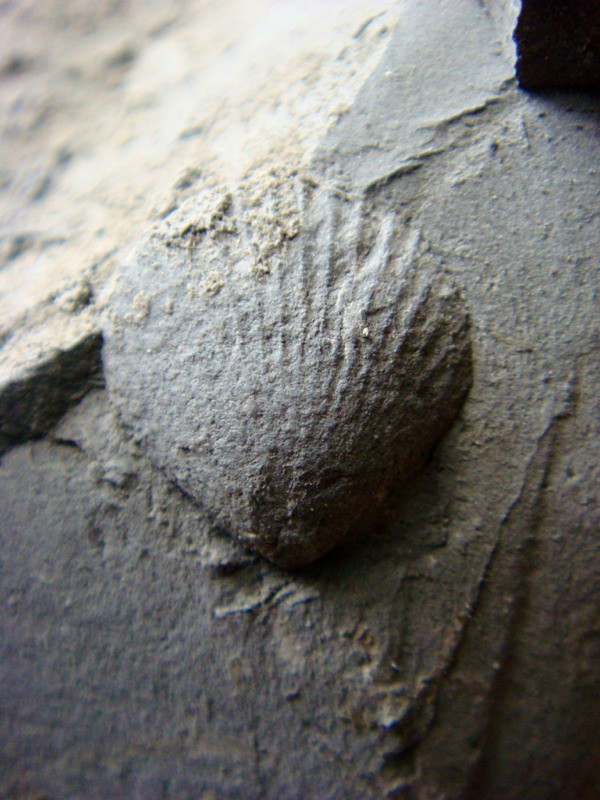


The lines of the shell’s imprint, in the photograph above, were made 195 million years ago, when mankind was beyond even the furthest reaches of improbability. When I read the closing words of my great-great uncle’s obituary, I imagine those gathered inside the church, struggling within the limits of their imaginations, to comprehend that other place which, although certain, exists – within the human mind – beyond the reaches of improbability; death.

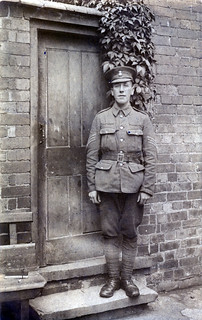
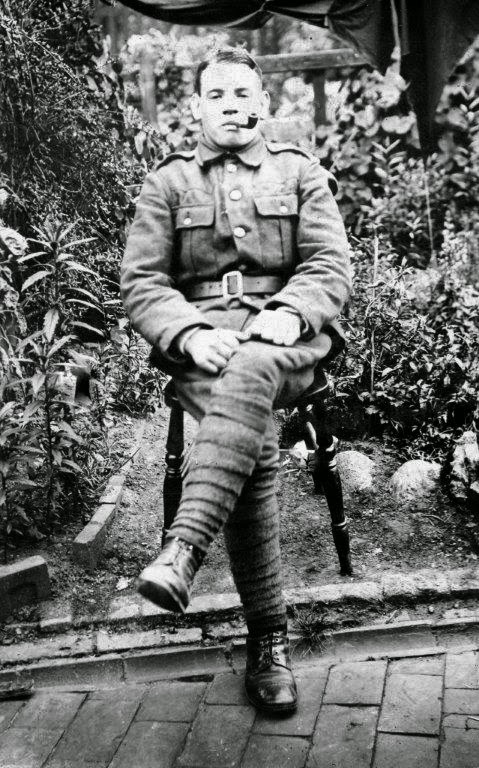
This obituary concerns the death of Jonah Rogers (pictured above) and yet all those inside the chapel are now dead; it is now as much about their deaths as his. And reading this text I am aware too of my own fragile existence. When that meeting took place, sometime in the summer of 1915 I did not exist. I too was also well beyond the reaches of improbability. And yet, it is in my imagination that this scene is taking place.
Filed Under: World War I Tagged With: Fossils, Gesture, Jonah Rogers, Obituary, Rilke, Silence, WW1 Centenary, WWI

Goethean Observation of a Fosslised Shell

August 3, 2013 by Nicholas Hedges

Shells
Fossilised shell (right)

Part 1

The object is a lump of soft grey rock. It is irregular in its appearance except for a small part about 1cm square, which is extremely regular in its form. The piece of rock is heavy and feels quite dense and sits comfortably in the palm of my hand. If I scratch the surface with my finger nail a mark is left behind. The texture of the piece of rock is rough but at the same time its softness makes it feel quite smooth to the touch. Part of its surface is smoother than that on the other side and it is on this side I can see the regular pattern of lines and a couple of other circular imprints. This smooth part of the rock feels softer than that on the outside – indeed there seems to be a distinction between an outside and an inside. The inside is defined in some respects by what looks like a cut. The ridge is about a centimetre deep and is irregular in shape, although it seems, compared with the other side, more regular.

The very distinguishable pattern is a shell. I can see the ridges running from its outer edge at the top to the bottom. There also seems to be a dark patch running from one side to the other about a third of the way down from the top. There is a distinguishable bulge at the bottom of the shell where all the lines meet.

The rock feels cool but not cold (as I write my observations outside in the garden, a breeze is blowing, turning the pages and agitating the protective wrappings in which I keep the rock). Looking carefully at the surface of the rock, on what I have called its outside, I can see small patches of grey which unlike the rather dull complexion of the rock are quite shiny, reflecting the light of the evening. The rock seems encrusted with crumbs of rock which it seems I could easily rub off with my thumb.

The rock has about nine surfaces or faces including the ridge mentioned earlier and the face on which you can find the form of the shell. Whereas the crumbs of rock and the lines, imprints and grey shining patches seem an integral part of the rock; the shell-like form seems (although it is made of the same thing) separate somehow. It is both the rock and something entirely different.

As the wind blows a little, everything moves it seems, save for the rock (and the table on which it is resting). It feels in my hand extremely fragile, as if should I drop it, it would break apart. Certainly I feel as if I could break pieces off with my bare hands.

Although to the eye there are faces of the rock which seem rough and those which seem much smoother, it feels nonetheless as I hold it in my hand the same texture all over. It has in some respects the look of a piece of bone (like a hip joint) or a worked piece of stone – an ancient tool for example.
As I write I can hear the odd shout in the street.

Part 2

The piece of rock is a fossil found in a large piece of rock next to cliffs at Charmouth. The rock is dated to around 195 million years old. The whole of this piece of rock has therefore been part of an inside for a period of time that is unimaginable in my human brain. It was once part of the cliff and therefore one can imagine that it would have been under a great weight. Of course the piece of rock only became a piece of rock because the cliff face eroded. Then part of the face collapsed, a smaller piece was broken open and inside the shell was revealed. For much of its incredible life span then, it wouldn’t have been a piece but rather a whole. And, therefore, this piece wouldn’t have born the whole weight of the cliff upon its shoulders; this weight would have been distributed throughout the layer of which it was a part.

The shell would, like the rest of the rock, have been covered (surrounded by ‘other rocks’). It is the breaking open of it which gives it a sense of being ‘inside’. Imagining it surrounded by rock, a seamless expanse of rock, one does have a sense of darkness and a sense of weight – immense dark and immense weight. When I found it and broke it open, there was, suddenly the sense of lightness and indeed light, whereupon the pattern of the shell’s form was revealed for the first time in over 195 million years.

The light from the sun in the present day allows me to see the lines – the same sun that would have shined above the sea 195 million years ago.

This sense of an outside and an inside: the inside is hidden from view – invisible, and yet it exists. Looking at a cliff one sees colossal weight, density and reaching my eyes inside, I can picture only darkness. And yet, looking at this rock, one sees a form which is fragile, delicate, regular, light. The cliffs must be full of such tiny shapes – full of fragility; a delicate, lightness of touch. This mirrors the time before the rock was formed, when the shell was a living creature in the seas. One can imagine the light of the sun on the sea, the lightness of the creature – its fragility as it lived. There is a sense of the sea being light (in terms of sunlight and a lack of weight) and yet the sea is also impenetrably dark and heavier than the cliffs which we see today.

(The cliffs are little different then to the sea. They are not static, but are moving, slowly – too slow for our eyes until the second they slide.)

The shell would have been compressed on the sea floor over tens of thousands, hundreds of thousands, millions of years. Its outline, its shape, its ridges and perhaps its surface pattern were fixed as lines of incredible delicacy. The sea levels fell, the rocks shifted: huge, unimaginable forces, acting over vast, incomprehensible spaces of time – and yet this shape and these lines have remained. And all the while these lines have existed – this tiny shape has existed, whole epochs have come and gone – creatures have evolved ; whole species, including the dinosaurs have come and gone; the great mammals and so on. And finally man has evolved too. There is the sense that I’m looking only at the shell rather than the rock of which it is a part.

This lump of ‘unremarkable’ rock, shapeless, rough, grey, ugly, is just as ancient and incredible as the beautiful, perfect shell which is a small part of it.

Part 3

Movement. Frozen.
The individual object which is not a part but a whole.
Air, light, water, colour condensed to make this soft, grey mass.
Delicacy of life translated into the delicacy of the small pattern on the rock’s surface.
(The light fades outside where I write and the shape of the shell begins to dissolve into the rock).
Movement of the shell. Movement of continents.
Movements of creatures, of time on an evolutionary scale. The weight of time which this patten of lines has withstood for 195 million years.
(What can humans withstand as individuals and as a species?)
(Colours begin to face into darkness).

Part 4

Movement returned to the rock from the moment it was found and carried in my hand – carried into the garden this evening.
Movement of that creature, of everything that sank to the seabed, of the water above, whose weight pressed upon it – now becomes/joins with my own movement through time/this world.
The light that allows me to see the lines of the shell – its shape, eyes which would have evolved since that shell was in the sea.
The delicacy of light, of eyes.
Lightness. Weight. Pressure.
Light. Vision.
Lines.

Filed Under: Goethean Observations Tagged With: Fossils, Goethean Observation, Shells

Two Shells

August 2, 2013 by Nicholas Hedges

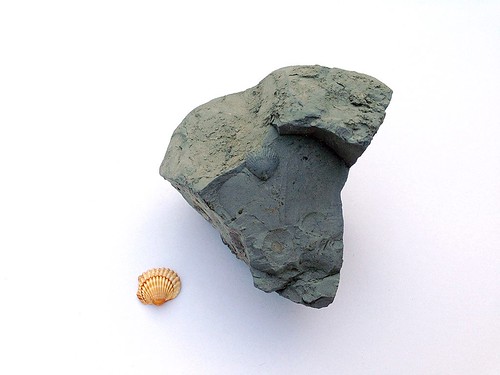
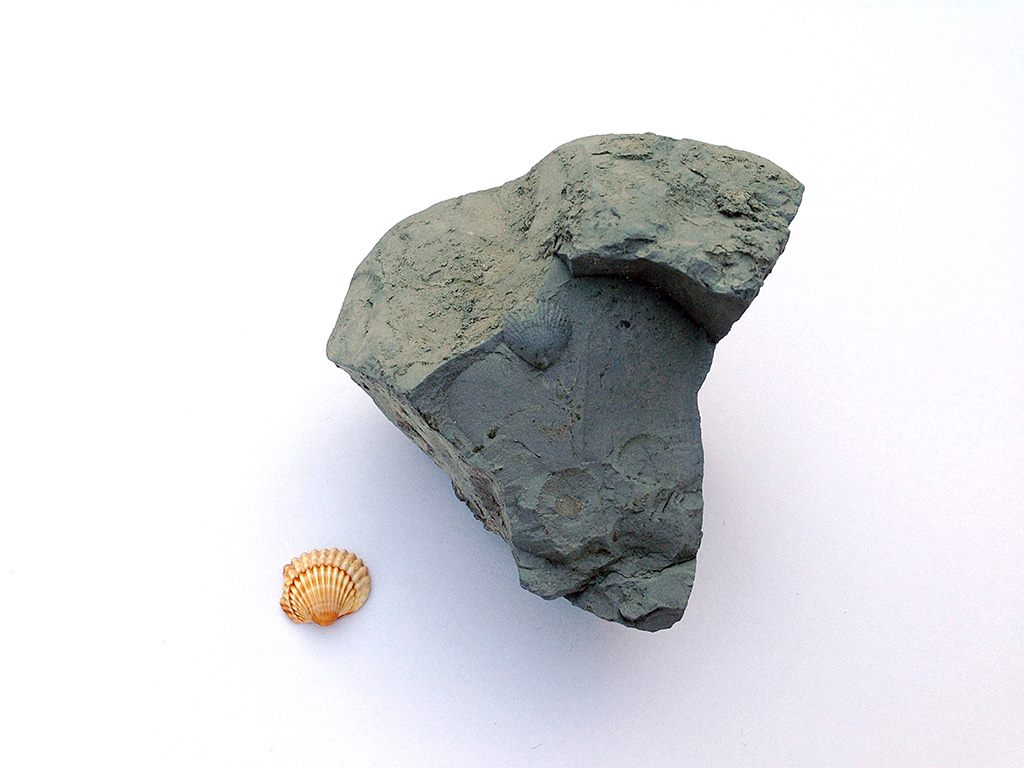
I found the shell on the left on a beach in Spain last week. The shell on the right (on which I’ve previously written), I found in 195 million year old rock on a beach in Charmouth at New Year.

Filed Under: Uncategorized Tagged With: Fossils, Shells, WW2

Thoughts

May 10, 2012 by Nicholas Hedges

IMG_1029
Fossilised shell, around 195 millions years old

“As physicists have pointed out, it is no accident that we see stars in our sky, for stars are a necessary part of any universe capable of generating us. Again, this does not imply that stars exist in order to make us. It is just that without stars there would be no atoms heavier than lithium in the periodic table, and a chemistry of only three elements is too impoverished to support life. Seeing is the kind of activity that can go on only in the kind of universe where what you see is stars.”
Richard Dawkins

Bartlemas Chapel Excavation
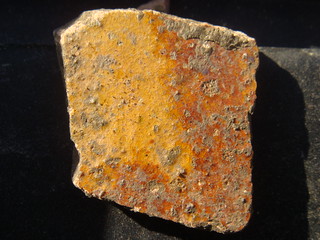
Mediaeval pottery shard

“Only God knows the reason for those changes linked with the mystery of the future: for men there are truths hidden in the depths of time; they come forth only with the help of the ages, just as there are stars so far removed from the earth that their light has not yet reached us.”
Chateaubriand

World War 1 Serviceman
Photograph of World War I serviceman 

“From a real body, which was there, proceed radiations which ultimately touch me, who am here; the duration of the transmission is insignificant; the photograph of the missing being as Sontag says, will touch me like the delayed rays of a star. A sort of umbilical cord links the body of the photographed thing to my gaze – light though impalpable, is here a carnal medium, a skin I share with anyone who has been photographed.”
Roland Barthes

Filed Under: Quotes Tagged With: Fossils, Fragments, Pottery, Quotes, Shells, Stars, Useful Quotes, WWI Postcards

Jurassic Shell

April 8, 2012 by Nicholas Hedges

I discovered this fossilised seashell, whilst hunting for fossils on the beach at Charmouth. The beach is part of the Jurassic Coast in Dorset – a UNESCO World Heritage site – and is famous for the fossils which one can find there.


The fossil itself is small but rather beautiful. Its shape is clearly delineated and one can even see the different shades of grey on what was once its shell. Its shape is utterly familiar and yet it comes from a time beyond our wildest imaginations.

This shell, this familiar pattern of lines, is around 195 million years old. It was extant in this form throughout the time of the dinosaurs. It ‘witnessed’ their demise and the emergence of man millions of years later. It has ‘seen’ man evolve from the earliest ancestors to the first modern homo-sapiens.

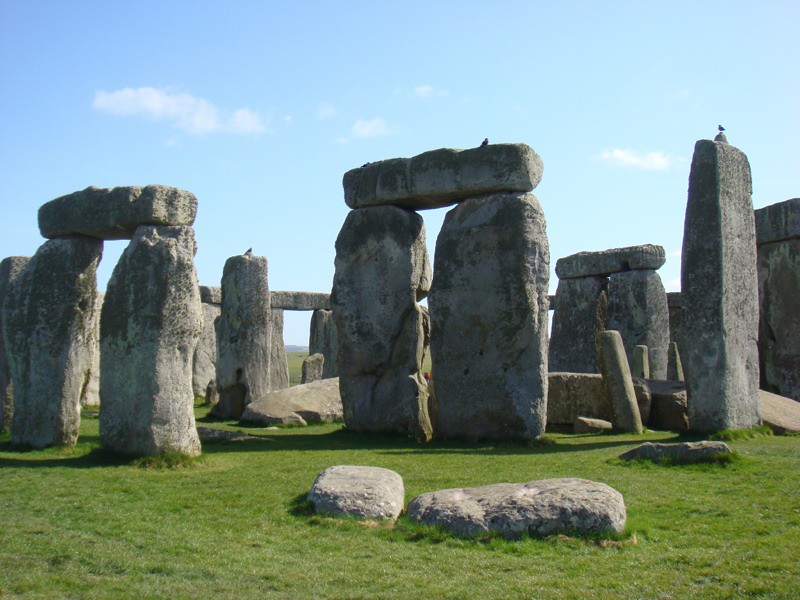
On the way down to Dorset, we stopped off at Stonehenge and marvelled at the stones whose exact purpose still remains a mystery. What I find most incredible is their age, somewhere in the region of 4,500 years old. To think what has happened in the intervening years is incredible, yet its age pales into insignificance when one considers that the small piece of shell-shaped rock above is over 40,000 times its age.


But what is interesting is that whereas the stones of Stonehenge are ‘unfamiliar’ (not of course in the sense of not having seen them before but rather as everyday objects), the seashell is part of the everyday world today – at least that of the seaside (in fact I found one like it on the beach in Lyme Regis just a few miles away). In this sense, it becomes easier almost, to bridge the gap between now and a time 195 million years ago, than it does to that of the Neolithic.

But in discovering the fossil, I found myself beginning to contrast the moment I broke open the rock to reveal it, with all the moments that have filled the 195,000,000 years since the shell fell to the sea floor. Moments when dinosaurs walked the Earth; moments when the world changed shape to make the countries and continents with which we are familiar. Moments when the dinosaurs became extinct, when mankind emerged to become what we are today; when the ice age came and passed… etc.

Filed Under: Uncategorized Tagged With: Fossils, Shell, Stonehenge

Atlas at the Reina Sofia, Madrid

April 3, 2011 by Nicholas Hedges

The following short piece of text was taken from the Atlas exhibition at the Reina Sofia Gallery in Madrid which I visited last week. I’ve always loved Rilke’s work and it’s been of some importance in my research. Reading the following, it’s clear to me that that influence will only become even greater as I continue.

‘The poet Rainer Maria Rilke said that the “depth of time” was revealed more in human gestures than in archaeological remains or fossilised organisms. The gesture is a “fossil of movement”; it is, at the same time, the very mark of the fleeting present and of desire in which our future is formed.’

Filed Under: Quotes Tagged With: Exhibitions, Fossils, Gesture, Quotes, Rilke, Useful Quotes

© Nicholas Hedges 2024

  • Facebook
  • Instagram
  • Twitter
  • YouTube

Copyright © 2025 · Outreach Pro on Genesis Framework · WordPress · Log in