Nicholas Hedges

Art, Writing and Research

  • Amazon
  • Behance
  • Facebook
  • Instagram
  • Pinterest
  • YouTube
  • Art
    • Digital
    • Drawing
    • Grids
      • Correspondence
      • The Wall
      • The Tourist
    • Ink on paper
      • Shadow Calligraphy
    • Installation
      • Murder
      • Echo
    • Painting
    • Patterns
    • Mixed Media
    • Photographic installation
      • St. Giles Fair 1908
      • Cornmarket 1907
      • Headington Hill 1903
      • Queen Street 1897
    • Research/Sketches
    • Stitched Work
      • Missded 1
      • Missded 2
      • Missded 3
      • Missded 4
    • Text Work
  • Blogs
    • Family History
    • Goethean Observations
    • Grief
    • Light Slowed But Never Stilled
    • Lists
    • Present Empathy
    • Shadow Calligraphy
    • Trees
    • Time
    • Walking Meditations
  • Video
  • Photography
    • Pillars of Snow
    • Creatures
    • The Trees
    • Snow
    • St. Giles Fair 1908
    • Cornmarket 1907
    • Headington Hill 1903
    • Queen Street 1897
    • Travel
  • Illustration and Design
  • Music
  • Projects
    • Dissonance and Rhyme
    • Design for an Heirloom
    • Backdrops
    • Shadow Calligraphy
  • Exhibitions
    • A Line Drawn in Water
      • Artwork
    • A Line Drawn in Water (Blog)
    • Mine the Mountain 3
      • Artwork
    • Mine the Mountain 2
      • Artwork
      • The Wall
    • The Woods, Breathing
      • Artwork
    • Snow
      • Artwork
    • Echo
      • Artwork
    • Murder
      • Artwork
    • The Tourist
    • Dreamcatcher
    • Mine the Mountain
      • Artwork
      • The Tourist
    • M8
    • The Gate
    • Creatures
      • Artwork
    • Residue
      • Artwork
    • A visit to Auschwitz
      • Artwork
  • Me
    • Artist’s Statement

Maps and Ivory Gurney

July 16, 2012 by Nicholas Hedges

On the bus into work this morning I read the following in Robert Macfarlane’s ‘The Wild Places.’

“Woods and forests have been essential to the imagination of these islands, and of countries throughout the world, for centuries. It is for this reason that when woods are felled, when they are suppressed by tarmac and concrete and asphalt, it is not only unique species and habitats that disappear, but also unique memories, unique forms of thought. Woods, like other wild places, can kindle new ways of being or cognition in people, can urge their minds differently.”

Woods have always been places of intense interest to me, particularly as a boy when I would love to imagine England as being covered in ancient woodland. My interest in history wasnt so much an interest in the characters and machinations of past times, but a means of accessing the landscape of those times – a way into the woods. 

I would create maps of imagined places, all of which would be home to vast swathes of untouched and unspoiled forests. And while those maps were ‘of places’, they were much more a means into a place, a path into and through my imagination.

In the same book ‘The Wild Places,’ Macfarlane briefly discusses the poet, composer and songwriter Ivor Gurney (1890-1937) who like the poet Edward Thomas, loved to explore the countryside of his native county – Gloucestershire. In 1915, Gurney enlisted to fight in the Great War, and in the battlefields of the Ypres Salient, discovered what Macfarlane describes as an ‘anti-landscape,’ a place in which the only evidence of forests ‘were upright bare dead trunks, stripped of leaves, branches and bark by shrapnel and gunfire.’ As Macfarlane writes: ‘On the military maps of the area that Gurney used, some of the old names of the landscape remained. But many of the new names spoke of the avoidance of death, or of its arrival. Shrapnel Corner, Crump Farm, Hellfire Corner, Halfway House, Dead Dog Farm, Battle Wood, Sanctuary Wood. The woods were no longer there, however; these were ghost names only. The trees had been felled for revetting, or blasted from the earth by shells.’

As someone with an interest in maps and in trench maps, the above passage interested me, particularly as I’ve often thought about how the landscape of the First World war, replete with all its new names and new features, had been superimposed, or rather gouged out of the landsape, only to smoothed over with the passage of time. Its was a sudden landscape. A few scars, smoothed over with grass – or hidden by trees – are all that’s left, but the wounds are still weeping in its names – not so much those of soldiers inscribed on the thousands of headstones, but rather the names of places – Arras, The Somme, Ypres and Passchendaele. 
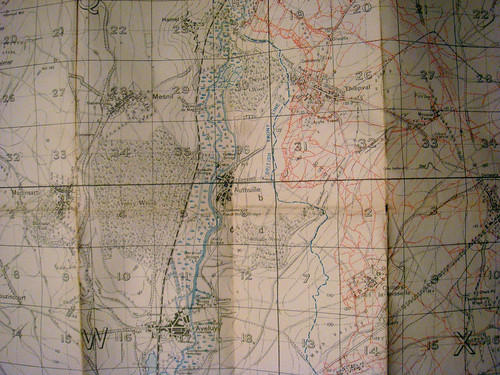
Trench Map 1916
Trench Map (1915)

In many places the woods have returned, and while the landscape today bears little resemblance to that of the war  – in which ‘the rich and complicated pasts of the trees that Gurney cherished’ had been so utterly effaced, it is nonetheless within those woods that one’s imagination picks up the voices of the past – of the fallen; voices which spoke in the midst of battle, of places and people cherished back home.
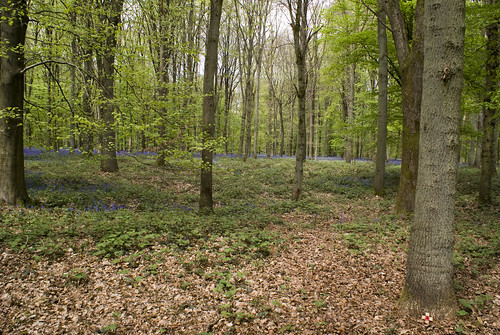
The Somme
Woods in The Somme

After returning from the war, Ivor Gurney, like so many others suffered a breakdown (he’d suffered his first in 1913) and a passage in Macfarlane’s book, which describes the visits to Gurney – within the Dartford asylum – by Helen Thomas, the widow of Edward Thomas is particularly moving. Helen took with her one of her husband’s Ordnance survey maps of Gloucestershire:

‘She recalled afterwards that Gurney, on being shown the map, took it at once from her, and spread it out on his bed, in his hot little white-tiled room in the asylum, with the sunlight falling in patterns upon the floor. Then the two of them kneeled together by the bed and traced out, with their fingers, walks that they and Edward had taken in the past.’

The map they laid on the bed was one that showed the familiar trails and paths of the countryside. But it was also one which, like that I made in my childhood, gave Gurney access to his imagination – to his own past. Together, the patient and his visitor read it with their fingers, following the trails as one follows words on a page. A narrative of sorts was revealed, memories stitched together by the threads of roads, paths and trails.
Filed Under: Trees, World War I Tagged With: Edward Thomas, Ivor Gurney, Maps, The Somme, Trench Maps, War Poets, World War I, WWI

New Work 3

February 20, 2012 by Nicholas Hedges

Filed Under: World War I Tagged With: Soldiers, The Somme, The Trees, Trees, World War I, WWI, WWI Postcards, WWI Postcards

New Work 2

February 9, 2012 by Nicholas Hedges

Filed Under: World War I Tagged With: Soldiers, The Somme, The Trees, Trees, World War I, WWI, WWI Postcards, WWI Postcards

New Work

February 7, 2012 by Nicholas Hedges

Filed Under: World War I Tagged With: Soldiers, The Somme, The Trees, Trees, World War I, WWI, WWI Postcards, WWI Postcards

Past and Present Postcard

January 25, 2012 by Nicholas Hedges

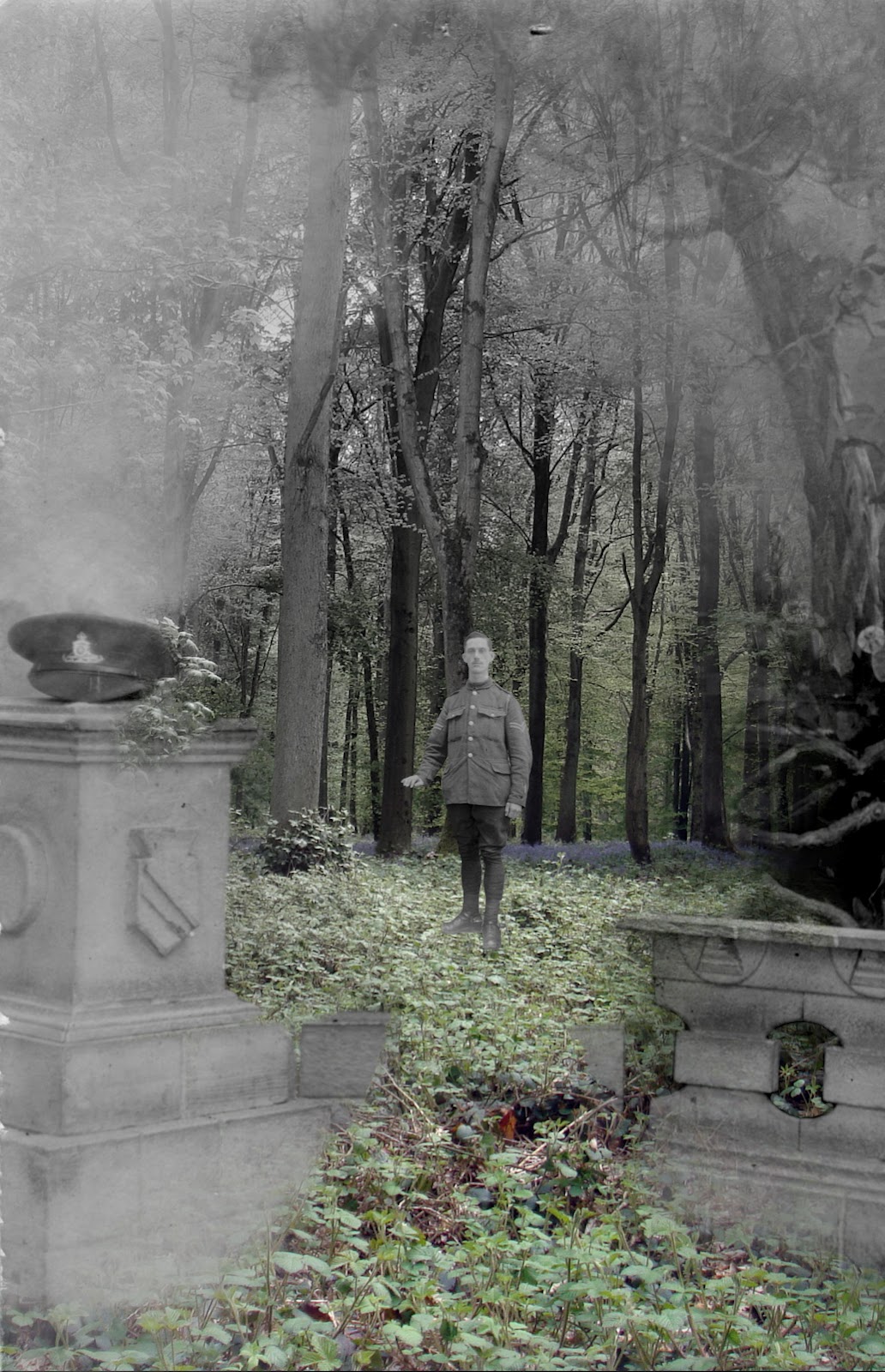
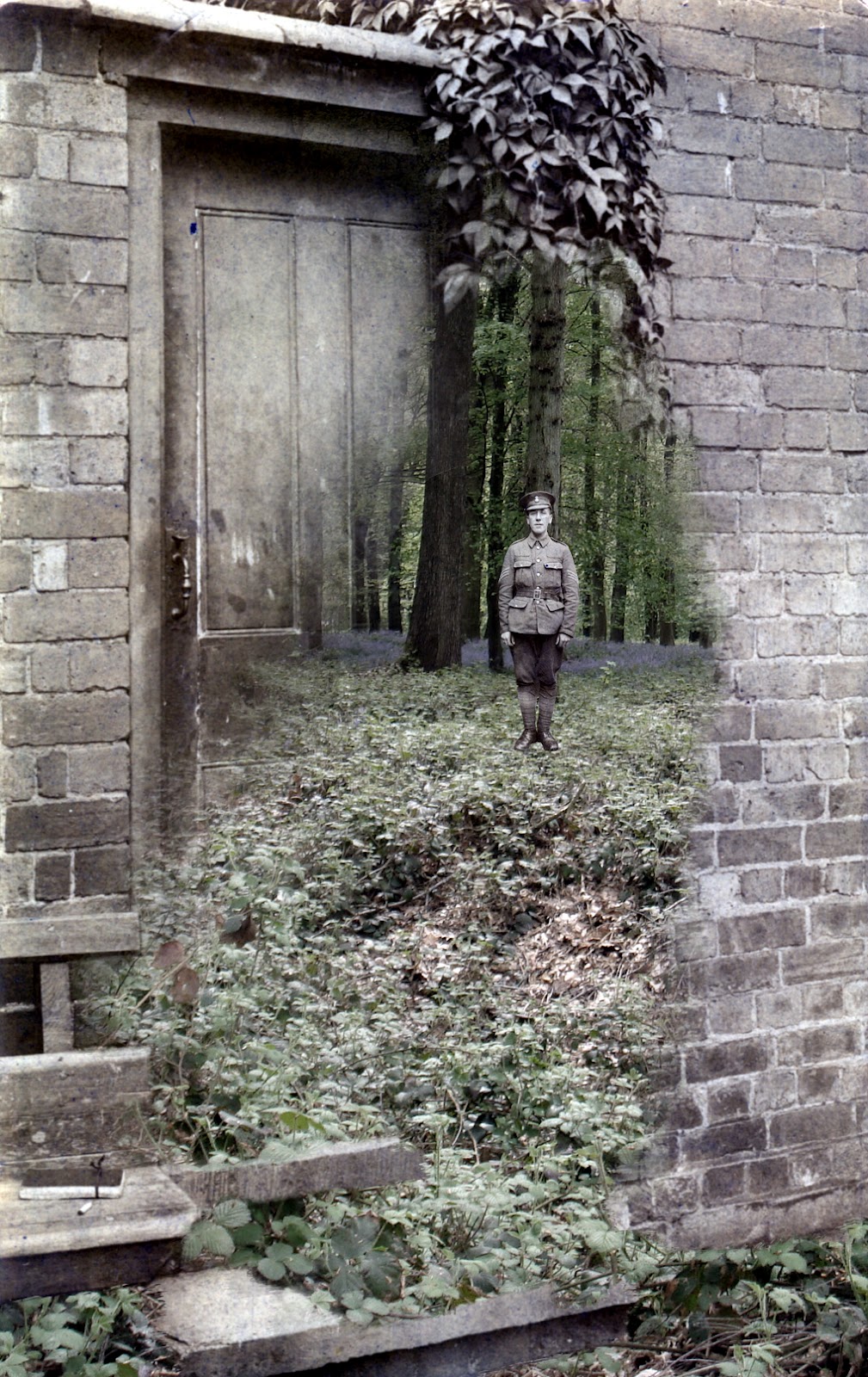
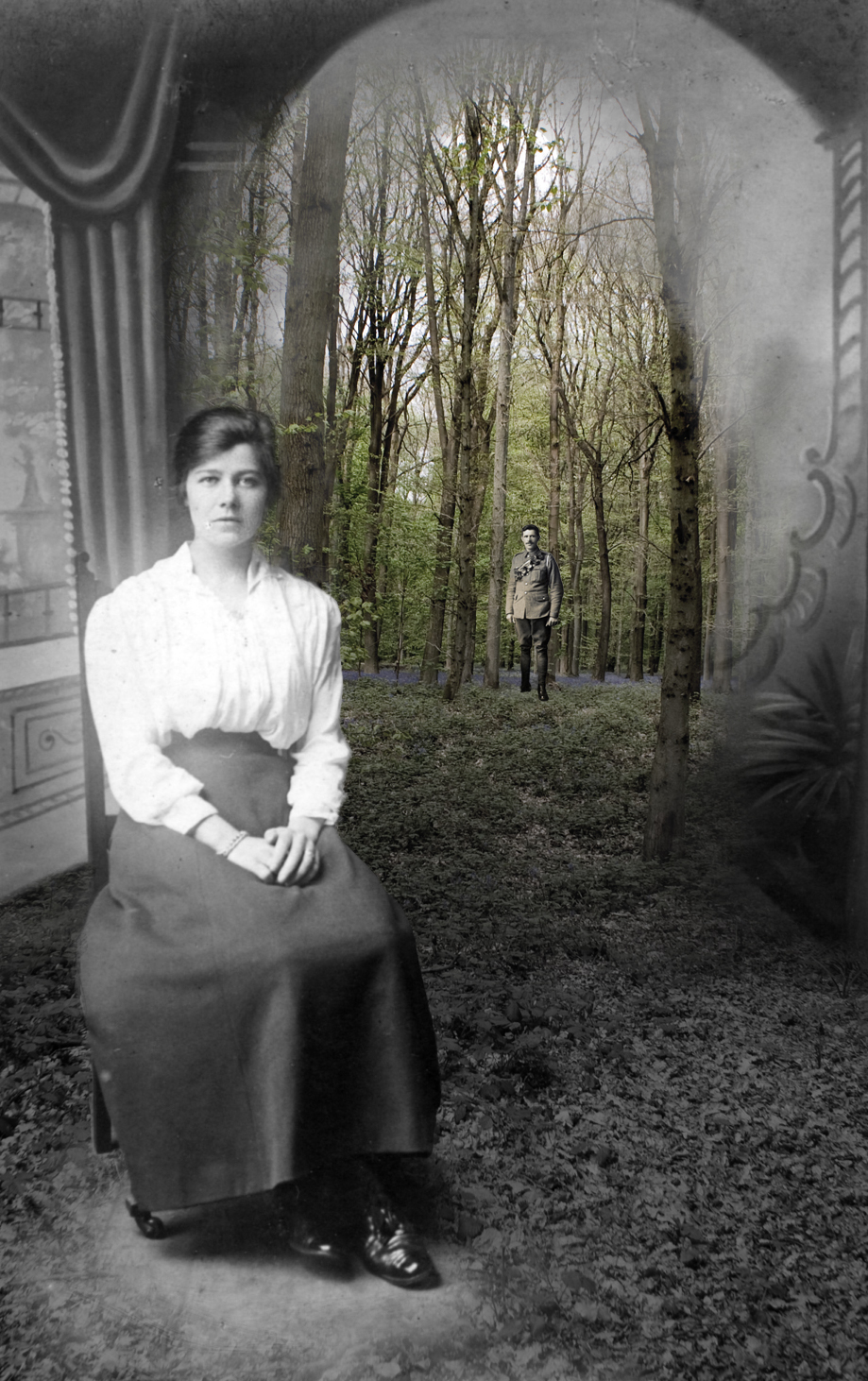
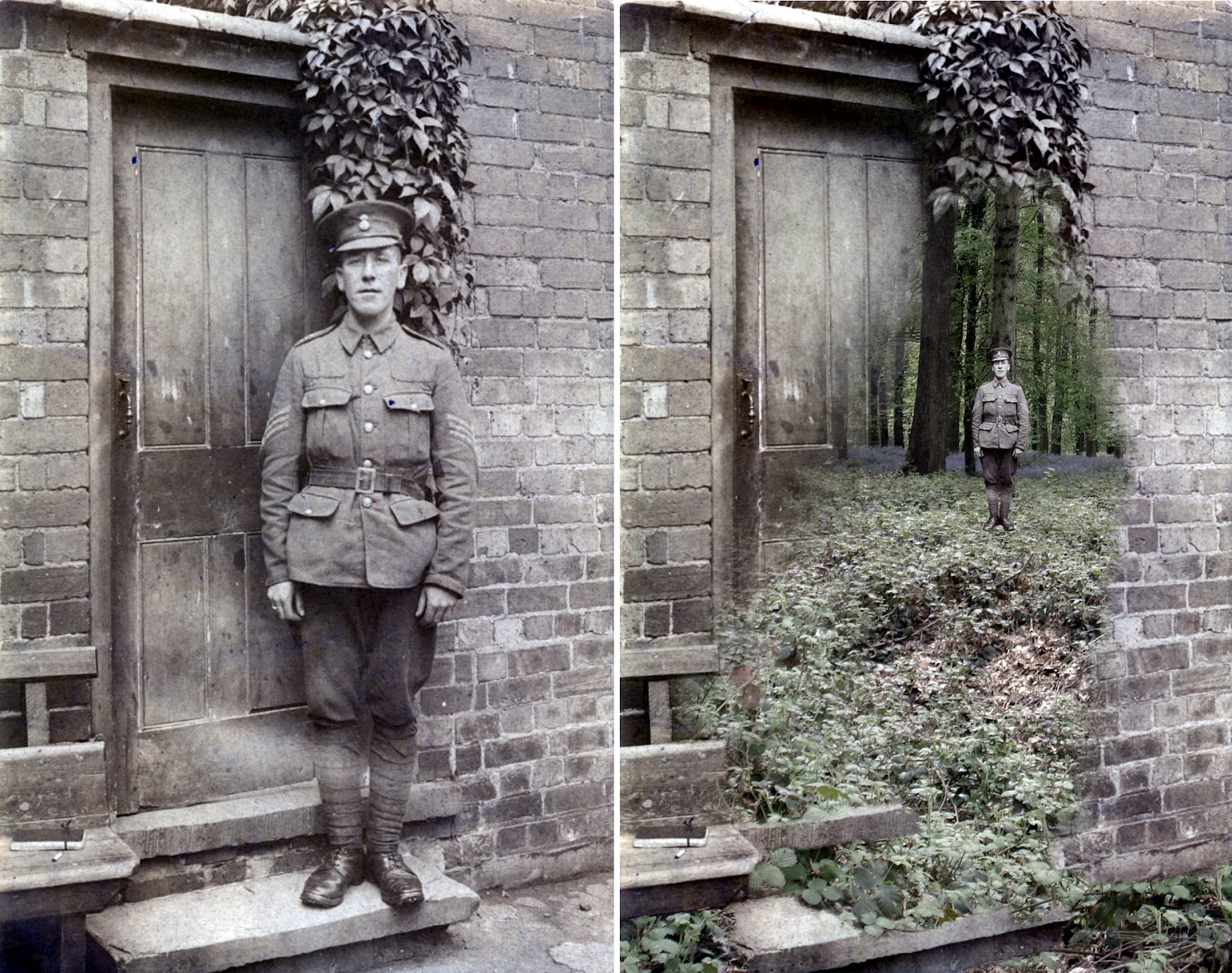
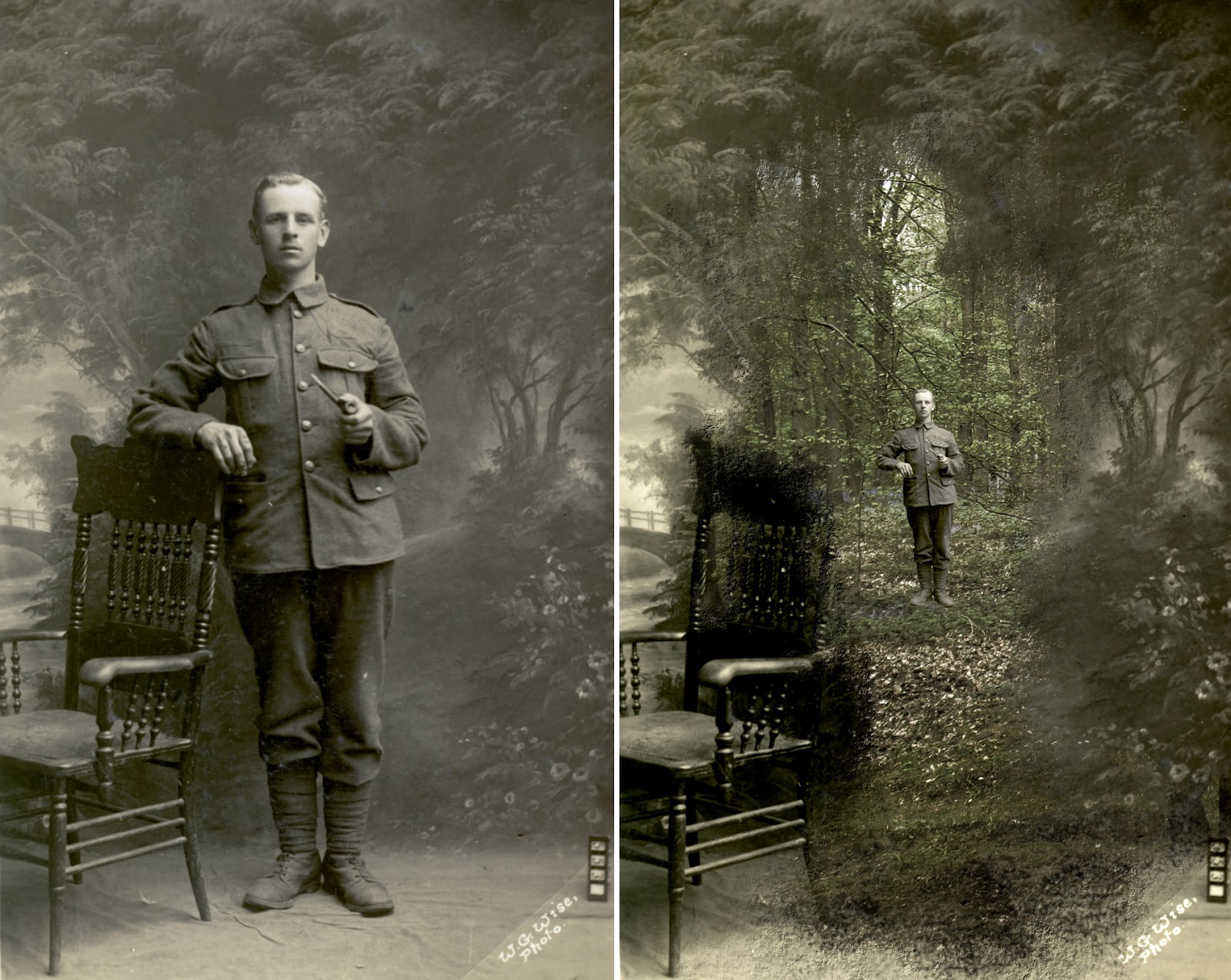
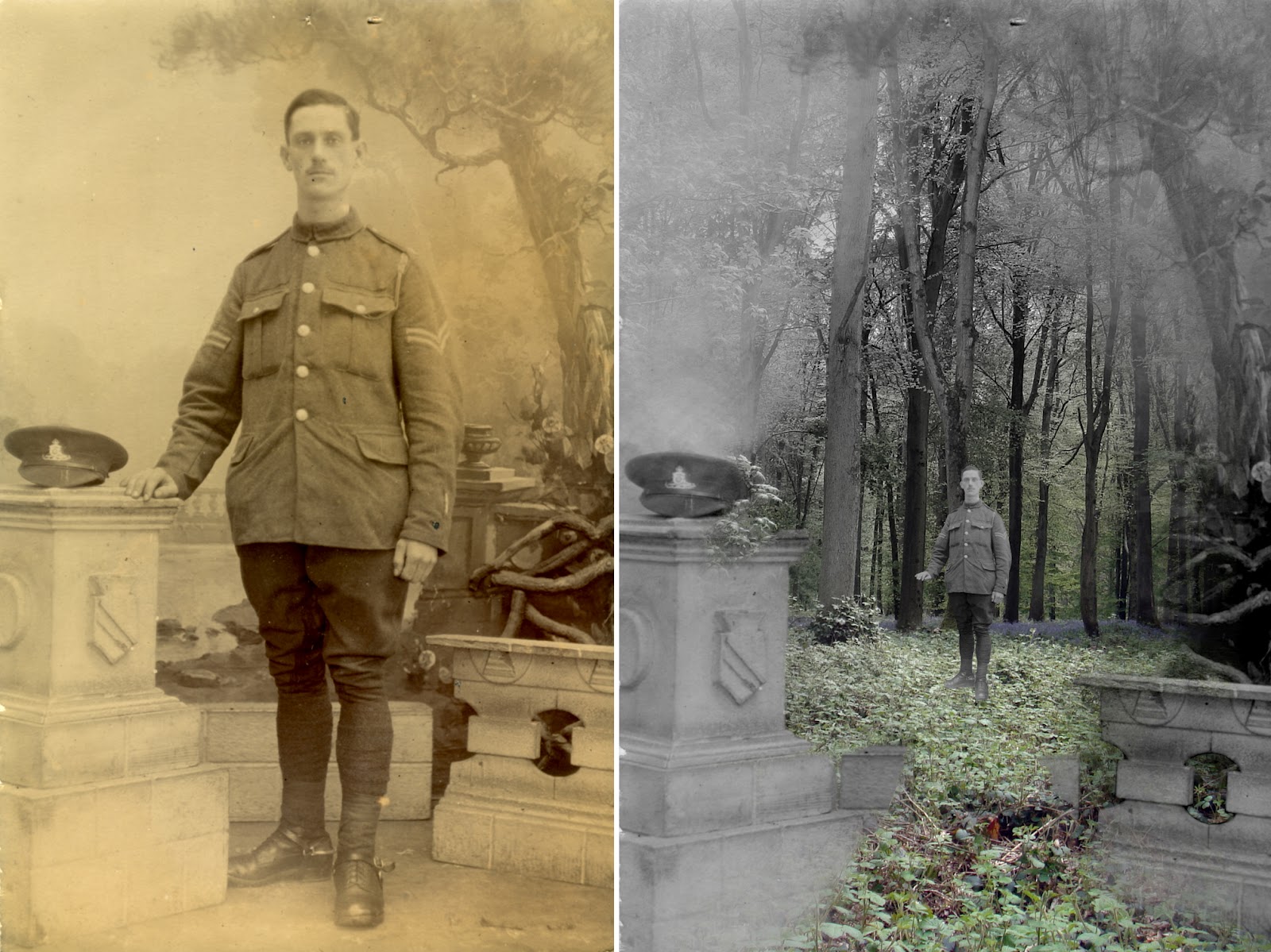
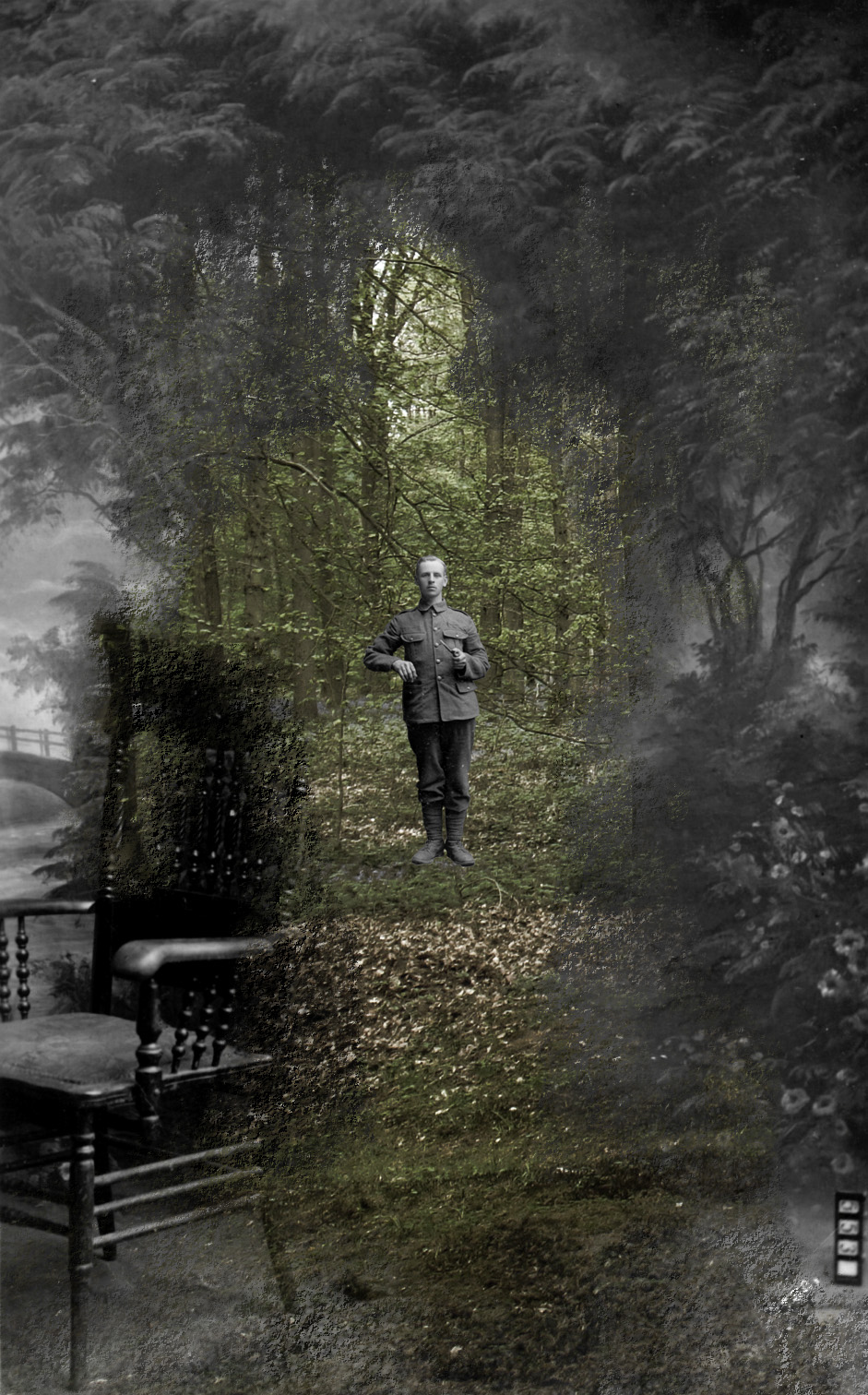
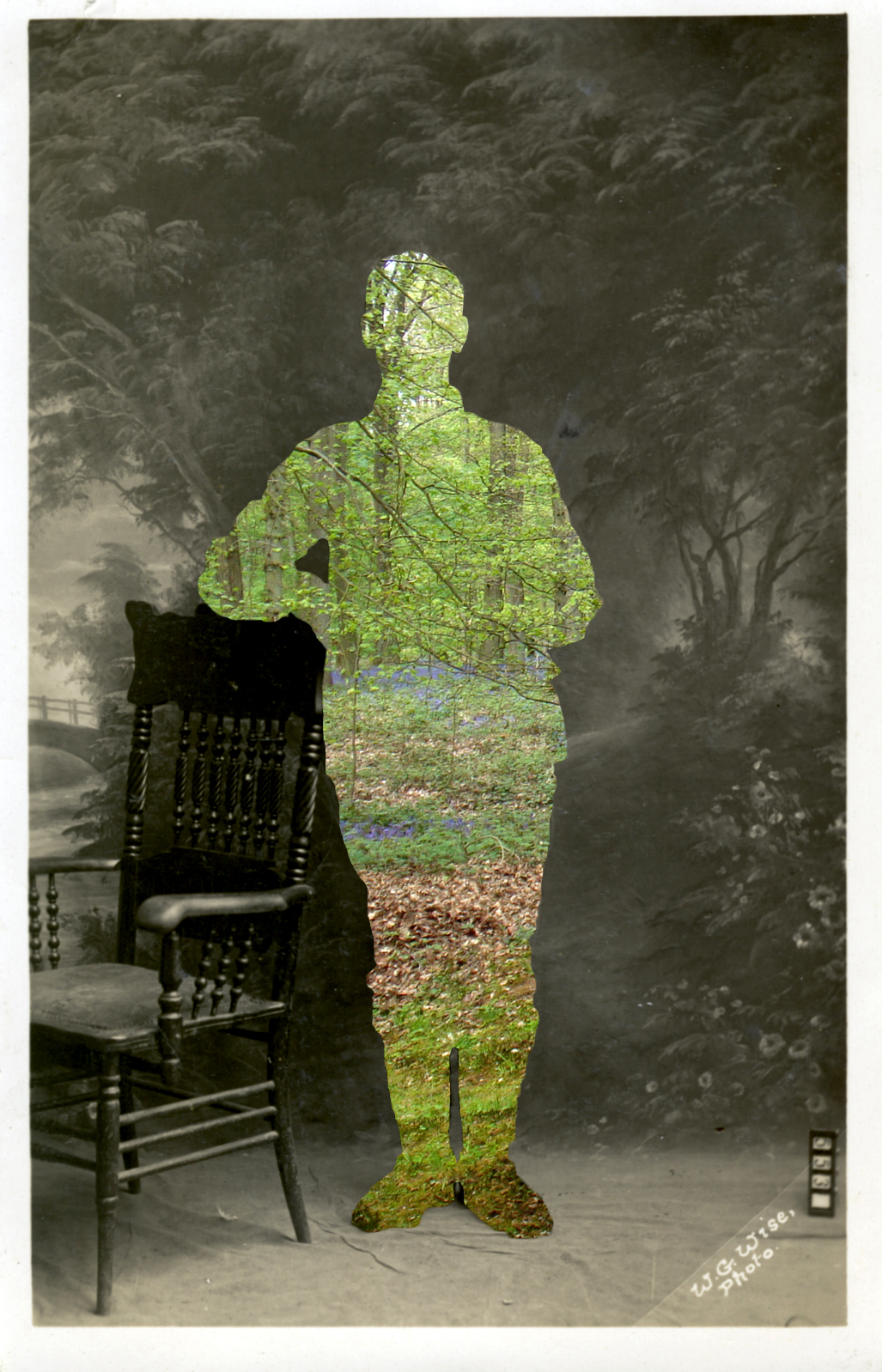
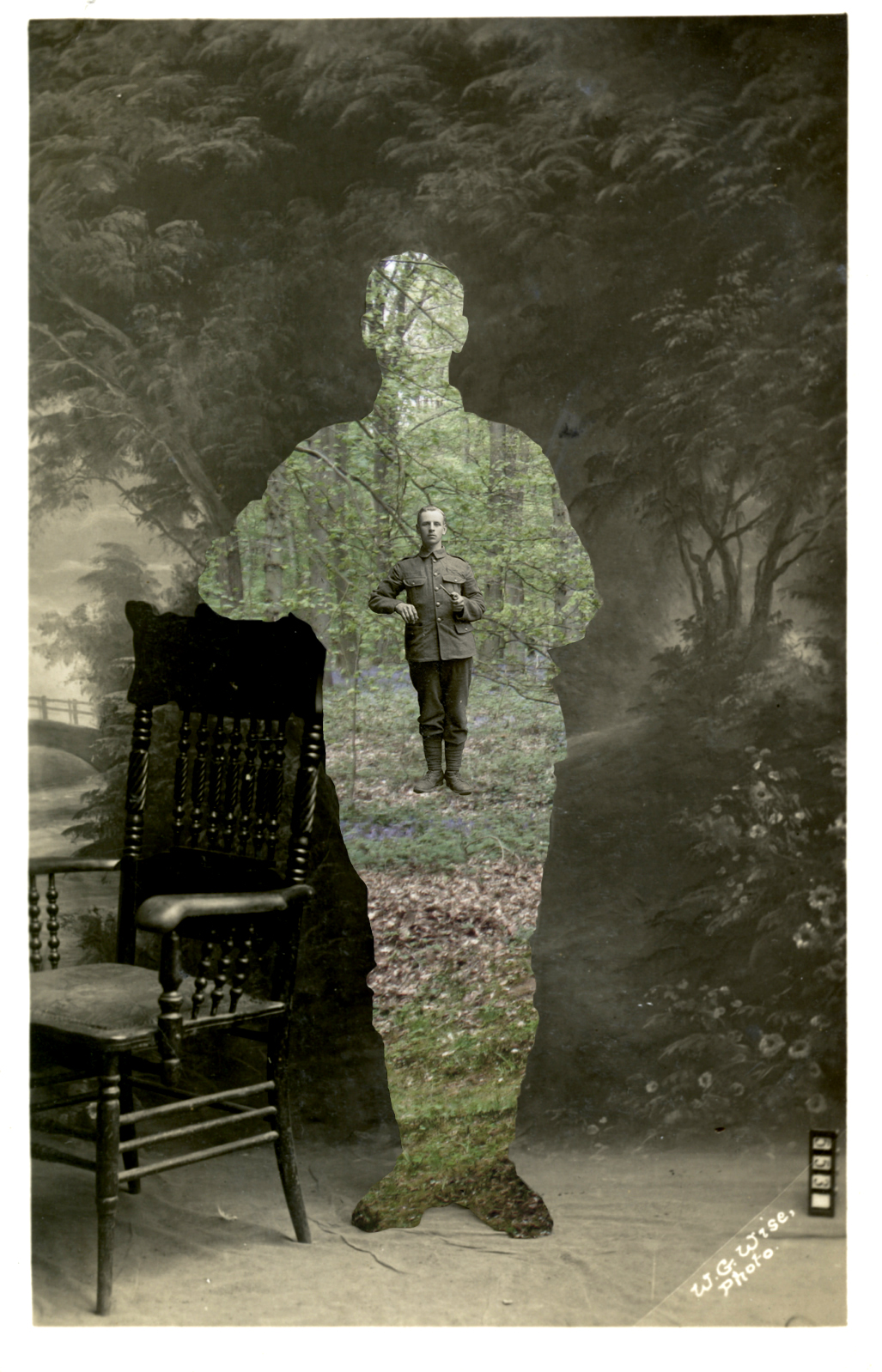
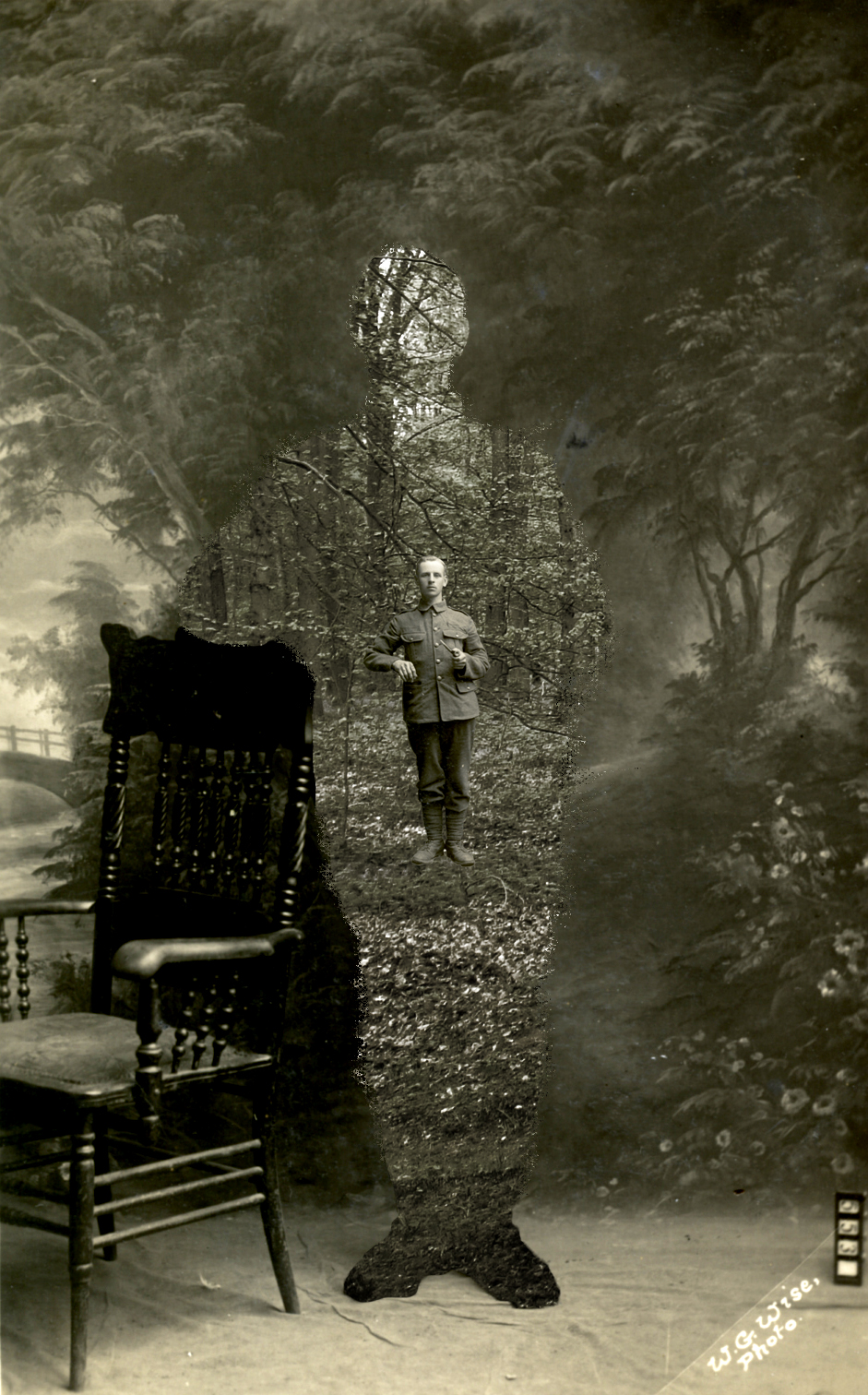
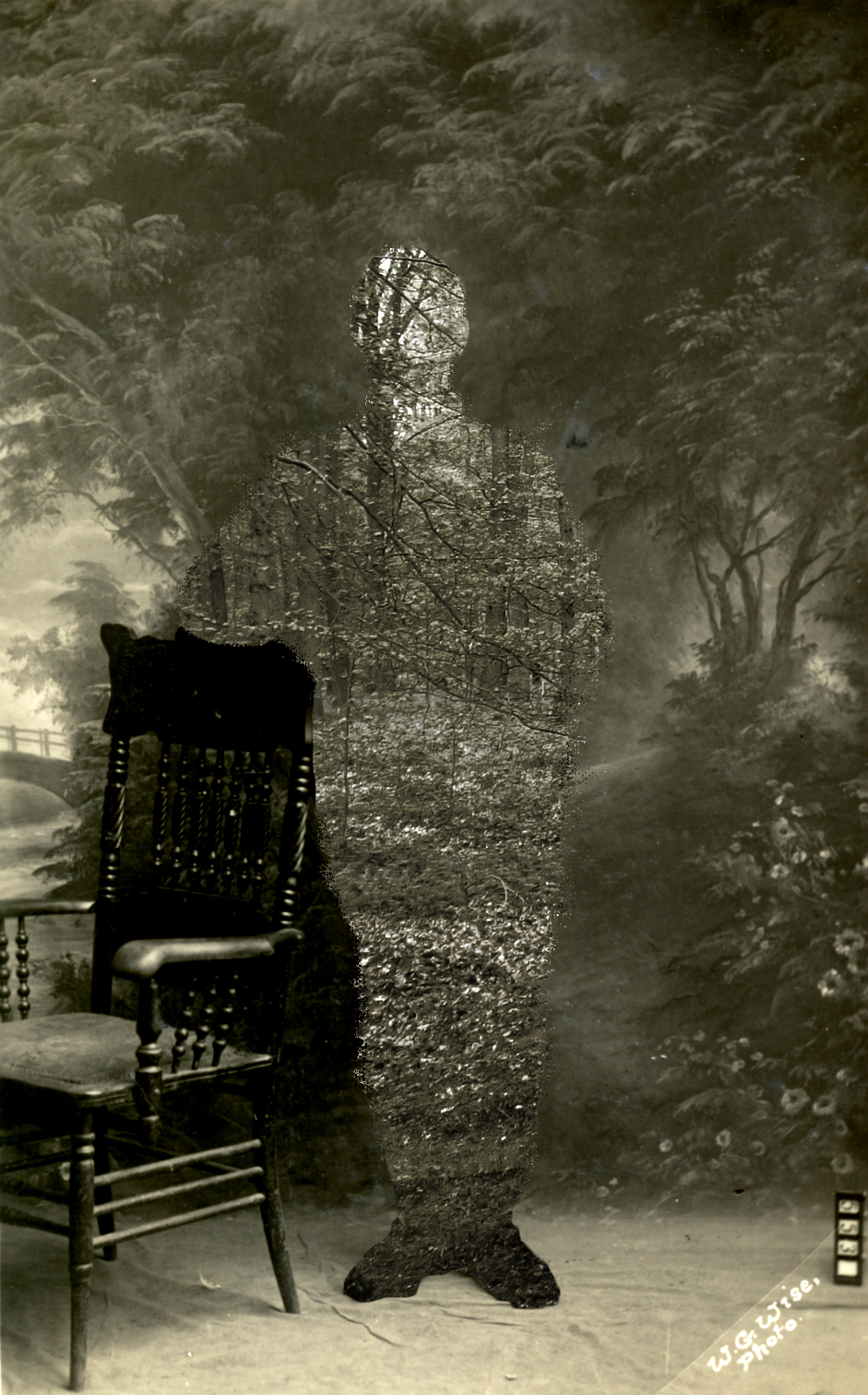
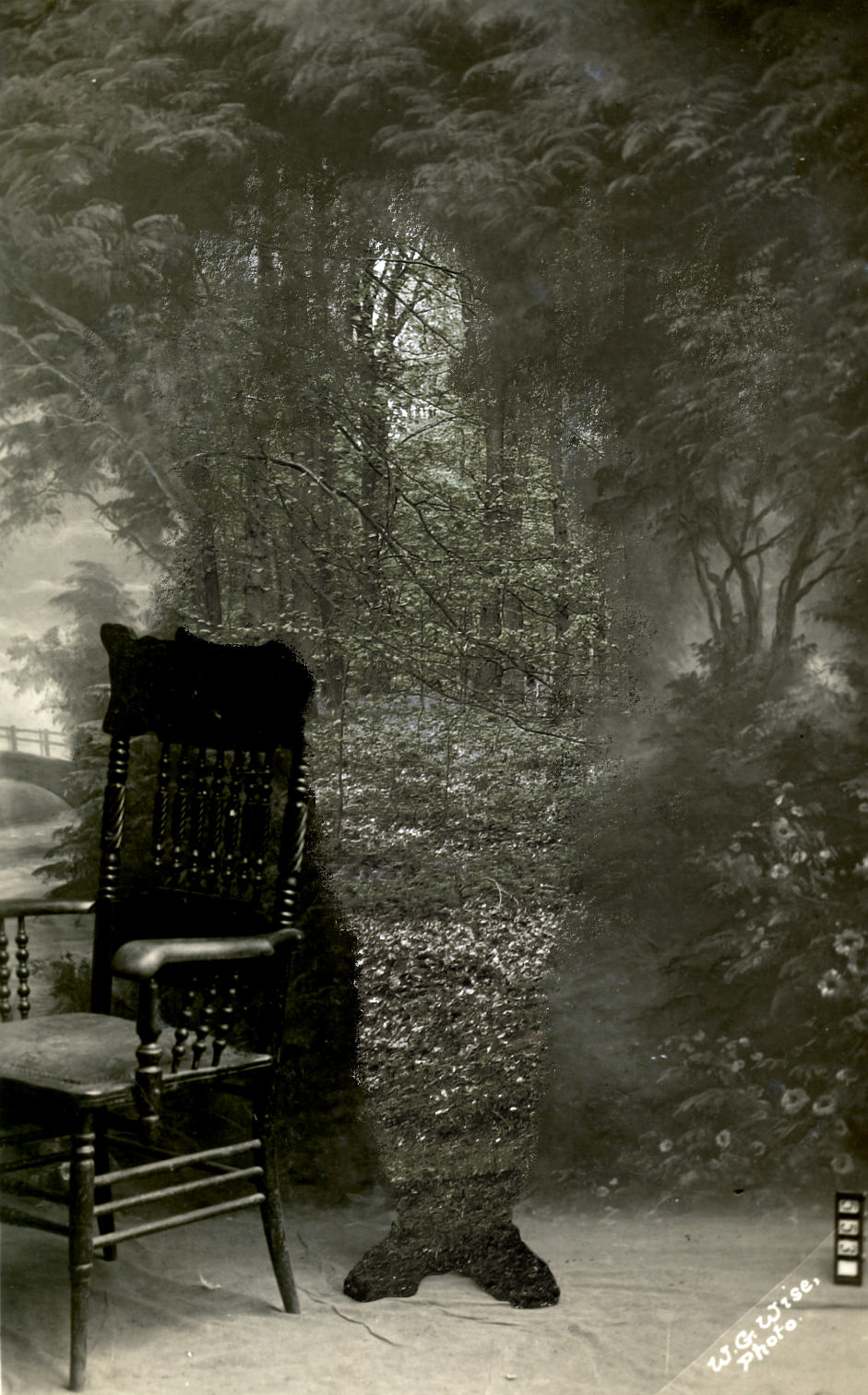
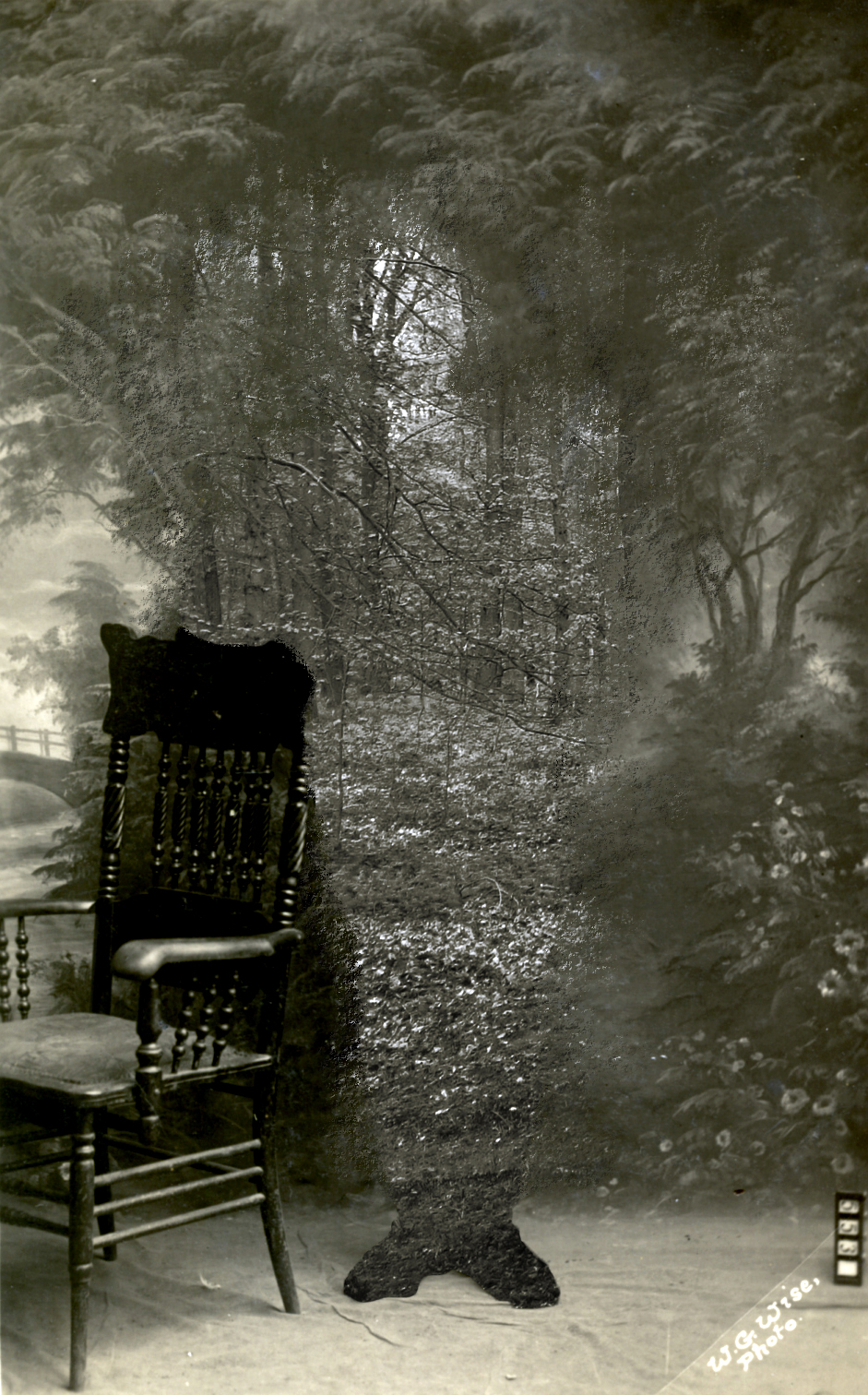
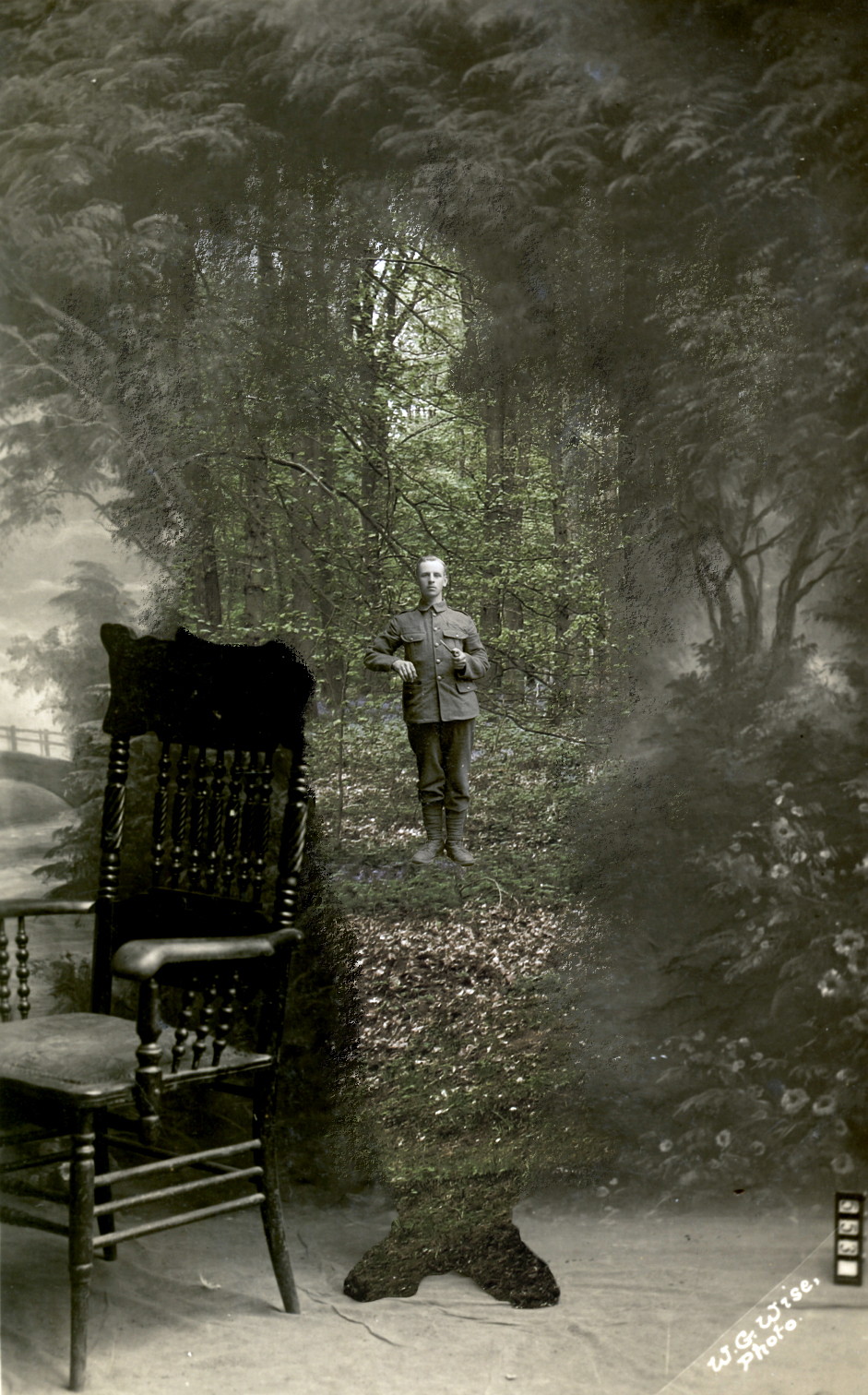
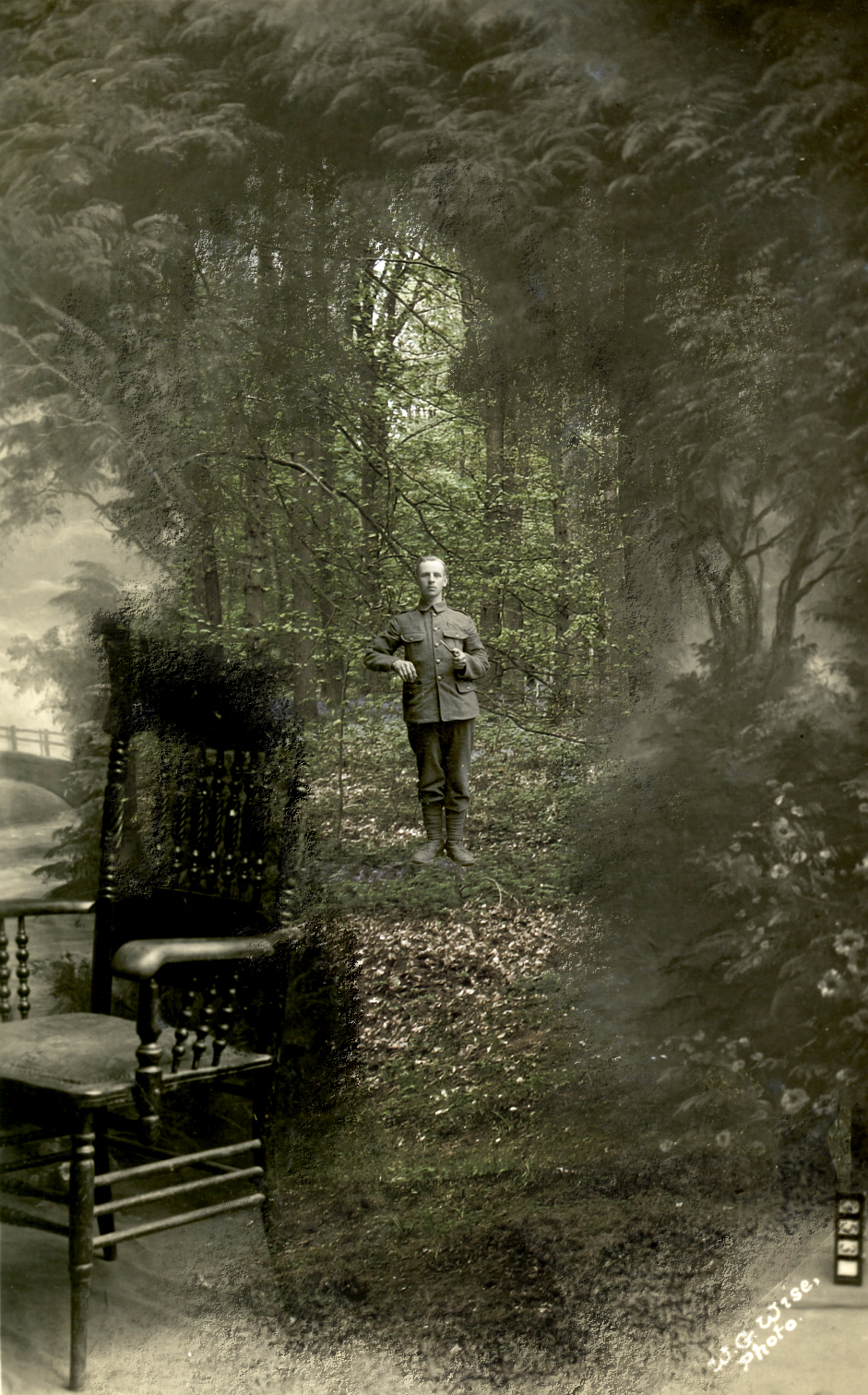
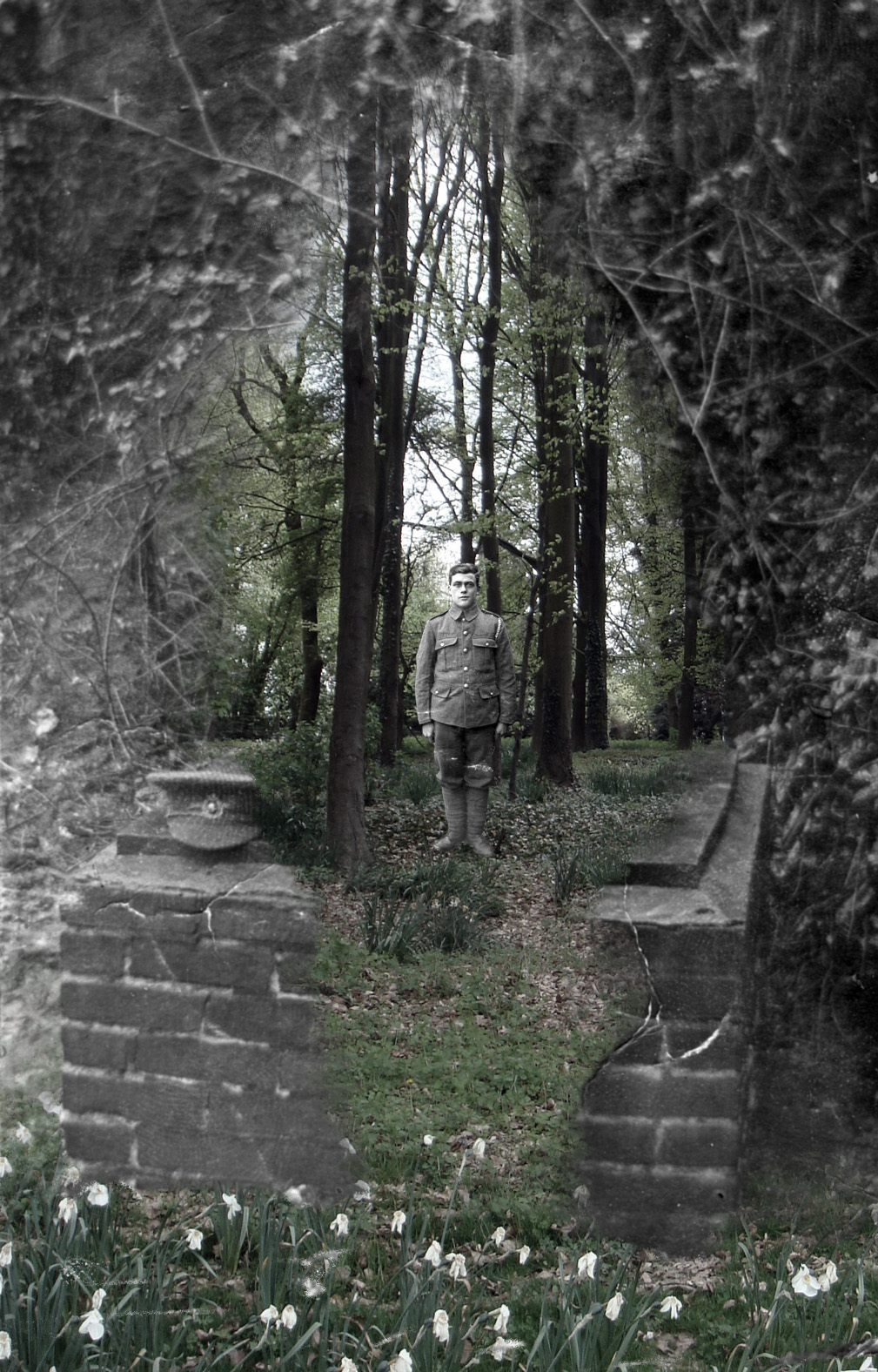
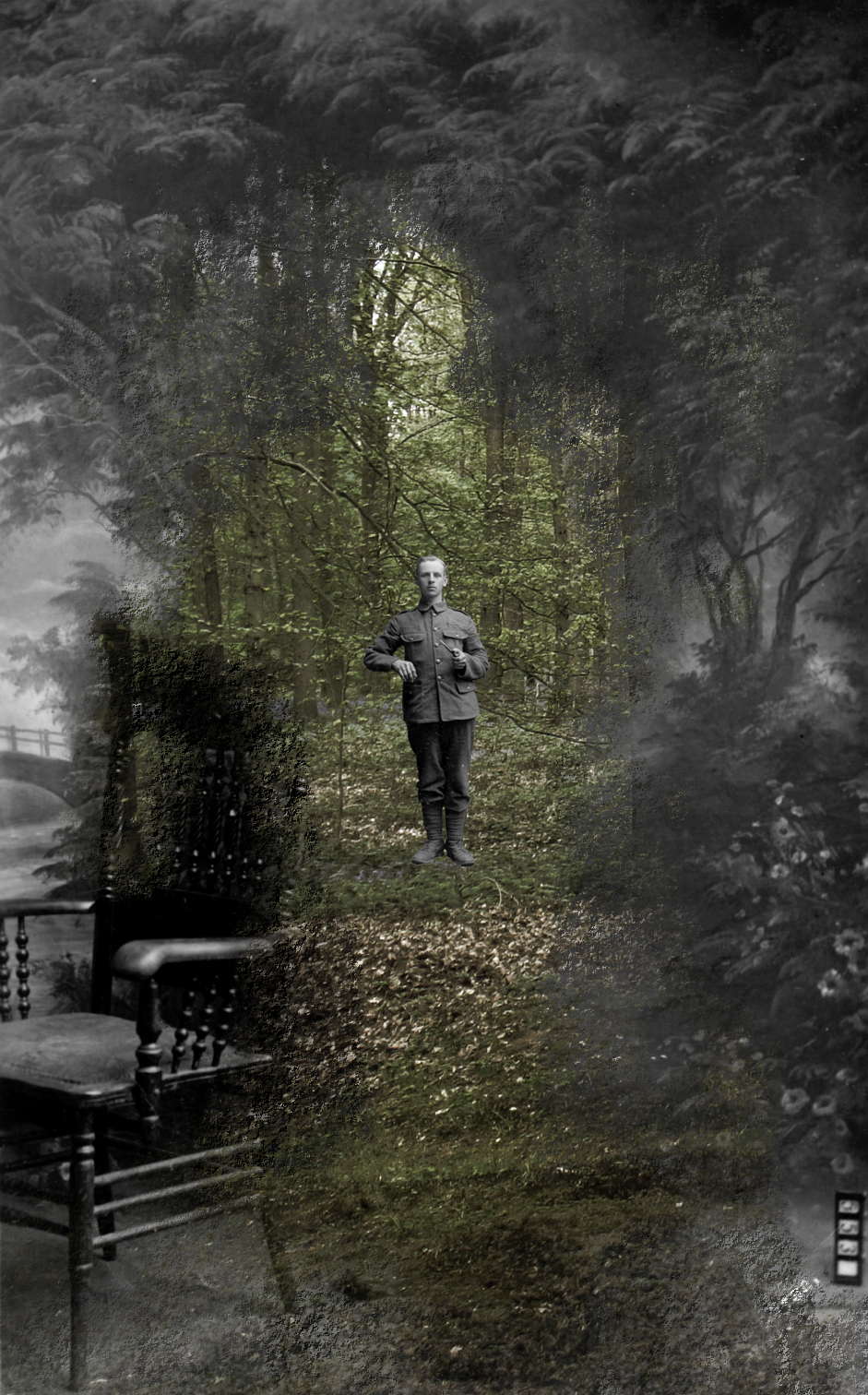
The image below is the last in a series I’ve made using both an original World War One postcard and a photograph I took in Verdun. All are works in progress.

I’ve been fascinated with the backdrops in some of these postcards for quite some time now and have been looking at ways of using them in works relating to the Great War and, in particular, the issue of empathy.

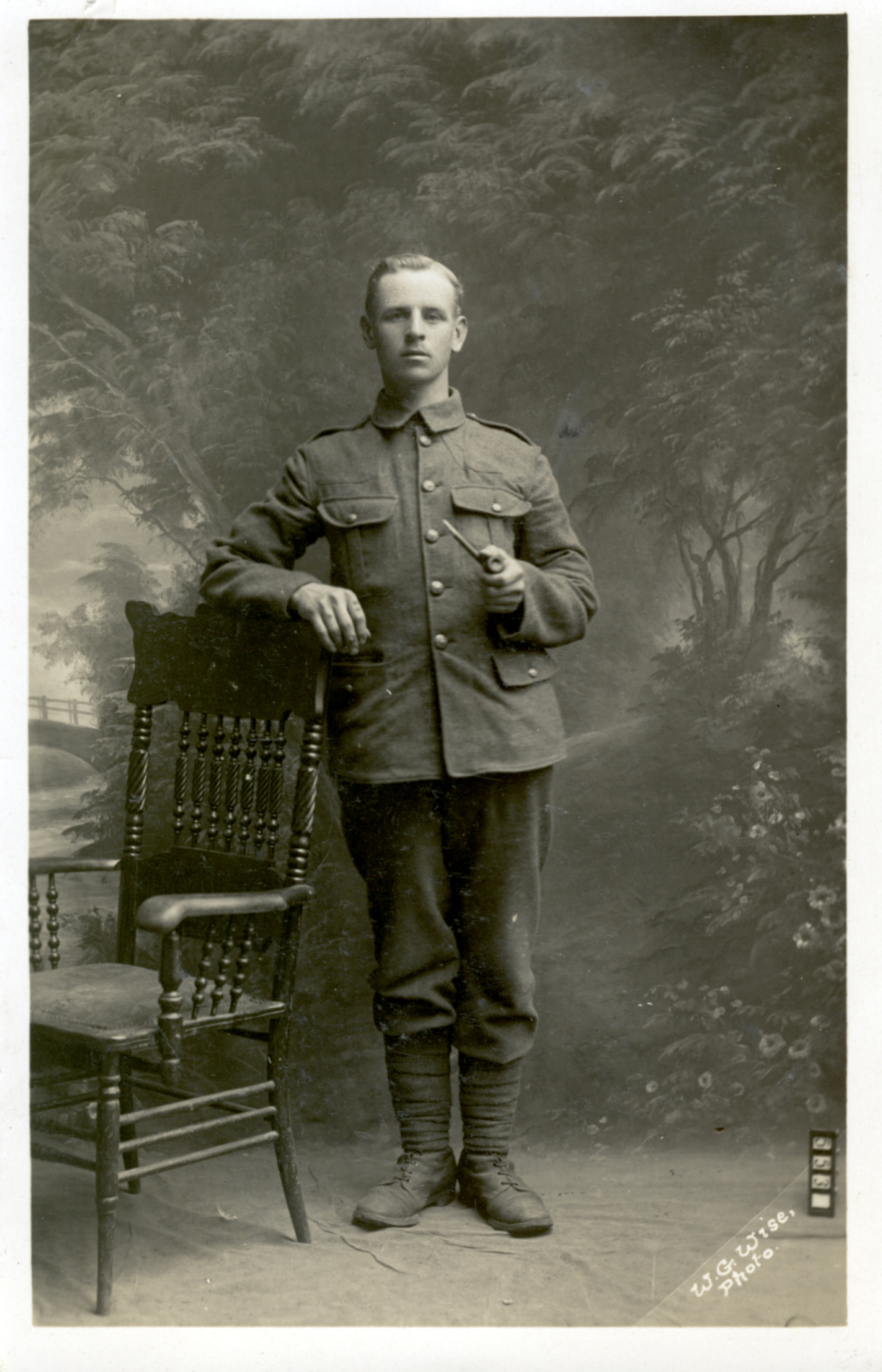
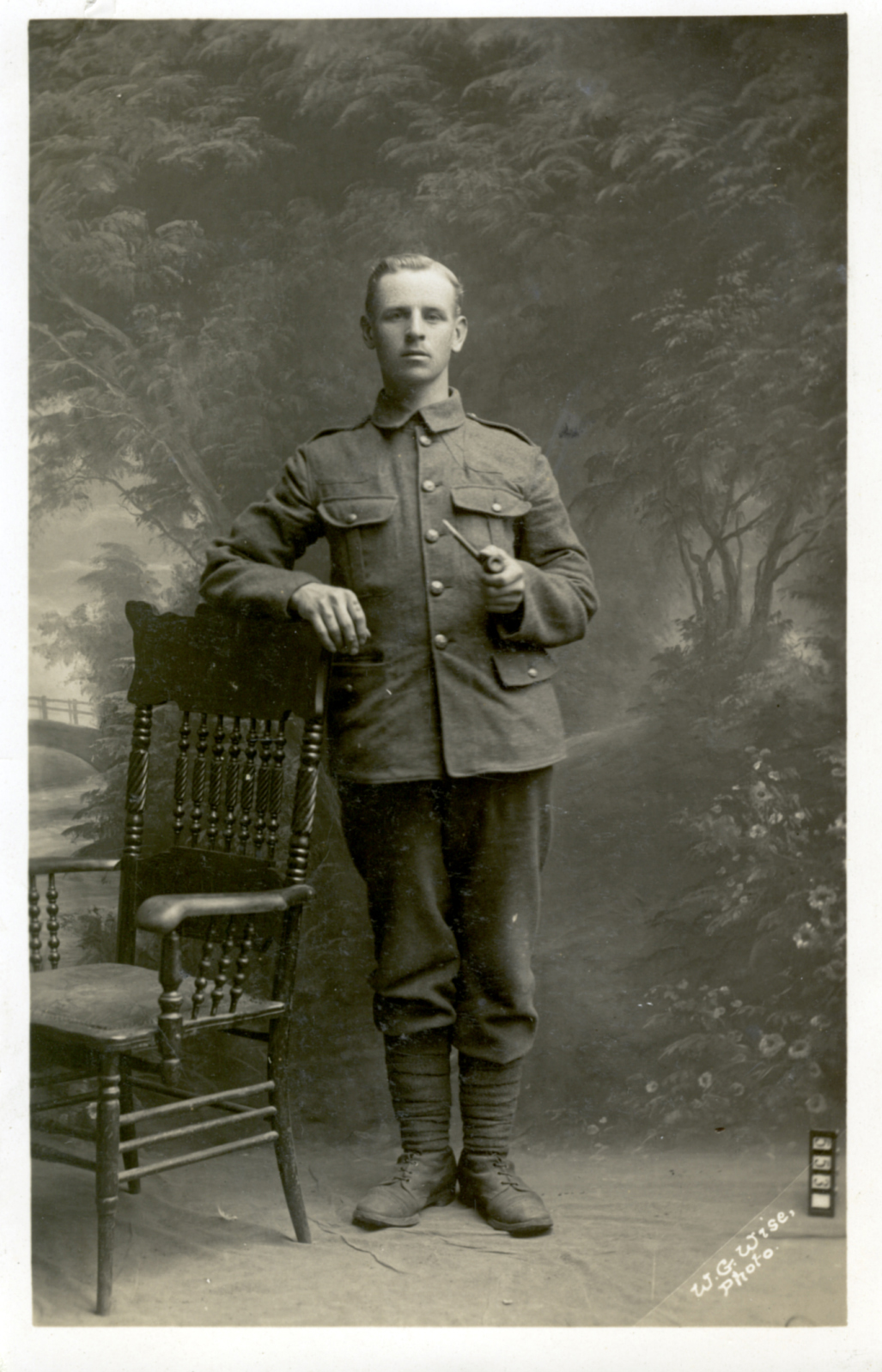
The original postcard is of course in black and white (with a greenish tint) and shows a soldier about to head to the Front, standing, leaning on a chair.

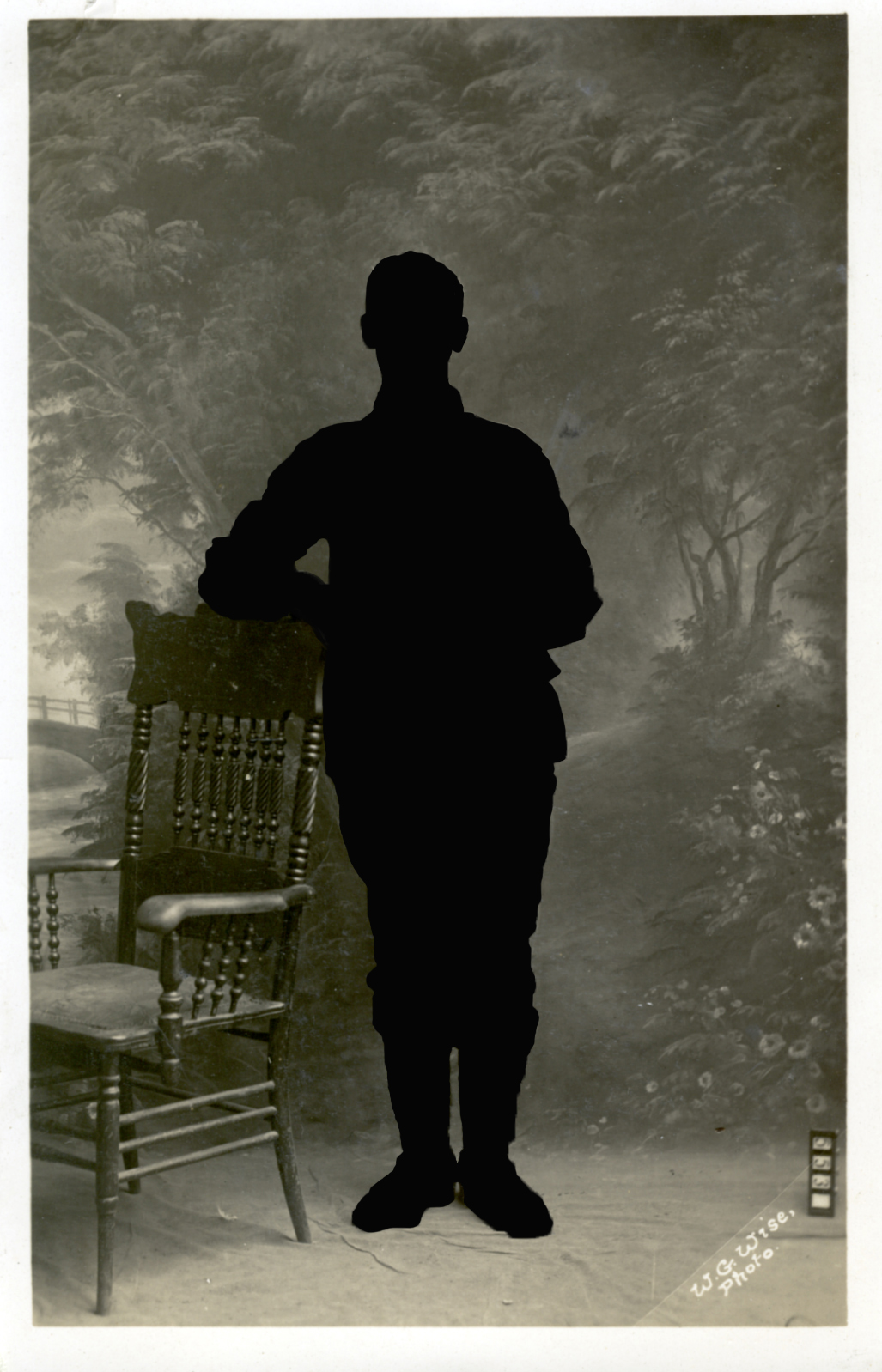
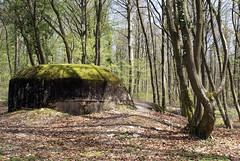
Behind him is an idealised image – an idyllic, invented landscape, a far cry from what he was, perhaps, about to encounter, but close in some respects to what we find on battlefields today; where there were trenches, arms, barbed wire and bodies, there are now trees. And amidst the trees, incongruous concrete Pill Boxes stand and watch as the seasons come and go. Everything is slowly reclaimed. The trees in the image at the top of the blog spill to reclaim the past – the interior of the studio – through the gap left by the missing soldier.

I have placed the solider back beyond the gap left by the vague shape of his own body, to remind us that people like the soldiers we see in all these postcards, were once like those of us who have visited the battlefields. They too would have known what it was to stand in a wood. To listen to the wind blowing through the branches.

To stand and do just that, is one way to remember them.

Filed Under: Trees, World War I Tagged With: Soldiers, The Somme, The Trees, Trees, World War I, WWI, WWI Postcards

Work in Progress

January 24, 2012 by Nicholas Hedges

Filed Under: World War I Tagged With: Soldiers, The Somme, The Trees, Trees, World War I, WWI, WWI Postcards, WWI Postcards

Stitched Trench Maps II

March 23, 2011 by Nicholas Hedges

I completed my first three stitched ‘trench maps’ today and have popped them in frames ready to be exhibited in Luxembourg. Ideally they wouldn’t be in frames at all and would be presented on a much large scale, but as first versions go I’m pleased. Certainly I can see how I would like to progress them, adding more layers to create kinds of palimpsests.

Filed Under: World War I Tagged With: GPS, Lines, Positioning, Serre Palimpsest, Stitchwork, The Somme, Trench Maps, World War I, WWI

Beaumont Hamel

May 7, 2010 by Nicholas Hedges

Filed Under: World War I Tagged With: The Somme, Trench Maps, World War I, WWI

Battle of the Somme – Serre

May 7, 2010 by Nicholas Hedges

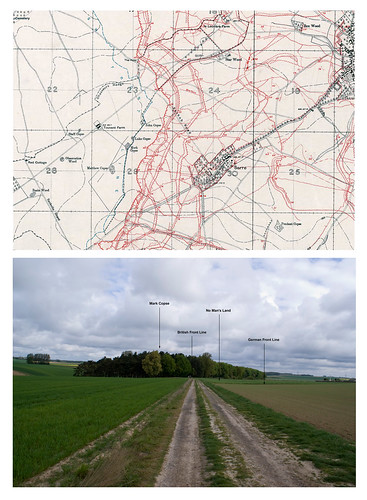
First image is a detail from a Trench Map (1916) showing Serre, the German Front Line and trenches (red) with the British Front line in blue. The photograph below shows Mark Copse, from where the 11th Battalion East Lancashire Regiment went over the top on 1st July 1916 suffering horrendous casualties as a result.

The Somme

Filed Under: World War I Tagged With: Serre, The Somme, Trench Maps, World War I, WWI

The Somme

May 7, 2010 by Nicholas Hedges

“Frontiers are lines. Millions of men are dead because of these lines.”
Georges Perec

The name Somme is, in the minds of many, synonymous with death, a byword for futile and indiscriminate slaughter. Think of the Somme and the image of men walking towards their deaths comes to mind. Think of the Somme and one date stands out above all others; 1st July 1916, the day the battle began. The battle itself lasted over four months, up until November 18th, but the 1st July is as infamous a date as any, being as it is the blackest day in British Military History. By the end of the first day’s fighting, British and Commonwealth forces had lost almost 60,000 men, with 20,000 of those killed or missing in action – a number which is almost impossible to comprehend. The exact number of casualties over the entire course of the battle (1st July – 18th November 1916) is unknown, but Allied forces lost some 620,000 men with over 145,000 killed or missing in action. Germany suffered around 465,000 casualties with almost 165,000 of those killed or missing.

These numbers are of course horrendous, but there’s always a danger that statistics such as these will only ever be numbers, rather than a single death multiplied several thousand times. Every one of those over 300,000 killed or missing in action was a son, husband or brother; an individual whose life was cut short for a small patch of ground. And we mustn’t forget the wounded whose injuries were often appalling – the result of a new type of warfare, where bodies were mauled and mangled by artillery shells, machine gun fire and shrapnel. Disfigurements and mental illness meant that even if they were lucky enough to return, many would never again lead a normal life.

Before visiting the battlefields, I recorded my thoughts on how I imagined the Somme. Drawing on old photographs, books I’ve read and contemporaneous records, I’d built up a picture – a collage of sorts – of devastated fields, cut through with trenches; craters and mud, machine gun fire and shells. I’d imagined woods reduced to spent matchsticks occupying a space on the horizon and the terrain as I saw it in my mind’s eye was almost always flat. The images themselves were silent, equivocal and without any weight or real sense of place. There was colour but like any specific detail the colours were always vague. Any imagined scene was removed from my senses. I could try to imagine the war, but of course any idea as to what it was like would – to say the very least – be well wide of the mark. I could imagine the rain, the blue sky, the smell of the grass, but still it was all divorced from my senses; an indeterminate collection of images wherein there was little sense of direction. I could try and imagine movement, but any progression derived only from a series of stills as if I was looking down a length of film found on a cutting-room floor.
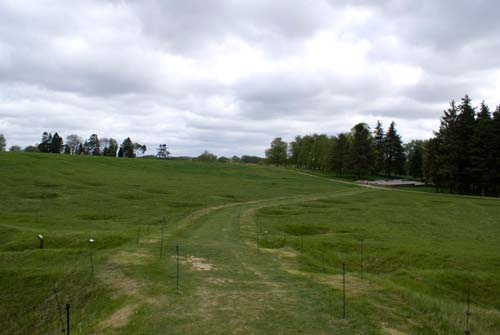
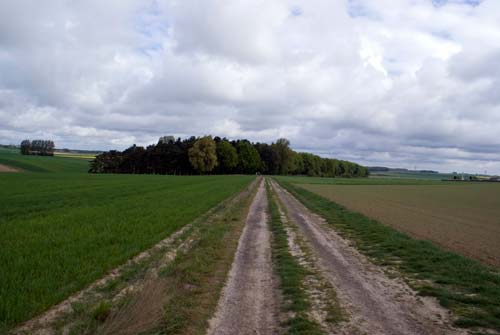
Having arrived in the Somme, we drove towards our B&B, down the narrow roads which cut across the fields. The sun was setting, casting long shadows which lay down across the landscape like discarded coats and clothes. I couldn’t help but think of those who’d stood in the trenches on the morning of 1st July 1916, knowing they might never see another sunset again. For a moment, this sunset became the one they wouldn’t to see. The sunset of that terrible day.

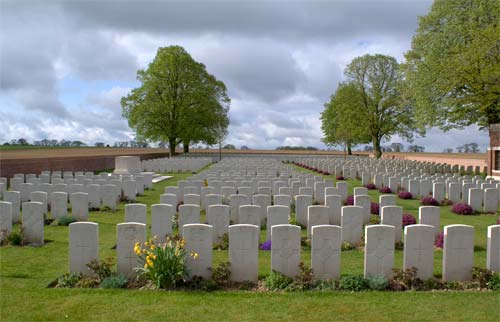
On arriving at the B&B we found our first cemetery.

We had just over a day to explore the Somme battlefields and therefore took the ‘Circuit of Remembrance’ a route signposted with poppies which takes in the major sites of the battle. Starting at Beaumont Hamel, we travelled to Thiepval, Pozières, Longueval, Rancourt, Peronne and La Boiselle. The following morning, we travelled to Serre to see the place where, among others, the Accrington Pals suffered horrific losses on that first terrible day.

Travelling through the countryside and seeing signposts pointing the way to villages and towns such as Arras, Pozières and Thiepval, I felt a strange sensation, in that prior to visiting the Somme, these legendary names were almost fictions – places connected with a distant past found only in the pages of history. Temporal distance in some way then correlates with geographic distance, where places one has never been are like those times to which one can never go. It’s as if they are names of moments in time rather than places in another country; the past is indeed a foreign country, and yet one it seems can go there.

Of all the places we visited along the ‘Circuit of Remembrance,’ two stand out in particular; the site of the attack on Serre at what is now The Sheffield Memorial Park, and the Newfoundland Memorial Park at Beaumont-Hamel. Of course all other sites were extremely poignant, not least the Memorial to the Missing at Thiepval and the many cemeteries, all immaculately kept, which are found throughout the Somme countryside.

The first place we visited was the Newfoundland Memorial Park at Beaumont Hamel.

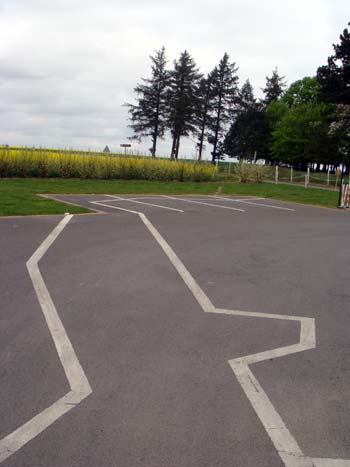
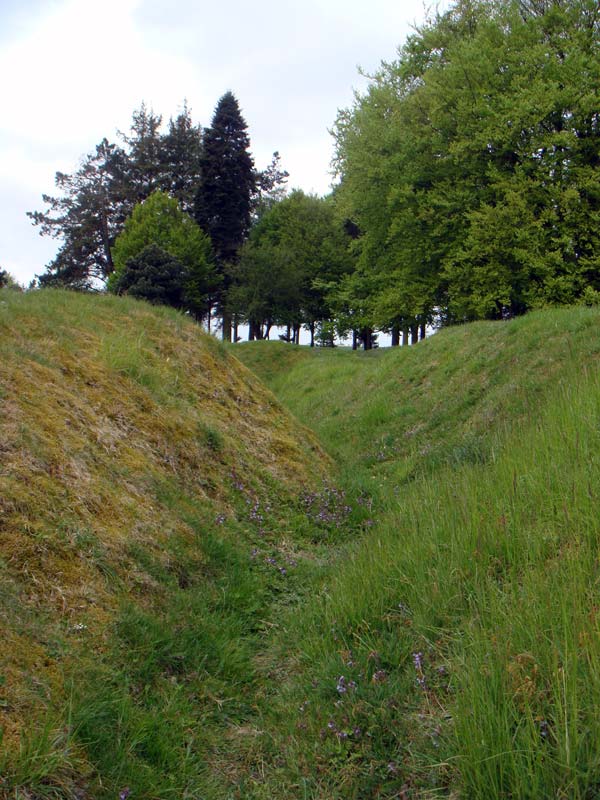
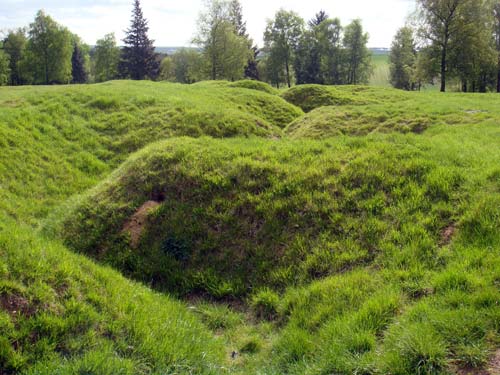
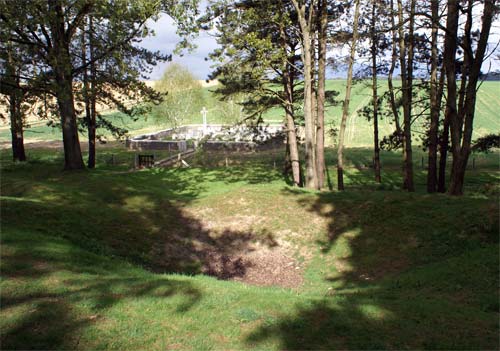
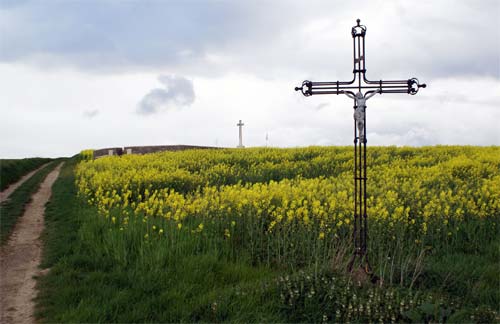
 It’s one of the few sites in the Somme region where the ground has remained largely untouched since the end of the First World War. The trenches are still visible, for example, St. John’s Road and Uxbridge Road which once led to Hyde Park Corner and Constitution Hill; trenches now filled in beneath a field of Rape (the line of the Uxbridge Road trench has been marked in white in the car park).

 The naming of the trenches has always interested me. It’s almost as if in the midst of the ruined landscape, whose pre-war character had all but been effaced, a new place was brought into being; not simply a ruin of that pre-existing world, but a new world entirely; a labyrinth of lines cut into the ground, named after streets or towns back home. It’s as if these ‘streets’, ‘lanes’ and ‘alleys’ were each a piece of the collective memory of those who fought and died there; fragments of a place called ‘home’ to which many would never return. Now of course the trenches have all but disappeared along with the men who made them, along with their individual memories. And yet they remain on maps and in books, and although the ruined towns and villages have been rebuilt, their own much older names seem to belong more to this other lost world than that before or after.


It was at Beaumont Hamel that the Newfoundland Regiment attacked on 1st July 1916, suffering as they did appalling losses. The following description is taken from the ‘Newfoundland and the Great War’ website:

“Thus it was that the Newfoundlanders moved off on their own at 9:15 a.m., their objective the first and second line of enemy trenches, some 650 to 900 metres away. In magnificent order, practiced many times before, they moved down the exposed slope towards No Man’s Land, the rear sections waiting until those forward reached the required 40-metre distance ahead…

 …No friendly artillery fire covered the advance. A murderous cross-fire cut across the advancing columns and men began to drop, at first not many but then in large numbers as they approached the first gaps in their own wire. Private Anthony Stacey, who watched the carnage from a forward trench with Lieutenant-Colonel Hadow, stated that “men were mown down in waves,” and the gaps cut the night before were “a proper trap for our boys as the enemy just set the sights of the machine guns on the gaps in the barbed wire and fired”. Doggedly, the survivors continued on towards The Danger Tree.”

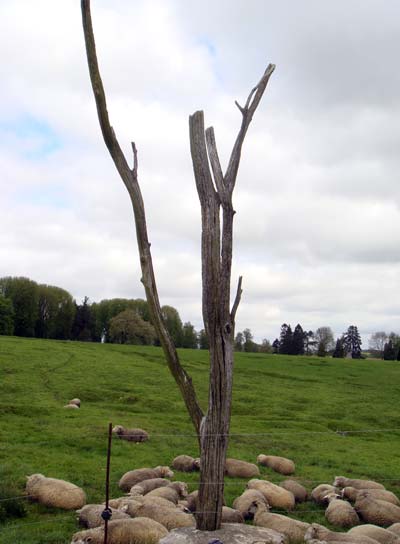
The ‘Danger Tree’ still stands, and standing there today, looking at the sheep laying around its base, it’s hard to imagine the scene at that same place 96 years ago.

Like many who’ve read about the Somme, I was aware how close the opposing armies were to one another – at least in terms of stats – separated as they were by the void of No Man’s Land, but it was only in this place that the distance was made startlingly apparent; it was hardly any distance at all. Entering the memorial, one can see the British front lines. A leaflet guides you around and suddenly, you find yourself looking back from the German front line towards where you entered, a distance which is all but a few minutes’ walk away. And in between is a patch of ground, much like any other you might have seen before but upon which thousands lost their lives.

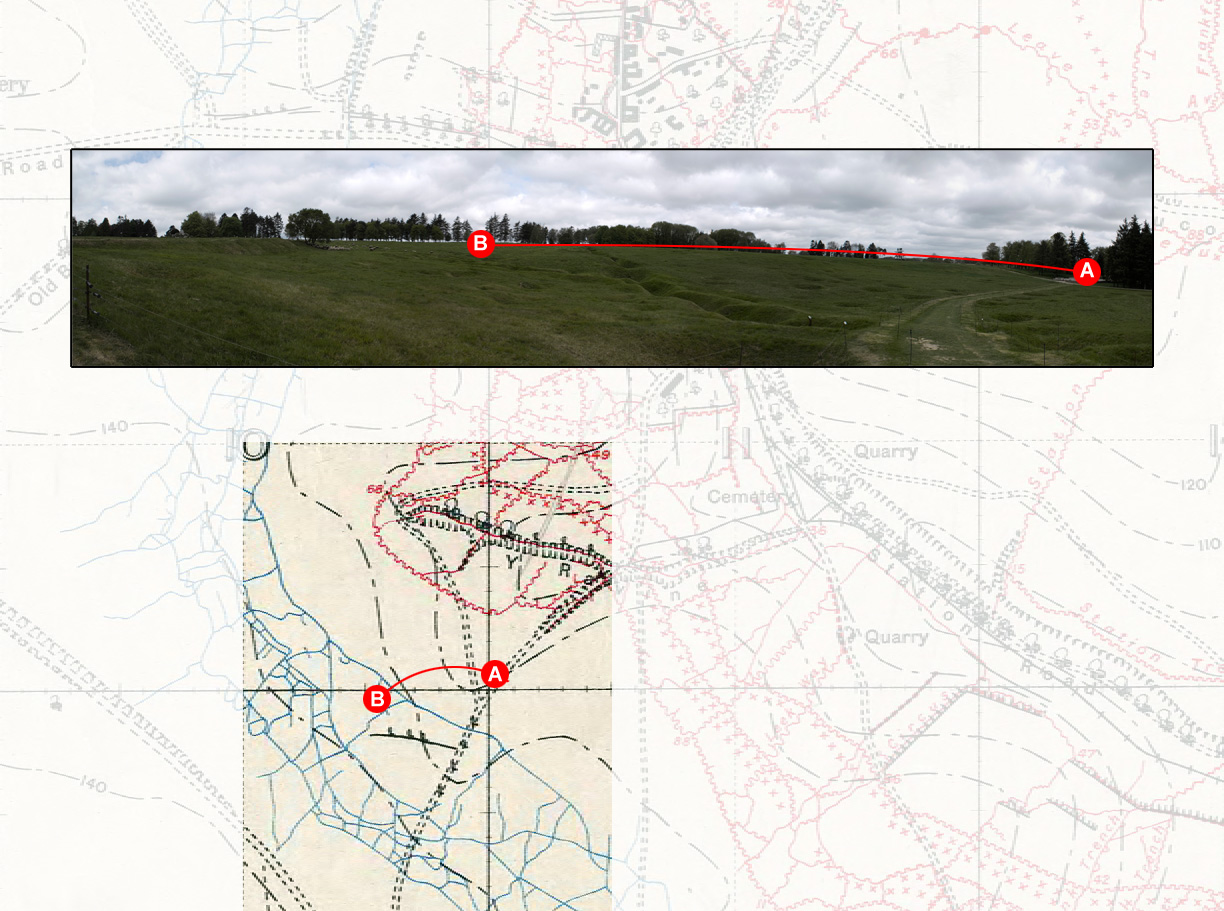
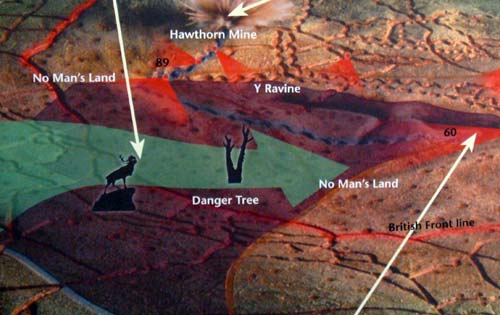
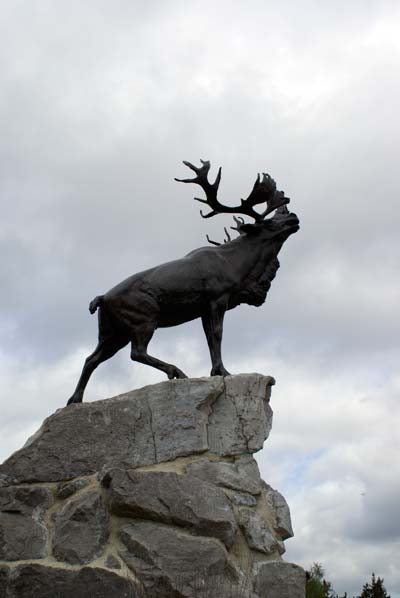
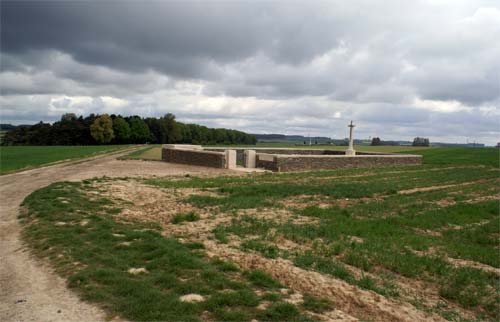
The following images show the Caribou Monument to the Newfoundland Regiment (shown on the map above) which stood at the British Front Line. The Danger Tree is that shown above which marked the furthest many men managed to get. The Y-Ravine is behind the German Front Line, the trenches of which are also shown below.

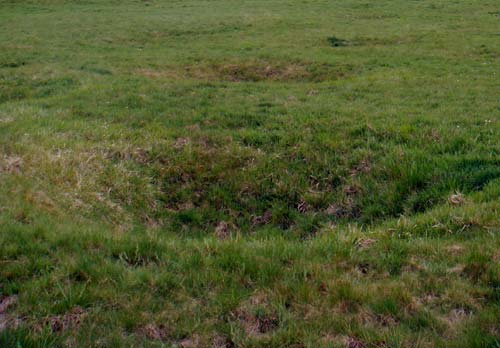
Of course it goes without saying that in 1916, the ground would have looked very different. Pockmarked by shells, cut through with trenches running on for miles and covered with swathes of barbed wire it would have presented advancing troops with considerable difficulties even without the horrors of enfilading machine gun fire and pounding artillery. 

As far as can be ascertained, 22 officers and 758 other ranks were directly involved in the advance that day. Of these, all the officers and around 650 other ranks became casualties.  Of the 780 men who went forward about 110 survived unscathed, of whom only 68 were available for roll call the following day. To all intents and purposes the Newfoundland Regiment had been wiped out, the unit as a whole having suffered a casualty rate of approximately 90%.

It goes without saying that as tourists today we can never imagine what it was like to be a part of this battle, not that we should be deterred from trying. Even so, one can appreciate things which sharpen the focus of any prior knowledge of the war and in particular any images which one might have imagined beforehand. I’d read about the attack on Beaumont Hamel in a book by Peter Hart and had imagined a vague collection of ‘ambiguous stills’ with which I did my best to appreciate the experiences of those who suffered the appalling violence of that first day. But standing in the middle of what had been No Man’s Land, with the British Front Line to my left, beside the Newfoundland Caribou Memorial, and the German Front Line to my right – just behind the memorial to the 51st Highland Division – I was struck by how small the battlefield, at that position,  was. As I’ve said, if this was any place in the countryside, it would constitute nothing more than a small part of a short walk, but in 1916 it was a great advance, in the pursuit of which, many thousands lost their lives.

There is a tendency at sites such as this, or rather in associated museums (for example that in Ypres) to create recreations of battles with sounds effects, waxworks, lighting effects and so on. For me, such recreations do nothing other than turn history into fantasy. They push history – which already borders on fiction (in that it can only be imagined)  – deeper into the world of make-believe. Recreations serve no other purpose than to ‘entertain’ and certainly do little by way of justice to memory of the men who fought there. It’s much better to be in a place, to hear the birds and see the trees… they might not be shells or machine guns, but they are real all the same.

I must admit I could have stood there in ‘No Man’s Land’ for hours, collecting together what I knew of the war and what I could glean from the guide and anchoring it to the reality of the world by which I was surrounded. What I could really appreciate here was the terrain, not only the pock-marked surface, but the level of the ground which,  superficially at least, appeared quite ‘flat’. Certainly, if one was out walking, one wouldn’t think it was particularly steep or hilly. However, from the point of view of those who left the British Front Line to attack the Germans, one could see what they were up against. The ground rose just enough to leave them exposed, while at the same time affording the German army at least a degree of shelter. Indeed, something which I found myself coming to understand in the Somme, were the subtle shifts of the terrain and how such changes, visible to the individual eye, shaped the war as a whole and determined the fates of so many hundreds of thousands of men.

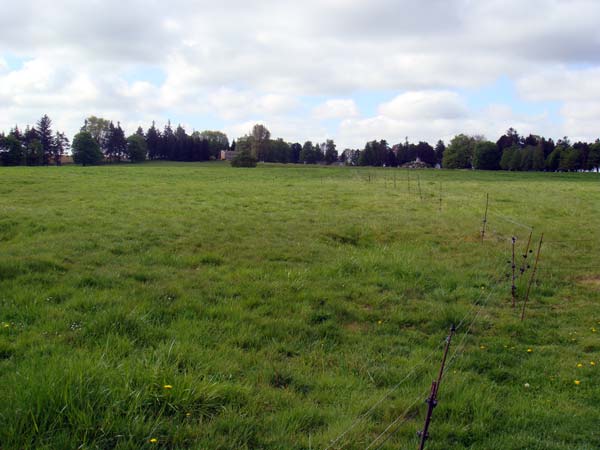
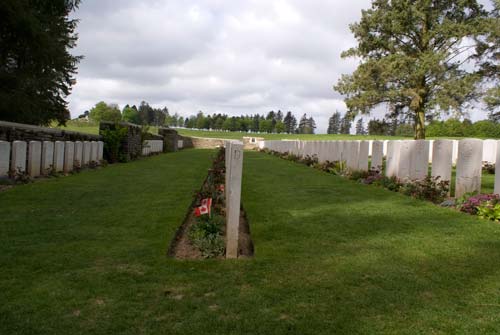
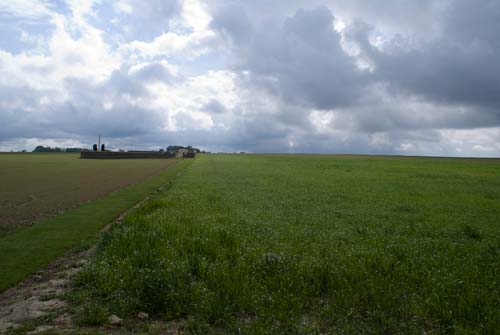
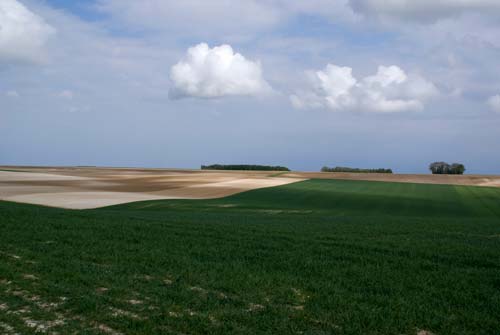
The image below is taken in what was No Man’s Land. The Y Ravine Cemetery is on the right. Over the ridge in the distance is the German Front Line.

Over the course of the last few years, ever since my visit to Auschwitz, I’ve tried to understand what it is about being in a particular place that makes knowledge of a past associated with that place so much more compelling. It seems obvious that it should be the case, but why? I can watch countless DVDs about the Somme for example, view masses of photographs, read the testimonies of those who fought and look at the lists of the names of the dead. But only by standing there, in the middle of a field (upon which sheep were grazing) did the full horror make itself known.

I felt exactly the same thing at the Sheffield Memorial Park, situated on what was once the British Front Line between ‘Matthew Copse’ and ‘Mark Copse’ near the village of Serre. It was from here that an attack was made on what was then a fortified village by, amongst others, the Accrington Pals and Sheffield City Battalions, again on that infamous day, 1st July, 1916.

Again, staring ahead towards the Queens Cemetery, behind which the German Front Line would have run, one could see just how close the two sides were to one another. One could also read the terrain and see the advantage the Germans had when facing the approaching army. As a result therefore, one could also see just what the soldiers of the Pals Battalions were up against, even without the horrors of machine guns and artillery.

Again I have to stress, that we can never fully appreciate what the men who climbed from their trenches faced that fateful day. But as with my experience at the Newfoundland Memorial, I found that in looking towards where the German lines would have run, across the field over which the soldiers would have walked, the horrors of which I’d read became much clearer. I couldn’t see the guns of course, or the artillery and barbed-wire. I wasn’t walking into a hail of bullets with shrapnel flying from shells bursting all around me. But there in the tranquility of the present day, where one could hear the birds, I’d brought with me to that place, the whole of my existence – my past – and that was something at least I had in common with the brave men who fought there.

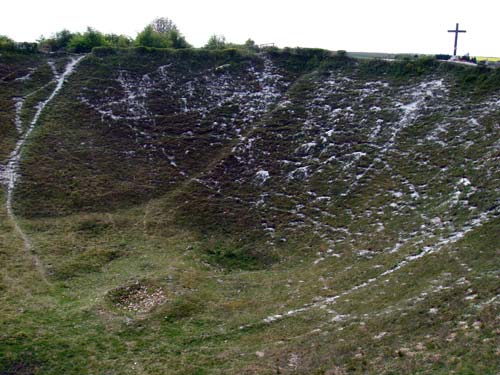
In La Boiselle, one can find the Lochnagar Crater, caused by a huge mine detonated at 7.28am on 1st July 1916. Containing 24 tons of explosives, it was at the time the largest ever man-made explosion.

 At 300 feet in diameter and 70 feet deep, the crater is still the largest caused by man in anger. Again, like the various battlefield sites, it’s a tranquil place, in stark contrast to the violence from which it was created. And yet, although one can’t hear the noise, one can see it in the vast space left in the ground. The sound has left a footprint; it’s become physical, just as sounds remain in the pock-marked battlefields found across the Somme.

In some respects, this idea of a ‘sonic footprint’ is akin to that of people leaving a trace on paths, roads, tracks and other lines found in the landscape. The trenches for example – those which one can see today – are not as they were in 1916 (i.e. they’re not as deep and are grown over with grass) but they are lines created by people many years ago. They might not call to mind a sound in quite the same way as the Lochnagar crater, but they’re nonetheless records of actions and movements.

In his book, ‘Lines, A Brief History’, anthropologist Tim Ingold writes that human beings, ‘leave reductive traces in the landscape, through frequent movement along the same route’. He considers this in light of the etymology of the word writing (derived from the Old English term writan – meaning to incise runic letters in stone) and surmises that human beings somehow ‘write’ themselves in the landscape. Henri Bergson wrote that our whole psychical existence was something just like a single sentence. I believe,’ he said, ‘that our whole past still exists.’ The whole past could be said to exist, upon and within these trenches, as ‘sentences’, ‘written’ in the landscape by men almost 100 years ago.

These lines can also – metaphorically speaking – be thought of as magnetic tapes, where as we walk, we record our presence; where what we see, hear, touch etc. at any given moment, is analogous to the recording head of a tape-player arranging the magnetic particles so as to record the sound or video image. Equally, when we walk down a particular street, path or track, we simultaneously play-back previous recordings, those laid down by people long since lost to the past and the battlefields of the Somme are a perfect place to illustrate this point.

At the battle for Serre on that fateful day – 1st July 1916, hundreds of men lost their lives on the ground between the village and the memorial where we were standing. The weather on the day of our visit was mixed, but mostly dry (the battle took place on a beautiful summer’s day). There were patches of blue sky and the odd cloud. Looking ahead, I could see the lie of the land. I could see the distance, the village of Serre and behind me the trees of the copse. I could hear the birds and feel the ground beneath my feet. Imagine then, that as I walked, the things I saw were somehow recorded in the ground upon which I was walking: the position of the sun, the colour of the sky, the sound of the birds and the distance. As a record-head receives information and translates it onto tape, so metaphorically, my body was doing the same.

Of course, recording-heads don’t just record, but play-back all that’s previously been recorded. Again we can think of the ground as being crossed by many lines and that along every one of those lines are hundreds of ‘recordings’ left by those who went before us. We can imagine that what they saw, what they heard and what they thought were all translated into the ground upon which they walked.

It was Bill Viola who said that ‘we have been living this same moment ever since we were conceived. It is memory, and to some extent sleep, that gives the impression of a life of discrete parts, periods or sections, of certain times or highlights’. If we think of the lines the soldiers left behind, lines which stopped abruptly in No Man’s Land, we can imagine them leading all the way back to the time they were born.

These long, individual lines are of course impossible for us to imagine in their entirety, but on sites such as the battlefields at Serre and Beaumont Hamel, where the lines of trenches can still be seen and where No Man’s Land stretches out ahead, we can be sure at least of seeing a small part. By following these fragmentary lines, our bodies in a very small way mirror that of the soldiers. Again I have to stress the words very small way and again make it clear that we can never know what it was like to experience what they did.

When we walk down the line of a trench, the gestures of our bodies are bound in some very small way to mirror those of people caught in the midst of war. When we look at the sky, down at our feet, turn our heads left or right, we can assume that an aspect of the way our bodies move is almost a mirror-image of those who went before us. We can imagine then, that when we plant a footstep, the way our body moves, what we see around us is akin to the idea of our bodies playing back that which has been recorded in the ground; the ground determines how we move – determines the shape of our body; thus we empathise kinaesthetically with those lost to the past.

These lines, as I’ve said, are only fractions of the total line carried by men into battle, i.e. the total span comprising the entire geography of their lives. But history is full of holes, and the gaps have holes of their own.
History tells us only a little about the past. It gives us the outline whereas the rest is all but missing. The history of an event, as told in a book, has a beginning, a middle and an end, but of course in reality the past is never like that. Historic events are about the people involved, many of whom are missed out altogether. For George Lukács, ‘the “world-historical individual” must never be the protagonist of the historical novel, but only viewed from afar, by the average or mediocre witness.’ In other words, those historic events written about in books, are best discovered through the eyes of those who are missing from the text, people who at best are either given the epithet ‘mob’ or ‘masses’ or are bundled into numbers and tables of statistics. It’s through the eyes of these people that I want to see the past.

 
To consider this a little further; in the film Jurassic Park, the visitors to the Park are shown an animated film, which explains how the Park’s scientists created the dinosaurs. DNA, they explain, is extracted from mosquitoes trapped in amber and where there are gaps in the code sequence, so the gaps are filled with the DNA of frogs; the past is in effect brought back to life with fragments of the past and parts of the modern, living world. This ‘filling in the gaps’ is exactly what I have done throughout my life when trying to imagine the past and it’s just what we do in terms of the fragments of lines upon which we can kinaesthetically engage with people lost to the past. Where there are gaps we use our own lives to fill the holes and thereby understand that those who died in places like the Somme, were people just the same as ourselves.

Something else which plays a key role in interpreting landscapes such as those at the Somme is something which we might describe as ‘Embodied Imagination.’ We all at some point in our lives try to imagine the past whether through photographs, paintings or literature, but what we imagine always comprises snapshots, static images animated to some degree by our imaginations. It’s exactly how I described my thoughts on the Somme before my visit.

“Before visiting the battlefields, I wanted to record how I imagined the Somme. Old photographs, books and contemporaneous records all made a picture – a collage of sorts, comprising devastated fields, cut through with networks of trenches. Craters and mud; machine gun fire and shells. Woods reduced to spent matchsticks occupying a space on the horizon. The terrain as I’d imagined it was always flat and the images themselves silent, equivocal, without any weight or sense of place. There was colour but like any specific detail it was always vague. Any imagined scene was removed from my senses.  I could try to imagine the war, but of course any idea as to what it was like would be well wide of the mark to say the very least. I could imagine the rain, the blue sky, the smell of the grass, but still it was all divorced from my senses; an indeterminate collection of images wherein there was little sense of direction. I could try and imagine movement, but any progression derived from a series of stills as if I was looking down a length of film found on a cutting-room floor.”

 
In his book ‘The Materiality of Stone: Explorations in Landscape Phenomenology,’ Christopher Tilley writes:
“At the basis of all, even the most abstract knowledge is the sensuous, sensing and sensed body in which all experience is embodied: subjectivity is physical… The body carries time into the experience of place and landscape. Any moment of lived experience is thus orientated by and toward the past, a fusion of the two. Past and present fold in upon each other. The past influences the present and the present rearticulates the past.”

In a ‘Phenomenology of Landscape,’ he writes: “Knowledge of place stems from human experiences, feeling and thought.”

We could say therefore that knowledge of the Serre battlefield, for example, stems from ‘human experiences’ (the experiences of those who fought in 1916), ‘feeling’ (my own kinaesthetic experience of the battlefield in the present day) and ‘thought’ (my embodied imagination where my knowledge of past human experience is animated by my own kinaesthetic experience). Knowledge of a place is both geography and biography, of both the place and the individual.
 
Again, Christopher Tilley’s work is useful here. In his book, ‘Body and Image,’ he writes:

“What the body does in relation to imagery [landscape], its motions, its postures, how that imagery [landscape] is sensed through the fingers or the ear or the nose, as much as through the organ of the eye, actively constitutes the mute significance of imagery [landscape] which to have its kinaesthetic impact does not automatically require translation into either thoughts or meanings. The kinaesthetic significance of imagery [landscape] is thus visceral. It works through the muscles and ligaments, through physical actions and postures which provide affordances for the perceptual apparatus of the body in relation to which meaning may be grafted on, or attached. Meaning is derived from and through the flesh, not a cognitive precipitate of the mind without a body, or a body without organs.”

 
The ‘perceptual apparatus of the body’ as described by Tilley is akin to what I’ve described as my kinaesthetic experience of the battlefield. ‘Meaning’ can then be ‘grafted on’ or ‘attached’, where that meaning is my knowledge of past human experience. The whole is what I’ve described as ‘embodied imagination.’ But we must be careful not to reduce experience down to a mind/body dualism. The mind is not divorced from the body, neither is the body separate from the mind. ‘Consciousness is corporeal.’

I mentioned earlier the names of the trenches; the fact that for four years, a strange, new and violent place was imposed upon a peaceful agricultural landscape; how it’s almost as if the names of the trenches were fragments of the collective memory of those who dug and occupied them. Today, when we walk along what remains, we engage kinaesthetically with those who knew them during the war and we carry with us the entire geography of our existence, stretching back in a line to the day we were born. In effect, we impose – just as we’ve done throughout our lives – our own world upon that which already exists. “In a fundamental way,” writes Christopher Tilley, “names create landscapes”  and in a sense, the names of those we have known, whether throughout our lives or for a few minutes are mixed with the names of streets, cities and buildings, to make a landscape unique to us as individuals. The landscape of the Somme, in the physical present or in books and maps has been created not only by the names which existed prior to the war, but by the names of the trenches, fortifications and not least the names of everyone who fell here.

 Inevitably in a place such as the battlefield at Serre where so may men fell on that small patch of ground, one’s thoughts will turn to death – the literal end of the line. In an interview in 1979 with Frank Venaille, writer Georges Perec was asked: “…don’t you think that… the determination to work from memories or from the memory, is the will above all to stand out against death, against silence?”

If we can empathise kinaesthetically with the lives of the men who fought, it’s almost inevitable that we will somehow engage with their deaths which inevitably means a contemplation of our own, and in that sense, the fact that we can then walk away means that to some extent we do indeed stand out against death and silence.

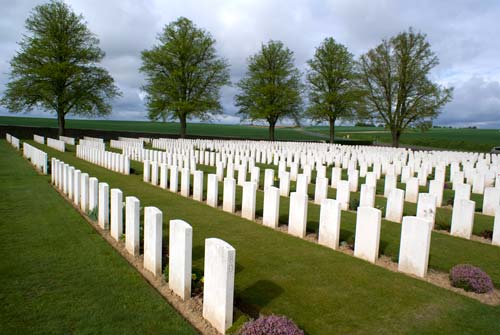
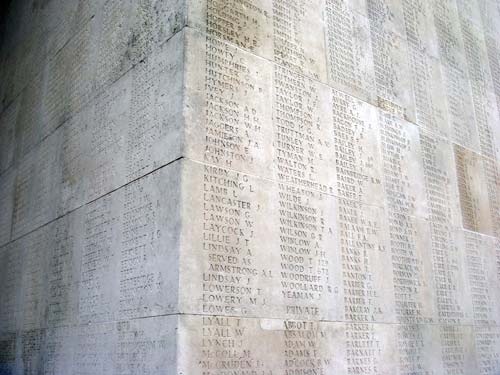
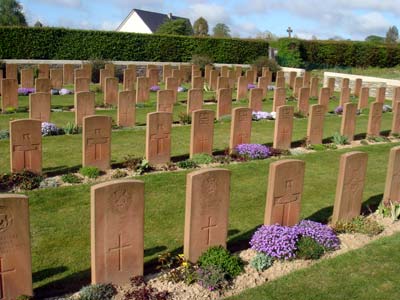
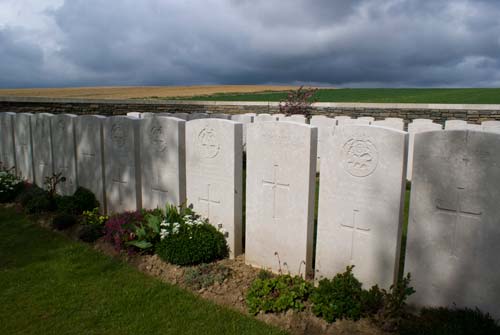
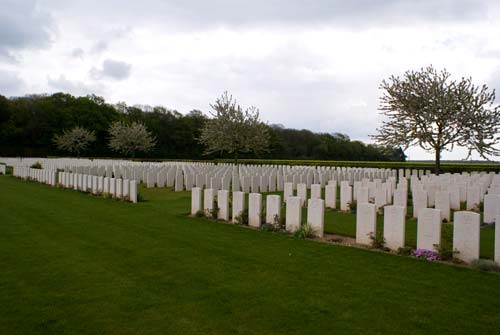
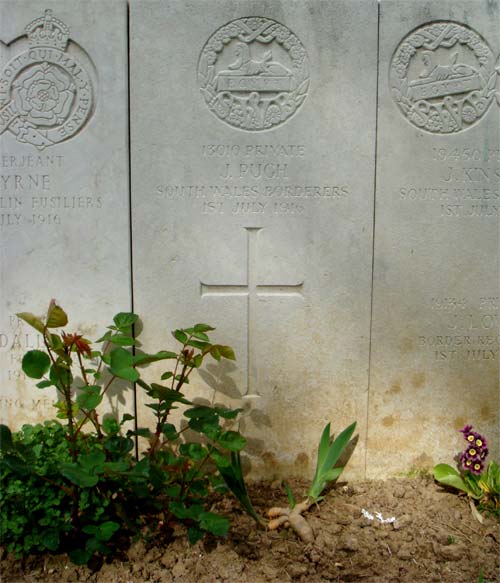
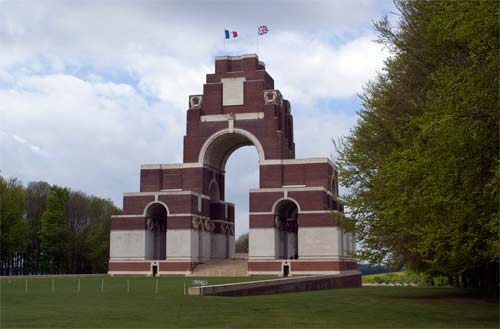
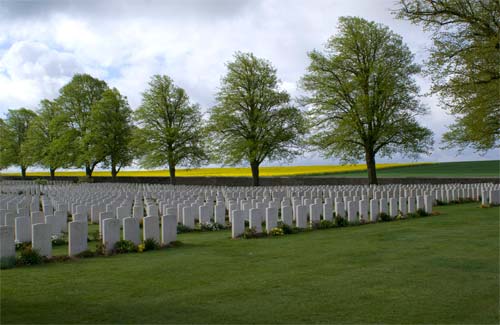
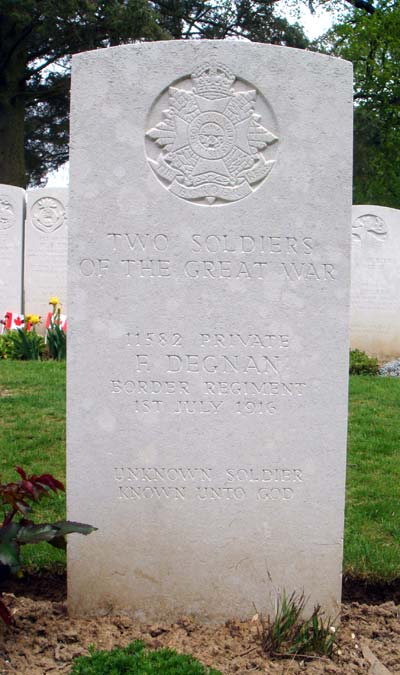
Death is at its most visible in the cemeteries and monuments of the Somme. The landscape is covered with hundreds. Immaculate and maintained by the Commonwealth War Graves Commission, they are strangely beautiful places wherein one’s breath is always taken away by the row upon row of white headstones. It’s only here the scale of the slaughter becomes apparent. Some headstones have names, many – where names are unknown – have just the words A Solider of the Great War. Often the date is familiar, coinciding with the start of a phase in the battle, July 1st 1916 for example. But many men too vanished altogether and over 72,000 of these men are commemorated on the Thiepval memorial to the missing.

In some respects, by being in the places where they fell, by walking the lines of the trenches and through ‘reading’ or ‘playing-back’ ‘recordings’ in the lines which cover the Somme as I’ve described above, we are, kinaesthetically, remembering the missing and all who never returned home. People are places and places are people. Remembrance is not an act solely of the mind, but of an embodied imagination.

Filed Under: Trees, World War I Tagged With: Bill Viola, Cemetery, Moments, Silence, The Somme, Tim Ingold, World War I, WWI

Verdun

April 30, 2008 by Nicholas Hedges

On 26th April I visited the battlefields and sites of Verdun. The name, like that of the Somme and Ypres, calls to mind visions of unimaginable horror; thousands upon thousands of men turned into names carved in monuments in towns throughout Europe, or lost completely, names and all, in the churned and pulverised fields. In my imagination, such places are always wet, cold, dark and desolate, as frozen in their appearance as they are fixed in old black and white photographs.

I won’t at this point discuss the battle’s history, suffice to say it’s a place in which around 500,000 men lost their lives, a figure which like so many grim statistics (I’m thinking here of my work on the Holocaust) is almost impossible to imagine (as much as it’s impossible to correlate). 26,000,000 shells rained upon the battlefield, six shells for every square metre. But difficult as these facts are to process, we must at least try.

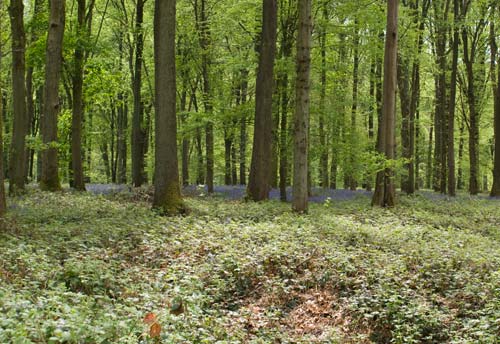
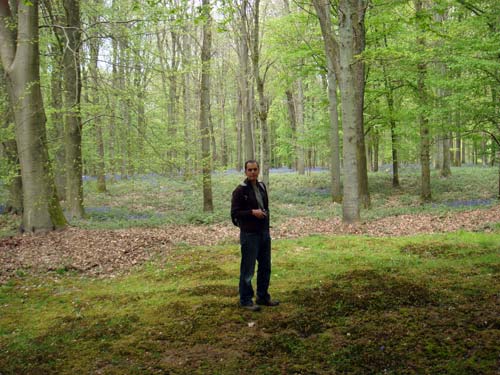
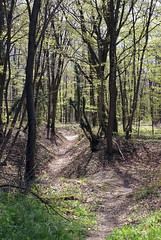
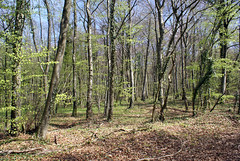
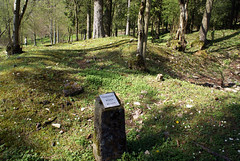
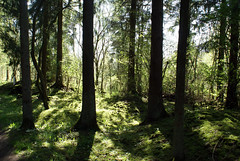
Having arrived in Verdun, we stopped the car at a track leading into a wood and no sooner had we started to walk amongst the trees than we became aware of the undulating ground; the shell craters and trenches, around and from within which this new wood had grown. At once we recalled the craters and trenches of Sanctuary Wood in Ypres, but the contrast between the two was clear; in Sanctuary Wood the trenches had been, at least, ‘over-preserved’ (some suggest they were dug for tourists after the war) but here they’d remained untouched since the end of hostilities. They were rounded and smoothed, and all the more powerful. At Sanctuary Wood, the whole place had the feel of a playground, whilst in this wood, the peace and quiet provided a stark counterpoint to the horrors of war.

Verdun

This counterpoint came in the birdsong and the colour of the sky, which on what was a glorious day was tinted by the brown of the trees and last year’s leaves filling the craters and trenches; a curious bruising as if a part of the dusk was somehow stained upon it. And between the carpet of leaves and the blue of the sky, was the green of this year’s growth; the whole scene a complete contrast to what the name, Verdun, had until now conjured in my mind. This place was simply beautiful.

Verdun

Save for a few tourists, we walked the woods alone, and yet, even then, the trees like those we’d encountered at other sites of trauma, seemed more than what they were. But whereas those which grow in Auschwitz-Birkenau and Belzec are strangely complicit in the events of the past, those in Verdun had grown from its wreckage; they did not hide what happened there. And stranger still was the sense that in this place Mankind was older than nature; Man had shaped the ground through his own destruction; he had made the void – the quagmire of mud – from which nature had risen, giving the trees a human quality, as if they carried with them the memory of all who fell – as if they were the fallen soldiers. And the resilience of Nature, it’s ability to rise from such appalling devastation, was one of the most striking aspects of our visit; despite the human feel of the trees, I realised how small humans are, even when they are made big through war. No matter what we do, Nature will in the course of time return. Long after we have finally gone, she will still be here, just as she was that day, in blue sky and birdsong, and as such, to walk through the woods was like being the last two people left on Earth.
This scarred idyll was littered with other wartime detritus; the pillboxes within which men would hide, seeking out their fellow man beyond the apertures through which their guns were trained. They sat like concrete bells, still ringing with the war, like the ringing heard in silence, after exposure to something loud. (I am reminded here of the idea of sympathetic vibrations, where when a bell is struck, another bell across the room begins vibrating, giving off the same sound. These pillboxes which litter the landscape around Verdun, and which we saw in Ypres, seem to contain within their walls and deep impenetrable interiors, a sound which finds sympathy in all the others. I can imagine these vibrations ringing in sites all across the world, again long after man has gone.)

Verdun

Having recorded the sounds of the birds (and on playback I notice the insects – and I start to think of flies trapped in amber) we left the wood and made our way to Fort Vaux, the second to fall in the Battle of Verdun and a place I will return to later.

This persistence of Nature was nowhere more apparent than in one of the ruined villages which we visited towards the end of the day. There was nothing left of Fleury-devant-Douaumont save for the street names preserved on signposts along with signs indicating where there’d been a farm, the cafe, Town Hall and the workshop of a weaver.

Verdun

One of the interesting things about the numerous ruined villages is how they each have a Major, a post created to preserve the memory of the place as well as those who lived there. Like the woods, the landscape was blistered beneath the lush grass, undulating like immeasurably slow ripples following the impact of thousands of shells. It was pockmarked with craters some of which had filled with water to make ponds, beautiful beneath the dappled shade of the trees. Again, one had the feel of Man being older than Nature, with the new wood growing out of what remained of the village; despite the unimaginable numbers of shells which ploughed the soil, the sheer number of dead, the poison of the gas used in the battle, the ground had somehow made this beautiful landscape. And just as a corpse can tell us much about its demise through what nature has written upon it – the time of death for example – so the woods grown out from the corpse of the landscape speak of the time that has passed; and here is the curious enigma of the Great War. Despite the fact that almost a hundred years separates us, it doesn’t seem that long ago.

Verdun

Fort Vaux is a name synonymous with the suffering, endurance and the bravery of the soldiers who fought there. Even after the French were forced to surrender, the Germans presented arms as a mark of respect. The following is an extract from H.P. Willmott’s book on the First World War.

Verdun

“The German bombardment of the Fort began on June 1st 1916, at one point firing shells at the rate of 1,500 to 2,000 of the per hour. Inside were 600 troops under the command of Major Raynal. Just before dawn on the 2nd the barrage stopped and two German battalions moved forward. By mid-afternoon they had overwhelmed the defenders and occupied a large part of the superstructure. Raynal was determined to resist, and he and his men withdrew to the underground corridors where a grim battle was fought in the darkness with grenades and machine guns. On June 4th the Germans used flamethrowers in an attempt to drive the French out with asphyxiating black smoke…”
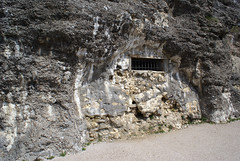
It’s a curious shell, a skull like structure cut into the rock which belies the horrors it has witnessed. Standing on top, one could see why it was so important, commanding spectacular views of the surrounding countryside and here, the contrast between the view of the tourist and that of the soldier becomes stark. What would they have seen from this same position? Hard to imagine that it was such a wasteland.

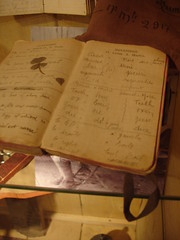
From Fort Vaux we made our way to the Memorial Museum and then to the Douaumont Ossuary. At the Museum, there was one object in particular which interested me, and that was a notebook containing handwritten translations of English words into French.

Verdun

The first line is the translation for Dead; Mort.

Verdun

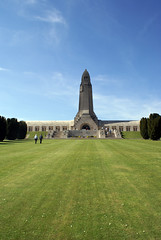
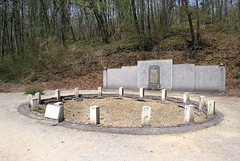
The structure of the ossuary is very much of its time and has the appearance of something which wouldn’t look out of place in Fritz Lang’s vision of the future, Metropolis. And this fact reminds us that it was just twenty years later when Europe and the world would be plunged into yet another catastrophe, indeed, during our journey around Verdun, we found evidence of this catastrophe in a memorial to 16 people killed in the second world war whose mutilated bodies were found dumped in a ditch which itself formed their memorial.

Verdun

From the top of the tower, one is again presented with spectacular views of the battlefields and again one can’t imagine what it would have looked like in those dark months of 1916. The tower itself houses the Victory Bell and the Lantern of the Dead which shines out over the battlefield.
Most of the structure is taken up by the 137 metre long cloister where each tomb shows a precise area of the battlefield from where the bodies were recovered. What one does notice – especially on a warm sunny day like that on which we visited – was how cold it is inside. One expects it to be colder given the thick stone walls, but there is something of an extra dimension to the chill, one is made all the more aware of being in the presence of the dead. And yet, this cold defines the living, it shows up our breath and for me, this was one of the most powerful aspects of the building.

Verdun

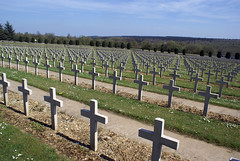
Outside the ossuary, through a row of small windows, one can see the bones of the 130,000 dead entombed within. Seeing the piles of leg bones, shoulder blades, vertebrae and skulls, one is reminded of the randomness of war, the arbitrariness of death on the battlefield. Like numbers and lists of names, it’s hard to imagine that these mountain of bones were once thousands of individuals, just as walking amongst the graves of the 15,000 men in front of the ossuary, one cannot imagine that many dead. Multiply that number, that space by thirty, see where it stretches out into the distance, and one begins to understand – in part – the horror of the war.

But one can never know what it was really like, and that to some extent is the point. Would we want to? We must do everything we can to never know. The inability to contemplate such horror in the face of such natural beauty is exactly its power. What we see when we walk through the woods is in some respects the world as it was before the war, the world of better days as remembered by those caught in the ‘meat-grinder’ of battle. The trenches gouged in the ground and the shell-craters pock-marking the soil are reminders of a brutal past, and yet they are also a warning about the future.
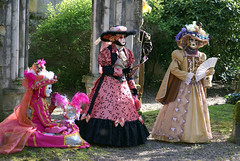
Having left the ossuray we made our way into the town of Verdun itself. Music was playing from speakers attached to all the lamposts, and at the appearance of people dressed in costume and sporting masks, we realised we had come at the time of a carnival. But there was something sinister about these people, the way in which they were a part of the town but detached, within but without. Something about their featureless, anonymous faces; the way they looked at us but we could not look at them, just a version of their selves.

Verdun

And seeing all these colourfully dressed people on the steps of the town’s huge memorial served to illustrate the continuity of life, but also the fact that those who died on the battlefields outside the town would have known brighter, happier, more colourful times, a juxtaposition which is everywhere in Verdun and which was to be found in the town’s Cathedral, itself hit on the first day of the battle – February 21st 1916.

Verdun

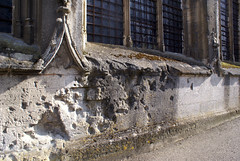
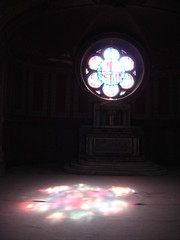
The Cathedral still bears the scars of war, but on the inside, one finds again the colour.

Verdun

Filed Under: Trees, World War I Tagged With: Place, Silence, The Somme, World War I, WWI, Ypres

The Unknown Soldier

April 6, 2007 by Nicholas Hedges

Extract from Neil Hanson’s book, ‘The Unknown Soldier,’ concerning the infamous Battle of the Somme.

‘The next day, the regiment began the long march to the Front. In the heat of early summer, nature had made attempts to reclaim the violated ground and a deceptive air of somnolence lay on the landscape. “The fields over which the scythe has not passed for years are a mass of wild flowers. They bathe the trenches in a hot stream of scent,” “smelling to heaven like incense in the sun.” “Brimstone butterflies and chalk-blues flutter above the dugouts and settle on the green ooze of the shell holes.” “Then a bare field strewn with barbed wire, rusted to a sort of Titian red – out of which a hare came just now and sat up with fear in his eyes and the sun shining red through his ears. Then the trench… piled earth with groundsel and great flaming dandelions and chickweed and pimpernels running riot over it. Decayed sandbags, new sandbags, boards, dropped ammunition, empty tins, corrugated iron, a smell of boots and stagnant water and burnt powder and oil and men, the occasional bang of a rifle and the click of a bolt, the occasional crack of a bullet coming over, or the wailing diminuendo of a ricochet. And over everything, the larks… and on the other side, nothing but a mud wall, with a few dandelions against the sky, until you look over the top or through a periscope and then you see the barbed wire and more barbed wire, and then fields with larks in them, and then barbed wire again.”

As the torrents of machine-gun bullets ripped through the grassy slopes up which the British troops were advancing, the smell of an English summer – fresh cut grass – filled the air. For thousands it would be the last scent they would ever smell.’

Filed Under: World War I Tagged With: Neil Hanson, Soldiers, The Somme, World War I, WWI

© Nicholas Hedges 2024

  • Facebook
  • Instagram
  • Twitter
  • YouTube

Copyright © 2025 · Outreach Pro on Genesis Framework · WordPress · Log in