Nicholas Hedges

Art, Writing and Research

  • Amazon
  • Behance
  • Facebook
  • Instagram
  • Pinterest
  • YouTube
  • Art
    • Digital
    • Drawing
    • Grids
      • Correspondence
      • The Wall
      • The Tourist
    • Ink on paper
      • Shadow Calligraphy
    • Installation
      • Murder
      • Echo
    • Painting
    • Patterns
    • Mixed Media
    • Photographic installation
      • St. Giles Fair 1908
      • Cornmarket 1907
      • Headington Hill 1903
      • Queen Street 1897
    • Research/Sketches
    • Stitched Work
      • Missded 1
      • Missded 2
      • Missded 3
      • Missded 4
    • Text Work
  • Blogs
    • Family History
    • Goethean Observations
    • Grief
    • Light Slowed But Never Stilled
    • Lists
    • Present Empathy
    • Shadow Calligraphy
    • Trees
    • Time
    • Walking Meditations
  • Video
  • Photography
    • Pillars of Snow
    • Creatures
    • The Trees
    • Snow
    • St. Giles Fair 1908
    • Cornmarket 1907
    • Headington Hill 1903
    • Queen Street 1897
    • Travel
  • Illustration and Design
  • Music
  • Projects
    • Dissonance and Rhyme
    • Design for an Heirloom
    • Backdrops
    • Shadow Calligraphy
  • Exhibitions
    • A Line Drawn in Water
      • Artwork
    • A Line Drawn in Water (Blog)
    • Mine the Mountain 3
      • Artwork
    • Mine the Mountain 2
      • Artwork
      • The Wall
    • The Woods, Breathing
      • Artwork
    • Snow
      • Artwork
    • Echo
      • Artwork
    • Murder
      • Artwork
    • The Tourist
    • Dreamcatcher
    • Mine the Mountain
      • Artwork
      • The Tourist
    • M8
    • The Gate
    • Creatures
      • Artwork
    • Residue
      • Artwork
    • A visit to Auschwitz
      • Artwork
  • Me
    • Artist’s Statement

WWI Portraits: Inside, Outside

September 18, 2013 by Nicholas Hedges

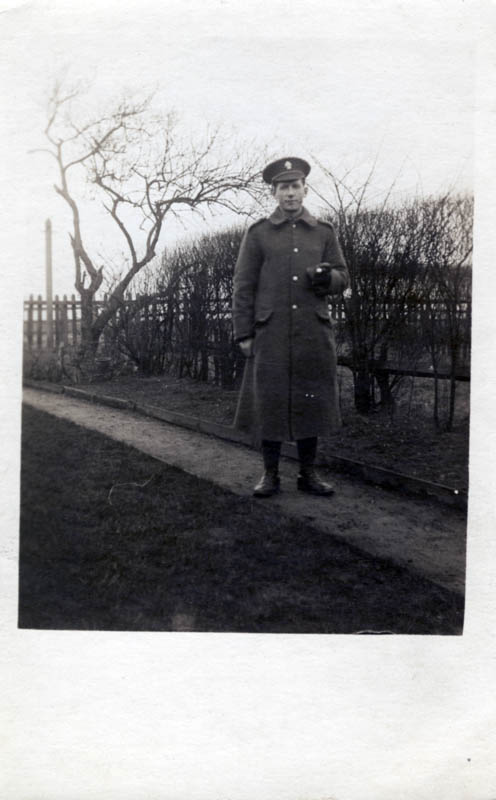
Below are two portraits, each of a soldier about to leave home to fight in what we now know as the Great War.
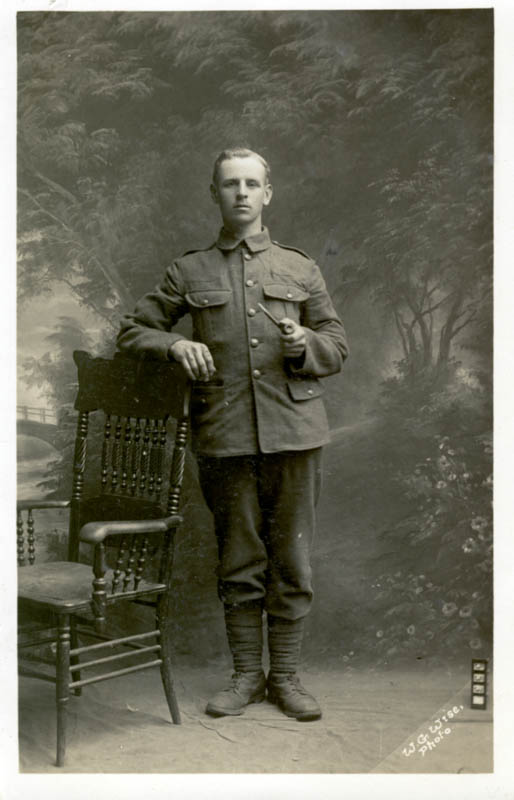
I’m interested in these two particular pictures because they reveal how differences in their immediate surroundings affect out ability to empathise with them as individuals.

In the first picture, taken in a studio, the soldier is pictured in front of a painted backdrop. In this idealised landscape, the leaves of the trees are out,  the flowers are always in bloom, and behind an incongruous chair a river flows nowhere beneath a bridge. In the second picture the trees are bare, there are no flowers and a path leads to the rear of what appears to be a garden.

In the first picture, the soldier could almost be an actor standing on a stage. In the second, the soldier is – one assumes – at home, although in a sense, he too is playing a part. His however is a picture of departure; an image pregnant with the weight of all we know was about to befall him and thousands like him. The image of the soldier standing in the studio, tells me only about that time between the shutter’s opening and closing. There is no sense of an entrance or indeed an exit – whereas with the second image, one can imagine the soldier standing in place, then leaving once the picture was taken.

I can empathise with the second soldier much more readily because I know what it’s like to stand in a garden in winter. Somehow, the fact the trees are bare, along with the hedge running the length of the garden helps me make a connection. The branches and twigs are stark, vivid, real. With the first soldier, the backdrop is a fantasy and connecting with him is like trying to connect with someone else’s dream.
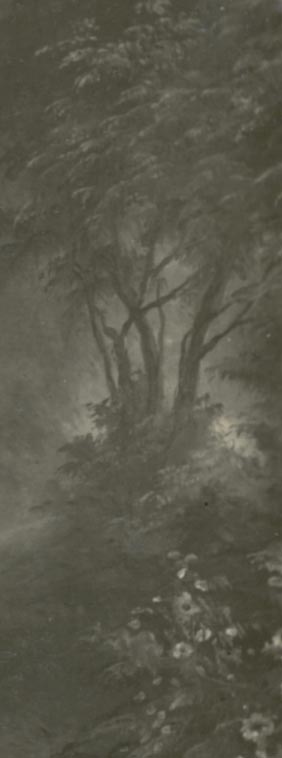
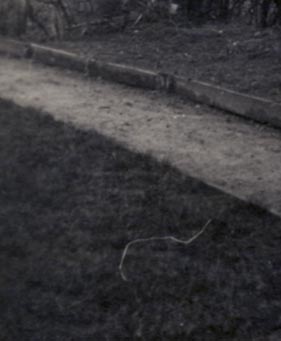
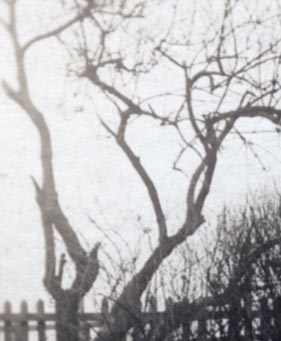
The main difference between the image above and those below is that in all those below I can feel the scene I’m looking at. I can almost hear it.

It was, I think, taken as the sun came up in the morning or as it set in the late afternoon…
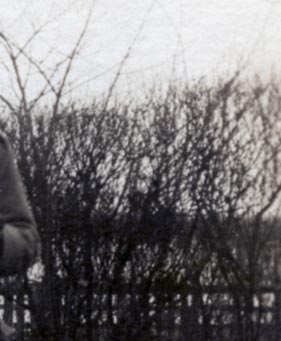
You can almost feel the dampness of the grass and smell the earth…

Looking at it, I’m reminded of a photograph from my own childhood (below), taken in the winter of 1984.
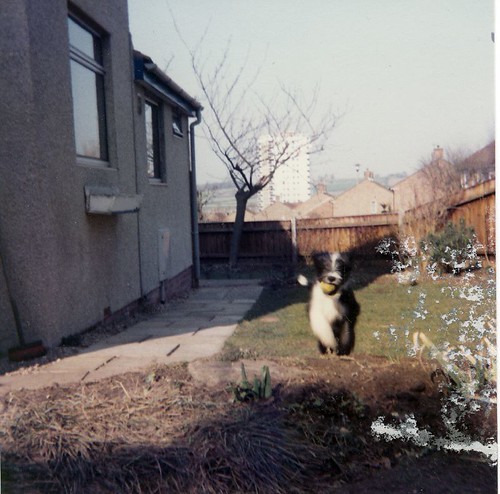
Sukey and Her Ball
The bare cherry tree at the bottom of the garden echoes the tree in the one above (as does, in some respects, the path). I can clearly remember the dog (Sukey) and the places beyond the limits of the photograph; the image – and my memory – opens out like a flower. 
The same is true in part of the image of the soldier standing in his own garden; his world opens out, not in terms of the surroundings beyond the limits of the picture (the gardens of his neighbours for example) but rather the history of the war about to be played out. I know what happened on an historical level, but now I can imagine this war from a different angle; from that of this small patch of ground in an undisclosed part of the UK; from the perspective of this particular soldier in the cold, milky light of a winter’s morning or afternoon.
I look at his image not only with my eyes but with my body – with an embodied imagination. I use my own memories to ‘colour in’ this image taken almost a hundred years ago, not in terms of green for grass, blue for sky etc. but in terms of the cold, the sharpness of the temperature. With the the soldier in the studio, there is very little to support any sense of an empathetic connection. His image is, a sense, just that – an image; one no different to the painted backdrop in front of which he stands. 

Filed Under: Trees, World War I Tagged With: Empathy, Nowness, Place, World War I, WWI, WWI Postcards

Beneath the floor

May 5, 2013 by Nicholas Hedges

I’ve always found it amazing, when, on a programme like Time Team, an apparently empty field is shown to have once been the site of some vast Roman villa; how something so grand and seemingly permanent can one day be lost to both memory and the landscape; a memento mori of inscribed lines on quite an epic scale. The recent discovery of the tomb of Richard III is perhaps the most vivid illustration of this; how the grave of so eminent a man could be buried (albeit hastily) in the choir of a friary, only for all trace (of both the grave and the friary) to be lost beneath the tarmac of a nondescript car park. In Urne Burial (1658), Sir Thomas Browne wrote:

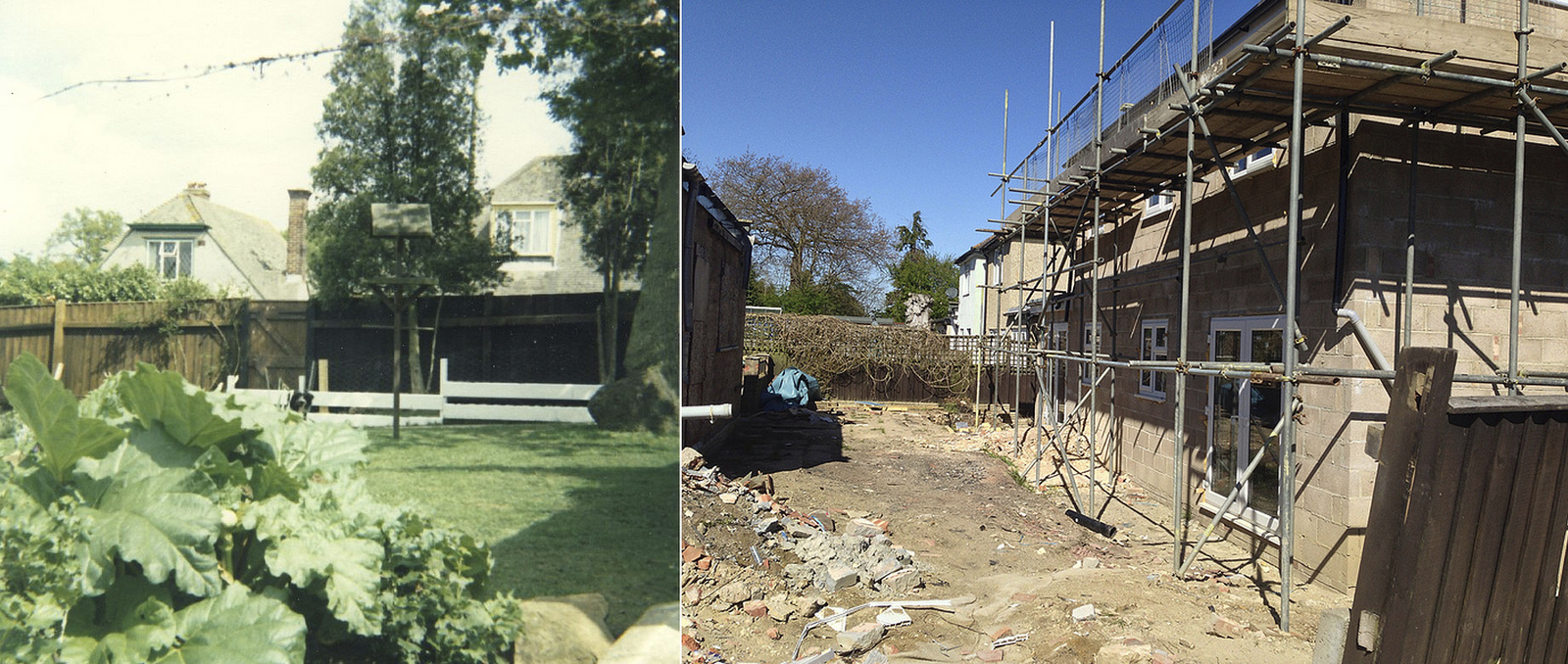
“There is no antidote against the Opium of time, which temporally considereth all things; Our Fathers finde their graves in our short memories, and sadly tell us how we may be buried in our Survivors. Grave-stones tell truth scarce fourty years; Generations passe while some trees stand, and old Families last not three Oaks.” In the garden of the house in which I grew up, there was an oak tree – now lost; a victim of the relentless drive to build flats and houses on every scrap of space ‘available’.

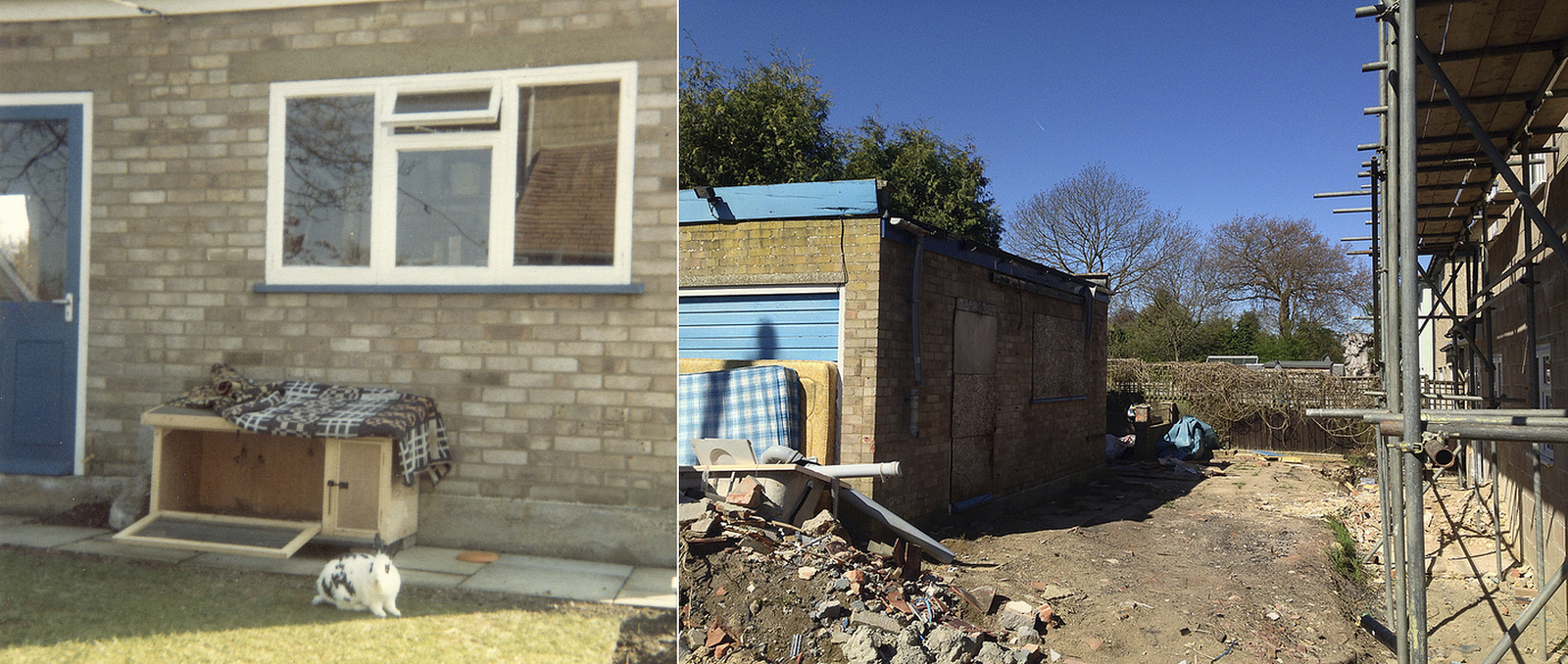
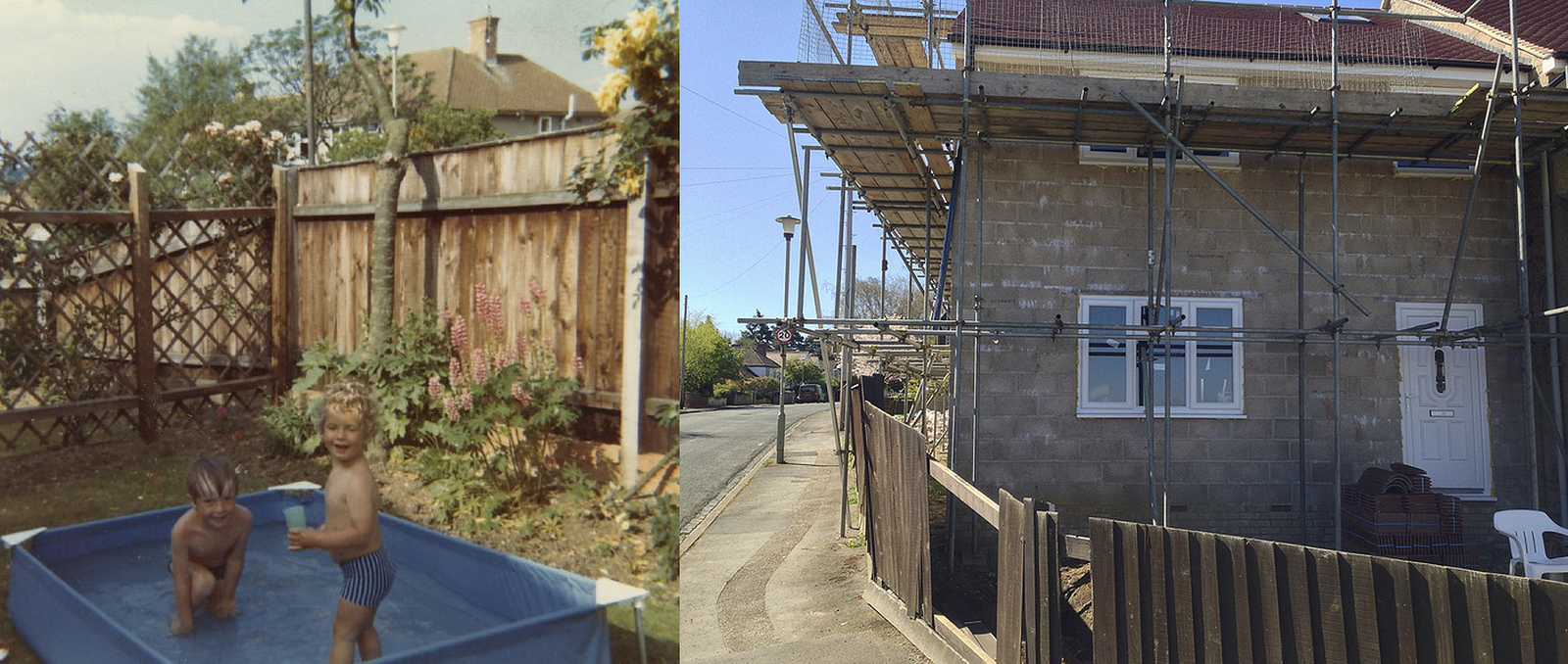
In the shade of that tree (visible above on the right hand side) and the lawn beyond its reach, I spent many childhood days, playing football, high-jumping (badly), playing at being ‘The Professionals’ and, on one occasion, holding a sale to raise money for charity. But in the last year, a few years since my dad sold up and left, half the house has been pulled down (including most of my bedroom) and a new one built alongside, covering most of the garden.

The lawn on which we had picnics, over which the rabbit – Patch – thundered, chasing Sammy the cat – and the beds beneath which those same animals, amongst many others, were interred, is now itself buried beneath new concrete floors and builder’s rubble.

It’s strange to think of someone standing in a kitchen, or sitting in a living room, on the exact same space where we once played.

And that’s what made me think of those Roman villas lost to the past beneath the ground; all those memories attached to those buildings which have soaked away like water, into the ground over the course of two millennia.

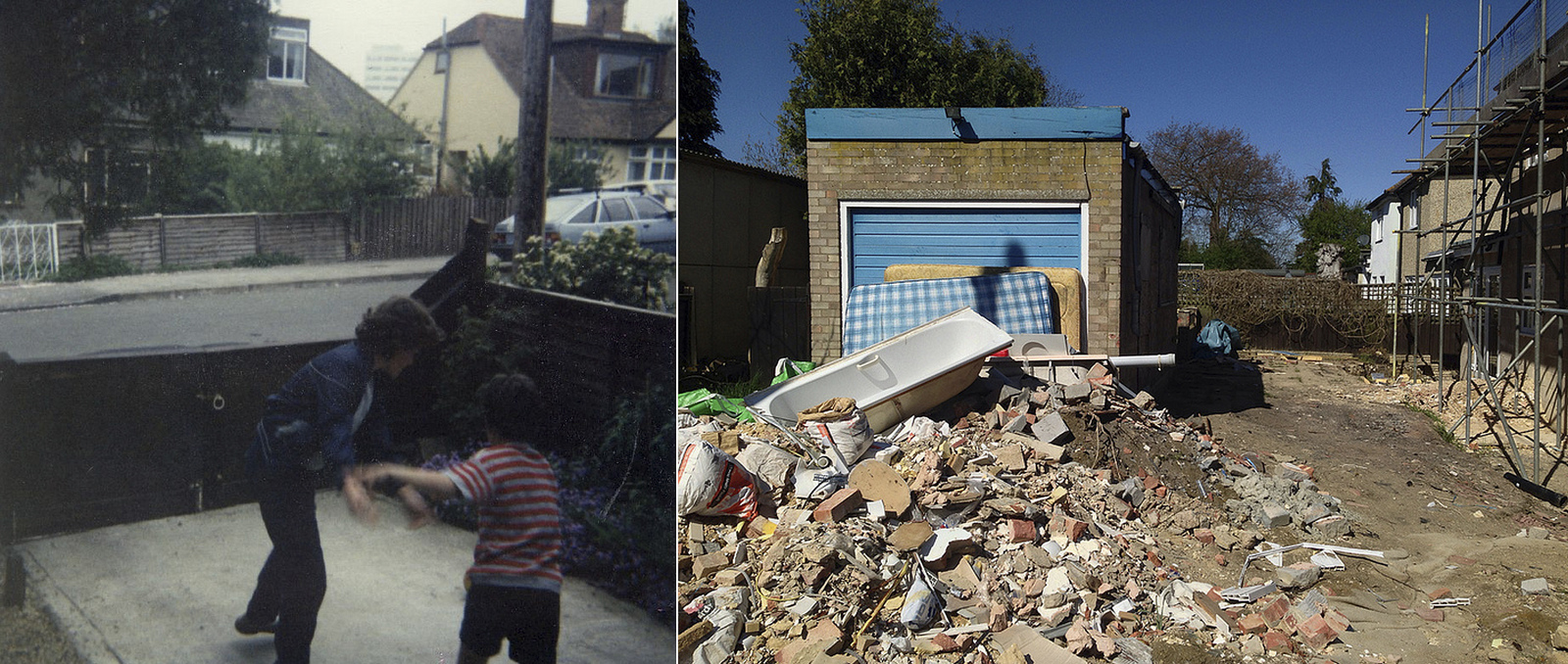
The garage is now a particularly mournful sight. Here, I spent many hours (often with enormous hair as evidenced by the photograph) on the drive, playing football with my brother and friends – or sometimes by myself (I can still hear the sound of the plastic ball skitting across the concrete and the bash of the blue metal door which was sometimes the goal). The sounds too at night of my dad arriving home in the car, the radio blaring as the wooden gates were opened; the whoosh of the garage door being lifted, are memories more permanent than the concrete drive itself. Now the garage is a sorry looking creature, whose full demise is certain, along with the shed tucked away behind (in which we sometimes slept on warm summer nights).

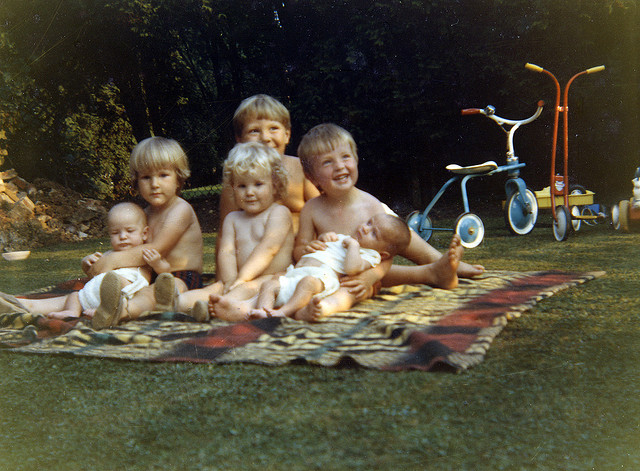
The photo below of me and my cousins (on my dad’s side) was taken when I was a baby in the summer of 1971.

The patch of grass on which we’re sitting would soon become the garage….

Filed Under: Family History, Trees Tagged With: Childhood, Coniston Avenue, Family History, Memory, Place

Fields of East Oxford

March 8, 2011 by Nicholas Hedges

The following is taken from my Blog and is reproduced here as it refers to research concerning East Oxford, and in particular the area surrounding the road up which the ‘Gentleman’s Servant’ would have ridden:

I’ve spent a very interesting morning in the archives at Christ Church college, researching as part of the East Oxford Archaeology Project. I had no fixed idea as to what I wanted to look for but was interested to see where the various material on offer would lead me.

I started by looking at a large and beautiful map of 1777 which showed the field system in East Oxford along with the names of fields and some of the individual furlongs. The abundance of units of measurement are quite baffling but nonetheless very poetic: furlongs, perches, chains, rods etc. and the way locations of land are described equally interesting; for example “The field called the Lakes begins next to Drove Acre Meer shooting onto the Marsh.”

A meer as far as I’ve been able to ascertain is a boundary deriving from the Old English world mǣre. Interestingly, Drove Acre still exists today in the form of Drove Acre Road, which joins with Ridgefield Road, so named after the old Ridge Field on which it’s built. Before I go into other field names, I want to try and identify the different units of measurement.


A rood is a unit describing an area of land and is equivalent to 1/4 acre. An acre is therefore 4 roods. In terms of length, an acre is a furlong (a furrowlong) which is equivalent to 10 chains or 220 yards. A chain therefore is 22 yards. A rod, pole or perch is 5 1/2 yards. A mile is 8 furlongs. 

I also found a unit called a butt, which I believe is where the oxen (ploughing a furlong) turned and rested where one acre butted onto the next creating a small mound of earth. 

The names of the main fields in this area – as I discovered in a document of 1814 – are as follows:

Bartholomew Field
Ridge Field
Compass Field
The Lakes
Broad Field
Church Field
Far Field
Wood Field
Open Field Meadow

The name Far Field makes sense in that it’s situated some way from town. But The Lakes? 

Within these fields, individual furlongs were also given names, such as:

Pressmore Furlong
London Way Furlong
Ridge Furlong
Furlong by the Mead Hedge
Clay Pits Furlong
Furlong Shooting on Breaden Hill
Short Furlong in Catwell
Brook Furlong
Hare Hedge Furlong
Croft Furlong by Bullingdon Green

The word shoot or shooting is used a lot to describe the location of land, such as ‘Furlong shooting on Sander’s Marsh.’ I think this must mean that the furlong joins or abuts the marsh. ‘The furlong that shoots on the alms-house,’ for example seems to describe land that joins the alms-house which I think describes those in St. Clements. 

What interests me is how differently this area of Oxford would have been known to those who lived 200 years ago. It’s an obvious point given that much of what were fields are now houses, but it’s the names that interest. How did these places acquire these names, and why have some survived and others haven’t? (It’s probably just as well that no-one lives in Shittern Corner today).

Filed Under: Oxford Tagged With: Archaeology, Gentlemans Servant, Oxford, Place, Servant

Fields

March 4, 2011 by Nicholas Hedges

I’ve spent a very interesting morning in the archives at Christ Church college, researching as part of the East Oxford Archaeology Project. I had no fixed idea as to what I wanted to look for but was interested to see where the various material on offer would lead me.

I started by looking at a large and beautiful map of 1777 which showed the field system in East Oxford along with the names of fields and some of the individual furlongs. The abundance of units of measurement are quite baffling but nonetheless very poetic: furlongs, perches, chains, rods etc. and the way locations of land are described equally interesting; for example “The field called the Lakes begins next to Drove Acre Meer shooting onto the Marsh.”

A meer as far as I’ve been able to ascertain is a boundary deriving from the Old English world mǣre. Interestingly, Drove Acre still exists today in the form of Drove Acre Road, which joins with Ridgefield Road, so named after the old Ridge Field on which it’s built. Before I go into other field names, I want to try and identify the different units of measurement.

A rood is a unit describing an area of land and is equivalent to 1/4 acre. An acre is therefore 4 roods. In terms of length, an acre is a furlong (a furrowlong) which is equivalent to 10 chains or 220 yards. A chain therefore is 22 yards. A rod, pole or perch is 5 1/2 yards. A mile is 8 furlongs. 

I also found a unit called a butt, which I believe is where the oxen (ploughing a furlong) turned and rested where one acre butted onto the next creating a small mound of earth. 

The names of the main fields in this area – as I discovered in a document of 1814 – are as follows:

Bartholomew Field
Ridge Field
Compass Field
The Lakes
Broad Field
Church Field
Far Field
Wood Field
Open Field Meadow

The name Far Field makes sense in that it’s situated some way from town. But The Lakes? 

Within these fields, individual furlongs were also given names, such as:

Pressmore Furlong
London Way Furlong
Ridge Furlong
Furlong by the Mead Hedge
Clay Pits Furlong
Furlong Shooting on Breaden Hill
Short Furlong in Catwell
Brook Furlong
Hare Hedge Furlong
Croft Furlong by Bullingdon Green

The word shoot or shooting is used a lot to describe the location of land, such as ‘Furlong shooting on Sander’s Marsh.’ I think this must mean that the furlong joins or abuts the marsh. ‘The furlong that shoots on the alms-house,’ for example seems to describe land that joins the alms-house which I think describes those in St. Clements. 

What interests me is how differently this area of Oxford would have been known to those who lived 200 years ago. It’s an obvious point given that much of what were fields are now houses, but it’s the names that interest. How did these places acquire these names, and why have some survived and others haven’t? (It’s probably just as well that no-one lives in Shittern Corner today).

Filed Under: Oxford Tagged With: 18th Century, Archaeology, Oxford, Place

Weymouth

November 4, 2009 by Nicholas Hedges

Yesterday I went to Weymouth to look at some deckchairs for use in a number of installations. One such installation I’ve been considering centres around the D-Day landings – I won’t go into the details of what it will entail but I was amazed as I was shown around the front to discover that Weymouth played a pivotal role in the landings themselevs, in that it was from the harbour that many of the men who took part in the invasion left. The coincidence convinced me that this was the place – the only place – where the work could be installed.

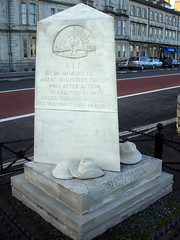
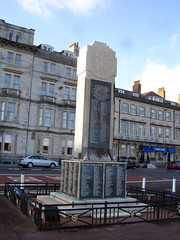
On the front is a memorial to the men who took part in the D-Day landings.

Weymouth

Around the base are the following inscriptions.

Weymouth

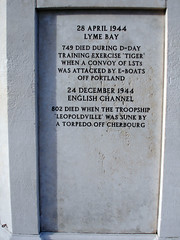
28 April 1944
Lyme Bay

749 Died during D-Day training exercise ‘Tiger’ when a convoy of LSTs was attacked by E-Boats off Portland.
24 December 1944
English Channel

802 Died when the troopship ‘Leopoldville’ was sunk by a torpedo off Cherbourg.

Weymouth

11th October 2002

Prior to 6th June 1944 the 2nd and 5th Ranger Battalions of the Army of the United States of America depended heavily on men and equipment of the Landing Craft Assault (LCA) Flotillas during training and while developing special assault-techniques on D-Day, these same men of the Royal Navy demonstrated the finest traditions of their service through their courage, steadfastness, and devotion to duty. The successes of their assaults at Pointe du Hoc and the Omaha beaches of Dog Green, Red and White were made possible through their skills and bravery. All World War II Rangers are proud to be associated with the veterans of the LCA Flotillas of the Royal Navy and remain grateful to them, and their vessels both large and small.

Weymouth

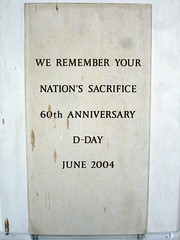
We remember your Nation’s sacrifice
60th anniversary
D-Day
June 2004

Weymouth

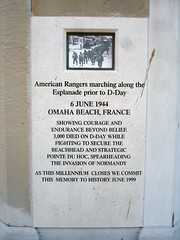
6 June 1944
Omaha Beach, France
Showing courage and endurance beyond belief 3000 died on D-Day while fighting to secure the beachhead and strategic Pointe du Hoc, spearheading the invasion of Normandy. As this  millennium closes we commit this memory to history June 1999.

Further along the beach are more war memorials.

Weymouth

A.I.F.
In memory of Anzac Volunteer Troops who after action at Gallipoli in 1915 passed through hospitals and training camps in Dorset.

Weymouth

Weymouth

As a child, I often went with my family on holiday to the Dorset coast, either to Weymouth or the surrounding areas, and even though my experiences were – it goes without saying – utterly different to those of the men who left Weymouth for France, nevertheless, there is something about these experiences residing in the past as memories which allows me to, in some small way, access the past before I was born. The past (and in particular the distant past) is often imbued with a sense of the exotic – a word which is of course as far removed from the reality endured by the men who fought and died during D-Day as you can get. This ‘exotic’ quality is more akin to the nostalgia we often feel when contemplating our own memories. There is a sensuousness to memories which we experience without recourse to our senses. We see, hear, smell, touch and taste memories internally; we can see them with our eyes closed. Only by being in the place where they happened can we begin to experience them as things which happened in what was then the present. It’s almost as if they are grounded.

Standing in Weymouth and looking out at the cliffs, feeling the wind, hearing the gulls and the waves, I could get a greater sense not only of my own memories, but those of a time when I was not even born. The men left Weymouth and who died on the beaches of Normandy would have known the same feel of the wind, the same sound of the waves – they would have seen the very same cliffs. We can never know what it was like to be in their shoes, but by understanding and observing the present we can at least ground the memories in reality.

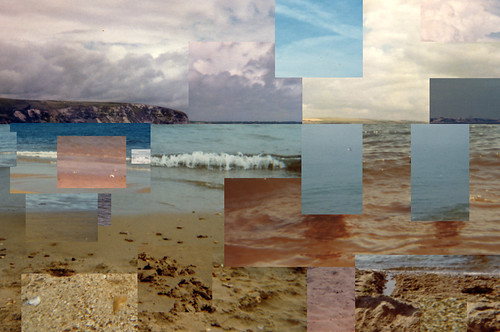
Looking at some recent work I’ve done with some of my old holiday snapshots, I can see in light of my visit to Weymouth how they have become more meaningful. The image below is a collage of all the parts of those holiday snaps from which the people have been removed.

The Place That's Always There

The Place That’s Always There (2009).

Filed Under: Uncategorized Tagged With: Coast, D-Day, History, Place, Sea, Weymouth

Echo

September 15, 2009 by Nicholas Hedges

Last week I installed a temporary artwork in St. Giles, Oxford entitled Echo. The piece comprised approximately 200 photographs of individuals isolated from group shots of the fair taken in 1908, 1913 and 1914. The date of the exhibition, Wednesday 9th September was important in that it was the day after St. Giles’ Fair was taken down, and the ‘space’ left in its wake (the fair was up for two days and filled the entire street) helped frame the fact that all those people shown in the exhibition, who had once stood in the same street, had, like the fair, gone. I was interested in the boundary between existence and non-existence, the impossiblity – within the human mind – of death as nothing and forever. What I hoped the photographs conveyed was the importance of having been.

The installation required grass in order that I could place the markers in the ground and the War Memorial in St. Giles was the only viable option. What was particularly interesting was how the location altered the meaning of the work in that one couldn’t help identify the people with the memorial and in particular those who fell in World War One. Given that some of the men pictured in the photographs almost certainly went to war and may well have lost their lives, so the work took on a new and poignant dimension. Many of the women  would have lost husbands, brothers, fathers, uncles and so on.

Click here to read more about this exhibition.

Filed Under: Oxford Tagged With: Echo, History, Oxford, Place, Vintage Photographs, World War I, WWI

Verdun

April 30, 2008 by Nicholas Hedges

On 26th April I visited the battlefields and sites of Verdun. The name, like that of the Somme and Ypres, calls to mind visions of unimaginable horror; thousands upon thousands of men turned into names carved in monuments in towns throughout Europe, or lost completely, names and all, in the churned and pulverised fields. In my imagination, such places are always wet, cold, dark and desolate, as frozen in their appearance as they are fixed in old black and white photographs.

I won’t at this point discuss the battle’s history, suffice to say it’s a place in which around 500,000 men lost their lives, a figure which like so many grim statistics (I’m thinking here of my work on the Holocaust) is almost impossible to imagine (as much as it’s impossible to correlate). 26,000,000 shells rained upon the battlefield, six shells for every square metre. But difficult as these facts are to process, we must at least try.

Having arrived in Verdun, we stopped the car at a track leading into a wood and no sooner had we started to walk amongst the trees than we became aware of the undulating ground; the shell craters and trenches, around and from within which this new wood had grown. At once we recalled the craters and trenches of Sanctuary Wood in Ypres, but the contrast between the two was clear; in Sanctuary Wood the trenches had been, at least, ‘over-preserved’ (some suggest they were dug for tourists after the war) but here they’d remained untouched since the end of hostilities. They were rounded and smoothed, and all the more powerful. At Sanctuary Wood, the whole place had the feel of a playground, whilst in this wood, the peace and quiet provided a stark counterpoint to the horrors of war.

Verdun

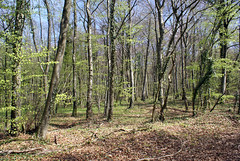
This counterpoint came in the birdsong and the colour of the sky, which on what was a glorious day was tinted by the brown of the trees and last year’s leaves filling the craters and trenches; a curious bruising as if a part of the dusk was somehow stained upon it. And between the carpet of leaves and the blue of the sky, was the green of this year’s growth; the whole scene a complete contrast to what the name, Verdun, had until now conjured in my mind. This place was simply beautiful.

Verdun

Save for a few tourists, we walked the woods alone, and yet, even then, the trees like those we’d encountered at other sites of trauma, seemed more than what they were. But whereas those which grow in Auschwitz-Birkenau and Belzec are strangely complicit in the events of the past, those in Verdun had grown from its wreckage; they did not hide what happened there. And stranger still was the sense that in this place Mankind was older than nature; Man had shaped the ground through his own destruction; he had made the void – the quagmire of mud – from which nature had risen, giving the trees a human quality, as if they carried with them the memory of all who fell – as if they were the fallen soldiers. And the resilience of Nature, it’s ability to rise from such appalling devastation, was one of the most striking aspects of our visit; despite the human feel of the trees, I realised how small humans are, even when they are made big through war. No matter what we do, Nature will in the course of time return. Long after we have finally gone, she will still be here, just as she was that day, in blue sky and birdsong, and as such, to walk through the woods was like being the last two people left on Earth.
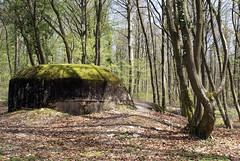
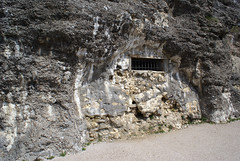
This scarred idyll was littered with other wartime detritus; the pillboxes within which men would hide, seeking out their fellow man beyond the apertures through which their guns were trained. They sat like concrete bells, still ringing with the war, like the ringing heard in silence, after exposure to something loud. (I am reminded here of the idea of sympathetic vibrations, where when a bell is struck, another bell across the room begins vibrating, giving off the same sound. These pillboxes which litter the landscape around Verdun, and which we saw in Ypres, seem to contain within their walls and deep impenetrable interiors, a sound which finds sympathy in all the others. I can imagine these vibrations ringing in sites all across the world, again long after man has gone.)

Verdun

Having recorded the sounds of the birds (and on playback I notice the insects – and I start to think of flies trapped in amber) we left the wood and made our way to Fort Vaux, the second to fall in the Battle of Verdun and a place I will return to later.

This persistence of Nature was nowhere more apparent than in one of the ruined villages which we visited towards the end of the day. There was nothing left of Fleury-devant-Douaumont save for the street names preserved on signposts along with signs indicating where there’d been a farm, the cafe, Town Hall and the workshop of a weaver.

Verdun

One of the interesting things about the numerous ruined villages is how they each have a Major, a post created to preserve the memory of the place as well as those who lived there. Like the woods, the landscape was blistered beneath the lush grass, undulating like immeasurably slow ripples following the impact of thousands of shells. It was pockmarked with craters some of which had filled with water to make ponds, beautiful beneath the dappled shade of the trees. Again, one had the feel of Man being older than Nature, with the new wood growing out of what remained of the village; despite the unimaginable numbers of shells which ploughed the soil, the sheer number of dead, the poison of the gas used in the battle, the ground had somehow made this beautiful landscape. And just as a corpse can tell us much about its demise through what nature has written upon it – the time of death for example – so the woods grown out from the corpse of the landscape speak of the time that has passed; and here is the curious enigma of the Great War. Despite the fact that almost a hundred years separates us, it doesn’t seem that long ago.

Verdun

Fort Vaux is a name synonymous with the suffering, endurance and the bravery of the soldiers who fought there. Even after the French were forced to surrender, the Germans presented arms as a mark of respect. The following is an extract from H.P. Willmott’s book on the First World War.

Verdun

“The German bombardment of the Fort began on June 1st 1916, at one point firing shells at the rate of 1,500 to 2,000 of the per hour. Inside were 600 troops under the command of Major Raynal. Just before dawn on the 2nd the barrage stopped and two German battalions moved forward. By mid-afternoon they had overwhelmed the defenders and occupied a large part of the superstructure. Raynal was determined to resist, and he and his men withdrew to the underground corridors where a grim battle was fought in the darkness with grenades and machine guns. On June 4th the Germans used flamethrowers in an attempt to drive the French out with asphyxiating black smoke…”
It’s a curious shell, a skull like structure cut into the rock which belies the horrors it has witnessed. Standing on top, one could see why it was so important, commanding spectacular views of the surrounding countryside and here, the contrast between the view of the tourist and that of the soldier becomes stark. What would they have seen from this same position? Hard to imagine that it was such a wasteland.

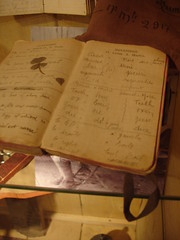
From Fort Vaux we made our way to the Memorial Museum and then to the Douaumont Ossuary. At the Museum, there was one object in particular which interested me, and that was a notebook containing handwritten translations of English words into French.

Verdun

The first line is the translation for Dead; Mort.

Verdun

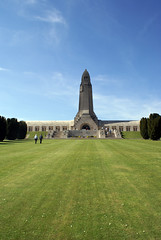
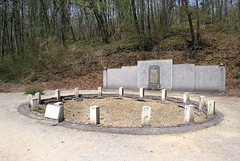
The structure of the ossuary is very much of its time and has the appearance of something which wouldn’t look out of place in Fritz Lang’s vision of the future, Metropolis. And this fact reminds us that it was just twenty years later when Europe and the world would be plunged into yet another catastrophe, indeed, during our journey around Verdun, we found evidence of this catastrophe in a memorial to 16 people killed in the second world war whose mutilated bodies were found dumped in a ditch which itself formed their memorial.

Verdun

From the top of the tower, one is again presented with spectacular views of the battlefields and again one can’t imagine what it would have looked like in those dark months of 1916. The tower itself houses the Victory Bell and the Lantern of the Dead which shines out over the battlefield.
Most of the structure is taken up by the 137 metre long cloister where each tomb shows a precise area of the battlefield from where the bodies were recovered. What one does notice – especially on a warm sunny day like that on which we visited – was how cold it is inside. One expects it to be colder given the thick stone walls, but there is something of an extra dimension to the chill, one is made all the more aware of being in the presence of the dead. And yet, this cold defines the living, it shows up our breath and for me, this was one of the most powerful aspects of the building.

Verdun

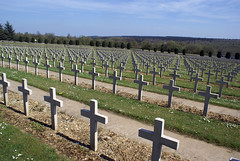
Outside the ossuary, through a row of small windows, one can see the bones of the 130,000 dead entombed within. Seeing the piles of leg bones, shoulder blades, vertebrae and skulls, one is reminded of the randomness of war, the arbitrariness of death on the battlefield. Like numbers and lists of names, it’s hard to imagine that these mountain of bones were once thousands of individuals, just as walking amongst the graves of the 15,000 men in front of the ossuary, one cannot imagine that many dead. Multiply that number, that space by thirty, see where it stretches out into the distance, and one begins to understand – in part – the horror of the war.

But one can never know what it was really like, and that to some extent is the point. Would we want to? We must do everything we can to never know. The inability to contemplate such horror in the face of such natural beauty is exactly its power. What we see when we walk through the woods is in some respects the world as it was before the war, the world of better days as remembered by those caught in the ‘meat-grinder’ of battle. The trenches gouged in the ground and the shell-craters pock-marking the soil are reminders of a brutal past, and yet they are also a warning about the future.
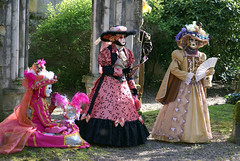
Having left the ossuray we made our way into the town of Verdun itself. Music was playing from speakers attached to all the lamposts, and at the appearance of people dressed in costume and sporting masks, we realised we had come at the time of a carnival. But there was something sinister about these people, the way in which they were a part of the town but detached, within but without. Something about their featureless, anonymous faces; the way they looked at us but we could not look at them, just a version of their selves.

Verdun

And seeing all these colourfully dressed people on the steps of the town’s huge memorial served to illustrate the continuity of life, but also the fact that those who died on the battlefields outside the town would have known brighter, happier, more colourful times, a juxtaposition which is everywhere in Verdun and which was to be found in the town’s Cathedral, itself hit on the first day of the battle – February 21st 1916.

Verdun

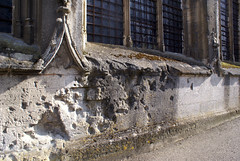
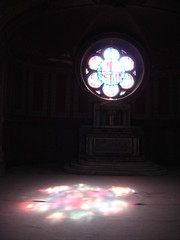
The Cathedral still bears the scars of war, but on the inside, one finds again the colour.

Verdun

Filed Under: Trees, World War I Tagged With: Place, Silence, The Somme, World War I, WWI, Ypres

© Nicholas Hedges 2024

  • Facebook
  • Instagram
  • Twitter
  • YouTube

Copyright © 2025 · Outreach Pro on Genesis Framework · WordPress · Log in