Nicholas Hedges

Art, Writing and Research

  • Amazon
  • Behance
  • Facebook
  • Instagram
  • Pinterest
  • YouTube
  • Art
    • Digital
    • Drawing
    • Grids
      • Correspondence
      • The Wall
      • The Tourist
    • Ink on paper
      • Shadow Calligraphy
    • Installation
      • Murder
      • Echo
    • Painting
    • Patterns
    • Mixed Media
    • Photographic installation
      • St. Giles Fair 1908
      • Cornmarket 1907
      • Headington Hill 1903
      • Queen Street 1897
    • Research/Sketches
    • Stitched Work
      • Missded 1
      • Missded 2
      • Missded 3
      • Missded 4
    • Text Work
  • Blogs
    • Family History
    • Goethean Observations
    • Grief
    • Light Slowed But Never Stilled
    • Lists
    • Present Empathy
    • Shadow Calligraphy
    • Trees
    • Time
    • Walking Meditations
  • Video
  • Photography
    • Pillars of Snow
    • Creatures
    • The Trees
    • Snow
    • St. Giles Fair 1908
    • Cornmarket 1907
    • Headington Hill 1903
    • Queen Street 1897
    • Travel
  • Illustration and Design
  • Music
  • Projects
    • Dissonance and Rhyme
    • Design for an Heirloom
    • Backdrops
    • Shadow Calligraphy
  • Exhibitions
    • A Line Drawn in Water
      • Artwork
    • A Line Drawn in Water (Blog)
    • Mine the Mountain 3
      • Artwork
    • Mine the Mountain 2
      • Artwork
      • The Wall
    • The Woods, Breathing
      • Artwork
    • Snow
      • Artwork
    • Echo
      • Artwork
    • Murder
      • Artwork
    • The Tourist
    • Dreamcatcher
    • Mine the Mountain
      • Artwork
      • The Tourist
    • M8
    • The Gate
    • Creatures
      • Artwork
    • Residue
      • Artwork
    • A visit to Auschwitz
      • Artwork
  • Me
    • Artist’s Statement

John Gwynn’s Survey 1772 – Pt 2

June 24, 2010 by Nicholas Hedges

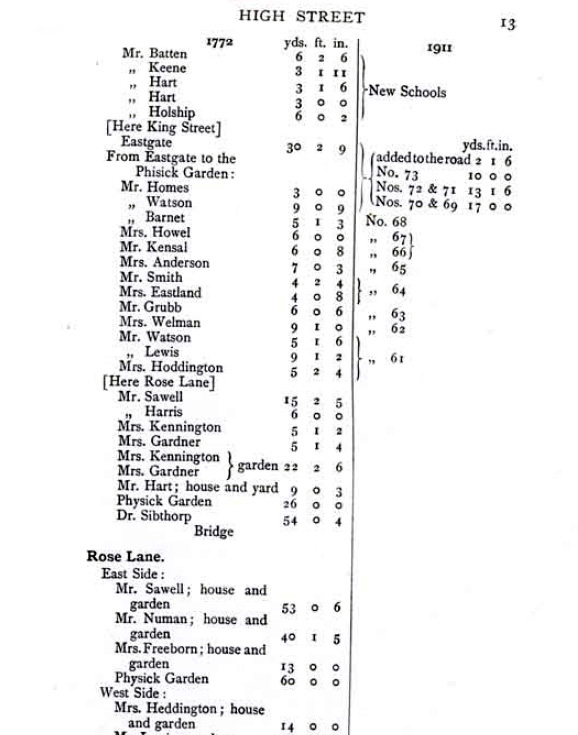
Whilst looking through some old research I did a few years ago, I came across the drawing reproduced below of Magdalen Bridge and its environs taken from John Gwynn’s survey of 1772.
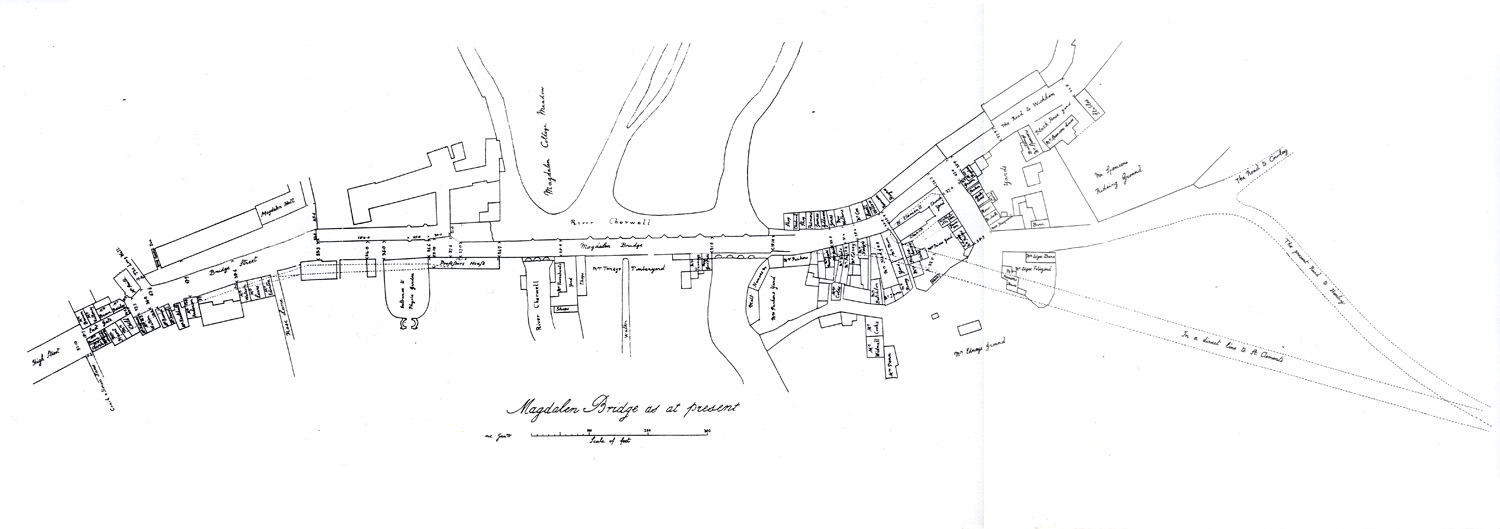
It shows the route we know the stranger took – the narrative line of this story – on December 12th 1770 along with the names of those who lived or owned properties bordering the street in 1771/72. Interestingly, my namesake – at least as far as my surname goes – owned property just in front of the old church of St. Clement which was demolished in 1828.
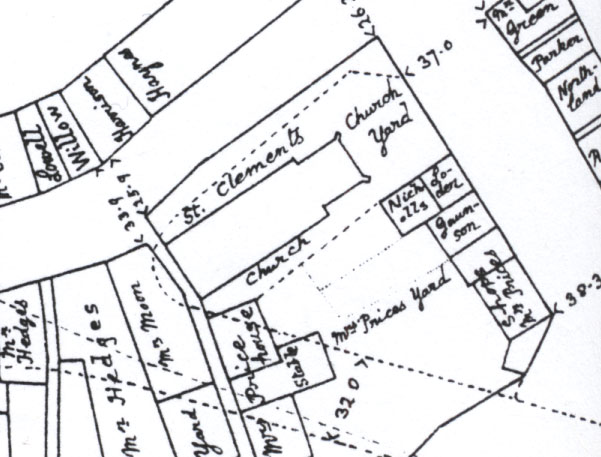
Filed Under: Oxford, The Gentleman's Servant Tagged With: John Gwynne, Maps, Oxford, Survey

John Malchair (1730-1812)

June 23, 2010 by Nicholas Hedges

I first encountered the work of John Malchair in 1998, at an exhibition in the Ashmolean Museum Oxford. Being as I am from Oxford, I was immediately struck by the beauty of his drawings which revealed through their own delicate rendering, the fragility of vanished places in and around the city.

According to Colin Harrison in the catalogue accompanying the exhibition, John Malchair was ‘the most important and influential drawing master in eighteenth century Oxford’. He was a German violinist who for over thirty years supplemented his earnings as leader of the band at the Holywell Music Room.

The following abridged text is taken from the catalogue; Malchair the Artist by Colin Harrison.

“He was baptised on 15th January 1730, in St. Peter’s Church, Cologne, the eldest son of a watchmaker, Joannes Malchair and Elizabetha Rogeri. They lived together in Sternen Grasse in a house next door to that where the Rubens family spent a difficult period between 1578 and 1587. After leaving his native city, he moved to Nancy and in 1754 arrived in England. Apart from short tours of Wales in his retirement, he never left his country of adoption.

After making his first appearance at the Three Choirs Festival in September 1759, where he was to play annually until 1776, Malchair came to Oxford to compete for the position of leader of the band at the Music Room after the death of Thomas Jackson. He won the competition and made his first appearance at the Widow Jackson’s benefit on 29th November or the choral concert on 12th December.

When Malchair arrived at Oxford, the city was essentially contained within the mediaeval city walls. As the first guidebook to the city – ‘A Gentleman of Oxford, The New Oxford Guide’ published in 1759 describes:

‘The town rises on a broad eminence which arises so gradually as to be hardly perceptible, in the midst of a beautiful extent of meadows, to the south, east and west and cornfields to the north. The vales on the east are watered by the river Cherwell and those on the west and south by the main stream and several branches of the Isis. Both rivers meet towards the north-east. The landscape is bounded on every side, the north excepted by a range of hills covered with woods….’

Walking was a popular pastime in such pleasant surroundings, in the streets, college gardens and father afield to nearby villages, such as Headington in the east, with its magnificent views from Shotover Hill.

Malchair quickly settled into the rhythm of rehearsals and concerts required at the Music Room and took his first pupils for drawing soon after he arrived. In 1760 he married Elizabeth Jenner who died ‘after a lingering illness’ on 14th August 1773. Malchair was deeply affected, and in later years frequently thought of their happy years together.

He died in 1812 and was buried in St. Michael’s church on 19th December 1812.”

In ‘Malchair the Musician’ also in the catalogue, Susan Wollenberg describes how Malchair “developed the idea of collecting tunes ‘on location'”.

“Interspersed with the many items from Playford and other published sources were his own discoveries. Numerous annotations to melodies in the collections… show Malchair’s eagerness in this regard. Beyond the academic and the musical aspects of his work are the pure ‘collector’s instinct’ and delight in acquisition. As Malchair remarked in his vivid English, ‘the leasure howers of many years were employed in forming this collection, ney, necessary busness was at time incrotched uppon when the fitt of collecting Grew Violent.”

Crotch (William Crotch, who, as a ‘Child in a Frock on his Mother’s Knee, performed the organ in the Music Room, to the great astonishment of a large audience’, on 3rd July 1779 – aged three) describes how No.156 of his Specimens was ‘written down by Mr. Malchair, who heard it sung in Harlech Castle’. Malchair himself notes that his version of ‘The Grand Duke of Tuscany’s March’ is ‘as played by a Savoyard on a barrill Organ in the Streets at Oxford. November 30 1784’.

The streets of Oxford were evidently a fertile source. Among the items gathered in the Cecil Sharpe House volume they yielded, besides the March already mentioned, such gems as La Rochelle, ‘played by a Piedmontese Girl on a Cymbal in Oxford Streets December 22 1784’ (and recorded together with Malchair’s instructions for reproducing the effect on the violin); an untitled tune resembling ‘Early One Morning’ transcribed ‘from the Singing of a Poor Woman and two femal [sic] Children Oxford May 18 1784’; a topical item, ‘The Budget for 1785. Sung in the Streete July 21 – 1785 – Oxon A Political Balad on Mr Pit’s Taxes,’ a tune for flute a bec [recorder] and Tambour’ which Malchair heard ‘play’d in the Streets at Oxford Ash Wednesday Feb: 25 1789’; and, most evocatively, the lively ‘Magpie Lane’ tune: ‘I heard a Man whistle this tune in Magpey Lane Oxon Dbr 22 1789. came home and noted it down directly.”

Filed Under: Oxford Tagged With: 18th Century, Gentlemans Servant, John Gwynne, John Malchair, Oxford, Servant

Magdalen Bridge c.1772

June 23, 2010 by Nicholas Hedges

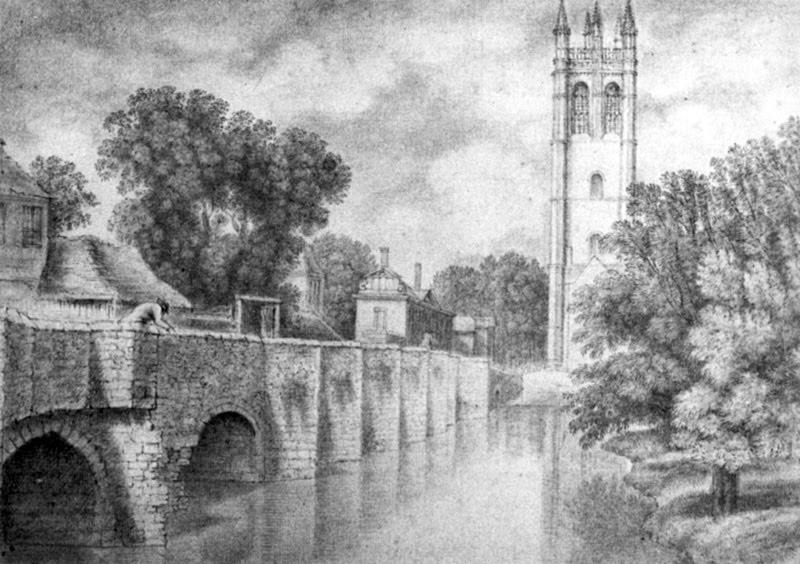
The image below is a drawing of Magdalen Bridge made around 1772 by the German artist John Malchair. Following the passing of the Mileways Act in 1771, Malchair made a number of studies of the old bridge so as to record it for posterity.

With various parts of the mediaeval city threatened because of the Act, Malchair drew a number of views of buildings and structures including the North Gate and Bocardo Prison and Friar Bacon’s study which eventually fell in 1779.

This then is the bridge over which The Gentleman’s Servant crossed with two horses on December 12th 1770.

Filed Under: Oxford, The Gentleman's Servant Tagged With: 18th Century, Gentlemans Servant, John Gwynne, John Malchair, Oxford, Servant, The Gentleman's Servant

John Gwynn’s Survey 1772

June 23, 2010 by Nicholas Hedges

Remarkable evidence of those who lived in Oxford around the time the notice appeared in Jackson’s Oxford Journal can be found in a survey carried out by John Gwynn in 1772 (John Gwynn also designed the new Magdalen Bridge). Made as part of continuing improvements originating with the Mileways Act of 1771, the actions of Gwynn (who could be seen around town measuring the fronts of houses and other buildings) aroused suspicion and even alarm among the city’s residents. The survey itself was required to calculate the costs of repaving the city’s streets for which each property was liable to pay a share depending on the size of their facades. What we have as a result is a wonderful record; a long list of names of all the city’s residents (or rather property owners), the streets on which they lived (or owned property) and the size of their dwellings – given in yards, feet and inches. It’s interesting for me that among the many Stevenses listed in the survey might well be my great-great-great-great-great-grandparents.

The page reproduced below, is taken from the survey and represents the bottom end of the High Street where it meets Magdalen Bridge – the Bridge can be seen listed below the name of a Dr. Sibthorpe. The Physick Garden above, is the old name for what is now the Botanic Gardens.

See also John Gwynn’s Survey 1772 – Part 2.

Filed Under: Oxford, The Gentleman's Servant Tagged With: 18th Century, John Gwynne, John Malchair, Oxford, Survey, The Gentleman's Servant

Magdalen Bridge

June 23, 2010 by Nicholas Hedges

The bridge over which our Gentleman’s Servant rode in December 1770 is not the same bridge which crosses the River Cherwell today. Being as it is an important part of the story, I’ve copied an entry on the bridge from The Encyclopaedia of Oxford1 which I’ve reproduced below.

A bridge, formerly known as Pettypont and East Bridge, has stood here since at least 1004. In the Middle Ages the cost of its upkeep was shared between the county and the town, the town meeting its three-quarters share largely by alms and charitable bequests, the maintenance of bridges being then considered a pious duty. Bridge-hermits were also appointed to help travellers with any difficulties they might experience in crossing. The original bridge was of wood, but by the 16th century a stone bridge, some 500 feet long, with about twenty pointed and rounded arches, had been constructed.

At this time the city was still paying for repairs, both by taxation and by the allocation of alms; but William of Waynflete, the founder of Magdalen College, may have paid for restoration of the bridge in the 15th century, and the University certainly did so in 1723. Although a major restoration was then undertaken, less than fifty years later some of the piers had been swept away by floods and the western end had collapsed completely. Condemned as dangerous, it was rebuilt between 1772 and 1778 under the provisions of the Oxford Improvement Act of 1771, to the design of John Gwynn. At the same time a toll-house was built at The Plain, with gates across the roads from Headington to Cowley to collect dues for the maintenance of the bridge. Twenty-seven feet wide, with recesses in the middle, the bridge’s large semi-circular arches were supplemented by smaller ones over the towpaths. The plain balustrade was designed by John Townesend after plans for a more elaborate one had been dropped. The bridge was widened in 1835 and again in 1882. Notabilities have frequently been welcomed or taken their official departure at the bridge, as Queen Elizabeth I did on leaving Oxford in 1566.

1 The Encyclpaedia of Oxford, 1988, Ed. Christopher Hibbert, Assoc. Ed. Edward Hibbert; London, Macmillan London Limited

Filed Under: Oxford, The Gentleman's Servant Tagged With: 18th Century, Gentlemans Servant, John Gwynne, John Malchair, Magdalen Bridge, Oxford, Servant, The Gentleman's Servant

Mr Stevens

August 11, 2009 by Nicholas Hedges

A year or so ago, I started work on a piece of work based around John Gwynn’s survey of 1772. The piece was called (as a working title) ‘6 Yards 0 Feet 6 inches’ based on the measurement of John Malchair‘s home in Broad Street. Having discovered an ancestor – John Stevens – born in the city in 1811, I wondered if there was any chance that one of the Mr Stevens’ listed on the survey was an ancestor of mine? It seemed a long shot but after today’s research I’m rather more optimistic.

If I did have an ancestor in Oxford at the time of the survey and if my research is correct, then that ancestor would be John Steven, the grandfather of the one previously mentioned. I’ve no idea when he was born but I do know that he was married in 1764 and is described as coming from St. Martin’s Parish, where his son Samuel, John Jr’s father was baptised in 1776. One could assume therefore that I did indeed have ancestors living in the parish of St. Martin’s at the time of the survey.
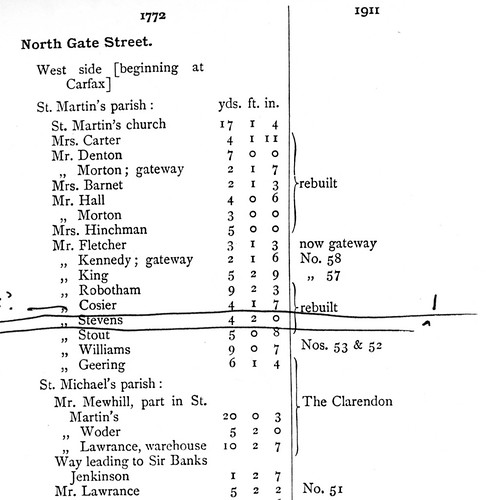
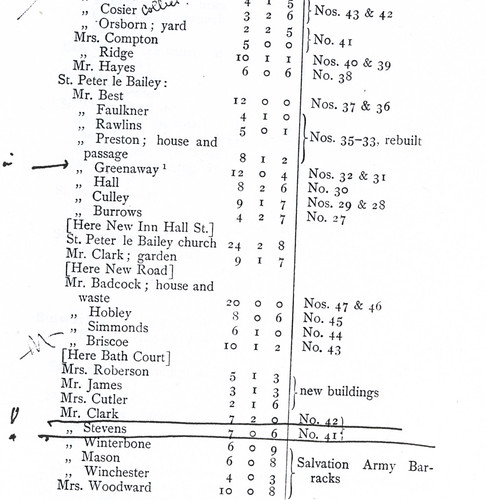
The images below are taken from the survey and show two Stevens one of which might well be my ancestor.

Gwynn fails to include (at least on the copy I have) first names from the survey but within the parish of St Martin’s two Mr Stevens are recorded along with a Mrs Stevens. One can assume however, that those most likely to be mine are the two Mr Stevens mentioned as living in the parish, one in Butcherrow (now Queen Street), the other in North Gate Street (now Cornmarket). The residence in Butcherrow is 7 yards 0 feet and 6 inches. That in North Gate Street is 4 yards 2 feet 0 inches.

John Gwynn's Survey 1772

John Gwynn's Survey 1772

Of course more work is required to see if one of these is indeed my ancestor, but I must admit to being very inspired by the prospect.

Filed Under: Oxford Tagged With: 18th Century, Family History, Family Stevens, John Gwynne, Oxford, Stevens, Survey

Abingdon Road

September 1, 2008 by Nicholas Hedges

One of my favourite drawings is that made by a German-born, Oxford-based artist called John Malchair, who lived and worked in the city in the late 18th century. The drawing shows a view of the Abingdon Road as it appeared in 1770 with the strange and imposing edifice of Roger Bacon’s study in the foreground – a building that was demolished nine years later – and the familiar, extant structure of Christ Church College’s Tom Tower behind.

There’s something beguiling about the image, depicting as it does the city long before the car, before its expansion into the suburbs when still surrounded by fields and meadows. It’s a quiet almost pastoral scene in which I feel I can hear the birds and feel the sun on my face. I can almost hear the quietude, contrasting it with the sounds I would hear today if I stood in a similar position; indeed, it’s an image in which I am constantly contrasting, moving back, to and fro between the past and the present.

This contrast between the past and present is what I experience as I research my family tree and this image I’ve lately realised embodies some of my recent thinking and research. My great-great-great-great-grandfather, Samuel Stevens, born in 1776, lived and worked as a tailor on St. Aldates in Oxford, a street which is in effect a continuation of Abingdon Road as it moves towards and connects with Carfax in the city centre. I like the fact that he is contemporary with this image and would have been alive (if only a small boy) when Roger Bacon’s study was still standing.

On the other side of my family tree, on my father’s side, my great-great-great-great-great-grandfather, William Hedges lived and worked in Abingdon, a town in which his line lived until George Hedges moved to Oxford sometime around 1869 when he married Amelia Noon, daughter of Charlotte Noon, murdered by her husband Elijah in 1852 (see ‘A Murder in Jericho‘). It’s very likely of course that both these lines (the Stevens’ and the Hedges’) continued back in those same places (Oxford and Abingdon) for further generations, and I like the fact that in this image by Malchair, and in a sense in the building he drew, is a connection between the two. Not only that, there is a connection between my past and my present, as if that connection might be found in the road between Oxford and Abingdon.

Finally, in a project I started some time ago (6 Yards 0 Feet 6 Inches) I make mention of a survey by John Gwynn, carried out in 1771 in which all the residents of Oxford are listed along with the measurements of their properties. It’s a fascinating document in its own right, but if Samuel Stevens’ parents lived in Oxford just a few years before his birth, they would be listed in that survey. Flicking through there are a number of Stevens’ and I can’t help but think one of them is my ancestor.

Filed Under: Oxford Tagged With: 18th Century, Drawings, John Gwynne, John Malchair, Oxford, Survey

Oxford’s Lost Streets

April 8, 2008 by Nicholas Hedges

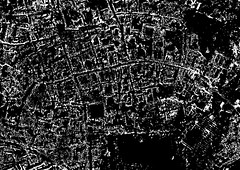
Appropriately for the work I’ve been doing on Oxford Destroyed (itself, part of my Tour Stories project), I chanced again upon a map of the lost streets of Oxford. I first found it a year or so ago, and it was only in conversation today that I remembered it; strange how things acquire relevance at a much later date. The map shows a number of streets and lanes lost to the city by the 17th century; among them Exeter Lane, Schools Street, Frideswide Lane and Jury Lane (the rather unfortunate Shitbarn Lane was also amongst their number). Looking at the map, I couldn’t help think of the ‘map’ I’ve recently ‘made’ as part of the the Oxford Destroyed project; the aerial view of the fictional ruined city.

Oxford Ruins

Thinking about the ruined cityscape, I imagined as I ‘walked the ruins’, how the layout of the streets would perhaps change as new routes were cut through the rubble of buildings, and, looking at the map of the lost streets of Oxford along with those which are still in existence, one can see how these changes are in fact all part of the natural evolution of the city.
In my introdction to Tour Stories I wrote:

As old as it is, Oxford is like every city, one which constantly changes. People come and go, passing through its streets as daytrippers; others live a lifetime here and never leave. Generations come and go, stones corrode; whole buildings are lost to progress. Every day the city is in some small way renewed, restored, destroyed and rebuilt. And with every building that is lost, with the death of every one who has ever known it, so the city changes.

The one thing that has changed little over the centuries is the layout of the streets. Buildings as I said above are lost to progress; generations come and go. One of the things that defines Oxford as being what it is is this ancient layout of streets and lanes down which people have walked for hundreds of years. But nevertheless as the map has shown, even these streets can be removed. High Street, Queen Street, St. Aldates and Cornmarket Street might well have stayed more or less intact (albeit the last three with different names) but those such as I listed above have succumbed.

The idea of streets lost to time beneath various buildings is to me as enigmantic as the lost names of John Gwynn’s survey (1772), a document I have been using on another project; 6 Yards 0 Feet 6 Inches and just as I am exploring this survey through a piece of sonic art/composition, so I want to explore these missing thoroughfares. The spaces still exist of course; Jury Lane has been swallowed up by Christ Church, Exeter Lane by the Bodleian Library, Schools Street by Radcliffe Square (part of it is still extant and is now known as St. Mary’s passage) and Frideswide Lane also by Christ Church.

The lost streets also interest me in relation to other projects; for example, the route between the two sites for my Mine the Mountain exhibition in Autumn (the Town Hall Gallery and the Botanic Gardens) are connected by Deadman’s Walk, the route taken along the old city wall by Jewish mourners in the 13th century. It seems to me that some of that route was along what its shown on the map as being Frideswide Lane, but what interests me in particular is Jury Lane off what is now St. Aldates. In the Victoria County History for Oxfordshire, it states :

Jury Lane (c. 1215-25): Little Jewry (1325); Jury Lane (1376); Civil School Lane (1526). Closed c. 1545 and incorporated in Christ Church.

Little Jewry corresponds with Great Jewry, the old name for St. Aldates which was, after Great Jewry, known as Fish Street. It was the mediaeval Jewish Quarter and the missing street strikes a chord with the theme I have been exploring for the past eighteen months or so; the missing of the Holocaust.

This theme of missing people has lately found form in another project – Umbilical Light and seeing the faces in this work, it is interesting to see how all these works are becoming intertwined.

Filed Under: Oxford Tagged With: History, John Gwynne, Lost Streets, Oxford, Survey

6 Yards 0 Feet 6 Inches III

April 6, 2008 by Nicholas Hedges

Following up the work I have done so far with the composition based on John Gwynn’s survey, I have decided to do the same with video. This follows on from work I have done on Tour Stories/Umbilical Light, projects based on photographs taken in Oxford around the turn of the 19th/20th century.

I’m not sure yet what the images will be within each, but I think it will be something along the lines of the photographs I have been using.

Filed Under: Uncategorized Tagged With: 18th Century, 6 Yards 0 Feet 6 Inches, John Gwynne, Sonic Work, Survey

6 Yards 0 Feet 6 Inches II

April 2, 2008 by Nicholas Hedges

Having converted the distances for each dwelling/building into seconds, I created a new track in Cubase and added markers for each of the sections, creating as a result a sonic image for the southern side of the High Street as it appeared in 1772. Below is a detail of a larger screenshot. Click on the image to open a new window with the larger image.

I’m not sure at this stage how I will proceed with the score, but I have added a note (C3) at each marker point which is at least a start. These can be seen in the two midi tracks beneath; the first track a short note, the second row the length of the interval between them. Listening – whilst it doesn’t make for an interesting sonic encounter – does at least allow the listener, in this case me, to get a sense of physical space of the street from the duration of the notes (in the case of the second midi track) or the duration between each (as in the case of the first).

Filed Under: Uncategorized Tagged With: 18th Century, 6 Yards 0 Feet 6 Inches, John Gwynne, Sonic Work, Survey

6 Yards 0 Feet 6 Inches

March 22, 2008 by Nicholas Hedges

I’ve started to consider ways in which I might use John Gwynn’s survey of 1772 as a basis for a score and after various ideas decided the best place to start was – obviously – with the measurements Gwynn recorded; measurements of the size of properties in the centre of the city.

The following is an image taken from a reproduction of the survey, showing Gwynn’s statistics of 1772, and those taken in 1911 for Holywell Street.

For the moment I have decided to concentrate on the south side of the High Street and have reproduced the stats for this part of the city which can be downloaded as a PDF. After various attempts at translating the measurements into time so that the score might be structured in this way, I finally came up with the following method: the yards and feet I converted into inches (36 inches in a yard, 12 inches in a foot). I added the remaining inches and then converted back into yards (the idea was to end up with a figure or figures that most resembled time, e.g. 10.789 seconds). So for example; Mr Brockis owned property on the south side of the High Street which was 14 yards, 2 feet and 4 inches in length. By using the wonders of Excel, I ended up with a figure – through calculating with the above formula – of 14.77777778 yards, which although was more like the period-of-time-type measurement I was looking for made me feel uneasy; there was something about decimal points and imperial measurements which didn’t add up so to speak. The obvious thing therefore was to convert this sum (14.77777778 yards) into centimetres, which in another column of my ever-expanding spreadhseet I did by multiplying the sum by a factor of 91.44. Mr Brockis’ propery therefore came out as being 1351.28cm in length, or 13.5128 metres. Much better; I had my figure.

The next thing to do was to take these seconds and see how long the composition for the south side of the High Street would be. Again using Excel, I calculated that the entire piece would last 13 minutes and 32 seconds and today I decided to try it out. Armed with a stopwatch I walked the length of the street (in quite appalling weather) and found that at a reasonable, ambling kind of pace, it took me about 10 minutes 25 seconds. Although not quite 13 minutes 32 seconds (others would of course walk much more slowly) it nonetheless means that any following composition is imbued with a sense of space; the music (whatever the music will come to be) will liaise directly with a walk through the city.

Filed Under: Uncategorized Tagged With: 18th Century, John Gwynne, Survey

John Gwynn Survey

March 3, 2008 by Nicholas Hedges

I have for a long time been interested in John Gwynn’s survey of 1772, carried out in reponse to the Paving Commission’s desire for improvements to the city. In ‘A History of the County of Oxford: Volume 4’ (Victoria County History), it states in the opening paragraph on ‘Modern Oxford’ that ‘…With the Paving Commission of 1771 Oxford’s modern history began…’ and that ‘…The enthusiasm for public improvements alarmed some householders, particularly when the Paving Commission’s surveyor, John Gwynn, was observed all over town, measuring and making notes on streets and houses.’

For a long time I have wanted to work with the survey, being particularly interested in the list of names and associated measurements of the spaces they occupied in the eighteenth century city; people who of course have long since disappeared.

I had looked at it in relation to some work I did as part of my residency at OVADA in April/May last year. Firstly, regards a painting called Gloucester Green to Broken Hayes:

The title ‘Broken Hayes’ is the old name for Gloucester Green and describes a place which, in a sense, no longer exists, although, like the ghostly dwellings on John Gwynn’s survey (1772) it’s ‘footprint’ is still visible in the boundaries of the Green. Many of the items rubbed out on the canvas no longer exist in the places where I ‘found’ them; they are, in name only memories, just like Broken Hayes, yet like the physical aspect of that place, they still exist.

Then the walk I made from which the painting derived:

This isn’t an area I know that well – I’m not sure if I’ve ever walked the entire length of Paradise Street – and yet afterwards, when I looked at David Loggan’s map of 1675, it all seemed very familiar. I was surprised at how much was left after the upheaval of redevelopment, particularly when standing near St. George’s tower, near the junction of St. Thomas’ and Paradise Streets. Now, looking at John Gwynn’s surveys, I could make much more sense of the Oxford of 1772.

In another entry I wrote:

“But the layout of the streets (if not the buildings and their inhabitants) still remain, and so, by walking these streets, armed with a residual list of measurements, one can walk back in time and make a connection with this vanished population.This correlation between time and distance had initially come through my thinking of how difficult it often is, to identify with people who live abroad in war-zones (Iraq and Afghanistan for example), for, even though these countries are only a comparatively short distance away, they might as well be years in the past, for it’s almost as difficult to relate to those who live (and die) there, as it is to those who lived and died, for example, during the first and second world wars, or the time of John Gwynn.”

However, in light of the recent work I have made as part of the Brookes show at MAO, my ideas have changed a little. Thinking back to some thoughts I had on the Three Fates, I’ve decided to try merging the two ideas. One aspect of the story of Gwynn I liked particularly was the idea of residents being worried by his measuring, as if he was measuring up the fate of their homes and the city as a whole. So, I’ve decided to take these measurements, and using string and a ruler, measure out the string and cut them according to the survey. Mr Pepal would therefore be 12 yards, 1 foot and 9 inches.

Filed Under: Oxford Tagged With: 18th Century, John Gwynne, Oxford, Survey

Walking and Measuring

April 4, 2007 by Nicholas Hedges

A few years ago, I did some research into the 1771 Mileways Act which saw a range of ‘improvements’ made to Oxford; improvements which, unfortunately, resulted in the demolition of some of the city’s more interesting mediaeval buildings; the North and East gates, the Bocardo Gaol and Friar Bacon’s study on Folly Bridge. The streets were also repaved, and to pay for this, each resident paid according to the yardage of their property. John Gwynn, an architect who designed the Covered Market and the new Magdalen Bridge, therefore undertook a survey, in which all the frontages of all properties on the city’s streets were measured. Seeing him with his measure, residents at the time thought the worse – that he was measuring up properties so that they would be demolished; given the spate of demolitions at the time it was perhaps hardly surprising. I’ve since imagined Gwynn therefore as some kind of undertaker, measuring up the city for its doom, and image which fits nicely with my work on Broken Hayes.

The list of measurements is very interesting as it presents us with a window onto a world which has now almost disappeared; certainly those who inhabited the town (Mrs. Barret of Magpie Lane, Mr. Hedges of Broken Hayes, Mr. Badger of Fish Street) have all gone and left only their names and the size of their ghostly dwellings. But the layout of the streets (if not the buildings and their inhabitants) still remain, and so, by walking these streets, armed with a residual list of measurements, one can walk back in time and make a connection with this vanished population.

This correlation between time and distance had initially come through my thinking of how difficult it often is, to identify with people who live abroad in war-zones (Iraq and Afghanistan for example), for, even though these countries are only a comparatively short distance away, they might as well be years in the past, for it’s almost as difficult to relate to those who live (and die) there, as it is to those who lived and died, for example, during the first and second world wars, or the time of John Gwynn.

Filed Under: Uncategorized Tagged With: Family Hedges, Hedges, John Gwynne, Mileways Act, Mileways Act 1771, Susan Sontag

© Nicholas Hedges 2024

  • Facebook
  • Instagram
  • Twitter
  • YouTube

Copyright © 2025 · Outreach Pro on Genesis Framework · WordPress · Log in