Nicholas Hedges

Art, Writing and Research

  • Amazon
  • Behance
  • Facebook
  • Instagram
  • Pinterest
  • YouTube
  • Art
    • Digital
    • Drawing
    • Grids
      • Correspondence
      • The Wall
      • The Tourist
    • Ink on paper
      • Shadow Calligraphy
    • Installation
      • Murder
      • Echo
    • Painting
    • Patterns
    • Mixed Media
    • Photographic installation
      • St. Giles Fair 1908
      • Cornmarket 1907
      • Headington Hill 1903
      • Queen Street 1897
    • Research/Sketches
    • Stitched Work
      • Missded 1
      • Missded 2
      • Missded 3
      • Missded 4
    • Text Work
  • Blogs
    • Family History
    • Goethean Observations
    • Grief
    • Light Slowed But Never Stilled
    • Lists
    • Present Empathy
    • Shadow Calligraphy
    • Trees
    • Time
    • Walking Meditations
  • Video
  • Photography
    • Pillars of Snow
    • Creatures
    • The Trees
    • Snow
    • St. Giles Fair 1908
    • Cornmarket 1907
    • Headington Hill 1903
    • Queen Street 1897
    • Travel
  • Illustration and Design
  • Music
  • Projects
    • Dissonance and Rhyme
    • Design for an Heirloom
    • Backdrops
    • Shadow Calligraphy
  • Exhibitions
    • A Line Drawn in Water
      • Artwork
    • A Line Drawn in Water (Blog)
    • Mine the Mountain 3
      • Artwork
    • Mine the Mountain 2
      • Artwork
      • The Wall
    • The Woods, Breathing
      • Artwork
    • Snow
      • Artwork
    • Echo
      • Artwork
    • Murder
      • Artwork
    • The Tourist
    • Dreamcatcher
    • Mine the Mountain
      • Artwork
      • The Tourist
    • M8
    • The Gate
    • Creatures
      • Artwork
    • Residue
      • Artwork
    • A visit to Auschwitz
      • Artwork
  • Me
    • Artist’s Statement

Map Work

July 9, 2012 by Nicholas Hedges

I’ve almost completed my map of observations made during a number of walks over the past few weeks and am now looking to see how I can progress this line of work.

The paper shown above has started to soften, from being carried for so long in my pocket and being held in my hand as I walk. It’s started to feel almost like material. I like the way too that it’s acquired those tell-take signs of wear and tear; dog-eared corners, rips and holes and creases.

On the reverse, you can see the selotape used to keep it all together, indeed there is something about this side which I really like.

I like the idea of these pieces becoming maps of individuals rather than just a place, while at the same time representing people as places – or at least the product of places. I like the idea of them becoming patterns, such as clothing patterns, again giving a sense of the individual.

Another part of this process has been the recording of my walks using GPS. I have, for this work, been putting them all together in one image.

In our minds, when we think about our own past journeys, there is little sense of space, i.e. the physical space between the places in which we made those journeys. Everything is heaped together. Time, like physical space is also similarly compressed. All the walks I’ve made for this work therefore are heaped one on top of the other, with little regard to their geography or temporality. The past with which I seek to identify is also like this. Geography and time are compressed. Everything is fragmentary.

In any given place – for example, Oxford – we can, as we walk down an ancient road, follow the (fragmentary) course of a life lived centuries ago. But walking down another road, we turn and pick up the fragment of another life. And so on and so on.

It is this fragmentary nature of past time, and its compression of time and space, which makes it sometimes hard of for us to empathise with anonymous individuals who lived in the distant past. To make sense of the fragments, we need to see them in the context of the present – in the nowness of the present. By doing this, we can begin to unpick these matted strands of time and space.

History is the attempt to make sense of the fragments left behind by time – to construct a narrative of events with a beginning and an end. It has a point A and a point B, between which the narrative weaves a path, much like a script, novel or score. What I’m interested in however are those fragments, not as parts of a narrative progression, but as fragments of a moment in time – a moment which was once now. As I’ve written before:

Access to the past therefore comes…  through the careful observation of a part in which the whole can be observed. As Henri Bortoft writes in The Wholeness of Nature – Goethe’s Way of Seeing; ‘…thus the whole emerges simultaneously with the accumulation of the parts, not because it is the sum of the parts, but because it is immanent within them’.

Consider the span of an hour, and imagine a city over the course of that hour with everything that would happen throughout that period of time; history with its refined narrative thread, is rather like a line – a route – drawn through a map of that place. The line delineates space (in that it starts then ends elsewhere) but we know nothing of what happens around it – the mundane, everyday things which make the present – now – what it is. In my walks I capture moments, observations of mundane things happening around me as I walk.

For example:

A man talks holding his hat
A flag flies, fluttering in the growing wind
The next bus is due
A car beeps
Amber, red, the signal beeps
The brakes hiss on a bus

One could argue that these observations still represent a linear sequence rather than being fragments of a single moment in time. However, reading them, one does get a sense of the nowness of the past. The route as drawn by the GPS represents the narrative thread (history) whereas the text represents the individual moments from which the narrative is constructed.

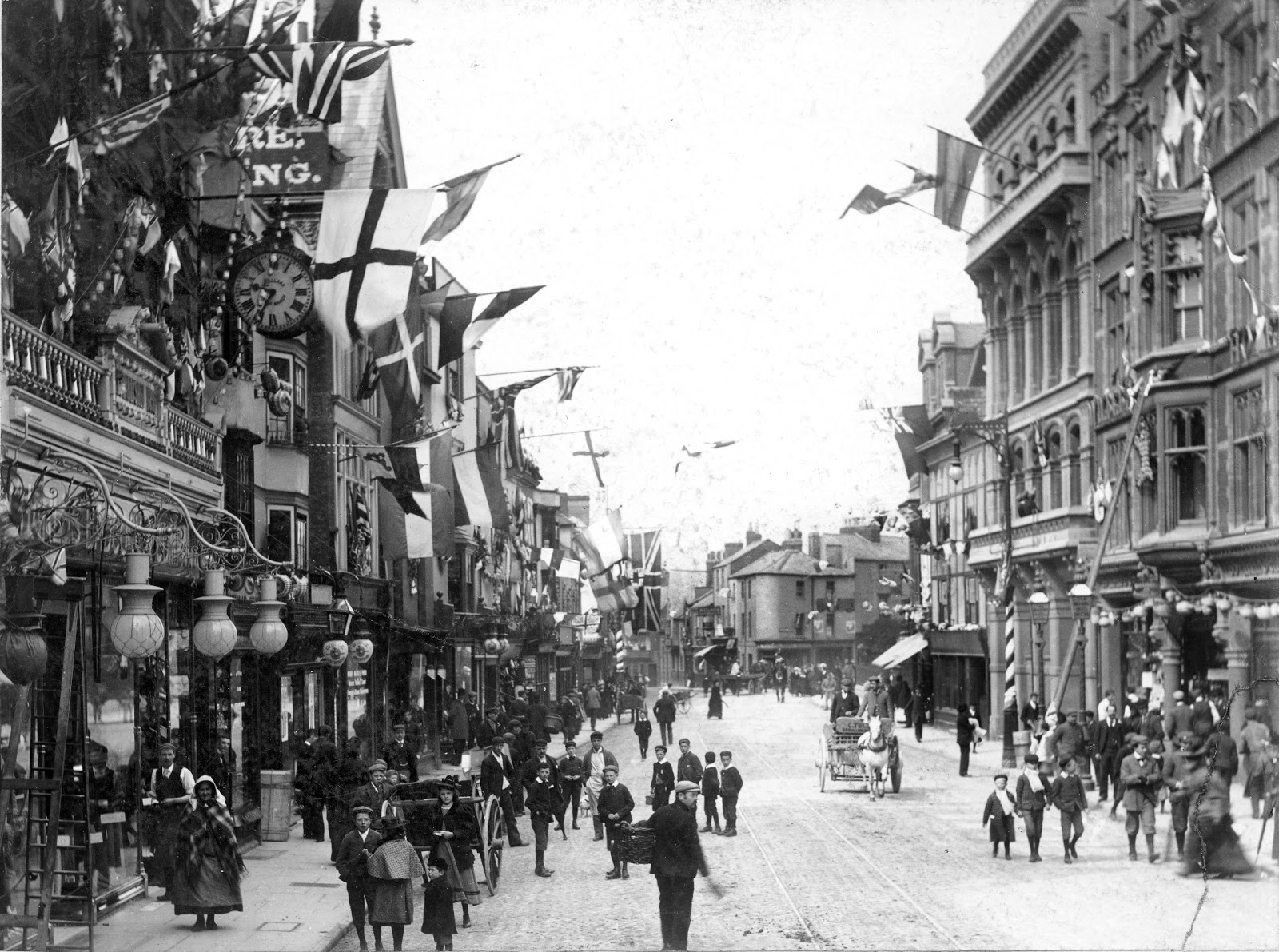
Imagine if someone had done the same in 1897 at the time of last Diamond Jubilee.
A man talks holding his hat
A flag flies, fluttering in the growing wind
Suddenly, 1897 would seem there within our grasp. We could take any observation and extrapolate the wider scene around it. Below is a photograph taken in Oxford in 1897.

© Oxfordshire County Council

We get a sense of the nowness of a past time from images such as that above, but as Roland Bathes states, time in photographs is engorged. It doesn’t move. With the work I’ve made above however, the immediacy of a past time is captured, but, unlike photographs, is fluid. And it is this fluidity which is crucial to an empathetic engagement with the past. For the nowness of the present isn’t static, but rather flows within us and around us.

The following text from Robert Macfarlane’s ‘The Wild Places,’ interested me a great deal in light of what I’ve written:

“Much of what we know of the life of the monks of Enlli and places like it, is inferred from the rich literature which they left behind. Their poems speak eloquently of a passionate and precise relationship with nature, and of the blend of receptivity and detachment which characterised their interactions with it. Some of the poems read like jotted lists, or field-notes: ‘Swarms of bees, beetles, soft music of the world, a gentle humming; brent geese, barnacle geese, shortly before All Hallows, music of the dark wild torrent.'”
Filed Under: Lists, Photography Tagged With: GPS, Henri Bortoft, Listmaking, Lists, Maps, Nowness, Positioning, Stephen Hedges, Text Work, Vintage Photographs, Walks

Stars

May 10, 2012 by Nicholas Hedges

A second example of wholeness involves the ordinary experience of looking up at the sky at night and seeing the vast number of stars. We see this nighttime world by means of the light ‘carrying’ the stars to us, which means that this vast expanse of sky must all be present in the light which passes through the small hole of the pupil into the eye. Furthermore, other observers in different locations can see the same expanse of night sky.
Henri Bortoft

As physicists have pointed out, it is no accident that we see stars in our sky, for stars are a necessary part of any universe capable of generating us. Again, this does not imply that stars exist in order to make us. It is just that without stars there would be no atoms heavier than lithium in the periodic table, and a chemistry of only three elements is too impoverished to support life. Seeing is the kind of activity that can go on only in the kind of universe where what you see is stars.
Richard Dawkins

The light of the moon covers the earth, yet it can be contained in a single bowl of water.
Dogen Zenji (1200-1253)

Only God knows the reason for those changes linked with the mystery of the future : for men there are truths hidden in the depths of time; they come forth only with the help of the ages, just as there are stars so far removed from the earth that their light has not yet reached us.
Chateaubriand

From a real body, which was there, proceed radiations which ultimately touch me, who am here; the duration of the transmission is insignificant; the photograph of the missing being as Sontag says, will touch me like the delayed rays of a star. A sort of umbilical cord links the body of the photographed thing to my gaze – light though impalpable, is here a carnal medium, a skin I share with anyone who has been photographed.
Roland Barthes

Filed Under: Quotes Tagged With: Henri Bortoft, Quotes, Richard Dawkins, Stars, Useful Quotes

Natural Born Psychogeographer

January 18, 2011 by Nicholas Hedges

It seems amazing to me that given the way I perceive the world around me – and the way I have since I was a child – and looking the work I’ve made over the course of the last few years, that I haven’t before delved into the world of Psychogeography, for having started to read Merlin Coverley’s book Psychogeography I seem to be a natural psychogeographer. I recall that when I studied for my degree back in the early 90s, I was fascinated by the writings of Andre Breton and Louis Aragon (‘Nadja’ and ‘Paris Peasant’) which today sit on my bookshelves along with the works of J.-K. Husymans, Blake and Peter Ackroyd, writers who are all discussed in Coverley’s book.Why they intrigued me so much I never really understood, until now.

This morning, in Coverley’s book, I read the following quote form a 19 year old member of Lettrist International who went by the name of Chtcheglov (his real name was Gilles Ivain, and he was later incarcerated in an asylum…). Within that quote, a few lines in particular interested me. The full quote however is as follows:

All cities are geological; you cannot take three steps without encountering ghosts bearing all the prestige of their legends. We move within a closed landscape whose landmarks constantly draw us to the past. Certain shifting angles, certain receding perspectives, allow us to glimpse original conceptions of space, but this vision remains fragmentary. It must be sought in the magical locales of fairy tales and surreralist writings: castles, endless walls, little forgotten bars, mammoth caves, casino mirrors.

The following line in particular brought me up short: ‘…Certain shifting angles, certain receding perspectives, allow us to glimpse original conceptions of space, but this vision remains fragmentary…’ for this exactly describes how I think when I walk through a city, or in fact any particular place. The remains comprising our present-day landscapes are overlaid with a weave of unremembered lives, narratives and events, which, Coverely explains, can, in a moment be revealed through even the most mundane objects and surroundings. It’s as if, whilst walking down the street, one can see something which opens up a ‘receding perspective’ just as Chtcheglov writes, allowing us for a second to glimpse those ‘original conceptions of space.’ The vision is fragmentary and lasts just a moment, but everywhere these possibilities exist.

I’ve often  used the idea of mundane (or everyday) objects and surroundings in my work as a means of accessing the past – as revealing the past through the lens of the present, and before beginning my MA in 2006, I wrote about what I called ‘memory spaces’; spaces which opened up when looking at old buildings or objects. For me, these spaces, were – or rather are – memories of a particular object or building held by people who lived  generations before us. I was trying to find a way of describing how when I look at an old building, it’s as if I gain access, in some fragmentary way, to the memories of those who beheld it years before – as if I could then walk from one of their memories to another.

In another piece of writing (What is History?), I tried to find another way of describing how we access these spaces. Instead of perceiving history as a series of horizontal layers, built up one on top of the other, I suggested that it was more accurate to see the past as comprising a vast number of durations, where every object, every building, every part of a building etc., was a duration, extending vertically down the page. (This idea was inspired by the writings of Bill Viola, who wrote how ‘we have been living this same moment ever since we were conceived. It is memory, he says, ‘and to some extent sleep, that gives the impression of a life of discrete parts, periods or sections, of certain times or highlights’. Similarly we can say that every object, building or landscape feature has existed in one continuous moment and that it is to some extent the passing generations which gives the impression of the past as being a series of ‘discrete parts, periods or sections.)

As I wrote:

Access to the past therefore comes not via a kind of mental gymnastics where we straddle the horizontal strata of different moments in time, accessing a part [an object] via the whole (the entire epoch of that particular layer e.g. 1900), but through the careful observation of a part in which the whole can be observed. As Henri Bortoft writes in The Wholeness of Nature – Goethe’s Way of Seeing; ‘…thus the whole emerges simultaneously with the accumulation of the parts, not because it is the sum of the parts, but because it is immanent within them’. In other words, from an object [for example, one made in 1900] we can extrapolate its wider context (the ‘epoch of 1900’). Instead of drilling down through many periods [of horizontal] time in order to get from one time to another some distance below (or behind), we simply have to observe an object we know that links the two. In this… model , there are no horizontal barriers, just vertical, navigable channels.

Therefore, when looking at an object in a museum, or glimpsing something whilst walking in the street, angles are shifted as Chtcheglov explains, and receding perspectives revealed, precisely because of the way the present comprises these continuous durations. Of course it doesn’t happen all the time, but depends on any number of things, not least the way we perceive that object at the moment of our encounter. History in this sense is kinaesthetic.

Filed Under: Quotes Tagged With: Bill Viola, Chtcheglov, Goethe, Henri Bortoft, Psychogeography, Quotes, Useful Quotes

No Man is an Island

February 12, 2010 by Nicholas Hedges

I have written a great deal about how I perceive the past and how I use objects and the landscape to find  ways back to times before I was born. In my text ‘What is History‘ I conclude with the following paragraph.

“History, as we have seen, [might be described as] an individual’s progression through life, an interaction between the present and the past. It follows, having seen how the material or psychical existence of things extends much further back than their creation that history spanning a period of time greater than an individual’s lifetime is like a knotted string comprising individual fragments; fragments within which – in the words of Henri Bortoft – the whole is immanent.  The whole history of all that’s gone before is imminent in every one of its parts; those parts being the individual.”

I was reminded as I read this paragraph – and in particular the last line – of the poet John Donne and the following words taken from his XVII Meditation:

“No man is an island, entire of itself; every man is a piece of the continent, a part of the main. If a clod be washed away by the sea, Europe is the less, as well as if a promontory were, as well as if a manor of thy friend’s or of thine own were: any man’s death diminishes me, because I am involved in mankind, and therefore never send to know for whom the bell tolls; it tolls for thee.”

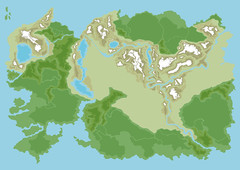
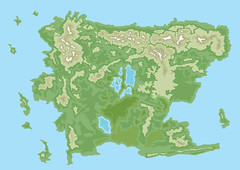
Having read this, I thought about some of the work I’ve been making for my forthcoming exhibition in Nottingham, Mine the Mountain. Two pieces are maps of invented landscapes, one of which (the first shown below) is based directly on a map I created as a child, the other based on the outline of Belzec Death Camp as seen in an aerial view of 1944.

If I Was A Place
If I was a Place, 2010

The Past is a Foreign Country
The Past is a Foreign Country, 2010

The first map, as I have said, is a contemporary reproduction of one I made as a child. It’s therefore essentially a map of an individual – of me, as I was at the time. It is a place that, although imagined, was real nonetheless, one based on fragments of my memory and my perception of the distant past.

Having been to Wales (in 2008) and imagined all my distant forebears walking the various tracks and roads around the village where my grandmother grew up, I realised how I was very much a part of those places and they in turn were part of who I was. I had existed – at least potentially – in those places long before I was born. All those roads, paths and trackways led in the ‘end’ to me. Of course that sounds a rather egocentric way of perceiving the world and its history, but then I’m not suggesting that I am the only intended outcome. Just as my invented world – my map of me – was made of all those bits of the past I loved to imagine as a child (the untouched forests, the unpolluted rivers and streams) so I can see how this foreshadowed my current thoughts on history; how I am indeed (as we all are) a place, one made of all those places in which my ancestors walked, lived and died. 

A quote from a source which is of huge importance to me and my work (Christopher Tilley’s ‘The Materiality of Stone, Explorations in Landscape Phenomenology’.)

“Lived bodies belong to places and help to constitute them so much so that the person can become the place (Gaffin 1996). The body is the medium through which we know place. Places constitute bodies, and vice versa, and bodies and places constitute landscapes. Places gather together persons, memories, structures, histories, myths and symbols.”

Alongside the second map I will be showing a piece of text taken from the diary of Rutka Laskier describing what appears to be an imaginary landscape, though one perhaps based on memories of family holidays to Zakopane, Poland. She was a child when she died in the Holocaust and by putting the two maps together, I want to reflect on the numbers of children who perished, as well as illustrating how within each child – within everyone – the whole of humanity is immanent.

John Donne’s words serve to illustrate this sentiment further still. No man, woman or child is an island. So whilst I have created two maps of individuals, through Donne’s words we can see how these islands comprise pieces of everybody else.

If a clod be washed away by the sea, Europe is the less.

Filed Under: Poetry Tagged With: Christopher Tilley, Family History, Family Jones, Henri Bortoft, History, John Donne, Jones, Maps, Mine the Mountain, Paths, Phenomenology, Poetry, Roads

The Moment

November 23, 2007 by Nicholas Hedges

Recently I was reading an article in the National Geographic about memory and was particularly interested in an explanation of how it works, i.e. the physical/chemical structure of a memory within the human brain. In layman’s terms, the brain is in a constant state of flux; neurons communicate with one another via a 1000 trillion synapses and a memory is a stored pattern of this communication. Every memory we have therefore is a pattern, the shape of a network, which ties in with the image I drew of a moment as being made up of numerous lines – pathways – knotted together, but always in flux, always being untied and retied with other paths to make new moments. Therefore, re-creating a memory (or a post-memory) in ‘artistic’ terms (string work) is, diagramatically how memory works in the human brain.

I have also been considering how my research into my family tree fits in with the projects I have been working on recently and over the past year or so. I made the following list of areas which have interested me:

My place in history (Holocaust, WW1)
My place in the spaces of history (Auschwitz-Birkenau, Oxford)
My relationship with people in the past and their relationship with me
Old photographs of Oxford
Old photographs of victims found in Auschwitz / found photographs
Old family photographs (holiday snaps/distance)
Memorials (as aids to memory and post-memory)
Objects (as aids to memory and post-memory)
Landscape (past, present and future)
Perception of history/the past (Frog and Dinosaur)
Maps, fictional and factual
Pathways
Moments as a combination of pathways
Potential Space
Windows and bicycles in old photographs
Twinned (GPS)
Parisian Cemeteries

The family tree is a living document. There is a big difference between a list of names on a memorial and those in a family tree. It is a social document which reveals my relationship with people in the past as well as the sheer number of people to whom I am related today; people who are as anonymous to me as I am to them.

It is a document of my coming into being and a blueprint for my own existence. It’s an impossible document, both certain and utterly implausible at the same time, and its impossibility, the unlikely combination of encounters from the late eighteenth century through to the present, is illustrated when births are mapped on a map of the British Isles. Ancestors from Norfolk, Lincolnshire, South Wales, Sussex, Warwickshire, Oxfordshire and Berkshire all moved from villages to towns, from one part of the country to another, following pathways which eventually led to my being born in Oxford in 1971. Every action they made, every thought they had (which of course would influence their actions) had to be exactly as it was for me to be who I am; anything different, no matter how small or irrelevant, and I would not be me. The more one thinks about the combination of actions and thoughts, things that were said and things that weren’t said, things seen and those which went unnoticed, the more impossible existence becomes.

This means of course that it isn’t simply the thoughts and actions of our ancestors which had to be the same; the thoughts and actions of everyone they knew, or strangers they met or saw in the street had to be as they were, for nothing exists in isolation.

These – till recently – unknown, anonymous relatives are like the distant people in my old holiday snaps, people with whom I shared a space and who therefore, unwittingly affected the path I took in life. Making these anonymous people the subjects of the photograph, places me and my family into the distance and therefore allows me to experience what it means to be anonymous to other people; the fact is, there is no difference at all.

I am related to thousands of people I do not know, who are distant, yet our lives have been brought into being through common elements; a shared ancestry.

Looking at holiday snaps as things in themselves we can say that they are two things; they are examples of both a memory and a moment. Of course, it could be argued that they are memories of moments and therefore one the same thing; however memories of that moment (sitting on the beach) are only linked to the main subjects (my family) and not the rest of the people who shared, or made that moment. Referring back to the maps of memories and moments, these photographs and indeed every photograph taken are themselves both these maps in one; they are the image of someone’s memory (the photographer’s) and the image of a combination of paths at a given moment in time.

When looking at photographs taken in times before our birth, we become a part of the moment and somehow witness that moment. To view, for example a photograph of Oxford taken in 1907 is to participate in that moment and in the photographer’s memory. We can use conjecture to imagine the immediate future and the past, but of course this then becomes a fiction, a made up country like the places I would invent as a child; a case of the frog and the dinosaur, where fragments of the past (dinosaur DNA in the bodies of mosquitoes trapped in amber) are combined with our own imaginal thought (frog DNA) to create our new Dinosaur (our picture of History).

As I’ve said before, this Jurassic Park metaphor is interesting in that our own DNA is itself derived from our ancestors, some of whom would have participated in the moment of the photograph, after all, a moment is not restricted by space, a moment is not defined by a physical place, but a period of time covering all places. In the photograph shown, I can wonder what my Great-Grandmother was doing the moment the shutter was released.

To some extent, we have all participated in all time because we are the outcome of an immense combination of moments, each comprising incredibly intricate paths, thoughts, conversations etc. We were imminent or potential in every moment, and as every moment required for our coming into being came and went as it should, so our potential grew until we were born. Anything different, anywhere in the world and we might not be here.

The non-confining of moments to space is illustrated by the boundaries of a photograph. Events pictured in a photograph did not happen in isolation. An open window reveals other spaces of that moment, spaces such as those inhabited in that moment by my forebears. Open windows are evidence of lives being led, oblivious to the photograph being taken.

A parked bicycle at the side of the road is also evidence of this. The owner of that bicycle has left the picture, but not the moment; he is completely unaware of the image being taken, and through his absence in the image, his presence in the moment is somehow heightened.

When looking at photographs of the Holocaust, in particular of transports arriving at Auschwitz-Birkenau, we must remember that these events did not happen in isolation. The moment did not exist solely behind the barbed wire fences or within the borders of the photograph, but across the entire world, and, as with my holiday snaps, reality is not that determined by the lens of the camera, it is not only a moment annexed by the chemical reactions which miraculously capture the image or solely the subject of a discriminating eye, but everything existing around it. Just as enlarging the distance of a photograph pushes the original subject into the distance (a subject made no less real because of it), so we can imagine the photographs taken at Auschwitz-Birkenau as being events in which my ancestors were simply the distance, in which they shared a moment in time; and it wouldn’t take a leap of the imagination to enlarge the distance of these images and make those who are distant, my ancestors, the subject.

Researching my family tree has heightened the sense of my participation in past events. Recalling Henri Bortoft’s book, ‘The Wholeness of Nature’ I thought about authentic wholes and how the whole is imminent in the parts. If we as individuals are the parts of the whole family tree then it might be said that the entire family tree, past, present and future is imminent in each and every one of us. I thought also of my work on the gesture of the apple tree in my garden and considered how much it shares with the gesture of individual existence.

Thinking about this and the idea of my ancestors being merely in the distance of the Holocaust, I thought about the gesture of the Holocaust, something which showed itself to me whilst watching Raul Hildberg in Claude Lanzmann’s ‘Shoah’, when he talked about a document detailing the journeys of death trains arriving and leaving Treblinka. The document was on the face of it a banal piece of bureaucracy, a timetable which, superficially, had all the significance of a timetable for trains taking tourists on holiday (it should be known that the same company which timetabled the trains for taking the Jews to the death camps, and which collected the fares they had to pay, was at the same time transporting people on their holidays, where they no doubt took photographs). Of course, these trains were taking, as I said, the Jews to their deaths. Therefore, when looking at photographs of trains at Birkenau, one mustn’t just see them as trains that have always been there within the confines of the image, just as the people being unloaded were never only victims. They were people who had lives before the war, brought in on trains, timetabled by bureaucrats from places all over Europe. With them they brought the banal objects of existence from which we can try and piece their lives together. But banal in this sense does not mean dull or boring, but rather normal in the face of what they were to experience.

Looking again at my map of where I came from, I get the sense of people not existing in isolation and also of moments not being confined to spaces or places; I understand with greater clarity, the sense of who these victims were; people just like me and my ancestors. And when researching, it is often the banal which is the most interesting, not as I said, the dull or boring, but what is normal in the face of History.

Filed Under: Uncategorized Tagged With: Biology, Henri Bortoft, Memory

Herodotus and the Morning Paper

November 10, 2007 by Nicholas Hedges

One has to remove the future from a past event to really understand its ‘presentness’. One has to view historical (‘Herodotus’ – see Walter Benjamin and Objects) events as being on the periphery, whilst the mean and the commonplace (‘morning paper’) take centre stage. It is the distance which interests me, the distance from the heroic or ‘main’ event and the historical perspective this gives us.

“Thus the whole emerges simultaneously with the accumulation of the parts, not because it is the sum of the parts, but because it is immanent within them.”

Bortoft’s theory of authentic wholeness could be applied to history. A great event, such as a coronation (let’s say, that of Elizabeth I), is not a whole in itself. Step outside the ceremony, outside the city and into the countryside; walk into a tavern… what is happening there, at the exact moment of the coronation? Let’s say a man sits at a table eating his dinner, enjoying a drink. The moment of the coronation is not simply about the ceremony but the moment in time (some time on January 15, 1559); that moment, of which the Queen and the man in the house are equal parts, although history has forgotten one and kept alive the other. Within both these people (parts), the moment (the whole) is immanent.

The man in the tavern pours his wine from a jug; 450 years later and that jug is in a display case in a museum, freed as Benjamin would have it from the ‘drudgery of its usefulness.’ For us to see it properly as it stands behind the glass, we need to re-impose that drudgery, we need to see it as it was, when it was useful.

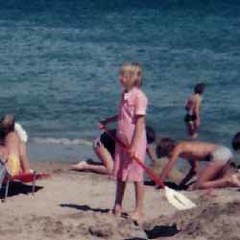
Returning to the idea of distance and perspective: the distant elements in my old holiday photographs on which I have been doing some work, as well as those in old photographs (windows and bicycles) coincide to some degree with what I have written above. When I look at a photograph, taken during a family holiday in the late 1970s, I see the people I recognise, whether that’s myself, my brother, parents or grandparents. But there are often others, all of whom were a part of that moment (such as the girl below who was standing in the distance of one of our snaps).

20

Returning to objects: how do we re-impose the ‘drudgery of an object’s usefulness’ back onto the object? Think of the old musical instruments in the museum. How did I give it back its usefulness? By using the Goethean method of observing, and, in particular, by placing it back – through use of the imagination – in its own time. Although I wasn’t looking at the specific ‘gesture’ of things at that time, I believe I found the gesture of the lira di braccio nonetheless.

So, returning to the man in the tavern; what are the elements of that place which one would need to understand in order to re-construct it through the imagination? Objects (contemporary and old), environments (the room itself and elements thereof), conversations…

Filed Under: Goethean Observations Tagged With: Creatures, Goethean Observation, Henri Bortoft, Herodotus, Objects, Vintage Photographs, Walter Benjamin

© Nicholas Hedges 2024

  • Facebook
  • Instagram
  • Twitter
  • YouTube

Copyright © 2025 · Outreach Pro on Genesis Framework · WordPress · Log in