Nicholas Hedges

Art, Writing and Research

  • Amazon
  • Behance
  • Facebook
  • Instagram
  • Pinterest
  • YouTube
  • Art
    • Digital
    • Drawing
    • Grids
      • Correspondence
      • The Wall
      • The Tourist
    • Ink on paper
      • Shadow Calligraphy
    • Installation
      • Murder
      • Echo
    • Painting
    • Patterns
    • Mixed Media
    • Photographic installation
      • St. Giles Fair 1908
      • Cornmarket 1907
      • Headington Hill 1903
      • Queen Street 1897
    • Research/Sketches
    • Stitched Work
      • Missded 1
      • Missded 2
      • Missded 3
      • Missded 4
    • Text Work
  • Blogs
    • Family History
    • Goethean Observations
    • Grief
    • Light Slowed But Never Stilled
    • Lists
    • Present Empathy
    • Shadow Calligraphy
    • Trees
    • Time
    • Walking Meditations
  • Video
  • Photography
    • Pillars of Snow
    • Creatures
    • The Trees
    • Snow
    • St. Giles Fair 1908
    • Cornmarket 1907
    • Headington Hill 1903
    • Queen Street 1897
    • Travel
  • Illustration and Design
  • Music
  • Projects
    • Dissonance and Rhyme
    • Design for an Heirloom
    • Backdrops
    • Shadow Calligraphy
  • Exhibitions
    • A Line Drawn in Water
      • Artwork
    • A Line Drawn in Water (Blog)
    • Mine the Mountain 3
      • Artwork
    • Mine the Mountain 2
      • Artwork
      • The Wall
    • The Woods, Breathing
      • Artwork
    • Snow
      • Artwork
    • Echo
      • Artwork
    • Murder
      • Artwork
    • The Tourist
    • Dreamcatcher
    • Mine the Mountain
      • Artwork
      • The Tourist
    • M8
    • The Gate
    • Creatures
      • Artwork
    • Residue
      • Artwork
    • A visit to Auschwitz
      • Artwork
  • Me
    • Artist’s Statement

Walks

October 31, 2010 by Nicholas Hedges

As part of my research during this residency, I’m undertaking a number of walks in and around Newcastle. During the walks, I write lists of observations; typically things which are seemingly insignificant or everday occurrences. Each walk is also recorded using GPS as are the number of steps using a pedometer.
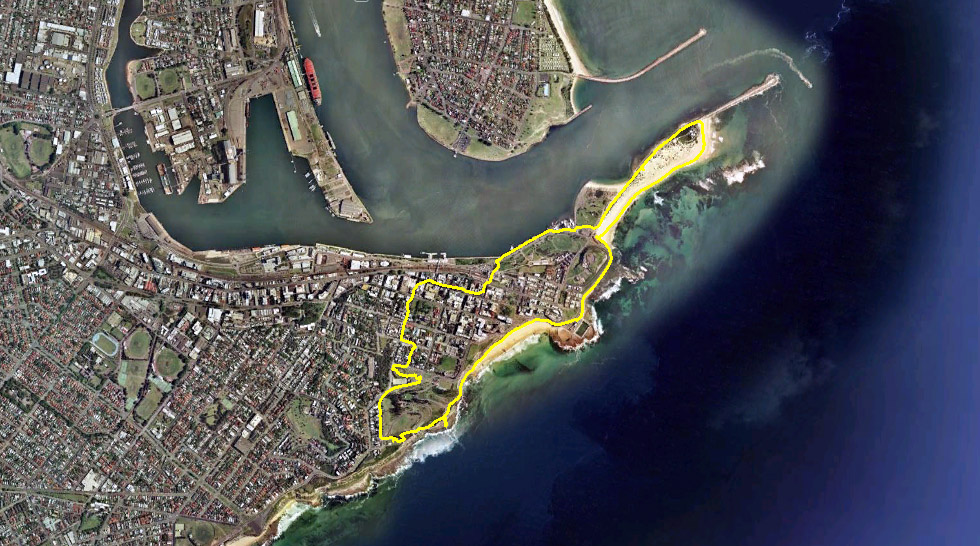
The first two lists can be found via the links below:
Walk 1
www.nicholashedges.co.uk/lockup/walk1.htm

Walk 2
www.nicholashedges.co.uk/lockup/walk2.htm

Filed Under: Artist in Residence Tagged With: A Line Drawn In Water, Artist in Residence, Australia, Everydayness, Family Hedges, Family History, Hedges, Lines, Stephen Hedges, Walks

Shepherds Hill

October 31, 2010 by Nicholas Hedges

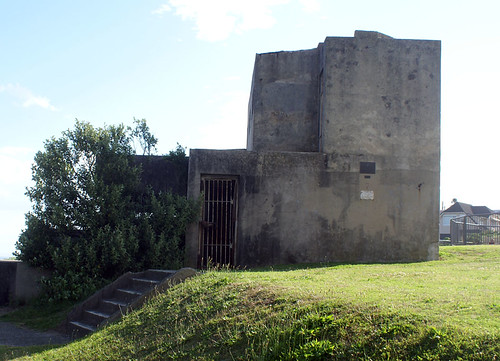
Whilst on my walk today, I took some time to explore the concrete ruins of what I discovered was the Shepherds Hill complex, described on a plaque fixed to one of the walls.

The text of the plaque is as follows: 

The Shepherds Hill complex is unique to in Australia for housing, during 1942, all three services at one time. A fortress observation post (army) coordinated the guns at Fort Wallace, Fort Scratchley and Park Battery. A Radar station (RAAF) assisted in locating air and seabourne targets. A port war signal station (Navy) monitored shipping movements to identify if friendly or enemy. A directing station (Army) coordinated the coastal searchlights which were used to illuminate seabourne targets. The army also took over nearby houses as well as King Edward Park, closing it to the public.

The empty concrete rooms, all stopped up with bars are strangely enigmatic. Full of detritus, graffiti and fragments of rusted metal like fossilised bones, they’re also full of lines, the movements of people busy at the time of the second world war.

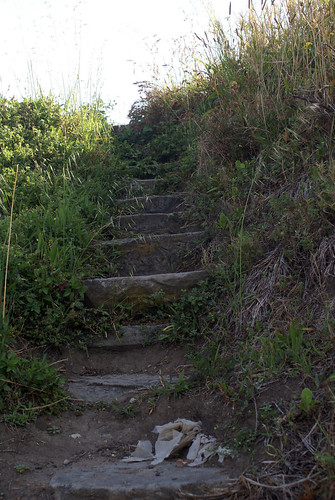
The steps that lead nowhere lead one nonetheless back to a time when they had a purpose, when they weren’t incongruous but rather banal and a part of everyday activity.

As I looked around the ruins, casting my eyes like the sonic pulse of a radar, I could imagine the individuals who once worked there, picking them out like blips on a radar screen. And it was interesting, given what I wrote about yesterday, that this space had once been used for the purpose of listening, just a few hundred yards from Yi-ran-na-li, where people haven’t listened enough.

Filed Under: A Line Drawn in Water, Artist in Residence Tagged With: A Line Drawn In Water, Artist in Residence, Australia, Everydayness, Family Hedges, Family History, Hedges, Lines, Stephen Hedges, Walks

Yi-ran-na-li

October 30, 2010 by Nicholas Hedges

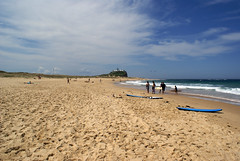
At the end of Nobbys beach can be found Nobbys Island. Once a rocky outcrop, the island was joined to the mainland through work carried out by convict gangs between 1818 and 1846. In 1855, the quarried summit of the island (the rock of which had been used to create the pier joining the island with the mainland) was cut down from 62 metres to his present height of 28 metres. A sign near the island explains how the local Aboriginal people, the Awabakal, believe Nobbys Island was created in the time of the Dreaming by the great rainbow serpent as it pushed itself onto the land after it had dropped from the sky into the island. To read how it was mined for coal (after being surveyed by Lieutenant John Shortland who surveyed the bluff during the 1790s) and then – being a danger to ships – reduced by almost a third in height, makes one feel sorry, especially in light of the beliefs of the Awabakal people.

The importance placed on rocks by Aboriginal people is also described near Newcastle beach, where a sign describes Yi-ran-na-li, the Aboriginal name for the cliff which, the sign tells us, is known by them as being a place of silence and respect. The cliff was – or rather is – a sacred place and the sign itself something of an apologia, the text of which is worth repeating here in full:

“In the 1880s, John McGill, an Awakbal man, also known as Biraban (Eaglehawk) told the missionary Reverend Lancelot Threlkeld the story of Yi-ran-na-li whilst passing beneath the cliff one day.

‘There is a sort of scared place near Newcastle on the sea-beach, beneath a high cliff named Yi-ran-na-li, it is said, that if any person speaks, the stones will fall  down upon them, from the high arched rocks above, the crumbling state of which is such as to render it extremely probable, that the mere concussion of air from the voice would cause the effect to take place.

I was walking beneath the projecting rock and called loudly to McGill , who with other blacks, were with me. He instantly beckoned me to be silent, at which I wondered, a few small stones fell down from the crumbling overshadowing cliff at that moment, and they urged me on.

When we had passed out the precincts of the fearful place, I asked what they meant by commanding my silence, and pushing on so quickly without speaking? This elicited the tradition of the place as a very fearful one, for if any one speaks whilst passing beneath the overhanging rocks, stones would invariably fall as we had just witnessed.’ (Threkeld in Gunson 1974:65)

The large rock fall in 2002 perhaps marked Yi-ran-na-li’s final stand. It was a rock so large that we couldn’t ignore it. The rock was a statement about our inability to live within the constraints and sensitivities of place. Despite the removal of the rock and the total reshaping of the cliff face to make it ‘safer’ we should not forget the cultural belief of the local Aboriginal people that this place was to be feared and respected.

The cliff speaks to us with a wisdom that is thousands of years old. McGill knew this cultural wisdom but we have failed to listen, and today we still have so much to learn about the many other aspects of an endemic sense of place and about the environment we live in.

It is not too late to show the respect that Yi-ran-na-li deserves.’

The photograph below, shows Yi-ran-na-li today:

I was struck by the last paragraph admitting to the country’s failings as regard its indigenous population and their ancient heritage (although this is in no way only an Australian problem: America, Europe, and in particular Britain have shown throughout history a blatant disregard for the culture of those people on whose countries it has claimed dominion). As regards Yi-ran-na-li, how can such respect be shown when, as the text also describes the rocks – like Nobbys Island – have been reshaped? Should the fallen rock have been removed? Would it not have been a good idea to leave it as a reminder of cultural ignorance and its consequences? It seems to me there is a strong correlation between failing to listen and speaking when we shouldn’t. Also, the fact the sign contained a few typos didn’t really help as regards the sincerity of its message. I’ve no doubt that it is sincere, but small things like spelling the ‘thre’ undermines its message nevertheless.

Filed Under: A Line Drawn in Water, Artist in Residence Tagged With: A Line Drawn In Water, Artist in Residence, Australia, Everydayness, Family Hedges, Family History, Hedges, Lines, Silence, Stephen Hedges, Walks

My Residence

October 30, 2010 by Nicholas Hedges

I arrived in Newcastle, NSW yesterday afternoon after a 3 hour train journey from Sydney. The journey itself was pleasant enough, save for the moment a rather loud couple got on and upset the peacefulness of the carriage. She kept going on about how “it wasn’t against the law” in such a way as to suggest that whatever it was that ‘wasn’t against the law’ was in fact against the law and was, furthermore, something she had done. Her partner then proceeded to take off his t-shirt, flap it out as if shaking sand from a beach towel, before leaving it on the seat in front of him. There he sat in all his glory; no top, flabby, hairy and covered with tattoos. If this wasn’t bad enough (and believe me it was) he then proceeded to comment on the magazine he was reading. “You can see he’s a Beckham!” he kept on. “He’s just like his Dad.” Imbecile.

I moved upstairs and enjoyed a peaceful rest of the journey. Something I like about Australian train carriages is the way you can move the seat-backs, so that where you have two seats facing each other, you can flip the back of one so they become two seats facing the same way; very natty.

The journey to Newcastle takes one through some lovely scenery as well as that which isn’t quite as nice. Many of the towns we passed through seemed rather down at heel to say the very least, comprising a hotch-potch of painted sheds and shacks. Newcastle however, appears to be a very pleasant town which I will explore shortly.

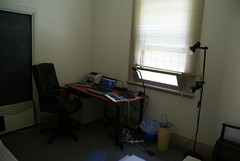
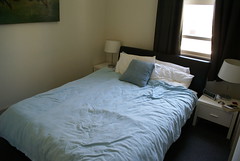
The residency itself is at the Lock Up Cultural Centre which was once a police station. The Lock Up refers to the cells (including a very rare padded cell) and exercise yard which I will document later. My apartment and study is on the first floor and is very pleasant as can be seen in the photographs below:

The study.

The lounge area.

The kitchenette.

The bedroom.

Filed Under: A Line Drawn in Water, Artist in Residence Tagged With: A Line Drawn In Water, Artist in Residence, Australia
Thoughts on Australia

October 29, 2010 by Nicholas Hedges

Why are Australian 50 cent pieces the size of dinner plates and 20 cent pieces like saucers? Especially when 2 dollar coins are little bigger than an English penny; I thought I was broke looking at my handful of money until I realised what the little ones were.

Filed Under: A Line Drawn in Water, Artist in Residence Tagged With: A Line Drawn In Water, Artist in Residence, Australia

Arriving in Port Jackson

October 28, 2010 by Nicholas Hedges

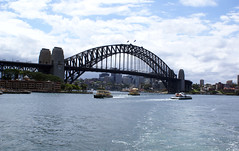
On 28th October 1828, the Marquis of Hastings sailed into Port Jackson after a 4 month journey from Portsmouth, England. Aboard was Stephen Hedges, the brother of my great-great-great-grandfather, Richard. Today, 172 years later, I took the Manly Ferry to Circular Quay in Sydney, sailing into Port Jackson also on October 28th. Quite unplanned, it was an interesting coincidence. Of course, the manner of our arrivals couldn’t have been more different. Economy class cabins may offer less legroom than business, but 22 hours on a plane with meals and entertainment certainly beats 104 days in a stinking hold fettered in chains.

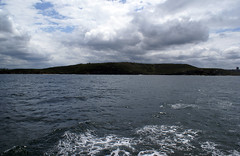
As we travelled out of Manly, I noticed the clouds, one of the few things which, even though they’re ephemeral, are nevertheless, consistent over centuries. Clouds have interested me in relation to the story of Stephen Hedges ever since I read the meteorological charts of William Rae, the ship’s surgeon. The immediate landscape may also have changed (to say the very least) but the sky and the water below are little different to all those years ago.

To reach the Manly Ferry I had to walk along the Manly Coastal Walk as well as a few suburban streets, and it was whilst walking down those streets that I realised how different the birds sounded. Certain things weren’t so different as regards comparison with England, but the sonic suburban landscape was quite alien; birds seemed to make noises like someone twiddling knobs on an old analogue synthesizer. That’s not to denigrate Australian birdsong – just an interesting difference.

Also, as I walked down the road, I found myself experiencing a part of my past – not a specific part, but a sense of what a part of my past was like. I have very strong sense impressions of the summer holidays when I was about 6 or 7 years old; dry sand in the sandpit, the pattern of dappled sunlight on the pavement leading to the shops and the smell of creosote on the fence. In this far-flung street on the other side of the world, I found myself walking within that sensation, as if somehow, I was physically experiencing a memory.

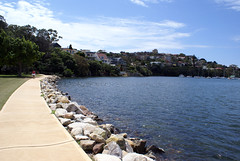
Strolling along the Manly Coastal Walk, I saw and heard the sea lapping at the rocks and on the beaches, and I thought – as I’ve often thought before – how that very sound has remained unchanged for millions of years; a sound which, given the way that it’s inspired and beguiled humankind for centuries, seems intimately bound up with man, rather than something which existed long before Man had even evolved. I thought too how this place had for so long evaded explorers and yet it had always been there in all its vastness – the past as a foreign country; there but out of sight and almost unreachable.

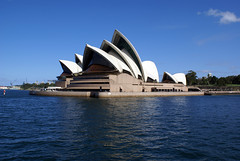
Like many people around the world I have seen countless images of Sydney Opera House and the Harbour Bridge and yet, despite their status, I felt a small shiver as we sailed up and saw them appear in the flesh. I have seen them, but i hadn’t until today experienced them. The iconic shape of the Opera House defined the ‘presentness’of that moment in time, a ‘presentness’ shared by all those aboard the Marquis of Hastings in October 1828.

Although everything looked entirely different, the ‘presentness’ of that lived moment in time was just the same. I was arriving in Port Jackson, carrying with me all that had gone before, just as everyone onboard had done. Today they are names on lists and often very little more – lines drawn in water. But by following the line of the Marquis of Hastings and drawing our own, we come a little closer to making the men more than just names. They cease to be outlines, and instead become like countries.

Filed Under: A Line Drawn in Water, Artist in Residence Tagged With: A Line Drawn In Water, Artist in Residence, Australia

The Road to New South Wales

October 8, 2010 by Nicholas Hedges

On Monday 28th January 1828, a sawyer by the name of Richard Burgess was travelling from Abingdon to Oxford with a cartload of bone for sale in town. On the road to Oxford, Burgess met with three men; Stephen Hedges – a young Abingdon man in his late teens, Henry Stockwell, originally from Aberdeen and a few years older than Hedges, and a man called John Harper. Hedges – described later by Stockwell as the ‘captain’ as regards the events about to follow – asked Burgess if he was going to Oxford and whether he’d carry a parcel for them. Burgess agreed, at which point Harper left the group, while Hedges and Stockwell continued on towards Oxford with the cart.

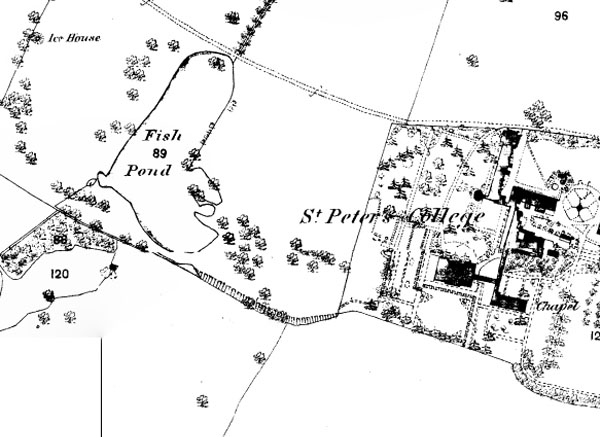
1875 Map of Radley showing Radley House

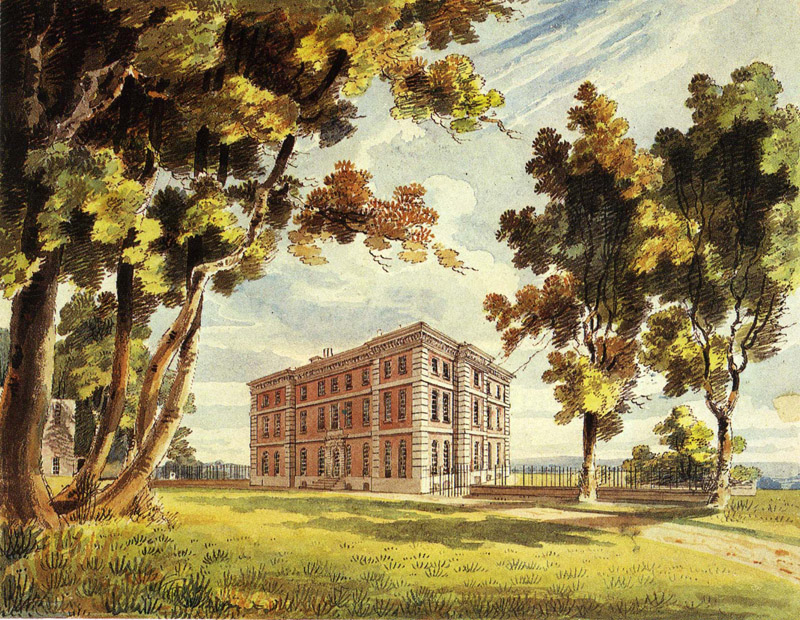
Radley House as painted by Turner in 1789

On the Oxford Road, near the lodge of what was then Radley House, Burgess was asked to stop. At first Burgess refused, but relented, stopping as he said later for about five minutes. At that time the house was owned by Sir George Bowyer (who in 1815 had been forced to sell its contents to help his struggling finances) and rented from him by a Mr. Benjamin Kent. When Harper arrived back on the scene with a bag, the three men went off into the gardens.

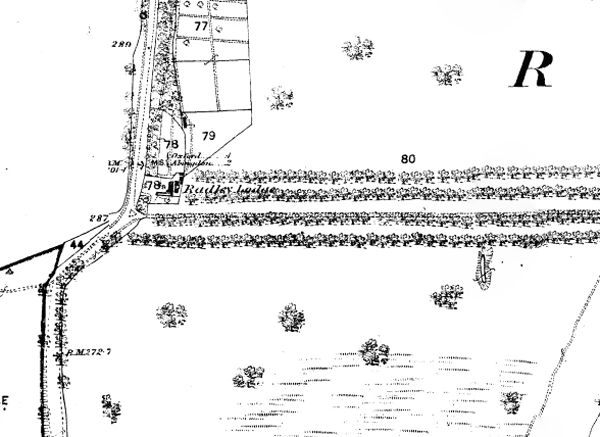
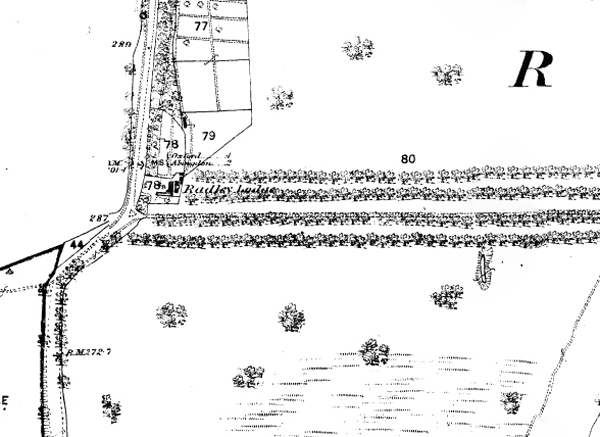
1875 Map of Radley showing the Lodge and Driveway of Radley House

After five minutes the men returned carrying the bag which Burgess described as being very heavy. What was in the bag, Burgess didn’t know, but given that Stockwell was carrying a piece of lead on his shoulder, it must have been obvious.

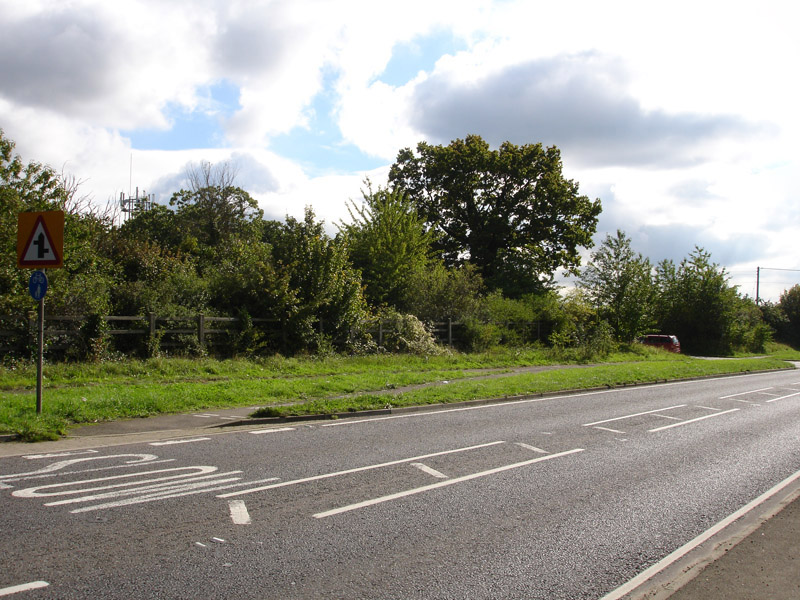
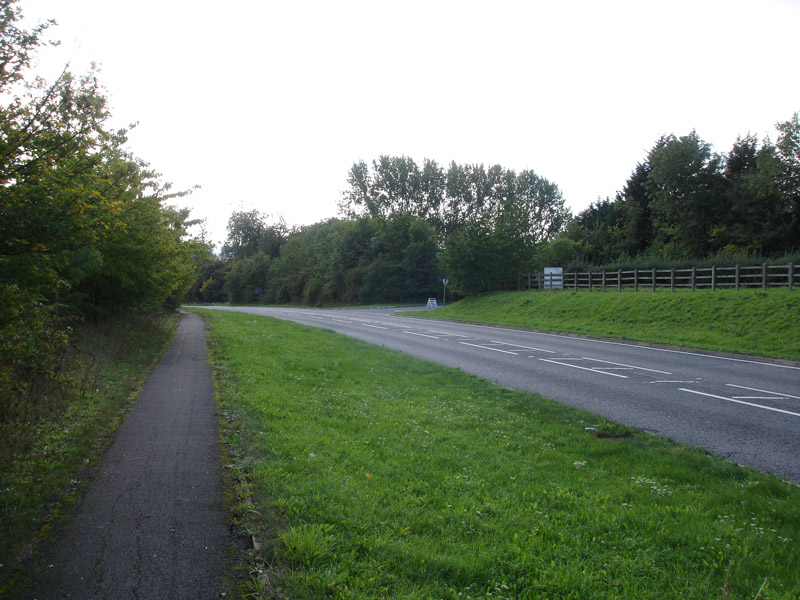
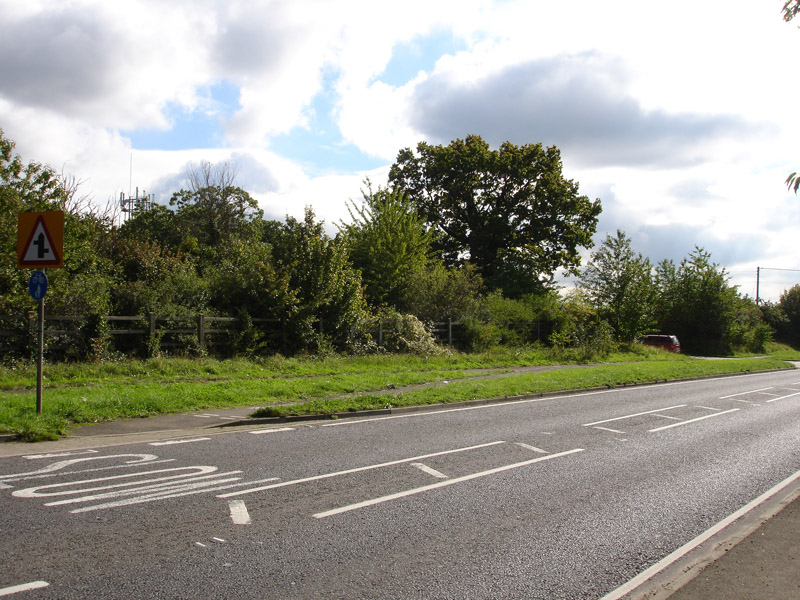
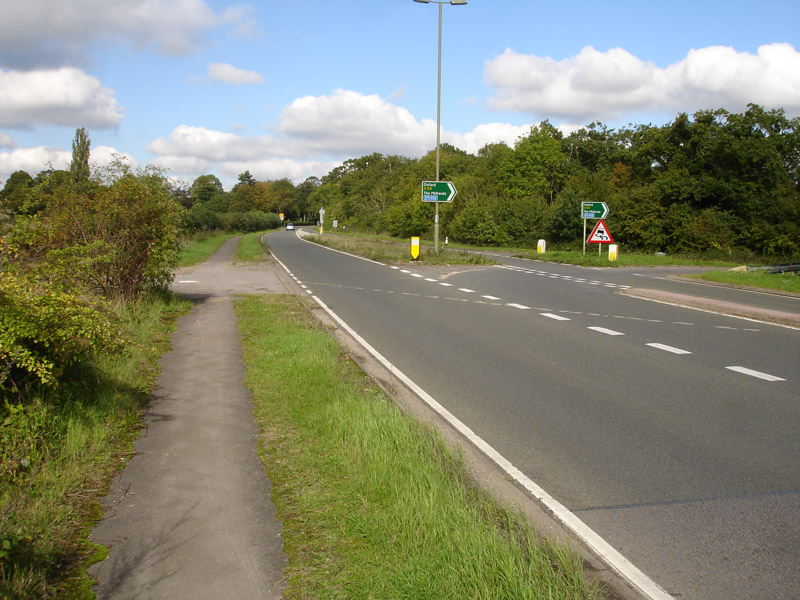
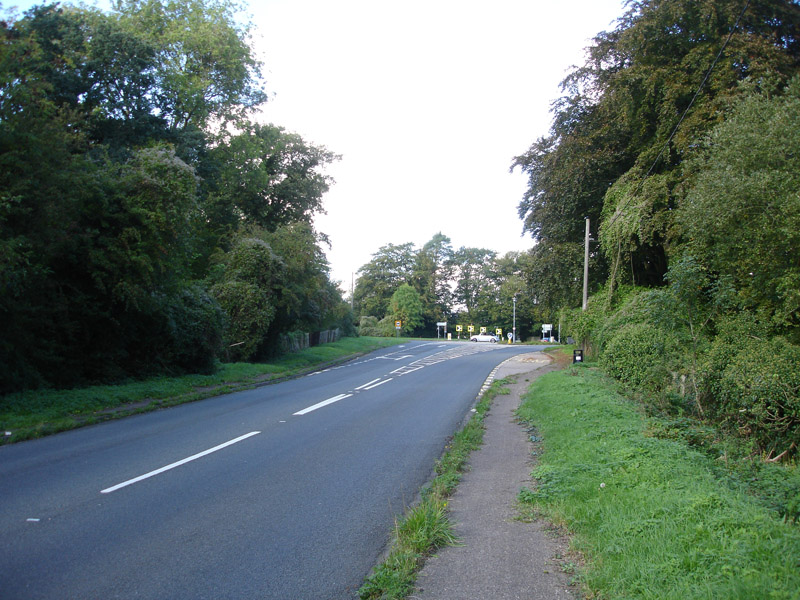
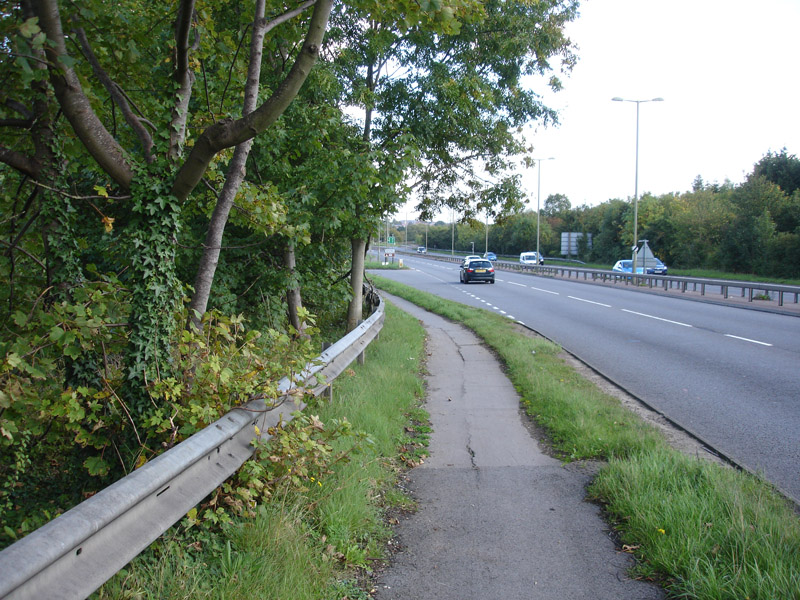
The road from Abingdon to Oxford. The parked car on the right marks the spot where Burgess stopped the cart.

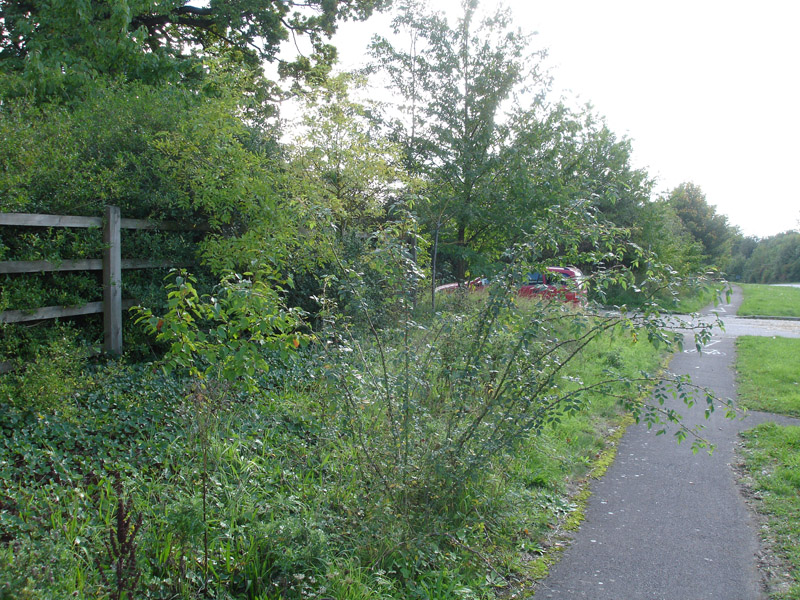
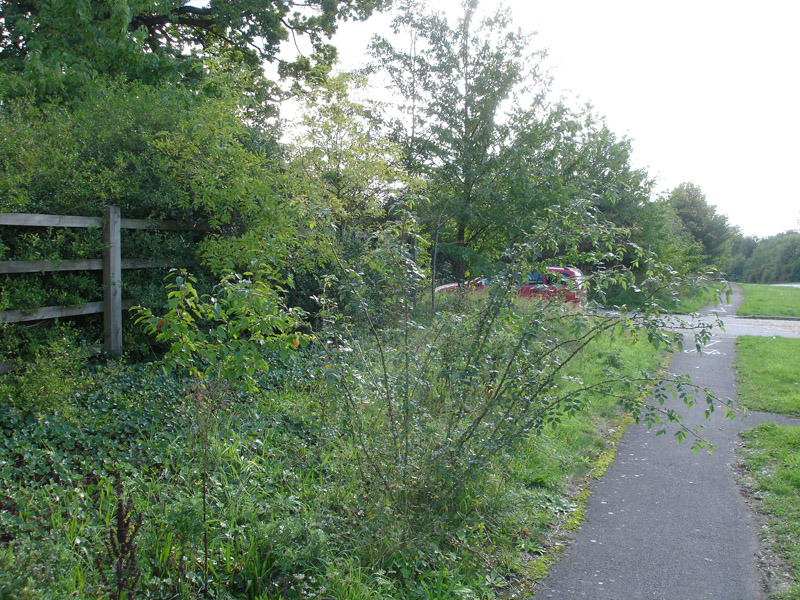
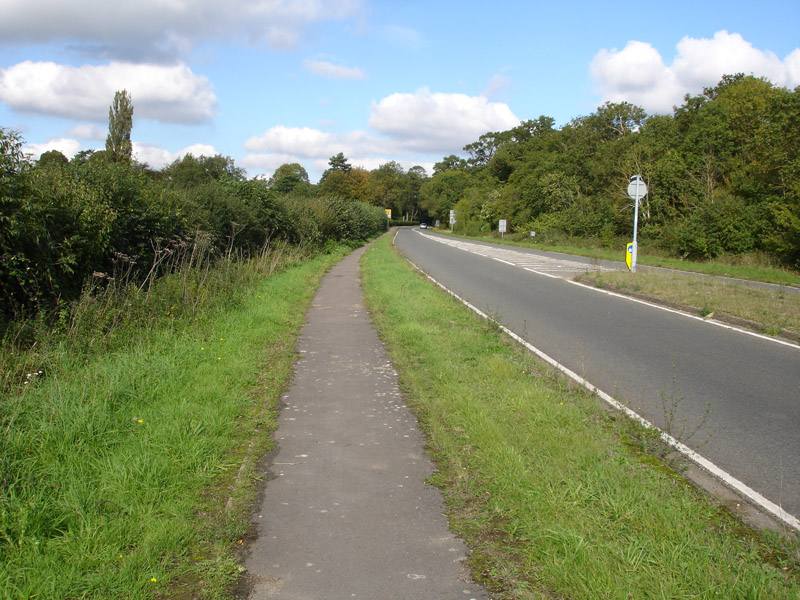
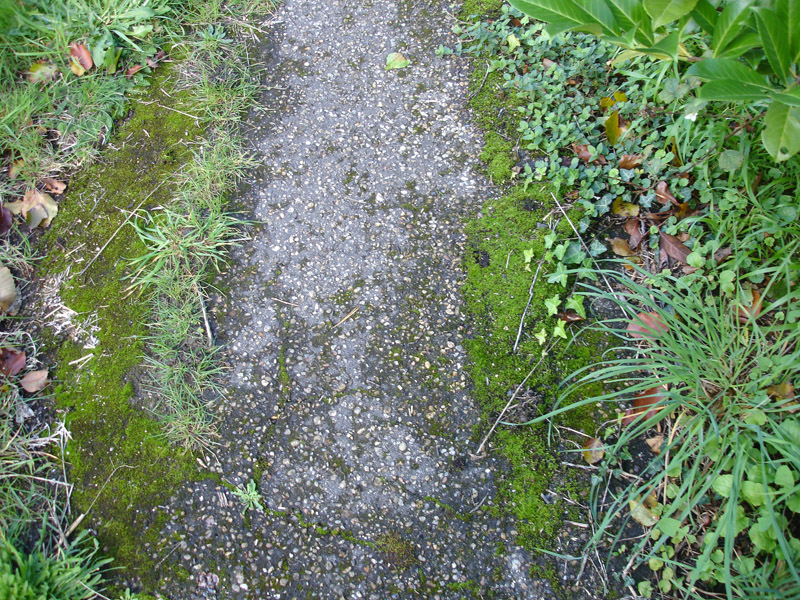
A path next to the Oxford Road showing the parked car.

On the way into Oxford, the men – still travelling with Burgess –  met a Charles Jones whereupon, according to Burgess, they engaged in conversation. Burgess went on into Oxford, to Mr. Round’s wharf and near the gates set down the lead and delivered his cargo of bone for weighing. Half an hour later, Stockwell and Jones reappeared and put the lead back on the cart. Burgess asked him where they were going to take it, to which he was told to follow Jones.

Burgess followed Jones up the ‘City Road’ and near the Castle met with Hedges and Harper. They turned back through Butcher Row to the place where the lead was to be delivered, and here, for his trouble Burgess was paid sixpence.

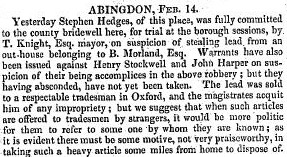
The next day, on Tuesday 29th January, James Smith, servant to Benjamin Kent, discovered three ‘hips’ of the larder roof had been stripped of their lead. Two weeks later, on Wednesday, 13th February, Stephen Hedges appeared in Abingdon before the mayor  T. Knight Esq. on suspicion of stealing lead from an outhouse belonging to B. Morland Esq. (I’m assuming here that B Morland and B. Kent are in fact the same person). He was fully committed to the Bridewell whereas Stockwell and Harper were, at that point, still on the run.

Jackson’s Oxford Journal, Saturday 16th February 1828

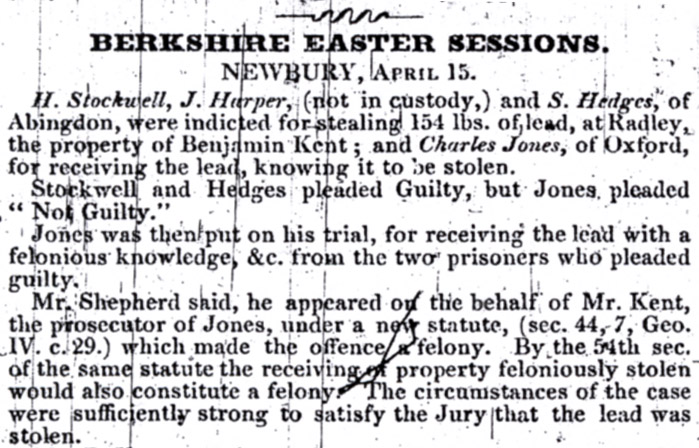
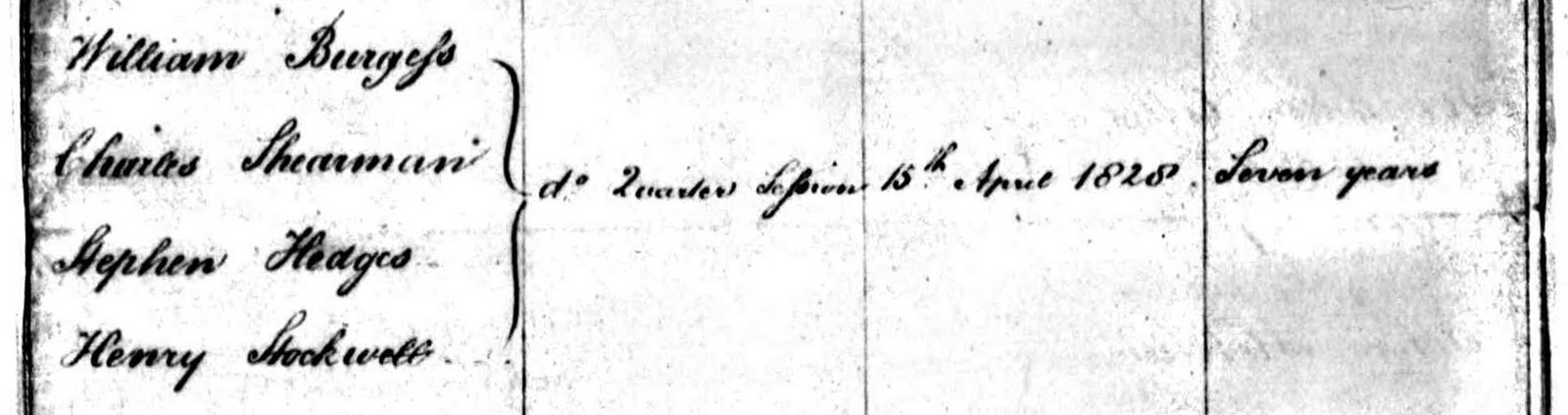
Justice however soon caught up with them, and together with Hedges they were tried at the Berkshire Easter Sessions on Tuesday, 15th April. Stephen Hedges and Henry Stockwell were found guilty of stealing 154 lbs of lead. The sentence passed was transportation for a period of 7 years. The report in Jackson’s Oxford Journal makes no mention of Harper’s fate. Charles Jones was acquitted.

Jackson’s Oxford Journal, Saturday 19th April 1828

Having been convicted and sentenced, Hedges and Stockwell were taken to Portsmouth, and on Monday 28th April, received aboard the prison hulk York.

The system of prison hulks had been established by an act of Parliament in 1776 (following the declaration of American Independence which meant the loss of penal colonies there) to ease overcrowding in British prisons. Old warships moored on the Thames and those in other ports, were converted into prisons, and despite the terrible conditions suffered by the prisoners within, the system remained in place for another 80 years.

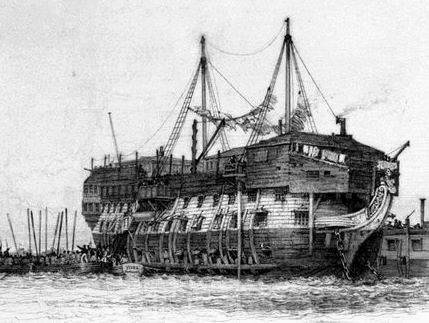
The prison hulk York from an engraving by E.W. Cooke. The National Maritime Museum, London.

The York, in which Hedges and Stockwell were incarcerated, was the eighth ship in the Navy to bear the name and had once been a 74-gun, third rate of 1,743 tons. Launched in 1807, she’d been posted to the West Indies where she was involved in the capture of the island stronghold of Martinique. She continued the war in the Mediterranean Squadron off Toulon and in 1819, returned to Portsmouth to serve as a prison hulk – home to some 500 inmates.

Entering a hulk was demoralising to say the very least. Prisoners were stripped of their clothes,  after which cold buckets of water were thrown over them. They received their slops and looked on as their own clothes were thrown into the sea – a baptism of their status as a convict and a ‘ceremonial drowning’ of their lives before that time. Finally, they were led into the darkest, foulest-smelling parts of the ship, to await their transportation – the last stage in the process of being forgotten.

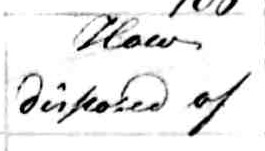
The final column of the York’s Muster reads rather ominously: how disposed of?

And this is just what was being done with all the men and women sentenced in this manner. In this column, next to the names of Stephen Hedges and Henry Stockwell, are the words: 24 Jun ’28 NSW; NSW being their final destination – New South Wales.

The York’s documentation also tells us something – albeit somewhat succinctly –about Stephen Hedges’ character. Whereas other prisoners are described as being badly connected, not known here, orderly or good in gaol, Hedges is described simply as bad. To be fair to him however, he wasn’t described as being very bad, which was a term applied to a certain John Head, who was being shipped abroad for 7 years for receiving stolen goods.

Conditions aboard the York were appalling, and Stephen Hedges and Henry Stockwell had to endure them for 2 months before they left for New South Wales, Australia. Finally, on Sunday, 29th June 1828, they left Portsmouth on the convict ship The Marquis of Hastings never to see England, or their families, again.

List of prisoners embarked on the Marquis of Hastings, bound for New South Wales, 27th June 1828

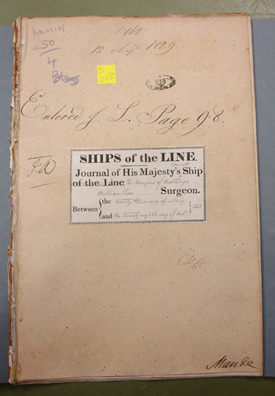
The journey to New South Wales took them 4 months and onboard the ship, travelling with the crew and the prisoners was the ship’s surgeon William Rae, who, as part of his duties, kept a journal of illnesses and treatments suffered throughout the voyage.

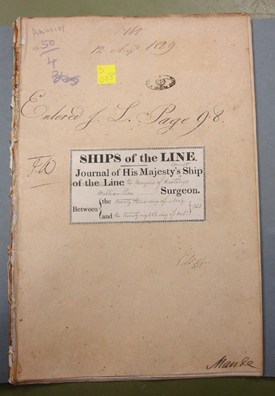
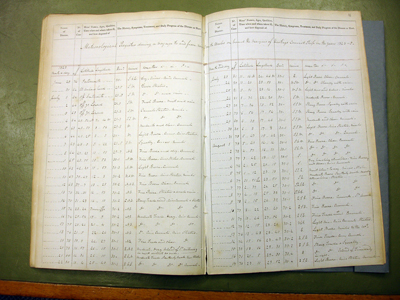
The Journal of William Rae at the National Archives, Kew.

Given the length of the voyage, the appalling conditions and the terrible diet the prisoners (and indeed the crew) had to endure, it’s surprising that so few people passed through William Rae’s sick bay. In total, 17 people were in his care during the course of the voyage, of whom 13 were discharged cured and 3 discharged convalescent in Sydney. Only one person died –  from Hydrocephalus (water on the brain).

During the voyage, Rae made notes on the weather which, even in brief descriptions of the clouds, paints a vivid picture of the journey. For example: July 24th 1828. The ship was located at Latitude 10.2o N and Longitude 23.50o S. The temperature was 80oF with a light West-South-Westerly breeze. ‘Cloudy with rain’ Rae has added, in the column marked ‘weather for the day’.

We might not know how it feels to be fettered by the ankles and the waist, locked inside a cramped, stinking space with dozens of other criminals, but we all know the weather. When we read about the conditions suffered by the convicts, it always seems – so long ago did it happen – comparable to a fiction. Strong breeze, squally with rain however is just as much a part of now. When we look at a cumulus cloud as Rae had done, we can get a little closer to the plight of the convicts in the hold.

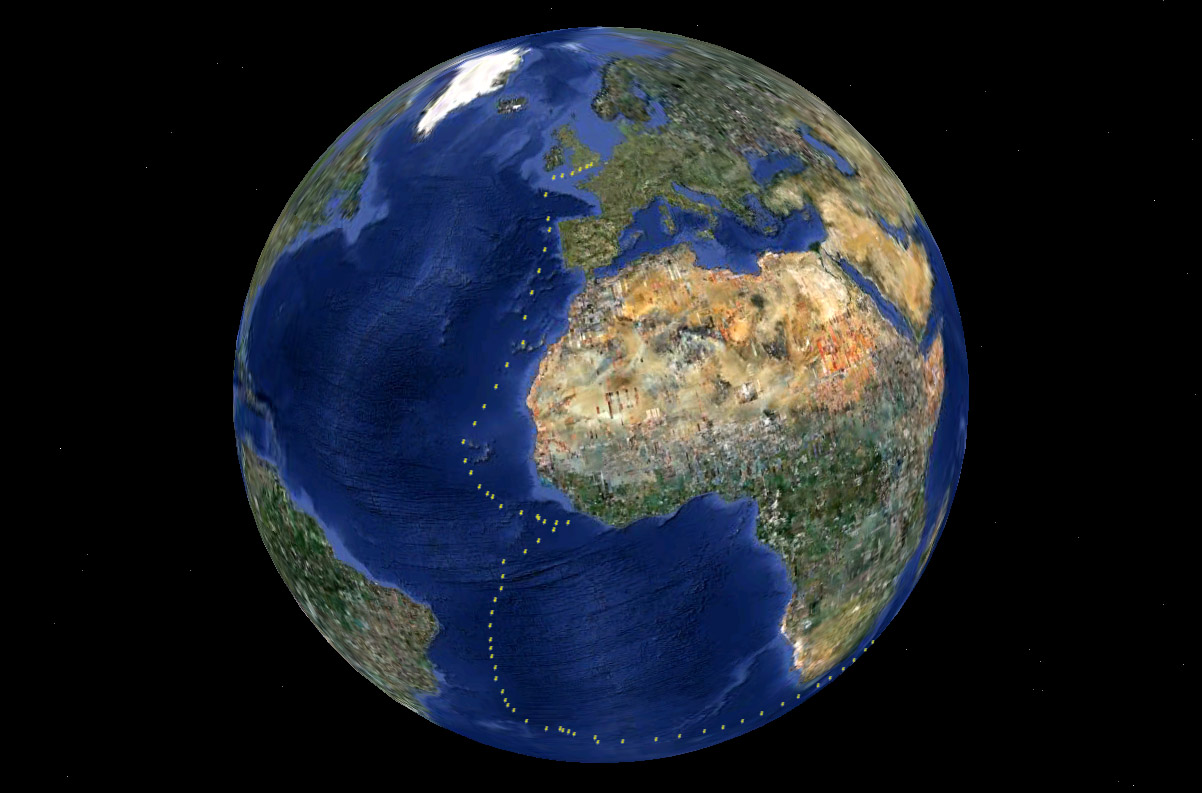
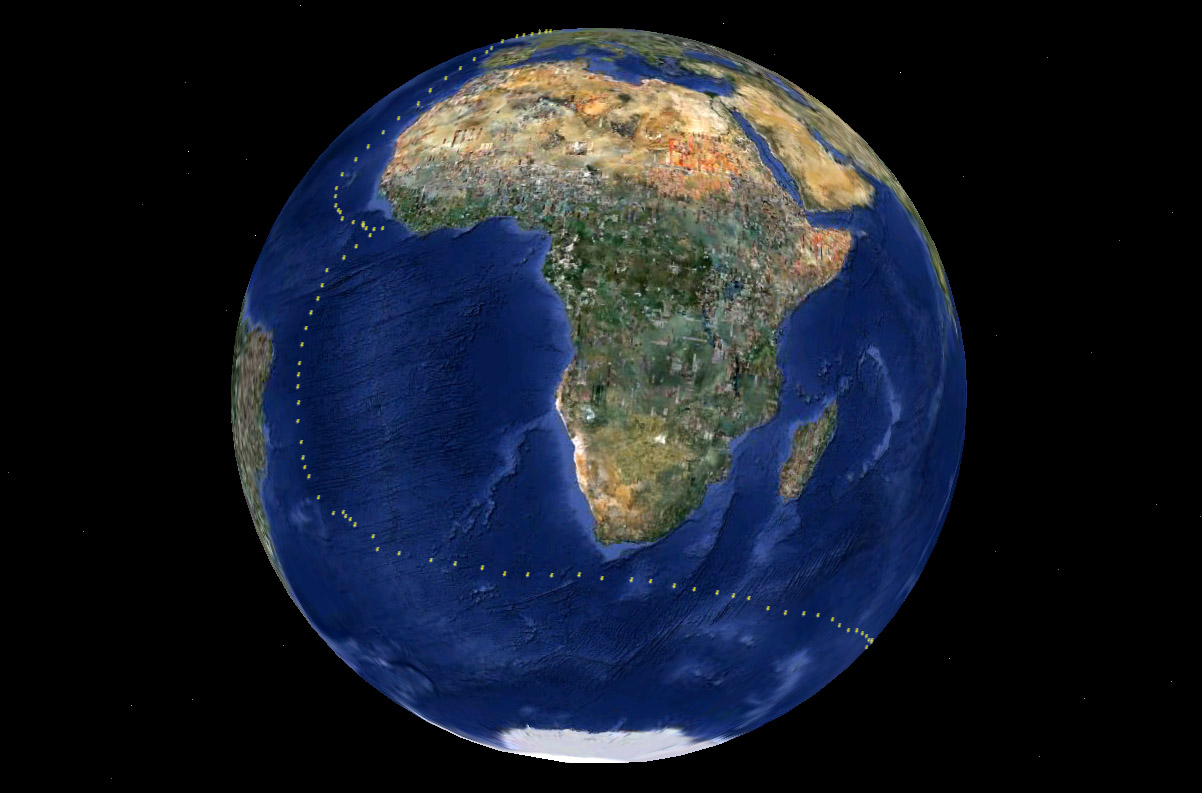
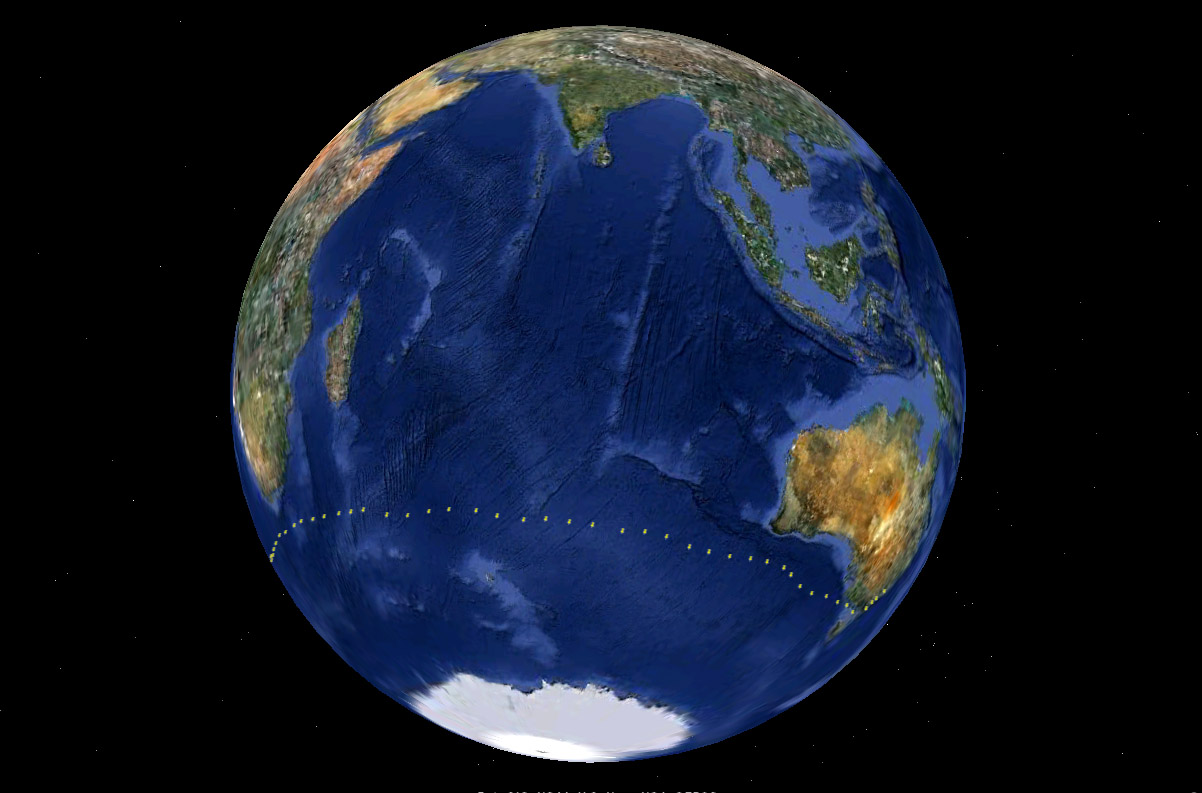
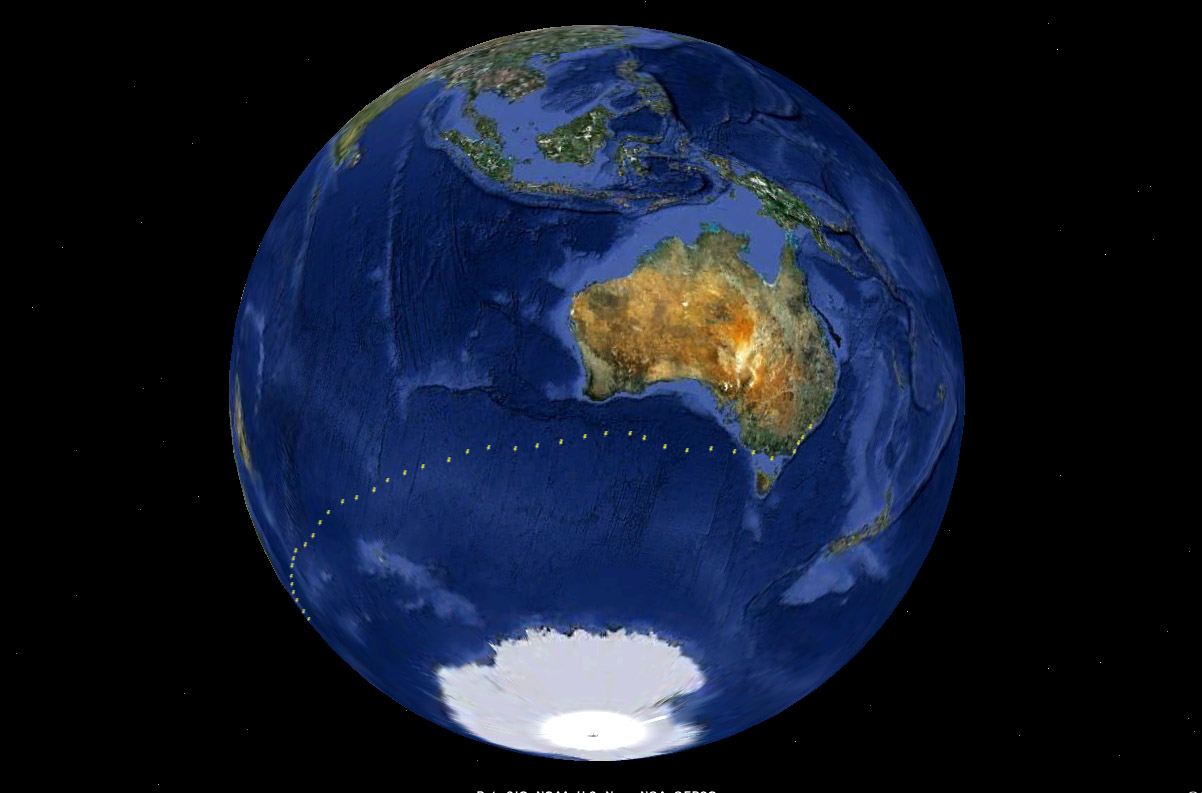
Plotting the coordinates of the voyage allows us to see the journey. The following stills are taken from Google Earth, in which I plotted Rae’s longitude and latitude.

Stephen Hedges would have had no idea what to expect in Australia, and the same could be said for most of those onboard. Australia itself had only recently emerged from the world of myth. It was still little more than an outline, a vast oubliette for the convicts on board.

On maps throughout the 18th century, Australia’s outlines slowly emerged, as various explorers happened upon her shores. It seems inconceivable that so vast a landmass could ever have been missed, but it just goes to show how big the oceans are by which it is surrounded.

The contrast between its (then) vague geography, its being a kind of oubliette and the realities of the present along with its unforgiving landscape, is something which interests me a great deal.

A map showing an as yet, unmapped east coast of Australia.

After four months at sea, bound for New South Wales, the prisoners disembarked at Sydney, on Tuesday, October 28th.

Stephen Hedges was assigned to James Bowman who’d been appointed principal surgeon for New South Wales after arriving on the John Barry in 1819. By 1832, Bowman had established a sheep run on more than 11,000 acres of land at Ravensworth, Patrick Plains. Hedges may well have been used to help construct it.

Detail from NSW 1828 Census, showing Stephen Hedges being assigned as a labourer to James Bowman at Patrick’s Plains.

On 24th December 1838, Stephen Hedges, now a free man, married Elizabeth Carter in Parramatta, New South Wales.

He died in Australia in 1885, at the age of 74.

Filed Under: A Line Drawn in Water, Artist in Residence Tagged With: A Line Drawn In Water, Artist in Residence, Australia, Family Hedges, Family History, Hedges, Stephen Hedges

Stephen Hedges

October 8, 2010 by Nicholas Hedges

On Monday 28th January 1828, a sawyer by the name of Richard Burgess was travelling from Abingdon to Oxford with a cartload of bone for sale in town. On the road to Oxford, Burgess met with three men; Stephen Hedges – a young Abingdon man in his late teens, Henry Stockwell, originally from Aberdeen and a few years older than Hedges, and a man called John Harper. Hedges – described later by Stockwell as the ‘captain’ as regards the events about to follow – asked Burgess if he was going to Oxford and whether he’d carry a parcel for them. Burgess agreed, at which point Harper left the group, while Hedges and Stockwell continued on towards Oxford with the cart.
On the Oxford Road, near the lodge of what was then Radley House, Burgess was asked to stop. At first Burgess refused, but relented, stopping as he said later for about five minutes. At that time the house was owned by Sir George Bowyer (who in 1815 had been forced to sell its contents to help his struggling finances) and rented from him by a Mr. Benjamin Kent. When Harper arrived back on the scene with a bag, the three men went off into the gardens.
After five minutes the men returned carrying the bag which Burgess described as being very heavy. What was in the bag, Burgess didn’t know, but given that Stockwell was carrying a piece of lead on his shoulder, it must have been obvious.
On the way into Oxford, the men – still travelling with Burgess –  met a Charles Jones whereupon, according to Burgess, they engaged in conversation. Burgess went on into Oxford, to Mr. Round’s wharf and near the gates set down the lead and delivered his cargo of bone for weighing. Half an hour later, Stockwell and Jones reappeared and put the lead back on the cart. Burgess asked him where they were going to take it, to which he was told to follow Jones.
Burges followed Jones up the ‘City Road’ and near the Castle met with Hedges and Harper. They turned back through Butcher Row to the place where the lead was to be delivered, and here, for his trouble Burgess was paid sixpence.
The next day, on Tuesday 29th January, James Smith, servant to Benjamin Kent, discovered three ‘hips’ of the larder roof had been stripped of their lead. Two weeks later, on Wednesday, 13th February, Stephen Hedges appeared in Abingdon before the mayor  T. Knight Esq. on suspicion of stealing lead from an outhouse belonging to B. Morland Esq. (I’m assuming here that B Morland and B. Kent are in fact the same person). He was fully committed to the Bridewell whereas Stockwell and Harper were, at that point, still on the run.
Justice however soon caught up with them, and together with Hedges they were tried at the Berkshire Easter Sessions on Tuesday, 15th April. Stephen Hedges and Henry Stockwell were found guilty of stealing 154 lbs of lead. The sentence passed was transportation for a period of 7 years. The report in Jackson’s Oxford Journal makes no mention of Harper’s fate. Charles Jones was acquitted.
Having been convicted and sentenced, Hedges and Stockwell were taken to Portsmouth, and on Monday 28th April, received aboard the prison hulk York. The hulk system had been established by an act of Parliament in 1776 (following the declaration of American Independence which meant the loss of penal colonies there) to ease overcrowding in British prisons. Old warships moored on the Thames and those in other ports, were converted into prisons, and despite the terrible conditions suffered by the prisoners within, the system remained in place for another 80 years.
The York, in which Hedges and Stockwell were incarcerated, was the eighth ship to bear the name and had once been a 74-gun, third rate of 1,743 tons. Launched in 1807, she’d been posted to the West Indies where she was involved in the capture of the island stronghold of Martinique. She continued the war in the Mediterranean Squadron off Toulon and in 1819, returned to Portsmouth to serve as a prison hulk – home to some 500 inmates.
Entering a hulk was demoralising to say the very least. Stripped of their clothes, cold buckets of water were thrown over the prisoners. They received their slops and looked on as their own clothes were thrown into the sea – a baptism of their status as a convict and a ‘ceremonial drowning’ of their lives before that time. Finally, they were led into the darkest, foulest-smelling parts of the ship, to await their transportation – the last stage in the process of being forgotten.
The final column on the York’s Muster reads rather ominously: how disposed of? And this is just what was being done with all the men and women sentenced in this manner. And written in this column, next to the names of Stephen Hedges and Henry Stockwell, are the words: 24 Jun ’28 NSW.
Conditions on the York were appalling but Hedges and Stockwell had to endure them for 2 months, until Sunday, 29th June 1828, when ‘at last’ they left England aboard The Marquis of Hastings. After four months at sea, bound for New South Wales, the prisoners disembarked at Sydney, on Tuesday, October 28th.
Stephen Hedges was assigned to James Bowman who’d been appointed principal surgeon for New South Wales after arriving on the John Barry in 1819. By 1832, Bowman had established a sheep run on more than 11,000 acres of land at Ravensworth, Patrick Plains. Hedges may well have been used to help construct it.
On 24th December 1838, Stephen Hedges, now a free man, married Elizabeth Carter in Parramatta, New South Wales.
He died in Australia in 1885, at the age of 74.

Filed Under: A Line Drawn in Water, Artist in Residence Tagged With: A Line Drawn In Water, Artist in Residence, Australia, Family Hedges, Family History, Hedges, Stephen Hedges

Lead Walk – Photos

October 4, 2010 by Nicholas Hedges

The following photographs were taken during a walk I made along the route as described in the previous entry Lead Walk – Maps.

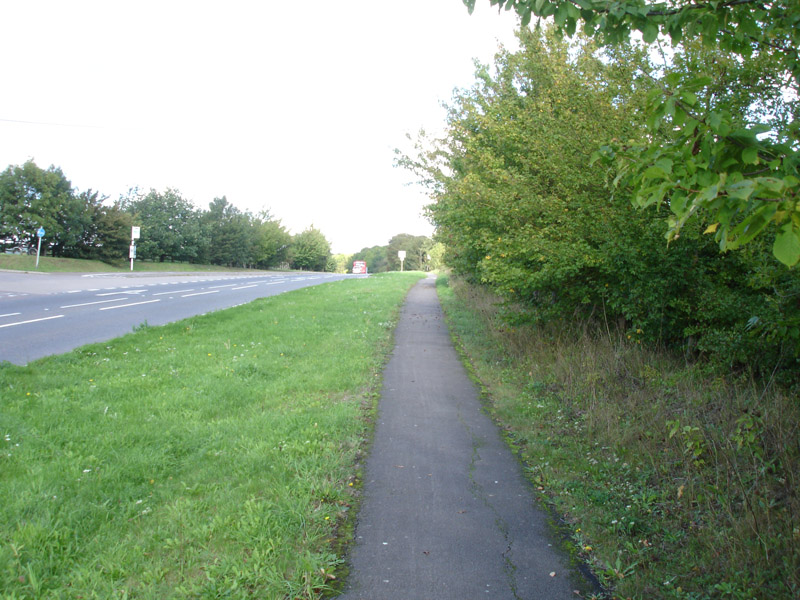
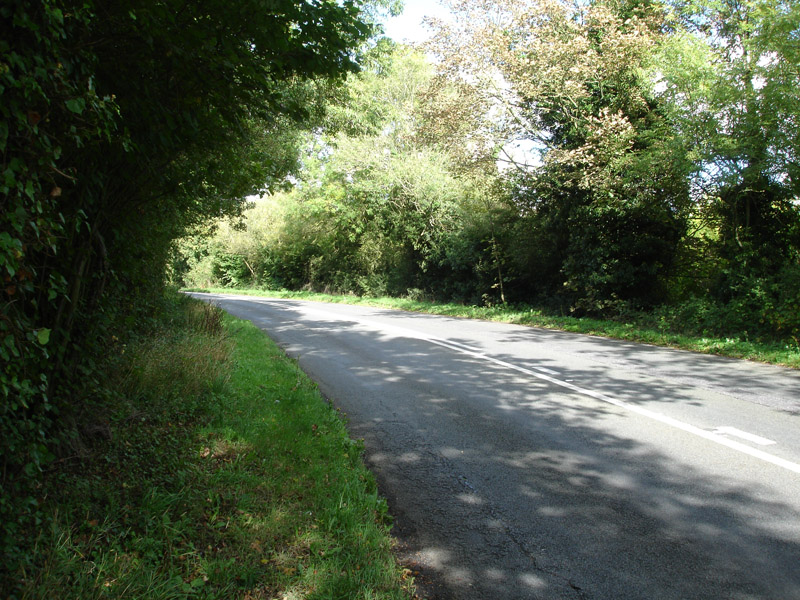
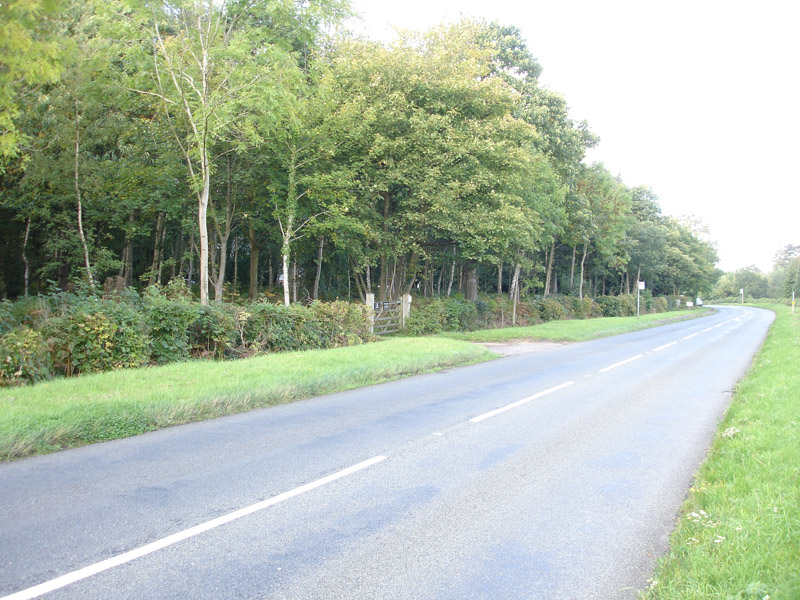
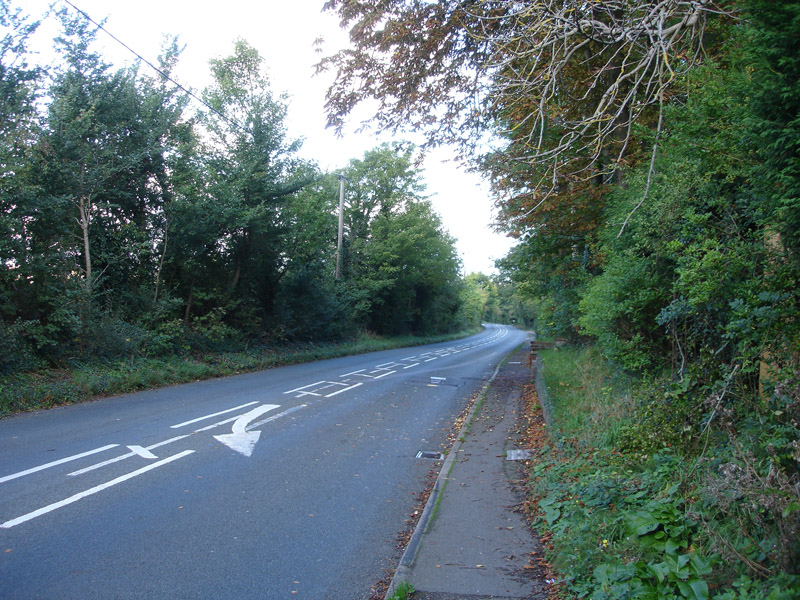
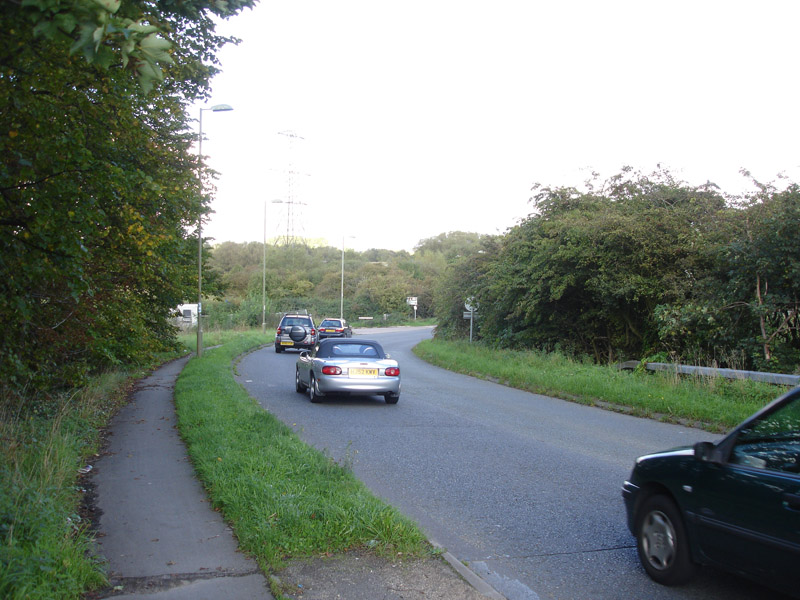
The road from Abingdon, down which Richard Burgess drove with his cart of bones for delivery in Oxford.

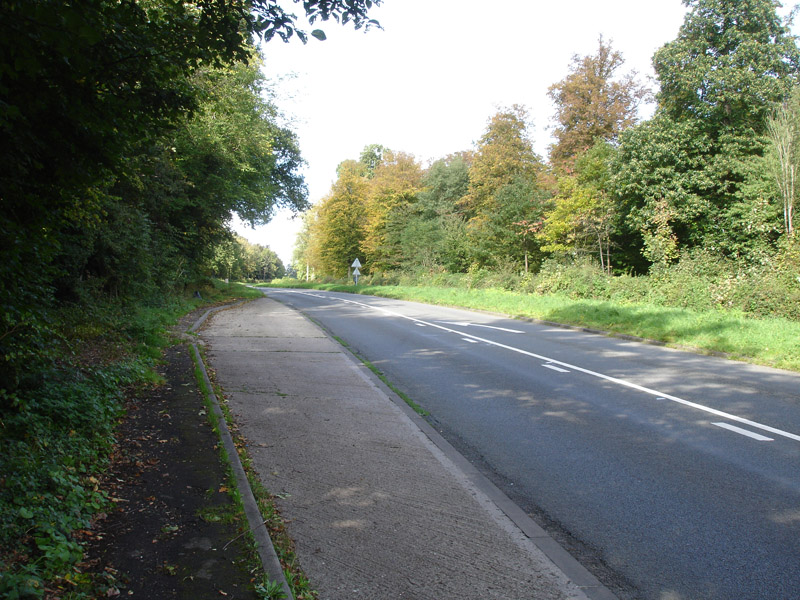
It was near here, where the red car is parked – slightly hidden from view – that Stephen Hedges and his accomplices asked Richard Burgess to stop, before heading off to steal the 154 lbs of lead. From that moment on, Hedges’ fate – along with that of Henry Stockwell – was sealed.

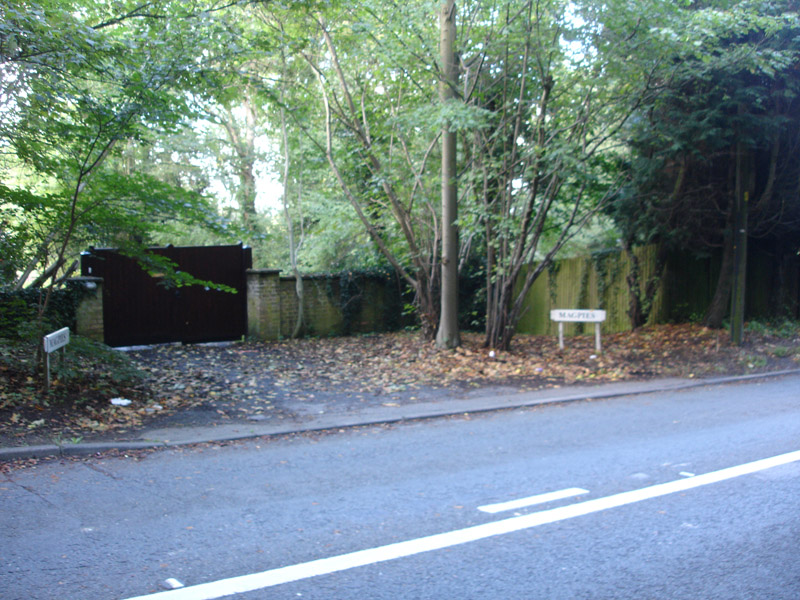
The entrance to Radley House where the car is parked on the right hand side.

When there were no cars driving past – which didn’t seem very often – I would find myself imagining Stephen Hedges looking around him, just as I was doing. I’d see a bird against the clouds and for a second I was him, walking down the road with the horse and cart. I could almost hear their conversation, muffled as if I had an ear to the ground.

When I did imagine a moment in 1828, for some reason my mind returned to my childhood, to Risinghurst where my Nana lived. I wondered about Stephen’s past and his childhood.

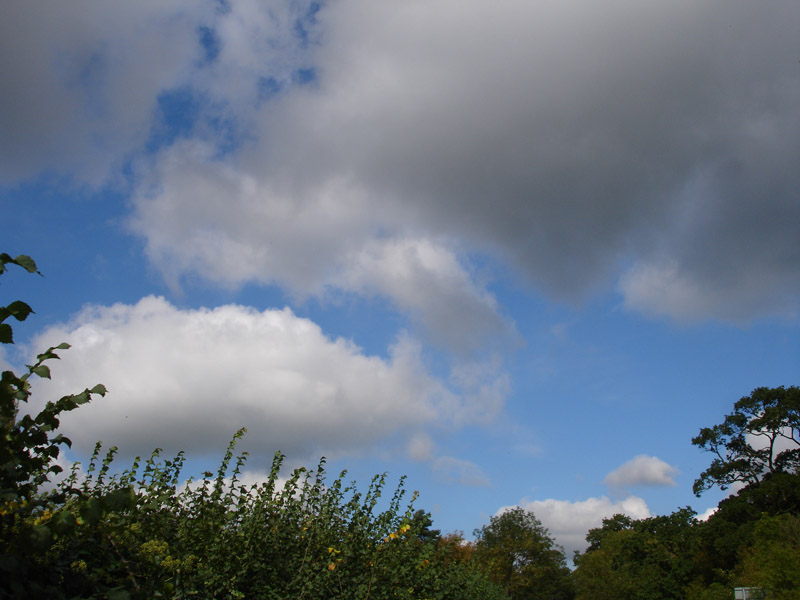
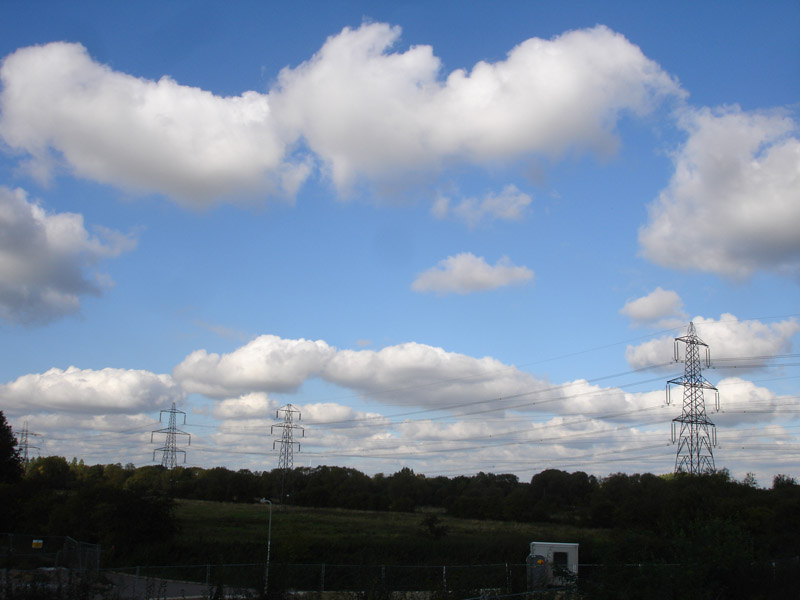
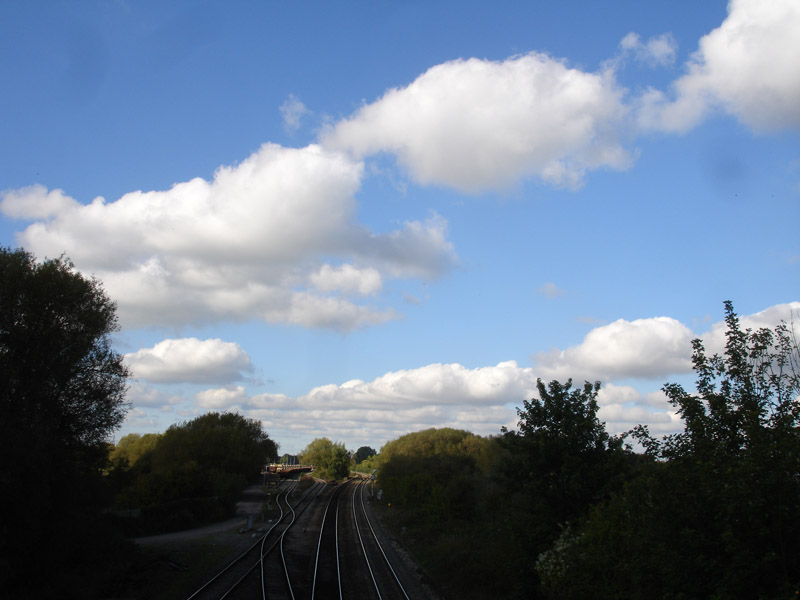
I’ve no idea of course what the clouds were like above the road that fateful day, but with the document I have recording the clouds on the voyage to Australia, the fairweather clouds above seemed ominous.

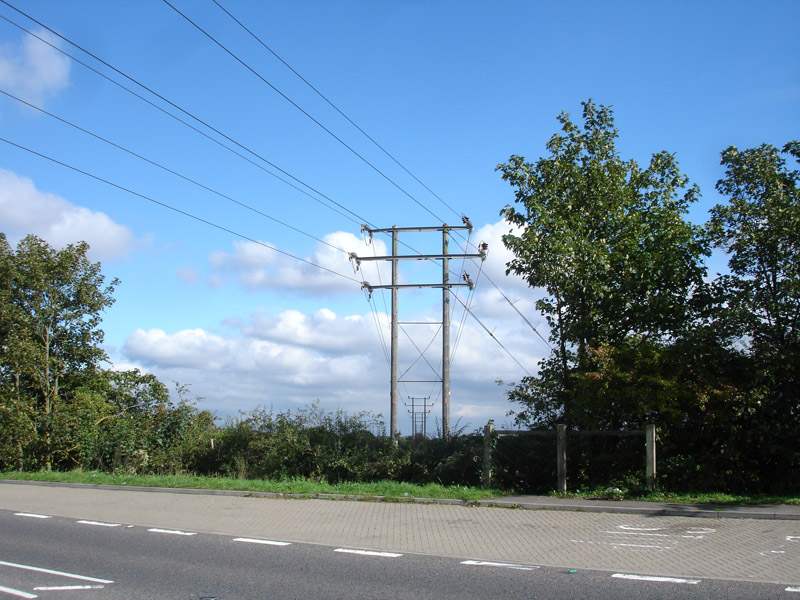
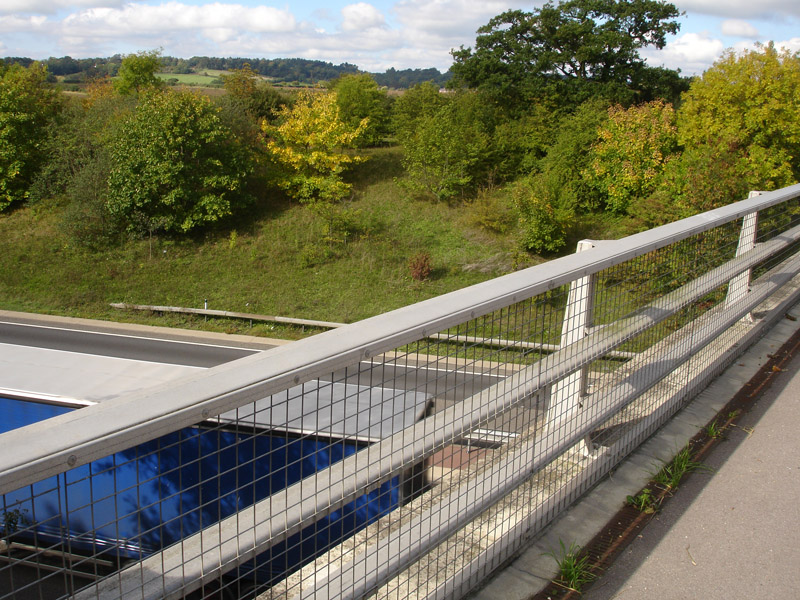
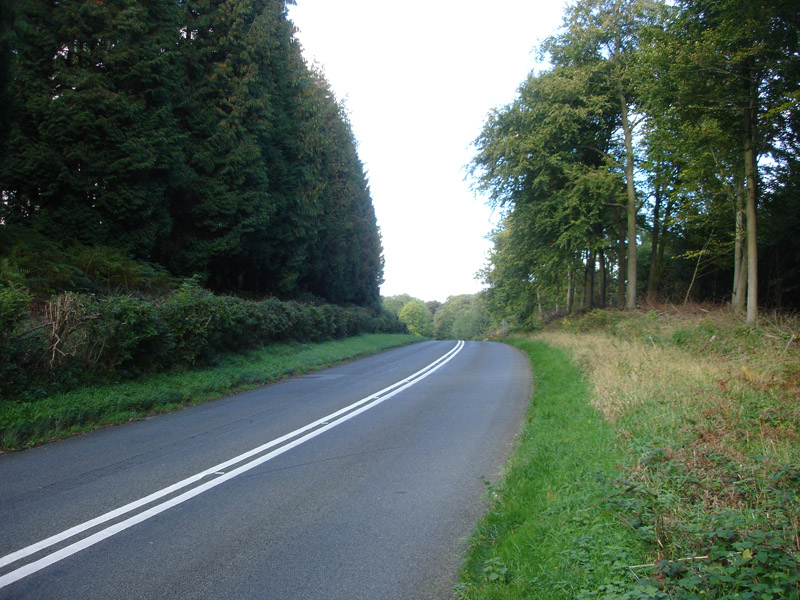
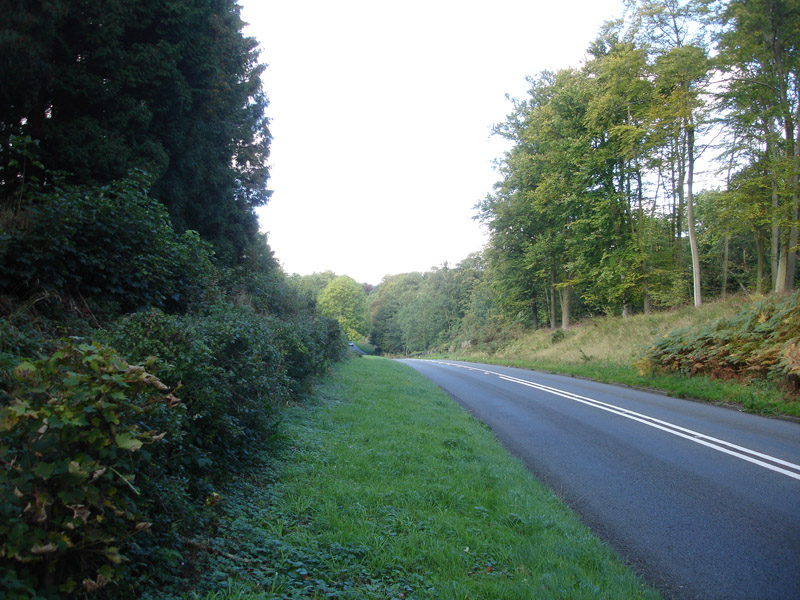
It wasn’t the safest walk I’ve ever done. Walking has long been forgotten here. But empathising with individuals long since lost to the past can only be done at that speed.

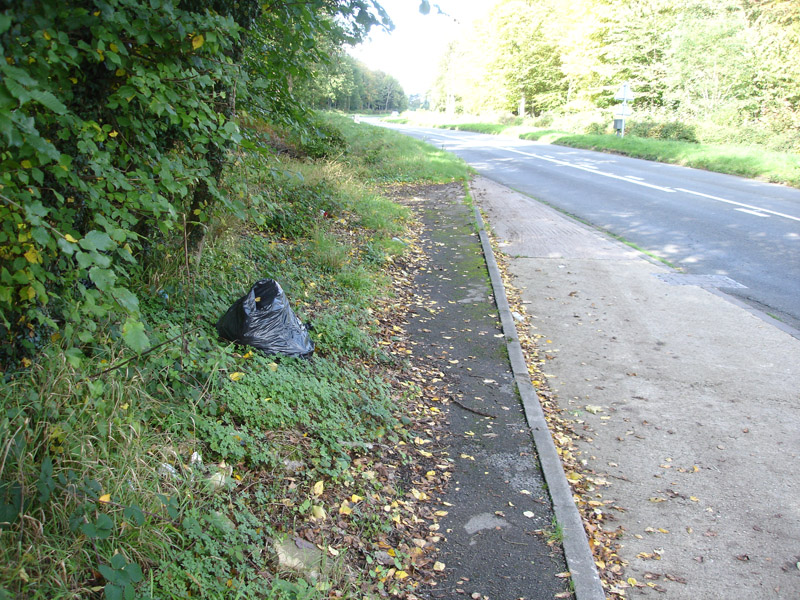
A bin bag. It reminded me of the heavy bag Burgess describes. Little did he know it was full of lead.

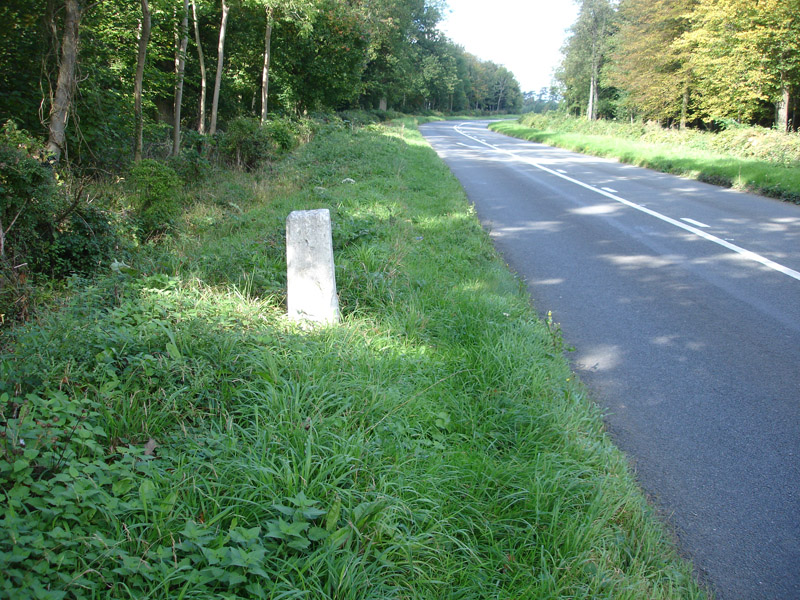
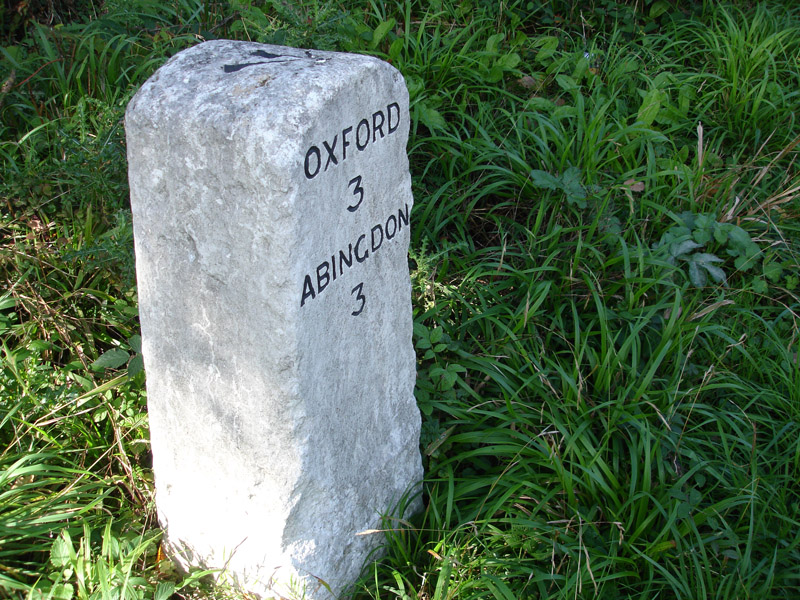
A milestone – one you can see if you’re going slowly enough.

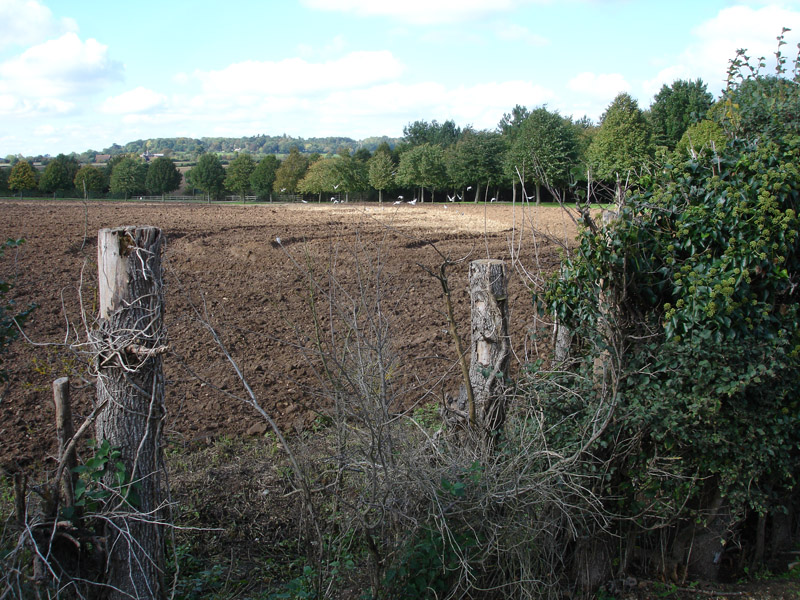
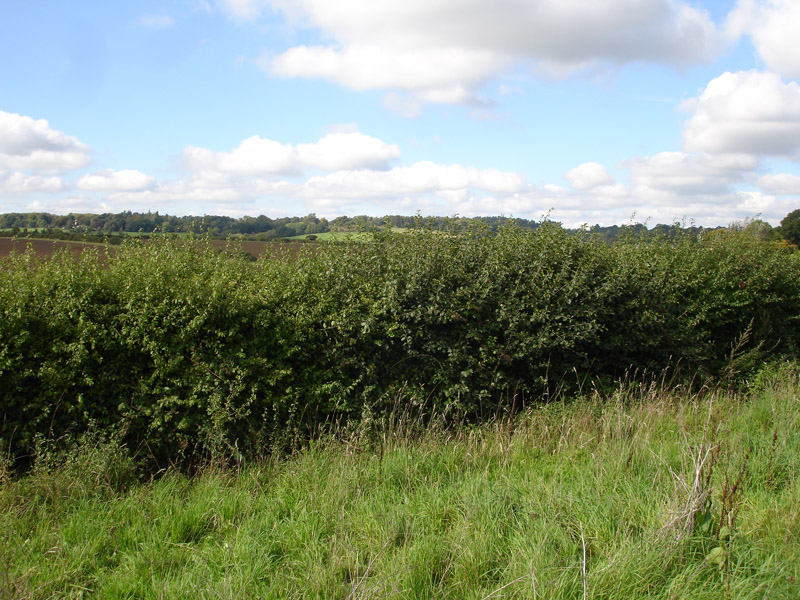
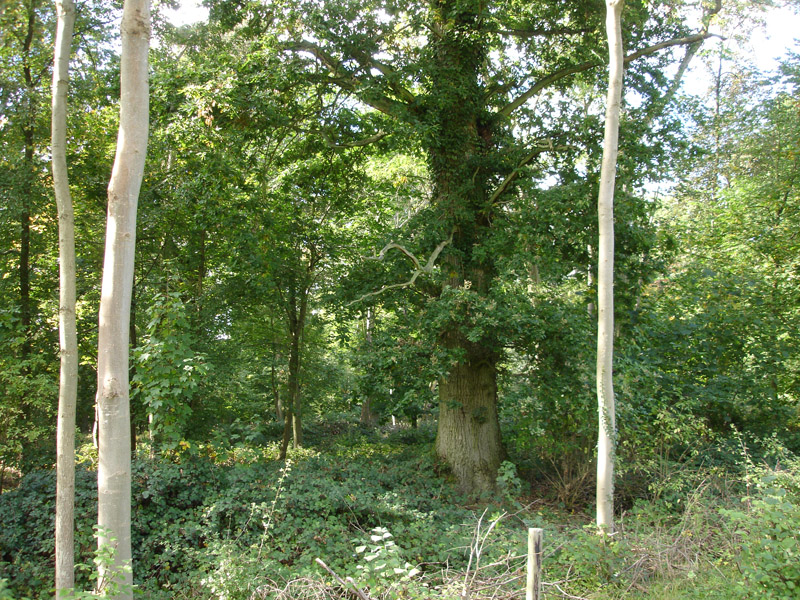
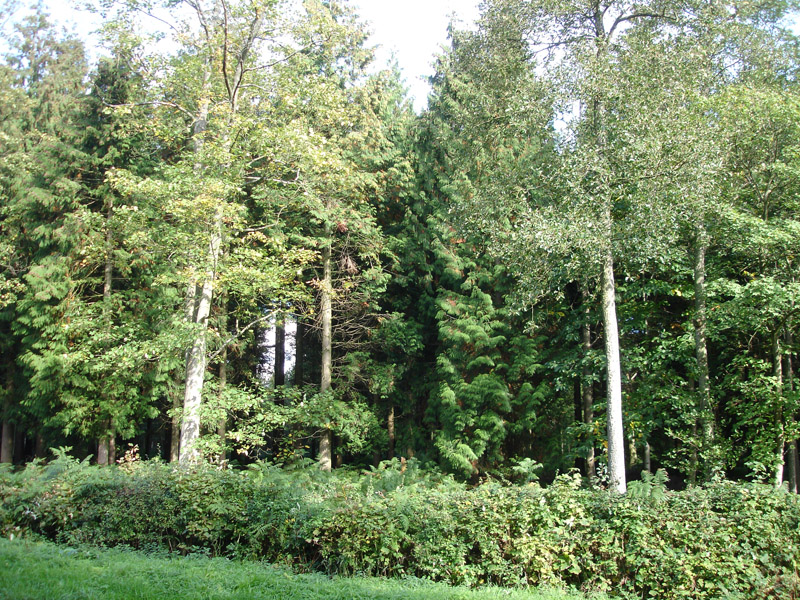
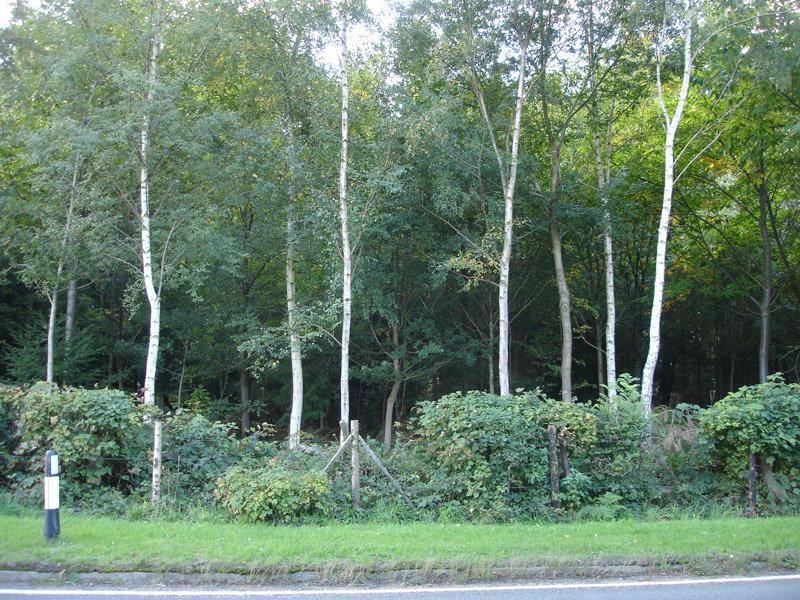
Bagley Wood. The same shape it seems as it was in 1828.

Filed Under: A Line Drawn in Water, Artist in Residence Tagged With: A Line Drawn In Water, Artist in Residence, Australia, Family Hedges, Family History, Hedges, Stephen Hedges

Lead Walk – Maps

October 4, 2010 by Nicholas Hedges

On the trail of my ancestor Stephen Hedges (my great, great, great, great uncle) I wanted to walk the route I think he would have travelled (along with Henry Stockwell, J Harper and the innocent Abingdon Sawyer, Richard Burgess) with the lead stolen from what was then Radley Hall or House. Below is a screenshot from Google Earth, showing the route as recorded on my GPS.

The following image is another screenshot from Google Earth, this time with a map of 1811 overlaid and the same GPS route placed over the top.

I was quite surprised how well they married up and below are the same two images combined. What is interesting is how the shape of Bagley Wood has hardly changed.

Filed Under: A Line Drawn in Water, Artist in Residence Tagged With: A Line Drawn In Water, Artist in Residence, Australia, Family Hedges, Family History, Hedges, Maps, Stephen Hedges

Mapping the Voyage of the Marquis of Hastings

October 4, 2010 by Nicholas Hedges

Below is a screenshot of a transcription I’ve made from the journal of William Rae, who served aboard the Marquis of Hastings in 1828 in the capacity of Surgeon. A PDF of the transcription is available here.

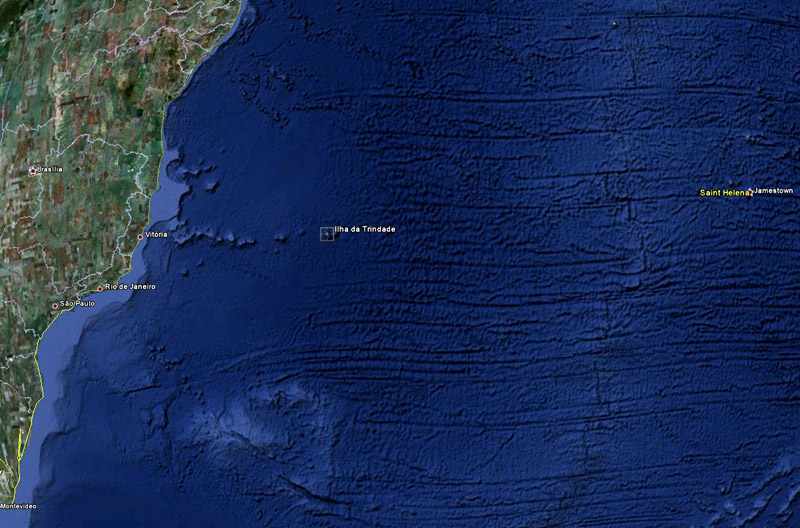
On August 16th, Rae states that the Island of Trinidad was in sight. But having looked at the route I’d plotted and then at the location of Trinidad I realised I must have made a mistake. However, on zooming in on Google Earth I found that the location plotted for that day was near the Trindade seachannel, and having searched for Trindade, discovered that on August 16th the ship was in fact in sight of Ilha de Trindade (see image below).

Filed Under: Artist in Residence Tagged With: A Line Drawn In Water, Artist in Residence, Australia, Family Hedges, Family History, Hedges, Maps, Stephen Hedges

Prison Hulk – York

October 3, 2010 by Nicholas Hedges

Following his conviction at the Berkshire Assizes on 15th April 1828, Stephen Hedges was sent to Portsmouth to serve time before his transportation on the prison hulk, York, pictured below.

This HMS York was the eighth ship to bear the name, and was a 74-gun third rate of 1,743 tons. Launched in 1807, she was posted to the West Indies where she was involved in the bold capture of the island stronghold of Martinique. She continued the war in the Mediterranean Squadron off Toulon and in 1819, returned to Portsmouth to serve as a prison hulk. She was broken up in 1854.

Having researched Hulks, I found the following on the Southern Life website:

“Embarking on board the hulks was a very demoralising affair; the convicts had to climb labourously up with their irons still on, stripped of their clothes, had buckets of cold water thrown over them; were issued with slops, saw their own clothes thrown overboard; were re-chained and then sent down into the lowest deck of the hulk – the darkest and most foul-smelling part of the ship.”

There’s something horribly poetic in the action of throwing the clothes overboard. Roland Barthes, in his book Camera Lucida, said that clothes made a second grave for the loved being. In this case, we could say the grave was that of a drowned man; one made before the man had actually died. Of course in many ways it really did symbolise their deaths.

For a ship with such an illustrious past, there is something pitiful about her condition in the picture above. De-masted and with her sails removed, she has instead the regulation clothes (?) of the inmates to catch the wind. She is very much the outward appearance of those locked away out of view.

Filed Under: A Line Drawn in Water, Artist in Residence Tagged With: A Line Drawn In Water, Artist in Residence, Australia, Family Hedges, Family History, Hedges, Stephen Hedges

The Voyage of The Marquis of Hastings

October 2, 2010 by Nicholas Hedges

After my research in the National Archives, I took the document I’d discovered (the Surgeon’s Journal from teh voyage of the Marquis of Hatings’ 1828 voyage) and plotted the longitude and latitude references into Google Earth. Given that these measurements were taken in 1828, I wasn’t sure what the results would be, but having entered them, I was pleased with what I ended up with.

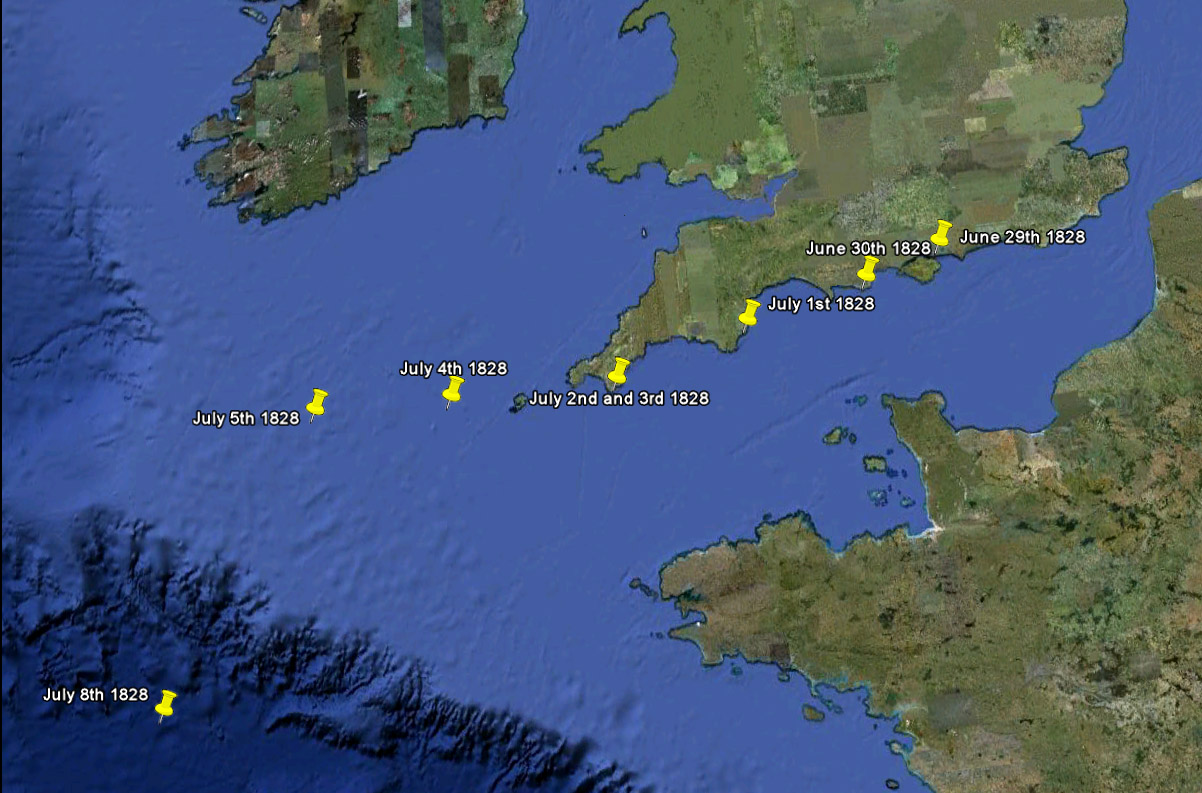
The voyage began on the 29th June 1828 in Portsmouth. The weather that day is described as ‘Dry, Cirrus, Cirrus Cumuli,’ and the temperature 74F. In reading these tiny details, the moment is straight away prised from the pages of history, as if a character from a fictional tale has, all of a sudden, become reality. They are small details but manage in their succinctness to paint a bigger picture.


Below is a screenshot from Google Earth showing the start of the voyage and the first 7 days of the journey.

One can only guess at what the prisoners must have felt leaving the country for what they surely knew would be the last time. Given the conditions some (including my ancestor, Stephen Hedges) had suffered on the prison hulks (the York in his case) it might have come as some relief that they were finally moving – not that the conditions would be be much of an improvement during the voyage.

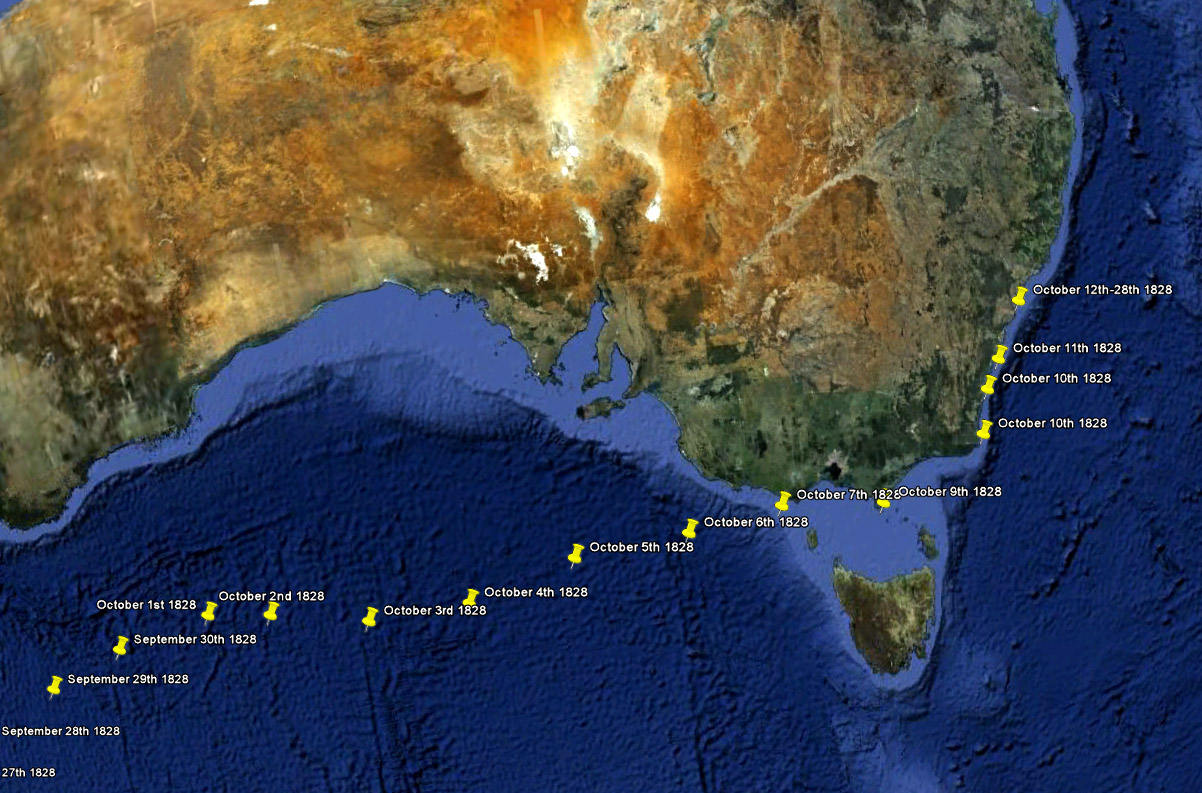
Below are screenshots showing the route of the ship, with each yellow pin representing one day of the voyage.

Having mapped the journey in this way, and having read the descriptions of weather and  temperature, the voyage and indeed the ordeal of my ancestor’s Transportation suddenly became more real. It was as if beforehand, the world of 1828 was purely a fiction, and that the names of the towns, islands and landmarks – Portsmouth, The Lizard, Tenerife and Sydney for example – just happened to have the same names as those – unconnected – places in the present day. Suddenly, the world of the past and the world of the present had collided.

The image below shows the last leg of the journey.

The last entry by William Rae (the ship’s surgeon) is dated the 28th October 1828 and reads: ‘nearing the same (Sydney Cove) since the 23rd. Prisoners disembarked.

Filed Under: A Line Drawn in Water, Artist in Residence Tagged With: A Line Drawn In Water, Artist in Residence, Australia, Family Hedges, Family History, Hedges, Stephen Hedges

The National Archives

October 1, 2010 by Nicholas Hedges

I’d never been to the National Archives and had only ever seen it on TV, on Who Do You Think You Are. As I approached the doors, I could almost hear Mark Strong (who narrates the progarmme) say, “Nick is going to the National Archives to find some information on….”

So what information was I looking for? Well, I wanted to find something on the voyage of the Marquis of Hastings, the convict ship which took Stephen Hedges and 177 other felons to Australia in 1828. Having gone through all the first time procedures and having obatined my Reader’s Ticket, I consulted the catalogue and found two documents.

 
I only had time to look at one which was the Surgeon’s Journal (above) written during the voyage by William Rae. This sounded particularly helpful, and although my ancestor wasn’t one of the patients (fortunately for him of course), the document gives a great insight into the prisoners and their health – not least the conditions they must have endured.

Furthermore, the document contains a daily list of longitiude and latitude, wind direction and weather conditions which, for me, is just the sort of thing I wanted to know from an artistic point of view – especially as regards the weather and cloud formations.

I will transcribe some in due course and return to the Archives soon to look at the other documents.

Filed Under: A Line Drawn in Water, Artist in Residence Tagged With: A Line Drawn In Water, Artist in Residence, Australia, Family Hedges, Family History, Hedges, National Archives, Stephen Hedges

Convict Trail III

September 26, 2010 by Nicholas Hedges

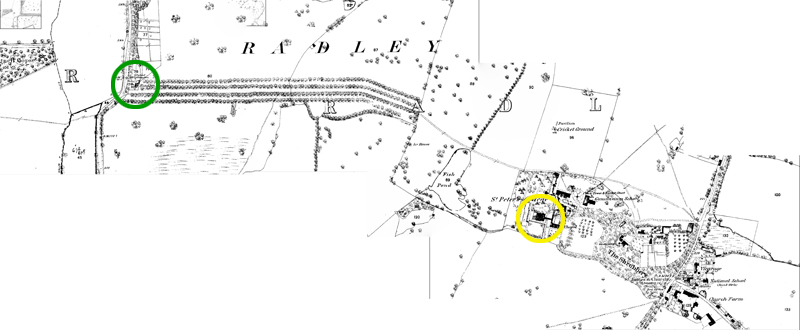
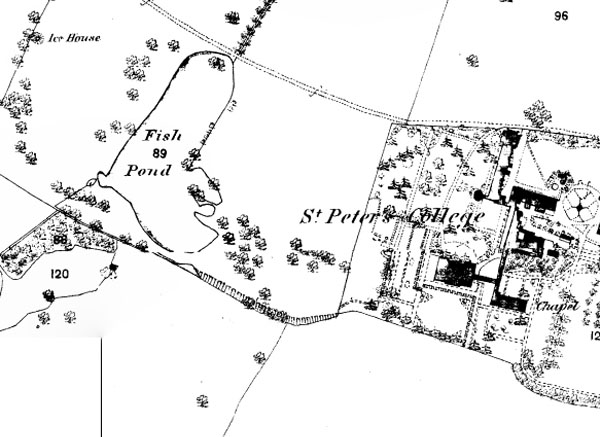
Having written to Radley College about my project, I received some very helpful information for which I’m very grateful. I was interested to know the location of Sir G.Bowyer’s lodge, next to which Richard Burgess was asked to stop by Stephen Hedges and his co-conspirators. Below is a map from 1875 showing St. Peter’s College, of which Radley Hall or House is a part. The house is circled in yellow. To the far left, is the lodge circled in green, at the end of a drive which leads out to the Oxford Road.

Below are two details taken from the map; first the lodge…

and then the house…

I think therefore we can assume that Richard Burgess was taking the route I suggested from Abingdon to Oxford. He stopped outside the Lodge whereupon Stephen Hedges, Stockwell and Harper left him to steal the lead from the ‘larder.’ The location of the larder is perhaps a little more difficult to ascertain. Benjamin Kent, who was renting the property from Sir George Bowyer, stated that the larder was about 100 yards from the ‘office’. In the painting of Radley Hall below, made by Turner in 1789 when he was just 14 years old, there is a collection a outbuildings on the left hand side, near to which, perhaps, the larder stood. Having stopped at the Lodge, Hedges and his accomplices left with a bag and returned five minutes later with the lead. If the larder was near the house, they must have worked very quickly to get to the larder, strip the roof, and return to the cart, suggesting perhaps they were well practiced in their ‘art’.

Filed Under: A Line Drawn in Water, Artist in Residence Tagged With: A Line Drawn In Water, Artist in Residence, Australia, Family Hedges, Family History, Hedges, Maps, Stephen Hedges

Convict Trail II

September 24, 2010 by Nicholas Hedges

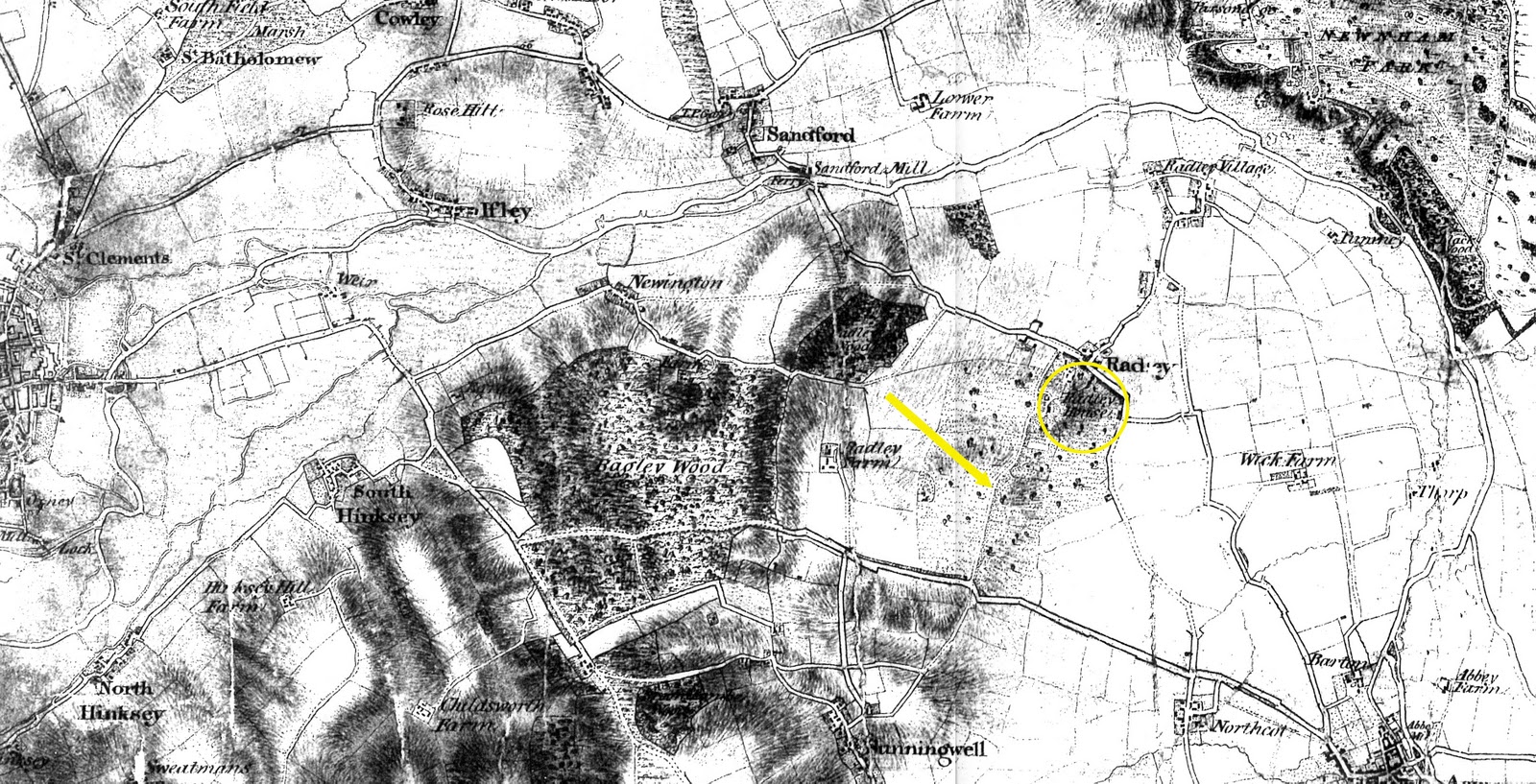
This afternoon I visited the library and found a map of Radley and its surrounds dating from 1811; 17 years before Stephen Hedges stole the lead from Radley Hall. On the map, Radley Hall (or House) is shown, along with a road – or drive – leading up, which, I think, corresponds to the satellite view I posted previously.

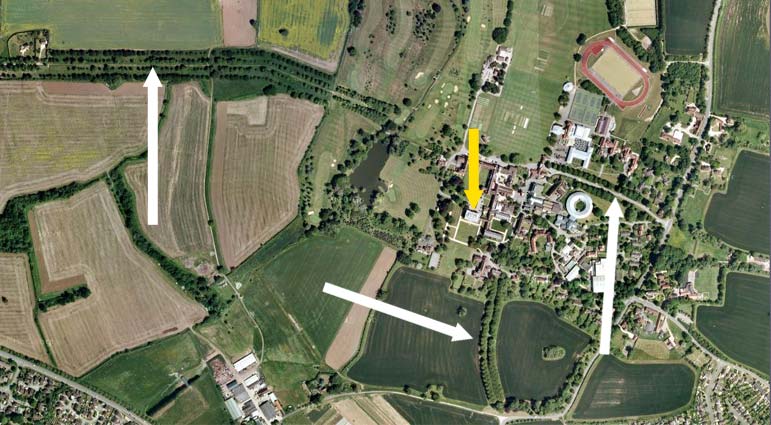
First the satellite view again:

And next, the 1811 map:

This map is aligned a little differently, but Radley Hall is circled in yellow and the drive indicated by the yellow arrow corresponds to that shown by the white arrow on the left hand side in the picture above. I’m not sure if the Lodge was located here, but the drive extends from the Oxford Road and would (I assume) have been the route taken by Richard Burgess on his way from Abingdon to Oxford. A little more research will be needed.

Having stolen the lead, I again assume that they would have travelled into the city via the Oxford Road through Bagley Wood, down Hinksey Hill and up the Abingdon Road. Once in the city, they made their way to the castle precincts and turned back up Butcher Row (modern day Queen Street) as indicated by the newspaper report. Of course I cannot be sure that this is how they travelled, but it seems much more likely compared with what I’d thought earlier.

Filed Under: A Line Drawn in Water, Artist in Residence Tagged With: A Line Drawn In Water, Artist in Residence, Australia, Family Hedges, Family History, Hedges, Maps, Stephen Hedges

Convict Trail

September 24, 2010 by Nicholas Hedges

Prior to my residency in Australia, I want to trace – as far as I can – the route my ancestor, Stephen Hedges, took with the lead stolen from Radley Hall. Radley Hall is now part of Radley College and in the newspaper article regarding the trial, the name of Sir G.Bowyer is given as the proprieter. Having Googled him, I was led to Wikipedia, where I discovered that he – George – was a Baronet and MP for Abingdon. In 1815, financial difficulties forced him to sell the contents of Radley Hall and by 1828, the house was being rented to Mr. Benjamin Kent. The article states that Richard Burgess – a sawyer – who was on his way from Abingdon to Oxford with a cart, met the defendents – Stockwell, Hedges and Harper – who asked if he could carry a parcel for them. He was asked to stop later on next to ‘Sir G. Bowyer’s Lodge’, after which the defendents went into a ‘plantation’ and returned with a heavy bag (full of lead).

Discovering the location of the Lodge will be important in helping me establish the route taken and looking at Google Maps, I have spotted a couple of possible locations for the old driveway. On the map below, the 18th century mansion is indicated with a yellow arrow, and the possible driveways with white arrows.

To be sure, I’ll need to try and find a map of the area as near to 1828 as I can, which means a trip to the library.

Filed Under: A Line Drawn in Water, Artist in Residence Tagged With: A Line Drawn In Water, Artist in Residence, Australia, Family Hedges, Family History, Hedges, Maps, Stephen Hedges

  • « Previous Page
  • 1
  • 2

© Nicholas Hedges 2024

  • Facebook
  • Instagram
  • Twitter
  • YouTube

Copyright © 2025 · Outreach Pro on Genesis Framework · WordPress · Log in