Nicholas Hedges

Art, Writing and Research

  • Amazon
  • Behance
  • Facebook
  • Instagram
  • Pinterest
  • YouTube
  • Art
    • Digital
    • Drawing
    • Grids
      • Correspondence
      • The Wall
      • The Tourist
    • Ink on paper
      • Shadow Calligraphy
    • Installation
      • Murder
      • Echo
    • Painting
    • Patterns
    • Mixed Media
    • Photographic installation
      • St. Giles Fair 1908
      • Cornmarket 1907
      • Headington Hill 1903
      • Queen Street 1897
    • Research/Sketches
    • Stitched Work
      • Missded 1
      • Missded 2
      • Missded 3
      • Missded 4
    • Text Work
  • Blogs
    • Family History
    • Goethean Observations
    • Grief
    • Light Slowed But Never Stilled
    • Lists
    • Present Empathy
    • Shadow Calligraphy
    • Trees
    • Time
    • Walking Meditations
  • Video
  • Photography
    • Pillars of Snow
    • Creatures
    • The Trees
    • Snow
    • St. Giles Fair 1908
    • Cornmarket 1907
    • Headington Hill 1903
    • Queen Street 1897
    • Travel
  • Illustration and Design
  • Music
  • Projects
    • Dissonance and Rhyme
    • Design for an Heirloom
    • Backdrops
    • Shadow Calligraphy
  • Exhibitions
    • A Line Drawn in Water
      • Artwork
    • A Line Drawn in Water (Blog)
    • Mine the Mountain 3
      • Artwork
    • Mine the Mountain 2
      • Artwork
      • The Wall
    • The Woods, Breathing
      • Artwork
    • Snow
      • Artwork
    • Echo
      • Artwork
    • Murder
      • Artwork
    • The Tourist
    • Dreamcatcher
    • Mine the Mountain
      • Artwork
      • The Tourist
    • M8
    • The Gate
    • Creatures
      • Artwork
    • Residue
      • Artwork
    • A visit to Auschwitz
      • Artwork
  • Me
    • Artist’s Statement

X, III

January 8, 2009 by Nicholas Hedges

Whilst looking at some more Trench Maps of the area in which my great-great-uncle was killed, I was reminded of an idea I had for some paintings which I had made notes on in my sketchbook. The image below is taken from my notebook and shows a quick sketch of an aerial view of the area with hundreds of Xs marking places where men fell and lay undiscovered. It follows on from some work I did for my Mine the Mountain exhibition in October 2008.


The next image is taken from a trench map dated to March 1918.

There is no legend as to what these Xs mean, but given what I wrote in my notebook, I couldn’t help but see them as anonymous graves. The word ‘secret’ at the top of the map enhanced that idea.
Filed Under: World War I Tagged With: A Line Drawn In Water, Jonah Rogers, Mine the Mountain, Trench Maps, X

Connections

August 7, 2008 by Nicholas Hedges

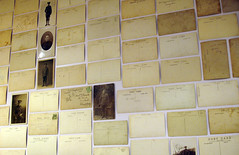
This evening I began working on an idea I’ve had for a while which incorporates the World War 1 postcards I was given by Tom Phillips. The idea was to show these postcards on a wall but with only a few the right way round i.e. showing the portrait (they are all portrait postcards of soldiers, most individual, some with other people). The rest would be displayed reversed showing either writing or, as is mostly the case, nothing – they would just be blank. I wasn’t sure how this would look and so I began putting the postcards up on my bedroom wall and fairly quickly I could see that the postcards, displayed in this way had an impact.

Very Lights

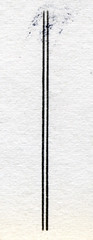
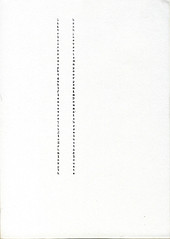
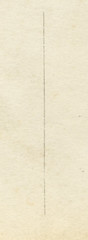
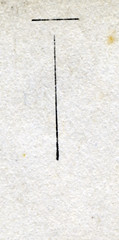
There was something about the blank postcards which was particularly resonant and the more I looked, the more I could see what it was that leant them this quality. On most of the blank postcards there is a motif running down the centre of the card (dividing the address from the text). These lines are of various designs, some very simple, others more elaborate. I decided to scan a few which can be found below.

Reverse Motif

Reverse Motif

Reverse Motif

For me these motifs have something of the grave about them, perhaps because they are each shaped a little like a crucifix, and they reminded me of some of the memorials I had seen in the Montparnasse Cemetery in Paris.

Paris

And as I started making connections, I thought of the X paintings and those I discussed in a previous entry – Black Mirrors and thought about how these marks could be incorporated into a work just like the symbol of the ‘X’.
X (Mine)

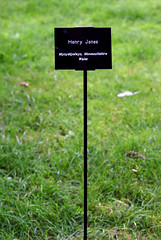
I also thought how these various motifs/symbols resembled the botanic labels I’ve had made, each engraved with the name of one of my ancestors such as that of Henry Jones (below).

Deadman's Walk (Henry Jones)

And finally, one last connection between the motifs and a work I made in November 2006, soon after a visit made to Auschwitz-Birkenau.

Reverse Motif

7

Reverse Motif

Filed Under: Holocaust Tagged With: Cemetery, Connections, Holocaust, World War I, WWI, WWI Postcards, WWI Postcards, WWII, X

X (Mine)

August 7, 2008 by Nicholas Hedges

I have completed a painting (oil and graphite on canvas, 120cm x 80cm) entitled ‘X (Mine)’ inspired by what I have discussed in previous posts and the profession of my Welsh ancestors; my great, great-great and great-great-great-grandfathers, namely, mining. Below are a couple of images of the work.

X (Mine)

X (Mine)

What interests me about these works is the fact that they are reflective surfaces and as such one can see a version of oneself (albeit shadowed and indistinct) in the painting itself. This is particularly interesting for me in relation to what I wrote yesterday about Black Mirrors.

Filed Under: Uncategorized Tagged With: Mine, Mine the Mountain, X

Kisses

July 31, 2008 by Nicholas Hedges

Following on from my previous two entries regarding ‘Xs‘ (the signature of the illiterate, a secret location marked on a map), I wanted to look briefly at another use of the mark, that of course being the kiss. I was prompted to do this whilst selecting a number of World War One postcards for a new project website; www.8may.org – a project I hope to carry out next year. Most of the postcards are blank, but on a few there is some writing; the scrawl of a soldier or a more recent label, ‘Mum’s uncle.’ for example. One particular card however took my interest for it contained the mark I had recently been applying to my paintings. In my most recent versions of the ‘X’ paintings (those which have been obliterated by graphite powder) I have been scratching the symbol into the dust whilst considering the many anonymous miners who lost their lives deep underground at the time my great, great-great and great-great-great grandfathers were working in the pits of South Wales.

As I’ve written before, Rainer Maria Rilke wrote that those who die leave their names behind as a child leaves off playing with a broken toy. Those who died in the mines left their names underground; most would not have known how to write them, doing instead what my ancestors did and marking documents only with an ‘X’. And many of those men from the 19th century have all but been forgotten, their names discarded, swept away like Rilke’s broken toys. Even their graves might be lost, their remains buried and marked with an ‘X’, secrets known only by the earth itself.

X - Kisses

The Xs on the postcard above are also marks of anonymity. We know they are kisses but we don’t know who they’re for or who gave them. But we know they are symbols of a relationship which once existed, whether between lovers, friends or relations; someone loved someone else. Many of those who fought in the Great War never returned home – all that did return were a few words on a postcard; and ‘Xs‘ – farewell kisses as they came to be. Hundreds of thousands of men not only lost their lives, but they have no known grave. Many too lost their names altogether. These Xs on the postcard therefore become symbols for their future anonymity, their unknown graves; their lost names.

And the Xs which I’ve scratched into dust on my paintings also become a kind of farewell; a broken name, a secret location in time. They also become a farewell kiss to the world.

Filed Under: World War I Tagged With: Rilke, World War I, WWI, WWI Postcards, WWI Postcards, X

X, II

July 25, 2008 by Nicholas Hedges

Having worked some more on what I have come to call my ‘X’ paintings, I realised there was something interesting in the contrast between the rough, physical paintwork, and the crosses marked on the canvas in pencil, which appear almost spoken by comparison. Perhaps this contrast was all the more appreciable after what I’d written earlier in the day regarding the suicide of my great-great-grandfather.

X, II

The crosses, barely distinguishable in the scraped and painterly landscape call to mind how nature can overwhelm us; not only in its beauty and its tempests, but in its age, which, in many respects, is as much a storm as any hurricane. At the moment of death, the world ceases to exist, as if all the storms of a lifetime are condensed into a dying breath. In this reversed storm, the living stand outside in the eye, whilst the dead are collapsed like shacks; stars imploding at the centre of the universe. And the ‘X’ becomes a marker on the landscape, of what was once but is no more; an absence marked by a presence.

How does a man who cannot write his name, leave his farewells as he contemplates the taking of his own life? The repeated mark-making of Xs on the canvas call to mind my drawings of Auschwitz-Birkenau. There, having considered my own non-existence (death), I was through the act of drawing confirming my life and my existence. I was also, through the rapidity of the drawing, trying to capture the present – the moment; the gap between the past and the future, the interval of the shutter’s release.

The Xs on the canvas therefore are in some ways like these drawings; they are confirmations of existence, not of many people, but of one person.

Recalling how these paintings began, as images concerned with Jonah Rogers, my great-great-uncle, I looked again at the landscape which inspired them – or at least the photographs of this landscape.

Hafodyrynys and Surrounds

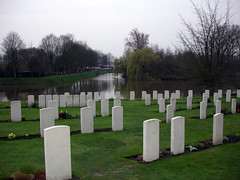
Jonah Rogers was killed in the Second Battle of Ypres, and the white of the buildings amongst the vivid green of the landscape called to mind the white gravestones of military cemeteries.

Ieper

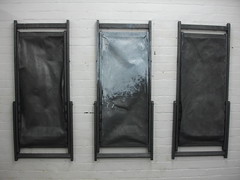
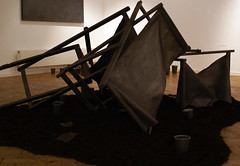
They also reminded me of another project on which I am working: Deckchairs, and it is with deckchairs that I am turning to again a regards my painting of this subject, using them as canvases. Having placed them on the wall of my studio, the effect they had was strong. They seem to become instant memorials, their shape and their very essence denoting the human, or in this instance, presence through absence.

X, II and Deckchairs

Filed Under: Holocaust Tagged With: Deckchairs, Family History, Family Jones, Hafodyrynys, Holocaust, Jonah Rogers, Jones, WWII, X, Ypres

X

June 30, 2008 by Nicholas Hedges

It was whilst I was cycling home from the studio this morning that the idea first came to me. I was thinking about the two paintings on which I am currently working, both of which are based on the landscape around Hafodyrynys, Wales (the village in which my Grandmother grew up) and one of which I intend to show, veiled, at the Mine the Mountain exhibition in October.
The paintings themselves were going quite well, but remembering the original idea behind them, I realised that there was something missing. The original idea was that these paintings, or rather the final selected painting would be based on both the death of my great-great-uncle, Jonah Rogers who was killed in action in the Second Battle of Ypres on May 8th 1915 and my birthday, May 8th 1971. The title of the piece was provisionally May 8th, but as is often the case, the painting has led me away from this. That isn’t to say the subject has been lost completely; I still want to think about Jonah, but how do I show him in the painting? How do I show the ambiguity between existence and nonexistence/death?
The answer came as I thought about names and some of the documents I have obtained through researching my family tree. Almost without exception, none of my ancestors from Wales at this time could read or write and all of them signed their name (or rather, indicated their presence) with an ‘x’. The ‘x’ therefore becomes a sign of a presence, but one which is anonymous.

Of course the ‘x’ is usually accompanied by the line; ‘the mark of…’ (as above) but without that, the human becomes relegated to this nondescript, anonymous sign (one could argue of course that we are all, in our names, reduced to signs, but the ability to write allows us to transfer to the page – and therefore leave to posterity – much more than just the name by which we are known). The act of making that mark instead of writing one’s name is also very significant. It levels all those who make it; it renders everyone the same – at least in the eyes of history. One could say that the greatest leveller of all is death and that the ‘x’ becomes the mark of death; presence is defined by absence.

We know much of what happened in the past through the written word although there are of course many other sources in which it’s also revealed; paintings, artworks, newspaper stories, oral histories/stories, fingerprints, photographs and so on, but for the most part, we know about the past through what we read. I have written about the limits of the written word before in relation to the work I did on ‘The Gate’, but looking at it again in relation to these paintings and to my previous work/research, there is something very poignant about these anonymous signatures; I can’t help but think of the names we see on memorials, carved into walls and so on. Imagine if they simply read ‘x’… For many who died in the Great War and whose bodies were either never found, names have been lost and an ‘x’ is perhaps all one could write on their behalf.

In relation to the landscape, ‘x’ has different connotations; on maps it marks a spot – it denotes the presence of something, a thing which is present and yet absent – hidden away from sight and mind like buried treasure. Marking the canvas with an ‘x’ would give the painting the meaning I was looking for; the presence of someone absent; the reduction of everyone in time to complete obscurity. Furthermore, taking what I wrote in the paragraph above, ‘x’ marks the last resting place of all those (including my great-great-uncle) whose bodies were never found.

X

The paintings are still in the early stages but there was instantly something about the marks which appealed. In some respects I saw them (those in the sky) as angels which given the nature of the work seemed relevant. They also reminded me of the stars one sometimes finds painted on the ceilings of cathedrals or in mediaeval manuscripts. But those ‘on the ground’ called to mind something else, something which given Jonah Rogers’ fate gave the paintings another dimension; first the shape reminded me of the deckchairs I made for the Residue exhibition (The Smell of an English Summer 1916 (Fresh Cut Grass))..

The Smell of an English Summer 1916 (Fresh Cut Grass)

…and secondly, the x-shape defences one sees on wartime photographs such as those of the Normandy landings below…

Filed Under: Artist in Residence Tagged With: Artist in Residence, Hafodyrynys, Mine the Mountain, Residue, World War I, WWI, X

Henry Jones’ First Wife

June 17, 2008 by Nicholas Hedges

I have been looking to find the first wife of Henry Jones for a while now having got it wrong first time round, albeit getting her first name right. I had – for reasons I cannot recall – listed her as being Mary Carey, but have since discounted that having found no matching record for their marriage.
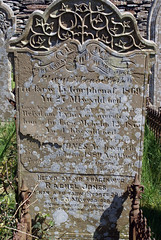
In May, we visited the graveyard in Cefn-y-Crib which some of my Welsh ancestors are buried, and there found the grave of Henry Jones, which we could see was also the grave of his second wife Rachel and his first wife Mary and daughter Lydia.

Hafodyrynys and Surrounds

The gravestone was a little damaged and the name of his first wife a little bit obscured, but one could nevertheless make out the name, Mari – the Welsh spelling of Mary. But what was her surname?
Having searched through the marriage indexes I came across a few possibilities that fitted in with the dates they would have been wed; Mary Lewis (1859), Mary Harris (1860) and Mary Issacs (1860). The last of these names rang a bell, and when I looked at the certificate for Henry’s marriage to his second wife Rachel, I saw the name Anne Isaac as being one of the witnesses.

Edmund Jones, the other witness, was the father of Rachel Jones (Jones was also her maiden name) and so I can only assume that both Henry’s parents were dead at the time. Of course, Isaac is not Isaacs but then spelling mistakes were made. Furthermore, when searching for Mary Issacs’ birth, I found only a few, all of whom would have been too young to have married Henry in 1860. Could the name have been wrong on the marriage index? Should it have been Isaac?

We know that she died in 1869 at the age of 27 and having searched for Mary Isaac in the birth records I found one Mary Isaac, born in the Pontypool district in 1843. But what of the other contenders; Mary Lewis and Mary Harris? There were a number of Mary Lewises born in 1842 (which one assumes is the correct year of birth), as indeed there were a number of Mary Harrises also born in 1842.

Filed Under: Family History Tagged With: Family History, Family Jones, Hafodyrynys, Jones, X

© Nicholas Hedges 2024

  • Facebook
  • Instagram
  • Twitter
  • YouTube

Copyright © 2025 · Outreach Pro on Genesis Framework · WordPress · Log in