Nicholas Hedges

Art, Writing and Research

  • Amazon
  • Behance
  • Facebook
  • Instagram
  • Pinterest
  • YouTube
  • Art
    • Digital
    • Drawing
    • Grids
      • Correspondence
      • The Wall
      • The Tourist
    • Ink on paper
      • Shadow Calligraphy
    • Installation
      • Murder
      • Echo
    • Painting
    • Patterns
    • Mixed Media
    • Photographic installation
      • St. Giles Fair 1908
      • Cornmarket 1907
      • Headington Hill 1903
      • Queen Street 1897
    • Research/Sketches
    • Stitched Work
      • Missded 1
      • Missded 2
      • Missded 3
      • Missded 4
    • Text Work
  • Blogs
    • Family History
    • Goethean Observations
    • Grief
    • Light Slowed But Never Stilled
    • Lists
    • Present Empathy
    • Shadow Calligraphy
    • Trees
    • Time
    • Walking Meditations
  • Video
  • Photography
    • Pillars of Snow
    • Creatures
    • The Trees
    • Snow
    • St. Giles Fair 1908
    • Cornmarket 1907
    • Headington Hill 1903
    • Queen Street 1897
    • Travel
  • Illustration and Design
  • Music
  • Projects
    • Dissonance and Rhyme
    • Design for an Heirloom
    • Backdrops
    • Shadow Calligraphy
  • Exhibitions
    • A Line Drawn in Water
      • Artwork
    • A Line Drawn in Water (Blog)
    • Mine the Mountain 3
      • Artwork
    • Mine the Mountain 2
      • Artwork
      • The Wall
    • The Woods, Breathing
      • Artwork
    • Snow
      • Artwork
    • Echo
      • Artwork
    • Murder
      • Artwork
    • The Tourist
    • Dreamcatcher
    • Mine the Mountain
      • Artwork
      • The Tourist
    • M8
    • The Gate
    • Creatures
      • Artwork
    • Residue
      • Artwork
    • A visit to Auschwitz
      • Artwork
  • Me
    • Artist’s Statement

Dreamcatcher

November 14, 2007 by Nicholas Hedges

In March 2008, Brookes will be showing a select number of works at MAO (Modern Art Oxford) and so I have decided to submit two proposals, one of which is entitled ‘Dreamcatcher’. The following extracts are taken from that proposal, the first section being ‘about me’ and the second ‘about the work’.

“As an artist, my main areas of interest are time, memory and remembering, with a particular emphasis on postmemory and its formation within the individual consciousness. Examining past events such as World War 1 and the Holocaust, my work seeks to explore how we formulate memories of times when we were not born, or of events to which we were not witness. What strategies do we employ in reconstructing the past? Contemporaneous objects, documents, photographs, verbal and written testimonies/narratives can all be used by the imagination to create postmemories, but what role do they play in the present-day, real-time, world?”

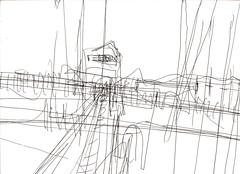
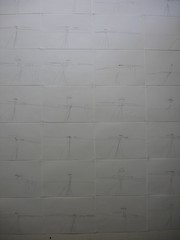
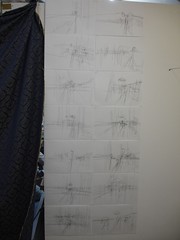
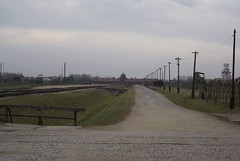
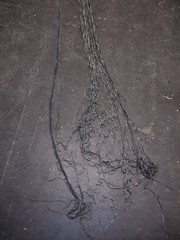
“An installation comprising a single room, all four walls of which are wallpapered with hundreds of drawings (see attached images for completed examples). These are drawings of the gate-tower at Auschwitz-Birkenau as remembered by myself following my visit there in October 2006. In the centre of the room, a net is suspended from the ceiling, created from hundreds of pieces of black string knotted together; a physical version of all the drawings, as if they were shown on a single piece of paper, and as if the ink had been turned into string.

The drawings themselves could be said to represent a last, snatched glance at the gate-tower of Birkenau and their number a testament to the number of people who died there. It could also be said to reveal my own incomprehension of standing in a place where over a million people died (a conflict between memory and postmemory), each death a piece of string – the thread of life drawn, measured and cut, as according to Greek Mythology – and tied to make the Dreamcatcher. Dreamcatchers are said to let good dreams through and ensnare nightmares, and for all the victims, Auschwitz-Birkenau was exactly that – a catastrophic nightmare.”

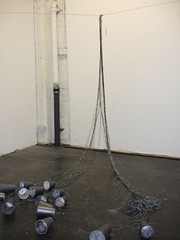
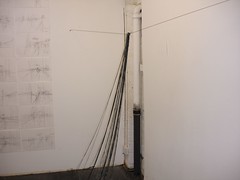
Today I started to create a prototype net at my studio and like all these things, it proved quite different in the way it began to develop off the page. Firstly, I tied a piece of string across my space about 7 feet off the ground and then attached vertical pieces which extended down to the floor. Almost straight away, I found myself thinking of a gallows.
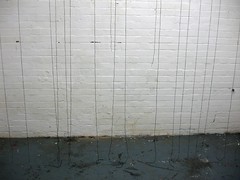
Dreamcatcher (work in progress)

When it came to tying the horizontal strings, I used the pile of cut strings which proved rather difficult to use, but I used them nevertheless, and the action of tying, again proved interesting albeit for very different reasons than before. Each knot felt just like an act of remembrance. It was a positive act rather than a negative one.

Having completed a number of the horizontal strings, a colleague in the studio told me that she thought it looked like a musical score of some kind. I was thinking that it looked like writing; but this idea of it being musical was interesting.
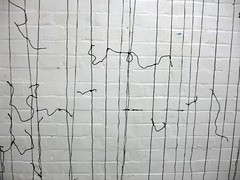
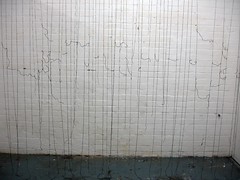
Dreamcatcher (work in progress)

Dreamcatcher (work in progress)

Filed Under: Holocaust Tagged With: Dreamcatcher, Holocaust, String, WWII

Colour

November 12, 2007 by Nicholas Hedges

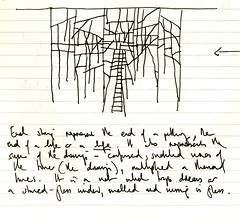
Each string (in what I have so far called the ‘net’) represents in its ‘cut end’ the end of a path, the end of a life. Each string also represents a life entire as measured by the three fates. Furthermore they could be said, as a group to represent the combination of paths which, at a specific moment in time created one of the many terrible moments of the Holocaust. Also, the image of the whole represents the sum of the snatched visions of the tower at Birkenau (the drawings).

Of the physical appearance of the net, the following quote from Fernando Pessoa’s ‘The Book of Disquiet’ is very pertinent:

“I also have my crochet,
It dates from when I began to think,
Stitch on stitch forming a whole without a whole,
A cloth, and I don’t know if it’s for a garment or for nothing,
A soul, and I don’t know if it’s for feeling or living.”

The image of the net looks like a ‘dream-catcher’ and in many ways that works in respect of this theme; dreams which many would have had of going back home, trapped in its strings. (There is also the idea of the writes of the telegraph poles carrying messages out of the camp and across Europe).

I was also thinking today about work by two of my colleagues which was very much to do with colour. This made me look at my own work (which is anything but colourful) and the subsequent contrast interested me. It reminded me of a television programme I watched last night about the photographer Albert-Kahn who documented the First World War in colour photographs. When we think of the past, in terms of the war, pre-war and Victorian periods, we think of it in terms of black and white. When we see colour photographs of the First World War they seem to validate reality – the very fact of time before we were born.

In my work there is no colour as such, but it is there, just as colour is there in Black and White photographs.

12-11-07
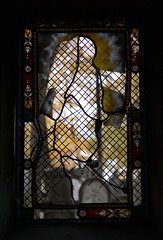
In the image above, I was reminded of the stained glass windows in the many tombs of Montmartre and Pere Lachaise cemeteries. The lines of the image (of the net) could just as easily be the lead work of a broken stained-glass window; what is missing of course is the colour.

Pere Lachaise, Paris

Colour could be a validating factor in this case. Often when we think of the Holocaust or World War One for example, we see them in Black and White (like the cats (although evidence suggests they may have limited colour vision) we saw in the cemetery); we often think of the weather as being dull, grey, miserable, always winter, and when we read evidence of the time that talks of blue sky and sun, it always seems somehow shocking. The following is an extract from Tadeusz Borowski’s “This Way for the Gas Ladies and Gentlemen.”

“‘…You have no idea how tremendous the world looks when you fall out of a closed, packed freight car! The sky is so high…’
‘…and blue…’
‘Exactly, blue, and the trees smell wonderful. The forest – you want to take it in your hand!'”

When imagining arrival at somewhere like Birkenau, one imagines it being night, or the smoke from the chimneys hiding the sky like a fog. But of course, people would have arrived on beautiful summer days, when colour was abundant.

Filed Under: Holocaust, Trees Tagged With: Borowski, Colour, Fernando Pessoa, Holocaust, String, World War I, WWI, WWII

Cut String

October 26, 2007 by Nicholas Hedges

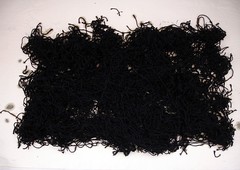
I finally dyed all the cut pieces of string and put them on some newsprint to dry. Looking at them I was reminded, for some reason, of writing, of a mass of scribbled words which had been piled up on top of one another.

Cut String

Filed Under: Uncategorized Tagged With: String

Clotho. Lachesis. Atropos.

October 22, 2007 by Nicholas Hedges

Thinking about the Three Fates project, I was considering how the individual fates, Clotho, Lachesis and Atropos, might somehow reflect the work I’ve been doing over the past year. As I thought about their roles, I realised that there were some interesting connections. Clotho for example, through her spinning yarn and creating life, reflects much of the work I’ve been doing regarding pathways and the coming-into-being (the unliklely, almost impossible coming-into-being) of the individual human. It is interesting that in much of my work and thoughts this year, I have been considering the pathways of our ancestors and visualising those pathways with, amongst other things, string (a tangle of string might represent the impossible pathways of ancestors). Lachesis of course represents the lifespan of the individual, and in the case of my work, the lives of individuals is a recurrent theme, particularly as regards my work on the Holocaust and World War One. Everything to do with life, our physical acts (such as walking) and the everyday, mundane objects which we encounter and which shape it, are represented by her. Atropos, who cuts the thread, is of course death, and I needn’t say how she fits in.

Of course, much of my work deals with memory and Bill Viola’s quote regarding how we have been “living this same moment ever since we were conceived,” and how “it is memory, and to some extent sleep, that gives the impression of a life of discrete parts, periods or sections, of certain times or ‘highlights'”, fits in with the ‘action’ of the three fates, who could be said to be dividing a single life into its component memories as well as Life with a capital ‘L’ into its separate lives.

Filed Under: Uncategorized Tagged With: Bill Viola, Myth, String, Three Fates

Knot Installation

October 22, 2007 by Nicholas Hedges

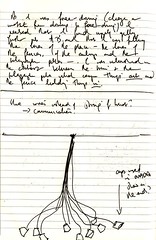
Taking the work I have done so far on the knot installation, and looking at some of the ideas inspired by a set of recent free-drawings on the subject of Auschwitz-Birkenau, I decided to try out an idea I’d put down quickly in my sketchbook on the 20th.
20-10-07

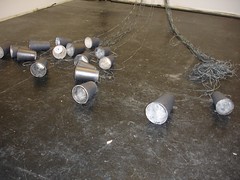
This involved tying a few of the paper cups I’d shown at OVADA to the ends of the strings (which themselves, now dry and somewhat two-toned reminded me even more of wires) to emphasise the idea of these strings being ways to communicate with those who have come before us. The cups act as both a device for listening and a device for hearing and in that sense they are tools for dialogue. There are 50 strings altogether, and so, I initially tried the idea with about a dozen cups.

Knot

Knot

The idea worked well, although one loses a little, the sense of a string being cut, so I will just carry them through as separate works.

Filed Under: Uncategorized Tagged With: Knots, String

Atropos’ Shears

October 21, 2007 by Nicholas Hedges

Today I began to cut up a few balls of string, cutting the strand into various lengths so as to indicate the different lengths of lives. It was interesting how as the pile grew, it had a completely different consistency to a ball of string that had become tangled, having been unravelled, dyed and left in a pile. It seems an obvious point to make but an observation that is nonetheless worth mentioning. It was on the second ball of string that I began to focus on the sound of the scissors and as I cut, I realised what the sound reminded me of – it was the sound of hair being cut. Of course the cutting of hair and the Holocaust have particular and distrurbing overtones, and on the third ball of string, I made a loop several strands thick and cut the lengths that way. In this respect, the thickness of the strings and the action of the scissors trying to cut through the threads became interesting to me.

I thought again of the ideas I have had recently where, three ‘Fates’ would pull tape through a reel to reel recorder. The action of the pulling – a violent action – when applied to the idea of Atropos cutting hair was particularly chilling.

Looking at the ‘string’ work I’ve been doing recently, the work with lines in the camp (railways lines, telegraph wires, barbed wire), threads, tape, Clotho, Lachesis, Atropos and scissors, it’s interesting how the action (potential performance) of the Three Fates can be used in so many different ways when the fabric is changed. Certainly, this whole performance/action is something I want to explore thoroughly over the next few months.

Filed Under: Uncategorized Tagged With: Myth, String, Three Fates

Weeping

October 20, 2007 by Nicholas Hedges

The following drawing is part of a series I’ve been working on regarding Auschwitz-Birkenau and the theme of pathways.

Untitled-9

Looking at the picture, I was reminded of something which for a while escaped me. There was something about the tower in particular which I was sure bore a striking resemblance with another, famous painting.

The following is a detail from the drawing.

Looking at it closely, at the apparent anguish and suffering in the ‘face’ of the tower (the tower as suffering goes against all I have written about it so far: “…the gate house is different, it knows its time has passed but doesn’t seem ashamed in anyway. Its almost as if it relives every moment in its glass eyes, glass eyes which are far from being blind. They don’t reflect what they see around them now but rather what has been, what the tower wants to remember…”) made me think at once of the painting I’d been thinking of, an image painted in 1937 and again, one of the utmost despair: Picasso’s ‘Weeping Woman’.

Filed Under: Holocaust Tagged With: 'Blind' Drawing, Drawings, Holocaust, Picasso, String, WWII

New Studio, New Work

October 19, 2007 by Nicholas Hedges

I have finally got myself into gear as regards moving into my studio at Magdalen Road and have now started to get some work done. I started with putting some pictures up on the wall (those I made after my visit to Auschwitz-Birkenau) and was struck by how different they appeared when shown all together. When I first showed them they were on two walls and all in a row, but having them all on one wall lent them a whole different – and more sinister – aspect.

Old Drawings

They’ve always been rather intimidating images, but now there was something relentless and almost obsessive about them; as a group they seemed to talk more; but this was not a dialogue between the pictures and the viewer (me in this case, but I believe it would have the same effect with anyone else) it was now more like an internal monologue – the externalisation of a guilty conscience. I thought about wallpapering them to the walls which would I think strengthen their obsessive quality.
I also drew more of the ‘collective views’ which are interesting. They too have the same relentless, clawing quality, but do not have quite the same connotations of guilt which one gets from repeated and near identical images.

New Drawings

As I drew these images, I ‘found my way’ back inside the camp, seeing it clearly in my mind as I drew with my eyes closed. I followed the various lines, in particular the railways tracks, the wire fences and the telegraph wires. And as my pen marked them on the page, I began to think about their functions. The train tracks were a means to the outside world, they were defined by their end points – outside, beyond the camp – connected to the great European cities and the home towns of many who died there. The telegraph wires were likewise a means of communicating with the outside world, which for those in the camp was an impossible dream – something quite unreal. All I could think as I drew, was the ‘image’ of screams being carried down the wires. Sadly the outside world wasn’t listening.

Auschwitz-Birkenau

Having worked on the drawings for a while, I then began to work on an idea I sketched out a while ago.

I started working on the knot using the balls of string which I dyed last week and as I began to build up the knot I found that the dye hadn’t taken properly which nevertheless produced and interesting effect as the knot grew.
Knot
.
Knot

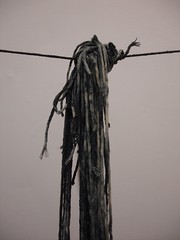
Any work associated with the Holocaust and which is realised with fabric has certain connotations, but what interested me particularly was what I’d thought about whilst drawing earlier – in particular the telegraph wires. The cut strings trailing on the floor – which represent the cut threads of life – became telegraph wires in my mind.

DSC05144

Could I perhaps use wires instead of string?

Filed Under: Holocaust Tagged With: Auschwitz, Holocaust, String, WWII

© Nicholas Hedges 2024

  • Facebook
  • Instagram
  • Twitter
  • YouTube

Copyright © 2025 · Outreach Pro on Genesis Framework · WordPress · Log in