Nicholas Hedges

Art, Writing and Research

  • Amazon
  • Behance
  • Facebook
  • Instagram
  • Pinterest
  • YouTube
  • Art
    • Digital
    • Drawing
    • Grids
      • Correspondence
      • The Wall
      • The Tourist
    • Ink on paper
      • Shadow Calligraphy
    • Installation
      • Murder
      • Echo
    • Painting
    • Patterns
    • Mixed Media
    • Photographic installation
      • St. Giles Fair 1908
      • Cornmarket 1907
      • Headington Hill 1903
      • Queen Street 1897
    • Research/Sketches
    • Stitched Work
      • Missded 1
      • Missded 2
      • Missded 3
      • Missded 4
    • Text Work
  • Blogs
    • Family History
    • Goethean Observations
    • Grief
    • Light Slowed But Never Stilled
    • Lists
    • Present Empathy
    • Shadow Calligraphy
    • Trees
    • Time
    • Walking Meditations
  • Video
  • Photography
    • Pillars of Snow
    • Creatures
    • The Trees
    • Snow
    • St. Giles Fair 1908
    • Cornmarket 1907
    • Headington Hill 1903
    • Queen Street 1897
    • Travel
  • Illustration and Design
  • Music
  • Projects
    • Dissonance and Rhyme
    • Design for an Heirloom
    • Backdrops
    • Shadow Calligraphy
  • Exhibitions
    • A Line Drawn in Water
      • Artwork
    • A Line Drawn in Water (Blog)
    • Mine the Mountain 3
      • Artwork
    • Mine the Mountain 2
      • Artwork
      • The Wall
    • The Woods, Breathing
      • Artwork
    • Snow
      • Artwork
    • Echo
      • Artwork
    • Murder
      • Artwork
    • The Tourist
    • Dreamcatcher
    • Mine the Mountain
      • Artwork
      • The Tourist
    • M8
    • The Gate
    • Creatures
      • Artwork
    • Residue
      • Artwork
    • A visit to Auschwitz
      • Artwork
  • Me
    • Artist’s Statement

The Light from Bellatrix

February 11, 2015 by Nicholas Hedges

Bellatrix, a star in the constellation of Orion, is a hot, blue giant some 240-250 light years away; let’s, for the sake of argument, call it 245. This would mean that the light from the star we see today, left in 1770 and has in that time been travelling at 186,000 miles per second. To put that in perspective, light can travel 7 times around the Earth in a single second.
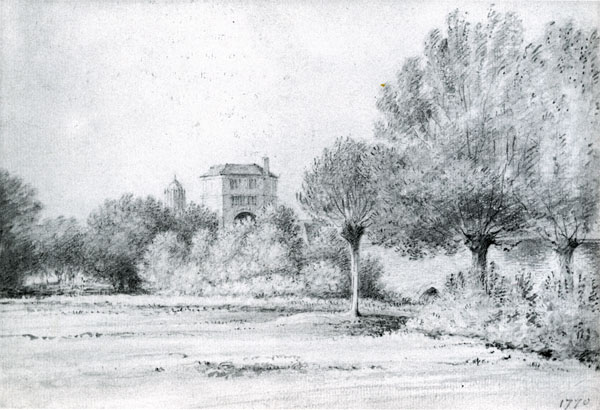
A view of Friar Bacon’s study, Oxford (1770) by John Malchair

Such a speed and distance is pretty much beyond the scope of even the keenest imagination. It’s hard to comprehend for example that at the time of the French Revolution, the light from Bellatrix had already been travelling 19 years. That during the Great Exhibition, it was 71 years into its journey. And that at the start of the First World War it had been going for 144 years, still at a speed way beyond our comprehension.

And for another 100 years it has travelled; at 186,000 miles a second.

In contemplating the distance it has travelled, thinking in terms of major events doesn’t really help; after all, we don’t conceive of history in terms of seconds, and thinking of the speed of light outside a few seconds is difficult (669,600,000 miles per hour…?)

Recollecting events in my life however – from my earliest memories on a beach on the Isle of Wight, through nursery, primary school, the Queen’s Silver Jubilee, holidays in Swanage, Christmases, birthdays, sleep overs at my Nan and Grandad’s, church events, middle school, upper school, university, relationships, friendships, nights in the pub etc. – I can better imagine the passage of time, which, ironically, makes it more difficult to comprehend the distance light travels. I can do the same with regards my parents’ lives and, to some extent, my grandparents, but it becomes quite impossible beyond that.

Flicking through data on historic events of the last 245 years, the mind really begins to bubble:

1775 – American War of Independence
1780s – Start of the Industrial Revolution
1787 – First convicts sent to Australia
1796 – Jenner’s smallpox vaccination
1805 – Battle of Trafalgar
1829 – Peel establishes Police force
1832 – Great Reform Act
1837 – Queen Victoria ascends the throne
1851 – The Great Exhibition
1854-56 – The Crimean War
1859 – Origin of Species published
1863 – London Underground opens
1876 – Invention of the telephone
1887 – Invention of the gramophone
1901 – Death of Queen Victoria
1912 – The Titanic sinks
1914-18 – World War I
1920 – Demonstration of television
1927 – BBC is created
1939-45 – The Second World War
1952 – Queen Elizabeth II ascends the throne
1953 – Discovery of DNA

…and so on. But it’s not until I start flicking through newspapers that my mind starts to buckle.

There’s a website where one can browse historic newspapers, and in the case of Jackson’s Oxford Journal, everything published between 1800 and 1900 is available. For example:

From Saturday, April 8, 1882:
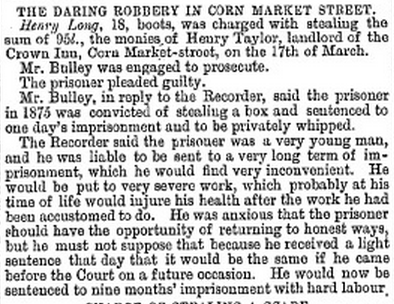

Our photons had been travelling 112 years when Henry Long stole £95 on 17th March 1882. We can imagine him now, a young man, at the Crown Inn, seizing the chance to grab the cash. We can hear the seconds ticking away, our photons moving 186,000 miles with every tick. We can imagine Henry’s heart beating… Then we cut to the Quarter Sessions where Henry was tried. We can hear his heart beating again as the verdict is read out, the photons still zipping through space far above. Then again we cut to April 8th and picture a woman sitting at home, a clock ticking on the mantelpiece. Beyond the window, the world goes about its business, as invisibly above, our Bellatrix light journeys towards us. The woman, sitting in the room, reads the paper and the story of Henry Long. It takes 48 seconds to read, in which time our photons have moved 8,928,000 miles closer to Earth…

Now we leap ahead 11 years to 1893, not far from the Crown Inn, where, in the blink of an eye, the scene below is caught on camera.
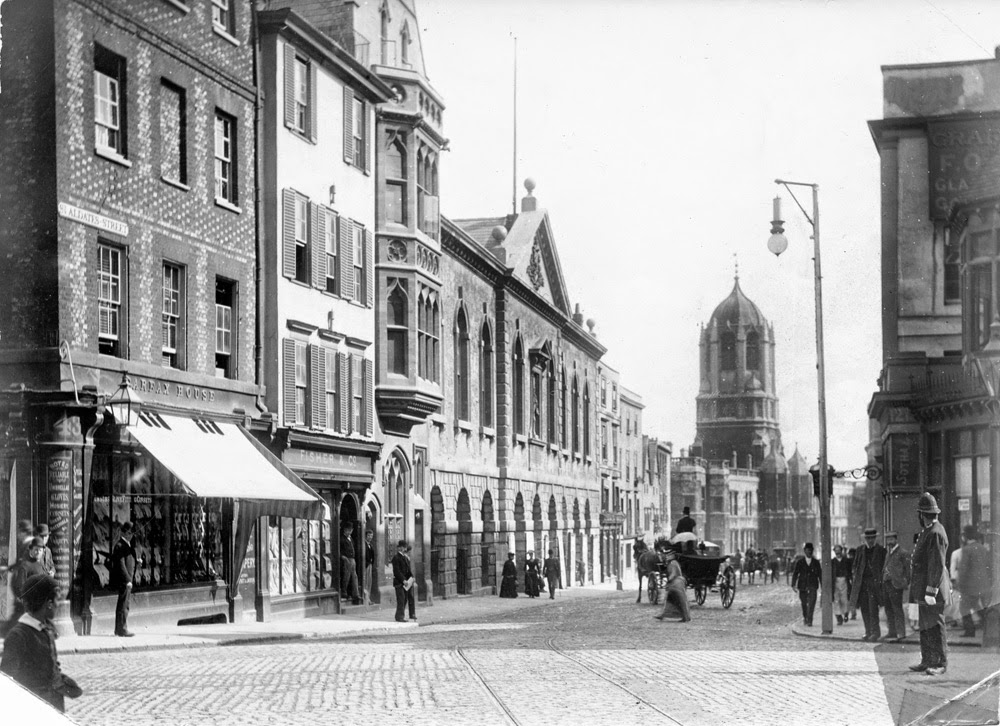
Perhaps someone in the photograph below – maybe the policeman – dimly recollects the story from all those years ago,

After the photograph’s been taken, life carries on. With every step the couple take below, the light which has travelled 123 years, moves on at the same, steady pace – the equivalent of 7 times around the world…
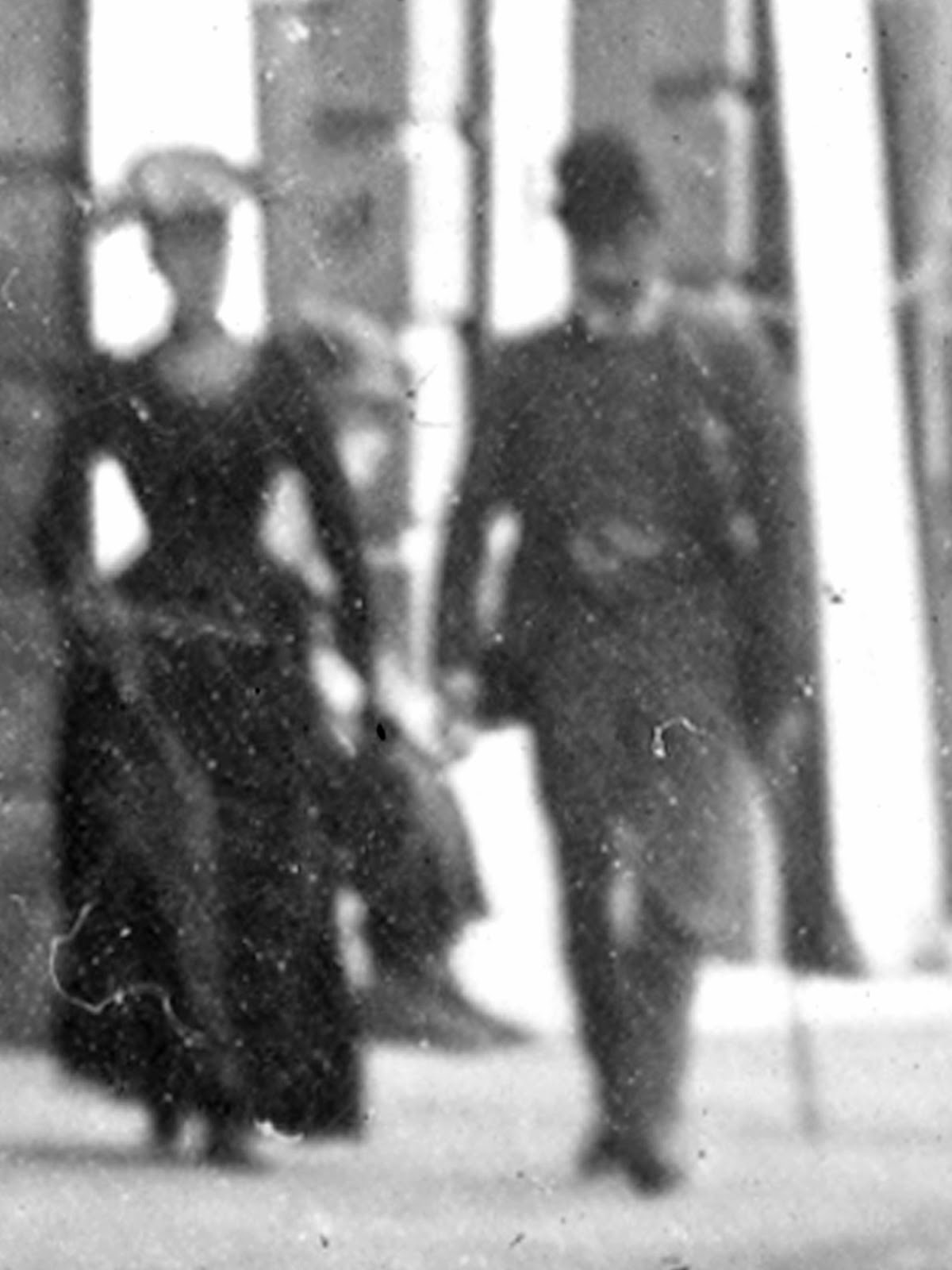

…and tonight, after 245 years, it will strike my eyes.
Filed Under: Uncategorized Tagged With: Bellatrix, Speed of Light, Stars

Redshift

October 20, 2013 by Nicholas Hedges

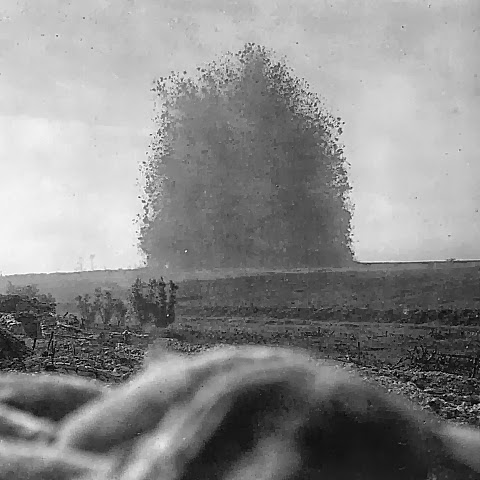
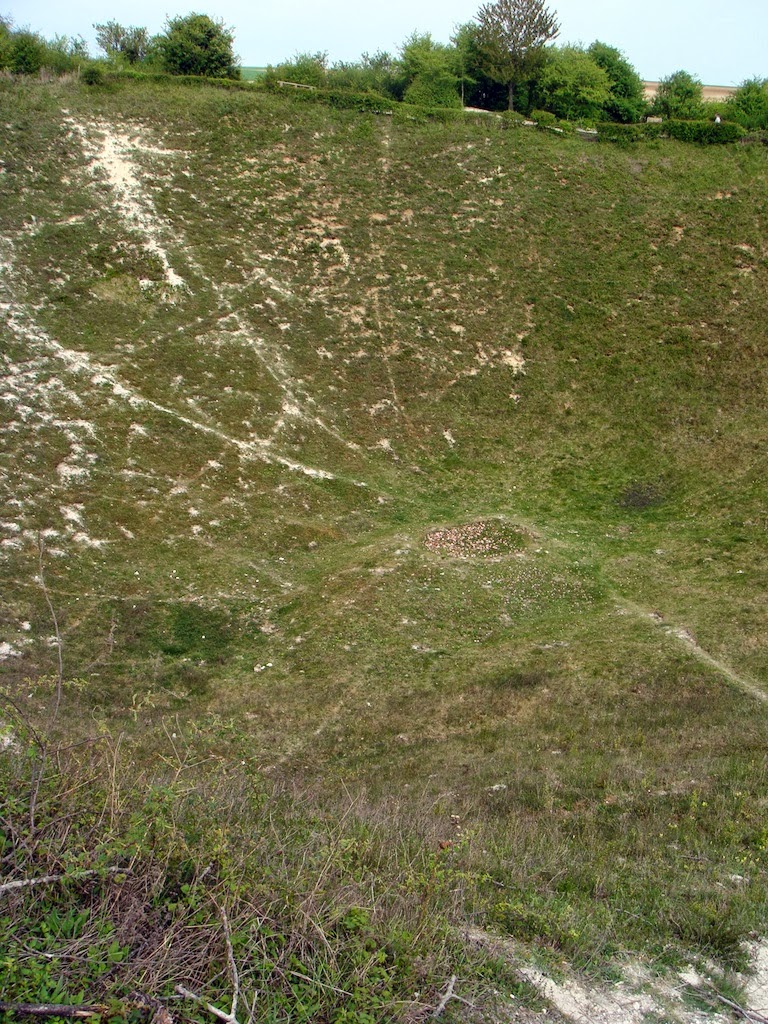
Anyone who has stood on the edge of the Lochnagar crater at La Boiselle in France, cannot help but be overawed by its vast size. The result of a huge mine, detonated below ground at 7:28am on 1st July 1916 (the first day of the Battle of the Somme), the crater is almost 300 feet in diameter and 70 feet deep.

“The whole earth heaved and flashed, a tremendous and magnificent column rose up in the sky. There was an ear-splitting roar drowning all the guns, flinging the machine sideways in the repercussing air. The earth column rose higher and higher to almost 4,000 feet. There it hung, or seemed to hang, for a moment in the air, like the silhouette of some great cypress tree, then fell away in a widening cone of dust and debris.” The words of 2nd Lieutenant C.A. Lewis of No. 3 Squadron RFC who witnessed the blast.

The image and video clip below shows a similar explosion, which took place a few minutes earlier at Hawthorn Redoubt, also on The Somme.

The obvious thing missing from this clip is the sound. Standing on the edge of the Lochnagar crater, one is aware of the noise this blast must have made – a sound so loud, it was said to have been heard in London. It’s almost as if the crater itself is an echo; one made from the mud of The Somme.

Thinking more on this, I had in my mind’s eye an image of the past receding – a past moving away from us here in the present-day. I thought about sound and how, as it moves away, its pitch shifts due to the fact its wavelength stretches (what’s known as the Doppler effect). I thought then about light, how as it moves away, its wavelength stretches and shifts towards the red end of the spectrum. It’s through this redshift that scientists can deduce how far away an object (such as a star) is from the Earth and how fast it is travelling. Redshift is often used as a way of explaining the Big Bang. If you imagine the Big Bang (or indeed any explosion), you can easily visualise how everything emanating from within it would move away from its centre. Everything we see in space today is a result of that first explosion. As a result, everything is moving away – something we can see in the redshift of distant galaxies.

As we move away from the catastrophic events of World War I, and as we approach its centenary, the craters and shell-holes that pockmark the old Western Front, become – like the trenches – filled with earth. They become grown over with grass, flowers and trees; and this gradual retreat towards the natural world is, I think, a kind of redshift in the landscape.

I want to explore this idea and to think more about an audio piece I’ve been working on: a recording of my mum and aunts singing Where Have All The Flowers Gone in 1962.

Filed Under: Trees, World War I Tagged With: Doppler Effect, Redshift, Shells, Stars, World War I, WWI

The Material World

July 19, 2012 by Nicholas Hedges

“What, then, is this material world? Of what does it consist?”

So asks Tim Ingold, in his book, Being Alive, Essays on Movement, Knowledge and Description. It seems an obvious question, or rather, a question for which there is an obvious answer, but in terms of the field Material Culture it would seem to be not so straightforward. Citing a number of works on the subject, Ingold writes how “their engagements, for the most part, are not with the tangible stuff of craftsmen and manufacturers but with the abstract ruminations of philosophers and theorists.” Furthermore, “literature in anthropology and archaeology that deals explicitly with the subjects of materiality and material culture seems to have hardly anything to say about materials.” Ingold then goes on to cite an inventory of materials one might expect to see when dealing with this subject, as can be found in a book by Henry Hodges called Artefacts.

pottery
glazes
glass and enamels
copper and copper alloys
iron and steel
gold, silver, lead and mercury
stone
wood
fibres and threads
textiles and baskets
hides and leather
antler, bone, horn, ivory
dyes, pigments and paints
adhesives

In an array of books on his bookshelf, all dealing in some form with the subject of material culture, Ingold states that one looks in vain for any “comprehensible explanation of what ‘materiality’ actually means, or for any account of materials and their properties.” 

To cut a long story short, Ingold goes on to question what the material world actually is – thus the question at the top: “What, then, is this material world? Of what does it consist?”

He writes:

“Christopher Gosden suggests, we could divide it into two broad components: landscape and artefacts. Thus it seems that we have human minds on the one hand, and a material world of landscape and artefacts on the other. That, you might think, should cover just about everything. But does it? Consider, for a moment, what is left out. Starting with landscape, does this include the sky? Where do we put the sun, the moon and the stars? We can reach for the stars but cannot touch them: are they, then, material realities with which humans can make contact, or do they exist only for us in the mind? is the moon part of the material world for terrestrial travellers, or only for cosmonauts who touch down on the lunar landscape? How about sunlight? Life depends on it. But if sunlight were a constituent of the material world, then we would have to admit not only that the diurnal landscape differs materially from the nocturnal one, but also that the shadow of a landscape feature, such as a rock or tree, is as much a part of the material world as the feature itself. For creatures that live in the shade, it does indeed make a difference! What, then, of the air? When you breathe, or feel the wind on your face, are you engaging with the material world? When the fog descends, and everything around you looks dim and mysterious, has the material world changed, or are you just seeing the same world differently? Does rain belong to the material world, or only the puddles that it leaves in ditches and pot-holes? Does falling snow join the material world only once it settles on the ground? As engineers and builders know all too well, rain and frost can break up roads and buildings. How then can we claim that roads and buildings are part of the material world, if rain and frost are not? And where would we place fire and smoke, molten lava and volcanic ash, not to mention liquids of all kinds from ink to running water? … If, moreover, they are part of the material world, then the same must be true of my own body. So where does this fit in? If I and my body are one and the same, and if my body indeed partakes of the material world, then how can the body-that-I-am engage with that world?”

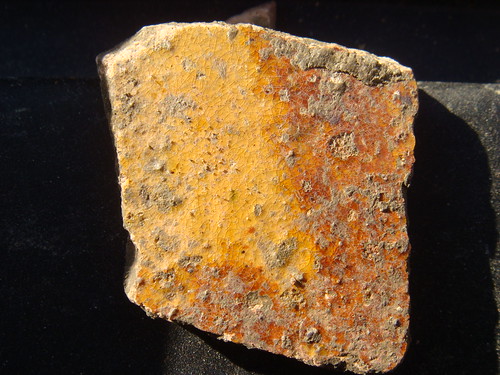
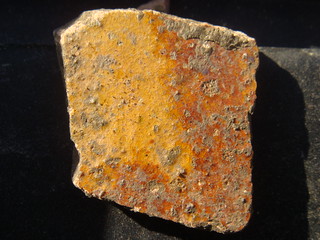
When I read this, I thought about the dig I went on last year at Bartlemas Chapel in Oxford, when I found a small but rather beautiful piece of mediaeval (I think) pottery.

Bartlemas Chapel Excavation

There are many ways in which one could interpret this find, but what I thought about was how this was like a missing piece of the present, and how, before it was lost to the soil, it had existed in a mediaeval present that was (save for the obvious differences) just like ours today. There was the wind, there were trees and flowers, the clouds, the sky and of course the sun, by whose light the beautiful glaze could be seen again, just as it had been by someone living hundreds of years ago. Reading what Tim Ingold has written about materiality and material culture above therefore made perfect sense.

And as regards my work with empathy and the importance in this respect of materiality and material culture, the idea of the body as part of the material world was also of interest. We are not set outside the material world but are an integral part – therefore it’s easier to engage empathetically with an individual through the objects those individuals once used. Empathy is as I’ve said before an augmented discourse between bodily experience and knowledge. Knowledge as Ingold writes derives through movement: “It is by moving that we know, and it is by moving, too, that we describe.” When I discovered the piece of pottery (through moving), I uncovered not only the object itself, but the material world by which it was once surrounded, including those people who once used it, or the person who even made it.

Filed Under: Archaeology, Lists, Trees Tagged With: Archaeology, Artefacts, Bartlemas Chapel, Empathy, Fragments, Landscape, Listmaking, Lists, Pottery, Stars, Tim Ingold

Thoughts

May 10, 2012 by Nicholas Hedges

IMG_1029
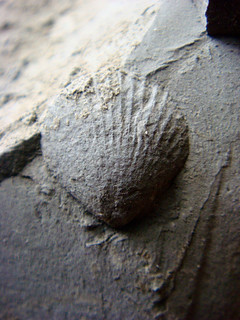
Fossilised shell, around 195 millions years old

“As physicists have pointed out, it is no accident that we see stars in our sky, for stars are a necessary part of any universe capable of generating us. Again, this does not imply that stars exist in order to make us. It is just that without stars there would be no atoms heavier than lithium in the periodic table, and a chemistry of only three elements is too impoverished to support life. Seeing is the kind of activity that can go on only in the kind of universe where what you see is stars.”
Richard Dawkins

Bartlemas Chapel Excavation
Mediaeval pottery shard

“Only God knows the reason for those changes linked with the mystery of the future: for men there are truths hidden in the depths of time; they come forth only with the help of the ages, just as there are stars so far removed from the earth that their light has not yet reached us.”
Chateaubriand

World War 1 Serviceman
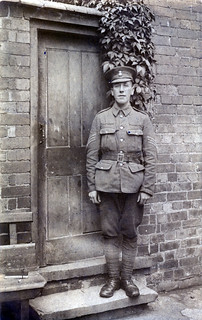
Photograph of World War I serviceman 

“From a real body, which was there, proceed radiations which ultimately touch me, who am here; the duration of the transmission is insignificant; the photograph of the missing being as Sontag says, will touch me like the delayed rays of a star. A sort of umbilical cord links the body of the photographed thing to my gaze – light though impalpable, is here a carnal medium, a skin I share with anyone who has been photographed.”
Roland Barthes

Filed Under: Quotes Tagged With: Fossils, Fragments, Pottery, Quotes, Shells, Stars, Useful Quotes, WWI Postcards

Stars

May 10, 2012 by Nicholas Hedges

A second example of wholeness involves the ordinary experience of looking up at the sky at night and seeing the vast number of stars. We see this nighttime world by means of the light ‘carrying’ the stars to us, which means that this vast expanse of sky must all be present in the light which passes through the small hole of the pupil into the eye. Furthermore, other observers in different locations can see the same expanse of night sky.
Henri Bortoft

As physicists have pointed out, it is no accident that we see stars in our sky, for stars are a necessary part of any universe capable of generating us. Again, this does not imply that stars exist in order to make us. It is just that without stars there would be no atoms heavier than lithium in the periodic table, and a chemistry of only three elements is too impoverished to support life. Seeing is the kind of activity that can go on only in the kind of universe where what you see is stars.
Richard Dawkins

The light of the moon covers the earth, yet it can be contained in a single bowl of water.
Dogen Zenji (1200-1253)

Only God knows the reason for those changes linked with the mystery of the future : for men there are truths hidden in the depths of time; they come forth only with the help of the ages, just as there are stars so far removed from the earth that their light has not yet reached us.
Chateaubriand

From a real body, which was there, proceed radiations which ultimately touch me, who am here; the duration of the transmission is insignificant; the photograph of the missing being as Sontag says, will touch me like the delayed rays of a star. A sort of umbilical cord links the body of the photographed thing to my gaze – light though impalpable, is here a carnal medium, a skin I share with anyone who has been photographed.
Roland Barthes

Filed Under: Quotes Tagged With: Henri Bortoft, Quotes, Richard Dawkins, Stars, Useful Quotes

An Unfinished World

January 19, 2012 by Nicholas Hedges

First thoughts on Graham Sutherland, ‘An Unfinished World.’ Modern Art Oxford

Graham Sutherland, Dark Hill – Landscape with Hedges and Fields, 1940. Swindon Museum and Art Gallery © Estate of Graham Sutherland

 In his excellent book, ‘A History of Ancient Britain,’ historian Neil Oliver writes:

“All of Britain was a work in progress as nature set about reclaiming the land. The period of hundreds of thousands of years known to archaeologists as the Palaeolithic – Lower, Middle and Upper – was over. The remote world of the mammoth-hunters of Paviland, even the lives and times of the Creswell artists and the butchers of Cheddar Gorge belonged to the past. The ice of the Big Freeze had drawn a line that separates them from us, then from now.”

This line in our history, this schism carved through time in much the same way as valleys were carved and gouged by ice from rock, is a place I find myself observing when I look at some of Sutherland’s haunted landscapes. They are silent spaces, from which it seems humankind is quite estranged; banished even. In some, it’s as if Man has yet to appear, as if the world is part of a parallel universe, similar in some respects, but altogether different. There are, as well as those landscapes which seem divorced from knowable time (from history), landscapes from the recent past; ruined prospects of towns wracked by war. And while the source of this ruination is Man himself, the sense which Sutherland creates is one in which Man again ceases to exist. It’s almost as if through both types of landscape (those we might – very loosley- describe as rural on the one hand, urban/industrial on the other), Sutherland is reminding us that for the unimaginably greater part of its existence, the world did not know us; that for the equally ‘impossible’ span of time that stretches ahead, the world will have no need of us either.

This sense of oblivion haunts Sutherland’s landscapes; Earth’s indifference towards us – in the grand scheme of things – permeates almost every canvas and drawing, no matter how small. They each seem to echo the wonderful words of the 17th century writer Sir Thomas Browne, when he writes in ‘Urn Burial.’

“We whose generations are ordained in this setting part of time, are providentially taken off from such imaginations. And being necessitated to eye the remaining particle of futurity, are naturally constituted unto thoughts of the next world, and cannot excusably decline the consideration of that duration, which maketh Pyramids pillars of snow, and all that’s past a moment.”

On some of Sutherland’s drawings, the artist has drawn a grid of horizontal, vertical and diagonal lines. Grids like these would often be used when scaling drawings up to full-size works, and perhaps that is what the artist intended them for. When I see them however, I see them not as something detached from the work itself – a mere tool for reproduction – but rather an integral part of the work. It’s as if the artist is trying either to order the chaos which he’s rendered on the page (and which he’s no doubt observed in the real world), or do battle with Man’s certain oblivion and relative obscurity, imposing his mark on the landscape; his dominion over the world.

A Farmhouse in Wales 1940. Amgueddfa Cymru – National Museum Wales

If the Farmhouse in Wales above is slowly dissolving back into the landscape, then perhaps it can be seen as a metaphor for man’s own ineveitable fate. The grid therefore, this means for scaling up, for seeing more clearly and in greater detail (the bigger picture as it were) is perhaps then a means for trying to understand that fate, for comprehending those ‘pillars of snow,’ so beautifully described by Browne in 1658.

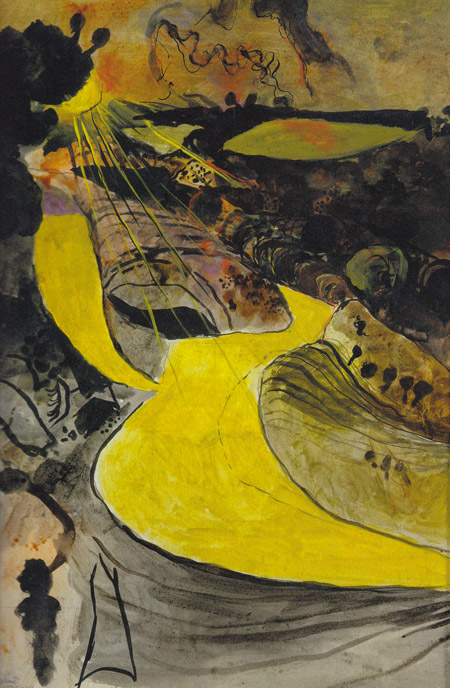
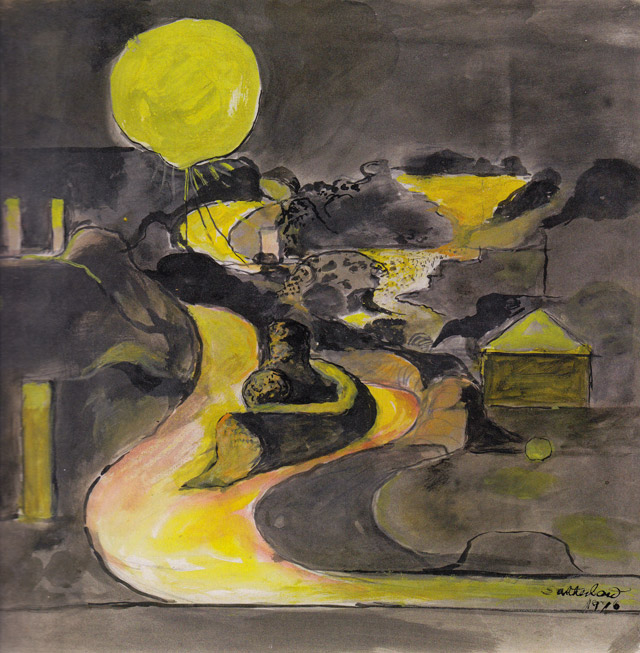
Welsh Landscape with Yellow Lane 1939-40. Private Collection, London

In a video to accompany the exhibition, curator (and artist) George Shaw, describes how the use of yellow gives the appearance of a landscape which is jaundiced; perhaps sick. I however see this sickness not as a part of the landscape, but a part of our own vision of ourselves; our place in the ‘grand scheme of things.’ Even where Sutherland has painted machines (which by their very existence would seem to point towards the existence – and therefore relevance – of mankind), there is still the sense of Man’s complete absence from the world. It’s as if, as I’ve said, these paintings depict those two great and awful spans of time, between which Man’s existence is pressed, like rocks beneath the vast sheets of ice, which once crawled and covered this place we call home. (Even those gargantuan glaciers – in places almost a mile thick – which smothered the country for so many thousands of years, would seem like Browne’s ‘pillars of snow’ when considered against the backdrop of eternity.)

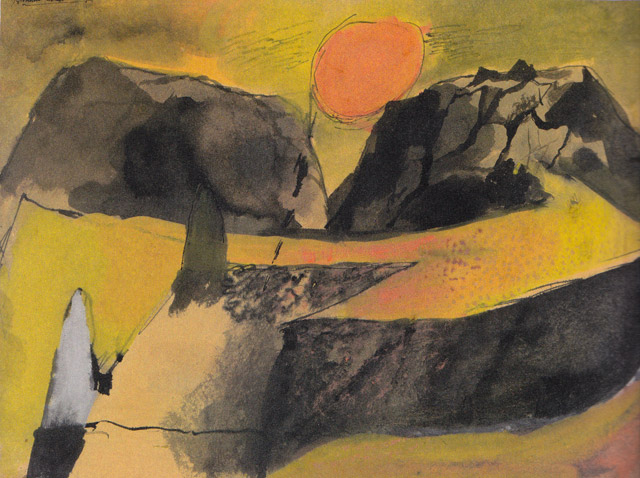
In the exhibition’s first few paintings, we find these same desolate landscapes, replete with standing stones (for example, in ‘Sun Setting Between Hills’ below) such as those found at ancient sites throughout the country.

Sun Setting Between Hills 1937. Private Collection

At once these landscapes become charged with mystery, and like those paintings which show, for example, cranes gorging themselves on the landscape, we are presented with evidence of Man’s existence. The standing stone and the ruined urban landscape, mirror one another. Poles apart, they seem to delineate this landscape in which we, for a short time, have strutted the stage of our existence. No-one is likely to walk the yellow roads which cut through the world above – yet someone must have been there.

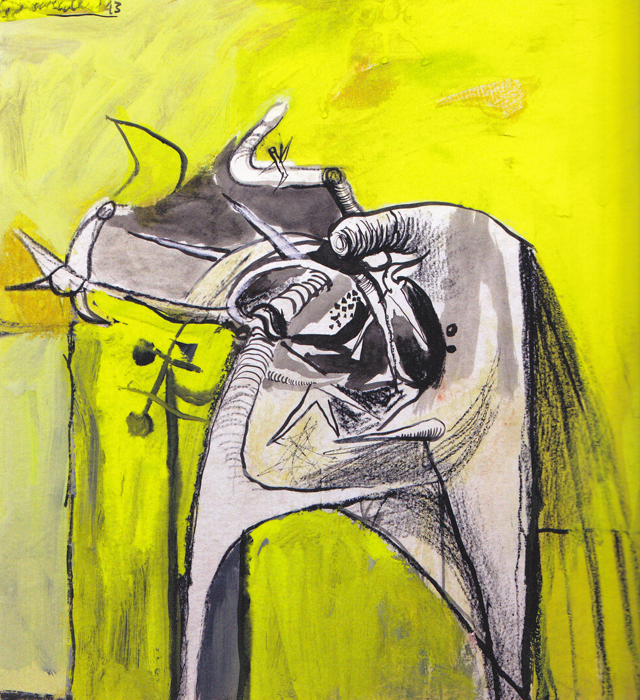
Interlocking Tree Form 1943. The Whitworth Gallery, University of Manchester

Despite this apparent absence of Man, the trees in some of Sutherland’s landscapes seem almost human, at least in their gestures. Some such gestures echo the agonies of Picasso’s ‘Guernica’, (for example, in ‘Interlocking Tree Form’ above) while ‘Study for a Blasted Tree,’ calls to mind Goya’s ‘Disasters of War.’

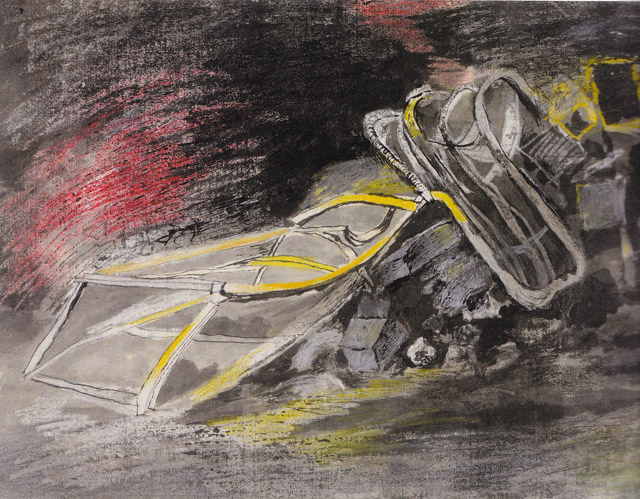
Fallen Lift Shaft 1941. Junior Common Room Art Collection, New College.

It was whilst looking at the painting above, that I found myself thinking of William Blake. In this work, ‘Fallen Lift Shaft,’ there is a small patch of red which is reminiscent of some of the poet’s own paintings. The lift is on the one hand a casualty of war, a victim of Man’s aggression. On the other it’s a symbol of his descent. It is perhaps the Fallen Angel.

The exhibition is titled ‘An Unfinished World‘ and whilst reading Richard Dawkins’ book ‘The Ancestor’s Tale,’ I found a quote, which for me encapulsates what that title means. The world, with or without Man, is always unfinished. Dawkins writes:

“The second connected temptation is the vanity of the present: of seeing the past as aimed at our own time, as though the characters in history’s play had nothing better to do with their lives than fore-shadow us.”

In other words, we are not the end, just as we weren’t the beginning. And it’s this conceit which Browne cautions against in his meditation on death discussed above. Sutherland’s landscapes are for me, the equivalent of trying to imagine one’s own non-existence in a world which is always, as Neil Oliver writes, ‘a work in progress,’ one in which nature will one day set about reclaiming from Man.

One might think it’s possible therefore to view Sutherland’s paintings as a warning against this conceit. But to do this is in itself a kind of conceit. The fact is, we are just another part of the landscape. The yellow road was there before us, and after us the yellow road rolls on. Sutherland’s paintings are not warnings, but statements of fact.

And while this might sound somewhat depressing, another quote from Dawkins (again from ‘The Ancestor’s Tale’) might just lift our spirits:

“As physicists have pointed out, it is no accident that we see stars in our sky, for stars are a necessary part of any universe capable of generating us. Again, this does not imply that stars exist in order to make us. It is just that without stars there would be no atoms heavier than lithium in the periodic table, and a chemistry of only three elements is too impoverished to support life. Seeing is the kind of activity that can go on only in the kind of universe where what you see is stars.”

Landscape 1969. Harry Moore-Gwyn (Moore-Gwyn Fine Art)

In many of Sutherland’s works, our very own star, the sun, is present such as in the work above. In one of the first paintings within the exhibition, to the last (painted just four years before his death- see below) the same sun is in view.  

Twisting Roads 1976. Private Collection.

And we – like Sutherland – can only see it, we only know it, because we exist. 

Perhaps therefore, in Sutherland’s work, humankind is in evidence after all.


Filed Under: Trees Tagged With: Art, Exhibitions, Graham Sutherland, Stars

Reading Roads

March 8, 2011 by Nicholas Hedges

Introduction

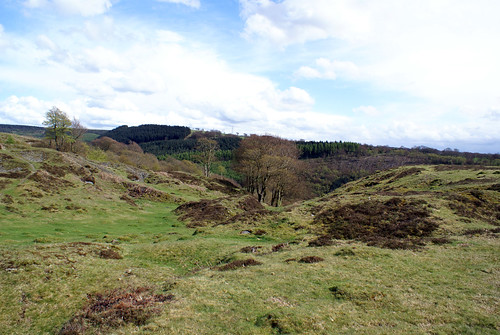
In Wales in 2008 I walked a path along which my great grandfather had walked every day from his home to the mines in which he worked. He died in 1929 (as a consequence of his work) and all I knew of him, before my visit, were what he looked like (from two photographs) and things my grandmother had told me. But on that path I felt I found him on a much deeper level. The feel of the wind, the way the clouds moved, the sound of the trees and the line of the horizon were all things he would have experienced in much the same way. It was as if these elements had combined to ‘remember’ him to me.

Hafodyrynys and Surrounds

As a consequence of my walk, the line which linked us on my genealogical chart changed to become instead a path, for when I follow lines in my family tree from one ancestor to the next and find myself at the end, so that path in Wales had led to my being born. That path on which I walked for the very first time, was as much a part of who I was as my great grandfather: “places belong to our bodies and our bodies belong to these places.” [i]
Roads (paths, tracks and traces) have become an important part of my research and it was whilst reading Edward Thomas’ poem Roads that I found connections between what he had written and what I was thinking. I’ve reproduced the poem below, and where necessary added my thoughts.

Roads by Edward Thomas (1878-1917)
I love roads:
The goddesses that dwell
Far along invisible
Are my favourite gods.
Roads go on
While we forget, and are
Forgotten like a star
That shoots and is gone.
The reference to stars (or a star) in this verse, reminds me of a quote (to which I often refer) from Roland Barthes’ book Camera Lucida, in which he writes:

“From a real body, which was there, proceed radiations which ultimately touch me, who am here; the duration of the transmission is insignificant; the photograph of the missing being as Sontag says, will touch me like the delayed rays of a star. A sort of umbilical cord links the body of the photographed thing to my gaze – light though impalpable, is here a carnal medium, a skin I share with anyone who has been photographed.”

The star shoots its light and is gone and similarly we walk and are gone. But what is left behind is the road, a version of the light left by the disappeared star; a ‘delayed’ ray which allows us to ‘see’ those who went before us. I use the word ‘see’, but we ‘see’ with our bodies. We see the light from the star, but we feel the road. This in turn brings me to the idea of empathy as something which is tactile and kinaesthetic.  Roads and paths become ‘a sort of umbilical cord… a carnal medium, a skin I share’ with those who’ve walked that road or path before – precisely what I’d felt in Wales.

On this earth ’tis sure
We men have not made
Anything that doth fade
So soon, so long endure:

In the third verse we might interpret the lines as a description of the difference between the act of walking and the road itself. We walk in the moment – a moment which fades in an instant (‘so soon’) and yet, behind us a record of the sum of all those moments is lined up along the road behind us – one which endures for centuries. It’s the same difference as that between speaking and writing; one is fleeting, the other endures. Christopher Tilley writes that “…if writing solidifies or objectifies speech into a material medium, a text which can be read and interpreted, an analogy can be drawn between a pedestrian speech act and its inscription or writing on the ground in the form of the path or track.” [ii] Paths and roads ‘record’ our movements, they are texts which we can read with our feet. 
The idea of the ‘moment’ is also discussed by artist Bill Viola who writes that:
“We have been living this same moment ever since we were conceived. It is memory, and to some extent sleep, that gives the impression of a life of discrete parts, periods or sections, of certain times or highlights. [iii]
This ‘same moment’ is in many respects like the act of walking and the road rolled into one; it fades and yet endures at one and the same time. There is an echo of this idea in Camera Lucida when Barthes writes:
“In the photograph, Time’s immobilisation assumes only an excessive, monstrous mode: Time is engorged…” [iv]
I described earlier, how the path on which I walked in Wales was as much a part of me as my great grandfather; it was the first time I’d ever walked it and yet I was a part of it long before I was born. There is then a continuous moment running along all paths and roads, and it’s memory and to some extent birth and death that gives the impression of discrete parts. This ‘universal’ moment is the ‘nowness’ of the present and it was this ‘nowness’ which I experienced on that path in Wales and which I’ve since been exploring in my work as regards empathy.
“The feel of the wind, the way the clouds moved, the sound of the trees and the line of the horizon were all things he would have experienced in much the same way.”
The third verse in Thomas’ poem seems to me to allude to the idea of experiencing the moment:

The hill road wet with rain
In the sun would not gleam
Like a winding stream
If we trod it not again.

The ‘we’ in the last line refers to us as individuals, whether ‘we’ were walking that path in 1915 or today in 2011; if ‘we’ weren’t there to see it, it wouldn’t be seen at all. 
In the fourth verse we read the following:

They are lonely
While we sleep, lonelier
For lack of the traveller
Who is now a dream only.

Before I look at this verse, I want to look at another quote; this time from the catalogue of a Paul Nash exhibition in which David Fraser Jenkins writes how Nash:
“…did not often show people in the landscape, even walking about in his lanes and paths, and as a result his pictures look deserted… Despite this absence, there is in his pictures a remarkable sense of drama, and it is this reaction between things – the trees or the buildings… that these pictures are about.” [v]
Looking at the fourth verse above, we can say that the ‘lack of the traveller’ alludes to the passing of that traveller, whether from the immediate scene, or perhaps life itself. Either way, all that’s left of what Sontag called ‘the missing being’ is the trace of the road on which they walked, the text written as they travelled. That traveller is now a dream, dreamt by the road and the elements by which it’s surrounded, a dream which I see expressed by David Fraser Jenkins as a ‘remarkable sense of drama’. The road might be lonely, but it’s never empty; the trees, the buildings, the feel of the wind and the way the clouds move all dream of the traveller – the missing being. There’s also a parallel to be found here in Rainer Maria Rilke’s Duino Elegies, where in the second elegy we read:
Look – trees exist.
The houses we live in continue to stand. Only we
pass away like air traded for air and everything
conspires to maintain silence about us, perhaps
half out of shame, half out of unspeakable hope. [vi]
This ‘silence’ alludes I think to what Jenkins describes as a ‘remarkable sense of drama’ and what I have called a ‘dream’. But how can we connect with these? In his book The Materiality of Stone,  Explorations in Landscape Phenomenology, Christopher Tilley writes:
“The painter sees the tree and the trees see the painter, not because the trees have eyes, but because the trees affect, move the painter, become part of the painting that would be impossible without their presence. In this sense the trees have agency and are not merely passive objects. [Martin] Dillon comments: “The trees ‘see’ the painter in a manner comparable to that in which the mirror ‘sees’ the painter: that is, the trees, like the mirror, let him become visible: they define a point of view on him which renders visible for him something that otherwise would remain invisible – his outside, his physiognomy, his carnal presence… The trees and mirror function as Other.” [vii]
Just as the trees function as what Dillon calls ‘Other’, so does everything else. It’s as if the shapes of disappeared travellers are somehow retained, like the people-shaped holes in the ash of Pompeii, which when filled with plaster, revealed the presence of people lost for almost 2000 years. Similarly, people-shaped holes exist along every road or path; gaps which can only be filled with our own bodies, by our own presence; by our experience of the nowness of the present.
In a definition of the Metaphysical poets, Georg Lukács described their common trait of ‘looking beyond the palpable’ whilst ‘attempting to erase one’s own image from the mirror in front so that it should reflect the not-now and not-here.’ [viii] For me, the road is the mirror which Lukács describes, and as I walk along it, I try to look beyond the palpable, to erase my own image so that the road reflects the not-­now and not-here. The palpable is the present (as opposed to the nowness of the past); the not-now and not-here is the nowness of that continuous moment in its entirety. To erase one’s image is to imagine one’s own non-existence, to see a part of that continuous moment when one did not exist, when that part was nonetheless now. It is about seeing the presentness of past events.  

From dawn’s twilight
And all the clouds like sheep
On the mountains of sleep
They wind into the night.

The next turn may reveal
Heaven: upon the crest
The close pine clump, at rest
And black, may Hell conceal.

Often footsore, never
Yet of the road I weary,
Though long and steep and dreary,
As it winds on for ever.

Helen of the roads,
The mountain ways of Wales
And the Mabinogion* tales
Is one of the true gods,

(*In the tale of Lludd and Lleuelys from the Mabinogion, you will find the following text: “Some time after that, Lludd had the island measured in length and breadth; the middle point was found to be in Oxford. There he had the earth dug up, and in that hole he put a vat full of the best mead that could be made, with a silk veil over the surface. He himself stood watch that night.” I discovered this passage whilst researching my Welsh ancestry, and being as I am from Oxford, found it rather appealing.)

Abiding in the trees,
The threes and fours so wise,
The larger companies,
That by the roadside be,

And beneath the rafter
Else uninhabited
Excepting by the dead;
And it is her laughter

At morn and night I hear
When the thrush cock sings
Bright irrelevant things,
And when the chanticleer

Calls back to their own night
Troops that make loneliness
With their light footsteps’ press,
As Helen’s own are light.

Now all roads lead to France
And heavy is the tread
Of the living; but the dead
Returning lightly dance:

Whatever the road bring
To me or take from me,
They keep me company
With their pattering,

Crowding the solitude
Of the loops over the downs,
Hushing the roar of towns
And their brief multitude.

The line ‘Now all roads lead to France’ reminds us that those who fell and are buried in France (and indeed other countries) were men with lives beyond the theatre of war – that the theatre of war extends well beyond the boundaries of any trench map. To know them and to know the missing, we have to follow the roads from France back to the towns and villages where they lived, just as to know ourselves we should follow the roads and paths from our own hometowns to those of our ancestors. To walk those streets, paths and tracks, is to turn them back into ‘consanguineal lines’; to restore lost connections in forgotten family trees; to remind us that those who fought and died were each part of a family as well as a wider community of friends and acquaintances.
The road brings and takes away and the dead keep us company at every step ‘with their pattering’. Again this could refer to the idea of the moment as being both fleeting and enduring. The moment is like a looped recording which plays and records at the same time, creating a kind of palimpsest, where all that’s gone before is contained in a moment, like light, tens of thousands of years old seen in a single second.
The line ‘Crowding the solitude,’ echoes what I wrote earlier, that roads might be lonely, but they’re never empty. And finally in the last two lines, Thomas reminds us of our own mortality; where the multitudes that make the towns roar are themselves brief. 


i Christopher Tilley, 1994, A Phenomenology of Landscape, Oxford, England, Berg
ii Christopher Tilley, 2004, The Materiality of Stone – Explorations in Landscape Phenomenology, Oxford, England, Berg
iii Bill Viola, 2005, Reasons for Knocking at an Empty House, Writings 1973-1994, Thames & Hudson
iv Camera Lucida, Roland Barthes, Vintage, 2000
v David Fraser Jenkins, 2010, Paul Nash – The Elements, London, Scala Publishers Ltd.
vi Rainer Maria Rilke, Tr. Martyn Crucefix, 2006, Duino Elegies, London, Enitharmon Press
vii Christopher Tilley, 2004, The Materiality of Stone – Explorations in Landscape Phenomenology, Oxford, England, Berg
viii http://en.wikipedia.org/wiki/Metaphysical_poets

Filed Under: Paintings, Trees Tagged With: Barthes, Bill Viola, Christopher Tilley, Family History, Family Jones, Jones, Paintings, Paths, Paul Nash, Rilke, Roads, Silence, Stars, War Poets, World War I, WWI

Landscape DNA: The Simultaneity of Stories-So-Far

October 5, 2010 by Nicholas Hedges

The Past is Time without a ticking clock. A place where paths and roads are measured in years. The Present is a place where the clock ticks but always only for a second. Where, upon those same paths and roads we continue, for that second, with our existence.

In 2006 I visited Auschwitz-Birkenau and since then have visited camps at Bełżec, Majdanek and Natzweiler-Struthof, as well as the battlefields of Ypres, Verdun and more recently, The Somme. All these sites present the visitor with numbers: 1.1 million dead at Auschwitz-Birkenau, 500,000 at Bełżec, 79,000 in Majdanek. At the start of the Battle of the Somme, on 1st July 1916, British and Commonwealth forces sustained 57,000 casualties, with almost 20,000 men killed in action on that day alone. These are all horrific statistics, but numbers rather than people and over the course of the last few years, I’ve looked for ways of identifying with the individuals behind the grim tolls. The tolls are only estimates, and the individuals to whom they allude have become themselves ‘estimates of existence’. Most have left nothing behind; no name, possessions, or photographs. Photographs, where they exist, are often nameless, names on graves are faceless, so how can we know them at all?

One of the most difficult things about my visit to Auschwitz-Birkenau was walking out the gate, performing an action that more than a million people could only ever dream about – if they had the time; most were killed within hours of their arrival. At Bełżec, the memorial to the dead is – in the main – a walk around the perimeter of where the camp once stood. During my visit in 2007, I recorded the walk using a GPS receiver and the fact that I, as an individual, one of several billion people on the planet, could be tracked in this place where half a million people perished, proved particularly resonant. The concept of walking as a means of remembering began to take hold in my work, evolving over time to become a means of empathising – in some small way – with those who’d perished.

In the book Walking, Writing and Performance by Deirdre Heddon, Carl Lavery and Phil Smith, artist Carl Lavery states the following:

“…pedestrian performance is a mode of resistance against the acceleration of the world, a desire, on the part of performance makers, to re-humanise space by encouraging spectators to experience the environment at a properly human pace, the bodily beat of three miles per hour. Implicit in this argument is the belief that walking is conducive to the production of place, a perfect technique for merging landscape, memory and imagination in a dynamic dialogue. Or as Michel de Certeau would have it: ‘The act of walking is to the urban system what the speech act is to language…’.”

In the passage quoted above, I was struck by the idea, as Lavery puts it, of “encouraging spectators to experience the environment at a properly human pace.” Merging landscape, memory and imagination (for which purpose, according to Lavery, walking is the perfect technique) has become central to my work. It’s also something I’ve done quite naturally since I was a child. For me, places have always been a conflation of these things, and as such, quite unique to me.

When I visit historic sites, landscape, memory and imagination merge to create something akin to what others have termed post-memories; ‘memories’ of events of which we can have no real recollection – in particular events that happened before we were even born. How this happens is something which has interested me throughout my research. A kinaesthetic engagement with a place, and our sense of the present are, it seems, both important in this regard.

Finally in the paragraph quoted above, I was struck by the words of Michel de Certeau; the idea that ‘the act of walking is to the urban system what the speech act is to language,’ reminded me very much of what I’ve read before in the work of Christopher Tilley, who in his book The Materiality of Stone – Explorations in Landscape Phenomenology, writes that ‘If writing solidifies or objectifies speech into a material medium, a text which can be read and interpreted, an analogy can be drawn between a pedestrian speech act and its inscription or writing on the ground in the form of the path or track.”

The idea of a path as ‘text’ is something which appeals to me; the notion that as we walk we ‘write’ ourselves in the landscape has a particularly poetic resonance. In his book Lines, a Brief History, Tim Ingold writes that “human beings leave reductive traces in the landscape, through frequent movement along the same route…”. The Old English word writan he tells us, meant to ‘incise runic letters in stone,’ and a  correlation can therefore be drawn between the act of walking and writing; a path is something written over years by many different people, incised into the landscape.

Just as when we speak we re-use the same words spoken over centuries – for example fragments of long forgotten conversations – so when we walk, we re-use fragments of other people’s ‘texts’, ‘written’ into the landscape. In this sense, we speak with our bodies words that other bodies have spoken or written before us. As Ingold notes: “retracing the lines of past lives is how we proceed along our own.”

In 2007, the year before she died, my grandmother told me about her childhood in Wales. The following is an extract from that conversation in which she describes her father, Elias Jones, who died in 1929, aged 47, as a result of working in the mines:

‘I can see him now because he went up our garden over the road and the mountain started from there up… and he’d go so far up and he’d turn back and wave to us…’

On visiting Hafodyrynys, the village where my grandmother grew up, I walked up the ‘mountain’ she’d described and followed the path my great grandfather would have taken to work in the mines at Llanhilleth. On top of the hill I turned and looked back down at the garden, imagining my grandmother and her siblings waving back at me from the past. Further on, I stood and looked at the view, rolled out all around me. A hundred years ago I thought, when I did not exist, he would have seen the very same thing. A hundred years later, long after his death, I found myself – through being in that place – identifying with him: I’d found him on the path – one which would in time lead to my being born.

Elias Jones, through frequent movement along that path had written himself into the landscape. A hundred years later, I was – through articulating my own presence through walking –  reading part of that text; speaking with my own body his simultaneous presence and absence. In many ways, I was speaking my own presence and absence too.

During that visit, I realised that as well as being a product of the ‘genetic text’ passed down the generations through a myriad number of genealogical lines, we are as much the consequence of pathways walked by every one of our ancestors. DNA is text – a kind of narrative sequence – and the paths which have led to our individual births are a vast text written across the landscape: self and environment, to borrow from Lavery, are umbilically connected.

People are therefore, in a sense, places, and in his book, Lavery quotes Mike Pearson, a performance maker and theorist who states that: “just as landscapes are constructed out of the imbricated actions and experiences of people, so people are constructed in and dispersed through their habituated landscape: each individual, significantly, has a particular set of possibilities in presenting an account of their own landscape: stories.”

Another passage in the book which interested me was that regarding the geographer Doreen Massey. Lavery writes how she offers a ‘conception of space that is interrelational, multiple and always under construction. In her book, For Space, she describes it [space] as ‘the dimension of multiple trajectories, a simultaneity of stories-so-far’.”

I like the idea of space being a ‘simultaneity of stories-so-far’, and it interested me insofar as it rang a bell with some thoughts I’d had previously regarding our own perception of the past. The following is taken from a piece I wrote on the nature of history:

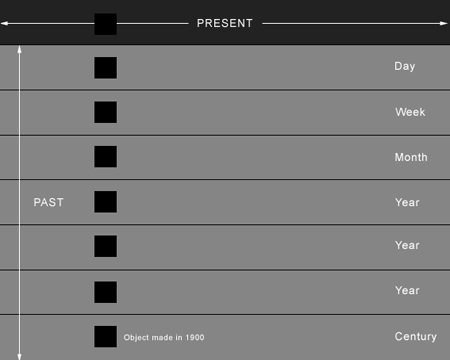
The past is often perceived much like the strata of a rock-face, wherein successive layers of geological time can be seen. We see the past as being built from the ‘ground up’ day upon day, year upon year, century upon century, like bricks in a wall. The problem with this ‘model’ however is that it makes the past difficult to access, the lines dividing each and every moment become like barriers inhibiting our movement between one and the other, particularly where one part is stacked so far below our own in what we perceive as being the present day. Another problem with this way of perceiving the past is that the layers necessarily contain objects, buildings and landscape features which, because of their age, appear in several different layers almost as if they were different things. For example, an object made a 100 years ago, would appear in each of the layers in the diagram below (see Figure 1). It’s rather like someone creating an animation, who draws the same scene a thousand times because it appears in a thousand frames, rather than using the same picture throughout them all.

Figure 1

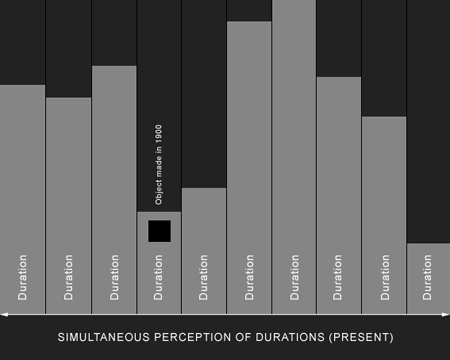
Whilst thinking about this and while considering the fact that any extant object, building or landscape feature, no matter what its age is always present, I realised that a better model for perceiving the past is one which turns the model above on its side – if not quite its head. Subsequently (see Figure 2), what we have is not a series of horizontal strata representing stacked moments in time (days, months, years, centuries etc.), but concurrent vertical lines, or what I have called ‘durations’ where each duration is an object, building or landscape feature and where the present is our simultaneous perception of those that are extant (of course, in the case of buildings, individual ‘objects’ can also contain many separate durations).

It was Bill Viola who said that ‘we have been living this same moment ever since we were conceived. It is memory, and to some extent sleep, that gives the impression of a life of discrete parts, periods or sections, of certain times or highlights’. Similarly we can say that every object, building or landscape feature has existed in one continuous moment and that it is to some extent the passing generations which gives the impression of the past as being a series of ‘discrete parts, periods or sections, i.e., the perceived layers or strata of our previous – first – model.

Figure 2

These ‘durations’ as I have described them, are indeed ‘stories so far,’ which move, as if they are being told, at the speed of walking – at a ‘properly human pace’ as Lavery puts it.

Returning to the idea of walking as writing, it’s true to say that we don’t always leave a physical trace of our presence when we walk – or at least a visible, physical trace. But, poetically speaking at least, we do leave something behind and this something is often augmented by objects, buildings or landscape features which are contemporaneous with past individuals.

Whenever I visit sites of historic trauma (death camps and the battlefields of World War One), even if they’re empty, I feel as if they’re full; not in a spiritual or pseudo-spiritual sense, but physically, as if they’re full of sculptures. Sculptor Antony Gormley describes his work as ‘confronting existence’ and that, in part, is what we do in places such as Auschwitz; death is, after all, another kind of existence. Walking itself is a means of confronting existence, being as it is a line drawn between absence and presence – just as I’d found in Wales.

“Part of my work,” Gormley writes, is to “give back immanence to both the body and art.” For archaeologist, Colin Renfrew, Gormley is “speaking of the existence of the individual, and the coming into being and self-awareness of the individual as the inhabitant of his or her body.” In reading these quotes, I began to see that the sites of trauma I’d visited, as well as those places relevant to my own family history, were full of what I can only describe as invisible sculptures – sculptures of absence, the physical presence/immanence of all who’ve gone before.

Gormley’s work comprises, in part, casts of his own body which reminds Renfrew of the bodies found in Pompeii; men, women and children frozen at the moment of their death almost 2000 years ago. Buried in ash, the spaces which had once contained their bodies remained after the bodies had decomposed, allowing archaeologists, to use them as moulds by pouring plaster into the cavities.

In light of this, I was reminded of the work of Christopher Tilley, who in his book, ‘The Materiality of Stone, Explorations in Landscape Phenomenology’ writes: “The painter sees the tree and the trees see the painter… in a manner comparable to that in which the mirror ‘sees’ the painter: that is, the trees, like the mirror, let him become visible: they define a point of view on him which renders visible for him something that otherwise would remain invisible – his outside, his physiognomy, his carnal presence… The trees and mirror function as Other.”

Just as the trees function as ‘Other’ therefore, so must the sun, the stars, the clouds, hills, mountains, the sea, rivers, the wind, the rain and so on. And in a sense, what Tilley is describing as Other, which ‘renders visible for him… his carnal presence,’ is a sense of being present in the present-day world.

In the book Walking, Writing and Performance, Lavery writes:

“…during… Mourning Walk I was aware of living more in the past than in the present. However at no time did this immersion in memory result in psychic saturation or disintegration. The natural world – the world of trees and stones – was stubbornly present and insisted on maintaining its autonomy and distance.”

When trying to access the past through walking, an awareness of the present – of being present in the world – is vital, and the natural world – the world of trees and stones – does that for us. Understanding the fact that the past was once the present, helps us in some small way to empathise with those lost to the past.

The present moment is a space, one which lasts only for a second – a space comprising the simultaneity of what Doreen Massey calls ‘stories so far’ or what I have called ‘durations’. And it’s in that space that life happens. Behind us and in front, beyond the physical boundaries of that second we are absent. The text is written, or yet to be written – the present being the moment of writing. Gormley’s sculptures then articulate this line between presence and absence, past and present.

In that space, in which we continue with our existence, we hear the birds, we see the sun, feel the wind and rain. In that space, all our hopes are held, all our fears and regrets. Into the space we carry our past in the form of memories. It’s the space of the everyday – one which we often take for granted. But it’s a space we share with everyone who’s ever gone before us.

Again, in his book, Lines. A Brief History, Tim Ingold tell us that:

‘…from late Antiquity right through to the Renaissance writing was valued above all as an instrument of memory. Its purpose was not to close off the past by providing a complete and objective account of what was said and done, but rather to provide the pathways along which the voices of the past could be retrieved and brought back into the immediacy of present experience, allowing readers to engage directly in dialogue with them and to connect what they have to say to the circumstances of their own lives. In short, writing was read not as a record but as a means of recovery.’

This paragraph has something in common with what I described earlier, the idea that just as when we speak we re-use the same words spoken over centuries – fragments of long forgotten conversations – so when we walk, we re-use fragments of other people’s ‘texts’, ‘written’ into the landscape. Walking becomes a means of recovery, where the past can be retrieved and ‘brought back into the immediacy of present experience’. As on the ‘mountain’ in Hafodyrynys, it’s  a means of engaging in a dialogue with those who’ve gone before us, and nowhere is this more keenly felt that in places of historic trauma.

It’s as if when walking through these places, we pick up – at random – the threads of other people’s texts. We tie them together, filling in the gaps with our own story. It’s rather like the film Jurassic Park, where dinosaurs are cloned using DNA extracted from mosquitoes frozen in amber. The gaps in the code are filled with modern frog DNA, creating a ‘modern’ dinosaur. Earlier, I stated that people were as much the product of places, and it figures therefore that places are as much the product of people; that the ‘DNA’ of any place comprises narrative lines laid down by everyone who’s ever been there. When we walk, we create new places based on the present day landscape. Our memory and memories, history and of course our imaginations all have a part to play. Within our imagination, we take with fragmentary strands of the landscape’s own ‘DNA’ (or history) and fill the gaps with our own presence and memory. These constantly created spaces (created then destroyed every second) are unique to us, and yet we share them, in that single moment, with all who’ve gone before us, not as part of a crowd, but as one body and mind.

The ‘stubborn’ presentness which Lavery describes is therefore vital to our empathising with the past, and in many ways the most terrifying thing at Auschwitz was the way the trees moved in Birkenau (Auschwitz II), simply because they would have moved that way during the Holocaust.

The writer Georges Perec once wrote that “the desire to find roots, the determination to work from memories or from the memory, is the will above all to stand out against death, against silence.”

I work from memories and the memory and I’m actively engaged in searching for my roots. Is this then a will to stand out ‘against death, against silence?’

Again, in Walking, Writing and Performance, Lavery writes:

“Is not all writing, all art, a response to a loss of some kind, an imaginative way of dealing with lack? …As I use it, the word recovery has nothing to do with re-experiencing the lost object in its original pristine state; rather, it designates a poetic or an enchanted process in which the subject negotiates the past from the standpoint of the present.”

This act of recovery is just the same as that which Ingold describes, where writing (in ancient times) was read not as a record but as a means of recovery. Walking as a means of ‘reading’ or ‘speaking’ the text of other people’s lives is a way of recovering a moment in the past; an ‘enchanted process’ to borrow from Lavery, where we ‘negotiate the past from the standpoint of the present.’

Empathy with the past therefore and in particular with individuals can be achieved, coming via a kinaesthetic response to the present mediated through memory and our embodied imaginations.

Filed Under: Trees Tagged With: Bill Viola, Carl Lavery, Death Camps, DNA, Georges Perec, GPS, History, Landscape, Michel de Certeau, Movement, Phenomenology, Positioning, Silence, Stars, Tim Ingold

The Ruined Ruins of Madinat Al-Zahra

September 29, 2010 by Nicholas Hedges

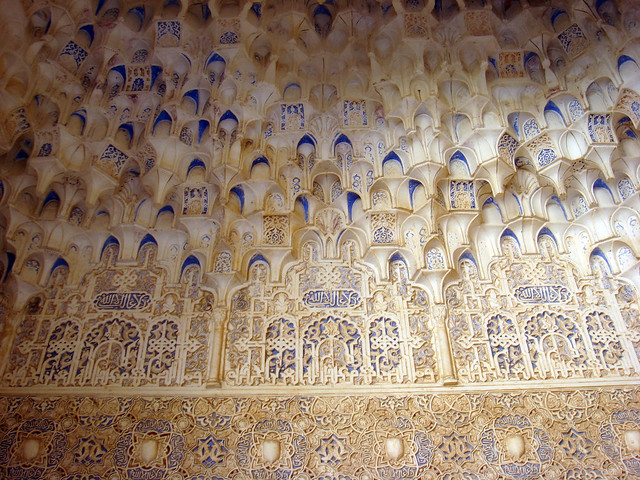
For more than 700 years, from 711 to 1492, there was an Islamic presence in Spain, and for that, in the 21st century, with the legacy of its beautiful architecture, we can only be grateful. After all these years, the stunning buildings with their beautiful interiors still retain the power to beguile, and certainly, the Moorish sights of Andalucía are without doubt, amongst the most beautiful things I’ve ever seen.

From the well-preserved ruins of ancient baths in Granada and Ronda, to the strange and somewhat schizophrenic Mezquita in Córdoba, the sights reach their zenith in the awe-inspiring perfection of the Alhambra palace. The craftsmanship of the Islamic artists responsible for its creation are, I believe, quite without equal, and with every step and every space within, the sense of wonder increases, as if playing pass the parcel where you win every turn, unwrapping an increasingly bigger prize.

Built in the 10th century by Abd ar-Rahman III of Córdoba, the city of Medinat al-Zahra existed for less than a century, when in 1010 it was destroyed during a civil war. In 1911, the ruins were discovered buried beneath the earth and since that time 10 per cent of the site has been uncovered.

Given what we’d seen in the rest of Andalucía, we had high hopes for the ruins. Of course we weren’t expecting another Alhambra or Mezquita – far from it – but what we found was, in our minds, a disaster.

We arrived first at the new visitors centre, a low profile, modern building – all crisp lines and angles – in which we got our free ticket, used the loo and bought fridge magnets. There was, as far as I could see, little else on offer, and it seemed to me that apart from the shop and the toilet, it was little more than a glorified bus stop. It maybe that in hindsight, I’m being particularly unkind, but the very shape of it, its very contemporary feel, all found an unwelcome resonance at the top of the hill, in the ruins of the Medinat al-Zahra.

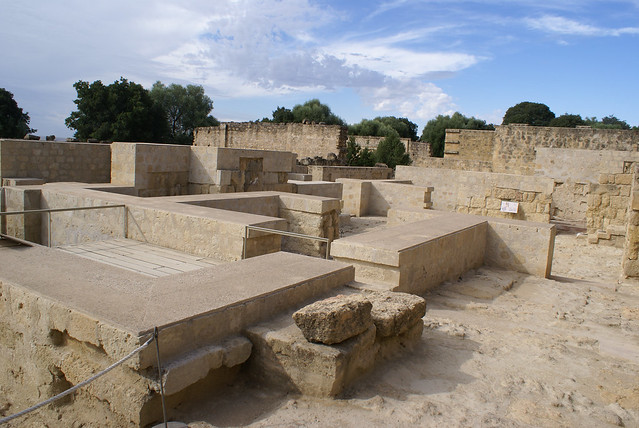
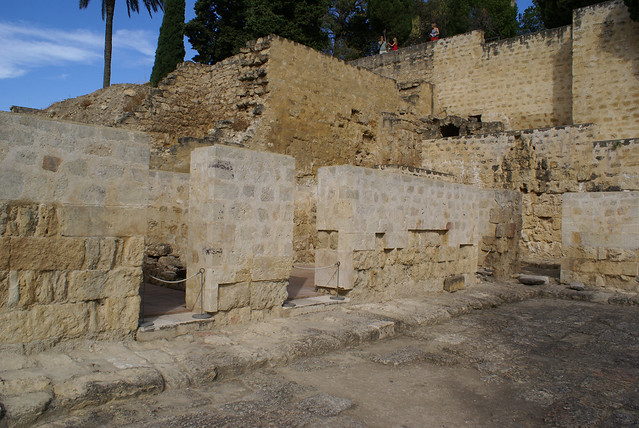
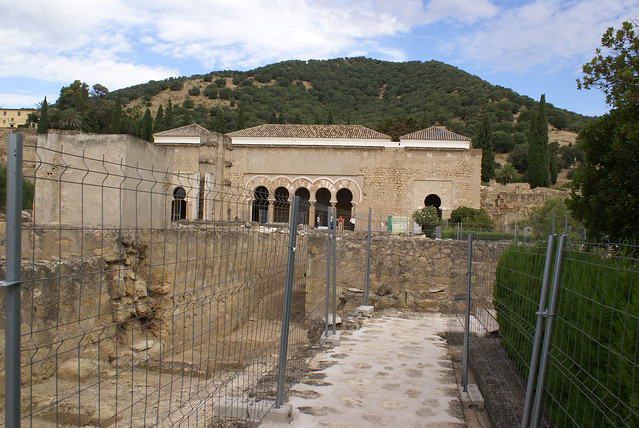
Having arrived on the bus and walked through the gates, we found ourselves with a view of the ruins, and at that moment our hearts sank. Everything was orderly, neat and clean, with far too many straight lines. We walked on, down concrete paths into what remained. The walls had been tidied up and neatened with concrete slabs, so that far from the tumbledown walls peppered with flora which make ruins so special, and which for centuries have delighted artists, writers and philosophers, visitors are presented with a series of modern facsimiles, of, amongst ther things, walls and gates.

Whole parts of the site have been ‘restored’, which is to say destroyed. Ruins of course are by their nature evidence of destruction. What we see in a ruin is the destructive passage of time as well as perhaps evidence of some historic trauma. Of course, the site has to be excavated, and again, by definition, archaeology – to some extent – destroys. But there is a huge difference between excavation and preservation on one hand, and restoration – or rather rebuilding – on the other. What visitors are offered at the site of Medinat al-Zahra isn’t the chance to see with their imaginations what it might have looked like 1000 years ago. Instead we are spoon-fed a vision of what someone else thinks it might have looked like.

On the Andalucía website, the following passage about the ruins speaks volumes:

To visit Madinat al-Zahra today does not mean entering an archaeological site where imagination has to make up for lack of volume. In al-Zahra, the huge amount of fragments found over many years of excavation made the experts seriously consider the question of how to present them. A museum would have meant metres and metres of display cabinets. Finally, it was decided to assemble the pieces of each palace over huge models at a scale of 1:1. This enable today’s visitors to perfectly visualise the setting for the tales of chroniclers and poets of the caliphate’s time.

It is then a model. Nothing more.

This response to what is a very important arcaheological site is rather like taking the recording of a song on a wax cylinder made in the late 19th century and embellishing it with new voices, new instruments and so on. While following the same melody, the new recording will ultimately drown out the original. Instead of listeners using their imaginations to enter the world of the 19th century room where the recording was made, and to hear how the voices would have sounded by using their experience of sound today – and there by doing become a part of that original moment – we get instead, nothing more than a replica.

Perhaps the most deplorable part of the extract from the Andalucía website is the first line: To visit Madinat al-Zahra today does not mean entering an archaeological site where imagination has to make up for lack of volume. It’s as if using one’s imagination is seen as bad, or at best a chore. You don’t have to do any of that here! We do it for you!

Imagining the ruins in our own minds, as they once might have looked, creates the space for us to imagine ourselves there. We’re never going to be able to recreate them as they really were, but that’s not the point. It does become a point however when someone tries to imagine them for us. As Christopher Woodward writes in his book ‘On Ruins’:

“A ruin is a dialogue between an incomplete reality and the imagination of the spectator…”

Furthermore, a city isn’t just a series of streets and buildings, it’s as much about the people who live there, who walk the streets, stand around, looking, chatting, getting on with their everyday lives. With ruins, in particular the ruins of cities, we have not only the fragmentary remains of physical structures, but the fragmentary remains of people – not in terms of their physical remains, i.e. their bones, but their movements.

This movement is bound up with what I call sightlines (and sightlines in turn with movement, for when we observe something, we do so as much with our bodies as our eyes). If you can imagine that when you look at something, the light between you and the thing observed remains once you’ve turned away, then we can imagine that bound up in every fragment within a ruin are hundreds and thousands of these lines.

In Roland Barthes’ Camera Lucida, we read:

“From a real body, which was there, proceed radiations which ultimately touch me, who am here; the duration of the transmission is insignificant; the photograph of the missing being as Sontag says, will touch me like the delayed rays of a star. A sort of umbilical cord links the body of the photographed thing to my gaze – light though impalpable, is here a carnal medium, a skin I share with anyone who has been photographed.”

When I look at the stones of a ruin, I’m sharing a similar skin with everyone who’s seen it.

In his novel Invisible Cities, the writer Italo Calvino writes of a city:

“Something runs among them, an exchange of glances like lines that connect one figure with another and draws arrows, stars, triangles, until all combinations are used up in a moment…”

In another extract:

“…there runs an invisible thread that binds one living being to another for a moment, then unravels, then is stretched again between moving points as it draws new and rapid patterns…”

Every place contains remanants of these threads which we can then pick up, and when we pick them up, we become for a moment part of one of these long since vanished patterns.

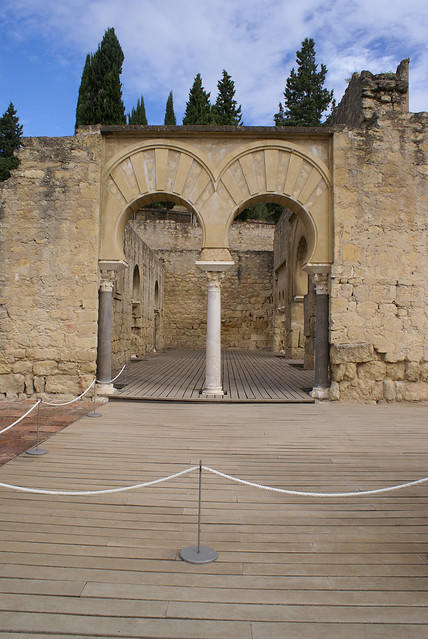
The picture below shows a reconstructed arch at the site.

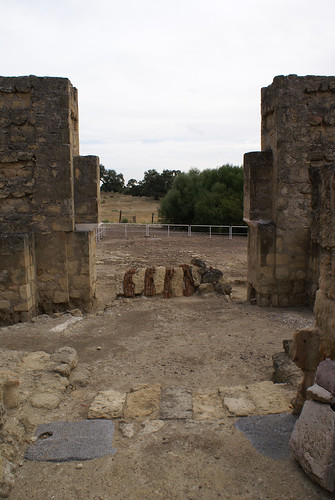
The following shows an arch which hasn’t been (completely) rebuilt, part of which still rests on the ground.

When I look at the remains on the ground, I imagine the sightlines associated with them. I imagine the people who would have looked at the arch every day – at those very stones lying on the ground. And by looking up at the gap where it once was, my body in some way mirrors that of the person looking centuries ago. The sightlines, as if they’re strings, become taut, and for a split second, a moment in the distant past is recovered. Part of a pattern (as Calvino describes) is restored; the dead light piled on the ground lives again.

A few years ago I described my view of history in terms of the cloning of dinosaurs in the film Jurassic Park. I explained how I took what fragments remained of a particular time or event (for example the old stones of a ruin) and filled the gaps with my embodied imagination. Embodied imagination in this instance, is an imagination anchored in the real world – in the sensory world around us. People in the past knew how it felt to feel the wind on their face; they saw the same sky and the clouds. They knew how it felt to have a body. In other words, it’s not a pure flight of fancy. It is just as Christopher Woodward explained – a dialogue. Not a monologue. We are not being dictated to by the ruins, and we are not dictating to them. Instead we are talking together, and it’s in this conversation that we find an authentic view of the vanished past.

At the Medinat al-Zahra however, what we experience is a monologue, but one which is spoken not by the ruins – but by those who have chosen to rebuild it. The gaps in the ‘DNA’ are filled not by our imaginations, but by concrete. Imagine a conversation between two people, with a third person – quite unknown to the others – shouting over the top of them. That is what it’s like here.

Filed Under: Uncategorized Tagged With: Barthes, Christopher Woodward, Italo Calvino, Ruins, Spain, Stars

Sculpture

June 2, 2010 by Nicholas Hedges

I am not, at least as far as I’m aware, a sculptor, but I think that what I’m striving to articulate in my work has perhaps more to do with sculpture than anything else. The following statements, from the book ‘Figuring it Out,’ by archaeologist Colin Renfrew were made by the sculptor Antony Gormley.

“I want to confront existence. It is obviously going to mean more if I use my own body… I turn to the body in an attempt to find a language that will transcend the limitations of race, creed and language, but which will be about the rootedness of identity… The body is a moving sensor. I want the body to be a sensing mechanism, so your response to the work does not have to be pre-informed and does not necessarily encourage discourse… If my subject is being, somehow I have to manage to engage the whole being of the viewer.”

“My body contains all possibilities. What I am working towards is a total identification of all existence with my point of contact with the material world: my body… Part of my work is to give back immanence both to the body and art.”

The last sentence particularly resonates with me, for part of the purpose of my work is I think to give back immanence to the past and to history, something which I have come to realise can only come about through the immanence of the body – the ‘moving sensor,’ which I have otherwise described as being like the recording/playback head of a tape player.

We are all familiar with the body-casts of Pompeii; men, women and children frozen at the moment of their death almost 2000 years ago. Buried in ash, the spaces which had once contained their bodies remained after the bodies had decomposed, allowing archaeologists, to use them as moulds by pouring plaster into the cavities. It was whilst reading about the casts in Colin Renfrew’s book ‘Figuring it Out’ that I began to think of the process of casting in terms of what I’ve been researching these past few years.

If we stand in a place, for example a wood, we can try to imagine those who’ve been there before us. By being aware of the moment of our own experience, of the wind, the light, the sound of the trees and so on, we can try to see the past through the immanent lens of the present. In a previous entry ‘An Archaeology of the Moment,’ I mentioned the writing of Christopher Tilley and the concept of Other and whilst reading Colin Renfrew’s book I realised how the process of creating the casts in Pompeii shared something with what I’ve been researching, albeit metaphorically.

If we stand in a place, we are defined not only by the shape of our bodies (our physiognomy), but by everything around us. To recap, as Tilley writes: “The painter sees the tree and the trees see the painter… in a manner comparable to that in which the mirror ‘sees’ the painter: that is, the trees, like the mirror, let him become visible: they define a point of view on him which renders visible for him something that otherwise would remain invisible – his outside, his physiognomy, his carnal presence… The trees and mirror function as Other.”

Just as the trees function as ‘Other’ therefore, so must the sun, the stars, the clouds, hills, mountains, the sea, rivers, the wind, the rain and so on.

Imagine that all these things, in the place where once someone stood are – metaphorically speaking – like the ash of Pompeii, in that the shape of the person’s body is somehow sculpted by them. Of course this shape is fleeting, but imagine again that it remains, delineated by the world around it. In order to ‘see’ the shape, we must learn to fill it, not, of course, with plaster but with our own bodies or rather our presence.

At any given moment, we are sculpted by the world around us. We are both looking for and filling in the gaps left by others. We are therefore artists, artwork and viewer simultaneously.

Imagine these two situations: One, you are standing in a gallery in front of a landscape painting, a picture of a wood with no-one in it. Two, you are standing on a path in a wood that is empty and in this wood, the trees and the wind blowing through the branches, the feel of your feet upon the ground, the sound of the birds, the dappled light and shadows all act as ‘Other’ rendering your outside – your presence – visible. The gallery too is empty, but like the wood, you are far from alone, for just as the painting also acts as ‘Other’ in terms of rendering your presence visible, so the spaces left by those ‘rendered’ before are made visible again by your presence; not least the space left by the artist. And after the artist come the spaces left by everyone who’s seen the painting before you, and in the woods the same is true; although there maybe no-one else on the path, the spaces left by everyone who’s ever walked upon it are filled with your presence; the present fills the spaces of the past.

Having found Antony Gormley’s words so interesting, I read the transcript of an interview between himself (AG) and Ernst Gombrich (EG). The following are sections which I found to be particularly pertinent.

AG I want to start where language ends.
EG But you want in a sense to make me feel what you feel.
AG But I also want you to feel what you feel. I want the works to be reflexive. So it isn’t simply an embodiment of a feeling I once had.
EG It’s not the communication.
AG I think it is a communication, but it is a meeting of two lives.

In many respects this conversation above reflects precisely what I am trying to do: to feel the way people felt in the past by feeling what I myself am feeling. It is the meeting of two lives.

AG I would be interested to know whether you feel that it is possible to convey a notion of embodiment without mimesis, without having to describe , for instance, movement or exact physiognomy?
EG I have no doubt that not only is it possible but it happens in our response to mountains, for example, we lend them our bodies.

–

AG I can’t be inside anyone else’s body so it’s very important that I use my own. And each piece comes from a unique moment in time. The process is simply the vehicle by which the event is captured, but it is very important to me that it’s my body.

–

AG I am interested in something that one could call the collective subjective. I really like the idea that if something is intensely felt by one individual that intensity can be felt, even if the precise cause of the intensity is not recognised. I think that is to do with the equation I am trying to make between an individual, highly personal experience and the very objective thing – a thing in the world amongst other things.

–

AG Then I go into the second stage which is making a journey from this very particularised moment to a more universal one.

–

As I’ve written before: In a famous definition of the Metaphysical poets (a group of 17th century British poets including John Donne), Georg Lukács, philosopher and literary critic, described their common trait of ‘looking beyond the palpable’ whilst ‘attempting to erase one’s own image from the mirror in front so that it should reflect the not-now and not-here.’ Thinking in terms of the metaphor I have described above (the trees and mirror function as Other), we could say that this erasing of one’s image is an attempt to see the space left behind us. I have also written in the past how history necessitates the consideration of our own non-existence; this space also reflects that state.

Filed Under: Archaeology, Trees Tagged With: Antony Gormley, Archaeology, Art, Georg Lukacs, John Donne, Pompeii, Sculpture, Stars

Umbilical Light

March 14, 2008 by Nicholas Hedges

In ‘Camera Lucida,’ Roland Barthes asks whether history is not simply that time when we were not born? He writes:

“I could read my non-existence in the clothes my mother had worn before I can remember her.”

The study of history necessitates the consideration of our own non-existence. To imagine a past event, as it was before our birth, requires us to see that event without knowledge of what was to come, much as how we don’t know what is coming tomorrow. But to imagine our non-existence, our being not-yet-born, becomes in our conscious minds nothing less than the image of death; such is why perhaps we struggle to comprehend the past, to look upon a turn of the century photograph, where our coming-into-being is so precarious.

Looking at photographs of Oxford, taken around the beginning of the 20th century (such as that below taken in Cornmarket in 1907), I can’t help imagine that somehow, amongst the numbers pictured, are some of my ancestors, or, failing that, someone they at least knew. Perhaps there might be someone unknown to them, who nevertheless crossed their path and in some small way (or, in the case of my own coming-into-being, no small way) made an impact on their life and indeed on all those to come.

But then of course, by thinking this, I am doing just what I shouldn’t do when trying to properly understand this image or rather this moment in time. I am placing upon it the weight of future history. But when I recognise the buildings in the picture, how can I take myself ‘out of the frame’ altogether? Is it not impossible?

Is history then not simply the study of the past, but rather the study of how we got here today? A study of pathways, intersections and the spaces in between – a form of cartography? Well, it is and it isn’t. To study an event we must discover what really happened, and what could have happened if things had been different, what might its protagonists have done otherwise? History therefore – through these other possible outcomes – requires us to examine our own fragility, our unlikely selves and the possibility of our never being born to ask the questions at all.

At the moment the photograph above was taken, when all those pictured were going about the business of their lives, the chance of my Being was practically nil. Now, as I look at the photograph I know that everyone pictured is dead; I can read my own non-existence in the clothes they are wearing, just as they might have read theirs in the photograph itself. But here we have a difference between not-Being and being dead and the photograph is an illustration of that very thing.

Susan Sontag wrote:

“From a real body, which was there, proceed radiations which ultimately touch me, who am here; the duration of the transmission is insignificant; the photograph of the missing being as Sontag says, will touch me like the delayed rays of a star. A sort of umbilical cord links the body of the photographed thing to my gaze – light though impalpable, is here a carnal medium, a skin I share with anyone who has been photographed.”

When we look at a star in the night sky, we can be assured that in most cases, the light which hits our eye, is at least hundreds of years old. It might even be that the star no longer exists, yet we can be certain that it did exist. The same can be said of those we see in the photograph; somehow the light as Sontag writes is like the delayed rays of a star – an umbilical cord which links us with them and vice-versa (if any of those pictured are indeed my ancestors, then the metaphor becomes more vivid). The moment the light left them (and the star), we did not exist; the moment we received it, they did not exist, and yet here we both are and here we have been.

This umbilical light, which springs from each of us, links us to our own non-existence. History is indeed a study of pathways, intersections and the spaces inbetween, and these pathways are made of light.

Filed Under: Oxford Tagged With: Barthes, Oxford, Stars, Susan Sontag, Vintage Photographs

© Nicholas Hedges 2024

  • Facebook
  • Instagram
  • Twitter
  • YouTube

Copyright © 2025 · Outreach Pro on Genesis Framework · WordPress · Log in