Nicholas Hedges

Art, Writing and Research

  • Amazon
  • Behance
  • Facebook
  • Instagram
  • Pinterest
  • YouTube
  • Art
    • Digital
    • Drawing
    • Grids
      • Correspondence
      • The Wall
      • The Tourist
    • Ink on paper
      • Shadow Calligraphy
    • Installation
      • Murder
      • Echo
    • Painting
    • Patterns
    • Mixed Media
    • Photographic installation
      • St. Giles Fair 1908
      • Cornmarket 1907
      • Headington Hill 1903
      • Queen Street 1897
    • Research/Sketches
    • Stitched Work
      • Missded 1
      • Missded 2
      • Missded 3
      • Missded 4
    • Text Work
  • Blogs
    • Family History
    • Goethean Observations
    • Grief
    • Light Slowed But Never Stilled
    • Lists
    • Present Empathy
    • Shadow Calligraphy
    • Trees
    • Time
    • Walking Meditations
  • Video
  • Photography
    • Pillars of Snow
    • Creatures
    • The Trees
    • Snow
    • St. Giles Fair 1908
    • Cornmarket 1907
    • Headington Hill 1903
    • Queen Street 1897
    • Travel
  • Illustration and Design
  • Music
  • Projects
    • Dissonance and Rhyme
    • Design for an Heirloom
    • Backdrops
    • Shadow Calligraphy
  • Exhibitions
    • A Line Drawn in Water
      • Artwork
    • A Line Drawn in Water (Blog)
    • Mine the Mountain 3
      • Artwork
    • Mine the Mountain 2
      • Artwork
      • The Wall
    • The Woods, Breathing
      • Artwork
    • Snow
      • Artwork
    • Echo
      • Artwork
    • Murder
      • Artwork
    • The Tourist
    • Dreamcatcher
    • Mine the Mountain
      • Artwork
      • The Tourist
    • M8
    • The Gate
    • Creatures
      • Artwork
    • Residue
      • Artwork
    • A visit to Auschwitz
      • Artwork
  • Me
    • Artist’s Statement

The Putting Green

January 24, 2015 by Nicholas Hedges

When I was a child, we would often go as a family to Swanage for our holidays, usually accompanied by my Nan and Grandad. I have wonderful memories of those times; sudden storms on the beach, the amusement arcade (from which my Nan was asked to leave after a mild-mannered contretemps with the change machine), evening milkshakes in Fortes, preceded by putting on the putting green (pictured below).
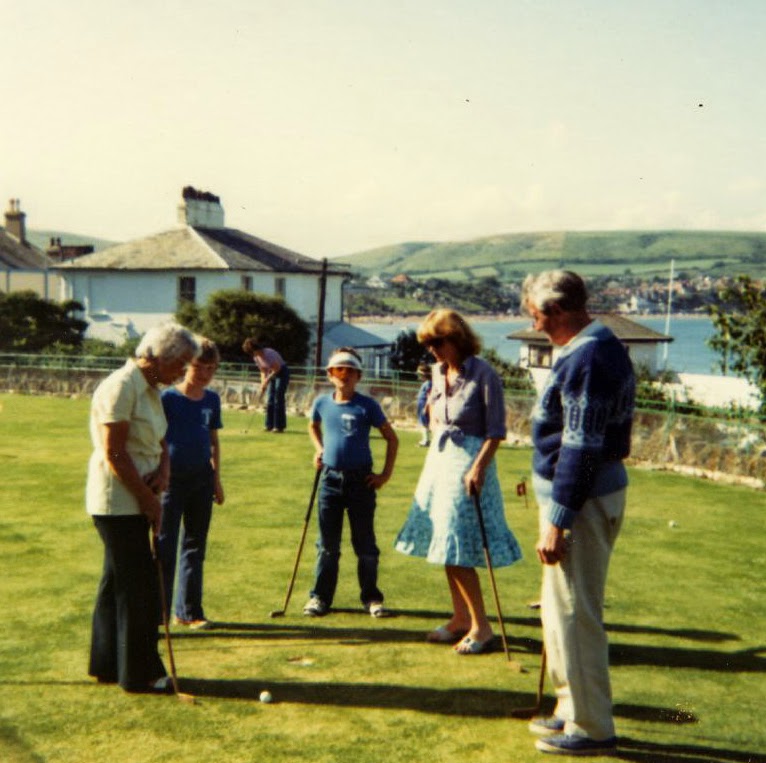
Putting in Swanage c1980

I loved putting and it was during a conversation in the office about Swanage that I wondered where exactly the putting green was. So often with memories, an event’s location slips anchor and drifts away, bumping up against other unassociated memories.

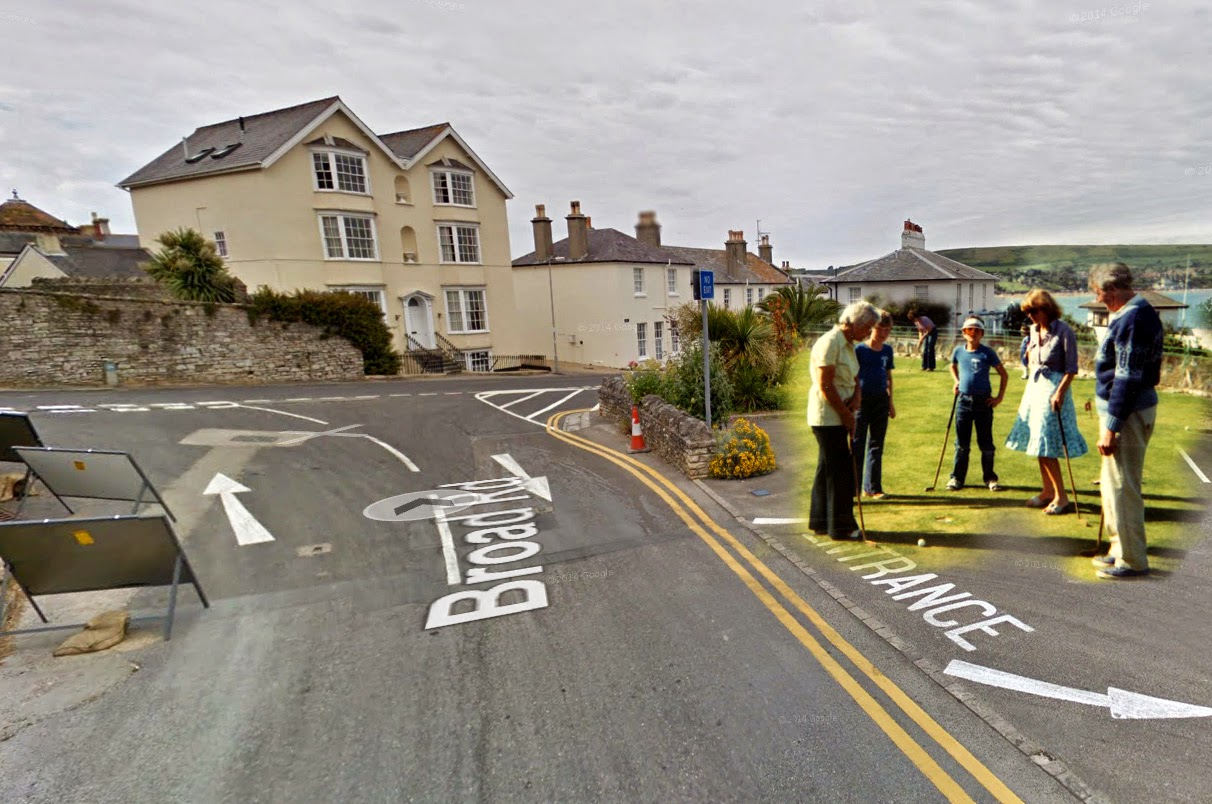
Using Google Streetview, I ‘went for a walk’ through the town centre, past the amusement arcade and what had been Fortes and, using the house in the background of the above photograph, arrived at what had been the putting green.

It was a putting green no more.
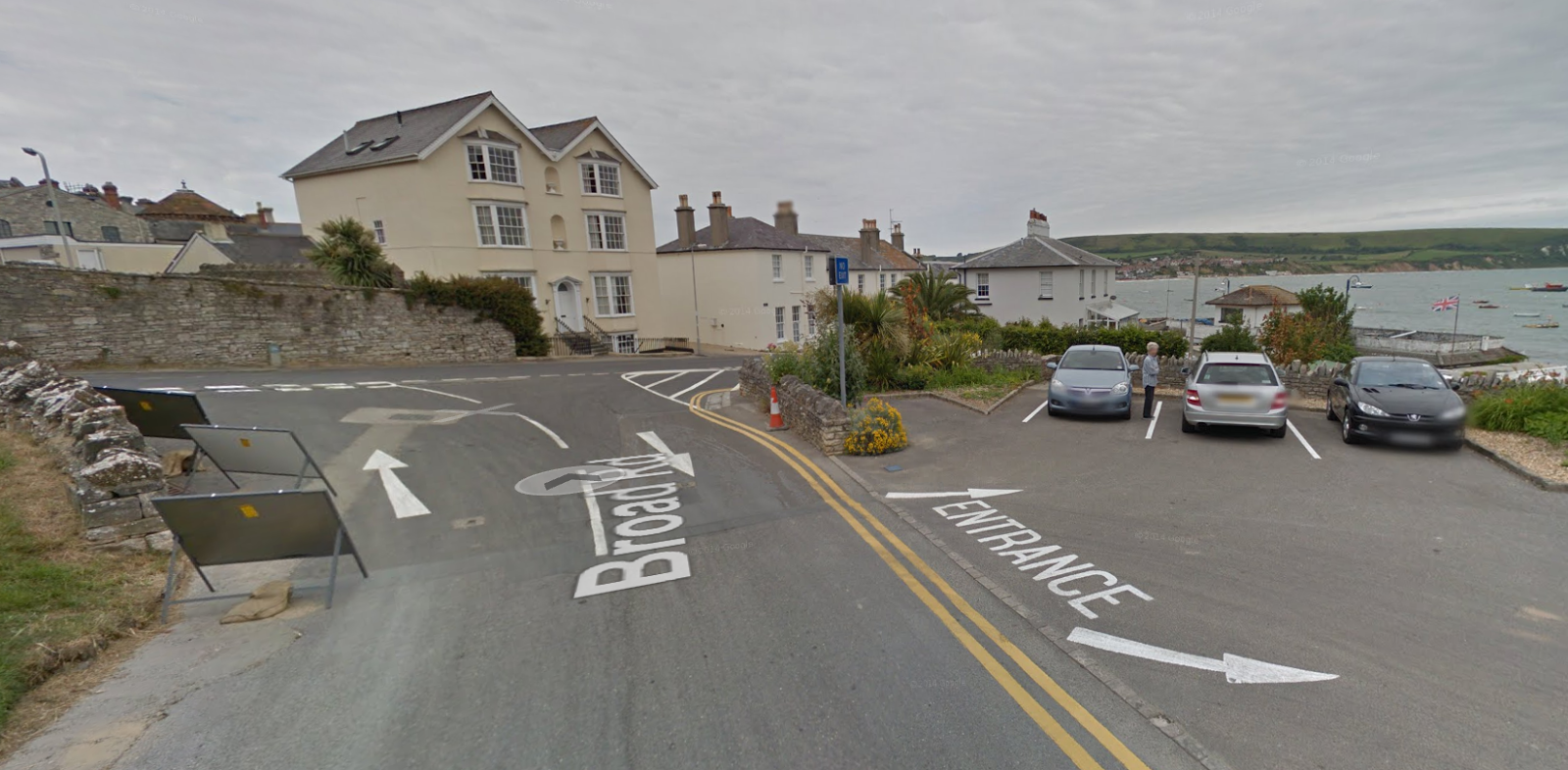
Google Streetview showing the location of the putting green today

It’s disconcerting, coming face to face with your past in the form of a ruin, or covered – as above – in tarmac. Suddenly, the way in which I visualise the far-distant past becomes the means by which I see my own.
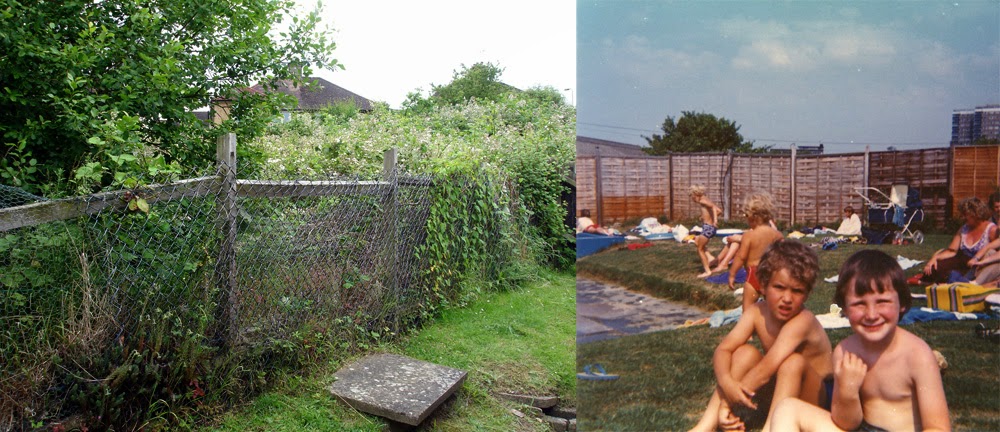
I found the same on a visit to my first school, when I saw how the swimming pool had become an overgrown ruin.
Filed Under: Uncategorized Tagged With: Childhood, Holidays, Memory, Putting, Ruins, Swanage, Then and Now

The Ruined Ruins of Madinat Al-Zahra

September 29, 2010 by Nicholas Hedges

For more than 700 years, from 711 to 1492, there was an Islamic presence in Spain, and for that, in the 21st century, with the legacy of its beautiful architecture, we can only be grateful. After all these years, the stunning buildings with their beautiful interiors still retain the power to beguile, and certainly, the Moorish sights of Andalucía are without doubt, amongst the most beautiful things I’ve ever seen.

From the well-preserved ruins of ancient baths in Granada and Ronda, to the strange and somewhat schizophrenic Mezquita in Córdoba, the sights reach their zenith in the awe-inspiring perfection of the Alhambra palace. The craftsmanship of the Islamic artists responsible for its creation are, I believe, quite without equal, and with every step and every space within, the sense of wonder increases, as if playing pass the parcel where you win every turn, unwrapping an increasingly bigger prize.

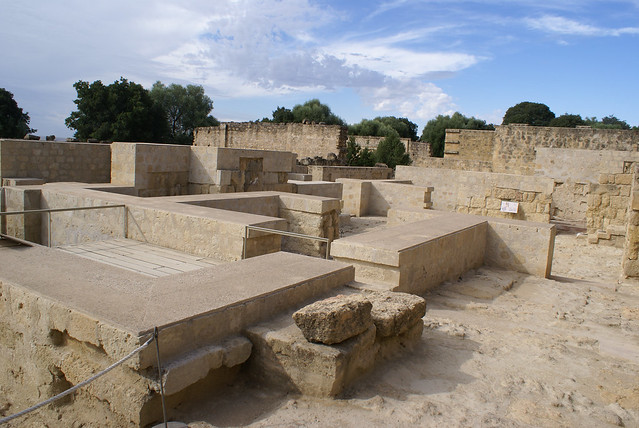
Built in the 10th century by Abd ar-Rahman III of Córdoba, the city of Medinat al-Zahra existed for less than a century, when in 1010 it was destroyed during a civil war. In 1911, the ruins were discovered buried beneath the earth and since that time 10 per cent of the site has been uncovered.

Given what we’d seen in the rest of Andalucía, we had high hopes for the ruins. Of course we weren’t expecting another Alhambra or Mezquita – far from it – but what we found was, in our minds, a disaster.

We arrived first at the new visitors centre, a low profile, modern building – all crisp lines and angles – in which we got our free ticket, used the loo and bought fridge magnets. There was, as far as I could see, little else on offer, and it seemed to me that apart from the shop and the toilet, it was little more than a glorified bus stop. It maybe that in hindsight, I’m being particularly unkind, but the very shape of it, its very contemporary feel, all found an unwelcome resonance at the top of the hill, in the ruins of the Medinat al-Zahra.

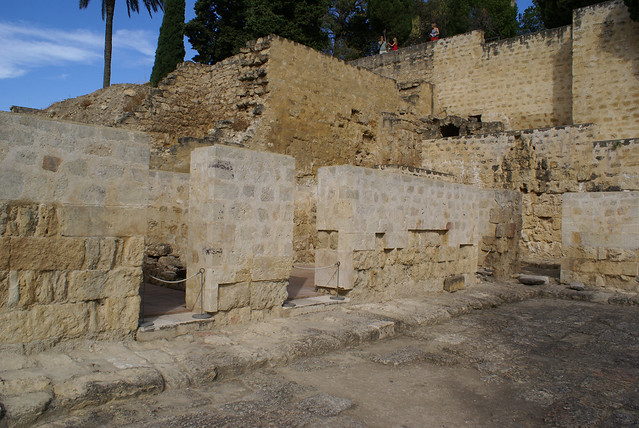
Having arrived on the bus and walked through the gates, we found ourselves with a view of the ruins, and at that moment our hearts sank. Everything was orderly, neat and clean, with far too many straight lines. We walked on, down concrete paths into what remained. The walls had been tidied up and neatened with concrete slabs, so that far from the tumbledown walls peppered with flora which make ruins so special, and which for centuries have delighted artists, writers and philosophers, visitors are presented with a series of modern facsimiles, of, amongst ther things, walls and gates.

Whole parts of the site have been ‘restored’, which is to say destroyed. Ruins of course are by their nature evidence of destruction. What we see in a ruin is the destructive passage of time as well as perhaps evidence of some historic trauma. Of course, the site has to be excavated, and again, by definition, archaeology – to some extent – destroys. But there is a huge difference between excavation and preservation on one hand, and restoration – or rather rebuilding – on the other. What visitors are offered at the site of Medinat al-Zahra isn’t the chance to see with their imaginations what it might have looked like 1000 years ago. Instead we are spoon-fed a vision of what someone else thinks it might have looked like.

On the Andalucía website, the following passage about the ruins speaks volumes:

To visit Madinat al-Zahra today does not mean entering an archaeological site where imagination has to make up for lack of volume. In al-Zahra, the huge amount of fragments found over many years of excavation made the experts seriously consider the question of how to present them. A museum would have meant metres and metres of display cabinets. Finally, it was decided to assemble the pieces of each palace over huge models at a scale of 1:1. This enable today’s visitors to perfectly visualise the setting for the tales of chroniclers and poets of the caliphate’s time.

It is then a model. Nothing more.

This response to what is a very important arcaheological site is rather like taking the recording of a song on a wax cylinder made in the late 19th century and embellishing it with new voices, new instruments and so on. While following the same melody, the new recording will ultimately drown out the original. Instead of listeners using their imaginations to enter the world of the 19th century room where the recording was made, and to hear how the voices would have sounded by using their experience of sound today – and there by doing become a part of that original moment – we get instead, nothing more than a replica.

Perhaps the most deplorable part of the extract from the Andalucía website is the first line: To visit Madinat al-Zahra today does not mean entering an archaeological site where imagination has to make up for lack of volume. It’s as if using one’s imagination is seen as bad, or at best a chore. You don’t have to do any of that here! We do it for you!

Imagining the ruins in our own minds, as they once might have looked, creates the space for us to imagine ourselves there. We’re never going to be able to recreate them as they really were, but that’s not the point. It does become a point however when someone tries to imagine them for us. As Christopher Woodward writes in his book ‘On Ruins’:

“A ruin is a dialogue between an incomplete reality and the imagination of the spectator…”

Furthermore, a city isn’t just a series of streets and buildings, it’s as much about the people who live there, who walk the streets, stand around, looking, chatting, getting on with their everyday lives. With ruins, in particular the ruins of cities, we have not only the fragmentary remains of physical structures, but the fragmentary remains of people – not in terms of their physical remains, i.e. their bones, but their movements.

This movement is bound up with what I call sightlines (and sightlines in turn with movement, for when we observe something, we do so as much with our bodies as our eyes). If you can imagine that when you look at something, the light between you and the thing observed remains once you’ve turned away, then we can imagine that bound up in every fragment within a ruin are hundreds and thousands of these lines.

In Roland Barthes’ Camera Lucida, we read:

“From a real body, which was there, proceed radiations which ultimately touch me, who am here; the duration of the transmission is insignificant; the photograph of the missing being as Sontag says, will touch me like the delayed rays of a star. A sort of umbilical cord links the body of the photographed thing to my gaze – light though impalpable, is here a carnal medium, a skin I share with anyone who has been photographed.”

When I look at the stones of a ruin, I’m sharing a similar skin with everyone who’s seen it.

In his novel Invisible Cities, the writer Italo Calvino writes of a city:

“Something runs among them, an exchange of glances like lines that connect one figure with another and draws arrows, stars, triangles, until all combinations are used up in a moment…”

In another extract:

“…there runs an invisible thread that binds one living being to another for a moment, then unravels, then is stretched again between moving points as it draws new and rapid patterns…”

Every place contains remanants of these threads which we can then pick up, and when we pick them up, we become for a moment part of one of these long since vanished patterns.

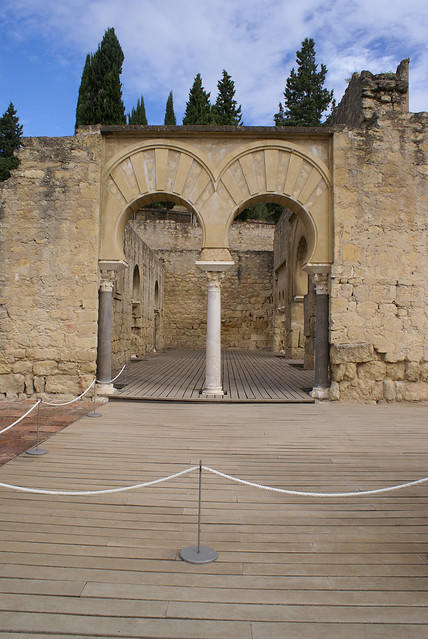
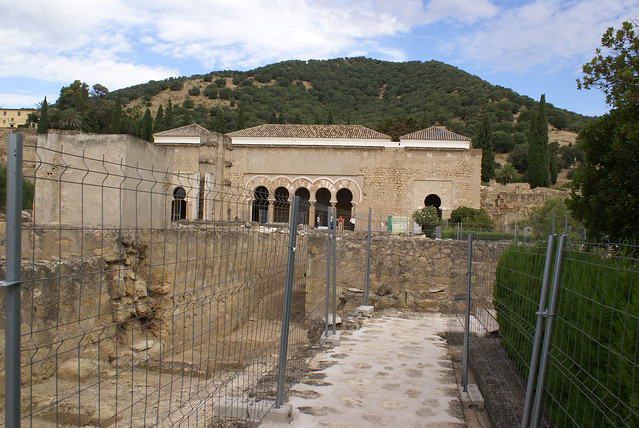
The picture below shows a reconstructed arch at the site.

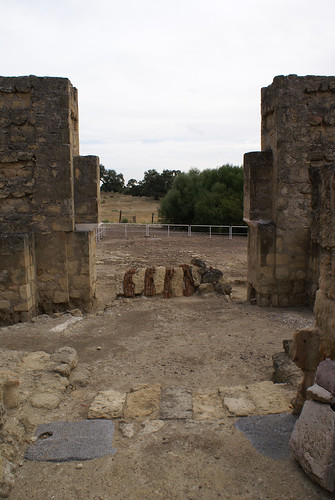
The following shows an arch which hasn’t been (completely) rebuilt, part of which still rests on the ground.

When I look at the remains on the ground, I imagine the sightlines associated with them. I imagine the people who would have looked at the arch every day – at those very stones lying on the ground. And by looking up at the gap where it once was, my body in some way mirrors that of the person looking centuries ago. The sightlines, as if they’re strings, become taut, and for a split second, a moment in the distant past is recovered. Part of a pattern (as Calvino describes) is restored; the dead light piled on the ground lives again.

A few years ago I described my view of history in terms of the cloning of dinosaurs in the film Jurassic Park. I explained how I took what fragments remained of a particular time or event (for example the old stones of a ruin) and filled the gaps with my embodied imagination. Embodied imagination in this instance, is an imagination anchored in the real world – in the sensory world around us. People in the past knew how it felt to feel the wind on their face; they saw the same sky and the clouds. They knew how it felt to have a body. In other words, it’s not a pure flight of fancy. It is just as Christopher Woodward explained – a dialogue. Not a monologue. We are not being dictated to by the ruins, and we are not dictating to them. Instead we are talking together, and it’s in this conversation that we find an authentic view of the vanished past.

At the Medinat al-Zahra however, what we experience is a monologue, but one which is spoken not by the ruins – but by those who have chosen to rebuild it. The gaps in the ‘DNA’ are filled not by our imaginations, but by concrete. Imagine a conversation between two people, with a third person – quite unknown to the others – shouting over the top of them. That is what it’s like here.

Filed Under: Uncategorized Tagged With: Barthes, Christopher Woodward, Italo Calvino, Ruins, Spain, Stars

In Ruins

February 28, 2010 by Nicholas Hedges

“A ruin is a dialogue between an incomplete reality and the imagination of the spectator.”

Christopher Woodward, In Ruins

Photograph of Corfe Castle taken during a school trip in 1983.

I first visited Corfe Castle in the summer of 1978 whilst on holiday with my family. I was 7 at the time. I can remember a postcard commemorating the murder of Edward the Martyr (reigned 975-978) a 1000 years before. It’s the first historic place which really captured my imagination, and ever since my mind’s been in thrall to the past. The idea of a 1000 years ago seemed – as it does now – impossible, and in the museum below, in the village of Corfe, I remember staring at a cannon ball dating from the English Civil War, trying in my mind’s eye to picture it, as it was at the time of the siege, moving through the air.

Photograph of me and my brother at Corfe Castle c.1980.

Filed Under: Photography Tagged With: Christopher Woodward, Corfe Castle, Family History, Photographs, Ruins

Back to my First School

June 20, 2009 by Nicholas Hedges

Today, my brother Simon and I took a trip down memory lane and visited New Marston First School which had opened its doors as part of its anniversary celebrations. The school had opened in 1949 and 27 years later, in 1976 I began my time there, leaving four years later to attend Northway Middle school. Simon had started three years earlier than me and it was hard to believe that some 30 years and more had passed since that time. I can still recall quite clearly my time at nursery (a stone’s throw away) and my first visit to the school when I was four years old. I’d made a picture of a lamb with polystyrene balls – or rather out of polystyrene balls I should perhaps say. And so there I was today, almost ten times the age I’d be when I first walked through the gates; if I was to return ten times my current age I’d be getting on for 400; dead in other words and a little upsetting for the children of 2409.

Almost straight away, as soon as we walked through the gates I began to feel a wave of nostalgia flooding not so much over me, but within me; ‘welling within me’ would perhaps be a better phrase for I could sense the place physically; I could recall walking there as a child. Much of it looks much the same, although of course things have changed, a few new doors, a new bicycle shed (or is it shelter now?) and so on, but essentially little else had been altered. However, after 30 years or more things are bound to be different and nowhere was this more evident than at what had been the swimming pool; a place beloved by my nostalgic mind, but loathed at the time by my feeble little body.

New Marston First School

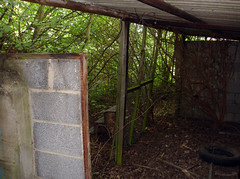
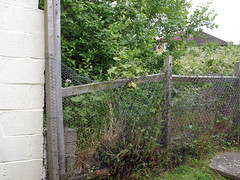
The changing rooms were always, to say the least, basic; sheds (or were they shelters?) comprising holes, breezeblocks and a corrugated roof. They were insubstantial then and just about standing in their decrepitude now, but the pool itself, if anything does remain is now lost in a jungle of trees, brambles and weeds. I couldn’t imagine a scene more different from what I could remember; indeed, if the whole plot had been cleared and a new block built in its place it wouldn’t have seemed as changed. It was shocking to see that part of my childhood had already become in part a ruin – but not just a ruin, rather, one undiscovered in the midst of sprawling vegetation. The swimming pool had become the equivalent – albeit less dramatic – of a Mayan temple lost in a Mexican jungle.

New Marston First School

Nature was reclaiming a part of my childhood, much as it had recovered the graves I’d seen at Highgate cemetery and I was reminded of the words of Walter Benjamin and his concept of ‘Natural History’ which is not, as we might suppose, the history of nature, but rather a term to describe the manner in which the ‘artefacts of human history acquire an aspect of mute, natural being at the point where they begin to lose their place in a viable form of life.’ I’d always thought about this definition in respect to ruins and other monuments of the past, and yet here it was, perfectly illustrated at the remains of a pool in which I used to swim (and in which I’d gained my 10 metre swimming badge).
Standing at the back of the pool and looking into the undergrowth, I could almost hear the sound of the water; I could remember the grey clouds which always seemed to gather whenever it was swim-day. And looking at the backs of the changing rooms, I could see in my mind’s eye, the board on which the temperature was always chalked and which was never above 16oC.

New Marston First School

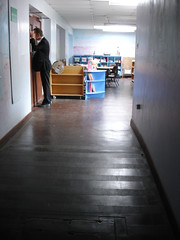
Inside, the school had changed very little. The main hall straight in front was everything I remembered it being – although there was a new floor (the old floor was a brown tiled one with a tennis court marked – for some reason – in tape) but before we could go inside we were greeted and taken to the ‘anniversary display’ in what was, in our day at least, the east-end of the school and a very different place to the west. It has to be said that the display left something to be desired. There were a few documents from the 1950s and 90s, but very little from the 70s which rather surprised me. Still, I was rather more interested in looking around and walking the length of the ‘east-end’ corridor the memories soon returned. But these memories were not so much of specific things but rather a general sense of having been there before a long time ago. They were memories insofar as I could recall images, albeit vague, and could recognise differences (it’s in the differences – what’s not there and what has been added – that memories are perhaps most clearly defined), but these memories were as much physical as cerebral; they were sensations rather than impressions. Now this may not be the time to begin discussing the kinaesthetic nature of memory or the notion of consciousness as corporeal (embodied mind as opposed to a mind/body dualism) but I was interested in how my visit to the school would help me in my recent work with phenomenological perception… but more of that later.

New Marston First School

At the end of the east-end corridor is a small incline on which we used to stand in line to get our dinner. The canteen itself has now been moved (to what was a cloakroom) but looking at the room from the outside I couldn’t get over how small it was. My memories of the canteen have always been of a large room, full of echoes in which hundreds of children sat and ate their food. Looking at it today I could see how my memory had ‘grown’ the interior to match my body in the years that had passed. It was a fraction of the size I’d remembered.
New Marston First School

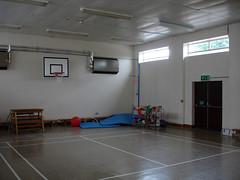
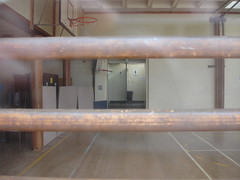
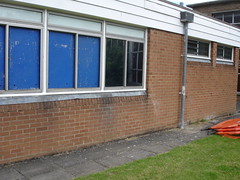
Looking at what is now called the sports hall – opposite what was the canteen – I could see that something was different but couldn’t tell exactly what that something was. Initially, and consciously at least, I thought that nothing much had changed, but a change had been registered somewhere, because when we went outside, I could see straight away that most of the old large windows had been blocked off which answered the question ‘what’s different?’ that had been there all the time.
The more we walked through the school, so more changes became apparent. Where the school had previously been one long corridor, there were now several doors dividing it up. This, I would imagine, has as much to do with fire safety as anything else and called to mind how when we were at school the fire alarm was the headmaster, Mr. Norris, who during drills walked through the school ringing a bell. In the event of a real fire, one imagines he might well have run rather than walked and shouted ‘Fire! Get out! Get out!’ just to be sure.

New Marston First School

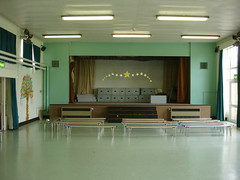
In the main hall, which we’d glimpsed when we first arrived, things – apart from the floor and a scattering of technology – had changed very little. The wall-bars still stood against one of the walls and the stage still stood musing upon my past successes.
New Marston First School

Boy in dressing gown was one notable part. A snake-charmer in Little Mookra another. But the crowning achievement was Prince Florenzel in Snow White. When I was meant to be proclaiming to the audience of my love for Snow White I was indisposed in the toilet. The stone steps leading to the stage (from the toilet) are still as they were; as clear and as sparkly as the memory itself. Indeed, along with these steps, there was a lot that was quite unchanged.

New Marston First School

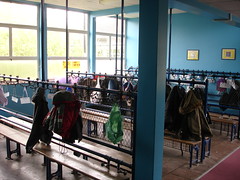
The clothes pegs, benches and shoe-baskets of one of the old cloakrooms were still in place. But it wasn’t so much things still in situ or things that had changed which prompted a rush of memories, as the line we were walking.
New Marston First School

What was most familiar to me as we walked through the school was the shape of the corridor, the shape of the ‘line’ we followed. Therefore, the nostalgia pangs (for want of a better way of putting it) weren’t so much the result of a mental response to the school but also a physical one. Or, to take the argument I alluded to previously, the response was that of an embodied mind; in other words, we don’t remember things in the mind and as a consequence feel a physical response, but rather they are one and the same thing. The recollection isn’t only triggered through our senses (in this case our vision) but by our physical position in a place, by our being in that place; we sense and think with our bodies.
New Marston First School

I felt this particularly strongly in the playground in which there was a notable absence of climbing frames – proper climbing frames that is, with metal bars and concrete underneath. As I walked across the playground to the door which led back into the west-end corridor I found myself ‘physically thinking’ of times associated with my being at the school; my nan’s garden, summer holidays and our house in Coniston Avenue. It wasn’t so much just recalling memories but somehow experiencing them.
After 40 minutes or so we left, and it was a very strange feeling to walk back through the gates, doing something so clearly connected with going home, to where we lived as children. The view up the hill only served to pull the body in that direction.
New Marston First School

Instead however we turned left and walked towards our old Middle School – Northway, which is now something of a community centre; I say something, as from the outside it looks more than a little care-worn. Again, the same pangs of nostalgia took a hold as I walked through the gate, and again these sensations came about as a result of being in that particular place. Seeing a photograph brings back memories, but that is very different to feeling them. In looking at a images of something as it was may bring about visual memories. But being in a place makes them physical
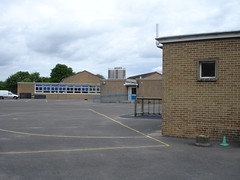
Like the swimming pool at New Marston, I haven’t seen something so fundamentally altered (and which has made such an impact on me) as the playground – or rather, the place where the playground used to be. The whole area including a large piece of land surrounding what was the second year area has now become a small housing development. The problem is that part of the school or community centre or whatever it’s meant to be now appears utterly incongruous.
Northway Middle School

To have a school gym abutting a bungalow is odd at the very least; in terms of my remembering the past and how things used to be it was utterly absurd. Of course things change, but one would have thought that planners could have been a little more imaginative in how the school was incorporated into the development and how in turn the development was incorporated into the school.

Northway Middle School

The gym and the second year classrooms, of which I have very fond memories, looked like a limb tied off from the body of the school, and as a result they appeared lifeless and in need of removal
Northway Middle School

Having left the school and returned to the car we drove past our childhood home in Coniston Avenue. All roads from the two schools we’d visited seemed to take us there but when we drove past we saw clearly how the passage of time could change things, again for the worse. Since my dad left a few years back the house has gradually fallen into a state of disrepair, but this has become a whole lot worse and the house looks on its way to becoming derelict. The fences have gone, the garage is boarded up and most shockingly of all, the large oak tree which played such a part in my childhood, being feature of the small world that I knew and fuelling my imagination has been cut down. We drove past quickly so I didn’t have time to take it all in, but in that split second I found a gap which couldn’t be filled by a hundred years of looking.

Filed Under: Trees Tagged With: Childhood, Memory, Natural History, New Marston, Ruins, Swimming, Walter Benjamin

Long and Flaubert

May 29, 2009 by Nicholas Hedges

From an essay in a Richard Long monograph (The Intricacy of the Skein, the Complexity of the Web: Richard Long’s Art by Paul Moorhouse):

To a large extent however, these works are not seen by anyone apart from the artist and others who happen to come upon them. Not only are they temporary sculptures which behind the process of their assimilation into nature as soon as the artist leaves them, they are also frequently in remote locations.

From Christopher Woodward’s ‘In Ruins’:

As Gustave Flaubert remarked in a letter to a friend in 1846, when he was twenty-five years old:

Yesterday … I saw some ruins, beloved ruins of my youth which I knew already … I thought again about them, and about the dead whom I had never known and on whom my feet trampled. I love above all the sight of vegetation resting upon old ruins; this embrace of nature, coming swiftly to bury the work of man the moment his hand is no longer there to defend it, fills me with deep and ample joy.

Filed Under: Quotes Tagged With: Christopher Woodward, Flaubert, Quotes, Richard Long, Ruins, Useful Quotes

Shadows 2

April 17, 2008 by Nicholas Hedges

Recently I bought ‘The Book of Shadows’ (edited by Jefferey Fraenkel), which I found whilst browsing in Blackwell’s bookshop, a book of found photographs all of which contain the shadow of the photographer along with that which is photographed. It’s something in which I have been interested for some time with some of my own family photographs containing just such shadows.

It called to mind as I flicked through the pages, looking at photographs such as that below, the words of Austerlitz in W.G. Sebald’s book of the same name, in which the character Austerlitz states that fortifications:

“…cast the shadow of their own destruction before them, and are designed from the first with an eye to their later existence as ruins.”

In many respects, the same could be said of any building or even, individuals. We all cast the shadow of our own mortlity before us, and, in respect of what Barthes has written in Camera Lucida (“I observe with horror an anterior future of which death is the stake… I shudder… over a catastrophe which has already occurred. Whether or not the subject is already dead, every photograph is this catastrophe.”) these shadows in these pictures could be said to be just that.

Below is one of the images from the book. There is something poetic about this image in particular, in the way the train tracks lead us to the distance, to the future, almost as if they are there to transport this shadow of the photographer’s own ‘destruction’.

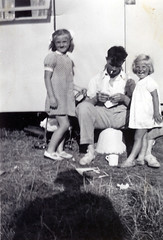
Below is one from my own collection showing my grandfather, my aunt and my mother.

Grandad

Filed Under: Photography Tagged With: Catastrophe, Ruins, Sebald, Shadows, Vintage Photographs

Memory – The Poor Draughtsman II

March 22, 2008 by Nicholas Hedges

Following on from my last entry on the subject (Memory – The Poor Draughtsman) I thought back to the ruined church I saw in Berlin, the Kaiser-Wilhelm Memorial church.

For me, the tower is just what the memory of a building is; a ruin of sorts, one which in part has been reconstructed by the brain to make an image which best approximates reality. Its edges are indistinct, the stone is vague and the fabric a hotchpotch of different materials no doubt rescued from the rubble. Whenever we think of a place we know – for example a building – we build – or rebuild – anew in our minds every time we think of it, constructing the remembered thing from whatever we can find.
The following image is a quick Photoshop sketch which takes the idea of the remembered ruin by blending an old map of Oxford (1750) with the image of the contemporary city as a ruin (aerial view) which I made recently. A more finished piece might leave those buildings still extant intact and blend in fully the areas which have been completely destroyed or altered.

Looking at this, and considering ideas of memory and draughtmanship, I was reminded of the work of Arie A. Galles who has made fourteen large scale drawings of aerial photographs taken over death camps during the second world war. I first discovered his work when studying the death camp at Belzec and have now begun to understand or interpret his work in a different way.

For him, memory is no ruin, it is as sharp as a photograph taken from the skies. But there is it seems a difference between the memory of a place and the memory of people. In the image of Belzec (above) something has been obscured, hidden, buried. It is a piece of text, the fourth verse of the Kaddish; a prayer said for the dead. Perhaps then, we should read this image as a warning, that this place of trauma will always be there, but is victims are gone; there is always the risk it seems of forgetting.
What is also interesting for me about Galles’ work, is the fact the drawings are made using charcoal. There is something about it (something it shares with coal), which gives the drawings of Galles’ extra poignancy; something living, now dead is used to make something new – it creates. I mention coal as I have in light of my work on my family tree, in particular with regards my great-grandfather Elias who worked in the coal mines of South Wales, been considering making drawings using coal. The images of the ruined city, the areial photographs and the black and white photographs I’ve been looking at of people long dead all point to my looking more closely at this idea.

Filed Under: Oxford Tagged With: 18th Century, Arie a Galles, Berlin, Map, Memory, Oxford, Ruins

© Nicholas Hedges 2024

  • Facebook
  • Instagram
  • Twitter
  • YouTube

Copyright © 2025 · Outreach Pro on Genesis Framework · WordPress · Log in