Nicholas Hedges

Art, Writing and Research

  • Amazon
  • Behance
  • Facebook
  • Instagram
  • Pinterest
  • YouTube
  • Art
    • Digital
    • Drawing
    • Grids
      • Correspondence
      • The Wall
      • The Tourist
    • Ink on paper
      • Shadow Calligraphy
    • Installation
      • Murder
      • Echo
    • Painting
    • Patterns
    • Mixed Media
    • Photographic installation
      • St. Giles Fair 1908
      • Cornmarket 1907
      • Headington Hill 1903
      • Queen Street 1897
    • Research/Sketches
    • Stitched Work
      • Missded 1
      • Missded 2
      • Missded 3
      • Missded 4
    • Text Work
  • Blogs
    • Family History
    • Goethean Observations
    • Grief
    • Light Slowed But Never Stilled
    • Lists
    • Present Empathy
    • Shadow Calligraphy
    • Trees
    • Time
    • Walking Meditations
  • Video
  • Photography
    • Pillars of Snow
    • Creatures
    • The Trees
    • Snow
    • St. Giles Fair 1908
    • Cornmarket 1907
    • Headington Hill 1903
    • Queen Street 1897
    • Travel
  • Illustration and Design
  • Music
  • Projects
    • Dissonance and Rhyme
    • Design for an Heirloom
    • Backdrops
    • Shadow Calligraphy
  • Exhibitions
    • A Line Drawn in Water
      • Artwork
    • A Line Drawn in Water (Blog)
    • Mine the Mountain 3
      • Artwork
    • Mine the Mountain 2
      • Artwork
      • The Wall
    • The Woods, Breathing
      • Artwork
    • Snow
      • Artwork
    • Echo
      • Artwork
    • Murder
      • Artwork
    • The Tourist
    • Dreamcatcher
    • Mine the Mountain
      • Artwork
      • The Tourist
    • M8
    • The Gate
    • Creatures
      • Artwork
    • Residue
      • Artwork
    • A visit to Auschwitz
      • Artwork
  • Me
    • Artist’s Statement

Glimmerings: The War Poets, Paths and Folds

October 16, 2012 by Nicholas Hedges

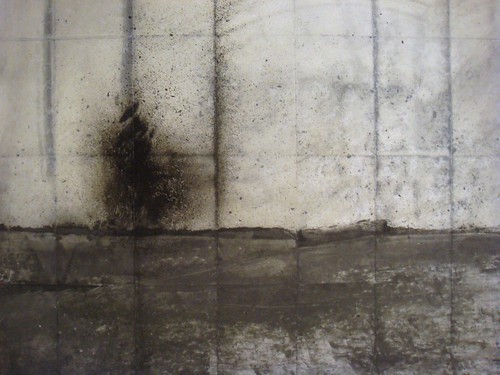
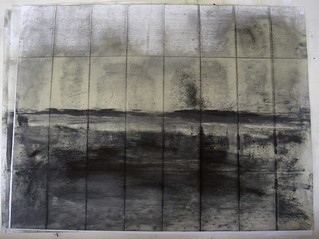
One of the nicest compliments I received during Friday’s private view was ‘…these remind me of Siegfried Sassoon…’. The works in question were those images of imagined World War I landscapes painted onto folded paper, one of which I have shown below:
DSC07879

In fact, the war poets were brought up a number of times in relation to these works which – for obvious reasons – pleased me enormously. But, I wondered what it was about these pieces which called to mind the poets?

One of the poets I’ve become increasingly interested in, is Edward Thomas – killed at the battle of Arras in 1917. I first became aware of his work whilst reading a book of World War I poetry, in which I found his poem ‘Roads’ (a poem I’ve already discussed in relation to my work). It was then in Robert Macfarlane’s book ‘Wild Places’ that I encountered Thomas again, this time in relation to another poet, Ivor Gurney. In a previous blog I wrote:

After returning from the war, Ivor Gurney, like so many others suffered a breakdown (he’d suffered his first in 1913) and a passage in Macfarlane’s book, which describes the visits to Gurney – within the Dartford asylum – by Helen Thomas, the widow of Edward Thomas is particularly moving. Helen took with her one of her husband’s Ordnance survey maps of Gloucestershire:

‘She recalled afterwards that Gurney, on being shown the map, took it at once from her, and spread it out on his bed, in his hot little white-tiled room in the asylum, with the sunlight falling in patterns upon the floor. Then the two of them kneeled together by the bed and traced out, with their fingers, walks that they and Edward had taken in the past.’

Macfarlane discusses Thomas in another book, ‘The Old Ways: A Journey on Foot,’ in which he writes how for Thomas, paths “connected real places but… also led outwards to metaphysics, backwards to history and inwards to the self. These traverses – between the conceptual, the spectral and the personal – occur often without signage in his writing, and are among its most characteristic events. He imagined himself in topographical terms. Corners, junctions, stiles, fingerposts, forks, crossroads, trivia, beckoning over-the-hill paths, tracks that led to danger, death or bliss: he internalized the features of path-filled landscapes such that they gave form to his melancholy and his hopes. Walking was a means of personal myth-making, but it also shaped his everyday longings: he not only thought on paths and of them, but also with them.”
DSC07578

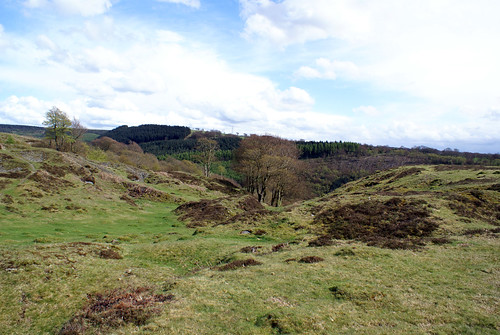
Ever since I walked a path in Wales on which I knew my great-great grandfather walked every day to the mine in which he worked, I’ve been interested in the idea of people as place (and vice-versa) – see Landscape DNA – the simultaneity of stories so far. The path from the small town of Hafodyrynys to Llanhilleth where he worked, not only connected those two places, it also connected me with my ancestor. It did just what Thomas suggested; connected real places but also went backwards to the past and inwards to my own self. As Macfarlane puts it: “paths run through people as surely as they run through places.”

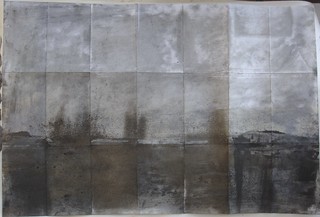
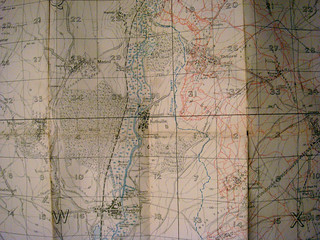
It was important for me that the images shown above did not appear so much as pictures – objects stuck on a wall – as objects of use. I wanted them to appear as if they’d been unfolded rather than simply painted, that like maps, they could be read rather than simply looked at. I wanted them to retain the potential for being folded (which, if they were framed, wouldn’t have been possible) for this inherent potential of folding and unfolding refers back to an observation I made whilst studying an old trench map.
DSC07754

During that observation I wrote, “…the past movements associated with this map are therefore recorded in its folds. It resists being folded any other way.”

The folds in the map are like ancient paths in a landscape. We can walk (within reason) wherever we like through a place, but more often than not, we will follow the way of countless others before us. Paths are themselves like folds within the landscape, and we, like the map, resist being folded any other way.
Trench Map 1916

Macfarlane again writes how for Thomas “…map-reading approached mysticism: he described it as an ‘old power’, of which only a few people had the ‘glimmerings’.”

These glimmerings reminded me of a passage I read in Merlin Coverley’s book Psychogeography, in which he writes: “Certain shifting angles, certain receding perspectives, allow us to glimpse original conceptions of space, but this vision remains fragmentary…”

These ‘glimmerings’or ‘shifting angles’ are best seen or accessed through the everyday; observations of which I record in other map works.

Map Work

This is something which Macfarlane again seems to allude to in ‘The Old Ways: A Journey on Foot’, when he writes: “The journeys told here take their bearings from the distant past, but also from the debris and phenomena of the present, for this is often a double insistence of old landscapes: that they be read in the then but felt in the now. The waymarkers of my walks were not only dolmens, tumuli and long barrows, but also last year’s ash-leaf frails (brittle in the hand), last night’s fox scat (rank in the nose), this minute’s bird call (sharp in the ear), the pylon’s lyric crackle and the crop-sprayer’s hiss.”

As I have recorded in my text-maps:

A man talks holding his hat
A flag flies, fluttering in the growing wind
The next bus is due
A car beeps
Amber, red, the signal beeps
The brakes hiss on a bus

Maps are objects which we fold and unfold. We unfold them to find our place within the landscape. We fold them and carry them with us. The process or unfolding and (en)folding: the idea that the past can be seen as being enfolded within the smallest objects and everyday observations in vital to my work; as is the way in which we are enfolded (written) into the landscape as we walk; the way in which the landscape is unfolded as we travel across it. Knowledge, likewise, is also unfolded in this way. As Tim Ingold writes in ‘Being Alive: Essays on Movement, Knowledge and Description’:

“…knowledge is perpetually ‘under construction… the things of this world are their stories, identified not by fixed attributes but by their paths of movement in an unfolding [my italics] field of relations. Each is the focus of ongoing activity. Thus in the storied world… things do not exist, they occur. Where things meet, occurrences intertwine, as each becomes bound up in the other’s story. Every such binding is a place or topic. It is in this binding that knowledge is generated.”

Empathy is another important aspect of my work and I’ve stated before that empathy is an augmented discourse between bodily experience and knowledge. I like to think that with these works I’ve discovered a means of expressing that.

Finally, the works I’ve made are fragile pieces, and in another passage on Thomas, I found in Macfarlane’s prose a sentence which describes why they should be so: “His poems are thronged with ghosts, dark doubles, and deep forests in which paths peter out; his landscapes are often brittle surfaces, prone to sudden collapse.”

Perhaps this, in part, answers my question above.
Filed Under: Lists, Poetry Tagged With: Broken Landscape, Edward Thomas, Ivor Gurney, Listmaking, Lists, Maps, Paths, Poetry, Trench Maps, Walks, War Poets, World War I, WWI

Reading Roads

March 8, 2011 by Nicholas Hedges

Introduction

In Wales in 2008 I walked a path along which my great grandfather had walked every day from his home to the mines in which he worked. He died in 1929 (as a consequence of his work) and all I knew of him, before my visit, were what he looked like (from two photographs) and things my grandmother had told me. But on that path I felt I found him on a much deeper level. The feel of the wind, the way the clouds moved, the sound of the trees and the line of the horizon were all things he would have experienced in much the same way. It was as if these elements had combined to ‘remember’ him to me.

Hafodyrynys and Surrounds

As a consequence of my walk, the line which linked us on my genealogical chart changed to become instead a path, for when I follow lines in my family tree from one ancestor to the next and find myself at the end, so that path in Wales had led to my being born. That path on which I walked for the very first time, was as much a part of who I was as my great grandfather: “places belong to our bodies and our bodies belong to these places.” [i]
Roads (paths, tracks and traces) have become an important part of my research and it was whilst reading Edward Thomas’ poem Roads that I found connections between what he had written and what I was thinking. I’ve reproduced the poem below, and where necessary added my thoughts.

Roads by Edward Thomas (1878-1917)
I love roads:
The goddesses that dwell
Far along invisible
Are my favourite gods.
Roads go on
While we forget, and are
Forgotten like a star
That shoots and is gone.
The reference to stars (or a star) in this verse, reminds me of a quote (to which I often refer) from Roland Barthes’ book Camera Lucida, in which he writes:

“From a real body, which was there, proceed radiations which ultimately touch me, who am here; the duration of the transmission is insignificant; the photograph of the missing being as Sontag says, will touch me like the delayed rays of a star. A sort of umbilical cord links the body of the photographed thing to my gaze – light though impalpable, is here a carnal medium, a skin I share with anyone who has been photographed.”

The star shoots its light and is gone and similarly we walk and are gone. But what is left behind is the road, a version of the light left by the disappeared star; a ‘delayed’ ray which allows us to ‘see’ those who went before us. I use the word ‘see’, but we ‘see’ with our bodies. We see the light from the star, but we feel the road. This in turn brings me to the idea of empathy as something which is tactile and kinaesthetic.  Roads and paths become ‘a sort of umbilical cord… a carnal medium, a skin I share’ with those who’ve walked that road or path before – precisely what I’d felt in Wales.

On this earth ’tis sure
We men have not made
Anything that doth fade
So soon, so long endure:

In the third verse we might interpret the lines as a description of the difference between the act of walking and the road itself. We walk in the moment – a moment which fades in an instant (‘so soon’) and yet, behind us a record of the sum of all those moments is lined up along the road behind us – one which endures for centuries. It’s the same difference as that between speaking and writing; one is fleeting, the other endures. Christopher Tilley writes that “…if writing solidifies or objectifies speech into a material medium, a text which can be read and interpreted, an analogy can be drawn between a pedestrian speech act and its inscription or writing on the ground in the form of the path or track.” [ii] Paths and roads ‘record’ our movements, they are texts which we can read with our feet. 
The idea of the ‘moment’ is also discussed by artist Bill Viola who writes that:
“We have been living this same moment ever since we were conceived. It is memory, and to some extent sleep, that gives the impression of a life of discrete parts, periods or sections, of certain times or highlights. [iii]
This ‘same moment’ is in many respects like the act of walking and the road rolled into one; it fades and yet endures at one and the same time. There is an echo of this idea in Camera Lucida when Barthes writes:
“In the photograph, Time’s immobilisation assumes only an excessive, monstrous mode: Time is engorged…” [iv]
I described earlier, how the path on which I walked in Wales was as much a part of me as my great grandfather; it was the first time I’d ever walked it and yet I was a part of it long before I was born. There is then a continuous moment running along all paths and roads, and it’s memory and to some extent birth and death that gives the impression of discrete parts. This ‘universal’ moment is the ‘nowness’ of the present and it was this ‘nowness’ which I experienced on that path in Wales and which I’ve since been exploring in my work as regards empathy.
“The feel of the wind, the way the clouds moved, the sound of the trees and the line of the horizon were all things he would have experienced in much the same way.”
The third verse in Thomas’ poem seems to me to allude to the idea of experiencing the moment:

The hill road wet with rain
In the sun would not gleam
Like a winding stream
If we trod it not again.

The ‘we’ in the last line refers to us as individuals, whether ‘we’ were walking that path in 1915 or today in 2011; if ‘we’ weren’t there to see it, it wouldn’t be seen at all. 
In the fourth verse we read the following:

They are lonely
While we sleep, lonelier
For lack of the traveller
Who is now a dream only.

Before I look at this verse, I want to look at another quote; this time from the catalogue of a Paul Nash exhibition in which David Fraser Jenkins writes how Nash:
“…did not often show people in the landscape, even walking about in his lanes and paths, and as a result his pictures look deserted… Despite this absence, there is in his pictures a remarkable sense of drama, and it is this reaction between things – the trees or the buildings… that these pictures are about.” [v]
Looking at the fourth verse above, we can say that the ‘lack of the traveller’ alludes to the passing of that traveller, whether from the immediate scene, or perhaps life itself. Either way, all that’s left of what Sontag called ‘the missing being’ is the trace of the road on which they walked, the text written as they travelled. That traveller is now a dream, dreamt by the road and the elements by which it’s surrounded, a dream which I see expressed by David Fraser Jenkins as a ‘remarkable sense of drama’. The road might be lonely, but it’s never empty; the trees, the buildings, the feel of the wind and the way the clouds move all dream of the traveller – the missing being. There’s also a parallel to be found here in Rainer Maria Rilke’s Duino Elegies, where in the second elegy we read:
Look – trees exist.
The houses we live in continue to stand. Only we
pass away like air traded for air and everything
conspires to maintain silence about us, perhaps
half out of shame, half out of unspeakable hope. [vi]
This ‘silence’ alludes I think to what Jenkins describes as a ‘remarkable sense of drama’ and what I have called a ‘dream’. But how can we connect with these? In his book The Materiality of Stone,  Explorations in Landscape Phenomenology, Christopher Tilley writes:
“The painter sees the tree and the trees see the painter, not because the trees have eyes, but because the trees affect, move the painter, become part of the painting that would be impossible without their presence. In this sense the trees have agency and are not merely passive objects. [Martin] Dillon comments: “The trees ‘see’ the painter in a manner comparable to that in which the mirror ‘sees’ the painter: that is, the trees, like the mirror, let him become visible: they define a point of view on him which renders visible for him something that otherwise would remain invisible – his outside, his physiognomy, his carnal presence… The trees and mirror function as Other.” [vii]
Just as the trees function as what Dillon calls ‘Other’, so does everything else. It’s as if the shapes of disappeared travellers are somehow retained, like the people-shaped holes in the ash of Pompeii, which when filled with plaster, revealed the presence of people lost for almost 2000 years. Similarly, people-shaped holes exist along every road or path; gaps which can only be filled with our own bodies, by our own presence; by our experience of the nowness of the present.
In a definition of the Metaphysical poets, Georg Lukács described their common trait of ‘looking beyond the palpable’ whilst ‘attempting to erase one’s own image from the mirror in front so that it should reflect the not-now and not-here.’ [viii] For me, the road is the mirror which Lukács describes, and as I walk along it, I try to look beyond the palpable, to erase my own image so that the road reflects the not-­now and not-here. The palpable is the present (as opposed to the nowness of the past); the not-now and not-here is the nowness of that continuous moment in its entirety. To erase one’s image is to imagine one’s own non-existence, to see a part of that continuous moment when one did not exist, when that part was nonetheless now. It is about seeing the presentness of past events.  

From dawn’s twilight
And all the clouds like sheep
On the mountains of sleep
They wind into the night.

The next turn may reveal
Heaven: upon the crest
The close pine clump, at rest
And black, may Hell conceal.

Often footsore, never
Yet of the road I weary,
Though long and steep and dreary,
As it winds on for ever.

Helen of the roads,
The mountain ways of Wales
And the Mabinogion* tales
Is one of the true gods,

(*In the tale of Lludd and Lleuelys from the Mabinogion, you will find the following text: “Some time after that, Lludd had the island measured in length and breadth; the middle point was found to be in Oxford. There he had the earth dug up, and in that hole he put a vat full of the best mead that could be made, with a silk veil over the surface. He himself stood watch that night.” I discovered this passage whilst researching my Welsh ancestry, and being as I am from Oxford, found it rather appealing.)

Abiding in the trees,
The threes and fours so wise,
The larger companies,
That by the roadside be,

And beneath the rafter
Else uninhabited
Excepting by the dead;
And it is her laughter

At morn and night I hear
When the thrush cock sings
Bright irrelevant things,
And when the chanticleer

Calls back to their own night
Troops that make loneliness
With their light footsteps’ press,
As Helen’s own are light.

Now all roads lead to France
And heavy is the tread
Of the living; but the dead
Returning lightly dance:

Whatever the road bring
To me or take from me,
They keep me company
With their pattering,

Crowding the solitude
Of the loops over the downs,
Hushing the roar of towns
And their brief multitude.

The line ‘Now all roads lead to France’ reminds us that those who fell and are buried in France (and indeed other countries) were men with lives beyond the theatre of war – that the theatre of war extends well beyond the boundaries of any trench map. To know them and to know the missing, we have to follow the roads from France back to the towns and villages where they lived, just as to know ourselves we should follow the roads and paths from our own hometowns to those of our ancestors. To walk those streets, paths and tracks, is to turn them back into ‘consanguineal lines’; to restore lost connections in forgotten family trees; to remind us that those who fought and died were each part of a family as well as a wider community of friends and acquaintances.
The road brings and takes away and the dead keep us company at every step ‘with their pattering’. Again this could refer to the idea of the moment as being both fleeting and enduring. The moment is like a looped recording which plays and records at the same time, creating a kind of palimpsest, where all that’s gone before is contained in a moment, like light, tens of thousands of years old seen in a single second.
The line ‘Crowding the solitude,’ echoes what I wrote earlier, that roads might be lonely, but they’re never empty. And finally in the last two lines, Thomas reminds us of our own mortality; where the multitudes that make the towns roar are themselves brief. 


i Christopher Tilley, 1994, A Phenomenology of Landscape, Oxford, England, Berg
ii Christopher Tilley, 2004, The Materiality of Stone – Explorations in Landscape Phenomenology, Oxford, England, Berg
iii Bill Viola, 2005, Reasons for Knocking at an Empty House, Writings 1973-1994, Thames & Hudson
iv Camera Lucida, Roland Barthes, Vintage, 2000
v David Fraser Jenkins, 2010, Paul Nash – The Elements, London, Scala Publishers Ltd.
vi Rainer Maria Rilke, Tr. Martyn Crucefix, 2006, Duino Elegies, London, Enitharmon Press
vii Christopher Tilley, 2004, The Materiality of Stone – Explorations in Landscape Phenomenology, Oxford, England, Berg
viii http://en.wikipedia.org/wiki/Metaphysical_poets

Filed Under: Paintings, Trees Tagged With: Barthes, Bill Viola, Christopher Tilley, Family History, Family Jones, Jones, Paintings, Paths, Paul Nash, Rilke, Roads, Silence, Stars, War Poets, World War I, WWI

An Archaeology of the Moment

May 18, 2010 by Nicholas Hedges

I’m currently reading an excellent book by Colin Renfrew, Senior Fellow of the McDonald Institute for Archaeological Research, entitled ‘Figuring it Out’, in which the author examines what he describes as ‘the parallel visions of artists and archaeologists,’ with an emphasis on contemporary art practice. As an artist with a deep interest in archaeology, I had to buy the book, and I’m very glad I did, for it’s helped me pull together numerous strands of thinking which have emerged from my research over the course of the last four years; in particular, the idea of the physical or ‘sensed’ present as a lens through which to ‘see’ the past. Professor Renfrew writes: “The past reality too was made up of a complex of experiences and feelings, and it also was experienced by human beings similar in some ways to ourselves.” The way we experience the present then, tells us a great deal about how people experienced the past when it too was the present.

I’ve written before how one of the problems we have in considering past events is the temporal distance which separates us. Reading a history book, although we know its content is‘ factual’, is nonetheless an interpretation of events; an outline at best no matter how well researched and well written it is. There may be a structure, just as in a novel, with a beginning, a middle and an end. But of course reality isn’t really like that – the boundaries are much more fluid. Necessarily therefore, a history of any event will be full of holes and it’s these holes which interest me.

In October 2006, I stood on the Ramp at Auschwitz-Birkenau and my experience there is something with which I’ve been working ever since, even whilst researching different places – whether other camps such as Bełżec or the battlefields of World War One – it’s that particular moment which I have been researching, peeling back the layers comprising the moment, much as an archaeologist digs through layers of stratified soil to uncover a whole range of times.

History is, in some respects, like fiction. What is known and written about can only be surmised from surviving evidence and what we ‘see’ as receivers of that knowledge, can only be imagined. What’s always missing is a sense of the present, as if what happened in the past always followed a script, one in which the main protagonists took their cues and delivered their lines accordingly. Hindsight, which one can hardly escape, joins all the dots, but leaves many gaps between the lines.

In the foreword to Peter Weiss’ book The Aesthetics of Resistance, Frederic Jameson writes how for the critic Georges Lukács, the world historical individual should never be the novel’s main protagonist, but rather seen from afar by the average or mediocre witness. We could say the same for history; that events described in history books are ‘best’ when seen through the eyes of those ‘average’ or ‘mediocre’ witnesses; people which history labels as ‘the mob’ or the ‘masses’; who are often buried beneath unimaginable numbers – mass graves within which, their names and individual identities are forgotten.

I’ve produced numerous works which examine this idea of the anonymous individual in history, but there’s another element I try to show, and that’s the ‘everydayness’ of any historic event. This is, I believe, key to our understanding of the past, for not only is history best seen by the ‘average’ or ‘mediocre’ witness, but – for me at least – when the main event is glimpsed as a backdrop to an individual’s own life experience. That’s not to say the event should always be viewed through the eyes of someone far away from the scene, but that it should always be seen behind the individual, rather than the individual being buried somewhere beneath.

In the time after my visit to Auschwitz-Birkenau, I wanted to find a way of identifying with those who died there. That’s not to say that I can identify with what they went through, no-one who wasn’t there can ever claim to understand what it was like to suffer, but we can seek to separate the individual from the grim statistics and site the camp in the landscape of the everyday world. Again, that’s not to say that Auschwitz-Birkenau was an everyday place, but what’s important for me, in understanding the past, in filling in the gaps which history inevitably leaves behind, is an understanding that the everyday world was happening at the time. Whatever event in whatever period we’re researching, the world was happening around it. The wind blew in the trees; the birds sang and the rain fell. The sun rose in the morning; the sky was just as blue or grey as it is today. There were clouds with their shadows, and during the night, the moon might be reflected in small pools of water, like that described by Auschwitz survivor, Filip Muller – in a pit soon to be filled with bodies. The events like the place were not everyday, but they took place regardless in an everyday world and understanding this ‘everydayness’ can help us understand and picture much more clearly events of the past.

For example, we can read hundreds of titles about the Holocaust and World War One, but when we read in the Diary of Adam Czerniakow – the ‘mayor’ of the Warsaw Ghetto – what the weather was like on a particular day, suddenly, in words like ‘beautiful weather,’ the full horror of the Holocaust is revealed, because, with these words at least, we can identify and – albeit in a very small way – empathise with someone who suffered; the past in effect becomes very much present.

In Birkenau, it wasn’t so much the sight of the gas chambers which was so horrific, or even the gaze of the infamous gatetower, but rather the way the trees moved, just as they’ve always moved, right throughout history.

Similarly, on the battlefields of the Somme, just as we cannot comprehend the horrors faced by the soldiers – the incessant shelling and machine gun fire – we can nonetheless see and feel the ground beneath our feet; we can see the sun in the sky, and feel the wind on our faces, and it’s these everyday details which take us, albeit just a little, into the midst of a battle. Of course we still need history to draw in the outlines, but it’s these other details which prevent history being a script. Events in history were not preordained, people made choices and choices can only be made and acted upon in a moment – in the present. Understanding the present therefore – that space wherein reside all our hopes and fears, our dreams and ambitions, and into which we bring our memories – is key to our understanding of the past.

In a passage written by Tadeusz Borowski, another Auschwitz survivor, we read the following: “do you really think,” he asks, that without hope such a world is possible, that the rights of man will be restored again, we could stand the concentration camp even for a day? It is that very hope that makes people go without a murmur to the gas chambers, keeps them from risking a revolt, paralyses them into numb inactivity.” People often ask why, when faced with certain death people didn’t revolt or even attempt to escape? If we read history as a script we might well feel obliged to ask that question, but when one’s alive in a moment, that in which we continue to exist, we will do anything to maintain that existence, and second by second that was achieved by doing nothing, right up to the end, for up to the end there was always the hope that something would change. Again, it’s through understanding what it means to live in the present that we can understand the past a little better.

In his book ‘The Materiality of Stone, Explorations in Landscape Phenomenology,’ Christopher Tilley writes: ‘The painter sees the tree and the trees see the painter, not because the trees have eyes, but because the trees affect, move the painter, become part of the painting that would be impossible without their presence. In this sense the trees have agency and are not merely passive objects. Dillon comments: “The trees ‘see’ the painter in a manner comparable to that in which the mirror ‘sees’ the painter: that is, the trees, like the mirror, let him become visible: they define a point of view on him which renders visible for him something that otherwise would remain invisible – his outside, his physiognomy, his carnal presence… The trees and mirror function as Other.”’ Just as the trees function as Other therefore, so must the sun, the stars, the clouds, hills, mountains, the sea, rivers, the wind, the rain and so on. Objects too, excavated during digs or on display in museums, act in much the same way.

Through archaeology, we excavate moments. We might come to better understand epochs and eras, but revealing a stone beneath a field which once belonged to part of a road reveals the movement of individuals and thereby an individual. And as we in the present stand on that stone and sense the world around us, we can bridge the gap between the past and present, even if that gap is one, two or three thousands years. If we walk along the line of the road, what we know of any relevant history becomes animated. With the aid of the ‘everydayness’ of the world we can position ourselves within an event – even if that event took place many miles away. We can become the ‘average’ or ‘mediocre’ witness, and rather than seeing a past event as one sandwiched between two pasts (those more and those less distant) we can instead bring to that past, the concept of the present and consequently the unknown future.

At the beginning of his book, ‘Figuring it Out’, Professor Renfrew looks at Paul Gauguin’s painting ‘Where Do We Come From? What Are We? Where Are We Going to?’ (1897) a title, and a question, which many artists and archaeologists alike have tried to answer. The questions posed in the title of are of course about the past, the present and the future and in reading this book I could see how these questions have always been there behind my work. After visiting Auschwitz-Birkenau and in an attempt to find anonymous individuals in history to whom I was related I began to investigate my own family tree, and, over the course of the last few years I’ve found several hundred ancestors going back on some lines as far as 1550. A year before she died, my grandmother told me about her childhood in Wales and in particular about my great grandfather who died in 1929 after years working in the mines. The following is an extract from that conversation:

‘I can see him now because he went up our garden over the road and the mountain started from there up… and he’d go so far up and he’d turn back and wave to us, and if we went out to play, our Mam would say, ‘you can go up the mountain to play…’ but every now and then our Mam would come out in the garden and we had to wave to her to know that we were alright you know… always remember going up the mountain…’

On visiting Hafodyrynys, the small town where my grandmother grew up, I walked up the ‘mountain’ she’d described and followed the path my great grandfather would have taken to work in the mines at Llanhilleth. On top of the hill I stood and looked at the view. One hundred years ago, when I did not exist, he would have seen the very same thing. One hundred years later, long after his death, I found myself – through being in that place – identifying with him, not because I know what it was like to work in the mines (of course I don’t), but because I saw the same horizon, felt the same wind, saw the same sun and so on. I’d found him there on the path (one which would in time lead to my being born).

I realised too in Hafodyrynys, that I’m not only who I am because of the genes passed down by my ancestors, but because of the things they did throughout their lives, not least because of the roads and paths they travelled, such as that upon the ‘mountain’. Anything different, no matter how seemingly irrelevant and I would not be here, and in a sense, that which I described earlier in relation to my standing on the Ramp at Auschwitz-Birkenau, where the way the trees moved seemed pregnant with the horrors of the Holocaust, is relevant here, albeit for different reasons; the everyday, insignificant details which make up a moment, are key to our existences. Until the time of our conceptions, we were always one step away (many times over) from never existing and again this refers back to what I described at the beginning of this piece; the idea of my own non-existence in relation to past events.

For the catalogue to the third in my series of exhibitions entitled ‘Mine the Mountain’ I wrote the following, in an attempt to summarise my thinking: ‘The Past is Time without a ticking clock. A place where paths and roads are measured in years. The Present is a place where the clock ticks but always only for a second. Where, upon those same paths and roads we continue, for that second, with our existence.’

The last line resonates when considered alongside what I described earlier regarding hope – that emotion which Borowski describes as ‘paralysing’ those who died in the camp.

I wrote earlier too, that through archaeology we excavate moments, that although we might come to better understand epochs and eras, revealing a stone beneath a field which once belonged to part of a road reveals the movement of individuals and thereby an individual, one continuing his or her existence for a second along the way. Artist Bill Viola wrote: ‘We have been living this same moment ever since we were conceived. It is memory, and to some extent sleep, that gives the impression of a life of discrete parts, periods or sections, of certain times or highlights.’ If we take what he says regarding this ‘same moment’ – that which we’ve been living continuously – along with what I’ve written above regarding pathways taken by our ancestors, we can see that that ‘same moment’ extends beyond the limits of our own existence and that moments and epochs are in the end, one and the same thing. The gap between the past and present – however big or small the temporal divide – is removed.

To conclude…

An ancient road, uncovered beneath a field, may be thousands of years old but nonetheless it will have been ‘written’ in terms of moments, where one individual amongst many others has carried his or her existence from one moment to the next. And as we walk ahead towards the future, along the line of the road, carrying our own existence with us; as we feel the ground beneath our feet and watch the wind blowing through the trees. As we listen to the birds and smell the scent of the grass, we’ll find ourselves in empathy with every individual who’s gone that way before us. Somewhere, beyond the horizon, Stonehenge is being built; the Romans have landed in England and the Mary Rose is sinking beneath the waves.

Filed Under: Archaeology, Trees Tagged With: Archaeology, Auschwitz, Bill Viola, Borowski, Christopher Tilley, Death Camps, Empathy, Family History, Family Jones, Holocaust, Jones, Mine the Mountain, Moments, Paths, WWII

No Man is an Island

February 12, 2010 by Nicholas Hedges

I have written a great deal about how I perceive the past and how I use objects and the landscape to find  ways back to times before I was born. In my text ‘What is History‘ I conclude with the following paragraph.

“History, as we have seen, [might be described as] an individual’s progression through life, an interaction between the present and the past. It follows, having seen how the material or psychical existence of things extends much further back than their creation that history spanning a period of time greater than an individual’s lifetime is like a knotted string comprising individual fragments; fragments within which – in the words of Henri Bortoft – the whole is immanent.  The whole history of all that’s gone before is imminent in every one of its parts; those parts being the individual.”

I was reminded as I read this paragraph – and in particular the last line – of the poet John Donne and the following words taken from his XVII Meditation:

“No man is an island, entire of itself; every man is a piece of the continent, a part of the main. If a clod be washed away by the sea, Europe is the less, as well as if a promontory were, as well as if a manor of thy friend’s or of thine own were: any man’s death diminishes me, because I am involved in mankind, and therefore never send to know for whom the bell tolls; it tolls for thee.”

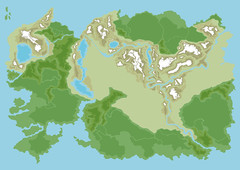
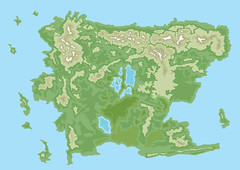
Having read this, I thought about some of the work I’ve been making for my forthcoming exhibition in Nottingham, Mine the Mountain. Two pieces are maps of invented landscapes, one of which (the first shown below) is based directly on a map I created as a child, the other based on the outline of Belzec Death Camp as seen in an aerial view of 1944.

If I Was A Place
If I was a Place, 2010

The Past is a Foreign Country
The Past is a Foreign Country, 2010

The first map, as I have said, is a contemporary reproduction of one I made as a child. It’s therefore essentially a map of an individual – of me, as I was at the time. It is a place that, although imagined, was real nonetheless, one based on fragments of my memory and my perception of the distant past.

Having been to Wales (in 2008) and imagined all my distant forebears walking the various tracks and roads around the village where my grandmother grew up, I realised how I was very much a part of those places and they in turn were part of who I was. I had existed – at least potentially – in those places long before I was born. All those roads, paths and trackways led in the ‘end’ to me. Of course that sounds a rather egocentric way of perceiving the world and its history, but then I’m not suggesting that I am the only intended outcome. Just as my invented world – my map of me – was made of all those bits of the past I loved to imagine as a child (the untouched forests, the unpolluted rivers and streams) so I can see how this foreshadowed my current thoughts on history; how I am indeed (as we all are) a place, one made of all those places in which my ancestors walked, lived and died. 

A quote from a source which is of huge importance to me and my work (Christopher Tilley’s ‘The Materiality of Stone, Explorations in Landscape Phenomenology’.)

“Lived bodies belong to places and help to constitute them so much so that the person can become the place (Gaffin 1996). The body is the medium through which we know place. Places constitute bodies, and vice versa, and bodies and places constitute landscapes. Places gather together persons, memories, structures, histories, myths and symbols.”

Alongside the second map I will be showing a piece of text taken from the diary of Rutka Laskier describing what appears to be an imaginary landscape, though one perhaps based on memories of family holidays to Zakopane, Poland. She was a child when she died in the Holocaust and by putting the two maps together, I want to reflect on the numbers of children who perished, as well as illustrating how within each child – within everyone – the whole of humanity is immanent.

John Donne’s words serve to illustrate this sentiment further still. No man, woman or child is an island. So whilst I have created two maps of individuals, through Donne’s words we can see how these islands comprise pieces of everybody else.

If a clod be washed away by the sea, Europe is the less.

Filed Under: Poetry Tagged With: Christopher Tilley, Family History, Family Jones, Henri Bortoft, History, John Donne, Jones, Maps, Mine the Mountain, Paths, Phenomenology, Poetry, Roads

© Nicholas Hedges 2024

  • Facebook
  • Instagram
  • Twitter
  • YouTube

Copyright © 2025 · Outreach Pro on Genesis Framework · WordPress · Log in