Nicholas Hedges

Art, Writing and Research

  • Amazon
  • Behance
  • Facebook
  • Instagram
  • Pinterest
  • YouTube
  • Art
    • Digital
    • Drawing
    • Grids
      • Correspondence
      • The Wall
      • The Tourist
    • Ink on paper
      • Shadow Calligraphy
    • Installation
      • Murder
      • Echo
    • Painting
    • Patterns
    • Mixed Media
    • Photographic installation
      • St. Giles Fair 1908
      • Cornmarket 1907
      • Headington Hill 1903
      • Queen Street 1897
    • Research/Sketches
    • Stitched Work
      • Missded 1
      • Missded 2
      • Missded 3
      • Missded 4
    • Text Work
  • Blogs
    • Family History
    • Goethean Observations
    • Grief
    • Light Slowed But Never Stilled
    • Lists
    • Present Empathy
    • Shadow Calligraphy
    • Trees
    • Time
    • Walking Meditations
  • Video
  • Photography
    • Pillars of Snow
    • Creatures
    • The Trees
    • Snow
    • St. Giles Fair 1908
    • Cornmarket 1907
    • Headington Hill 1903
    • Queen Street 1897
    • Travel
  • Illustration and Design
  • Music
  • Projects
    • Dissonance and Rhyme
    • Design for an Heirloom
    • Backdrops
    • Shadow Calligraphy
  • Exhibitions
    • A Line Drawn in Water
      • Artwork
    • A Line Drawn in Water (Blog)
    • Mine the Mountain 3
      • Artwork
    • Mine the Mountain 2
      • Artwork
      • The Wall
    • The Woods, Breathing
      • Artwork
    • Snow
      • Artwork
    • Echo
      • Artwork
    • Murder
      • Artwork
    • The Tourist
    • Dreamcatcher
    • Mine the Mountain
      • Artwork
      • The Tourist
    • M8
    • The Gate
    • Creatures
      • Artwork
    • Residue
      • Artwork
    • A visit to Auschwitz
      • Artwork
  • Me
    • Artist’s Statement

Connections

August 7, 2008 by Nicholas Hedges

This evening I began working on an idea I’ve had for a while which incorporates the World War 1 postcards I was given by Tom Phillips. The idea was to show these postcards on a wall but with only a few the right way round i.e. showing the portrait (they are all portrait postcards of soldiers, most individual, some with other people). The rest would be displayed reversed showing either writing or, as is mostly the case, nothing – they would just be blank. I wasn’t sure how this would look and so I began putting the postcards up on my bedroom wall and fairly quickly I could see that the postcards, displayed in this way had an impact.
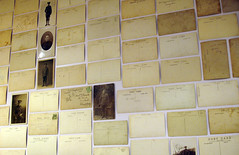
Very Lights

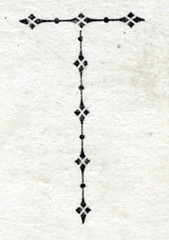
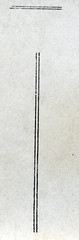
There was something about the blank postcards which was particularly resonant and the more I looked, the more I could see what it was that leant them this quality. On most of the blank postcards there is a motif running down the centre of the card (dividing the address from the text). These lines are of various designs, some very simple, others more elaborate. I decided to scan a few which can be found below.
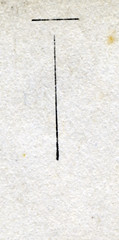
Reverse Motif

Reverse Motif

Reverse Motif

For me these motifs have something of the grave about them, perhaps because they are each shaped a little like a crucifix, and they reminded me of some of the memorials I had seen in the Montparnasse Cemetery in Paris.
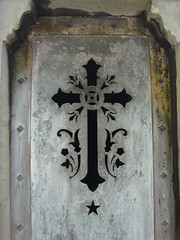
Paris

And as I started making connections, I thought of the X paintings and those I discussed in a previous entry – Black Mirrors and thought about how these marks could be incorporated into a work just like the symbol of the ‘X’.
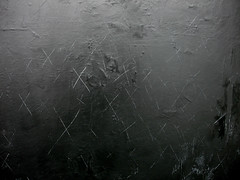
X (Mine)

I also thought how these various motifs/symbols resembled the botanic labels I’ve had made, each engraved with the name of one of my ancestors such as that of Henry Jones (below).
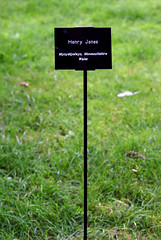
Deadman's Walk (Henry Jones)

And finally, one last connection between the motifs and a work I made in November 2006, soon after a visit made to Auschwitz-Birkenau.
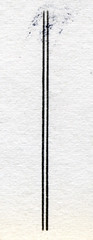
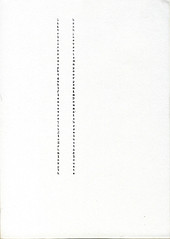
Reverse Motif

7

Reverse Motif

Filed Under: Holocaust Tagged With: Cemetery, Connections, Holocaust, World War I, WWI, WWI Postcards, WWI Postcards, WWII, X

Kisses

July 31, 2008 by Nicholas Hedges

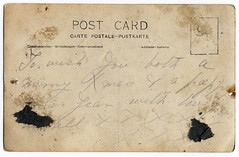
Following on from my previous two entries regarding ‘Xs‘ (the signature of the illiterate, a secret location marked on a map), I wanted to look briefly at another use of the mark, that of course being the kiss. I was prompted to do this whilst selecting a number of World War One postcards for a new project website; www.8may.org – a project I hope to carry out next year. Most of the postcards are blank, but on a few there is some writing; the scrawl of a soldier or a more recent label, ‘Mum’s uncle.’ for example. One particular card however took my interest for it contained the mark I had recently been applying to my paintings. In my most recent versions of the ‘X’ paintings (those which have been obliterated by graphite powder) I have been scratching the symbol into the dust whilst considering the many anonymous miners who lost their lives deep underground at the time my great, great-great and great-great-great grandfathers were working in the pits of South Wales.

As I’ve written before, Rainer Maria Rilke wrote that those who die leave their names behind as a child leaves off playing with a broken toy. Those who died in the mines left their names underground; most would not have known how to write them, doing instead what my ancestors did and marking documents only with an ‘X’. And many of those men from the 19th century have all but been forgotten, their names discarded, swept away like Rilke’s broken toys. Even their graves might be lost, their remains buried and marked with an ‘X’, secrets known only by the earth itself.

X - Kisses

The Xs on the postcard above are also marks of anonymity. We know they are kisses but we don’t know who they’re for or who gave them. But we know they are symbols of a relationship which once existed, whether between lovers, friends or relations; someone loved someone else. Many of those who fought in the Great War never returned home – all that did return were a few words on a postcard; and ‘Xs‘ – farewell kisses as they came to be. Hundreds of thousands of men not only lost their lives, but they have no known grave. Many too lost their names altogether. These Xs on the postcard therefore become symbols for their future anonymity, their unknown graves; their lost names.

And the Xs which I’ve scratched into dust on my paintings also become a kind of farewell; a broken name, a secret location in time. They also become a farewell kiss to the world.

Filed Under: World War I Tagged With: Rilke, World War I, WWI, WWI Postcards, WWI Postcards, X

Zuleika Dobson

March 31, 2008 by Nicholas Hedges

It was through reading E.M. Forster’s lectures (collected in a book entitled ‘Aspects of the Novel’ and first published in 1927) delivered under the auspices of Trinity College, Cambridge, that I first came across a reference to Max Beerbohm’s satirical novel Zuleika Dobson. In particular it was a passage quoted by Forster as ‘this most exquisite of funeral palls… Has,” he goes on to say “not a passage like this a beauty unattainable by serious litertature?” The answer to that is in some respects yes and below is that very passage:

“Through the square, across the High Street and down Grove Street they passed. The Duke looked up at the tower of Merton… Strange that tonight it would still be standing there, in all its sober and solid beauty – still be gazing over the roofs and chimneys, at the tower of Magdalen, its rightful bride. Through untold centuries of the future it would stand thus, gaze thus. He winced. Oxford walls have a way of belittling us; and the Duke was loth to regard his doom as trivial.

Aye by all the minerals we are mocked. Vegetables, yearly deciduous are far more sympathetic. The lilac and laburnum making lovely now the railed pathway to Christ Church Meadow were all a-swaying and a-nodding to the Duke as he passed by – ‘Adieu, adieu your Grace,’ they were whispering. ‘We are very sorry for you – very sorry indeed. We never dared suppose you would predecease us. We think your death a very great tragedy. Adieu!”

The premise of the novel concerns the arrival into Oxford of the beautiful Zuleika Dobson, a woman of such beauty, any man who sees her cannot help but fall in love.

“To these Emperors, for whom none weeps, time will give no surcease. Surely, it is sign of some grace in them that they rejoiced not, this bright afternoon, in the evil that was to befall the city of their penance.”

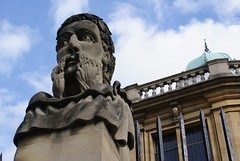
Broad Street

The problem is that Miss Dobson herself cannot love any man who loves her in return and so, having fallen in love with the brilliant Duke of Dorset, her love is immediately lost on hearing of his reciprocal feelings. Spurned, there is only one course of action left to the Duke and that is suicide by drowning in the Isis during Eights Week. But such is the esteem in which he’s held, and such is the love every undergraduate holds for Miss Dobson, that almost the entire undergraduate population of Oxford plunges into the river and is lost.

Taking the plaintive tones of the passage above and some other extracts of the novel, I assumed (not recalling the date of its first publication) that Beerbohm’s novel was something of an allegory about the lost generation of the First World War, of the lost innocence of Edwardian Oxford. However, the novel was first published in 1911, and as such, the book is not unlike the pair of black owls which perch on the battlements of the Duke’s ancestral home and foretell of his death.

“Young Oxford! Here, in this mass of boyish faces, all fused and obliterated, was the realisation of that phrase. Two or three thousands of human bodies, human souls? Yet the effect of them in the moonlight was as of one great passive monster.”

Just after reading the novel, I started reading again Peter Vansittart’s survey of the First World War, Voices From the Great War. Comprising quotes, poems, letters and so on, the book paints a picture of the war through the long lost contemporaneous voices. I first bought the book following a visit made to Ypres and turned to it again having received a gift of almost 200 postcards from the time of the Great War.

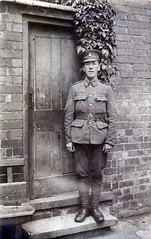
World War 1 Serviceman

Taking the three together – Beerbohm’s novel, the postcards and the quotes – one begins to read the absurd fantasy of Zuleika Dobson in an altogether different way. We have all seen images of men cheerfully marching to the Front, waving their hats and shouting, and when one reads of the mass (almost cheerful) suicide of all the young men in the novel, one cannot help but compare.

“There was a confusion of shouts from the raft of screams from the roof. Many youths-all the youths there-cried ‘Zuleika!’ and leapt emulously headlong into the water. ‘Brave fellows!’ shouted the elder men, supposing rescue-work. The rain pelted, the thunder pealed. Here and there was a glimpse of a young head above water-for an instant only.
Shouts and screams now from the infected barges on either side. A score of fresh plunges. ‘Splendid fellows!'”

And from Vansitartt’s book…

“The enormous expansion of wealth in the peaceful years between 1908 and 1914 brought not happiness but fear, and fear so powerful that it could be expressed only in images of fear and destruction. When war came, it was almost universally accepted as something foreseen and foretold. Even those who loathed the notion of it acquiesced in it as inevitable, and it is not foolish to conclude that what ultimately brought the war was not the ambitions and fears of Germany, but a death-wish in the peoples of Europe, a half-conscious desire to break away from their humdrum or horrifying circumstances to something more exciting or more exalted.” C.M. Bowra

“War might drive a man till he dropped: it could be a dangerous and bloody business; we believed, however, that it still offered movement, colour, adventure, and drama. Later, when the murderous, idiotic machinery of the Western Front was grinding away, of course all was different.” J.B. Priestly

Of course it was different – the reality of the situation. And having turned the last few pages of Beerbohm’s novel, I wondered what it would have looked like, all those dead young men lying prone in the waters of the Isis.

Filed Under: World War I Tagged With: Memory, Nowness, World War I, WWI, WWI Postcards, WWI Postcards, Zuleika Dobson

  • « Previous Page
  • 1
  • 2

© Nicholas Hedges 2024

  • Facebook
  • Instagram
  • Twitter
  • YouTube

Copyright © 2025 · Outreach Pro on Genesis Framework · WordPress · Log in