Nicholas Hedges

Art, Writing and Research

  • Amazon
  • Behance
  • Facebook
  • Instagram
  • Pinterest
  • YouTube
  • Art
    • Digital
    • Drawing
    • Grids
      • Correspondence
      • The Wall
      • The Tourist
    • Ink on paper
      • Shadow Calligraphy
    • Installation
      • Murder
      • Echo
    • Painting
    • Patterns
    • Mixed Media
    • Photographic installation
      • St. Giles Fair 1908
      • Cornmarket 1907
      • Headington Hill 1903
      • Queen Street 1897
    • Research/Sketches
    • Stitched Work
      • Missded 1
      • Missded 2
      • Missded 3
      • Missded 4
    • Text Work
  • Blogs
    • Family History
    • Goethean Observations
    • Grief
    • Light Slowed But Never Stilled
    • Lists
    • Present Empathy
    • Shadow Calligraphy
    • Trees
    • Time
    • Walking Meditations
  • Video
  • Photography
    • Pillars of Snow
    • Creatures
    • The Trees
    • Snow
    • St. Giles Fair 1908
    • Cornmarket 1907
    • Headington Hill 1903
    • Queen Street 1897
    • Travel
  • Illustration and Design
  • Music
  • Projects
    • Dissonance and Rhyme
    • Design for an Heirloom
    • Backdrops
    • Shadow Calligraphy
  • Exhibitions
    • A Line Drawn in Water
      • Artwork
    • A Line Drawn in Water (Blog)
    • Mine the Mountain 3
      • Artwork
    • Mine the Mountain 2
      • Artwork
      • The Wall
    • The Woods, Breathing
      • Artwork
    • Snow
      • Artwork
    • Echo
      • Artwork
    • Murder
      • Artwork
    • The Tourist
    • Dreamcatcher
    • Mine the Mountain
      • Artwork
      • The Tourist
    • M8
    • The Gate
    • Creatures
      • Artwork
    • Residue
      • Artwork
    • A visit to Auschwitz
      • Artwork
  • Me
    • Artist’s Statement

Printmaking – A Reflection IV

October 26, 2007 by Nicholas Hedges

I completed another set of prints this week, again trying to lift the rust from a plate but again failing. However, the resulting prints were interesting so it wasn’t all bad – I just need to look at whether I should print from the rusted plates now or use them simply in their own right.

This time, the reverse of the plate was that which was particularly rusted (because it was face up in the ground) and so it was from this side that I decided to try and take the first print.
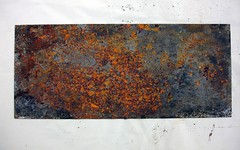
Plate (3rd week Buried)

The rust itself was particularly beautiful with some very nice red -almost liquid – rust-drops on its surface.
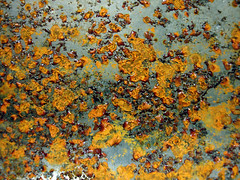
Plate (3rd week Buried) Detail

The resulting print however was a little disappointing. Perhaps using a heavier paper might do the trick?
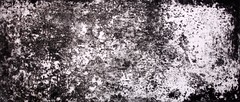
Print 4 (Reverse)

Again I printed the other side which by now is so marked, it’s difficult to remove much of the ink and so the resulting image is extremely dark.
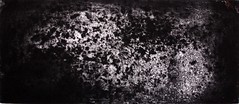
Print 4

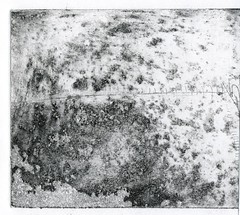
The most interesting results came with a plate I hid in the woods. I left it for a period of a week, and although there didn’t appear to be much on it, aside from a few patches of rust, it was only when it was printed that the extent of wear on the plate’s surface became apparent.
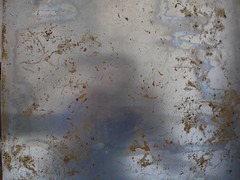
Plate from the Woods

This was the plate I used, and having taken the image I was interested in how I could see my own reflection, for the marking on the plate had reminded me of the surfaces of old mirrors. Seeing the marks revealed in the print led me think how interesting it would be to print some mirrors. Maybe past reflections would be contained on the resulting image…?
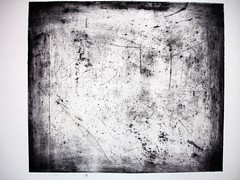
Woodland Plate - First Print

In fact, on the side of which I took the photograph, there is a shadow which could well pass for my image…
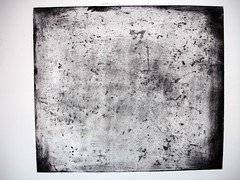
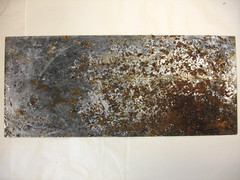
Woodland Plate - First Print (Reverse)

Filed Under: Uncategorized Tagged With: Printmaking

Printmaking – A Reflection III

October 18, 2007 by Nicholas Hedges

Yesterday I carried on with the process I initiated two weeks ago, that of burying an engraved plate, leaving it a week and then printing the rusted version. Having dug up the plate after a second period in the ground, I was pleased with the resulting pattern of rust which I hoped would be lifted onto the paper by some of the ink during the printing process.

Printing Plate

The resulting print from this plate was as follows.

Print 3 (Photo)

The thing I realised with printing from such a rusted plate was the fact that the rust has quite a pull on the ink, and so once the paper has been through the press and one lifts it from the plate, it has a tendency to be left behind. With the print above, I was somewhat disappointed that the rust was ‘drowned out’ by the ink – hardly surprising when I think how thickly it was applied. Of course this is normal, but whereas one can use the scrim to take the ink off, and use quite a bit of pressure to do so, with the rust one doesn’t want to rub so much (and thereby remove it) and so the ink remains too thick in these areas.

I took a second print of the plate without re-inking and and the texture of the rust was well preserved.

3rd Print detail (2nd Proof)

For the next print (after a third week in the ground the plate will be even rustier) I need to ink the particularly rusted sections less and perhaps moisten the rust to encourage it to lift off the plate.
As well as continuing this experiment, I also started working with photo-polymer plates. A photograph is printed onto acetate (with all black areas ‘removed’/greyed) and this positive is then used to ‘etch’ the plate. The plate is sensitive to UV light and so this is done in a darkroom in a UV box. The light passes through the acetate and exposes the plate in the darker areas. When the plate is washed and inked, these areas then take the ink which is then printed onto the page.

In order to get a good print, one needs to make two or three proofs, the results of which are below (those on the left being the first).

Photo-Etching

Photo-Etching

Photo-Etching

The question I have to ask myself now is what does it mean to print these photographs as etchings? Something to consider over the next few days.

Filed Under: Photography Tagged With: Holocaust, Printmaking, Vintage Photographs, WWII

Printmaking – A Reflection II

October 10, 2007 by Nicholas Hedges

Having completed my first two etchings, I decided to make another larger one, again using my Auschwitz-Birkenau drawings as a basis. The following print is the result.
Auschwitz-Birkenau

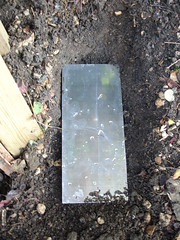
What I have become interested in, is, as I wrote on my original printmaking entry, the plates themselves, not only as physical objects in their own right, but as metaphors for actions which later one remembers (the memories being the prints taken from the plate). Having buried a plate in the first week and taken a print of the rusted plate this week (which was particularly interesting) I decided to bury the plate from which the above print was taken, and this I did, burying the plate in my garden.

The plate buried in garden

A week later, the plate was dug up again. We’d had some pretty heavy downpours so I was hoping for a good bit of rust.

The plate about to be dug up

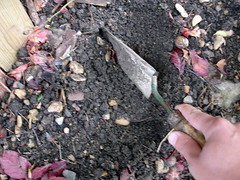
Just the act of using the trowel reminded me of archaeologists gently scraping away the earth to reveal the hidden thing beneath the surface.

The plate uncovered

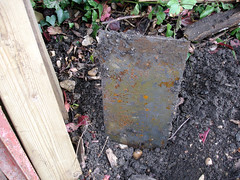
The plate itself was compacted with earth, underneath which was an interesting patina of various rusts.

The rusted plate

Tomorrow I shall take a print from this and then re-bury the plate in the garden for another week. I will also start making more plates for burying but not actually printing.

Filed Under: Uncategorized Tagged With: Plate, Printmaking

Printmaking – A Reflection

October 4, 2007 by Nicholas Hedges

Last week saw my first attempts at printmaking (etching) the results of which can be seen below.

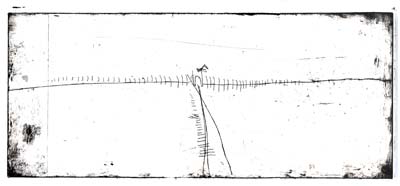
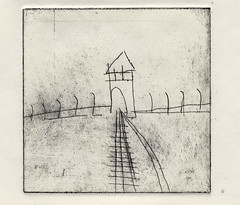
Auschwitz-Birkenau Etching

Hard ground etching on steel plate.
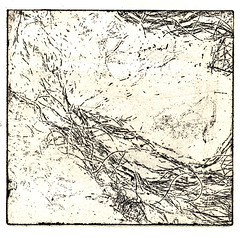
String Etching

Soft ground etching on steel plate.

The two techniques we used were hard and soft ground etching, both of which yielded surprising results, which, in part, is the beauty of printmaking, where the eventual result is never certain. Of course this might just be down to inexperience; I’m sure that professional printmakers achieve results which are wholly intended.

For the first print, I decided to etch a version of the drawings I made of Auschwitz-Birkenau, not so as to aestheticise the image, but to explore what could be gained from this particular medium. Would it bring anything new to my investigations? Despite the fact it looks like something one might find on a greetings card (itself an interesting point) the quality of the image interested me nonetheless – in particular the lines of the track and the fence where the ink had been left on the plate. The manipulation of the ink I realised could make all the difference – an obvious point perhaps, but then I had assumed that I would be creating a clean image with pure and crisp lines (something which I could certainly try in the future). But what interested me the most was the plate itself, the plate as an object in its own right, and, it’s in this that I see potential for investigation re my work on Auschwitz-Birkenau.

As an experiment, we buried some of our plates (these will be dug up this week) so as to cause them to rust. I’d already begun to think of the plate and the print as metaphors for action and the remembered action, and the idea of something rusting or decaying synonymous with the past, where original, unrepeatable moments decay and the memories of those events are merely obfuscated reproductions; the original moment is only ever partially revealed.

The actual scratching at the plate in order to secure an image also interested me. There is something – violent is too strong a word – ‘particular’ about its physicality which, if the plate is the ‘lived action’, declares a degree of tribulation a regards its making, and dealing, as I do in much of my work, with trauma, the etching of an image on a plate and the ‘biting’ of the image into the plate by acid serves to emphasise this.

From this etched, ‘traumatic’ image, one can make facsimiles, but these copies – these memories or post-memories – are never the same (for one they are reversed), and as the plate decays so any prints will remove themselves further from the actual event. Of course, if no prints are made from the plates – if actions are not ‘remembered’ – then more possiblities arise.

Filed Under: Uncategorized Tagged With: Printmaking

© Nicholas Hedges 2024

  • Facebook
  • Instagram
  • Twitter
  • YouTube

Copyright © 2025 · Outreach Pro on Genesis Framework · WordPress · Log in