Nicholas Hedges

Art, Writing and Research

  • Amazon
  • Behance
  • Facebook
  • Instagram
  • Pinterest
  • YouTube
  • Art
    • Digital
    • Drawing
    • Grids
      • Correspondence
      • The Wall
      • The Tourist
    • Ink on paper
      • Shadow Calligraphy
    • Installation
      • Murder
      • Echo
    • Painting
    • Patterns
    • Mixed Media
    • Photographic installation
      • St. Giles Fair 1908
      • Cornmarket 1907
      • Headington Hill 1903
      • Queen Street 1897
    • Research/Sketches
    • Stitched Work
      • Missded 1
      • Missded 2
      • Missded 3
      • Missded 4
    • Text Work
  • Blogs
    • Family History
    • Goethean Observations
    • Grief
    • Light Slowed But Never Stilled
    • Lists
    • Present Empathy
    • Shadow Calligraphy
    • Trees
    • Time
    • Walking Meditations
  • Video
  • Photography
    • Pillars of Snow
    • Creatures
    • The Trees
    • Snow
    • St. Giles Fair 1908
    • Cornmarket 1907
    • Headington Hill 1903
    • Queen Street 1897
    • Travel
  • Illustration and Design
  • Music
  • Projects
    • Dissonance and Rhyme
    • Design for an Heirloom
    • Backdrops
    • Shadow Calligraphy
  • Exhibitions
    • A Line Drawn in Water
      • Artwork
    • A Line Drawn in Water (Blog)
    • Mine the Mountain 3
      • Artwork
    • Mine the Mountain 2
      • Artwork
      • The Wall
    • The Woods, Breathing
      • Artwork
    • Snow
      • Artwork
    • Echo
      • Artwork
    • Murder
      • Artwork
    • The Tourist
    • Dreamcatcher
    • Mine the Mountain
      • Artwork
      • The Tourist
    • M8
    • The Gate
    • Creatures
      • Artwork
    • Residue
      • Artwork
    • A visit to Auschwitz
      • Artwork
  • Me
    • Artist’s Statement

Windows, Bicycles and Catastrophe

January 9, 2011 by Nicholas Hedges

Windows in images are, as I’ve discussed previously, evidence of people living their lives without a thought for the subject or subjects in the photograph. This entry examines a number of details taken from photographs of Oxford at the beginning of the 20th century.

This detail below, from a view of the High Street taken in 1907, shows the open windows of what was then the Mitre Hotel.
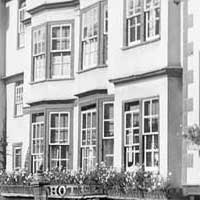
Perhaps these windows were opened by guests visiting the city over 100 years ago, or perhaps by maids in preparation for their visit. But what was taking place behind these windows when the photograph was taken? What conversations were being had? As I’ve said above, whatever they were and whatever was happening within, the open windows serve to give life back to a place from which the photograph was taken. The rooms become portals to unseen parts of the image, not just in the rest of the city, but rather the wider world. It is perhaps then, rather appropriate, that this image shows a hotel.
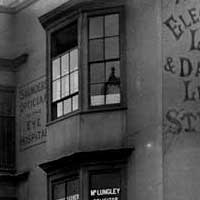
The image above, taken from a photograph of 1909 (amazing how we can just skip a couple of years) is particularly interesting, in that as well as being open, we can also see clear reflections within the window’s glass. This window serves again to take us beyond the boundaries of the image, into its hidden interiors, from where we might look upon that view reflected in the window. The same can be said to some degree about the image below, also from a photograph of 1909.
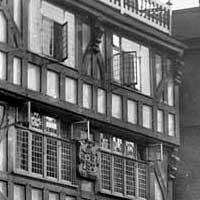
As an aside, it’s interesting how these two images, because they were taken in the same year, constitute in our mind’s eye a single moment; the year (in this case 1909) becomes just that – a moment in time. But what period of time separates the photographs from which these details are taken? Is it minutes, hours, days, weeks or several months? What happened between the taking of one picture and the other?

In the detail below (from a photograph of 1907)  my eyes are drawn to the the bicycle; not the make or the style, but the way it seems to reveal the presence of time, or rather an inconsequential moment in time. For me, it’s in these everday, unremarkable moments that the past is revealed – where history really comes alive.
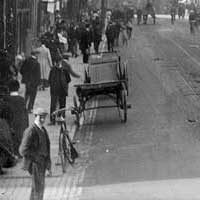
Of course the man in the foreground looking at the camera, and those people walking up the High Street are subjects of a particular moment (cameras are, Barthes beautifully put it, ‘clocks for seeing’), but there’s something about the bicycle which expresses it better. Below is another a detail from a photograph of 1911. Taken again in the High Street, a few metres back from the one above, Carfax Tower in visible the distance.
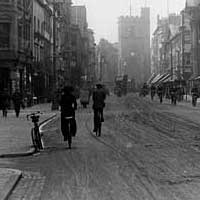
In the image below, something in the window of a shop on the High Street in 1909 has caught they eye of the man looking in as well as the two men walking towards him. The man with his hands in his pockets also describes a specific moment in time; the way he’s standing seems to suggest that he’s just that second stopped; something very different to being ‘stopped’ – as in the case of the two men walking – by the shutter of the camera. But again it’s the bicycle parked at the side of the road which, for me, best describes the moment; or more accurately, its continuity – its place in a passage of time. Even though the two men walking have clearly come from somewhere and will no doubt go somewher else, the bicycle is still much the better way of representing a moment within the passage of consectuive moments, both before and after.
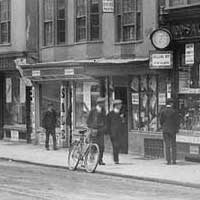
But why is this the case?

One might assume that in a photograph there’s no better means of indicating someone’s presence than someone’s image. The detail above shows such a person on the right. But somehow, the bike and the absence of its rider are more indicative of presence than the man we can actually see, just as it is – as I’ve described above – a better indicator of a single moment in a wider sequence of moments.

In Camera Lucida, Barthes writes:

“I observe with horror an anterior future of which death is the stake… I shudder… over a catastrophe which has already occurred. Whether or not the subject is already dead, every photograph is this catastrophe.”

Forgetting the bicycle for a moment and looking instead at the man in the photograph, one knows that he is dead. His frozen pose alludes to this anterior future of which Barthes speaks. He also writes:

“In the photograph, Time’s immobilisation assumes only an excessive, monstrous mode: Time is engorged…”

The idea of time engorged conjures up apocalyptic images of disaster; Time not able to proceed but growing nonetheless, swelling within the frame of the picture, the world shaking as it struggles to chew and to swallow. The man in the picture above must and will fall victim to this catastrophe (he must and will die), but the man who’s left his bicycle (and as such the photograph) will instead be sure to survive.

I’d assumed it was the act of leaving the bicycle which gave the bicycle its status in the photograph; the fact that whoever left it would be sure to return and pick it up in a matter of seconds or at most minutes; that it was the idea of these few moments which countered the blurring of time I described above (where entire years can implode to fit the space a second – which itself alludes to the idea of engorged time). But in fact, I believe it’s the rider’s escape from the photograph which instills in them – the bicycles – their appeal to the viewer.We know the rider must be somewhere and it’s as if he’s still there; as if the moment from when he left his bike (for example in 1909), to picking it up again is still ongoing.
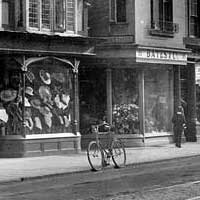
The detail above is taken from a photograph of Cornmarket in 1889. Looking at the entire image, one can see that all the buildings shown have since been demolished, and as sad as this is when one sees what stands there now, one doesn’t find it hard to imagine. Buildings are demolished all the time – it’s a fact of life. But when looking at the detail above, with its open window, it seems less conceivable that it’s since been destroyed, that it no longer exists.

Such a thought doesn’t occur however when I look at images of people.
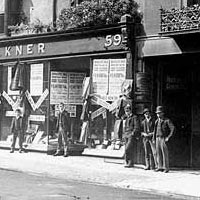
The image above is a detail from the same photograph. Like the building they stand against, all these men are gone. But this, unlike with the detail of the window, does not strike me as inconceivable in any way; quite the opposite. Perhaps it’s the open window which makes the building’s demise (or non existence) seem so unlikely. The open window is indicative of life, of the everyday aspect of life. Who would open a window in a building set to be demolished? But then, who would dress and pose for death?
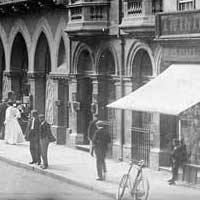
Above, Cornmarket 1907. Another rider has escaped impending disaster.
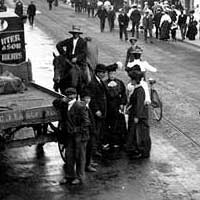
Also Cornmarker 1907. A group of people talk at the southern end, nearest to Carfax. Their clothes (particularly those of the women) position them unequivocally in the time in which they lived.

A number of questions come to mind as I look at them and the scene around them. What are they talking about? What were the hot topics of the day? Where is the woman pushing her bike? (Wherever it is, it’s too late to escape the imminent catastrophe). In this image however, that which captures my interest above all is the rain on the pavement.

Just as shadows give life to a photograph (without the sun beyond the frame of the photograph there can be no shadows within it) so puddles and reflections on wet pavements point to a time before the photograph was taken and, – like shadows with the sun – to the clouds above and beyond the gaze of the lens. Barthes declares that “the photograph is without a future” and while this might be the case, there’s is no doubt they have a past.

Sometimes, photographs (without shadows, puddles, windows open and closed) can look flat and lifeless, as if they’re merely constructions (tableau vivant) designed in their entirety, as counterfeits for the reality they purport to be. They have no future, but, more importantly perhaps, no past. The rain in the photograph above however counters this; it gives the photograph its validity, it is a recognisable sign that something came before.
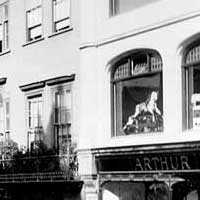
The detail above is taken from the same picture (Cornmarket 1907), and, rather sentimentally perhaps, I was drawn to the rocking horse in the window. One can’t help but wonder what happened to this somewhat peripheral object (peripheral in terms of the overall photograph). I can well imagine it languishing in some dusty attic, forgotten, even broken… although, of course it might be in very rude health, respected as an old family heirloom. And herein lies its point of interest. Whatever its current state – if indeed it still exists – here, in the picture, it’s yet to occupy the mind of the person to whom it belonged. It’s yet to form the memories which that person would have carried with them throughout their life, memories which they might have passed down and which might, to this day be talked about. Perhaps this rocking horse no longer exists as a physical object, but maybe somewhere, it continues to move in words, written or spoken.
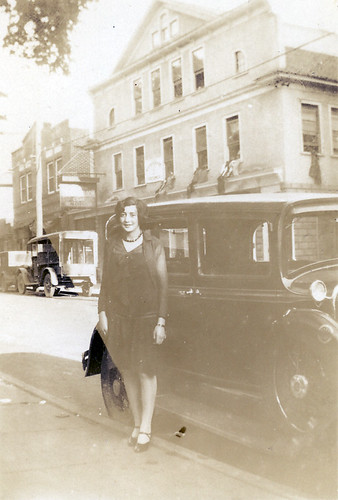
Filed Under: Photography Tagged With: Barthes, Bicycles, Catastrophe, Everydayness, Nowness, Photographs, Vintage Photographs, Windows

Windows 1

January 5, 2011 by Nicholas Hedges

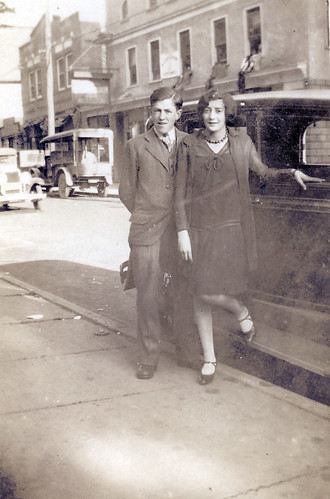
This image was part of a collection I bought a few years ago. I had no idea what I was buying at the time and was intrigued by the image reproduced below.

A young woman and a car

In the photograph, a young woman poses beside a car. The awkwardness of her pose and the uncertainty in her face suggests that she is attending a special occasion of some kind. In the second image below, she is joined moments later (or perhaps it was before) by a young man (her partner?) who also looks a little uncertain, not necessarily because of what he’s about to do, but rather because of what he’s doing at that exact moment, i.e. having his photo taken. Perhaps they are young lovers about to get married? Of course we’ll never know.

A young couple and a car

What intrigues me about these pictures are the details. Looking again at the second photo – which might of course, in the course of time, have come before the one above it (“…if things are perceived as discrete parts or elements they can be rearranged…” as Bill Viola writes) – a car has appeared on the left, moving into shot just as the shutter is released. Even though the young man has also ‘appeared,’ it’s nevertheless the car which gives us the sense of time passing; it is a vehicle for what Sontag describes in her book, ‘On Photography’ as “time’s relentless melt.”

Who was in the car as it drove past? Where was it going? Where had it come from?

History often comes to us ‘top ‘n’ tailed’, where all that went before the period in question, and all that came thereafter is removed, leaving us with an event which reads like a novel; conveniently packaged with a beginning, a middle and an end. To some extent, regarding this, the first image serves as an illustration, whereas with the second, the car tells us that something came before the ‘beginning’, and that something will follow ‘the end’. As a painter, Degas was inspired by photography, and used this device to give his works a greater sense of movement. It’s not so much a means of accentuating movement with regards to that which is shown, but moving the viewer into the world that’s hidden beyond its edges. 

Just as in the first photograph I looked at, my viewpoint shifts as I become aware of the image’s other protagonists. From in front of the couple, and in the guise of the person who took the photo, I glimpse the couple as if I can see them out the window of the car. It doesn’t last for long, but it shows how an image can be opened up by such small details.  

Windows in photographs have always interested me for much the same reason. Within the context of an image, like those above, they provide a means of escape, or again, as in the case of the first photograph I discussed, a means of concealment. They act as eyes, reflecting – literally – the world around them; the world beyond the limits of the picture’s edge. Spatially and temporally, there’s always more to a photograph that that contained within its borders; and for me, a photograph’s appeal, often resides in how it allows access to these spaces.

In the detail below, we can see in some of the windows, the sky and the trees reflected from beyond the frame of the camera; another way in which a camera can capture that beyond its reach.

Windows are also evidence (or perhaps reminders) of ordinary people living their everyday lives without a thought for the subject or subjects below – in this case the couple on the pavement. They conceal those who are perfectly oblivious to the chemical annexation of whatever inconsequential moment in time is being captured. And as a result, this invisible population can often breathe life into a photograph well beyond the stage upon which the action is taking place.

In his book ‘Camera Obscura,’  Roland Barthes describes a portrait by James van der Zee, of a Black American family taken in 1926. Barthes writes:

“On account of her necklace, the black woman in her Sunday best has had, for me, a whole life external to her portrait.”

What Barthes perhaps means, is that the necklace has a provenance, and therefore seems to speak more about the woman’s life than anything else in the photograph. It is a cherished object, worn perhaps for the occasion of the picture (just as the necklace has perhaps been worn by the young lady in the images above). For me, this is, in a way, analogous to the windows in the first picture and the car in the second, for they are small details compared with the picture’s subjects, but details which, nonetheless, build for us a bigger picture of the world the subjects inhabit.
 
The closed windows in the building then, reflect the world beyond the edges of the photograph, they provide evidence of a world beyond the stage. Furthermore, they are windows onto the stage, through which those sitting, standing or passing behind might, just like the driver in the car, catch a glimpse of the actors.
The open windows however provide us with something a little different. Open a window and the outside world pours in; sounds, smells, the noise of the traffic and passing conversations. In other words – life. They serve to animate the scene, again just like the car, and through them we can let our imaginations wander, to discover for themselves, more of this world long since vanished.

Filed Under: Photography, Trees Tagged With: Barthes, Bill Viola, Photographs, Vintage Photographs, Windows

Secret Police 1

January 2, 2011 by Nicholas Hedges

The first image I want to look at (taken from a book called ‘Prague Through the Lens of the Secret Police’ from the Institute for the Study of Totalitarian Regimes; ÚSTR, Prague 2009, 1st edition) shows a scene captured from the window of an apartment block in May 1980.

The net curtain hanging in front of the closed window serves to conceal the identity of the photographer, not only from those outside, but also from us as we look at the picture; more so even, than the fact the photographer is standing behind the camera. Nevertheless, despite the fact they can’t be seen, one is aware of the photographer’s presence. It’s almost as if the camera has captured something beyond the reach of its lens; the secret policeman is out of sight, but never out of mind, just as he was every single day, throughout the time of Communist rule in what was then Czechoslovakia.
The net curtain serves to obscure our view of the world outside, but far from removing us from what is taking place down in the street, it seems instead to immerse us in its here and now (or rather there and then). It becomes the means by which the light from that single moment in May 1980 is frozen, rather than the click of the camera’s shutter.

As I look at the photograph, the identity of the voyeur is both concealed and revealed. The space before the net curtain (that inside the room) becomes the world around me now, here in the present. I look at the image in silence (or to put it another way, I watch the image) and become aware of my breathing as well as every little noise around me; the hum of my computer, the ticking of a clock, a bird singing in the garden. It’s as if the plane of the photograph has moved a few inches forward, as if the photograph begins just beyond the curtain, with the pot of old flowers on the window sill. We are the secret police, watching through the window 30 years in the future.

This paradox is one of the consequences of photography, whatever the particular photograph we’re studying. In fact, however we research the past, we become like secret police, following people, keeping notes, putting notes in files. We document their lives as if we’re trailing them, following them down the street, around buildings or even in their own homes. And yet of course we’re always far in the distance. We follow on behind, yet we’re always way ahead. 

Returning to our image, we can assume the person being followed is the woman entering the apartment block opposite. She turns a little, as if she’s aware that she is being watched. At first glance, it’s as if she’s also being watched by the children on the right, but when we follow their gaze, we can see that two of them are looking beyond the frame of the photograph, somewhere down the street to the left. The woman being followed – our ‘target’ – is glancing that way too, as if something has made a noise. Perhaps that noise startled whoever was watching enough to take the picture?
As I look at the photograph, I rewind the scene a little. There’s the noise and its aftermath, then, in a flash I’m there walking through the doorway, stepping into the shadows beyond, my footsteps clattering, mixed in with the noise which slowly falls away in a receding echo. And as my viewpoint shifts as the observer, so I move between the scene’s protagonists at which the plane of the photograph falls away completely. Was it perhaps a broken window they heard?
Back in the room (and here in my room in the present day) I lean back, as if to avoid the possibility the target might turn her head completely and look up at the window behind, at that from behind which I’m looking 30 years in the future. I look away from her and ahead at the windows opposite. There are two of them, one open, the other closed, both dressed in the same net curtains through which I’m also peering. The sound I’ve described has found its way through the open window, carried on the wind,   along with the children’s conversation and the woman’s footsteps below. Is there someone there too, hiding behind the curtain? A neighbour looking to see what the noise was, or another member of the secret police following the same person, or even someone else? Or perhaps it’s someone else entirely who stands opposite, looking like me at a photograph somewhere in the future, one in which I’m looking back from behind a net curtain, there in the window across the street. 

Filed Under: Photography Tagged With: Photographs, Secret Police, Silence, Vintage Photographs, Windows

© Nicholas Hedges 2024

  • Facebook
  • Instagram
  • Twitter
  • YouTube

Copyright © 2025 · Outreach Pro on Genesis Framework · WordPress · Log in