Nicholas Hedges

Art, Writing and Research

  • Amazon
  • Behance
  • Facebook
  • Instagram
  • Pinterest
  • YouTube
  • Art
    • Digital
    • Drawing
    • Grids
      • Correspondence
      • The Wall
      • The Tourist
    • Ink on paper
      • Shadow Calligraphy
    • Installation
      • Murder
      • Echo
    • Painting
    • Patterns
    • Mixed Media
    • Photographic installation
      • St. Giles Fair 1908
      • Cornmarket 1907
      • Headington Hill 1903
      • Queen Street 1897
    • Research/Sketches
    • Stitched Work
      • Missded 1
      • Missded 2
      • Missded 3
      • Missded 4
    • Text Work
  • Blogs
    • Family History
    • Goethean Observations
    • Grief
    • Light Slowed But Never Stilled
    • Lists
    • Present Empathy
    • Shadow Calligraphy
    • Trees
    • Time
    • Walking Meditations
  • Video
  • Photography
    • Pillars of Snow
    • Creatures
    • The Trees
    • Snow
    • St. Giles Fair 1908
    • Cornmarket 1907
    • Headington Hill 1903
    • Queen Street 1897
    • Travel
  • Illustration and Design
  • Music
  • Projects
    • Dissonance and Rhyme
    • Design for an Heirloom
    • Backdrops
    • Shadow Calligraphy
  • Exhibitions
    • A Line Drawn in Water
      • Artwork
    • A Line Drawn in Water (Blog)
    • Mine the Mountain 3
      • Artwork
    • Mine the Mountain 2
      • Artwork
      • The Wall
    • The Woods, Breathing
      • Artwork
    • Snow
      • Artwork
    • Echo
      • Artwork
    • Murder
      • Artwork
    • The Tourist
    • Dreamcatcher
    • Mine the Mountain
      • Artwork
      • The Tourist
    • M8
    • The Gate
    • Creatures
      • Artwork
    • Residue
      • Artwork
    • A visit to Auschwitz
      • Artwork
  • Me
    • Artist’s Statement

A Humument

December 19, 2010 by Nicholas Hedges

In January this year, I used words from two seemingly unrelated books to create an installation in Shotover Country Park as part of Holocaust Memorial Day. The piece was called The Woods, Breathing, the title coming from an entry in the diary of Adam Czerniakow, who was ‘mayor’ of the Warsaw Ghetto up until his death in 1942.

In his diary, on January 19th 1940, Czerniakow describes a book he’d read, of which, he wrote: ‘The forest, little wild animals – a veritable Eden.’ The book was Pilgrims of the Wild by Grey Owl, and his comment is especially poignant given the horrors of the time in which he was living. It’s as if in the book, he found the freedom he craved, freedom which vanished as soon as the book was closed. The previous year, a few months after the start of the Nazi Occupation, he wrote how he was ‘constantly envying all the heroes of my novels because they lived in different times.’ There is a sense then, when he describes Pilgrims of the Wild that he is also envying the author, Grey Owl.

I’ve always seen Grey Owl’s book as a map, as in many respects all books are, maps through fictional landscapes, half conjured up in the minds of the author and his or her readers. Having read Czerniakow’s diary, reading Pilgrims of the Wild bought me closer, not only to him but to the time in which he was living, as if reading the book was a shared experience; as if we were walking through the same landscape, emerging at the end in very different places. That is not to say of course that reading the book enabled me to understand what it was like to live in those terrible times – nothing can ever do that. But by reading the words he would have read, it was as if I was following in his footsteps.

Looking up from the page, gazing out the window at the sky made me consider the present, the moment in time in which I was living. The sky was that of the book’s landscape, and that which Czerniakow would have seen outside his own window. We must remember, although it seems quite obvious, that the past too was once the present. By understanding this, we can begin to find indviduals lost to the pages of history. We don’t know what it’s like to experience the horrors of Nazi persecution, but reading the book beomes a shared experience, both mentally and kinaesthetically. It is an everyday activity, which opens up a crack through which we can glimpse the past.

Tom Phillips’ ‘treated Victorian novel’ – A Humument – (a page from which is pictured above) has always interested me; the technique of taking a text and changing it to make something entirely new is appealing for a number of different reasons. Every conversation we have, letter we write or note we take borrows from conversations, letters and notes spoken and written over the course of centuries (depending of course on how long the language has been used). Similarly the way we move, whether walking, sitting, standing or reading, borrows from the ways people have moved, again over the course of many hundreds, if not thousands of years. For me, Tom Phillip’s technique as used in The Humument articulates this. It’s as if we’re in the same landscape created by the original work (A Human Document by W.H. Mallock, first published in 1892) and yet are making our way through it in an entirely different way, as if the words are breadcrumbs on a trail, most of which have long since vanished.

As we walk down streets today, across parks, or through woods, we find ourselves within the same place as those who walked there a hundred, two hundred, maybe three hundred years before. We use the same words, we move the same way, but find ourselves interpretating the place quite differently. But it is the same place.

I want to useTom Phillips’ technique and create a new work from Pilgrims of the Wild, a page from which can be seen below; a work that articulates both my time of reading the book and that of Czerniakow’s.
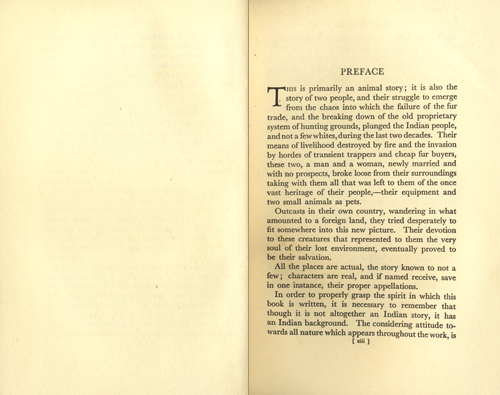
Pilgrims of the Wild by Grey Owl

Filed Under: Heavy Water Sleep, Holocaust Tagged With: Heavy Water Sleep, Holocaust, Humument, Text Work, The Woods Breathing, Tom Phillips, WWII

Text Rain

March 7, 2010 by Nicholas Hedges

The following image is taken from Tom Phillips’ book, Postcard Century. I was reminded on looking at the image of a piece I made called Dreamcatcher and in particular a photograph I took of work in progress.

 
Dreamcatcher (work in progress)

Filed Under: Uncategorized Tagged With: Dreamcatcher, Postcards, Text Work, Tom Phillips

Mine the Mountain 2

February 27, 2010 by Nicholas Hedges

Postcards are a kind of conversation, inasmuch as they’re a connection between two places; one that’s unfamiliar and one that’s known. That’s not always the case of course, but their form’s a framework – a metaphor – with which I try to engage with the past.; to find its lost, anonymous individuals. ‘The Past is a foreign country’, wrote the author L.P. Hartley in the first line of his novel The Go-Between. Whatever information we receive about that place, whether in writing, an object, a painting or a photograph, it comes like a postcard from a foreign shore.

Postcards are fragments, pieces of a world which has vanished, often carrying information of little or no consequence. In the translator’s foreword to The Arcade’s Project, Walter Benjamin’s ‘monumental ruin,’ we read:

“It was not the great men and celebrated events of traditional historiography but rather the ‘refuse’ and ‘detritus’ of history, the half concealed, variegated traces of the daily life of ‘the collective,’ that was to be the object of study.”

The ‘collective’ is represented in this exhibition by the sheer number of postcards and the pictures which they make when grouped together as a whole. What their component images say, echoes my attempt to find the individual so often subsumed, both in unimaginable numbers and the history which we read in books or know through film and television.

In photographs we often come closest to finding individuals when – ironically – they’re distant, when they’re blurred and unaware of the picture being taken. These are genuine moments of history. With words, it’s often the smallest of details which brings the past alive, for in these parts the whole of the time from which they’re now estranged is immanent.

Tom Phillips, in the preface to his book ‘The Postcard Century’ writes that with postcards:

“High history vies with everyday pleasures and griefs and there are glimpses of all kinds of lives and situations.”

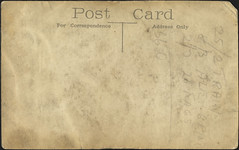
High history sits in every word, even in the ‘x’ of a single kiss. Or the words in the postcard below; prices for Train, Ale and Fags.

Reverse WW1 Postcard

A postcard too is often the physical trace of a journey, one connecting the dots from the place in which it was posted to its final destination. But this destination’s never really reached, and as such, a conversation which may have begun 100 years ago, is never finished. We read the words today, written before we’d ever the hope of existing, sent by those who don’t exist anymore.

The images in this exhibition are not ‘genuine’ postcards per se, but they are (for the most part) postcard-sized, inspired by a collection dating from the First World War. It’s the idea of the part (the individual image) as being a part of a whole which interests me and the whole being immanent in the part, just as humanity is immanent in every individual.

Filed Under: World War I Tagged With: LP Hartley, Postcards, Tom Phillips, World War I, WWI, WWI Postcards, WWI Postcards

© Nicholas Hedges 2024

  • Facebook
  • Instagram
  • Twitter
  • YouTube

Copyright © 2025 · Outreach Pro on Genesis Framework · WordPress · Log in