Nicholas Hedges

Art, Writing and Research

  • Amazon
  • Behance
  • Facebook
  • Instagram
  • Pinterest
  • YouTube
  • Art
    • Digital
    • Drawing
    • Grids
      • Correspondence
      • The Wall
      • The Tourist
    • Ink on paper
      • Shadow Calligraphy
    • Installation
      • Murder
      • Echo
    • Painting
    • Patterns
    • Mixed Media
    • Photographic installation
      • St. Giles Fair 1908
      • Cornmarket 1907
      • Headington Hill 1903
      • Queen Street 1897
    • Research/Sketches
    • Stitched Work
      • Missded 1
      • Missded 2
      • Missded 3
      • Missded 4
    • Text Work
  • Blogs
    • Family History
    • Goethean Observations
    • Grief
    • Light Slowed But Never Stilled
    • Lists
    • Present Empathy
    • Shadow Calligraphy
    • Trees
    • Time
    • Walking Meditations
  • Video
  • Photography
    • Pillars of Snow
    • Creatures
    • The Trees
    • Snow
    • St. Giles Fair 1908
    • Cornmarket 1907
    • Headington Hill 1903
    • Queen Street 1897
    • Travel
  • Illustration and Design
  • Music
  • Projects
    • Dissonance and Rhyme
    • Design for an Heirloom
    • Backdrops
    • Shadow Calligraphy
  • Exhibitions
    • A Line Drawn in Water
      • Artwork
    • A Line Drawn in Water (Blog)
    • Mine the Mountain 3
      • Artwork
    • Mine the Mountain 2
      • Artwork
      • The Wall
    • The Woods, Breathing
      • Artwork
    • Snow
      • Artwork
    • Echo
      • Artwork
    • Murder
      • Artwork
    • The Tourist
    • Dreamcatcher
    • Mine the Mountain
      • Artwork
      • The Tourist
    • M8
    • The Gate
    • Creatures
      • Artwork
    • Residue
      • Artwork
    • A visit to Auschwitz
      • Artwork
  • Me
    • Artist’s Statement

In Ruins

February 28, 2010 by Nicholas Hedges

“A ruin is a dialogue between an incomplete reality and the imagination of the spectator.”

Christopher Woodward, In Ruins

Photograph of Corfe Castle taken during a school trip in 1983.

I first visited Corfe Castle in the summer of 1978 whilst on holiday with my family. I was 7 at the time. I can remember a postcard commemorating the murder of Edward the Martyr (reigned 975-978) a 1000 years before. It’s the first historic place which really captured my imagination, and ever since my mind’s been in thrall to the past. The idea of a 1000 years ago seemed – as it does now – impossible, and in the museum below, in the village of Corfe, I remember staring at a cannon ball dating from the English Civil War, trying in my mind’s eye to picture it, as it was at the time of the siege, moving through the air.

Photograph of me and my brother at Corfe Castle c.1980.

Filed Under: Photography Tagged With: Christopher Woodward, Corfe Castle, Family History, Photographs, Ruins

Creatures 2

February 13, 2008 by Nicholas Hedges

New images, 30 x 20 inches.

Filed Under: Photography Tagged With: Creatures, Detail, Photographs

Creatures

January 30, 2008 by Nicholas Hedges

Yesterday, as part of my MA, I showed a collection of photographs entitled ‘Creatures’. Some of the photographs and the supporting text can be found in the Gallery section of this website, under ‘Creatures‘.

In the feedback session afterwards, the response was, I felt very positive, but what was interesting for me as an artist was the discussion around the different media I employed to show the images. There were of course the photographs on the wall, there was a book which contained the same sets of photographs, and finally the website, which comprised the supporting text and interactive versions of the images.

Different things appealed to different people, but what most people agreed was that the book was particularly engaging. Why was this? What is it about the book which holds our attention, or rather captures our attention so much more – or rather so differently – than pictures on a wall?

One aspect is the fact that on looking at the images on the wall (or any collection of images) one moves; one has to walk from one picture to the next. It may seem an obvious point but it’s one which I hadn’t considered when setting up the exhibition. With a book of course, one is sedentary. Obviously one can walk with a book, but even then there is a difference, with a book the viewer is in control, the viewer has control of time; when images are on a wall, there is inevitably a sense that at some point one must move on. There also is something very personal about a book of photographs as opposed again, to those on a wall. We are all familiar with photograph albums and have no doubt at one time or another spent idle moments looking through the pages of our own family collection. There is then, I believe, a sort of empathy which exists between viewer and artist when images such as these are presented in book form. It is the act of looking at a book which is very personal, it’s a remembered action, one which we do quite unconsciously which connects the viewer with the images.

When the images are on a wall, they become objects, that sense empathy is broken – or rather, it doesn’t exist. A phrase used by someone during the feedback was ‘mechanical’. The selection of the photograph, the enlarging of a detail soon becomes clear as a process which almost threatens the work in terms of its actual content. Someone said that he first viewed the work on an intellectual level, and then, at this point where the intellectual/process part of the work threatened to dominate, this intellectual engagement became an emotional one; this was when he realised the images were my old family photographs.

This was an interesting point in that during the feedback, I began to think that it would be better to show the original, unmounted, photographs rather than mounted copies, or at least, copies which more accurately reproduced the original image. There needs to be a greater distinction between the two. One set are my family photographs, they are intensely personal – the others are photographs of different people; they are not personal (although the contributed in some way to a personal moment). Also, someone suggested – in terms of work shown on the wall – that there needs to be fewer images and perhaps larger details. This however wouldn’t be the case with the book. Again, time is at play here; with a book, one has control over time, one can flick through the pages, put the book down, open it again moments, days or weeks later. In a gallery, or with images on a wall, that engagement is, as I’ve said of a very different quality. One has to (physically) leave images behind, and, in a sense, this is no bad thing. The present passes and moves behind us, the present exists for as long as we are consciously aware of it being present. We hold the image before us, as we consciously hold life before us, and then we move on.

So there is a sense – one that needs to be explored in greater depth – that the temporal aspects of perceiving an artwork are at play here. There is the emotional engagement which might be stronger when images are presented in a book. It is interesting in that during the show of work, a colleague told me about friends of his who’d been to Auschwitz and who had seen a wall of snapshots found in the camp. I told him that I had the book and after the feedback began to think about how different my engagement with these images would be in terms of seeing them on a wall and seeing them on the page. Turning pages makes one subconsciously think of one’s own family albums and this gives the photographs of a stranger a somewhat personal quality.

Thinking back to the suggestion then that there needs to be fewer images and details which are physically larger, I would suggest that the opposite might be true. Perhaps the details should be shown on a scale identical with those of the original photograph? Perhaps they should be places in an album all of their own? Perhaps they should be shown as a pile which one can pick though, or in a cardboard box or suitcase from which one can take them.

There are many possibilities which need to be explored. I believe the photographs as they are, work, but I am intrigued by the emotional and temporal aspects of the way in which they are shown.

Filed Under: Photography Tagged With: Creatures, Photographs

Brief Notes on Boredom

December 13, 2007 by Nicholas Hedges

Notes from ‘On Creaturely Life’ by Eric Santner

“In being left empty by profound boredom, something vibrates, like an echo of that ‘essential disruption’ that arises in the animal from its being exposed and taken in an ‘other’ that is, however, never revealed to it as such. For this reason the man who becomes bored finds himself in the ‘closest proximity’ even if it is only apparent – to animal captivation.”

21

“‘The jewel set at the center of the human world and its Lichtung,’ Agamben writes, ‘is nothing but animal captivation; the wonder ‘that beings are’ is nothing but the grasping of the ‘essential disruption’ that occurs in the living being from its being exposed in a nonrevelation.’ But this means, Agamben continues, that Dasein is simply an animal that has learned to become bored; it has awakened from its own captivation to its own captivation. This awakening of the living being to its own being-captivated, this anxious and resolute opening to a not-open, is the human.”

Filed Under: Photography Tagged With: Agamben, Boredom, Eric L Santer, Photographs

On Old Photographs

June 13, 2007 by Nicholas Hedges

Over the course of the past week, I’ve been scanning in what amounts to almost my entire collection of family photographs. I started, initially, a while ago with just a few that I particularly liked, but after a time, began to think of scanning all those contained in various old albums, a plastic bag and a dilapidated cardboard box. The possibility that one day they would be lost was as good a reason as any; that and the fact it would be easier to view them and to organise them (through the joys of Flickr) were my principal motives.

So, staying up late into the night, I have, over the last few days become somewhat obsessive, and scanned in a few hundred photographs, covering a period of time between c.1946 to c.1997. And, although at first this was a purely practical exericse, it soon became much more than this. It was, and still is, a journey of discovery, for in these small, ‘chemical annexations’, I can see again faces long since lost to the past; revisit once familiar places, and perhaps most poignantly of all, find long lost objects as if I were rummaging through the contents of an attic.

I will write about this experience at length, but will conclude with a summary of what I’ve been thinking when looking at these images. Firstly, I’ve come to realise how drawn I am to ‘bad’ photographs such as the one below:

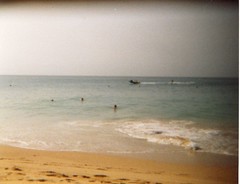
Unknown Seaside

There is something about this photograph (and many others like it) which I find particulary haunting; something about its amateurishness, which makes it seem somehow more genuine. It has the freshness of a sketch as opposed to a finished painting and contains references to an experience which is both direct and profound. Perhaps it is the footprints in the sand, long since washed away which I find so affecting? Or maybe the unknown swimmers and the water-skiier: distant then, and as just as unknown to me now. What course did they take through life after this picture was taken? Did they yet survive the sea, in which, in time, we all will come to be drowned?
As Barthes said:

“I observe with horror an anterior future of which death is the stake… Whether or not the subject is already dead, every photograph is this catastrophe.”

The photograph above seems to illustrate this perfectly, as do many ‘bad photographs’ I have found. Perhaps it’s because they contain this reference to the less than falable human holding the camera (a difference between chemical and digital).

Following on from this, I’ve become very interested in the peripheral parts of photographs, particularly in relation to images taken near the sea (distant swimmers, ships and so on). I have already written about windows in relation to other photographs, but having recently scanned and observed so many images, I’ve come to realise that it’s these areas which are the most ‘genuine’, perhaps because those inhabiting the distance are freed from the artifice of a pose, or because at the moment the picture was taken (just as they were for the rest of their lives) they were oblivious to the photograph’s principal subject and the one taking the picture.

This obliviousness is something I find quite compelling, particularly in relation to my work on the Holocaust, whose victims were by and large anonymous, both in life and now in death. Although I wasn’t living at the time, many members of my family were; they were the ones on the periphery, the specks in the distance, oblivious to what was going on behind them.

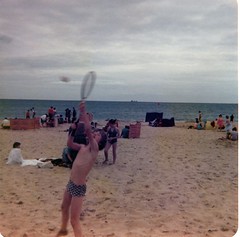
This is a photograph taken in c.1976. It shows my brother in the foreground playing tennis, a lovely image of a fondly remembered family holiday. But what interests me, in relation to my thinking, is the distance.

Looking out to sea we can see a ship, a tanker, sailing under the direction of more (and no doubt large numbers of) human beings, hidden away and quite unknowable. Yet for a time we shared the same stretch of the planet. Those onboard would have had no idea as to our existence, they would have seen at best a mass of coloured dots on the horizon. Yet this degree of separation does not make us any less human, any less feeling. Distance does not negate our hopes and our ambitions. Those few unknowable dots, in the eyes of the ship’s crew, were my family, and have in the years that followed, seen more members come and go. And whether the distance between us is measured in years or miles, we must never forget, that what we see as specs on the horizon, or dots that make the picture on the TV screen, are, in the end, the same people as us.

For more on this subject, click here.

Filed Under: Photography Tagged With: Bathes, Catastrophe, Childhood, Creatures, Details, Holocaust, Photographs, WWII

  • « Previous Page
  • 1
  • 2

© Nicholas Hedges 2024

  • Facebook
  • Instagram
  • Twitter
  • YouTube

Copyright © 2025 · Outreach Pro on Genesis Framework · WordPress · Log in