Nicholas Hedges

Art, Writing and Research

  • Amazon
  • Behance
  • Facebook
  • Instagram
  • Pinterest
  • YouTube
  • Art
    • Digital
    • Drawing
    • Grids
      • Correspondence
      • The Wall
      • The Tourist
    • Ink on paper
      • Shadow Calligraphy
    • Installation
      • Murder
      • Echo
    • Painting
    • Patterns
    • Mixed Media
    • Photographic installation
      • St. Giles Fair 1908
      • Cornmarket 1907
      • Headington Hill 1903
      • Queen Street 1897
    • Research/Sketches
    • Stitched Work
      • Missded 1
      • Missded 2
      • Missded 3
      • Missded 4
    • Text Work
  • Blogs
    • Family History
    • Goethean Observations
    • Grief
    • Light Slowed But Never Stilled
    • Lists
    • Present Empathy
    • Shadow Calligraphy
    • Trees
    • Time
    • Walking Meditations
  • Video
  • Photography
    • Pillars of Snow
    • Creatures
    • The Trees
    • Snow
    • St. Giles Fair 1908
    • Cornmarket 1907
    • Headington Hill 1903
    • Queen Street 1897
    • Travel
  • Illustration and Design
  • Music
  • Projects
    • Dissonance and Rhyme
    • Design for an Heirloom
    • Backdrops
    • Shadow Calligraphy
  • Exhibitions
    • A Line Drawn in Water
      • Artwork
    • A Line Drawn in Water (Blog)
    • Mine the Mountain 3
      • Artwork
    • Mine the Mountain 2
      • Artwork
      • The Wall
    • The Woods, Breathing
      • Artwork
    • Snow
      • Artwork
    • Echo
      • Artwork
    • Murder
      • Artwork
    • The Tourist
    • Dreamcatcher
    • Mine the Mountain
      • Artwork
      • The Tourist
    • M8
    • The Gate
    • Creatures
      • Artwork
    • Residue
      • Artwork
    • A visit to Auschwitz
      • Artwork
  • Me
    • Artist’s Statement

A to B

February 24, 2009 by Nicholas Hedges

As part of a new project, I took a walk to Headington, going via the house where I grew up. I haven’t walked around that area for many years and was quite surprised at how run down it appeared to be, particularly my old house. Of course places change – it’s only natural, but many houses and gardens in what was once a very well maintained street looked – for want of a better word – shabby. Like a lot of places nowadays, the front gardens have been abandoned, either to cars or, through apathy, to the weeds. Walls and fences have been torn down. They’ve collapsed or been removed. There’s a profusion of signs too – a common complaint for many – which litter the streets; a far cry from the 1970s and 80s.

I was also aware as I walked of the huge increase in traffic in the area, at least since I’d lived there, particularly towards Old Headington which, I assume has something to do with the ever expanding John Radcliffe Hospital.

It was on my way to Old Headington that I became aware of two different qualities of memory – not specific ones as such, but those accumulated memories which help us know where we are. I’ve walked thousands of times up and down the streets where I lived (to and from school; to and from the shops), but on the road towards Old Headington my memories are much more of being driven, usually on my way to my Nan’s in the back of Dad’s car. Walking the street today, I noticed things that I’d never seen before whereas walking down the street on which I lived everything was much more familiar (even though they’d changed). This difference is due to the way memories of these places were formed. Of the street on which I lived they were formed, in the main, through walking. On the road to Old Headington, they were formed, again in the main, through a window in the back of the car.

As we walk, we accumulate a sense of place through the memories which are stored in the mind. These images are stronger and clearer when taken in through walking, and indeed when recalled through walking. The slower the pace (although not to the point of a standstill) the more we absorb of the world and thereby the better our sense of place.

The world today, or rather our interaction with and indeed within it is very ‘nodal’. We travel from A to B, usually (but not always) as quickly as we can. The bit in between A and B is taken up, in the case of the car, with looking at the road ahead of us. I should point out that I am in no way anti-car, anti-train or anti-plane; I rely on them as anyone does; my point is that we rely on them far too much at the expense of our engagement with the world around us.

When we walk from A to B however, we don’t ‘get’ just A and B but everything in between. The act of walking ‘anchors’ our destination and the place from which we travel, positioning them in the world. We have time to think, to see and to accumulate a sense of place. We have time to engage with the world and thereby position ourselves within it.

Whilst studying the Old London Road for another project, I began to get an understanding of how slowing our life down helps us to engage with the world around us. I also became aware of how roads today are much different to those in the past. Journeys were slower and roads were very much more a connection between two places. This may sound like a truism, but what I mean is that today, one could travel for mile after mile on roads without actually getting anywhere at all. Destination is not something built into the fabric of the road – something which I felt was very much the case on the Old London Road. Again I should point out that I am not in favour (were it possible) of a return to bumpy, uncomfortable, 16 hour journeys to London.

When the pace of life was slower, when people walked more than they did, I wonder whether their sense of place in the world was different (physical as opposed to social). Again I don’t want to sound as if I’m being naively romantic about the past – it was often grim and difficult to say the very least, but I do think it must have been the case that the world was perceived very differently, not because of the lack of technologies such as the camera, the internet, film or television per se, but because of the pace. Technology of course is a contributing factor to the increased pace of life (and not just through transport). Increasingly we use our mobile phones or email to contact one another (and a great thing both of them are too). But again, this form of contact reduces the world to nodes, to A and B. In the days before such technologies (even when phones were abundant – this applies to a time not so long ago) if we wanted to speak with someone, we would go to meet them, or write them a letter. Either way, our words were physical; they had a place in the world; it wasn’t just about A to B but, as with walking, A through to B.

I think what I’ve gleaned through my ramblings – both physical and verbal – is that we are missing the bits in between. Everything is being reduced to A, B and C. Where there are bit in between, they are little more than a hinterland, glimpses of which we snatch as we travel along roads, motorways, train tracks or even through the air. This brings me back to the houses of which I spoke earlier. They have the appearance, even to the walker, of something that is seen in transit, at speed. Even if one looks for a period of time at one of the houses I saw today (again by no means all of them) it’s as if one is looking through the window of a passing car.
Filed Under: Oxford Tagged With: Childhood, Family History, Memory, Oxford, Walk

Elijah Noon (1838-1885)

November 19, 2008 by Nicholas Hedges

Elijah was the son of Elijah and Charlotte Noon whose tragic story I have already written about in ‘A Murder in Jericho‘. With Elijah Jr, tragedy it seems was waiting to strike the family again, for on 26th May 1885, at the Grapes Inn on George Street Oxford (which still stands today), he choked to death.
At an inquest held before the city coroner E. L. Hussey Esq. William Timms, a relative of Noon’s and the Landlord of the Inn gave evidence. The following is taken from the report in Jackson’s Oxford Journal, printed on May 30th 1885.

“On Wednesday at the Grapes Inn, George Street, on the body of Elijah Noon who died suddenly at that house on Tuesday – J Childs, landlord of the Inn, said he knew the deceased. He thought he was about 46 years of age. On Tuesday morning a little after ten, a man named Timms and his wife, relations of Noon, came in accompanied by the deceased. He heard Timms say he was going to Birmingham. He did not see Noon eat anything, but he had some beer which Timms gave him. The next thing he saw was the deceased gasping for breath. Timms caught him and thinking he was choking, patted him on the back, at the same time telling him to put his finger down his mouth. Noon soon after died, getting a little black in the face. He did not vomit. He sent for a doctor, but he came too late to be of any assistance – William Timms of Birmingham, a relative of the deceased, said that on the day in question they walked from Summertown with his (witness’s) wife. Deceased bought some pigs chitterlings at a shop in George Street which he eat [sic] going along. They all went into the Grapes Inn and had some beer. Noon began eating, and all at once he saw him turn black in the face. He patted him on the back but all the deceased did was to beat his chest, He managed to drink a little beer and then fell back dead into his arms. He had known him some years, and had not heard he was short of breath. A Juryman mentioned that the deceased was a well-known whistler which, he thought, showed he was in good health. Verdict ‘Death from Accidental Choking’.

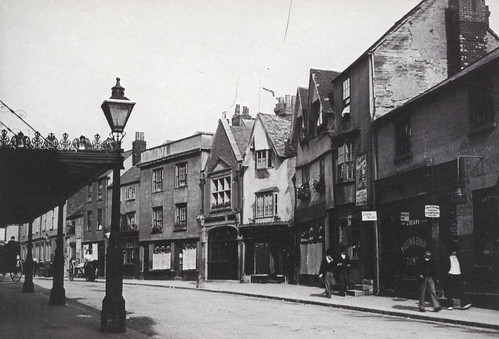
Below is a contemporary (c.1900) photograph of the Grapes Inn. Of all the victorian facades, this is the only one left standing today.
The Grapes

Filed Under: Oxford Tagged With: Death, Elijah Noon, Family History, Newspaper Cutting, Oxford

Oxford and Wales

September 8, 2008 by Nicholas Hedges

Given my Welsh ancestry and my recent visit to Wales I’ve been looking for something which might give me another way into the subject, a link perhaps between me here in Oxford and my ancestors there is Wales. I decided to look at some Welsh myths, being as I am interested in old stories, and so I bought a book; ‘The Mabinogi and Other Welsh Tales.’ I won’t discuss at any length the book (translated and edited by Patrick K. Ford) or explain what the Mabinogi is, but will simply present a piece of text from one of the tales; ‘Lludd and Lleuelys’. In that story one finds the following:

“Some time after that, Lludd had the island measured in length and breadth; the middle point was found to be in Oxford. There he had the earth dug up, and in that hole he put a vat full of the best mead that could be made, with a silk veil over the surface. He himself stood watch that night. As he was thus, he could see the dragons fighting. When they grew weary and exhausted, they fell onto the screen and dragged it down with them to the bottom of the vat. After they drank the mead they slept; as they slept, Lludd wrapped the veil about them. In the safest place he could find in Eryri, he secluded them in a stone chest. After that the place was called Dinas Emrys; before that it was known as Dinas Ffaraon Dandde, He was one of three stewards whose hearts broke from sorrow.”

The reason why this piece of text interested me in particular is probably obvious; the fact that in a book of Welsh Mediaeval myths, Oxford is mentioned. There’s also some thing in the text which gives me a way in to the subject, into possible ideas.

Filed Under: Oxford Tagged With: Mabinogion, Myth, Oxford, Wales

Abingdon Road

September 1, 2008 by Nicholas Hedges

One of my favourite drawings is that made by a German-born, Oxford-based artist called John Malchair, who lived and worked in the city in the late 18th century. The drawing shows a view of the Abingdon Road as it appeared in 1770 with the strange and imposing edifice of Roger Bacon’s study in the foreground – a building that was demolished nine years later – and the familiar, extant structure of Christ Church College’s Tom Tower behind.

There’s something beguiling about the image, depicting as it does the city long before the car, before its expansion into the suburbs when still surrounded by fields and meadows. It’s a quiet almost pastoral scene in which I feel I can hear the birds and feel the sun on my face. I can almost hear the quietude, contrasting it with the sounds I would hear today if I stood in a similar position; indeed, it’s an image in which I am constantly contrasting, moving back, to and fro between the past and the present.

This contrast between the past and present is what I experience as I research my family tree and this image I’ve lately realised embodies some of my recent thinking and research. My great-great-great-great-grandfather, Samuel Stevens, born in 1776, lived and worked as a tailor on St. Aldates in Oxford, a street which is in effect a continuation of Abingdon Road as it moves towards and connects with Carfax in the city centre. I like the fact that he is contemporary with this image and would have been alive (if only a small boy) when Roger Bacon’s study was still standing.

On the other side of my family tree, on my father’s side, my great-great-great-great-great-grandfather, William Hedges lived and worked in Abingdon, a town in which his line lived until George Hedges moved to Oxford sometime around 1869 when he married Amelia Noon, daughter of Charlotte Noon, murdered by her husband Elijah in 1852 (see ‘A Murder in Jericho‘). It’s very likely of course that both these lines (the Stevens’ and the Hedges’) continued back in those same places (Oxford and Abingdon) for further generations, and I like the fact that in this image by Malchair, and in a sense in the building he drew, is a connection between the two. Not only that, there is a connection between my past and my present, as if that connection might be found in the road between Oxford and Abingdon.

Finally, in a project I started some time ago (6 Yards 0 Feet 6 Inches) I make mention of a survey by John Gwynn, carried out in 1771 in which all the residents of Oxford are listed along with the measurements of their properties. It’s a fascinating document in its own right, but if Samuel Stevens’ parents lived in Oxford just a few years before his birth, they would be listed in that survey. Flicking through there are a number of Stevens’ and I can’t help but think one of them is my ancestor.

Filed Under: Oxford Tagged With: 18th Century, Drawings, John Gwynne, John Malchair, Oxford, Survey

Feedback

September 1, 2008 by Nicholas Hedges

Continuing in my research into the murder (or manslaughter as it transpired in the Assizes) of Charlotte Noon by her husband Elijah, I looked – in the Oxfordshire Record Office – at the original burial records for the Parish of St. Paul’s which includes Jericho where the Noons lived in Portland Place, Cardigan Street. I had my suspicions that Charlotte Noon would have been laid to rest in St. Sepulchre’s cemetery off Walton Street and in the records I found this to indeed be the case. I could even see the original plot number ‘G7’ which unfortunately today, won’t help in the identifying of her grave.

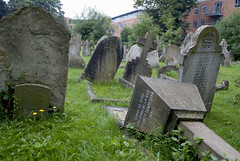
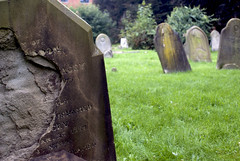
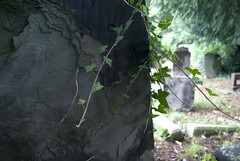
Despite this, yesterday I went a second time to St. Sepulchre’s and began to look again for the grave of Charlotte Noon. Maybe, just maybe, it would be one of those which had defied the passage of time and which could still be read – even if with fingers, but I knew this was unlikely to be the case; for one thing, I assume, as they were not a wealthy family, that the grave stone would be have been rather modest and less likely to survive the last 153 years; indeed this seems to be the case. Many of the graves have melted into the ground and only their outlines in the depressed turf indicate their presence. Nevertheless, there was something very poignant about walking around the cemetery knowing that I was in the immediate vicinity of her last resting place – there was, for those moemnts – a physical link between us.

I have walked around the cemetery on several occasions before, but was always oblivious to what it contained; now, as I walk, the whole place feels very different, as indeed does Jericho as a whole.

St. Sepulchre Cemetery

St. Sepulchre Cemetery

St. Sepulchre Cemetery

The cemetery along with streets Jericho are a part of my ‘geographic biography’. Writing about the piece of work I’m showing at the Botanic Gardens – 100 Mirrors (Dolls), I borrowed a quote from the artist Bill Viola, who wrote:

“Looking closely into the eye, the first thing to be seen, indeed the only thing to be seen, is one’s own self-image. This leads to the awareness of two curious properties of pupil gazing. The first is the condition of infinite reflection, the first visual feedback.”

This ‘feedback’ is precisely what I experience when I walk in these places – indeed any places where I know named ancestors of mine once walked – as if we are for that moment, both walking at the same time.
St. Sepulchre Cemetery

Filed Under: Oxford Tagged With: Bill Viola, Charlotte Noon, Elijah Noon, Family History, Jericho Cemetery, Murder, Oxford, Quotes, St Sepulchres Cemetery, Useful Quotes

North Star Public House

August 22, 2008 by Nicholas Hedges

In the Oxford Journal reports into the murder of Elizabeth Noon by her husband Elijah, it’s stated that:

“He had been drinking at the North Star public House, in St. Giles’s, on Saturday night; that house is kept by the daughter of her [Elizabeth Noon, daughter of Elizabeth and Elijah] uncle Mr Thomas Noon, who paid his men there, and where her father, who worked for him, received his wages which were 20s.”

Like dozens of pubs, the North Star public house has long since vanished and is one which I have never heard of. However, on researching the pub in the library today I discovered the following information:

“North Star public house, 3 Broad Street. Very few records of this pub, but seems to have been mainly licenced by women; Isabella Gittins in 1832 and Mrs. Marsh in 1871. Not known when it closed, but the premises could have been the house of W.B. Yeats the poet while he lived in Oxford. The whole of the site was demolished in 19828 and became Boswell’s department store [which it still is].”

Broad Street, Oxford

On another site, Headington.org the following information about the North Star is given:

Among the building which had to be demolished to make way for the present Boswell’s was… the eighteenth-century North Star pub. At the time of the 1851 census the North Star pub was occupied by John White and his wife and four young children, while in 1881 the publican was a widow, Mrs Eliza Smith, who lived there with her two sons.

According to the newspaper, the pub was, in 1852, run by the daughter of Thomas Noon, brother of Elijah Noon. It is interesting however, that the surname ‘White’ is the maiden name of Elizabeth (Charlotte). To understand the report I decided to take a look at the census for 1851.

Indeed, John White was the publican so one can only surmise that between the date of the census being taken and the date of the murder, the tenancy was taken over by Thomas Noon’s daughter, the cousin of Elizabeth Noon (daughter). Looking again at my family tree however, I could see clearly that the Thomas Noon I had down as being Elijah’s brother would be too young to have a daughter running a pub at that time. Therefore I could again surmise that I had made a mistake and that Thomas Noon must be older (it made sense too given that Elijah worked for him).

Searching the records again, I found a Thomas Noon, born in Burton Dassett in 1796 and living in Oxford in 1851. I knew this was Elijah Noon’s older brother. Looking at the census details I could see also that he was a builder and was married to to a woman called Ann who was born around the same time. They both lived in Little Clarendon Street.

As far as things stand, I haven’t found the name of their daughter, or any of their children for that matter, but it’s interesting how I’m using Ancestry not only to find people to whom I am directly related, but to track and place people in a particular moment in time – an event, which in this case happens to be a murder.

Filed Under: Oxford Tagged With: Charlotte Noon, Elijah Noon, Family History, Murder, Oxford

A Murder in Jericho

August 21, 2008 by Nicholas Hedges

Through my research these past few months, I’ve uncovered several tragic stories surrounding the lives and deaths of my ancestors; John Stevens, my great-great-great-uncle, spent 17 years incarcerated in Moulsford Asylum, Berkshire until his death in 1888 at the age of 51; Jonah Rogers my great-great-uncle, was killed in the second battle of Ypres on May 8th 1915 at just 22 years of age; and Henry Jones, my great-great-grandfather took his own life in Cefn-y-Crib, Wales in June 1889, whilst, as his death certificate records, ‘temporary insane’. Death certificates can, as I discovered with that of Henry Jones tell one a great deal about a person’s life as well as their death, and knowing that my great-great-great-grandmother, Charlotte Noon, had died in Oxford at the age of just 33, I was intrigued to see how she’d met her end, assuming that it was as a consequence of disease.

Having received the certificate in the post however, I was stunned to see the cause of death given as follows:

“Wilful murder bythe said Elijah Noon, the husband of the deceased.” Place of death, “Portland Place, Cardigan Street, St. Thomas’, Oxford.”

I must admit it took a while for the fact to sink in and questions such as how he had killed her began to demand answers. But there were other questions too arising from my research which didn’t seem to fit with the facts as presented by the certificate. If Elijah Noon had, as the certificate stated, wilfully murdered his wife in May 1852, how was it he married Sophia Kinch in December 1854? Surely in those days, if you were guilty of murder, you were hanged?

I decided the next phase of my research would be to look at local papers for the time – namely, Jackson’s Oxford Journal in which I assumed I would find some mention of the case. The next issue following the date of the murder was that published on Saturday 8th May 1852 in which I found a very lengthy report on the murder, the inquest and the subsequent hearing at which Elijan Noon was committed for trial at the next Assizes.

As with the stories I’ve previously mentioned, my ancestors in this case were, in reading the report, certainly brought my to life, even in the retelling of what was a terrible death. Reading their words; “Oh, good God Almighty what shall I do?” “Pray let some one come for I shall die,” I found myself hearing them speak. “Oh my dear boy,” some of the last words of Elizabeth (Charlotte) Noon to her eldest son Elijah. Of course the account is tinged in places with a degree of Victorian melodrama, and at times that which to the modern reader, might seem absurd understatement (“oh dear, what shall I do?”) but the sincerity of the writing is evident and indeed compelling enough to get a sense of the whole tragic affair, the drama not only of the murder itself, but the impact it had in Oxford as a whole.
In the final paragraph of the piece, under the heading “Examination of the Prisoner by the City Magistrates” the words of Elijah Noon, a man “undone” by his actions, say it all.

“The prisoner was then asked by the Mayor if he had anything to say? when he replied ‘I have nothing to say, gentlemen.'”

One can almost hear his tone of voice, see him standing with his head bowed, his whole world and that of his family turned completely upside down. Committed to trial for the wilful murder of his wife, he must have supposed he would hang.

In stories such as this, names become people. Parents and children become more than just past facts in a family tree and the last line of the report illustrates this clearly:

“The announcement [commital for trial at the next Assizes] increased the distress of the prisoner which had manifested throughout the investigation and the parting with his son and daughter was of the most painful nature.”

I have made as best I can from the two prints of the report in Jackson’s Oxford Journal, a PDF copy which is available to download.

So given the dire position in which my great-great-great-grandfather found himself in May 1852, how was it that he lived to marry Sophia Kinch and father seven more children before his death in 1889? Returning to the library I turned again to Jackson’s Oxford Journal. I had thought at first to try and look at the Assizes records but these are held at Kew. I also tried to find the dates of the Assizes held in 1852 but to no avail. However, knowing that there were three Assizes in the year including one in summer, I assumed that Elijah’s trial would take place soon after his appearance before the magistrates at which he was committed for trial.

In the same newspaper I eventually found notice of the Oxfordshire Summer Assizes and the trial of Elijah Noon. It was to take place at 9 o’clock on the morning of Thursday 15th July and in the edition for the 17th July, a full report was given. Again I have created a PDF of the report, but have transcribed a little of it below.

“The trial of Elijah Noon for the murder of his wife, Elizabeth Noon, was fixed to take place at nine o’clock this morning, and by that time every part of the Court was crowded. The prisoner on being placed at the bar, looked very ill, and appeared to feel his position very acutely. Mr. Cripps and Mr. Sawyer were engaged for the prosecution, and Mr Pigott and Mr. Huddlestone for the defence.

Mr. Cripps opened the case by adverting to its painful character, a husband being charged with the wilful murder of his wife, and that it was rendered the more painful because the principal witness in the case as the daughter of the prisoner. Mr. Cripps then detailed the facts of the case, as given in the evidence, and concluded by saying that he felt assured that after they had heard all the evidence, the defence, and his Lordship’s summing up, they would return such a verdict as would be satisfactory to their own consciences and to the public.

Elizabeth Noon, the daughter of the prisoner, was then examined, and was about detailing the facts, when the prisoner: fainted, and was obliged to be taken out of Court. He looked ghastly pale, and his daughter burst into tears, and a more painful and distressing scene has rarely been witnessed in a Court of Justice. The trial was delayed for nearly half an hour, and as soon as the prisoner had revived, he returned into Court, and the case proceeded.”

It is no wonder Elijah Noon looked so ‘ghastly pale.’ He had killed his wife, spent two months in the city gaol and had been separated from his children. Furthermore he was staring at the gallows. The judge in the case had already directed the jury that “no amount of provocation given with words could have the effect of reducing the crime from murder to that of manslaughter,” and this it seems to me was all he could really rely on. “Great allowances must certainly be made for the infirmities of human nature, and when death ensued by means which did not show actual malice, then, in most cases, the crime would be that of manslaughter; but short of that, and if the provocation given were only in words, and death ensued, then the party must be considered as guilty of murder.”

Yet despite the odds seemingly being stacked against him, Elijah Noon was found guilty of the lesser charge of manslaughter and sentenced to two years imprisonment with hard labour. Bizarrely, at the same Assizes, two men on trial for stealing a pair of trousers were given 7 years transportation due to it being their second offence.

Further to studying the newspapers, I was interested in discovering the location of Portland Place. I know Cardigan Street which is listed as being part of the address in the newspaper and on the death-certificate, but Portland Place has disappeared since then. On looking at a map of 1850 however, I found that Cardigan Street continued into Portland Place, whereas today it is all Cardigan Street.

Having studied the map, I walked to Cardigan Street, the layout of which has changed a great deal since that time, but the part of the street which was Portland Place still exists, and walking down there, even though the houses have all changed and the views completely different, I still felt a chill run down my spine.

We are, as I’ve often said, a product not only of everyone that went before us, but everything they did. Anything different and we would not be here. It felt strange then to think that I was only able to walk down that street because, in some small part, of the terrible incident which happened there over 150 years before.

Filed Under: Oxford Tagged With: Charlotte Noon, Elijah Noon, Family History, Murder, Oxford

Oxford’s Lost Streets

April 8, 2008 by Nicholas Hedges

Appropriately for the work I’ve been doing on Oxford Destroyed (itself, part of my Tour Stories project), I chanced again upon a map of the lost streets of Oxford. I first found it a year or so ago, and it was only in conversation today that I remembered it; strange how things acquire relevance at a much later date. The map shows a number of streets and lanes lost to the city by the 17th century; among them Exeter Lane, Schools Street, Frideswide Lane and Jury Lane (the rather unfortunate Shitbarn Lane was also amongst their number). Looking at the map, I couldn’t help think of the ‘map’ I’ve recently ‘made’ as part of the the Oxford Destroyed project; the aerial view of the fictional ruined city.

Oxford Ruins

Thinking about the ruined cityscape, I imagined as I ‘walked the ruins’, how the layout of the streets would perhaps change as new routes were cut through the rubble of buildings, and, looking at the map of the lost streets of Oxford along with those which are still in existence, one can see how these changes are in fact all part of the natural evolution of the city.
In my introdction to Tour Stories I wrote:

As old as it is, Oxford is like every city, one which constantly changes. People come and go, passing through its streets as daytrippers; others live a lifetime here and never leave. Generations come and go, stones corrode; whole buildings are lost to progress. Every day the city is in some small way renewed, restored, destroyed and rebuilt. And with every building that is lost, with the death of every one who has ever known it, so the city changes.

The one thing that has changed little over the centuries is the layout of the streets. Buildings as I said above are lost to progress; generations come and go. One of the things that defines Oxford as being what it is is this ancient layout of streets and lanes down which people have walked for hundreds of years. But nevertheless as the map has shown, even these streets can be removed. High Street, Queen Street, St. Aldates and Cornmarket Street might well have stayed more or less intact (albeit the last three with different names) but those such as I listed above have succumbed.

The idea of streets lost to time beneath various buildings is to me as enigmantic as the lost names of John Gwynn’s survey (1772), a document I have been using on another project; 6 Yards 0 Feet 6 Inches and just as I am exploring this survey through a piece of sonic art/composition, so I want to explore these missing thoroughfares. The spaces still exist of course; Jury Lane has been swallowed up by Christ Church, Exeter Lane by the Bodleian Library, Schools Street by Radcliffe Square (part of it is still extant and is now known as St. Mary’s passage) and Frideswide Lane also by Christ Church.

The lost streets also interest me in relation to other projects; for example, the route between the two sites for my Mine the Mountain exhibition in Autumn (the Town Hall Gallery and the Botanic Gardens) are connected by Deadman’s Walk, the route taken along the old city wall by Jewish mourners in the 13th century. It seems to me that some of that route was along what its shown on the map as being Frideswide Lane, but what interests me in particular is Jury Lane off what is now St. Aldates. In the Victoria County History for Oxfordshire, it states :

Jury Lane (c. 1215-25): Little Jewry (1325); Jury Lane (1376); Civil School Lane (1526). Closed c. 1545 and incorporated in Christ Church.

Little Jewry corresponds with Great Jewry, the old name for St. Aldates which was, after Great Jewry, known as Fish Street. It was the mediaeval Jewish Quarter and the missing street strikes a chord with the theme I have been exploring for the past eighteen months or so; the missing of the Holocaust.

This theme of missing people has lately found form in another project – Umbilical Light and seeing the faces in this work, it is interesting to see how all these works are becoming intertwined.

Filed Under: Oxford Tagged With: History, John Gwynne, Lost Streets, Oxford, Survey

Memory – The Poor Draughtsman II

March 22, 2008 by Nicholas Hedges

Following on from my last entry on the subject (Memory – The Poor Draughtsman) I thought back to the ruined church I saw in Berlin, the Kaiser-Wilhelm Memorial church.

For me, the tower is just what the memory of a building is; a ruin of sorts, one which in part has been reconstructed by the brain to make an image which best approximates reality. Its edges are indistinct, the stone is vague and the fabric a hotchpotch of different materials no doubt rescued from the rubble. Whenever we think of a place we know – for example a building – we build – or rebuild – anew in our minds every time we think of it, constructing the remembered thing from whatever we can find.
The following image is a quick Photoshop sketch which takes the idea of the remembered ruin by blending an old map of Oxford (1750) with the image of the contemporary city as a ruin (aerial view) which I made recently. A more finished piece might leave those buildings still extant intact and blend in fully the areas which have been completely destroyed or altered.

Looking at this, and considering ideas of memory and draughtmanship, I was reminded of the work of Arie A. Galles who has made fourteen large scale drawings of aerial photographs taken over death camps during the second world war. I first discovered his work when studying the death camp at Belzec and have now begun to understand or interpret his work in a different way.

For him, memory is no ruin, it is as sharp as a photograph taken from the skies. But there is it seems a difference between the memory of a place and the memory of people. In the image of Belzec (above) something has been obscured, hidden, buried. It is a piece of text, the fourth verse of the Kaddish; a prayer said for the dead. Perhaps then, we should read this image as a warning, that this place of trauma will always be there, but is victims are gone; there is always the risk it seems of forgetting.
What is also interesting for me about Galles’ work, is the fact the drawings are made using charcoal. There is something about it (something it shares with coal), which gives the drawings of Galles’ extra poignancy; something living, now dead is used to make something new – it creates. I mention coal as I have in light of my work on my family tree, in particular with regards my great-grandfather Elias who worked in the coal mines of South Wales, been considering making drawings using coal. The images of the ruined city, the areial photographs and the black and white photographs I’ve been looking at of people long dead all point to my looking more closely at this idea.

Filed Under: Oxford Tagged With: 18th Century, Arie a Galles, Berlin, Map, Memory, Oxford, Ruins

Umbilical Light

March 14, 2008 by Nicholas Hedges

In ‘Camera Lucida,’ Roland Barthes asks whether history is not simply that time when we were not born? He writes:

“I could read my non-existence in the clothes my mother had worn before I can remember her.”

The study of history necessitates the consideration of our own non-existence. To imagine a past event, as it was before our birth, requires us to see that event without knowledge of what was to come, much as how we don’t know what is coming tomorrow. But to imagine our non-existence, our being not-yet-born, becomes in our conscious minds nothing less than the image of death; such is why perhaps we struggle to comprehend the past, to look upon a turn of the century photograph, where our coming-into-being is so precarious.

Looking at photographs of Oxford, taken around the beginning of the 20th century (such as that below taken in Cornmarket in 1907), I can’t help imagine that somehow, amongst the numbers pictured, are some of my ancestors, or, failing that, someone they at least knew. Perhaps there might be someone unknown to them, who nevertheless crossed their path and in some small way (or, in the case of my own coming-into-being, no small way) made an impact on their life and indeed on all those to come.

But then of course, by thinking this, I am doing just what I shouldn’t do when trying to properly understand this image or rather this moment in time. I am placing upon it the weight of future history. But when I recognise the buildings in the picture, how can I take myself ‘out of the frame’ altogether? Is it not impossible?

Is history then not simply the study of the past, but rather the study of how we got here today? A study of pathways, intersections and the spaces in between – a form of cartography? Well, it is and it isn’t. To study an event we must discover what really happened, and what could have happened if things had been different, what might its protagonists have done otherwise? History therefore – through these other possible outcomes – requires us to examine our own fragility, our unlikely selves and the possibility of our never being born to ask the questions at all.

At the moment the photograph above was taken, when all those pictured were going about the business of their lives, the chance of my Being was practically nil. Now, as I look at the photograph I know that everyone pictured is dead; I can read my own non-existence in the clothes they are wearing, just as they might have read theirs in the photograph itself. But here we have a difference between not-Being and being dead and the photograph is an illustration of that very thing.

Susan Sontag wrote:

“From a real body, which was there, proceed radiations which ultimately touch me, who am here; the duration of the transmission is insignificant; the photograph of the missing being as Sontag says, will touch me like the delayed rays of a star. A sort of umbilical cord links the body of the photographed thing to my gaze – light though impalpable, is here a carnal medium, a skin I share with anyone who has been photographed.”

When we look at a star in the night sky, we can be assured that in most cases, the light which hits our eye, is at least hundreds of years old. It might even be that the star no longer exists, yet we can be certain that it did exist. The same can be said of those we see in the photograph; somehow the light as Sontag writes is like the delayed rays of a star – an umbilical cord which links us with them and vice-versa (if any of those pictured are indeed my ancestors, then the metaphor becomes more vivid). The moment the light left them (and the star), we did not exist; the moment we received it, they did not exist, and yet here we both are and here we have been.

This umbilical light, which springs from each of us, links us to our own non-existence. History is indeed a study of pathways, intersections and the spaces inbetween, and these pathways are made of light.

Filed Under: Oxford Tagged With: Barthes, Oxford, Stars, Susan Sontag, Vintage Photographs

Memory – The Poor Draughtsman

March 10, 2008 by Nicholas Hedges

I have for a long time been interested in memory and how – in terms of its visual fidelity to the thing remembered – it is a rather poor draughtsman. I was thinking of this in terms of how I ‘see’ Oxford when I am remembering it – a street, a building and so on. The city is of course a place I have known well for many, many years and yet, if I try and draw a building (for example Magdalen Tower) or a street (such as the High), I realise very quickly, as I explore the image in my mind (and on the page) that what my mind takes as being Magdalen Tower and High Street has more in common with a ruin that the real thing. That is not to say I see a smouldering pile of blackened stones and charred twisted timbers, but rather, the image which comprises – in my mind at least – the whole, is in fact made up of miscellaneous fragments which are often unrecognisable or entirely out of sequence.

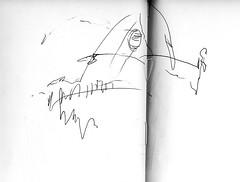
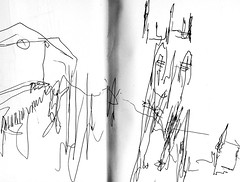
As with the work I did on Auschwitz, I decided to try and draw Oxford, and the following were made with my eyes closed.

Oxford Destroyed Memory Images

In light of my Tour Stories: Oxford Destroyed project, I found these images particularly resonant, and I began to wonder what would happen if I did the same with text; free-writing about a building as I see it in my mind.

Oxford Destroyed Memory Images

Filed Under: Oxford Tagged With: Drawings, Oxford, Oxford Destroyed

John Gwynn Survey

March 3, 2008 by Nicholas Hedges

I have for a long time been interested in John Gwynn’s survey of 1772, carried out in reponse to the Paving Commission’s desire for improvements to the city. In ‘A History of the County of Oxford: Volume 4’ (Victoria County History), it states in the opening paragraph on ‘Modern Oxford’ that ‘…With the Paving Commission of 1771 Oxford’s modern history began…’ and that ‘…The enthusiasm for public improvements alarmed some householders, particularly when the Paving Commission’s surveyor, John Gwynn, was observed all over town, measuring and making notes on streets and houses.’

For a long time I have wanted to work with the survey, being particularly interested in the list of names and associated measurements of the spaces they occupied in the eighteenth century city; people who of course have long since disappeared.

I had looked at it in relation to some work I did as part of my residency at OVADA in April/May last year. Firstly, regards a painting called Gloucester Green to Broken Hayes:

The title ‘Broken Hayes’ is the old name for Gloucester Green and describes a place which, in a sense, no longer exists, although, like the ghostly dwellings on John Gwynn’s survey (1772) it’s ‘footprint’ is still visible in the boundaries of the Green. Many of the items rubbed out on the canvas no longer exist in the places where I ‘found’ them; they are, in name only memories, just like Broken Hayes, yet like the physical aspect of that place, they still exist.

Then the walk I made from which the painting derived:

This isn’t an area I know that well – I’m not sure if I’ve ever walked the entire length of Paradise Street – and yet afterwards, when I looked at David Loggan’s map of 1675, it all seemed very familiar. I was surprised at how much was left after the upheaval of redevelopment, particularly when standing near St. George’s tower, near the junction of St. Thomas’ and Paradise Streets. Now, looking at John Gwynn’s surveys, I could make much more sense of the Oxford of 1772.

In another entry I wrote:

“But the layout of the streets (if not the buildings and their inhabitants) still remain, and so, by walking these streets, armed with a residual list of measurements, one can walk back in time and make a connection with this vanished population.This correlation between time and distance had initially come through my thinking of how difficult it often is, to identify with people who live abroad in war-zones (Iraq and Afghanistan for example), for, even though these countries are only a comparatively short distance away, they might as well be years in the past, for it’s almost as difficult to relate to those who live (and die) there, as it is to those who lived and died, for example, during the first and second world wars, or the time of John Gwynn.”

However, in light of the recent work I have made as part of the Brookes show at MAO, my ideas have changed a little. Thinking back to some thoughts I had on the Three Fates, I’ve decided to try merging the two ideas. One aspect of the story of Gwynn I liked particularly was the idea of residents being worried by his measuring, as if he was measuring up the fate of their homes and the city as a whole. So, I’ve decided to take these measurements, and using string and a ruler, measure out the string and cut them according to the survey. Mr Pepal would therefore be 12 yards, 1 foot and 9 inches.

Filed Under: Oxford Tagged With: 18th Century, John Gwynne, Oxford, Survey

Jews in 13th Century Oxford

February 12, 2008 by Nicholas Hedges

Text taken from ‘The Encyclopaedia of Oxford‘, Ed. Christopher Hibbert, Macmillan London, 1988.

“Jews first came to England in the wake of William I and settled first in London and then in provincial centres. A group of Jews was settled in Oxford early in the 12th century, and the community developed during the following decades, although always remaining comparatively small. Throughout mediaeval England Jews were restricted mainly to money-lending as a means of livelihood, and they were subject to heavy taxation and not infrequent property confiscation by the Crown: the earliest surviving document relating to Oxford Jews refers to a levy exacted from them in 1141, during the war between Stephen and Matilda.

The expansion of the University in the later 12th century attracted Jews to the city, and many were among the wealthiest in England. They were also scholarly but were prohibited, as Jews, from membership of the University, and their contacts with scholars were through lending money and letting lodgings. Jacob’s Hall, facing the present Town Hall in St Aldates’s, was probably let by a Jew as student accommodation, as was Moyses’ Hall, which was to become the property of Oriel College in 1362.

By the end of the 12th century Great Jewry, the street of the Jews, ran from the present Carfax to Folly Bridge. Many of the houses were owned by Jews, some of them let to Christians. There were also Jewish houses in Pennyfarthing Lane (now Pembroke Street), Lombard’s Lane (now Brewer Street) and around Wheatsheaf Yard. Jewish investment in house property was an important feature of mediaeval Oxford since the Jews rebuilt the lath-and-plaster dwellings in stone, often extending as well as improving them. Later documented transactions, such as those between Walter de Merton and Jacob of Oxford in the 13th century, show how these residences became part of the newly founded colleges of the University.

Two stone tablets, one on the wall of the town hall and the other at the entrance to the Botanic Gardens, commemorate the mediaeval Jewish community. David of Oxford, a noted financier, owned a house on the town hall site which was, at his death in 1244, expropriated and presented to the Domus Conversorum, the `home for converted Jews’. Some time after 1190 land outside the East Gate was acquired by the Jews for use as a cemetery. The plaque on the wall of the Botanic Garden gives the date of establishment as 1177, now accepted as too early. On the east side of St Aldate’s, just south of the north corner-tower of Christ Church, stood the 13th-century synagogue. The building comprised houses that belonged to Copin of Worcester, an Oxford Jew who had property dealings with St Frideswide’s Priory.

In general the Oxford Jews’ relationships with their Christian neighbours seem to have been friendly. On occasion the latter safeguarded the former’s property against confiscation; and Copin of Oxford, a prominent member of the 13th-century community, was cleared of one of the frequent ‘coin-clipping’ charges by an all-Christian jury.

The 13th century was characterised by extortionate and restrictive measures against Jews in England, culminating in their expulsion by Edward I on 1 November 1290. Oxford Jewry was impoverished and many fled the country. Under Henry III the Jews were urged to apostatise, and in 1221 a Dominican Friary was established in Great Jewry in Oxford, probably for this purpose. Accusations of crimes of violence, fraud and desecration against the Jews increased. In Oxford on Ascension Day, 17 May 1268, Jews were accused of desecrating the processional crucifix. The community was imprisoned and required to pay for its replacement as well as for the construction of a gold-and-marble crucifix, which was inscribed with an account of the alleged incident and erected opposite the synagogue.

During the years leading up to the expulsion, Queen Eleanor appropriated the property of Oxford’s Jews as `death duties’ due to the Crown and presented it to her favourite, Henry Owen. By 1290 the Oxford Jewish community numbered fewer than 100, of whom no more than nine remained home-owners; and, following the expulsion, surviving Jewish property, including the synagogue, was presented by King Edward to William Burnell, Provost of Wells, who subsequently bequeathed it to Balliol.

Although unable to take part in University life, through their business and personal contacts the Jews of mediaeval Oxford had had an influence on scholarship, as is evident early in the work Of Robert Grosseteste and of Roger Bacon. Both these scholars studied Jewish exegesis, and the latter was particularly interested in the work of an important Jewish scholar of the 13th century – Moses of Oxford.”

The following is a chronology of events (taken from the Jewish Communities and Records website):

1075 – First Jews settle in Oxford.

1141 – During the civil war between King Stephen and Matilda, Matilda imposes a levy on the Jews when she occupied the town. On Oxford’s recapture by King Stephen, he demands, by way of punishment for the Jews’ compliance, three and a half times as much. The Jews are unwilling for comply, until he burns down the home of the Aaron fil’ Isaac.

1177 – Jews permitted to purchase land outside London. Jews of Oxford purchase land for use as a cemetery.

1210 – Much of the property of Oxford Jews confiscated by King John.

1222 – A University deacon, Robert of Reading, converts to Judaism and marries a Jewess. He is burnt alive.

1222 – Council of Oxford orders Jews to wear yellow star on all clothing.

1231 – New Jewish cemetery to the East of the town centre, on the west bank of the River Cherwell, was acquired by the Jews.

1244 – Jewish homes attacked and looted by Oxford students.

1244 – Jewish Loan Rate to students fixed by King Henry III at two pence in the pound per week.

1255 – Oxford sees influx of large number of Jews who converted to Christianity and receive a allowance of one and half pence per day.

1290 – All Jews expelled. Jewish property granted to Provost of Wells.

1309 – The former Synagogue in Great Jewry, later Fish Street (now St. Aldates), was converted into a tavern called ‘Broadyates’ (and from 1520 ‘Dolphin’). It is now part of Christ Church.

Filed Under: Oxford Tagged With: Jewish History, Oxford

A Hollow Square

August 13, 2007 by Nicholas Hedges

Thinking about the Hollow Square further, I thought of Gloucester Green – which is of course a square – and of my previous ideas regarding the contrast between the square at night and during the day. During the day, it might be said to be full, and at night, quite empty. The square too (Broken Hayes) was used to drill soldiers during the civil war, so it has a military history. The idea of empty (hollow) squares

Filed Under: Artist in Residence Tagged With: Artist in Residence, Gloucester Green, Oxford, Residue

A Rocking Horse at Starbucks

July 15, 2007 by Nicholas Hedges

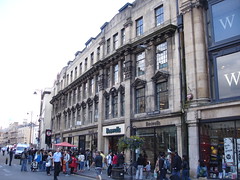
Whilst writing on old photographs, I came across several pictures of Oxford, taken for the most part just after the turn of the twentieth century. One of them, a view of Cornmarket in 1907 is reproduced below.

This photograph is interesting for a number of reasons (you can read more on this and other photographs here), the clothes – particularly those worn by the women – and the rather rudimentary means of transport, all point to a time long since gone. But what really took my interest, over and above everything else, was the rocking horse in the window on the right hand side of the image (see detail below).

The following is taken from my my writing on old photographs of Oxford:

“…rather sentimentally perhaps, I was drawn to the rocking horse in the window. One can’t help but wonder what happened to this somewhat peripheral object (peripheral in terms of the overall photograph). I can well imagine it languishing in some dusty attic, forgotten, broken… although, of course it might be in very rude health, respected as an old family heirloom. And herein lies it’s point of interest. Whatever its current state – if indeed it still exists – here, in the picture, it’s yet to occupy the mind of the person to whom it belonged. It’s yet to form the memories which that person would carry with them throughout their life, memories which they might have passed down and which might, to this day be talked about. Perhaps this rocking horse no longer exists as a physical object, but maybe somewhere, it continues to move in words, written or spoken.”

I knew the window in which the rocking horse stood 100 years ago still existed, although now, sitting behind the glass, in place of the horse, were people drinking coffee in one one the city’s Starbucks.

Comparing the image above taken in 2007 with that taken in 1907, it’s clear that in the intervening 100 years there have been – obviously – many changes – not least the fact that everyone in the 1907 photograph is dead (Barthes’ ‘Catastrophe’). Also, there have been many changes regarding the street’s physical appearance – several of the buildings have been demolished and replaced, in many cases, not for the better (the concrete block on the corner of Market Street).

Looking beyond the photographs, at the wider world, I looked up a list of inventions and discoveries of the 20th century, to get more of an idea as to what else has changed. Most of course were obvious, but the list ran roughly as follows:
instant coffee
talking pictures
the crossword puzzle
the bra
the pop-up toaster
frozen-food
TV
the aerosol spray
penicillin
bubble-gum
the jet-engine
the computer
the polaroid
cats eyes
canned beer
nylon
radar
the photocopier
the ballpoint pen
the helicopter
the slinky
the atom-bomb
the microwave oven
the Frisbee
Velcro
the credit-card
the non-stick pan
McDonalds (which stands today in this very street – in fact, I took the photograph just outside)
the Barbie Doll
audio-cassettes
felt-tips
the ATM
LCD
VCR
the CD
the post-it note
the ink-jet printer
mobile phones
Apple
Windows
Prozac
the internet…

It’s the small things in this list (e.g. the pop-up toaster and post-it notes) as well as the large (jet-engines, the internet) which particulary interest me; small things, but things which have nevertheless helped shape our world today; the way we think and the way we live our lives. It’s hard to imagine a world without the pop-up toaster, ball-point pens and frozen food, but there it is in the photograph.

I first became interested in the importance of small objects on a residency at OVADA, making a series of walks around the city, on which I would note down anything that took my interest, no matter how small and seemingly irrelevant. Below is an extract from a talk I gave as part of the residency.

“The chances of any of us being who we are is practically nil. In order for me to be born, I had to be conceived at the exact time I was conceived, any difference in time – even a split second – and I wouldn’t be me. Also, everything leading up to that moment had to be exactly as it was; anything done differently by my parents, no matter how small, how seemingly irrelevant, any deviation from the path and I would not be me.”

Any of these smaller objects have the power to alter the path of our lives and as such the future. In 1907, the rocking horse in the window might have caught the attention of a passer-by, enough at least to alter his or her life’s path just for a second, and subsequently, in some small or signficant way, the future. I wonder – if I was walking around the city of 1907, listing things as I did on the residency, whether I would have written down, ‘Rocking Horse in a window’.

This future world has seen enormous changes. The world in 1907, of which that street was a part, is in many respects a completely different place to the world of 2007 (not least because of two world wars, the Holocaust, and countless other wars and atrocities). Yet, the two photographs, or at least the first photograph and my contemporary knowledge of the street, share similarities – they are recognisable as being one of the same thing. In both photographs, the tower of St. Michael at the Northgate can be seen in the distance, standing where it has stood since c.1050.

In fact, despite the wholsesale change in the population and the changes to a number of the street’s buildings, the most striking difference for me, is the absence of the rocking horse. So much about the turn of the twentieth century seems to be expressed by it standing in the window, and so much about the years in between, articulated by its disappearance.

Filed Under: Oxford Tagged With: Catastrophe, Oxford, Rocking Horse, Vintage Photographs

Day 7

April 12, 2007 by Nicholas Hedges

I decided to do a walk today, one which I would record in single words or very short phrases. I am interested in how we relate to single words and phrases when trying to picture a past experience, particularly of someone else. The following passage from Neil Hanson’s book, ‘The Unknown Soldier,’ gives a very distinct and accurate picture of a scene one of the millions of soldiers witnessed:

“Decayed sandbags, new sandbags, boards, dropped ammunition, empty tins, corrugated iron, a smell of boots and stagnant water and burnt powder and oil and men, the occasional bang of a rifle and the click of a bolt, the occasional crack of a bullet coming over, or the wailing diminuendo of a ricochet. And over everything, the larks… and on the other side, nothing but a mud wall, with a few dandelions against the sky, until you look over the top or through a periscope and then you see the barbed wire and more barbed wire, and then fields with larks in them, and then barbed wire again.”

The simple use of words makes this passage very stark and easy to imagine. We can see it because in our own minds we can easily conjure objects such as sandbags, boards, empty tins and smells such as old boots and stagnant water. My walk around Oxford would therefore be described as a list of words.

The route was as follows:

Gloucester Green
Gloucester Place
George Street
Bulwarks Alley
New Road
Queen Street
St. Ebbe’s
Brewer Street
St. Aldates
Christ Church
Merton Grove
Deadman’s Walk
Rose Lane
High Street
Merton Street
Magpie Lane
High Street
Catte Street
Broad Street
Magdalen Street
Beaumont Street
Worcester Street
George Street
Chain Alley
Gloucester Green
In total the walk was around 4,300 steps and I wrote 631 words, some of which are listed below:
luminous jacket
suitcase
maps
market
bicycles
litter bin
jackets
mirror
coke can
boots
bicycles
taxis
sunshine – dappled
popcorn (smell)
cigarette smoked
sapling
buses
signs
“…do you remember…”
crutches
blue doors
letter box
chewing gum
‘topiaried’ trees
restaurants
cobbles
gutter
spire
bicycle
crunching wheels
cigarette butts
litter
broken glass
telephone
smell of rubbish
yellow lines
drain
graffiti
lampost
cobbles
stone wall
napkin
window
manhole cover
overhanging shrubs
green door
letter box
railings
fence panels
steps
man drinking
mound
sunshine
shadows
pedestrian zone
red telephone box
scaffolding
exhausts
litter bin
bus stop
taxi rank
colours
pinks, reds, blacks
flags
souvenirs
eating

and so on…

On returning the studio, I wrote up all 631 words on a long piece of paper stuck on the wall

What I was struck by, was how they reminded me of the names carved into the walls of the Menin Gate; column after column of words which at first meant nothing, but all of which had their own unique reference. I decided to create a virtual wall of these words which gave them a very different quality:

I had thought of writing all the words as in the extract above, in a prose form, i.e. something like: “a man wears a luminous jacket, another pulls a suitcase. There’s a machine for maps and the market is on. Bicycles are propped against the wall. Nearby is a litter bin…” Adding words however makes it less authentic, and writing them in this style at the time would be far too time consuming. What is interesting however, is how the mind knits the single words together and in a way the prose form is that process – the mind fills in the blanks.

luminous jacket
suitcase
maps
market
bicycles
litter bin
becomes…

“a man wears a luminous jacket, another pulls a suitcase. There’s a machine for maps and the market is on. Bicycles are propped against the wall. Nearby is a litter bin…”
I refer to a previous entry, Reading and Experience in which I quote the following extract from Filip Muller’s, ‘Eyewitness Auschwitz – Three Years in the Gas Chambers.’

“There was utter silence, broken only by the twitterings of the swallows darting back and forth.”

As I wrote: we were not there in Auschwitz at the moment this line describes (the moment before the doomed prisoner speaks up against the camp’s brutal regime), yet we all know silence and have seen and heard swallows. So although we were not there to witness at first hand this terrible event, we can imagine a silence, a particular one we might have felt some place before, and picture a time we saw a swallow fly. We can use fragments of evidence (photographs, documentary footage) to construct a fuller picture, and fill in the gaps with fragments of own experience. When we speak the words of others therefore, those words will form pictures in our own minds drawn from our own experience.
Taking the list above and adding words to turn it into prose, is in a way similar to this filling in the gaps. In this respect, it is worth doing.

I also tried to draw memories of the walk, taking individual words and drawing the corresponding image. It has always interested me, exactly what we see when we remember something. If we could print out a memory, what would it look like? Certainly what we remember is an approximation of what we actually saw, and again, we use words to ‘join the dots’, to fill in the gaps.
I am reminded again of what I read on Memory places:

“It is better to form one’s memory loci in a deserted and solitary place, for crowds of passing people tend to weaken the impression. Therefore the student intent on acquiring a sharp and well defined set of loci will choose one unfrequented building in which to memorise places…”

The image this passage conjures is of a deserted building, one which has seen better days and is perhaps in need of restoration, a shell which needs some gaps filled.

Filed Under: Artist in Residence, Lists Tagged With: Artist in Residence, Everydayness, Fragments, Listmaking, Lists, Memorials, Memory, Oxford, Residue, Silence

Postcard 1906

April 7, 2007 by Nicholas Hedges

This morning I received a postcard which I’d purchased on eBay; an early twentieth century hand-tinted photograph of Magdalen Tower postmarked on the reverse Oxford 1906.

The text on the rear of the postcard reads as follows:

“My Dear Boy I am sorry that I will not manage to see you on my visit to Coombe. I go to Wallingford on the 13. Will visit when I get settled then you must come over, much love and blessing, your loving brother…”

It’s amazing as one reads this card, to think that it was posted over 100 years ago. Combe (the version written on the postcard – Combe – is actually a misspelling) is a village near Woodstock and a place where my Mum and Step-Dad once lived, and as I read it, I’m reminded of their cottage and the many memories associated with it. Secondly, at the end, the author signs off as ‘your loving brother’ and so, as I read the words in my own voice, I’m reminded of my own brother. In a text of just a few lines written 101 years ago, I have an image – or rather images – of my own family and a house from my own past. I imagine too the bond between the two brothers as being the same which exists between me and mine and as such I have an interest in their lives – lives which have almost certainly been over for several decades. Yet, although the author of this card is certainly dead, by reading his words, we somehow give him life, albeit for the time it takes to read the message. And in some ways, this message might be likened to the last words of a man killed in war, whose last letter reaches his loved ones after news of his death had already been received.

The fact the postcard features an image of Magdalen Tower, serves to strengthen this feeling of familiarity. The man who wrote the postcard, and his brother who received it, no doubt knew it well, just as I do now. It becomes – as indeed does the postcard as an object in its own right – a memory space, a “‘starting point’, and a place for the ‘purpose of recollecting'”. Reading these words, I am sharing the ‘space ‘ of the postcard as an object, as well as a recollection of the scene it shows, Magdalen Tower.

In his book, Camera Lucida, Roland Barthes says regarding photographs:

“From a real body, which was there, proceed radiations which ultimately touch me, who am here; the duration of the transmission is insignificant; the photograph of the missing being as Sontag says, will touch me like the delayed rays of a star. A sort of umbilical cord links the body of the photographed thing to my gaze – light though impalpable, is here a carnal medium, a skin I share with anyone who has been photographed.”

This quote precisely describes a memory space. “‘From a real body [the author of the postcard], which [who] was there [in 1906], proceed radiations which ultimately touch me, who am here [in 2007]; the duration of the transmission [101 years] is insignificant; the photograph of the missing being [the author] as Sontag says, will touch me like the delayed rays of a star. A sort of umbilical cord links the body of the photographed thing [or the author of the postcard] to my gaze – light though impalpable, is here a carnal medium, a skin [a memory space] I share with anyone who has been photographed [or seen the thing I’m seeing].”

Filed Under: Oxford Tagged With: Barthes, Magdalen Tower, Oxford, Postcards, Susan Sontag

Day 1

April 3, 2007 by Nicholas Hedges

I’ve always thought there something about this place (Gloucester Green) which separates it from the rest of the city. Despite the extensive redevelopment carried out in the 1980s, it still retains something of that place which Anthony Wood described in the 17th century as ‘rude, broken and undigested.’ I’m not sure what it is exactly, but I was surprised, as I walked around, at just how empty it was. I have to say, I doubt as to whether there’ll be much of a contrast – in terms of numbers of people – between Gloucester Green at night and during the day. However, tomorrow is market day, and so perhaps with the the extra numbers, I might find some kind of contrast there.

Filed Under: Artist in Residence Tagged With: Artist in Residence, Gloucester Green, Oxford, Residue

Walking

April 2, 2007 by Nicholas Hedges

As part of my continuing work on sites of the Holocaust, I have been investigating Belzec death camp which I will be visiting next month. Even with a place as large as Auschwitz-Birkenau, it’s hard to equate its size with the number of people killed there (1.1 million). Yet this appalling correlation of camp size to victims, is perhaps at its most disturbing in Belzec, where in a space of less than 300 metres by 300 metres, approximately 600,000 people perished. Death on this scale, on the open fields of battle is hard enough to imagine, yet it somehow seems all the more sickening in a place the size of Belzec (and one designed for the purpose). In order to ascertain just how big (or rather small) 300m x 300m is, I bought a pedometer and looked for somewhere in Oxford which might, more or less, equate with these dimensions. The closest I got to those dimensions was in Christ Church Meadow, which if anything was bigger. As I’ve already documented my continuing investigations on this subject I won’t add any more here, but I would like to explore further the idea of using the memory of a place to understand the wider past; something which I touched on in Postcards.

During my walks, I found myself recalling a raft of memories from my own past, triggered by the sites I saw as I travelled. Even a short walk around Christ Church Meadow (the length of which, in terms of time, was itself indicative of the horror and magnitude of the suffering at Belzec) opened the floodgates, not only for my own memories to pour through, but those of the city itself . Here I was, an individual with my own recollections, walking amongst the hundreds of thousands of memories of people long since dead from which the city is inevitably constructed – an interesting metaphor for the individual swallowed by the world stage; swallowed by the violence war.

As I have already written, but something it’s worth stating again, the Italian author Italo Calvino discusses memory and its relationship to a place in his book Invisible Cities. The city he says, consists of:

“…relationships between the measurements of its space and the events of its past; the height of a lamppost and the distance from the ground of a hanged usurper’s swaying feet; the line strung from the lamppost to the railing opposite and the festoons that decorate the course of the queen’s nuptial procession; the height of that railing and the leap of the adulterer who climbed over it at dawn; the tilt of a guttering and a cat’s progress along it as he slips into the same window; the firing range of a gunboat which has suddenly appeared beyond the cape and the bomb that destroys the guttering; the rips in the fish net and the three old men seated on the dock mending nets and telling each other for the hundredth time the story of the gunboat of the usurper, who some say was the queen’s illegitimate son, abandoned in his swaddling clothes there on the dock…”

Could it also be said, that there is a relationship between the measurement of spaces within the city and the events of the past elsewhere?

Filed Under: Oxford Tagged With: Auschwitz, Belzec, Christ Church, Holocaust, Invisible Cities, Italo Calvino, Oxford, Postcards, WWII

Postcards

April 2, 2007 by Nicholas Hedges

I was thinking (given the theme of Residue) about the residues of war, and listed the following sorts of things one might expect to find in the wake of conflict: objects dredged from the battlefield, pieces of shrapnel, bullet casings, shell casings, shoes, photographs, letters, memoirs, bones, clothes, luggage, memories (sights, sounds, smells)… and as I wrote, I thought how important the idea of ‘home’ was, and what a dreadful contrast it must have been to the realities of the often appalling predicaments of those caught up in conflict, whether soldiers or civilians.

Reading various books about World War One, it’s been interesting (and indeed heart-breaking) to read extracts from soldiers’ letters and postcards sent from the trenches, and to read about the packages they received in turn from home. How difficult (as well as comforting) it must have been for them to receive these little pieces of home as they suffered in such unimaginable conditions, and how terrible for parents and relatives to receive the postcards and letters from a loved one after news of their death.
Given that I am exploring the theme of contrast (particularly with regards to the silence of a place following a traumatic event) I thought this was an interesting ‘contrast’ to explore, particularly as Gloucester Green is a place where people are in transit, perhaps travelling away from home.

To change the subject slightly for a moment, one way of identifying with people and events so long ago – for example the Great War – is by identifying with a place (with which we are particularly familiar) as it was at the time, i.e. 1914. I have for a long time been interested in the idea of memory spaces (spaces within the memory of someone either dead or living) and how by accessing these spaces we might gain access to their contemporary thoughts. Under ‘Objects‘ on this site I have written:

“These objects, each through their own unique provenance, allow us, if we use our imaginations, to glimpse people from the pages of history; they, along with tens of thousands of others, once held a place in the minds and memories of men and women long since dead. Now we hold these objects within our minds and memories and as such share a place, a single, common space with those who have long since vanished from the world. To read about the past and those people who made it is one thing, to share this common space with them through the power of objects is quite another.

Objects can be those found in a museum, or buildings contemporary with the time you wish to explore within your imagination; in the case of the Great and the Second World War, it is most of the city (Oxford) as it stands today. As I have already written (on Objects), Aristotle says in relation to systems of memory:

“We should also seek to recover an order of events or impressions which will lead us to the object of our search, for the movements of recollection follow the same order as the original events; and the things that are easiest to remember are those which have an order, like mathematical propositions. But we need a starting-point from which to initiate the effort of recollection.”

This starting point could be anything contemporary with the time we wish to explore. In respect of the Great War, there is a photograph showing men marching to war over Magdalen Bridge and past the Jubilee Fountain which stands near what is now The Plain roundabout. These men are as anonymous to us now, ‘living’ in this photograph, as they are dead, yet the landmarks past which they march are still in existence. That same fountain occupied a place in each of their minds, and so by choosing this as our starting point we might find our way into their thoughts by placing ourselves in their position.

“For remembering really depends upon the potential existence of the stimulating cause… But he must seize hold of the starting point. For this reason some use places for the purpose of recollecting.”

The fountain, in this example, is therefore our ‘stimulating cause’, our ‘starting point’, a place for the ‘purpose of recollecting’. We share in effect a common space with those men who are marching in the photograph and as such we have a starting point from which to ‘initiate the effort of recollection’.
Whilst looking for old prewar photographs of Oxford, I happened upon some old postcards and thought at once how these objects were the perfect metaphor or symbol for our being away from home; a small sliver of our journey away. What we choose to write on the back is largely inconsequential, what is important, is that we have written, that we are remembering those back home.
As I wrote above:

“…how important the idea of ‘home’ was, and what a dreadful contrast it must have been to the realities of their often appalling predicaments.”

Home is an ever-present contrast to that place in which we find ourselves, whenever we travel or make a journey, no matter how long or short, and postcards (now perhaps superseded by texts and emails) are a means by which we remember where it is we come from, by which we close that gap.

Filed Under: Artist in Residence Tagged With: Artist in Residence, Magdalen Bridge, Objects, Oxford, Residue, Silence, World War I, WWI

  • « Previous Page
  • 1
  • 2
  • 3
  • Next Page »

© Nicholas Hedges 2024

  • Facebook
  • Instagram
  • Twitter
  • YouTube

Copyright © 2025 · Outreach Pro on Genesis Framework · WordPress · Log in