Nicholas Hedges

Art, Writing and Research

  • Amazon
  • Behance
  • Facebook
  • Instagram
  • Pinterest
  • YouTube
  • Art
    • Digital
    • Drawing
    • Grids
      • Correspondence
      • The Wall
      • The Tourist
    • Ink on paper
      • Shadow Calligraphy
    • Installation
      • Murder
      • Echo
    • Painting
    • Patterns
    • Mixed Media
    • Photographic installation
      • St. Giles Fair 1908
      • Cornmarket 1907
      • Headington Hill 1903
      • Queen Street 1897
    • Research/Sketches
    • Stitched Work
      • Missded 1
      • Missded 2
      • Missded 3
      • Missded 4
    • Text Work
  • Blogs
    • Family History
    • Goethean Observations
    • Grief
    • Light Slowed But Never Stilled
    • Lists
    • Present Empathy
    • Shadow Calligraphy
    • Trees
    • Time
    • Walking Meditations
  • Video
  • Photography
    • Pillars of Snow
    • Creatures
    • The Trees
    • Snow
    • St. Giles Fair 1908
    • Cornmarket 1907
    • Headington Hill 1903
    • Queen Street 1897
    • Travel
  • Illustration and Design
  • Music
  • Projects
    • Dissonance and Rhyme
    • Design for an Heirloom
    • Backdrops
    • Shadow Calligraphy
  • Exhibitions
    • A Line Drawn in Water
      • Artwork
    • A Line Drawn in Water (Blog)
    • Mine the Mountain 3
      • Artwork
    • Mine the Mountain 2
      • Artwork
      • The Wall
    • The Woods, Breathing
      • Artwork
    • Snow
      • Artwork
    • Echo
      • Artwork
    • Murder
      • Artwork
    • The Tourist
    • Dreamcatcher
    • Mine the Mountain
      • Artwork
      • The Tourist
    • M8
    • The Gate
    • Creatures
      • Artwork
    • Residue
      • Artwork
    • A visit to Auschwitz
      • Artwork
  • Me
    • Artist’s Statement

Archaeological Dig

June 12, 2011 by Nicholas Hedges

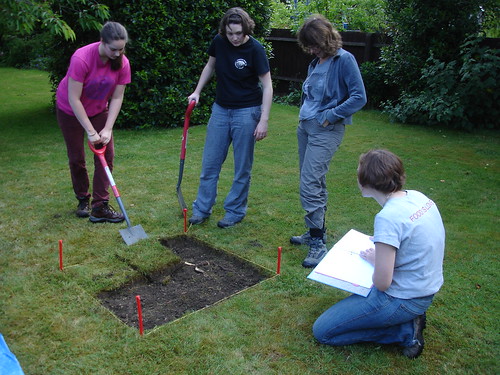
For the past day and a half I’ve been working on the East Oxford Archaeological Project, digging a test-pit in a garden in Iffley Village. Although I’ve had an interest in archaeology for a long time now, I’d never dug before and so the last two days have been both good fun and very informative.

The weather on the first day was good and digging was fairly easy (save for some roots). As I said, I’d never dug before so it was interesting – even on this small scale – to see the process involved; how everything was   observed and recorded.
Iffley Test Pit

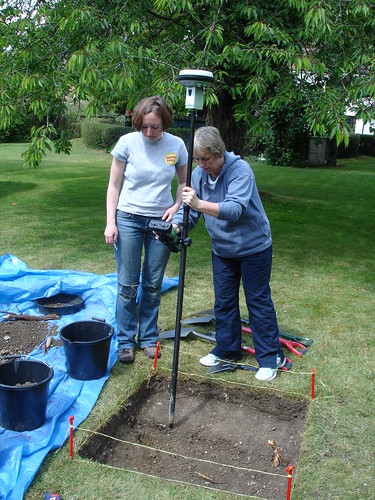
There were a few finds; miscellaneous bits of pottery (including fragments of flowerpot and a possible Roman rim!), a curious brooch-like item, some bits of clay pipe and the piece-de-la-resistance, a Roman coin from the reign of Emperor Postumus (AD 260-269). The image below shows the position of the coin being recorded with GPS.
Iffley Test Pit

Now, most of us in our time have seen a few Roman coins; not least in museums. But finding this one coin (which, I was told, was in suprisingly good condition) was quite remarkable. It’s not a rare coin; it isn’t worth a great deal of money, but that we were the first to see it and to touch it in over 1700 years was amazing. Indeed, the very fact that in the 3rd century someone had walked nearby and dropped the coin where it lay in the soil until its discovery yesterday astounds me. The 3rd century seems – and in many ways is – a completely alien world, and yet, as the coin reminds us, it was the same world as we inhabit today.

Coins are of course objects of transaction. They are given by one to another in exchange for – amongst other things – goods and services. And behind every coin is a complex network of these transactions of which we, as finders, become a part – as much a part as the person who dropped it over 1700 years ago.

It’s also astonishing to think that, within the local context, the coin was lost centuries before Oxford – now regarded as an ancient university, was even established as a town. I couldn’t help think, as I stood in the garden, of how the local landscape looked when the coin was lost, and to then make my way within my imagination down to the centre of town, to ‘see’ what was there.
Filed Under: Archaeology Tagged With: Archaeology, Artefacts, Objects

Herodotus and the Morning Paper

November 10, 2007 by Nicholas Hedges

One has to remove the future from a past event to really understand its ‘presentness’. One has to view historical (‘Herodotus’ – see Walter Benjamin and Objects) events as being on the periphery, whilst the mean and the commonplace (‘morning paper’) take centre stage. It is the distance which interests me, the distance from the heroic or ‘main’ event and the historical perspective this gives us.

“Thus the whole emerges simultaneously with the accumulation of the parts, not because it is the sum of the parts, but because it is immanent within them.”

Bortoft’s theory of authentic wholeness could be applied to history. A great event, such as a coronation (let’s say, that of Elizabeth I), is not a whole in itself. Step outside the ceremony, outside the city and into the countryside; walk into a tavern… what is happening there, at the exact moment of the coronation? Let’s say a man sits at a table eating his dinner, enjoying a drink. The moment of the coronation is not simply about the ceremony but the moment in time (some time on January 15, 1559); that moment, of which the Queen and the man in the house are equal parts, although history has forgotten one and kept alive the other. Within both these people (parts), the moment (the whole) is immanent.

The man in the tavern pours his wine from a jug; 450 years later and that jug is in a display case in a museum, freed as Benjamin would have it from the ‘drudgery of its usefulness.’ For us to see it properly as it stands behind the glass, we need to re-impose that drudgery, we need to see it as it was, when it was useful.

Returning to the idea of distance and perspective: the distant elements in my old holiday photographs on which I have been doing some work, as well as those in old photographs (windows and bicycles) coincide to some degree with what I have written above. When I look at a photograph, taken during a family holiday in the late 1970s, I see the people I recognise, whether that’s myself, my brother, parents or grandparents. But there are often others, all of whom were a part of that moment (such as the girl below who was standing in the distance of one of our snaps).

20

Returning to objects: how do we re-impose the ‘drudgery of an object’s usefulness’ back onto the object? Think of the old musical instruments in the museum. How did I give it back its usefulness? By using the Goethean method of observing, and, in particular, by placing it back – through use of the imagination – in its own time. Although I wasn’t looking at the specific ‘gesture’ of things at that time, I believe I found the gesture of the lira di braccio nonetheless.

So, returning to the man in the tavern; what are the elements of that place which one would need to understand in order to re-construct it through the imagination? Objects (contemporary and old), environments (the room itself and elements thereof), conversations…

Filed Under: Goethean Observations Tagged With: Creatures, Goethean Observation, Henri Bortoft, Herodotus, Objects, Vintage Photographs, Walter Benjamin

Walter Benjamin and Objects

November 10, 2007 by Nicholas Hedges

Walter Benjamin, in his ‘Arcades Project’ writes:

“The collector dreams his way not only into a distant or bygone world, but also into a better one-one in which, to be sure, human beings are no better provided with what they need than in the everyday world, but in which things are freed from the drudgery of being useful.”

and in his introduction (Expose 1939)…

“The subject of this book is an illusion expressed by Schopenhauer in the following formula: to seize the essence of history, it suffices to compare Herodotus and the morning newspaper. What is expressed here is a feeling of vertigo characteristic of the nineteenth century’s conception of history. It corresponds to a viewpoint according to which the course of the world is an endless series of facts congealed in the form of things.”

When I was thinking about how I perceive history, or at least, how I try to perceive history, I began to consider that it was as much about removing the ‘stain’ of history from whatever it was I was perceiving, i.e. an event, date etc., and seeing that event or date as it was, in all its minutiae, at the moment of its happening. It was as much about the mundane (the morning newspaper) as it was the heroic (Herodotus). And that is why I’m so drawn to objects, the simple things – broken bits of pots and so on – one finds in a museum, those things which have been collected and ‘relieved of the drudgery of being useful’ as Benjamin puts it. However, in order to find one’s way back in time, when looking at such objects, one needs to reimpose that drudgery, to see them as they were, when they were in fact useful, when they were being used, and who it was who was using them.

Filed Under: Uncategorized Tagged With: Arcades Project, Herodotus, Objects, Schopenhauer, Walter Benjamin

From Dinosaurs to Human Beings

April 25, 2007 by Nicholas Hedges

After yesterday’s viewing, I began to think about the works I’ve produced so far on this residency and what it is that links them; not that there should be a link – I just know that there is one. Despite the differences, there is an underlying theme which unites the drawings, the text pieces, the deckchairs and the paintings. So what is it?

In answering this I have started to think about… dinosaurs. Not something which first springs to mind when looking at my work and if I mention Jurassic Park, then it might seem that I’m losing the plot altogether, but there is a sequence in this film which is relevant to my work.

In the film, the visitors to the Park are shown an animated film, which explains how the Park’s scientists created the dinosaurs. DNA, they explain, is extracted from mosquitoes trapped in amber and where there are gaps in the code sequence, so the gaps are filled with the DNA of frogs; the past is in effect brought back to life with fragments of the past and parts of the modern, living world. This ‘filling in the gaps’ is exactly what I have done throughout my life when trying to imagine the past, particularly the past of the city in which I live.

As well as reading about and drawing dinosaurs, I also as a child, liked to create and map worlds; countries which I would build from fragments of the world around me; forests, mountains and plains – unspoilt landscapes. And in these worlds there would exist towns and cities, created from ‘the best bits’ of those I had visited.

These invented worlds became, as I grew up, the ‘invented’ or imagined landscapes of Oxford’s past; landscapes that were – just as they still are – created from fragments, parts of the past which are still extant in the city; old buildings, walls, objects and so on. Between these structures, these fragments, I would fill the gaps, with my own imagination, with thoughts derived from my own experience. The city’s past and the past in general, as it exists within my mind, is then, to use the metaphor of cloning in Jurassic Park, a cloned dinosaur. The extant buildings, structures and objects within museums, are like the mosquitoes trapped inside the amber. They are broken strands of DNA. All that is required is for me to fill the gaps, and this I can do with my own DNA. I am in effect, the frog.

This metaphor is interesting in that DNA patterns are, of course, unique to everyone. My DNA is different to everybody else’s as there’s is to mine. Therefore, using my imagination to plug in the gaps of the past, means that the ‘past’ will comprise large parts of my own experience; my dinosaur will contain elements of my own being. (See ‘Postcard 1906’). But although my DNA is unique, it is nonetheless derived from my own past, elements have been passed down by my ancestors from time immemorial. The code which makes me who I am, comprises parts of people I know now (parents and grandmothers), people I knew (grandfathers and great-grandmother) and people lost to the past altogether (great-great grandparents and so on). What interests me about this, is that, through stating above how ‘my dinosaur will contain elements of my own being’ I can now see that ‘my dinosaur’ will contain elements of my own being, which is itself comprised of elements of hundreds – thousands – of people, the majority of whom I will of course never know and who have been dead for centuries. I like to think therefore, that ‘my dinosaur’ and my imagination aren’t entirely unique.

This leads me to look at paths – not the route I walk around the castle, or those recorded by my GPS receiver (although these are entirely relevant) but to the paths taken by my ancestors so that I might be brought into being. The chances of any of us being who we are is practically nil. In order for me to be born, I had to be conceived at the exact time I was conceived, any difference in time – even a split second – and I wouldn’t be me. Also, everything leading up to that moment had to be exactly as it was; anything done differently by my parents, no matter how small, how seemingly irrelevant, any deviation from the path and I would not be me. This is extraordinary enough (whenever I see old photographs of members of my family, I think that if it was taken a second sooner or later, I would not be here) but when one considers this is the same for my entire family tree, again, all the way back to time immemorial, then one realises how, to quote Eric Idle in ‘Monty Python’s Meaning of Life’, ‘incredibly unlikely is your [my] birth’. We are all impossibly unlikely. The chances of all our ancestors walking the exact paths through their lives which they walked is almost nil.

Therefore, my walks, my mapping, my identifying (seemingly irrelevant) objects, my recording them, my palimpsests, are all linked. Memorialising objects (disposable or otherwise), snatches of conversation and so on, inscribing them on a slab, shows how vital these fragments are to future generations and to me in terms of my own past. But how does this fit in with my work on Auschwitz-Birkenau, death camps and World War I?

These ‘arenas’ of death were constructions (although the carnage of a battlefield was often random, the battles themselves were always planned, ‘constructed’ for the purpose) in stark contrast to the rather arbitrary paths our ancestors took so that we might each be born. Death in these places was designed, it was planned, particularly with regards to the horrors of the death camps and by looking at these places, by visiting them, by looking at the seemingly irrelevant, everyday objects left behind, we can fill in the gaps, each using our own existence to imagine the lives and the deaths of others. We understand what it means to be human, the near impossibility of birth and the absolute certainty of death.
Imagining a group of a several hundred people walking to their deaths, whether down a path to the gas chambers, or on a road to the Front, we can easily imagine the route; we can in places walk the route today. But imagining the paths walked by thousands of people through time, to bring each of the victims into being is almost impossible: I say almost impossible, but, as I’ve written above regarding each of our births, it’s possible in the end.

Looking at death therefore is to to look at life and its inestimable value, whoever we are and wherever we live. It is to understand what it means to be human and to cherish the lives of others.

Filed Under: Artist in Residence Tagged With: Artist in Residence, DNA, Holocaust, Objects, Postcards, Residue, Vintage Photographs, World War I, WWI, WWII

Postcards

April 2, 2007 by Nicholas Hedges

I was thinking (given the theme of Residue) about the residues of war, and listed the following sorts of things one might expect to find in the wake of conflict: objects dredged from the battlefield, pieces of shrapnel, bullet casings, shell casings, shoes, photographs, letters, memoirs, bones, clothes, luggage, memories (sights, sounds, smells)… and as I wrote, I thought how important the idea of ‘home’ was, and what a dreadful contrast it must have been to the realities of the often appalling predicaments of those caught up in conflict, whether soldiers or civilians.

Reading various books about World War One, it’s been interesting (and indeed heart-breaking) to read extracts from soldiers’ letters and postcards sent from the trenches, and to read about the packages they received in turn from home. How difficult (as well as comforting) it must have been for them to receive these little pieces of home as they suffered in such unimaginable conditions, and how terrible for parents and relatives to receive the postcards and letters from a loved one after news of their death.
Given that I am exploring the theme of contrast (particularly with regards to the silence of a place following a traumatic event) I thought this was an interesting ‘contrast’ to explore, particularly as Gloucester Green is a place where people are in transit, perhaps travelling away from home.

To change the subject slightly for a moment, one way of identifying with people and events so long ago – for example the Great War – is by identifying with a place (with which we are particularly familiar) as it was at the time, i.e. 1914. I have for a long time been interested in the idea of memory spaces (spaces within the memory of someone either dead or living) and how by accessing these spaces we might gain access to their contemporary thoughts. Under ‘Objects‘ on this site I have written:

“These objects, each through their own unique provenance, allow us, if we use our imaginations, to glimpse people from the pages of history; they, along with tens of thousands of others, once held a place in the minds and memories of men and women long since dead. Now we hold these objects within our minds and memories and as such share a place, a single, common space with those who have long since vanished from the world. To read about the past and those people who made it is one thing, to share this common space with them through the power of objects is quite another.

Objects can be those found in a museum, or buildings contemporary with the time you wish to explore within your imagination; in the case of the Great and the Second World War, it is most of the city (Oxford) as it stands today. As I have already written (on Objects), Aristotle says in relation to systems of memory:

“We should also seek to recover an order of events or impressions which will lead us to the object of our search, for the movements of recollection follow the same order as the original events; and the things that are easiest to remember are those which have an order, like mathematical propositions. But we need a starting-point from which to initiate the effort of recollection.”

This starting point could be anything contemporary with the time we wish to explore. In respect of the Great War, there is a photograph showing men marching to war over Magdalen Bridge and past the Jubilee Fountain which stands near what is now The Plain roundabout. These men are as anonymous to us now, ‘living’ in this photograph, as they are dead, yet the landmarks past which they march are still in existence. That same fountain occupied a place in each of their minds, and so by choosing this as our starting point we might find our way into their thoughts by placing ourselves in their position.

“For remembering really depends upon the potential existence of the stimulating cause… But he must seize hold of the starting point. For this reason some use places for the purpose of recollecting.”

The fountain, in this example, is therefore our ‘stimulating cause’, our ‘starting point’, a place for the ‘purpose of recollecting’. We share in effect a common space with those men who are marching in the photograph and as such we have a starting point from which to ‘initiate the effort of recollection’.
Whilst looking for old prewar photographs of Oxford, I happened upon some old postcards and thought at once how these objects were the perfect metaphor or symbol for our being away from home; a small sliver of our journey away. What we choose to write on the back is largely inconsequential, what is important, is that we have written, that we are remembering those back home.
As I wrote above:

“…how important the idea of ‘home’ was, and what a dreadful contrast it must have been to the realities of their often appalling predicaments.”

Home is an ever-present contrast to that place in which we find ourselves, whenever we travel or make a journey, no matter how long or short, and postcards (now perhaps superseded by texts and emails) are a means by which we remember where it is we come from, by which we close that gap.

Filed Under: Artist in Residence Tagged With: Artist in Residence, Magdalen Bridge, Objects, Oxford, Residue, Silence, World War I, WWI

© Nicholas Hedges 2024

  • Facebook
  • Instagram
  • Twitter
  • YouTube

Copyright © 2025 · Outreach Pro on Genesis Framework · WordPress · Log in