Nicholas Hedges

Art, Writing and Research

  • Amazon
  • Behance
  • Facebook
  • Instagram
  • Pinterest
  • YouTube
  • Art
    • Digital
    • Drawing
    • Grids
      • Correspondence
      • The Wall
      • The Tourist
    • Ink on paper
      • Shadow Calligraphy
    • Installation
      • Murder
      • Echo
    • Painting
    • Patterns
    • Mixed Media
    • Photographic installation
      • St. Giles Fair 1908
      • Cornmarket 1907
      • Headington Hill 1903
      • Queen Street 1897
    • Research/Sketches
    • Stitched Work
      • Missded 1
      • Missded 2
      • Missded 3
      • Missded 4
    • Text Work
  • Blogs
    • Family History
    • Goethean Observations
    • Grief
    • Light Slowed But Never Stilled
    • Lists
    • Present Empathy
    • Shadow Calligraphy
    • Trees
    • Time
    • Walking Meditations
  • Video
  • Photography
    • Pillars of Snow
    • Creatures
    • The Trees
    • Snow
    • St. Giles Fair 1908
    • Cornmarket 1907
    • Headington Hill 1903
    • Queen Street 1897
    • Travel
  • Illustration and Design
  • Music
  • Projects
    • Dissonance and Rhyme
    • Design for an Heirloom
    • Backdrops
    • Shadow Calligraphy
  • Exhibitions
    • A Line Drawn in Water
      • Artwork
    • A Line Drawn in Water (Blog)
    • Mine the Mountain 3
      • Artwork
    • Mine the Mountain 2
      • Artwork
      • The Wall
    • The Woods, Breathing
      • Artwork
    • Snow
      • Artwork
    • Echo
      • Artwork
    • Murder
      • Artwork
    • The Tourist
    • Dreamcatcher
    • Mine the Mountain
      • Artwork
      • The Tourist
    • M8
    • The Gate
    • Creatures
      • Artwork
    • Residue
      • Artwork
    • A visit to Auschwitz
      • Artwork
  • Me
    • Artist’s Statement

Verdun

April 30, 2008 by Nicholas Hedges

On 26th April I visited the battlefields and sites of Verdun. The name, like that of the Somme and Ypres, calls to mind visions of unimaginable horror; thousands upon thousands of men turned into names carved in monuments in towns throughout Europe, or lost completely, names and all, in the churned and pulverised fields. In my imagination, such places are always wet, cold, dark and desolate, as frozen in their appearance as they are fixed in old black and white photographs.

I won’t at this point discuss the battle’s history, suffice to say it’s a place in which around 500,000 men lost their lives, a figure which like so many grim statistics (I’m thinking here of my work on the Holocaust) is almost impossible to imagine (as much as it’s impossible to correlate). 26,000,000 shells rained upon the battlefield, six shells for every square metre. But difficult as these facts are to process, we must at least try.

Having arrived in Verdun, we stopped the car at a track leading into a wood and no sooner had we started to walk amongst the trees than we became aware of the undulating ground; the shell craters and trenches, around and from within which this new wood had grown. At once we recalled the craters and trenches of Sanctuary Wood in Ypres, but the contrast between the two was clear; in Sanctuary Wood the trenches had been, at least, ‘over-preserved’ (some suggest they were dug for tourists after the war) but here they’d remained untouched since the end of hostilities. They were rounded and smoothed, and all the more powerful. At Sanctuary Wood, the whole place had the feel of a playground, whilst in this wood, the peace and quiet provided a stark counterpoint to the horrors of war.
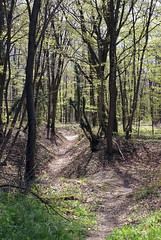
Verdun

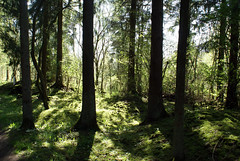
This counterpoint came in the birdsong and the colour of the sky, which on what was a glorious day was tinted by the brown of the trees and last year’s leaves filling the craters and trenches; a curious bruising as if a part of the dusk was somehow stained upon it. And between the carpet of leaves and the blue of the sky, was the green of this year’s growth; the whole scene a complete contrast to what the name, Verdun, had until now conjured in my mind. This place was simply beautiful.
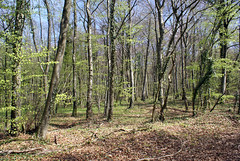
Verdun

Save for a few tourists, we walked the woods alone, and yet, even then, the trees like those we’d encountered at other sites of trauma, seemed more than what they were. But whereas those which grow in Auschwitz-Birkenau and Belzec are strangely complicit in the events of the past, those in Verdun had grown from its wreckage; they did not hide what happened there. And stranger still was the sense that in this place Mankind was older than nature; Man had shaped the ground through his own destruction; he had made the void – the quagmire of mud – from which nature had risen, giving the trees a human quality, as if they carried with them the memory of all who fell – as if they were the fallen soldiers. And the resilience of Nature, it’s ability to rise from such appalling devastation, was one of the most striking aspects of our visit; despite the human feel of the trees, I realised how small humans are, even when they are made big through war. No matter what we do, Nature will in the course of time return. Long after we have finally gone, she will still be here, just as she was that day, in blue sky and birdsong, and as such, to walk through the woods was like being the last two people left on Earth.
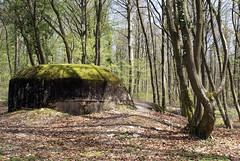
This scarred idyll was littered with other wartime detritus; the pillboxes within which men would hide, seeking out their fellow man beyond the apertures through which their guns were trained. They sat like concrete bells, still ringing with the war, like the ringing heard in silence, after exposure to something loud. (I am reminded here of the idea of sympathetic vibrations, where when a bell is struck, another bell across the room begins vibrating, giving off the same sound. These pillboxes which litter the landscape around Verdun, and which we saw in Ypres, seem to contain within their walls and deep impenetrable interiors, a sound which finds sympathy in all the others. I can imagine these vibrations ringing in sites all across the world, again long after man has gone.)
Verdun

Having recorded the sounds of the birds (and on playback I notice the insects – and I start to think of flies trapped in amber) we left the wood and made our way to Fort Vaux, the second to fall in the Battle of Verdun and a place I will return to later.

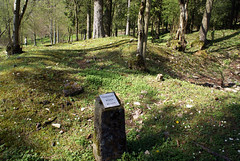
This persistence of Nature was nowhere more apparent than in one of the ruined villages which we visited towards the end of the day. There was nothing left of Fleury-devant-Douaumont save for the street names preserved on signposts along with signs indicating where there’d been a farm, the cafe, Town Hall and the workshop of a weaver.
Verdun

One of the interesting things about the numerous ruined villages is how they each have a Major, a post created to preserve the memory of the place as well as those who lived there. Like the woods, the landscape was blistered beneath the lush grass, undulating like immeasurably slow ripples following the impact of thousands of shells. It was pockmarked with craters some of which had filled with water to make ponds, beautiful beneath the dappled shade of the trees. Again, one had the feel of Man being older than Nature, with the new wood growing out of what remained of the village; despite the unimaginable numbers of shells which ploughed the soil, the sheer number of dead, the poison of the gas used in the battle, the ground had somehow made this beautiful landscape. And just as a corpse can tell us much about its demise through what nature has written upon it – the time of death for example – so the woods grown out from the corpse of the landscape speak of the time that has passed; and here is the curious enigma of the Great War. Despite the fact that almost a hundred years separates us, it doesn’t seem that long ago.
Verdun

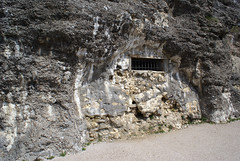
Fort Vaux is a name synonymous with the suffering, endurance and the bravery of the soldiers who fought there. Even after the French were forced to surrender, the Germans presented arms as a mark of respect. The following is an extract from H.P. Willmott’s book on the First World War.
Verdun

“The German bombardment of the Fort began on June 1st 1916, at one point firing shells at the rate of 1,500 to 2,000 of the per hour. Inside were 600 troops under the command of Major Raynal. Just before dawn on the 2nd the barrage stopped and two German battalions moved forward. By mid-afternoon they had overwhelmed the defenders and occupied a large part of the superstructure. Raynal was determined to resist, and he and his men withdrew to the underground corridors where a grim battle was fought in the darkness with grenades and machine guns. On June 4th the Germans used flamethrowers in an attempt to drive the French out with asphyxiating black smoke…”
It’s a curious shell, a skull like structure cut into the rock which belies the horrors it has witnessed. Standing on top, one could see why it was so important, commanding spectacular views of the surrounding countryside and here, the contrast between the view of the tourist and that of the soldier becomes stark. What would they have seen from this same position? Hard to imagine that it was such a wasteland.

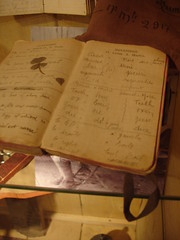
From Fort Vaux we made our way to the Memorial Museum and then to the Douaumont Ossuary. At the Museum, there was one object in particular which interested me, and that was a notebook containing handwritten translations of English words into French.
Verdun

The first line is the translation for Dead; Mort.
Verdun

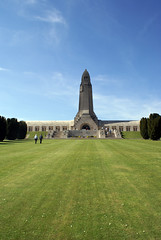
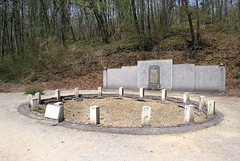
The structure of the ossuary is very much of its time and has the appearance of something which wouldn’t look out of place in Fritz Lang’s vision of the future, Metropolis. And this fact reminds us that it was just twenty years later when Europe and the world would be plunged into yet another catastrophe, indeed, during our journey around Verdun, we found evidence of this catastrophe in a memorial to 16 people killed in the second world war whose mutilated bodies were found dumped in a ditch which itself formed their memorial.
Verdun

From the top of the tower, one is again presented with spectacular views of the battlefields and again one can’t imagine what it would have looked like in those dark months of 1916. The tower itself houses the Victory Bell and the Lantern of the Dead which shines out over the battlefield.
Most of the structure is taken up by the 137 metre long cloister where each tomb shows a precise area of the battlefield from where the bodies were recovered. What one does notice – especially on a warm sunny day like that on which we visited – was how cold it is inside. One expects it to be colder given the thick stone walls, but there is something of an extra dimension to the chill, one is made all the more aware of being in the presence of the dead. And yet, this cold defines the living, it shows up our breath and for me, this was one of the most powerful aspects of the building.
Verdun

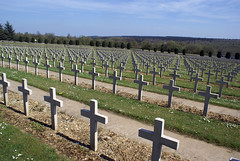
Outside the ossuary, through a row of small windows, one can see the bones of the 130,000 dead entombed within. Seeing the piles of leg bones, shoulder blades, vertebrae and skulls, one is reminded of the randomness of war, the arbitrariness of death on the battlefield. Like numbers and lists of names, it’s hard to imagine that these mountain of bones were once thousands of individuals, just as walking amongst the graves of the 15,000 men in front of the ossuary, one cannot imagine that many dead. Multiply that number, that space by thirty, see where it stretches out into the distance, and one begins to understand – in part – the horror of the war.

But one can never know what it was really like, and that to some extent is the point. Would we want to? We must do everything we can to never know. The inability to contemplate such horror in the face of such natural beauty is exactly its power. What we see when we walk through the woods is in some respects the world as it was before the war, the world of better days as remembered by those caught in the ‘meat-grinder’ of battle. The trenches gouged in the ground and the shell-craters pock-marking the soil are reminders of a brutal past, and yet they are also a warning about the future.
Having left the ossuray we made our way into the town of Verdun itself. Music was playing from speakers attached to all the lamposts, and at the appearance of people dressed in costume and sporting masks, we realised we had come at the time of a carnival. But there was something sinister about these people, the way in which they were a part of the town but detached, within but without. Something about their featureless, anonymous faces; the way they looked at us but we could not look at them, just a version of their selves.
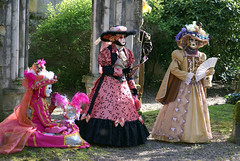
Verdun

And seeing all these colourfully dressed people on the steps of the town’s huge memorial served to illustrate the continuity of life, but also the fact that those who died on the battlefields outside the town would have known brighter, happier, more colourful times, a juxtaposition which is everywhere in Verdun and which was to be found in the town’s Cathedral, itself hit on the first day of the battle – February 21st 1916.
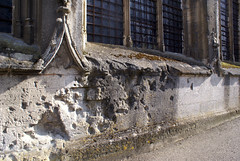
Verdun

The Cathedral still bears the scars of war, but on the inside, one finds again the colour.
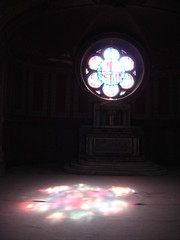
Verdun

Filed Under: Trees, World War I Tagged With: Place, Silence, The Somme, World War I, WWI, Ypres

Zuleika Dobson

March 31, 2008 by Nicholas Hedges

It was through reading E.M. Forster’s lectures (collected in a book entitled ‘Aspects of the Novel’ and first published in 1927) delivered under the auspices of Trinity College, Cambridge, that I first came across a reference to Max Beerbohm’s satirical novel Zuleika Dobson. In particular it was a passage quoted by Forster as ‘this most exquisite of funeral palls… Has,” he goes on to say “not a passage like this a beauty unattainable by serious litertature?” The answer to that is in some respects yes and below is that very passage:

“Through the square, across the High Street and down Grove Street they passed. The Duke looked up at the tower of Merton… Strange that tonight it would still be standing there, in all its sober and solid beauty – still be gazing over the roofs and chimneys, at the tower of Magdalen, its rightful bride. Through untold centuries of the future it would stand thus, gaze thus. He winced. Oxford walls have a way of belittling us; and the Duke was loth to regard his doom as trivial.

Aye by all the minerals we are mocked. Vegetables, yearly deciduous are far more sympathetic. The lilac and laburnum making lovely now the railed pathway to Christ Church Meadow were all a-swaying and a-nodding to the Duke as he passed by – ‘Adieu, adieu your Grace,’ they were whispering. ‘We are very sorry for you – very sorry indeed. We never dared suppose you would predecease us. We think your death a very great tragedy. Adieu!”

The premise of the novel concerns the arrival into Oxford of the beautiful Zuleika Dobson, a woman of such beauty, any man who sees her cannot help but fall in love.

“To these Emperors, for whom none weeps, time will give no surcease. Surely, it is sign of some grace in them that they rejoiced not, this bright afternoon, in the evil that was to befall the city of their penance.”

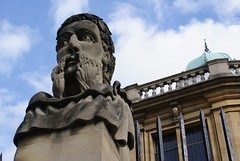
Broad Street

The problem is that Miss Dobson herself cannot love any man who loves her in return and so, having fallen in love with the brilliant Duke of Dorset, her love is immediately lost on hearing of his reciprocal feelings. Spurned, there is only one course of action left to the Duke and that is suicide by drowning in the Isis during Eights Week. But such is the esteem in which he’s held, and such is the love every undergraduate holds for Miss Dobson, that almost the entire undergraduate population of Oxford plunges into the river and is lost.

Taking the plaintive tones of the passage above and some other extracts of the novel, I assumed (not recalling the date of its first publication) that Beerbohm’s novel was something of an allegory about the lost generation of the First World War, of the lost innocence of Edwardian Oxford. However, the novel was first published in 1911, and as such, the book is not unlike the pair of black owls which perch on the battlements of the Duke’s ancestral home and foretell of his death.

“Young Oxford! Here, in this mass of boyish faces, all fused and obliterated, was the realisation of that phrase. Two or three thousands of human bodies, human souls? Yet the effect of them in the moonlight was as of one great passive monster.”

Just after reading the novel, I started reading again Peter Vansittart’s survey of the First World War, Voices From the Great War. Comprising quotes, poems, letters and so on, the book paints a picture of the war through the long lost contemporaneous voices. I first bought the book following a visit made to Ypres and turned to it again having received a gift of almost 200 postcards from the time of the Great War.

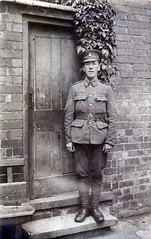
World War 1 Serviceman

Taking the three together – Beerbohm’s novel, the postcards and the quotes – one begins to read the absurd fantasy of Zuleika Dobson in an altogether different way. We have all seen images of men cheerfully marching to the Front, waving their hats and shouting, and when one reads of the mass (almost cheerful) suicide of all the young men in the novel, one cannot help but compare.

“There was a confusion of shouts from the raft of screams from the roof. Many youths-all the youths there-cried ‘Zuleika!’ and leapt emulously headlong into the water. ‘Brave fellows!’ shouted the elder men, supposing rescue-work. The rain pelted, the thunder pealed. Here and there was a glimpse of a young head above water-for an instant only.
Shouts and screams now from the infected barges on either side. A score of fresh plunges. ‘Splendid fellows!'”

And from Vansitartt’s book…

“The enormous expansion of wealth in the peaceful years between 1908 and 1914 brought not happiness but fear, and fear so powerful that it could be expressed only in images of fear and destruction. When war came, it was almost universally accepted as something foreseen and foretold. Even those who loathed the notion of it acquiesced in it as inevitable, and it is not foolish to conclude that what ultimately brought the war was not the ambitions and fears of Germany, but a death-wish in the peoples of Europe, a half-conscious desire to break away from their humdrum or horrifying circumstances to something more exciting or more exalted.” C.M. Bowra

“War might drive a man till he dropped: it could be a dangerous and bloody business; we believed, however, that it still offered movement, colour, adventure, and drama. Later, when the murderous, idiotic machinery of the Western Front was grinding away, of course all was different.” J.B. Priestly

Of course it was different – the reality of the situation. And having turned the last few pages of Beerbohm’s novel, I wondered what it would have looked like, all those dead young men lying prone in the waters of the Isis.

Filed Under: World War I Tagged With: Memory, Nowness, World War I, WWI, WWI Postcards, WWI Postcards, Zuleika Dobson

Walking and Memorials

June 3, 2007 by Nicholas Hedges

Having written in the previous entry (about Belzec) ‘Walking is itself a vital part of the memorial’, I was interested to read the following in Neil Hanson’s book, The Unknown Soldier.

“However, no-one, not even a Prime Minister could impose a meaning unacceptable to the public on any memorial, which ‘by themselves remain inert and amnesiac, dependant on visitors for whatever memory they finally produce.

Filed Under: World War I Tagged With: Memorials, Neil Hanson, Walking, World War I, WWI

The Unknown Soldier

April 6, 2007 by Nicholas Hedges

Extract from Neil Hanson’s book, ‘The Unknown Soldier,’ concerning the infamous Battle of the Somme.

‘The next day, the regiment began the long march to the Front. In the heat of early summer, nature had made attempts to reclaim the violated ground and a deceptive air of somnolence lay on the landscape. “The fields over which the scythe has not passed for years are a mass of wild flowers. They bathe the trenches in a hot stream of scent,” “smelling to heaven like incense in the sun.” “Brimstone butterflies and chalk-blues flutter above the dugouts and settle on the green ooze of the shell holes.” “Then a bare field strewn with barbed wire, rusted to a sort of Titian red – out of which a hare came just now and sat up with fear in his eyes and the sun shining red through his ears. Then the trench… piled earth with groundsel and great flaming dandelions and chickweed and pimpernels running riot over it. Decayed sandbags, new sandbags, boards, dropped ammunition, empty tins, corrugated iron, a smell of boots and stagnant water and burnt powder and oil and men, the occasional bang of a rifle and the click of a bolt, the occasional crack of a bullet coming over, or the wailing diminuendo of a ricochet. And over everything, the larks… and on the other side, nothing but a mud wall, with a few dandelions against the sky, until you look over the top or through a periscope and then you see the barbed wire and more barbed wire, and then fields with larks in them, and then barbed wire again.”

As the torrents of machine-gun bullets ripped through the grassy slopes up which the British troops were advancing, the smell of an English summer – fresh cut grass – filled the air. For thousands it would be the last scent they would ever smell.’

Filed Under: World War I Tagged With: Neil Hanson, Soldiers, The Somme, World War I, WWI

Two Minutes Silence

April 2, 2007 by Nicholas Hedges

Every year, at the 11th hour, on the 11th day of the 11th month, we pause for two minutes and remember all those who died in two world wars and subsequent conflicts. We stand still and in silence, a tradition which, one hopes, will always be respected. Over the last few days, having written about the nature of silence in those places which have witnessed appalling human suffering, I’ve been thinking more about this tradition of silence – not so as to question it (as I’ve said, it is a tradition which must always be recognised and respected) but rather its process; what we think about when we stop and are quiet; what it is we are doing when we remember?

The silence temporarily turns the street, the office or wherever it is we’re standing into a different place; it creates a contrast, against which we might compare our normal everyday environment – that from which we step for two minutes to then rejoin at its end. This act of rejoining is, I believe, as important as the stopping and the silence, for as simple as it is, it’s nevertheless something which millions were unable to do, whether through disability or simply because they never came home at all.

Filed Under: World War I Tagged With: Memorials, Memory, Remembrance, Silence, World War I, WWI

Edmund Blunden

March 30, 2007 by Nicholas Hedges

Edmund Blunden (1896-1974) saw action at both Ypres and the Somme and was awarded the Military Cross. A friend of Siegfried Sassoon, he became a fellow of Merton College, Oxford in 1931 where he remained until 1944, returning to the city in 1968 as Professor of Poetry.

I found the following poem in The Penguin Book of First World War Poetry.

1916 seen from 1921

Tired with dull grief, grown old before my day,
I sit in solitude and only hear
Long silent laughters, murmurings of dismay,
The lost intensities of hope and fear;
In those old marshes yet the rifles lie,
On the thin breastwork flutter the grey rags,
The very books I read are there – and I
Dead as the men I loved, wait while life drags

Its wounded length from those sad streets of war
Into green places here, that were my own;
But now what once was mine is mine no more,
I seek such neighbours here and I find none.
With such strong gentleness and tireless will
Those ruined houses seared themselves in me,
Passionate I look for their dumb story still,
And the charred stub outspeaks the living tree.

I rise up at the singing of a bird
And scarcely knowing slink along the lane,
I dare not give a soul a look or word
Where all have homes and none’s at home in vain:
Deep red the rose burned in the grim redoubt,
The self-sown wheat around was like a flood,
In the hot path the lizard lolled time out,
The saints in broken shrines were bright as blood.

Sweet Mary’s shrine between the sycamores!
There we would go, my friend of friends and I,
And snatch long moments from the grudging wars,
Whose dark made light intense to see them by.
Shrewd bit the morning fog, the whining shots
Spun from the wrangling wire: then in warm swoon
The sun hushed all but the cool orchard plots,
We crept in the tall grass and slept till noon.

This is a beautiful poem, three lines of which struck me in particular:

Those ruined houses seared themselves in me,
Passionate I look for their dumb story still,
And the charred stub outspeaks the living tree.

As part of my research for my OVADA residency I have been looking at the area of Oxford in which the OVADA gallery is situated (Gloucester Green) a place which following the Black Death was known as ‘Broken Hayes’. At this time (c.1348/49) many parts of the town – decimated by the plague – were empty, and Blunden’s lines seem to describe perfectly this sense of emptiness, reflection and loss.

Filed Under: Poetry, World War I Tagged With: Uncategorized

  • « Previous Page
  • 1
  • 2
  • 3
  • 4

© Nicholas Hedges 2024

  • Facebook
  • Instagram
  • Twitter
  • YouTube

Copyright © 2025 · Outreach Pro on Genesis Framework · WordPress · Log in