Nicholas Hedges

Art, Writing and Research

  • Amazon
  • Behance
  • Facebook
  • Instagram
  • Pinterest
  • YouTube
  • Art
    • Digital
    • Drawing
    • Grids
      • Correspondence
      • The Wall
      • The Tourist
    • Ink on paper
      • Shadow Calligraphy
    • Installation
      • Murder
      • Echo
    • Painting
    • Patterns
    • Mixed Media
    • Photographic installation
      • St. Giles Fair 1908
      • Cornmarket 1907
      • Headington Hill 1903
      • Queen Street 1897
    • Research/Sketches
    • Stitched Work
      • Missded 1
      • Missded 2
      • Missded 3
      • Missded 4
    • Text Work
  • Blogs
    • Family History
    • Goethean Observations
    • Grief
    • Light Slowed But Never Stilled
    • Lists
    • Present Empathy
    • Shadow Calligraphy
    • Trees
    • Time
    • Walking Meditations
  • Video
  • Photography
    • Pillars of Snow
    • Creatures
    • The Trees
    • Snow
    • St. Giles Fair 1908
    • Cornmarket 1907
    • Headington Hill 1903
    • Queen Street 1897
    • Travel
  • Illustration and Design
  • Music
  • Projects
    • Dissonance and Rhyme
    • Design for an Heirloom
    • Backdrops
    • Shadow Calligraphy
  • Exhibitions
    • A Line Drawn in Water
      • Artwork
    • A Line Drawn in Water (Blog)
    • Mine the Mountain 3
      • Artwork
    • Mine the Mountain 2
      • Artwork
      • The Wall
    • The Woods, Breathing
      • Artwork
    • Snow
      • Artwork
    • Echo
      • Artwork
    • Murder
      • Artwork
    • The Tourist
    • Dreamcatcher
    • Mine the Mountain
      • Artwork
      • The Tourist
    • M8
    • The Gate
    • Creatures
      • Artwork
    • Residue
      • Artwork
    • A visit to Auschwitz
      • Artwork
  • Me
    • Artist’s Statement

The rue Notre-Dame des Champs, Paris by Walter Sickert

January 6, 2011 by Nicholas Hedges

The photograph below is a rather poor reproduction of a painting hanging in The Ashmolean museum, Oxford. It is perhaps, my favourite painting in the museum. Painted by Walter Sickert (1860-1942), it’s one which I have stood before for some considerable time, not least quite recently in order to write the following.
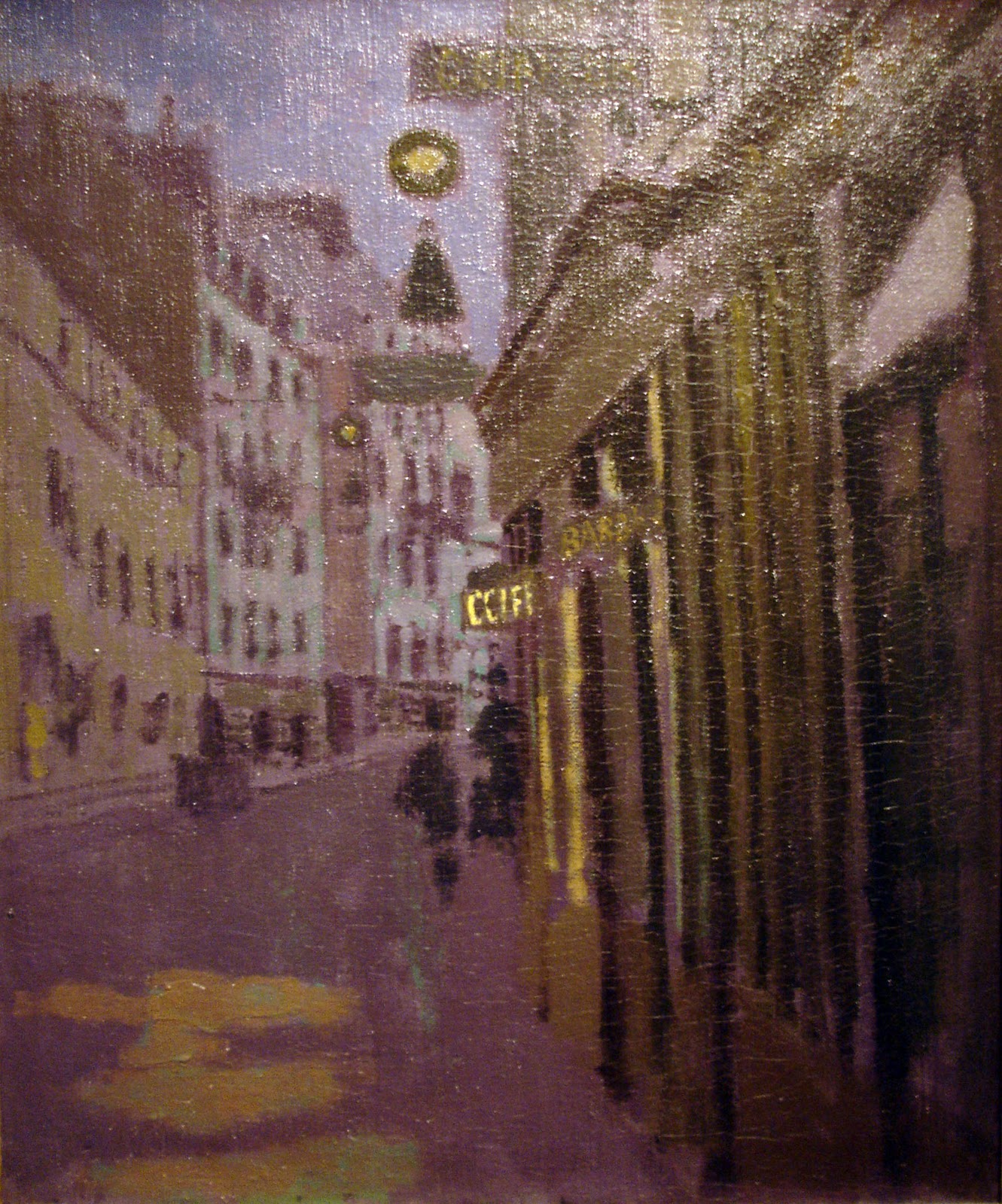
In my previous entry, regarding Cy Twombly’s Panorama, I discussed, albeit briefly, how it was quite impossible to fully appreciate a painting through a reproduction. Of course that much is obvious, but I wanted to write about this particular work to see just how differently I perceived it compared with the work by Cy Twombly, which, as I say, I’ve only ever seen in a book.

As can be seen from the photograph, one of the things I noticed straight away about this painting was the light reflecting off its surface. Not really anything to do with the painting perhaps, but, nonetheless it forced me to move, to find an angle where I wouldn’t be dazzled, and by doing so, I discovered something about the painting itself. What’s important here, is the fact that a painting isn’t just a surface on which paint is applied (although the appreciation of surface and texture can only be attained when faced with the real thing). Instead, a painting is as much about the space around it. Of course, Walter Sickert would have no idea that his painting would one day grace a wall in the Ashmolean museum, dazzled by the lights. But he would have walked whilst painting it, or rather moved before the easel. He would have stood in front, to the left, to the right, and this movement in the act of painting is, I believe, important in the act of viewing and appreciating the result.

So what do we see in this work? Well, it’s a road in Paris (the rue Notre-Dame des Champs), one on which the painter John Singer Sargent had a studio. Given the muted palette and bruised sky, the picture shows a scene from about that time of day when the night begins removing all the colours from the world, when the last light in the sky, makes all manner of colours that seem to last for just a few seconds. It’s a wet end to a day that’s more than likely seen nothing but rain. The concertinaed facades of the shops with their heavy paint dragged down the surface, the downward strokes of the windows in the buildings opposite and the vague forms from which the scene’s almost entirely comprised, all suggest the fading light and drenched air of an autumn or winter evening.

There are puddles in the street which soak up the sickly light of the cafe like a man with a sponge mopping up blood after a brawl. The road is somewhat sickly and the light of the cafe offers us a refuge from whatever is coming just around the corner. Two or three figures stand just ahead. Are they moving? Are they walking towards us? Away? It’s hard to tell. But a feeling of isolation, pervading the picture, is I believe augmented by their presence.

As I moved before the painting, shifting my weight from one foot to the other, the colours seemed to shift. The bluey-violet sky shimmered above the drowned buildings, and the reflections in the road revealed new colours the more I looked. Looking at the painting in the flesh, I felt – compared with looking at the reproduction above – that my eyes had to move in order to cross from one side to the other. In a reproduction, the spaces are of course greatly reduced and everything can be seen or grabbed in an instant. In the flesh (and this painting is very much about the physicality of the world) you look as you might when standing somewhere in town.  You look with more than just your eyes; you experience the painting with your body; one that stands alone before the canvas.

Returning for the moment to the glare of the lights, I found that when I looked at the painting from the right hand side, the glare subsided, and that all that remained were just a few specs where the paint was raised above the rest of the surface. Furthermore, from this position, the painting seemed to open up, as if the concertinaed lines of the shop facades were being pulled, expanding like bellows. Here, the street seemed to pull me on. Standing directly in front, it almost seems about to collapse upon itself.

I’m not trying to suggest that this is all deliberate on the part of the artist, but to emphasise the fact that the act of looking at a painting is a physical experience. Sickert would have known this street, he would have recalled what it was like to stand there. He would have moved before the canvas as he painted, and, as a viewer, the way I stand and move before the canvas reflects that. It is, in the end, the only way to get to know art.
www.nicholashedges.co.uk

Filed Under: Paintings Tagged With: Paintings, Sickert

Panorama by Cy Twombly – Part 1

January 2, 2011 by Nicholas Hedges

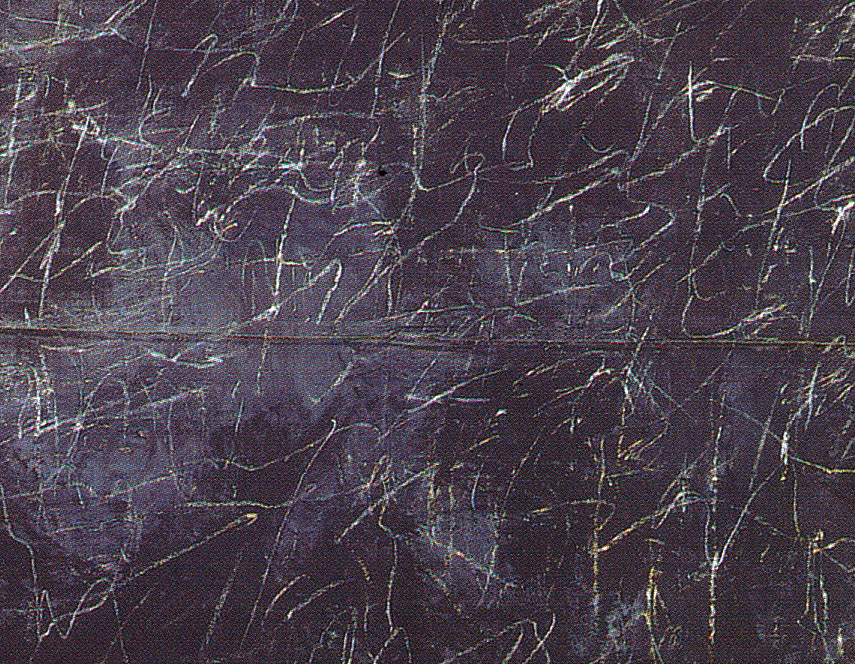
The first painting I have chosen is Cy Twombly’s 1955 painting Panorama.

The first thing to say about discussing a work of art which one has only seen in a book, is that any view is going to be extremely restricted. To be fully appreciated, art (whether paintings, installations, sculpture and so on) needs to be experienced. The impact of a painting can be felt as much with the body as the eyes, and a reproduction found in a book will only reveal a fraction of its ‘story’. (I never cease to be amazed  – and indeed, depressed – at how people when standing before a painting in a gallery will choose to view it through the screen of their camera, rather than look directly). This difference between experiencing a painting and seeing it in a book is itself an interesting area to research, and one I’ll be looking at over the coming months. Nevertheless, reproductions can still tell us a great deal, so with this in mind I shall begin with the painting shown above.    
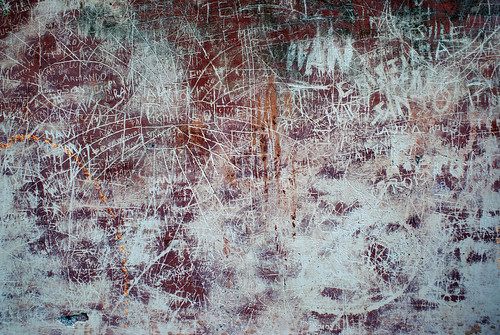
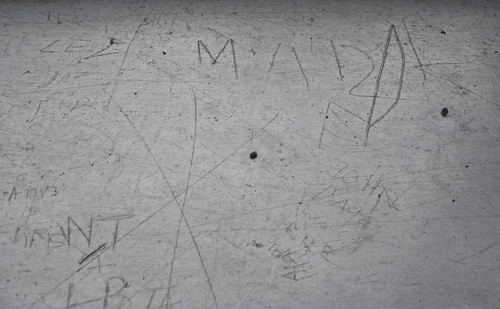
I have always been drawn to a certain kind of aesthetic, one which you’ll often find in places of decay, where time has taken hold of a building and chewed upon it like a dog with a bone. The aesthetic of time or the passage of time is beautiful in its relentlessness; from crumbling walls and cracked plaster, to buckled paint layers and the weary look of old books and photographs. It’s something which, for whatever reason, captivates me, whether I’m there amongst the glorious ruins of Pompeii and Herculaneum; walking down a hot and dusty street in Siracusa; looking at a long abandoned tomb in Montparnasse or standing in my old school, just before its scheduled demolition. Indeed, it was in my old school that I photographed the window sills, scratched with the names of bored pupils from the 1970s, and it wasn’t so much the names that interested me, rather, the look of those names; an aesthetic which we find in Cy Twombly’s Panorama, painted in 1955.
Before Demolition

I can anticipate what many might say when confronted with a painting such as this. ‘I could do that’ is a usual retort, or even worse, ‘a child could do better.’ Which is of course not the point. Whenever someone says ‘I could do that,’ I always point out that they haven’t, and that, in all likelihood, they’d have no reason to try. ‘I could’ in this instance, is just another way of saying ‘I haven’t’. And while I’m not going to extol its virtues as a great work of art, a work of art this painting is and one which, for whatever reason I’m particularly drawn to.
But why? What is it about this piece that I find so engaging?
Without wishing to sound too shallow, first and foremost it’s the look of the painting which appeals. Looks matter for me in art, but that’s not to say art should be beautiful (nothing could be further from the truth); but it needs to be engaging. In order to hold the attention of the viewer, in order to attract them in the first place, you need to trigger something within them. To use a rather crude analogy, it’s rather like the cover of a book and the subsequent opening line. Get it right and your story with its deep themes and intricate plots may well get the chance to be revealed. Get it wrong and no matter how perfect the rest of the book, the potential reader will never get to know. As I’ve said, this is a crude analogy, and I don’t wish to dwell on the idea of a painting being analogous to a book; but nonetheless artists have something to say and how they say it matters. Of course there are no rules governing taste, and what one person likes another will dislike, or even hate.
In the case of Panorama, it’s a painting I’ve come to love.
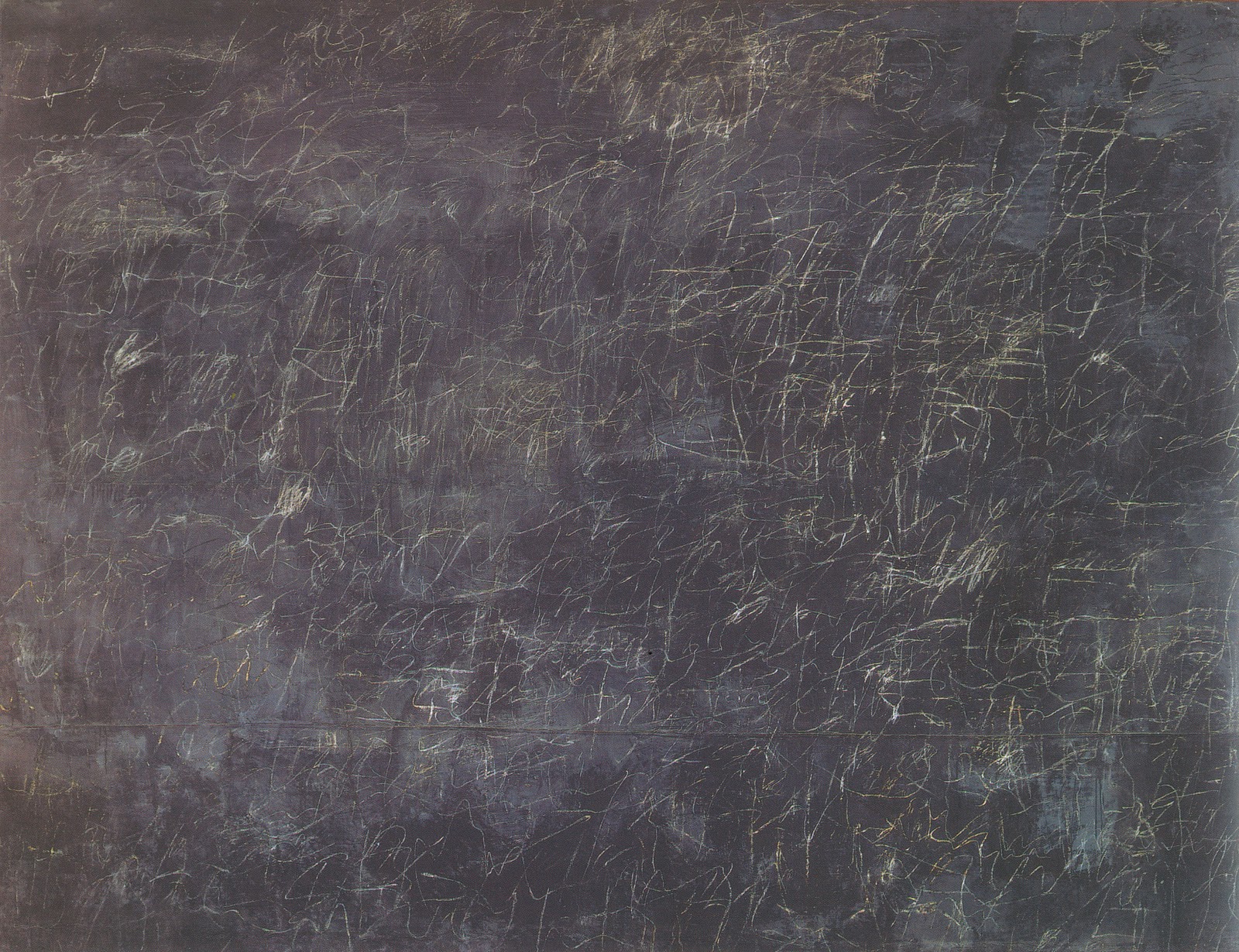
Looking at this painting (a detail is shown above) is like looking at a wall upon which people have scratched words and names, which then over time have lost their shape and meaning. The scratches are words or signifiers reduced to a new kind of text yet to be deciphered. Not that as a viewer I’m trying to make sense of all the lines or even groups of lines. This isn’t a game of ‘pick-up-sticks,’ where individual elements are teased out from the apparent chaos.

Sicily

Something which in a moment was possessed with meaning, means nothing now, and all those moments, layered one on top of the other, create as a result, a palimpsest of ambiguous symbols signifying a strange kind of nothingness; a presence which at the same time is also an absence. People come and people go, and in some respects, this painting is for me a work about time – about the simultaneity of what I’ve just described: presence and absence.

Of course we know that this is the work of one man, but even so, there is a sense of a multitude of meanings. If it’s not a collection of thoughts, then it’s a mass of independent actions; a multitude of presents, wrapped up in a simultaneous slab of the past.
The shades of grey, smudges and rapid scrawls, also call to mind a blackboard, on which someone has poured out their thoughts in the hope of distilling them down into an equation – a simple truth. I’ve always loved the aesthetic of the blackboard (as well as mathematics); the half revealed texts and mathematical symbols, the swirling smudges of rubbings out, the dust and the physicality of thought. (I’m only glad we didn’t have whiteboards or even worse, smartboards when I was at school). This could be a painting about obfuscation, of concealment, where something has been scratched out and hidden from view. Or perhaps it’s the opposite, a painting that is looking, searching for that something which remains elusive?
We can follow lines, from one to the next in our own search, but we’re always held on the surface; we cannot penetrate the painting’s depth. And depth there must be, for the work could not have been made in an instant, but gradually over the course of time. It is then a panorama, viewed in a moment, and made of many thousands.
www.nicholashedges.co.uk

Filed Under: Paintings Tagged With: Cy Twombly, Graffiti, Paintings

Dust Motes

February 27, 2010 by Nicholas Hedges

Two paintings by Hammershoi. Two photographs found in Auschwitz.


Filed Under: Paintings Tagged With: Hammershoi, Motes, Paintings, Vintage Photographs

Totes Meer

February 18, 2010 by Nicholas Hedges

I was watching The Culture Show last night and during a piece on a Paul Nash exhibition at the Dulwich Picture Gallery I was struck by the following painting, Totes Meer which can be seen below.

It shows a heap of German planes – those brought down over England, ready to be sorted so the metal could be salvaged. For Nash, it was a scene to inspire Patriotism, but what interested me – at least initisally – was the fact this scrap heap had been in Cowley, not far from where I once lived.

I am of course interested in the past, the wreckage of the past if you like, and how we can salvage parts to be reused in the present day, so therefore this painting has a great deal of interest for me; not only because of that but because of the scrapheap in Cowley.

Filed Under: Paintings Tagged With: Paintings, Paul Nash, Totes Meer, WW2

Front and Back (2nd Mons)

January 27, 2009 by Nicholas Hedges

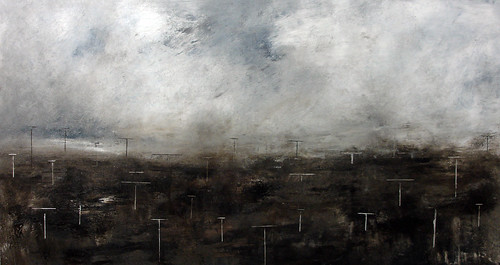
I started work on a new painting today based on the work I made as part of my Mine the Mountain exhibition. This piece, Front and Back (2nd Mons), uses the ‘T’ shaped divides on the backs of postcards which are then stencilled onto the canvas, already painted with a generic battlefield scene. I would really like to paint this on a large scale but we’ll see how this goes first.

Front and Back (2nd Mons)

Filed Under: Paintings Tagged With: A Line Drawn In Water, Front and Back, Paintings, World War I, WWI, WWI Postcards

8th May – A Painting

June 16, 2008 by Nicholas Hedges

This is the second day of working on the painting which will be shown as part of my ‘Mine the Mountain‘ exhibition. The title, 8th May, alludes to both my date of birth and the date my great-great-uncle, Jonah Rogers, was killed in action at the Battle of Frezenberg Ridge (Second Battle of Ypres) in 1915.

8th May - Oil on Canvas: Day 02

When the painting is shown it will be veiled to represent the death of my ancestor. When the veil is lifted, the work will of course be changed to represent my own coming into being. Veiled, the scene is obfuscated, hidden from the deceased to prevent his getting lost on his way to the next life; when lifted, the scene is presented as I remember it, or know it.

Filed Under: Paintings Tagged With: Jonah Rogers, Mine the Mountain, Paintings

Dark Tourism Conference

February 26, 2008 by Nicholas Hedges

This morning I went down to St. John’s college to view a room in which I’ve proposed to exhibit work during a conference to be held there in April. The conference is titled ‘Travel and Trauma: Suffering and the Journey’ with a sub-heading; ‘A Writing Journeys and Places Interdisciplinary Colloquium,’ and therefore I wanted to show something which would fit in with this theme. Even though much of the work on my MA has already dealt with this subject and would be entirely appropriate for this event, I have in mind to do something new. And so, I went to view the space to see what possibilities it might afford me.

The space itself is a room in a modern block and what I noticed right away was that there was a lot of glass with, and as a result, a good view of the outside. I asked if the outside might be used and there seemed to be no objections to this. However, the more I thought about the space, and the more I thought about the conference title, the more I saw myself writing – creating a work with text. I thought of some of the work I’d done in the past, and the painting I made after my visit to Auschwitz gave me an idea.

The text written across the painting and resembling wire immediately made me think of writing in a similar style across the large windows in the room (perhaps with a black chinagraph pencil). But what would I write? Whatever it was would have to be relevant to the space and the idea of tourism and after thinking for a while I considered again the view beyond the window – the reality of what was on the other side of the glass. I thought of writing a history of St. John’s college but then considered instead, the idea of writing a description of what was actually there outside, framed by the window at which those reading the text would be standing; reading and yet blind to the reality of what was in front of them.

So what would this mean: people reading the text describing the reality of what was there ahead of them, blind to that reality because of the text/wire behind which they are held? For me it signifies the impossibility of getting near to the reality of an event through writing/reading about and expriencing a place, but saying that, it wouldn’t be a work suggesting the futility of such experiences – far from it – but it would hopefully raise questions about our role as tourists.

Filed Under: Paintings Tagged With: Dark Tourism, Paintings, Text Work, The Gate

Canaletto

September 21, 2007 by Nicholas Hedges

Yesterday, prior to meeting a friend, I paid a quick visit to the National Gallery, a place of which I can never tire (just the fact one can enter as freely as one enters a shop never ceases to amaze me). I had little time, around 15-20 minutes and so I headed towards the 18th century, and as I walked I saw a sign pointing the way to Venice. Having not long returned from the city, I made my way in that direction, checking my watch to keep an eye on the time and quickly found myself there again, in the mind of a certain Canaletto. Of course, I am familiar with Canaletto and his great views of the Grand Canal, but it was, as always a pleasure to see them again. And with Venice still fresh in my memory, wet like paint, I found the canvases teaming with life; the blue two centuries old sky which I had seen just two weeks ago, the turquoise canals and the buildings, which always put me in mind of old yet elegant widows. Yet, it was two smaller works which I found the most appealing. Firstly, ‘Venice: Piazza San Marco and the Colonnade of the Procuratie Nuove’ painted in about 1756, and secondly ‘Venice: Piazza San Marco,’ painted again around 1756.

I paid little attention to the dates (I didn’t have much time as I said), but recognised there was something melancholic about these works when compared with others I could see (such as the Regatta on the Grand Canal).

In my mind, I can still hear Venice, I can hear the sounds of these very colonades, I can feel the lapping shadows, and when I look at the paintings above, those sounds (the murmuring voices, the footsteps chipping at the ground) become those of the people in the paintings, of men, women and children who have been dead for two centuries. One can almost imagine, the man in the green cape holding his coffee (‘Venice: Piazza San Marco’) still standing there now, listening in on the conversations of the living, quite unaware of the passing of time, of the passing of his own life.

Venice

And it is interesting, and indeed appropriate, that not far from the place painted by Canaletto in these two late works, Bill Viola’s meditation on life and death was installed in the Chiesa di San Gallo. This work, with its use of water as a ‘dividing line’ between life and death has no more appropriate place to he shown than Venice, and the more I think about the city, the more I see it as a place where life and death coexist; indeed, the very symbol of Venice, the Gondolier has a role to play. Amongst the crowds thronging the Riva Degli Schiavoni, who’s to say the dead don’t stand amidst the tourists – the man with his coffee cup – awaiting the Gondoliers who will ferry them to the next place. Perhaps it is the city’s almost supernatural existence, which lends the place this other-worldly air. As Paul Morand writes in somewhat unconventional biography, ‘Venices’:

” Venice did not withstand Attila, Bonaparte, the Hapsburgs, or Eisenhower; she had something more important to do: survive; they believed they were building upon rock; she sided with the poets and decided to be built on water… Within her restricted space, Venice, situated as she is in the middle of nowhere, between the foetal waters and those of the Styx encapsulates my journey on earth…”

Filed Under: Paintings Tagged With: Bill Viola, Canaletto, Paintings, Paul Morand, Venice

Panorama

January 12, 2007 by Nicholas Hedges

Just back from a New Year visit to Poland where I visited my girlfriend and saw more of the attractions the country has to offer. This time we took a trip to Wroclaw (a five hour train ride from Warsaw) and there saw amongst other things, the Panorama of Raclawicka. I had no idea what to expect of it, only that it was a large painting of a battle and that we were going to look at it for half an hour. At 3.30pm (our appointed slot) Monika and I made our way along with a number of others, up a slope inside what the Rough Guide describes as a ‘gargantuan wicker basket rendered in concrete’. I could see a part of the painting as we approached from below – the sky and some of the ‘set’ displayed in front of the painting, in this case what looked like a wheel from a cannon. On seeing this my heart sank a little, as the combination of a painting with ‘added scenery’ called to mind a set for some dodgy play, but on reaching the painting proper, and seeing the whole thing in its entirety, I was more than very pleasantly surprised.

The painting itself is 120m long and 15m high and is beautifully painted, and far from being a bit twee, the ‘set’ between the painting and the viewer works really well. And it got me to thinking about my own work and the paintings I made last semester. I want to create something like a panorama, in the style of the paintings I have already created, onto which I can project the shadows of those viewing. I’m not sure how, but it’s an idea nonetheless.

Filed Under: Paintings Tagged With: Uncategorized

  • « Previous Page
  • 1
  • 2

© Nicholas Hedges 2024

  • Facebook
  • Instagram
  • Twitter
  • YouTube

Copyright © 2025 · Outreach Pro on Genesis Framework · WordPress · Log in