Nicholas Hedges

Art, Writing and Research

  • Amazon
  • Behance
  • Facebook
  • Instagram
  • Pinterest
  • YouTube
  • Art
    • Digital
    • Drawing
    • Grids
      • Correspondence
      • The Wall
      • The Tourist
    • Ink on paper
      • Shadow Calligraphy
    • Installation
      • Murder
      • Echo
    • Painting
    • Patterns
    • Mixed Media
    • Photographic installation
      • St. Giles Fair 1908
      • Cornmarket 1907
      • Headington Hill 1903
      • Queen Street 1897
    • Research/Sketches
    • Stitched Work
      • Missded 1
      • Missded 2
      • Missded 3
      • Missded 4
    • Text Work
  • Blogs
    • Family History
    • Goethean Observations
    • Grief
    • Light Slowed But Never Stilled
    • Lists
    • Present Empathy
    • Shadow Calligraphy
    • Trees
    • Time
    • Walking Meditations
  • Video
  • Photography
    • Pillars of Snow
    • Creatures
    • The Trees
    • Snow
    • St. Giles Fair 1908
    • Cornmarket 1907
    • Headington Hill 1903
    • Queen Street 1897
    • Travel
  • Illustration and Design
  • Music
  • Projects
    • Dissonance and Rhyme
    • Design for an Heirloom
    • Backdrops
    • Shadow Calligraphy
  • Exhibitions
    • A Line Drawn in Water
      • Artwork
    • A Line Drawn in Water (Blog)
    • Mine the Mountain 3
      • Artwork
    • Mine the Mountain 2
      • Artwork
      • The Wall
    • The Woods, Breathing
      • Artwork
    • Snow
      • Artwork
    • Echo
      • Artwork
    • Murder
      • Artwork
    • The Tourist
    • Dreamcatcher
    • Mine the Mountain
      • Artwork
      • The Tourist
    • M8
    • The Gate
    • Creatures
      • Artwork
    • Residue
      • Artwork
    • A visit to Auschwitz
      • Artwork
  • Me
    • Artist’s Statement

Random Memories: The 1983 General Election

June 26, 2007 by Nicholas Hedges

I have recently started to think more about my memories and how I should start writing them down, not because as a collection they would amount to a great memoir, but because it’s often the small snippets which come to us for no apparent reason that are amongst the most interesting. Reading the work of W.G Sebald has certainly precipitated this idea and so, here I am with a memory which came to me a few moments ago. I should point out that these memories are not stories or anecdotes; they do not have a punchline or cast new light on momentous moments of the past, but rather they are fragments which remind me of how life really was. Incidentally, I took delivery today of a copy of Walter Benjamin’s ‘The Arcade Project’, a large tome, made up of quotes, thoughts, ruminations etc. on the Parisian Arcades of the Nineteenth Century. To borrow, or rather steal, from the translators’ notes:

“Benjamin’s intention from the first, it would seem, was to grasp such diverse material under the general category of Urgeschichte signifying the ‘primal history’ of the nineteenth century. This was something that could be realized only indirectly, through ‘cunning’: it was not the great men and celebrated events of traditional historiography but rather the ‘refuse’ and ‘detritus’ of history, the half concealed, variegated traces of the daily life of ‘the collective,’ that was to be the object of study [my italics], and with the aid of methods more akin – above all, in their dependence of chance – to the methods of the nineteenth-century collector of antiquities and curiosities, or indeed to the methods of the nineteenth-century ragpicker, than to those of the modern historian. Not conceptual analysis but something like dream interpretation was the model.”

It’s often the case, that these small pieces of memory, these apparently inconsequential fragments, often build to give a much clearer, more defined image of a time, than a particular event or traditional historiography, and, as such, I will write as many that spring to mind over the coming months.

The first of these fragments concerns me riding my bike (I was going to write ‘cycling’ but ‘cycling’ wasn’t what I did when I was a boy. I ‘rode my bike’ as all boys did). I was ‘riding my bike’ up Ambleside Drive (one of the roads around where I grew up) at a time approaching an election. I’m not entirely sure as to which election it was, but given my age, I can only assume it was the General Election of 1983. Ambleside Drive itself was a very pleasant road which rose from the bottom of a hill (where was my old school) to the top – Eden Drive – where one would find a small collection of four shops, all of which have since disappeared: Kendal’s (groceries), Tucker’s (butcher), Shepherd’s (greengrocer) and the Post Office. I have many memories of this small parade which would fill several pages in themselves, but for the moment, here are just a few.

I remember buying sweets in Kendal’s (when this shop closed, the purchase of sweets was transferred to the Post Office opposite or Mallows at the bottom of the hill) and being amazed by the slicing machine with its circular blade. Here we purchased our sweets prior to going to the cinema up in Headington; they were a type of sweet I can’t quite put my finger on, although mint and lemon seems to ring a bell. The cinema was at the top of the road where my grandparents lived and it was here I saw Benji and Grizzly among many others. I remember little else about Kendal’s, apart from the slices of ham falling from the machine, the cheese slicer, the jars of sweets (a ‘quarter of pear drops’) up on the left, ‘Wavy Line’ and the path outside, which ran by the side of the shop to join the road. When the shop closed and became a house, I couldn’t quite believe I wasn’t able to walk on that path anymore, and the whole idea of a shop becoming a house seemed to go against the whole nature of things – just as it does today. In fact, there is something still quite ghostly and not a little sad about this small parade.
Mr Tucker the butcher (adjacent to Kendal’s) was a cheerful man, always in his dirty white coat, bald head, black-rimmed glasses and sporting large sideburns. I can see him now taking the pencil from behind his ears and writing the price on the paper packet, containing whatever meat Mum was cooking that week. I remember the beaded curtain to the back, the way he wrote his prices in deformed numerals, in the window display and on the board outside. And the handles of the doors – I remember them, along with the front wall, which, I believe is still there today.

Mr Shepherd, the greengrocer (opposite Tucker’s) was was a cheerful man. He too would always have a pen behind his ear and would wear a coat that was either green or grey. I seem to recall an orange biro, or even a collection of biros in his top pocket. Like Mr Tucker, his prices comprised deformed numerals, and whatever was requested, he would measure it into the bowl of his scales, which were without doubt the most formidable I have ever seen – the mass of numbers which made up the chart would however, be read in an instant – take the pen from behind his ear and write the product and price on the order pad. I can see his writing now, black biro, almost illegible, slanting to the right. In a deft manoeuvre, the bowl of the scales would be tipped up, the contents emptied into a brown paper bag, the open corners gripped and the bag swung over itself so as to close it, all done as if a conjurer on a stage.

Outside the shop was a figure of eight path which ran around two patches of grass. We would ride around these on our bikes or tricycles whilst Mum carried on with the shop inside. I vaguely remember Mr Shepherd’s brother. He too worked in the shop until one day he disappeared. I later learnt he’d hanged himself.

The Post Office was pretty much that, and was the last of the four shops to close.

Returning to the election, I must admit that I cannot remember much about it. Of course now I know the result (Conservative landslide) and its place in history, but in terms of my contemporary thoughts there are none – all except for the fact that even at that young age (I would have just turned 12) I couldn’t understand why anyone would be voting Conservative. Conservative? Quite where my disdain originated I don’t really know; one assumes it was at home, but my parents were never what I would call political. All I can remember is looking in bewilderment at the small blue posters in the windows of a few houses up the road. The posters were particularly neat and quite unlike the posters one sees displayed in windows these days; certainly, the current vogue of nailing one’s colours to huge boards in the front garden (as if one were selling the house) didn’t, as far as I recall, exist back then. No luminous-green posters with the red font of Labour (back then the liveries were simple; blue or red) , and certainly not the bright orange diamonds of the LibDems (who were then the SDP Liberal Alliance). In fact, there is something about Liberal Democrat posters which belie their power in parliament; perhaps the smaller a party’s tally of seats, the louder they have to ‘shout’ in the hustings. At the last election, some LibDem posters I saw were large to the point of obscene. Back then however, the conservative posters (which were actually more like postcards) were well mannered – much like those who looked out from behind the windows in which they were displayed. They didn’t shout but rather stated their allegiance as if introducing themselves at a wake.

And so I cycled on. Perhaps to post a letter or to just to go to the shops.
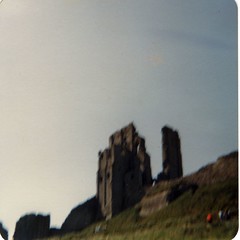
Corfe Castle 1983
Corfe Castle. Taken in 1983.

Filed Under: Uncategorized Tagged With: Arcades Project, Childhood, Memory, Walter Benjamin

Day 7

April 12, 2007 by Nicholas Hedges

I decided to do a walk today, one which I would record in single words or very short phrases. I am interested in how we relate to single words and phrases when trying to picture a past experience, particularly of someone else. The following passage from Neil Hanson’s book, ‘The Unknown Soldier,’ gives a very distinct and accurate picture of a scene one of the millions of soldiers witnessed:

“Decayed sandbags, new sandbags, boards, dropped ammunition, empty tins, corrugated iron, a smell of boots and stagnant water and burnt powder and oil and men, the occasional bang of a rifle and the click of a bolt, the occasional crack of a bullet coming over, or the wailing diminuendo of a ricochet. And over everything, the larks… and on the other side, nothing but a mud wall, with a few dandelions against the sky, until you look over the top or through a periscope and then you see the barbed wire and more barbed wire, and then fields with larks in them, and then barbed wire again.”

The simple use of words makes this passage very stark and easy to imagine. We can see it because in our own minds we can easily conjure objects such as sandbags, boards, empty tins and smells such as old boots and stagnant water. My walk around Oxford would therefore be described as a list of words.

The route was as follows:

Gloucester Green
Gloucester Place
George Street
Bulwarks Alley
New Road
Queen Street
St. Ebbe’s
Brewer Street
St. Aldates
Christ Church
Merton Grove
Deadman’s Walk
Rose Lane
High Street
Merton Street
Magpie Lane
High Street
Catte Street
Broad Street
Magdalen Street
Beaumont Street
Worcester Street
George Street
Chain Alley
Gloucester Green
In total the walk was around 4,300 steps and I wrote 631 words, some of which are listed below:
luminous jacket
suitcase
maps
market
bicycles
litter bin
jackets
mirror
coke can
boots
bicycles
taxis
sunshine – dappled
popcorn (smell)
cigarette smoked
sapling
buses
signs
“…do you remember…”
crutches
blue doors
letter box
chewing gum
‘topiaried’ trees
restaurants
cobbles
gutter
spire
bicycle
crunching wheels
cigarette butts
litter
broken glass
telephone
smell of rubbish
yellow lines
drain
graffiti
lampost
cobbles
stone wall
napkin
window
manhole cover
overhanging shrubs
green door
letter box
railings
fence panels
steps
man drinking
mound
sunshine
shadows
pedestrian zone
red telephone box
scaffolding
exhausts
litter bin
bus stop
taxi rank
colours
pinks, reds, blacks
flags
souvenirs
eating

and so on…

On returning the studio, I wrote up all 631 words on a long piece of paper stuck on the wall

What I was struck by, was how they reminded me of the names carved into the walls of the Menin Gate; column after column of words which at first meant nothing, but all of which had their own unique reference. I decided to create a virtual wall of these words which gave them a very different quality:

I had thought of writing all the words as in the extract above, in a prose form, i.e. something like: “a man wears a luminous jacket, another pulls a suitcase. There’s a machine for maps and the market is on. Bicycles are propped against the wall. Nearby is a litter bin…” Adding words however makes it less authentic, and writing them in this style at the time would be far too time consuming. What is interesting however, is how the mind knits the single words together and in a way the prose form is that process – the mind fills in the blanks.

luminous jacket
suitcase
maps
market
bicycles
litter bin
becomes…

“a man wears a luminous jacket, another pulls a suitcase. There’s a machine for maps and the market is on. Bicycles are propped against the wall. Nearby is a litter bin…”
I refer to a previous entry, Reading and Experience in which I quote the following extract from Filip Muller’s, ‘Eyewitness Auschwitz – Three Years in the Gas Chambers.’

“There was utter silence, broken only by the twitterings of the swallows darting back and forth.”

As I wrote: we were not there in Auschwitz at the moment this line describes (the moment before the doomed prisoner speaks up against the camp’s brutal regime), yet we all know silence and have seen and heard swallows. So although we were not there to witness at first hand this terrible event, we can imagine a silence, a particular one we might have felt some place before, and picture a time we saw a swallow fly. We can use fragments of evidence (photographs, documentary footage) to construct a fuller picture, and fill in the gaps with fragments of own experience. When we speak the words of others therefore, those words will form pictures in our own minds drawn from our own experience.
Taking the list above and adding words to turn it into prose, is in a way similar to this filling in the gaps. In this respect, it is worth doing.

I also tried to draw memories of the walk, taking individual words and drawing the corresponding image. It has always interested me, exactly what we see when we remember something. If we could print out a memory, what would it look like? Certainly what we remember is an approximation of what we actually saw, and again, we use words to ‘join the dots’, to fill in the gaps.
I am reminded again of what I read on Memory places:

“It is better to form one’s memory loci in a deserted and solitary place, for crowds of passing people tend to weaken the impression. Therefore the student intent on acquiring a sharp and well defined set of loci will choose one unfrequented building in which to memorise places…”

The image this passage conjures is of a deserted building, one which has seen better days and is perhaps in need of restoration, a shell which needs some gaps filled.

Filed Under: Artist in Residence, Lists Tagged With: Artist in Residence, Everydayness, Fragments, Listmaking, Lists, Memorials, Memory, Oxford, Residue, Silence

Imagination and Memory

April 6, 2007 by Nicholas Hedges

Like many others, my imagination has played a central role in my life ever since I was a young boy, and recently, in connection with my recent work, I’ve been thinking about that role and how it has changed as I’ve grown up. As a child, I lived much of my life within imagined worlds; fictional countries which I would map and for which I would create entire histories. I would inhabit these places, hidden from everyone else, and while I walked, I would be walking not in the real world, but in my mind. I can still to this day remember one particular map in all its detail; the mountain ranges, the plains, the forests which were always a particular favourite of mine. I can even list the names of the towns and cities (Aquidos, Anasrehlon, Varimeere), yet while this ‘place’ has remained unchanged, whilst my imagination as a place is only a little different (one might say that the country I created was a map of my mind) the uses made of my imagination have altered. As a child I imagined the imagined, as an adult I imagine reality, and often the unimaginable.

Going back to my childhood, my imagination provided me with a means of escape (not that I needed to escape anywhere – I was fortunate enough to have the perfect upbringing). I’d always wanted to see the world unspoilt, an Arcadian vision without cars, planes, pollution, machines or any trace of the modern. And in a sense, this is I believe, what first fired my interest in the past. As a child and well into my teens – and perhaps early twenties – my interest in history ended at the late 17th century, certainly well before the Industrial Revolution, when the modern world began to develop and my vision of a rural Arcadia began to collapse. In some ways, my imagined world was a pick of the best bits of the (somewhat idealised) past; the ancient sprawling forests, beautiful timber-framed houses. When I looked at an old pair of 16th century shoes, a bottle from a 17th century tavern, I was picturing their place in a comparatively unspoiled landscape.

Of course, as a child, my impressions of the past were, as I said, somewhat idealised; they were little more than romantic impressions of an untamed idyll. In reality of course, the past, at least on a human level was, I came to understand, far from romantic; life was short, harsh and often brutal. So as I grew older, and while I still used my imagination to find my way back into the past, I didn’t imagine the imagined, but rather, as I said earlier, the unimaginable: the reality of the lives of others.

In recent years, this change in emphasis has seen the boundaries of my interest in history widen to include the twentieth century; in particular the unimaginable horrors of the Holocaust and the slaughter of World War One. Yet although these very difficult subjects are far removed from the invented landscapes of my childhood, my memories of maps and the stories created within them, provide an interesting, and I believe vital counterpoint to my understanding of such subjects. One of the problems with studying the Holocaust (and indeed World War One) is not only the sheer scale of the suffering, but also the fact that often the victims of both are, in the eyes of history, just that: victims. To say otherwise, i.e. to say that they weren’t only victims, is not to take away from the terrible suffering they endured, but rather to emphasise it, to focus our minds; they weren’t only victims, they were people with lives both behind them and ahead of them; pasts that for many were happy. They all had childhoods, and perhaps imagined their own fantasy worlds. Many, caught up in the Holocaust, were still inhabiting them – they were still of course, children.

As I’ve said, as a child, I would walk and imagine myself in my invented landscape, but as I grew older, although I still walked and imagined myself elsewhere, it wasn’t within an invented world that I walked, but rather a real world; that of my home town, Oxford’s past. Of course one might argue that this past was a much a fabrication as the map I drew as a child, but nevertheless, it was constructed from fragments of the past – drawings, paintings, descriptions in books, photographs. I could never know for sure what things looked like, or how it must have been to walk through the city’s streets (for example during the 14th century) but my imagination did its best to conjure a picture. Of course, as well as those things listed above, there are parts of the city which are contemporary with the past and these buildings and streets are particularly important when looking for that which has long since gone; just as I have found in Auschwitz-Birkenau and Ieper.

One man who did so much to capture Oxford before much of its past was demolished in the late 18th century was a German artist and musician called John Malchair. His drawings are amongst the most beautiful and indeed haunting images of a city I have seen, particularly his views of Friar Bacon’s study, an unusual edifice which was sadly demolished in 1779.

One particularly poignant drawing (below) shows the remaining arch, when all above it has been taken down.

In my mind, as I walk, I suppose one might say I am often trying to rebuild Friar Bacon’s Study. Walking as a means of remembering then is important to me although it does throw up interesting philosophical questions (which I’ve touched on before) namely, what is it we are remembering when we ‘remember’ events which we ourselves have not experienced. As Paul Ricoeur asks in his book, ‘Memory, History, Forgetting,’ ‘Of what are there memories? Whose memory is it?’.

The invented world I ‘walked in’ as a child was a fiction, an amalgam of all the fragments of an unspoiled landscape which I could see in parts around me. And, in a sense, when ‘remembering’ the past of Malchair’s Oxford, the Great War and the Holocaust, I am creating a fiction of sorts – a world created from fragments; photographs, drawings, letters and documentary evidence. The past becomes my imaginary world.

So what is it which separates the past and my past imaginary landscapes? It is this: it is the theme of this residency; Residue.

Filed Under: Artist in Residence Tagged With: 18th Century, Artist in Residence, Holocaust, Imagined Landscapes, John Malchair, Memory, Paul Ricoeur, Residue, WWII, Ypres

Two Minutes Silence

April 2, 2007 by Nicholas Hedges

Every year, at the 11th hour, on the 11th day of the 11th month, we pause for two minutes and remember all those who died in two world wars and subsequent conflicts. We stand still and in silence, a tradition which, one hopes, will always be respected. Over the last few days, having written about the nature of silence in those places which have witnessed appalling human suffering, I’ve been thinking more about this tradition of silence – not so as to question it (as I’ve said, it is a tradition which must always be recognised and respected) but rather its process; what we think about when we stop and are quiet; what it is we are doing when we remember?

The silence temporarily turns the street, the office or wherever it is we’re standing into a different place; it creates a contrast, against which we might compare our normal everyday environment – that from which we step for two minutes to then rejoin at its end. This act of rejoining is, I believe, as important as the stopping and the silence, for as simple as it is, it’s nevertheless something which millions were unable to do, whether through disability or simply because they never came home at all.

Filed Under: World War I Tagged With: Memorials, Memory, Remembrance, Silence, World War I, WWI

  • « Previous Page
  • 1
  • 2

© Nicholas Hedges 2024

  • Facebook
  • Instagram
  • Twitter
  • YouTube

Copyright © 2025 · Outreach Pro on Genesis Framework · WordPress · Log in