Nicholas Hedges

Art, Writing and Research

  • Amazon
  • Behance
  • Facebook
  • Instagram
  • Pinterest
  • YouTube
  • Art
    • Digital
    • Drawing
    • Grids
      • Correspondence
      • The Wall
      • The Tourist
    • Ink on paper
      • Shadow Calligraphy
    • Installation
      • Murder
      • Echo
    • Painting
    • Patterns
    • Mixed Media
    • Photographic installation
      • St. Giles Fair 1908
      • Cornmarket 1907
      • Headington Hill 1903
      • Queen Street 1897
    • Research/Sketches
    • Stitched Work
      • Missded 1
      • Missded 2
      • Missded 3
      • Missded 4
    • Text Work
  • Blogs
    • Family History
    • Goethean Observations
    • Grief
    • Light Slowed But Never Stilled
    • Lists
    • Present Empathy
    • Shadow Calligraphy
    • Trees
    • Time
    • Walking Meditations
  • Video
  • Photography
    • Pillars of Snow
    • Creatures
    • The Trees
    • Snow
    • St. Giles Fair 1908
    • Cornmarket 1907
    • Headington Hill 1903
    • Queen Street 1897
    • Travel
  • Illustration and Design
  • Music
  • Projects
    • Dissonance and Rhyme
    • Design for an Heirloom
    • Backdrops
    • Shadow Calligraphy
  • Exhibitions
    • A Line Drawn in Water
      • Artwork
    • A Line Drawn in Water (Blog)
    • Mine the Mountain 3
      • Artwork
    • Mine the Mountain 2
      • Artwork
      • The Wall
    • The Woods, Breathing
      • Artwork
    • Snow
      • Artwork
    • Echo
      • Artwork
    • Murder
      • Artwork
    • The Tourist
    • Dreamcatcher
    • Mine the Mountain
      • Artwork
      • The Tourist
    • M8
    • The Gate
    • Creatures
      • Artwork
    • Residue
      • Artwork
    • A visit to Auschwitz
      • Artwork
  • Me
    • Artist’s Statement

Jasenovac

June 9, 2007 by Nicholas Hedges

Whilst reading W.G Sebald’s ‘The Rings Around Saturn’ I was struck by his description of the Jasenovac concentration camp, situated in Croatia. I for one had never heard of it, but from the accounts in Sebald’s book, it was, even by the standards of other such appalling places, particularly horrific.

“Seven hundred thousand men, women and children were killed there alone in ways that made the hair of the Reich’s experts stand on end, as some of them were said to have admitted when they were amongst themselves.”

According to Sebald, the preferred instruments of execution were “saws and sabres, axes and hammers” and knives specially designed for cutting throats. The fascist Ustasha, who established the camp, were even regarded by the Nazis as particularly cruel. One German representative in Zagreb, Artur Hoeffner, wrote in his diary on November 18, 1942:

“Regardless of the propaganda, [Jasenovac] is a camp of the very worst kind and can be compared to Dante’s Inferno.”

Italians who visited or served in the area during the war were also sickened. Alfio Russo wrote in Revoluzione in Jugoslavia (Rome, 1944), “Even the most extraordinary massacres in the darkest era of history would not soil its name… “

Like most camps, the death toll is disputed, but the fact the figures range from 300,000 through to 860,000 speaks volumes.

The main victims were ethnic Serbs, although other groups, such as Jews and Gypsies perished there.
Filed Under: Holocaust Tagged With: Dante, Holocaust, Jasenovac, Sebald, WWII

Poland

May 28, 2007 by Nicholas Hedges

I’ve just returned from another fantastic trip to Poland, this time taking in the east of the country through Lublin, Zamosc and the very picturesque Kazimierz Dolny. My girlfriend negotiated the less-than-brilliant Polish roads whilst I sat in the passenger seat armed with my GPS creating a record of the route. The weather was wonderful, over 30 degrees every day and very sunny.

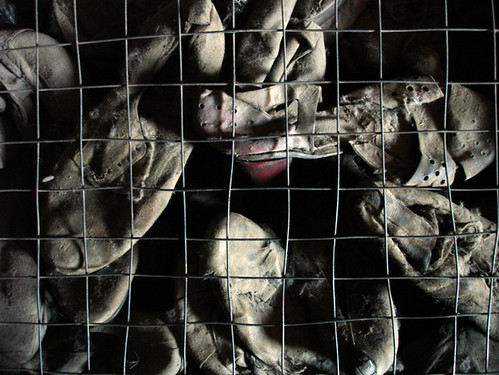
One of the reasons for the trip, aside from it being a holiday, was to visit two more Holocaust sites, these being the concentration camp at Majdanek and the death camp at Belzec. Having left Warsaw we made our way down to Lublin and on arrival, went to the Majdanek concentration camp, just on the outskirts of the city. I didn’t know much about this camp and even after reading a little about its history I didn’t expect what we found there. It is one of the best preserved camps in the country and in some respects is like a smaller version of Auschwitz and Birkenau in one. Like Auschwitz it has numerous exhibitions in each of the barracks, including piles and piles of old shoes. Yet whereas in Auschwitz these were held behind glass, here in Majdanek they are stored in cages; one can smell them.
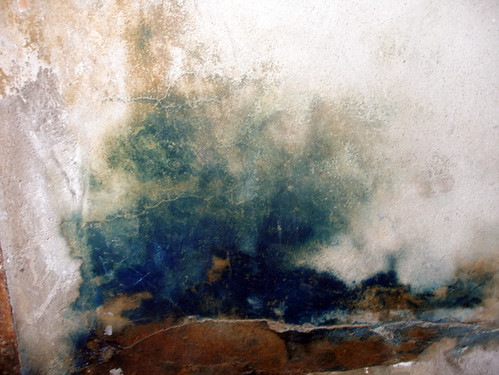
The gas chambers are still intact here along with the original washrooms, and walking through these was, as one would expect, particularly poignant. We noticed on the walls and ceilings of the chamber, that there were patches of blue. I assumed this was just mould caused by damp, but on returning home, I’ve since discovered these patches were caused by the residue of the Zyklon B gas. Indeed, one can see how dense the colours are on the ground and almost see the residue pale as it climbs the walls.

Colours have become a point of interest for me in my work. As above, the blueish tones on the grey walls were striking, not only because of their colour, but because of what they signified. The same was true in the barracks full of shoes. Amidst the rows of earth-brown shoes, one could occasionally glimpse a patch of colour, a red shoe (below) or a blue one.

Another striking part of the camp was the memorial containing a mound of ash; the cremated remains of the camp’s thousands of victims. It’s hard to imagine this mass of ash was once a mass of people.

Lublin itself was very interesting. The city has a wonderful old town which more than hints at its original splendor. Sadly, some of the old houses are in a terrible state and one was left wondering whether they would survive.

Having spent the evening in the city, we had an good breakfast and made our way to Zamosc, a sixteenth century version of Milton Keynes, founded by Jan Zamoyski and built from scratch by the Italian architect Bernardo Morando in 1580. However, before sampling its various delights, we visited the second Holocaust site on our itinerary – the site of Belzec Death Camp.

Driving through the village of Belzec, it was hard to tell exactly where the camp was; to be honest, neither of us knew quite what to expect. And whereas before, in the camp at Majdanek we found patches of colour in amidst the piles of shoes, so here in Belzec, as we drove down the road, we saw a shadow in amidst the countryside; a charcoal scar like a field ravaged by fire. This was it, and it took our breaths away.

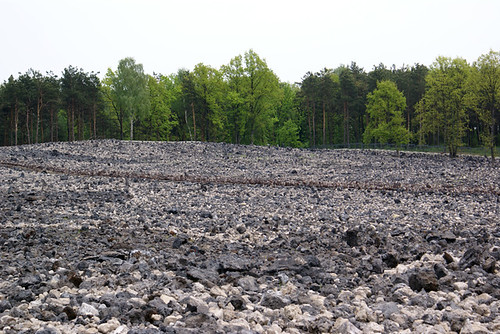
Whereas the proximity of Majdanek to the centre of Lublin was shocking, here at Belzec, what was shocking was its size. Measuring just 275 metres on three of its sides and 265 on the other, this small space witnessed the deaths of around half a million people, all in the space of nine terrible months. But unlike camps such as Majdanek, Auschwitz and Auschwitz-Birkenau, nothing of this camp (which was liquidated by the Germans in December 1942) remains.

I must admit I wasn’t sure how I’d respond to visiting a place where nothing of the original camp remained, but of course what is important here is the land itself, for it’s the very soil upon which the victims walked and within which they were buried which holds their memories still. The scale of the site becomes the memorial and just as its countless victims walked upon this small piece of land to their deaths, so we walk around it, looking in, so as to remember them, staring at the rocks which litter the landscape as if each stone is a single individual.

Thinking about the hundreds of thousands of stones, I’ve been reminded since coming home of an old Jewish cemetery we visited in Kazimierz Dolny which was desecrated and destroyed by the Nazis. We wondered when we visited it about the practice of putting stones on graves and I have discovered that when the tradition started grave monuments were mounds of stones; visitors added stones to the mound to show we are never finished building the monument to the deceased. Another explanation was that it shows those visiting that others have come before to remember. The monument at Belzec therefore, covered as it is with hundreds of thousands of stones reminds us that this piece of land is a grave for hundreds of thousands of people who will not be forgotten; the memorial will never be finished. The fact that the stones look like the remnants of a demolished building is also significant.

Walking is itself a vital part of the memorial (it will never be finished as it is incomplete without people there to walk around), just as it has been important to me in my work on Belzec prior to my visit. I’m wondering now if stones will also become a feature?

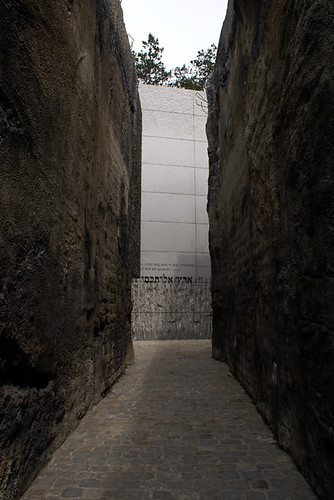
One of the most haunting parts of the memorial was the walk through the tunnel, a cutting made into the hill exposing the soil on both sides.

This brought to mind two things: one, the ‘tunnel’ through which the victims walked to the gas chambers, and secondly, the fact that we could see inside the ground, into the very place in which the victims had been buried.

From here we made our way to Zamosc and having spent a lovely night there, made our way to Kazimierz Dolny via the beautiful Kozlowka Palace, Zwierzyniec and the spa town of Nalenczow. Looking at the towns we passed through (including Zamosc which we left), one couldn’t help remember those very names as being places from which Jews had been deported to Belzec; the day before was never far from our thoughts.

Kazimierz was indeed a beautiful little town which had suffered much under the Nazi terror; half its population had been deported to camps such as Belzec. The weather was hot and having rested for the night, we spent the next day walking around the town, visiting King Kazimierz’s castle and walking through the forests by which it was surrounded. The landscape was indeed beautiful.
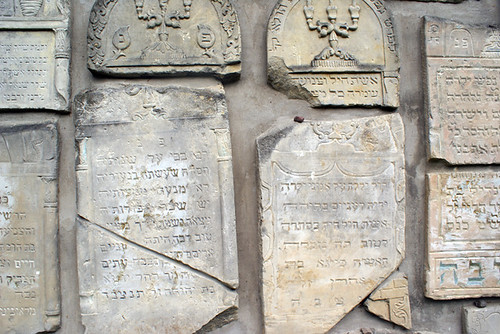
It was near the end of the day that we came upon the old Jewish cemetery, destroyed by the Nazis. After the war, a memorial was built using the old gravestones which again served to remind us of a recent and tragic past.

Filed Under: Holocaust Tagged With: Belzec, Holocaust, Lublin, Majdanek, Poland, WWII

From Dinosaurs to Human Beings

April 25, 2007 by Nicholas Hedges

After yesterday’s viewing, I began to think about the works I’ve produced so far on this residency and what it is that links them; not that there should be a link – I just know that there is one. Despite the differences, there is an underlying theme which unites the drawings, the text pieces, the deckchairs and the paintings. So what is it?

In answering this I have started to think about… dinosaurs. Not something which first springs to mind when looking at my work and if I mention Jurassic Park, then it might seem that I’m losing the plot altogether, but there is a sequence in this film which is relevant to my work.

In the film, the visitors to the Park are shown an animated film, which explains how the Park’s scientists created the dinosaurs. DNA, they explain, is extracted from mosquitoes trapped in amber and where there are gaps in the code sequence, so the gaps are filled with the DNA of frogs; the past is in effect brought back to life with fragments of the past and parts of the modern, living world. This ‘filling in the gaps’ is exactly what I have done throughout my life when trying to imagine the past, particularly the past of the city in which I live.

As well as reading about and drawing dinosaurs, I also as a child, liked to create and map worlds; countries which I would build from fragments of the world around me; forests, mountains and plains – unspoilt landscapes. And in these worlds there would exist towns and cities, created from ‘the best bits’ of those I had visited.

These invented worlds became, as I grew up, the ‘invented’ or imagined landscapes of Oxford’s past; landscapes that were – just as they still are – created from fragments, parts of the past which are still extant in the city; old buildings, walls, objects and so on. Between these structures, these fragments, I would fill the gaps, with my own imagination, with thoughts derived from my own experience. The city’s past and the past in general, as it exists within my mind, is then, to use the metaphor of cloning in Jurassic Park, a cloned dinosaur. The extant buildings, structures and objects within museums, are like the mosquitoes trapped inside the amber. They are broken strands of DNA. All that is required is for me to fill the gaps, and this I can do with my own DNA. I am in effect, the frog.

This metaphor is interesting in that DNA patterns are, of course, unique to everyone. My DNA is different to everybody else’s as there’s is to mine. Therefore, using my imagination to plug in the gaps of the past, means that the ‘past’ will comprise large parts of my own experience; my dinosaur will contain elements of my own being. (See ‘Postcard 1906’). But although my DNA is unique, it is nonetheless derived from my own past, elements have been passed down by my ancestors from time immemorial. The code which makes me who I am, comprises parts of people I know now (parents and grandmothers), people I knew (grandfathers and great-grandmother) and people lost to the past altogether (great-great grandparents and so on). What interests me about this, is that, through stating above how ‘my dinosaur will contain elements of my own being’ I can now see that ‘my dinosaur’ will contain elements of my own being, which is itself comprised of elements of hundreds – thousands – of people, the majority of whom I will of course never know and who have been dead for centuries. I like to think therefore, that ‘my dinosaur’ and my imagination aren’t entirely unique.

This leads me to look at paths – not the route I walk around the castle, or those recorded by my GPS receiver (although these are entirely relevant) but to the paths taken by my ancestors so that I might be brought into being. The chances of any of us being who we are is practically nil. In order for me to be born, I had to be conceived at the exact time I was conceived, any difference in time – even a split second – and I wouldn’t be me. Also, everything leading up to that moment had to be exactly as it was; anything done differently by my parents, no matter how small, how seemingly irrelevant, any deviation from the path and I would not be me. This is extraordinary enough (whenever I see old photographs of members of my family, I think that if it was taken a second sooner or later, I would not be here) but when one considers this is the same for my entire family tree, again, all the way back to time immemorial, then one realises how, to quote Eric Idle in ‘Monty Python’s Meaning of Life’, ‘incredibly unlikely is your [my] birth’. We are all impossibly unlikely. The chances of all our ancestors walking the exact paths through their lives which they walked is almost nil.

Therefore, my walks, my mapping, my identifying (seemingly irrelevant) objects, my recording them, my palimpsests, are all linked. Memorialising objects (disposable or otherwise), snatches of conversation and so on, inscribing them on a slab, shows how vital these fragments are to future generations and to me in terms of my own past. But how does this fit in with my work on Auschwitz-Birkenau, death camps and World War I?

These ‘arenas’ of death were constructions (although the carnage of a battlefield was often random, the battles themselves were always planned, ‘constructed’ for the purpose) in stark contrast to the rather arbitrary paths our ancestors took so that we might each be born. Death in these places was designed, it was planned, particularly with regards to the horrors of the death camps and by looking at these places, by visiting them, by looking at the seemingly irrelevant, everyday objects left behind, we can fill in the gaps, each using our own existence to imagine the lives and the deaths of others. We understand what it means to be human, the near impossibility of birth and the absolute certainty of death.
Imagining a group of a several hundred people walking to their deaths, whether down a path to the gas chambers, or on a road to the Front, we can easily imagine the route; we can in places walk the route today. But imagining the paths walked by thousands of people through time, to bring each of the victims into being is almost impossible: I say almost impossible, but, as I’ve written above regarding each of our births, it’s possible in the end.

Looking at death therefore is to to look at life and its inestimable value, whoever we are and wherever we live. It is to understand what it means to be human and to cherish the lives of others.

Filed Under: Artist in Residence Tagged With: Artist in Residence, DNA, Holocaust, Objects, Postcards, Residue, Vintage Photographs, World War I, WWI, WWII

The Unknown Soldier

April 17, 2007 by Nicholas Hedges

“The Post Office Rifles and the 6th Battalion – ‘the Cast-Iron Sixth – in turn would then pass through their lines to continue the advance to the next objectives on the downward slope of the ridge, the ‘Cough Drop,’ also known as ‘Leicester Square’, and the ‘Starfish Line’. The London Irish and the Poplar and Stepney Rifles were to lead the advance to the west of High Wood, before being succeeded by the 19th and 20th Battalions. ‘The postmen from quiet little hamlets or clerks who had spent their lives hitherto in snug offices, talked about these future regimental mortuaries with the homely names with astonishing calmness…'”

What struck me about this quote from Neil Hanson’s book, was how soldiers used the names of well known and familiar places, to name those places which were not only unfamiliar, but also terrifying, often places of horror and death on a scale which could never be imagined within those more familiar places back home. Trenches were named in a similar fashion: Oxford Circus, Oxford Street, George Street, Broad Street and so on.

“By day, the screams and groans of the wounded and dying had been drowned by the deafening clamour of the battle. At nightfall, though still counterpointed by the rumble of the guns, their pitiful cries and please for help could be hear echoing through the shattered wood…”

This quote reiterates how this war was a war of sounds; how men could be reduced to tears and much worse by sounds; those of the incessant shells or the solitary man crying in a dark wood.

“‘The reading of the battalion roll-call must have broken the hearts of all who heard it – ‘a hollow square of jaded, muddy figures… A strong voice… calls one name after another from a Roll lit by a fluttering candle, shaded by the hand of one of the remaining Sergeant Majors.’ Name after name went unanswered; each silence, another man wounded, missing or dead.'”

This very poignant passage reminded me of some text-based work I did whilst investigating the site of Auschwitz-Birkenau. These text-based pieces started as free-written prose and through a process of increasing the spacing between the letters changed to become squares where the words were reduced to a scattering of letters. As soon as I read the words ‘a hollow square’ I thought at once of those.

Filed Under: Artist in Residence Tagged With: Artist in Residence, Auschwitz, Holocaust, Neil Hanson, Quotes, Residue, Silence, Useful Quotes, World War I, WWI, WWII

Imagination and Memory

April 6, 2007 by Nicholas Hedges

Like many others, my imagination has played a central role in my life ever since I was a young boy, and recently, in connection with my recent work, I’ve been thinking about that role and how it has changed as I’ve grown up. As a child, I lived much of my life within imagined worlds; fictional countries which I would map and for which I would create entire histories. I would inhabit these places, hidden from everyone else, and while I walked, I would be walking not in the real world, but in my mind. I can still to this day remember one particular map in all its detail; the mountain ranges, the plains, the forests which were always a particular favourite of mine. I can even list the names of the towns and cities (Aquidos, Anasrehlon, Varimeere), yet while this ‘place’ has remained unchanged, whilst my imagination as a place is only a little different (one might say that the country I created was a map of my mind) the uses made of my imagination have altered. As a child I imagined the imagined, as an adult I imagine reality, and often the unimaginable.

Going back to my childhood, my imagination provided me with a means of escape (not that I needed to escape anywhere – I was fortunate enough to have the perfect upbringing). I’d always wanted to see the world unspoilt, an Arcadian vision without cars, planes, pollution, machines or any trace of the modern. And in a sense, this is I believe, what first fired my interest in the past. As a child and well into my teens – and perhaps early twenties – my interest in history ended at the late 17th century, certainly well before the Industrial Revolution, when the modern world began to develop and my vision of a rural Arcadia began to collapse. In some ways, my imagined world was a pick of the best bits of the (somewhat idealised) past; the ancient sprawling forests, beautiful timber-framed houses. When I looked at an old pair of 16th century shoes, a bottle from a 17th century tavern, I was picturing their place in a comparatively unspoiled landscape.

Of course, as a child, my impressions of the past were, as I said, somewhat idealised; they were little more than romantic impressions of an untamed idyll. In reality of course, the past, at least on a human level was, I came to understand, far from romantic; life was short, harsh and often brutal. So as I grew older, and while I still used my imagination to find my way back into the past, I didn’t imagine the imagined, but rather, as I said earlier, the unimaginable: the reality of the lives of others.

In recent years, this change in emphasis has seen the boundaries of my interest in history widen to include the twentieth century; in particular the unimaginable horrors of the Holocaust and the slaughter of World War One. Yet although these very difficult subjects are far removed from the invented landscapes of my childhood, my memories of maps and the stories created within them, provide an interesting, and I believe vital counterpoint to my understanding of such subjects. One of the problems with studying the Holocaust (and indeed World War One) is not only the sheer scale of the suffering, but also the fact that often the victims of both are, in the eyes of history, just that: victims. To say otherwise, i.e. to say that they weren’t only victims, is not to take away from the terrible suffering they endured, but rather to emphasise it, to focus our minds; they weren’t only victims, they were people with lives both behind them and ahead of them; pasts that for many were happy. They all had childhoods, and perhaps imagined their own fantasy worlds. Many, caught up in the Holocaust, were still inhabiting them – they were still of course, children.

As I’ve said, as a child, I would walk and imagine myself in my invented landscape, but as I grew older, although I still walked and imagined myself elsewhere, it wasn’t within an invented world that I walked, but rather a real world; that of my home town, Oxford’s past. Of course one might argue that this past was a much a fabrication as the map I drew as a child, but nevertheless, it was constructed from fragments of the past – drawings, paintings, descriptions in books, photographs. I could never know for sure what things looked like, or how it must have been to walk through the city’s streets (for example during the 14th century) but my imagination did its best to conjure a picture. Of course, as well as those things listed above, there are parts of the city which are contemporary with the past and these buildings and streets are particularly important when looking for that which has long since gone; just as I have found in Auschwitz-Birkenau and Ieper.

One man who did so much to capture Oxford before much of its past was demolished in the late 18th century was a German artist and musician called John Malchair. His drawings are amongst the most beautiful and indeed haunting images of a city I have seen, particularly his views of Friar Bacon’s study, an unusual edifice which was sadly demolished in 1779.

One particularly poignant drawing (below) shows the remaining arch, when all above it has been taken down.

In my mind, as I walk, I suppose one might say I am often trying to rebuild Friar Bacon’s Study. Walking as a means of remembering then is important to me although it does throw up interesting philosophical questions (which I’ve touched on before) namely, what is it we are remembering when we ‘remember’ events which we ourselves have not experienced. As Paul Ricoeur asks in his book, ‘Memory, History, Forgetting,’ ‘Of what are there memories? Whose memory is it?’.

The invented world I ‘walked in’ as a child was a fiction, an amalgam of all the fragments of an unspoiled landscape which I could see in parts around me. And, in a sense, when ‘remembering’ the past of Malchair’s Oxford, the Great War and the Holocaust, I am creating a fiction of sorts – a world created from fragments; photographs, drawings, letters and documentary evidence. The past becomes my imaginary world.

So what is it which separates the past and my past imaginary landscapes? It is this: it is the theme of this residency; Residue.

Filed Under: Artist in Residence Tagged With: 18th Century, Artist in Residence, Holocaust, Imagined Landscapes, John Malchair, Memory, Paul Ricoeur, Residue, WWII, Ypres

Walking

April 2, 2007 by Nicholas Hedges

As part of my continuing work on sites of the Holocaust, I have been investigating Belzec death camp which I will be visiting next month. Even with a place as large as Auschwitz-Birkenau, it’s hard to equate its size with the number of people killed there (1.1 million). Yet this appalling correlation of camp size to victims, is perhaps at its most disturbing in Belzec, where in a space of less than 300 metres by 300 metres, approximately 600,000 people perished. Death on this scale, on the open fields of battle is hard enough to imagine, yet it somehow seems all the more sickening in a place the size of Belzec (and one designed for the purpose). In order to ascertain just how big (or rather small) 300m x 300m is, I bought a pedometer and looked for somewhere in Oxford which might, more or less, equate with these dimensions. The closest I got to those dimensions was in Christ Church Meadow, which if anything was bigger. As I’ve already documented my continuing investigations on this subject I won’t add any more here, but I would like to explore further the idea of using the memory of a place to understand the wider past; something which I touched on in Postcards.

During my walks, I found myself recalling a raft of memories from my own past, triggered by the sites I saw as I travelled. Even a short walk around Christ Church Meadow (the length of which, in terms of time, was itself indicative of the horror and magnitude of the suffering at Belzec) opened the floodgates, not only for my own memories to pour through, but those of the city itself . Here I was, an individual with my own recollections, walking amongst the hundreds of thousands of memories of people long since dead from which the city is inevitably constructed – an interesting metaphor for the individual swallowed by the world stage; swallowed by the violence war.

As I have already written, but something it’s worth stating again, the Italian author Italo Calvino discusses memory and its relationship to a place in his book Invisible Cities. The city he says, consists of:

“…relationships between the measurements of its space and the events of its past; the height of a lamppost and the distance from the ground of a hanged usurper’s swaying feet; the line strung from the lamppost to the railing opposite and the festoons that decorate the course of the queen’s nuptial procession; the height of that railing and the leap of the adulterer who climbed over it at dawn; the tilt of a guttering and a cat’s progress along it as he slips into the same window; the firing range of a gunboat which has suddenly appeared beyond the cape and the bomb that destroys the guttering; the rips in the fish net and the three old men seated on the dock mending nets and telling each other for the hundredth time the story of the gunboat of the usurper, who some say was the queen’s illegitimate son, abandoned in his swaddling clothes there on the dock…”

Could it also be said, that there is a relationship between the measurement of spaces within the city and the events of the past elsewhere?

Filed Under: Oxford Tagged With: Auschwitz, Belzec, Christ Church, Holocaust, Invisible Cities, Italo Calvino, Oxford, Postcards, WWII

Maps and Walking

March 16, 2007 by Nicholas Hedges

The main theme of much of my work has so far been the Holocaust and in particular its sites, such as those at Auschwitz-Birkenau, Belzec and Babi Yar. I’ve also been studying memory and how memories within objects and buildings might allow us a glimpse of the past; a theme which has fascinated me ever since I was a child. It was through reading Bill Viola’s writings a few months back that I was reminded of the mnemonic techniques practiced by the ancient Greeks:

“The idea of art as a kind of diagram has for the most part not made it down from the Middle Ages into modern European Consciousness. The Renaissance was the turning point… The structural aspect of art, and the idea of a ‘data-space’ was preserved through the Renaissance however in the continued relations between image and architecture. Painting became an architectural, spatial form which the viewer experienced by physically walking through it. The older concept of an idea and an image architecture, a memory ‘place’ like the mnemonic temples of the Greeks is carried through in the great European cathedrals and palaces, as is the relation between memory, spatial movement and storage (recording) of ideas.”

When I first read this quote, I was at the time researching The University Parks in Oxford, and in particular examining the plaques on the benches. I realised then, that my act of walking and ‘remembering’ those who have passed away, was in a broad and rather loose sense, like walking through one of those ‘mnemonic temples’ albeit in a physical sense. I was constructing a bigger picture of the place.

More recently, walking has started to play an important role in my work on the Holocaust (one of the themes which has struck me through my research has been that of walking. Many photos of the Holocaust show people walking, usually, and tragically, to their deaths). I’ve started to look at the Operation Reinhard camps and in particular Belzec. Laurence Rees, in his book, ‘Auschwitz’, describes the unimaginable scale of death and contrasts it with the disproportionately tiny size of Belzec Death Camp, which measured less less than 300m x 300m. I knew this was a small size, but it wasn’t until I walked around some familiar spaces in Oxford – including the University Parks – that I realised just how small it was.

Since then I’ve started looking for more evidence of the size of Belzec (and other camps) so that I might walk specific distances around the city, and have since discovered a number of maps drawn by survivors, SS men and archaeologists. These roughly sketched maps, these ‘memories,’ are a poignant reminder of the camp’s existence and might help me in my attempts to bring people closer to the Holocaust, which should never be forgotten.

“All things fade away in time, but time itself is made fadeless and undying by recollection.” Apollonius of Tyana
“We have to describe and to explain a building the upper story of which was erected in the nineteenth century; the ground-floor dates from the sixteenth century, and a careful examination of the masonry discloses the fact that it was reconstructed from a dwelling-tower of the eleventh century. In the cellar we discover Roman foundation walls, and under the cellar a filled-in cave, in the floor of which stone tool are found and remnants of glacial fauna is the layers below… Not only our memories, but the things we have forgotten are ‘housed’.” C.G. Jung
“Memory, whether individual or generational, political or public is always more than the prison house of the past.” Andreas Huyssen

Here I must return to the ancient Greeks and their mnenomic temples. With a place or loci, such as a house, fixed in the mind, the person remembering would place various objects in its rooms (“…what I have spoken of as being done in a house can also be done in public buildings, or on a long journey, or going through a city…”), objects which by association would remind them of part of the whole thing – such as a speech – to be remembered. Here I saw at once a correlation with my work on Belzec. The ancient Greeks were walking as a means of remembering, of not forgetting; their memory loci were in effect maps which one could sketch, maps of the mind. Therefore, the maps drawn by survivors, are in effect maps of their minds and bring us closer to the horrors of the time – closer to the individuals who suffered.

The fact that objects were used to create associations, and therefore build (through ‘walking’) a bigger ‘picture’ of something also fits in with the recent work I’ve been doing on Auschwitz, looking at the possessions left by the victims and trying to build a picture of the individuals before the Holocaust, to see them not only as victims, but people who lived lives before its horror.

Through walking distances which I’ve taken from descriptions of the camp, I have found myself walking back into my own past and the past of the city in general; for example, walking the route of Cuckoo Lane and the Old London Road at Shotover. My own past confirms my individuality and the past of the city confirms my place as a small part in the mass of memories associated with this place (this also correlates with my work on Auschwitz, trying to find the individuals amongst the huge number of dead, individual possessions from amongst the mountains, names rather than inconceivable numbers). The fact these walks have been derived from a map or a description of Belzec, helps me to identify further with the individuals who suffered there; not because I can in anyway conceive of their suffering – no-one could ever imagine the horrors they endured – but because I can imagine their own pasts and that of the places they knew so well, places from which they were taken to their deaths.

Filed Under: Oxford Tagged With: Andreas Huyssen, Auschwitz, Babi Yar, Belzec, Bill Viola, Death Camps, Holocaust, Jung, Laurence Rees, Oxford, Quotes, University Parks, Useful Quotes, WWII

  • « Previous Page
  • 1
  • 2
  • 3
  • 4

© Nicholas Hedges 2024

  • Facebook
  • Instagram
  • Twitter
  • YouTube

Copyright © 2025 · Outreach Pro on Genesis Framework · WordPress · Log in