Nicholas Hedges

Art, Writing and Research

  • Amazon
  • Behance
  • Facebook
  • Instagram
  • Pinterest
  • YouTube
  • Art
    • Digital
    • Drawing
    • Grids
      • Correspondence
      • The Wall
      • The Tourist
    • Ink on paper
      • Shadow Calligraphy
    • Installation
      • Murder
      • Echo
    • Painting
    • Patterns
    • Mixed Media
    • Photographic installation
      • St. Giles Fair 1908
      • Cornmarket 1907
      • Headington Hill 1903
      • Queen Street 1897
    • Research/Sketches
    • Stitched Work
      • Missded 1
      • Missded 2
      • Missded 3
      • Missded 4
    • Text Work
  • Blogs
    • Family History
    • Goethean Observations
    • Grief
    • Light Slowed But Never Stilled
    • Lists
    • Present Empathy
    • Shadow Calligraphy
    • Trees
    • Time
    • Walking Meditations
  • Video
  • Photography
    • Pillars of Snow
    • Creatures
    • The Trees
    • Snow
    • St. Giles Fair 1908
    • Cornmarket 1907
    • Headington Hill 1903
    • Queen Street 1897
    • Travel
  • Illustration and Design
  • Music
  • Projects
    • Dissonance and Rhyme
    • Design for an Heirloom
    • Backdrops
    • Shadow Calligraphy
  • Exhibitions
    • A Line Drawn in Water
      • Artwork
    • A Line Drawn in Water (Blog)
    • Mine the Mountain 3
      • Artwork
    • Mine the Mountain 2
      • Artwork
      • The Wall
    • The Woods, Breathing
      • Artwork
    • Snow
      • Artwork
    • Echo
      • Artwork
    • Murder
      • Artwork
    • The Tourist
    • Dreamcatcher
    • Mine the Mountain
      • Artwork
      • The Tourist
    • M8
    • The Gate
    • Creatures
      • Artwork
    • Residue
      • Artwork
    • A visit to Auschwitz
      • Artwork
  • Me
    • Artist’s Statement

Authenticity of the Alienation

October 15, 2014 by Nicholas Hedges

Returning to Otto Dov Kulka’s book ‘Landscape of the Metropolis of Death,’ I want to look at another passage which I’ve copied out below:

“… many works of cinema, theatre and art, offer a way to understand and experience Auschwitz, its universe, the ghettos, that final stage, that reality. And everyone reads these books — they sell thousands of copies — so they obviously speak in a uniform language to all those myriad readers. Yet I cannot find in them what they seek to convey! It’s a completely different world! The only response I feel able to express is alienation; all that is authentic is the authenticity of the alienation.”

The ‘authenticity of the alienation’- an interesting phrase. As an artist working with subjects like the Holocaust, one has to place that sense of alienation – one’s removal from the fact – at the forefront of any work. It is the lens through which the work is seen, becoming, in my case, the work itself; i.e. how, given that sense of alienation, we can empathise with those who suffered. Kulka continues:

“Therefore I ask: in what am I different? Something is wrong with me! And then, as so often, as almost always during periods of distress, I escape to Kafka, either his diaries or his other works. At that time, I again opened at the ending – I always open randomly – I opened at the ending of the wonderful story of the man standing before the Gate of the Law. This man who stands before the Gate of the Law actually asks the same question -and it is one of the last questions he asks, driven by his insatiable curiosity, as the gatekeeper jests. He asks: ‘Tell me, after all this is the Gate of the Law, and the Gate of the Law is open to everyone.’ To which the gatekeeper says: ‘Yes, that is so.’ Then the man says (if I remember the text correctly): ‘Yet in all the years I have been sitting here no one has entered the gate.’ And the gate-keeper nods his head and says: ‘Indeed.’ The man asks him to explain this puzzling fact, and the gatekeeper does him this one last mercy and says: ‘This gate is open only for you, it exists only for you, and now I am going to close it.’ 

Accordingly, everything I have recorded here – all these landscapes, this whole private mythology, this Metropolis, Auschwitz  – this Auschwitz that was recorded here, which speaks here from my words, is the only entrance and exit — an exit, perhaps, or a closing — the only one that exists for me alone. I take this to mean that I cannot enter by any other way, by any other gate to that place. Will others be able to enter through the gate that I opened here, that remains open for me? It is possible that they will, because this gate that Kafka opened, which was intended for only one person, for K., Josef K., is actually open to almost everyone. But for him there was only one gate into his private mythology.”
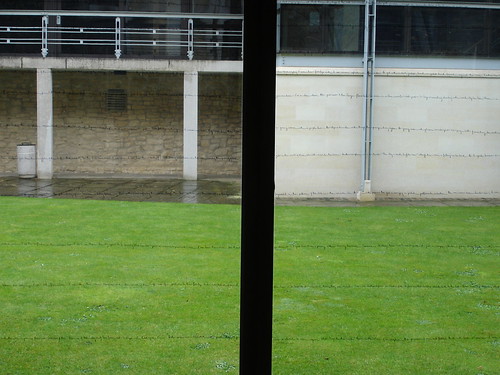
On reading this, I was reminded of a text by Holocaust survivor, Elie Wiesel which I used in relation to a piece of work I made in 2009. 


“I would bring the viewer closer to the gate but not inside, because he can’t go inside, but that’s close enough.”

There is no way into Kulka’s Auschwitz – his own private mythology. But there is a way into Auschwitz.

To try and empathise with those who suffered in, for example, Auschwitz, we should perhaps consider the camp as being like the Gate of the Law in the parable above; something that was, or rather is, open to everyone. Furthermore, we should think of the famous gates (the Arbeit Macht Frei gate or the gate tower at Birkenau) again like the Gate of the Law, as being gates made for specific individuals, through which only they can enter; serving to illustrate that this was a human tragedy – an individual tragedy repeated (in the case of Auschwitz) well over a million times.
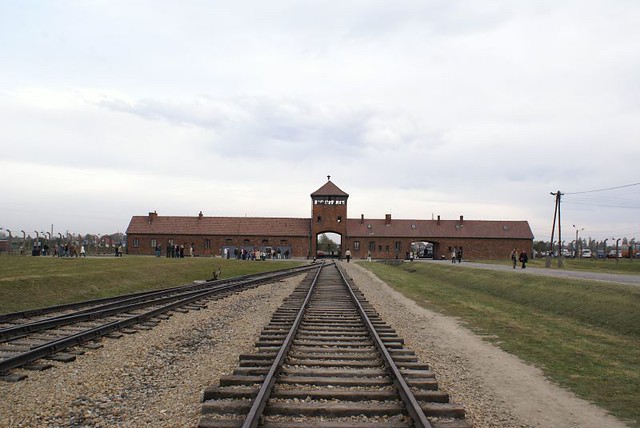
Auschwitz-Birkenau

I remember clearly how strange it felt to be standing on the infamous ramp at Birkenau having walked in beneath the gate tower; how was it I could stand freely in that place where so many had perished? I think of it like this; the gate through which I walked was open only for me, it existed only for me at that particular time. To borrow from Kulka: I could not enter by any other way, by any other gate to that place. For over a million people, their only way in – their gate – led to a death camp. For me, the gate led to a memorial. 
Filed Under: Holocaust Tagged With: Elie Wiesel, Holocaust, Otto Dov Kulka, The Gate

Dark Tourism Conference II

February 29, 2008 by Nicholas Hedges

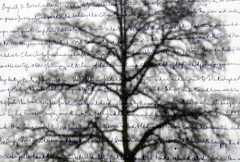
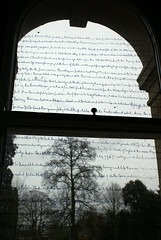
Having thought about the ideas raised after my visit to St. John’s College, I decided to try the idea out in my studio space at Brookes. I began by copying the entry on St. John’s College from the Encyclopaedia of Oxford which, using a water-based marker I then wrote out (in part) onto one of the windows. The windows are not the right shape for the project but I got a good idea of how it would look nevertheless.

Dark Tourism

Having used the text of the history of St. John’s I decided to write on another window, all that I could see as I looked through the glass, and, having done this, I considered the significance of the two.
The text delineates the surface of the glass and so defines it more readily as a barrier; the text itself is not a physical barrier but rather a conscious one. One is able to shift one’s focus from one to the other but can never see them at the same time – at least not clearly. With regards the text describing the scene beyond the window I found that this created an interesting, temporal exchange. Looking through the text one can see the world as it is ‘now’, whereas when reading the text one can only see the world (albeit in words) as it was. You have to read/view one or the other – you can’t do both.

Reading the text traps the viewer for a moment in the past and obscures the reality of the world. It follows therefore that seeing the world as it is outside hides the past. Reading the text describing the scene outside as the text was written, one can flit between past and present but can see by doing so how some things remain the same. A building for example described in the text might well be the same as when viewed through the glass, whereas someone who was walking beyond the glass when the text was written will exist in words but will not be visible to the viewer when looking (reading) between lines. Of course it might be that words used to describe a person in a somewhat vague fashion in the text may be applicable to someone beyond the glass when the viewer’s focus is shifted; for me, this is a good way to represent the continuity of life and also acts as a warning that the past can always repeat itself.

Dark Tourism

How does this work resolve with the issue of Dark Tourism? Let’s assume we are in Auschwitz-Birkenau. As tourists we are exposed to a place of trauma; we constantly flit between the past (that of which we’ve read in testimonies or seen in films and photographs) and the present (the reality of the world around us). Often we cannot make a connection between the two. We may well have read about one million dead but standing where we stand in the present, we simply cannot imagine it. However, when we do see something that fits the ‘text’ and the world around us, when we find a correlation (such as the gate tower), the past with all its trauma is brought into the present and vice-versa; there is in effect an exchange. But of course we are always safe behind the barrier; the barbed-wire-text fence doesn’t keep us in, but keeps the past at bay.

So why do we visit places of trauma? Perhaps it’s because we can always leave, we can move between past and present, yet know that we can always go home. Perhaps that’s why we go to places such as Auschwitz; because we know we can leave – leave with our existence all the brighter because of it, framed by the shadow of the past.

In the end, words (whether describing the experience of a tourist or a victim) can only take us so far. As Elie Wiesel wrote: ‘I would bring the viewer closer to the gate but not inside, because he can’t go inside, but that’s close enough.’ We can walk up to the ‘barbed-wire’ (text) fence, we can see the wires (read the text) and see through them, but we can never go any closer – not would we want to; that is, as Wiesel says, ‘close enough.’

Filed Under: Holocaust Tagged With: Dark Tourism, Elie Wiesel, Holocaust, Text Work, The Gate, WWII

© Nicholas Hedges 2024

  • Facebook
  • Instagram
  • Twitter
  • YouTube

Copyright © 2025 · Outreach Pro on Genesis Framework · WordPress · Log in