Nicholas Hedges

Art, Writing and Research

  • Amazon
  • Behance
  • Facebook
  • Instagram
  • Pinterest
  • YouTube
  • Art
    • Digital
    • Drawing
    • Grids
      • Correspondence
      • The Wall
      • The Tourist
    • Ink on paper
      • Shadow Calligraphy
    • Installation
      • Murder
      • Echo
    • Painting
    • Patterns
    • Mixed Media
    • Photographic installation
      • St. Giles Fair 1908
      • Cornmarket 1907
      • Headington Hill 1903
      • Queen Street 1897
    • Research/Sketches
    • Stitched Work
      • Missded 1
      • Missded 2
      • Missded 3
      • Missded 4
    • Text Work
  • Blogs
    • Family History
    • Goethean Observations
    • Grief
    • Light Slowed But Never Stilled
    • Lists
    • Present Empathy
    • Shadow Calligraphy
    • Trees
    • Time
    • Walking Meditations
  • Video
  • Photography
    • Pillars of Snow
    • Creatures
    • The Trees
    • Snow
    • St. Giles Fair 1908
    • Cornmarket 1907
    • Headington Hill 1903
    • Queen Street 1897
    • Travel
  • Illustration and Design
  • Music
  • Projects
    • Dissonance and Rhyme
    • Design for an Heirloom
    • Backdrops
    • Shadow Calligraphy
  • Exhibitions
    • A Line Drawn in Water
      • Artwork
    • A Line Drawn in Water (Blog)
    • Mine the Mountain 3
      • Artwork
    • Mine the Mountain 2
      • Artwork
      • The Wall
    • The Woods, Breathing
      • Artwork
    • Snow
      • Artwork
    • Echo
      • Artwork
    • Murder
      • Artwork
    • The Tourist
    • Dreamcatcher
    • Mine the Mountain
      • Artwork
      • The Tourist
    • M8
    • The Gate
    • Creatures
      • Artwork
    • Residue
      • Artwork
    • A visit to Auschwitz
      • Artwork
  • Me
    • Artist’s Statement

A Victorian Storm

February 12, 2015 by Nicholas Hedges

Whilst researching Jackson’s Oxford Journal, I randomly selected an edition from 1842 in which I found the following:
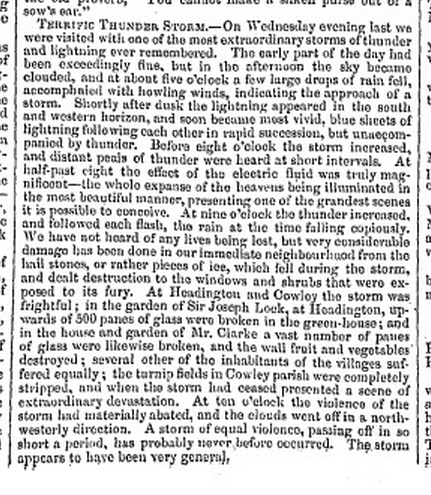
weather1842

Following on from my last blog and my interest in the perception of time in the past as time passing I’m drawn to this piece which serves, I think, to illustrate the point.

For example, the first line:

“On Wednesday evening last we were visited with one of the most extraordinary storms of thunder and lightning ever remembered.”

Firstly, the words “Wednesday evening last,” pinpoints the storm in terms that are not ‘historical’. It’s not as if we’ve read in a book, “on September 7th 1842, a great storm hit the city.” Rather the event is located in time using a phrase we might use today. It locates the storm in relation to the present – even if that present is September 10th 1842 – and at once feels fresh and contemporary.

Secondly, the phrase “ever remembered,” reminds us, if you pardon the truism, that there was a time before this time. But whereas we know that before 1842 there was 1841 and so on, what this phrase describes is living memory. Again, if we were reading about the storm in terms of its being an historical one, we would know that everyone who experienced it was dead. Reading this article, they are very much alive. Not only that, but the whole of the nineteenth century – and perhaps a part of the eighteen is alive within them too.

It isn’t only this storm which lives within these words, but many others stretching back as far as the late 1700s.

The next description is something with which we have all experienced:

“Shortly after dusk, the lightning appeared in the south and western horizon, and soon became most vivid, blue sheets of lightning following each other in rapid succession, but unaccompanied by thunder.”

That lack of thunder is the punctum of this text. (Ironically, the last time I mentioned punctum in a blog was in an entry entitled ‘Silence‘ about the death of my great-great-uncle, Jonah Rogers.) All the sounds of Victorian Oxford, on that September night in 1842 are contained in that silence. Even within our imaginations, it would seem that the the absence of one sense, heightens all the others. We can sense the approaching storm, feel its presence on the horizon. We can see the muted colours of dusk, muted further still.

Then the thunder comes – “distant peals of thunder” as the writer puts it – which increase until by 9 o’clock, it accompanies every flash. This means of course that the storm was right above the city. The rain falls hard, and with it hail – or “pieces of ice,” which damage numerous properties and the turnip fields of Cowley. By 10 o’clock it was over.

One of the names mentioned in the piece is Sir Joseph Lock whose greenhouse was damaged to the tune of 500 panes of glass. An unpopular man, he built Bury Knowle House in 1800 (the gardens of which feature in another recent blog). Here in Headington, as it was in Cowley, the storm “was frightful” and we can imagine Mr Lock looking out the window of his house as the storm lashed his garden, his face, in the dark midsts of the past, illuminated for a moment by the lightning.

Filed Under: Oxford Tagged With: Everydayness, History, Newspaper Cutting, Nowness, Old Newspapers, Oxford, Silence, Victorians

The Victorians

March 19, 2010 by Nicholas Hedges

Today I discovered, much to my delight, that The British Library has on its website a database of 19th century newspapers including 100 years of Jackson’s Oxford Journal. From 1800-1900, every issue is available and fully searchable. It goes without saying how incredibly useful this is and no sooner had I logged on than I began to search for information about my ancestors, in particular those whose activities I have described in previous blogs.

Perhaps the most notorious of my ancestors is Elijah Noon, who murdered his wife Charlotte with a sword in Oxford in 1852. I dealt with this crime at length in an installation which I put on in the cemetery where Charlotte was buried (see www.nicholashedges.co.uk/murder for more information) but soon discovered, thanks to The British Library, a whole lot more that I would never have otherwise found.

The website also allows users to download articles or pages as PDFs. Those about the murder are available here:

Murder of a Wife by her Husband (8th May 1852) 
The Recent Murder in Oxford (17th July 1852)

I’ve read these stories before, but in another article, I discovered that a nephew of Elijah’s had recently been killed in a railway railway accident at Bicester, not so far from Oxford. Elijah’s older brother, Thomas Noon,  was a builder in Oxford and a man who it seems was very much respected. Having searched for news of an accident some time around 1852, I discovered that Thomas Noon’s son, also called Thomas, who was a Corporal in the 7th Company of Royal Sappers and Miners, had been killed in a railway accident on 6th September 1851. He was buried in the same cemetery (St. Sepulchre’s in Jericho) in which his aunt would be interred less than a year later, his funeral attended by ‘an immense concourse of persons.’

Frightful Railway Accident and Loss of Life at Bicester (13th September 1851)
Notice of the Funeral of Corporal Noon (13th September 1851)

Elijah Noon served just two years in prison for the murder (or ‘manslaughter’) of his wife. In 1880 and 1882, he is listed as a prize-winning ‘bird-fancier’.

One article I was shocked to read concerned a fight which took place in Summertown on 29th December 1869. The article reads:

“Elijah Noon and George Hedges were fined, the former 7s. 9d. and the latter 10s. 6d. for being drunk and riotous at Summertown on 29th Dec. last. P.C. Culverwell substantiated the accusation and stated that the defendants were stripped to fight, when he stopped the disturbance going on.”

Petty Sessions (19th February 1870)

The Elijah Noon in this story is the son of my great-great-great-grandfather, Elijah Noon Sr. who of course we know murdered his wife. George Hedges is my great-great-grandfather who married Elijah’s sister, Amelia in 1869, not long before the fight took place. What it was all about, of course I cannot say, but it seems that both George Hedges and Elijah Noon Jr. were often in trouble.

Elijah Jr. had something of a drink problem. In September 1883, William Francis Piggott of Summertown applied for the renewal of his licence, which it seemed had been revoked on account of Elijah’s drunkeness.

Licence Renewal (8th September 1883)

Elijah of course had had a traumatic childhood having witnessed the murder of his mother at the hands of his own father. It seems his was an unhappy life, one which ended tragically when he choked to death in The Grapes, George Street in 1885 (click here to read more).

What George’s excuse was I don’t know, but he was, as I’ve said, often in trouble. In 1861, at the age of 15, he was already in attendance at the Petty Sessions in County Hall. In 1867 he was sentenced to 21 days hard labour for stealing wood and in 1888, fined for a disturbance, again in Summertown.

George had a brother called Edwin. Their father, my great-great-great-grandfather, was called Richard, and in 1858, a Richard and Edwin Hedges were convicted of an assault on a certain John Harris. Whether this Richard and Edwin are my ancestors is debatable, but it would seem to concur with George’s general behaviour, and indeed that of the family. One story, which certainly involves George and indeed, it seems, the whole family, took place in Summertown in 1899. It’s described under the rather inappropriate heading of ‘Family Squabble’ and involves William Bowerman, who married Elizabeth Hedges – George and Amelia’s daughter – in 1894.

Bowerman and Elizabeth had been drinking in the Cherwell Tavern, Sunnymede when ‘there was a quarrel’. Elizabeth went to her parents’ house where she was followed by her husband. He knocked on the door, Amelia answered and Bowerman, so it was alleged, punched her in the face. Her son Harry and her husband George went out to ‘remonstrate.’ Bowerman hit them both and Harry hit him back. The scan of the report is a little ‘wonky’ but it can be read here.

Interestingly, I have a photograph of my ancestors taken in 1899 – one assumes before the brawl.

Christening 1899

I have (tentatively in some cases) identified them as follows:

(Top, left to right) Harry Hedges, Ernest Edges (my great-grandfather), Lily Bowerman (?), William Bowerman (?), George Hedges (my great-great-grandfather), Alfred Hedges
(Middle, left to right) Flo (Alfred’s wife) (?), Amelia Hedges (my great-great-grandmother), John Lafford (my great-great-grandfather), Alice Hedges, (?), Percy Hedges
(Bottom, left to right) Richard Hedges, Margaret Hemmings (nee Hedges), Margaret V Hemmings (on knee), Alice M Hemmings (on feet), Ellen Hedges (nee Lafford) (my great-grandmother), Winifred May Hedges (on lap), Eliza Hedges (nee Villebois), Jack Hedges (on knee), Olive Hedges (at feet), Elizabeth Bowerman (nee Hedges), Eliza M Bowerman (on knee), Ernest G Bowerman (at feet).

Filed Under: Family History Tagged With: Family Hedges, Family History, Hedges, Murder, Newspaper Cutting, Victorians

© Nicholas Hedges 2024

  • Facebook
  • Instagram
  • Twitter
  • YouTube

Copyright © 2025 · Outreach Pro on Genesis Framework · WordPress · Log in