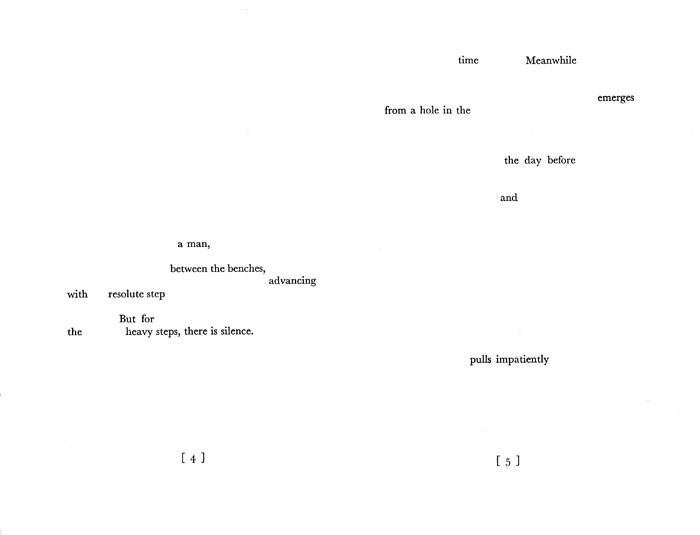
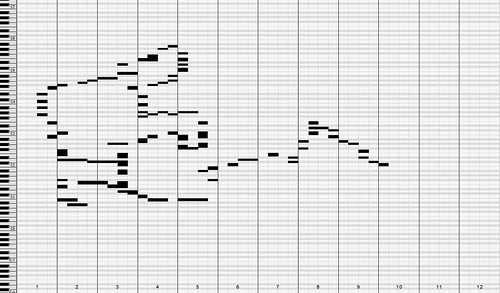
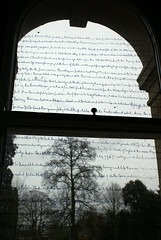
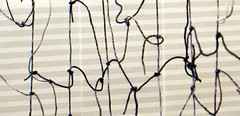
Two images from two separate projects: Heavy Water Sleep (top) and Fragment (below).
Art, Writing and Research
I’ve spent the last day or so working on a new composition which will form part of an art installation based around a fragment of mediaeval pottery… (all will be revealed in due course).
Anyway, for now, here is a very short part of what I’ve written and recorded. By the way, the vinyl crackle is important as regards the visual element.
Following up the work I have done so far with the composition based on John Gwynn’s survey, I have decided to do the same with video. This follows on from work I have done on Tour Stories/Umbilical Light, projects based on photographs taken in Oxford around the turn of the 19th/20th century.

I’m not sure yet what the images will be within each, but I think it will be something along the lines of the photographs I have been using.
Having converted the distances for each dwelling/building into seconds, I created a new track in Cubase and added markers for each of the sections, creating as a result a sonic image for the southern side of the High Street as it appeared in 1772. Below is a detail of a larger screenshot. Click on the image to open a new window with the larger image.
I’m not sure at this stage how I will proceed with the score, but I have added a note (C3) at each marker point which is at least a start. These can be seen in the two midi tracks beneath; the first track a short note, the second row the length of the interval between them. Listening – whilst it doesn’t make for an interesting sonic encounter – does at least allow the listener, in this case me, to get a sense of physical space of the street from the duration of the notes (in the case of the second midi track) or the duration between each (as in the case of the first).
As part of a new project, I’ve been looking at ways of creating musical scores. As someone who composes music but cannot read it, I find this particularly interesting inasmuch as I’m looking to write a piece of music but want to do so, not by ‘feeling’ the music as I’m playing it (as is how I normally do it), but rather, through a process of ‘writing’ it down first. The scoring should, furthermore, be linked with the theme of the piece. For example, for the music I want to write as part of my Tour Stories: Oxford Destroyed project, I’ve tried drawing remembered images of the city, blind on a piece of manuscript paper.
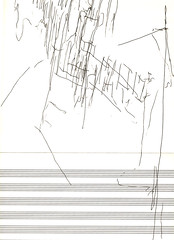
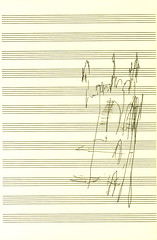
It was whilst making work for a project “The Ordinary Language of Freedom” that I became aware of how what I was doing (writing on a window) reminded me of the look of music – a link made manifest perhaps by dint of the fact I cannot read it.
And prior to this, music – and in particular, musical scores – surfaced towards the end of my work on the Dreamcatcher project, where I began to see the piles of string as unsung/unwritten notes and the net as an attempt to piece them together – to write, in effect, a score of unwritten music.
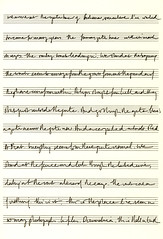
I began by considering what what one can derive from a blank sheet of manuscript paper. Comparing it with an ordinary blank sheet of paper there is clearly a difference. The staves somehow resonate, they make a sound even when there is nothing on them, and remind me of the silence one encounters in churches; pregnant with echoes (one thinks here again of Bill Viola’s discussion of sound in Chartres catherdral). When the text is written upon the staves (as above), the text becomes music, but of a different kind. The words are not words to be sung (that would be the case if the words were written beneath the staves and notes upon them) neither are they to be spoken. If the words are written beneath the staves without notation then they become neither words to be sung or spoken. They are not music. They are not simply text. They become lost.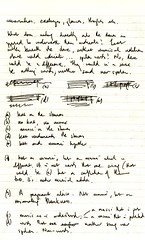
Looking at some past text work I made as part of my OVADA residency (‘Wound’), I thought of repeating the work using manuscript paper.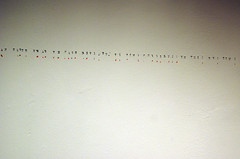
The results were particularly interesting.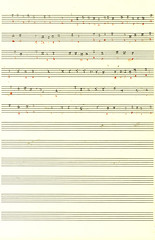
There is something about this piece which I find particularly resonant. The text is taken from a piece of writing I made following my visit to Auschwitz-Birkenau in which I describe the silence of the place; one, which like that in churches, I remember as being pregnant with the past. Looking at it closely, I was in fact reminded of mediaeval manucripts.
I need to explore these ideas more throughly, which in part I will do through a new project (6 Yards 0 Feet 6 Inches) and then, with a few ‘scores’ in hand, I will start to create some music based upon them.